
Article

Long-Range Topological Objects in Systems with Asymmetric Potentials
by
Jorge A. González
1,
Salvador Jiménez
2,*,
Alberto J. Bellorín
3 and
Leonardo Reyes
4,5
1
Department of Physics, Florida International University, Miami, FL 33199, USA
2
Departamento de Matemática Aplicada a las TIC, ETSI Telecomunicación, Universidad Politécnica de Madrid, 28040 Madrid, Spain
3
Escuela de Física, Facultad de Ciencias, Universidad Central de Venezuela, A.P. 47586, Caracas 1041-A, Venezuela
4
Centro de Física, Instituto Venezolano de Investigaciones Científicas, A.P. 21827, Caracas 1020-A, Venezuela
5
Departamento de Física, Universidad Simón Bolívar, A.P. 89000, Caracas 1080-A, Venezuela
*
Author to whom correspondence should be addressed.
Mod. Math. Phys. 2026, 2(2), 5; https://doi.org/10.3390/mmphys2020005
Submission received: 11 October 2025 / Revised: 24 March 2026 / Accepted: 13 April 2026 / Published: 7 May 2026

Abstract

Long-range topological objects can exist in many physical systems, and they can tunnel through very wide barriers. Thus, the propagation of long-range kink-like objects through disordered media can be extremely enhanced. When the potential is asymmetric, the long-range kink-like excitations can enter a regime of superpropagation, where, essentially, they can move through almost any disordered medium. We believe these phenomena can find applications in macroscopic quantum technologies (including robust qubits), energy devices for energy harvesting and storage, and high- T c superconductivity in hydrides. We expect that many of these results can be generalized to other topological objects, e.g., fluxons, domain walls, skyrmions, topological defects, stripes, textures, dislocations in crystals, strings, monopoles, instantons, vortices, and spiral waves.

1. Introduction

Recently, there has been a lot of interest in long-range field configurations (see [1,2,3,4,5]). Since González and Estrada-Sarlabous investigated the behavior of long-range forces between kink-like and antikink-like objects [3], the number of papers dedicated to these objects has been increasing exponentially (see [1,4,5,6,7,8,9,10,11,12,13,14,15,16,17,18,19,20,21,22,23,24,25,26,27,28,29,30,31,32,33,34,35]).
In the present paper, we investigate the dynamics of long-range topological objects in the presence of inhomogeneous external fields and impurities when the potential U ( ϕ ) is asymmetric. We show that the motion of long-range topological objects in asymmetric potentials ( U ( ϕ ) ) can show ballistic behavior in media with almost any kind of disorder.
Topological objects play a significant role in almost all areas of physics (see [36,37,38,39]). They are universal patterns of nature, appearing in condensed matter physics, cosmology and elementary particle physics. Some examples of topological objects are the following: kink-like objects, fluxons, domain walls, skyrmions, topological defects, stripes, textures, dislocations in crystals, strings, monopoles, instantons, vortices, and spiral waves. Their topological nature provides some stability against perturbations.
Soliton-like objects are particle-like mobile excitations that are ubiquitous in physical systems, from hydrodynamics to particle physics and the universe. They can transport energy, charge, spin and/or information (see [40,41,42,43]). The escape of an object from a potential well is of near universal importance [44,45,46,47,48]. The process can be classical (e.g., noise-assisted escape over a barrier) or quantum (e.g., tunneling through the barrier). Some phenomena and applications where this process can be observed are the following: α -decay radioactivity, chemical reactions, tunnel diode, tunnel field-effect transistors, scanning microscope, flash memory, quantum computing, quantum biology, nuclear fusion, etc.
What happens when the object confined inside this potential well is a long-range topological object? All the well-known kink-like objects (e.g., ϕ 4 theory, and sine-Gordon) interact with short-range forces. This paper is devoted to the motion of long-range topological objects in disordered media when the potential U ( ϕ ) is asymmetric.
In a system with an asymmetric potential, the long-range topological object can enter a regime of superpropagation, where it can escape almost every potential well. In these systems, soliton-like objects can move through a disordered system even in the absence of an external field. Similar phenomena can occur in systems with negative resistance.

2. Equation of Motion

Let us consider the following nonlinear Klein–Gordon equations:
2 ϕ t 2 2 ϕ x 2 + d U ( ϕ ) d ϕ = 0 ,
2 ϕ t 2 2 ϕ x 2 + d U ( ϕ ) d ϕ = F ( x ) ,
2 ϕ t 2 2 ϕ x 2 + 1 + g ( x ) d U ( ϕ ) d ϕ = 0 ,
2 ϕ t 2 + b ϕ t 2 ϕ x 2 + 1 + g ( x ) d U ( ϕ ) d ϕ = F ( x ) ,
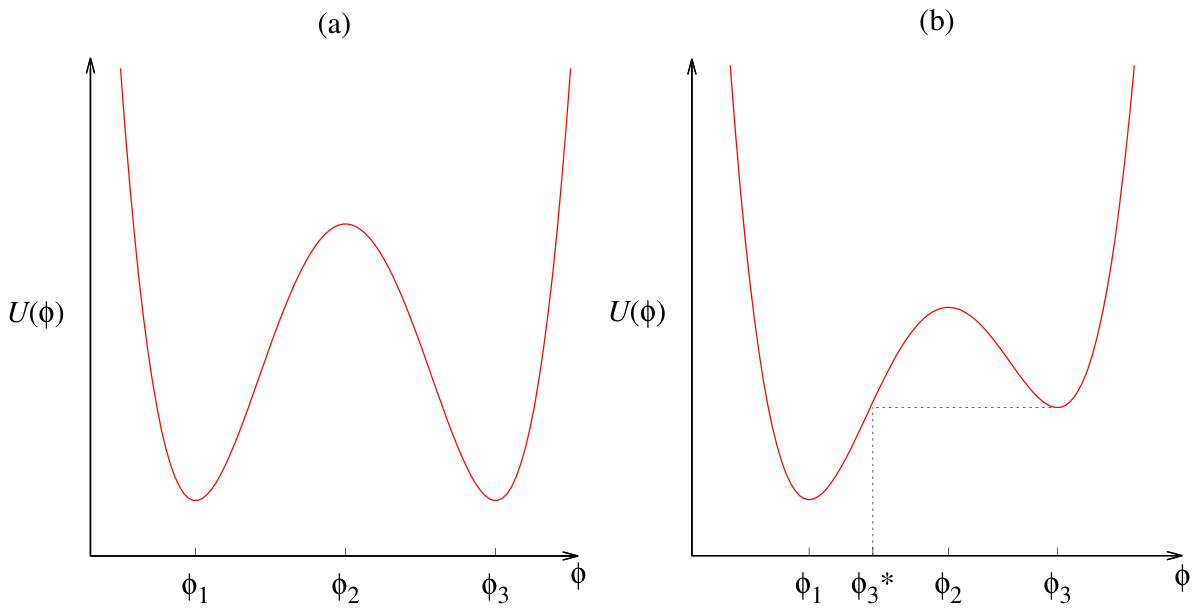
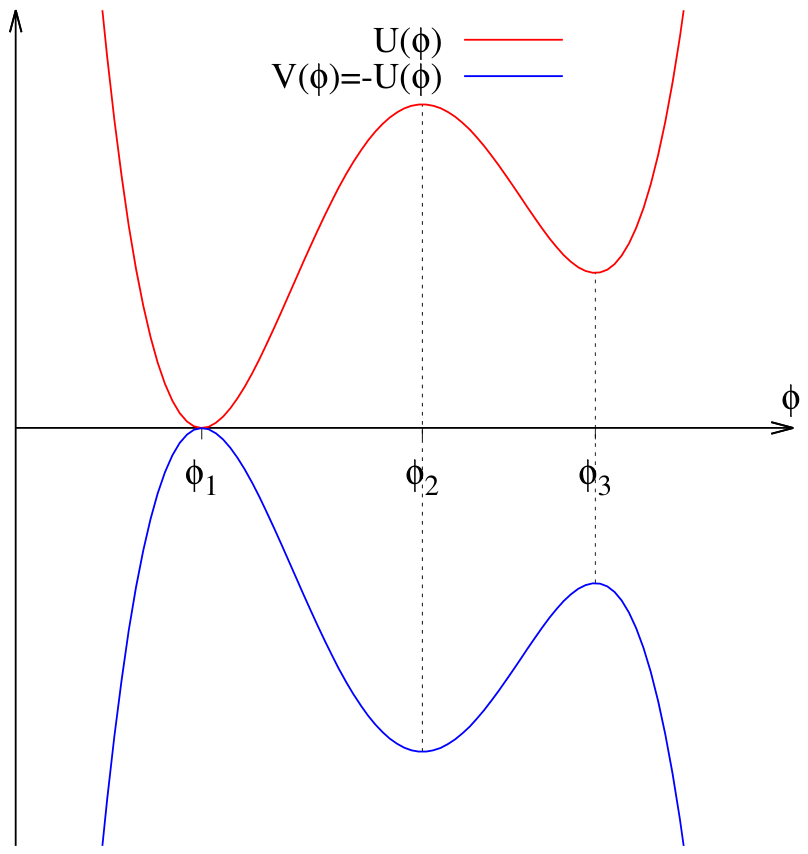
where U ( ϕ ) is an analytical function of ϕ with at least two local minima (at ϕ 1 and ϕ 3 ) and a local maximum (at ϕ 2 ) such that ϕ 1 < ϕ 2 < ϕ 3 (see Figure 1).
We write Equations (1)–(4) in such a way that we can introduce important concepts and explain the physical meaning of perturbations and parameters in a simple manner.
Originally, soliton solutions were defined only for integrable systems. An integrable soliton would move always with constant velocity and without any change in shape. And we should expect only elastic collisions between a soliton and an antisoliton.
Let us discuss a concrete example. Only unperturbed Equation (1) could be integrable for some very particular potentials U ( ϕ ) . For instance, when U ( ϕ ) = 1 cos ( ϕ ) , we get the famous sine-Gordon equation
2 ϕ t 2 2 ϕ x 2 + sin ( ϕ ) = 0 .
This equation has soliton solutions
ϕ ( x , t ) = 4 arctan exp x v t x 0 1 v 2 ,
which behave as a classical particle. The energy density of solution (6) at t = 0 has a maximum at the center of the soliton ( x 0 ) and decays exponentially in both directions as | x x 0 | increases.
If we perturb Equation (1) with external fields (e.g., F ( x ) ) or parametric impurities (e.g., g ( x ) ) or dissipative terms (e.g., b ϕ / t ), then even the sine-Gordon equation becomes non-integrable. Let us consider what happens in a real system, when a soliton is under these perturbations.
Imagine that we have a real object described by the integrable sine-Gordon Equation (5). Then we apply a small external constant force F ( x ) = F 0 < 0 :
2 ϕ t 2 2 ϕ x 2 + sin ( ϕ ) = F 0 .
This equation is not integrable anymore. Thus, it does not have soliton solutions. But the real particle-like object that was there when F 0 = 0 does not disappear. If the object was at rest, it will start moving with acceleration. If it was moving with a constant velocity, the velocity now will change. Some change in the shape is also possible. Alternatively, we may consider the effect of a damping ( b > 0 ) in the system:
2 ϕ t 2 + b ϕ t 2 ϕ x 2 + sin ( ϕ ) = 0 .
Now, if the object was initially moving with a constant velocity, as in the solution of Equation (6), its velocity will be decreasing until the object is completely at rest. Equation (8) is not integrable. However a particle-like object still exists. Real physical systems, subject to realistic conditions, are not described by integrable equations.
Following the example of our previous paper [49], we will call these particle-like objects soliton-like solutions (also, kink-like solutions). In this way, we avoid misunderstandings with the mathematical definition of a soliton.
The nonlinear Klein–Gordon Equation (1) can be derived from the Lagrangian density
L = 1 2 ϕ t 2 1 2 ϕ x 2 U ( ϕ ) .
The associated Hamiltonian density is
H = 1 2 Π 2 + 1 2 ϕ x 2 + U ( ϕ ) ,
where Π = L ϕ t is the momentum. The potential part in the energy of the field is U ( ϕ ) . The famous nonlinear terms in the sine-Gordon model and the ϕ 4 model are obtained using, respectively, U ( ϕ ) = 1 cos ( ϕ ) and U ( ϕ ) = 1 8 ( ϕ 2 1 ) 2 , in Equation (1). In the famous Landau theory of phase transitions, U ( ϕ ) is the potential part of the free energy of the system.
In Equation (2), F ( x ) plays the role of an external inhomogeneous field. But it can also describe the interaction of the charge carriers with the positive ions in the lattice of a crystal. That is, using F ( x ) we can include the fact that the system is inhomogeneous. We will see, later, that the zeroes of F ( x ) are candidates for equilibrium positions for the kink-like objects. In Equation (3), g ( x ) can model parametric impurities. Unlike F ( x ) , it is the local maxima and local minima of g ( x ) which can be the equilibrium positions for the kink-like object.
The Hamiltonian density for Equation (2) is given by
H = 1 2 Π 2 + 1 2 ϕ x 2 + U ( ϕ ) F ( x ) ϕ .
This equation will be important later. Equations (1)–(3) are particular cases of Equation (4), where all the perturbations and inhomogeneities are considered.

3. Physical Implementation

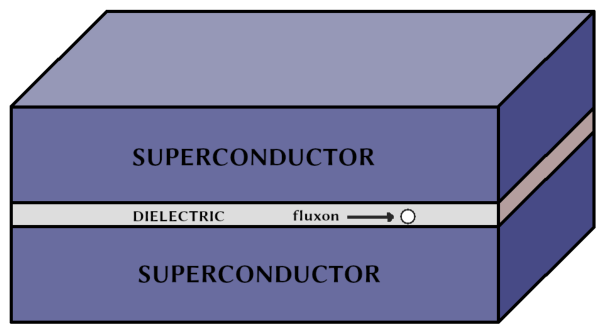
Many of the phenomena discussed in the present paper can be realized in a physical device known as a long Josephson junction. A Josephson junction consists of two superconductors coupled by a weak link. The weak link can be made of a thin insulating barrier or a normal non-superconducting metal (see Figure 2).
The dynamics of a long Josephson junction can be described by the so-called perturbed sine-Gordon equation
1 ω p 2 2 ϕ t 2 λ J 2 2 ϕ x 2 + 1 ω c ϕ t + sin ( ϕ ) = j / j c ,
where λ J is the Josephson penetration depth, ω p is the Josephson plasma frequency, ω c is the characteristic frequency, j / j c is the bias current density j normalized to the critical current density j c , and ϕ is the difference in the phases of the superconducting wave functions for each one of the electrodes.
Usually we consider normalized sine-Gordon equations
2 ϕ t 2 + b ϕ t 2 ϕ x 2 + sin ( ϕ ) = F ( x ) ,
where the spatial coordinate is normalized to the Josephson penetration depth λ J , time is normalized to the inverse plasma frequency 1 / ω p , b is the dimensionless damping coefficient, and F = j / j c is the normalized bias current. The perturbation F ( x ) can have several zeroes, local maxima and local minima when the system is built with current dipoles [50,51].
The soliton-like solution to Equation (13) describes a fluxon. A fluxon is a particle-like excitation that carries exactly one magnetic flux quantum ( ϕ 0 = h / 2 e ). Josephson junctions are perfect machines to study soliton-like phenomena. Experimental scientists in laboratories all over the world routinely observe soliton-like dynamics under different physical conditions. We have predicted that using stacks of ultra-narrow Josephson junctions, a physical system can be created where the coherent structures can become long-range soliton-like objects [20]. If we construct arrays of serially coupled Josephson junctions, we can observe charged soliton-like objects. Let us consider a ring-shaped array of serially coupled Josephson junctions. The existence of an external magnetic flux applied through the center of the ring-shaped array leads to an effect that is equivalent to the presence of a finite difference Δ = U ( ϕ 1 ) U ( ϕ 3 ) 0 [52,53]. The effect of a non-zero Δ on the kink-like object will be discussed in Section 9.

4. Long-Range Topological Objects

González and Estrada-Sarlabous [3] investigated the behavior of the interaction forces between a kink-like object and an antikink-like object in general Klein–Gordon equations for the first time. Under certain conditions, these forces decay as a power law. We will call these solutions long-range kink-like objects. Right now, there is a whole movement dedicated to solitons with power-law tails [1,2,4,5,6,7,8,9,10,11,12,13,14,15,16,17,18,19,20,21,22,23,24,25,26,27,28,54,55,56,57,58,59,60,61,62,63,64,65,66,67,68,69,70].
The self-sustained motion of topological long-range solitons, both in systems with negative resistance and in materials with asymmetric potentials, can help develop new energy technologies and new methods for energy harvesting and energy storage.
We will consider the dynamics of kink-like objects in perturbed Klein–Gordon equations
2 ϕ t 2 2 ϕ x 2 + d U ( ϕ ) d ϕ = F ( x )
and
2 ϕ t 2 2 ϕ x 2 + [ 1 + g ( x ) ] d U ( ϕ ) d ϕ = F ( x ) .
We will also study fluxons in Josephson junctions with nonlocal electrodynamics [71,72,73,74], solitary waves in systems with Kac–Baker long-range interaction potentials [75,76,77,78,79,80,81,82], and open states in DNA torsional dynamics [11,83].
In Equations (14) and (15), the potential must have at least two minima (at ϕ 1 and ϕ 3 ) and a maximum (at ϕ 2 ) such that ϕ 1 < ϕ 2 < ϕ 3 (see Figure 1) for the existence of kink-like and antikink-like objects.
Let the degree for the first term different from zero in the Taylor expansion of U ( ϕ ) in the neighborhood of the minima be 2 n . When n = 1 , for large values of x, the solution ϕ ( x ) decays exponentially as ϕ ϕ 1 , 3 . When n > 1 , the solution satisfies the relation ϕ ϕ j x k , where k = 1 / ( 1 n ) and ϕ j are the location of the minima [3]. Therefore, the solutions when n > 1 will be long-range kink-like excitations.
González and Estrada-Sarlabous [3] have shown that the interaction forces, F in ( d ) , between solitons, where d is the distance between their centers of mass, satisfy the following relations: d = O ln | F in | , if n = 1 , and d = O F in ( 1 n ) / ( 2 n ) , if n 2 .
In potentials where n > 1 , the interaction force decreases as a power law: F in d 2 n / ( 1 n ) . As n , F in d 2 .
We consider that a soliton-like object is long-range when | ϕ ϕ 1 , 3 | 1 / x α , because this leads to long-range interactions. Most papers that belong to the long-range movement take this definition as well [1,2,3,4,5,6,7,8,9,10,11,12,13].
For the equations studied in this paper, when n = 1 , | ϕ ϕ 1 , 3 | decays exponentially, so ϕ 4 and sine-Gordon kink-like objects are short range. For n > 1 , | ϕ ϕ 1 , 3 | decays as a power law. Hence, these are long-range kink-like objects. The larger n is, the more long range the solutions.
We now introduce the concept of solitonic extent ( L SE ). Let the soliton-like object’s center of mass be at point x = 0 . Then let L SE / 2 be the point in x where ϕ ( L SE / 2 ) = 0.99 V v , with V v the “vacuum value”. For instance, for ϕ 4 theory, V v = 1 , whereas for sine-Gordon, V v = 2 π . The solitonic extent measures how far the source of a field must be from the kink-like object’s center of mass so that the soliton-like object does not feel the interaction in any way.
Let us compare different kinds of soliton-like objects. The solitonic extent of the ϕ 4 -kink would be L SE ( n = 1 ) 5 , whereas for long-range kink-like objects L SE ( n = 2 ) 126 , L SE ( n = 9 ) 5 × 10 19 , L SE ( n = 21 ) 2 × 10 36 . Note that the solitonic radius or size and the solitonic extent can be of a completely different order of magnitude. For instance, the solitonic size and extent are of the same order of magnitude for the ϕ 4 -kink. Meanwhile, the solitonic size of a long-range soliton-like object can be L SE 10 , and the solitonic extent can be several orders of magnitude larger.
In general, as n is increased, the solitonic extent increases. The paragraph above about the solitonic extent is important because of the following physical effects. Normally quantum tunneling of elementary particles occur in systems where the barrier width is of the order of 2–3 nm. However, recently there have been some discussions on experimental results (see [84]), where tunneling has been observed in systems with barrier width of the order of several millimeters or even a couple of centimeters. Thus, the results of this paper could indicate that the tunneling can be enhanced by several orders of magnitude.
Nonlocal Josephson electrodynamics can lead to the existence of long-range solitons [20,68,71,73,85]. We believe that in stacks of ultra-narrow Josephson junctions, the strong magnetic interaction between the junctions will lead to the Ivanchenko’s nonlocal electrodynamics [71]. In this case, the interaction energy between the Josephson vortices will behave as V in 1 / d . This means that these topological objects will behave as our long-range soliton-like objects when n 1 .
In condensed matter physics, where the lattice possesses Kac–Baker interactions, long-range soliton-like objects can exist. Using results from references [75,76,77,78,79,80,81,82], we conclude that the solitonic extent goes to infinity as the parameter r (that defines the range of the interaction) is increased: as r 1 , L SE 2 ( r ) 1 / ( 1 r 2 ) 2 .
Our investigation of solitons in the DNA torsional dynamics [11,13] conducts to a power-law behavior of the solutions when x ± , namely, | ϕ ϕ j | 1 / x .
Nonlocal, Kac–Baker, and DNA solitons will behave as long-range kink-like objects in all their dynamical behavior in different experimental situations: the interactions between the kink-like objects, the interaction of a kink-like object with external fields, and the kink-like object propagation in disordered media.

5. Solitonic Tunneling

Solitonic tunneling was discovered in the perturbed ϕ 4 -theory [86] but it can occur in any system. The important result is that a soliton-like object is a complex extended object [49,86,87,88,89].
Consider Equations (14) or (15) with perturbations F ( x ) or g ( x ) that make the system inhomogeneous. Suppose there is a kink-like object moving in a landscape potential created by the perturbations F ( x ) or g ( x ) . They can create potential wells and barriers for the motion of the kink-like object [90].
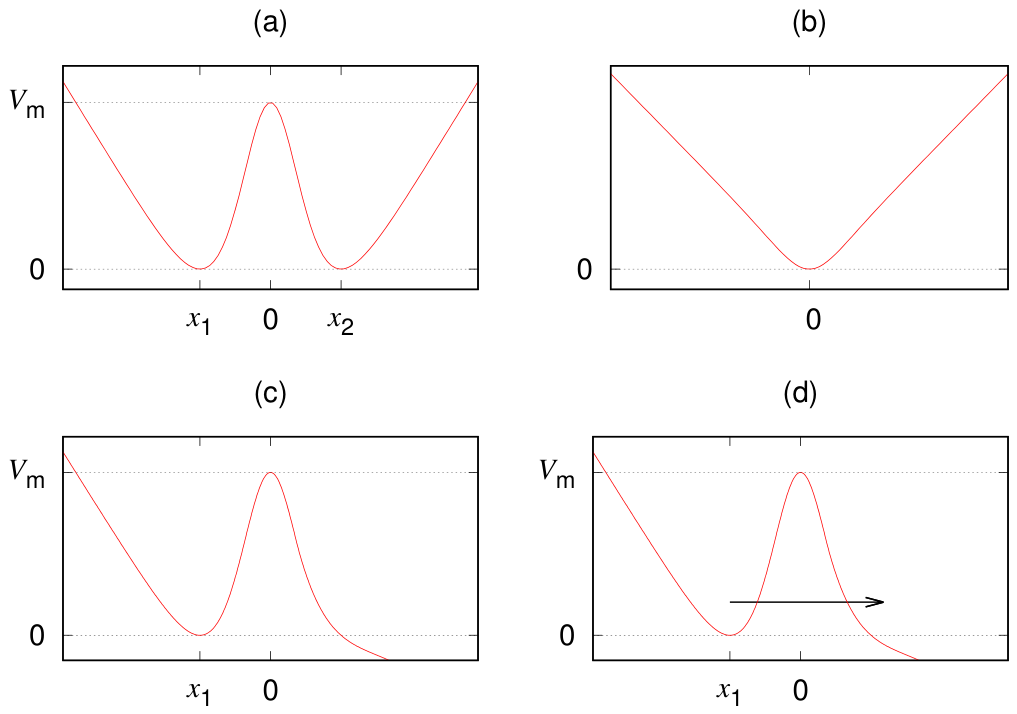
For example, when F ( x ) has three zeros, there is the possibility that the kink-like wave will be moving in a bistable potential V ( x ) , such that V ( x ) = F ( x ) , as the one shown in Figure 3a.
Suppose there is a stationary solution ϕ k ( x ) of Equation (14) in such a way that the center of mass of the kink-like object is at point x = 0 . In order to know whether the point x = 0 is a stable equilibrium for the kink-like object or not, we must solve the complete stability problem using the exact solution ϕ k ( x ) to the exact nonlinear partial differential Equations (14) or (15) [49,86,87,91].
The complete spectral problem is
L ^ f = Γ f ,
where
L ^ = 2 x 2 + d 2 U ( ϕ ) d ϕ 2 | ϕ = ϕ k ,
and Γ = λ 2 . The translational invariance is lost in Equations (14) and (15). But the nodeless mode, f 0 ϕ k ( x ) / x , is still the translational mode.
The eigenvalue Γ 0 = λ 2 0 , corresponding to the translational mode (the Goldstone mode) is not zero anymore, but it will decide the stability of the equilibrium position [49,86,87,90,91].
There are situations when there are three equilibrium positions for the solitonic center of mass as in Figure 3a. Then the kink-like object can be trapped near point x = x 1 . In that case, the kink-like object will not move to the “right”.
Under certain conditions, despite the fact that there are perturbations F ( x ) and g ( x ) in Equations (14) and (15) creating obstacles for the motion of the kink-like object, the kink-like object does not feel the barrier as in Figure 3a. For the kink-like object, the potential V ( x ) will be like that shown in Figure 3b. Instead of three equilibrium positions there is only one at x = 0 , and it is stable.
Suppose now that we construct a potential V ( x ) similar to that shown in Figure 3a with the difference that at point x = x 2 there is no local minimum. The function V ( x ) will continue decreasing monotonically (see Figure 3c). If the conditions for the stability of point x = 0 are satisfied, then the following phenomenon will occur. A kink-like object that is at the bottom of the left potential well (at point x = x 1 ) will move to the “right”. It will cross the barrier, and it will escape the potential well despite the fact that its center of mass has less energy than the height of the barrier (see Figure 3c,d). We obtain similar results for Equation (15), where the impurities are introduced parametrically [86,90]. The role played by the zeros of F ( x ) in Equation (14) is now played by the local maxima and minima of g ( x ) .

6. Long-Range Solitonic Tunneling

The condition for solitonic tunneling was obtained in [20] and is
E p ( x 0 ) > E p ( x z ) ,
where
E p ( x ) = F ( y ) ϕ k ( y x ) d y ,
x 0 is the initial position of the kink-like object, x z is any point in the interval x 0 < x z < x 2 , and ϕ k is the stationary kink-like object profile.
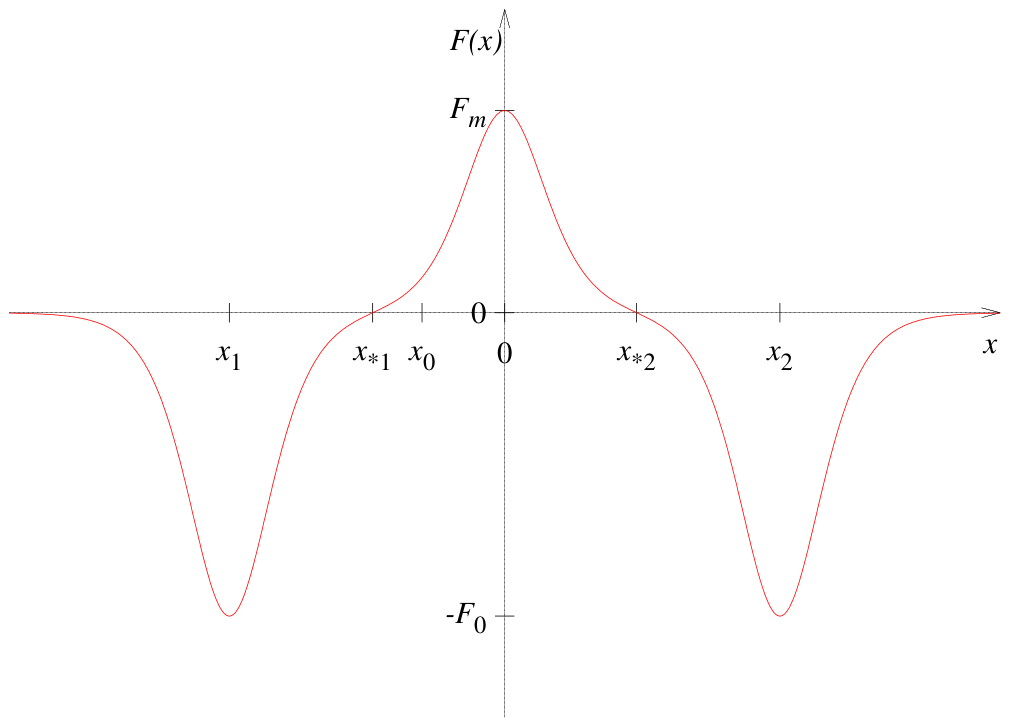
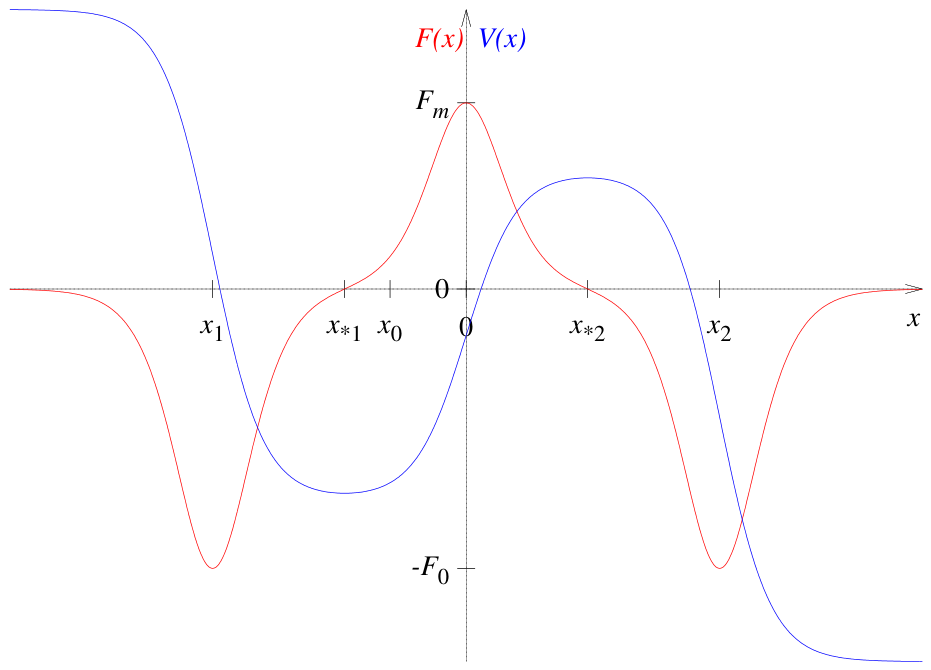
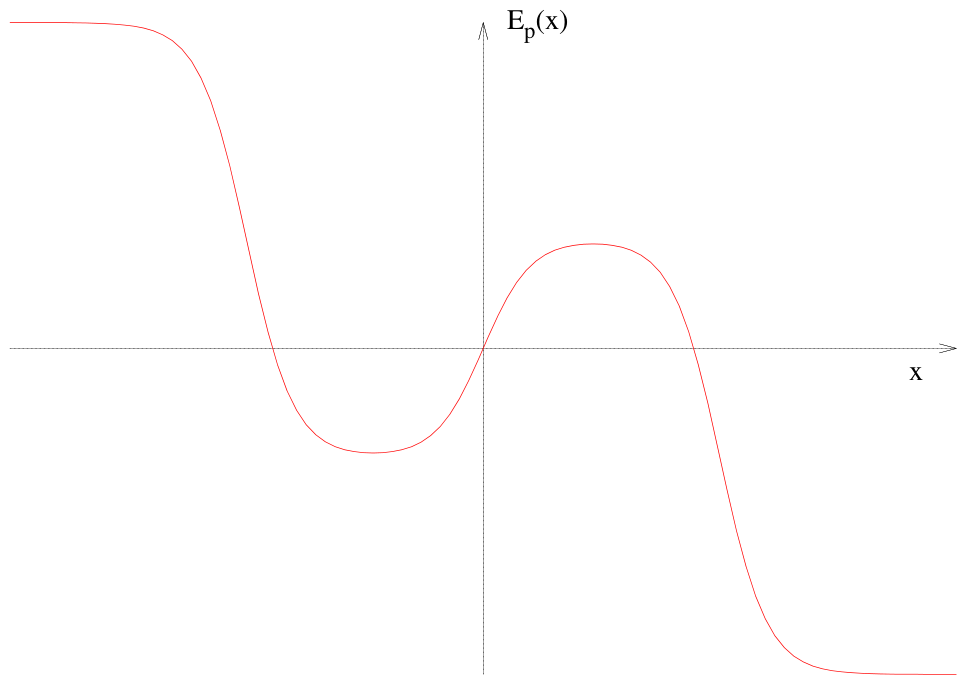
The typical shape of F ( x ) for studying soliton-like tunneling is shown in Figure 4.
For normal solitons d ϕ k ( x ) / d x is an exponentially localized function. Normal solitons cannot penetrate wide barriers. Normal solitonic tunneling can occur only when the width of the barrier is less than the solitonic radius. On the other hand, long-range soliton-like solutions can tunnel through very wide barriers. A long-range kink-like object can interact with another soliton-like excitation even if they are not close. In the same way, a long-range kink-like object can interact with “negative zones” of F ( x ) even if the field that creates such zones is exponentially localized and the negative extrema are far from the solitonic center of mass. The interaction of a long-range soliton-like object with the “negative zones” of F ( x ) is crucial for understanding tunneling through very wide barriers [20]. The long-range kink-like object can “feel” these zones even if they are far away from the potential well. For instance, there is always a “negative zone” of F ( x ) immediately behind the barrier. If the barrier is very wide, a conventional soliton-like object will not interact with this zone. However, a long-range kink-like object will use its interaction with the negative zones that are close to the points x 1 and x 2 (see Figure 4) in order to tunnel through the barrier.
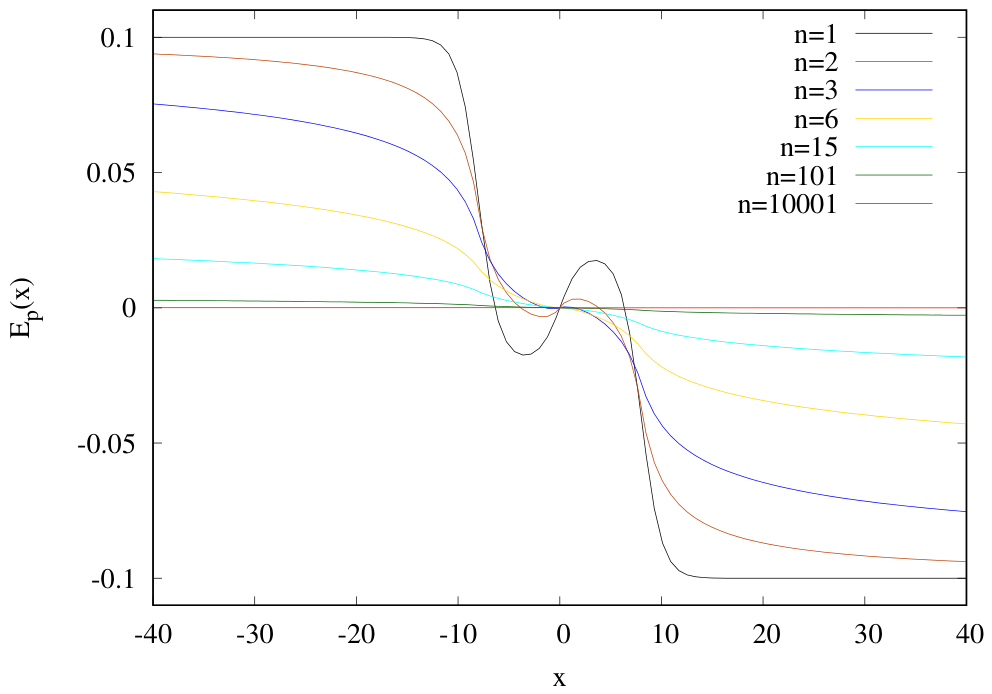
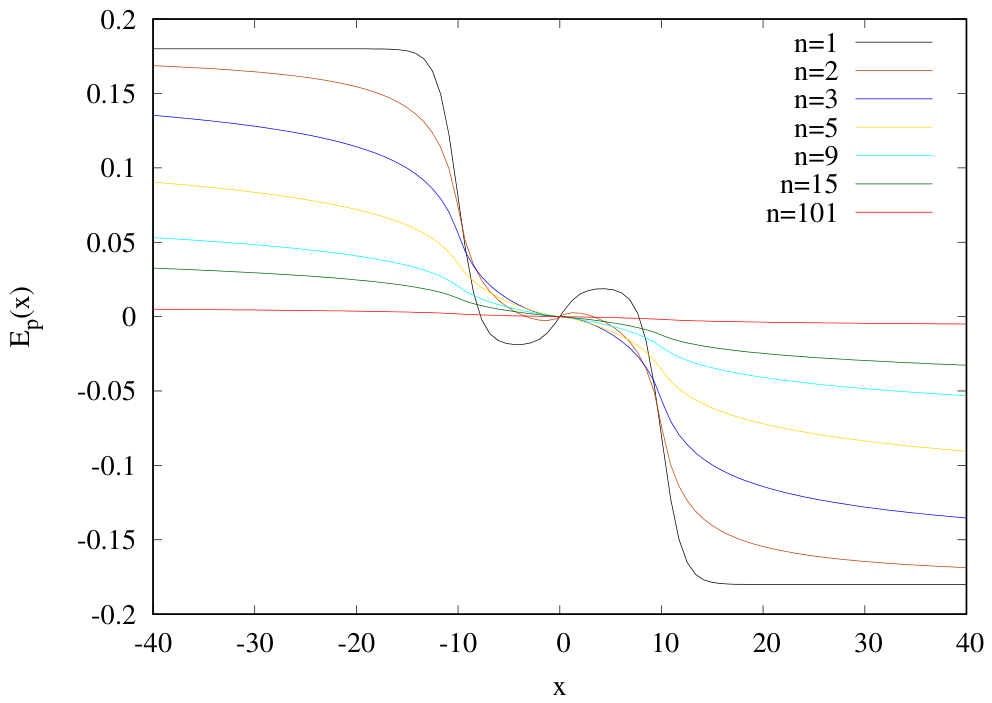
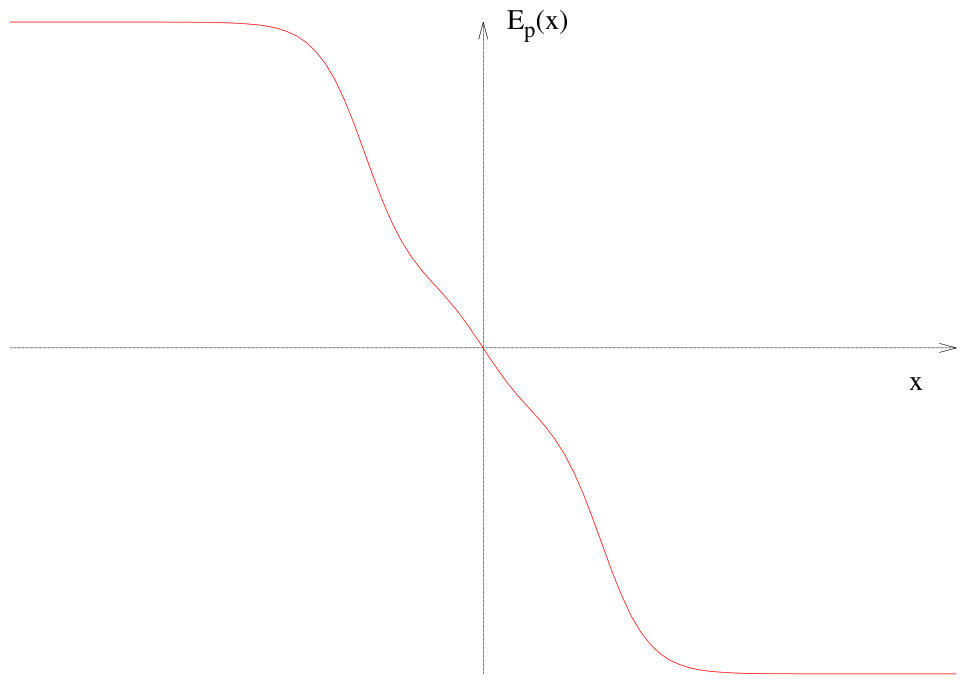
Our findings show that a long-range soliton-like object of arbitrarily low energy can penetrate any finite barrier if the solitonic extent is sufficiently long. Figure 5 and Figure 6 show the transformation of the quantity E p ( x ) as n is increased. The width of the barrier is shortened and the height is lowered. The barrier will eventually disappear. The effect that this phenomenon can cause to the motion of a particle in a medium with obstacles can be compared only to resonant quantum tunneling. However, in resonant tunneling, the particle’s energy must match some resonant value. Moreover, the smallest impurity in the sample would spoil the magic. In the present phenomenon, there is the possibility that the particle will not feel the impurities at all.
For solitonic tunneling, the width of the potential well is as important as the width of the barrier (see Figure 7).
The interaction of the solitary wave with the “walls” of the potential well can be decisive for the kink-like object’s fate. Moreover, the long-range kink-like object can interact with F ( x ) even when x x 1 and x x 2 .

7. Propagation of Soliton-like Excitations in Disordered Media

In order to describe the motion of solitary waves in disordered media, we use the following functions for F ( x ) :
F ( x ) = i = 1 N A i sech 2 B i [ x x i ] ,
where A i , B i , x i can be random numbers generated by the equations developed in [92]. Consider that the tunneling condition (18) is satisfied for every set of one minimum – one maximum – one minimum of F ( x ) in the disordered system (20). In that case, the long-range kink-like object will move through the whole disordered array as a free particle.
We perform numerical simulations using Equations (2) and (4) with the potentials
U ( ϕ ) = 1 8 n ϕ 2 1 2 n ,
and
U ( ϕ ) = 2 n sin 2 n ϕ 2 .
All simulations are done with and without damping ( b = 0 or b 0 ). These phenomena are robust against the interaction with the environment. The condition (18) has been confirmed in all the computer experiments.

8. The Quantum Long-Range Soliton-like Object

We believe that the quantum tunneling of a kink-like object will be enhanced if the system parameters are changed so that it will support long-range solitons. First, the long-range soliton tunneling phenomenon would shorten the wall and would reduce the height of the barrier. In some situations, the long-range soliton tunneling phenomenon can suppress the barrier altogether. Second, the kink-like object mass will be smaller. Using the general formula for the kink-like object mass,
m k = ϕ 1 ϕ 3 2 U ( ϕ ) d ϕ ,
for the potential (21), we obtain
m k ( n ) = 1 2 n 2 2 n + 1 ( n ! ) 2 ( 2 n + 1 ) ! ,
where n = 1 , 2 , 3 , The kink-like object mass decreases as n increases. In Figure 5, we can see that, as n is increased, the width of the barrier is shortened and its height is reduced.
Equation (23) is the well-known formula for the mass of a kink-like object (see [20]) in field theories with a Lagrangian density like this,
L = 1 2 c 2 ϕ t 2 1 2 ϕ x 2 U ( ϕ ) .
A simple calculation with function (24) yields that
m k ( n + 1 ) m k ( n ) < 1
for any n 1 . This implies that the sequence m k ( n ) is a decreasing sequence. Indeed, here are some elements of the sequence m k ( n ) for the potential (21):
{ m k ( n ) } = { 0.66666 , 0.377124 , 0.263932 , 0.203175 , 0.165264 , }
The same is true for the potential (22) (see numerical values for m k ( n ) in a table in [20].) Hence, the mass of the topological object decreases as n increases. This is important for quantum phenomena and for comparison with experiments in Section 10. Therefore, this effect should enhance quantum tunneling.

9. Analysis of the Equation of Motion

Let us consider the equation
1 c 2 2 ϕ t 2 2 ϕ x 2 + b ϕ t + d U ( ϕ ) d ϕ = 0 ,
where U ( ϕ ) is our well-known potential with two minima (see Figure 1), b is the damping coefficient, and we assume that U ( ϕ 1 ) = 0 . This last condition can be achieved for any potential adding a constant to U ( ϕ ) in the Lagrangian, which will not affect the equation of motion. The constant c is the maximum velocity in the system. Equation (27) supports kink-like solutions because U ( ϕ ) has two minima (as mentioned in Section 2).
We will start the analysis with the traveling wave solutions of Equation (27) that have constant velocity v and a constant shape of the wave. It is convenient to introduce the variable
z = x v t 1 ( v / c ) 2 .
The partial differential Equation (27) can now be rewritten in the form of an ordinary differential equation,
d 2 ϕ ( z ) d z 2 + γ d ϕ ( z ) d z = d V ( ϕ ) d ϕ ,
where
γ = b v 1 ( v / c ) 2 , V ( ϕ ) = U ( ϕ ) .
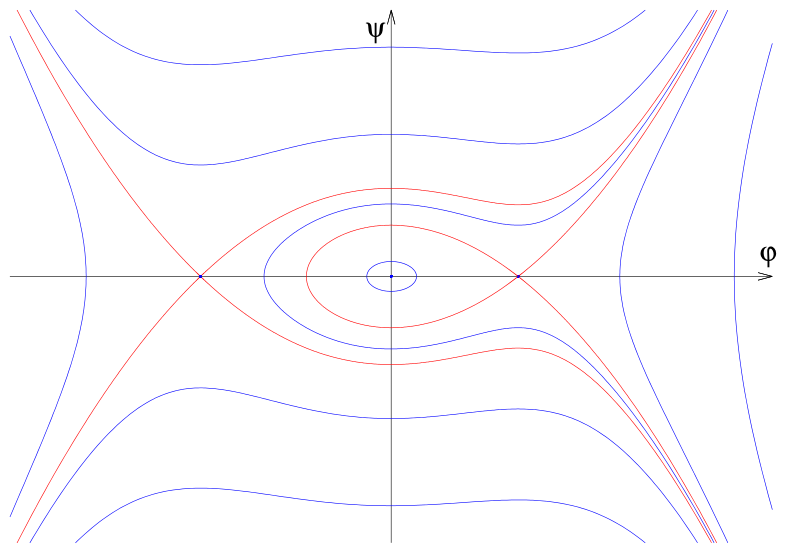
Equation (28) can be treated as a Newtonian equation of motion for a fictitious unit-mass point particle moving in the inverted potential V ( ϕ ) (see Figure 8). The position of the fictitious particle would be ϕ and z plays the role of the “time”.
The “mechanical” energy of the fictitious particle is very important for the description of the possible traveling solitary waves.
We are interested in kink-like solutions with the property that
lim z ϕ ( z ) = ϕ 1 and lim z + ϕ ( z ) = ϕ 3 .
This means that the fictitious particle moves between the local maximum at ϕ = ϕ 1 and the local maximum at ϕ = ϕ 3 . An analogous research study can be done investigating the following autonomous dynamical system
d ϕ ( z ) d z = ψ ( z ) ,
d ψ ( z ) d z = γ ψ ( z ) d V ( ϕ ) d ϕ .
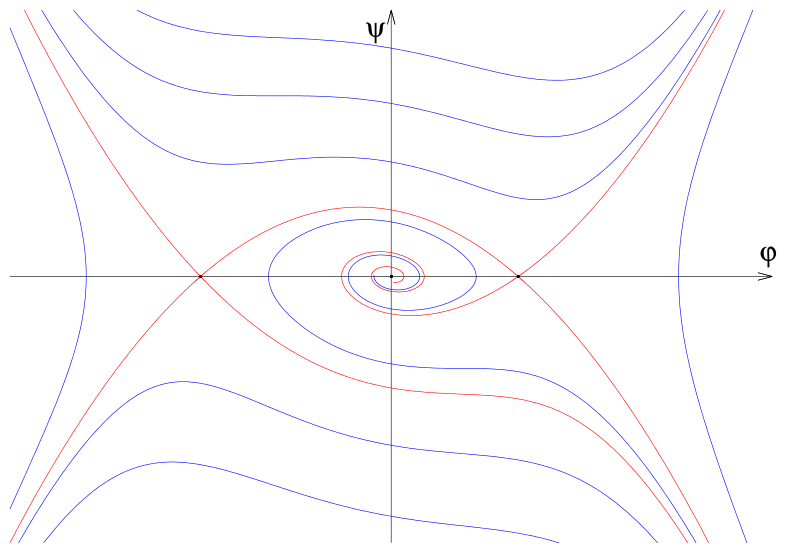
The kink-like solution corresponds to a heteroclinical orbit that connects the saddle points at ( ϕ 1 , 0 ) and ( ϕ 3 , 0 ) , as represented in Figure 9. See a discussion of all the possible traveling wave solutions of Equation (27) in [3,93].
Note that not all solutions of the partial differential Equation (27) can be expressed using the solutions of Equation (28) and the system (31) and (32). And the physics of the real system is much more dynamical than these traveling wave solitary objects. We will explain how these pieces fit in the big picture of the global dynamics. Note, also, that the heteroclinic saddle connection shown in Figure 9 does not always exist.
Let us discuss some remarks. When b = 0 and Δ U ( ϕ 1 ) U ( ϕ 3 ) = 0 , the kink-like object can move with any constant velocity 0 | v | 1 . When b = 0 and Δ 0 , the heteroclinic orbit does not exist (see Figure 10).
This does not mean that the kink-like object suddenly disappears. As discussed in [3], Δ 0 means that there is a force acting on the kink-like object. Therefore the object will accelerate. Hence the solution of Equation (27) that describes this accelerated motion of the object is not a solution of Equation (28) or the system (31) and (32), where a constant velocity is assumed. We will return to this accelerated motion later.
If b 0 and Δ = 0 , the heteroclinic connection exists only if γ = 0 . But as b 0 , the only way to have γ = 0 , as defined in (29), is when the velocity is zero: v = 0 . The physical meaning is that since the initial velocity of the object is zero, then it will remain there at rest. There is no force that pushes the kink-like object. If the initial velocity is not zero, the the object’s motion will slow down and, eventually, it will stop.
When b 0 and Δ 0 there is only one value of γ for which there is a solution of Equation (28) (or of the dynamical system (31) and (32)) that connects the two minima of U ( ϕ ) : ϕ = ϕ 1 and ϕ = ϕ 3 . This implies that there is only one possible velocity. Thus, the kink-like object can move with that constant velocity. However, this is a terminal or cruise velocity, a limit velocity.
Let us multiply all terms of Equation (28) by d ϕ d z and integrate both sides of the equation with respect to z. There is a value of γ , let us say γ k , for which the following equality holds:
γ k + d ϕ k d z 2 d z = U ( ϕ 3 ) U ( ϕ 1 ) ,
where ϕ k is the corresponding solution. Using the definitions of γ and Δ , we obtain
v k 1 ( v k / c ) 2 = Δ b + d ϕ k d z 2 d z .
Recalling that for the unperturbed kink-like object,
ϕ k x 2 = U ( ϕ k ) ,
and that its mass is
m k = ϕ 1 ϕ 3 2 U ( ϕ ) d ϕ ,
we obtain
d ϕ k d z 2 d z = d ϕ k d z d ϕ k d z d z = ϕ 1 ϕ 3 2 U ( ϕ ) d ϕ = m k .
Solving now for v k in (34) we find that
v k = c | Δ | c 2 b 2 m k 2 + Δ 2 .
From this expression we see that v k is bounded by c and that lim Δ v k = c . When b 0 and Δ 0 , and the initial velocity of the kink-like structure is zero, since the kink-like object cannot remain at rest as Δ 0 it will accelerate and, eventually, will reach the velocity v k given by (38). Thus, we call v k a limit velocity: lim t v ( t ) = v k .
We present now an example for which we have all the exact solutions. Let us consider the potential
U ( ϕ ) = 1 8 ϕ 4 + β 2 ϕ 2 + α 3 ϕ 3 , β < 0 , α > 0 .
This is the asymmetric potential for the ϕ 4 theory.
With the change of variables ϕ = φ + δ ( δ is a constant), we may remove the cubic term α ϕ 3 / 3 . However, this generates a linear term in φ . This term in the Hamiltonian corresponds to the existence of a constant external force. If we eliminate the cubic term, we may rescale all the variables in such a way to obtain the following potential:
U ( ϕ ) = 1 8 ϕ 2 1 2 F ϕ ,
where F is a constant, F 2 < 1 / 27 . The exact kink-like solution can be found [87]:
ϕ k = C tanh D ( x v t x 0 ) 1 v 2 / c 2 + E ,
where C = ( ϕ 3 ϕ 1 ) / 2 , D = ( ϕ 3 ϕ 1 ) / 4 , E = ( ϕ 1 + ϕ 3 ) / 2 . The velocity satisfies the equation
γ v 1 v 2 / c 2 = 1 2 ϕ 2 .
In Equations (41) and (42), the values ϕ 1 < ϕ 2 < ϕ 3 are the roots of the algebraic cubic equation
ϕ ϕ 3 = 2 F ,
and when F = 0 , then ϕ 1 = 1 , ϕ 2 = 0 , ϕ 3 = 1 .
Let us imagine a slow process where | F | is increasing but F < 0 .
In Figure 11, the roots of the cubic Equation (43) are represented on the real axis ϕ . As | F | slowly increases (keeping F < 0 ), the point ϕ 2 moves to the “right” (for small | F | , ϕ 2 2 F ), ϕ 3 moves to the “left” ( ϕ 3 1 + F ). Meanwhile ϕ 1 moves to the left ( ϕ 1 1 + F ). Recall that the coefficient of ϕ 2 in (43) must be zero. Indeed, we have ϕ 1 + ϕ 2 + ϕ 3 = ( 1 + F ) + ( 2 F ) + ( 1 + F ) = 0 . The points ϕ 2 and ϕ 3 merge when | F | = 1 3 3 . If | F | > 1 3 3 , there are no soliton-like objects in the ϕ 4 theory. Recall that we need two minima in U ( ϕ ) for the existence of these objects.
All the properties of the exact kink-like solution defined by Equations (41) and (42) are in agreement with the general properties discussed above. The exact formula for the velocity is (42).
Let us suppose now that U ( ϕ ) is a polynomial function of order 2 n , and let us suppose that there is a term of order 2 n 1 , which makes U ( ϕ ) asymmetric (and Δ 0 ). We can always eliminate this term with a change of variable as before, ϕ ϕ + δ . This change will always generate a linear term, which is equivalent to the existence of an external force in the Lagrangian and in the Hamiltonian. Thus, the existence of Δ 0 leads to the existence of an external force.
Consider the relativistic nonlinear Klein–Gordon equation
1 c 2 2 ϕ t 2 2 ϕ x 2 + d U ( ϕ ) d ϕ = 0 ,
It is expected that the particle-like solutions to Equation (44) behave according to the Special Theory of Relativity. It is well-known that, in classical mechanics, the main law of motion can be expressed as
d P d t = F net
where P is the momentum of the particle and F net is the net force acting on the particle. On the other hand, in the Special Theory of Relativity (in one dimension),
P = m v 1 v 2 / c 2 ,
Consider now a kink-like object of mass m k given by (36), whose dynamics is governed by the relativistic Equation (44). We already know that there is a net force acting on the soliton-like object
F net = Δ .
Therefore, we obtain the Newton–Einstein equation of motion
d d t m k v 1 v 2 / c 2 = Δ .
The connection with Equation (44) is given by the mass (36) and Δ U ( ϕ 1 ) U ( ϕ 3 ) . However, we present here a mathematically more direct derivation of Equation (48). Consider the perturbed nonlinear Klein–Gordon equation
1 c 2 2 ϕ t 2 2 ϕ x 2 + d U ( ϕ ) d ϕ = Pert ,
where Pert is any perturbation: dissipative terms, external fields, inhomogeneous forces, parametric impurities, among many others. There are two equations that are fundamental for the analysis of the dynamics of kink-like objects governed by Equation (49) [94]:
P = ϕ t ϕ x d x ,
d P d t = ϕ x Pert d x ,
where P is the particle momentum. Let us re-write the potential U ( ϕ ) as
U ( ϕ ) = U 0 ( ϕ ) + U 1 ( ϕ ) ,
where U 0 ( ϕ ) is a symmetric potential (i.e., such that U 0 ( ϕ 1 ) = U 0 ( ϕ 3 ) = 0 ) and U 1 ( ϕ ) carries the asymmetric part with the property U 1 ( ϕ 1 ) U 1 ( ϕ 3 ) . From Equation (50) we obtain
P = m k v 1 ( v / c ) 2 .
Equation (44) can be expressed as
1 c 2 2 ϕ t 2 2 ϕ x 2 + d U 0 ( ϕ ) d ϕ = d U 1 ( ϕ ) d ϕ .
The potential U 0 ( ϕ ) has two local minima with the same value, and hence the equation
1 c 2 2 ϕ t 2 2 ϕ x 2 + d U 0 ( ϕ ) d ϕ = 0
has kink-like solutions and, if we compare Equations (49) and (54), we see that
Pert = d U 1 ( ϕ ) d ϕ .
Thus, the perturbation in Equation (54) is produced by the part of the potential that creates the asymmetry. In other words, the perturbation in Equation (54) is produced by the part of the potential that generates a non-zero Δ . Equation (51) becomes now
d P d t = ϕ x d U 1 ( ϕ ) d ϕ d x = ϕ 1 ϕ 3 d U 1 ( ϕ ) = Δ ,
and from (53), we finally obtain Equation (48):
d d t m k v 1 v 2 / c 2 = Δ .
We can integrate both sides of this equation, then solve for v ( t ) . The exact solution is
v ( t ) = ( | Δ | t + K 2 ) c m k 2 c 2 + ( | Δ | t + K 2 ) 2 ,
where K 2 is an integration constant whose physical meaning is the initial relativistic momentum:
K 2 = m k v 0 1 v 0 2 / c 2 , v 0 = v ( 0 ) .
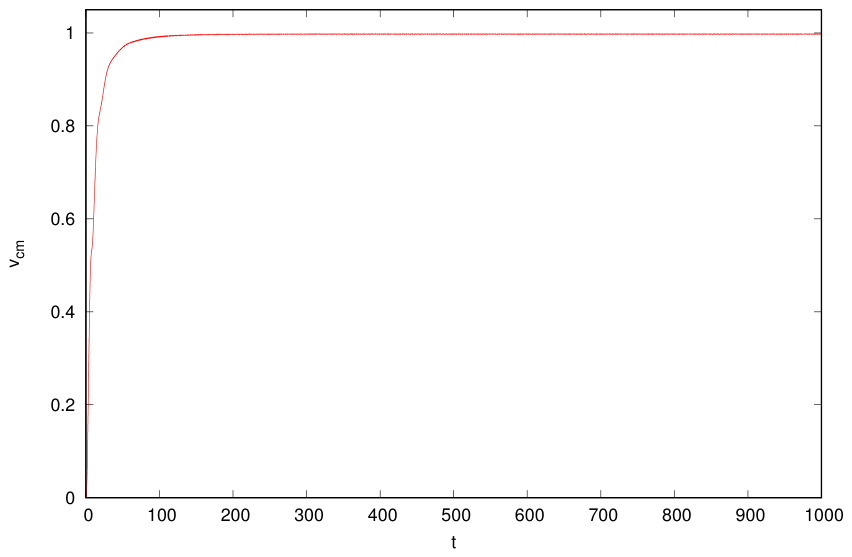
Note that even if the object’s initial velocity is very small, the kink-like object is accelerated until it reaches the maximum velocity (see Figure 12):
lim t v ( t ) = c .
As we are working with relativistic equations, it is expected that c must be a maximum. Nevertheless, the limit in Equation (60) can be seen as an internal consistency check. Although for all initial conditions the velocity v ( t ) in Equation (58) has the same limit, it is important to know how fast this value is approached. We can introduce the concept of “initial” acceleration a ( 0 ) . Let us use the case of initial zero velocity ( v 0 = 0 ) as a reference. For small times, such that t m k c / | Δ | , we have from Equation (58)
v ( t ) | Δ | m k t .
Therefore, the initial acceleration is
a ( 0 ) = | Δ | m k .
Thus, if we wish to “accelerate” the velocity in order to approach c, we can increase | Δ | , or we can reduce m k , or both. The physics of this will be presented later.
Using Equations (50) and (51) we can consider also dissipative perturbations. Let us contemplate equation
1 c 2 2 ϕ t 2 2 ϕ x 2 + d U 0 ( ϕ ) d ϕ = b ϕ t d U 1 ( ϕ ) d ϕ ,
where b is the damping coefficient.
There are many possible cases. Thus, in order to avoid confusion, we will consider that the moving object is a kink-like particle and that Δ < 0 . This Δ will push the object to the “right”. The equation of motion of the excitation is
d P d t = b P + | Δ | ,
or
d d t m k v 1 v 2 / c 2 = b m k v 1 v 2 / c 2 + | Δ | .
The exact solution to Equation (64) is
P ( t ) = | Δ | b + P 0 | Δ | b e b t ,
where P 0 is the initial momentum. If the initial velocity is small (such that the initial momentum is P ( 0 ) < | Δ | / b ), then the particle will accelerate and, eventually, will reach a limit constant velocity.
Equation (65) has a stationary solution when
b m k v 1 v 2 / c 2 = | Δ | .
The same value can be obtained from the exact solution given by function (66). In both calculations, we obtain
lim t v k ( t ) = c | Δ | c 2 b 2 m k 2 + Δ 2 .
Note that this is exactly the same formula we found in Equation (38) using a different analysis.
Now we have the confirmation of the big picture. The kink-like solution to Equation (63) is not a traveling solitary wave that moves with constant velocity. The velocity will be increasing with time. It will move with constant velocity only when t . The kink-like particle will be driven by Δ to the “right”. It will move with acceleration and, eventually, will attain the limit velocity given by Equation (68).
For very large damping,
v k limit | Δ | b m k .
This relation has been compared to the Stokes law for an object moving in a viscous liquid [93]. For very large | Δ | and/or very small b and m k ,
v k limit c .
This means that the particle-like wave will reach the maximum speed very fast and will continue moving at that constant velocity all the time.
We analyze, now, the inhomogeneous equation
1 c 2 2 ϕ t 2 2 ϕ x 2 + d U ( ϕ ) d ϕ = F ( x ) .
Previous works by González and coworkers [49,87] can shed light on this problem when F ( x ) is a constant:
1 c 2 2 ϕ t 2 2 ϕ x 2 + d U ( ϕ ) d ϕ = F 0 ,
with F 0 as a constant. We know that the kink-like object will accelerate while moving to the “right” if F 0 < 0 . On the other hand, when F 0 > 0 , there will be a force acting on the kink-like particle to the “left”. Thus, we expect that the zeros of F ( x ) are candidates for the equilibrium positions for the soliton-like object in Equation (71).
Let x * be a point such that F ( x * ) = 0 , with F ( x ) < 0 if x < x * and F ( x ) > 0 if x > x * . Let us suppose that there is a kink-like object whose center of mass is at rest at the point X * . If we move the center of mass of the particle-like object slightly such that x < x * , then F ( x ) < 0 and the force will push the object towards the equilibrium point x * . If the object is moved to the other side of x * such that x > x * , then F ( x ) > 0 and the force will be returning it back towards the equilibrium point. Therefore, this equilibrium position is stable. In the case that F ( x * ) = 0 , but F ( x ) > 0 if x < x * and F ( x ) < 0 if x > x * , the equilibrium point is unstable. The formal stability theory is based on an eigenvalue–eigenfunction problem of a differential operator. In what follows we take c = 1 without loss of generality.
Let
ϕ ( x , t ) = ϕ k ( x ) + f ( x ) e λ t ,
where ϕ k ( x ) is the stationary kink-like solution to Equation (71). It can be shown that f satisfies the eigenvalue problem
L ^ f = Γ f ,
where the operator L ^ corresponds to
L ^ = x 2 + d 2 U ( ϕ ) d ϕ 2 ϕ = ϕ k ( x )
and Γ = λ 2 . The key question is the sign of the eigenvalue, Γ 0 , of the translational mode:
f 0 ( x ) d ϕ k ( x ) d x .
Let x * be the only zero of the force F ( x ) . If
d F ( x ) d x x = x * > 0 ,
then Γ 0 > 0 and the equilibrium position x = x * is stable for the kink-like particle [20,49]. Otherwise the equilibrium x = x * is unstable. This means that, if function F ( x ) has many zeros, the soliton-like excitation will face several potential wells and barriers while moving in this medium. Sometimes it may be captured by one of the potential wells because it cannot jump over the next barrier. The motion of the particle in such a disorder can be very difficult. When the distance between the zeros of F ( x ) is much larger than the solitonic extent, the object feels every stable equilibrium as a potential well and every unstable equilibrium as a barrier [89,90]. This is an unsurprising feature. However, when the zeros of F ( x ) are close enough, new phenomena can occur [89]. One of them is solitonic tunneling [20,86].
Suppose that F ( x ) has three zeros, x * 1 < x * 2 < x * 3 such that
d F ( x ) d x x = x * 1 > 0 , d F ( x ) d x x = x * 2 < 0 , d F ( x ) d x x = x * 3 > 0 ,
and that the distance between x * 1 and x * 2 , and the distance between x * 2 and x * 3 , are both of the order of the solitonic extent. Additionally, suppose that the eigenvalue Γ 0 corresponding to the translational mode for a kink-like object whose center of mass is at x * 2 is positive, Γ 0 > 0 . Then the kink-like excitation will not feel a barrier at x = x * 2 and it will move through the barrier as if there were nothing there.
Let us illustrate this with an example. Consider the equation
2 ϕ t 2 2 ϕ x 2 1 2 ϕ ϕ 3 = F ( x ) ,
where
F ( x ) = F 1 ( x ) , if x < x * * , F ( x ) = C , if x > x * * ,
F 1 ( x ) = 1 2 A ( A 2 1 ) tanh ( B x ) + 1 2 A 4 B 2 A 2 sinh ( B x ) cosh 3 ( B x ) ,
with A and B constants, and x * * is a local minimum of F 1 , with F 1 ( x * * ) = 0 , and F 1 ( x * * ) = C . The stability problem for the equilibrium point x * = 0 is reduced to the eigenvalue problem L ^ f = Γ f where, now,
L ^ = x 2 + 3 2 A 2 1 2 3 A 2 2 cosh 2 ( B x ) .
The eigenvalues of the discrete spectrum are given by
Γ n = 1 2 + B 2 Λ + 2 Λ n n 2 ,
where Λ ( Λ + 1 ) = 3 A 2 / ( 2 B 2 ) . Our analysis reveals that if A 2 > 1 and 4 B 2 < 1 , the force F ( x ) given by Equation (80) possesses the desired properties, i.e., there is a zero that would correspond to a stable equilibrium position at a point x = d ( d > 0 ) and a zero at x = 0 that would correspond to an unstable equilibrium position and serve as a potential barrier. For x > 0 , the potential is a monotonically decreasing function.
In fact, if 2 B 2 ( 3 A 2 1 ) < 1 , then the soliton-like object behaves as a classical point-like particle. The object feels the barrier at x = 0 . If the object is situated in the left vicinity of x = 0 with zero initial velocity and with the center of mass at a point x < 0 , it will not move to the right of point x = 0 and remain trapped inside the potential well.
On the other hand, if 2 B 2 ( 3 A 2 1 ) > 1 , then Γ 0 > 0 ; therefore, the topological excitation will move to the right, penetrating the barrier even if its center of mass is placed at the minimum of the potential well and its initial velocity is zero (see Figure 3d). In this case the particle-like object is performing soliton-like tunneling.
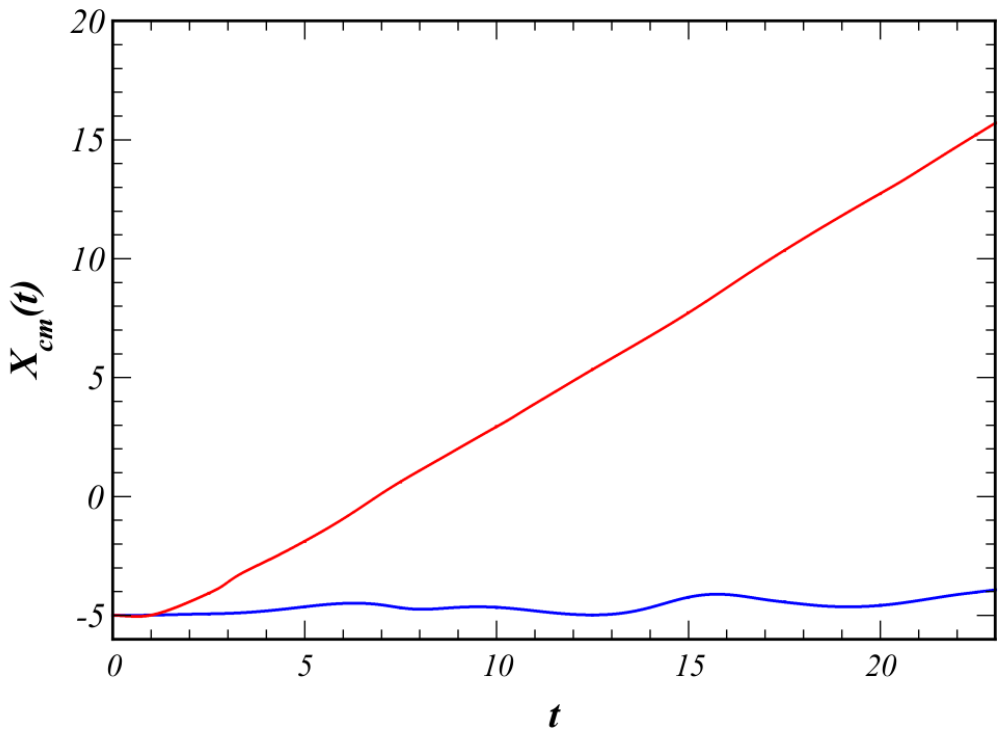
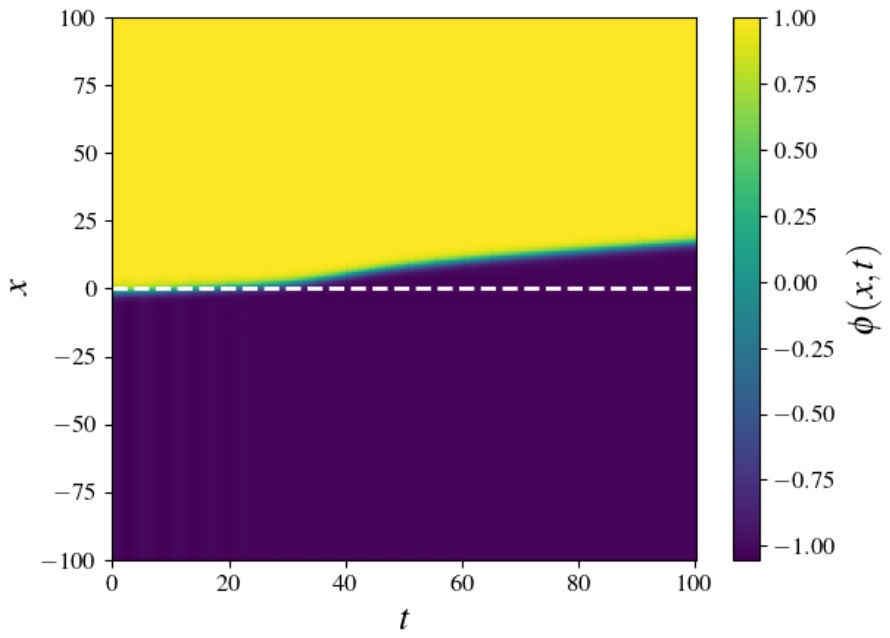
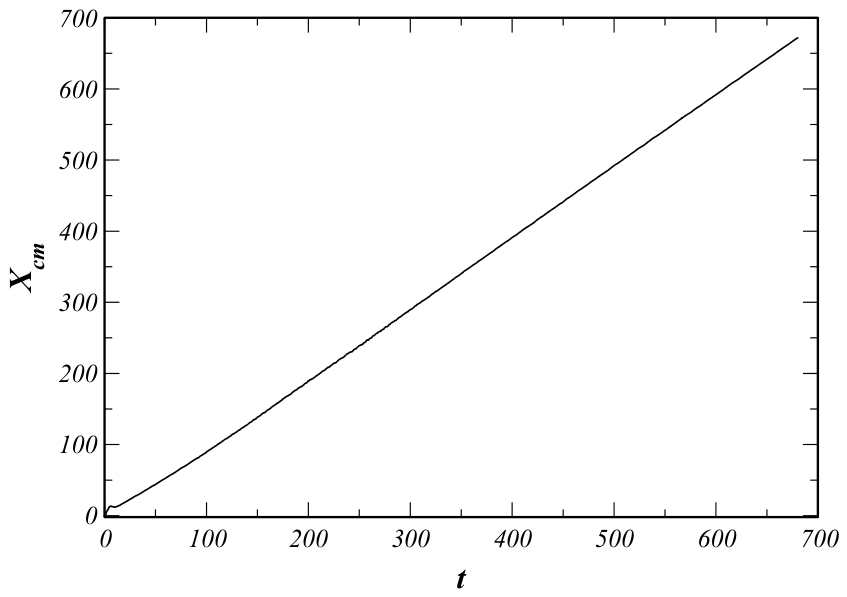
Figure 13 shows the comparison between the dynamics of a kink when Δ = 0 and when Δ 0 . The blue line represents the center of mass of the kink as a function of time X cm ( t ) when the behavior of the kink is governed by the equation
ϕ t t + 0.01 ϕ t ϕ x x + 0.5 ϕ ( ϕ + 1 ) 9 ( ϕ 1 ) 9 = F ( x ) .
In this system Δ = 0 . On the other hand, the dynamics of the kink obtained from the equation
ϕ t t + 0.01 ϕ t ϕ x x + 0.5 ϕ ( ϕ + 1.3 ) 9 ( ϕ 1 ) 9 = F ( x )
leads to the X cm ( t ) represented by the red line. Here Δ 0.6057892 .
In both cases the initial conditions and the field F ( x ) are the same:
ϕ ( x , 0 ) = 2 π arctan tanh ( x + 5 ) | x + 5 | 1 / 4 , ϕ t ( x , 0 ) = 0 ,
F ( x ) = 0.03 sech 2 ( x + 10 ) + 0.02 sech 2 ( x ) 0.03 sech 2 ( x 10 ) ,
and the initial position of the kink’s center of mass is x 0 = 5 .
In [20], we observe that the propagation of long-range kinks in inhomogeneous systems is highly enhanced. However, sometimes, even long-range kinks are stuck inside a potential well as in the case of Equation (84). In Equation (85), Δ helps the kink to escape from the potential well.
In Figure 14, we can see the dynamics generated by the equation
ϕ t t + 0.01 ϕ t ϕ x x + 0.5 ϕ ( ϕ + 1.2 ) 9 ( ϕ 1 ) 9 = F ( x )
where F ( x ) is given, as before, by (87) and the initial conditions for the computer experiments are
ϕ ( x , 0 ) = 2 π arctan tanh ( x + 7.5 ) | x + 7.5 | 1 / 4 , ϕ t ( x , 0 ) = 0 .
The long-range kink ( n = 5 ) is leaving the structure created by F ( x ) that is a potential well with a finite barrier on the right. Now Δ 0.1735531036 .
Sometimes, the kink is moving in a disordered system. We will model this situation with Equation (85) but with a different field given by
F ( x ) = i = 1 n A i sech 2 ( x x i ) ,
where A i and x i , i = 1 , , n , are random numbers.
An example of this process can be observed in Figure 15. The initial conditions are
ϕ ( x , 0 ) = 2 π arctan tanh ( x + 1 ) | x + 1 | 1 / 4 , ϕ t ( x , 0 ) = 0 .
The initial position of the kink center of mass is x 0 = 1 . Despite the disorder, the kink is able to move through the array of impurities with a velocity very close to the maximum speed in the medium: c = 1 .
The dynamics produced by the equation
ϕ t t + 0.1 ϕ t ϕ x x + 0.5 ϕ ( ϕ + 1.5 ) 17 ( ϕ 1 ) 17 = F ( x )
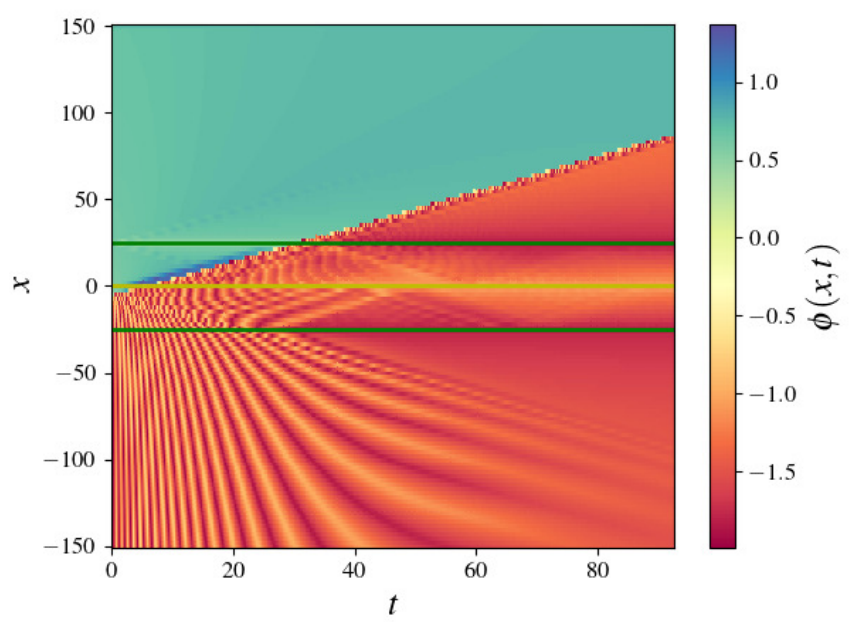
where
F ( x ) = 0.4 sech 2 ( x + 25 ) + 0.3 sech 2 ( x ) 0.4 sech 2 ( x 25 ) ,
can be observed in Figure 16. The initial conditions for the simulation are
ϕ ( x , 0 ) = 2 π arctan tanh ( x + 5 ) | x + 5 | 1 / 8 , ϕ t ( x , 0 ) = 0 .
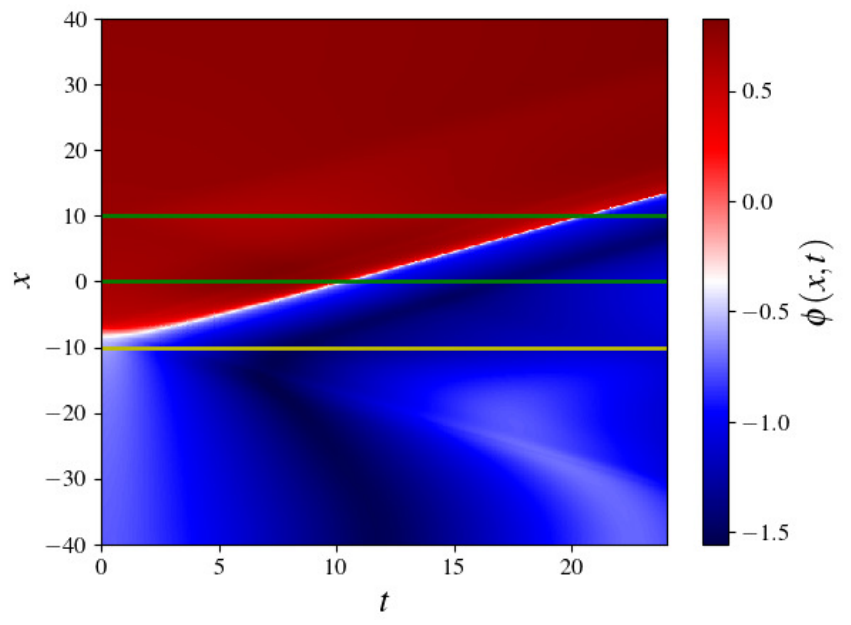
A Δ -driven long-range kink ( n = 9 ) is escaping a 25-wide potential well overcoming a 25-wide barrier. The amplitudes of the fields that form F ( x ) are twice as big as the fields that would destroy a ϕ 4 kink. The barrier height in this structure is too high for the escaping of any normal kink. Nevertheless, the Δ acting on the kink in Equation (92) is a good help (here, Δ 129.6187 ). As we can see in Figure 16, the kink is overcoming the obstacle.
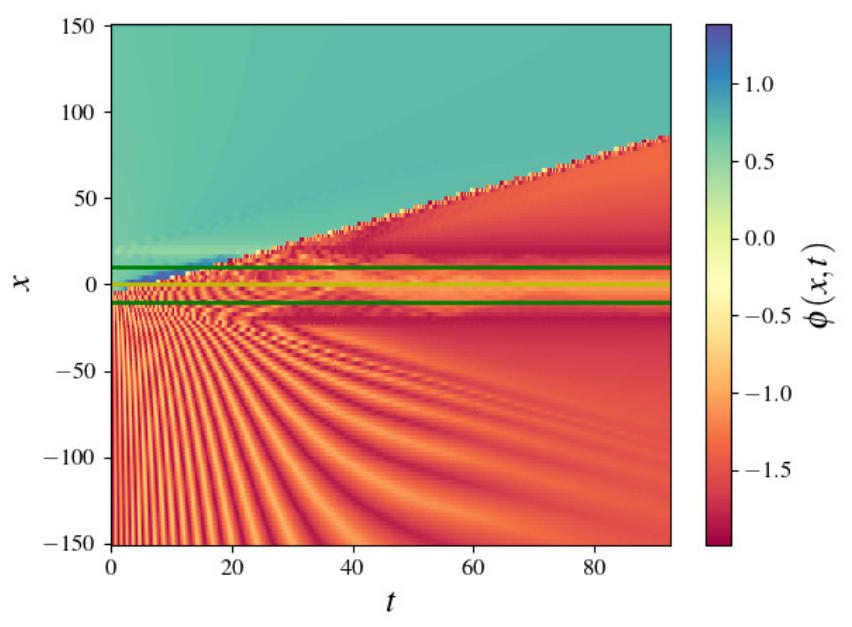
Figure 17 shows the motion of a long-range kink ( n = 9 ) governed by Equation (92) with the field
F ( x ) = 0.69 sech 2 ( x + 10 ) + 0.6992 sech 2 ( x ) 0.69 sech 2 ( x 10 ) .
The initial conditions are the same as Equation (94), above. The amplitudes of the fields that form F ( x ) , in this case, are almost four times as big as fields that would destroy a ϕ 4 kink. Moreover, the positive maximum of F ( x ) at point x = 0 is larger than the absolute value of the negative minima of F ( x ) at points x = x 1 and x = x 2 .
With a barrier like this, pure tunneling (without Δ ) would be impossible for any kind of kink, long-range or not. The Δ in Equation (92) is giant ( Δ 129.6187 ). The acceleration that the kink gets from this Δ is spectacular. We will comment more about this, later.
The dynamics of a kink described by equation
ϕ t t + 0.01 ϕ t ϕ x x + 0.5 ϕ ( ϕ + 1.3 ) 17 ( ϕ 1 ) 17 = F ( x ) ,
where
F ( x ) = 3 sech 2 ( x + 30 ) + 2 sech 2 ( x ) 3 sech 2 ( x 30 ) ,
and initial conditions given by Equation (94), above, is shown in Figure 18.
The field amplitudes that form F ( x ) are around 11 to 16 times larger than the maximum allowed for a ϕ 4 kink. A “reasonable” Δ ( Δ 4.2018438 ) can drive the kink out of the largest potential well and the widest barrier, as shown in Figure 18. A 30-wide barrier is the longest in this paper, so far.
The enormous increase in electrical conductivity in trans-polyacetylene is normally explained using the fact that the charge carriers are topological solitons [95,96,97].
Trans-(CH) X is a degenerate polymer ( Δ = U ( ϕ 1 ) U ( ϕ 3 ) = 0 ). Thus, static kinks are possible. Or kinks can move with constant velocity if there is no damping and there is no disorder in the system. External fields or a voltage can force the charged kink to move forward. What happens when the polymer is non-degenerate ( Δ 0 )? Other excitations (like polarons and bipolarons) have been suggested to play a role in the process. Kinks are not supposed to exist. However, our present results show that topological solitons can exist in non-degenerate systems. Furthermore, they can be accelerated to very high velocities, and they will be self-sustained at those velocities due to the existence of the effective force Δ 0 .
Our results in this section explain for the first time the fact that cis-(CH) X has the largest conductivity [98,99,100]. Recall that cis-polyacetylene is a non-degenerate polymer. These findings can be used in order to develop new energy technologies and new methods for energy harvesting and energy storage. All these developments can help create a new generation of batteries. Of course, as in the case of all batteries, after a sufficiently long time, these new devices should be replaced or recharged.
Similar phenomena can be observed in systems with negative resistance or in active and excitable media [101,102,103,104]. One example is the following equation:
2 ϕ t 2 + R ( ϕ , ϕ t , ϕ x ) 2 ϕ x 2 + d U ( ϕ ) d ϕ = F ( x ) .
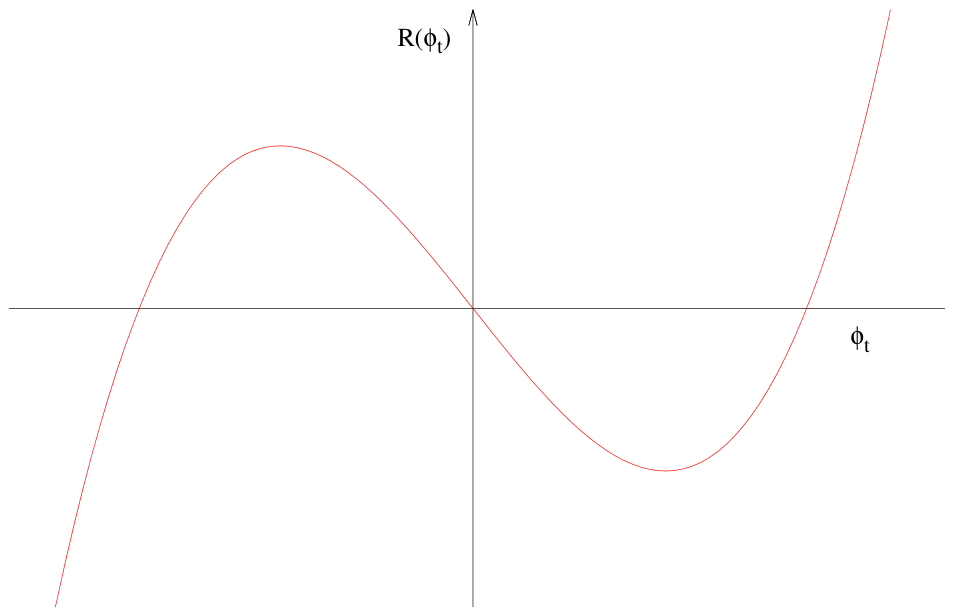
The dissipative term R ( ϕ , ϕ t , ϕ x ) can be, for instance,
R ( ϕ t ) = b ϕ t + a ϕ t 3 , a , b > 0 .
We illustrate this in Figure 19.
Equation (98) can be seen as a combination of a soliton-bearing system with a van der Pol-like circuit. A system like this can be created using a Josephson-transmission line with negative-resistance elements [105] or in an extended chemical reactor with auto-catalytic chemical reactions [106]. In other words, this is a spatio-temporal system that supports topological objects with subsystems that (taken individually) could support limit cycles [107,108]. Any autonomous system with self-sustained oscillations can be used as a source of intrinsic energy for the self-sustained motion of topological objects. The oscillations do not need to be periodic. The autonomous system can have limit cycles or chaotic strange attractors. This autonomous system can be coupled to a system that supports topological objects. This design can help create technological devices for energy harvesting and/or energy storage.
Moreover, long-range topological objects can tunnel through very wide macroscopic barriers. Let us write down the Hamiltonian that generates Equation (71):
H = 1 2 Π 2 + 1 2 ϕ x 2 + U ( ϕ ) F ( x ) ϕ , Π = L ϕ t ,
where L is the Lagrangian density. The term F ( x ) ϕ in the Hamiltonian (100) describes the interaction between the fields ϕ ( x , t ) and F ( x ) [20].
The potential energy of the kink-like object due to its interaction with the field F ( x ) can be expressed by the function E p ( X ) defined in (19) where X is here the collective coordinate that represents the object’s position [20]. Figure 5 and Figure 6 show the behavior of E p ( X ) for different functions F ( x ) and different values of n in (21) and (22). These figures show that as n is increased, the height and the width of the barrier decrease. Eventually the barrier will disappear. Thus, the tunneling condition (18) will be satisfied and the object will tunnel. It does not matter how small the object’s energy is.
Now we will consider the escape of a long-range kink-like object from a potential well under the action of force generated by the fact that Δ 0 . Despite the highly enhanced tunneling of long-range soliton-like excitations due to the fact that they are long range, there are potential-well-barrier systems where even a long-range kink-like structure will remain trapped inside the well. Very wide barriers and very large potential wells can make the tunneling difficult. The equation of motion for the particle-like object is the following:
d d t m k v 1 v 2 / c 2 = Δ E p ( x ) x .
Suppose there is a kink-like particle inside the potential well, shown in blue in Figure 7, generated by the perturbation F ( x ) (represented in red). The condition for the escape is that
| Δ | E p ( x ) x > 0 ,
for all points in the interval x 0 < x < x 2 , where x 0 is the initial position of the kink-like excitation. Let us see some details of the forces in action during the process. Normally we have an F ( x ) like that shown in Figure 4. Typically E p ( x ) can have two kinds of behavior (see Figure 20 and Figure 21).
In the case shown in Figure 20, a particle located inside the potential well (on the left), at rest, would not escape leaving the system potential-well-barrier behind. In Figure 21, the particle will move forward all the time.
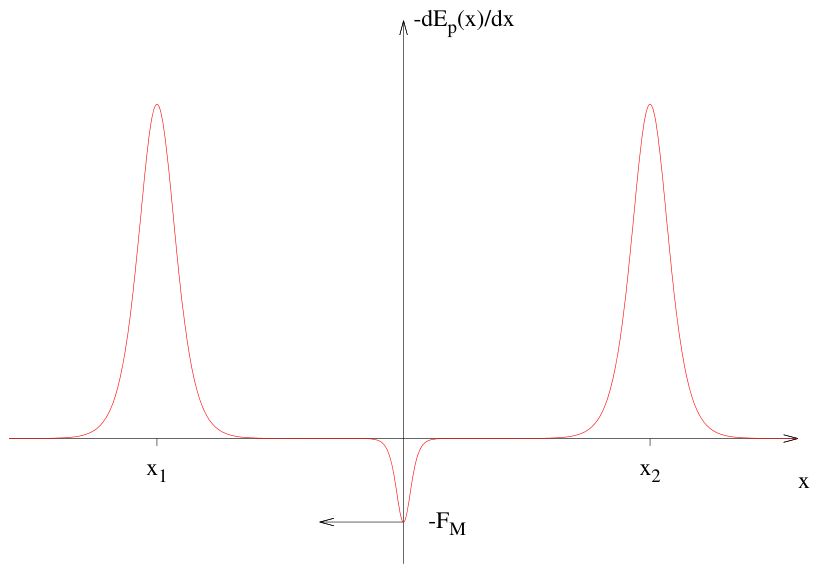
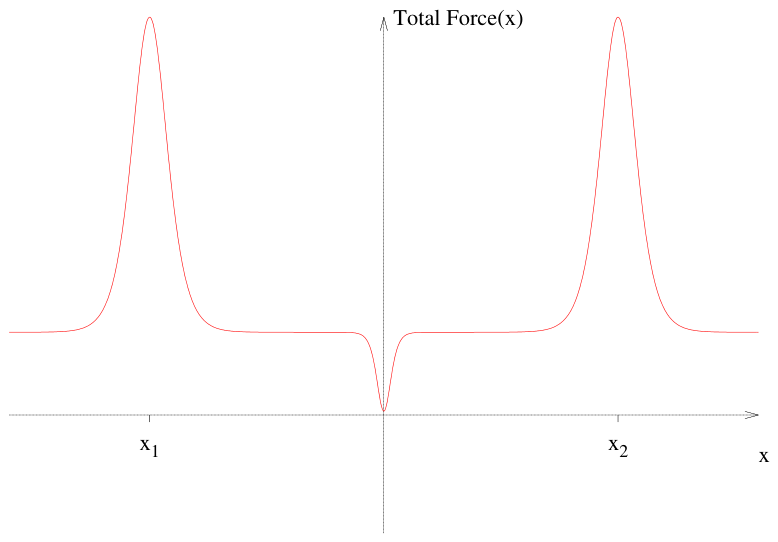
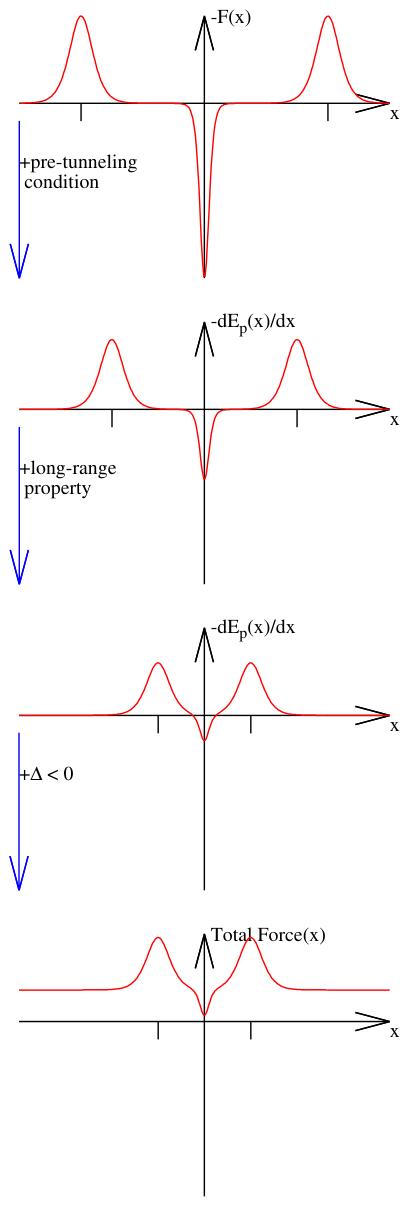
In Figure 22 we can see the graph of E p ( x ) x for the case shown in Figure 20. The graph of E p ( x ) x depicted in Figure 23 shows that, in this case, E p ( x ) x is always positive. Typically, as n increases, the negative minima of E p ( x ) x tend to decrease in absolute value (see Figure 24). Thus, if despite the long-range property the kink-like object remains trapped inside the potential well, then Δ can help. For this we need the condition
| Δ | > F M ,
where F M is the absolute value of the local negative minimum of E p ( x ) x .
In Figure 22, Figure 23 and Figure 24 we illustrate this phenomenon.
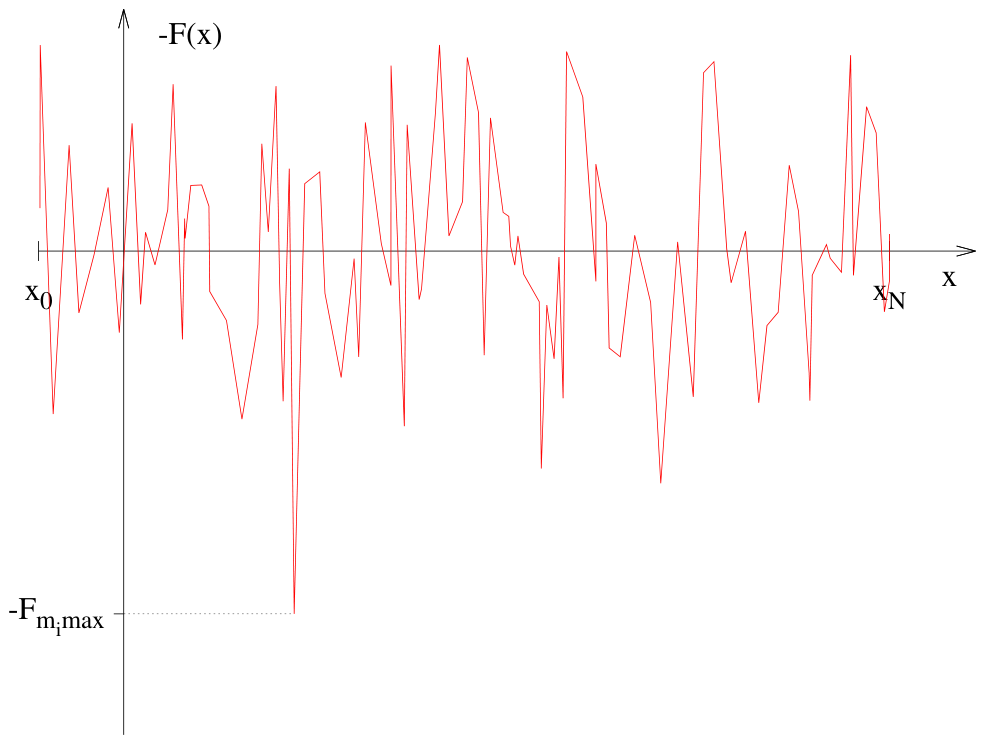
If the soliton-like entity is moving in a randomly disordered medium like that shown in Figure 25, the escape condition (102) can be used again with the modification that the inequality
| Δ | E p ( x ) x > 0
must be satisfied for all the points in the disordered sample x 0 < x < x N . We are graphing also F ( x ) in Figure 22 because the intervals of x where F ( x ) > 0 are the “zones” of x where there are the maximal forces opposing the motion of the topological object, which is trying to move to the “right”.
Compare Figure 22 and Figure 25: in Figure 22, we had to defeat the negative force F M . Thus, in Figure 25, we have to defeat the force F m i m a x . Let { F m i } be the sequence of positive local maxima of F ( x ) . And let F m i m a x be its maximum value. If the condition
| Δ | > F m i m a x
is satisfied, then the long-range kink-like object will be in a regime of superpropagation. It does not matter how random the disorder is, how big the potential wells are, and how wide the barriers are. The long-range kink-like particle can move through the whole disordered array. Nothing can stop it.
In some cases the escape condition (104) can be satisfied by the term E p ( x ) x alone (i.e., even when Δ = 0 , the inequality will hold). For increasing n, the height of the barrier in E p ( x ) will be decreasing and the width of the barrier in E p ( x ) will also be decreasing. For sufficiently large n, the barrier can disappear altogether. However, in some cases the term E p ( x ) x will not be enough to satisfy the inequality in (104). Then | Δ | can do the job. This analysis highlights the synergy between the long-range and the Δ 0 properties. The coexistence of the two phenomena can lead to an enhanced propagation. For long-range solitonic tunneling and for the propagation of the topological object in a disordered medium, the interaction of the object with the walls of the potential wells (the “negative zones” of F ( x ) ) is very important. Even a long-range kink-like structure can be trapped in a potential well if the width of the barrier and the distance between the walls of the potential well are very large, and the solitonic extent is short.
Nevertheless, this handicap for solitonic motion in media with very large potential wells can be an advantage for the self-sustained propagation of the kink-like particle driven by Δ 0 . When the distance between the walls of the potential well is very large, the object can be trapped inside the potential well. However, if Δ < 0 , the kink-like excitation has a lot of room to get energy from the effective force Δ . Again, this synergy can enhance the propagation.
Equation (68) can be rewritten as
v k l i m i t = c 1 + c 2 b 2 m k 2 / Δ 2 .
Equation (106) can be another way to explain the synergy between Δ and the long-range property. All the processes that lead to the decrease in the quantity c 2 b 2 m k 2 / Δ 2 will favor the solitonic propagation. This can be done increasing Δ 2 or decreasing the object’s mass m k , or both at the same time. The more long range the kink-like particle is, the smaller its mass. Thus, combining long-range topological objects with asymmetric potentials U ( ϕ ) ( Δ 0 ), we can enhance the object’s propagation in unseen ways.
Similar phenomena can be observed in systems with negative resistance or in active and excitable media [101,102,103,104]. A model that contains both negative resistance and soliton-like excitations is the following equation:
1 c 2 2 ϕ t 2 + R ( ϕ , ϕ t , ϕ x ) 2 ϕ x 2 + d U ( ϕ ) d ϕ = F ( x ) ,
where U ( ϕ 1 ) = U ( ϕ 3 ) = 0 (i.e., Δ = 0 ). The dissipative term R ( ϕ , ϕ t , ϕ x ) can be a nonlinear damping function of its dependent variables. An example is
R ( ϕ t ) = b ϕ t + a ϕ t 3 ,
where a > 0 , b > 0 . Note that R / ϕ t is negative for small values of ϕ t and positive for large values. Function (108) can be understood as a nonlinear Ohm’s law (see Figure 19).
In [105] nonlinear circuits with the i v characteristics depicted in Figure 19 are built. The zone where d i d v < 0 represents a regime with negative resistance. Equation (107) can be seen as a model of a physical system that combines a soliton-bearing-like system with a van der Pol-like circuit. A system like this can be created using a Josephson transmission line with negative-resistance elements [105] or in an extended chemical reactor with autocatalytic chemical reactions [106].
Let us analyze the equation
1 c 2 2 ϕ t 2 + R ( ϕ t ) 2 ϕ x 2 + d U ( ϕ ) d ϕ = 0 .
Kink-like objects that move without change of shape and velocity correspond to solutions of
d 2 ϕ z 2 R w d ϕ d z = d V ( ϕ ) d ϕ ,
where
z = x v t 1 v 2 / c 2 , and w = v 1 v 2 / c 2 ,
v being the velocity of the kink-like excitation. Equation (110) can be studied as a Newton equation for a “fictitious” particle as we did earlier, or we can investigate the dynamical system
d ϕ ( z ) d z = ψ ( z ) ,
d ψ ( z ) d z = R ( w ψ ) d V ( ϕ ) d ϕ .
Kink-like solutions of (109) correspond to heteroclinic orbits that connect the saddle points of (112) at ( ϕ 1 , 0 ) and ( ϕ 3 , 0 ) . Another way to investigate the dynamics of the soliton-like excitations in Equation (109) is using the equation that consider the effect of perturbations on the soliton-like objects (50) and (51). The perturbation now is
Pert = b ϕ t a ϕ t 3 .
This approach leads to the equation
d P d t = b P a P 3 , where P = m k v 1 v 2 / c 2 .
Note that despite the fact that, in this case, there are no external forces, Δ = 0 , and the system is dissipative, there is the possibility of self-sustained solitonic motion with non-zero constant velocity. The possible constant velocities can be calculated using stationary solutions to Equation (104),
b P a P 3 = 0 .
There are three solutions to this equation
P 1 = 0 , P 2 = b / a , P 3 = b / a .
These constant velocities have physical meaning only if kink-like objects actually exist.
It turns out that, even when R ( ϕ t ) can change signs at some values of ϕ t , for some values of the parameters a and b, the heteroclinic orbit connecting the two saddle points does not exist [105,109,110].
When we study the exact kink-like solution to the unperturbed nonlinear Klein–Gordon equation, we must find the square root of U:
d ϕ d z = 2 U ( ϕ ) .
It is no surprise that U ( ϕ ) must be non-negative in the interval ϕ 1 ϕ 2 ϕ 3 . For the kink-like solution to exist in Equation (109), there is another function of ϕ that must be non-negative:
U ( ϕ ) + ϕ 1 ϕ R P 2 U ( ϕ ) d ϕ ,
where P is a solution to Equation (115). This expression can be obtained when we try to integrate Equation (110) after the substitution d ϕ d z = 2 U ( ϕ ) . Thus, the condition for the existence of the kink-like structure in the nonlinear Klein–Gordon Equation (109) with nonlinear damping is
U ( ϕ ) + ϕ 1 ϕ R P 2 U ( ϕ ) d ϕ > 0 .
When this condition is not satisfied a new kind of bifurcation will occur. Now, what happens in the system when the parameters cross the threshold of this bifurcation?
First, we will present an example of a system where a simple exact solution can be obtained. These results can be generalized using the topological method developed in [49,111]. Let us consider R given by (108) and a somewhat general potential such that
d U ( ϕ ) d ϕ = A 1 ϕ + A 3 ϕ 3 + A 5 ϕ 5 + A 7 ϕ 7 + A 9 ϕ 9 .
The traveling solitary waves moving with constant velocity are solutions to the equation
ϕ z z R w d ϕ d z d U ( ϕ ) d ϕ = 0 ,
where R ( ϕ z ) = δ ϕ z + γ ϕ t 3 , δ = b w and γ = b w 3 . We will follow the method developed by Otwinowski et al. [112]. If
ϕ z = ϵ 1 ϕ + ϵ 3 ϕ 3 ,
where ϵ 1 and ϵ 3 are unknown parameters, then it is possible to integrate Equation (121) in quadrature. For a kink-like solution to Equation (121) to exist, satisfying Equation (122), ϵ 1 and ϵ 3 must satisfy a system of algebraic equations
A 1 = ϵ 1 2 δ ϵ 1 ,
A 3 = 4 ϵ 1 ϵ 3 δ ϵ 1 3 δ ϵ 3 ,
A 5 = 3 ϵ 3 2 + 3 γ ϵ 1 2 ϵ 3 ,
A 7 = 3 γ ϵ 1 ϵ 3 2 ,
A 9 = γ ϵ 3 3 .
The only truly independent parameters are A 5 , A 7 and A 9 . Parameters ϵ 1 and ϵ 3 can be calculated using the formulas
ϵ 1 2 = 1 9 A 7 A 9 2 A 5 A 9 A 7 2 3 A 9 2 ,
ϵ 3 2 = A 5 A 9 A 7 2 3 A 9 2 .
There is a kink-like solitary wave that connects the points ϕ 1 = 0 and
ϕ 3 = ϵ 1 ϵ 3 1 / 2 = A 7 3 A 9 1 / 2 .
The parameters must satisfy the following relations:
ϵ 1 ϵ 3 < 0 ,
A 7 A 9 < 0 ,
A 9 A 9 A 5 A 7 2 < 0 .
Recalling that U ( ϕ 1 ) = U ( ϕ 3 ) = 0 , we state that w is a solution of
b w + R a w 3 = 0 ,
where, now,
R = A 7 3 270 A 9 2 A 5 A 9 A 7 2 3 A 9 .
The exact solution is
ϕ ( z ) = ϕ 3 1 + e 2 ϵ 1 z .
Note that
lim z ϕ ( z ) = 0 , and lim z + ϕ ( z ) = ϕ 3 .
The particle-like object can have three different stationary velocities that correspond to the solutions of the cubic Equation (134). However, there is a condition for parameters a and b,
b 3 a < A 7 3 729 A 9 2 A 5 A 9 A 7 2 .
Using the condition (119) in the general theory, we obtain that there is always a threshold value “ t h ” such that the condition
b 3 a < t h
must be satisfied for the existence of the kink-like object. Inequality (138) confirms this result. Thus, when
b 3 a > t h ,
a new kind of bifurcation occurs. The solution is not a kink-like structure anymore. It becomes a highly unstable, highly dynamical, spatiotemporal oscillation that has been termed a “soliton explosion”. See the experiment shown in Figure 3 in [105].
In the dissipative perturbation (108) there is a competition between two damping terms, one with the “correct” sign for dissipation, and the other that describes the autonomous pumping of energy into the system. The balance between these two processes leads to the self-sustained motion of a stable soliton-like particle. However, if the rate of energy pumping is too high, the propagation phenomenon is not stable anymore, as mentioned above in the previous paragraph.
Let us analyze the motion of a negative-resistance-driven kink-like object in a disordered medium. The equation of motion for the soliton-like excitation is
d d t m k v 1 v 2 / c 2 = b m k v 1 v 2 / c 2 a m k v 1 v 2 / c 2 3 E p ( x ) x = 0 .
We will assume that the object is already moving, driven by the negative resistance, when it faces the disorder created by F ( x ) . The object’s velocity satisfies the equation
v 2 = ( b / a ) c 2 m k 2 c 2 + ( b / a ) .
The kinetic energy of the soliton-like excitation is
K E = m k c 2 1 1 v 2 / c 2 1 .
Using v 2 from (142) in (143), we obtain a quite simple formula
K E = b a m k .
Let E M be the highest barrier height of the disorder as seen through E p ( x ) . Then, the condition for the kink-like wave to move through the whole disorder is
b a m k > E M .
However, recall that b cannot be increased limitlessly because of the threshold condition (140).

Summary of Numerical Simulations

We present here different sets of equations and initial conditions that illustrate the behaviors described above:
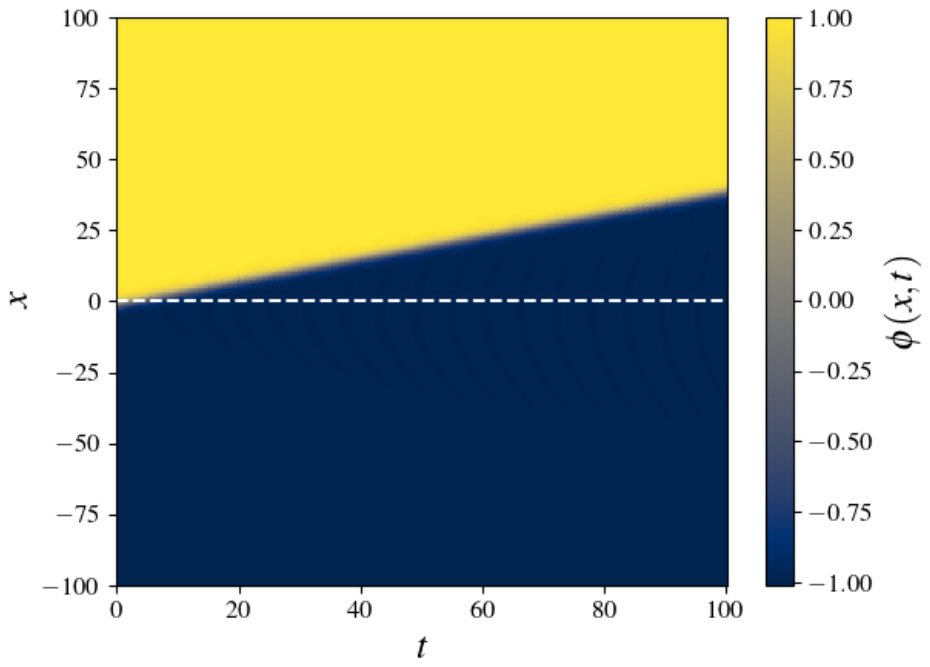
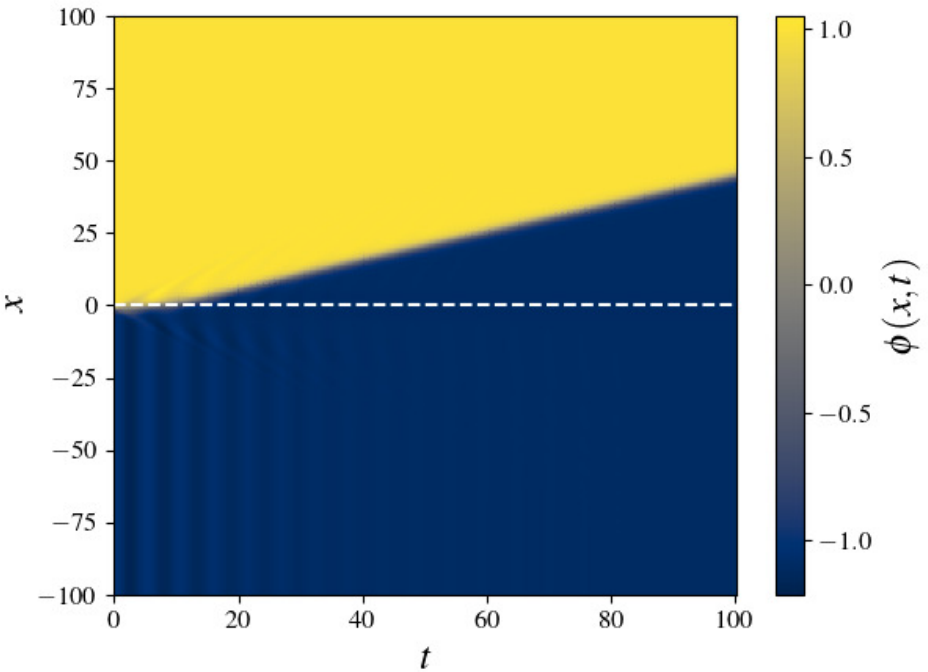
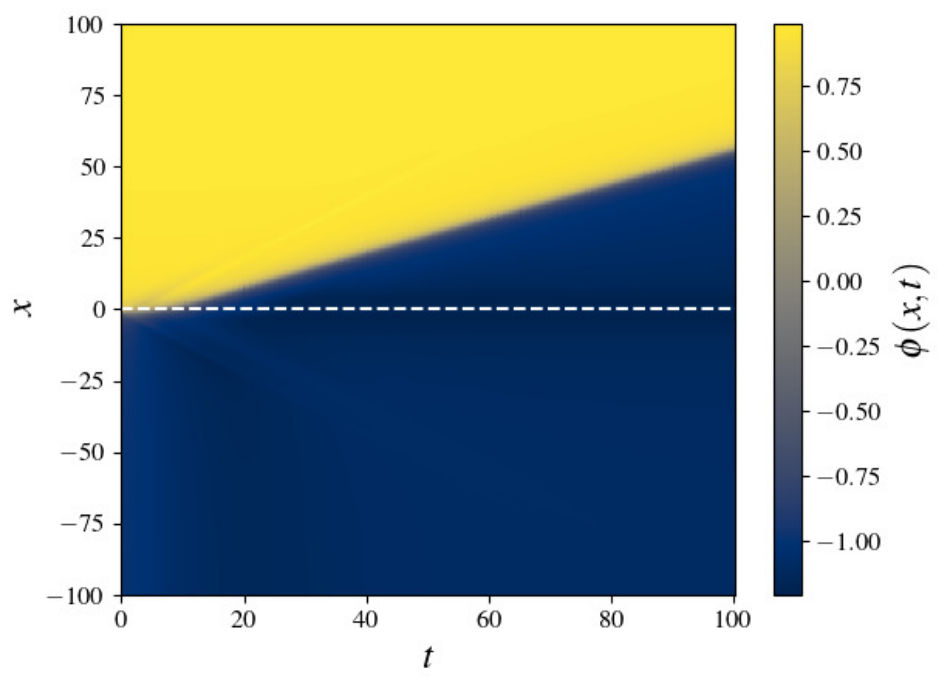
ϕ t t ϕ x x 0.5 ϕ + 0.5 ϕ 3 = 0 , ϕ ( x , 0 ) = tanh x + 1 1.95958 , ϕ t ( x , 0 ) = 0.20412 sech 2 x + 1 1.959228 .
Results are shown in Figure 26.
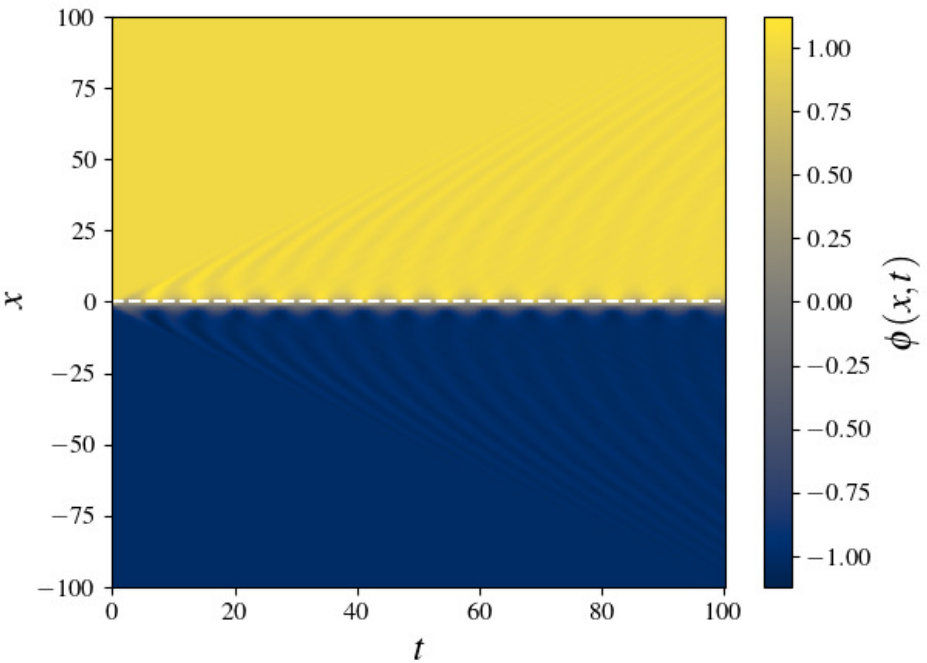
ϕ t t ϕ x x 0.5 ϕ + 0.5 ϕ 3 = 0 , ϕ ( x , 0 ) = tanh ( x + 1 ) , ϕ t ( x , 0 ) = 0 .
Results are shown in Figure 27.
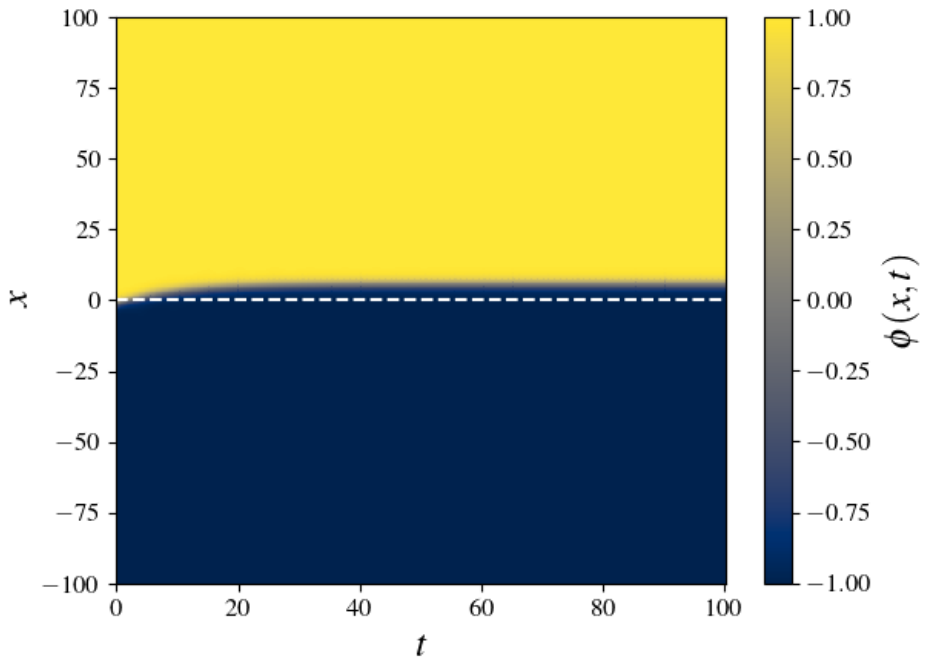
ϕ t t + 0.1 ϕ t ϕ x x 0.5 ϕ + 0.5 ϕ 3 = 0 , ϕ ( x , 0 ) = tanh [ 0.625 ( x + 1 ) ] , ϕ t ( x , 0 ) = 0.375 sech 2 [ 0.625 ( x + 1 ) ] .
Results are shown in Figure 28.
ϕ t t ϕ x x 0.5 ϕ + 0.5 ϕ 3 + 0.1 ϕ 2 = 0 , ϕ ( x , 0 ) = tanh ( x + 1 ) , ϕ t ( x , 0 ) = 0 .
Results are shown in Figure 29.
ϕ t t + 0.5 ϕ t ϕ x x = 0.5 ϕ + 0.5 ϕ 3 + 0.1 ϕ 2 = 0 , ϕ ( x , 0 ) = tanh ( x + 1 ) , ϕ t ( x , 0 ) = 0 .
Results are shown in Figure 30.
ϕ t t + 0.5 ϕ t ϕ x x 0.5 ϕ + 0.5 ϕ 3 + 0.3 ϕ 2 = 0 , ϕ ( x , 0 ) = tanh ( x + 1 ) , ϕ t ( x , 0 ) = 0 .
The results are shown in Figure 31.
ϕ t t + ( 0.1 ) ϕ t ϕ x x + 0.5 ϕ ( ϕ + 1 ) ( ϕ 1 ) = F ( x ) , ϕ ( x , 0 ) = tanh [ 0.5 ( x + 1 ) ] , ϕ t ( x , 0 ) = 0 , F ( x ) = 0.03 sech 2 ( x + 3 ) + 0.02 sech 2 ( x ) 0.03 sech 2 ( x 3 ) .
Results are shown in Figure 32.
ϕ t t + ( 0.1 ) ϕ t ϕ x x + 0.5 ϕ ( ϕ + 1.1 ) ( ϕ 1 ) = F ( x ) , ϕ ( x , 0 ) = tanh ( x + 1 ) , ϕ t ( x , 0 ) = 0 , F ( x ) = 0.03 sech 2 ( x + 3 ) + 0.02 sech 2 ( x ) 0.03 sech 2 ( x 3 ) .
The results are shown in Figure 33.
ϕ t t + 0.1 ϕ t ϕ x x + 0.5 ϕ ( ϕ + 1.1 ) 3 ( ϕ 1 ) 3 = F ( x ) , ϕ ( x , 0 ) = ϕ k ( x ) , ϕ t ( x , 0 ) = 0 , F ( x ) = 0.03 sech 2 ( x + 3 ) + 0.02 sech 2 ( x ) 0.03 sech 2 ( x 3 ) .
Results are shown in Figure 34.
ϕ t t + ( 0.1 ) ϕ t ϕ x x + 0.5 ϕ ( ϕ + 1.3 ) 5 ( ϕ 1 ) 5 = F ( x ) , ϕ ( x , 0 ) = ϕ k ( x ) , ϕ t ( x , 0 ) = 0 , F ( x ) = 0.03 sech 2 ( x + 3 ) + 0.02 sech 2 ( x ) 0.05 sech 2 ( x 3 ) .
Results are shown in Figure 35.
ϕ t t + ( 0.1 ) ϕ t ϕ x x + 0.5 ϕ ( ϕ + 1 ) ( ϕ 1 ) = F ( x ) , ϕ ( x , 0 ) = tanh ( x + 1 ) , ϕ t ( x , 0 ) = 0 , F ( x ) = 0.03 sech 2 ( x + 4 ) + 0.02 sech 2 ( x ) 0.05 sech 2 ( x 4 ) .
Results are shown in Figure 36.
ϕ t t + ( 0.1 ) ϕ t ϕ x x + 0.5 ϕ ( ϕ + 1.06 ) ( ϕ 1 ) = F ( x ) , ϕ ( x , 0 ) = tanh [ 0.5 ( x + 1 ) ] , ϕ t ( x , 0 ) = 0 , F ( x ) = 0.03 sech 2 ( x + 4 ) + 0.02 sech 2 ( x ) 0.03 sech 2 ( x 4 ) .
Results are shown in Figure 37.
ϕ t t + ( 0.1 ) ϕ t ϕ x x + 0.5 ϕ ( ϕ + 1.05 ) ( ϕ 1 ) = F ( x ) , ϕ ( x , 0 ) = tanh [ 0.5 ( x + 1 ) ] , ϕ t ( x , 0 ) = 0 , F ( x ) = 0.03 sech 2 ( x + 3 ) + 0.02 sech 2 ( x ) 0.03 sech 2 ( x 3 ) .
Results are shown in Figure 38.
ϕ t t + ( 0.1 ) ϕ t ϕ x x + 0.5 ϕ ( ϕ + 1.03 ) ( ϕ 1 ) = F ( x ) , ϕ ( x , 0 ) = tanh [ 0.5 ( x + 1 ) ] , ϕ t ( x , 0 ) = 0 , F ( x ) = 0.03 sech 2 ( x + 3 ) + 0.02 sech 2 ( x ) 0.03 sech 2 ( x 3 ) .
Results are shown in Figure 39.
ϕ t t + ( 0.01 ) ϕ t ϕ x x + 0.5 ϕ ( ϕ + 1 ) 9 ( ϕ 1 ) 9 = F ( x ) , ϕ ( x , 0 ) = 2 π arctan tanh ( x + 5 ) | x + 5 | 1 4 , ϕ t ( x , 0 ) = 0 , F ( x ) = 0.03 sech 2 ( x + 10 ) + 0.02 sech 2 ( x ) 0.03 sech 2 ( x 10 ) .
Results are shown in Figure 13 corresponding to the blue curve.
ϕ t t + ( 0.01 ) ϕ t ϕ x x + 0.5 ϕ ( ϕ + 1.3 ) 9 ( ϕ 1 ) 9 = F ( x ) , ϕ ( x , 0 ) = 2 π arctan tanh ( x + 5 ) | x + 5 | 1 4 , ϕ t ( x , 0 ) = 0 , F ( x ) = 0.03 sech 2 ( x + 10 ) + 0.02 sech 2 ( x ) 0.03 sech 2 ( x 10 ) .
Results are shown in Figure 13 corresponding to the red curve.
ϕ t t + ( 0.1 ) ϕ t ϕ x x + 0.5 ϕ ( ϕ + 1.5 ) 17 ϕ 1 17 = F ( x ) , ϕ ( x , 0 ) = 2 π arctan tanh ( x + 5 ) | x + 5 | 1 8 , ϕ t ( x , 0 ) = 0 , F ( x ) = 0.4 sech 2 ( x + 2.5 ) + 0.3 sech 2 ( x ) 0.4 sech 2 ( x 2.5 ) .
Results are shown in Figure 16.
ϕ t t + ( 0.1 ) ϕ t ϕ x x + 0.5 ϕ ( ϕ + 1.5 ) 17 ϕ 1 17 = F ( x ) , ϕ ( x , 0 ) = 2 π arctan tanh ( x + 5 ) | x + 5 | 1 8 , ϕ t ( x , 0 ) = 0 , F ( x ) = 0.69 sech 2 ( x + 10 ) + 0.6992 sech 2 ( x ) 0.69 sech 2 ( x 10 ) .
Results are shown in Figure 17.
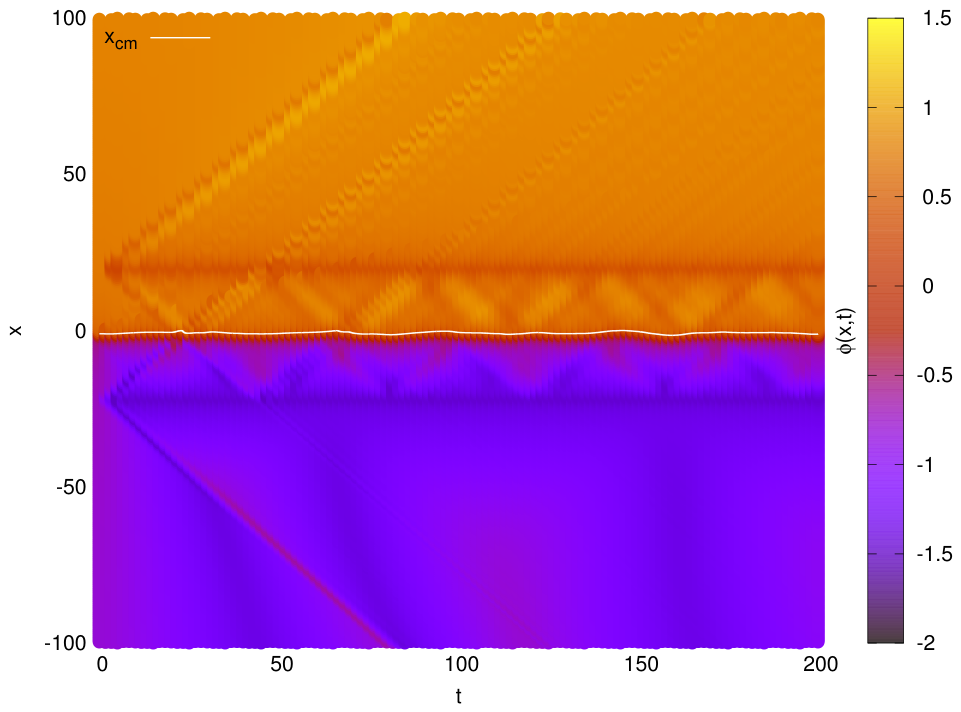
ϕ t t + ( 0.0001 ) ϕ t ϕ x x + 0.5 ϕ ( ϕ + 1.12 ) 9 ( ϕ 1 ) 9 = F ( x ) , ϕ ( x , 0 ) = 2 π arctan tanh ( x + 1 ) | x + 1 | 1 4 , ϕ t ( x , 0 ) = 0 , F ( x ) = 0.2 sech 2 ( x + 21 ) + 0.1 sech 2 ( x ) 0.1 sech 2 ( x 21 ) .
Results are shown in Figure 40.
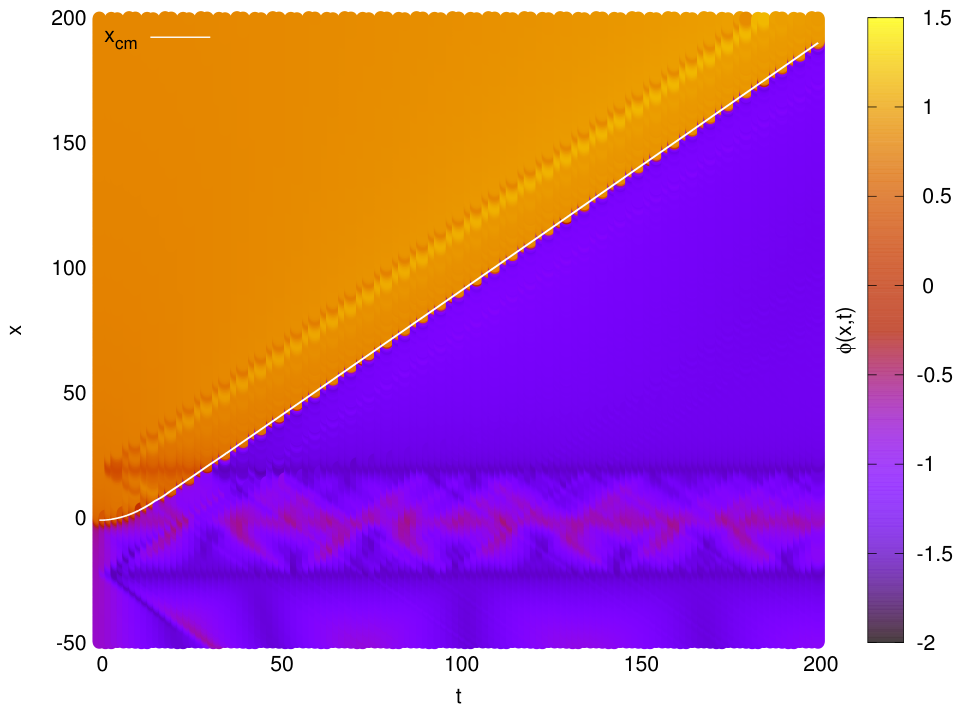
ϕ t t + ( 0.0001 ) ϕ t ϕ x x + 0.5 ϕ ( ϕ + 1.15 ) 9 ( ϕ 1 ) 9 = F ( x ) , ϕ ( x , 0 ) = 2 π arctan tanh ( x + 1 ) | x + 1 | 1 4 , ϕ t ( x , 0 ) = 0 , F ( x ) = 0.2 sech 2 ( x + 21 ) + 0.1 sech 2 ( x ) 0.1 sech 2 ( x 21 ) .
Results are shown in Figure 41.
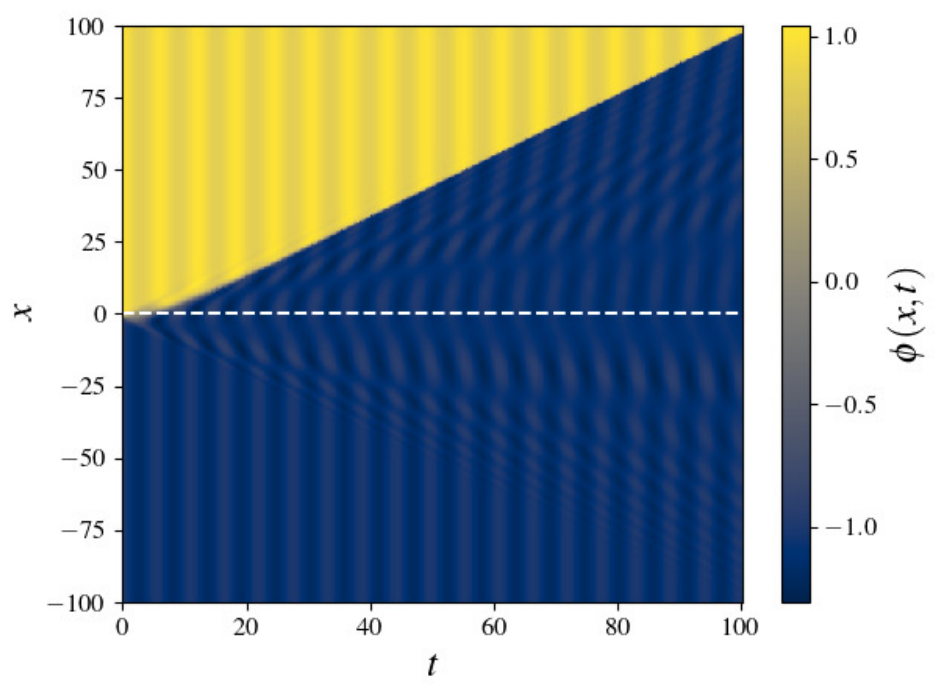
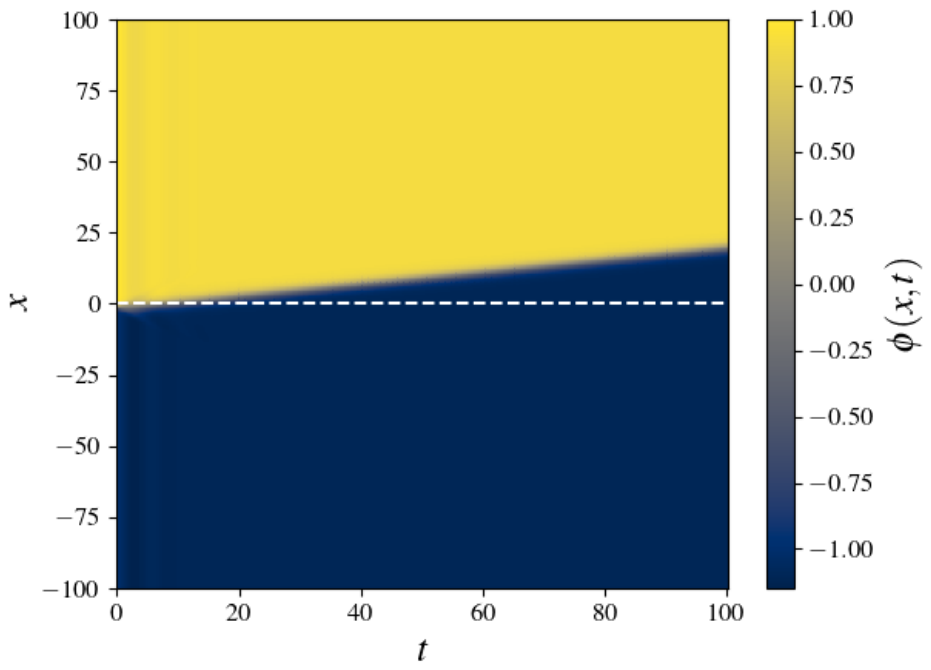
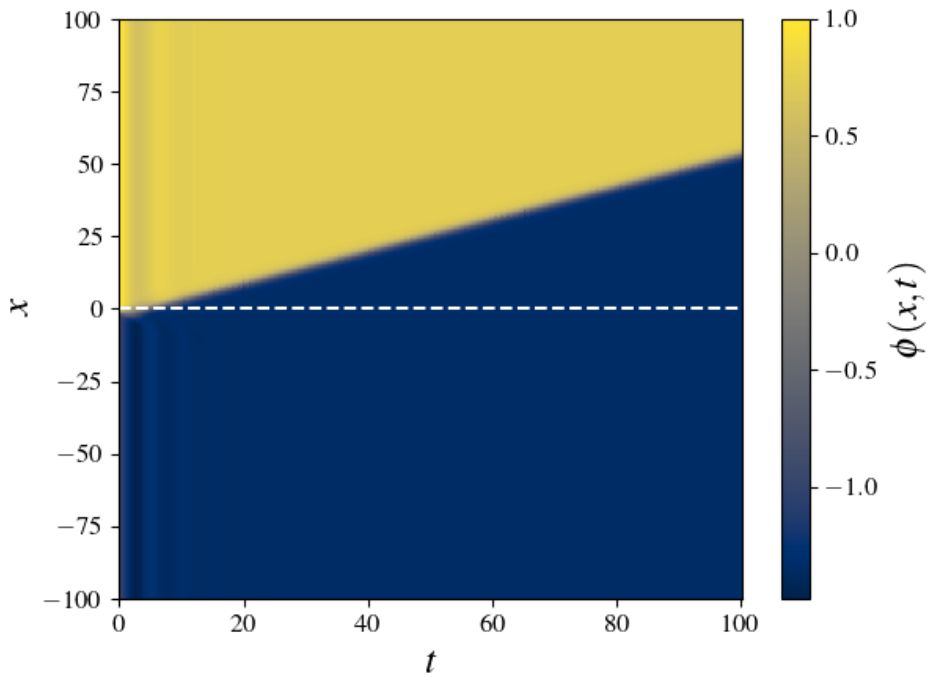
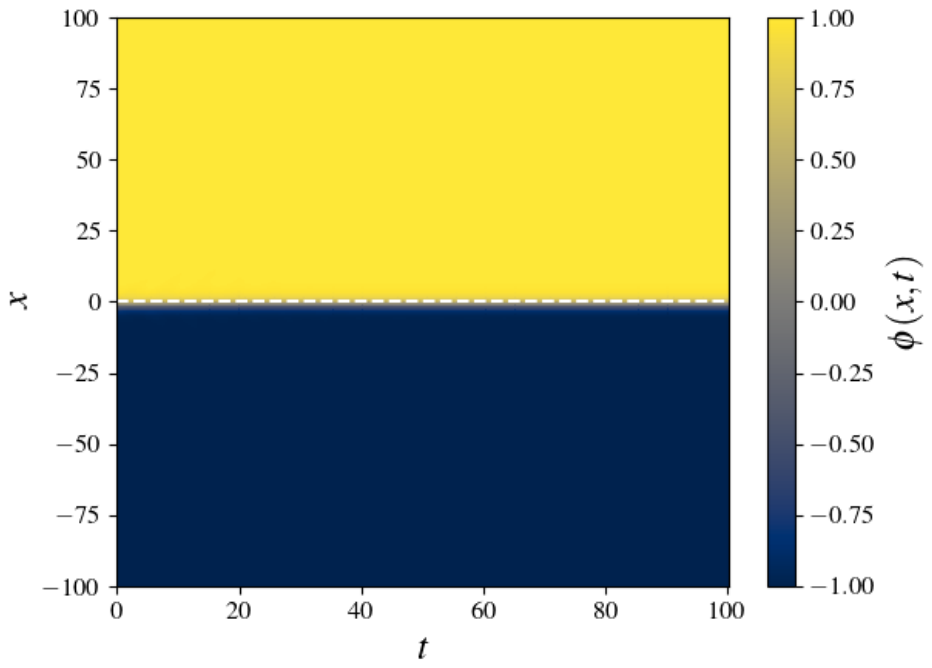
The dynamical system modeled by the equation set (164) represents a trapped long-range kink-like object for which n and Δ are not enough to satisfy the condition (104). On the other hand, the equation set (165) represents an escaping kink-like object for which the combination of long-range and Δ 0 properties leads to the fact that the condition (104) is satisfied although the superpropagation condition (105) is not. For this outcome, neither the long-range nor the Δ 0 properties are sufficient by themselves.

10. Some Experiments

In Ref. [113], the experimental macroscopic quantum tunneling of a domain wall is reported. When we study the original data very carefully, we understand that this domain wall behaves exactly like our long-range kink. In the lab, the authors can control the domain-wall mass, the soliton’s extent, and many other physical quantities. When they change some fields, they can make the domain wall broader; at some critical values of the parameters, the domain wall can fill the entire system and its mass approaches zero (!).
The domain wall can pass from classical (large m) to quantum mechanical (small m). The general mobility of the domain wall through the disorder increases as the soliton’s extent is increased exactly in the same way as our long-range solitons. Josephson junction arrays (networks of superconducting islands weakly coupled by tunnel junctions) are among the physical systems used to study superconductor–insulator and insulator–superconductor transitions.
The dynamics of excess Cooper pairs in the array is described using charge solitons [114]. A long-range Cooper-pair charge soliton with a very large soliton’s extent implies an extremely long-range Josephson coupling. This could explain the very recently measured experimental data [115], where extremely long-range Josephson coupling was observed.
According to some experimental and theoretical evidence [116,117,118,119,120,121,122,123], the Cooper-pair charge soliton can spread over several superconducting islands. This sounds like a description of the long-range solitons. And the long-range Cooper pair charge solitons can be the ultimate charge carriers!
Our investigation leads to a picture, where the soliton’s extent can be a control parameter that explains different phenomena in the context of the superconductor-insulator transition. The observation of tunneling through barriers with a width of several centimeters (see [84] and references quoted there in) and the giant enhancement of the quantum tunneling rate in stacks of Josephson junctions with nonlocal electrodynamics [124] can be explained using the theory of the long-range solitons.
These possible applications will be explored more rigorously in future work.
One-dimensional models are considered almost exact for conducting polymers like polyacetylene, long Josephson junctions, one-dimensional arrays of Josephson junctions, charge density waves, etc. The model created by Frohlich (which nowadays is used for charge density waves) was the one-dimensional case of superconductivity. However, in some magnetic systems, higher-dimensional structures are very important. Therefore, we plan to investigate D-dimensional systems in future work.
Higher-dimensional systems present great mathematical difficulties. We have already obtained some results in two-dimensional and three-dimensional models [50,51,111,125,126]. Nevertheless, new developments are needed for these systems. We need to study new kinds of disorder that could be experimentally relevant for real systems.

11. Possible Applications and Outlook for Future Research

In this section we summarize the possible connections of our results to other areas of physics. The actual applications will be explored rigorously in future works. We have organized these applied areas in three main groups: energy, superconductivity and quantum technologies.

11.1. Energy

There are many systems where the potential U ( ϕ ) is asymmetric in such a way that Δ = U ( ϕ 1 ) U ( ϕ 3 ) 0 [127,128,129,130,131,132,133,134]. Some of these systems could, potentially, be used in energy harvesting and energy storing. We can use reference [132] in order to briefly explain one example. This paper is a very important work that shows that the proton dynamics in hydrogen bonds occurs in an asymmetric potential U ( ϕ ) . Our future investigation could lead to a technology that would utilize the non-zero- Δ effect. The Δ -driven soliton-like charge carriers can help the development of perfect energy devices. Proton-conducting solids have potential application in batteries, fuel cells and many other technologies.

11.2. Superconductivity

In 2015, Drozdov et al. [135] experimentally discovered high- T c superconductivity in hydrogen compounds. This event has generated a tsunami of work on hydrides (see [136,137,138,139,140,141,142,143,144,145,146,147,148,149,150]). There are reports on near-room-temperature superconductivity in hydrides [143,150]. At present, very high pressures (of the order of 100–400 GPa) are needed to bring about the superconductivity in these compounds. A lot of research is needed in order to create materials where room-temperature superconductivity can be found at ambient pressures. The connections between superconductivity in hydrides and the dynamics of hydrogen bonds have been presented in [151,152]. It is well known that hydrogen-bond materials can support charged soliton-like objects [129]. According to [140], we can have asymmetric potentials U ( ϕ ) for hydrogen-bond systems. This corresponds to Δ 0 . Here we can conjecture that the chemical versatility that the multinary hydrides exhibit can be exploited to create a potential U ( ϕ ) with both the long-range and Δ 0 properties, simultaneously. This could lead to superconductivity at ambient temperature and pressure [153,154,155].
A lot of work is needed for this. We must do further work on model-building, theoretical investigation, numerical simulations, collaboration with experimental physicists and engineers.

11.3. Quantum Technologies

Current available quantum devices are dominated by noise, which limits their applicability. An approach to conserve the coherence of superconducting qubits is to develop circuits that are intrinsically protected against decoherence [156,157,158]. Such protection arises when quantum information is encoded in delocalized collective states capable of withstanding errors originating from local noise in these circuits [159,160,161]. Long-range interactions promise to play a crucial role in quantum applications since their prominent collective character promotes entanglement spreading and leads to novel forms of scaling, which cannot be observed in traditional systems with local interactions [162]. Long-range interactions are crucial for building robust qubits [163]. Long-range interactions between objects allow for the generation of entanglement [164]. The time-crystalline response on a superconducting quantum computer can be stabilized, increasing the interaction range [165]. Experimental systems with power-law interactions have garnered interest as promising platforms for quantum information processing. Such systems are capable of spreading entanglement superballistically and achieving an asymptotic speed-up over locally interacting systems [166,167]. As the long-range topological objects discussed in the present paper interact with long-range forces, we believe they can play an important role in quantum technologies.
Long-range Cooper-pair charged kink-like objects [20,118] present a promising, inherently protected candidate for constructing stable superconducting qubits. Unlike conventional localized charge qubits, these topological excitations in superconducting Josephson junction arrays are highly delocalized, which offers inherent resistance to environmental decoherence. The core principle is that quantum information encoded in a delocalized state is less susceptible to local noise and decoherence [168]. Long-range Cooper-pair charge kink-like objects exhibit a wave function that decays with a power law, rather than exponentially. This slow decay makes these excitations highly delocalized across the array, rendering its charge state less sensitive to local noise sources. Furthermore, these soliton-like structures interact via long-range forces, which enable a more robust collective state.
Long-range topological objects have less mass and are more quantum than “normal” short-range excitations. Their quantum state is more robust. The utilization of these quasiparticles offers a path towards topological quantum computing. The delocalization provides an advantage in suppressing noise, as the soliton-like object is spread over many superconducting islands. This system allows for the creation of stable, nonlocal qubits, which are inherently more protected against localized noise, such as charge offset fluctuations.
This is a good plan for future works. However, this is a hypothesis. As in the previous framework of applications, we have now to prove these statements through more advanced modeling, rigorous theoretical calculations, numerical simulations and the analysis of present and future experimental data.

12. Discussion and Conclusions

We have shown that the propagation of long-range topological objects in inhomogeneous systems can be highly enhanced. Similar results can be obtained in systems with negative resistance. This is mostly due to the phenomenon of solitonic tunneling. In Equation (2), the function F ( x ) represents an inhomogeneous external field. If function F ( x ) has several zeroes, it can create potential wells and barriers that will serve as obstacles for the motion of the topological object. Under certain conditions, a kink-like object can tunnel through a barrier even when the center of mass of the object has less energy than the height of the energy barrier.
However, there are barriers that normal soliton-like objects cannot penetrate. This is where we say “enter the long-range kink-like excitation”: we have shown that long-range topological objects can tunnel through very wide barriers.
Nevertheless, even a long-range kink-like object can be trapped in a potential well if the distance between the walls of the potential well is very large, the width of the barrier is also very large, and the height of the energy barrier is very high.
There are values of F ( x ) that can generate instabilities in the kink-like object [49,88,89,91]. When F ( x ) is a constant (say, x , F ( x ) = F 0 ), there is always a threshold value F crit such that the algebraic equation
d U ( ϕ ) d ϕ = F 0 , | F 0 | > | F crit | ,
does not have real solutions for ϕ . If we consider Equation (72) with | F 0 | > | F crit | , and as an initial condition a kink-like function satisfying ϕ ( x , 0 ) = ϕ k ( x ) , ϕ t ( x , 0 ) = 0 , this kink-like solution will be destroyed. In the case of the inhomogeneous system given by Equation (71), the zeros of F ( x ) represent equilibrium positions for a kink-like excitation. In Section 9, we have discussed the stability conditions. Let x = x * be an unstable equilibrium. For systems where the amplitudes of F ( x ) are not very large, when the initial position of the soliton-like object is close to the point x * , the object will just move away from the unstable point. Nothing dramatic will happen to the shape of the object. Now, if the absolute value of the local maximum and the local minimum that are in the neighborhood of x * are of the order of | F crit | , big transformations can occur. For instance, solitonic “reactions” like the following can happen: the kink-like excitation may produce a kink-like excitation plus an antikink-like excitation plus a kink-like excitation. This process can occur with the conservation of the topological charge [89].
As we have explained before, an unstable equilibrium point created by F ( x ) represents a barrier for the motion of the excitation. And, when the amplitude of F ( x ) in the neighborhood of the unstable equilibrium point is of the order of | F crit | , this barrier can become a formidable obstacle for the object. As the amplitude | F ( x ) | approaches | F crit | , the barrier can become an insurmountable wall. However, in the present paper, we have shown that the combination of the Δ 0 property with the long-range condition can help the kink-like object escape from a potential well closed off by a massive barrier. Furthermore, when the superpropagation condition is met, the long-range kink-like object can move through any disordered medium. Nothing can stop it. We refer the reader to the mentioned section.
Possible applications of these results are discussed in the previous Section 11 where we organized them in three big groups: energy, superconductivity and quantum technologies.

Author Contributions

Conceptualization, J.A.G., S.J., A.J.B. and L.R.; Validation, A.J.B. and L.R.; Investigation, J.A.G. and S.J.; Writing—original draft, J.A.G., S.J., A.J.B. and L.R. All authors have read and agreed to the published version of the manuscript.

Funding

Salvador Jiménez acknowledges partial support from the Project PULSE, funded by the European Innovation Council under the EIC Pathfinder Open 2022 program (protocol number 101099313).

Data Availability Statement

All the results presented in this work can be replicated simulating the corresponding equations and initial problems.

Conflicts of Interest

The authors declare no conflicts of interest.

References

  1. Andrade, I.; Bazeia, D.; Marques, M.A.; Menezes, R. Long range vortex configurations in generalized models with Maxwell or Chern-Simons dynamics. Phys. Rev. D 2020, 102, 025017. [Google Scholar] [CrossRef]
  2. Christov, I.C.; Decker, R.J.; Demirkaya, A.; Gani, V.A.; Kevrekidis, P.G.; Radomskiy, R.V. Long-range interactions of kinks. Phys. Rev. D 2019, 99, 016010. [Google Scholar] [CrossRef]
  3. Gonzalez, J.A.; Estrada-Sarlabous, J. Kinks in systems with degenerate critical points. Phys. Lett. A 1989, 140, 189–192. [Google Scholar] [CrossRef]
  4. Christov, I.C.; Decker, R.J.; Demirkaya, A.; Gani, V.A.; Kevrekidis, P.G.; Khare, A.; Saxena, A. Kink-kink and kink-antikink interactions with long-range tails. Phys. Rev. Lett. 2019, 122, 171601. [Google Scholar] [CrossRef]
  5. Christov, I.C.; Decker, R.J.; Demirkaya, A.; Gani, V.A.; Kevrekidis, P.G.; Saxena, A. Kink-antikink collisions and multi-bounce resonance windows in higher-order field theories. Commun. Nonlinear Sci. Numer. Simul. 2021, 97, 105748. [Google Scholar] [CrossRef]
  6. Campos, J.G.F.; Mohammadi, A. Interaction between kinks and antikinks with double long-range tails. Phys. Lett. B 2021, 818, 136361. [Google Scholar] [CrossRef]
  7. Kumar, P.; Khare, A.; Saxena, A. A minimal nonlinearity logarithmic potential: Kinks with super-exponential profiles. Int. J. Mod. Phys. B 2021, 35, 2150114. [Google Scholar] [CrossRef]
  8. Khare, A.; Saxena, A. Family of potentials with power law kink tails. J. Phys. A Math. Theor. 2019, 52, 365401. [Google Scholar] [CrossRef]
  9. Khare, A.; Saxena, A. Kink solutions with power law tails. Front. Phys. 2022, 10, 992915. [Google Scholar] [CrossRef]
  10. Guerrero, L.E.; Lopez-Atencio, E.; Gonzalez, J.A. Long-range self-affine correlations in a random soliton gas. Phys. Rev. E 1997, 55, 7691. [Google Scholar] [CrossRef]
  11. Gonzalez, J.A.; Martin-Landrove, M. Solitons in a nonlinear DNA model. Phys. Lett. A 1994, 191, 409–415. [Google Scholar] [CrossRef]
  12. Mello, B.A.; Gonzalez, J.A.; Guerrero, L.E.; Lopez-Atencio, E. Topological defects with long-range interactions. Phys. Lett. A 1998, 244, 277–284. [Google Scholar] [CrossRef]
  13. Gonzalez, J.A.; Martin-Landrove, M. Long-range interactions of solitons in a double chain. Phys. Lett. A 2002, 292, 256–262. [Google Scholar] [CrossRef]
  14. Manton, N.S. Forces between kinks and antikinks with long-range tails. J. Phys. A Math. Theor. 2019, 52, 065401. [Google Scholar] [CrossRef]
  15. d’Ornellas, P. Forces between kinks in ϕ8 theory. J. Phys. Commun. 2020, 4, 055014. [Google Scholar] [CrossRef]
  16. Andrade, I.; Bazeia, D.; Marques, M.A.; Menezes, R. Maxwell-scalar system and scalar field with impurity: Novel approach to find nontrivial solutions. Chaos Solitons Fractals 2023, 176, 114171. [Google Scholar] [CrossRef]
  17. Manton, N.S. Integration theory for kinks and sphalerons in one dimension. J. Phys. A Math. Theor. 2023, 57, 025202. [Google Scholar] [CrossRef]
  18. Bazeia, D.; Campos, J.G.F.; Mohammadi, A. Kink-antikink collisions in the ϕ8 model: Short-range to long-range journey. J. High Energy Phys. 2023, 2023, 116. [Google Scholar] [CrossRef]
  19. Bazeia, D.; Marques, M.A.; Menezes, R. Geometrically constrained kink-like configurations engendering longrange, double-exponential, half-compact and compact behavior. Eur. Phys. J. Plus 2023, 138, 735. [Google Scholar] [CrossRef]
  20. Gonzalez, J.A.; Bellorin, A.; Guerrero, L.E.; Jimenez, S.; Marin, J.F. Highly-enhanced propagation of long-range kinks in heterogeneous media. J. High Energy Phys. 2024, 2024, 42. [Google Scholar] [CrossRef]
  21. Gani, V.A.; Moradi Marjaneh, A.; Askari, A.; Belendryasova, E.; Saadatmand, D. Scattering of the double sine-Gordon kinks. Eur. Phys. J. C 2018, 78, 345. [Google Scholar] [CrossRef]
  22. Andrade, I.; Marques, M.A.; Menezes, R. Super long-range kinks. Chaos Solitons Fractals 2025, 192, 116040. [Google Scholar] [CrossRef]
  23. Manton, N.S. Antikink-Kink Forces Revisited. arXiv 2024, arXiv:2410.15412. [Google Scholar] [CrossRef]
  24. Rout, A.; Altschul, B. Bound States and Particle Production by Breather-Type Background Field Configurations. Symmetry 2024, 16, 1571. [Google Scholar] [CrossRef]
  25. Campos, J.G.F.; Mohammadi, A.; Romanczukiewicz, T. Collective coordinates method for long-range kink collisions. J. High Energy Phys. 2025, 2025, 166. [Google Scholar] [CrossRef]
  26. Lima, F.C.E.; Casana, R.; Almeida, C.A.S. Kinks and double-kinks in generalized ϕ4- and ϕ8-models. Eur. Phys. J. C 2024, 84, 1266. [Google Scholar] [CrossRef]
  27. Moradi Marjaneh, A.; Gani, V.A.; Ghaani, A.; Javidan, K.; Malnev, A.A.; Nagornov, O.V. Kink dynamics in a high-order field model. arXiv 2023, arXiv:2310.12957. [Google Scholar] [CrossRef]
  28. Jangid, A.; Devi, P.; Soni, H.; Chakraborty, A. Soliton Solutions for a Quantum Particle in One-dimensional Boxes. Int. J. Theor. Phys. 2024, 63, 54. [Google Scholar] [CrossRef]
  29. Wang, S.F. Novel solitonic localized structures of high-dimensional breaking equation. Eur. Phys. J. Plus 2022, 137, 1381. [Google Scholar] [CrossRef]
  30. Souza, H.; Bevilaqua, L.I.; Lehum, A.C. Renormalization group improvement of the effective potential in six dimensions. Phys. Rev. D 2020, 102, 045004. [Google Scholar] [CrossRef]
  31. Lemos, J.P.S.; Luz, P. Bubble universes and traversable wormholes. Phys. Rev. D 2022, 105, 044058. [Google Scholar] [CrossRef]
  32. Lima, J.A.S.; Zilioti, G.J.M.; Brito, L.C.T. Extended metastable dark energy. Phys. Dark Universe 2020, 30, 100713. [Google Scholar] [CrossRef]
  33. Campos, J.G.F.; Mohammadi, A. Collisions between kinks with long-range tails: A simple and efficient method. J. High Energy Phys. 2024, 2024, 56. [Google Scholar] [CrossRef]
  34. Andrade, I.; Marques, M.A.; Menezes, R. Analytical short-and long-range kink-like structures in scalar field models with polynomial interactions. Ann. Phys. 2025, 473, 169915. [Google Scholar] [CrossRef]
  35. Ling, Y.; Liu, P.; Wu, M.-H. Holographic superconductor induced by charge density waves. Phys. Rev. D 2020, 102, 126013. [Google Scholar] [CrossRef]
  36. Zhang, D.-Q.; Chen, P.-C.; Li, Z.-Y.; Zhang, R.; Li, B. Topological defect-mediated morphodynamics of active-active interfaces. Proc. Natl. Acad. Sci. USA 2022, 119, e2122494119. [Google Scholar] [CrossRef] [PubMed]
  37. Giomi, L.; Kos, Ž.; Ravnik, M.; Sengupta, A. Cross-talk between topological defects in different fields revealed by nematic microfluidics. Proc. Natl. Acad. Sci. USA 2017, 114, E5771–E5777. [Google Scholar] [CrossRef]
  38. Alden, J.S.; Tsen, A.W.; Huang, P.Y.; Hovden, R.; Brown, L.; Park, J.; Muller, D.A.; McEuen, P.L. Strain solitons and topological defects in bilayer graphene. Proc. Natl. Acad. Sci. USA 2013, 110, 11256–11260. [Google Scholar] [CrossRef] [PubMed]
  39. Li, X.; Martinez-Gonzalez, J.A.; Hernandez-Ortiz, J.P.; Ramirez-Hernandez, A.; Zhou, Y.; Sadati, M.; Zhang, R.; Nealey, P.F.; de Pablo, J.J. Mesoscale martensitic transformation in single crystals of topological defects. Proc. Natl. Acad. Sci. USA 2017, 114, 10011–10016. [Google Scholar] [CrossRef]
  40. Aycock, L.M.; Hurst, H.M.; Efimkin, D.K.; Genkina, D.; Lu, H.-I.; Galitski, V.M.; Spielman, I.B. Brownian motion of solitons in a Bose-Einstein condensate. Proc. Natl. Acad. Sci. USA 2017, 114, 2503–2508. [Google Scholar] [CrossRef]
  41. Chen, B.G.-g.; Upadhyaya, N.; Vitelli, V. Nonlinear conduction via solitons in a topological mechanical insulator. Proc. Natl. Acad. Sci. USA 2014, 111, 13004–13009. [Google Scholar] [CrossRef]
  42. Bronski, J.C.; Segev, M.; Weinstein, M.I. Mathematical frontiers in optical solitons. Proc. Natl. Acad. Sci. USA 2001, 98, 12872–12873. [Google Scholar] [CrossRef] [PubMed]
  43. Brazovskii, S.; Brun, C.; Wang, Z.-Z.; Monceau, P. Scanning-Tunneling Microscope Imaging of Single-Electron Solitons in a Material with Incommensurate Charge-DensityWaves. Phys. Rev. Lett. 2012, 108, 096801. [Google Scholar] [CrossRef]
  44. Gamow, G. Zur Quantentheorie des Atomkernes. Z. Phys. 1928, 51, 204–212. [Google Scholar] [CrossRef]
  45. Gurney, R.W.; Condon, E.U. Wave Mechanics and Radioactive Disintegration. Nature 1928, 122, 439. [Google Scholar] [CrossRef]
  46. Kramers, H.A. Brownian motion in a field of force and the diffusion model of chemical reactions. Physica 1940, 7, 284–360. [Google Scholar] [CrossRef]
  47. Caldeira, A.O.; Leggett, A.J. Quantum tunnelling in a dissipative system. Ann. Phys. 1983, 149, 374–456. [Google Scholar] [CrossRef]
  48. Hanggi, P.; Talkner, P.; Borkovec, M. Reaction-rate theory: Fifty years after Kramers. Rev. Mod. Phys. 1990, 62, 251. [Google Scholar] [CrossRef]
  49. Gonzalez, J.A.; Mello, B.A.; Reyes, L.I.; Guerrero, L.E. Resonance Phenomena of a soliton-like Extended Object in a Bistable Potential. Phys. Rev. Lett. 1998, 80, 1361. [Google Scholar] [CrossRef]
  50. Castro-Montes, A.G.; Marin, J.F.; Teca-Wellmann, D.; Gonzalez, J.A.; Garcia-Nustes, M.A. Stability of bubble-like fluxons in disk-shaped Josephson junctions in the presence of a coaxial dipole current. Chaos 2020, 30, 063132. [Google Scholar] [CrossRef]
  51. Garcia-Nustes, M.A.; Marin, J.F.; Gonzalez, J.A. Bubblelike structures generated by activation of internal shape modes in two-dimensional sine-Gordon line solitons. Phys. Rev. E 2017, 95, 032222. [Google Scholar] [CrossRef]
  52. Rastelli, G.; Pop, I.M.; Hekking, F.W.J. Quantum phase slips in Josephson junction rings. Phys. Rev. B 2013, 87, 174513. [Google Scholar] [CrossRef]
  53. Ulrich, J.; Hassler, F. Dual approach to circuit quantization using loop charges. Phys. Rev. B 2016, 94, 094505. [Google Scholar] [CrossRef]
  54. Blinov, P.A.; Gani, T.V.; Gani, V.A. Deformations of kink tails. Ann. Phys. 2022, 437, 168739. [Google Scholar] [CrossRef]
  55. Megias, E.; Teixeira, M.J.; Timoteo, V.S.; Deppman, A. Nonlinear Klein-Gordon equation and the Bose-Einstein condensation. Eur. Phys. J. Plus 2022, 137, 325. [Google Scholar] [CrossRef]
  56. Belendryasova, E.; Gani, V.A.; Zloshchastiev, K.G. Kink solutions in logarithmic scalar field theory: Excitation spectra, scattering, and decay of bions. Phys. Lett. B 2021, 823, 136776. [Google Scholar] [CrossRef]
  57. Khare, A.; Duzgun, A.; Saxena, A. Explicit kink solutions in several one-parameter families of higher-order field theory models. Int. J. Mod. Phys. B 2021, 35, 2150324. [Google Scholar] [CrossRef]
  58. Khare, A.; Saxena, A. Logarithmic potential with super-super-exponential kink profiles and tails. Phys. Scr. 2020, 95, 075205. [Google Scholar] [CrossRef]
  59. Zhong, Y.; Du, X.-L.; Jiang, Z.-C.; Liu, Y.-X.; Wang, Y.-Q. Collision of two kinks with inner structure. J. High Energy Phys. 2020, 2020, 153. [Google Scholar] [CrossRef]
  60. Belendryasova, E.; Gani, V.A. Scattering of the ϕ8 kinks with power-law asymptotics. Commun. Nonlinear Sci. Numer. Simul. 2019, 67, 414. [Google Scholar] [CrossRef]
  61. Bazeia, D.; Belendryasova, E.; Gani, V.A. Scattering of kinks of the sinh-deformed ϕ4 model. Eur. Phys. J. C 2018, 78, 340. [Google Scholar] [CrossRef]
  62. Bonatto, A.; Nunes, R.P.; Bonatto, C.; Pakter, R.; Lopes, S.R.; Rizzato, F.B. Multidimensional aspects of nonlinear electromagnetic solitary pulses. Phys. A 2014, 404, 332–340. [Google Scholar] [CrossRef]
  63. Hua, C.; Li, K. On the solitary wave solutions of the CQNLS. Chaos Solitons Fractals 2005, 25, 1169–1175. [Google Scholar] [CrossRef]
  64. Bray, M.-A.; Wikswo, J.P. Physical Review Letters. Phys. Rev. Lett. 2003, 90, 238303. [Google Scholar] [CrossRef] [PubMed]
  65. Hua, C.-C.; Liu, Y.-Z. Bifurcation and solitary waves of the nonlinear wave equation with quartic polynomial potential. Chin. Phys. 2002, 11, 547. [Google Scholar] [CrossRef]
  66. Hua, C.-C.; Liu, Y.-Z. Bifurcation, Bi-instability and Area Principle for the Solitary Waves of the Nonlinear Wave Equation with Quartic Polynomial Potential. Chin. Phys. Lett. 2002, 19, 885. [Google Scholar] [CrossRef]
  67. Guerrero, L.E.; Gonzalez, J.A. Long-range interacting solitons: Pattern formation and nonextensive thermostatistics. Phys. A 1998, 257, 390–394. [Google Scholar] [CrossRef]
  68. Gonzalez, J.A.; Jimenez, S.; Bellorin, A.; Guerrero, L.E.; Vazquez, L. Internal degrees of freedom, long-range interactions and nonlocal effects in perturbed Klein-Gordon equations. Phys. A 2012, 391, 515–527. [Google Scholar] [CrossRef]
  69. Hua, C.-C.; Liu, Y.-Z. Bifurcation and Solitary Waves of the Combined KdV and mKdV Equation. Commun. Theor. Phys. 2002, 38, 133. [Google Scholar] [CrossRef]
  70. Hua, C.-C.; Liu, Y.-Z. SolitaryWaves of a Perturbed sine-Gordon Equation. Commun. Theor. Phys. 2002, 37, 21. [Google Scholar] [CrossRef]
  71. Ivanchenko, Y.M.; Soboleva, T.K. Nonlocal interaction in Josephson junctions. Phys. Lett. A 1990, 147, 65–69. [Google Scholar] [CrossRef]
  72. Gronbech-Jensen, N.; Samuelsen, M.R.; Lomdahl, P.S.; Blackburn, J.A. Bunched soliton states in weakly coupled sine-Gordon systems. Phys. Rev. B 1990, 42, 3976. [Google Scholar] [CrossRef]
  73. Gronbech-Jensen, N.; Samuelsen, M.R. Long Range Magnetic Interaction between Josephson Junctions. Phys. Rev. Lett. 1995, 74, 170. [Google Scholar] [CrossRef] [PubMed]
  74. Gronbech-Jensen, N.; Samuelsen, M.R. Magnetic interaction between spatially extended superconducting tunnel junctions. Phys. Rev. B 2002, 65, 144512. [Google Scholar] [CrossRef][Green Version]
  75. Baker, G.A., Jr. One-Dimensional Order-Disorder Model Which Approaches a Second-Order Phase Transition. Phys. Rev. 1961, 122, 1477. [Google Scholar] [CrossRef]
  76. Kac, M.; Helfand, E. Study of Several Lattice Systems with Long-Range Forces. J. Math. Phys. 1963, 4, 1078–1088. [Google Scholar] [CrossRef]
  77. Sarker, S.K.; Krumhansl, J.A. Effect of solitons on the thermodynamic properties of a system with long-range interactions. Phys. Rev. B 1981, 23, 2374. [Google Scholar] [CrossRef]
  78. Ishimori, Y. Solitons in a One-Dimensional Lennard-Jones Lattice. Prog. Theor. Phys. 1982, 68, 402–410. [Google Scholar] [CrossRef][Green Version]
  79. Pokrovsky, V.L.; Virosztek, A. Long-range interactions in commensurate-incommensurate phase transition. J. Phys. C Solid State Phys. 1983, 16, 4513. [Google Scholar] [CrossRef]
  80. Remoissenet, M.; Flytzanis, N. Solitons in anharmonic chains with long-range interactions. J. Phys. C Solid State Phys. 1985, 18, 1573. [Google Scholar] [CrossRef]
  81. Ferrer, R. Long-range interactions in the compressible Heisenberg chain. Phys. Rev. B 1989, 40, 11007. [Google Scholar] [CrossRef]
  82. Woafo, P.; Kenne, J.R.; Kofane, T.C. Topological solitons in a sine-Gordon system with Kac-Baker long-range interactions. J. Phys. Condens. Matter 1993, 5, L123. [Google Scholar] [CrossRef]
  83. Yakushevich, L.V. Nonlinear Physics of DNA; Wiley-VCH Verlag GmbH & Co. KGaA: Weinheim, Germany, 2004. [Google Scholar] [CrossRef]
  84. Rojo-Bravo, A.; Jacques, V.L.R.; Le Bolloc’h, D. Collective transport of charges in charge density wave systems based on traveling soliton lattices. Phys. Rev. B 2016, 94, 201120. [Google Scholar] [CrossRef]
  85. Abdumalikov, A.A., Jr.; Kurin, V.V.; Helm, C.; De Col, A.; Koval, Y.; Ustinov, A.V. Nonlocal electrodynamics of long ultranarrow Josephson junctions: Experiment and theory. Phys. Rev. B 2006, 74, 134515. [Google Scholar] [CrossRef]
  86. Gonzalez, J.A.; Bellorin, A.; Guerrero, L.E. Soliton tunneling with sub-barrier kinetic energies. Phys. Rev. E 1999, 60, R37. [Google Scholar] [CrossRef]
  87. Gonzalez, J.A.; Hołyst, J.A. Behavior of ϕ4 kinks in the presence of external forces. Phys. Rev. B 1992, 45, 10338. [Google Scholar] [CrossRef] [PubMed]
  88. Gonzalez, J.A.; Bellorin, A.; Guerrero, L.E. Internal modes of sine-Gordon solitons in the presence of spatiotemporal perturbations. Phys. Rev. E 2002, 65, 065601. [Google Scholar] [CrossRef]
  89. Gonzalez, J.A.; Garcia-Nustes, M.A.; Sanchez, A.; McClintock, P.V.E. Hawking-like emission in kink-soliton escape from a potential well. New J. Phys. 2008, 10, 113015. [Google Scholar] [CrossRef]
  90. Gonzalez, J.A.; Cuenda, S.; Sanchez, A. Kink dynamics in spatially inhomogeneous media: The role of internal modes. Phys. Rev. E 2007, 75, 036611. [Google Scholar] [CrossRef] [PubMed]
  91. Gonzalez, J.A.; de Mello, B.A. Bifurcations of kink dynamics in the presence of special inhomogeneities. Phys. Lett. A 1996, 219, 226. [Google Scholar] [CrossRef]
  92. Gonzalez, J.A.; Pino, R. Random number generator based on unpredictable chaotic functions. Comput. Phys. Commun. 1999, 120, 109. [Google Scholar] [CrossRef]
  93. Gonzalez, J.A.; Hołyst, J.A. Solitary waves in one-dimensional damped systems. Phys. Rev. B 1987, 35, 3643. [Google Scholar] [CrossRef] [PubMed]
  94. Kivshar, Y.S.; Malomed, B.A. Dynamics of solitons in nearly integrable systems. Rev. Mod. Phys. 1989, 61, 763. [Google Scholar] [CrossRef]
  95. Heeger, A.J.; Kivelson, S.; Schrieffer, J.R.; Su, W.-P. Solitons in conducting polymers. Rev. Mod. Phys. 1988, 60, 781. [Google Scholar] [CrossRef]
  96. Heeger, A.J. Semiconducting and metallic polymers: The fourth generation of polymeric materials. Rev. Mod. Phys. 2001, 73, 681. [Google Scholar] [CrossRef]
  97. Meier, E.J.; An, F.; Gadway, B. Observation of the topological soliton state in the Su-Schrieffer-Heeger model. Nat. Commun. 2016, 7, 13986. [Google Scholar] [CrossRef] [PubMed]
  98. Chiang, C.K.; Fincher, C.R., Jr.; Park, Y.W.; Heeger, A.J.; Shirakawa, H.; Louis, E.J.; Gau, S.C.; MacDiarmid, A.G. Electrical Conductivity in Doped Polyacetylene. Phys. Rev. Lett. 1977, 39, 1098. [Google Scholar] [CrossRef]
  99. MacDiarmid, A.G.; Heeger, A.J. Organic metals and semiconductors: The chemistry of polyacetylene,(CH)x, and its derivatives. Synth. Met. 1980, 1, 101–118. [Google Scholar] [CrossRef]
  100. Rasmussen, S.C. The path to conductive polyacetylene. Bull. Hist. Chem. 2014, 39, 64. Available online: https://acshist.scs.illinois.edu/bulletin_open_access/ (accessed on 12 April 2026). [CrossRef]
  101. Esaki, L. New Phenomenon in Narrow Germanium pn Junctions. Phys. Rev. 1958, 109, 603. [Google Scholar] [CrossRef]
  102. van der Pol, B. On relaxation-oscillations. Lond. Edinb. Dublin Philos. Mag. J. Sci. 1926, 2, 978–992. [Google Scholar] [CrossRef]
  103. Andronov, A.A.; Witt, A.A.; Khaikin, S.E. The Theory of Oscillations; Pergamon Press: New York, NY, USA, 1966. [Google Scholar]
  104. Esaki, L.; Tsu, R. Superlattice and Negative Differential Conductivity in Semiconductors. IBM J. Res. Dev. 1970, 14, 61–65. [Google Scholar] [CrossRef]
  105. Gonzalez, J.A.; Guerrero, L.E.; Bellorin, A. Self-excited soliton motion. Phys. Rev. E 1996, 54, 1265. [Google Scholar] [CrossRef]
  106. Prigogine, I.; Nicolis, G. Self-organisation in nonequilibrium systems: Towards a dynamics of complexity. In Bifurcation Analysis; Hazewinkel, M., Jurkovich, R., Paelinck, J.H.P., Eds.; Springer: Berlin/Heidelberg, Germany, 1985; pp. 3–12. [Google Scholar]
  107. Prigogine, I.; Stengers, I. La Nouvelle Alliance: Metamorphose de la Science; Editions Gallimard: Paris, France, 1979. [Google Scholar]
  108. Goldbeter, A. Dissipative structures in biological systems: Bistability, oscillations, spatial patterns and waves. Philos. Trans. R. Soc. A 2018, 376, 20170376. [Google Scholar] [CrossRef] [PubMed]
  109. Gonzalez, J.A. Dynamics of fluxons in perturbed long Josephson junctions. Mod. Phys. Lett. B 1992, 6, 1867–1870. [Google Scholar] [CrossRef]
  110. Gonzalez, J.A.; Carbo, J.R. Stationarity-breaking bifurcations of solitons under nonlinear damping. Mod. Phys. Lett. B 1994, 8, 739–748. [Google Scholar] [CrossRef]
  111. Gonzalez, J.A.; Oliveira, F.A. Nucleation theory, the escaping processes, and nonlinear stability. Phys. Rev. B 1999, 59, 6100. [Google Scholar] [CrossRef]
  112. Otwinowski, M.; Paul, R.; Laidlaw, W.G. Exact travelling wave solutions of a class of nonlinear diffusion equations by reduction to a quadrature. Phys. Lett. A 1988, 128, 483–487. [Google Scholar] [CrossRef]
  113. Brooke, J.; Rosenbaum, T.; Aeppli, G. Tunable quantum tunnelling of magnetic domain walls. Nature 2001, 413, 610–613. [Google Scholar] [CrossRef]
  114. Hermon, Z.; Ben-Jacob, E.; Schon, G. Charge solitons in one-dimensional arrays of serially coupled Josephson junctions. Phys. Rev. B 1996, 54, 1234. [Google Scholar] [CrossRef]
  115. Sanchez-Manzano, D.; Mesoraca, S.; Cuellar, F.A.; Cabero, M.; Rouco, V.; Orfila, G.; Palermo, X.; Balan, A.; Marcano, L.; Sander, A.; et al. Extremely long-range, high-temperature Josephson coupling across a half-metallic ferromagnet. Nat. Mater. 2022, 21, 188. [Google Scholar] [CrossRef]
  116. Haviland, D.B.; Liu, Y.; Goldman, A.M. Onset of superconductivity in the two-dimensional limit. Phys. Rev. Lett. 1989, 62, 2180. [Google Scholar] [CrossRef]
  117. Delsing, P.; Chen, C.D.; Haviland, D.B.; Harada, Y.; Claeson, T. Charge solitons and quantum fluctuations in two-dimensional arrays of small Josephson junctions. Phys. Rev. B 1994, 50, 3959. [Google Scholar] [CrossRef] [PubMed]
  118. Haviland, D.B.; Delsing, P. Cooper-pair charge solitons: The electrodynamics of localized charge in a superconductor. Phys. Rev. B 1996, 54, R6857. [Google Scholar] [CrossRef] [PubMed]
  119. Sambandamurthy, G.; Engel, L.W.; Johansson, A.; Shahar, D. Superconductivity-Related Insulating Behavior. Phys. Rev. Lett. 2004, 92, 107005. [Google Scholar] [CrossRef]
  120. Sambandamurthy, G.; Engel, L.W.; Johansson, A.; Peled, E.; Shahar, D. Experimental Evidence for a Collective Insulating State in Two-Dimensional Superconductors. Phys. Rev. Lett. 2005, 94, 017003. [Google Scholar] [CrossRef] [PubMed]
  121. Baturina, T.I.; Mironov, A.Y.; Vinokur, V.M.; Baklanov, M.R.; Strunk, C. Localized Superconductivity in the Quantum-Critical Region of the Disorder-Driven Superconductor-Insulator Transition in TiN Thin Films. Phys. Rev. Lett. 2007, 99, 257003. [Google Scholar] [CrossRef]
  122. Fistul, M.V.; Vinokur, V.M.; Baturina, T.I. Collective Cooper-Pair Transport in the Insulating State of Josephson-Junction Arrays. Phys. Rev. Lett. 2008, 100, 086805. [Google Scholar] [CrossRef]
  123. Mooij, J.E.; van Wees, B.J.; Geerligs, L.J.; Peters, M.; Fazio, R.; Schon, G. Unbinding of charge-anticharge pairs in twodimensional arrays of small tunnel junctions. Phys. Rev. Lett. 1990, 65, 645. [Google Scholar] [CrossRef]
  124. Jin, X.Y.; Lisenfeld, J.; Koval, Y.; Lukashenko, A.; Ustinov, A.V.; Muller, P. Enhanced Macroscopic Quantum Tunneling in Bi2Sr2CaCu2O8+δ Intrinsic Josephson-Junction Stacks. Phys. Rev. Lett. 2006, 96, 177003. [Google Scholar] [CrossRef]
  125. Gonzalez, J.A.; Marcano, A.; Mello, B.A.; Trujillo, L. Controlled transport of solitons and bubbles using external perturbations. Chaos Solitons Fractals 2006, 28, 804–821. [Google Scholar] [CrossRef]
  126. Gonzalez, J.A.; Bellorin, A.; Garcia-Nustes, M.A.; Guerrero, L.E.; Jimenez, S.; Marin, J.F.; Vazquez, L. Fate of the true-vacuum bubbles. J. Cosmol. Astropart. Phys. 2018, 2018, 033. [Google Scholar] [CrossRef]
  127. Machnikowski, P.; Magnuszewski, P.; Radosz, A. Nontopological solitary waves in continuous and discrete one-component molecular chains. Phys. Rev. E 2000, 63, 016601. [Google Scholar] [CrossRef] [PubMed][Green Version]
  128. Yomosa, S. Dynamics of the Protons in One-Dimensional Hydrogen-Bonded Systems. J. Phys. Soc. Jpn. 1982, 51, 3318. [Google Scholar] [CrossRef]
  129. Antonchenko, V.; Davydov, A.S.; Zolotariuk, A.V. Solution and proton motion in ice-like structures. Phys. Status Solidi B 1983, 115, 631–640. [Google Scholar] [CrossRef]
  130. Bishop, A.R.; Krumhansl, J.A.; Trullinger, S.E. Solitons in condensed matter A paradigm. Phys. D 1980, 1, 1–44. [Google Scholar] [CrossRef]
  131. Schmidt, V.H. Exact solution in the discrete case for solitons propagating in a chain of harmonically coupled particles lying in double-minimum potential wells. Phys. Rev. B 1979, 20, 4397. [Google Scholar] [CrossRef][Green Version]
  132. Nagle, J.F.; Mille, M.; Morowitz, H.J. Theory of hydrogen bonded chains in bioenergetics. J. Chem. Phys. 1980, 72, 3959. [Google Scholar] [CrossRef]
  133. Kawada, A.; McGhie, A.R.; Labes, M.M. Protonic Conductivity in Imidazole Single Crystal. J. Chem. Phys. 1970, 52, 3121. [Google Scholar] [CrossRef]
  134. Koshihara, S.; Tokura, Y.; Takeda, K.; Koda, T. Dynamics of a photoinduced phase transition in polydiacetylene crystals. Phys. Rev. B 1995, 52, 6265. [Google Scholar] [CrossRef]
  135. Drozdov, A.P.; Eremets, M.I.; Troyan, I.A.; Ksenofontov, V.; Shylin, S.I. Conventional superconductivity at 203 kelvin at high pressures in the sulfur hydride system. Nature. 2015, 525, 73–76. [Google Scholar] [CrossRef]
  136. Wang, H.; Yao, Y.; Peng, F.; Liu, H.; Hemley, R.J. Quantum and Classical Proton Diffusion in Superconducting Clathrate Hydrides. Phys. Rev. Lett. 2021, 126, 117002. [Google Scholar] [CrossRef]
  137. Chen, H.; Shi, J. Coexistence of Superconductivity and Superionicity in Li2 MgH16. Phys. Rev. B 2024, 109, L140505. [Google Scholar] [CrossRef]
  138. Pickett, W.; Eremets, M. The quest for room-temperature superconductivity in hydrides. Phys. Today. 2019, 72, 52. [Google Scholar] [CrossRef]
  139. Yuce, H.; Mandal, M.; Yalcinkaya, Y.; Andrienko, D.; Demir, M.M. Improvement of Photophysical Properties of CsPbBr3 and Mn2+:CsPb(Br,Cl)3 Perovskite Nanocrystals by Sr2+ Doping for White Light-Emitting Diodes. J. Phys. Chem. C 2022, 126, 11277–11284. [Google Scholar] [CrossRef]
  140. Perrin, C.L. Symmetry of Hydrogen Bonds Application of NMR Method of Isotopic Perturbation and Relevance of Solvatomers. Molecules. 2023, 28, 4462. [Google Scholar] [CrossRef]
  141. Bi, J.; Nakamoto, Y.; Zhang, P.; Shimizu, K.; Zou, B.; Liu, H.; Zhou, M.; Liu, G.; Wang, H.; Ma, Y. Giant enhancement of superconducting critical temperature in substitutional alloy (La,Ce)H9. Nat. Commun. 2022, 13, 5952. [Google Scholar] [CrossRef] [PubMed]
  142. Hou, Y.; Li, B.; Bai, Y.; Hao, X.; Yang, Y.; Chi, F.; Liu, S.; Cheng, J.; Shi, Z. Superconductivity in CeBeH8 and CeBH8 at moderate pressures. J. Phys. Condens. Matter. 2022, 34, 505403. [Google Scholar] [CrossRef] [PubMed]
  143. Grockowiak, A.D.; Ahart, M.; Helm, T.; Coniglio, W.A.; Kumar, R.; Glazyrin, K.; Garbarino, G.; Meng, Y.; Oliff, M.; Williams, V.; et al. Hot Hydride Superconductivity Above 550 K. Front. Electron. Mater. 2022, 2, 837651. [Google Scholar] [CrossRef]
  144. An, D.; Duan, D.; Zhang, Z.; Jiang, Q.; Song, H.; Cui, T. Thermodynamically stable room-temperature superconductors in Li-Na hydrides under high pressures. arXiv 2023, arXiv:2303.09805. [Google Scholar] [CrossRef]
  145. He, X.L.; Zhang, P.; Ma, Y.; Li, H.; Zhong, X.; Wang, Y.; Liu, H.; Ma, Y. Potential high-temperature superconductivity in the substitutional alloy of (Y,Sr)H11 under high pressure. Phys. Rev. B 2023, 107, 134509. [Google Scholar] [CrossRef]
  146. Li, X.; Zhang, X.; Bergara, A.; Gao, G.; Liu, Y.; Yang, G. Superconducting LaP2H2 with graphenelike phosphorus layers. Phys. Rev. B 2022, 105, 024504. [Google Scholar] [CrossRef]
  147. Struzhkin, V.; Li, B.; Ji, C.; Chen, X.-J.; Prakapenka, V.; Greenberg, E.; Troyan, I.; Gavriliuk, A.; Mao, H.-K. Superconductivity in La and Y hydrides Remaining questions to experiment and theory. Matter Radiat. Extrem. 2020, 5, 028201. [Google Scholar] [CrossRef]
  148. Zhong, X.; Tse, J.S.; Hemley, R.J.; Liu, H. Theory-directed discovery of high-temperature superconductivity in clathrate hydrides at high pressure. The Innovation 2022, 3, 100226. [Google Scholar] [CrossRef]
  149. Lucrezi, R.; Di Cataldo, S.; von der Linden, W.; Boeri, L.; Heil, C. In-silico synthesis of lowest-pressure high-Tc ternary superhydrides. npj Comput. Mater. 2022, 8, 119. [Google Scholar] [CrossRef]
  150. Sun, Y.; Lv, J.; Xie, Y.; Liu, H.; Ma, Y. Route to a Superconducting Phase above Room Temperature in Electron-Doped Hydride Compounds under High Pressure. Phys. Rev. Lett. 2019, 123, 097001. [Google Scholar] [CrossRef]
  151. Kaplan, D.; Imry, Y. High-temperature superconductivity using a model of hydrogen bonds. Proc. Natl. Acad. Sci. USA 2018, 115, 5709. [Google Scholar] [CrossRef]
  152. Kashimori, Y.; Kikuchi, T.; Nishimoto, K. The solitonic mechanism for proton transport in a hydrogen bonded chain. J. Chem. Phys. 1982, 77, 1904. [Google Scholar] [CrossRef]
  153. Di Cataldo, S.; Heil, C.; von der Linden, W.; Boeri, L. LaBH8 Towards high-Tc low-pressure superconductivity in ternary superhydrides. Phys. Rev. B 2021, 104, L020511. [Google Scholar] [CrossRef]
  154. Di Cataldo, S.; Boeri, L. Metal borohydrides as ambient-pressure high-Tc superconductors. Phys. Rev. B 2023, 107, L060501. [Google Scholar] [CrossRef]
  155. Zhang, Z.; Cui, T.; Hutcheon, M.J.; Shipley, A.M.; Song, H.; Du, M.; Kresin, V.Z.; Duan, D.; Pickard, C.J.; Yao, Y. Design Principles for High-Temperature Superconductors with a Hydrogen-Based Alloy Backbone at Moderate Pressure. Phys. Rev. Lett. 2022, 128, 047001. [Google Scholar] [CrossRef]
  156. Kitaev, A.Y. Fault-tolerant quantum computation by anyons. Ann. Phys. 2003, 303, 2–30. [Google Scholar] [CrossRef]
  157. Ioffe, L.B.; Feigel’mann, M.V.; Ioselevich, A.; Ivanov, D.; Troyer, M.; Blatter, G. Topologically protected quantum bits using Josephson junction arrays. Nature 2002, 415, 503–506. [Google Scholar] [CrossRef]
  158. Brooks, P.; Kitaev, A.; Preskill, J. Protected gates for superconducting qubits. Phys. Rev. A 2013, 87, 052306. [Google Scholar] [CrossRef]
  159. Doucot, B.; Ioffe, L.B. Physical implementation of protected qubits. Rep. Prog. Phys. 2012, 75, 072001. [Google Scholar] [CrossRef] [PubMed]
  160. Gladchenko, S.; Olaya, D.; Dupont-Ferrier, E.; Doucot, B.; Ioffe, L.B.; Gershenson, M.E. Superconducting nanocircuits for topologically protected qubits. Nat. Phys. 2009, 5, 48–53. [Google Scholar] [CrossRef]
  161. Bell, M.T.; Paraman, J.; Ioffe, L.B.; Gershenson, M.E. Protected Josephson Rhombus Chains. Phys. Rev. Lett. 2014, 112, 167001. [Google Scholar] [CrossRef]
  162. Defenu, N.; Donner, T.; Macri, T.; Pagano, G.; Ruffo, S.; Trombettoni, A. Long-range interacting quantum systems. Rev. Mod. Phys. 2023, 95, 035002. [Google Scholar] [CrossRef]
  163. Gurevich, B.; Xie, W.; Yarmohammadi, M.; Kolodrubetz, M.H. Robust qubit interactions mediated by photonic topological edge states. Phys. Rev. B 2026, 113, 045150. [Google Scholar] [CrossRef]
  164. Tomza, M.; Jachymski, K.; Gerritsma, R.; Negretti, A.; Calarco, T.; Idziaszek, Z.; Julienne, P.S. Cold hybrid ion-atom systems. Rev. Mod. Phys. 2019, 91, 035001. [Google Scholar] [CrossRef]
  165. Solfanelli, A.; Ruffo, S.; Succi, S.; Defenu, N. Stabilization of discrete time-crystalline response on a superconducting quantum computer by increasing the interaction range. Phys. Rev. Res. 2024, 6, 013311. [Google Scholar] [CrossRef]
  166. Eldredge, Z.; Gong, Z.-X.; Young, J.T.; Moosavian, A.H.; Foss-Feig, M.; Gorshkov, A.V. Fast Quantum State Transfer and Entanglement Renormalization Using Long-Range Interactions. Phys. Rev. Lett. 2017, 119, 170503. [Google Scholar] [CrossRef]
  167. Tran, M.C.; Guo, A.Y.; Deshpande, A.; Lucas, A.; Gorshkov, A.V. Optimal State Transfer and Entanglement Generation in Power-Law Interacting Systems. Phys. Rev. X 2021, 11, 031016. [Google Scholar] [CrossRef]
  168. Smith, W.C.; Villiers, M.; Marquet, A.; Palomo, J.; Delbecq, M.R.; Kontos, T.; Campagne-Ibarcq, P.; Doucot, B.; Leghtas, Z. Magnifying Quantum Phase Fluctuations with Cooper-Pair Pairing. Phys. Rev. X 2022, 12, 021002. [Google Scholar] [CrossRef]
Figure 1. Symmetric (a), and asymmetric (b) potentials.
Mmphys 02 00005 g001
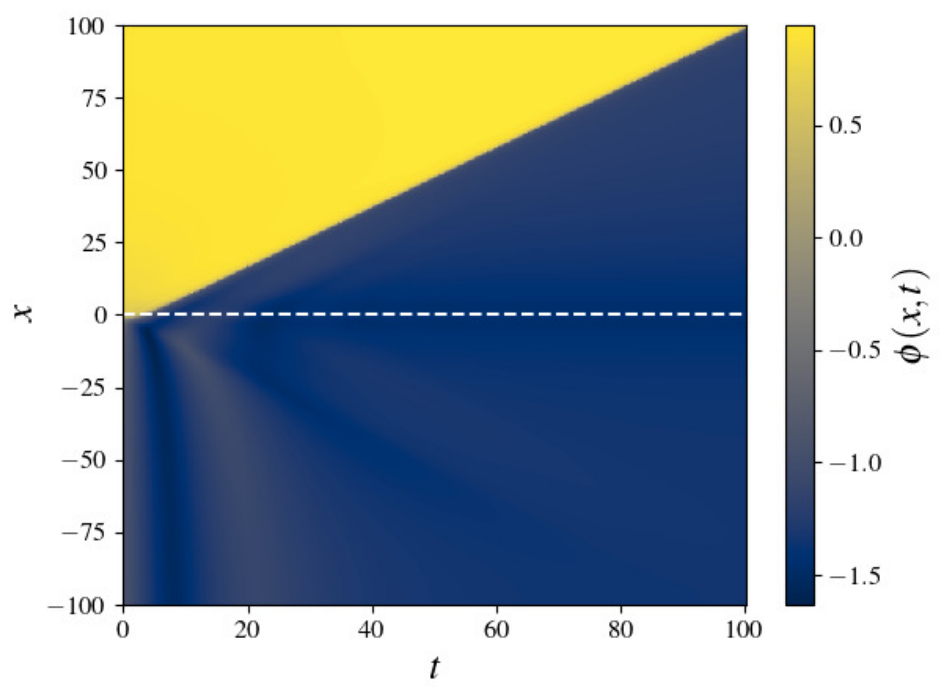
Figure 2. Scheme of a Josephson junction.
Mmphys 02 00005 g002
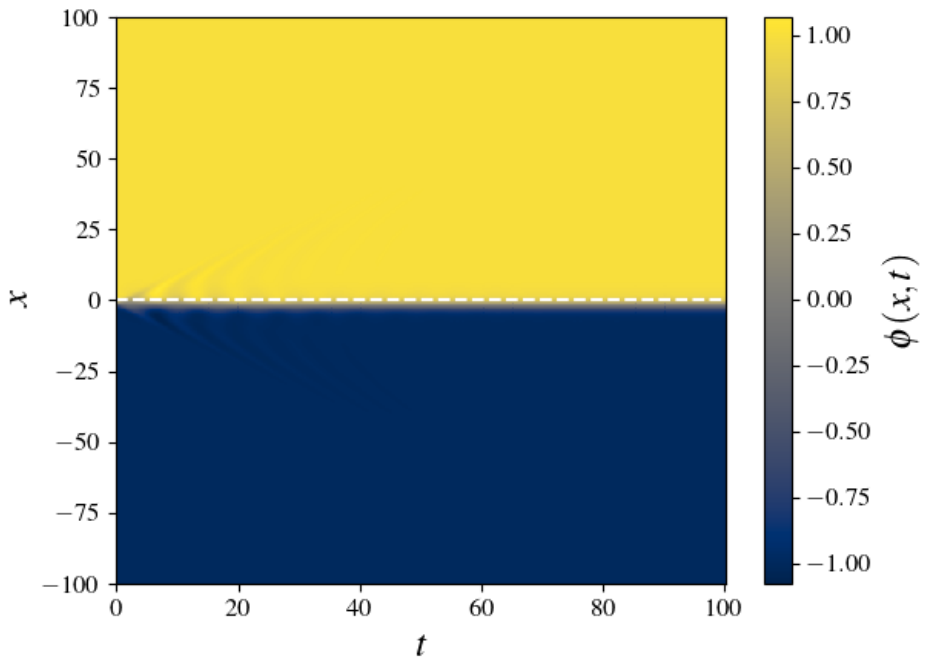
Figure 3. Inhomogeneous potential V ( x ) for the motion of the kink-like object. (a) A bistable potential. (b) The kink-like object does not “feel” the barrier in the middle: the position x = 0 is a stable equilibrium position for the kink-like object. (c) The potential from (a) when we remove the minimum on the “right”-side. (d) As the kink-like object does not “feel” the barrier as in (c), it can move to the right direction as if tunneling through the barrier.
Mmphys 02 00005 g003
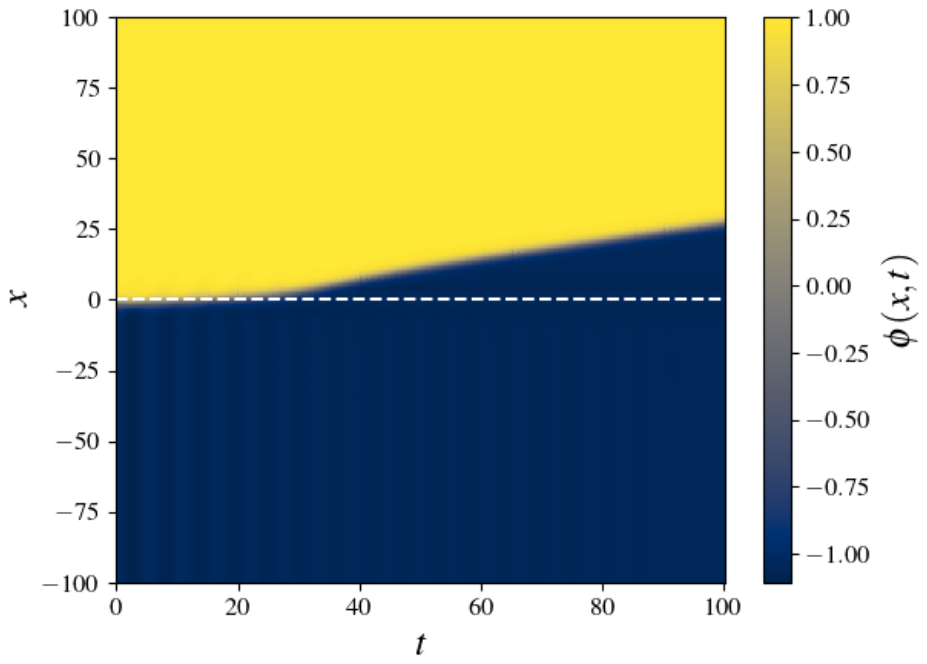
Figure 4. External force F ( x ) for soliton-like tunneling.
Mmphys 02 00005 g004
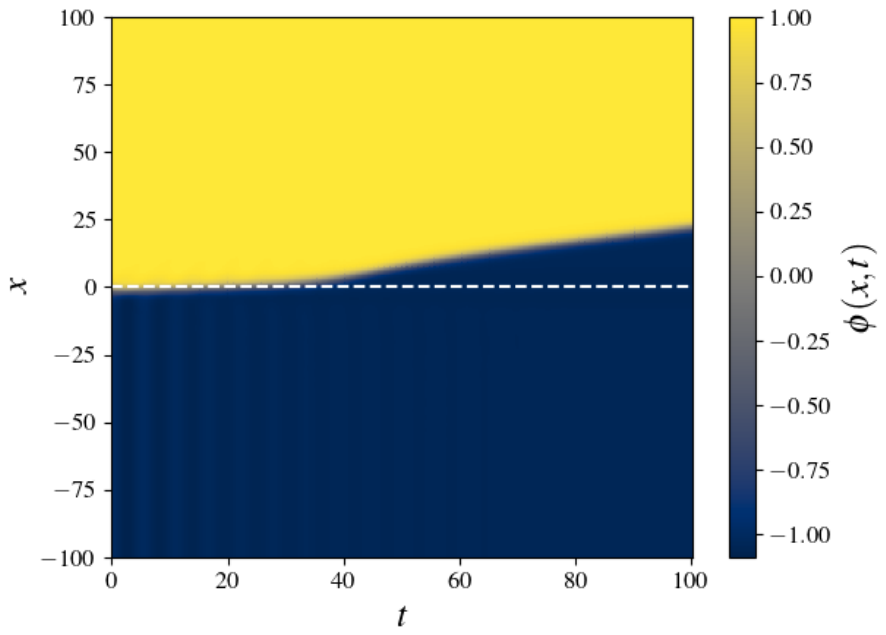
Figure 5. A first example: E p for increasing values of n, showing how the barrier disappears. For n = 15 there is already tunneling.
Mmphys 02 00005 g005
Figure 6. A second example: E p for increasing values of n, showing how the barrier disappears.
Mmphys 02 00005 g006
Figure 7. External force F ( x ) (in red color) and potential V ( x ) (in blue) for soliton tunneling.
Mmphys 02 00005 g007
Figure 8. Potentials U ( ϕ ) , V ( ϕ ) = U ( ϕ ) .
Mmphys 02 00005 g008
Figure 9. Phase plane for the dynamical system (31) and (32) associated to the fictitious particle. In red the separatrices of the saddle points, in blue some reference orbits.
Mmphys 02 00005 g009
Figure 10. Phase plane for the dynamical system (31) and (32) associated to the fictitious particle, for b = 0 and Δ 0 . In red the separatrices of the saddle points, in blue some reference orbits.
Mmphys 02 00005 g010
Figure 11. Variations of ϕ 1 , ϕ 2 and ϕ 3 as | F | increases and F < 0 .
Mmphys 02 00005 g011
Figure 12. This is a typical graph of v k ( t ) that illustrates that lim t v k ( t ) = v l i m i t 0.99 . Thus, theoretically and experimentally we get the behavior of v k ( t ) .
Mmphys 02 00005 g012
Figure 13. Dynamics of the kink’s center of mass. The blue line shows an ( n = 5 ) kink that remains trapped inside the potential well. In this case Δ = 0 . The red line shows the same long-range kink now driven by Δ 0 ( Δ 0.6057892 ). Now the kink is escaping the potential well. In both cases the initial position of the center of mass is X 0 = 5 .
Mmphys 02 00005 g013
Figure 14. A long-range ( n = 5 ) kink is moving inside a potential well (defined between the points x = 10 and x = 0 , represented respectively by the yellow and the lower green lines) and is facing a barrier (defined between the points x = 0 and x = 10 , represented by the two green lines). The kink is driven by Δ 0 ( Δ 0.1735531036 ). The kink is able to escape the potential well, Equation (88).
Mmphys 02 00005 g014
Figure 15. A Δ -driven long-range kink is moving through a randomly disordered medium with a velocity very close to the maximum speed c = 1 ( Δ 0.6057892 ).
Mmphys 02 00005 g015
Figure 16. Behavior of the long-range kink according to Equation (92). Here both the barrier and the potential well are very wide.
Mmphys 02 00005 g016
Figure 17. A long-range ( n = 9 ) kink is escaping a potential well closed by a barrier almost four times higher than the maximum height that (supposedly) is already prohibitive for a ϕ 4 kink. Here Δ 129.6187 .
Mmphys 02 00005 g017
Figure 18. A long-range ( n = 9 ) kink is escaping an enormous potential well closed by a giant barrier in height and width. The height of the barrier is almost eleven times higher than the critical value for the ϕ 4 kink. Here Δ 4.2018438 .
Mmphys 02 00005 g018
Figure 19. Function R ( ϕ t ) when for small values of ϕ t , R ( ϕ t ) ϕ t < 0 . This implies negative resistance.
Mmphys 02 00005 g019
Figure 20. Function E p ( x ) with a local minimum and a local maximum.
Mmphys 02 00005 g020
Figure 21. Function E p ( x ) monotonically decreasing.
Mmphys 02 00005 g021
Figure 22. Graph of E p ( x ) x for the case shown in Figure 20.
Mmphys 02 00005 g022
Figure 23. This picture can be the result of long-range topological object tunneling (as in Figure 21) or the addition of Δ 0 , or a sequence of events where, first, the long-range property reduces the value of F M , and, second, Δ 0 is added (see Figure 24). As a result of the two processes, the total force ( x ) is positive everywhere.
Mmphys 02 00005 g023
Figure 24. Force transformation as different features are considered.
Mmphys 02 00005 g024
Figure 25. Illustration of a randomly disordered medium. The maximal negative value of F ( x ) ( F m i m a x ) is indicated. This is the maximal force that will try to act against the motion of the kink-like excitation to the “right”.
Mmphys 02 00005 g025
Figure 26. Equation set (146). One of the simplest experiments with a kink-like solitary wave: no damping, no external forces, Δ = 0 . The initial velocity is not zero ( V 0 > 0 ). The kink-like object will continue moving with that positive constant velocity.
Mmphys 02 00005 g026
Figure 27. Equation set (147). No damping, no external forces, Δ = 0 . The initial velocity is zero. The kink-like object will remain at rest.
Mmphys 02 00005 g027
Figure 28. Equation set (148). The initial velocity is not zero ( V 0 > 0 ), but there is damping. No external forces, Δ = 0 . Initially the object will move forward for a while. The dissipation will slow down its motion. The solitary wave will eventually be at rest.
Mmphys 02 00005 g028
Figure 29. Equation set (149). No damping, no external forces. Initial velocity is zero ( V 0 = 0 ). The kink-like object is moving forward because Δ 0 ( Δ < 0 ). Despite the fact that the initial velocity is zero and there are no external forces acting on the object, the solitary wave will eventually move forward very fast.
Mmphys 02 00005 g029
Figure 30. Equation set (150). There is damping. Initial velocity is zero ( V 0 = 0 ). There are no external forces. The kink-like solitary wave will eventually be moving with constant velocity because Δ 0 ( Δ < 0 ). Despite the fact that V 0 = 0 and there is damping, the Δ -driven kink-like object will move forward. The constant velocity is the result of an equilibrium from the competition between Δ 0 and the damping (see Equations (64)–(67)).
Mmphys 02 00005 g030
Figure 31. Equation set (151). This is a kink-like solitary wave moving with a higher constant velocity due to the action of a larger | Δ | and the same damping as in Figure 30.
Mmphys 02 00005 g031
Figure 32. Equation set (152). A short-range ϕ 4 kink-like object ( n = 1 ) remains trapped inside the potential well created by F ( x ) .
Mmphys 02 00005 g032
Figure 33. Equation set (153). A short-range ϕ 4 kink-like object is initially in the same potential well mentioned in Figure 32. However, in this case Δ 0 ( Δ < 0 ), which leads to the object’s escape.
Mmphys 02 00005 g033
Figure 34. Equation set (154). The same situation as in Figure 33 with the difference that the solitary wave is long range. As the mass of the object is smaller, the velocity that it can reach is higher.
Mmphys 02 00005 g034
Figure 35. Equation set (155). The same F ( x ) as in Figure 34, but the solitary wave is longer range, and | Δ | is larger. The limit velocity is very large. The height of the barrier which this object can escape is much higher.
Mmphys 02 00005 g035
Figure 36. Equation set (156). The potential well is larger and the barrier is higher than in Figure 33. The object will remain trapped inside the potential well.
Mmphys 02 00005 g036
Figure 37. Equation set (157). The same F ( x ) as in Figure 36. However, | Δ | satisfies the superpropagation condition. Hence, the solitary wave will escape.
Mmphys 02 00005 g037
Figure 38. The same system as in Figure 37 but with a different Δ ( Δ = 0.0177481 ). Here | Δ | < F M . However, using the condition (104), we obtain that this Δ is enough for the the kink-like escape.
Mmphys 02 00005 g038
Figure 39. There is damping. There is F ( x ) that creates a potential closed off by a barrier. Initial velocity is zero ( V 0 = 0 ). The kink-like object is inside the potential well at rest. It seems that the escape is difficult. The potential U ( ϕ ) is asymmetric ( Δ 0 ). However, Δ = 0.0109567 , | Δ | < F M = 0.02 . There is no superpropagation. Nevertheless, (104) holds for all points x, such that x 1 < x < x 2 . We know this because the maximum negative value of E p ( x ) / x is F M = 0.004579 . Therefore | Δ | > | F M | . Hence, (104) holds for all x.
Mmphys 02 00005 g039
Figure 40. A long-range kink-like object remains trapped in a potential well.
Mmphys 02 00005 g040
Figure 41. A long-range kink-like object escapes the potential well due to a value Δ 0 ( Δ < 0 ).
Mmphys 02 00005 g041
Disclaimer/Publisher’s Note: The statements, opinions and data contained in all publications are solely those of the individual author(s) and contributor(s) and not of MDPI and/or the editor(s). MDPI and/or the editor(s) disclaim responsibility for any injury to people or property resulting from any ideas, methods, instructions or products referred to in the content.