1. Introduction
National and international literature and policy analysts have long labelled Pakistan’s economy as “an agricultural economy”, which is supported by the latest Pakistan Economic Survey (2020–21), showing that agriculture employs 38.5% of the workforce [
1]. However, when it comes to the agriculture sector’s contribution to the overall Gross Domestic Product (GDP), it exhibits alarmingly contradictory numbers, accounting for only 19.5% of the total national output. In comparison, the industrial sector contributes 20.8%, while the services sector contributes 59.9%. These figures reveal that Pakistan’s agriculture industry is declining and can be considered a critical stumbling block to economic growth [
2]. Pakistan’s agriculture sector desperately needs improvement to meet the country’s rising population’s food and agricultural input needs [
3]. In addition to political stability, improved governance, and stable macroeconomic variables, a policy framework must be anchored alongside research and development (R&D) in the agriculture sector to be more productive. Therefore, the increased agricultural productivity will help achieve sustainable economic growth.
The financial well-being of the rural population is inextricably related to increased agricultural productivity. Given the deteriorating climatic conditions and the scarcity of significant resources such as land, salinity, and acidity, agricultural growth relies primarily on technology and investment. Consequently, researchers have emphasised the critical role of agricultural R&D expenditures, highlighting their substantial returns in improving agricultural production [
4]. R&D fosters the development of innovative production techniques, enhancing producers’ efficiency [
5]. Moreover, R&D provides a sustainable solution to persistent issues such as poverty, unemployment, and food insecurity, particularly in rural areas. As a result, increased investment in agricultural R&D is essential to improve economic growth and long-run development [
6]. Usually, a country’s technological advancement is determined by its R&D expenditure. However, besides the positive role of R&D investments, climate change poses a significant threat to crop yields. The South Asian region, particularly Pakistan, is susceptible to climate change, such as erratic rainfall patterns and rising temperatures.
At the same time, climate change poses a significant threat to crop yields, and South Asian countries—particularly Pakistan—are especially vulnerable to erratic rainfall patterns and rising temperatures. While a country’s technological advancement is often determined by its R&D expenditure, these climate factors can undermine gains from innovation if not addressed alongside technological improvements. Thus, R&D investments and climate change considerations must be integrated into any strategy to improve agricultural outcomes.
Wheat is considered the primary food crop in Asia. Historical data indicated that 1960 wheat production amounted to 3.91 million tonnes, and the wheat cultivated area was nearly 5 million hectares.
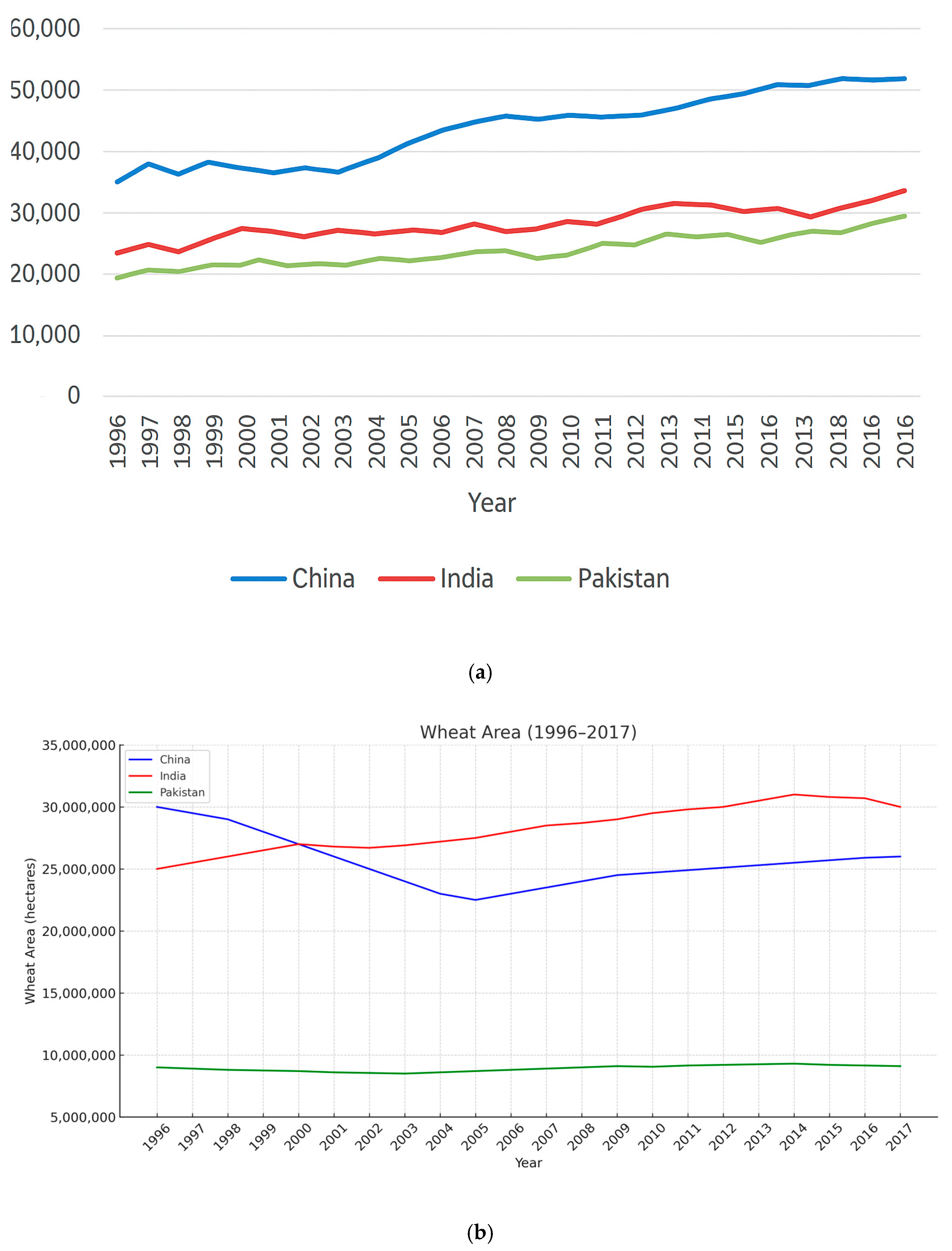
Figure 1 presents the history of wheat yield over the past 20 years, revealing that China has higher efficiency in wheat productivity than India and Pakistan.
Figure 1a illustrates the wheat yield per hectare, with the x-axis representing years from 1996 to 2018 and the y-axis showing yield in kilograms per hectare (kg/ha). It clearly shows that China has maintained a higher wheat yield than India and Pakistan, highlighting its efficiency in wheat productivity.
Figure 1b depicts the total area under wheat cultivation for the same period, with the x-axis representing years and the y-axis showing the area in hectares. The trends in this panel indicate the changes in cultivation areas over time, providing insights into how agricultural practices and policies have influenced the scale of wheat production in these countries. The disparity is primarily attributed to China’s strategic emphasis on fertiliser application in wheat cultivation [
7].
The scale and production of wheat cultivation in Pakistan have increased significantly over the past five decades, reaching 27.3 million tonnes in 2020–21 and spanning more than 9 million hectares. This growth stems from technological improvements since the Green Revolution of the 1960s and 1970s, including hybrid seed varieties, optimal fertiliser use, and supportive agricultural policies. Despite these advancements, there remains a notable scarcity of research that systematically examines how climate change variables (such as temperature and rainfall) intersect with R&D investments to influence wheat productivity in South Asia, particularly Pakistan. While various studies highlight individual factors—like climate impacts on yields or R&D’s contribution to productivity—few integrate both dimensions across China, India, and Pakistan in a comparative framework. This lack of comprehensive, country-level evidence on the interplay between climate shocks and R&D expenditure leaves critical questions unanswered regarding the best strategies to enhance resilience and maintain high productivity under changing climatic conditions.
Over the past centuries, human activities have significantly altered the world’s atmosphere [
4]. The agriculture sector is the most susceptible to the effects of climate change [
8]. Changes in rainfall patterns, temperature fluctuations, water availability, and evapotranspiration are key factors through which climate change affects crop yields [
9].
The increased CO
2 concentration increases the process of photosynthesis and suppresses transpiration in C3 crops, leading to accelerated plant growth. On the other hand, increased average temperature offsets these positive effects of CO
2 concentration [
10]. This study investigated the impact of CO
2 emissions and temperature change on China, India, and Pakistan’s wheat yield.
R&D is imperative in developing a modern economy, particularly in agriculture. Empirical studies consistently have demonstrated a causal relationship between R&D, technological innovation, and productivity growth [
11,
12,
13]. Despite Pakistan’s classification as an agricultural economy with more than 40% of the labour force employed in this sector, its agriculture value-added and crop production index significantly trail India and China [
9]. This lagging can be attributed to Pakistan’s falling behind in R&D expenditures, as both India’s and China’s R&D expenditures as a portion of GDP are 0.8% and 2%, respectively, compared to Pakistan’s 0.3% [
9,
14]. Besides these disparities, there is an information gap, as there is no information available about R&D indicators, such as missing years for Pakistan, which is clear evidence of the lack of research and innovative practices in Pakistan.
Addressing this gap is crucial because understanding the dual impact of R&D and climate factors on wheat yield can inform evidence-based policies to mitigate climate shocks and enhance food security. By exploring these issues across China, India, and Pakistan—three countries with varying degrees of climate vulnerability, population pressures, and investment in R&D—this study provides a more holistic perspective on what drives sustained agricultural productivity. Two central research questions guide this study. The first question seeks to determine whether R&D has any positive effect on increasing wheat yield in China, India, and Pakistan. The second question explores whether these countries have consistently achieved positive trends in wheat yield. By examining the role of R&D in boosting productivity and evaluating patterns of wheat yields over time, the study aims to provide a comprehensive understanding of the factors influencing agricultural output in these regions. It further investigates the contribution of R&D expenditures alongside climatic variables—specifically temperature and rainfall—to wheat yield productivity in Pakistan and the neighbouring countries of India and China.
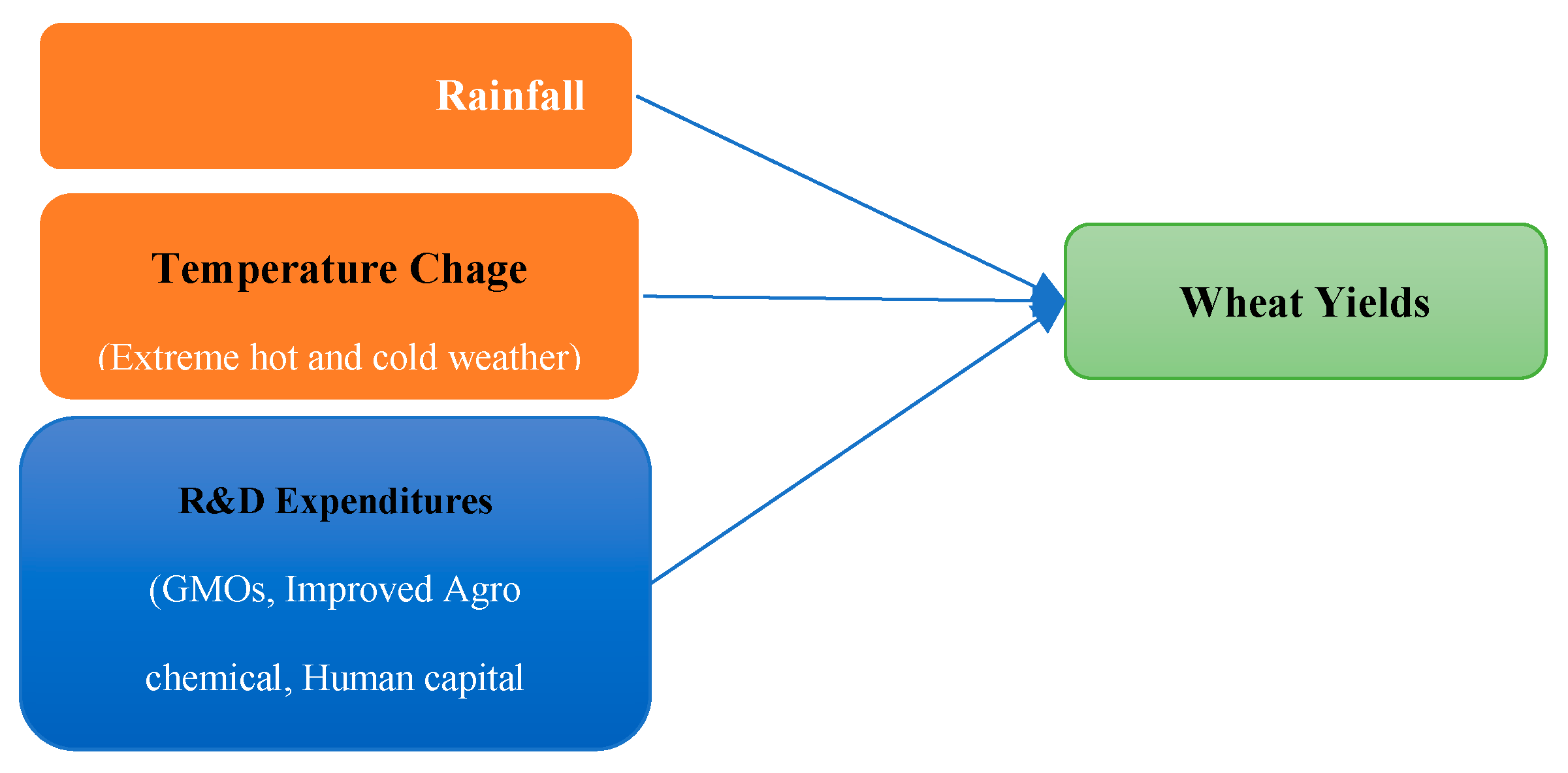
To support the methodology of this analysis, the study draws on Romer [
15], endogenous growth theory, which posits that technological improvements can increase output per worker and incentivise capital accumulation. In this framework, technological change arises in response to market incentives and government support for academic research, generating knowledge and instructions that enhance product value. Once created, such knowledge and instructions can be reused, reflecting their nature as an initial fixed cost. R&D is viewed as newly developed knowledge that can positively affect crop productivity, even amid climate shocks. This conceptual approach will guide the empirical investigation that follows in
Figure 2.
This study aimed to provide critical insights for climate change practitioners by examining the impacts of climate change on crop productivity, assessing its regional severity, and highlighting the potential consequences, such as food losses, poverty, and unemployment, in the absence of proper mitigation strategies. By analysing the impact of R&D expenditure, this study contributed to policy-making. Specifically, it underscores the importance of strategic fund allocation to mitigate climate shocks and enhance food security for a growing population. This research article is the first attempt to analyse the role of innovation in agriculture in Pakistan.
The remaining sections of the research study consist of the literature review, methodology, results and discussion, and suggestions and recommendations.
2. Literature Review
A significant proportion of the population in developing economies resides in rural areas, where the agricultural sector is a primary source of livelihood and employment [
6]. Agricultural development is essential for these economies [
16]. Viana et al. [
17] highlighted the sector’s crucial role in providing food items and sustainable ecosystem services. Therefore, agriculture is vital for food security and employment opportunities for rural populations. Developing the agricultural sector aligns with sustainable development goal 2 (SDG 2), zero hunger [
18]. Among agricultural products, cereal crops remain fundamental to the human diet and are expected to retain this importance in the foreseeable future. The availability of irrigation water from streams, rivers, and underground sources significantly influences agricultural production. Studies have established a direct correlation between crop yield and irrigation water availability [
19]. However, expanding the irrigation system remains challenging due to water scarcity and environmental constraints. Jat et al. [
20], in a study on integrated nutrient management, suggested that applied research on conservation tillage technologies in areas with limited rainfall would improve the living standard in third-world countries; however, the impact was likely to remain localised. Soil degradation, primarily driven by unfavourable climate conditions, significantly threatens global food security, particularly in developing countries. Over the next three decades, global food security will primarily depend on agricultural innovations designed according to soil quality, plant ecology, and many other environmental factors such as rainfall variability, temperature fluctuations, and greenhouse gas emissions. Even incremental improvements in yield potential contribute positively to global food security, particularly in the developing regions where rural populations remain vulnerable to food security. Although R&D investments in developing economies require time to yield benefits, they are crucial for ensuring long-run food security and economic growth [
21].
Since the 18th century, economic growth has been the prime focus of macroeconomics. The literature mainly focused on economic growth and other factors, such as per capita income and population, through both theoretical and empirical analyses [
22]. In early neoclassical theory, knowledge was considered an exogenous factor, while production was affected by input goods, labour, and capital. On the other hand, the endogenous growth theory states that R&D investments drive knowledge and technological innovations, thereby enhancing productivity [
15]. R&D investments have been shown to increase the returns to scale and contribute to long-run growth [
23]. Solow [
24] provides the neoclassical growth model, which originally identified capital accumulation, productivity, and population growth as the primary sources of economic growth but has been modified to incorporate R&D activity as a central determinant of economic growth. Technological advancement results from conscious financial investment, making R&D expenditures essential to economic growth and development [
11]. Moreover, sustained growth is only achievable through R&D spillovers [
11]. Both theoretical and empirical studies have emphasised the critical role of R&D investments in long-run economic growth [
22]. In agriculture, R&D was changing rapidly, affecting future outcomes related to global poverty, food insecurity, and other outcomes [
25]. The sector-wise empirical results of the rate of return on R&D are given in chronological order. Similarly, Peterson [
26] estimated the rate of return on R&D expenditures in poultry to be between 21% and 25%, in tomato harvesters between 37% and 46%, and in the overall agricultural sector between 41% and 50% [
25]. Existing literature has employed various methodologies to quantify the impact of R&D expenditures on economic growth and agricultural productivity [
5,
27,
28]. Most of these studies used the production function approach as an example (Guellec and Potterie, 2003), the cost function approach, for instance [
29], or the modified Cobb-Douglas production function used by Hall and Scobie [
30]. Most of these models have been estimated using an econometric method. A limited number of research studies have applied diverse econometric methodologies to assess the role of R&D in productivity, specifically in developing economies like Pakistan. Given the key role of agriculture in these economies, more advanced and comprehensive techniques are required to provide a deeper understanding of the impact of R&D expenditures on agricultural productivity. In the present study, we proposed to use a panel data econometric technique to quantify the impact of R&D expenditures on wheat yield across a selected group of countries. The moving average technique was employed to estimate some of the missing observations of R&D in the sampled countries.
Most research studies on this topic were qualitative at the aggregate level, e.g., the Intergovernmental Panel on Climate Change [
31]. Quantitative research studies, particularly those assessing efficiency and measuring productivity in uncertain agricultural conditions under climatic change, remain challenging due to the unavailability of data and the lack of appropriate methodologies [
32]. This study aimed to fill this gap by empirically analysing the impact of climate change on wheat productivity and analysing the role of R&D expenditures on wheat yield across selected countries.
Although existing studies have examined the impact of R&D on agricultural productivity, there is still a lack of research on the specific effects of climate change on wheat yield in South Asia and the role of R&D in mitigating these impacts. Moreover, there is a gap in the literature regarding a systematic comparative analysis of the three major agricultural countries—Pakistan, India, and China. This study aims to fill this gap by empirically investigating the short- and long-term impacts of R&D and climate change on wheat yield, providing a scientific basis for policy-making.
3. Methodology
3.1. Data and Data Sources
This study used secondary data from 1996 to 2018 on significant crops (wheat, maize, rice, sugarcane, and cotton) in Pakistan, India, and China. This period was chosen because of the data availability from 1996 to 2018; R&D data were unavailable after 2018. Comparing India and Pakistan is important because these countries are ranked among the top five populous countries, and they are developing countries that can be vulnerable to food hunger. The food security situation is nearly similar, and their large populations put the same immense pressure on their agriculture sector. The sampled countries are neighbouring countries, and the agricultural practices of one country have repercussions for the other countries. The data sources were the World Bank, FAOSTAT, Economic Survey of Pakistan, Pakistan Meteorological Department, and Trading Economics. Although some newer data may exist for specific variables or individual countries, excluding post-2018 data helps maintain consistency in the panel. Specifically, R&D data were not uniformly published or accessible after 2018 for all three countries, making it difficult to extend the analysis without compromising comparability.
The reliance on data ending in 2018 may introduce bias if important shifts or non-linear trends occur in the subsequent years. For instance, changes in agricultural practices, climate patterns, or policy reforms post-2018 could significantly influence agricultural outputs and R&D investments. While using a balanced, multi-country panel from 1996 to 2018 strengthens cross-sectional comparability, any unobserved structural changes or shocks that have occurred since 2019 (e.g., global disruptions or notable climate anomalies) remain outside the scope of this analysis. As such, readers should interpret the findings within this specific time frame and with the awareness that some longer-term or more recent trends may not be fully captured. A future extension of this research could reassess the findings by integrating post-2018 data once it becomes available, thereby examining whether the observed relationships hold in the presence of potentially non-linear developments or abrupt changes after the study period.
3.2. Econometric Techniques
This study used two different econometric techniques to analyse the relationships between crop yield and explanatory variables. The Autoregressive Distributive Lag (ARDL) model was used to investigate the short- and long-run relationship between study variables in each sampled country. First, we investigated these relationships at the individual country level, and subsequently, we analysed them collectively for a region comprising three sampled countries. The ARDL model has been widely used for several decades due to its ability to test short- and long-run cointegration between a mix of stationary and non-stationary variables [
33,
34]. Furthermore, ARDL modelling effectively addressed severe econometric issues such as endogeneity and incorrect hypothesis testing that might arise in quantitative analysis [
28,
35]. There were several cross-section units in panel data analysis, each with its own effects. The Pooled Mean Group (PMG) or panel ARDL model offered several benefits in empirical research, as it may be used for stationary and non-stationary variables. Because of the association between mean-differenced repressors and the error, ARDL regression estimation became skewed in this situation and preferred over other panel econometric techniques [
36]. As a result, it was unnecessary to check for the unit root property of data before using the PMG estimator. ARDL and PMG models were also free from unit root restrictions, but the only condition was that none of the variables was integrated into the order. Because, in that case, the F-statistics were not valid, and the panel cointegration was not likely to be applicable.
The PMG estimator also offered a key advantage by providing estimates of coefficients for both long- and short-run connections. This study evaluated the long- and short-run relationships between wheat yield, R&D expenditures, average rainfall, average temperature, and area under cultivation across selected sampled countries. Therefore, the panel ARDL or PMG technique was used to investigate the long- and short-run relationships between dependent variables (crop yield) and independent variables (environmental factors, R&D expenditures, and area under wheat crop).
3.3. Variables and Units
In our econometric model, wheat yield was dependent on R&D, average rainfall, and land use (land under wheat crop). The unit of measurement and description of variables are given as follows:
3.4. Specification of Econometric Models
3.5. The Auto-Regressive Distributed Lag (ARDL) Model
In this section, the selected model for this study is presented in ARDL format. The ARDL model’s long- and short-run equations are both provided. The ARDL (p, q) model is shown in Equation (7).
Equation (7) above consists of both short- and long-run elements. As a result, if a long-run association exists, i.e., if the model had cointegration, the following long-run model was estimated.
The Error-Correction Model
Finally, if the long-run relationship exists, the error correction model was used to calculate the dynamic coefficient in the case of the short run. This model is also known as the speed of adjustment.
Pooled Mean Group (PMG) Model
In the above Equation (10), the regressors are allowed to be purely integrated of a mixed order, such that I(0) and I(1). δ_i is a scalar and a coefficient of the lagged dependent variable (crops). φ_i is the unit-specific fixed effects; i = 1,2…, N; p, q are optimal lag orders; eit is the error term; t = 1, 2…, T. The optimal lag order is to use a relatively large value for p, estimate the model for p, p − 1, p − 2, … lags and choose the model with the lowest value of Akaike Information Criterion (AIC) and Schwarz Bayesian Criterion (SBC).
The Re-Parameterised PMG and Error Correction Model (ECM)
where;
, group-specific speed of adjustment coefficient (expected that , usually the sign is negative with significant p-value).
= coefficients long run relationship
= short-run dynamic coefficients
Threshold Temperature Change
where
TEMP2 = Threshold temperature level
exp = exponential function
= coefficient of temperature
= coefficient of threshold temperature
5. Discussion
The discussion section comprehensively examines the broader implications of the study’s findings, effectively bridging the gap between empirical results and their relevance to academia, practice, and policy-making. It analyses explicitly how R&D investments and climate variables influence wheat productivity in China, India, and Pakistan, providing valuable insights into the region’s agricultural sustainability dynamics. While the panel analysis suggests that higher temperatures generally negatively impact wheat yields, the individual country-level estimates in
Table 4 indicate a more complex relationship. Specifically, moderate temperature increases appear beneficial in specific contexts, potentially due to localised growing conditions that allow wheat plants to take advantage of slightly warmer weather early in the season. However, once temperatures exceed an optimal threshold, yields begin to decline, as reported by Rosenzweig and Tubiello [
39].
These seemingly contradictory effects also align with region-specific agronomic factors, sowing times, and cultivated varieties. In parts of Northern China and some regions of Pakistan, an earlier or moderately warmer spring can hasten germination and crop establishment, thereby increasing yields. Conversely, excessive heat, especially during the grain-filling stage, induces heat stress and accelerates evapotranspiration, reducing final output [
10]. Such threshold-dependent temperature effects underscore the importance of identifying local climate ‘sweet spots’ and investing in heat-tolerant wheat varieties to counteract detrimental impacts.
5.1. Academic Implications
This study has emphasised the crucial role of R&D expenditures and environmental factors in determining wheat productivity in China, India, and Pakistan. By applying PMG and ARDL models, this research has highlighted the significance of R&D expenditures as a long-run driver of agricultural productivity, thereby contributing to the theoretical discourse on endogenous growth models. The findings align with existing literature, demonstrating that R&D expenditures exert a delayed yet substantial impact on crop yield improvements. Moreover, temperature and rainfall’s nuanced effects on wheat productivity have enhanced our understanding of climate-agriculture interrelationships. The country-specific findings offered valuable comparative insights, enriching empirical studies on agricultural sustainability, particularly in developing economies where agriculture is crucial for food security and rural livelihoods.
5.2. Practical Implications
This research has emphasised the importance of long-run agricultural R&D expenditure for agricultural practitioners to sustain and enhance crop yields. The results suggested that adopting climate-resilient seed varieties and advanced farming techniques had mitigated adverse climatic effects. Agricultural extension services should prioritise educating farmers on efficient resource utilisation, technological advancements, and the importance of R&D innovations. Furthermore, the findings underscored the necessity of targeted interventions, such as optimising wheat cultivation areas, to maximise output efficiency in resource-constrained environments.
5.3. Policy Recommendations
Policymakers should prioritise increasing agricultural R&D expenditure, particularly in Pakistan, where the return on investment has been the highest, to achieve long-run productivity gains. For example, we will suggest concrete policy tools such as increasing the agricultural R&D budget by a specific percentage, offering subsidies for climate-resilient crop varieties, and establishing regional agricultural technology cooperation mechanisms. Introducing and subsidising climate-resilient wheat varieties that could withstand temperature fluctuations and rainfall variability is essential for mitigating the adverse effects of climate change. Optimising land use by adopting advanced farming practices and technologies should also be encouraged, reducing the need to expand cultivated areas further. Regional collaboration among China, India, and Pakistan is crucial for sharing R&D insights, technologies, and best practices to address common agricultural challenges. Furthermore, integrating agricultural resilience measures into comprehensive climate action plans will enhance national and regional climate adaptation strategies, ensuring sustainable agricultural development amid increasing climatic uncertainties.
5.4. Limitations of the Study
This study, while comprehensive, has certain limitations. First, the reliance on secondary data limited the granularity of climate-related variables, such as microclimatic effects and localised rainfall patterns. Future studies could incorporate high-resolution climatic datasets to capture local variations better. Second, this research is on three South Asian countries, which may limit the findings’ generalisability to other regions with distinct climatic and economic contexts. Expanding the analysis to other wheat-producing regions could yield broader insights. Finally, although this study considered R&D expenditures as a percentage of GDP, further research could disaggregate R&D expenditures to explore the specific impacts of individual components, such as seed development and irrigation technologies.
5.5. Summary
The findings largely support Romer [
15] and the endogenous growth framework, which posits that R&D investment stimulates productivity growth. Consistent with this theoretical perspective, we observe significant long-run elasticity of R&D expenditures on wheat yields across China, India, and Pakistan. This outcome indicates that accumulated knowledge and innovation—enabled by sustained R&D—can gradually transform agricultural practices, leading to higher crop productivity. Consequently, our results reinforce the view that policy measures aimed at bolstering agricultural R&D can foster long-term, self-reinforcing improvements in crop yield and food security. At the same time, our findings show that adverse climate factors, especially rising temperature beyond a threshold level, can offset some of these productivity gains, underscoring the importance of integrating climate adaptation strategies within the broader framework of endogenous growth.