
Article

Influence of Forest Cover and Human Activity on the Distribution of Sites Where Jaguars (Panthera onca) Feed on Sea Turtles in Santa Rosa National Park, Costa Rica

by
Jóse M. Chopin-Rodríguez
1,2,
Víctor H. Montalvo
1,3,*,
Kevin J. Lloyd
1,
Carolina Sáenz-Bolaños
1,3,
Brayan Morera
1,
Juan C. Cruz-Díaz
3,
Eduardo Carrillo
1,3 and
Todd K. Fuller
4
1
Instituto Internacional en Conservación y Manejo de Vida Silvestre, Universidad Nacional, Heredia 1350-3000, Costa Rica
2
Facultad de Medicina Veterinaria y Zootecnia, Universidad Salvadoreña Alberto Masferrer, San Salvador 1101, El Salvador
3
Namá Conservation, Heredia 40101, Costa Rica
4
Department of Environmental Conservation, University of Massachusetts, Amherst, MA 01003, USA
*
Author to whom correspondence should be addressed.
Submission received: 20 October 2025 / Revised: 28 December 2025 / Accepted: 14 January 2026 / Published: 19 January 2026

Simple Summary

Jaguars (Panthera onca) frequently prey on nesting sea turtles and drag carcasses from the beach into forested areas, yet the factors shaping these behaviors are not well understood. We examined how vegetative cover and human presence influence carcass distribution across three nesting beaches in Santa Rosa National Park with varying visitation levels. Jaguars favored densely vegetated areas, likely to reduce scavenger interference. Tourist-heavy beaches contained fewer carcasses, while remote beaches had the most. On disturbed beaches, jaguars dragged carcasses farther inland and clustered feeding sites more tightly. These results indicate that jaguars avoid humans and seek concealed habitats, informing conservation strategies for both species.

Abstract

Predation of sea turtles by jaguars (Panthera onca) in the Santa Rosa National Park (SRNP) has been well documented over the past decade. However, the factors that influence jaguar feeding behavior, including environmental factors or characteristics of the beaches and the adjacent forest, are poorly known. This study aimed to identify the relationship between vegetation density and human activity on the distribution of feeding sites of jaguar on sea turtles at nesting beaches in Santa Rosa National Park, Costa Rica. We sampled three beaches (Naranjo, Nancite, and Colorada), where we identified and registered sea turtle carcasses preyed on by jaguars between June and November 2019. Through systematic searches of the forest adjacent to the beach, we documented the species, geographic coordinates, carcass length and width, vegetation cover at the carcass site, and the average vegetation coverage corresponding to the date and beach of each sea turtle carcass. In total, we recorded 338 sea turtle carcasses preyed on by jaguars, 156 at Naranjo beach, 103 at Nancite beach, and 89 at Colorada beach. The beach with the highest average density of carcasses was Colorada (8.7 (SD = 5.42)/ha), followed by Nancite (6.06 (SD = 5.58)/ha) and Naranjo (2.64 (SD = 1.79)/ha). The dragging distance from the beach line to sea turtle carcasses was best explained by the interaction of nesting beach and canopy cover at the carcass. Our canopy cover results may reflect that jaguars select sites that better hide their prey, in the same way that green turtles (Chelonia mydas) usually prefer areas with good coverage to nest in, contrasting to the nesting behavior of olive ridleys (Lepidochelys olivacea). On beaches, higher concentrations were observed where there was less human presence and this may reflect both turtle nesting and jaguar predation activity.

1. Introduction

The predation of sea turtles by jaguars (Panthera onca) represents a unique ecological interaction between two species of conservation concern [1]. When nesting on land, sea turtles become accessible and energetically profitable prey compared to more elusive species such as deer or peccaries [2]. Because turtles provide substantial biomass, jaguars can extend the interval between hunting events, obtaining a more favorable energetic return [3]. This predator–prey relationship has been reported along the coasts of the Americas, including Mexico [4], Suriname [5], and Guyana [6]. In Costa Rica, jaguar predation on sea turtles has been documented in Corcovado National Park [7], Tortuguero National Park [8], and Santa Rosa National Park (SRNP) [9]. Within SRNP, jaguars prey upon olive ridley (Lepidochelys olivacea), green (Chelonia mydas), leatherback (Dermochelys coriacea), and hawksbill turtles (Eretmochelys imbricata) [7,8,9,10]. Predation events occur frequently, and numerous carcasses with characteristic jaguar bite and drag marks have been recorded [9]. This behavior has been most thoroughly studied at the main nesting beaches of Naranjo and Nancite, where jaguars adjust their foraging strategies in response to prey availability [11,12,13]. Despite this focus, predation has also been reported at more remote SRNP beaches, such as Colorada, Potrero, Blanca, Pelada, and several unnamed sites [14]. Due to limited accessibility, these beaches have received much less research attention. Carcass distribution varies widely across SRNP. A cumulative 228 carcasses have been reported, with the highest numbers at Nancite beach (93), followed by Naranjo (80), Colorada (72), Potrero (23), Pelada (20), and Blanca (5) [14,15,16]. Carcasses cluster predominantly at the southern end of Naranjo [16,17] and the northern and southern edges of Nancite [10]. However, the drivers shaping the spatial distribution of jaguar feeding sites remain poorly understood.
Multiple ecological and anthropogenic factors may influence carcass deposition patterns [18]. For example, Naranjo beach spans 5.6 km and receives consistent tourism (≈10 visitors/day, occasionally up to 100/day), in addition to a permanent ranger station [19]. In contrast, Nancite beach (spanning 1.1 km) permits access only to park staff and researchers (1–20 individuals per season). The remaining beaches are essentially isolated from tourists and enforcement authorities except for occasional scientific visits [14]. Higher jaguar activity typically occurs where human presence is minimal [13]. Vegetation structure is also an important factor. A positive relationship between canopy cover and carcass presence has been reported [20]. Jaguars often conceal prey from scavengers as part of their feeding strategy [21], and they preferentially use primary forests while avoiding zones with elevated human disturbance [22]. Similarly, some sea turtle species (e.g., green turtles) tend to nest near or within the vegetation line, preferentially selecting areas with high canopy cover [23]. Prey species may further influence dragging distance; carcasses of olive ridleys are typically found slightly farther into vegetation than those of green turtles, likely due to differences in body size (≈50 kg vs. ≈80 kg, respectively) [24]. Additionally, carcasses have been detected from the open sand into the forest up to 1 km inland [3]. Jaguar habitat use generally decreases toward the shoreline [25], while optimal nesting habitat for turtles depends on beach morphology, including shorter distances between low- and high-tide zones [26].
Overall, the distribution of sea turtle carcasses preyed on by jaguars in SRNP seems shaped by a combination of ecological and anthropogenic constraints. Understanding these drivers is helpful for developing effective management strategies for both jaguars and sea turtles. To address this need, we evaluated whether spatial variation in carcass deposition can be explained by differences in vegetative cover and human presence. We specifically compare carcass dragging distance and canopy cover among beaches to quantify carcass aggregation at Naranjo, Nancite, and Colorada beaches—three sites that differ in biophysical attributes and human disturbance levels.

2. Materials and Methods

2.1. Study Area

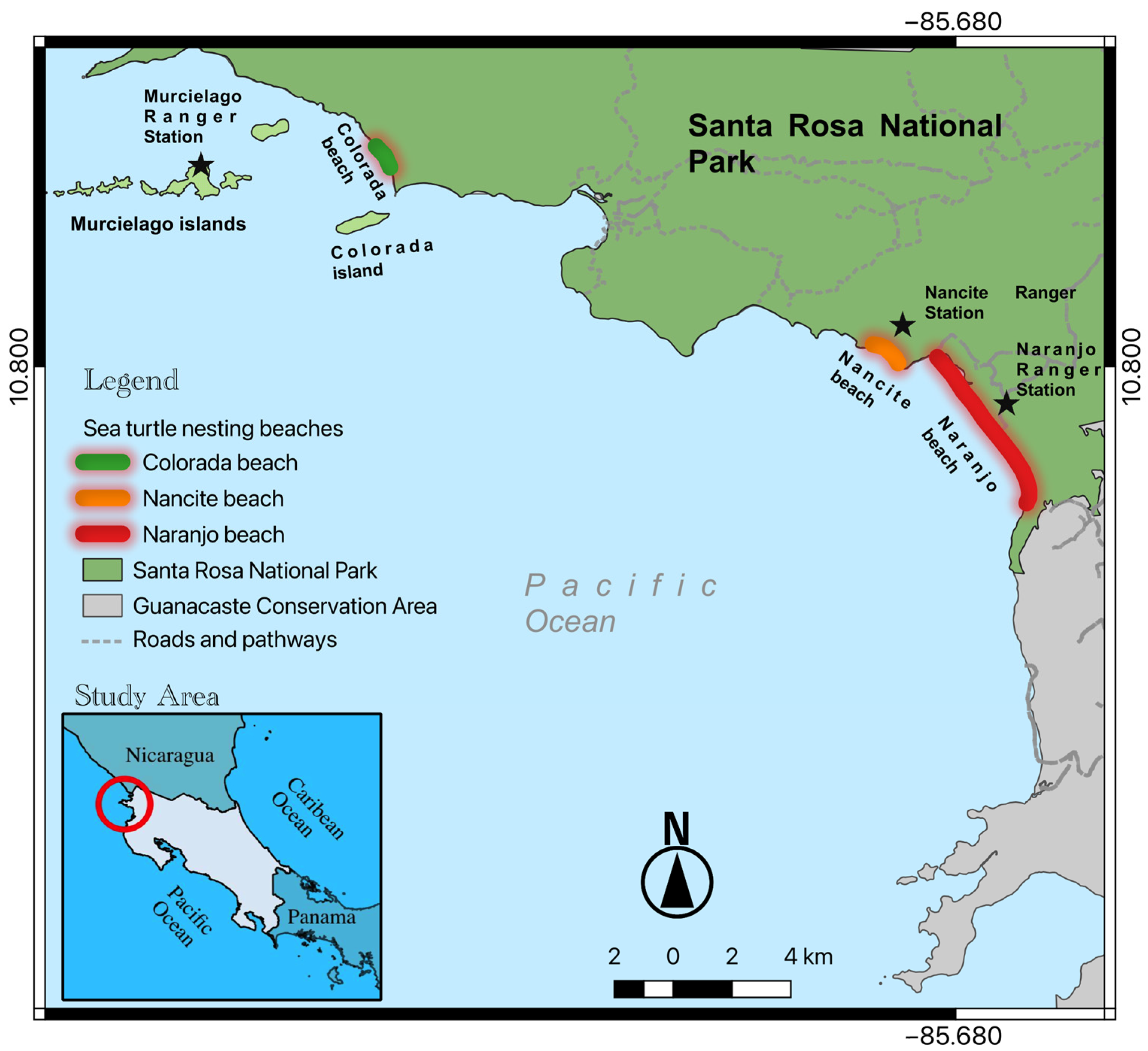
Our research was conducted between June and November 2019 in the Guanacaste Conservation Area, located in the northwestern part of Costa Rica along the Pacific coast (10°53′01″ N, 85°46′30″ W). We selected the beaches in the Santa Rosa National Park (SRNP), which comprises a land area of 39,000 ha and 42,500 ha of marine area [27]. Within the SRNP, there are several turtle nesting beaches, but for this study we have considered only 3 of the most important: Naranjo (10°46′44″ N, 85°39′57″ W), Nancite (10°48′13″ N, 85°41′53″ W), and Colorada (10°51′49.83″ N, 85°51′25.23″ W) (Figure 1). These beaches are located on the Santa Elena Peninsula and are surrounded by mature and secondary dry forest, mangroves, and estuaries.
Jaguar density in the vicinity of Naranjo and Nancite beaches is likely 5–12/100 km2, with at least 6–9 individuals identified in the general area when turtle nesting is highest (August–December) [28]. Jaguars spend more time closer to these beaches when turtles are nesting and 1 radio-monitored female jaguar that frequented both beaches had a home range that extended up to 12 km away from the beach [29]. Jaguar density is unknown at Colorada beach, but jaguar signs are common throughout the area. As it is an isolated site accessible only by boat and seldom visited, even by authorized personnel, we surmise jaguars are relatively abundant there. As noted above, Naranjo beach is open to tourism and is known for its popular surf spot [19], while Nancite beach is restricted to researchers and park rangers (i.e., no unauthorized visits by tourists) due to the arribada phenomenon of the olive ridley, and thus to minimize disturbance to the species [30].

2.2. Data Collection

To assess the distribution of sea turtle carcasses preyed on by jaguars, we conducted systematic searches for sea turtle carcasses in the forest along the shore by zigzag movement from the beach line (defined as the line that divides vegetation and beach sand) to the forest interior and back to the beach line with a gap no more than 20 m between search lines until we covered the entire extent of forest adjacent to each beach (up to 250 m inland). Once a turtle carcass was found, we identified characteristic signs of jaguar predation, such as evident canine marks or bites and partial or total removal of the head [9]. When we confirmed it was a jaguar kill, we collected the following data: species, geographic coordinates, length and width of carcass, percent of canopy cover (by using a spherical crow densitometer), date, and beach. In addition, to carry out density estimation (carcasses per ha) we used a grid that divided each beach into 1 ha hexagons (since this shape allowed us to maximize the sampling surfaces in small areas), which served as replicates to estimate density and to compare mean values between beaches. We recognize that there is seasonal variation in the occurrence of turtle carcasses at beaches, but because we have no reason to believe that carcass disappearance varied among beaches, and that sampling occurred over a time span less than the time it takes for a carcass to disappear, our comparisons of carcass abundance were considered justified.

2.3. Data Analysis

We specifically compared carcass dragging distance and canopy cover among beaches using analysis of variance and applied spatial point pattern analysis to quantify carcass aggregation at Naranjo, Nancite, and Colorada beaches. To evaluate this, we used the R software version 3.6.3 [31] to perform the statistics. We applied generalized linear models (GLMs), assuming a Poisson error distribution as the best fit for this dataset after previously examining data issues (e.g., normality, overdispersion, outliers) to fulfill model assumptions. We assessed the empirical support of the candidate models by evaluating the effect of the variables (nesting beach and canopy cover per carcass) on the dragging distance from the beach line to the forest of sea turtles killed by jaguars. To identify the best-fit model with the greatest empirical support, we used the Akaike Information Criterion (AIC) and its corresponding weight (ω) [32]. To assess differences between group means, we conducted paired ANOVA (analysis of variance), previously fulfilling all the assumptions. In addition, we performed descriptive analyses using the Visreg 2.7.0 statistical package [33].
To calculate the spatial distribution pattern of carcasses across beaches, we first assessed the distribution of sea turtle carcasses across beaches using kernel density heat maps in QGIS version 2.18 [34]. To further characterize spatial patterns, we fitted spatial point process models in Programita [35], which applies edge corrections to account for irregular plot shapes. Model selection was based on four summary functions that capture spatial structure at multiple scales: the pair correlation function g(r), the L-function L(r), the spherical contact distribution Hs(r), and the nearest-neighbor distribution D(r).
The functions g(r) and L(r)—sensitive to small- and large-scale aggregation, respectively—were used to estimate model parameters. Specifically, g(r) compares neighborhood density at distance r to the overall density (values > 1 indicate aggregation), whereas L(r) measures deviations from randomness based on the cumulative number of neighbors within r (positive values indicate clustering). To capture more complex spatial features, such as gaps or isolated points, we also included Hs(r), which estimates the probability that a random location has at least one neighbor within r, and D(r), which describes the probability that a carcass has a neighbor within distance r [35,36].
We tested a series of spatial point process models of increasing complexity: (1) a null model assuming complete spatial randomness (CSR; homogeneous Poisson process), (2) a single-cluster Thomas process, and (3) a double-cluster Thomas process. The goal was to identify the model that best explained the observed carcass distribution (see Appendix A; [35,37]). The simplest model that adequately fitted all four summary functions was selected.
Model fit was evaluated using 199 simulations of each process, generating pointwise simulation envelopes with an error rate of α = 0.05 [35]. Envelopes were defined by the fifth smallest and largest simulated values at each scale. To assess overall fit and reduce Type I error, we applied the Loosmore and Ford goodness-of-fit test [38], which summarizes the squared deviation between observed and expected values across spatial scales (0–50 m) into a single statistic (ui). The observed value (u0) was ranked among the 199 simulated ui values; ranks above 190 indicated significant deviation (p < 0.05). The best-fitting model was defined as the one showing no significant departures (p ≥ 0.05) across all functions.
The fitted Thomas process models yielded up to three parameters describing carcass spatial distribution: the number of large clusters (ρL), the spatial extent of large clusters (2σL), and the mean number of carcasses per cluster (μL). To ensure comparability across sites, cluster numbers were standardized by plot area (cluster density).

3. Results

3.1. Variation in Carcass Density

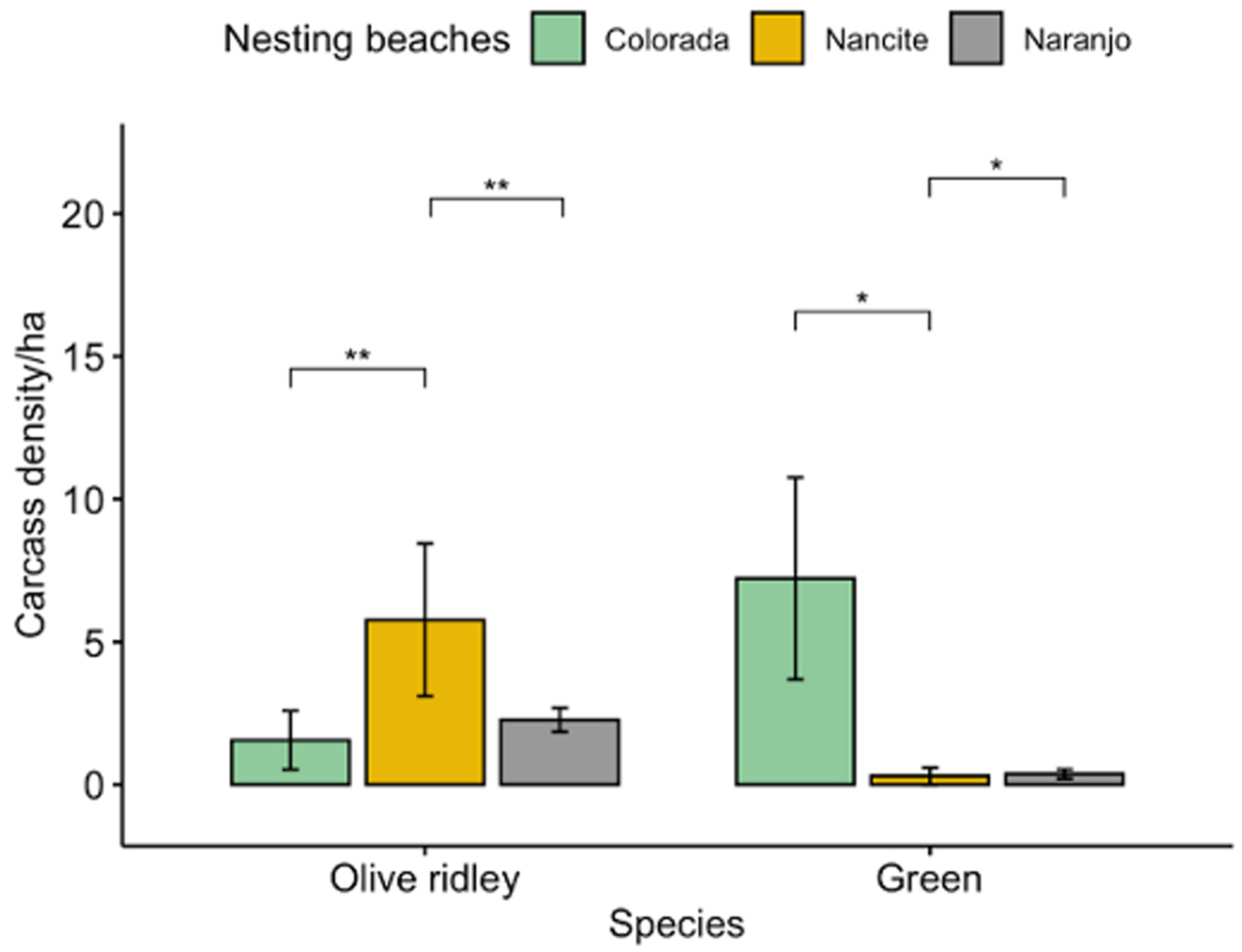
We registered 354 sea turtle carcasses preyed on by jaguars on the three nesting beaches in SRNP; Colorada: n = 88 [17 olive ridley; 71 green], Nancite: n = 104 [99 olive ridley; 5 green], and Naranjo: n = 162 [140 olive ridley; 22 green]. Carcass density (the sum of olive ridley and green turtle carcasses counts/ha) was highest at Colorada beach ( x ¯ = 8.7 carcasses/ha), followed by Nancite beach ( x ¯ = 6.6 carcasses/ha) and Naranjo beach ( x ¯   = 2.64 carcasses/ha). Paired comparisons among predated sea turtle species and nesting beaches indicated Colorada beach had the highest density of green turtle carcasses among the three nesting beaches (Figure 2; x ¯ = 7.22 carcasses/ha; p < 0.05; df = 8.14), followed by Naranjo beach ( x ¯ = 0.37 carcasses/ha) and Nancite beach ( x ¯ = 0.29 carcasses/ha). For olive ridley density comparison among beaches, Nancite beach ( x ¯ = 5.76 carcasses/ha; p < 0.05; df =19.6) had the highest density, followed by Naranjo beach ( x ¯ = 2.27 carcasses/ha) and Colorada beach ( x ¯ = 1.55 carcasses/ha).

3.2. Carcasses Concentrations

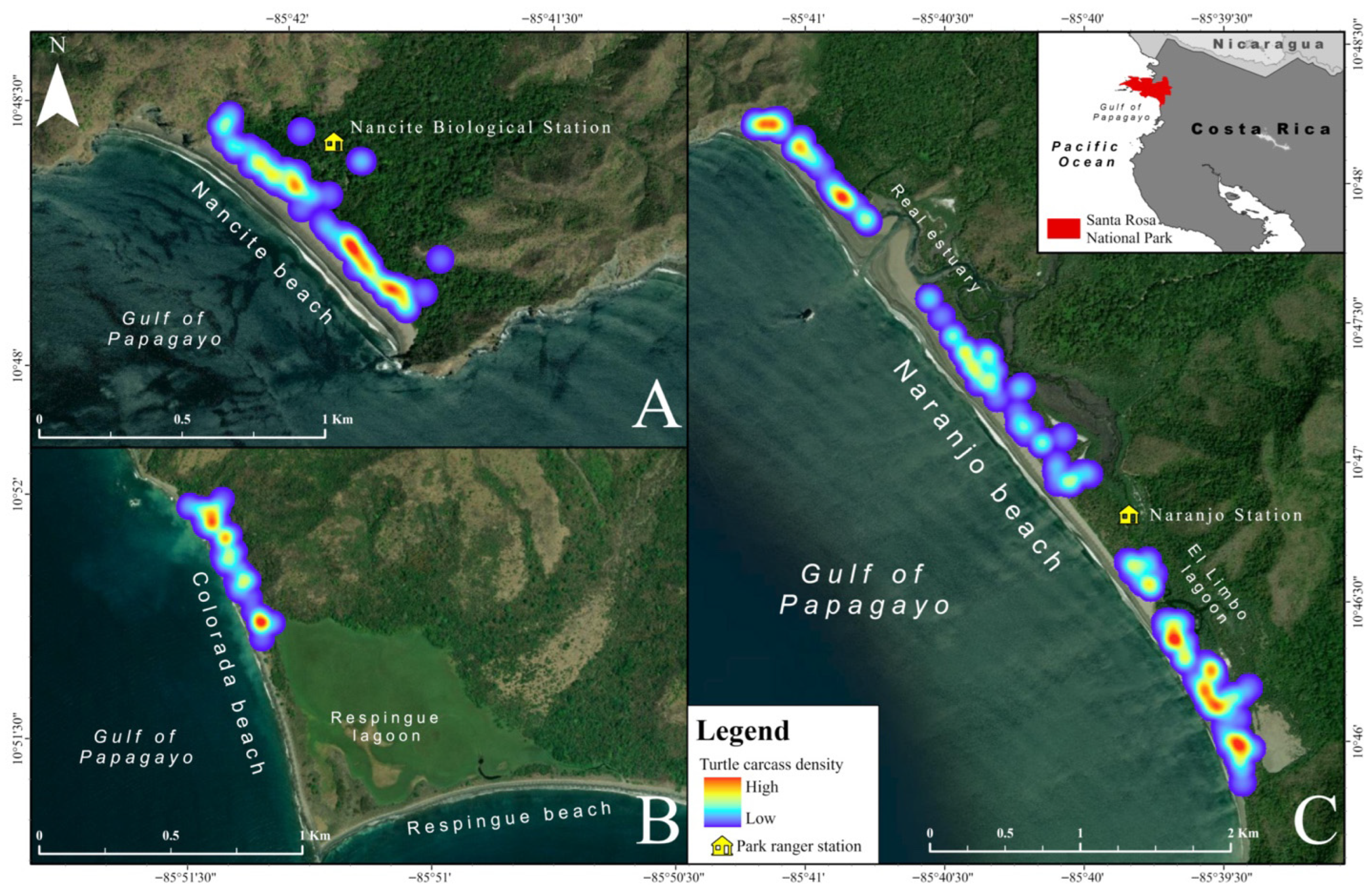
The distribution of sea turtle carcasses for both species showed clusters/aggregations (hotspots) at each beach; hence, we described these sites as “sea turtle cemeteries”. Nancite beach showed areas of high concentrations of carcasses at its northern and southern ends (Figure 3A), whereas Colorada beach showed the largest concentration of carcasses at the northern end (Figure 3B). Naranjo beach showed a concentration of sea turtle carcasses at the southern end and its north next to the estuary “Estero Real” (Figure 3C).

3.3. Dragging Distances and Vegetation Density Variation

We also used GLM model testing for canopy cover per carcass (Can-cov), and nesting beach (Beach: Colorada/Nancite/Naranjo) effect on the dragging distance from the beach line to the forest. Hence, the top-ranked model included the interaction between nesting beach and canopy cover per carcass (Table 1; AIC weight ω = 1), evidently influencing jaguar’s dragging distances for both carcasses of green and olive ridley species.
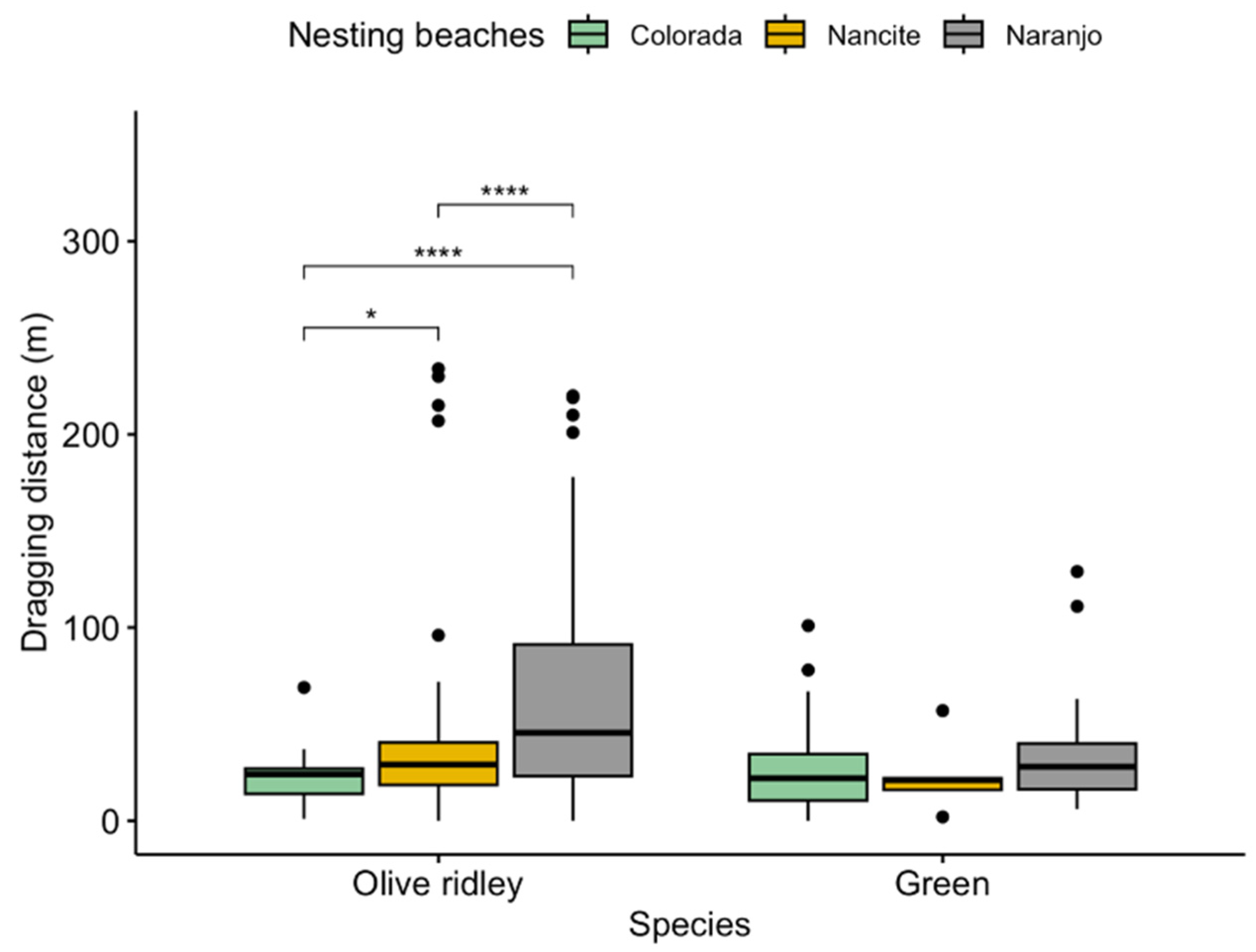
As expected, olive ridley carcasses were farther into the forest compared to green turtle carcasses (Figure 4); Naranjo beach ( x ¯ = 62.1 m; p <0.05; df = 71.3) reported the largest dragging distances, followed by Nancite beach ( x ¯ = 37.1 m) and Colorada beach ( x ¯ = 23.6 m). Green turtle carcasses were dragged only slightly farther into the forest at Naranjo beach ( x ¯ = 35.1 m; p > 0.05; df = 26.4). There were no differences detected between Colorada ( x ¯ = 24.7 m) and Nancite beaches ( x ¯ = 23.6 m).
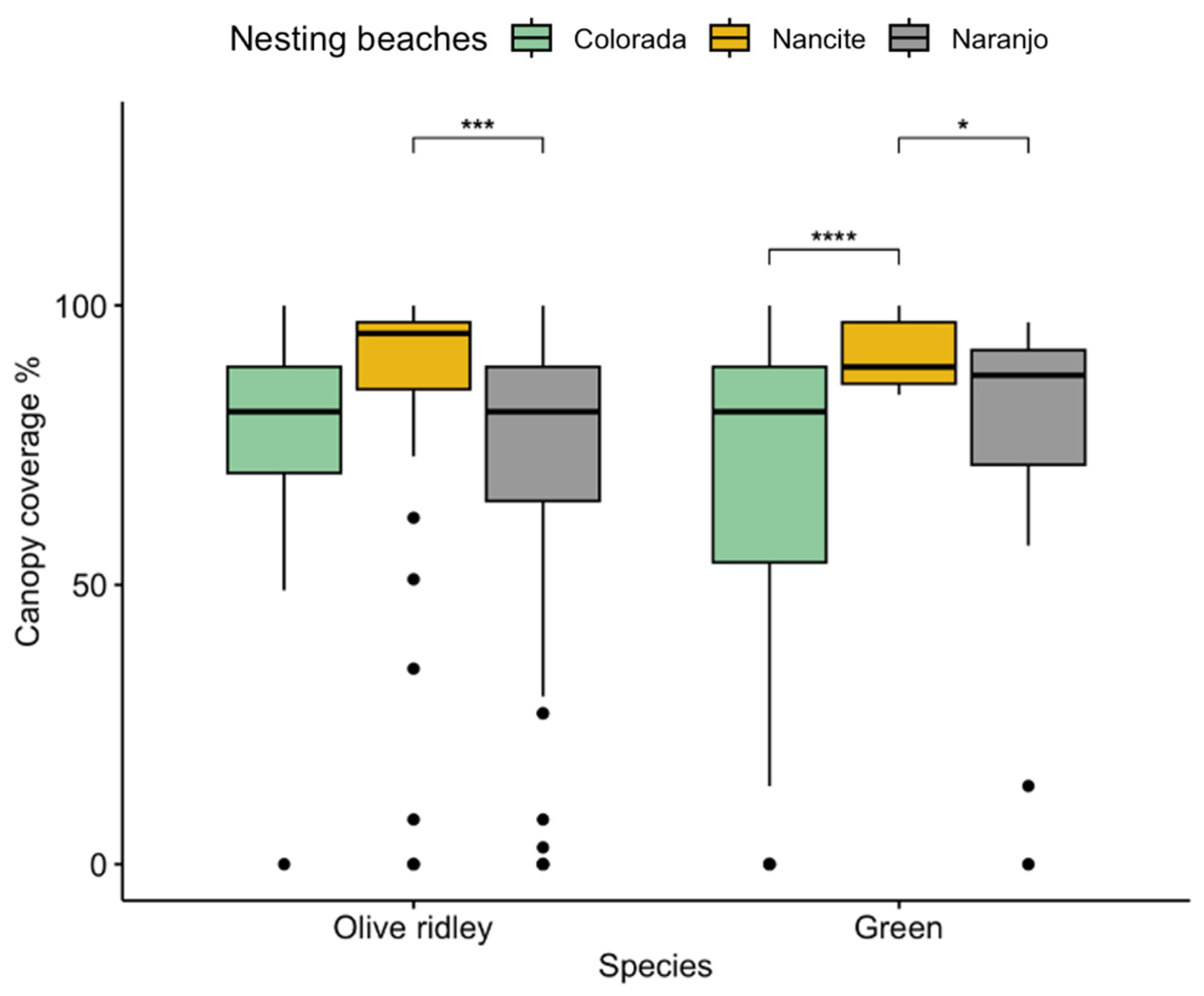
Canopy cover percentage among beaches for olive ridley carcasses showed Nancite beach with the densest canopy cover percentage (Figure 5; x ¯ = 85.0%; p > 0.05; df = 22.1), differing significantly from Naranjo beach ( x ¯ = 71.0%), but not from Colorada beach ( x ¯ = 75.2%). With regard to green turtle carcasses, Nancite beach registered the highest records of canopy cover percentage ( x ¯ = 91.2%; p > 0.05; df = 26.4), subsequently followed by Naranjo ( x ¯ = 74.1%) and Colorada beach ( x ¯ = 65.2%), but we could detect statistical differences between them.

3.4. Spatial Distribution Pattern of Carcass Across Beaches

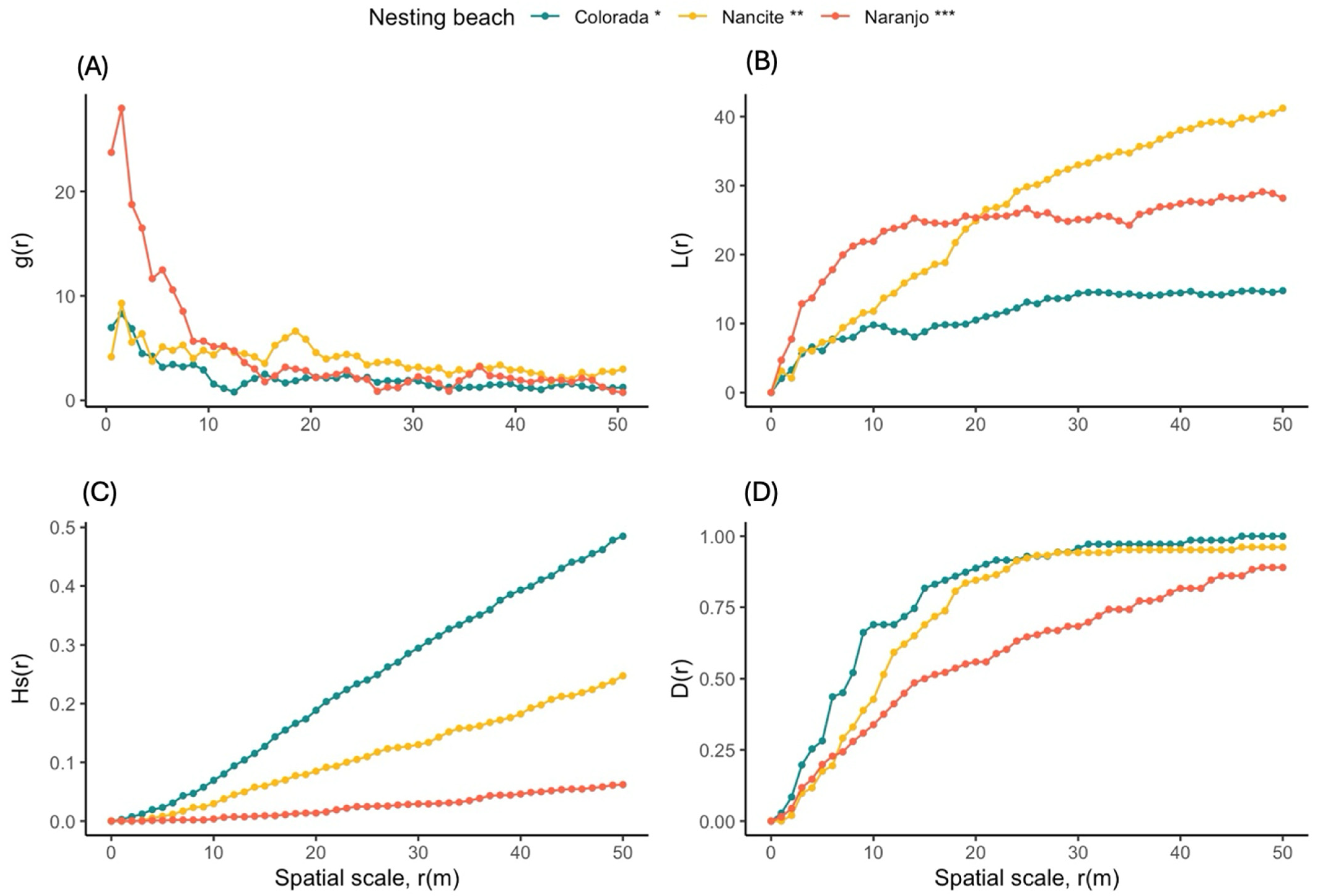
Regarding the spatial patterns of sea turtle carcass distribution, the pair correlation function g(r)—which is sensitive to small spatial scales—revealed strong aggregation between 1 and 10 m at all sites, with local densities 8–28 times higher than expected under complete spatial randomness (Figure 6A). Patterns of g(r) were generally consistent, although Naranjo beach (high visitation) showed a markedly higher degree of small-scale clustering; for example, aggregation at 5 m was 3.9 times greater than in Colorada beach (low visitation) and 2.4 times greater than in Nancite beach (intermediate visitation).
The L-function, more sensitive to broader spatial scales, showed similar trends beyond 20 m at all sites except at Nancite beach, reporting the highest values at Naranjo and Nancite beaches and the lowest at Colorada beach (Figure 6B). The Hs(r) function, which estimates the probability of encountering a carcass within distance r of a random point, indicated smaller gaps at Colorada beach (≈50% probability at r = 50 m), intermediate gaps in Nancite (≈25%), and the largest gaps in Naranjo beach (≈5%) (Figure 6C). The nearest-neighbor distribution function D(r) was broadly similar among sites, except in Naranjo beach, where consistently lower values were observed across all scales. Nevertheless, D(r) revealed that 55–88% of carcasses had a nearest-neighbor within 20 m, highlighting the high degree of small-scale aggregation across all the study area (Figure 6D).
Point process model fitting revealed distinct spatial structures in carcass distributions across sites. At both the low- and high-visitation beaches (Colorada and Naranjo, respectively), spatial patterns were best explained by a double-cluster model, suggesting tight carcass groups nested within larger-scale aggregations. In contrast, the intermediate-visitation site (Nancite beach) was best explained by a simple-cluster model, indicating a single level of aggregation (Table 2). This pattern is consistent with the arribada nesting behavior at Nancite, where thousands of turtles nest synchronously and likely generate a more homogeneous prey distribution. Conversely, the solitary nesting observed at Colorada and Naranjo likely results in patchier prey availability, leading to more complex, hierarchical carcass clustering driven by jaguar foraging behavior.
The best-fit point process analysis estimated an average of 0.95 ± 0.69 clusters per hectare, each with a mean radius of 43.7 ± 13.6 m and containing on average 5.6 ± 3.3 carcasses. Site-specific differences included the following: the highest cluster density at Colorada beach (1.7 clusters/ha), the largest cluster radius in Naranjo (58.4 m), and the highest number of carcasses per cluster in Nancite (8.8), compared to 5.7 in Colorada and 2.2 in Naranjo.

4. Discussion

Variation in carcass density among the beaches we studied likely reflects the combined influence of human disturbance, habitat structure, and prey availability. The distribution of jaguar-predated marine turtle carcasses differed markedly among beaches, with the highest concentrations occurring where human presence was lowest. This is probably the result of higher nesting density, where historically humans have not interfered with nesting or affected both jaguar density overall and their movements at the beaches. It may also be that human activity on beaches causes jaguars to move carcasses farther into the forest to avoid disturbances.
Other studies examining the effects of human pressure on long-term hawksbill turtle nesting trends support these findings, showing that reductions in human presence and access to nesting beaches are associated with year-to-year increases in nesting activity [39]. Additionally, some individuals may shift between nearby beaches while maintaining high site fidelity to avoid potential threats, as documented for green turtles [40]. These patterns suggest that anthropogenic disturbances affecting sea turtle nesting behavior may also indirectly reduce prey availability for jaguars. Reduced human disturbance likely increases predator–prey encounter rates by allowing jaguars to move freely and forage without interruption, such as occurs in protected areas of Mexico [4]. Conversely, higher levels of human activity may induce behavioral avoidance in both sea turtles and jaguars, reducing jaguar use of open beaches and consequently lowering predation rates. This interpretation is consistent with studies demonstrating that jaguars avoid areas with elevated human activity [41].
Differences between total carcass counts and carcass density emphasize the importance of accounting for beach size and nesting intensity when interpreting predation patterns. Although the highest number of predation events occurred at Naranjo beach, Colorada beach had the highest carcass density per hectare. This contrasts with earlier studies identifying Nancite as the site with the greatest number of carcasses [14]. Such discrepancies may reflect differences in analytical approaches, temporal variation in turtle nesting and jaguar activity, or a recent increase in nesting activity at Colorada, where no previous records existed.
The inverse relationship between human activity and carcass density further highlights the sensitivity of jaguars to anthropogenic disturbance. Colorada beach, which lacks human presence, had the highest carcass density, followed by Nancite beach (moderate presence limited to researchers), and Naranjo beach (high human presence), which had the lowest density. Although this pattern differs from earlier findings that reported Nancite as having the highest carcass concentration [10], it supports broader observations that jaguar predation on sea turtles declines in areas with higher human activity [19]. Human disturbance may also reduce turtle nesting activity [11] and may prompt individuals to relocate to nearby beaches (<80 km) with fewer anthropogenic stressors, such as artificial lighting, roads, and marine debris [40], thereby indirectly influencing predation patterns.
Spatial clustering of carcasses (“turtle graveyards”) reflects interactions among nesting hotspots, vegetation structure, and jaguar behavior. At Naranjo, major clusters were observed in the southern sector of the beach and near the northern estuary (Estero Real), consistent with previous studies [9] and corresponding to areas of highest nesting activity [42]. These locations are also farthest from tourist camping zones, reinforcing the idea that jaguar activity increases where human disturbance is minimal [16,43]. At Nancite, carcasses were concentrated in the southern sector, aligning with earlier observations [10] and coinciding with both higher nesting activity and greater distance from the research station [16]. At Colorada, clusters at both ends of the beach likely reflect denser vegetation or higher nesting intensity, consistent with patterns reported for Naranjo [29], Nancite [30], and Tortuguero [41].
Variation in drag distance among species and beaches reflects energetic constraints and disturbance-avoidance strategies. Olive ridley carcasses were found farther inland than those of green turtles, consistent with previous findings [21]. Our larger sample size revealed a clearer trend, likely driven by body size differences: green turtles weigh nearly twice as much as olive ridleys [15,23], increasing the energetic cost of transporting carcasses into forested areas. Among beaches, the greatest drag distances were recorded at Naranjo, followed by Nancite and Colorada for both species. At Colorada, many carcasses remained on the beach (0 m), whereas in another study at Naranjo a carcass was found 1 km inland [9]. This suggests that, in areas with higher human presence, jaguars may transport prey farther inland to reduce disturbance risk [19].
Differences in vegetation structure at predation sites further underscore the role of canopy cover in jaguar foraging behavior. Canopy cover at Nancite was significantly denser than at Naranjo, with intermediate levels at Colorada. This aligns with known jaguar behavior, as the species typically consumes prey under dense vegetation to reduce exposure and perceived risk [22]. Consequently, beaches with greater canopy cover may support higher carcass densities by providing suitable microhabitats for predation. For green turtles, canopy cover at predation sites was generally higher than for olive ridleys, with the highest values recorded at Nancite, followed by Naranjo and Colorada. This pattern likely reflects green turtles’ preference for nesting in vegetated coastal areas [26,44], suggesting that higher canopy cover associated with green turtle carcasses may result from nesting behavior rather than differences in jaguar predation intensity.
Despite the limitations of this study, our data clearly indicate that high human presence on touristic beaches, such as Naranjo, represents a threat to both sea turtles and jaguars. These findings have important management implications for balancing human recreation with the conservation of sea turtle nesting habitats. Overall, our results demonstrate how human presence, habitat structure, and prey characteristics jointly shape jaguar–sea turtle interactions. Integrating behavioral ecology, vegetation structure, and anthropogenic disturbance provides a more nuanced understanding of predation dynamics along nesting beaches and is essential for designing effective conservation strategies that consider both jaguar behavior and sea turtle nesting ecology.

5. Conclusions

Multiple environmental and anthropogenic factors influence the distribution of sea turtle carcasses predated by jaguars within Santa Rosa National Park (SRNP). Among these, the level of human presence appears to be the most influential, as beaches with lower human activity exhibited the highest carcass densities. We strongly recommend that, at Naranjo Beach, which experiences the greatest tourist visitation, management measures be implemented to regulate nighttime activities during the turtle nesting season, such as restricting access to the southern section of the beach. At Colorada Beach, where predation rates were particularly high, we suggest establishing a long-term monitoring program for jaguar predation on sea turtles, as this site remains poorly studied, despite its ecological importance. Overall, our findings provide valuable insights into the predator–prey dynamics between jaguars and sea turtles and offer critical information to guide conservation planning and management for both species within Santa Rosa National Park.

Author Contributions

Conceptualization, V.H.M. and T.K.F.; funding acquisition, C.S.-B., T.K.F. and E.C.; data curation, V.H.M.; field work, J.C.C.-D., E.C., C.S.-B., J.M.C.-R. and K.J.L.; writing—original draft preparation, J.M.C.-R., V.H.M., T.K.F. and E.C.; writing—review and editing, V.H.M., J.C.C.-D., T.K.F., E.C., J.M.C.-R., K.J.L., B.M. and C.S.-B. All authors have read and agreed to the published version of the manuscript.

Funding

This research was supported by the Jaguar Program of the National University of Costa Rica, Namá Conservation, Katie Adamson Conservation Fund, Volcafe and German Academic Exchange Service—DAAD.

Institutional Review Board Statement

The study was conducted in accordance with the Declaration of the Environmental Minister of Costa Rica and approved by the institutional review board of Área de Conservación Guanacaste (ACG-PI-F-03-2019) on 5 March 2019, following all the ethics and animal protocols in accordance with the animal legislation of Costa Rica.

Informed Consent Statement

Not applicable.

Data Availability Statement

The original contributions presented in this study are included in the article. Further inquiries can be directed to the corresponding author.

Acknowledgments

We thank all the students and volunteers. We also thank Roger Blanco and María Martha Chavarria from the research program as well as all personnel of Área de Conservación Guanacaste and anonymous reviewers for helping to improve this manuscript.

Conflicts of Interest

The authors declare no conflicts of interest.

Appendix A

To analyze carcass spatial patterns, we used four summary functions—g(r), L(r), Hs(r), and D(r)—which together provide a comprehensive description of spatial structure in homogeneous point patterns [35,36]. These functions guided the evaluation of increasingly complex point process models, ranging from complete spatial randomness to single- and double-cluster configurations. We selected the simplest model that adequately fits all four summary functions.
Complete Spatial Randomness (CSR): The CSR model assumes that points are distributed independently and uniformly over space, following a homogeneous Poisson process. Under CSR, the pair correlation function g(r) is equal to 1 at all distances r, indicating the absence of spatial structure—neither aggregation nor regularity.
Single-cluster process: This Thomas process models clustering at a single spatial scale, where cluster centers are randomly and independently distributed across area A, with intensity ρ (clusters per unit area). Points are assigned to clusters and positioned following a bivariate normal distribution around each center, with variance σ2. The typical cluster radius (rC) is about 2σ, encompassing roughly 87% of points, and the area covered by a cluster is 4πσ2. The pair correlation function of this point process is as follows:
g r , σ , ρ = 1 + 1 ρ e x p ( r 2 / 4 σ 2 ) 4 π σ 2
Double-cluster process: This model builds on the single-cluster Thomas process by introducing two spatial scales of aggregation. Here, small clusters are not randomly distributed but are themselves clustered according to a higher-level Thomas process. This results in a hierarchical structure, with small clusters nested within larger ones. The model includes four parameters: the intensities of the large and small cluster centers (ρL and ρS), and their corresponding cluster sizes (σL and σS). The pair correlation function of this point process is as follows:
g r , σ , ρ = 1 + 1 ρ S e x p ( r 2   / 4 σ S 2 ) 4 π σ 2 + 1 ρ L e x p ( r 2   / 4 ( σ S 2 + σ L 2 ) ) 4 π ( σ s 2 + σ L 2 )

References

  1. Veríssimo, D.; Jones, D.A.; Chaverri, R.; Meyer, R.S. Jaguar Panthera onca predation of marine turtles: Conflict between flagship species in Tortuguero, Costa Rica. Oryx 2012, 46, 340–347. [Google Scholar] [CrossRef]
  2. Carrillo, E.; Fuller, T.K.; Saenz, J.C. Jaguar (Panthera onca) hunting activity: Effects of prey distribution and availability. J. Trop. Ecol. 2009, 25, 563–567. [Google Scholar] [CrossRef]
  3. Cavalcanti, S.M.C.; Gese, E.M. Kill rates and predation patterns of jaguars (Panthera onca) in the southern Pantanal, Brazil. J. Mammal. 2010, 91, 722–736. [Google Scholar] [CrossRef]
  4. Rosales-Hernández, V.A.; Cruz-Romo, L.; Contreras-Moreno, F.M.; Petrone, S.; Jesús-Espinosa, D. Predation on sea turtles by jaguars in the Mexican Caribbean. Therya Notes 2022, 3, 24–29. [Google Scholar] [CrossRef]
  5. Autar, L. Sea turtles attacked and killed by jaguars in Suriname. Mar. Turt. Newsl. 1994, 67, 11–12. [Google Scholar]
  6. Fretey, J. Causes de motalite des tortues luth adultes (Dermochelys coriacea) sur le littoral guayanais. Courr. Nat. 1977, 52, 257–266. [Google Scholar]
  7. Carrillo, E.; Morera-Avila, R.A.; Wong-Reyes, G. Depredación de tortuga lora (Lepidochelys olivacea) y de tortuga verde (Chelonia mydas) por el jaguar (Panthera onca). Vida Silv. Neotrop. 1994, 3, 48–49. [Google Scholar]
  8. Troëng, S. Predation of green (Chelonia mydas) and leatherback (Dermochelys coriacea) turtles by jaguars (Panthera onca) at Tortuguero National Park, Costa Rica. Chelonian Conserv. Biol. 2000, 3, 751–753. [Google Scholar]
  9. Alfaro, L.D.; Montalvo, V.H.; Guimaraes, F.; Saenz-Bolaños, C.; Cruz, J.C.; Morazán, F.; Carrillo, E. Characterization of attack events on sea turtles (Chelonia mydas and Lepidochelys olivacea) by jaguar (Panthera onca) in Naranjo sector, Santa Rosa National Park, Costa Rica. Int. J. Conserv. Sci. 2016, 7, 101–108. [Google Scholar]
  10. Escobar-Lasso, S.; Gil-fernández, M.; Sáenz, J.; Carrillo-Jiménez, E.; Wong, G. Distribution and hotspots of the feeding areas of jaguars on sea turtles at a national park in Costa Rica. Neotrop. Biol. Conserv. 2017, 12, 2–11. [Google Scholar] [CrossRef][Green Version]
  11. Rangel, E.; Arroyo-Arce, S.; Quirós-Pereira, W.; Fonseca, L.G.; Villachica, W.N.; Thomson, I.; Plotkin, P.T.; Valverde, R.A. Impacts of Jaguar predation on nesting sea turtles at Nancite Beach, Santa Rosa National Park, Costa Rica. Herpetol. Conserv. Biol. 2020, 15, 547–557. [Google Scholar]
  12. Arroyo-Arce, S.; Guilder, J.; Salom-Pérez, R. Habitat features influencing jaguar Panthera onca (Carnivora: Felidae) occupancy in Tortuguero National Park, Costa Rica. Rev. Biol. Trop. 2014, 62, 1449–1458. [Google Scholar] [CrossRef]
  13. Arroyo-Arce, S.; Thomson, I.; Harrison, E.; Wilmott, S.; Baker, G. First record of jaguar (Panthera onca) predation on a loggerhead sea turtle (Caretta caretta) in Tortuguero National Park, Costa Rica. Herpetol. Notes 2017, 10, 17–18. [Google Scholar]
  14. Fonseca, L.G.; Arroyo-Arce, S.; Thomson, I.; Villachica, W.; Valverde, R. New records of jaguar predation on sea turtles, Pacific coast, Costa Rica. Cat News 2017, 66, 36–37. [Google Scholar]
  15. Fonseca, L.G.; Villachica, W.; Rojas, H.; Valverde, R.; Quirós, W.; Pesquero, M.; Plotkin, T. Reporte Final de la Anidación de Tortuga Verde (Chelonia mydas), Playa Nancite, Parque Nacional Santa Rosa, Costa Rica. 2015. Available online: https://copa.acguanacaste.ac.cr/handle/11606/637 (accessed on 1 October 2015).
  16. Herrera, H.; Carrillo, E.; Saenz, J.; Spinola, M.; Wong, G.; Escobar-Lasso, S. Jaguar (Panthera onca) Activity Patterns and Hunting Behavior in the Guanacaste Conservation Area, Costa Rica. 2017. Available online: https://www.researchgate.net/publication/318680181_Jaguar_Panthera_onca_activity_patterns_and_hunting_behavior_in_the_Guanacaste_Conservation_Area_Costa_Rica (accessed on 1 May 2017).
  17. Montalvo, V. Environmental Drivers of Jaguar and Prey Distribution in Santa Rosa National Park. Ph.D. Thesis, University of Massachussetts Amherst, Amherst, MA, USA, 2020. [Google Scholar]
  18. Hughes, D.A.; Richard, J.D. The nesting of the Pacific ridley turtle Lepidochelys olivacea on Playa Nancite, Costa Rica. Mar. Biol. 1974, 24, 97–107. [Google Scholar] [CrossRef]
  19. Herrera, H.A. Actividad Diaria y Depredacion de Tortugas Marinas por el Jaguar (Panthera onca) en el Parque Nacional Santa Rosa. Master’s Thesis, Universidad Nacional de Costa Rica, Heredia, Costa Rica, 2017. [Google Scholar]
  20. Morera-Chacón, B.H.; Posadas-García, A.C.; Mora-Benavides, J.M.; Carrillo, E. Relationship between vegetation cover and feeding areas of jaguars (Panthera onca) on sea turtles in Santa Rosa National Park, Costa Rica. Food Webs 2019, 21, e00127. [Google Scholar] [CrossRef]
  21. Escobar- Lasso, S. Depredación Y Carroñeo de Tortugas Marinas y Uso de Hábitat del Jaguar en el Parque Nacional Santa Rosa, Costa Rica. Master’s Thesis, Universidad Nacional de Costa Rica, Heredia, Costa Rica, 2017. [Google Scholar]
  22. Junior, L.C.; Sana, D.A.; Lima, F.; De Abreu, K.C.; Uezu, A. Selection of habitat by the jaguar, Panthera onca (Carnivore: Felidae), in the upper Paraná River, Brazil. Zoologia 2013, 30, 379–387. [Google Scholar] [CrossRef]
  23. Cornelius, S.E. Marine turtles nesting activity at Playa Naranjo, Costa Rica. Brenesia 1976, 8, 1–27. [Google Scholar]
  24. Chacón, D.; Sánchez, J.; Calvo, J.; Ash, J. Manual para el Manejo y la Conservación de las Tortugas Marinas en Costa Rica; Con énfasis en la Operación de Proyectos en Playa y Viveros. 2007. Available online: https://www.latinamericanseaturtles.com/archivos/documentos/ManualPlayasViveros.pdf (accessed on 1 May 2022).
  25. Arroyo, S.; Berrondo, L.Y.; Canto, N.; Carrillo, V.; Gomez Carrillo, C.; Loaiza, M.; Mendez, D.; Rivera, D.; Unda, K. Living conditions of sainos (Pecari tajacu) in two types of train-forests in the station “La Selva”, located in Costa Rica. Cult. Cient. 2013, 32–39. [Google Scholar]
  26. Zavaleta-Lizárraga, L.; Morales-Mávil, J.E. Nest site selection by the green turtle (Chelonia mydas) in a beach of the north of Veracruz, Mexico. Rev. Mex. Biodivers. 2013, 84, 927–937. [Google Scholar] [CrossRef]
  27. ACG Área de Conservación Guanacaste. Available online: https://www.acguanacaste.ac.cr/index.php (accessed on 5 January 2025).
  28. Montalvo, V.H.; Sáenz-Bolaños, C.; Cruz-Díaz, J.C.; Carrillo, E.; Fuller, T.K. The use of camera traps and auxiliary satellite telemetry to estimate jaguar population density in northwestern Costa Rica. Animals 2022, 12, 2544. [Google Scholar] [CrossRef]
  29. Montalvo, V.; Fuller, T.K.; Saénz-Bolaños, C.; Cruz-Diaz, J.C.; Hagnauer, I.; Herrera, J.; Carrillo, E. Influence of sea turtle nesting on hunting behavior and movements of jaguars in the dry forest of northwest Costa Rica. Biotropica 2020, 52, 1076–1083. [Google Scholar] [CrossRef]
  30. Fonseca, L.G.; Murillo, G.A.; Guadamúz, L.; Spínola, R.M.; Valverde, R.A. Downward but stable trend in the abundance of arribada olive ridley sea turtles (Lepidochelys olivacea) at Nancite Beach, Costa Rica (1971–2007). Chelonian Conserv. Biol. 2009, 8, 19–27. [Google Scholar] [CrossRef]
  31. R Core Team. R: A Language and Environment for Statistical Computing; R Foundation for Statistical Computing: Vienna, Austria, 2020; Available online: http://www.R-project.org/ (accessed on 15 November 2020).
  32. Burnham, K.P.; Anderson, D.R. Model Selection and Multimodel Inference: A Practical Information-Theoretic Approach, 2nd ed.; Springer: New York, NY, USA, 2002. [Google Scholar]
  33. Breheny, P.; Burchett, W. Visualization of regression models using visreg. R J. 2017, 9, 56–71. [Google Scholar] [CrossRef]
  34. QGIS Development Team. QGIS Geographic Information System, Version 3.3; Open Source Geospatial Foundation: Beaverton, OR, USA, 2022. Available online: https://qgis.org (accessed on 15 April 2022).
  35. Illian, J.; Penttinen, A.; Stoyan, H.; Stoyan, D. Statistical Analysis and Modelling of Spatial Point Patterns; John Wiley & Sons: West Sussex, UK, 2008. [Google Scholar]
  36. Wiegand, T.; He, F.; Hubbell, S.P. A systematic comparison of summary characteristics for quantifying point patterns in ecology. Ecography 2013, 36, 92–103. [Google Scholar] [CrossRef]
  37. Wiegand, T.; Martínez, I.; Huth, A. Recruitment in tropical tree species: Revealing complex spatial patterns. Am. Nat. 2009, 174, 106–140. [Google Scholar] [CrossRef]
  38. Loosmore, N.B.; Ford, E.D. Statistical inference using the G or K point pattern spatial statistics. Ecology 2006, 87, 1925–1931. [Google Scholar] [CrossRef] [PubMed]
  39. Chatting, M.; Saliba, S.; Hamza, S.; Mohd Salleh, S.; Syed Asim, F.; Smyth, D.; Marshall, C.D.; Al-Khayat, J.A.A. Effects of human presence on hawksbill turtle nesting: Lessons learned from beach management. J. Nat. Conserv. 2025, 87, 127007. [Google Scholar] [CrossRef]
  40. Shimada, T.; Duarte, C.M.; Al-Suwailem, A.M.; Tanabe, L.K.; Meekan, M.G. Satellite tracking reveals nesting patterns, site fidelity, and potential impacts of warming on major green turtle rookeries in the Red Sea. Front. Mar. Sci. 2021, 8, 633814. [Google Scholar] [CrossRef]
  41. Arroyo-Arce, S.; Thomson, I. Depredación de Jaguar Panthera onca Sobre Tortugas Marinas en el Parque Nacional Tortuguero, Costa Rica Ubicación: Coastal Jaguar Conservation. Heredia, Costa Rica. Available online: https://www.acto.go.cr/wp-content/uploads/2020/04/ (accessed on 10 October 2025).
  42. Drake, D.L.; Behm, J.E.; Hagerty, M.A.; Mayor, P.A.; Goldenberg, S.J.; Spotila, J.R. Marine turtle nesting activity at Playa Naranjo, Santa Rosa National Park, Costa Rica, for the 1998–1999 season. Chelonian Conserv. Biol. 2003, 3, 675–678. Available online: https://www.iecolab.org/wp-content/uploads/2017/06/Drake-et-al.-2003.pdf (accessed on 14 July 2024).
  43. Herrera, H.; Escobar-Lasso, S.; Carrillo-Jimenez, E. Predation on the hawksbill turtle Eretmochelys imbricata by the jaguar Panthera onca in the Pacific coast of Costa Rica. Mammal. Notes 2016, 3, 13–16. [Google Scholar] [CrossRef]
  44. Patrício, A.; Varela, M.; Barbosa, C.; Broderick, A.; Airaud, M.B.F.; Godley, B.J.; Regalla, A.; Tilley, D.; Catry, P. Nest site selection repeatability of green turtles, Chelonia mydas, and consequences for offspring. Anim. Behav. 2018, 139, 91–102. [Google Scholar] [CrossRef]
Figure 1. Location of the study area showing the nesting and depredation beaches: Colorada, Nancite, and Naranjo, within Santa Rosa National Park, Guanacaste Conservation Area, northwestern Costa Rica.
Wild 03 00005 g001
Figure 2. Mean plot (±confidence interval 95%), for carcass density (no./ha) of green and olive ridley sea turtles preyed on by jaguars at three nesting beaches under different anthropogenic pressure in Santa Rosa National Park, Guanacaste Conservation Area, Northwestern Costa Rica. Asterisks represent p-values at significance level of <0.05 [*] and <0.01 [**] for nesting beach comparisons.
Wild 03 00005 g002
Figure 3. Location and distribution of concentration hotspots of turtle carcasses preyed on by jaguars in three nesting beaches under different anthropogenic pressure [(A) Colorada, (B) Nancite, (C) Naranjo] in Santa Rosa National Park, Guanacaste Conservation Area, Northwestern Costa Rica, 2020.
Wild 03 00005 g003
Figure 4. Boxplot graph with median (bold line), lower, and upper quartile for dragging distances of green and olive ridley sea turtle carcasses preyed on by jaguars at three nesting beaches under different anthropogenic pressures in Santa Rosa National Park, Guanacaste Conservation Area, Northwestern Costa Rica. Asterisks represents p-values at significance level of <0.05 [*] and <0.001 [****] for group comparisons: Colorada–Nancite; Colorada–Naranjo; Naranjo–Nancite.
Wild 03 00005 g004
Figure 5. Boxplot graph with median (bold line), lower, and upper quartile for canopy coverage percentages of green and olive ridley (sea turtle carcasses preyed on by jaguars at three nesting beaches under different anthropogenic pressure in Santa Rosa National Park, Guanacaste Conservation Area, Northwestern Costa Rica Asterisks represents p-values at significance level of <0.05 [*], <0.005 [***] and <0.001 [****] for group comparisons: Colorada–Nancite; Colorada–Naranjo; Naranjo–Nancite.
Wild 03 00005 g005
Figure 6. Summary functions describing the spatial distribution of the overall sea turtle carcasses of green and olive ridley preyed on by jaguars at three nesting beaches study sites with different anthropogenic pressure in Santa Rosa National Park, Guanacaste Conservation Area, Northwestern Costa Rica. Pair correlation function g(r) (A), L-function L(r) (B), spherical contact distribution Hs(r) (C), and nearest-neighbor distribution function D(r) (D) under different levels of anthropogenic pressure: * low, ** medium, and *** high.
Wild 03 00005 g006
Table 1. Model importance weight for green and olive ridley sea turtle carcasses preyed on by jaguars, describing the effect of canopy cover per carcass (Can-cov) and nesting beach (Beach: Colorada/Nancite/Naranjo) on the dragging distance from the beach line to the forest vegetation (Drag-dist) in Santa Rosa National Park, Guanacaste Conservation Area, Northwestern Costa Rica. Category with the highest importance weight for each species in bold.
Model DescriptionAIC Weights (ω)
Olive RidleyGreen
Drag-dist~Beach<0.001<0.001
Drag-dist~Can-cov<0.001<0.001
Drag-dist~Beach + Can-cov<0.001<0.001
Drag-dist~Beach × Can-cov11
Drag-dist~1 (intercept)<0.001<0.001
Note: best model fitted in bold.
Table 2. Summary of the goodness-of-fit (GoF) test of different Thomas cluster point process models describing the spatial distribution of the overall sea turtle carcasses of green and olive ridley preyed on by jaguars at three nesting beaches study sites with different anthropogenic pressure in Santa Rosa National Park, Guanacaste Conservation Area, Northwestern Costa Rica. Pair correlation function g(r), L-function L(r), spherical contact distribution Hs(r), and nearest-neighbor distribution function D(r) under different levels of anthropogenic pressure: * low, ** medium, and *** high.
Nesting BeachNThomas
Process
Summary Functions
g(r)L(r)Hs(r)D(r)
RankpRankpRankpRankp
Colorada *71CSR2000.0052000.0052000.0052000.005
SC1910.051130.44520.741750.13
DC100.95790.61310.85230.89
Nancite **103CSR2000.0052000.0052000.0052000.005
SC630.691080.4630.99500.75
DC300.85960.5270.97410.8
Naranjo ***136CSR2000.0052000.0052000.0052000.005
SC1870.071600.21510.251900.05
DC510.75850.58460.77330.84
Disclaimer/Publisher’s Note: The statements, opinions and data contained in all publications are solely those of the individual author(s) and contributor(s) and not of MDPI and/or the editor(s). MDPI and/or the editor(s) disclaim responsibility for any injury to people or property resulting from any ideas, methods, instructions or products referred to in the content.