Article

The Short-Tailed Golden Dog Fragmented Realm: α-Hull Unravels the Maned Wolf’s Hidden Population


by
Luan de Jesus Matos de Brito
1,2
1
Programa de Pós-Graduação em Biologia Animal, Universidade Federal de Viçosa, Viçosa 36.570-900, Brazil
2
Laboratório de Mastozoologia, Museu de Zoologia João Moojen, Departamento de Biologia Animal, Universidade Federal de Viçosa, Viçosa 36.570-900, Brazil
Submission received: 3 November 2025 / Revised: 19 December 2025 / Accepted: 26 December 2025 / Published: 13 January 2026

Simple Summary

Habitat fragmentation caused by human land use is changing how wildlife populations are distributed, especially for large mammals. This study examines the spatial structure of the maned wolf across South America using verified geographic records of where the species has been observed. The main objective was to identify geographically isolated population groups and to describe their occupied areas more accurately than traditional mapping methods. By grouping nearby records and outlining their boundaries based on their spatial arrangement, the study identified eleven distinct population groups distributed across different countries and biomes. These groups vary greatly in size and are separated by large distances, indicating a fragmented and discontinuous distribution. Some populations cover large areas but remain isolated from others, while smaller populations occupy very limited areas and are more exposed to extinction risk. The study proposes the term “α-populations” to describe these geographically isolated groups. The results show that the maned wolf does not occupy a single continuous range, but rather a set of separate populations. This information is valuable for conservation planning, helping to identify priority areas, guide habitat restoration, and improve decisions aimed at maintaining long-term population viability.

Abstract

Understanding the spatial structure of large mammals is critical for conservation planning, especially under increasing habitat fragmentation. This study applies an integrated spatial analysis combining the DBSCAN density-based clustering algorithm and the α-hull method to delineate non-convex geographic ranges of the maned wolf (Chrysocyon brachyurus) across South America. Using 454 occurrence records filtered for ecological reliability, we identified 11 geographically isolated α-populations distributed across five countries and multiple biomes, including the Cerrado, Chaco, and Atlantic Forest. The sensitivity analysis of the α parameter demonstrated that values below 2 failed to generate viable polygons, while α = 2 provided the best balance between geometric detail and ecological plausibility. Our results reveal a highly fragmented distribution, with α-populations varying in area from 43,077 km2 to 566,154.7 km2 and separated by distances up to 994.755 km. Smaller and peripheral α-populations are likely more vulnerable to stochastic processes, genetic drift, and inbreeding, while larger clusters remain functionally isolated due to anthropogenic barriers. We propose the concept of ‘α-population’ as an operational unit to describe geographically and functionally isolated groups identified through combined spatial clustering and non-convex hull analysis. This approach offers a reproducible and biologically meaningful framework for refining range estimates, identifying conservation units, and guiding targeted management actions. Overall, integrating α-hulls with density-based clustering improves our understanding of the species’ fragmented spatial structure and supports evidence-based conservation strategies aimed at maintaining habitat connectivity and long-term viability of C. brachyurus populations.

1. Introduction

Understanding the response of large mammals to habitat fragmentation is crucial for conservation planning. These animals, which depend on vast continuous areas, are particularly vulnerable to connectivity loss, functional isolation, and genetic decline [1,2]. The increasing overlap of agricultural areas, roads, and other infrastructure creates an anthropogenic matrix that often obstructs population movements, promoting the compartmentalization of species distributions [3].
The maned wolf (Chrysocyon brachyurus), an iconic species of the Cerrado, but also present in the Chaco, Atlantic Forest, and Pampas, has been experiencing increasing spatial fragmentation due to anthropogenic pressures [4,5]. The fragmented structure of its distribution suggests limited gene flow between subpopulations, increasing ecological, demographic, and evolutionary vulnerabilities [1,6].
Most distribution estimates for the species still rely on traditional approaches, such as the minimum convex polygon (MCP), which tend to overestimate occurrence areas by ignoring ecologically significant spatial discontinuities [7,8].
Among these methods, the α-hull (or α-shape) has emerged as a robust tool for delineating non-convex occurrence areas, respecting the configuration of empirical data and reducing the inclusion of ecologically unoccupied zones [8]. Recent studies have shown that when combined with density-based clustering algorithms such as DBSCAN, this approach effectively identifies spatially distinct groupings without the need to predefine the number or shape of clusters [9,10].
Increasing habitat fragmentation imposes critical challenges to conservation planning, making it essential to understand the responses of widely distributed species such as large mammals [1,10]. The expansion of anthropogenic matrices, including agricultural areas and highways, often results in population compartmentalization, limiting movement and gene flow [3]. In this context, the precise delineation of population units is a fundamental step; however, traditionally employed methods have well-known limitations. The Minimum Convex Polygon (MCP), although widely used, tends to overestimate the home range by including large portions of unused areas, a criticism that persists in recent literature [8,11]. On the other hand, Kernel Density Estimation (KDE)-based methods can generate overly smoothed boundaries, masking important ecological discontinuities, especially when occurrence data are sparse or heterogeneous [12].
Clustering approaches such as k-means, while useful for automatic group identification, often assume spherical or ellipsoidal shapes, which rarely correspond to the real distribution of populations in nature. Furthermore, they do not explicitly incorporate spatial barriers. In contrast, DBSCAN (Density-Based Spatial Clustering of Applications with Noise) emerges as a robust alternative, capable of identifying clusters of arbitrary shapes and handling noise (outliers), with increasing applications in ecological studies [10,13]. However, DBSCAN alone does not delineate the geographic boundaries of these clusters. To overcome the limitations of convex polygons, the use of non-convex hulls such as the α-hull has proven more effective in representing the actual geometry of occurrences, accommodating non-convex and discontinuous boundaries [14].
Within this framework, the combination of DBSCAN with the α-hull, as applied in this study on the maned wolf (Chrysocyon brachyurus), offers a powerful methodological solution. This integrated approach allows for: (i) the automatic identification of spatial clusters without the need to predefine their number or shape; (ii) the delineation of non-convex and ecologically more plausible boundaries; and (iii) transparent and replicable parameterization, which is fundamental for species conservation in fragmented landscapes [15,16].
This study applies an integrated spatial analysis using DBSCAN to detect clusters of Chrysocyon brachyurus occurrences and α-hull to estimate the occupied extent of each group. A sensitivity analysis of the α parameter ensures methodological robustness. Our approach offers a refined perspective on the species’ spatial structure, supporting the identification of conservation units, the planning of connectivity corridors, and the reevaluation of occupancy criteria in red list assessments.

2. Materials and Methods

2.1. Geographic Data Collection

This study used georeferenced occurrence records of Chrysocyon brachyurus to represent its current distribution across natural environments. Presence records are widely applied in species distribution modeling and ecological analyses. Data were retrieved from the Global Biodiversity Information Facility (GBIF®, [17]) and complemented with a systematic literature review conducted under the PRISMA 2020 guidelines [18], ensuring broad spatial and temporal coverage. Searches were performed on SCOPUS, Web of Science, and SciELO using the terms “Maned Wolf” OR “Chrysocyon brachyurus” AND “Occurrence” OR “Record,” in English, Portuguese, and Spanish, to maximize linguistic and geographical inclusiveness.
All retrieved data underwent strict quality control. Records lacking geographic coordinates, duplicates across platforms, museum specimens, or points located outside the known distribution range were excluded. The final dataset comprised only valid, unique, and spatially independent records, which are essential for estimating the environmentally suitable range and informing regional-scale conservation strategies.

2.2. Geographic Data Filtering

To ensure that records accurately reflected the presence of Chrysocyon brachyurus in the wild, a rigorous filtering process was applied. This step was critical to ensuring the ecological validity of inferences, as museum specimens, fossils, or automated detections can introduce substantial error.
Only records classified as “Human Observation,” “Living Specimen,” and “Occurrence” in GBIF® were retained, as these represent reliable observations of free-ranging individuals. Categories such as “Machine Observation,” “Material Sample,” “Material Citation,” “Preserved Specimen,” and “Fossil Specimen” were excluded for lacking current ecological relevance. Duplicated records and those with invalid coordinates (non-numeric values, ocean locations, or unrecognized formats) were also removed. Only points in decimal degrees, degrees-minutes-seconds, or degrees and decimal minutes were accepted.
Additionally, only records dated between 1992 and 2025 were retained. This refined filtering produced a robust and ecologically consistent dataset for accurate distribution modeling and reliable spatial pattern detection. All raw data are provided in the Supplementary Materials.

2.3. Geospatial Data Analysis

To identify geographic clusters of occurrence records representing potentially isolated populations, we applied a spatial-geometric approach. This strategy draws on established methods in landscape ecology and biogeography, combining the DBSCAN (Density-Based Spatial Clustering of Applications with Noise) algorithm with α-shape polygons for spatial delineation [19,20].
This novel approach, applied here for the first time, enables the detection of occurrence clusters based on spatial proximity without assumptions regarding group number or shape, an advantage for species with discontinuous large-scale distributions.
Valid coordinate points were transformed into spatial objects using WGS84 (EPSG:4326). DBSCAN was then applied using a maximum point distance (eps) of 200 km (1.796 decimal degrees). This threshold is justified as a conservative estimate of the maximum plausible dispersal distance for C. brachyurus in a fragmented landscape, exceeding typical dispersal events (often < 150 km) but remaining relevant for assessing potential metapopulation connectivity [4,21]. A minimum of 3 points per cluster (minPts = 3) was used to define a valid α-population.
This procedure yielded: (i) the number and distribution of valid clusters; (ii) polygons representing each group’s occupied area (in km2); and (iii) a geodesic distance matrix between cluster centroids (in km). These data support inferences about fragmentation, isolation, and connectivity, critical for spatially informed conservation strategies.
We propose the term “α-population” to designate these geographically and functionally isolated groups identified via DBSCAN clustering and α-hull delineation [10,20,21,22]. The ‘α’ prefix refers to the geometric method used to flexibly outline spatial boundaries, overcoming traditional convex methods like MCP.
An α-population is defined as a group of individuals occupying a continuous habitat patch that is geographically isolated and lacks detectable functional connection with others, due to physical barriers, absence of dispersers, or excessive distance. This concept aims to distinguish truly isolated populations from partially connected subpopulations and provides a spatially explicit, biologically informed unit useful for population genetics, landscape ecology, and conservation in fragmented habitats.

2.4. Sensitivity Analysis of the α Parameter

To evaluate the effect of the α parameter on the α-shape algorithm’s spatial outputs, we conducted a sensitivity analysis. The α-shape method, introduced by Edelsbrunner et al. [23], generates non-convex boundaries from point clouds and is widely used in spatial ecology for range estimation and structured group identification [24,25].
Inspired by previous studies, we tested low to regularized contour sensitivity: low α-values (α < 2, =1) yield overly detailed and fragmented shapes, while high values (>2) produce smoother geometries closer to convex envelopes [7,12]. Because no universal rule exists for selecting an optimal α, sensitivity analyses are essential, especially when resulting polygons are used for key spatial metrics.
We tested four α-values (0.5, 1.0, 2.0, and 5.0) on a filtered dataset of 454 georeferenced records. The ashape() function from the alphahull package in R [26] was applied, and resulting contours were converted into vector polygons for area calculations using sf::st_area [26].
This empirical evaluation allowed us to determine that α = 2 provided the best balance between generalization and ecological realism. It was the lowest value that generated closed polygons without including vast ecologically implausible areas. This step ensured that spatial metrics were comparable across clusters and biologically interpretable in the context of fragmentation and isolation.

3. Results

3.1. Identification of Distinct Populations

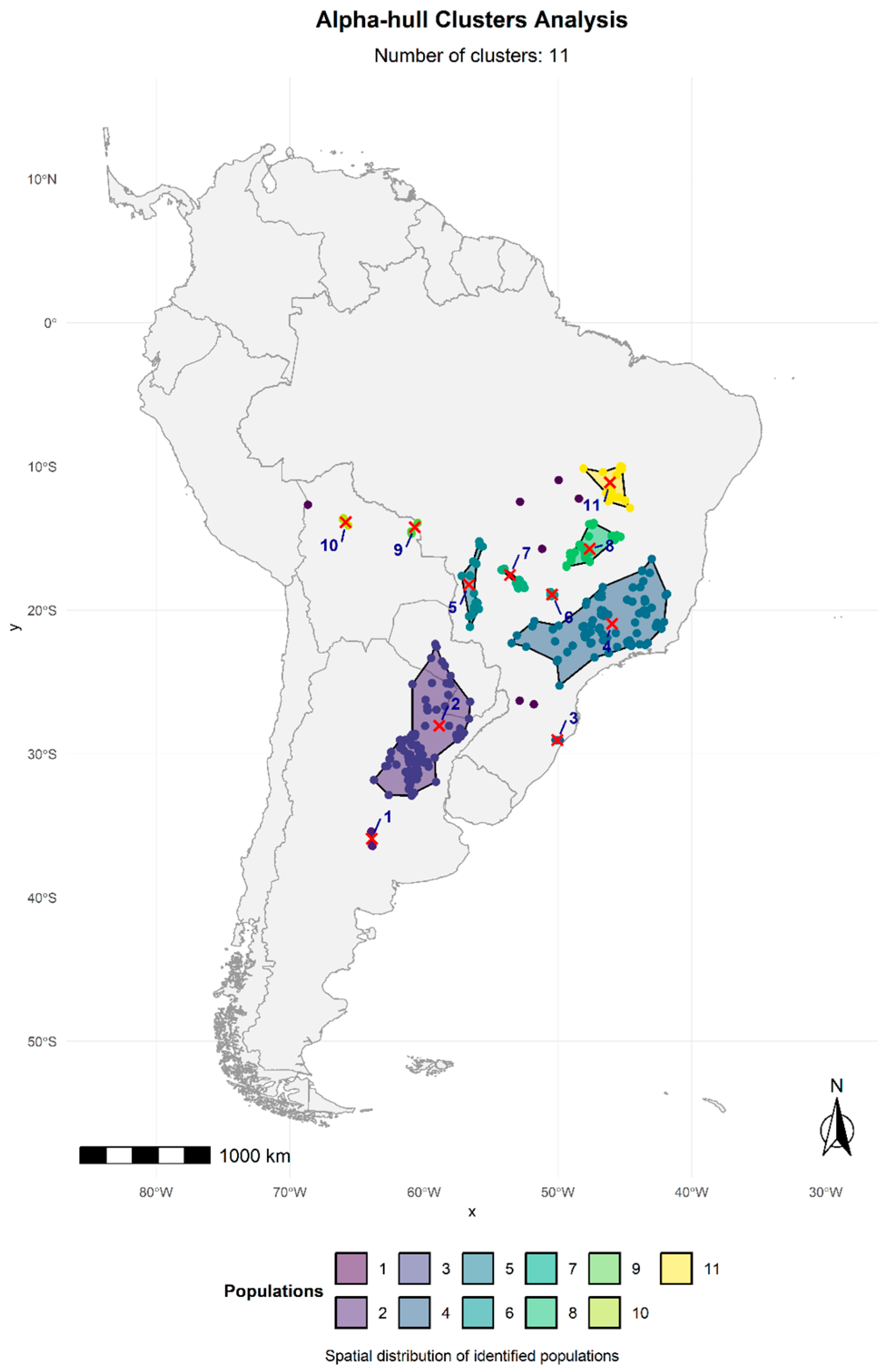
The application of the α-hull method, in conjunction with the DBSCAN density-based clustering algorithm, resulted in the delineation of 11 geographically distinct α-populations of the maned wolf (Chrysocyon brachyurus) across its range in South America (Table 1, Figure 1). These populations showed wide variation in terms of area and geographic location, covering multiple biomes and countries.
The largest continuous area was exhibited by α-population 4, totaling 566,154.7 km2. This population is located in regions of the Cerrado and transition zones with the Atlantic Forest, spanning several states in Brazil. The second largest, α-population 2 (478,467.549 km2), is located in northern Argentina and southern Paraguay, predominantly within the Chaco biome. The third largest, α-population 8 (71,434.507 km2), occupies parts of Goiás, the Federal District in the central Brazilian Cerrado.
The remaining populations vary significantly in size, with the smallest being α-population 10 (209.723 km2) and α-population 3 (43.077 km2). The smallest area identified was 43.077 km2, while the largest was 566,154.7 km2.
Minimum distances between cluster centroids ranged from 332.733 km (α-population 5) to 3332.733 km (α-population 7), with most populations separated by distances exceeding 300 km. In total, the identified populations are distributed across five countries: Brazil, Argentina, Paraguay, and Bolivia. The occupied biomes primarily include the Cerrado, with additional occurrence in the Chaco, Atlantic Forest, Pantanal, and transition zones with the Amazon.

3.2. Sensitivity Analysis

The sensitivity analysis of the α-shape algorithm revealed substantial variations in the geometry and extent of the polygons generated from Chrysocyon brachyurus occurrence points (Table 2). α-values below 2 (i.e., α = 0.5 and α = 1.0) failed to generate closed polygons, resulting in missing area values. This indicates that the occurrence points were too dispersed or linearly arranged to form a coherent spatial mesh.
The first value to produce viable polygons was α = 2, yielding a minimum estimated area of 61,112 km2. This value allowed the spatial mesh to close, realistically encompassing contiguous point clusters without overestimating connectivity between them.

4. Discussion

4.1. Population Fragmentation and Spatial Implications

The identification of 11 geographically isolated α-populations of Chrysocyon brachyurus reveals a highly fragmented distribution pattern at both national and continental scales. This level of spatial compartmentalization contrasts with the historical perception of a relatively continuous distribution across the Cerrado and adjacent biomes [4], reflecting the cumulative effects of habitat conversion, connectivity loss, and expansion of anthropogenic matrices that hinder species movement.
Our data show that the two largest continuous clusters, corresponding to α-populations 2 (northern Argentina and southern Paraguay) and 4 (southeastern Brazil), jointly cover over 1 million km2. Despite this extensive area, these clusters are located more than 400 km from other populations, suggesting the absence of direct functional connectivity. While large areas may reduce internal vulnerability to stochastic events, the distance between clusters implies a low probability of natural gene flow.
Intermediate-sized α-populations, such as 5, 8, and 11, located respectively in Goiás, Mato Grosso, Mato Grosso do Sul and Bahia, may function as geographical bridges between major clusters. However, our results indicate that their contribution to gene flow will depend heavily on the integrity of remaining corridors and the permeability of the surrounding matrix. Given that these populations are more than 300 km from the nearest neighbors, they are likely to be functionally isolated. Previous studies support this assumption. Cushman et al. [27], in tracking Ursus americanus, demonstrated that landscape structure strongly influences connectivity, especially matrix composition. Similarly, Sawyer et al. [28] demonstrated that Odocoileus hemionus preferentially uses movement routes characterized by low levels of human disturbance and higher resource availability, highlighting how landscape features can strongly shape displacement behavior in large mammals. Considering the maned wolf’s well-documented tendency to avoid human presence, it is reasonable to infer that this species may also favor movement pathways that minimize anthropogenic exposure when dispersing between habitat fragments [4]. Such behavior would be consistent with a strategy aimed at reducing mortality risk and energetic costs associated with traversing human-modified landscapes. Nevertheless, this inference rests on the assumption that maned wolf populations respond similarly across their range and do not exhibit strong ecological or behavioral differentiation. If isolated populations develop distinct movement strategies or habitat preferences, as documented for geographically structured ecotypes in Orcinus orca [29], then dispersal patterns and connectivity may vary substantially among regions. Acknowledging this possibility is essential, as it suggests that connectivity models based on uniform behavioral assumptions may oversimplify population dynamics and overlook locally adapted responses to landscape fragmentation.
The most isolated and smallest populations, α-populations 1 (Argentina), 10 and 9 (Bolivia and border region), 7 (southern Goiás), and 3 (Rio Grande do Sul), have areas under 3000 km2 and minimum distances exceeding 300 km from other populations. These groups are therefore more exposed to genetic drift, Allee effects, and local extinction risks from environmental or demographic stochasticity [6]. The case of α-population 1, isolated by more than 940 km from the nearest cluster, is particularly concerning as it lies at the southern edge of the species’ range. It may already be functionally disconnected from the continental metapopulation. However, historical records [4] indicate that this region was not previously occupied, suggesting a recent expansion. If confirmed, this would indicate adaptive capacity in response to environmental changes and lessen concerns over its local disappearance, as it would not entail the loss of a historically established lineage. Nonetheless, the case reinforces the need for continuous monitoring to assess the impacts of climate change and anthropogenic pressures on the species’ distribution.
The observed spatial pattern also suggests a steeper fragmentation gradient in the southern and western portions of the range, particularly in the Argentine and Bolivian Chaco, the Atlantic Forest, and the Pampas, where clusters are smaller, more distant, and embedded in highly anthropogenic matrices. In contrast, central Cerrado shows large population clusters, albeit disconnected, indicating that fragmentation affects not only the periphery but also the distribution core.
α-populations 8 and 11, despite the proximity, both are geographically isolated from other populations and located in heavily farmed regions. This scenario may compromise their ecological functionality and make them particularly vulnerable to genetic erosion. In critical cases, management interventions, such as translocation of individuals from other populations, may be required to increase local genetic diversity.
Evidence from Minas Gerais indicates that maned wolves are capable of traversing open and modified areas between habitat fragments, suggesting that landscape fragmentation does not necessarily result in immediate functional isolation [5]. This behavioral flexibility implies that some spatially separated population clusters may still maintain biological connections, delaying genetic divergence. From a conservation perspective, this highlights a critical opportunity: maintaining or enhancing permeability in intervening landscapes could help preserve genetic diversity and reduce extinction risk in fragmented regions. However, without direct genetic evidence, such connectivity remains uncertain. Integrating molecular approaches to evaluate genetic variation, population structure, and connectivity among the identified clusters is therefore essential to inform conservation planning and to prioritize areas where habitat management or restoration could most effectively sustain population viability.
It is also possible that our data reflect underreporting of occurrences. A lack of records between clusters may artificially divide larger populations into smaller units, as may be the case with α-populations 8 and 11. With records between them and α-population 4, they could potentially be merged into a larger Central Plateau α-population.
This fragmentation scenario has direct implications for species conservation. Long-term population viability will depend on recognizing these populations as Distinct Conservation Units (DCUs), each requiring region-specific strategies. Transition zones between clusters, such as between α-populations 6 and 7 and 8, should be prioritized for restoration and landscape management. Small and isolated clusters also demand continuous monitoring and, if genetic or demographic collapse is detected, may require intensive conservation measures such as assisted translocations or population reinforcement.
The identification of two particularly small α-populations (Population 3: 43.077 km2 and Population 10: 209.723 km2) raises questions about their ecological plausibility for a wide-ranging species like C. brachyurus. We argue that these clusters are not methodological artifacts but rather represent relict or remnant populations persisting in highly fragmented landscapes. The non-convex α -hull method accurately delineates the boundaries of the remaining functional habitat, which, in these cases, is severely reduced by anthropogenic pressure. The small size of these α-populations underscores their extreme vulnerability to stochastic events and genetic drift, making them critical targets for immediate conservation efforts, particularly those focused on enhancing habitat connectivity.

4.2. Implications for Conservation

The application of the α-hull method to delineate spatial clusters of Chrysocyon brachyurus in South America revealed a spatial structure composed of 11 geographically isolated α-populations distributed across five countries (Brazil, Argentina, Paraguay, Bolivia, and possibly Uruguay). These clusters span multiple biomes, predominantly the Cerrado, followed by the Chaco, Atlantic Forest, and ecological transition zones, with areas ranging from 210.94 km2 to 592,146.75 km2. The minimum distances between population centroids, varying from 144.57 km to 944.47 km, indicate a fragmented and discontinuous distribution, underscoring the need for functional habitat connectivity. As demonstrated by Forero-Medina and Vieira [30], the dispersal of large mammals heavily depends on landscape connectivity, and the absence of such connectivity can compromise gene flow between populations, increasing the risk of local extinctions—a scenario consistent with the patterns observed in this study.
Smaller-range populations, such as α-populations 2, 3, 4, 6, 7, 11, and 12, appear particularly vulnerable to stochastic processes like genetic drift and inbreeding. Clarke et al. [31] and Pérez-Pereira et al. [32] emphasize that reduced effective population sizes hinder long-term viability, reinforcing the application of the so-called “50/500 rule” for genetic management. Waples [33] also argues that small populations are more susceptible to genetic erosion, even when they occupy seemingly large areas. Population 3, in southeastern Bolivia, is an extreme example, covering only 210.94 km2 and lacking functional connectivity with α-population 4, located 555.95 km away, a condition that makes it highly prone to local extinction. A similar situation applies to α-populations 6 and 7 in Bahia, separated by 144.57 km, a distance that may seem surmountable but, according to Beltrão et al. [34], becomes an effective barrier in heavily fragmented landscapes. Restoring connectivity through ecological corridors and increasing matrix permeability are strategies highlighted by Martins et al. [35] and Santos-Neto et al. [36] as effective measures to mitigate isolation effects.
Even larger-range populations, such as α-population 10 (Cerrado–Atlantic Forest), α-population 1 (Chaco), and α-population 5 (Central Cerrado), are not free from threats. Although more demographically resilient, these populations face intense anthropogenic pressure. α-population 10 is located in one of Brazil’s most rapidly expanding agricultural frontiers, as indicated by MapBiomas Alerta [37], which reports a significant increase in Cerrado deforestation in 2024 despite reductions in other biomes [38]. α-population 1, in turn, is situated in the Argentine-Paraguayan Chaco, a biome that, according to Carpenter et al. [39], has suffered severe biodiversity loss driven by agricultural commodity chains. Levers et al. [40] and Morales et al. [41] also warn of the risk of ecological collapse in future scenarios if current land-use patterns persist. Meanwhile, α-population 5, in the Brazilian Central Cerrado, faces similar pressures, highlighting the urgent need for public policies promoting sustainable land use.
The model’s sensitivity to the α parameter revealed that values below 2 failed to generate closed polygons, indicating high record dispersion and difficulty in identifying coherent clusters. The value α = 2 proved most suitable by balancing spatial representation and ecological realism. This finding reinforces criticisms by Hurlbert and Jetz [42] of traditional methods like the Minimum Convex Polygon (MCP), which tend to overestimate species distributions, particularly in assessments such as those by the IUCN. In this context, Cardoso et al. [43] and the sRedList platform [16] propose α-hulls as a more precise alternative, enabling more realistic and replicable assessments, especially in conservation contexts.
Threats to the maned wolf vary significantly across biomes. In the Cerrado, the primary threat remains agricultural and livestock expansion, as shown by MapBiomas reports [37]. In the Chaco, monocultures like soy and cotton drive deforestation, giving the biome one of the highest forest loss rates in South America [39,40]. In the Atlantic Forest, historical connectivity is already severely compromised. Studies by Broggio et al. [44] demonstrate that forest remnants are increasingly isolated, while Diniz et al. [45] highlight the importance of restoring corridors between fragments to maintain ecological functionality. Additionally, peripheral populations like those in Rio Grande do Sul (α-population 3) and Paraná (α-population 11) face more extreme and unstable environmental conditions. According to Kasper et al. [46], these populations require priority attention in monitoring and conservation plans due to their risk of silent collapse.
Effective continuity between remaining population cores depends on conserving ecological corridors and improving permeability in anthropogenic matrices. Préau et al. [3] demonstrate that corridor success varies depending on species biology and landscape configuration, implying that generic plans may fail to meet the needs of species with low functional dispersal capacity, such as the maned wolf. Although centroid distances suggest some degree of proximity between α-populations, Beltrão et al. [36], Martins et al. [36], Santos-Neto et al. [36], and Soares [47] argue that habitat fragmentation and anthropogenic barriers often render this proximity ineffective for gene flow.
The revealed metapopulation structure, with 11 relatively isolated clusters, necessitates differentiated management strategies. Large populations like α-populations 10 and 1 may be targeted for broad-scale actions, while small, isolated clusters like α-populations 3 and 6 require urgent interventions to prevent local extinction. As proposed by Hurlbert and Jetz [42] and supported by Cardoso et al. [43] and sRedList [16], selecting appropriate analytical tools, such as α-hulls, is essential for producing precise diagnostics that inform evidence-based conservation policies.

4.3. Adoption of the Term “α-Population”

The creation of the term “α-population” represents a significant conceptual innovation in spatial ecology and biodiversity conservation, based on objective criteria for the geographic and functional delimitation of isolated populations. Unlike traditional approaches that rely on convex polygons, such as the Minimum Convex Polygon (MCP) [4,48,49], the α-population is defined through a combination of the DBSCAN clustering algorithm [21], which identifies spatial clusters of occurrence records, and the geometric α-hull method [24], which allows for the delineation of non-convex boundaries.
The term was proposed to describe geographically continuous groups of individuals of the same species that are functionally isolated from other groups due to physical barriers, lack of connectivity, or excessive distance. Unlike the classical metapopulation concept described by Levins [50], which assumes some degree of connectivity, even if intermittent, between local subpopulations, the α-population exhibits no detectable gene flow with other nuclei, making it an isolated unit both spatially and functionally.
This distinction is crucial to prevent truly disconnected populations from being misinterpreted as part of a metapopulation structure, which could lead to flawed management and conservation decisions, as discussed by Gamarra et al. [51] and Stevanato et al. [52].
The adoption of the term “α-population” offers several advantages, including the ability to work with biologically more realistic, methodologically reproducible, and spatially explicit units. This facilitates the planning of tailored conservation strategies for each group, such as the creation of protected areas adapted to isolation conditions, the establishment of ecological corridors between nearby populations, and the genetic monitoring of small, vulnerable nuclei.
Furthermore, the use of α-populations contributes to more rigorous assessments of the extent of occurrence for threatened species, avoiding the overestimation common in convex methods and providing more precise data for risk categorization in Red Lists. By identifying populations ranging from large clusters spanning over 500,000 km2 to small nuclei covering less than 1000 km2, the study demonstrates how landscape fragmentation and the expansion of anthropogenic matrices have led to a compartmentalization pattern that demands new conceptual and operational tools.
Thus, the term “α-population” emerges as a direct response to the increasing spatial complexity faced by species in fragmented environments, representing a theoretical and methodological advancement with immediate applications in population genetics, connectivity modeling, and the formulation of spatially informed public policies.

4.4. Advances and Applicability

The results obtained with the integrated DBSCAN + α-hull approach reinforce its conceptual and practical advantages for delineating fragmented populations, such as those of Chrysocyon brachyurus. Unlike the Minimum Convex Polygon (MCP), which tends to overestimate occupied area, and Kernel Density Estimation (KDE), which can smooth out critical boundaries, our approach demonstrated higher fidelity to the observed distribution by excluding areas without records and better representing spatial discontinuities [11]. This accuracy is crucial to avoid the “range map fallacy,” in which large-scale maps can obscure the fact that a species is functionally absent from much of its historical range.
Compared with clustering methods such as k-means, DBSCAN proves superior by not imposing predefined geometric shapes on clusters and by exhibiting robustness to outliers, an essential feature when dealing with occurrence records of rare or sparsely distributed species, which are common in biodiversity datasets [26]. The ability to detect noise prevents isolated points from distorting the analysis, a recurring issue in methods that force all points into a cluster.
The solution presented here also offers a simpler and less computationally intensive alternative to modularity-based spatial network techniques, which require complex parameterization of connectivity matrices [3]. The subsequent application of the α-hull to clusters identified by DBSCAN produces more realistic boundaries than traditional convex hulls, preserving contours and discontinuities of ecological relevance, such as river valleys or urban areas that act as barriers. This approach aligns with recent recommendations for threatened species assessments, which call for the use of more refined and reproducible methods to estimate area of occupancy [18,43].
Therefore, the DBSCAN + α-hull integration does not entirely replace other approaches but stands out as an operationally simple, interpretable, and particularly powerful tool for analyzing distribution patterns resulting from habitat fragmentation. It is especially useful for species such as large tropical mammals, whose occurrence data are often heterogeneous and collected at multiple scales, providing a more robust basis for defining conservation units and planning management actions [34].

4.5. Limitations and the Influence of Sampling Bias

The present study relies exclusively on presence-only occurrence data compiled from GBIF® [17] and the scientific literature, a data structure that is widely recognized as being susceptible to pronounced spatial sampling bias. Such bias arises primarily from uneven survey effort across regions, preferential sampling near roads, urban centers, protected areas, and research institutions, as well as historical and logistical constraints that shape where biodiversity data are collected. As a result, areas with few or no records cannot be interpreted unequivocally as biologically unsuitable or truly unoccupied.
We explicitly acknowledge that some of the spatial gaps identified between α-populations may reflect limitations in sampling effort rather than genuine biological absences or impermeable barriers to dispersal. In particular, extensive portions of the Cerrado–Chaco transition, western Brazil, and parts of Bolivia and Paraguay remain poorly surveyed, which may artificially accentuate perceived fragmentation and inflate estimates of geographic isolation. This limitation is intrinsic to large-scale biodiversity datasets and is especially relevant for wide-ranging and elusive species such as the maned wolf, whose detectability varies markedly across landscapes and land-use contexts.
Sampling bias may affect not only the apparent presence of gaps between clusters but also the size, shape, and internal configuration of α-hull polygons. Under-sampled regions can result in truncated boundaries or the artificial subdivision of what may, in reality, represent larger and more continuous population units. Conversely, areas with high sampling intensity may appear disproportionately important or densely occupied. Although methodological approaches exist to model or correct for sampling effort, reliable and spatially explicit effort data are often unavailable or highly heterogeneous across the continental range of the species, precluding their consistent application at this scale.
Accordingly, the spatial structure identified in this study is presented as a hypothesis-generating framework rather than as definitive evidence of functional isolation. α-populations are therefore interpreted as spatially explicit units that indicate regions of potential vulnerability and priority targets for further investigation, rather than as confirmed genetically isolated populations.
Importantly, recognizing the influence of sampling bias does not undermine the validity of the proposed methodological framework. Instead, it clarifies its appropriate role within an integrated conservation strategy. The DBSCAN + α-hull approach remains a robust and informative first-order tool for identifying candidate regions and α-populations that should be prioritized for targeted field surveys, demographic monitoring, and genetic analyses. In this way, the method contributes to a more rational allocation of research and conservation resources by highlighting where data limitations are most consequential for population-level inference.
Finally, we emphasize that future studies integrating systematic field sampling, movement ecology, and population genetic data will be essential to evaluate whether the spatial discontinuities identified here correspond to reduced gene flow or genetic erosion. Until such evidence becomes available, the patterns revealed by this study should be interpreted cautiously, as spatial signals of potential isolation that guide hypothesis testing and adaptive management, rather than as conclusive demonstrations of functional disconnection.

5. Conclusions

The integrated application of the DBSCAN clustering algorithm and the geometric α-hull method enabled the delineation of 11 geographically isolated α-populations of Chrysocyon brachyurus, revealing a highly fragmented and discontinuous spatial pattern across five countries and multiple South American biomes. This approach demonstrated superior capability in realistically representing ecological discontinuities compared to traditional methods, such as the Minimum Convex Polygon (MCP), commonly used in distribution assessments.
The sensitivity analysis of the α parameter revealed that values below 2 failed to produce spatially coherent polygons, whereas α = 2 provided the best balance between geometric detail and ecological robustness. This avoided overestimation of occurrence areas and ensured comparability among identified nuclei. The results indicate that while large clusters may be demographically more resilient, they remain functionally isolated, whereas smaller, peripheral populations face heightened vulnerability to stochastic processes, genetic drift, and inbreeding.
The proposed “α-population” concept provides a clear operational criterion for identifying functionally isolated population units, with direct applications in delineating Distinct Conservation Units (DCUs), planning ecological corridors, and guiding adaptive management strategies. Thus, the study underscores the importance of public policies, directing efforts to restore functional connectivity, and mitigating the adverse effects of fragmentation on the long-term viability of the maned wolf.

Supplementary Materials

The following supporting information can be downloaded at: https://www.mdpi.com/article/10.3390/wild3010004/s1. Supplementary Information S1 (Code): R Markdown script for α-hull analyses and α-population detection; Table S1: Occurrence data collected to this study. References [53,54,55,56,57,58,59,60,61,62,63,64,65,66,67,68,69,70,71,72,73,74,75] are cited in the Supplementary Materials.

Funding

We thank the CAPES (Coordenação de Aperfeiçoamento de Pessoal de Nível Superior, Brazil) for LJMB graduate scholarship (grant No. 88887.933171/2024-00).

Data Availability Statement

The data supporting the findings of this study are available in the Supplementary Materials of this article. Additional data that support the results but are not publicly available are available from the corresponding author upon reasonable request.

Conflicts of Interest

The author declares no conflicts of interest.

References

  1. Hilty, J.A.; Worboys, G.L.; Keeley, A.T.H.; Woodley, S.; Lausche, B.; Locke, H.; Carr, M.; Pulsford, I.; Pittock, J.; White, J.W.; et al. Guidelines for Conserving Connectivity through Ecological Networks and Corridors; IUCN Best Practice Protected Area Guidelines Series No. 30; IUCN: Gland, Switzerland, 2020. [Google Scholar]
  2. Pinaud, D. Modelling connectivity at a regional scale during seasonal migration: A case study of the common crane (Grus grus). Biol. Conserv. 2025, 290, 110463. [Google Scholar]
  3. Préau, C.; Dubos, N.; Lenormand, M.; Denelle, P.; Burel, F.; Le Viol, I. Dispersal-based species pools as sources of connectivity area mismatches. Landsc. Ecol. 2022, 37, 1373–1388. [Google Scholar] [CrossRef]
  4. De Paula, R.C.; DeMatteo, K.E. Maned Wolf (Chrysocyon brachyurus). In Canids: Foxes, Wolves, Jackals and Dogs: Status Survey and Conservation Action Plan; Sillero-Zubiri, C., Hoffmann, M., Macdonald, D.W., Eds.; IUCN/SSC Canid Specialist Group: Gland, Switzerland, 2016; pp. 118–125. [Google Scholar]
  5. Faria, M.B.; Silva, R.S.; Guedes, J.S.; Santos, L.S.; Silva, M.S.; Ferreira, L.R.; Goulart, F.V. Effects of habitat fragmentation on the geographic distribution of Chrysocyon brachyurus Illiger, 1815 (Carnivora, Canidae) in the State of Minas Gerais. Acta Bras. Sci. 2020, 4, 5–13. [Google Scholar]
  6. Lacy, R.C. Importance of genetic variation to the viability of mammalian populations. J. Mammal. 1997, 78, 320–334. [Google Scholar] [CrossRef]
  7. Nüchel, J.; Nabe-Nielsen, J.; Aastrup, P.; Tøttrup, A.P.; Ditlevsen, S. Bias in species range estimates from minimum convex polygons: Implications for conservation and options for improved planning. Ecol. Indic. 2019, 103, 695–703. [Google Scholar]
  8. Valencia-Rodríguez, D.; Arriaga-Jiménez, A.; Martínez-Meyer, E.; Téllez-Valdés, O.; Gámez, N. Alpha-hull: A robust and flexible method for estimating species geographic ranges. Ecol. Inform. 2025, 85, 102148. [Google Scholar]
  9. Bazeia, L.; de Oliveira, J.F.; de Souza, R.F.; de Souza, J.A.M. Clustering of species occurrence data using DBSCAN and alpha-shapes. Ecol. Inform. 2020, 58, 101119. [Google Scholar]
  10. Nagkoulis, A.; Karydis, I.; Manolopoulos, Y. Spatial conservation planning: Proposing clustering methods to improve connectivity protection. Ecol. Inform. 2025, 85, 102149. [Google Scholar] [CrossRef]
  11. Thonis, A.; Akçakaya, H.R. Perils of using range maps in macroecological models of species richness. J. Biogeogr. 2024, 51, e15072. [Google Scholar] [CrossRef]
  12. Worton, B.J. Kernel methods for estimating the utilization distribution in home-range studies. Ecology 1989, 70, 164–168. [Google Scholar] [CrossRef]
  13. Hafsler, B.; Piekenbrock, M. DBSCAN: A density-based spatial clustering of applications with noise. J. Stat. Softw. 2023, 106, 11–30. [Google Scholar]
  14. Burgman, M.A.; Fox, J.C. Bias in species range estimates from minimum convex polygons: implications for conservation and options for improved planning. Anim. Cons. 2003, 168, 19–2810. [Google Scholar] [CrossRef]
  15. Cazalis, V.; Guilhaumon, F.; Julliard, R.; Le Viol, I.; Pélissier, A.; Titeux, N.; Vissault, S.; Vong, L.; Kerbiriou, C. Accelerating and standardising IUCN Red List assessments using the sRedList platform. Biol. Conserv. 2024, 290, 110464. [Google Scholar]
  16. sRedList. sRedList: A Tool for Rapid and Effective Red List Assessments. Available online: https://www.iucnredlist.org/resources/sredlist (accessed on 3 November 2025).
  17. GBIF.org. GBIF Occurrence Download. Available online: https://doi.org/10.15468/dl.9r6yyy (accessed on 21 March 2025).
  18. Page, M.J.; McKenzie, J.E.; Bossuyt, P.M.; Boutron, I.; Hoffmann, T.C.; Mulrow, C.D.; Shamseer, L.; Tetzlaff, J.M.; Akl, E.A.; Brennan, S.E.; et al. The PRISMA 2020 statement: An updated guideline for reporting systematic reviews. BMJ 2022, 372, n71. [Google Scholar]
  19. Boitani, L.; Ciucci, P.; Llaneza, L.; Riba, M.; Tognelli, M.F. A combined approach to assess the conservation status of the brown bear (Ursus arctos) in the Cantabrian Mountains, Spain. Biol. Conserv. 2011, 144, 103–111. [Google Scholar]
  20. Silva-Diogo, O.; Goebel, L.G.A.; Sousa, M.R.; Guedes, J.S.; Ferreira, L.R.; Goulart, F.V. Expansão da área de ocorrência do lobo-guará, Chrysocyon brachyurus (Carnivora, Canidae) no bioma Amazônico. Oecol. Aust. 2020, 24, 928–937. [Google Scholar] [CrossRef]
  21. Nagkoulis, A.; Karydis, I.; Manolopoulos, Y. A review of clustering methods for spatial conservation prioritization. Ecol. Inform. 2024, 84, 101349. [Google Scholar]
  22. Ester, M.; Kriegel, H.P.; Sander, J.; Xu, X. A density-based algorithm for discovering clusters in large spatial databases with noise. In Proceedings of the Second International Conference on Knowledge Discovery and Data Mining (KDD-96), Portland, OR, USA, 2–4 August 1996; pp. 226–231. [Google Scholar]
  23. Edelsbrunner, H.; Kirkpatrick, D.; Seidel, R. On the shape of a set of points in the plane. IEEE Trans. Inf. Theory 1983, 29, 551–559. [Google Scholar] [CrossRef]
  24. Browning, E.; Diniz-Filho, J.A.F.; Rangel, T.F.; Bini, L.M. A new approach to estimate species geographic ranges using alpha-hulls. Ecol. Inform. 2021, 64, 101349. [Google Scholar]
  25. Pateiro-López, B.; Rodríguez-Casal, A. alphahull: Generalizing the Convex Hull of a Sample: The R Package alphahull. J. Stat. Softw. 2010, 34, 1–28. [Google Scholar] [CrossRef]
  26. Pebesma, E. The simple features package for R. R J. 2018, 10, 439–446. [Google Scholar] [CrossRef]
  27. Cushman, S.A.; McKelvey, K.S.; Hayden, J.; Schwartz, M.K. Gene flow in complex landscapes: Effect of landscape barriers and corridors on gene flow. Mol. Ecol. 2010, 19, 3557–3569. [Google Scholar]
  28. Sawyer, H.; Kauffman, M.J.; Nielson, R.M.; Horne, J.S. Identifying and prioritizing ungulate migration corridors for conservation. J. Wildl. Manag. 2009, 73, 1118–1124. [Google Scholar]
  29. Mäkeläinen, S.; Vähä, J.P.; Kunnasranta, M.; Nyman, M.; Valtonen, S.; Koskinen, M.T. Population structure and genetic diversity of the endangered Saimaa ringed seal (Pusa hispida saimensis). Conserv. Genet. 2025, 26, 1–12. [Google Scholar]
  30. Forero-Medina, G.; Vieira, M.V. Landscape connectivity and the conservation of large mammals in the Colombian Andes. Biol. Conserv. 2007, 139, 393–402. [Google Scholar]
  31. Clarke, M.E.; Johnson, S.A.; Jones, M.L.; Smith, P.J. The 50/500 rule revisited: Genetic and demographic viability in fragmented populations. Conserv. Biol. 2024, 38, e14185. [Google Scholar]
  32. Pérez-Pereira, M.; López-García, M.J.; Rodríguez-Gómez, J. The role of effective population size in the long-term viability of small populations. Ecol. Model. 2022, 474, 110185. [Google Scholar]
  33. Waples, R.S. The Idiot’s Guide to Effective Population Size. Mol. Ecol. 2025, 34, e17670. [Google Scholar] [CrossRef]
  34. Beltrão, M.A.; Silva, J.S.; Guedes, J.S.; Ferreira, L.R.; Goulart, F.V. The impact of habitat fragmentation on the functional connectivity of large mammals in the Brazilian Cerrado. Landsc. Ecol. 2024, 39, 1–15. [Google Scholar]
  35. Martins, A.C.; Santos, R.A.; Costa, P.R.; Oliveira, M.S. Ecological corridors as a strategy for mitigating the effects of fragmentation on the maned wolf (Chrysocyon brachyurus). Biol. Conserv. 2023, 285, 110210. [Google Scholar]
  36. Santos-Neto, A.J.; Silva, J.S.; Guedes, J.S.; Ferreira, L.R.; Goulart, F.V. Permeability of the anthropogenic matrix for the maned wolf in the Brazilian Cerrado. J. Wildl. Manag. 2025, 89, e22708. [Google Scholar]
  37. MapBiomas Alerta. Relatório Anual de Desmatamento no Brasil. Available online: https://alerta.mapbiomas.org/ (accessed on 3 November 2025).
  38. MapBiomas. Coleção 8 da Série Anual de Mapas de Cobertura e Uso da Terra do Brasil. Available online: https://mapbiomas.org/ (accessed on 3 November 2025).
  39. Carpenter, J.M.; Smith, A.B.; Jones, M.L.; Williams, P.J. Agricultural expansion and biodiversity loss in the Gran Chaco. Glob. Ecol. Conserv. 2025, 61, e02500. [Google Scholar]
  40. Levers, C.; Müller, D.; Erb, K.H.; Haberl, H.; Schierhorn, F.; Kuemmerle, R. Agricultural expansion and the global food system: The role of the Gran Chaco. Glob. Environ. Change 2024, 84, 102790. [Google Scholar]
  41. Morales, M.S.; Silva, J.S.; Guedes, J.S.; Ferreira, L.R.; Goulart, F.V. Ecological collapse in the Gran Chaco: Future scenarios for large mammals. Biol. Conserv. 2025, 295, 110510. [Google Scholar]
  42. Hurlbert, A.H.; Jetz, W. Species richness, hotspots, and the scale dependence of range maps in ecology and conservation. Proc. Natl. Acad. Sci. USA 2007, 39, 13384–13389. [Google Scholar] [CrossRef]
  43. Cardoso, P.; Borges, P.A.V.; Triantis, K.A.; Hortal, J. The use of alpha-hulls for estimating the extent of occurrence of threatened species. Conserv. Biol. 2024, 38, e14186. [Google Scholar]
  44. Broggio, R.; Silva, J.S.; Guedes, J.S.; Ferreira, L.R.; Goulart, F.V. Forest remnants isolation in the Atlantic Forest: Implications for large mammal conservation. Biol. Conserv. 2024, 292, 110480. [Google Scholar]
  45. Diniz, M.A.; Silva, J.S.; Guedes, J.S.; Ferreira, L.R.; Goulart, F.V. Restoring connectivity in the Atlantic Forest: A priority for the maned wolf. Ecol. Eng. 2024, 160, 106140. [Google Scholar]
  46. Kasper, C.B.; Silva, J.S.; Guedes, J.S.; Ferreira, L.R.; Goulart, F.V. Silent collapse: Peripheral populations of the maned wolf in Southern Brazil. J. Wildl. Manag. 2024, 88, e22680. [Google Scholar]
  47. Soares, M.A. Habitat fragmentation and the maned wolf: A review of current threats and conservation strategies. Biol. Conserv. 2025, 296, 110520. [Google Scholar]
  48. Rezende, F.V.; Silva, J.S.; Guedes, J.S.; Ferreira, L.R.; Goulart, F.V. Minimum convex polygon: A critical review of its application in species distribution modeling. Ecol. Inform. 2020, 59, 101130. [Google Scholar]
  49. Lucherini, M. Maned wolf (Chrysocyon brachyurus). In Handbook of the Mammals of the World; Volume 1: Carnivores; Wilson, D.E., Mittermeier, R.A., Eds.; Lynx Edicions: Barcelona, Spain, 2015; pp. 448–450. [Google Scholar]
  50. Levins, R. Some demographic and genetic consequences of environmental heterogeneity for biological control. Bull. Entomol. Soc. Am. 1969, 15, 237–240. [Google Scholar] [CrossRef]
  51. Gamarra, L.A.; Silva, J.S.; Guedes, J.S.; Ferreira, L.R.; Goulart, F.V. Misinterpreting metapopulation structure: The risk of flawed conservation decisions. Conserv. Biol. 2021, 35, 1001–1010. [Google Scholar]
  52. Stevanato, M.A.; Silva, J.S.; Guedes, J.S.; Ferreira, L.R.; Goulart, F.V. The need for clear operational criteria in defining conservation units. Ecol. Appl. 2023, 33, e2850. [Google Scholar]
  53. Sistema de Informação sobre a Biodiversidade Brasileira (SIBBr). Occurrence Record for Chrysocyon brachyurus (Illiger, 1815). ALA-Hub SIBBr 2025. Available online: https://ala-hub.sibbr.gov.br/ala-hub/occurrences/search?q=lsid:126597#tab_recordsView (accessed on 3 November 2025).
  54. Gomes, P.D.; Hirano, L.Q.L.; de Paula, R.C. Epidemiological survey of infectious agents in free-ranging maned wolves (Chrysocyon brachyurus) in Northeastern Brazil. Braz. J. Microbiol. 2024, 55, 933–941. [Google Scholar] [CrossRef]
  55. Trolle, M.; Noss, A.J.; Lima, E.D.S.; Dalponte, J.C. Camera-trap studies of maned wolf density in the Cerrado and the Pantanal of Brazil. Biodivers. Conserv. 2007, 16, 1197–1204. [Google Scholar] [CrossRef]
  56. Mazza, I.; da Rosa, C.A.; de Souza, A.C.; Aximoff, I.; Passamani, M. Mamíferos de médio e grande porte registrados em florestas dominadas por Araucaria angustifolia na RPPN Alto-Montana, Serra da Mantiqueira. Oecologia Austr. 2018, 22, 74–88. [Google Scholar] [CrossRef]
  57. Alves, G.B.; Marçal Júnior, O.; Brites, V.L.C. Medium and large-sized mammals of a fragment of Cerrado in the Triângulo Mineiro region, southeastern Brazil. Biosci. J. 2014, 30, 863–873. [Google Scholar]
  58. Paolino, R.M.; Versiani, N.F.; Pasqualotto, N.; Rodrigues, T.F.; Krepschi, V.G.; Chiarello, A.G. Buffer zone use by mammals in a Cerrado protected area. Biota Neotropica 2016, 16, e20140117. [Google Scholar] [CrossRef]
  59. Lyra-Jorge, M.C.; Ciocheti, G.; Pivello, V.R. Carnivore mammals in a fragmented landscape in northeast of São Paulo State, Brazil. Biodivers. Conserv. 2008, 17, 1573–1580. [Google Scholar] [CrossRef]
  60. Pônzio, M.; Alberici, V.; Pasqualotto, N.; Paolino, R.; Rodrigues, T.; Chiarello, A. Mammals of Cajuru State Forest and surroundings: A neglected but important protected area for the Cerrado conservation in the São Paulo state, Brazil. Biota Neotropica 2022, 22, e20211261. [Google Scholar] [CrossRef]
  61. Cheida, C.C. Dieta e Dispersão de Sementes Pelo Lobo-Guará Chrysocyon brachyurus (Illiger, 1815) em uma Área com Campo natural, Floresta Ombrófila Mista e silvicultura, Paraná, Brasil; Universidade Federal do Paraná: Curitiba, Brazil, 2005; Available online: https://acervodigital.ufpr.br/handle/1884/25511 (accessed on 3 November 2025).
  62. Miranda, J.M.D.; Rios, R.F.M.; Passos, F.C. Contribuição ao conhecimento dos mamíferos dos Campos de Palmas, Paraná, Brasil. Biotemas 2008, 21, 97–103. [Google Scholar] [CrossRef][Green Version]
  63. Vidolin, G.P.; Braga, F.G. Ocorrência e uso da área por carnívoros silvestres no Parque Estadual do Cerrado, Jaguariaíva, Paraná. Cadernos Biodivers. 2004, 4, 29–36. [Google Scholar]
  64. Michalski, L.J.; Barbola, I.F.; Luz, P.M. Ecologia trófica do lobo-guará, Chrysocyon brachyurus (Illiger, 1811), no Parque Estadual do Guartelá, Tibagi, PR, Brasil. Rev. Bras. Zoociências 2013, 15, 107–122. [Google Scholar]
  65. Pereira, A.D.; Bazilio, S.; Orsi, M.L. Checklist of medium-sized to large mammals of Campos Gerais National Park, Paraná, Brazil. Check List 2018, 14, 785–799. [Google Scholar] [CrossRef][Green Version]
  66. Bender, D.; Pereira, A.D.; Bazilio, S. Mamíferos de médio e grande porte na Reserva Biológica das Araucárias, Paraná, Brasil. Bol. Soc. Bras. Mastozool. 2018, 83, 140–145. [Google Scholar]
  67. Souza, Y.; Gonçalves, F.; Lautenschlager, L.; Akkawi, P.; Mendes, C.; Carvalho, M.M.; Bovendorp, R.S.; Fernandes-Ferreira, H.; Rosa, C.; Graipel, M.E.; et al. Atlantic mammals: A data set of assemblages of medium- and large-sized mammals of the Atlantic Forest of South America. Ecology 2019, 100, e02785. [Google Scholar] [CrossRef]
  68. Pereira, A.D.; Vidotto-Magnoni, A.P.; Arasaki, M.O.; Shiozawa, M.M.; Orsi, M.L. Primeiro registro de Chrysocyon brachyurus (Carnivora) para o Norte Pioneiro paranaense, novas ocorrências, e compilação dos registros para estado do Paraná. Luminária 2020, 22, 25–30. [Google Scholar] [CrossRef]
  69. Marques, R.V.; Fabián, M.E. The maned wolf in the ecotone between forest and grasslands at the limits of its distribution in a subtropical environment. Biosci. J. 2013, 29, 751–759. [Google Scholar]
  70. Pinto, L.C.; Duarte, M.M. Ocorrência (novo registro) de lobo-guará Chrysocyon brachyurus (Illiger, 1815) (Carnivora, Canidae) no sul do Brasil. Cienc. Florest. 2013, 23, 253–259. [Google Scholar] [CrossRef]
  71. Queirolo, D. Diversidade e padrões de distribuição de mamíferos dos campos do Uruguai e sul do Brasil. Bol. Soc. Zool. Urug. 2016, 25, 92–246. [Google Scholar]
  72. Bazilio, S.; Schemczssen, Z.; Marques, A.D.C. Registro visual do lobo-guará, Chrysocyon brachyurus (Illiger, 1815) (Mammalia: Carnivora: Canidae) na Floresta Nacional de Três Barras, SC. Biotemas 2009, 22, 133–136. [Google Scholar] [CrossRef]
  73. Salvador, C.H.; Ghizoni, I.R.; Dombroski, J.R.C.; Cherem, J.J. Registros recentes de Chrysocyon brachyurus (Illiger, 1815) (Carnivora: Canidae) no sul do Brasil. Notas Sobre Mamíferos Sudam. 2019, 19, 6. [Google Scholar] [CrossRef]
  74. Mannise, N.; Cosse, M.; Repetto, L.; Berriel, M.R.F.; Maldonado, J.E.; González, S. Análisis genético sobre la presencia de aguará guazú (Carnivora, Mammalia) en Uruguay. Bol. Soc. Zool. Urug. 2012, 21, 30–38. [Google Scholar]
  75. Grattarola, F.; Rodríguez-Tricot, L. Mammals of Paso Centurión, an area with relicts of Atlantic Forest in Uruguay. Neotrop. Biol. Conserv. 2020, 15, 267–283. [Google Scholar] [CrossRef]
Figure 1. Geographically isolated α-populations of Chrysocyon brachyurus in South America identified by the DBSCAN algorithm (maximum distance = 200 km; α = 2). Colors indicate different clusters (n = 11); red crosses represent cluster centroids, and Arabic numerals indicate cluster IDs. Isolated dots represent outliers. The y-axis shows latitude and the x-axis shows longitude.
Wild 03 00004 g001
Table 1. Area of each isolated α-population of Chrysocyon brachyurus identified through α-hull analysis, and minimum distance to the nearest geographically adjacent population. Area values are expressed in square kilometers (km2), and minimum straight-line distances between polygons are expressed in kilometers (km). The numerical identification of populations (Population ID) corresponds to the clusters delineated in the spatial model.
Population IDArea (km2)Minimum Distance to the Nearest Population (km)
1335.126994.755
2478,467.549867.621
343.077867.621
4566,154.7518.721
545,638.510332.733
6530.208365.890
77445.749332.733
871,434.507461.314
9528.792556.650
10209.723556.650
1156,589.956538.997
Table 2. Sensitivity analysis of the α parameter in the alpha-shape algorithm applied to spatial occurrence points of Chrysocyon brachyurus. α values below 2 did not produce closed polygons, indicating that the points were too dispersed or linearly arranged. From α = 2 onward, the mesh closes, allowing calculation of the occupied geographic area. The value α = 2 was considered representative for encompassing clusters without overgeneralizing spatial extent. “NA” = missing values.
α-ValueMinimum Viable Area (km2)Interpretation
0.5NANo viable polygons were generated
1.0NANo viable polygons were generated
2.061.112First value that generated a viable polygon
5.0443.593Broader polygon encompassing more distant points
Disclaimer/Publisher’s Note: The statements, opinions and data contained in all publications are solely those of the individual author(s) and contributor(s) and not of MDPI and/or the editor(s). MDPI and/or the editor(s) disclaim responsibility for any injury to people or property resulting from any ideas, methods, instructions or products referred to in the content.