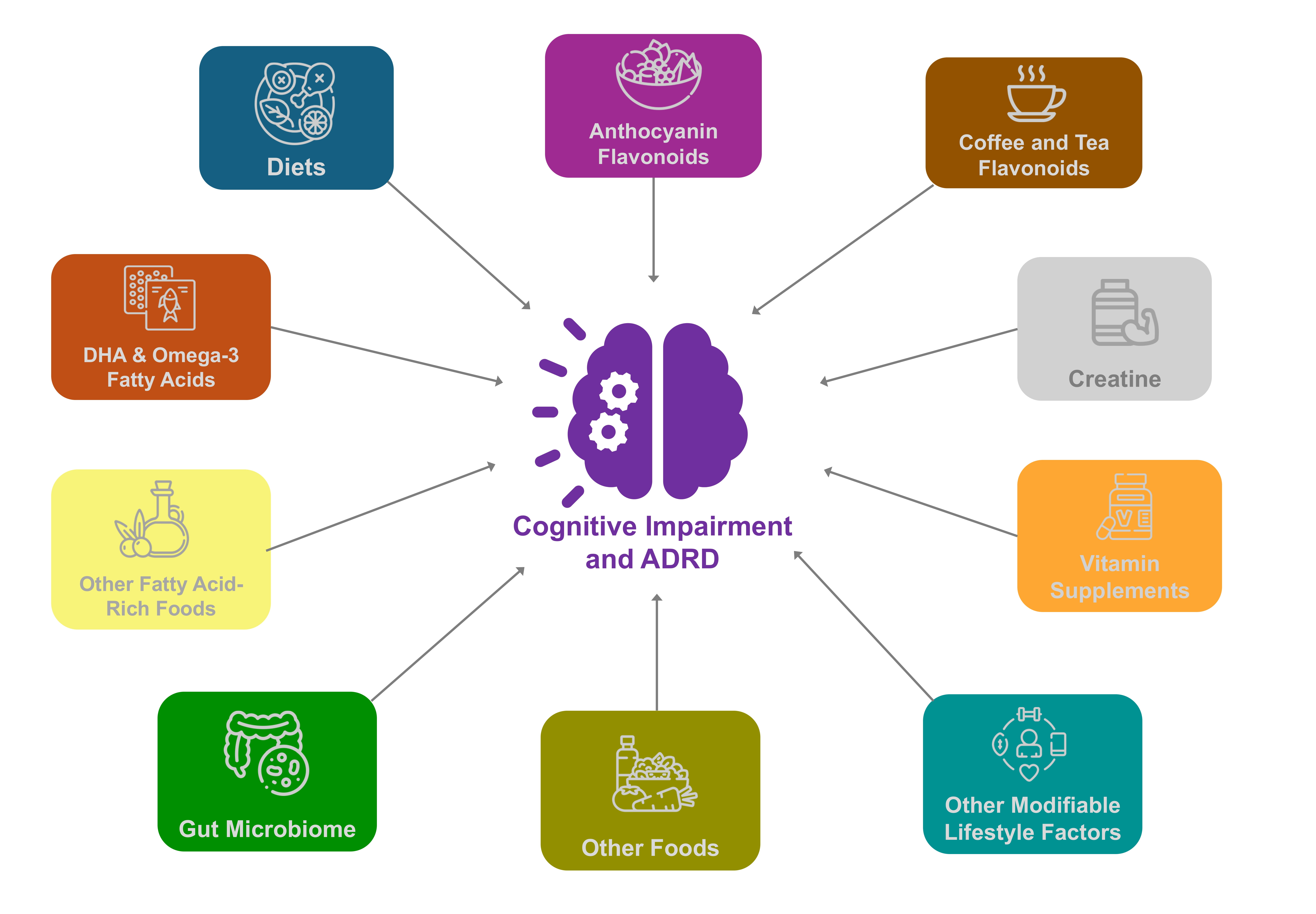

A Narrative Review of Dietary, Lifestyle, and Other Complementary and Alternative Approaches in Alzheimer’s Disease and Related Dementias

Abstract
1. Introduction
2. Nutrition and Dietary Interventions
2.1. Mediterranean Diet and Related Diets

| Dietary Intervention | Delays MCI Onset [References] | Reduces Risk for AD Dementia/Neurocognitive Decline [References] | Reduces MCI-to-Dementia Conversion [References] | Improves Cognitive Functioning in Dementia Populations [References] | Improves Age-Related Normal Cognitive Functioning [References] | Reduces AD-Related Pathology/ Neurophysiology [References] |
|---|---|---|---|---|---|---|
| Mediterranean Diet | Yes [63,67] | Yes [53,54,55,56,65] | Mixed (limited) [68,69] | Yes (limited) [68] | Yes (limited) [60,73] | Yes (limited) [58,59,61,62] |
| MIND | Yes [63,67] | Yes [64,65,66,74] | -- | -- | -- | Yes (limited) [66] |
| Ketogenic Diet | Mixed (limited) [75,76,77] | Mixed (limited) [76,78] | Yes (limited) [76,77,79] | Yes (limited) [76,79,80] | [76] | Yes (limited) [75,76] |
| Japanese Diet | -- | Yes (limited) [81,82] | -- | -- | Yes (limited) [81] | -- |
| General Healthy Diets | Yes (limited) [83] | Yes (limited) [84] | -- | -- | Yes (limited) [83] | -- |
| Vegetable-Rich Diets | Yes (limited) [85] | Yes (limited) [86] | -- | -- | Yes (limited) [87,88] | Yes (limited) [89] |
| Fruit-Rich Diets (excluding juices, citrus emphasis) | Yes (limited) [86,90] | Yes (limited) [82,86] | -- | -- | Yes (limited) [88] | -- |
2.2. Ketogenic Diet
2.3. Other Important Healthy Diets
3. Specific Dietary Components
3.1. Docosahexaenoic Acid (DHA) and Other Omega-3 Fatty Acids
3.2. Other Fatty Acids
3.2.1. Olive Oil
3.2.2. Avocados
3.2.3. Coconut Oil
3.3. Creatine
3.4. Flavonoids
3.4.1. Anthocyanin Flavonoids
3.4.2. Flavonoids with Coffee and Tea
3.4.3. Other Flavonoids
3.5. Vitamin Supplements
3.5.1. Vitamin B
3.5.2. Vitamin D
3.5.3. Other Vitamins
3.5.4. Multivitamins
3.5.5. Vitamin Deficiency
3.6. Other Foods That Should Be Noted
3.7. Avoidance of Ultra-Processed Food
4. Individual Agents with Potential Impact
5. Gut Microbiome
5.1. Modifiable Factors for Microbiome–Gut–Brain Axis
5.1.1. Fiber
5.1.2. Fatty Acids
| Gut Microbiome and Modifiable Factors | Delays MCI Onset [References] | Reduces Risk for AD Dementia/Neurocognitive Decline [References] | Reduces MCI-to-Dementia Conversion [References] | Improves Cognitive Functioning in Dementia Populations [References] | Improves Age-Related Normal Cognitive Functioning [References] | Reduces AD-Related Pathology/ Neurophysiology [References] |
|---|---|---|---|---|---|---|
| Gut Microbiome | Mixed [46,47,334] | Mixed [46,334] | Mixed [333] | Mixed [335] | Yes [335] | Yes [333,336,337] |
| Fiber | Mixed [356,357] | Mixed [101,367,368] | Yes (limited) [358] | -- | Yes [355,359,360] | Mixed [101,359,360] |
| Short-Chain Fatty Acids | Mixed [363,365] | Mixed [361,362,364] | Yes (limited) [339] | Yes (limited) [339] | Mixed [355,357,359,360] | Mixed [101,359,360] |
| Polyphenols | Mixed (limited) [369] | Mixed (limited) [350,370,371,372] | -- | Yes (limited) [369] | -- | Yes (limited) [369] |
| Fermented Foods/Probiotics | Mixed (limited) [373,374] | Mixed (limited) [375,376] | Yes (limited) [377] | Yes [374,377,378] | Yes [373] | Yes (limited) [378] |
| Acupuncture/ Moxibustion | Mixed (limited) [379] | Mixed (limited) [379] | -- | -- | -- | Mixed (limited) [379] |
5.1.3. Other Gut Microbiome Modifiable Factors
6. Other Important Non-Dietary and Non-Nutritional Modifiable Factors
6.1. Cardiovascular Factors
6.2. Environmental Factors
| Non-Dietary and Non-Nutritional Modifiable Factors | Delays MCI Onset [References] | Reduces Risk for AD Dementia/Neurocognitive Decline [References] | Reduces MCI-to-Dementia Conversion [References] | Improves Cognitive Functioning in Dementia Populations [References] | Improves Age-Related Normal Cognitive Functioning [References] | Reduces AD-Related Pathology/ Neurophysiology [References] |
|---|---|---|---|---|---|---|
| Cardiovascular Disease | Mixed [386,388] | Yes [384,385,389,391,393] | Mixed (limited) [390] | -- | Yes (limited) [387,392] | Mixed (limited) [386,390] |
| Cardiovascular Health Metrics | Yes (limited) [385] | Yes [385,391,393] | -- | -- | Yes [387,392] | -- |
| Air Pollution | Mixed [397,403] | Yes [394,396,397,403,404] | -- | -- | Mixed (limited) [405] | Yes (limited) [398,399,400,402,406,407] |
| Neighborhood Greenness/Natural Features | Yes (limited) [408] | Yes (limited) [405] | -- | -- | Yes (limited) [405] | -- |
| Neighborhood Socioeconomic Status/Deprivation | Mixed [409] | Yes (limited) [407,409] | -- | -- | Mixed [405] | Yes (limited) [406,407] |
| Age-Related Hearing Loss | Mixed [410,411] | Yes [412,413,414,415,416] | -- | Mixed [411,417] | Yes (limited) [417] | Yes (limited) [418] |
| Age-Related Vision Loss | Mixed [410,419] | Yes (limited) [412,419] | -- | -- | -- | -- |
| Dual Sensory Impairment | Yes (limited) [419] | Yes [414,415] | -- | -- | -- | -- |
| Hearing Aid Use/ Sensory Restoration | Yes (limited) [420,421] | Yes [420,421,422] | -- | Yes (limited) [422] | Yes (limited) [421] | -- |
| Cognitively Stimulating & Leisure Activities | Yes (limited) [423] | Yes [424,425,426,427] | -- | -- | Yes (limited) [428] | Yes (limited) [429,430,431] |
| Cognitive Training | Yes (limited) [432] | Yes [431,433] | Yes (limited) [426] | Yes [434,435] | Yes (limited) [433] | Mixed (limited) [436,437] |
| Cognitively Engaging Occupation/ Employment | Yes (limited) [426,427] | Yes (limited) [431,438] | -- | -- | Yes (limited) [431] | Yes (limited) [430] |
| Physical Activity | Yes [439,440,441] | Yes [441,442,443] | Mixed (limited) [444,445] | Yes [443,446,447] | Yes [448,449] | Yes (limited) [450,451,452] |
| Social Engagement | Yes (limited) [453,454] | Yes [455,456,457,458] | -- | Mixed [459] | Yes (limited) [454] | Yes (limited) [459] |
| Leisure Activities | Yes (limited) [441,460,461] | Yes [425,441,462,463,464] | -- | Yes (limited) [462] | Yes (limited) [461] | Yes (limited) [463,464] |
| Depression | Yes (limited) [465,466] | Mixed [393,467,468] | -- | -- | Mixed [469] | Mixed [470] |
| Anxiety | Yes (limited) [465,471] | Yes (limited) [472,473,474] | -- | Mixed [474] | Mixed [470] | Yes (limited) [465] |
| Positive Age Beliefs | Yes (limited) [475] | Yes [475,476] | -- | -- | Yes (limited) [477,478] | Yes (limited) [476,479] |
| Mindfulness | Mixed [480,481] | Mixed [482,483] | Mixed (limited) [482,484] | Mixed [481,485] | Mixed [485,486] | -- |
| Mediation/Movement- Based Meditation | Yes (limited) [487,488] | Yes (limited) [489,490] | -- | Yes (limited) [488,491] | Yes (limited) [492,493] | Yes (limited) [492] |
| Self-Reappraisal/ Self-Reflection | Yes (limited) [494] | -- | -- | Mixed [495] | Yes (limited) [494] | -- |
| Stress | Yes [496,497] | Yes [498,499] | -- | Mixed [500,501] | Yes (limited) [502] | Yes (limited) [503,504,505] |
| Environmental Stressors | Mixed [394,407] | Mixed [406,506] | -- | -- | Mixed [507] | Yes (limited) [508] |
| Sleep Health | Mixed (limited) [509,510,511] | Yes [511,512,513,514] | -- | Yes (limited) [467] | Mixed (limited) [511,515] | Yes (limited) [511,516] |
| Non-Pharmacological Approach for Acupuncture | Yes (limited) [517] | Yes (limited) [518,519] | Mixed (limited) [520,521] | Yes (limited) [518,519] | -- | Mixed (limited) [521] |
| Non-Pharmacological Approach for Music Therapy | Yes (limited) [522] | Yes [523,524,525,526] | Yes (limited) [527] | Yes [525,526,528] | Yes (limited) [529] | Mixed [528,529] |
6.3. Sensory Impairment
6.4. Cognitively Stimulating Activities
6.5. Physical, Social, and Leisure Activities
6.6. Psychosocial Factors
6.6.1. Depression and Anxiety
6.6.2. Positive Age Beliefs
6.6.3. Mindfulness
6.6.4. Self-Reappraisal
6.6.5. Stress
6.7. Sleep
7. Non-Pharmacological-Based Approaches: Acupuncture and Music Therapy
8. General Conclusions and Future Directions
Author Contributions
Funding
Data Availability Statement
Conflicts of Interest
References
- Luck, T.; Luppa, M.; Briel, S.; Riedel-Heller, S.G. Incidence of mild cognitive impairment: A systematic review. Dement. Geriatr. Cogn. Disord. 2010, 29, 164–175. [Google Scholar] [CrossRef] [PubMed]
- Jones, E.; Aigbogun, M.S.; Pike, J.; Berry, M.; Houle, C.R.; Husbands, J. Agitation in Dementia: Real-World Impact and Burden on Patients and the Healthcare System. J. Alzheimer’s Dis. 2021, 83, 89–101. [Google Scholar] [CrossRef]
- Nichols, E.; Steinmetz, J.D.; Vollset, S.E.; Fukutaki, K.; Chalek, J.; Abd-Allah, F.; Abdoli, A.; Abualhasan, A.; Abu-Gharbieh, E.; Akram, T.T.; et al. Estimation of the global prevalence of dementia in 2019 and forecasted prevalence in 2050: An analysis for the Global Burden of Disease Study 2019. Lancet Public Health 2022, 7, e105–e125. [Google Scholar] [CrossRef]
- Gaugler, J.; James, B.; Johnson, T.; Reimer, J.; Solis, M.; Weuve, J.; Buckley, R.F.; Hohman, T.J. 2022 Alzheimer’s disease facts and figures. Alzheimer’s Dement. 2022, 18, 700–789. [Google Scholar] [CrossRef]
- Ferri, C.P.; Prince, M.; Brayne, C.; Brodaty, H.; Fratiglioni, L.; Ganguli, M.; Hall, K.; Hasegawa, K.; Hendrie, H.; Huang, Y.; et al. Global prevalence of dementia: A Delphi consensus study. Lancet 2005, 366, 2112–2117. [Google Scholar] [CrossRef] [PubMed]
- Yiannopoulou, K.G.; Papageorgiou, S.G. Current and Future Treatments in Alzheimer Disease: An Update. J. Cent. Nerv. Syst. Dis. 2020, 12, 1179573520907397. [Google Scholar] [CrossRef]
- Hansen, R.A.; Gartlehner, G.; Lohr, K.N.; Kaufer, D.I. Functional outcomes of drug treatment in Alzheimer’s disease: A systematic review and meta-analysis. Drugs Aging 2007, 24, 155–167. [Google Scholar] [CrossRef]
- Deary, I.J.; Corley, J.; Gow, A.J.; Harris, S.E.; Houlihan, L.M.; Marioni, R.E.; Penke, L.; Rafnsson, S.B.; Starr, J.M. Age-associated cognitive decline. Br. Med. Bull. 2009, 92, 135–152. [Google Scholar] [CrossRef]
- Harada, C.N.; Natelson Love, M.C.; Triebel, K.L. Normal cognitive aging. Clin. Geriatr. Med. 2013, 29, 737–752. [Google Scholar] [CrossRef]
- Salthouse, T.A. Selective review of cognitive aging. J. Int. Neuropsychol. Soc. 2010, 16, 754–760. [Google Scholar] [CrossRef]
- Salthouse, T.A.; Fristoe, N.M.; Lineweaver, T.T.; Coon, V.E. Aging of attention: Does the ability to divide decline? Mem. Cogn. 1995, 23, 59–71. [Google Scholar] [CrossRef]
- Glisky, E.L. Changes in Cognitive Function in Human Aging. In Brain Aging; CRC Press: Boca Raton, FL, USA, 2007; pp. 3–20. [Google Scholar]
- Haaland, K.Y.; Price, L.; Larue, A. What does the WMS–III tell us about memory changes with normal aging? J. Int. Neuropsychol. Soc. 2003, 9, 89–96. [Google Scholar] [CrossRef] [PubMed]
- Rhodes, S.; Greene, N.R.; Naveh-Benjamin, M. Age-related differences in recall and recognition: A meta-analysis. Psychon. Bull. Rev. 2019, 26, 1529–1547. [Google Scholar] [CrossRef]
- Naveh-Benjamin, M.; Cowan, N. The roles of attention, executive function and knowledge in cognitive ageing of working memory. Nat. Rev. Psychol. 2023, 2, 151–165. [Google Scholar] [CrossRef]
- Luo, L.; Craik, F.I. Aging and memory: A cognitive approach. Can. J. Psychiatry 2008, 53, 346–353. [Google Scholar] [CrossRef] [PubMed]
- Ruthruff, E.; Lien, M.-C. Aging and Attention. In Encyclopedia of Geropsychology; Springer: Singapore, 2016; pp. 1–7. [Google Scholar]
- Curtis, A.F.; Turner, G.R.; Park, N.W.; Murtha, S.J. Improving visual spatial working memory in younger and older adults: Effects of cross-modal cues. Aging Neuropsychol. Cogn. 2019, 26, 24–43. [Google Scholar]
- Carriere, J.S.; Cheyne, J.A.; Solman, G.J.; Smilek, D. Age trends for failures of sustained attention. Psychol. Aging 2010, 25, 569. [Google Scholar] [CrossRef]
- Luis, C.A.; Loewenstein, D.A.; Acevedo, A.; Barker, W.W.; Duara, R. Mild cognitive impairment: Directions for future research. Neurology 2003, 61, 438–444. [Google Scholar] [CrossRef]
- Schmitter-Edgecombe, M.; Parsey, C.M. Assessment of functional change and cognitive correlates in the progression from healthy cognitive aging to dementia. Neuropsychology 2014, 28, 881–893. [Google Scholar] [CrossRef]
- Petersen, R.C.; Smith, G.E.; Waring, S.C.; Ivnik, R.J.; Tangalos, E.G.; Kokmen, E. Mild cognitive impairment: Clinical characterization and outcome. Arch. Neurol. 1999, 56, 303–308. [Google Scholar] [CrossRef] [PubMed]
- Joe, E.; Ringman, J.M. Cognitive symptoms of Alzheimer’s disease: Clinical management and prevention. BMJ 2019, 367, l6217. [Google Scholar] [CrossRef]
- Guarino, A.; Favieri, F.; Boncompagni, I.; Agostini, F.; Cantone, M.; Casagrande, M. Executive Functions in Alzheimer Disease: A Systematic Review. Front. Aging Neurosci. 2018, 10, 437. [Google Scholar] [CrossRef]
- Testo, A.A.; Roundy, G.; Dumas, J.A. Cognitive Decline in Alzheimer’s Disease. Curr. Top. Behav. Neurosci. 2025, 69, 181–195. [Google Scholar] [CrossRef]
- Karantzoulis, S.; Galvin, J.E. Distinguishing Alzheimer’s disease from other major forms of dementia. Expert. Rev. Neurother. 2011, 11, 1579–1591. [Google Scholar] [CrossRef] [PubMed]
- Davis, M.; O’Connell, T.; Johnson, S.; Cline, S.; Merikle, E.; Martenyi, F.; Simpson, K. Estimating Alzheimer’s Disease Progression Rates from Normal Cognition Through Mild Cognitive Impairment and Stages of Dementia. Curr. Alzheimer Res. 2018, 15, 777–788. [Google Scholar] [CrossRef] [PubMed]
- Smits, L.L.; van Harten, A.C.; Pijnenburg, Y.A.; Koedam, E.L.; Bouwman, F.H.; Sistermans, N.; Reuling, I.E.; Prins, N.D.; Lemstra, A.W.; Scheltens, P.; et al. Trajectories of cognitive decline in different types of dementia. Psychol. Med. 2015, 45, 1051–1059. [Google Scholar] [CrossRef]
- Arvanitakis, Z.; Shah, R.C.; Bennett, D.A. Diagnosis and Management of Dementia: Review. JAMA 2019, 322, 1589–1599. [Google Scholar] [CrossRef]
- Reuben, D.B.; Kremen, S.; Maust, D.T. Dementia Prevention and Treatment: A Narrative Review. JAMA Intern. Med. 2024, 184, 563–572. [Google Scholar] [CrossRef]
- Mendes, A.J.; Ribaldi, F.; Sayin, O.; Khachvani, G.; Mulargia, R.; Volpara, G.; Remoli, G.; Nencha, U.; Gianonni-Luza, S.; Cappa, S.; et al. Single-domain and multidomain lifestyle interventions for the prevention of cognitive decline in older adults who are cognitively unimpaired: A systematic review and network meta-analysis. Lancet Healthy Longev. 2025, 6, 100762. [Google Scholar] [CrossRef] [PubMed]
- Livingston, G.; Sommerlad, A.; Orgeta, V.; Costafreda, S.G.; Huntley, J.; Ames, D.; Ballard, C.; Banerjee, S.; Burns, A.; Cohen-Mansfield, J.; et al. Dementia prevention, intervention, and care. Lancet 2017, 390, 2673–2734. [Google Scholar] [CrossRef]
- Livingston, G.; Huntley, J.; Sommerlad, A.; Ames, D.; Ballard, C.; Banerjee, S.; Brayne, C.; Burns, A.; Cohen-Mansfield, J.; Cooper, C.; et al. Dementia prevention, intervention, and care: 2020 report of the Lancet Commission. Lancet 2020, 396, 413–446. [Google Scholar] [CrossRef]
- Krivanek, T.J.; Gale, S.A.; McFeeley, B.M.; Nicastri, C.M.; Daffner, K.R. Promoting Successful Cognitive Aging: A Ten-Year Update. J. Alzheimer’s Dis. 2021, 81, 871–920. [Google Scholar] [CrossRef]
- Daffner, K.R. Promoting successful cognitive aging: A comprehensive review. J. Alzheimer’s Dis. 2010, 19, 1101–1122. [Google Scholar] [CrossRef]
- Wang, B.; Wang, N.; Sun, Y.; Tan, X.; Zhang, J.; Lu, Y. Association of Combined Healthy Lifestyle Factors with Incident Dementia in Patients with Type 2 Diabetes. Neurology 2022, 99, e2336–e2345. [Google Scholar] [CrossRef]
- Loeffler, D.A. Modifiable, Non-Modifiable, and Clinical Factors Associated with Progression of Alzheimer’s Disease. J. Alzheimer’s Dis. 2021, 80, 1–27. [Google Scholar] [CrossRef]
- Nguyen, S.A.; Oughli, H.A.; Lavretsky, H. Use of Complementary and Integrative Medicine for Alzheimer’s Disease and Cognitive Decline. J. Alzheimer’s Dis. 2024, 97, 523–540. [Google Scholar] [CrossRef]
- Beversdorf, D.Q.; Crosby, H.W.; Shenker, J.I. Complementary and Alternative Medicine Approaches in Alzheimer Disease and Other Neurocognitive Disorders. Mo. Med. 2023, 120, 70–78. [Google Scholar]
- Nguyen, S.A.; Oughli, H.A.; Lavretsky, H. Complementary and Integrative Medicine for Neurocognitive Disorders and Caregiver Health. Curr. Psychiatry Rep. 2022, 24, 469–480. [Google Scholar] [CrossRef]
- Diamond, B.; Johnson, S.; Torsney, K.; Morodan, J.; Prokop, B.; Davidek, D.; Kramer, P. Complementary and alternative medicines in the treatment of dementia: An evidence-based review. Drugs Aging 2003, 20, 981–998. [Google Scholar] [CrossRef]
- Yehuda, S.; Rabinovitz, S.; Carasso, R.L.; Mostofsky, D.I. The role of polyunsaturated fatty acids in restoring the aging neuronal membrane. Neurobiol. Aging 2002, 23, 843–853. [Google Scholar] [CrossRef] [PubMed]
- Bazinet, R.P.; Laye, S. Polyunsaturated fatty acids and their metabolites in brain function and disease. Nat. Rev. Neurosci. 2014, 15, 771–785. [Google Scholar] [CrossRef]
- Kinney, J.W.; Bemiller, S.M.; Murtishaw, A.S.; Leisgang, A.M.; Salazar, A.M.; Lamb, B.T. Inflammation as a central mechanism in Alzheimer’s disease. Alzheimer’s Dement. 2018, 4, 575–590. [Google Scholar] [CrossRef]
- Joffre, C.; Rey, C.; Laye, S. N-3 Polyunsaturated Fatty Acids and the Resolution of Neuroinflammation. Front. Pharmacol. 2019, 10, 1022. [Google Scholar] [CrossRef]
- Angoorani, P.; Ejtahed, H.S.; Siadat, S.D.; Sharifi, F.; Larijani, B. Is There Any Link between Cognitive Impairment and Gut Microbiota? A Systematic Review. Gerontology 2022, 68, 1201–1213. [Google Scholar] [CrossRef]
- Pei, Y.; Lu, Y.; Li, H.; Jiang, C.; Wang, L. Gut microbiota and intestinal barrier function in subjects with cognitive impairments: A cross-sectional study. Front. Aging Neurosci. 2023, 15, 1174599. [Google Scholar] [CrossRef]
- Kivipelto, M.; Mangialasche, F.; Ngandu, T. Lifestyle interventions to prevent cognitive impairment, dementia and Alzheimer disease. Nat. Rev. Neurol. 2018, 14, 653–666. [Google Scholar] [CrossRef]
- Zucchella, C.; Sinforiani, E.; Tamburin, S.; Federico, A.; Mantovani, E.; Bernini, S.; Casale, R.; Bartolo, M. The Multidisciplinary Approach to Alzheimer’s Disease and Dementia. A Narrative Review of Non-Pharmacological Treatment. Front. Neurol. 2018, 9, 1058. [Google Scholar] [CrossRef]
- van Dyck, C.H.; Swanson, C.J.; Aisen, P.; Bateman, R.J.; Chen, C.; Gee, M.; Kanekiyo, M.; Li, D.; Reyderman, L.; Cohen, S.; et al. Lecanemab in Early Alzheimer’s Disease. N. Engl. J. Med. 2023, 388, 9–21. [Google Scholar] [CrossRef] [PubMed]
- Solfrizzi, V.; Panza, F.; Capurso, A. The role of diet in cognitive decline. J. Neural Transm. 2003, 110, 95–110. [Google Scholar] [CrossRef] [PubMed]
- Charbit, J.; Vidal, J.-S.; Hanon, O. Effects of Dietary Interventions on Cognitive Outcomes. Nutrients 2025, 17, 1964. [Google Scholar] [CrossRef] [PubMed]
- Andreu-Reinon, M.E.; Chirlaque, M.D.; Gavrila, D.; Amiano, P.; Mar, J.; Tainta, M.; Ardanaz, E.; Larumbe, R.; Colorado-Yohar, S.M.; Navarro-Mateu, F.; et al. Mediterranean Diet and Risk of Dementia and Alzheimer’s Disease in the EPIC-Spain Dementia Cohort Study. Nutrients 2021, 13, 700. [Google Scholar] [CrossRef]
- Ballarini, T.; Melo van Lent, D.; Brunner, J.; Schroder, A.; Wolfsgruber, S.; Altenstein, S.; Brosseron, F.; Buerger, K.; Dechent, P.; Dobisch, L.; et al. Mediterranean Diet, Alzheimer Disease Biomarkers and Brain Atrophy in Old Age. Neurology 2021, 96, e2920–e2932. [Google Scholar] [CrossRef]
- Moustafa, B.; Trifan, G.; Isasi, C.R.; Lipton, R.B.; Sotres-Alvarez, D.; Cai, J.; Tarraf, W.; Stickel, A.; Mattei, J.; Talavera, G.A.; et al. Association of Mediterranean Diet with Cognitive Decline Among Diverse Hispanic or Latino Adults from the Hispanic Community Health Study/Study of Latinos. JAMA Netw. Open 2022, 5, e2221982. [Google Scholar] [CrossRef]
- Vassilaki, M.; Aakre, J.A.; Syrjanen, J.A.; Mielke, M.M.; Geda, Y.E.; Kremers, W.K.; Machulda, M.M.; Alhurani, R.E.; Staubo, S.C.; Knopman, D.S.; et al. Mediterranean Diet, Its Components, and Amyloid Imaging Biomarkers. J. Alzheimer’s Dis. 2018, 64, 281–290. [Google Scholar] [CrossRef]
- Zhang, R.; Zhang, M.; Wang, P. The intricate interplay between dietary habits and cognitive function: Insights from the gut-brain axis. Front. Nutr. 2025, 12, 1539355. [Google Scholar] [CrossRef] [PubMed]
- Rainey-Smith, S.R.; Gu, Y.; Gardener, S.L.; Doecke, J.D.; Villemagne, V.L.; Brown, B.M.; Taddei, K.; Laws, S.M.; Sohrabi, H.R.; Weinborn, M.; et al. Mediterranean diet adherence and rate of cerebral Abeta-amyloid accumulation: Data from the Australian Imaging, Biomarkers and Lifestyle Study of Ageing. Transl. Psychiatry 2018, 8, 238. [Google Scholar] [CrossRef]
- Berti, V.; Walters, M.; Sterling, J.; Quinn, C.G.; Logue, M.; Andrews, R.; Matthews, D.C.; Osorio, R.S.; Pupi, A.; Vallabhajosula, S.; et al. Mediterranean diet and 3-year Alzheimer brain biomarker changes in middle-aged adults. Neurology 2018, 90, e1789–e1798. [Google Scholar] [CrossRef]
- Luciano, M.; Corley, J.; Cox, S.R.; Valdes Hernandez, M.C.; Craig, L.C.; Dickie, D.A.; Karama, S.; McNeill, G.M.; Bastin, M.E.; Wardlaw, J.M.; et al. Mediterranean-type diet and brain structural change from 73 to 76 years in a Scottish cohort. Neurology 2017, 88, 449–455. [Google Scholar] [CrossRef]
- Wang, X.; Xin, Z.; Li, X.; Wu, K.; Wang, W.; Guo, L.; Wang, L.; Mo, X.; Liu, X.; Guo, Z.; et al. Mediterranean diet and dementia: MRI marker evidence from meta-analysis. Eur. J. Med. Res. 2025, 30, 32. [Google Scholar] [CrossRef]
- Liu, Y.; Gu, X.; Li, Y.; Wang, F.; Vyas, C.M.; Peng, C.; Dong, D.; Li, Y.; Zhang, Y.; Zhang, Y.; et al. Interplay of genetic predisposition, plasma metabolome and Mediterranean diet in dementia risk and cognitive function. Nat. Med. 2025, 31, 3790–3800. [Google Scholar] [CrossRef] [PubMed]
- Hosking, D.E.; Eramudugolla, R.; Cherbuin, N.; Anstey, K.J. MIND not Mediterranean diet related to 12-year incidence of cognitive impairment in an Australian longitudinal cohort study. Alzheimer’s Dement. 2019, 15, 581–589. [Google Scholar] [CrossRef]
- de Crom, T.O.E.; Mooldijk, S.S.; Ikram, M.K.; Ikram, M.A.; Voortman, T. MIND diet and the risk of dementia: A population-based study. Alzheimer’s Res. Ther. 2022, 14, 8. [Google Scholar] [CrossRef]
- Youn, J.E.; Kwon, Y.J.; Lee, Y.J.; Heo, S.J.; Lee, J.W. Association of Mediterranean, high-quality, and anti-inflammatory diet with dementia in UK Biobank cohort. J. Nutr. Health Aging 2025, 29, 100564. [Google Scholar] [CrossRef]
- Agarwal, P.; Agrawal, S.; Wagner, M.; Cherian, L.J.; Aggarwal, N.T.; James, B.D.; Holland, T.M.; Bennett, D.A.; Barnes, L.L.; Leurgans, S.E.; et al. MIND Diet and Hippocampal Sclerosis Among Community-Based Older Adults. JAMA Netw. Open 2025, 8, e2526089. [Google Scholar] [CrossRef]
- McEvoy, C.T.; Guyer, H.; Langa, K.M.; Yaffe, K. Neuroprotective Diets Are Associated with Better Cognitive Function: The Health and Retirement Study. J. Am. Geriatr. Soc. 2017, 65, 1857–1862. [Google Scholar] [CrossRef] [PubMed]
- de la Rubia Orti, J.E.; Garcia-Pardo, M.P.; Drehmer, E.; Sancho Cantus, D.; Julian Rochina, M.; Aguilar, M.A.; Hu Yang, I. Improvement of Main Cognitive Functions in Patients with Alzheimer’s Disease after Treatment with Coconut Oil Enriched Mediterranean Diet: A Pilot Study. J. Alzheimer’s Dis. 2018, 65, 577–587. [Google Scholar] [CrossRef]
- Glans, I.; Sonestedt, E.; Nagga, K.; Gustavsson, A.M.; Gonzalez-Padilla, E.; Borne, Y.; Stomrud, E.; Melander, O.; Nilsson, P.M.; Palmqvist, S.; et al. Association Between Dietary Habits in Midlife with Dementia Incidence Over a 20-Year Period. Neurology 2023, 100, e28–e37. [Google Scholar] [CrossRef]
- Tatulian, S.A. Challenges and hopes for Alzheimer’s disease. Drug Discov. Today 2022, 27, 1027–1043. [Google Scholar] [CrossRef]
- Christodoulou, C.C.; Pitsillides, M.; Hadjisavvas, A.; Zamba-Papanicolaou, E. Dietary Intake, Mediterranean and Nordic Diet Adherence in Alzheimer’s Disease and Dementia: A Systematic Review. Nutrients 2025, 17, 336. [Google Scholar] [CrossRef] [PubMed]
- Fekete, M.; Varga, P.; Ungvari, Z.; Fekete, J.T.; Buda, A.; Szappanos, A.; Lehoczki, A.; Mozes, N.; Grosso, G.; Godos, J.; et al. The role of the Mediterranean diet in reducing the risk of cognitive impairement, dementia, and Alzheimer’s disease: A meta-analysis. Geroscience 2025, 47, 3111–3130. [Google Scholar] [CrossRef] [PubMed]
- Martinez-Lapiscina, E.H.; Clavero, P.; Toledo, E.; Estruch, R.; Salas-Salvado, J.; San Julian, B.; Sanchez-Tainta, A.; Ros, E.; Valls-Pedret, C.; Martinez-Gonzalez, M.A. Mediterranean diet improves cognition: The PREDIMED-NAVARRA randomised trial. J. Neurol. Neurosurg. Psychiatry 2013, 84, 1318–1325. [Google Scholar] [CrossRef]
- Morris, M.C.; Tangney, C.C.; Wang, Y.; Sacks, F.M.; Barnes, L.L.; Bennett, D.A.; Aggarwal, N.T. MIND diet slows cognitive decline with aging. Alzheimer’s Dement. 2015, 11, 1015–1022. [Google Scholar] [CrossRef]
- Fortier, M.; Castellano, C.A.; Croteau, E.; Langlois, F.; Bocti, C.; St-Pierre, V.; Vandenberghe, C.; Bernier, M.; Roy, M.; Descoteaux, M.; et al. A ketogenic drink improves brain energy and some measures of cognition in mild cognitive impairment. Alzheimer’s Dement. 2019, 15, 625–634. [Google Scholar] [CrossRef]
- Bonnechere, B.; Stephens, E.B.; Boileau, A.C.; Ducker, M.; Stubbs, B.J. The Effect of Exogenous Ketone Bodies on Cognition in Patients with Mild Cognitive Impairment, Alzheimer’s Disease and in Healthy Adults: A Systematic Review and Meta-Analysis. medRxiv 2025. [Google Scholar] [CrossRef]
- Brandt, J.; Buchholz, A.; Henry-Barron, B.; Vizthum, D.; Avramopoulos, D.; Cervenka, M.C. Preliminary Report on the Feasibility and Efficacy of the Modified Atkins Diet for Treatment of Mild Cognitive Impairment and Early Alzheimer’s Disease. J. Alzheimer’s Dis. 2019, 68, 969–981. [Google Scholar] [CrossRef] [PubMed]
- Dowis, K.; Banga, S. The Potential Health Benefits of the Ketogenic Diet: A Narrative Review. Nutrients 2021, 13, 1654. [Google Scholar] [CrossRef]
- Ota, M.; Matsuo, J.; Ishida, I.; Takano, H.; Yokoi, Y.; Hori, H.; Yoshida, S.; Ashida, K.; Nakamura, K.; Takahashi, T.; et al. Effects of a medium-chain triglyceride-based ketogenic formula on cognitive function in patients with mild-to-moderate Alzheimer’s disease. Neurosci. Lett. 2019, 690, 232–236. [Google Scholar] [CrossRef]
- Phillips, M.C.L.; Deprez, L.M.; Mortimer, G.M.N.; Murtagh, D.K.J.; McCoy, S.; Mylchreest, R.; Gilbertson, L.J.; Clark, K.M.; Simpson, P.V.; McManus, E.J.; et al. Randomized crossover trial of a modified ketogenic diet in Alzheimer’s disease. Alzheimer’s Res. Ther. 2021, 13, 51. [Google Scholar] [CrossRef]
- Lu, Y.; Matsuyama, S.; Sugawara, Y.; Sone, T.; Tsuji, I. Changes in a specific dietary pattern and incident dementia: A prospective cohort study. Clin. Nutr. 2021, 40, 3495–3502. [Google Scholar] [CrossRef] [PubMed]
- Zhang, S.; Tomata, Y.; Sugiyama, K.; Sugawara, Y.; Tsuji, I. Citrus consumption and incident dementia in elderly Japanese: The Ohsaki Cohort 2006 Study. Br. J. Nutr. 2017, 117, 1174–1180. [Google Scholar] [CrossRef] [PubMed]
- Lehtisalo, J.; Levalahti, E.; Lindstrom, J.; Hanninen, T.; Paajanen, T.; Peltonen, M.; Antikainen, R.; Laatikainen, T.; Strandberg, T.; Soininen, H.; et al. Dietary changes and cognition over 2 years within a multidomain intervention trial-The Finnish Geriatric Intervention Study to Prevent Cognitive Impairment and Disability (FINGER). Alzheimer’s Dement. 2019, 15, 410–417. [Google Scholar] [CrossRef]
- Smyth, A.; Dehghan, M.; O’Donnell, M.; Anderson, C.; Teo, K.; Gao, P.; Sleight, P.; Dagenais, G.; Probstfield, J.L.; Mente, A.; et al. Healthy eating and reduced risk of cognitive decline: A cohort from 40 countries. Neurology 2015, 84, 2258–2265. [Google Scholar] [CrossRef] [PubMed]
- Li, W.; Sun, L.; Yue, L.; Li, G.; Xiao, S. The Association Between Eating Green Vegetables Every Day and Mild Cognitive Impairment: A Community-Based Cross-Sectional Study in Shanghai. Neuropsychiatr. Dis. Treat. 2019, 15, 3213–3218. [Google Scholar] [CrossRef]
- Jiang, X.; Huang, J.; Song, D.; Deng, R.; Wei, J.; Zhang, Z. Increased Consumption of Fruit and Vegetables Is Related to a Reduced Risk of Cognitive Impairment and Dementia: Meta-Analysis. Front. Aging Neurosci. 2017, 9, 18. [Google Scholar] [CrossRef] [PubMed]
- Gehlich, K.H.; Beller, J.; Lange-Asschenfeldt, B.; Kocher, W.; Meinke, M.C.; Lademann, J. Consumption of fruits and vegetables: Improved physical health, mental health, physical functioning and cognitive health in older adults from 11 European countries. Aging Ment. Health 2020, 24, 634–641. [Google Scholar] [CrossRef]
- Mao, X.; Chen, C.; Xun, P.; Daviglus, M.L.; Steffen, L.M.; Jacobs, D.R.; Van Horn, L.; Sidney, S.; Zhu, N.; Qin, B.; et al. Intake of Vegetables and Fruits Through Young Adulthood Is Associated with Better Cognitive Function in Midlife in the US General Population. J. Nutr. 2019, 149, 1424–1433. [Google Scholar] [CrossRef]
- Pachter, D.; Yaskolka Meir, A.; Kaplan, A.; Tsaban, G.; Zelicha, H.; Rinott, E.; Levakov, G.; Finkelstein, O.; Shelef, I.; Salti, M.; et al. Serum Galectin-9 and Decorin in relation to brain aging and the green-Mediterranean diet: A secondary analysis of the DIRECT PLUS randomized trial. Clin. Nutr. 2025, 53, 99–108. [Google Scholar] [CrossRef]
- Yuan, C.; Fondell, E.; Bhushan, A.; Ascherio, A.; Okereke, O.I.; Grodstein, F.; Willett, W.C. Long-term intake of vegetables and fruits and subjective cognitive function in US men. Neurology 2019, 92, e63–e75. [Google Scholar] [CrossRef]
- Veech, R.L. The therapeutic implications of ketone bodies: The effects of ketone bodies in pathological conditions: Ketosis, ketogenic diet, redox states, insulin resistance, and mitochondrial metabolism. Prostaglandins Leukot. Essent. Fat. Acids 2004, 70, 309–319. [Google Scholar] [CrossRef]
- Lilamand, M.; Mouton-Liger, F.; Di Valentin, E.; Sanchez Ortiz, M.; Paquet, C. Efficacy and Safety of Ketone Supplementation or Ketogenic Diets for Alzheimer’s Disease: A Mini Review. Front. Nutr. 2021, 8, 807970. [Google Scholar] [CrossRef]
- Gough, S.M.; Casella, A.; Ortega, K.J.; Hackam, A.S. Neuroprotection by the Ketogenic Diet: Evidence and Controversies. Front. Nutr. 2021, 8, 782657. [Google Scholar] [CrossRef] [PubMed]
- Shabbir, I.; Liu, K.; Riaz, B.; Rahim, M.F.; Zhong, S.; Aweya, J.J.; Cheong, K.L. Investigating the Therapeutic Potential of the Ketogenic Diet in Modulating Neurodegenerative Pathophysiology: An Interdisciplinary Approach. Nutrients 2025, 17, 1268. [Google Scholar] [CrossRef]
- Jang, J.; Kim, S.R.; Lee, J.E.; Lee, S.; Son, H.J.; Choe, W.; Yoon, K.S.; Kim, S.S.; Yeo, E.J.; Kang, I. Molecular Mechanisms of Neuroprotection by Ketone Bodies and Ketogenic Diet in Cerebral Ischemia and Neurodegenerative Diseases. Int. J. Mol. Sci. 2023, 25, 124. [Google Scholar] [CrossRef]
- de la Rubia Orti, J.E.; Garcia-Pardo, M.P.; Cuerda-Ballester, M.; Castellano-Estornell, G.; Benlloch, M. Editorial: Ketogenic diets for cognitive and behavioral function. Front. Nutr. 2024, 11, 1463796. [Google Scholar] [CrossRef]
- Morris, M.C.; Wang, Y.; Barnes, L.L.; Bennett, D.A.; Dawson-Hughes, B.; Booth, S.L. Nutrients and bioactives in green leafy vegetables and cognitive decline: Prospective study. Neurology 2018, 90, e214–e222. [Google Scholar] [CrossRef]
- Villanueva, J.L.; Vita, A.A.; Zwickey, H.; Fitzgerald, K.; Hodges, R.; Zimmerman, B.; Bradley, R. Dietary associations with reduced epigenetic age: A secondary data analysis of the methylation diet and lifestyle study. Aging 2025, 17, 994–1010. [Google Scholar] [CrossRef]
- Liu, C.; Meng, Q.; Wei, Y.; Su, X.; Zhang, Y.; He, P.; Zhou, C.; Liu, M.; Ye, Z.; Qin, X. J-shaped association between dietary thiamine intake and the risk of cognitive decline in cognitively healthy, older Chinese individuals. Gen. Psychiatr. 2024, 37, e101311. [Google Scholar] [CrossRef]
- Berding, K.; Long-Smith, C.M.; Carbia, C.; Bastiaanssen, T.F.S.; van de Wouw, M.; Wiley, N.; Strain, C.R.; Fouhy, F.; Stanton, C.; Cryan, J.F.; et al. A specific dietary fibre supplementation improves cognitive performance-an exploratory randomised, placebo-controlled, crossover study. Psychopharmacology 2021, 238, 149–163. [Google Scholar] [CrossRef] [PubMed]
- Prokopidis, K.; Giannos, P.; Ispoglou, T.; Witard, O.C.; Isanejad, M. Dietary Fiber Intake is Associated with Cognitive Function in Older Adults: Data from the National Health and Nutrition Examination Survey. Am. J. Med. 2022, 135, e257–e262. [Google Scholar] [CrossRef]
- Berding, K.; Carbia, C.; Cryan, J.F. Going with the grain: Fiber, cognition, and the microbiota-gut-brain-axis. Exp. Biol. Med. 2021, 246, 796–811. [Google Scholar] [CrossRef] [PubMed]
- van de Rest, O.; Wang, Y.; Barnes, L.L.; Tangney, C.; Bennett, D.A.; Morris, M.C. APOE epsilon4 and the associations of seafood and long-chain omega-3 fatty acids with cognitive decline. Neurology 2016, 86, 2063–2070. [Google Scholar] [CrossRef] [PubMed]
- Nooyens, A.C.J.; van Gelder, B.M.; Bueno-de-Mesquita, H.B.; van Boxtel, M.P.J.; Verschuren, W.M.M. Fish consumption, intake of fats and cognitive decline at middle and older age: The Doetinchem Cohort Study. Eur. J. Nutr. 2018, 57, 1667–1675. [Google Scholar] [CrossRef]
- Andrieu, S.; Guyonnet, S.; Coley, N.; Cantet, C.; Bonnefoy, M.; Bordes, S.; Bories, L.; Cufi, M.N.; Dantoine, T.; Dartigues, J.F.; et al. Effect of long-term omega 3 polyunsaturated fatty acid supplementation with or without multidomain intervention on cognitive function in elderly adults with memory complaints (MAPT): A randomised, placebo-controlled trial. Lancet Neurol. 2017, 16, 377–389. [Google Scholar] [CrossRef]
- Wood, A.H.R.; Chappell, H.F.; Zulyniak, M.A. Dietary and supplemental long-chain omega-3 fatty acids as moderators of cognitive impairment and Alzheimer’s disease. Eur. J. Nutr. 2022, 61, 589–604. [Google Scholar] [CrossRef]
- Sala-Vila, A.; Satizabal, C.L.; Tintle, N.; Melo van Lent, D.; Vasan, R.S.; Beiser, A.S.; Seshadri, S.; Harris, W.S. Red Blood Cell DHA Is Inversely Associated with Risk of Incident Alzheimer’s Disease and All-Cause Dementia: Framingham Offspring Study. Nutrients 2022, 14, 2408. [Google Scholar] [CrossRef] [PubMed]
- Hartnett, K.B.; Ferguson, B.J.; Hecht, P.M.; Schuster, L.E.; Shenker, J.I.; Mehr, D.R.; Fritsche, K.L.; Belury, M.A.; Scharre, D.W.; Horwitz, A.J.; et al. Potential Neuroprotective Effects of Dietary Omega-3 Fatty Acids on Stress in Alzheimer’s Disease. Biomolecules 2023, 13, 1096. [Google Scholar] [CrossRef]
- Shinto, L.; Quinn, J.; Montine, T.; Dodge, H.H.; Woodward, W.; Baldauf-Wagner, S.; Waichunas, D.; Bumgarner, L.; Bourdette, D.; Silbert, L.; et al. A randomized placebo-controlled pilot trial of omega-3 fatty acids and alpha lipoic acid in Alzheimer’s disease. J. Alzheimer’s Dis. 2014, 38, 111–120. [Google Scholar] [CrossRef]
- Quinn, J.F.; Raman, R.; Thomas, R.G.; Yurko-Mauro, K.; Nelson, E.B.; Van Dyck, C.; Galvin, J.E.; Emond, J.; Jack, C.R., Jr.; Weiner, M.; et al. Docosahexaenoic acid supplementation and cognitive decline in Alzheimer disease: A randomized trial. JAMA 2010, 304, 1903–1911. [Google Scholar] [CrossRef]
- Yassine, H.N.; Carrasco, A.S.; Badie, D.S. Designing Newer Omega-3 Supplementation Trials for Cognitive Outcomes: A Systematic Review Guided Analysis. J. Alzheimer’s Dis. 2024, 101, S455–S466. [Google Scholar] [CrossRef] [PubMed]
- Wang, B.; Li, D.; Peng, C.; Hong, J.; Wu, Y. Dietary omega-3 intake and cognitive function in older adults. Int. J. Psychiatry Med. 2025, 60, 265–279. [Google Scholar] [CrossRef]
- Zamroziewicz, M.K.; Paul, E.J.; Zwilling, C.E.; Barbey, A.K. Determinants of fluid intelligence in healthy aging: Omega-3 polyunsaturated fatty acid status and frontoparietal cortex structure. Nutr. Neurosci. 2018, 21, 570–579. [Google Scholar] [CrossRef]
- Tofiq, A.; Zetterberg, H.; Blennow, K.; Basun, H.; Cederholm, T.; Eriksdotter, M.; Faxen-Irving, G.; Hjorth, E.; Jerneren, F.; Schultzberg, M.; et al. Effects of Peroral Omega-3 Fatty Acid Supplementation on Cerebrospinal Fluid Biomarkers in Patients with Alzheimer’s Disease: A Randomized Controlled Trial-The OmegAD Study. J. Alzheimer’s Dis. 2021, 83, 1291–1301. [Google Scholar] [CrossRef]
- Majou, D.; Dermenghem, A.L. Effects of DHA (omega-3 fatty acid) and estradiol on amyloid beta-peptide regulation in the brain. Brain Res. 2024, 1823, 148681. [Google Scholar] [CrossRef] [PubMed]
- Sala-Vila, A.; Arenaza-Urquijo, E.M.; Sanchez-Benavides, G.; Suarez-Calvet, M.; Mila-Aloma, M.; Grau-Rivera, O.; Gonzalez-de-Echavarri, J.M.; Crous-Bou, M.; Minguillon, C.; Fauria, K.; et al. DHA intake relates to better cerebrovascular and neurodegeneration neuroimaging phenotypes in middle-aged adults at increased genetic risk of Alzheimer disease. Am. J. Clin. Nutr. 2021, 113, 1627–1635. [Google Scholar] [CrossRef]
- Li, L.; Xu, W.; Tan, C.C.; Cao, X.P.; Wei, B.Z.; Dong, C.W.; Tan, L.; Alzheimer’s Disease Neuroimaging, I. A gene-environment interplay between omega-3 supplementation and APOE epsilon4 provides insights for Alzheimer’s disease precise prevention amongst high-genetic-risk population. Eur. J. Neurol. 2022, 29, 422–431. [Google Scholar] [CrossRef] [PubMed]
- Sun, G.Y.; Appenteng, M.K.; Li, R.; Woo, T.; Yang, B.; Qin, C.; Pan, M.; Cieslik, M.; Cui, J.; Fritsche, K.L.; et al. Docosahexaenoic Acid (DHA) Supplementation Alters Phospholipid Species and Lipid Peroxidation Products in Adult Mouse Brain, Heart, and Plasma. Neuromol. Med. 2021, 23, 118–129. [Google Scholar] [CrossRef]
- Tsolaki, M.; Lazarou, E.; Kozori, M.; Petridou, N.; Tabakis, I.; Lazarou, I.; Karakota, M.; Saoulidis, I.; Melliou, E.; Magiatis, P. A Randomized Clinical Trial of Greek High Phenolic Early Harvest Extra Virgin Olive Oil in Mild Cognitive Impairment: The MICOIL Pilot Study. J. Alzheimer’s Dis. 2020, 78, 801–817. [Google Scholar] [CrossRef]
- Guasch-Ferre, M.; Li, Y.; Willett, W.C.; Sun, Q.; Sampson, L.; Salas-Salvado, J.; Martinez-Gonzalez, M.A.; Stampfer, M.J.; Hu, F.B. Consumption of Olive Oil and Risk of Total and Cause-Specific Mortality Among U.S. Adults. J. Am. Coll. Cardiol. 2022, 79, 101–112. [Google Scholar] [CrossRef]
- Tessier, A.J.; Cortese, M.; Yuan, C.; Bjornevik, K.; Ascherio, A.; Wang, D.D.; Chavarro, J.E.; Stampfer, M.J.; Hu, F.B.; Willett, W.C.; et al. Consumption of Olive Oil and Diet Quality and Risk of Dementia-Related Death. JAMA Netw. Open 2024, 7, e2410021. [Google Scholar] [CrossRef]
- Cheng, F.W.; Ford, N.A.; Taylor, M.K. US Older Adults That Consume Avocado or Guacamole Have Better Cognition Than Non-consumers: National Health and Nutrition Examination Survey 2011-2014. Front. Nutr. 2021, 8, 746453. [Google Scholar] [CrossRef]
- Scott, T.M.; Rasmussen, H.M.; Chen, O.; Johnson, E.J. Avocado Consumption Increases Macular Pigment Density in Older Adults: A Randomized, Controlled Trial. Nutrients 2017, 9, 919. [Google Scholar] [CrossRef]
- Edwards, C.G.; Walk, A.M.; Thompson, S.V.; Reeser, G.E.; Erdman, J.W., Jr.; Burd, N.A.; Holscher, H.D.; Khan, N.A. Effects of 12-week avocado consumption on cognitive function among adults with overweight and obesity. Int. J. Psychophysiol. 2020, 148, 13–24. [Google Scholar] [CrossRef] [PubMed]
- Torres-Isidro, O.; Gonzalez-Montoya, M.; Vargas-Vargas, M.A.; Florian-Rodriguez, U.; Garcia-Berumen, C.I.; Montoya-Perez, R.; Saavedra-Molina, A.; Calderon-Cortes, E.; Rodriguez-Orozco, A.R.; Cortes-Rojo, C. Anti-Aging Potential of Avocado Oil via Its Antioxidant Effects. Pharmaceuticals 2025, 18, 246. [Google Scholar] [CrossRef] [PubMed]
- Giraldo-Berrio, D.; Mendivil-Perez, M.; Velez-Pardo, C.; Jimenez-Del-Rio, M. Rotenone Induces a Neuropathological Phenotype in Cholinergic-like Neurons Resembling Parkinson’s Disease Dementia (PDD). Neurotox. Res. 2024, 42, 28. [Google Scholar] [CrossRef] [PubMed]
- da Silva, G.G.; Pimenta, L.P.S.; Melo, J.O.F.; Mendonca, H.O.P.; Augusti, R.; Takahashi, J.A. Phytochemicals of Avocado Residues as Potential Acetylcholinesterase Inhibitors, Antioxidants, and Neuroprotective Agents. Molecules 2022, 27, 1892. [Google Scholar] [CrossRef]
- Fernando, M.G.; Silva, R.; Fernando, W.; de Silva, H.A.; Wickremasinghe, A.R.; Dissanayake, A.S.; Sohrabi, H.R.; Martins, R.N.; Williams, S.S. Effect of Virgin Coconut Oil Supplementation on Cognition of Individuals with Mild-to-Moderate Alzheimer’s Disease in Sri Lanka (VCO-AD Study): A Randomized Placebo-Controlled Trial. J. Alzheimer’s Dis. 2023, 96, 1195–1206. [Google Scholar] [CrossRef]
- Bafail, D.; Bafail, A.; Alshehri, N.; Alhalees, N.H.; Bajarwan, A. Impact of Coconut Oil and Its Bioactive Metabolites in Alzheimer’s Disease and Dementia: A Systematic Review and Meta-Analysis. Diseases 2024, 12, 272. [Google Scholar] [CrossRef]
- Ostojic, S.M.; Korovljev, D.; Stajer, V. Dietary creatine and cognitive function in U.S. adults aged 60 years and over. Aging Clin. Exp. Res. 2021, 33, 3269–3274. [Google Scholar] [CrossRef]
- Pilatus, U.; Lais, C.; Rochmont Adu, M.; Kratzsch, T.; Frolich, L.; Maurer, K.; Zanella, F.E.; Lanfermann, H.; Pantel, J. Conversion to dementia in mild cognitive impairment is associated with decline of N-actylaspartate and creatine as revealed by magnetic resonance spectroscopy. Psychiatry Res. 2009, 173, 1–7. [Google Scholar] [CrossRef]
- Smith, R.N.; Agharkar, A.S.; Gonzales, E.B. A review of creatine supplementation in age-related diseases: More than a supplement for athletes. F1000Research 2014, 3, 222. [Google Scholar] [CrossRef]
- Xu, C.; Bi, S.; Zhang, W.; Luo, L. The effects of creatine supplementation on cognitive function in adults: A systematic review and meta-analysis. Front. Nutr. 2024, 11, 1424972. [Google Scholar] [CrossRef]
- Avgerinos, K.I.; Spyrou, N.; Bougioukas, K.I.; Kapogiannis, D. Effects of creatine supplementation on cognitive function of healthy individuals: A systematic review of randomized controlled trials. Exp. Gerontol. 2018, 108, 166–173. [Google Scholar] [CrossRef]
- McMorris, T.; Mielcarz, G.; Harris, R.C.; Swain, J.P.; Howard, A. Creatine supplementation and cognitive performance in elderly individuals. Neuropsychol. Dev. Cogn. B Aging Neuropsychol. Cogn. 2007, 14, 517–528. [Google Scholar] [CrossRef]
- Smith, A.N.; Choi, I.Y.; Lee, P.; Sullivan, D.K.; Burns, J.M.; Swerdlow, R.H.; Kelly, E.; Taylor, M.K. Creatine monohydrate pilot in Alzheimer’s: Feasibility, brain creatine, and cognition. Alzheimer’s Dement. 2025, 11, e70101. [Google Scholar] [CrossRef]
- Riesberg, L.A.; Weed, S.A.; McDonald, T.L.; Eckerson, J.M.; Drescher, K.M. Beyond muscles: The untapped potential of creatine. Int. Immunopharmacol. 2016, 37, 31–42. [Google Scholar] [CrossRef] [PubMed]
- Prokopidis, K.; Giannos, P.; Triantafyllidis, K.K.; Kechagias, K.S.; Forbes, S.C.; Candow, D.G. Effects of creatine supplementation on memory in healthy individuals: A systematic review and meta-analysis of randomized controlled trials. Nutr. Rev. 2023, 81, 416–427. [Google Scholar] [CrossRef]
- Brewer, G.J.; Wallimann, T.W. Protective effect of the energy precursor creatine against toxicity of glutamate and beta-amyloid in rat hippocampal neurons. J. Neurochem. 2000, 74, 1968–1978. [Google Scholar] [CrossRef] [PubMed]
- Krikorian, R.; Shidler, M.D.; Nash, T.A.; Kalt, W.; Vinqvist-Tymchuk, M.R.; Shukitt-Hale, B.; Joseph, J.A. Blueberry supplementation improves memory in older adults. J. Agric. Food Chem. 2010, 58, 3996–4000. [Google Scholar] [CrossRef]
- de Lucia, C.; Tovar-Rios, D.A.; Khalifa, K.; Kvernberg, S.M.; Pola, I.; Bergland, A.K.; Maple-Grodem, J.; Siow, R.; Ashton, N.; Ballard, C.; et al. Effects of Oral Anthocyanin Supplementation on In Vitro Neurogenesis, Hippocampus-Dependent Cognition, and Blood-Based Dementia Biomarkers: Results from a 24-Week Randomized Controlled Trial in Older Adults at Risk for Dementia (ACID). Nutrients 2025, 17, 2680. [Google Scholar] [CrossRef]
- Flanagan, E.; Cameron, D.; Sobhan, R.; Wong, C.; Pontifex, M.G.; Tosi, N.; Mena, P.; Del Rio, D.; Sami, S.; Narbad, A.; et al. Chronic Consumption of Cranberries (Vaccinium macrocarpon) for 12 Weeks Improves Episodic Memory and Regional Brain Perfusion in Healthy Older Adults: A Randomised, Placebo-Controlled, Parallel-Groups Feasibility Study. Front. Nutr. 2022, 9, 849902. [Google Scholar] [CrossRef]
- Dai, Q.; Borenstein, A.R.; Wu, Y.; Jackson, J.C.; Larson, E.B. Fruit and vegetable juices and Alzheimer’s disease: The Kame Project. Am. J. Med. 2006, 119, 751–759. [Google Scholar] [CrossRef]
- Lamport, D.J.; Williams, C.M. Polyphenols and Cognition In Humans: An Overview of Current Evidence from Recent Systematic Reviews and Meta-Analyses. Brain Plast. 2021, 6, 139–153. [Google Scholar] [CrossRef]
- Pezzuto, J.M. Perspective: Are Grapes Worthy of the Moniker Superfood? J. Agric. Food Chem. 2025, 73, 19262–19272. [Google Scholar] [CrossRef]
- Agarwal, P.; Holland, T.M.; James, B.D.; Cherian, L.J.; Aggarwal, N.T.; Leurgans, S.E.; Bennett, D.A.; Schneider, J.A. Pelargonidin and Berry Intake Association with Alzheimer’s Disease Neuropathology: A Community-Based Study. J. Alzheimer’s Dis. 2022, 88, 653–661. [Google Scholar] [CrossRef] [PubMed]
- Lorzadeh, E.; Weston-Green, K.; Roodenrys, S.; do Rosario, V.; Kent, K.; Charlton, K. The Effect of Anthocyanins on Cognition: A Systematic Review and Meta-analysis of Randomized Clinical Trial Studies in Cognitively Impaired and Healthy Adults. Curr. Nutr. Rep. 2025, 14, 23. [Google Scholar] [CrossRef]
- Chen, X.; Walton, K.; Brodaty, H.; Chalton, K. Polyphenols and Diets as Current and Potential Nutrition Senotherapeutics in Alzheimer’s Disease: Findings from Clinical Trials. J. Alzheimer’s Dis. 2024, 101, S479–S501. [Google Scholar] [CrossRef]
- Curtis, A.F.; Musich, M.; Costa, A.N.; Gonzales, J.; Gonzales, H.; Ferguson, B.J.; Kille, B.; Thomas, A.L.; Wei, X.; Liu, P.; et al. Feasibility and Preliminary Efficacy of American Elderberry Juice for Improving Cognition and Inflammation in Patients with Mild Cognitive Impairment. Int. J. Mol. Sci. 2024, 25, 4352. [Google Scholar] [CrossRef] [PubMed]
- Musich, M.; Curtis, A.F.; Ferguson, B.J.; Drysdale, D.; Thomas, A.L.; Greenlief, C.M.; Shenker, J.I.; Beversdorf, D.Q. Preliminary Effects of American Elderberry Juice on Cognitive Functioning in Mild Cognitive Impairment Patients: A Secondary Analysis of Cognitive Composite Scores in a Randomized Clinical Trial. Antioxidants 2025, 14, 131. [Google Scholar] [CrossRef]
- Boespflug, E.L.; Eliassen, J.C.; Dudley, J.A.; Shidler, M.D.; Kalt, W.; Summer, S.S.; Stein, A.L.; Stover, A.N.; Krikorian, R. Enhanced neural activation with blueberry supplementation in mild cognitive impairment. Nutr. Neurosci. 2018, 21, 297–305. [Google Scholar] [CrossRef]
- Chai, S.C.; Jerusik, J.; Davis, K.; Wright, R.S.; Zhang, Z. Effect of Montmorency tart cherry juice on cognitive performance in older adults: A randomized controlled trial. Food Funct. 2019, 10, 4423–4431. [Google Scholar] [CrossRef] [PubMed]
- Rutledge, G.A.; Sandhu, A.K.; Miller, M.G.; Edirisinghe, I.; Burton-Freeman, B.B.; Shukitt-Hale, B. Blueberry phenolics are associated with cognitive enhancement in supplemented healthy older adults. Food Funct. 2021, 12, 107–118. [Google Scholar] [CrossRef]
- Miller, M.G.; Hamilton, D.A.; Joseph, J.A.; Shukitt-Hale, B. Dietary blueberry improves cognition among older adults in a randomized, double-blind, placebo-controlled trial. Eur. J. Nutr. 2018, 57, 1169–1180. [Google Scholar] [CrossRef]
- Zhang, Y.; Yang, H.; Li, S.; Li, W.D.; Wang, Y. Consumption of coffee and tea and risk of developing stroke, dementia, and poststroke dementia: A cohort study in the UK Biobank. PLoS Med. 2021, 18, e1003830. [Google Scholar] [CrossRef] [PubMed]
- Driscoll, I.; Shumaker, S.A.; Snively, B.M.; Margolis, K.L.; Manson, J.E.; Vitolins, M.Z.; Rossom, R.C.; Espeland, M.A. Relationships Between Caffeine Intake and Risk for Probable Dementia or Global Cognitive Impairment: The Women’s Health Initiative Memory Study. J. Gerontol. A Biol. Sci. Med. Sci. 2016, 71, 1596–1602. [Google Scholar] [CrossRef]
- Wu, L.; Sun, D.; He, Y. Coffee intake and the incident risk of cognitive disorders: A dose-response meta-analysis of nine prospective cohort studies. Clin. Nutr. 2017, 36, 730–736. [Google Scholar] [CrossRef] [PubMed]
- Gardener, S.L.; Rainey-Smith, S.R.; Villemagne, V.L.; Fripp, J.; Dore, V.; Bourgeat, P.; Taddei, K.; Fowler, C.; Masters, C.L.; Maruff, P.; et al. Higher Coffee Consumption Is Associated with Slower Cognitive Decline and Less Cerebral Abeta-Amyloid Accumulation over 126 Months: Data from the Australian Imaging, Biomarkers, and Lifestyle Study. Front. Aging Neurosci. 2021, 13, 744872. [Google Scholar] [CrossRef]
- Koreki, A.; Nozaki, S.; Shikimoto, R.; Tsugane, S.; Mimura, M.; Sawada, N. A longitudinal cohort study demonstrating the beneficial effect of moderate consumption of green tea and coffee on the prevention of dementia: The JPHC Saku Mental Health Study. J. Alzheimer’s Dis. 2025, 103, 519–527. [Google Scholar] [CrossRef]
- Okello, E.J.; Mendonca, N.; Stephan, B.; Muniz-Terrera, G.; Wesnes, K.; Siervo, M. Tea consumption and measures of attention and psychomotor speed in the very old: The Newcastle 85+ longitudinal study. BMC Nutr. 2020, 6, 57. [Google Scholar] [CrossRef]
- Tomata, Y.; Sugiyama, K.; Kaiho, Y.; Honkura, K.; Watanabe, T.; Zhang, S.; Sugawara, Y.; Tsuji, I. Green Tea Consumption and the Risk of Incident Dementia in Elderly Japanese: The Ohsaki Cohort 2006 Study. Am. J. Geriatr. Psychiatry 2016, 24, 881–889. [Google Scholar] [CrossRef] [PubMed]
- Ma, Y.H.; Wu, J.H.; Xu, W.; Shen, X.N.; Wang, H.F.; Hou, X.H.; Cao, X.P.; Bi, Y.L.; Dong, Q.; Feng, L.; et al. Associations of Green Tea Consumption and Cerebrospinal Fluid Biomarkers of Alzheimer’s Disease Pathology in Cognitively Intact Older Adults: The CABLE Study. J. Alzheimer’s Dis. 2020, 77, 411–421. [Google Scholar] [CrossRef]
- Santana, R.A.; McWhirt, J.M.; Brewer, G.J. Treatment of age-related decreases in GTP levels restores endocytosis and autophagy. Geroscience 2025, 1–24. [Google Scholar] [CrossRef]
- Xu, H.; Wang, S.; Gao, F.; Li, C. Vitamin B6, B9, and B12 Intakes and Cognitive Performance in Elders: National Health and Nutrition Examination Survey, 2011–2014. Neuropsychiatr. Dis. Treat. 2022, 18, 537–553. [Google Scholar] [CrossRef]
- Ji, K.; Sun, M.; Li, L.; Hong, Y.; Yang, S.; Wu, Y. Association between vitamin B2 intake and cognitive performance among older adults: A cross-sectional study from NHANES. Sci. Rep. 2024, 14, 21930. [Google Scholar] [CrossRef]
- Ma, F.; Wu, T.; Zhao, J.; Ji, L.; Song, A.; Zhang, M.; Huang, G. Plasma Homocysteine and Serum Folate and Vitamin B12 Levels in Mild Cognitive Impairment and Alzheimer’s Disease: A Case-Control Study. Nutrients 2017, 9, 725. [Google Scholar] [CrossRef]
- Chen, H.; Liu, S.; Ge, B.; Zhou, D.; Li, M.; Li, W.; Ma, F.; Liu, Z.; Ji, Y.; Huang, G. Effects of Folic Acid and Vitamin B12 Supplementation on Cognitive Impairment and Inflammation in Patients with Alzheimer’s Disease: A Randomized, Single-Blinded, Placebo-Controlled Trial. J. Prev. Alzheimer’s Dis. 2021, 8, 249–256. [Google Scholar] [CrossRef] [PubMed]
- Kim, S.; Choi, B.Y.; Nam, J.H.; Kim, M.K.; Oh, D.H.; Yang, Y.J. Cognitive impairment is associated with elevated serum homocysteine levels among older adults. Eur. J. Nutr. 2019, 58, 399–408. [Google Scholar] [CrossRef] [PubMed]
- Ling, Y.; Yuan, S.; Huang, X.; Tan, S.; Cheng, H.; Xu, A.; Lyu, J. Associations of Folate/Folic Acid Supplementation Alone and in Combination with Other B Vitamins on Dementia Risk and Brain Structure: Evidence from 466 224 UK Biobank Participants. J. Gerontol. A Biol. Sci. Med. Sci. 2024, 79, glad266. [Google Scholar] [CrossRef] [PubMed]
- Smith, A.D.; Smith, S.M.; de Jager, C.A.; Whitbread, P.; Johnston, C.; Agacinski, G.; Oulhaj, A.; Bradley, K.M.; Jacoby, R.; Refsum, H. Homocysteine-lowering by B vitamins slows the rate of accelerated brain atrophy in mild cognitive impairment: A randomized controlled trial. PLoS ONE 2010, 5, e12244. [Google Scholar] [CrossRef]
- Ma, F.; Li, Q.; Zhou, X.; Zhao, J.; Song, A.; Li, W.; Liu, H.; Xu, W.; Huang, G. Effects of folic acid supplementation on cognitive function and Abeta-related biomarkers in mild cognitive impairment: A randomized controlled trial. Eur. J. Nutr. 2019, 58, 345–356. [Google Scholar] [CrossRef]
- Nelson, M.E.; Andel, R.; Nedelska, Z.; Martinkova, J.; Cechova, K.; Markova, H.; Matuskova, V.; Nikolai, T.; Lerch, O.; Parizkova, M.; et al. The Association Between Homocysteine and Memory in Older Adults. J. Alzheimer’s Dis. 2021, 81, 413–426. [Google Scholar] [CrossRef]
- Li, S.; Guo, Y.; Men, J.; Fu, H.; Xu, T. The preventive efficacy of vitamin B supplements on the cognitive decline of elderly adults: A systematic review and meta-analysis. BMC Geriatr. 2021, 21, 367. [Google Scholar] [CrossRef]
- Vreones, M.; Mustapic, M.; Moaddel, R.; Pucha, K.A.; Lovett, J.; Seals, D.R.; Kapogiannis, D.; Martens, C.R. Oral nicotinamide riboside raises NAD+ and lowers biomarkers of neurodegenerative pathology in plasma extracellular vesicles enriched for neuronal origin. Aging Cell 2023, 22, e13754. [Google Scholar] [CrossRef] [PubMed]
- Smith, A.D.; Refsum, H.; Bottiglieri, T.; Fenech, M.; Hooshmand, B.; McCaddon, A.; Miller, J.W.; Rosenberg, I.H.; Obeid, R. Homocysteine and Dementia: An International Consensus Statement. J. Alzheimer’s Dis. 2018, 62, 561–570. [Google Scholar] [CrossRef]
- Tu, M.C.; Chung, H.W.; Hsu, Y.H.; Yang, J.J.; Wu, W.C. Neurovascular Correlates of Cobalamin, Folate, and Homocysteine in Dementia. J. Alzheimer’s Dis. 2023, 96, 1329–1338. [Google Scholar] [CrossRef]
- Wang, Q.; Zhao, J.; Chang, H.; Liu, X.; Zhu, R. Homocysteine and Folic Acid: Risk Factors for Alzheimer’s Disease-An Updated Meta-Analysis. Front. Aging Neurosci. 2021, 13, 665114. [Google Scholar] [CrossRef] [PubMed]
- McCleery, J.; Abraham, R.P.; Denton, D.A.; Rutjes, A.W.; Chong, L.Y.; Al-Assaf, A.S.; Griffith, D.J.; Rafeeq, S.; Yaman, H.; Malik, M.A.; et al. Vitamin and mineral supplementation for preventing dementia or delaying cognitive decline in people with mild cognitive impairment. Cochrane Database Syst. Rev. 2018, 11, CD011905. [Google Scholar] [CrossRef] [PubMed]
- Olsson, E.; Byberg, L.; Karlstrom, B.; Cederholm, T.; Melhus, H.; Sjogren, P.; Kilander, L. Vitamin D is not associated with incident dementia or cognitive impairment: An 18-y follow-up study in community-living old men. Am. J. Clin. Nutr. 2017, 105, 936–943. [Google Scholar] [CrossRef]
- Pavlovic, A.; Abel, K.; Barlow, C.E.; Farrell, S.W.; Weiner, M.; DeFina, L.F. The association between serum vitamin d level and cognitive function in older adults: Cooper Center Longitudinal Study. Prev. Med. 2018, 113, 57–61. [Google Scholar] [CrossRef]
- Zhao, C.; Tsapanou, A.; Manly, J.; Schupf, N.; Brickman, A.M.; Gu, Y. Vitamin D intake is associated with dementia risk in the Washington Heights-Inwood Columbia Aging Project (WHICAP). Alzheimer’s Dement. 2020, 16, 1393–1401. [Google Scholar] [CrossRef]
- Geng, T.; Lu, Q.; Wan, Z.; Guo, J.; Liu, L.; Pan, A.; Liu, G. Association of serum 25-hydroxyvitamin D concentrations with risk of dementia among individuals with type 2 diabetes: A cohort study in the UK Biobank. PLoS Med. 2022, 19, e1003906. [Google Scholar] [CrossRef]
- Ghahremani, M.; Smith, E.E.; Chen, H.Y.; Creese, B.; Goodarzi, Z.; Ismail, Z. Vitamin D supplementation and incident dementia: Effects of sex, APOE, and baseline cognitive status. Alzheimer’s Dement. 2023, 15, e12404. [Google Scholar] [CrossRef]
- Mokry, L.E.; Ross, S.; Morris, J.A.; Manousaki, D.; Forgetta, V.; Richards, J.B. Genetically decreased vitamin D and risk of Alzheimer disease. Neurology 2016, 87, 2567–2574. [Google Scholar] [CrossRef]
- Jia, J.; Hu, J.; Huo, X.; Miao, R.; Zhang, Y.; Ma, F. Effects of vitamin D supplementation on cognitive function and blood Abeta-related biomarkers in older adults with Alzheimer’s disease: A randomised, double-blind, placebo-controlled trial. J. Neurol. Neurosurg. Psychiatry 2019, 90, 1347–1352. [Google Scholar] [CrossRef]
- Rutjes, A.W.; Denton, D.A.; Di Nisio, M.; Chong, L.Y.; Abraham, R.P.; Al-Assaf, A.S.; Anderson, J.L.; Malik, M.A.; Vernooij, R.W.; Martinez, G.; et al. Vitamin and mineral supplementation for maintaining cognitive function in cognitively healthy people in mid and late life. Cochrane Database Syst. Rev. 2018, 12, CD011906. [Google Scholar] [CrossRef] [PubMed]
- Travica, N.; Ried, K.; Sali, A.; Hudson, I.; Scholey, A.; Pipingas, A. Plasma Vitamin C Concentrations and Cognitive Function: A Cross-Sectional Study. Front. Aging Neurosci. 2019, 11, 72. [Google Scholar] [CrossRef]
- Dong, Y.; Chen, X.; Liu, Y.; Shu, Y.; Chen, T.; Xu, L.; Li, M.; Guan, X. Do low-serum vitamin E levels increase the risk of Alzheimer disease in older people? Evidence from a meta-analysis of case-control studies. Int. J. Geriatr. Psychiatry 2018, 33, e257–e263. [Google Scholar] [CrossRef]
- Kryscio, R.J.; Abner, E.L.; Caban-Holt, A.; Lovell, M.; Goodman, P.; Darke, A.K.; Yee, M.; Crowley, J.; Schmitt, F.A. Association of Antioxidant Supplement Use and Dementia in the Prevention of Alzheimer’s Disease by Vitamin E and Selenium Trial (PREADViSE). JAMA Neurol. 2017, 74, 567–573. [Google Scholar] [CrossRef]
- Klatte, E.T.; Scharre, D.W.; Nagaraja, H.N.; Davis, R.A.; Beversdorf, D.Q. Combination therapy of donepezil and vitamin E in Alzheimer disease. Alzheimer Dis. Assoc. Disord. 2003, 17, 113–116. [Google Scholar] [CrossRef]
- Dysken, M.W.; Sano, M.; Asthana, S.; Vertrees, J.E.; Pallaki, M.; Llorente, M.; Love, S.; Schellenberg, G.D.; McCarten, J.R.; Malphurs, J.; et al. Effect of vitamin E and memantine on functional decline in Alzheimer disease: The TEAM-AD VA cooperative randomized trial. JAMA 2014, 311, 33–44. [Google Scholar] [CrossRef] [PubMed]
- McNeill, G.; Avenell, A.; Campbell, M.K.; Cook, J.A.; Hannaford, P.C.; Kilonzo, M.M.; Milne, A.C.; Ramsay, C.R.; Seymour, D.G.; Stephen, A.I.; et al. Effect of multivitamin and multimineral supplementation on cognitive function in men and women aged 65 years and over: A randomised controlled trial. Nutr. J. 2007, 6, 10. [Google Scholar] [CrossRef] [PubMed]
- Grodstein, F.; O’Brien, J.; Kang, J.H.; Dushkes, R.; Cook, N.R.; Okereke, O.; Manson, J.E.; Glynn, R.J.; Buring, J.E.; Gaziano, M.; et al. Long-term multivitamin supplementation and cognitive function in men: A randomized trial. Ann. Intern. Med. 2013, 159, 806–814. [Google Scholar] [CrossRef]
- Grima, N.A.; Pase, M.P.; Macpherson, H.; Pipingas, A. The effects of multivitamins on cognitive performance: A systematic review and meta-analysis. J. Alzheimer’s Dis. 2012, 29, 561–569. [Google Scholar] [CrossRef] [PubMed]
- Kennedy, D.O.; Haskell, C.F. Vitamins and cognition: What is the evidence? Drugs 2011, 71, 1957–1971. [Google Scholar] [CrossRef]
- Sachs, B.C.; Williams, B.J.; Gaussoin, S.A.; Baker, L.D.; Manson, J.E.; Espeland, M.A.; Sesso, H.D.; Shumaker, S.A.; Rapp, S.R.; Group, C.O.-M.R. Impact of multivitamin-mineral and cocoa extract on incidence of mild cognitive impairment and dementia: Results from the COcoa Supplement and Multivitamin Outcomes Study for the Mind (COSMOS-Mind). Alzheimer’s Dement. 2023, 19, 4863–4871. [Google Scholar] [CrossRef]
- Yeung, L.K.; Alschuler, D.M.; Wall, M.; Luttmann-Gibson, H.; Copeland, T.; Hale, C.; Sloan, R.P.; Sesso, H.D.; Manson, J.E.; Brickman, A.M. Multivitamin Supplementation Improves Memory in Older Adults: A Randomized Clinical Trial. Am. J. Clin. Nutr. 2023, 118, 273–282. [Google Scholar] [CrossRef]
- Vyas, C.M.; Manson, J.E.; Sesso, H.D.; Cook, N.R.; Rist, P.M.; Weinberg, A.; Moorthy, M.V.; Baker, L.D.; Espeland, M.A.; Yeung, L.K.; et al. Effect of multivitamin-mineral supplementation versus placebo on cognitive function: Results from the clinic subcohort of the COcoa Supplement and Multivitamin Outcomes Study (COSMOS) randomized clinical trial and meta-analysis of 3 cognitive studies within COSMOS. Am. J. Clin. Nutr. 2024, 119, 692–701. [Google Scholar] [CrossRef]
- Alam, J. Vitamins: A nutritional intervention to modulate the Alzheimer’s disease progression. Nutr. Neurosci. 2022, 25, 945–962. [Google Scholar] [CrossRef]
- Low, D.Y.; Lefevre-Arbogast, S.; Gonzalez-Dominguez, R.; Urpi-Sarda, M.; Micheau, P.; Petera, M.; Centeno, D.; Durand, S.; Pujos-Guillot, E.; Korosi, A.; et al. Diet-Related Metabolites Associated with Cognitive Decline Revealed by Untargeted Metabolomics in a Prospective Cohort. Mol. Nutr. Food Res. 2019, 63, e1900177. [Google Scholar] [CrossRef]
- Crichton, G.E.; Elias, M.F.; Alkerwi, A. Chocolate intake is associated with better cognitive function: The Maine-Syracuse Longitudinal Study. Appetite 2016, 100, 126–132. [Google Scholar] [CrossRef] [PubMed]
- Zeli, C.; Lombardo, M.; Storz, M.A.; Ottaviani, M.; Rizzo, G. Chocolate and Cocoa-Derived Biomolecules for Brain Cognition during Ageing. Antioxidants 2022, 11, 1353. [Google Scholar] [CrossRef]
- Socci, V.; Tempesta, D.; Desideri, G.; De Gennaro, L.; Ferrara, M. Enhancing Human Cognition with Cocoa Flavonoids. Front. Nutr. 2017, 4, 19. [Google Scholar] [CrossRef] [PubMed]
- Brickman, A.M.; Yeung, L.K.; Alschuler, D.M.; Ottaviani, J.I.; Kuhnle, G.G.C.; Sloan, R.P.; Luttmann-Gibson, H.; Copeland, T.; Schroeter, H.; Sesso, H.D.; et al. Dietary flavanols restore hippocampal-dependent memory in older adults with lower diet quality and lower habitual flavanol consumption. Proc. Natl. Acad. Sci. USA 2023, 120, e2216932120. [Google Scholar] [CrossRef]
- Nehlig, A. The neuroprotective effects of cocoa flavanol and its influence on cognitive performance. Br. J. Clin. Pharmacol. 2013, 75, 716–727. [Google Scholar] [CrossRef]
- Feng, L.; Cheah, I.K.; Ng, M.M.; Li, J.; Chan, S.M.; Lim, S.L.; Mahendran, R.; Kua, E.H.; Halliwell, B. The Association between Mushroom Consumption and Mild Cognitive Impairment: A Community-Based Cross-Sectional Study in Singapore. J. Alzheimer’s Dis. 2019, 68, 197–203. [Google Scholar] [CrossRef]
- Zhang, S.; Tomata, Y.; Sugiyama, K.; Sugawara, Y.; Tsuji, I. Mushroom Consumption and Incident Dementia in Elderly Japanese: The Ohsaki Cohort 2006 Study. J. Am. Geriatr. Soc. 2017, 65, 1462–1469. [Google Scholar] [CrossRef]
- Ba, D.M.; Gao, X.; Al-Shaar, L.; Muscat, J.; Chinchilli, V.M.; Ssentongo, P.; Beelman, R.B.; Richie, J. Mushroom intake and cognitive performance among US older adults: The National Health and Nutrition Examination Survey, 2011–2014. Br. J. Nutr. 2022, 128, 2241–2248. [Google Scholar] [CrossRef] [PubMed]
- Silva, A.M.; Preto, M.; Grosso, C.; Vieira, M.; Delerue-Matos, C.; Vasconcelos, V.; Reis, M.; Barros, L.; Martins, R. Tracing the Path between Mushrooms and Alzheimer’s Disease—A Literature Review. Molecules 2023, 28, 5614. [Google Scholar] [CrossRef] [PubMed]
- Phan, C.W.; David, P.; Sabaratnam, V. Edible and Medicinal Mushrooms: Emerging Brain Food for the Mitigation of Neurodegenerative Diseases. J. Med. Food 2017, 20, 1–10. [Google Scholar] [CrossRef]
- Nishina, A.; Kimura, H.; Sekiguchi, A.; Fukumoto, R.H.; Nakajima, S.; Furukawa, S. Lysophosphatidylethanolamine in Grifola frondosa as a neurotrophic activator via activation of MAPK. J. Lipid Res. 2006, 47, 1434–1443. [Google Scholar] [CrossRef] [PubMed]
- Preuss, H.G.; Echard, B.; Bagchi, D.; Perricone, N.V. Maitake mushroom extracts ameliorate progressive hypertension and other chronic metabolic perturbations in aging female rats. Int. J. Med. Sci. 2010, 7, 169–180. [Google Scholar] [CrossRef][Green Version]
- Lai, C.S.; Yu, M.S.; Yuen, W.H.; So, K.F.; Zee, S.Y.; Chang, R.C. Antagonizing beta-amyloid peptide neurotoxicity of the anti-aging fungus Ganoderma lucidum. Brain Res. 2008, 1190, 215–224. [Google Scholar] [CrossRef]
- Liuzzi, G.M.; Petraglia, T.; Latronico, T.; Crescenzi, A.; Rossano, R. Antioxidant Compounds from Edible Mushrooms as Potential Candidates for Treating Age-Related Neurodegenerative Diseases. Nutrients 2023, 15, 1913. [Google Scholar] [CrossRef] [PubMed]
- Abitbol, A.; Mallard, B.; Tiralongo, E.; Tiralongo, J. Mushroom Natural Products in Neurodegenerative Disease Drug Discovery. Cells 2022, 11, 3938. [Google Scholar] [CrossRef]
- Small, G.W.; Siddarth, P.; Li, Z.; Miller, K.J.; Ercoli, L.; Emerson, N.D.; Martinez, J.; Wong, K.P.; Liu, J.; Merrill, D.A.; et al. Memory and Brain Amyloid and Tau Effects of a Bioavailable Form of Curcumin in Non-Demented Adults: A Double-Blind, Placebo-Controlled 18-Month Trial. Am. J. Geriatr. Psychiatry 2018, 26, 266–277. [Google Scholar] [CrossRef]
- Kehinde, S.A.; Lin, W.P.; Lay, B.B.; Phyo, K.Y.; San, M.M.; Pattanayaiying, R.; Chusri, S. Curcumin and Dementia: A Systematic Review of Its Effects on Oxidative Stress and Cognitive Outcomes in Animal Models. Int. J. Mol. Sci. 2025, 26, 7026. [Google Scholar] [CrossRef]
- Pan, Y.; Wallace, T.C.; Karosas, T.; Bennett, D.A.; Agarwal, P.; Chung, M. Association of Egg Intake with Alzheimer’s Dementia Risk in Older Adults: The Rush Memory and Aging Project. J. Nutr. 2024, 154, 2236–2243. [Google Scholar] [CrossRef]
- Cardoso, B.R.; Machado, P.; Steele, E.M. Association between ultra-processed food consumption and cognitive performance in US older adults: A cross-sectional analysis of the NHANES 2011–2014. Eur. J. Nutr. 2022, 61, 3975–3985. [Google Scholar] [CrossRef]
- Gomes Goncalves, N.; Vidal Ferreira, N.; Khandpur, N.; Martinez Steele, E.; Bertazzi Levy, R.; Andrade Lotufo, P.; Bensenor, I.M.; Caramelli, P.; Alvim de Matos, S.M.; Marchioni, D.M.; et al. Association Between Consumption of Ultraprocessed Foods and Cognitive Decline. JAMA Neurol. 2023, 80, 142–150. [Google Scholar] [CrossRef]
- Weinstein, G.; Kojis, D.; Banerjee, A.; Seshadri, S.; Walker, M.; Beiser, A.S. Ultra-processed food consumption and risk of dementia and Alzheimer’s disease: The Framingham Heart Study. J. Prev. Alzheimer’s Dis. 2025, 12, 100042. [Google Scholar] [CrossRef] [PubMed]
- Claudino, P.A.; Bueno, N.B.; Piloneto, S.; Halaiko, D.; Azevedo de Sousa, L.P.; Barroso Jara Maia, C.H.; Netto, B.D.M. Consumption of ultra-processed foods and risk for Alzheimer’s disease: A systematic review. Front. Nutr. 2023, 10, 1288749. [Google Scholar] [CrossRef] [PubMed]
- Henney, A.E.; Gillespie, C.S.; Alam, U.; Hydes, T.J.; Mackay, C.E.; Cuthbertson, D.J. High intake of ultra-processed food is associated with dementia in adults: A systematic review and meta-analysis of observational studies. J. Neurol. 2024, 271, 198–210. [Google Scholar] [CrossRef]
- Asensi, T.M.; Napoletano, A.; Sofi, F.; Dinu, M. Low-Grade Inflammation and Ultra-Processed Foods Consumption: A Review. Nutrients 2023, 15, 1546. [Google Scholar] [CrossRef]
- Melo Van Lent, D.; Gokingco, H.; Short, M.I.; Yuan, C.; Jacques, P.F.; Romero, J.R.; DeCarli, C.S.; Beiser, A.S.; Seshadri, S.; Himali, J.J.; et al. Higher Dietary Inflammatory Index scores are associated with brain MRI markers of brain aging: Results from the Framingham Heart Study Offspring cohort. Alzheimer’s Dement. 2023, 19, 621–631. [Google Scholar] [CrossRef] [PubMed]
- Luo, J.; Beam, C.R.; Gatz, M. Is Stress an Overlooked Risk Factor for Dementia? A Systematic Review from a Lifespan Developmental Perspective. Prev. Sci. 2023, 24, 936–949. [Google Scholar] [CrossRef]
- Lemche, E. Early Life Stress and Epigenetics in Late-onset Alzheimer’s Dementia: A Systematic Review. Curr. Genom. 2018, 19, 522–602. [Google Scholar] [CrossRef]
- Yassine, H.N.; Braskie, M.N.; Mack, W.J.; Castor, K.J.; Fonteh, A.N.; Schneider, L.S.; Harrington, M.G.; Chui, H.C. Association of Docosahexaenoic Acid Supplementation with Alzheimer Disease Stage in Apolipoprotein E epsilon4 Carriers: A Review. JAMA Neurol. 2017, 74, 339–347. [Google Scholar] [CrossRef] [PubMed]
- Li, M.; Li, Z.; Fan, Y. Omega-3 fatty acids: Multi-target mechanisms and therapeutic applications in neurodevelopmental disorders and epilepsy. Front. Nutr. 2025, 12, 1598588. [Google Scholar] [CrossRef] [PubMed]
- Zinkow, A.; Grodzicki, W.; Czerwinska, M.; Dziendzikowska, K. Molecular Mechanisms Linking Omega-3 Fatty Acids and the Gut-Brain Axis. Molecules 2024, 30, 71. [Google Scholar] [CrossRef]
- Blasbalg, T.L.; Hibbeln, J.R.; Ramsden, C.E.; Majchrzak, S.F.; Rawlings, R.R. Changes in consumption of omega-3 and omega-6 fatty acids in the United States during the 20th century. Am. J. Clin. Nutr. 2011, 93, 950–962. [Google Scholar] [CrossRef]
- Kim, O.Y.; Song, J. Important roles of linoleic acid and alpha-linolenic acid in regulating cognitive impairment and neuropsychiatric issues in metabolic-related dementia. Life Sci. 2024, 337, 122356. [Google Scholar] [CrossRef]
- Loef, M.; Walach, H. The omega-6/omega-3 ratio and dementia or cognitive decline: A systematic review on human studies and biological evidence. J. Nutr. Gerontol. Geriatr. 2013, 32, 1–23. [Google Scholar] [CrossRef]
- MacDonald-Wicks, L.; McEvoy, M.; Magennis, E.; Schofield, P.W.; Patterson, A.J.; Zacharia, K. Dietary Long-Chain Fatty Acids and Cognitive Performance in Older Australian Adults. Nutrients 2019, 11, 711. [Google Scholar] [CrossRef]
- Andruchow, N.D.; Konishi, K.; Shatenstein, B.; Bohbot, V.D. A lower ratio of omega-6 to omega-3 fatty acids predicts better hippocampus-dependent spatial memory and cognitive status in older adults. Neuropsychology 2017, 31, 724–734. [Google Scholar] [CrossRef]
- Wretlind, A.; Xu, J.; Chen, W.; Velayudhan, L.; Ashton, N.J.; Zetterberg, H.; Proitsi, P.; Legido-Quigley, C. Lipid profiling reveals unsaturated lipid reduction in women with Alzheimer’s disease. Alzheimer’s Dement. 2025, 21, e70512. [Google Scholar] [CrossRef]
- Mielke, M.M.; Vemuri, P.; Rocca, W.A. Clinical epidemiology of Alzheimer’s disease: Assessing sex and gender differences. Clin. Epidemiol. 2014, 6, 37. [Google Scholar] [CrossRef] [PubMed]
- Fazlollahi, A.; Motlagh Asghari, K.; Aslan, C.; Noori, M.; Nejadghaderi, S.A.; Araj-Khodaei, M.; Sullman, M.J.M.; Karamzad, N.; Kolahi, A.A.; Safiri, S. The effects of olive oil consumption on cognitive performance: A systematic review. Front. Nutr. 2023, 10, 1218538. [Google Scholar] [CrossRef] [PubMed]
- Martinez-Lapiscina, E.H.; Clavero, P.; Toledo, E.; San Julian, B.; Sanchez-Tainta, A.; Corella, D.; Lamuela-Raventos, R.M.; Martinez, J.A.; Martinez-Gonzalez, M.A. Virgin olive oil supplementation and long-term cognition: The PREDIMED-NAVARRA randomized, trial. J. Nutr. Health Aging 2013, 17, 544–552. [Google Scholar] [CrossRef] [PubMed]
- Berasategi, I.; Barriuso, B.; Ansorena, D.; Astiasaran, I. Stability of avocado oil during heating: Comparative study to olive oil. Food Chem. 2012, 132, 439–446. [Google Scholar] [CrossRef]
- Flores, M.; Saravia, C.; Vergara, C.E.; Avila, F.; Valdes, H.; Ortiz-Viedma, J. Avocado Oil: Characteristics, Properties, and Applications. Molecules 2019, 24, 2172. [Google Scholar] [CrossRef]
- Ameer, K. Avocado as a Major Dietary Source of Antioxidants and Its Preventive Role in Neurodegenerative Diseases. Adv. Neurobiol. 2016, 12, 337–354. [Google Scholar] [CrossRef]
- Rohman, A. Infrared spectroscopy for quantitative analysis and oil parameters of olive oil and virgin coconut oil: A review. Int. J. Food Prop. 2017, 20, 1447–1456. [Google Scholar] [CrossRef]
- Rabail, R.; Shabbir, M.A.; Sahar, A.; Miecznikowski, A.; Kieliszek, M.; Aadil, R.M. An Intricate Review on Nutritional and Analytical Profiling of Coconut, Flaxseed, Olive, and Sunflower Oil Blends. Molecules 2021, 26, 7187. [Google Scholar] [CrossRef]
- Sandupama, P.; Munasinghe, D.; Jayasinghe, M. Coconut oil as a therapeutic treatment for alzheimer’s disease: A review. J. Future Foods 2022, 2, 41–52. [Google Scholar] [CrossRef]
- Roschel, H.; Gualano, B.; Ostojic, S.M.; Rawson, E.S. Creatine Supplementation and Brain Health. Nutrients 2021, 13, 586. [Google Scholar] [CrossRef]
- Dolan, E.; Gualano, B.; Rawson, E.S. Beyond muscle: The effects of creatine supplementation on brain creatine, cognitive processing, and traumatic brain injury. Eur. J. Sport Sci. 2019, 19, 1–14. [Google Scholar] [CrossRef]
- Smith, A.N.; Morris, J.K.; Carbuhn, A.F.; Herda, T.J.; Keller, J.E.; Sullivan, D.K.; Taylor, M.K. Creatine as a Therapeutic Target in Alzheimer’s Disease. Curr. Dev. Nutr. 2023, 7, 102011. [Google Scholar] [CrossRef] [PubMed]
- Eckert, I. Creatine Supplementation for Cognition: A Critical Perspective on Promise, Proof, and Public Perception. J. Nutr. 2025, 155, 3143–3147. [Google Scholar] [CrossRef]
- Letenneur, L.; Proust-Lima, C.; Le Gouge, A.; Dartigues, J.F.; Barberger-Gateau, P. Flavonoid intake and cognitive decline over a 10-year period. Am. J. Epidemiol. 2007, 165, 1364–1371. [Google Scholar] [CrossRef] [PubMed]
- Devore, E.E.; Kang, J.H.; Breteler, M.M.; Grodstein, F. Dietary intakes of berries and flavonoids in relation to cognitive decline. Ann. Neurol. 2012, 72, 135–143. [Google Scholar] [CrossRef]
- Yeh, T.S.; Yuan, C.; Ascherio, A.; Rosner, B.A.; Willett, W.C.; Blacker, D. Long-term Dietary Flavonoid Intake and Subjective Cognitive Decline in US Men and Women. Neurology 2021, 97, e1041–e1056. [Google Scholar] [CrossRef]
- Holland, T.M.; Agarwal, P.; Wang, Y.; Leurgans, S.E.; Bennett, D.A.; Booth, S.L.; Morris, M.C. Dietary flavonols and risk of Alzheimer dementia. Neurology 2020, 94, e1749–e1756. [Google Scholar] [CrossRef] [PubMed]
- Shishtar, E.; Rogers, G.T.; Blumberg, J.B.; Au, R.; Jacques, P.F. Long-term dietary flavonoid intake and risk of Alzheimer disease and related dementias in the Framingham Offspring Cohort. Am. J. Clin. Nutr. 2020, 112, 343–353. [Google Scholar] [CrossRef]
- Lefevre-Arbogast, S.; Gaudout, D.; Bensalem, J.; Letenneur, L.; Dartigues, J.F.; Hejblum, B.P.; Feart, C.; Delcourt, C.; Samieri, C. Pattern of polyphenol intake and the long-term risk of dementia in older persons. Neurology 2018, 90, e1979–e1988. [Google Scholar] [CrossRef] [PubMed]
- Sloan, R.P.; Wall, M.; Yeung, L.K.; Feng, T.; Feng, X.; Provenzano, F.; Schroeter, H.; Lauriola, V.; Brickman, A.M.; Small, S.A. Insights into the role of diet and dietary flavanols in cognitive aging: Results of a randomized controlled trial. Sci. Rep. 2021, 11, 3837. [Google Scholar] [CrossRef]
- Amiri, B.; Yazdani Tabrizi, M.; Naziri, M.; Moradi, F.; Arzaghi, M.; Archin, I.; Behaein, F.; Bagheri Pour, A.; Ghannadikhosh, P.; Imanparvar, S.; et al. Neuroprotective effects of flavonoids: Endoplasmic reticulum as the target. Front. Neurosci. 2024, 18, 1348151. [Google Scholar] [CrossRef]
- Mani, S.; Dubey, R.; Lai, I.C.; Babu, M.A.; Tyagi, S.; Swargiary, G.; Mody, D.; Singh, M.; Agarwal, S.; Iqbal, D.; et al. Oxidative Stress and Natural Antioxidants: Back and Forth in the Neurological Mechanisms of Alzheimer’s Disease. J. Alzheimer’s Dis. 2023, 96, 877–912. [Google Scholar] [CrossRef]
- Mattioli, R.; Francioso, A.; Mosca, L.; Silva, P. Anthocyanins: A Comprehensive Review of Their Chemical Properties and Health Effects on Cardiovascular and Neurodegenerative Diseases. Molecules 2020, 25, 3809. [Google Scholar] [CrossRef]
- Hein, S.; Whyte, A.R.; Wood, E.; Rodriguez-Mateos, A.; Williams, C.M. Systematic Review of the Effects of Blueberry on Cognitive Performance as We Age. J. Gerontol. A Biol. Sci. Med. Sci. 2019, 74, 984–995. [Google Scholar] [CrossRef] [PubMed]
- Travica, N.; D’Cunha, N.M.; Naumovski, N.; Kent, K.; Mellor, D.D.; Firth, J.; Georgousopoulou, E.N.; Dean, O.M.; Loughman, A.; Jacka, F.; et al. The effect of blueberry interventions on cognitive performance and mood: A systematic review of randomized controlled trials. Brain Behav. Immun. 2020, 85, 96–105. [Google Scholar] [CrossRef] [PubMed]
- Krikorian, R.; Nash, T.A.; Shidler, M.D.; Shukitt-Hale, B.; Joseph, J.A. Concord grape juice supplementation improves memory function in older adults with mild cognitive impairment. Br. J. Nutr. 2010, 103, 730–734. [Google Scholar] [CrossRef]
- Kolahdouzan, M.; Hamadeh, M.J. The neuroprotective effects of caffeine in neurodegenerative diseases. CNS Neurosci. Ther. 2017, 23, 272–290. [Google Scholar] [CrossRef]
- Socala, K.; Szopa, A.; Serefko, A.; Poleszak, E.; Wlaz, P. Neuroprotective Effects of Coffee Bioactive Compounds: A Review. Int. J. Mol. Sci. 2020, 22, 107. [Google Scholar] [CrossRef]
- Chen, S.Q.; Wang, Z.S.; Ma, Y.X.; Zhang, W.; Lu, J.L.; Liang, Y.R.; Zheng, X.Q. Neuroprotective Effects and Mechanisms of Tea Bioactive Components in Neurodegenerative Diseases. Molecules 2018, 23, 512. [Google Scholar] [CrossRef]
- Mielke, M.M. Sex and Gender Differences in Alzheimer’s Disease Dementia. Psychiatr. Times 2018, 35, 14–17. [Google Scholar]
- Beam, C.R.; Kaneshiro, C.; Jang, J.Y.; Reynolds, C.A.; Pedersen, N.L.; Gatz, M. Differences Between Women and Men in Incidence Rates of Dementia and Alzheimer’s Disease. J. Alzheimer’s Dis. 2018, 64, 1077–1083. [Google Scholar] [CrossRef]
- Vina, J.; Borras, C.; Mas-Bargues, C. Genistein, A Phytoestrogen, Delays the Transition to Dementia in Prodromal Alzheimer’s Disease Patients. J. Alzheimer’s Dis. 2024, 101, S275–S283. [Google Scholar] [CrossRef]
- Babak, F.; Sadegh, M.; Jalali-Mashayekhi, F.; Sakhaie, M.H. Effects of Carvacrol on Cognitive Function and Apoptotic Gene Expression in Trimethyltin- Induced Hippocampal Injury in Rats. Cell J. 2024, 26, 277–284. [Google Scholar] [CrossRef] [PubMed]
- Taheri, M.; Roghani, M.; Sedaghat, R. Metformin Mitigates Trimethyltin-Induced Cognition Impairment and Hippocampal Neurodegeneration. Cell Mol. Neurobiol. 2024, 44, 70. [Google Scholar] [CrossRef] [PubMed]
- Faryadras, K.; Golchoobian, R.; Iranzadeh, S.; Roghani, M. Promising neuroprotective potential of naringenin against trimethyltin-induced cognitive deficits and hippocampal neurodegeneration in rats. Front. Neurosci. 2025, 19, 1567236. [Google Scholar] [CrossRef] [PubMed]
- Morato, X.; Tartari, J.P.; Pytel, V.; Boada, M. Pharmacodynamic and Clinical Effects of Ginkgo Biloba Extract EGb 761 and Its Phytochemical Components in Alzheimer’s Disease. J. Alzheimer’s Dis. 2024, 101, S285–S298. [Google Scholar] [CrossRef]
- Butler, M.; Nelson, V.A.; Davila, H.; Ratner, E.; Fink, H.A.; Hemmy, L.S.; McCarten, J.R.; Barclay, T.R.; Brasure, M.; Kane, R.L. Over-the-Counter Supplement Interventions to Prevent Cognitive Decline, Mild Cognitive Impairment, and Clinical Alzheimer-Type Dementia: A Systematic Review. Ann. Intern. Med. 2018, 168, 52–62. [Google Scholar] [CrossRef]
- Morris, M.S. The role of B vitamins in preventing and treating cognitive impairment and decline. Adv. Nutr. 2012, 3, 801–812. [Google Scholar] [CrossRef] [PubMed]
- Shen, X.; Yang, L.; Liu, Y.Y.; Jiang, L.; Huang, J.F. Association between dietary niacin intake and cognitive function in the elderly: Evidence from NHANES 2011–2014. Food Sci. Nutr. 2023, 11, 4651–4664. [Google Scholar] [CrossRef]
- Gibson, G.E.; Luchsinger, J.A.; Cirio, R.; Chen, H.; Franchino-Elder, J.; Hirsch, J.A.; Bettendorff, L.; Chen, Z.; Flowers, S.A.; Gerber, L.M.; et al. Benfotiamine and Cognitive Decline in Alzheimer’s Disease: Results of a Randomized Placebo-Controlled Phase IIa Clinical Trial. J. Alzheimer’s Dis. 2020, 78, 989–1010. [Google Scholar] [CrossRef]
- Lauriola, M.; D’Onofrio, G.; Ciccone, F.; Germano, C.; Cascavilla, L.; Paris, F.; Greco, A. Relationship of Homocysteine Plasma Levels with Mild Cognitive Impairment, Alzheimer’s Disease, Vascular Dementia, Psychobehavioral, and Functional Complications. J. Alzheimer’s Dis. 2021, 82, 235–248. [Google Scholar] [CrossRef]
- Miller, J.W.; McCaddon, A.; Yu, J.T.; Hooshmand, B.; Refsum, H.; Smith, A.D. Concerning the debate about homocysteine, B vitamins, and dementia. J. Alzheimer’s Dis. 2025, 106, 920–924. [Google Scholar] [CrossRef]
- Gordon, S.; Hoey, L.; McNulty, H.; Keenan, J.; Pangilinan, F.; Brody, L.C.; Ward, M.; Strain, J.J.; McAnena, L.; McCann, A.; et al. Associations of one-carbon metabolism, related B-vitamins and ApoE genotype with cognitive function in older adults: Identification of a novel gene-nutrient interaction. BMC Med. 2025, 23, 440. [Google Scholar] [CrossRef]
- Palacios, N.; Scott, T.; Sahasrabudhe, N.; Gao, X.; Tucker, K.L. Lower Plasma Vitamin B-6 is Associated with 2-Year Cognitive Decline in the Boston Puerto Rican Health Study. J. Nutr. 2019, 149, 635–641. [Google Scholar] [CrossRef]
- Sharma, V.; Aran, K.R. Unraveling the molecular mechanisms of vitamin deficiency in Alzheimer’s disease pathophysiology. Aging Health Res. 2025, 5, 100226. [Google Scholar] [CrossRef]
- Kim, J.W.; Byun, M.S.; Yi, D.; Lee, J.H.; Kim, M.J.; Jung, G.; Lee, J.Y.; Kang, K.M.; Sohn, C.H.; Lee, Y.S.; et al. Serum zinc levels and in vivo beta-amyloid deposition in the human brain. Alzheimer’s Res. Ther. 2021, 13, 190. [Google Scholar] [CrossRef]
- Sommer, I.; Griebler, U.; Kien, C.; Auer, S.; Klerings, I.; Hammer, R.; Holzer, P.; Gartlehner, G. Vitamin D deficiency as a risk factor for dementia: A systematic review and meta-analysis. BMC Geriatr. 2017, 17, 16. [Google Scholar] [CrossRef]
- Chai, B.; Gao, F.; Wu, R.; Dong, T.; Gu, C.; Lin, Q.; Zhang, Y. Vitamin D deficiency as a risk factor for dementia and Alzheimer’s disease: An updated meta-analysis. BMC Neurol. 2019, 19, 284. [Google Scholar] [CrossRef] [PubMed]
- Sultan, S.; Taimuri, U.; Basnan, S.A.; Ai-Orabi, W.K.; Awadallah, A.; Almowald, F.; Hazazi, A. Low Vitamin D and Its Association with Cognitive Impairment and Dementia. J. Aging Res. 2020, 2020, 6097820. [Google Scholar] [CrossRef] [PubMed]
- Mielech, A.; Puscion-Jakubik, A.; Markiewicz-Zukowska, R.; Socha, K. Vitamins in Alzheimer’s Disease-Review of the Latest Reports. Nutrients 2020, 12, 3458. [Google Scholar] [CrossRef]
- Shen, L.; Ji, H.F. Associations between Homocysteine, Folic Acid, Vitamin B12 and Alzheimer’s Disease: Insights from Meta-Analyses. J. Alzheimer’s Dis. 2015, 46, 777–790. [Google Scholar] [CrossRef] [PubMed]
- Hooshmand, B.; Refsum, H.; Smith, A.D.; Kalpouzos, G.; Mangialasche, F.; von Arnim, C.A.F.; Kareholt, I.; Kivipelto, M.; Fratiglioni, L. Association of Methionine to Homocysteine Status with Brain Magnetic Resonance Imaging Measures and Risk of Dementia. JAMA Psychiatry 2019, 76, 1198–1205. [Google Scholar] [CrossRef]
- Cha, S.; Bell, L.; Shukitt-Hale, B.; Williams, C.M. A review of the effects of mushrooms on mood and neurocognitive health across the lifespan. Neurosci. Biobehav. Rev. 2024, 158, 105548. [Google Scholar] [CrossRef]
- Rehault-Godbert, S.; Guyot, N.; Nys, Y. The Golden Egg: Nutritional Value, Bioactivities, and Emerging Benefits for Human Health. Nutrients 2019, 11, 684. [Google Scholar] [CrossRef]
- Szczechowiak, K.; Diniz, B.S.; Leszek, J. Diet and Alzheimer’s dementia-Nutritional approach to modulate inflammation. Pharmacol. Biochem. Behav. 2019, 184, 172743. [Google Scholar] [CrossRef]
- Liao, R.; Yang, J.; Huang, X.; Xu, Y.; Ji, Q.; Liu, Q.; Xu, S.; Liu, P.; Zhan, Y. Dietary inflammatory index and Alzheimer’s disease mortality in a prospective cohort. Exp. Gerontol. 2025, 206, 112770. [Google Scholar] [CrossRef]
- McGrattan, A.M.; McGuinness, B.; McKinley, M.C.; Kee, F.; Passmore, P.; Woodside, J.V.; McEvoy, C.T. Diet and Inflammation in Cognitive Ageing and Alzheimer’s Disease. Curr. Nutr. Rep. 2019, 8, 53–65. [Google Scholar] [CrossRef]
- Martinez Steele, E.; Baraldi, L.G.; Louzada, M.L.; Moubarac, J.C.; Mozaffarian, D.; Monteiro, C.A. Ultra-processed foods and added sugars in the US diet: Evidence from a nationally representative cross-sectional study. BMJ Open 2016, 6, e009892. [Google Scholar] [CrossRef]
- Li, H.; Li, S.; Yang, H.; Zhang, Y.; Zhang, S.; Ma, Y.; Hou, Y.; Zhang, X.; Niu, K.; Borne, Y.; et al. Association of Ultraprocessed Food Consumption with Risk of Dementia: A Prospective Cohort Study. Neurology 2022, 99, e1056–e1066. [Google Scholar] [CrossRef]
- Baltacı, P.; Şengün, N. The Role of Ultra-Processed Foods in Inflammation and Aging. In Global Perspective on the Relationship Between Dietary Habits and Health; IntechOpen: Rijeka, Croatia, 2025. [Google Scholar] [CrossRef]
- Ownby, R.L. Neuroinflammation and cognitive aging. Curr. Psychiatry Rep. 2010, 12, 39–45. [Google Scholar] [CrossRef]
- Witte, A.V.; Kerti, L.; Margulies, D.S.; Floel, A. Effects of resveratrol on memory performance, hippocampal functional connectivity, and glucose metabolism in healthy older adults. J. Neurosci. 2014, 34, 7862–7870. [Google Scholar] [CrossRef]
- Kobe, T.; Witte, A.V.; Schnelle, A.; Tesky, V.A.; Pantel, J.; Schuchardt, J.P.; Hahn, A.; Bohlken, J.; Grittner, U.; Floel, A. Impact of Resveratrol on Glucose Control, Hippocampal Structure and Connectivity, and Memory Performance in Patients with Mild Cognitive Impairment. Front. Neurosci. 2017, 11, 105. [Google Scholar] [CrossRef]
- Palomera-Avalos, V.; Grinan-Ferre, C.; Izquierdo, V.; Camins, A.; Sanfeliu, C.; Pallas, M. Metabolic Stress Induces Cognitive Disturbances and Inflammation in Aged Mice: Protective Role of Resveratrol. Rejuvenat. Res. 2017, 20, 202–217. [Google Scholar] [CrossRef] [PubMed]
- Sanchez-Melgar, A.; Albasanz, J.L.; Palomera-Avalos, V.; Pallas, M.; Martin, M. Resveratrol Modulates and Reverses the Age-Related Effect on Adenosine-Mediated Signalling in SAMP8 Mice. Mol. Neurobiol. 2019, 56, 2881–2895. [Google Scholar] [CrossRef] [PubMed]
- Sanchez-Melgar, A.; Izquierdo-Ramirez, P.J.; Grinan-Ferre, C.; Pallas, M.; Martin, M.; Albasanz, J.L. Neuroprotective Effects of Resveratrol by Modifying Cholesterol Metabolism and Abeta Processing in SAMP8 Mice. Int. J. Mol. Sci. 2022, 23, 7580. [Google Scholar] [CrossRef]
- Lopresti, A.L. Salvia (Sage): A Review of its Potential Cognitive-Enhancing and Protective Effects. Drugs R&D 2017, 17, 53–64. [Google Scholar] [CrossRef]
- Lopresti, A.L.; Smith, S.J.; Majeed, M.; Drummond, P.D. Effects of an Oroxylum indicum Extract (Sabroxy®) on Cognitive Function in Adults with Self-reported Mild Cognitive Impairment: A Randomized, Double-Blind, Placebo-Controlled Study. Front. Aging Neurosci. 2021, 13, 728360. [Google Scholar] [CrossRef]
- Galasso, C.; Orefice, I.; Pellone, P.; Cirino, P.; Miele, R.; Ianora, A.; Brunet, C.; Sansone, C. On the Neuroprotective Role of Astaxanthin: New Perspectives? Mar. Drugs 2018, 16, 247. [Google Scholar] [CrossRef]
- Mori, T.; Koyama, N.; Tan, J.; Segawa, T.; Maeda, M.; Town, T. Combined treatment with the phenolics (-)-epigallocatechin-3-gallate and ferulic acid improves cognition and reduces Alzheimer-like pathology in mice. J. Biol. Chem. 2019, 294, 2714–2731. [Google Scholar] [CrossRef]
- Fernandes, L.; Cardim-Pires, T.R.; Foguel, D.; Palhano, F.L. Green Tea Polyphenol Epigallocatechin-Gallate in Amyloid Aggregation and Neurodegenerative Diseases. Front. Neurosci. 2021, 15, 718188. [Google Scholar] [CrossRef]
- Benameur, T.; Soleti, R.; Porro, C. The Potential Neuroprotective Role of Free and Encapsulated Quercetin Mediated by miRNA against Neurological Diseases. Nutrients 2021, 13, 1318. [Google Scholar] [CrossRef] [PubMed]
- Kaushik, R.; Morkovin, E.; Schneeberg, J.; Confettura, A.D.; Kreutz, M.R.; Senkov, O.; Dityatev, A. Traditional Japanese Herbal Medicine Yokukansan Targets Distinct but Overlapping Mechanisms in Aged Mice and in the 5xFAD Mouse Model of Alzheimer’s Disease. Front. Aging Neurosci. 2018, 10, 411. [Google Scholar] [CrossRef]
- More, J.; Galusso, N.; Veloso, P.; Montecinos, L.; Finkelstein, J.P.; Sanchez, G.; Bull, R.; Valdes, J.L.; Hidalgo, C.; Paula-Lima, A. N-Acetylcysteine Prevents the Spatial Memory Deficits and the Redox-Dependent RyR2 Decrease Displayed by an Alzheimer’s Disease Rat Model. Front. Aging Neurosci. 2018, 10, 399. [Google Scholar] [CrossRef]
- Cai, Z.; Wang, C.; Yang, W. Role of berberine in Alzheimer’s disease. Neuropsychiatr. Dis. Treat. 2016, 12, 2509–2520. [Google Scholar] [CrossRef] [PubMed]
- Chauhan, A.; Chauhan, V. Beneficial Effects of Walnuts on Cognition and Brain Health. Nutrients 2020, 12, 550. [Google Scholar] [CrossRef]
- Ano, Y.; Ohya, R.; Takaichi, Y.; Washinuma, T.; Uchida, K.; Takashima, A.; Nakayama, H. beta-Lactolin, a Whey-Derived Lacto-Tetrapeptide, Prevents Alzheimer’s Disease Pathologies and Cognitive Decline. J. Alzheimer’s Dis. 2020, 73, 1331–1342. [Google Scholar] [CrossRef]
- You, M.; Pan, Y.; Liu, Y.; Chen, Y.; Wu, Y.; Si, J.; Wang, K.; Hu, F. Royal Jelly Alleviates Cognitive Deficits and beta-Amyloid Accumulation in APP/PS1 Mouse Model Via Activation of the cAMP/PKA/CREB/BDNF Pathway and Inhibition of Neuronal Apoptosis. Front. Aging Neurosci. 2018, 10, 428. [Google Scholar] [CrossRef]
- Toledo, J.P.; Fernandez-Perez, E.J.; Ferreira, I.L.; Marinho, D.; Riffo-Lepe, N.O.; Pineda-Cuevas, B.N.; Pinochet-Pino, L.F.; Burgos, C.F.; Rego, A.C.; Aguayo, L.G. Boldine Attenuates Synaptic Failure and Mitochondrial Deregulation in Cellular Models of Alzheimer’s Disease. Front. Neurosci. 2021, 15, 617821. [Google Scholar] [CrossRef]
- Zhao, R.; Bai, W.; Tian, Z.; Li, X.; Sun, R.; Wang, Z.; Yan, X.; Jia, J. Cistanche flavonoids activate the Keap1-Nrf2-ARE signaling pathway in improving cognitive dysfunction in Alzheimer’s disease: A review. J. Alzheimer’s Dis. 2025, 107, 409–420. [Google Scholar] [CrossRef]
- Ding, X.; Ma, X.; Meng, P.; Yue, J.; Li, L.; Xu, L. Potential Effects of Traditional Chinese Medicine in Anti-Aging and Aging-Related Diseases: Current Evidence and Perspectives. Clin. Interv. Aging 2024, 19, 681–693. [Google Scholar] [CrossRef] [PubMed]
- Li, Z.; Liu, S.; Shen, Y.; Zhao, H.; Chen, Z.; Tan, R.; Li, Z.; Quan, L.; Yang, D.; Shi, M. Distinct brain activity patterns associated with traditional Chinese medicine syndromes: A task-fMRI study of mild cognitive impairment. Front. Neurosci. 2025, 19, 1555365. [Google Scholar] [CrossRef]
- Voulgaropoulou, S.D.; van Amelsvoort, T.; Prickaerts, J.; Vingerhoets, C. The effect of curcumin on cognition in Alzheimer’s disease and healthy aging: A systematic review of pre-clinical and clinical studies. Brain Res. 2019, 1725, 146476. [Google Scholar] [CrossRef] [PubMed]
- Xu, A.; Zeng, Q.; Tang, Y.; Wang, X.; Yuan, X.; Zhou, Y.; Li, Z. Electroacupuncture Protects Cognition by Regulating Tau Phosphorylation and Glucose Metabolism via the AKT/GSK3beta Signaling Pathway in Alzheimer’s Disease Model Mice. Front. Neurosci. 2020, 14, 585476. [Google Scholar] [CrossRef]
- Zhang, J.; Li, X.; Ren, Y.; Zhao, Y.; Xing, A.; Jiang, C.; Chen, Y.; An, L. Intermittent Fasting Alleviates the Increase of Lipoprotein Lipase Expression in Brain of a Mouse Model of Alzheimer’s Disease: Possibly Mediated by beta-hydroxybutyrate. Front. Cell Neurosci. 2018, 12, 1. [Google Scholar] [CrossRef]
- Babygirija, R.; Han, J.H.; Sonsalla, M.M.; Matoska, R.; Calubag, M.F.; Green, C.L.; Tobon, A.; Yeh, C.Y.; Vertein, D.; Schlorf, S.; et al. Fasting is required for many of the benefits of calorie restriction in the 3xTg mouse model of Alzheimer’s disease. Nat. Commun. 2025, 16, 7147. [Google Scholar] [CrossRef]
- Baik, S.H.; Rajeev, V.; Fann, D.Y.; Jo, D.G.; Arumugam, T.V. Intermittent fasting increases adult hippocampal neurogenesis. Brain Behav. 2020, 10, e01444. [Google Scholar] [CrossRef]
- Park, S.; Zhang, T.; Wu, X.; Qiu, J.Y. Ketone production by ketogenic diet and by intermittent fasting has different effects on the gut microbiota and disease progression in an Alzheimer’s disease rat model. J. Clin. Biochem. Nutr. 2020, 67, 188–198. [Google Scholar] [CrossRef]
- Beydoun, M.A.; Beydoun, H.A.; Fanelli-Kuczmarski, M.T.; Weiss, J.; Hossain, S.; Canas, J.A.; Evans, M.K.; Zonderman, A.B. Association of Serum Antioxidant Vitamins and Carotenoids with Incident Alzheimer Disease and All-Cause Dementia Among US Adults. Neurology 2022, 98, e2150–e2162. [Google Scholar] [CrossRef]
- Lu, J.; Zheng, Y.L.; Luo, L.; Wu, D.M.; Sun, D.X.; Feng, Y.J. Quercetin reverses D-galactose induced neurotoxicity in mouse brain. Behav. Brain Res. 2006, 171, 251–260. [Google Scholar] [CrossRef]
- Saiz-Vazquez, O.; Puente-Martinez, A.; Ubillos-Landa, S.; Pacheco-Bonrostro, J.; Santabarbara, J. Cholesterol and Alzheimer’s Disease Risk: A Meta-Meta-Analysis. Brain Sci. 2020, 10, 386. [Google Scholar] [CrossRef]
- Anstey, K.J.; Ashby-Mitchell, K.; Peters, R. Updating the Evidence on the Association between Serum Cholesterol and Risk of Late-Life Dementia: Review and Meta-Analysis. J. Alzheimer’s Dis. 2017, 56, 215–228. [Google Scholar] [CrossRef]
- Mielke, M.M.; Zandi, P.P.; Sjogren, M.; Gustafson, D.; Ostling, S.; Steen, B.; Skoog, I. High total cholesterol levels in late life associated with a reduced risk of dementia. Neurology 2005, 64, 1689–1695. [Google Scholar] [CrossRef]
- Iwagami, M.; Qizilbash, N.; Gregson, J.; Douglas, I.; Johnson, M.; Pearce, N.; Evans, S.; Pocock, S. Blood cholesterol and risk of dementia in more than 1.8 million people over two decades: A retrospective cohort study. Lancet Healthy Longev. 2021, 2, e498–e506. [Google Scholar] [CrossRef] [PubMed]
- Zimmerman, S.C.; Choi, M.; Jiang, C.; Ferguson, E.L.; Hoffmann, T.J.; Swinnerton, K.; Oni-Orisan, A.; Gilsanz, P.; Meyers, T.J.; Choudhary, V.; et al. Statin Initiation and Dementia Incidence in a Large Health Care System from 1997 to 2020: A Target Trial Emulation Study. Neurology 2025, 105, e213855. [Google Scholar] [CrossRef] [PubMed]
- Sun, G.Y.; Li, R.; Yang, B.; Fritsche, K.L.; Beversdorf, D.Q.; Lubahn, D.B.; Geng, X.; Lee, J.C.; Greenlief, C.M. Quercetin Potentiates Docosahexaenoic Acid to Suppress Lipopolysaccharide-induced Oxidative/Inflammatory Responses, Alter Lipid Peroxidation Products, and Enhance the Adaptive Stress Pathways in BV-2 Microglial Cells. Int. J. Mol. Sci. 2019, 20, 932. [Google Scholar] [CrossRef] [PubMed]
- Verhaar, B.J.H.; Hendriksen, H.M.A.; de Leeuw, F.A.; Doorduijn, A.S.; van Leeuwenstijn, M.; Teunissen, C.E.; Barkhof, F.; Scheltens, P.; Kraaij, R.; van Duijn, C.M.; et al. Gut Microbiota Composition Is Related to AD Pathology. Front. Immunol. 2021, 12, 794519. [Google Scholar] [CrossRef]
- Fan, K.C.; Lin, C.C.; Liu, Y.C.; Chao, Y.P.; Lai, Y.J.; Chiu, Y.L.; Chuang, Y.F. Altered gut microbiota in older adults with mild cognitive impairment: A case-control study. Front. Aging Neurosci. 2023, 15, 1162057. [Google Scholar] [CrossRef]
- Ni Lochlainn, M.; Bowyer, R.C.E.; Moll, J.M.; Garcia, M.P.; Wadge, S.; Baleanu, A.F.; Nessa, A.; Sheedy, A.; Akdag, G.; Hart, D.; et al. Effect of gut microbiome modulation on muscle function and cognition: The PROMOTe randomised controlled trial. Nat. Commun. 2024, 15, 1859. [Google Scholar] [CrossRef]
- Zhao, X.; Kong, M.; Wang, Y.; Mao, Y.; Xu, H.; He, W.; He, Y.; Gu, J. Nicotinamide mononucleotide improves the Alzheimer’s disease by regulating intestinal microbiota. Biochem. Biophys. Res. Commun. 2023, 670, 27–35. [Google Scholar] [CrossRef]
- Alghamdi, M.; Braidy, N. Supplementation with NAD+ Precursors for Treating Alzheimer’s Disease: A Metabolic Approach. J. Alzheimer’s Dis. 2024, 101, S467–S477. [Google Scholar] [CrossRef]
- Angelucci, F.; Cechova, K.; Amlerova, J.; Hort, J. Antibiotics, gut microbiota, and Alzheimer’s disease. J. Neuroinflamm. 2019, 16, 108. [Google Scholar] [CrossRef]
- La Rosa, F.; Clerici, M.; Ratto, D.; Occhinegro, A.; Licito, A.; Romeo, M.; Iorio, C.D.; Rossi, P. The Gut-Brain Axis in Alzheimer’s Disease and Omega-3. A Critical Overview of Clinical Trials. Nutrients 2018, 10, 1267. [Google Scholar] [CrossRef]
- Bostanciklioglu, M. The role of gut microbiota in pathogenesis of Alzheimer’s disease. J. Appl. Microbiol. 2019, 127, 954–967. [Google Scholar] [CrossRef] [PubMed]
- Coradduzza, D.; Sedda, S.; Cruciani, S.; De Miglio, M.R.; Ventura, C.; Nivoli, A.; Maioli, M. Age-Related Cognitive Decline, Focus on Microbiome: A Systematic Review and Meta-Analysis. Int. J. Mol. Sci. 2023, 24, 13680. [Google Scholar] [CrossRef]
- Jiang, C.; Li, G.; Huang, P.; Liu, Z.; Zhao, B. The Gut Microbiota and Alzheimer’s Disease. J. Alzheimer’s Dis. 2017, 58, 1–15. [Google Scholar] [CrossRef]
- Sun, M.; Ma, K.; Wen, J.; Wang, G.; Zhang, C.; Li, Q.; Bao, X.; Wang, H. A Review of the Brain-Gut-Microbiome Axis and the Potential Role of Microbiota in Alzheimer’s Disease. J. Alzheimer’s Dis. 2020, 73, 849–865. [Google Scholar] [CrossRef]
- Gonzalez Cordero, E.M.; Cuevas-Budhart, M.A.; Perez Moran, D.; Trejo Villeda, M.A.; Gomez-Del-Pulgar, G.f.-M.M. Relationship Between the Gut Microbiota and Alzheimer’s Disease: A Systematic Review. J. Alzheimer’s Dis. 2022, 87, 519–528. [Google Scholar] [CrossRef]
- Sochocka, M.; Donskow-Lysoniewska, K.; Diniz, B.S.; Kurpas, D.; Brzozowska, E.; Leszek, J. The Gut Microbiome Alterations and Inflammation-Driven Pathogenesis of Alzheimer’s Disease-a Critical Review. Mol. Neurobiol. 2019, 56, 1841–1851. [Google Scholar] [CrossRef]
- Bibbo, S.; Ianiro, G.; Giorgio, V.; Scaldaferri, F.; Masucci, L.; Gasbarrini, A.; Cammarota, G. The role of diet on gut microbiota composition. Eur. Rev. Med. Pharmacol. Sci. 2016, 20, 4742–4749. [Google Scholar]
- Zmora, N.; Suez, J.; Elinav, E. You are what you eat: Diet, health and the gut microbiota. Nat. Rev. Gastroenterol. Hepatol. 2019, 16, 35–56. [Google Scholar] [CrossRef]
- Su, Q.; Liu, Q. Factors Affecting Gut Microbiome in Daily Diet. Front. Nutr. 2021, 8, 644138. [Google Scholar] [CrossRef]
- Kim, S.K.; Guevarra, R.B.; Kim, Y.T.; Kwon, J.; Kim, H.; Cho, J.H.; Kim, H.B.; Lee, J.H. Role of Probiotics in Human Gut Microbiome-Associated Diseases. J. Microbiol. Biotechnol. 2019, 29, 1335–1340. [Google Scholar] [CrossRef] [PubMed]
- Makarewicz, M.; Drozdz, I.; Tarko, T.; Duda-Chodak, A. The Interactions between Polyphenols and Microorganisms, Especially Gut Microbiota. Antioxidants 2021, 10, 188. [Google Scholar] [CrossRef] [PubMed]
- Dimidi, E.; Cox, S.R.; Rossi, M.; Whelan, K. Fermented Foods: Definitions and Characteristics, Impact on the Gut Microbiota and Effects on Gastrointestinal Health and Disease. Nutrients 2019, 11, 1806. [Google Scholar] [CrossRef]
- Fu, J.; Zheng, Y.; Gao, Y.; Xu, W. Dietary Fiber Intake and Gut Microbiota in Human Health. Microorganisms 2022, 10, 2507. [Google Scholar] [CrossRef]
- Zhong, S.; Xiao, C.; Li, R.; Lan, Y.; Gong, C.; Feng, C.; Qi, H.; Lin, Y.; Qin, C. The global, regional, and national burdens of dementia in 204 countries and territories from 1990 to 2021: A trend analysis based on the Global Burden of Disease Study 2021. Medicine 2025, 104, e41836. [Google Scholar] [CrossRef] [PubMed]
- Ettinger, S. Diet, Gut Microbiome, and Cognitive Decline. Curr. Nutr. Rep. 2022, 11, 643–652. [Google Scholar] [CrossRef]
- Sun, Y.; Baptista, L.C.; Roberts, L.M.; Jumbo-Lucioni, P.; McMahon, L.L.; Buford, T.W.; Carter, C.S. The Gut Microbiome as a Therapeutic Target for Cognitive Impairment. J. Gerontol. A Biol. Sci. Med. Sci. 2020, 75, 1242–1250. [Google Scholar] [CrossRef] [PubMed]
- Yamagishi, K.; Maruyama, K.; Ikeda, A.; Nagao, M.; Noda, H.; Umesawa, M.; Hayama-Terada, M.; Muraki, I.; Okada, C.; Tanaka, M.; et al. Dietary fiber intake and risk of incident disabling dementia: The Circulatory Risk in Communities Study. Nutr. Neurosci. 2023, 26, 148–155. [Google Scholar] [CrossRef] [PubMed]
- Prinelli, F.; Fratiglioni, L.; Kalpouzos, G.; Musicco, M.; Adorni, F.; Johansson, I.; Marseglia, A.; Xu, W. Specific nutrient patterns are associated with higher structural brain integrity in dementia-free older adults. NeuroImage 2019, 199, 281–288. [Google Scholar] [CrossRef]
- Fernando, W.; Rainey-Smith, S.R.; Gardener, S.L.; Villemagne, V.L.; Burnham, S.C.; Macaulay, S.L.; Brown, B.M.; Gupta, V.B.; Sohrabi, H.R.; Weinborn, M.; et al. Associations of Dietary Protein and Fiber Intake with Brain and Blood Amyloid-beta. J. Alzheimer’s Dis. 2018, 61, 1589–1598. [Google Scholar] [CrossRef]
- Zhou, Y.; Xie, L.; Schroder, J.; Schuster, I.S.; Nakai, M.; Sun, G.; Sun, Y.B.Y.; Marino, E.; Degli-Esposti, M.A.; Marques, F.Z.; et al. Dietary Fiber and Microbiota Metabolite Receptors Enhance Cognition and Alleviate Disease in the 5xFAD Mouse Model of Alzheimer’s Disease. J. Neurosci. 2023, 43, 6460–6475. [Google Scholar] [CrossRef] [PubMed]
- Shi, H.; Ge, X.; Ma, X.; Zheng, M.; Cui, X.; Pan, W.; Zheng, P.; Yang, X.; Zhang, P.; Hu, M.; et al. A fiber-deprived diet causes cognitive impairment and hippocampal microglia-mediated synaptic loss through the gut microbiota and metabolites. Microbiome 2021, 9, 223. [Google Scholar] [CrossRef]
- Sanna, S.; van Zuydam, N.R.; Mahajan, A.; Kurilshikov, A.; Vich Vila, A.; Vosa, U.; Mujagic, Z.; Masclee, A.A.M.; Jonkers, D.; Oosting, M.; et al. Causal relationships among the gut microbiome, short-chain fatty acids and metabolic diseases. Nat. Genet. 2019, 51, 600–605. [Google Scholar] [CrossRef]
- Qian, X.H.; Xie, R.Y.; Liu, X.L.; Chen, S.D.; Tang, H.D. Mechanisms of Short-Chain Fatty Acids Derived from Gut Microbiota in Alzheimer’s Disease. Aging Dis. 2022, 13, 1252–1266. [Google Scholar] [CrossRef]
- Huang, Y.; Wang, Y.F.; Miao, J.; Zheng, R.F.; Li, J.Y. Short-chain fatty acids: Important components of the gut-brain axis against AD. Biomed. Pharmacother. 2024, 175, 116601. [Google Scholar] [CrossRef]
- Marizzoni, M.; Cattaneo, A.; Mirabelli, P.; Festari, C.; Lopizzo, N.; Nicolosi, V.; Mombelli, E.; Mazzelli, M.; Luongo, D.; Naviglio, D.; et al. Short-Chain Fatty Acids and Lipopolysaccharide as Mediators Between Gut Dysbiosis and Amyloid Pathology in Alzheimer’s Disease. J. Alzheimer’s Dis. 2020, 78, 683–697. [Google Scholar] [CrossRef]
- Nagpal, R.; Neth, B.J.; Wang, S.; Mishra, S.P.; Craft, S.; Yadav, H. Gut mycobiome and its interaction with diet, gut bacteria and alzheimer’s disease markers in subjects with mild cognitive impairment: A pilot study. EBioMedicine 2020, 59, 102950. [Google Scholar] [CrossRef]
- Dilmore, A.H.; Martino, C.; Neth, B.J.; West, K.A.; Zemlin, J.; Rahman, G.; Panitchpakdi, M.; Meehan, M.J.; Weldon, K.C.; Blach, C.; et al. Effects of a ketogenic and low-fat diet on the human metabolome, microbiome, and foodome in adults at risk for Alzheimer’s disease. Alzheimer’s Dement. 2023, 19, 4805–4816. [Google Scholar] [CrossRef] [PubMed]
- So, D.; Whelan, K.; Rossi, M.; Morrison, M.; Holtmann, G.; Kelly, J.T.; Shanahan, E.R.; Staudacher, H.M.; Campbell, K.L. Dietary fiber intervention on gut microbiota composition in healthy adults: A systematic review and meta-analysis. Am. J. Clin. Nutr. 2018, 107, 965–983. [Google Scholar] [CrossRef] [PubMed]
- Myhrstad, M.C.W.; Tunsjo, H.; Charnock, C.; Telle-Hansen, V.H. Dietary Fiber, Gut Microbiota, and Metabolic Regulation-Current Status in Human Randomized Trials. Nutrients 2020, 12, 859. [Google Scholar] [CrossRef]
- Li, H.; Xiao, C.; Wang, F.; Guo, X.; Zhou, Z.; Jiang, Y. Blueberry-Mulberry Extract Alleviates Cognitive Impairment, Regulates Gut Metabolites, and Inhibits Inflammation in Aged Mice. Foods 2023, 12, 860. [Google Scholar] [CrossRef] [PubMed]
- Zhang, Y.; Yu, W.; Zhang, L.; Wang, M.; Chang, W. The Interaction of Polyphenols and the Gut Microbiota in Neurodegenerative Diseases. Nutrients 2022, 14, 5373. [Google Scholar] [CrossRef]
- Shabbir, U.; Tyagi, A.; Elahi, F.; Aloo, S.O.; Oh, D.H. The Potential Role of Polyphenols in Oxidative Stress and Inflammation Induced by Gut Microbiota in Alzheimer’s Disease. Antioxidants 2021, 10, 1370. [Google Scholar] [CrossRef]
- Ross, F.C.; Mayer, D.E.; Horn, J.; Cryan, J.F.; Del Rio, D.; Randolph, E.; Gill, C.I.R.; Gupta, A.; Ross, R.P.; Stanton, C.; et al. Potential of dietary polyphenols for protection from age-related decline and neurodegeneration: A role for gut microbiota? Nutr. Neurosci. 2024, 27, 1058–1076. [Google Scholar] [CrossRef]
- Aljumaah, M.R.; Bhatia, U.; Roach, J.; Gunstad, J.; Azcarate Peril, M.A. The gut microbiome, mild cognitive impairment, and probiotics: A randomized clinical trial in middle-aged and older adults. Clin. Nutr. 2022, 41, 2565–2576. [Google Scholar] [CrossRef] [PubMed]
- Hwang, Y.H.; Park, S.; Paik, J.W.; Chae, S.W.; Kim, D.H.; Jeong, D.G.; Ha, E.; Kim, M.; Hong, G.; Park, S.H.; et al. Efficacy and Safety of Lactobacillus Plantarum C29-Fermented Soybean (DW2009) in Individuals with Mild Cognitive Impairment: A 12-Week, Multi-Center, Randomized, Double-Blind, Placebo-Controlled Clinical Trial. Nutrients 2019, 11, 305. [Google Scholar] [CrossRef]
- Gates, E.J.; Bernath, A.K.; Klegeris, A. Modifying the diet and gut microbiota to prevent and manage neurodegenerative diseases. Rev. Neurosci. 2022, 33, 767–787. [Google Scholar] [CrossRef]
- Marco, M.L.; Sanders, M.E.; Ganzle, M.; Arrieta, M.C.; Cotter, P.D.; De Vuyst, L.; Hill, C.; Holzapfel, W.; Lebeer, S.; Merenstein, D.; et al. The International Scientific Association for Probiotics and Prebiotics (ISAPP) consensus statement on fermented foods. Nat. Rev. Gastroenterol. Hepatol. 2021, 18, 196–208. [Google Scholar] [CrossRef]
- Akbari, E.; Asemi, Z.; Daneshvar Kakhaki, R.; Bahmani, F.; Kouchaki, E.; Tamtaji, O.R.; Hamidi, G.A.; Salami, M. Effect of Probiotic Supplementation on Cognitive Function and Metabolic Status in Alzheimer’s Disease: A Randomized, Double-Blind and Controlled Trial. Front. Aging Neurosci. 2016, 8, 256. [Google Scholar] [CrossRef]
- Bonfili, L.; Cuccioloni, M.; Gong, C.; Cecarini, V.; Spina, M.; Zheng, Y.; Angeletti, M.; Eleuteri, A.M. Gut microbiota modulation in Alzheimer’s disease: Focus on lipid metabolism. Clin. Nutr. 2022, 41, 698–708. [Google Scholar] [CrossRef]
- Shi, J.; Zhang, X.; Chen, J.; Shen, R.; Cui, H.; Wu, H. Acupuncture and moxibustion therapy for cognitive impairment: The microbiome-gut-brain axis and its role. Front. Neurosci. 2023, 17, 1275860. [Google Scholar] [CrossRef]
- Colombo, A.V.; Sadler, R.K.; Llovera, G.; Singh, V.; Roth, S.; Heindl, S.; Sebastian Monasor, L.; Verhoeven, A.; Peters, F.; Parhizkar, S.; et al. Microbiota-derived short chain fatty acids modulate microglia and promote Abeta plaque deposition. eLife 2021, 10, e59826. [Google Scholar] [CrossRef] [PubMed]
- Chen, C.; Liao, J.; Xia, Y.; Liu, X.; Jones, R.; Haran, J.; McCormick, B.; Sampson, T.R.; Alam, A.; Ye, K. Gut microbiota regulate Alzheimer’s disease pathologies and cognitive disorders via PUFA-associated neuroinflammation. Gut 2022, 71, 2233–2252. [Google Scholar] [CrossRef]
- Olson, C.A.; Iniguez, A.J.; Yang, G.E.; Fang, P.; Pronovost, G.N.; Jameson, K.G.; Rendon, T.K.; Paramo, J.; Barlow, J.T.; Ismagilov, R.F.; et al. Alterations in the gut microbiota contribute to cognitive impairment induced by the ketogenic diet and hypoxia. Cell Host Microbe 2021, 29, 1378–1392 e1376. [Google Scholar] [CrossRef]
- Ivanich, K.; Yackzan, A.; Flemister, A.; Chang, Y.H.; Xing, X.; Chen, A.; Yanckello, L.M.; Sun, M.; Aware, C.; Govindarajan, M.; et al. Ketogenic Diet Modulates Gut Microbiota-Brain Metabolite Axis in a Sex- and Genotype-Specific Manner in APOE4 Mice. J. Neurochem. 2025, 169, e70216. [Google Scholar] [CrossRef] [PubMed]
- Tini, G.; Scagliola, R.; Monacelli, F.; La Malfa, G.; Porto, I.; Brunelli, C.; Rosa, G.M. Alzheimer’s Disease and Cardiovascular Disease: A Particular Association. Cardiol. Res. Pract. 2020, 2020, 2617970. [Google Scholar] [CrossRef] [PubMed]
- Liang, Y.; Ngandu, T.; Laatikainen, T.; Soininen, H.; Tuomilehto, J.; Kivipelto, M.; Qiu, C. Cardiovascular health metrics from mid- to late-life and risk of dementia: A population-based cohort study in Finland. PLoS Med. 2020, 17, e1003474. [Google Scholar] [CrossRef] [PubMed]
- Eriksson, U.K.; Bennet, A.M.; Gatz, M.; Dickman, P.W.; Pedersen, N.L. Nonstroke cardiovascular disease and risk of Alzheimer disease and dementia. Alzheimer Dis. Assoc. Disord. 2010, 24, 213–219. [Google Scholar] [CrossRef]
- Yaffe, K.; Vittinghoff, E.; Hoang, T.; Matthews, K.; Golden, S.H.; Zeki Al Hazzouri, A. Cardiovascular Risk Factors Across the Life Course and Cognitive Decline: A Pooled Cohort Study. Neurology 2021, 96, e2212–e2219. [Google Scholar] [CrossRef]
- van Gennip, A.C.E.; van Sloten, T.T.; Fayosse, A.; Sabia, S.; Singh-Manoux, A. Age at cardiovascular disease onset, dementia risk, and the role of lifestyle factors. Alzheimer’s Dement. 2024, 20, 1693–1702. [Google Scholar] [CrossRef]
- Dove, A.; Guo, J.; Marseglia, A.; Fastbom, J.; Vetrano, D.L.; Fratiglioni, L.; Pedersen, N.L.; Xu, W. Cardiometabolic multimorbidity and incident dementia: The Swedish twin registry. Eur. Heart J. 2023, 44, 573–582. [Google Scholar] [CrossRef]
- Peloso, G.M.; Beiser, A.S.; Satizabal, C.L.; Xanthakis, V.; Vasan, R.S.; Pase, M.P.; Destefano, A.L.; Seshadri, S. Cardiovascular health, genetic risk, and risk of dementia in the Framingham Heart Study. Neurology 2020, 95, e1341–e1350. [Google Scholar] [CrossRef]
- Lu, Y.; Chang, J.; Zhao, Y.; Gao, P.; Tang, Y. Association of healthy lifestyle with excess risk of dementia in individuals with hypertension. J. Alzheimer’s Dis. 2025, 106, 620–633. [Google Scholar] [CrossRef] [PubMed]
- Gonzalez, H.M.; Tarraf, W.; Harrison, K.; Windham, B.G.; Tingle, J.; Alonso, A.; Griswold, M.; Heiss, G.; Knopman, D.; Mosley, T.H. Midlife cardiovascular health and 20-year cognitive decline: Atherosclerosis Risk in Communities Study results. Alzheimer’s Dement. 2018, 14, 579–589. [Google Scholar] [CrossRef] [PubMed]
- Brain, J.; Greene, L.; Tang, E.Y.H.; Louise, J.; Salter, A.; Beach, S.; Turnbull, D.; Siervo, M.; Stephan, B.C.M.; Tully, P.J. Cardiovascular disease, associated risk factors, and risk of dementia: An umbrella review of meta-analyses. Front. Epidemiol. 2023, 3, 1095236. [Google Scholar] [CrossRef]
- Killin, L.O.; Starr, J.M.; Shiue, I.J.; Russ, T.C. Environmental risk factors for dementia: A systematic review. BMC Geriatr. 2016, 16, 175. [Google Scholar] [CrossRef]
- Walsh, S.; Klee, M.; Hui, E.K.; Saeed, U.; Waters, S.; Kuhn, I.; Siette, J.; Orgeta, V.; Stafford, J.; Smith, L.J.; et al. Social determinants of dementia: A scoping review. Alzheimer’s Dement. 2025, 21, e70524. [Google Scholar] [CrossRef]
- Peters, R.; Ee, N.; Peters, J.; Booth, A.; Mudway, I.; Anstey, K.J. Air Pollution and Dementia: A Systematic Review. J. Alzheimer’s Dis. 2019, 70, S145–S163. [Google Scholar] [CrossRef] [PubMed]
- Fu, P.; Yung, K.K.L. Air Pollution and Alzheimer’s Disease: A Systematic Review and Meta-Analysis. J. Alzheimer’s Dis. 2020, 77, 701–714. [Google Scholar] [CrossRef]
- Akushevich, I.; Yashkin, A.; Tupler, L.A.; Ouyang, M.; Kravchenko, J. The absolute and relative concentration-response patterns of exposure to ambient air pollutants and the risk of Alzheimer’s disease. J. Alzheimer’s Dis. 2025, 107, 586–596. [Google Scholar] [CrossRef]
- Moulton, P.V.; Yang, W. Air pollution, oxidative stress, and Alzheimer’s disease. J. Environ. Public Health 2012, 2012, 472751. [Google Scholar] [CrossRef]
- Kim, B.; Blam, K.; Elser, H.; Xie, S.X.; Van Deerlin, V.M.; Penning, T.M.; Weintraub, D.; Irwin, D.J.; Massimo, L.M.; McMillan, C.T.; et al. Ambient Air Pollution and the Severity of Alzheimer Disease Neuropathology. JAMA Neurol. 2025, 82, 1153. [Google Scholar] [CrossRef]
- Iaccarino, L.; La Joie, R.; Lesman-Segev, O.H.; Lee, E.; Hanna, L.; Allen, I.E.; Hillner, B.E.; Siegel, B.A.; Whitmer, R.A.; Carrillo, M.C.; et al. Association Between Ambient Air Pollution and Amyloid Positron Emission Tomography Positivity in Older Adults with Cognitive Impairment. JAMA Neurol. 2021, 78, 197–207. [Google Scholar] [CrossRef]
- Alemany, S.; Crous-Bou, M.; Vilor-Tejedor, N.; Mila-Aloma, M.; Suarez-Calvet, M.; Salvado, G.; Cirach, M.; Arenaza-Urquijo, E.M.; Sanchez-Benavides, G.; Grau-Rivera, O.; et al. Associations between air pollution and biomarkers of Alzheimer’s disease in cognitively unimpaired individuals. Environ. Int. 2021, 157, 106864. [Google Scholar] [CrossRef] [PubMed]
- Shaffer, R.M.; Blanco, M.N.; Li, G.; Adar, S.D.; Carone, M.; Szpiro, A.A.; Kaufman, J.D.; Larson, T.V.; Larson, E.B.; Crane, P.K.; et al. Fine Particulate Matter and Dementia Incidence in the Adult Changes in Thought Study. Environ. Health Perspect. 2021, 129, 87001. [Google Scholar] [CrossRef]
- Chin-Chan, M.; Navarro-Yepes, J.; Quintanilla-Vega, B. Environmental pollutants as risk factors for neurodegenerative disorders: Alzheimer and Parkinson diseases. Front. Cell Neurosci. 2015, 9, 124. [Google Scholar] [CrossRef] [PubMed]
- Dalecka, A.; Ksinan, A.; Szabo, D.; Capkova, N.; Pikhart, H.; Bobak, M. Neighborhood environment and cognitive functioning in middle-aged and older population: A mediating role of physical activity. Int. J. Hyg. Environ. Health 2025, 264, 114521. [Google Scholar] [CrossRef]
- Gogniat, M.A.; Khan, O.A.; Ratangee, B.; Bolton, C.J.; Zhang, P.; Liu, D.; Pechman, K.R.; Yates, A.; Gaynor, L.S.; Eaton, J.; et al. Cross-Sectional and Longitudinal Associations of Neighborhood Disadvantage with Fluid Biomarkers of Neuroinflammation and Neurodegeneration. Neurology 2025, 105, e213770. [Google Scholar] [CrossRef] [PubMed]
- Powell, W.R.; Buckingham, W.R.; Larson, J.L.; Vilen, L.; Yu, M.; Salamat, M.S.; Bendlin, B.B.; Rissman, R.A.; Kind, A.J.H. Association of Neighborhood-Level Disadvantage with Alzheimer Disease Neuropathology. JAMA Netw. Open 2020, 3, e207559. [Google Scholar] [CrossRef] [PubMed]
- Aitken, W.W.; Lombard, J.; Wang, K.; Toro, M.; Byrne, M.; Nardi, M.I.; Kardys, J.; Parrish, A.; Dong, C.; Szapocznik, J.; et al. Relationship of Neighborhood Greenness to Alzheimer’s Disease and Non-Alzheimer’s Dementia Among 249,405 U.S. Medicare Beneficiaries. J. Alzheimer’s Dis. 2021, 81, 597–606. [Google Scholar] [CrossRef]
- Kuchibhatla, M.; Hunter, J.C.; Plassman, B.L.; Lutz, M.W.; Casanova, R.; Saldana, S.; Hayden, K.M. The association between neighborhood socioeconomic status, cardiovascular and cerebrovascular risk factors, and cognitive decline in the Health and Retirement Study (HRS). Aging Ment. Health 2020, 24, 1479–1486. [Google Scholar] [CrossRef]
- Maharani, A.; Dawes, P.; Nazroo, J.; Tampubolon, G.; Pendleton, N.; Sense-Cog, W.P.g. Visual and hearing impairments are associated with cognitive decline in older people. Age Ageing 2018, 47, 575–581. [Google Scholar] [CrossRef] [PubMed]
- Ray, J.; Popli, G.; Fell, G. Association of Cognition and Age-Related Hearing Impairment in the English Longitudinal Study of Ageing. JAMA Otolaryngol. Head Neck Surg. 2018, 144, 876–882. [Google Scholar] [CrossRef]
- Dawes, P.; Wolski, L.; Himmelsbach, I.; Regan, J.; Leroi, I. Interventions for hearing and vision impairment to improve outcomes for people with dementia: A scoping review. Int. Psychogeriatr. 2019, 31, 203–221. [Google Scholar] [CrossRef]
- Panza, F.; Lozupone, M.; Sardone, R.; Battista, P.; Piccininni, M.; Dibello, V.; La Montagna, M.; Stallone, R.; Venezia, P.; Liguori, A.; et al. Sensorial frailty: Age-related hearing loss and the risk of cognitive impairment and dementia in later life. Ther. Adv. Chronic Dis. 2019, 10, 2040622318811000. [Google Scholar] [CrossRef]
- Hwang, P.H.; Longstreth, W.T., Jr.; Thielke, S.M.; Francis, C.E.; Carone, M.; Kuller, L.H.; Fitzpatrick, A.L. Longitudinal Changes in Hearing and Visual Impairments and Risk of Dementia in Older Adults in the United States. JAMA Netw. Open 2022, 5, e2210734. [Google Scholar] [CrossRef]
- Kuo, P.L.; Huang, A.R.; Ehrlich, J.R.; Kasper, J.; Lin, F.R.; McKee, M.M.; Reed, N.S.; Swenor, B.K.; Deal, J.A. Prevalence of Concurrent Functional Vision and Hearing Impairment and Association with Dementia in Community-Dwelling Medicare Beneficiaries. JAMA Netw. Open 2021, 4, e211558. [Google Scholar] [CrossRef]
- Huang, A.R.; Jiang, K.; Lin, F.R.; Deal, J.A.; Reed, N.S. Hearing Loss and Dementia Prevalence in Older Adults in the US. JAMA 2023, 329, 171–173. [Google Scholar] [CrossRef]
- Lampraki, C.; Zuber, S.; Turoman, N.; Joly-Burra, E.; Mack, M.; Laera, G.; Scarampi, C.; Rostekova, A.; Kliegel, M.; Ihle, A. Profiles of social isolation and loneliness as moderators of the longitudinal association between uncorrected hearing impairment and cognitive aging. Commun. Psychol. 2025, 3, 101. [Google Scholar] [CrossRef]
- Brenowitz, W.D.; Besser, L.M.; Kukull, W.A.; Keene, C.D.; Glymour, M.M.; Yaffe, K. Clinician-judged hearing impairment and associations with neuropathologic burden. Neurology 2020, 95, e1640–e1649. [Google Scholar] [CrossRef]
- Lin, M.Y.; Gutierrez, P.R.; Stone, K.L.; Yaffe, K.; Ensrud, K.E.; Fink, H.A.; Sarkisian, C.A.; Coleman, A.L.; Mangione, C.M.; Study of Osteoporotic Fractures Research, G. Vision impairment and combined vision and hearing impairment predict cognitive and functional decline in older women. J. Am. Geriatr. Soc. 2004, 52, 1996–2002. [Google Scholar] [CrossRef]
- Cantuaria, M.L.; Pedersen, E.R.; Waldorff, F.B.; Wermuth, L.; Pedersen, K.M.; Poulsen, A.H.; Raaschou-Nielsen, O.; Sorensen, M.; Schmidt, J.H. Hearing Loss, Hearing Aid Use, and Risk of Dementia in Older Adults. JAMA Otolaryngol. Head Neck Surg. 2024, 150, 157–164. [Google Scholar] [CrossRef]
- Francis, L.; Seshadri, S.; Dillard, L.K.; Kujawa, S.G.; Welling, D.B.; Alcabes, R.L.; Beiser, A.S. Self-Reported Hearing Aid Use and Risk of Incident Dementia. JAMA Neurol. 2025, 82, 1195. [Google Scholar] [CrossRef] [PubMed]
- Yeo, B.S.Y.; Song, H.; Toh, E.M.S.; Ng, L.S.; Ho, C.S.H.; Ho, R.; Merchant, R.A.; Tan, B.K.J.; Loh, W.S. Association of Hearing Aids and Cochlear Implants with Cognitive Decline and Dementia: A Systematic Review and Meta-analysis. JAMA Neurol. 2023, 80, 134–141. [Google Scholar] [CrossRef] [PubMed]
- Lee, J.; Kim, J.; Valdivia, D.S. A Longitudinal Analysis of the Relationship Between Different Levels of Cognitively Stimulating Leisure Activity and Cognitive Function Among Older Adults with MCI. J. Cogn. Enhanc. 2024, 8, 257–270. [Google Scholar] [CrossRef]
- Christie, G.J.; Hamilton, T.; Manor, B.D.; Farb, N.A.S.; Farzan, F.; Sixsmith, A.; Temprado, J.J.; Moreno, S. Do Lifestyle Activities Protect Against Cognitive Decline in Aging? A Review. Front. Aging Neurosci. 2017, 9, 381. [Google Scholar] [CrossRef] [PubMed]
- Yates, L.A.; Ziser, S.; Spector, A.; Orrell, M. Cognitive leisure activities and future risk of cognitive impairment and dementia: Systematic review and meta-analysis. Int. Psychogeriatr. 2016, 28, 1791–1806. [Google Scholar] [CrossRef]
- Belleville, S.; Cuesta, M.; Bier, N.; Brodeur, C.; Gauthier, S.; Gilbert, B.; Grenier, S.; Ouellet, M.C.; Viscogliosi, C.; Hudon, C. Five-year effects of cognitive training in individuals with mild cognitive impairment. Alzheimer’s Dement. 2024, 16, e12626. [Google Scholar] [CrossRef] [PubMed]
- Hale, J.M.; Bijlsma, M.J.; Lorenti, A. Does postponing retirement affect cognitive function? A counterfactual experiment to disentangle life course risk factors. SSM Popul. Health 2021, 15, 100855. [Google Scholar] [CrossRef]
- Anguera, J.A.; Volponi, J.J.; Simon, A.J.; Gallen, C.L.; Rolle, C.E.; Anguera-Singla, R.; Pitsch, E.A.; Thompson, C.J.; Gazzaley, A. Integrated cognitive and physical fitness training enhances attention abilities in older adults. npj Aging 2022, 8, 12. [Google Scholar] [CrossRef]
- Seider, T.R.; Fieo, R.A.; O’Shea, A.; Porges, E.C.; Woods, A.J.; Cohen, R.A. Cognitively Engaging Activity Is Associated with Greater Cortical and Subcortical Volumes. Front. Aging Neurosci. 2016, 8, 94. [Google Scholar] [CrossRef] [PubMed]
- Oveisgharan, S.; Wilson, R.S.; Yu, L.; Schneider, J.A.; Bennett, D.A. Association of Early-Life Cognitive Enrichment with Alzheimer Disease Pathological Changes and Cognitive Decline. JAMA Neurol. 2020, 77, 1217–1224. [Google Scholar] [CrossRef]
- Maguire, E.A.; Gadian, D.G.; Johnsrude, I.S.; Good, C.D.; Ashburner, J.; Frackowiak, R.S.; Frith, C.D. Navigation-related structural change in the hippocampi of taxi drivers. Proc. Natl. Acad. Sci. USA 2000, 97, 4398–4403. [Google Scholar] [CrossRef] [PubMed]
- Butler, M.; McCreedy, E.; Nelson, V.A.; Desai, P.; Ratner, E.; Fink, H.A.; Hemmy, L.S.; McCarten, J.R.; Barclay, T.R.; Brasure, M.; et al. Does Cognitive Training Prevent Cognitive Decline?: A Systematic Review. Ann. Intern. Med. 2018, 168, 63–68. [Google Scholar] [CrossRef]
- Huang, A.R.; Rebok, G.W.; Swenor, B.K.; Deal, J.A. Vision and hearing difficulty and effects of cognitive training in older adults. Alzheimer’s Dement. 2024, 16, e12537. [Google Scholar] [CrossRef]
- Giuli, C.; Papa, R.; Lattanzio, F.; Postacchini, D. The Effects of Cognitive Training for Elderly: Results from My Mind Project. Rejuvenat. Res. 2016, 19, 485–494. [Google Scholar] [CrossRef]
- Hill, N.T.; Mowszowski, L.; Naismith, S.L.; Chadwick, V.L.; Valenzuela, M.; Lampit, A. Computerized Cognitive Training in Older Adults with Mild Cognitive Impairment or Dementia: A Systematic Review and Meta-Analysis. Am. J. Psychiatry 2017, 174, 329–340. [Google Scholar] [CrossRef]
- Wadley, V.G.; Zhang, Y.; Bull, T.; Barba, C.; Bolaji, Y.; Bryan, R.N.; Crowe, M.; Desiderio, L.; Erus, G.; Geldmacher, D.S.; et al. Daily function outcomes in adults with mild cognitive impairment due to Alzheimer’s disease after two years of processing speed training versus a control training protocol. J. Alzheimer’s Dis. 2025, 106, 1130–1142. [Google Scholar] [CrossRef] [PubMed]
- Simons, D.J.; Boot, W.R.; Charness, N.; Gathercole, S.E.; Chabris, C.F.; Hambrick, D.Z.; Stine-Morrow, E.A. Do “Brain-Training” Programs Work? Psychol. Sci. Public Interest 2016, 17, 103–186. [Google Scholar] [CrossRef]
- Patel, V.R.; Liu, M.; Worsham, C.M.; Jena, A.B. Alzheimer’s disease mortality among taxi and ambulance drivers: Population based cross sectional study. BMJ 2024, 387, e082194. [Google Scholar] [CrossRef] [PubMed]
- Buchman, A.S.; Boyle, P.A.; Yu, L.; Shah, R.C.; Wilson, R.S.; Bennett, D.A. Total daily physical activity and the risk of AD and cognitive decline in older adults. Neurology 2012, 78, 1323–1329. [Google Scholar] [CrossRef] [PubMed]
- Zhao, X.; Wu, X.; Ma, T.; Xiao, J.; Chen, X.; Tang, M.; Zhang, L.; Zhang, T.; Fan, M.; Liao, J.; et al. Late-life physical activity, midlife-to-late-life activity patterns, APOE epsilon4 genotype, and cognitive impairment among Chinese older adults: A population-based observational study. Int. J. Behav. Nutr. Phys. Act. 2025, 22, 5. [Google Scholar] [CrossRef]
- Su, S.; Shi, L.; Zheng, Y.; Sun, Y.; Huang, X.; Zhang, A.; Que, J.; Sun, X.; Shi, J.; Bao, Y.; et al. Leisure Activities and the Risk of Dementia: A Systematic Review and Meta-analysis. Neurology 2022, 99, e1651–e1663. [Google Scholar] [CrossRef]
- Hou, C.; Zhang, Y.; Zhao, F.; Lv, Y.; Luo, M.; Pan, C.; Ding, D.; Chen, L. Active Travel Mode and Incident Dementia and Brain Structure. JAMA Netw. Open 2025, 8, e2514316. [Google Scholar] [CrossRef]
- Du, Z.; Li, Y.; Li, J.; Zhou, C.; Li, F.; Yang, X. Physical activity can improve cognition in patients with Alzheimer’s disease: A systematic review and meta-analysis of randomized controlled trials. Clin. Interv. Aging 2018, 13, 1593–1603. [Google Scholar] [CrossRef]
- Guzman-Velez, E.; Aguillon, D.; Rivera-Hernandez, A.; Baena, A.Y.; Londono-Sotomayor, N.; Picard, G.; Kramer, A.F.; Arnold, S.E.; Caraballo-Gracia, D.I.; Taylor, J.A.; et al. Association among cardiorespiratory fitness, plasma biomarkers of pathology and astrocyte reactivity, and cognition in autosomal-dominant Alzheimer’s disease. J. Alzheimer’s Dis. 2025, 106, 678–685. [Google Scholar] [CrossRef]
- Baker, L.D.; Pa, J.A.; Katula, J.A.; Aslanyan, V.; Salmon, D.P.; Jacobs, D.M.; Chmelo, E.A.; Hodge, H.; Morrison, R.; Matthews, G.; et al. Effects of exercise on cognition and Alzheimer’s biomarkers in a randomized controlled trial of adults with mild cognitive impairment: The EXERT study. Alzheimer’s Dement. 2025, 21, e14586. [Google Scholar] [CrossRef] [PubMed]
- Coelho-Junior, H.; Marzetti, E.; Calvani, R.; Picca, A.; Arai, H.; Uchida, M. Resistance training improves cognitive function in older adults with different cognitive status: A systematic review and Meta-analysis. Aging Ment. Health 2022, 26, 213–224. [Google Scholar] [CrossRef]
- Yang, D.; Hou, N.; Jia, M. Multicomponent exercise interventions for older adults with Alzheimer’s disease: A systematic review and meta-analytical perspective. J. Alzheimer’s Dis. 2025, 106, 876–889. [Google Scholar] [CrossRef]
- Erickson, K.I.; Hillman, C.; Stillman, C.M.; Ballard, R.M.; Bloodgood, B.; Conroy, D.E.; Macko, R.; Marquez, D.X.; Petruzzello, S.J.; Powell, K.E.; et al. Physical Activity, Cognition, and Brain Outcomes: A Review of the 2018 Physical Activity Guidelines. Med. Sci. Sports Exerc. 2019, 51, 1242–1251. [Google Scholar] [CrossRef]
- Raji, C.A.; Meysami, S.; Hashemi, S.; Garg, S.; Akbari, N.; Ahmed, G.; Chodakiewitz, Y.G.; Nguyen, T.D.; Niotis, K.; Merrill, D.A.; et al. Exercise-Related Physical Activity Relates to Brain Volumes in 10,125 Individuals. J. Alzheimer’s Dis. 2024, 97, 829–839. [Google Scholar] [CrossRef]
- Casaletto, K.B.; Kornack, J.; Paolillo, E.W.; Rojas, J.C.; VandeBunte, A.; Staffaroni, A.S.; Lee, S.; Heuer, H.; Forsberg, L.; Ramos, E.M.; et al. Association of Physical Activity with Neurofilament Light Chain Trajectories in Autosomal Dominant Frontotemporal Lobar Degeneration Variant Carriers. JAMA Neurol. 2023, 80, 82–90. [Google Scholar] [CrossRef]
- Macpherson, H.; Teo, W.P.; Schneider, L.A.; Smith, A.E. A Life-Long Approach to Physical Activity for Brain Health. Front. Aging Neurosci. 2017, 9, 147. [Google Scholar] [CrossRef]
- Okonkwo, O.C.; Schultz, S.A.; Oh, J.M.; Larson, J.; Edwards, D.; Cook, D.; Koscik, R.; Gallagher, C.L.; Dowling, N.M.; Carlsson, C.M.; et al. Physical activity attenuates age-related biomarker alterations in preclinical AD. Neurology 2014, 83, 1753–1760. [Google Scholar] [CrossRef]
- Saito, T.; Murata, C.; Saito, M.; Takeda, T.; Kondo, K. Influence of social relationship domains and their combinations on incident dementia: A prospective cohort study. J. Epidemiol. Community Health 2018, 72, 7–12. [Google Scholar] [CrossRef] [PubMed]
- Sommerlad, A.; Sabia, S.; Singh-Manoux, A.; Lewis, G.; Livingston, G. Association of social contact with dementia and cognition: 28-year follow-up of the Whitehall II cohort study. PLoS Med. 2019, 16, e1002862. [Google Scholar] [CrossRef]
- Kuiper, J.S.; Zuidersma, M.; Oude Voshaar, R.C.; Zuidema, S.U.; van den Heuvel, E.R.; Stolk, R.P.; Smidt, N. Social relationships and risk of dementia: A systematic review and meta-analysis of longitudinal cohort studies. Ageing Res. Rev. 2015, 22, 39–57. [Google Scholar] [CrossRef]
- Evans, I.E.M.; Martyr, A.; Collins, R.; Brayne, C.; Clare, L. Social Isolation and Cognitive Function in Later Life: A Systematic Review and Meta-Analysis. J. Alzheimer’s Dis. 2019, 70, S119–S144. [Google Scholar] [CrossRef]
- Huang, A.R.; Roth, D.L.; Cidav, T.; Chung, S.E.; Amjad, H.; Thorpe, R.J., Jr.; Boyd, C.M.; Cudjoe, T.K.M. Social isolation and 9-year dementia risk in community-dwelling Medicare beneficiaries in the United States. J. Am. Geriatr. Soc. 2023, 71, 765–773. [Google Scholar] [CrossRef]
- Salinas, J.; Beiser, A.S.; Samra, J.K.; O’Donnell, A.; DeCarli, C.S.; Gonzales, M.M.; Aparicio, H.J.; Seshadri, S. Association of Loneliness with 10-Year Dementia Risk and Early Markers of Vulnerability for Neurocognitive Decline. Neurology 2022, 98, e1337–e1348. [Google Scholar] [CrossRef]
- Donovan, N.J.; Okereke, O.I.; Vannini, P.; Amariglio, R.E.; Rentz, D.M.; Marshall, G.A.; Johnson, K.A.; Sperling, R.A. Association of Higher Cortical Amyloid Burden with Loneliness in Cognitively Normal Older Adults. JAMA Psychiatry 2016, 73, 1230–1237. [Google Scholar] [CrossRef]
- Fallahpour, M.; Borell, L.; Luborsky, M.; Nygard, L. Leisure-activity participation to prevent later-life cognitive decline: A systematic review. Scand. J. Occup. Ther. 2016, 23, 162–197. [Google Scholar] [CrossRef] [PubMed]
- Zhang, Y.; Fu, S.; Ding, D.; Lutz, M.W.; Zeng, Y.; Yao, Y. Leisure Activities, APOE epsilon4, and Cognitive Decline: A Longitudinal Cohort Study. Front. Aging Neurosci. 2021, 13, 736201. [Google Scholar] [CrossRef] [PubMed]
- He, X.; Liu, C.; Li, Z.; Cai, X. Leisure Activity Interventions on Cognition in Mild Cognitive Impairment Patients: A Meta-Analysis. Neuropsychiatr. Dis. Treat. 2025, 21, 1671–1687. [Google Scholar] [CrossRef] [PubMed]
- Knekt, P.; Jarvinen, R.; Rissanen, H.; Heliovaara, M.; Aromaa, A. Does sauna bathing protect against dementia? Prev. Med. Rep. 2020, 20, 101221. [Google Scholar] [CrossRef]
- Laukkanen, T.; Kunutsor, S.; Kauhanen, J.; Laukkanen, J.A. Sauna bathing is inversely associated with dementia and Alzheimer’s disease in middle-aged Finnish men. Age Ageing 2017, 46, 245–249. [Google Scholar] [CrossRef]
- Pink, A.; Krell-Roesch, J.; Syrjanen, J.A.; Vassilaki, M.; Lowe, V.J.; Vemuri, P.; Stokin, G.B.; Christianson, T.J.; Kremers, W.K.; Jack, C.R.; et al. A longitudinal investigation of Abeta, anxiety, depression, and mild cognitive impairment. Alzheimer’s Dement. 2022, 18, 1824–1831. [Google Scholar] [CrossRef]
- Byers, A.L.; Yaffe, K. Depression and risk of developing dementia. Nat. Rev. Neurol. 2011, 7, 323–331. [Google Scholar] [CrossRef]
- Ooms, S.; Ju, Y.E. Treatment of Sleep Disorders in Dementia. Curr. Treat. Options Neurol. 2016, 18, 40. [Google Scholar] [CrossRef] [PubMed]
- Mortamais, M.; Abdennour, M.; Bergua, V.; Tzourio, C.; Berr, C.; Gabelle, A.; Akbaraly, T.N. Anxiety and 10-Year Risk of Incident Dementia-An Association Shaped by Depressive Symptoms: Results of the Prospective Three-City Study. Front. Neurosci. 2018, 12, 248. [Google Scholar] [CrossRef]
- Singh-Manoux, A.; Dugravot, A.; Fournier, A.; Abell, J.; Ebmeier, K.; Kivimaki, M.; Sabia, S. Trajectories of Depressive Symptoms Before Diagnosis of Dementia: A 28-Year Follow-up Study. JAMA Psychiatry 2017, 74, 712–718. [Google Scholar] [CrossRef] [PubMed]
- Donovan, N.J.; Locascio, J.J.; Marshall, G.A.; Gatchel, J.; Hanseeuw, B.J.; Rentz, D.M.; Johnson, K.A.; Sperling, R.A.; Harvard Aging Brain, S. Longitudinal Association of Amyloid Beta and Anxious-Depressive Symptoms in Cognitively Normal Older Adults. Am. J. Psychiatry 2018, 175, 530–537. [Google Scholar] [CrossRef] [PubMed]
- Gimson, A.; Schlosser, M.; Huntley, J.D.; Marchant, N.L. Support for midlife anxiety diagnosis as an independent risk factor for dementia: A systematic review. BMJ Open 2018, 8, e019399. [Google Scholar] [CrossRef]
- Gulpers, B.; Ramakers, I.; Hamel, R.; Kohler, S.; Oude Voshaar, R.; Verhey, F. Anxiety as a Predictor for Cognitive Decline and Dementia: A Systematic Review and Meta-Analysis. Am. J. Geriatr. Psychiatry 2016, 24, 823–842. [Google Scholar] [CrossRef]
- Beaudreau, S.A.; O’Hara, R. Late-life anxiety and cognitive impairment: A review. Am. J. Geriatr. Psychiatry 2008, 16, 790–803. [Google Scholar] [CrossRef]
- Pietrzak, R.H.; Lim, Y.Y.; Neumeister, A.; Ames, D.; Ellis, K.A.; Harrington, K.; Lautenschlager, N.T.; Restrepo, C.; Martins, R.N.; Masters, C.L.; et al. Amyloid-beta, anxiety, and cognitive decline in preclinical Alzheimer disease: A multicenter, prospective cohort study. JAMA Psychiatry 2015, 72, 284–291. [Google Scholar] [CrossRef]
- Levy, B.R.; Slade, M.D. Role of Positive Age Beliefs in Recovery from Mild Cognitive Impairment Among Older Persons. JAMA Netw. Open 2023, 6, e237707. [Google Scholar] [CrossRef]
- Levy, B.R.; Slade, M.D.; Pietrzak, R.H.; Ferrucci, L. When Culture Influences Genes: Positive Age Beliefs Amplify the Cognitive-Aging Benefit of APOE epsilon2. J. Gerontol. B Psychol. Sci. Soc. Sci. 2020, 75, e198–e203. [Google Scholar] [CrossRef]
- Levy, B. Stereotype Embodiment: A Psychosocial Approach to Aging. Curr. Dir. Psychol. Sci. 2009, 18, 332–336. [Google Scholar] [CrossRef]
- Li, Z.; Shue, F.; Zhao, N.; Shinohara, M.; Bu, G. APOE2: Protective mechanism and therapeutic implications for Alzheimer’s disease. Mol. Neurodegener. 2020, 15, 63. [Google Scholar] [CrossRef] [PubMed]
- Levy, B.R.; Slade, M.D.; Pietrzak, R.H.; Ferrucci, L. Positive age beliefs protect against dementia even among elders with high-risk gene. PLoS ONE 2018, 13, e0191004. [Google Scholar] [CrossRef]
- Wong, W.P.; Coles, J.; Chambers, R.; Wu, D.B.; Hassed, C. The Effects of Mindfulness on Older Adults with Mild Cognitive Impairment. J. Alzheimer’s Dis. Rep. 2017, 1, 181–193. [Google Scholar] [CrossRef]
- Marciniak, R.; Sumec, R.; Vyhnalek, M.; Bendickova, K.; Laznickova, P.; Forte, G.; Jelenik, A.; Rimalova, V.; Fric, J.; Hort, J.; et al. The Effect of Mindfulness-Based Stress Reduction (MBSR) on Depression, Cognition, and Immunity in Mild Cognitive Impairment: A Pilot Feasibility Study. Clin. Interv. Aging 2020, 15, 1365–1381. [Google Scholar] [CrossRef] [PubMed]
- Larouche, E.; Hudon, C.; Goulet, S. Potential benefits of mindfulness-based interventions in mild cognitive impairment and Alzheimer’s disease: An interdisciplinary perspective. Behav. Brain Res. 2015, 276, 199–212. [Google Scholar] [CrossRef]
- Malinowski, P.; Shalamanova, L. Meditation and cognitive ageing: The role of mindfulness meditation in building cognitive reserve. J. Cogn. Enhanc. 2017, 1, 96–106. [Google Scholar] [CrossRef]
- Nagaoka, M.; Hashimoto, Z.; Takeuchi, H.; Sado, M. Effectiveness of mindfulness-based interventions for people with dementia and mild cognitive impairment: A meta-analysis and implications for future research. PLoS ONE 2021, 16, e0255128. [Google Scholar] [CrossRef]
- Berk, L.; van Boxtel, M.; van Os, J. Can mindfulness-based interventions influence cognitive functioning in older adults? A review and considerations for future research. Aging Ment. Health 2017, 21, 1113–1120. [Google Scholar] [CrossRef] [PubMed]
- Russell-Williams, J.; Jaroudi, W.; Perich, T.; Hoscheidt, S.; El Haj, M.; Moustafa, A.A. Mindfulness and meditation: Treating cognitive impairment and reducing stress in dementia. Rev. Neurosci. 2018, 29, 791–804. [Google Scholar] [CrossRef] [PubMed]
- Eyre, H.A.; Siddarth, P.; Acevedo, B.; Van Dyk, K.; Paholpak, P.; Ercoli, L.; St Cyr, N.; Yang, H.; Khalsa, D.S.; Lavretsky, H. A randomized controlled trial of Kundalini yoga in mild cognitive impairment. Int. Psychogeriatr. 2017, 29, 557–567. [Google Scholar] [CrossRef]
- Siu, M.Y.; Lee, D.T.F. Effects of tai chi on cognition and instrumental activities of daily living in community dwelling older people with mild cognitive impairment. BMC Geriatr. 2018, 18, 37. [Google Scholar] [CrossRef]
- Khalsa, D.S. Stress, Meditation, and Alzheimer’s Disease Prevention: Where The Evidence Stands. J. Alzheimer’s Dis. 2015, 48, 1–12. [Google Scholar] [CrossRef]
- Yue, C.; Yu, Q.; Zhang, Y.; Herold, F.; Mei, J.; Kong, Z.; Perrey, S.; Liu, J.; Muller, N.G.; Zhang, Z.; et al. Regular Tai Chi Practice Is Associated with Improved Memory as Well as Structural and Functional Alterations of the Hippocampus in the Elderly. Front. Aging Neurosci. 2020, 12, 586770. [Google Scholar] [CrossRef] [PubMed]
- Chetelat, G.; Lutz, A.; Klimecki, O.; Frison, E.; Asselineau, J.; Schlosser, M.; Arenaza-Urquijo, E.M.; Mezenge, F.; Kuhn, E.; Moulinet, I.; et al. Effect of an 18-Month Meditation Training on Regional Brain Volume and Perfusion in Older Adults: The Age-Well Randomized Clinical Trial. JAMA Neurol. 2022, 79, 1165–1174. [Google Scholar] [CrossRef]
- Dwivedi, M.; Dubey, N.; Pansari, A.J.; Bapi, R.S.; Das, M.; Guha, M.; Banerjee, R.; Pramanick, G.; Basu, J.; Ghosh, A. Effects of Meditation on Structural Changes of the Brain in Patients with Mild Cognitive Impairment or Alzheimer’s Disease Dementia. Front. Hum. Neurosci. 2021, 15, 728993. [Google Scholar] [CrossRef]
- Krause-Sorio, B.; Siddarth, P.; Kilpatrick, L.; Milillo, M.M.; Aguilar-Faustino, Y.; Ercoli, L.; Narr, K.L.; Khalsa, D.S.; Lavretsky, H. Yoga Prevents Gray Matter Atrophy in Women at Risk for Alzheimer’s Disease: A Randomized Controlled Trial. J. Alzheimer’s Dis. 2022, 87, 569–581. [Google Scholar] [CrossRef]
- Demnitz-King, H.; Gonneaud, J.; Klimecki, O.M.; Chocat, A.; Collette, F.; Dautricourt, S.; Jessen, F.; Krolak-Salmon, P.; Lutz, A.; Morse, R.M.; et al. Association of Self-reflection with Cognition and Brain Health in Cognitively Unimpaired Older Adults. Neurology 2022, 99, e1422–e1431. [Google Scholar] [CrossRef]
- Scherling, C.S.; Wilkins, S.E.; Zakrezewski, J.; Kramer, J.H.; Miller, B.L.; Weiner, M.W.; Rosen, H.J. Decreased Self-Appraisal Accuracy on Cognitive Tests of Executive Functioning Is a Predictor of Decline in Mild Cognitive Impairment. Front. Aging Neurosci. 2016, 8, 120. [Google Scholar] [CrossRef]
- Sulkava, S.; Haukka, J.; Sulkava, R.; Laatikainen, T.; Paunio, T. Association Between Psychological Distress and Incident Dementia in a Population-Based Cohort in Finland. JAMA Netw. Open 2022, 5, e2247115. [Google Scholar] [CrossRef]
- Tani, Y.; Fujiwara, T.; Kondo, K. Association Between Adverse Childhood Experiences and Dementia in Older Japanese Adults. JAMA Netw. Open 2020, 3, e1920740. [Google Scholar] [CrossRef] [PubMed]
- Ouanes, S.; Popp, J. High Cortisol and the Risk of Dementia and Alzheimer’s Disease: A Review of the Literature. Front. Aging Neurosci. 2019, 11, 43. [Google Scholar] [CrossRef]
- Bougea, A.; Anagnostouli, M.; Angelopoulou, E.; Spanou, I.; Chrousos, G. Psychosocial and Trauma-Related Stress and Risk of Dementia: A Meta-Analytic Systematic Review of Longitudinal Studies. J. Geriatr. Psychiatry Neurol. 2022, 35, 24–37. [Google Scholar] [CrossRef] [PubMed]
- Cheng, S.T. Dementia Caregiver Burden: A Research Update and Critical Analysis. Curr. Psychiatry Rep. 2017, 19, 64. [Google Scholar] [CrossRef]
- Dassel, K.B.; Carr, D.C.; Vitaliano, P. Does Caring for a Spouse with Dementia Accelerate Cognitive Decline? Findings from the Health and Retirement Study. Gerontologist 2017, 57, 319–328. [Google Scholar] [CrossRef]
- Milligan Armstrong, A.; Porter, T.; Quek, H.; White, A.; Haynes, J.; Jackaman, C.; Villemagne, V.; Munyard, K.; Laws, S.M.; Verdile, G.; et al. Chronic stress and Alzheimer’s disease: The interplay between the hypothalamic-pituitary-adrenal axis, genetics and microglia. Biol. Rev. Camb. Philos. Soc. 2021, 96, 2209–2228. [Google Scholar] [CrossRef] [PubMed]
- Ennis, G.E.; An, Y.; Resnick, S.M.; Ferrucci, L.; O’Brien, R.J.; Moffat, S.D. Long-term cortisol measures predict Alzheimer disease risk. Neurology 2017, 88, 371–378. [Google Scholar] [CrossRef] [PubMed]
- Zheng, B.; Tal, R.; Yang, Z.; Middleton, L.; Udeh-Momoh, C. Cortisol hypersecretion and the risk of Alzheimer’s disease: A systematic review and meta-analysis. Ageing Res. Rev. 2020, 64, 101171. [Google Scholar] [CrossRef]
- Pohanka, M. Alzheimer s disease and oxidative stress: A review. Curr. Med. Chem. 2014, 21, 356–364. [Google Scholar] [CrossRef]
- Santiago, C.D.; Wadsworth, M.E.; Stump, J. Socioeconomic status, neighborhood disadvantage, and poverty-related stress: Prospective effects on psychological syndromes among diverse low-income families. J. Econ. Psychol. 2011, 32, 218–230. [Google Scholar] [CrossRef]
- Zahodne, L.B. Psychosocial Protective Factors in Cognitive Aging: A Targeted Review. Arch. Clin. Neuropsychol. 2021, 36, 1266–1273. [Google Scholar] [CrossRef]
- Thomson, E.M. Air Pollution, Stress, and Allostatic Load: Linking Systemic and Central Nervous System Impacts. J. Alzheimer’s Dis. 2019, 69, 597–614. [Google Scholar] [CrossRef]
- Wennberg, A.M.V.; Wu, M.N.; Rosenberg, P.B.; Spira, A.P. Sleep Disturbance, Cognitive Decline, and Dementia: A Review. Semin. Neurol. 2017, 37, 395–406. [Google Scholar] [CrossRef] [PubMed]
- Shi, L.; Chen, S.-J.; Ma, M.-Y.; Bao, Y.-P.; Han, Y.; Wang, Y.-M.; Shi, J.; Vitiello, M.V.; Lu, L. Sleep disturbances increase the risk of dementia: A systematic review and meta-analysis. Sleep Med. Rev. 2018, 40, 4–16. [Google Scholar] [CrossRef] [PubMed]
- Carvalho, D.Z.; Kolla, B.P.; McCarter, S.J.; St Louis, E.K.; Machulda, M.M.; Przybelski, S.A.; Fought, A.J.; Lowe, V.J.; Somers, V.K.; Boeve, B.F.; et al. Associations of Chronic Insomnia, Longitudinal Cognitive Outcomes, Amyloid-PET, and White Matter Changes in Cognitively Normal Older Adults. Neurology 2025, 105, e214155. [Google Scholar] [CrossRef]
- Bubu, O.M.; Brannick, M.; Mortimer, J.; Umasabor-Bubu, O.; Sebastiao, Y.V.; Wen, Y.; Schwartz, S.; Borenstein, A.R.; Wu, Y.; Morgan, D.; et al. Sleep, Cognitive impairment, and Alzheimer’s disease: A Systematic Review and Meta-Analysis. Sleep 2017, 40, zsw032. [Google Scholar] [CrossRef]
- Leng, Y.; McEvoy, C.T.; Allen, I.E.; Yaffe, K. Association of Sleep-Disordered Breathing with Cognitive Function and Risk of Cognitive Impairment: A Systematic Review and Meta-analysis. JAMA Neurol. 2017, 74, 1237–1245. [Google Scholar] [CrossRef]
- Yaffe, K.; Falvey, C.M.; Hoang, T. Connections between sleep and cognition in older adults. Lancet Neurol. 2014, 13, 1017–1028. [Google Scholar] [CrossRef]
- Zhang, Y.; Ren, R.; Yang, L.; Zhang, H.; Shi, Y.; Okhravi, H.R.; Vitiello, M.V.; Sanford, L.D.; Tang, X. Sleep in Alzheimer’s disease: A systematic review and meta-analysis of polysomnographic findings. Transl. Psychiatry 2022, 12, 136. [Google Scholar] [CrossRef] [PubMed]
- Reddy, O.C.; van der Werf, Y.D. The Sleeping Brain: Harnessing the Power of the Glymphatic System through Lifestyle Choices. Brain Sci. 2020, 10, 868. [Google Scholar] [CrossRef] [PubMed]
- Huang, C.-H.; Lin, M.-C.; Chou, I.-C.; Hsieh, C.-L. Acupuncture Treatment is Associated with Reduced Dementia Risk in Patients with Migraine: A Propensity-Score–Matched Cohort Study of Real-World Data. Neuropsychiatr. Dis. Treat. 2022, 18, 1895–1906. [Google Scholar] [CrossRef]
- Peng, J.; Chen, X.; Wang, A.-p.; Luo, L.; Zhou, B.; Zhang, H.-y. Efficacy evaluation on electroacupuncture for Alzheimer’s disease. J. Acupunct. Tuina Sci. 2017, 15, 296–299. [Google Scholar] [CrossRef]
- He, W.; Li, M.; Han, X.; Zhang, W. Acupuncture for Mild Cognitive Impairment and Dementia: An Overview of Systematic Reviews. Front. Aging Neurosci. 2021, 13, 647629. [Google Scholar] [CrossRef]
- Huang, J.; Shen, M.; Qin, X.; Wu, M.; Liang, S.; Huang, Y. Acupuncture for the Treatment of Alzheimer’s Disease: An Overview of Systematic Reviews. Front. Aging Neurosci. 2020, 12, 574023. [Google Scholar] [CrossRef]
- Li, H.; Xiang, Q.; Ren, R.; Wang, G. Acupuncture as a Complementary Therapy for Alzheimer’s Disease. J. Alzheimer’s Dis. 2024, 101, S503–S520. [Google Scholar] [CrossRef]
- Capuano, A.W.; Wilson, R.S.; Leurgans, S.E.; Sampaio, C.; Farfel, J.M.; Barnes, L.L.; Bennett, D.A. Relation of Literacy and Music Literacy to Dementia in Older Black and White Brazilians. J. Alzheimer’s Dis. 2021, 84, 737–744. [Google Scholar] [CrossRef]
- Brotons, M.; Koger, S.M. The impact of music therapy on language functioning in dementia. J. Music. Ther. 2000, 37, 183–195. [Google Scholar] [CrossRef]
- Fang, R.; Ye, S.; Huangfu, J.; Calimag, D.P. Music therapy is a potential intervention for cognition of Alzheimer’s Disease: A mini-review. Transl. Neurodegener. 2017, 6, 2. [Google Scholar] [CrossRef]
- Dorris, J.L.; Neely, S.; Terhorst, L.; VonVille, H.M.; Rodakowski, J. Effects of music participation for mild cognitive impairment and dementia: A systematic review and meta-analysis. J. Am. Geriatr. Soc. 2021, 69, 2659–2667. [Google Scholar] [CrossRef]
- Lyu, J.; Zhang, J.; Mu, H.; Li, W.; Champ, M.; Xiong, Q.; Gao, T.; Xie, L.; Jin, W.; Yang, W.; et al. The Effects of Music Therapy on Cognition, Psychiatric Symptoms, and Activities of Daily Living in Patients with Alzheimer’s Disease. J. Alzheimer’s Dis. 2018, 64, 1347–1358. [Google Scholar] [CrossRef]
- Wang, J.; Liu, C.; Dai, Y.; Mei, C.; Wang, G.; Wang, Y.; Huang, T.; Zhan, J.; Cheng, J. Efficacy of music therapy as a non-pharmacological measure to support alzheimer’s disease patients: A systematic review. BMC Geriatr. 2025, 25, 508. [Google Scholar] [CrossRef] [PubMed]
- Sakamoto, M.; Ando, H.; Tsutou, A. Comparing the effects of different individualized music interventions for elderly individuals with severe dementia. Int. Psychogeriatr. 2013, 25, 775–784. [Google Scholar] [CrossRef] [PubMed]
- Nikkhah Bahrami, S.; Momtazmanesh, S.; Rezaei, N. Music therapy for Alzheimer’s disease management: A narrative review. Egypt. J. Neurol. Psychiatry Neurosurg. 2024, 60, 66. [Google Scholar] [CrossRef]
- Zhao, Y.L.; Qu, Y.; Ou, Y.N.; Zhang, Y.R.; Tan, L.; Yu, J.T. Environmental factors and risks of cognitive impairment and dementia: A systematic review and meta-analysis. Ageing Res. Rev. 2021, 72, 101504. [Google Scholar] [CrossRef]
- Lad, M.; Sedley, W.; Griffiths, T.D. Sensory Loss and Risk of Dementia. Neuroscientist 2024, 30, 247–259. [Google Scholar] [CrossRef] [PubMed]
- Hultsch, D.F.; Hertzog, C.; Small, B.J.; Dixon, R.A. Use it or lose it: Engaged lifestyle as a buffer of cognitive decline in aging? Psychol. Aging 1999, 14, 245–263. [Google Scholar] [CrossRef]
- Iizuka, A.; Suzuki, H.; Ogawa, S.; Kobayashi-Cuya, K.E.; Kobayashi, M.; Takebayashi, T.; Fujiwara, Y. Can cognitive leisure activity prevent cognitive decline in older adults? A systematic review of intervention studies. Geriatr. Gerontol. Int. 2019, 19, 469–482. [Google Scholar] [CrossRef]
- Stephen, R.; Hongisto, K.; Solomon, A.; Lonnroos, E. Physical Activity and Alzheimer’s Disease: A Systematic Review. J. Gerontol. A Biol. Sci. Med. Sci. 2017, 72, 733–739. [Google Scholar] [CrossRef]
- De la Rosa, A.; Olaso-Gonzalez, G.; Arc-Chagnaud, C.; Millan, F.; Salvador-Pascual, A.; Garcia-Lucerga, C.; Blasco-Lafarga, C.; Garcia-Dominguez, E.; Carretero, A.; Correas, A.G.; et al. Physical exercise in the prevention and treatment of Alzheimer’s disease. J. Sport Health Sci. 2020, 9, 394–404. [Google Scholar] [CrossRef]
- Baker, L.D.; Espeland, M.A.; Whitmer, R.A.; Snyder, H.M.; Leng, X.; Lovato, L.; Papp, K.V.; Yu, M.; Kivipelto, M.; Alexander, A.S.; et al. Structured vs Self-Guided Multidomain Lifestyle Interventions for Global Cognitive Function: The US POINTER Randomized Clinical Trial. JAMA 2025, 334, 681. [Google Scholar] [CrossRef] [PubMed]
- Penninkilampi, R.; Casey, A.N.; Singh, M.F.; Brodaty, H. The Association between Social Engagement, Loneliness, and Risk of Dementia: A Systematic Review and Meta-Analysis. J. Alzheimer’s Dis. 2018, 66, 1619–1633. [Google Scholar] [CrossRef] [PubMed]
- Hussain, J.; Cohen, M. Clinical Effects of Regular Dry Sauna Bathing: A Systematic Review. Evid. Based Complement. Altern. Med. 2018, 2018, 1857413. [Google Scholar] [CrossRef] [PubMed]
- Beekman, A.T.; Bremmer, M.A.; Deeg, D.J.; van Balkom, A.J.; Smit, J.H.; de Beurs, E.; van Dyck, R.; van Tilburg, W. Anxiety disorders in later life: A report from the Longitudinal Aging Study Amsterdam. Int. J. Geriatr. Psychiatry 1998, 13, 717–726. [Google Scholar] [CrossRef]
- Cherbuin, N.; Kim, S.; Anstey, K.J. Dementia risk estimates associated with measures of depression: A systematic review and meta-analysis. BMJ Open 2015, 5, e008853. [Google Scholar] [CrossRef]
- Lenze, E.J.; Voegtle, M.; Miller, J.P.; Ances, B.M.; Balota, D.A.; Barch, D.; Depp, C.A.; Diniz, B.S.; Eyler, L.T.; Foster, E.R.; et al. Effects of Mindfulness Training and Exercise on Cognitive Function in Older Adults: A Randomized Clinical Trial. JAMA 2022, 328, 2218–2229. [Google Scholar] [CrossRef]
- Doshi, K.; Henderson, S.L.; Fan, Q.; Wong, K.F.; Lim, J. Mindfulness-Based Training Does Not Improve Neuropsychological Outcomes in Mild Cognitive Impairment More Than Spontaneous Reversion Rates: A Randomized Controlled Trial. J. Alzheimer’s Dis. 2021, 84, 449–458. [Google Scholar] [CrossRef]
- Gilhooly, K.J.; Gilhooly, M.L.; Sullivan, M.P.; McIntyre, A.; Wilson, L.; Harding, E.; Woodbridge, R.; Crutch, S. A meta-review of stress, coping and interventions in dementia and dementia caregiving. BMC Geriatr. 2016, 16, 106. [Google Scholar] [CrossRef]
- Rothman, S.M.; Mattson, M.P. Adverse stress, hippocampal networks, and Alzheimer’s disease. Neuromol. Med. 2010, 12, 56–70. [Google Scholar] [CrossRef]
- Schrag, M.; Mueller, C.; Zabel, M.; Crofton, A.; Kirsch, W.M.; Ghribi, O.; Squitti, R.; Perry, G. Oxidative stress in blood in Alzheimer’s disease and mild cognitive impairment: A meta-analysis. Neurobiol. Dis. 2013, 59, 100–110. [Google Scholar] [CrossRef]
- Pratico, D.; Clark, C.M.; Liun, F.; Rokach, J.; Lee, V.Y.; Trojanowski, J.Q. Increase of brain oxidative stress in mild cognitive impairment: A possible predictor of Alzheimer disease. Arch. Neurol. 2002, 59, 972–976. [Google Scholar] [CrossRef]
- Gundersen, C.; Ziliak, J.P. Food Insecurity And Health Outcomes. Health Aff. 2015, 34, 1830–1839. [Google Scholar] [CrossRef]
- Goldberg, S.L.; Mawn, B.E. Predictors of Food Insecurity among Older Adults in the United States. Public Health Nurs. 2015, 32, 397–407. [Google Scholar] [CrossRef]
- Vaudin, A.M.; Moshfegh, A.J.; Sahyoun, N.R. Measuring Food Insecurity in Older Adults Using Both Physical and Economic Food Access, NHANES 2013-18. J. Nutr. 2022, 152, 1953–1962. [Google Scholar] [CrossRef]
- Lee, H.; Ludwig-Borycz, E.; Heeringa, S.G.; Ryan, L.H.; Langa, K.M.; McEvoy, C.T.; Wolfson, J.A.; Leung, C.W. Food Insecurity and Risk of Dementia and Cognitive Impairment with No Dementia in US Older Adults. JAMA Netw. Open 2025, 8, e2533592. [Google Scholar] [CrossRef] [PubMed]
- Goyal, M.; Singh, S.; Sibinga, E.M.; Gould, N.F.; Rowland-Seymour, A.; Sharma, R.; Berger, Z.; Sleicher, D.; Maron, D.D.; Shihab, H.M.; et al. Meditation programs for psychological stress and well-being: A systematic review and meta-analysis. JAMA Intern. Med. 2014, 174, 357–368. [Google Scholar] [CrossRef]
- Xu, W.; Tan, C.C.; Zou, J.J.; Cao, X.P.; Tan, L. Sleep problems and risk of all-cause cognitive decline or dementia: An updated systematic review and meta-analysis. J. Neurol. Neurosurg. Psychiatry 2020, 91, 236–244. [Google Scholar] [CrossRef] [PubMed]
- American Psychiatric Association. Diagnostic and Statistical Manual of Mental Disorders, 5th ed.; American Psychiatric Association: Washington, DC, USA, 2013. [Google Scholar] [CrossRef]
- DiNapoli, E.A.; Gebara, M.A.; Kho, T.; Butters, M.A.; Gildengers, A.G.; Albert, S.M.; Dew, M.A.; Erickson, K.I.; Reynolds, C.F.; Karp, J.F. Subjective-Objective Sleep Discrepancy in Older Adults with MCI and Subsyndromal Depression. J. Geriatr. Psychiatry Neurol. 2017, 30, 316–323. [Google Scholar] [CrossRef] [PubMed]
- Spira, A.P.; Chen-Edinboro, L.P.; Wu, M.N.; Yaffe, K. Impact of sleep on the risk of cognitive decline and dementia. Curr. Opin. Psychiatry 2014, 27, 478–483. [Google Scholar] [CrossRef]
- Michaelson, D.M. APOE epsilon4: The most prevalent yet understudied risk factor for Alzheimer’s disease. Alzheimer’s Dement. 2014, 10, 861–868. [Google Scholar] [CrossRef]
- Kapogiannis, D.; Mattson, M.P. Disrupted energy metabolism and neuronal circuit dysfunction in cognitive impairment and Alzheimer’s disease. Lancet Neurol. 2011, 10, 187–198. [Google Scholar] [CrossRef] [PubMed]
- Sayre, L.M.; Perry, G.; Smith, M.A. Oxidative stress and neurotoxicity. Chem. Res. Toxicol. 2008, 21, 172–188. [Google Scholar] [CrossRef] [PubMed]
- Dominguez, L.J.; Barbagallo, M. Nutritional prevention of cognitive decline and dementia. Acta Biomed. 2018, 89, 276–290. [Google Scholar] [CrossRef]
- Scarmeas, N.; Anastasiou, C.A.; Yannakoulia, M. Nutrition and prevention of cognitive impairment. Lancet Neurol. 2018, 17, 1006–1015. [Google Scholar] [CrossRef]
- Petersson, S.D.; Philippou, E. Mediterranean Diet, Cognitive Function, and Dementia: A Systematic Review of the Evidence. Adv. Nutr. 2016, 7, 889–904. [Google Scholar] [CrossRef]
- Valls-Pedret, C.; Sala-Vila, A.; Serra-Mir, M.; Corella, D.; de la Torre, R.; Martinez-Gonzalez, M.A.; Martinez-Lapiscina, E.H.; Fito, M.; Perez-Heras, A.; Salas-Salvado, J.; et al. Mediterranean Diet and Age-Related Cognitive Decline: A Randomized Clinical Trial. JAMA Intern. Med. 2015, 175, 1094–1103. [Google Scholar] [CrossRef]
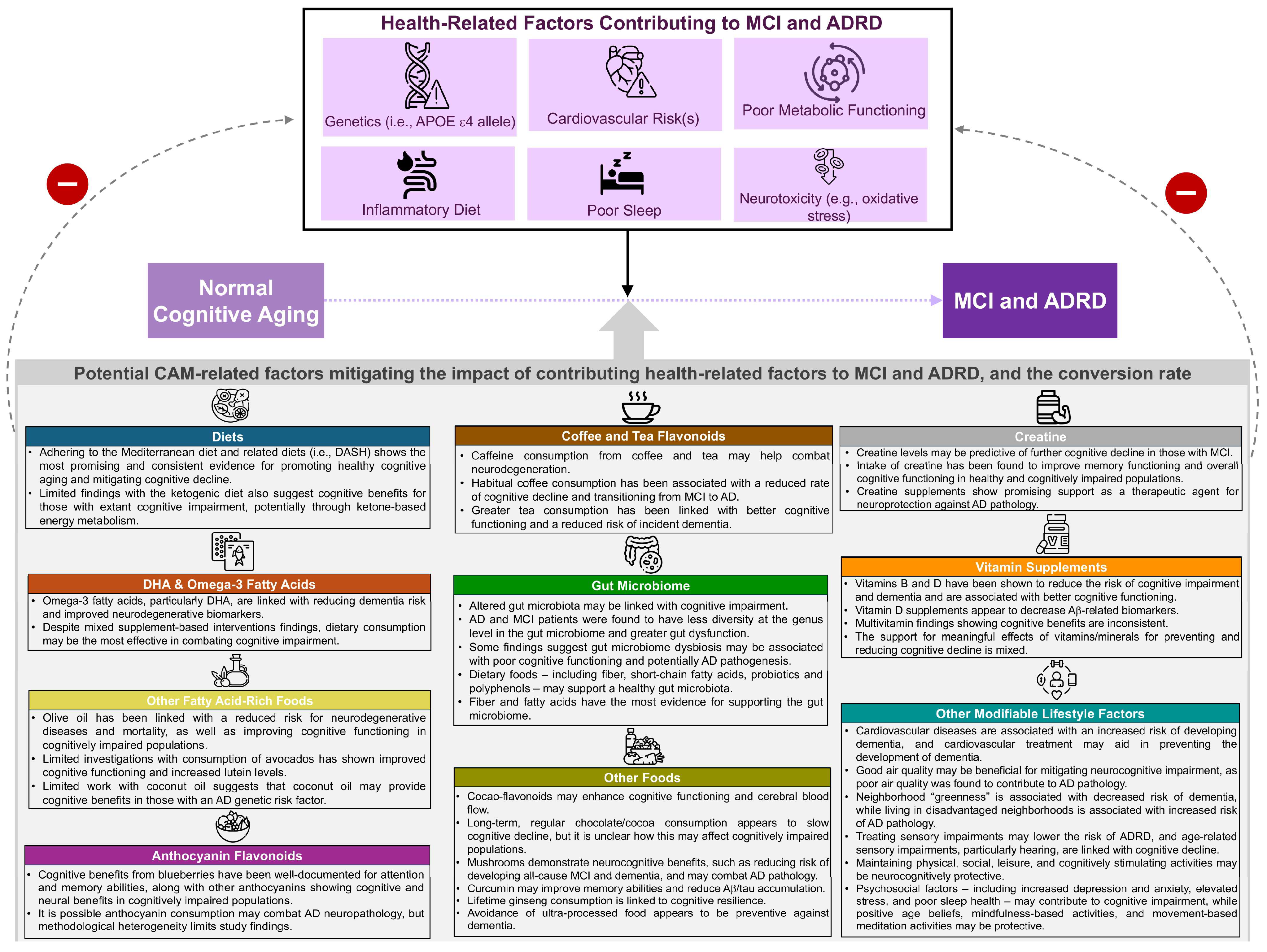
| Dietary Individual Component | Delays MCI Onset [References] | Reduces Risk for AD Dementia/Neurocognitive Decline [References] | Reduces MCI-to-Dementia Conversion [References] | Improves Cognitive Functioning in Dementia Populations [References] | Improves Age-Related Normal Cognitive Functioning [References] | Reduces AD-Related Pathology/ Neurophysiology [References] |
|---|---|---|---|---|---|---|
| DHA and Omega-3 Fatty Acids | Mixed [103,104,105] | Yes [103,104,106,107,108] | -- | Mixed [109,110,111] | Yes [112,113] | Yes [114,115,116,117,118] |
| Olive Oil | Yes (limited) [119] | Yes [120,121] | -- | Yes (limited) [73,119] | -- | -- |
| Avocados | Yes (limited) [122,123] | Yes (limited) [122,124] | -- | Yes (limited) [123,124] | Yes [124] | Mixed [125,126,127] |
| Coconut Oil | -- | -- | Mixed (limited) [68,128] | Yes (limited) [68,128,129] | -- | -- |
| Creatine | Yes (limited) [130,131] | Yes (limited) [132,133] | Mixed [131] | Yes (limited) [134,135,136] | Yes (limited) [137,138] | Yes [136,139] |
| Anthocyanin Flavonoids | Mixed [140,141,142,143,144] | Mixed [145,146,147,148] | Yes (limited) [140,149,150] | Yes (limited) [140,142,149,150,151,152] | Yes (limited) [152,153,154] | Yes [141,145,146,148] |
| Coffee Flavonoids | Yes (limited) [155,156] | Yes (limited) [155,157] | Yes (limited) [158] | -- | Yes (limited) [158] | Yes (limited) [158] |
| Tea Flavonoids | Yes (limited) [159,160,161] | Yes [155,159] | -- | -- | Yes (limited) [160] | Yes (limited) [162,163] |
| Vitamin B | Yes (limited) [164,165,166,167] | Mixed [168,169] | Yes (limited) [167,170,171] | Yes (limited) [167,171] | Mixed [164,165,172,173] | Yes [166,169,170,173,174,175,176,177] |
| Vitamin D | Mixed (limited) [178,179] | Yes [180,181,182,183,184] | Mixed (limited) [178] | Yes (limited) [183,185] | Yes (limited) [180,181] | Mixed (limited) [185,186] |
| Vitamin C | -- | -- | -- | -- | Yes [187] | -- |
| Vitamin E | -- | Mixed [188,189] | -- | Yes (limited) [190,191] | -- | Mixed [189,191] |
| Multivitamin Supplements | Mixed [192,193] | Mixed [194,195] | Yes (limited) [196] | Yes (limited) [196] | Yes (limited) [194,197,198] | Mixed (limited) [199] |
| Cocoa/Chocolate | Mixed (limited) [200,201] | Mixed (limited) [201,202] | -- | Yes (limited) [203,204] | Yes (limited) [201,204] | Mixed (limited) [202,205] |
| Mushrooms | Yes (limited) [206] | Yes (limited) [207,208] | -- | Mixed (limited) [208] | Yes (limited) [208] | Yes (limited) [209,210,211,212,213,214,215] |
| Curcumin (turmeric) | -- | -- | -- | -- | Yes (limited) [216] | Yes (limited) [216,217] |
| Gingseng | -- | -- | -- | -- | Yes (limited) [216] | -- |
| Eggs | -- | Yes (limited) [218] | -- | -- | -- | Yes (limited) [218] |
| Ultra-Processed Food Consumption | Mixed (limited) [219] | Yes [220,221,222,223] | Mixed (limited) [221] | -- | Mixed (limited) [219] | Yes (limited) [224,225] |
Disclaimer/Publisher’s Note: The statements, opinions and data contained in all publications are solely those of the individual author(s) and contributor(s) and not of MDPI and/or the editor(s). MDPI and/or the editor(s) disclaim responsibility for any injury to people or property resulting from any ideas, methods, instructions or products referred to in the content. |
© 2026 by the authors. Licensee MDPI, Basel, Switzerland. This article is an open access article distributed under the terms and conditions of the Creative Commons Attribution (CC BY) license.
Share and Cite
Musich, M.L.; Shenker, J.I.; Beversdorf, D.Q. A Narrative Review of Dietary, Lifestyle, and Other Complementary and Alternative Approaches in Alzheimer’s Disease and Related Dementias. J. Dement. Alzheimer's Dis. 2026, 3, 4. https://doi.org/10.3390/jdad3010004
Musich ML, Shenker JI, Beversdorf DQ. A Narrative Review of Dietary, Lifestyle, and Other Complementary and Alternative Approaches in Alzheimer’s Disease and Related Dementias. Journal of Dementia and Alzheimer's Disease. 2026; 3(1):4. https://doi.org/10.3390/jdad3010004
Chicago/Turabian StyleMusich, Madison L., Joel I. Shenker, and David Q. Beversdorf. 2026. "A Narrative Review of Dietary, Lifestyle, and Other Complementary and Alternative Approaches in Alzheimer’s Disease and Related Dementias" Journal of Dementia and Alzheimer's Disease 3, no. 1: 4. https://doi.org/10.3390/jdad3010004
APA StyleMusich, M. L., Shenker, J. I., & Beversdorf, D. Q. (2026). A Narrative Review of Dietary, Lifestyle, and Other Complementary and Alternative Approaches in Alzheimer’s Disease and Related Dementias. Journal of Dementia and Alzheimer's Disease, 3(1), 4. https://doi.org/10.3390/jdad3010004