
Elevated CSF Serotonin in Prodromal Alzheimer’s Disease Patients Developing Psychosis
 , ,
, ,
Abstract
1. Introduction
Objective
2. Materials and Methods
2.1. Study Design
2.2. Study Population
2.3. Inclusion Criteria for LP
- Age > 55 years;
- Mini-Mental State Examination (MMSE) ≥ 24;
- Informant questionnaire score < 78;
- Written informed consent.
2.4. Inclusion Criteria for This Study
- Diagnosis of AD according to NIA-AA 2011 clinical criteria and NIA-AA 2018 laboratory criteria [9];
- Minimum 5-year follow-up unless psychosis developed earlier.
2.5. Exclusion Criteria for LP
- Dementia at baseline;
- Neurological, psychiatric, or medical conditions causing cognitive impairment;
- Anticoagulation therapy;
- Lack of consent;
- Yesavage Geriatric Depression Scale score > 5.
2.6. Exclusion Criteria for This Study
2.7. Clinical Procedures
2.8. CSF Collection and Processing
2.9. Measurement of Core AD Biomarkers
2.10. Measurement of Serotonin (5-HT)
2.11. Statistical Analysis
2.12. Ethical Considerations
2.13. Limitations
3. Results
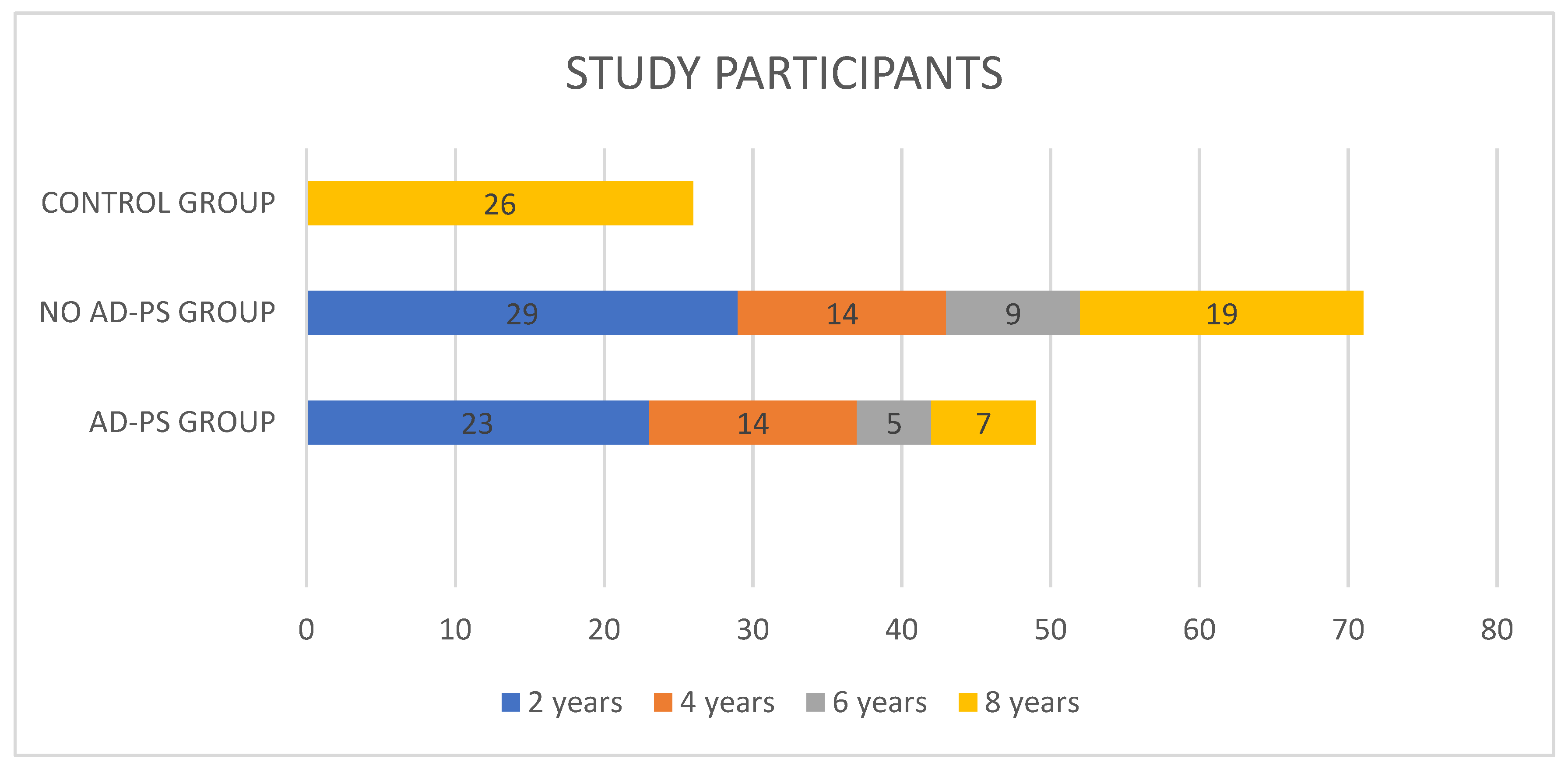
3.1. Included Population
3.2. Baseline Characteristics
3.3. Comparison Between AD-PS and AD-NoPS Groups (8 Years Post-Diagnosis)
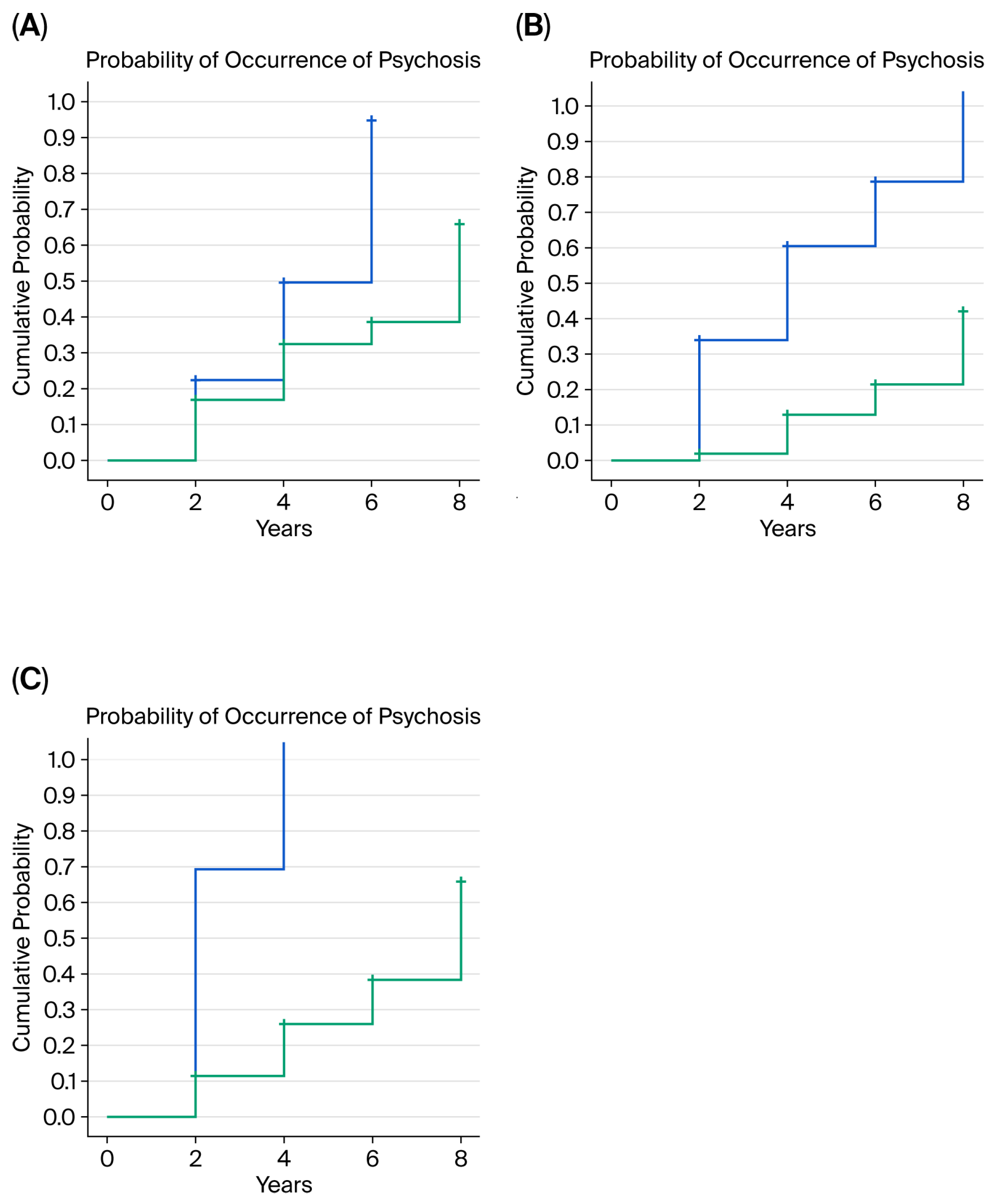
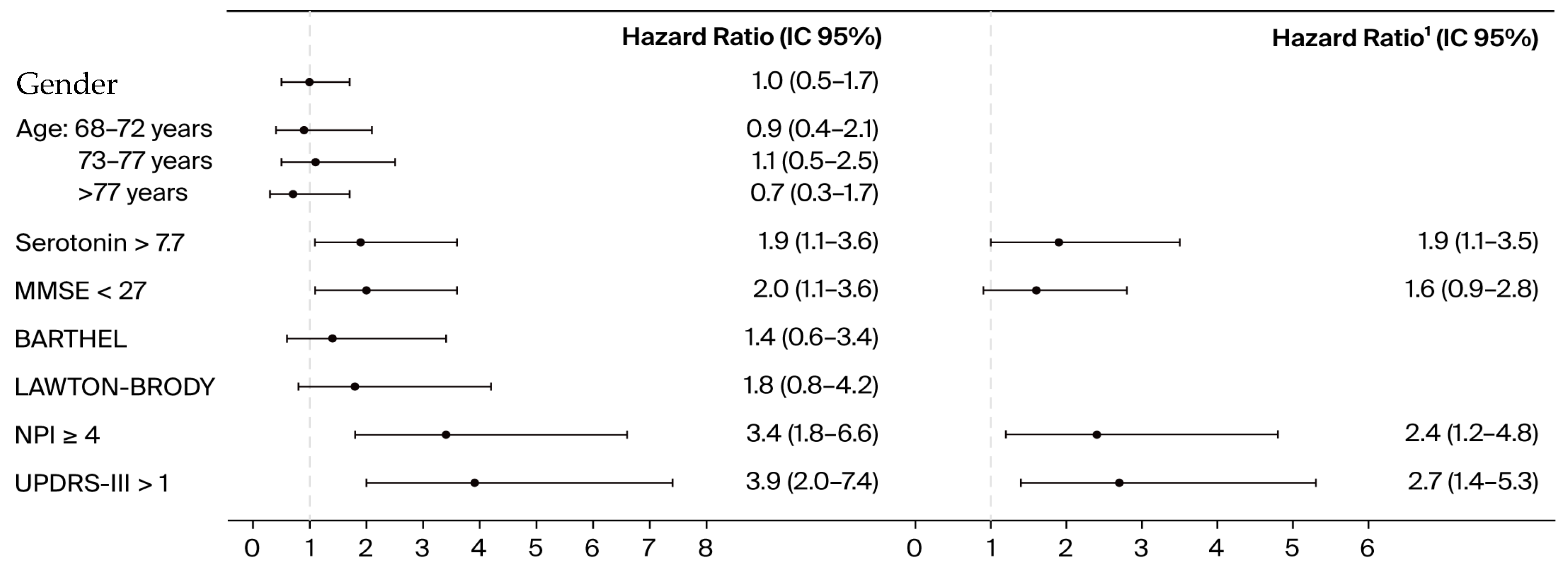
3.4. Predictive Analysis
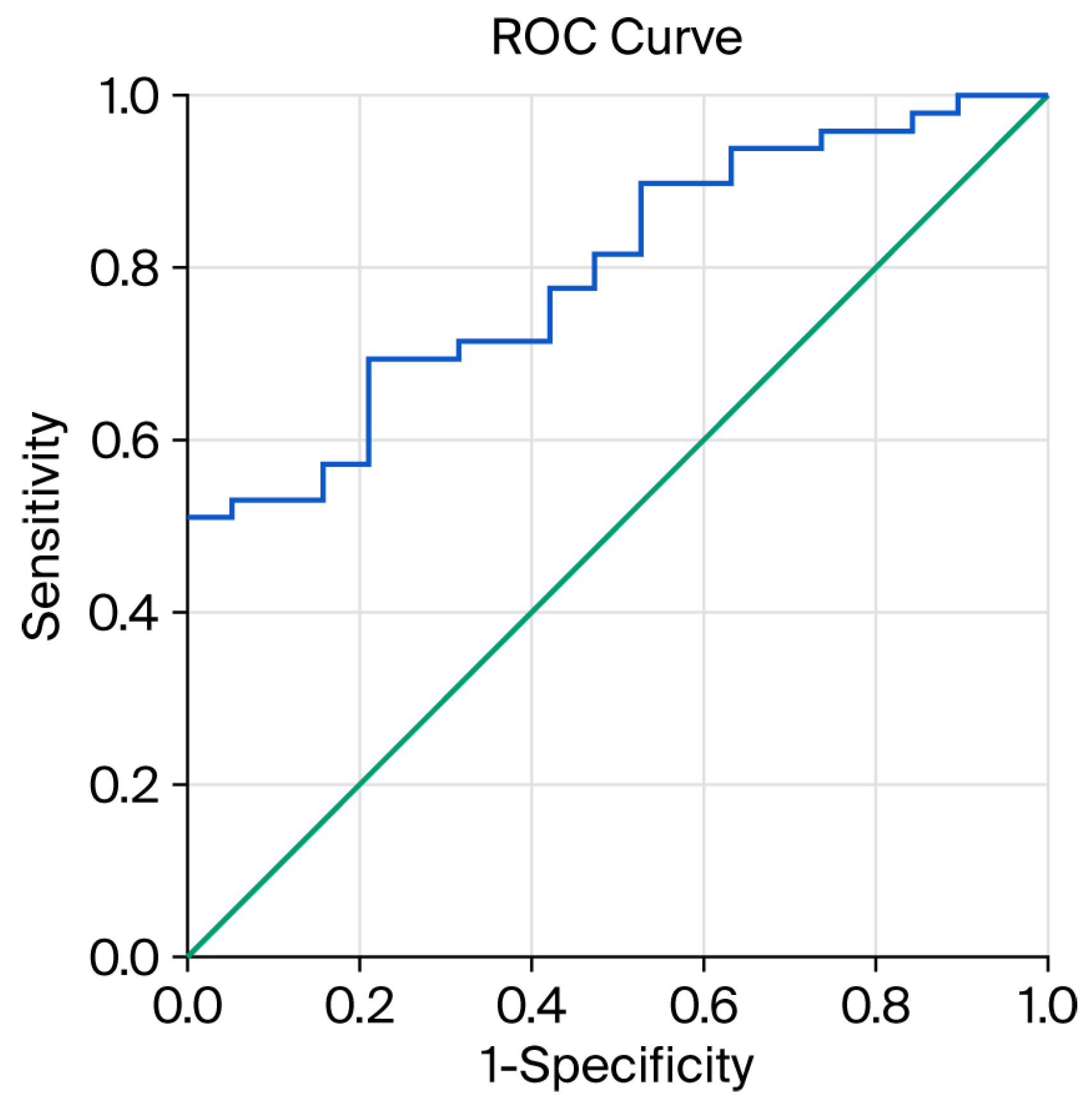
3.5. ROC Analysis
4. Discussion
5. Conclusions
Author Contributions
Funding
Institutional Review Board Statement
Informed Consent Statement
Data Availability Statement
Acknowledgments
Conflicts of Interest
Abbreviations
| AD | Alzheimer’s disease |
| PS | Psychotic symptoms |
| CSF | Cerebrospinal fluid |
| 5-HT | Serotonin |
| NPI | Neuropsychiatric Inventory |
| UPDRS III | Unified Parkinson’s Disease Rating Scale part III |
| LP | Lumbar puncture |
| MCI | Mild cognitive impairment |
| ROC | Receiver operating characteristics |
| OR | Odds Ratio |
| RBC | Red blood cells |
| NIA-AA | National Institute of Aging and Alzheimer’s Association |
| ELISA | Enzyme-Linked Immunosorbent Assay. |
| HRP | Horseradish Peroxidase |
| TMB | Tetramethylbenzidine |
Appendix A

| NO PS-AD GROUP (n = 71) | PS-AD GROUP (n = 49) | CONTROL GROUP (n = 26) | S. L. | |
|---|---|---|---|---|
| AGE (mean ± SD) | 73.0 ± 6.1 | 72.3 ± 6.4 | 68.3 ± 7.1 | 0.1 |
| GENDER M/F (%M) | 30/41 (42) | 18/31 (36.7) | 13/13 (50) | 0.1 |
| APOE GENOTYPE ε2 (%) ε3 (%) ε4 (%) | 2 (3) 33 (46) 19 (26) | 0 (0) 28 (57) 11 (23) | 1 (4) 14 (53) 1 (4) | 0.2 |
| MMSE (median p25–p75) | 25.2 (23–26) | 24.6 (23–26) | 28 (26–28) | 0.05 |
| BARTHEL Schelle (mean ± SD) | 99.1 ± 2.1 | 98.6 ± 2.3 | 99.4 ± 3.4 | 0.1 |
| LAWTON-BRODY (median p25-p75) | 5.94 (4–8) | 5.46 (4–8) | 6.84 (6.5–8) | 0.2 |
| NPI (median p25-p75) | 3.3 (0–4) | 5.5 (0–8) | 5.9 (0–10) | 0.05 |
| UPDRS III (median p25-p75) | 0.34 (0–1) | 1.71 (0–4) | 0 | 0.02 |
| CSF 5-HT LEVELS (pg/dL) (median p25-p75) | 6.07 (2–8) | 7.09 (2–12) | 6.26 (3–7) | 0.05 |
| CSF Aβ42 LEVELS (pg/dL) (median p25-p75) | 653.56 (489–676) | 557.18 (472–652) | 1133.2 (940–1403) | 0.0001 |
| CSFT-TAU LEVELS (pg/dL) (median p25-p75) | 720.18 (419–768) | 590.95 (337–718) | 222.69 (166–246) | 0.0001 |
| CSF P-TAU 181 LEVELS (pg/dL) (median p25-p75) | 112.4 (75–118) | 87.78 (60–98) | 37.9 (34–49) | 0.0001 |
| SSRI TREATMENT (%) | 24 (34) | 15 (31) | 14 (53) | 0.05 |
| Total | Serotonin > 7.74 | Serotonin < 7.74 | p | |
|---|---|---|---|---|
| n (%) | n (%) | n (%) | ||
| Total | 120 (100) | 30 (25) | 90 (75) | - |
| Gender | 0.331 | |||
| Men | 47 (39.2) | 14 (46.7) | 33 (36.7) | |
| Woman | 73 (60.8) | 16 (53.3) | 57 (63.3) | |
| Age | 0.594 | |||
| <68 years | 24 (20.0) | 8 (26.7) | 16 (17.8) | |
| 68–72 years | 27 (22.5) | 6 (20.0) | 21 (23.3) | |
| 73–77 years | 37 (30.8) | 7 (23.3) | 30 (33.3) | |
| >77 years | 32 (26.7) | 9 (30.3) | 23 (25.6) | |
| APOE genotype | 0.609 | |||
| 3 | 33 (47.8) | 10 (43.5) | 23 (50.0) | |
| 4 | 36 (52.2) | 13 (56.5) | 23 (50.0) | |
| MMSE | 0.459 | |||
| 24–27 | 55 (45.8) | 12 (40.0) | 43 (47.8) | |
| >27 | 65 (54.2) | 18 (60.0) | 47 (52.2) | |
| Barthel Schelle | 1.000 | |||
| 90–95 | 13 (10.8) | 3 (10.0) | 10 (11.1) | |
| 100 | 107 (89.2) | 27 (90.0) | 80 (88.9) | |
| Lawton-Brody Schelle | 0.292 | |||
| 0–5 | 58 (48.3) | 17 (56.7) | 41 (45.6) | |
| >5 | 62 (51.7) | 13 (43.3) | 49 (54.4) | |
| NPI | 0.289 | |||
| ≥4 | 66 (55.0) | 19 (63.3) | 47 (52.2) | |
| 0–4 | 54 (45.0) | 11 (36.7) | 43 (47.8) | |
| UPDRS III | 0.486 | |||
| >1 | 18 (15.0) | 5 (16.7) | 13 (14.4) | |
| 0 | 102 (85.0) | 25 (83.3) | 77 (85.6) |
| Psychosis % (n) | OR (CI95%) | p | |
|---|---|---|---|
| Total | 72.1 (49/68) | - | - |
| Serotonin | 0.003 | ||
| >7.74 | 100.0 (16/16) | invaluable | |
| 0–7.73 | 63.5 (33/52) | 1 | |
| Gender | 0.690 | ||
| Men | 75.0 (18/24) | 1.3 (0.4–3.9) | |
| Woman | 70.5 (31/44) | 1 | |
| Age | |||
| <68 years | 76.9 (10/13) | 1 | |
| 68–72 years | 73.3 (11/15) | 0.8 (0.1–4.6) | 0.827 |
| 73–77 years | 78.3 (18/23) | 1.1 (0.2–5.5) | 0.926 |
| >77 years | 58.8 (10/17) | 0.4 (0.1–2.1) | 0.303 |
| APOE genotype | 0.483 | ||
| 3 | 86.7 (13/15) | invaluable | |
| 4 | 100.0 (14/14) | 1 | |
| MMSE | 0.154 | ||
| 24–27 | 78.9 (30/38) | 2.2 (0.7–6.4) | |
| >27 | 63.3 (19/30) | 1 | |
| Barthel Schelle | 0.664 | ||
| 90–95 | 85.7 (6/7) | 2.5 (0.3–22.4) | |
| 100 | 70.5 (43/61) | 1 | |
| Lawton-Brody Schelle | 0.844 | ||
| 0–5 | 71.7 (43/60) | 0.8 (0.2–4.6) | |
| >5 | 75.0 (6/8) | 1 | |
| NPI | 0.001 | ||
| ≥4 | 86.0 (37/43) | 6.7 (2.1–21.4) | |
| 0–4 | 48.0 (12/25) | 1 | |
| UPDRS III | 0.009 | ||
| >1 | 100.0 (14/14) | invaluable | |
| 0 | 64.8 (35/54) | 1 |
References
- Korf, A.; Liu, C.; Ginghina, C.; Shi, M.; Zhang, J. Alzheimer’s Disease Neuroimaging Initiative. α-Synuclein in CSF of Alzheimer’s Disease and Mild Cognitive Impairment. J. Alzheimers Dis. 2013, 36, 679–688. [Google Scholar]
- Toledo, J.B.; Korff, A.; Shaw, L.M.; Trojanowski, J.Q.; Zhang, J. CSF α-Synuclein Improves Diagnostic and Prognostic Performance of CSF Tau and Aβ in Alzheimer’s Disease. Acta Neuropathol. 2013, 126, 683–697. [Google Scholar]
- Mackin, R.S.; Insel, P.; Zhang, J.; Mohlenhoff, B.; Galasko, D.; Weiner, M.; Mattsson, N. CSF α-Synuclein and Lewy Body-Like Symptoms in Normal Controls, Mild Cognitive Impairment and Alzheimer’s Disease. J. Alzheimers Dis. 2014, 43, 1007–1016. [Google Scholar] [CrossRef]
- Slaets, S.; Van Mechelen, E.; Bastard, N.; Le Decraemer, H.; Van Dijck, M.; Martin, J.J.; De Deyn, P.P.; Engelborghs, S. Increased CSF α-Synuclein Levels in Alzheimer’s Disease: Correlation with Tau Levels. Alzheimers Dement. 2014, 10, S290–S298. [Google Scholar]
- Chiasserini, D.; Biscetti, L.; Eusebi, P. Differential Role of CSF Fatty Acid Binding Protein 3, α-Synuclein and Alzheimer’s Disease Core Biomarkers in Lewy Body Disorders and Alzheimer’s Dementia. Alzheimers Res. Ther. 2017, 9, 52. [Google Scholar] [PubMed]
- Shi, M.; Tang, L.; Toledo, J.B. CSF α-Synuclein Contributes to the Differential Diagnosis of Alzheimer’s Disease. Alzheimers Dement. 2018, 14, 1052–1062. [Google Scholar] [PubMed]
- Bousiges, O.; Philippi, N.; Lavaux, T.; Pierre, A.; Lachmann, I.; Blanc, F. Total alpha-synuclein assay in the Cerebro-Spinal-Fluid is of interest in the differential diagnosis between Alzheimer’s disease and dementia with Lewy bodies from the prodromal stage. BMC Neurol. 2020. Epub ahead of printing. [Google Scholar] [CrossRef]
- García-Ayllón, M.S.; Monge-Argilés, J.A.; Monge-García, V.; Navarrete-Rueda, F.; Cortés-Gómez, M.A.; Sánchez-Payá, J.; Manzanares-Robles, J.; Gasparini-Berenguer, R.; Leiva-Santana, C.; Sáez-Valero, J. Measurement of CSF α-Synuclein Improves Early Differential Diagnosis of Mild Cognitive Impairment Due to Alzheimer’s Disease. J. Neurochem. 2019, 150, 218–230. [Google Scholar] [CrossRef]
- Jack, C.R.; Bennett, D.A.; Blennow, K.; Carrillo, M.C.; Dunn, B.; Haeberlein, S.B.; Holtzman, D.M.; Jagust, W.; Jessen, F.; Karlawish, J.; et al. NIA-AA Research Framework: Toward a Biological Definition of Alzheimer’s Disease. Alzheimers Dement. 2018, 14, 535–562. [Google Scholar] [CrossRef]
- Pérez-Romero, A.; González-Garrido, S. The Importance of Behavioural and Psychological Symptoms in Alzheimer’s Disease. Neurologia 2018, 33, 378–384. [Google Scholar]
- Murray, P.S.; Kumar, S.; DeMichele-Sweet, M.A.A.; Sweet, R.A. Psychosis in Alzheimer’s Disease. Biol. Psychiatry 2014, 75, 542–552. [Google Scholar] [CrossRef] [PubMed]
- Cummings, J. New Approaches to Symptomatic Treatments for Alzheimer’s Disease. Mol. Neurodegener. 2021, 16, 2. [Google Scholar] [CrossRef] [PubMed]
- Monge-García, S.; García-Ayllón, M.S.; Sánchez-Payá, J.; Gasparini-Berenguer, R.; Cortés-Gómez, M.Á.; Sáez-Valero, J.; Monge-Argilés, J.A. Validity of CSF α-Synuclein to Predict Psychosis in Prodromal Alzheimer’s Disease. Front. Neurol. 2023, 14, 1124145. [Google Scholar] [CrossRef]
- Ballard, C.; Kales, H.C.; Lyketsos, C.; Aarsland, D.; Creese, B.; Mills, R.; Williams, H.; Sweet, R.A. Psychosis in Alzheimer’s Disease. Curr. Neurol. Neurosci. Rep. 2020, 20, 57. [Google Scholar] [CrossRef]
- Chakraborty, S.; Lennon, J.C.; Malkaram, S.A.; Zeng, Y.; Fisher, D.W.; Dong, H. Serotonergic System, Cognition, and BPSD in Alzheimer’s Disease. Neurosci. Lett. 2019, 704, 36–44. [Google Scholar] [CrossRef]
- Tang, L.; Wang, Y.; Chen, Y.; Chen, L.; Zheng, S.; Bao, M.; Xiang, J.; Luo, H.; Li, J.; Li, Y. The Association between 5HT2A T102C and Behavioral and Psychological Symptoms of Dementia in Alzheimer’s Disease: A Meta-Analysis. BioMed Res. Int. 2017, 2017, 5320135. [Google Scholar] [CrossRef]
- Scarmeas, N.; Brandt, J.; Albert, M.; Hadjigeorgiou, G.; Papadimitriou, A.; Dubois, B.; Sarazin, M.; Devanand, D.; Honig, L.; Marder, K.; et al. Delusions and hallucinations are associated with worse outcome in Alzheimer disease. Arch. Neurol. 2005, 62, 1601–1608. [Google Scholar] [CrossRef]
- Collerton, D.; Taylor, J.P. Advances in the treatment of visual hallucinations in neurodegenerative diseases. Future Neurol. 2013, 8, 433–444. [Google Scholar] [CrossRef]
- Garcia-Alloza, M.; Gil-Bea, F.J.; Diez-Ariza, M.; Chen, C.H.; Francis, P.T.; Lasheras, B.; Ramirez, M.J. Cholinergic-Serotonergic Imbalance Contributes to Cognitive and Behavioral Symptoms in Alzheimer´s Disease. Neuropsychologia 2005, 43, 442–449. [Google Scholar] [CrossRef]
- Cummings, J.; Cortez-Pinto, L.; Cruz, M.; Fischer, C.E.; Gerritsen, D.L.; Grossberg, G.T.; Hwang, T.J.; Ismail, Z.; Jeste, D.V.; Koopmans, R.; et al. Criteria for Psychosis in Major and Mild Neurocognitive Disorders: International Psychogeriatric Association Consensus Clinical and Research Definition. Am. J. Geriatr. Psychiatry 2020, 28, 1256–1269. [Google Scholar] [CrossRef] [PubMed]
- Ballard, C.; Youakim, J.M.; Coate, B.; Stankovic, S. Pimavanserin in Alzheimer’s Disease Psychosis: Efficacy in Patients with More Pronounced Psychotic Symptoms. J. Prev. Alzheimers Dis. 2018, 6, 27–33. [Google Scholar] [CrossRef]
- Chen, Y.; Sun, J.; Yang, Z.; Bi, H. Efficacy and Safety of Negative Allosteric Modulators of 5-HT2A Receptors in the Treatment of Alzheimer’s Disease Psychosis: A Systematic Review and Meta-Analysis. Adv. Clin. Exp. Med. 2023, 32, 1089–1098. [Google Scholar] [CrossRef] [PubMed]
- Cummings, J.L.; Devanand, D.P.; Stahl, S.M. Dementia-related psychosis and the potential role for pimavanserin. CNS Spectr. 2022, 27, 7–15. [Google Scholar] [CrossRef] [PubMed]
- Helzner, E.P.; Scarmeas, N.; Cosentino, S.; Tang, M.X.; Schupf, N.; Stern, Y. Survival in Alzheimer Disease: A Multiethnic, Population-Based Study of Incident Cases. Neurology 2008, 71, 1489–1495. [Google Scholar] [CrossRef] [PubMed]


Disclaimer/Publisher’s Note: The statements, opinions and data contained in all publications are solely those of the individual author(s) and contributor(s) and not of MDPI and/or the editor(s). MDPI and/or the editor(s) disclaim responsibility for any injury to people or property resulting from any ideas, methods, instructions or products referred to in the content. |
© 2026 by the authors. Licensee MDPI, Basel, Switzerland. This article is an open access article distributed under the terms and conditions of the Creative Commons Attribution (CC BY) license.
Share and Cite
Monge-García, V.; Pérez-González, R.; Monge-García, S.; Gasparini-Berenguer, R.; Sánchez-Payá, J.; Silva-Afonso, R.d.F.; Monge-Argilés, J.-A. Elevated CSF Serotonin in Prodromal Alzheimer’s Disease Patients Developing Psychosis. J. Dement. Alzheimer's Dis. 2026, 3, 14. https://doi.org/10.3390/jdad3010014
Monge-García V, Pérez-González R, Monge-García S, Gasparini-Berenguer R, Sánchez-Payá J, Silva-Afonso RdF, Monge-Argilés J-A. Elevated CSF Serotonin in Prodromal Alzheimer’s Disease Patients Developing Psychosis. Journal of Dementia and Alzheimer's Disease. 2026; 3(1):14. https://doi.org/10.3390/jdad3010014
Chicago/Turabian StyleMonge-García, Victoria, Rocío Pérez-González, Sonia Monge-García, Ruth Gasparini-Berenguer, José Sánchez-Payá, Raissa de Fátima Silva-Afonso, and José-Antonio Monge-Argilés. 2026. "Elevated CSF Serotonin in Prodromal Alzheimer’s Disease Patients Developing Psychosis" Journal of Dementia and Alzheimer's Disease 3, no. 1: 14. https://doi.org/10.3390/jdad3010014
APA StyleMonge-García, V., Pérez-González, R., Monge-García, S., Gasparini-Berenguer, R., Sánchez-Payá, J., Silva-Afonso, R. d. F., & Monge-Argilés, J.-A. (2026). Elevated CSF Serotonin in Prodromal Alzheimer’s Disease Patients Developing Psychosis. Journal of Dementia and Alzheimer's Disease, 3(1), 14. https://doi.org/10.3390/jdad3010014