


Abstract
This study adheres to a logistic regression modeling protocol originally developed for long-range intelligence analyses and employs data from UN demographic estimates (the 2024 revision) to generate a set of statistical functions that suggest a moderately strong relationship between increasing median age and the probability of a persistently positive international net migration rate (NMR). According to this relationship, the post-Cold War probability (data from 1990 to 2015) of experiencing a persistently positive net migration rate (defined as a +NMR, directly followed by five consecutive years of +NMRs) rose from less than 0.12 at a population median age of 15 years, to a probability greater than 0.55 at 36 years, and then to more than 0.77 at 45 years. The author hypothesizes a speculative set of predictions aimed at providing long-term tests for this model. These predictions assume that, by a median age of 36.0 years, at least one country in the hypothesized cluster of countries will have shifted to experiencing a series of +NMRs. If, as this model predicts, the age-structurally associated transition to sustained +NMRs transpires by 2055, there could be a substantially larger pool of migrant net-receiving states in parts of Asia, Latin America, and North Africa than the UN’s future scenarios currently project.
1. Introduction
As gaps in income, governance, and political stability have widened between the countries bearing the most youthful distributions of residents (Figure 1) and those countries with population age distributions (age structures) that are more mature, international migration has assumed a larger role in the demographic dynamics of countries, as well as a more palpable presence in both international and domestic politics. As a result, the future direction of the international net migration rate (the annual total of immigrants minus emigrants per thousand country residents, from here on abbreviated as NMR) has increasingly become of interest to foreign affairs, defense, and intelligence analysts, as well as to those policymakers who focus on their own country’s migration trends, migration policies, and migration’s political consequences. Consequently, greater attention has been drawn to what many demographers view as one of the most difficult challenges faced by the UN Population Division (UNPD) in each revision of its World Population Prospects database: its country-level projections of net international migration—a component of population change that is sensitive to conditions both within and well beyond a country’s borders.
The goal of the age-structural research on NMRs (of which the following is a part) has been to determine if, after passing through the fertility transition, countries ultimately enter a narrow range of median ages during which most can be assumed to have become continuous net receivers of international migrants. Whereas the following article is focused solely on NMR projections, here I briefly acknowledge the methodological changes that the UNPD has recently made to both estimation (of the past) and projection (of the future) of net migration.
Since first appearing in the UNPD’s 1998 database [1], net migration estimates have been heavily influenced by census and migration survey results in a small (but growing) number of countries where dependable counts of international migrant stocks and flows have been available. However, in most cases, net migration estimates have been adjusted to fill the gap between the computed age-specific population that is expected from the natural components of change (age-specific fertility, mortality, and progressive aging) and population estimates that have been enumerated or backward projected [2].
Over the past decade, a set of modeling protocols that were developed by Abel and colleagues [3,4,5] have been used to estimate bilateral (from origin to destination country) migration flows from migrant and migration data residing in a collection of migration databases. While bilateral estimates are not currently a part of published UN demographic estimates, these bilateral flows could soon supplement (or perhaps supplant) current UNPD methods of estimating net migration. Moreover, it would not be surprising if research using bilateral migration data ultimately yields relationships that influence the agency’s NMR projections (in fact, the most recent bilateral flows were used to structure male and female migrant age distributions in the agency’s 2024 revision of its projections [2,6]).
UNPD projections of net migration have been aimed at extending past patterns of net migration into the future. In its 2024 revision, the UNPD employed an independently developed Bayesian statistical protocol advanced by Azose and colleagues [7,8] to probabilistically generate NMRs from past estimates. This followed a 2022 Bayesian methodological upgrade [9] that replaced the previous method, which projected an annual average net count of international migrants that appeared consistent with regular (i.e., non-volatile) country estimates of net migration from the preceding decade [10].
1.1. The Problem
Despite methodological improvements, projection methods that draw on a country’s past patterns of NMR estimates to describe that country’s future NMR scenario are unable to anticipate a future shift to becoming a continuous net receiver of international migrants.
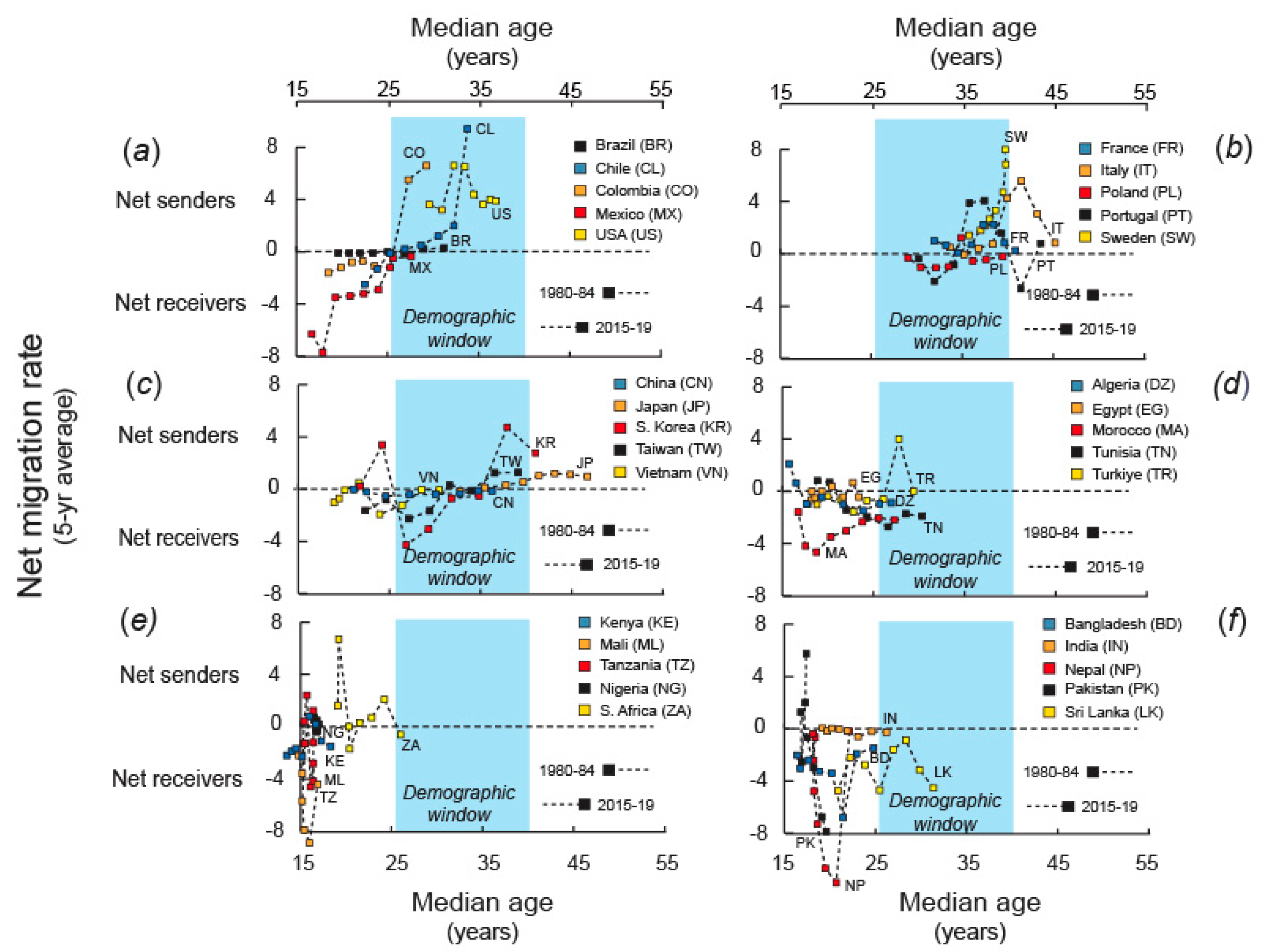
For example, in the 2024 revision of the UNPD’s projections [6], countries that display a past pattern of continuous −NMRs, or of sign-switching NMRs (irregularly alternating between negative and positive signs), continue to display these patterns through the very end of the agency’s projection period (year 2100) [2]. Consequently, today’s relatively limited set of continuous net receivers of international migrants is projected to remain the world’s only continuous migrant net receivers through the end of that period—a situation that seems unlikely, given the past four decades of trends in NMRs. As countries in Europe, East Asia, and Latin America have approached and entered the mature phase of the age-structural transition (see Figure 1), many have shifted to a series of +NMRs (Figure 2).
1.2. Objectives
The specific objectives of the following essay are as follows:
- To determine if, as countries advance through the age-structural transition (the gradual shift from a youthful, high-fertility population to a low-fertility population that is distributionally much more mature), they generally (with noted exceptions) experience an increasing probability of becoming a continuous net receiver of international migrants;
- To hypothesize a population median age that could be used to reasonably project the timing of a country’s future shift to performing as a continuous net receiver of international migrants;
- To characterize exceptional types of countries (i.e., outlier groups) that are unlikely to adhere to that hypothesized timing.
To provide a long-term test of this modeled relationship and its outliers, the following essay uses the study’s findings as the basis for a set of hypothetical predictions—i.e., a speculative set of geographic clusters of countries that, according to this model, have a high probability of featuring one or more countries with continuous +NMRs by the year 2055. Clearly stating these as testable, hypothetical predictions permits each to serve as future grounds for assessing the utility of the age-structural model, and choosing whether to accept, modify, or reject it (whole or in part) [11].
2. The Shift to Continuous +NMRs
Like all UNPD demographic projections, the agency’s methods for projecting net migration avoid drawing on variables that directly represent the social, economic, political, or environmental factors with which social scientists generally explain a shift to positive net migration. The following section briefly acknowledges evidence of the non-demographic factors that contribute to sustained positive net migration, and reviews evidence suggesting why progress along the age-structural transition might capture these relationships.
2.1. Drivers of the Shift to +NMRs
Empirical studies indicate that the conditions that most strongly favor +NMRs in migrant destination countries are those that offer more abundant employment opportunities and higher wages, an improved standard of living, and greater accessibility of social services, more basic freedoms, and better security—conditions that typically accompany higher levels of human development [12,13]. Sociologists and economists have explained the shift to +NMRs using neoclassical economic theory [14,15]; and with global theories that credit increasing demands for certain types of labor—demands that have been generated by rapid urbanization, industrialization, technological development, and capitalist centralization of the global economy [16]. Other researchers have called attention to international migration’s ability to reunify families, improving their social well-being and collective security [17], and to the facilitation of migrant geographic mobility through the support of diaspora communities, migration transportation networks, and financial services [18,19].
In addition, a series of +NMRs has sometimes been induced by catastrophic natural and human-induced events, usually occurring in neighboring countries. While often reversed by return migration flows following the re-establishment of more stable political and socioeconomic conditions (e.g., post-conflict returns to Afghanistan, 1992–1994 and 2002–2003; returns to Lebanon, 2012–2014), such inflows have been sustained in destination countries by prolonged conflict, continued political oppression, or persistent climate-induced food insecurity (or combinations thereof) in migrant-origin countries (e.g., +NMRs in Senegal, 2013–2022; in Uganda, 2016–2021).
2.2. Age-Structure and the Shift to +NMRs
Beginning with theoretical efforts in the late 1950s, 1960s, and early 1970s [20,21,22], followed by an ongoing series of empirical studies since the early 1990s, demographic researchers (including demographers, economists, geographers, sociologists, political scientists, and historians) have demonstrated compelling theoretical reasons and consistently significant statistical associations that link country-level advancement along the age-structural transition, to progress among development-related social [23,24], economic [24,25], and political transitions [26,27,28,29]. This body of research suggests that, as a group, countries that have advanced into the latter stages of the demographic transition have achieved levels of development that social scientists have shown to be most attractive to international migrants (thus, conditions conducive to a series of +NMRs). In contrast, countries that retain youthful populations have been more likely to be poorly governed [30] and generally less economically developed [23,24]. The most youthful of these have been the most vulnerable to the onset and persistence of armed civil conflict [31,32,33] (conditions conducive to −NMRs, or sign-switching NMRs).
Regional differences in economic development, and associated differences in the pace of the demographic and age-structural transitions, have translated to differences between where workers live and where there is greater demand and reward for their labor ([12], pp. 43–59). Without sufficient migrant labor, high-income countries have generally found it difficult to fill low-skilled and physically demanding jobs, particularly where there is unmet demand for caregivers in their aging societies. In contrast, less developed countries with youthful, rapidly growing populations generally experience an abundance of underemployed, low-skill workers. Additionally, low- and lower-middle-income countries—typically with either age-structurally youthful or intermediate populations (Figure 1)—can boast well-educated elites and trained technicians who often find their skills and interests are a better match for a more technologically developed economy.
Figure 1.
The ranges of median ages of the five phases of the age-structural transition: (a) early youthful, (b) late youthful, (c) intermediate, (d) mature, and (e) post-mature. This heuristic categorization expands on a schema published by the (U.S.) National Intelligence Council [34] and is similar to other age-structural categorizations used in the literature [35,36,37]. Whereas the age-structural transition is a continuous and varied process, this schema’s categories (and their iconic graphic age structures) have been clearly defined and made artificially discrete in order to facilitate mapping and graphic comparisons (e.g., Figure 3), as well as to add clarity to discussions.
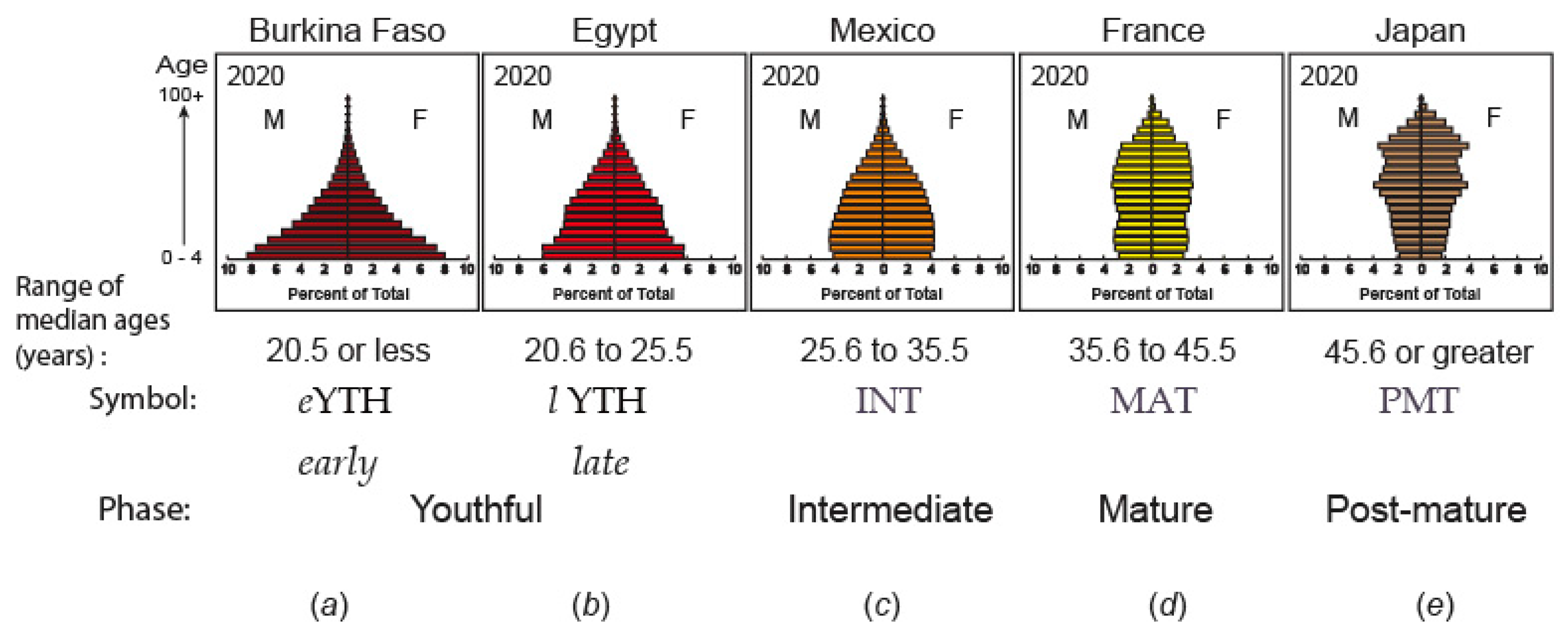
Figure 2.
Five-year averages of the international net migration rate (NMR) for 30 selected countries (five in each of six regions; two-letter country abbreviations are ISO-2 alpha codes). Data are UN estimates [4] from 1980–1985 to 2015–2019. Regions are as follows: (a) North and South America, (b) Europe, (c) East Asia, (d) North Africa and the Middle East, (e) sub-Saharan Africa, and (f) South Asia. The demographic window, a heuristic device that was first described by UN demographers in 2004 [38], estimates a central portion of the age-structural transition (median age ~26 to ~40 years) during which states are likely to encounter a series of low-dependency, fiscally advantageous, and development-favorable age structures.
3. Data and Methods
3.1. Geographic and Temporal Extent of Data
The study’s list of independent states was drawn from the United Nations worldwide list of countries, but excluded the following: (1) non-independent political entities (e.g., Hong Kong, Palestine, and Western Sahara); and (2) independent states with a resident population of fewer than 500,000 individuals (thus, currently excluding Belize, Iceland, Brunei, and numerous small-island states).
For preliminary analyses, data from 1970 to 2020 were drawn from the 2024 revision of the UNPD’s worldwide data set [6]. However, in order to minimize missing data from now-extinct (Cold War era) states and to focus on the increasingly large group of low-fertility countries that were nearing the mature phase of the age-structural transition, the study’s statistical modeling effort was primarily targeted at the period from 1990 (the beginning of the post-Cold War era) to 2015. Data during the years 2016 to 2023 (the latter, the final year of the UN 2024 revision of its demographic estimates) were reserved for use in out-of-sample tests.
To address an early reviewer’s concern, a separate effort was made to generate results for some of the Cold War years, 1970 (a year when most overseas colonies of Western powers had achieved independence) to 1989, and then to model the entire data set, from 1970 to 2015, by excluding the extinct political entities for which NMR and median age data were unavailable or incompatible with the most recent revision of the UN demographic estimates, the results of which supported the earlier decision to use 1990 to 2015 data [6].
3.2. Age-Structural Modeling
The statistical technique used in this analysis, logistic regression analysis, employs an iterative algorithm and maximum likelihood estimation to fit a simple logistic curve to a series of dichotomous observations of a dependent variable, y = [0, 1], across the domain of a continuous variable, x, yielding a monotonic probabilistic function, P(x). The following analysis adheres to age-structural modeling’s logistic regression protocol [24], which restricts the user’s statistical model to a logit (Equation (1)) in which k is a constant and a mediates the pitch of the curve, yielding a probabilistic logistic outcome function (Equation (2)), P(m). At any median age, m, within the data’s coverage of the continuous median-age domain, M, which simulates the age-structural transition, P(m) predicts the probability (P) of observing the condition y = 1.
During the course of research using age-structural modeling, two groups of states have been shown to frequently behave independently of median age. Each is included in the logit of age-structural modeling’s general model, P(m), and is statistically isolated (i.e., controlled) and assessed as the product of a dichotomous independent (dummy) variable and corresponding coefficient:
- BRR, the group of resource-reliant states (having annual total natural resource rents exceeding 20.0% of GDP) [13] with its coefficient, bRR;
- BLP, the group of the least populated states (having less than 5.0 million residents) [4] with its coefficient, bLP.
For purposes of deductively hypothesizing the effects of additional characteristic groups of states, this modeling protocol allows for any number of experimental dichotomous (dummy) variables (C1, C2, …, Cn) and their corresponding coefficients (c1, c2, …, cn). However, in order to maintain its analysis solely in the median-age domain, age-structural modeling’s logistic regression modeling protocol does not permit additional continuous variables.
When graphed across M, the resultant probabilistic age-structural function, P(m), ideally assumes the form of a simple logistic curve—a positively or negatively sloping sigmoid function with its inflection point, IP, fixed at a probability of 0.50. However, as a best fit to dichotomous data in M, the logistic regression algorithm can also generate a partial segment of a simple logistic curve (i.e., a positively or negatively sloping tail).
Whereas a two-dimensional visualization of P(m) provides indications of the direction, age-structural timing, and completeness of the probabilistic shift from conditions where y = 0 dominates, to conditions where y = 1 dominates, aspects of this shift can be quantitatively assessed and compared using several additional indicators:
- the median age at the inflection point, IP, which is indicative of the age-structural timing of peak change;
- P(15), which reflects the probability at which countries are likely to attain y = 1 in the earliest phase of the age-structural transition;
- P(45), which indicates the probability of y = 1 near the beginning of the post-mature phase of the age-structural transition;
- an estimate of the function’s first derivative at IP, , indicating how abruptly (steeply) the shift from y = 0 to y = 1 occurs (a larger P’(IP) indicates a steeper shift to y = 1 around the inflection point).
To generate the age-structural modeling’s standard function, P(m)* (i.e., a function that can be compared to similarly modeled functions of other age-structural analyses), the iterative logistic regression algorithm is tasked with fitting parameters for the logit’s constant, k, its pitch, a, and for generating values for the coefficients, bRR and bLP, of its two standard dummy variables, BRR and BLP. In this logit of the standard age-structural model, experimental dummy variables and their coefficients, ciCi, are not permitted.
3.3. The Dependent Variable: Persistently +NMR
Preliminary evidence of frequent NMR sign switching in the early and late youthful phase of the age-structural transition called attention to the need for an outcome variable that would
- reflect a substantial degree of serial continuity of +NMRs, rather than respond to each acute +NMR or discontinuous set of +NMRs in countries that frequently undergo NMR sign switching;
- exhibit a monotonic functional relationship with median age that would be an appropriate fit for logistic regression analysis.
To meet these criteria (Figure 3), each country datum (i) of the continuous variable, NMR, was transformed to a dichotomous variable, :
Thus, yi during a specific year (t0) was assigned the integer value of one (1) if NMRi,t0 was positive, and only if NMRi remained positive during each of the following five consecutive years (t1→t5).
3.4. Fixed-Effects: Controlling for Countries and Years
To further test the assumption that these data demonstrated the transitional nature of persistent +NMRs as median age increased—irrespective of unmeasured country qualities and the passage of time—fixed-effects versions of age-structural models of persistently +NMRs were generated for the full data set, from 1970 to 2015, controlling for countries, for years, and for countries and years.
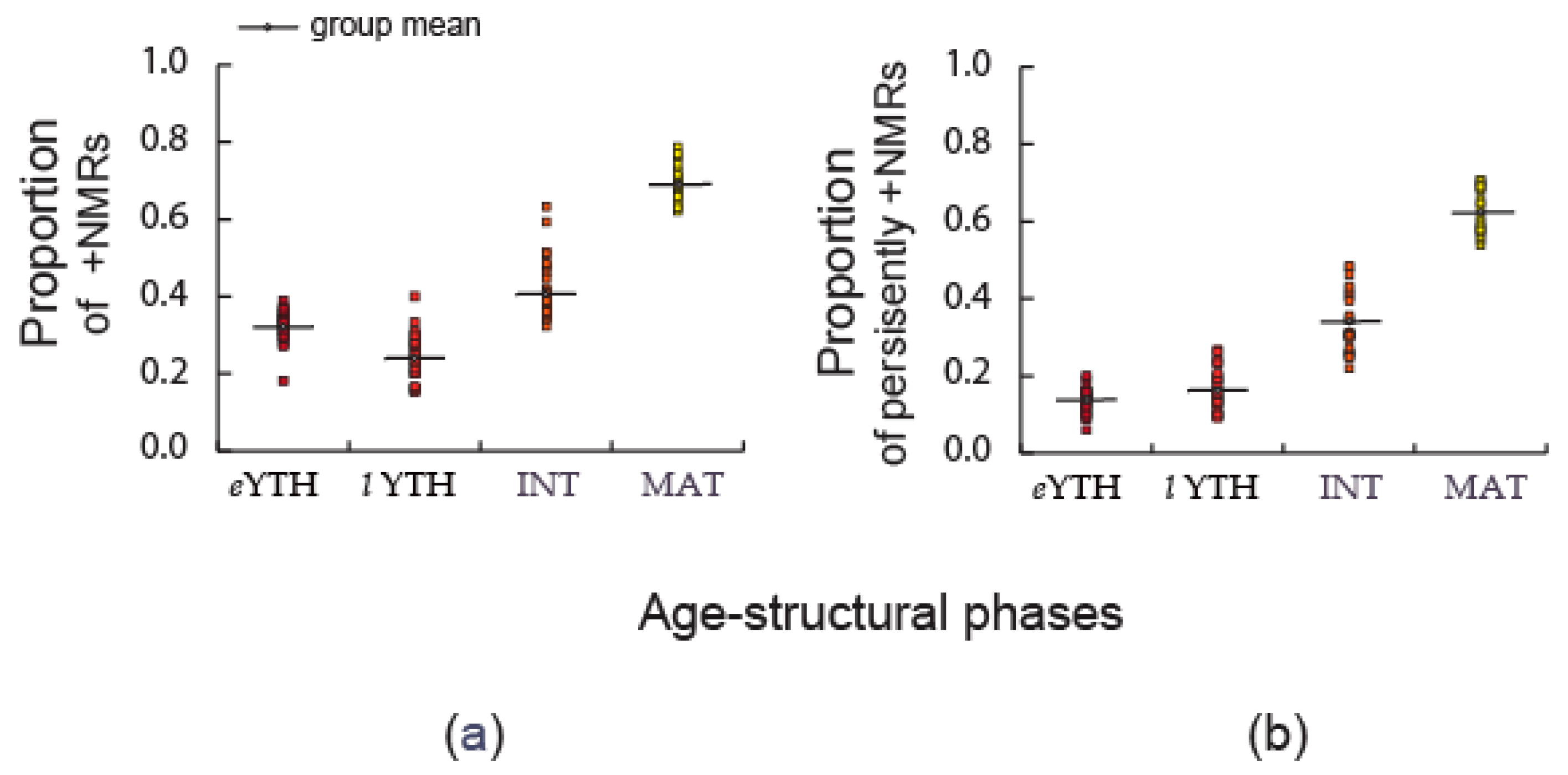
Figure 3.
Annual proportions of (a) +NMRs, and (b) persistently +NMRs (defined as a year with a +NMR immediately followed by five consecutive years of +NMRs) in each of four phases of the age-structural transition: early-youthful, late-youthful, intermediate, and mature (see Figure 1 for definitions). Data are from the 2024 revision of the UN demographic estimates [6], from 1970 to 2015 at five-year intervals.
3.5. Within-Sample and Out-of-Sample Testing
The standard form of the age-structural function, (m)*, was validated by comparing its functional probability of a persistently +NMR to a discrete within-sample reconstruction of the curve (i.e., means and standard deviations for four within-sample years: 1995, 2000, 2005, and 2010) and an out-of-sample test using 2016-to-2018 data (for definitions of the discrete median-age categories used, see Figure 1). To comply with the standard model, two outlier groups were omitted: (1). the set of consistently resource-reliant states (i.e., often referred to as rentier states, including the six Gulf Cooperation Council states, Angola, Equatorial Guinea, Gabon, Iran, Iraq, Kazakhstan, Libya, Timor-Leste, and Venezuela), and the set of (2). least populated states (fewer than 5.0 million residents).
3.6. Experimental Analyses
Several experimental factors were added as dummy variables to the age-structural theory’s standard logit in order to statistically isolate countries with hypothetically influential characteristics from the logistic regression’s curve-fitting algorithm. These hypothetically influential factors were assessed by dummy variables that controlled for:
- Freedom House’s “Not Free” status states (the category representing the lowest Freedom Scores) [39],
- high-income countries in the World Bank lending categories [40], and
- Freedom House’s “Free” status states (the highest set of Freedom Scores) [39].
3.7. The Empirical Peak Shift to Persistently +NMRs
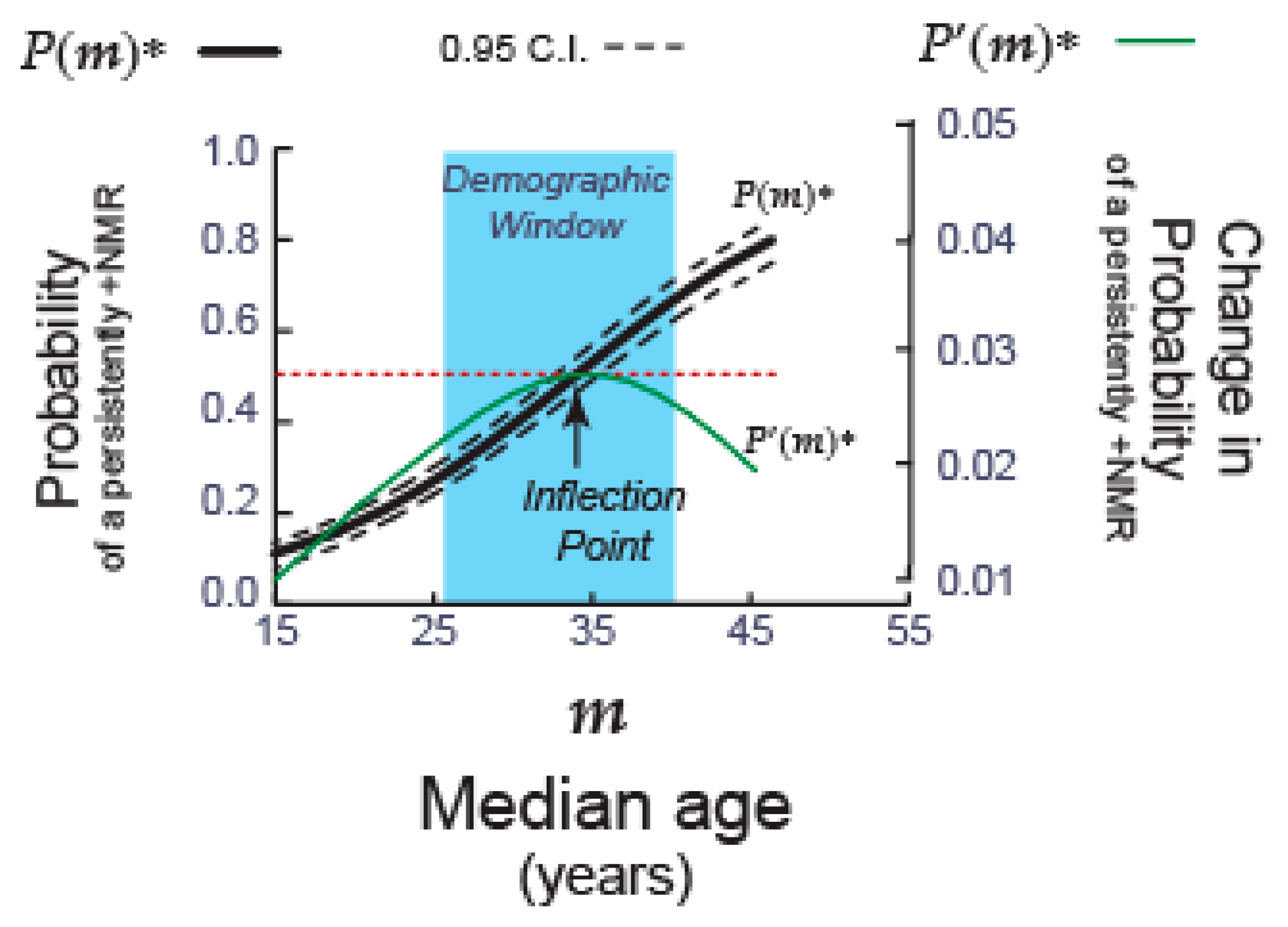
Being a two-dimensional simple logistic function, both the inflection point of P(m)* and the theoretical maximum (peak) of its first derivative, P’(m)*, reside at a median age where the probability of a persistently +NMR is 0.50 (Appendix B, Figure A4). This theoretical assumption was validated by individually identifying (and graphing) the median age at which countries first began a series of five consecutive persistently +NMRs (thus, 10 consecutive +NMRs). For this test, data were omitted to account for the standard model’s two controls: for the set of consistently resource-reliant states, and for a set of the least populated states.
3.8. A Cut Point for +NMRs
In logistic regression analysis, the cut point (or cut-off point) separates the portion of the logistic function that is dominated by dichotomous data with the value of y = 0, from that portion dominated by y = 1 [41]. Statistical software typically sets the default cut point at the simple logistic function’s inflection point, above which the theoretical probability that y = 1 is 0.50, and the odds ratio (correct predictions divided by incorrect predictions) is 1.0 (i.e., 1 to 1). However, in practice, analysts often adjust the cut point to increase the odds of a correct prediction (a true positive)—thus lowering the odds of a false positive, while increasing the risk of missing true positives just below the cut point.
In this analysis, two indicators of predictive success were generated for P(m)*:
- the proportion of correct predictions of +NMRs at median ages higher than the cut point’s median age (a proportion that is expected to decrease as the cut point increases), and
- the odds ratio of a correct prediction of +NMRs (a ratio that is expected to increase as the cut point increases).
Using these two measures, a pair of graphs was generated—the first based on theoretical calculations from the standard model’s functional probabilities, the second on empirical data:
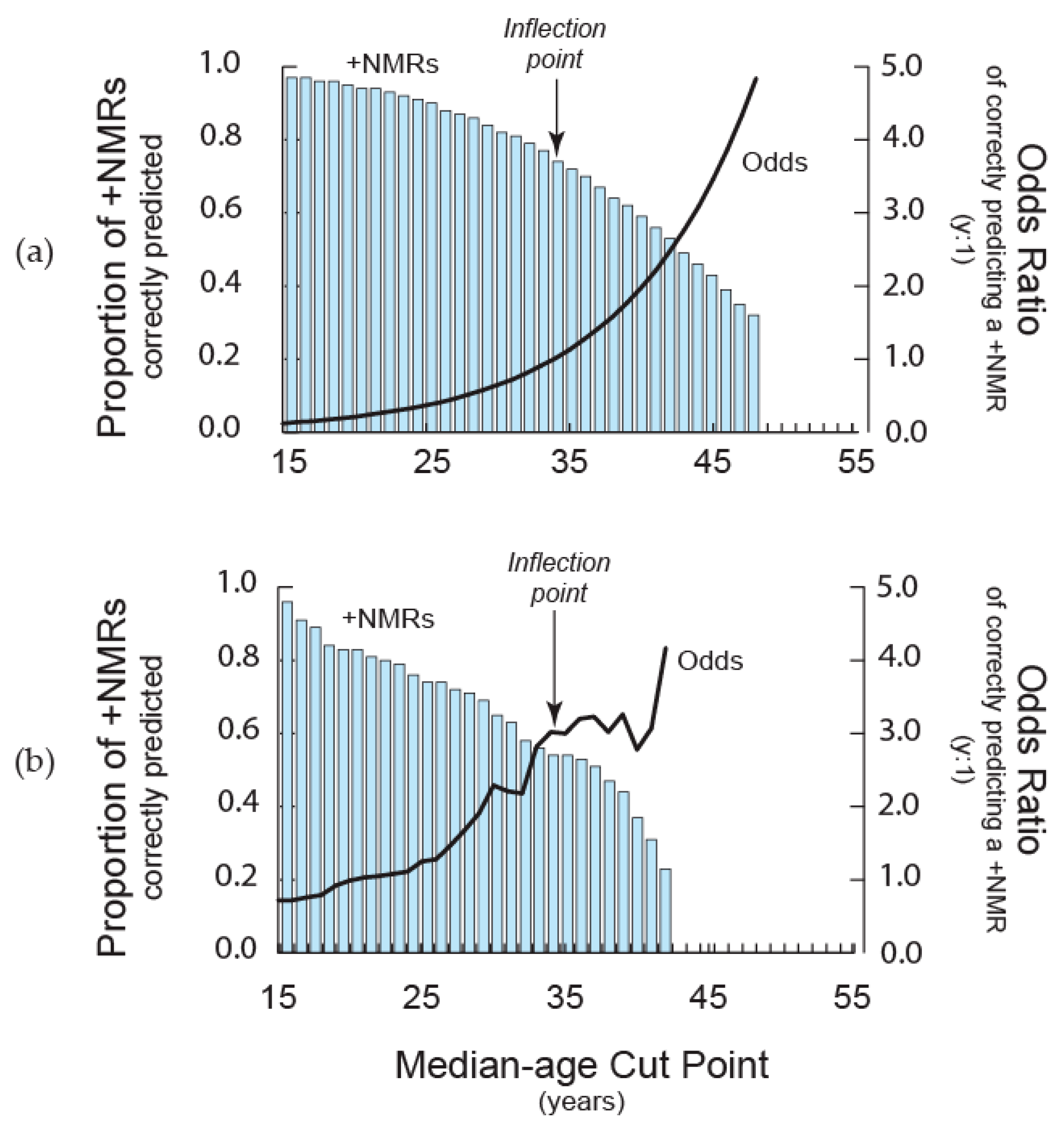
- The theoretical graph uses a proportion of correct predictions and the odds ratios that were generated from the functional probabilities of P(m)*. These results assume a limitless number of evenly distributed observations and a precise fit to the standard model, P(m)*. In this theoretical graph, the cut point was moved from a median age of 15 to 48 years.
- The second graph describes empirical proportions of correct predictions and odds ratios that were determined from reserve data (years 2021 to 2023). For these empirical results, the cut point was started at a median age of 15 years and ended at 42 years, after which fewer than 15 observations were available.
4. Results
The following section summarizes the results of a series of logistic regression analyses (Appendix A, Table A1, Table A2, Table A3, Table A4 and Table A5) that address the study’s primary research questions (as well as address reviewers’ questions and comments). These results are described in the following narrative and are portrayed as probabilistic functions in the median-age domain.
4.1. Age Structure’s Relationship with Persistently +NMRs
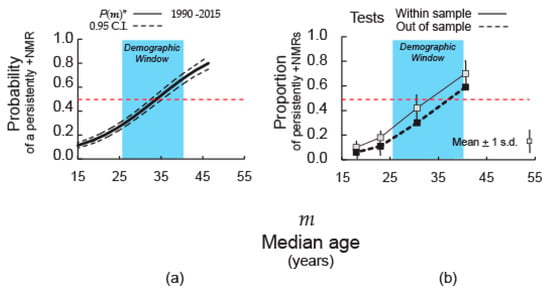
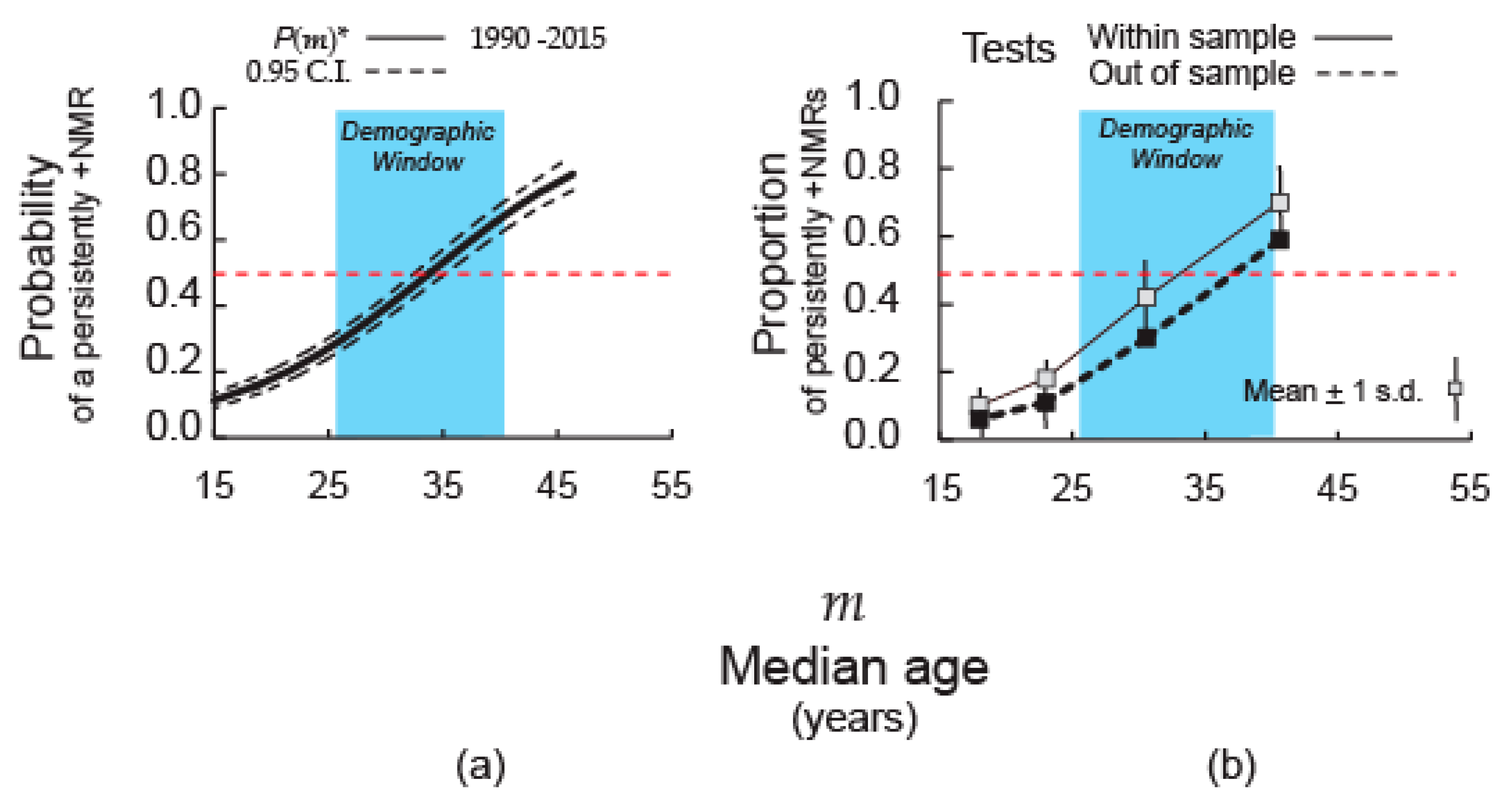
The standard age-structural function portrays a relationship of moderate strength in which the probability of a persistently +NMR (a +NMR, followed by five consecutive +NMRs) gradually accumulates as states advance through the age-structural transition (Figure 4a). States exceeding a median age of 34 years have a probability greater than 0.50 of being persistently +NMRs.
Figure 4.
The (a) probability of a persistently +NMR, P(m)*, generated by the standard model (controlling for resource-reliant states and the least populated states); and (b) a categorical within-sample validation and out-of-sample (2016 to 2018) test of that function. In (b), the calculated proportions of persistently +NMRs are positioned at the mid-points of four discrete categories: early youthful, late youthful, intermediate, and mature (see Figure 1).
The fitted standard logistic function, P(m)*, covers the period from 1990 to 2015 data and employs age-structural analyses’ two controls: resource-reliant states (total natural resource rents greater than 20.0% of GDP), and the least populated states (less than 5.0 million residents, but not resource reliant) (Appendix A, Table A1, Model A1b). This analysis suggests that, at a median age of 15 years, most non-resource-reliant states and those with populations greater than 5.0 million are expected to experience a low (although non-zero) probability of experiencing a persistently +NMR (p = 0.12 ± 0.02). This curve reaches its inflection point (p = 0.50) near the close of the intermediate phase of the age-structural transition (at a median age of 34 ± 2 years). By the median age of 45 years, the probability of a persistently +NMR is expected to have risen to relatively high levels (p = 0.77 ± 0.03).
For the purpose of validation of the function, P(m)*, of the standard model, categorical proportions (for categories, see Figure 1) for both within-sample means and 2016-to-2018 out-of-sample means (Figure 4b) were found to be fairly consistent with the statistically generated logistic representation of this relationship.
Early reviews of this research noted that NRM data are irregularly punctuated by high-amplitude NMRs (|NMR| > 10.0), which (a reviewer suspected) would influence the pattern of persistently +NMRs among youthful countries, where high-amplitude −NMRs and +NMRs are frequent (Appendix B, Figure A1, Figure A2 and Figure A3) due to catastrophic events in-country and in neighboring countries (e.g., armed conflict, famine, economic and political instabilities, etc.). However, the segregation of both negative and positive high-amplitude NMRs as dummy variables (Appendix A, Table A2, Models A2a, A2b) neither appreciably altered the inflection point nor the form of the resultant logistic function.
Another early review questioned the decision to avoid using data from 1970 to 1989. Despite missing data from states that became extinct at the end of the Cold War (e.g., the Soviet Union, Yugoslavia, Czechoslovakia, and the German Democratic Republic) and, in the 1970s and 1980s, a dearth of countries with populations in the mature phase of the age-structural transition, logistic regression fit a similar logistic function to available data from 1970 to 2015 (Appendix A, Table A4, Model A4c).
4.2. Models with Fixed Effects
The results of fixed-effects modeling across the full data set, from 1970 to 2015 (Appendix A, Table A5), call further attention to the finding that median age is a robust, statistically significant predictor of the increasing probability of a country becoming a continuous net receiver of international migrants as that country demographically matures.
By controlling for each country, fixed-effects modeling identified 21 individual states with trends running counter to the dominant relationship with median age. These were largely members of age-structural modeling’s most statistically significant outlier groups: oil and/or mineral-reliant (rentier) states (most of the GCC and OPEC states), and the least populated states (particularly small-island states). Aside from members of these two outlier groups (discussed in more depth the following section), these models identified states with a youthful population that, due to an extended period of instability, temporarily became persistent net receivers of migrants (including Jordon, Zambia, and South Africa) or returning migrants (including Zimbabwe, Ethiopia, and Eritrea), and a handful of states with a mature population that occasionally experienced −NMRs (e.g., Japan, Spain, and Italy) during this 45-year period.
By controlling for each year, fixed-effects modeling indicated that yearly trends during the post-Cold War period (beginning in 1990) were significantly different from those in the Cold War period (1970 to 1989). Thus, the analysis lent support to the decisions (based on preliminary analyses of data) to control for the resource-reliant states and the least populated states, and to separate Cold War from post-Cold War analyses.
4.3. Outlier Groups
This best-fit logistic function was generated by statistically controlling for three sets of countries—resource-reliant states, the least populated states, and states the most autocratic states—whose pattern of net migration has been either largely unresponsive to movement through the age-structural transition, or otherwise inconsistent with the median-age-related pattern followed by the majority of states.
For example, at youthful and intermediate phases of the transition, when most countries are net senders of migrants, resource-reliant states (total natural resource rents greater than 20.0% of GDP) stand out as youthful net receivers of labor migrants (i.e., a negative coefficient) of labor migrants. In contrast, the least populated states (with less than 5.0 million residents, many of which are small-island states) tend to act as net senders (i.e., having a positive coefficient) of migrants to diaspora communities, even in the late-intermediate and mature phases of the transition.
In addition, most of the migrant net senders (−NMRs) that persist through the transition’s late-intermediate phase or into the mature phase can be statistically isolated by the optional inclusion of a third dummy variable isolating politically repressive states in the logit equation. These age-structurally intermediate and mature outliers were identified as “Not Free” in Freedom House’s annual global assessment of political rights and civil liberties (Appendix A, Table A3, Model A3b), and include Belarus, China, Cuba, Democratic People’s Republic of Korea, Iran, Russia, Venezuela, and Viet Nam.
Notably, neither the addition of the two standard controls (resource-reliant states and the least populated states), nor of “Not Free” states in the 1990-to-2015 logit equation (Appendix A, Table A3) substantially moves the logistic curve’s inflection point beyond the 0.95 confidence limits of the original function (without controls, Appendix A, Table A1, Model A1a) or substantially alters probabilistic outcome values at its extreme median ages (i.e., at P(15) or P(45)).
4.4. Evidence of Proximate Effects
The results of additional experimental analyses suggested that both high levels of per capita income and high levels of political rights and civil liberties were strong proximate contributors to a lengthy succession of +NMRs.
When added to the logit equation as dichotomous independent variables, individually or together, the presence of states in the World Bank’s high-income lending category and states assessed as “Free” in Freedom House’s annual survey altered the functional form of the logistic relationship and, when both included in the logit, removed much (but not all) of the probability of a persistently +NMR that is associated with median age. Of the two, the effect of controlling for high per capita income was substantially stronger than the effect of a “Free” assessment.
4.5. The Shift to Persistently +NMRs
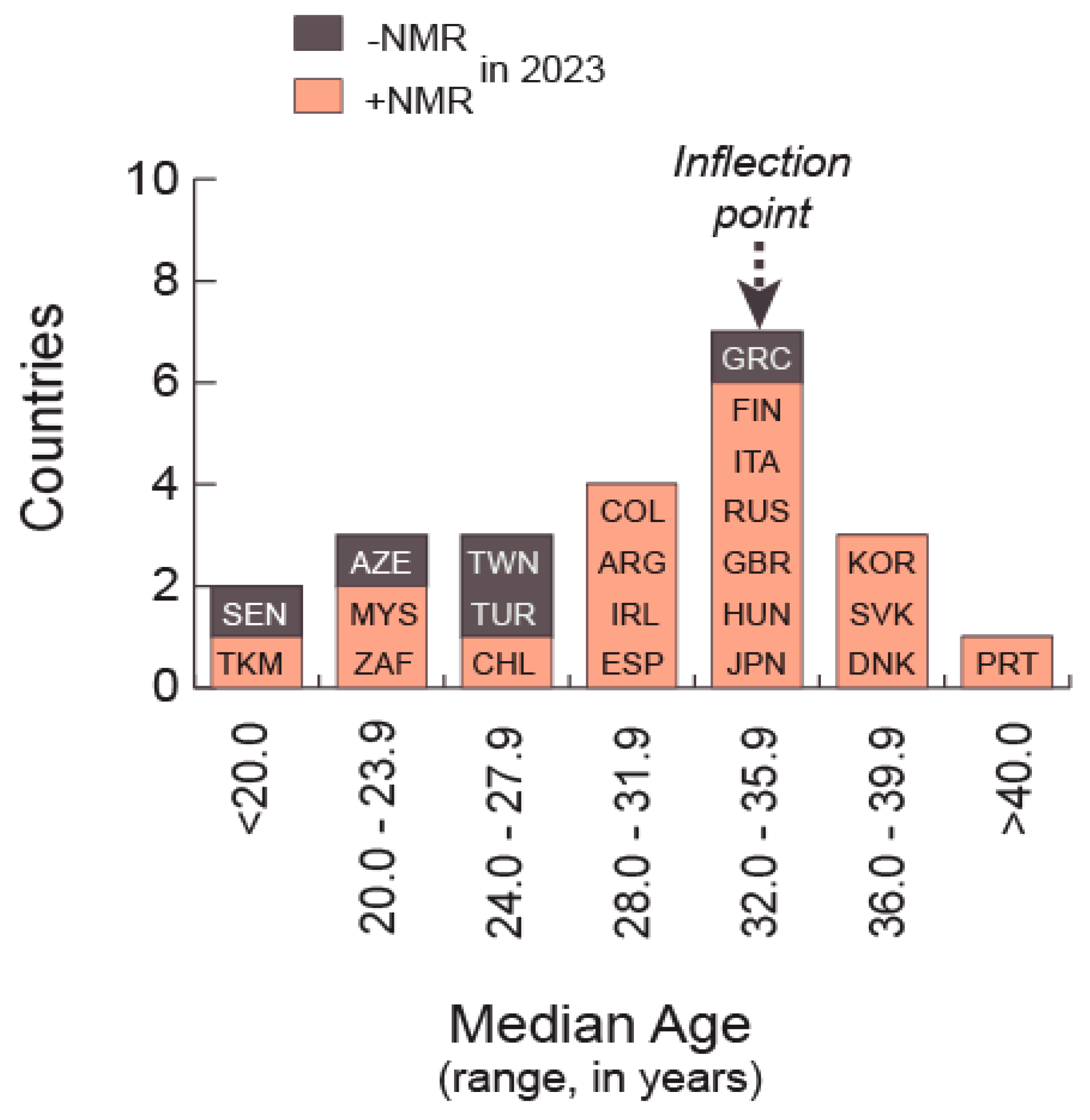
Future shifts, from −NMRs to a long series of persistently +NMRs, are expected to occur as countries surpass the inflection point of P(m)*, at median ages centered around 34 (±2) years.
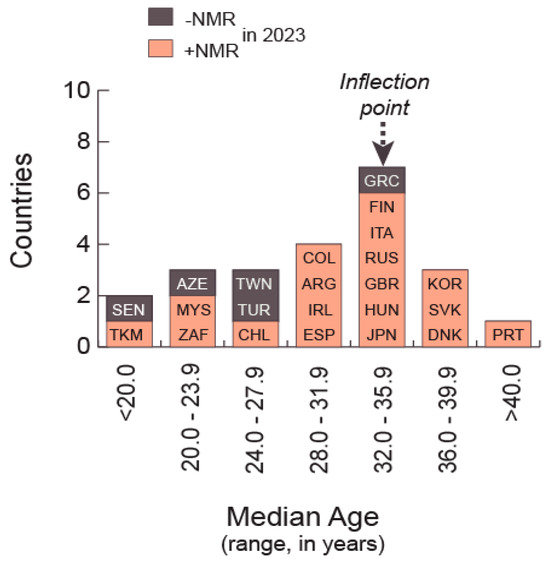
A review of NMR data disclosed a pattern of direction shifting (Figure 5) that has been roughly consistent with the model’s theoretical expectations (Appendix B, Figure A4)—i.e., that the shift to a lengthy series of persistently +NMRs, although not restricted to any portion of the transition, has peaked around the model’s inflection point. Notably, the collection of independent countries that have joined the set of migrant net-receiving states since 1970 has been regionally diverse, including states in Latin America (Argentina, Chile, and Colombia), southern Africa (South Africa), Europe (Ireland, Spain, and the United Kingdom), and East Asia (Japan, the Republic of Korea, and Taiwan).
Figure 5.
The median age at which 23 countries (identified by their ISO3 Alpha Code) have shifted from a −NMR to a string of 10 consecutive +NMRs since 1970. Darkened segments indicate that the country failed to retain its +NMR status in the latest year (2023) of the most recent UN estimates [6].
4.6. A Median-Age Cut Point for +NMRs
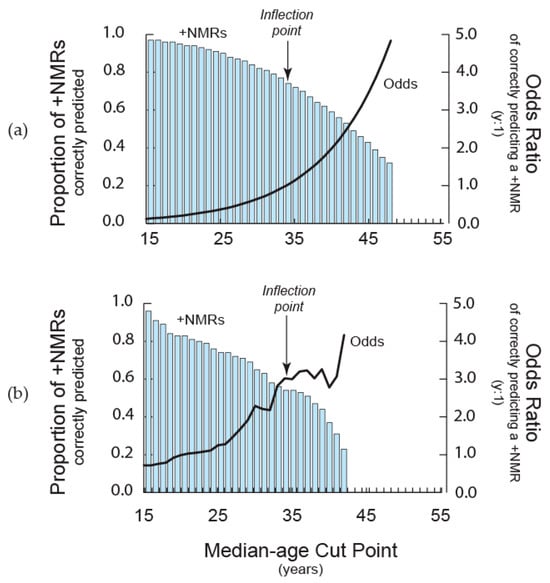
As an alternative to employing the inflection point of P(m)* as the default cut point, empirical calculations (Figure 6b) using reserved data (years 2021 to 2023) indicates that a median-age cut point between 35 and 39 years would (at least, at present), provide relatively high odds of prediction success (around three-to-one) with a relatively small sacrifice in the proportion of correct predictions of +NMRS.
Figure 6.
The standard model’s (a) theoretical and (b) empirically determined proportion of +NMRs correctly predicted (left vertical axis) and odds ratio of correct-to-incorrect +NMRs (right vertical axis) at median ages greater than the selected cut point (horizontal axis). The smooth theoretical results (a) are due to assumptions of evenly distributed data, unlimited n, and a precise fit to the age-structural function. Empirical results (b) are averages from three years of reserve data (2021 to 2023) for years when n ≥ 15.
Logistic regression’s iterative algorithm is designed to maximize the likelihood of separating data dominated by instances of y = 1 from data dominated by y = 0 at the function’s inflection point. However, at this cut point (where P(m) = 0.50), the odds of a correct prediction are, by definition, one-to-one—a level of predictive success that, in practice, is usually unacceptably low for forecasting. Nonetheless, advancing the cut point to attain higher odds of a correct prediction often entails passing over potentially correct predictions, some of which could be critically important to the prediction’s ultimate users.
This cut-point tradeoff becomes apparent when theoretical prediction odds are calculated from the functional probabilities that were fit to P(m)* (Figure 6a). In this theoretical calculation (which assumes limitless countries and data that are perfectly fit to the function and evenly distributed across the age-structural transition), a cut point with 2-to-1 odds of a correct prediction can only be achieved at a median age of 40 years. Moreover, when compared to results using the inflection-point as the cut point, those odds can only be secured with the loss of about one-third of the correct predictions of persistently +NMRs.
A more realistic, more irregular empirical tradeoff (Figure 6b) can be observed using UN estimates [6] from three years of reserved data, 2021 to 2023. As the median-age cut point is advanced in this empirical graph (which is based upon the true positions of unevenly distributed data from the world’s countries), the odds of a correct prediction (+NMR) flatten near three-to-one between median ages 35 and 39 years, with relatively minor losses to the proportion of correct predictions of +NMRs.
5. Discussion
The following set of speculative predications is aimed at providing tests of the age-structural model over the next two decades. Generated from this analysis, each hypothetical prediction takes the form of a geographic cluster of countries. This test assumes that, as countries in the hypothesized cluster approach and surpass the median age cut point of 36.0 years, at least one country in each cluster will have shifted to experiencing a series of +NMRs.
Over the next two decades, failures among the following predictions—whole or in part—should encourage either a revision of the median-age cut point, or a rejection of this age-structural method. However, should this cut point adequately portray the transition to continuous +NMRs (and its apparent exceptions), by 2055, there could be a substantially larger pool of migrant net-receiving states than the UN’s future scenarios currently indicate.
5.1. Hypothetical Predictions: Asia, Latin America, and North Africa
A significant number of countries in South and Southeast Asia, Latin America, and across the Maghreb of North Africa have, since the 1990s, attained sub-replacement levels of fertility and will continue to experience population aging over the coming decades. According to the age-structural model, the probability that some of these countries become continuous net receivers of international migrants will rise as they approach or enter the mature phase of the age-structural transition. These include the following:
- North Africa, probably in Morocco, Algeria, and Tunisia, which are likely to receive increasing inflows of migrants from the Sahel, coastal West Africa, and other Arab states, which could outpace migrant outflows from North Africa.
- South Asia, most likely India, which could receive an even greater influx of migrants from nearby South Asian states (Nepal, Bangladesh), and perhaps from more distant, less developed countries in Southeast Asia and East Africa.
- Southeast Asia, particularly in Malaysia (already a migrant net receiver) and Indonesia, which could experience an increased inflow of migrants from less economically developed parts of South Asia, Southeast Asia, and the Middle East (and possibly skilled professionals from India and China, which have diaspora populations in these countries).
- Latin America, probably in Brazil and Colombia (both have recently become migrant net receivers, primarily due to the influx of Venezuelans), as well as Ecuador, Mexico, and Uruguay, which could receive larger inflows from poor communities in the Andean and Central American regions. As Argentina and Chile (both of which have recently become net receivers) continue to develop economically, these already cosmopolitan societies could experience a greater influx of international migrants of Latin American origin, as well as from more distant regions, as they have in the past.
5.2. Hypothetical Predictions: Sub-Saharan Africa
Sub-Saharan Africa’s lingering youthfulness, chronic political instability, and projected population growth suggest a continued upward trajectory in the numbers of the region’s cross-border migrants. Moreover, even by 2055, the gradual declines expected in fertility and slow advances in median age make it difficult to imagine the emergence of a new, economically vigorous, and politically stable set of continuous migrant net receivers in sub-Saharan Africa, beyond the small set that is already present.
Currently, sub-Saharan Africa’s continuous net receivers are limited to the following:
- Senegal, a relatively politically stable coastal West African state that, while still youthful, serves as a conduit for migrants leaving the conflict-torn Sahel, many of whom later head northward, primarily to the Maghreb and Europe;
- Some of sub-Saharan Africa’s most oil-rich rentier states (Gabon, Equatorial Guinea, and Angola), which attract workers from West and Central Africa;
- Southern African states (particularly South Africa and Namibia), which tend to attract professionals and workers from various parts of the continent.
Notably, even when projected to 2055, the UN Population Division’s medium scenario falls far short of projecting a median age of 36.0 years in all of tropical Africa—a region extending from Mauritania, eastward across the Sahel to Somalia, south through coastal West Africa, Central Africa, and East Africa, and then southward again, ending in Angola and Mozambique (notably, South Africa has already experienced major fertility decline and entered the demographic window).
According to the UN’s medium scenario, tropical Africa’s most age-structurally mature states (with more than 5.0 million residents) are projected to be Ghana and Kenya, which could enter the demographic window (beginning at a median age of about 26 years) between 2045 and 2050. However, even the slow pace of age-structural change that is projected for these two countries can be viewed as optimistic. Demographers recall that while fertility was declining in Arab North Africa and within Africa’s southern cone, other promising tropical African countries (e.g., Côte d’Ivoire, Nigeria, and Senegal) have repeatedly stalled along their projected path to lower fertility, despite gains in other fundamental development indicators.
6. Conclusions
Whereas UN projection scenarios currently do not incorporate this median-age-associated shift toward long-term positive net migration, the results of this study’s analysis provide a method that, by remaining mindful of this relationship and its likely exceptions, demographers could—with additional testing—integrate this shift into future long-term demographic projections.
Would the discussion of the possible emergence of a new set of migrant net-receiving countries matter to strategic foreign affairs and intelligence analyses? Here, the answer is clearly “yes”. Lessons on the economic and political impacts of migration are already being gleaned from the ongoing experiences of increasingly attractive migrant-destination countries such as South Africa, Chile, Colombia, and Brazil. The emergence of other aging, migrant net-receiving countries—among states that have long acted as net senders—might likewise influence future regional patterns of development.
Funding
This research received no external funding.
Institutional Review Board Statement
Ethical review and approval were waived for this study because it used secondary analyses of pre-existing anonymous data, and this study did not directly involve human participants.
Informed Consent Statement
Informed Consent Statement was not required for this study because it used secondary analyses of pre-existing anonymous data, and this study did not directly involve human participants.
Data Availability Statement
The data supporting the conclusions of this article are drawn from online sources in the public domain, which are individually cited and appear in the references. An Excel spreadsheet of these data, and the author’s dichotomous transformations of these data, will be made available by the author on request.
Acknowledgments
The author wishes to thank a series of anonymous reviewers who, previous to and following submission and processing of the manuscript, influenced the final product of this research.
Conflicts of Interest
The author declares no conflict of interest.
Abbreviations
The following abbreviations are used in this manuscript:
| FH | Freedom House |
| GCC | Gulf Cooperation Council |
| NMR | International net migration rate |
| OPEC | Organization of Petroleum Exporting Countries |
| WB | World Bank |
| UN | United Nations |
| UNPD | United Nations Population Division |
Appendix A
Table A1.
Age-structural models: post-Cold War model (1990 to 2015) with a standard pair of independent variables.
Table A2.
Age-structural models with and without high-amplitude NMRs (|NMR| > 10.0).
Table A3.
Age-structural models with experimental dichotomous independent variables.
Table A4.
Age-structural models: Cold War and post-Cold War models.
Table A5.
Conditional age-structural models: full model (1970 to 2015) with fixed effects.
Appendix B
Figure A1.
The frequency distribution of negative (net sending) and positive (net receiving) country-level NMRs, 1990 to 2019. These data are limited to countries with populations greater than 500,000 residents and are drawn from the most recent UN estimates [4]. The frequencies of high amplitude NMRs, both negative (≤−10.0) and positive (≥+10.0), are shown as darkened bars.
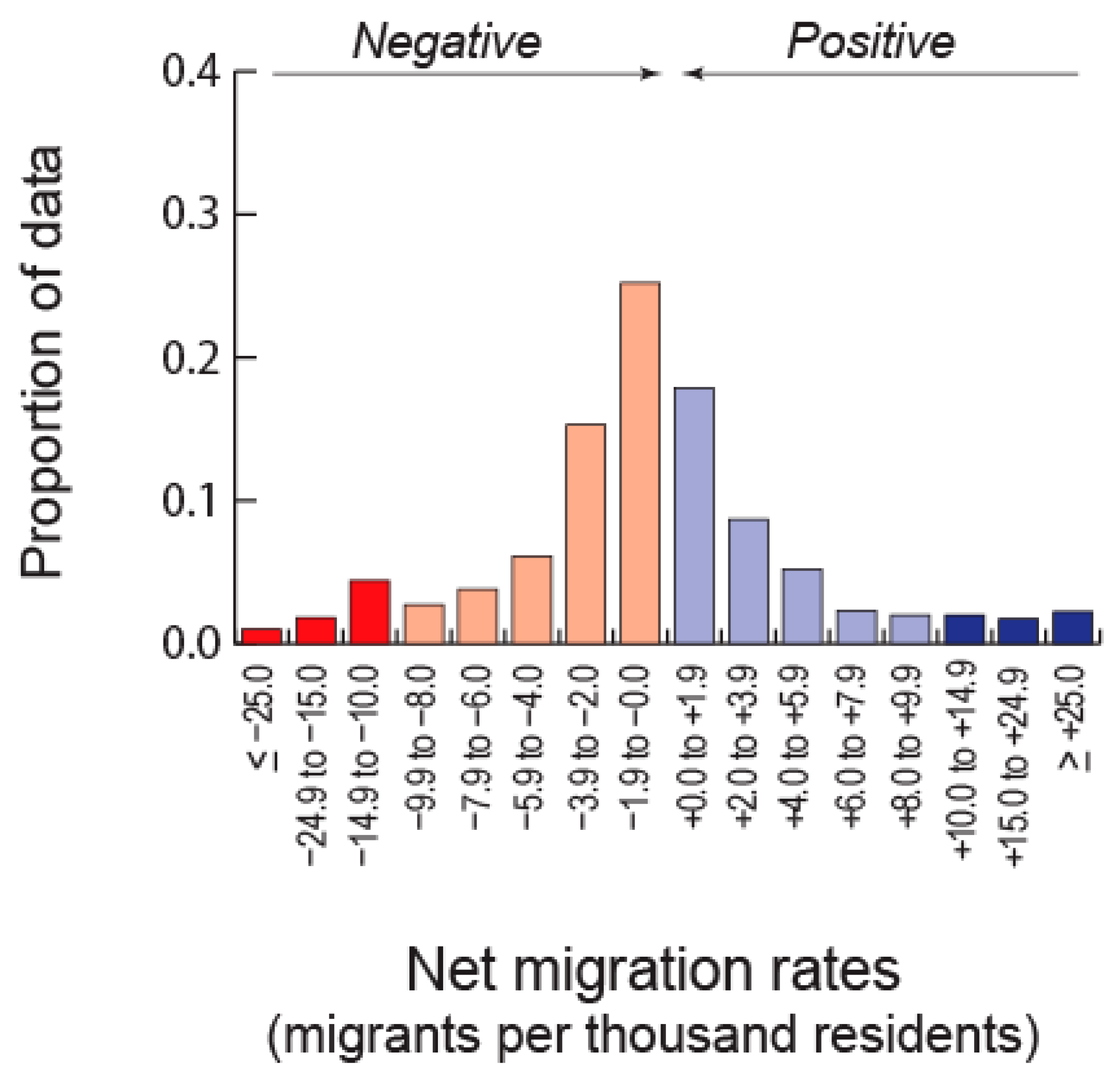
Figure A2.
The presence of negative and positive high-amplitude NMRs. Data are 2015 NMR and median age estimates drawn from the most recent UN estimates [4].
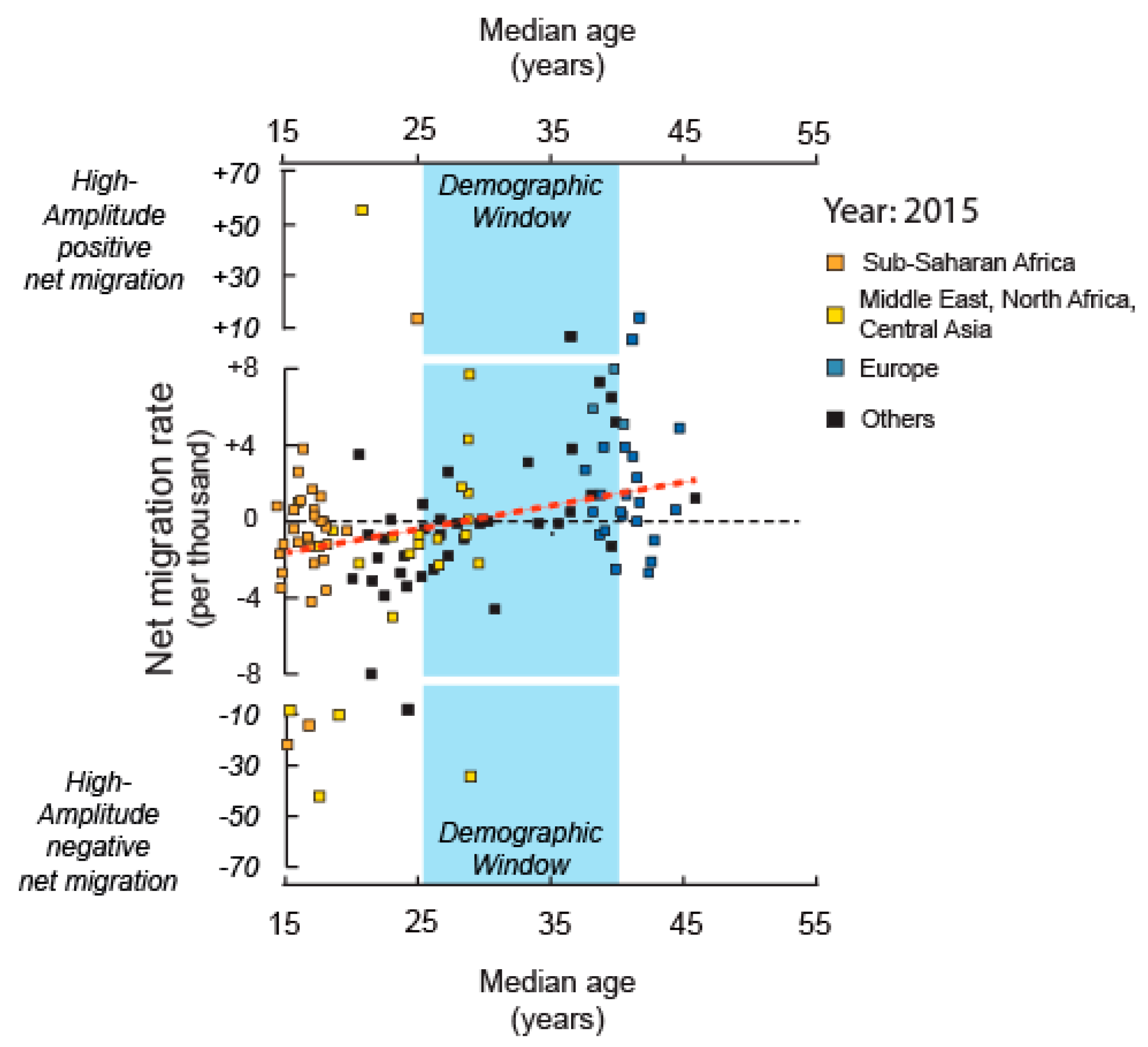
Figure A3.
The frequencies of (a) high-amplitude positive NMRs and (b) high-amplitude negative NMRs for each of three age-structural phases: youthful (YTH), intermediate (INT), and mature (MAT) (see Figure 1 for details of phases). The data for these tabulations span five decades, from 1970–1979 to 2010–2019.
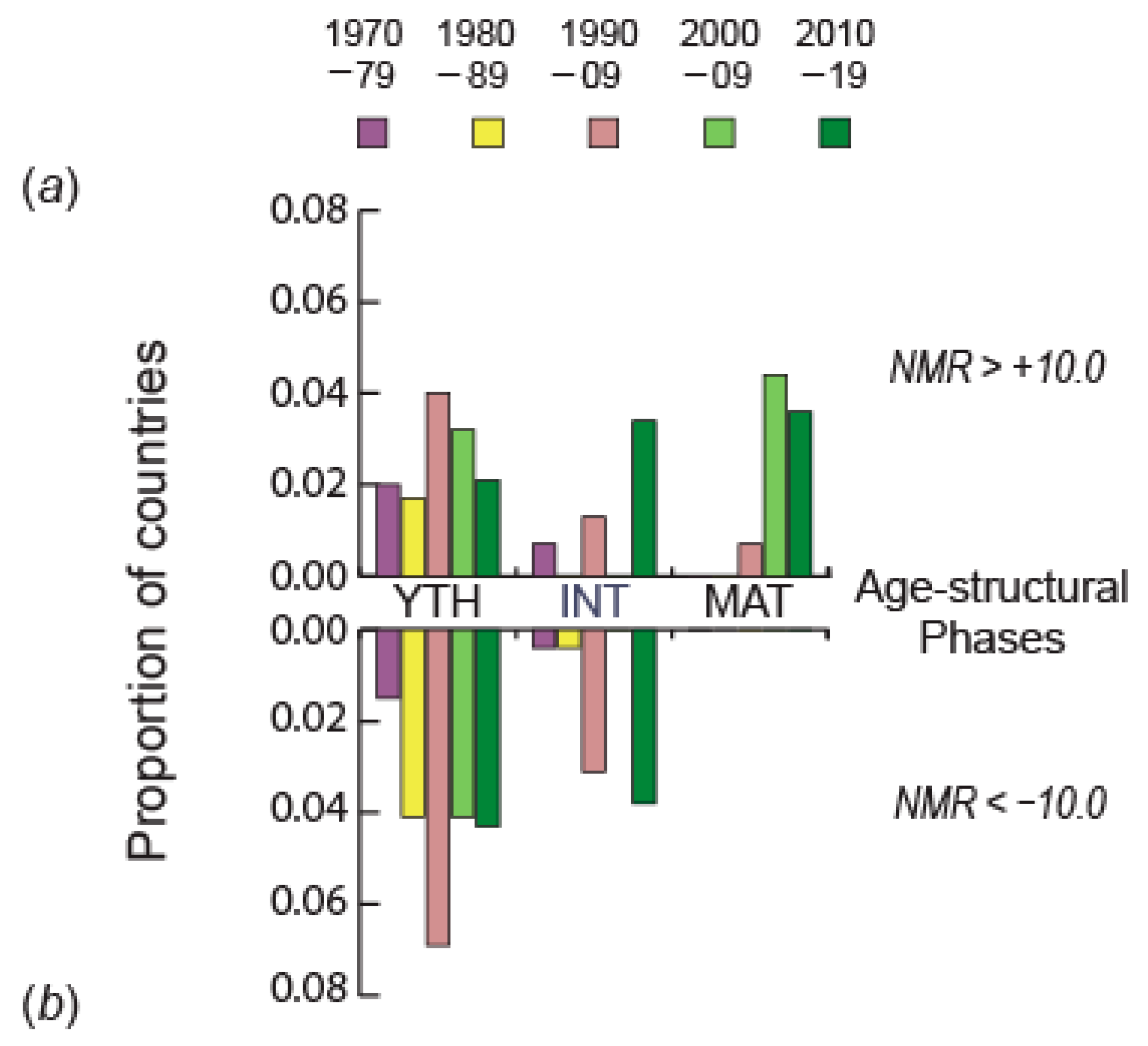
Figure A4.
The standard age-structural function estimating the probability of persistently +NMRs and 0.95 confidence intervals (scale on left vertical axis) and its first derivative (scale on right vertical axis), identifying the theoretical peak of the shift to persistently +NMRs.
References
- United Nations, Department of Economic and Social Affairs, Population Division. World Population Prospects: The 1998 Revision; ST/ESA/P/WP.150; United Nations: New York, NY, USA, 1999; Available online: https://digitallibrary.un.org/record/1491150?ln=en (accessed on 20 May 2023).
- United Nations, Department of Economic and Social Affairs, Population Division. World Population Prospects 2024: Methodology of the United Nations Population Estimates and Projections; UN DESA/POP/2022/DC/NO. 10; United Nations: New York, NY, USA, 2024; pp. 1–86. [Google Scholar]
- Abel, G.J.; Cohen, J.E. Bilateral international migration flow estimates for 200 countries. Sci. Data 2019, 6, 82. [Google Scholar] [CrossRef] [Scilit]
- Abel, G.J.; Cohen, J.E. Bilateral international migration flow estimates updated and refined by sex. Sci. Data 2022, 9, 173. [Google Scholar] [CrossRef] [Scilit]
- Abel, G.J.; Sander, N. Quantifying global international migration flows. Science 2014, 343, 1520–1522. [Google Scholar] [CrossRef] [Scilit] [PubMed]
- United Nations, Department of Economic and Social Affairs, Population Division. World Population Prospects, the 2024 Revision; POP/DB/WPP/Rev.2024/GEN/F01; United Nations: New York, NY, USA, 2024; Available online: https://population.un.org/wpp/ (accessed on 1 September 2024).
- Azose, J.; Raftery, A.E. Bayesian probabilistic projection of international migration. Demography 2015, 52, 1627–1650. [Google Scholar] [CrossRef] [Scilit] [PubMed]
- Azose, J.; Ševčíková, H.; Raftery, A.E. Probabilistic population projections with migration uncertainty. Proc. Natl. Acad. Sci. USA 2016, 113, 6460–6465. [Google Scholar] [CrossRef] [Scilit] [PubMed]
- United Nations, Department of Economic and Social Affairs, Population Division. World Population Prospects 2022: Methodology of the United Nations Population Estimates and Projections; UN DESA/POP/2022/TR/NO. 4; United Nations: New York, NY, USA, 2022; Available online: https://population.un.org/wpp/assets/Files/WPP2022_Methodology.pdf (accessed on 12 January 2025).
- UN Department of Economic and Social Affairs, Population Division. World Population Prospects, 2019: Methodology of the United Nations Population Estimates and Projections; ST/ESA/SER.A/425; United Nations: New York, NY, USA, 2019; Available online: https://population.un.org/wpp/assets/Files/WPP2019_Methodology.pdf (accessed on 12 January 2025).
- Lakatos, I. The Methodology of Scientific Research Programmes: Philosophical Papers, Volume No. 1; Cambridge University Press: Cambridge, UK, 1978; pp. 8–101. [Google Scholar]
- World Bank. World Development Report 2023: Migrants, Refugees, and Societies; World Bank: Washington, DC, USA, 2023; pp. 43–59. [Google Scholar]
- Simpson, N.B. Demographic and economic determinants of migration. IZA World Labor 2022, 373. [Google Scholar] [CrossRef] [Scilit]
- Becker, G. The Challenge of Immigration: A Radical Solution; Institute of Economic Affairs Monographs: London, UK, 2011; pp. 19–34. Available online: https://ssrn.com/abstract=3922137 (accessed on 5 November 2025).
- Canales, A. Migration, Reproduction and Society: Economic and Demographic Dilemmas in Global Capitalism; Haymarket: Chicago, IL, USA; pp. 34–53.
- Harris, J.R.; Todaro, M.P. Migration, unemployment and development: A two-sector analysis. Am. Econ. Rev. 1970, 60, 126–142. [Google Scholar]
- Massey, D.S.; Arango, J.; Hugo, G.; Kouaouci, A.; Pellegrino, A.; Taylor, J.E. Theories of international migration: A review and appraisal. Popul. Dev. Rev. 1993, 19, 431–466. [Google Scholar] [CrossRef] [Scilit]
- Skeldon, R. Population Mobility in Developing Countries: A Reinterpretation; Belhaven Press: New York, NY, USA, 1990. [Google Scholar]
- Hazán, M. Understanding Return Migration to Mexico: Towards a Comprehensive Policy for the Reintegration of Returning Migrants; CCIS Working Paper, No. 193; Center for Comparative Immigration Studies, University of California San Diego: San Diego, CA, USA, 2014; Available online: https://ccis.ucsd.edu/_files/wp193.pdf (accessed on 15 June 2025).
- Coale, A.J.; Hoover, E.M. Population Growth and Economic Development in Low-Income Countries: A Case Study of India’s Prospect; Princeton University Press: Princeton, NJ, USA, 1958. [Google Scholar]
- Möller, H. Youth as a Force in the Modern World. Comp. Stud. Soc. Hist. 1968, 10, 237–260. [Google Scholar] [CrossRef] [Scilit]
- Zelinsky, W. The hypothesis of the mobility transition. Geogr. Rev. 1971, 61, 219–249. [Google Scholar] [CrossRef] [Scilit]
- Lutz, W.; Butz, W.P.; KC, S. World Population and Human Capital in the Twenty-First Century; International Institute for Applied Systems Analysis: Laxenberg, Austria, 2011. [Google Scholar]
- Cincotta, R. The age-structural theory of state behavior. In Oxford Research Encyclopedia of Politics; Oxford University Press: Oxford, UK, 2017; Available online: https://oxfordre.com/politics/view/10.1093/acrefore/9780190228637.001.0001/acrefore-9780190228637-e-327 (accessed on 21 August 2023).
- Lee, R.; Mason, A. Population Aging and the Generational Economy: A Global Perspective; Edward Elgar: Cheltenham Glos, UK, 2011. [Google Scholar]
- Weber, H. Demography and democracy: The impact of youth cohort size on democratic stability in the world. Democratization 2013, 20, 335–357. [Google Scholar] [CrossRef] [Scilit]
- Dyson, T. On the democratic and demographic transitions. Popul. Dev. Rev. 2013, 38, 83–102. [Google Scholar] [CrossRef] [Scilit]
- Cincotta, R. Half a chance: Youth bulges and transitions to liberal democracy. Environ. Change Secur. Proj. Rep. 2008, 13, 10–18. [Google Scholar]
- Lu, Y.; Luo, Z. Age structure and democratic development: The non-linear and conditional role of youth bulges. World Dev. 2025, 195, 107132. [Google Scholar] [CrossRef] [Scilit]
- Cincotta, R. Population age structure and the vulnerability of states to coups d’état. Stat. Politics Policy 2023, 14, 331–355. [Google Scholar] [CrossRef] [Scilit]
- Urdal, H. A clash of generations? Youth bulges and political violence. Int. Stud. Q. 2006, 50, 607–629. [Google Scholar] [CrossRef] [Scilit]
- Yair, O.; Miodownik, D. Youth bulge and civil war: Why a country’s share of young adults explains only non-ethnic wars. Confl. Manag. Peace Sci. 2016, 33, 25–44. [Google Scholar] [CrossRef] [Scilit]
- Cincotta, R.; Weber, H. Youthful age structures and the risks of revolutionary and separatist conflicts. In Global Political Demography: The Politics of Population Change; Goerres, A., Vanhuysse, P., Eds.; Palgrave Macmillan: London, UK, 2021; pp. 57–92. [Google Scholar]
- National Intelligence Council. Global Trends 2030: Alternative Worlds; Office of the Director of National Intelligence: Washington, DC, USA, 2012.
- Malmberg, B.; Lindh, T. Forecasting Global Income Growth Using Age-structural Projections. In Age-Structural Transitions: Challenges for Development; Pool, I., Wong, L.R., Vilquin, E., Eds.; Committee for International Cooperation in National Research in Demography: Paris, France, 2006; pp. 60–82. [Google Scholar]
- Leahy, E. Beginning the demographic transition: Very young and youthful age structures. Environ. Change Secur. Proj. Rep. 2008, 13, 40–47. Available online: https://www.wilsoncenter.org/sites/default/files/media/documents/publication/ECSPReport13_Leahy.pdf (accessed on 14 December 2023).
- Cilliers, J. Harnessing and Advancing Africa’s Demographic Dividend; WRR Working Paper, No. 70; Netherlands Scientific Council for Government Policy (WRR): The Hague, The Netherlands, 2025. [Google Scholar]
- United Nations Department of Economic and Social Affairs, Population Division. World Population to 2300; ST/ESA/SER.A/236; United Nations: New York, NY, USA, 2004. [Google Scholar]
- Freedom House. Country and Territory Ratings and Statuses, 1973–2020; Freedom House: Washington, DC, USA, 2025; Available online: https://freedomhouse.org/report/freedom-world (accessed on 12 May 2025).
- World Bank. World Bank Country and Lending Groups; IBRD: Washington, DC, USA, 2025; Available online: https://datahelpdesk.worldbank.org/knowledgebase/articles/906519-world-bank-country-and-lending-groups (accessed on 12 May 2025).
- Menard, S. Applied Logistic Regression Analysis; Sage: Thousand Oaks, CA, USA, 2002. [Google Scholar]
Disclaimer/Publisher’s Note: The statements, opinions and data contained in all publications are solely those of the individual author(s) and contributor(s) and not of MDPI and/or the editor(s). MDPI and/or the editor(s) disclaim responsibility for any injury to people or property resulting from any ideas, methods, instructions or products referred to in the content. |
© 2026 by the author. Licensee MDPI, Basel, Switzerland. This article is an open access article distributed under the terms and conditions of the Creative Commons Attribution (CC BY) license.