1. Introduction
Obstetric violence has been defined broadly to encompass both physical and psychological violence, such as verbal abuse and humiliation during obstetric visits ([
1], p. 2). It has been cited as procedures performed without consent and/or limited information or coercion, including C-sections, episiotomies, sterilizations, or even vaginal exams [
1]. Others include lack of privacy, denial of care, or threats to remove children as examples of how obstetric violence might manifest [
1,
2,
3]. Obstetric violence has been associated not only with psychological illness but also with increased maternal mortality rates and serious complications for fetal and child development [
1,
4,
5]. In this article, we use “obstetric violence” to mean any of these harms, i.e., physical, mental, or structural, that occur during prenatal, birth, and postpartum care. We also extend the term to capture specific forms of violence present in the Ecuadorian Amazon, which encapsulate corporeal violence as well as community-level harms.
Across Latin America, Indigenous women have been disproportionately impacted by this phenomenon, facing both physical and psychological harm during pregnancy, childbirth, and postpartum care. In Ecuador, national surveys indicate that nearly one in three women has experienced obstetric violence, with significantly higher prevalence among Indigenous populations [
1]. Yet, despite these alarming statistics, quantitative data capturing the specific experiences of Indigenous women in the Amazon remain strikingly limited. This lack of data has been termed “data genocide”, or the systemic erasure or lack of Indigenous health data [
6,
7,
8]. Data genocide can also refer to the extraction of data from Indigenous communities, contributing to colonial patterns of Indigenous dispossession, with no benefit to local communities [
8].
Due to decades of Indigenous organizing, Ecuador passed a new and revolutionary constitution in 2008, the first to guarantee “rights” to nature itself, and among many others, the right to “intercultural health”, defined as both biomedical and ancestral medicine [
9]. This right has not been realized, and in many ways, has been undermined by many of the intercultural projects that purport to support Indigenous healers and
yachaks [
10,
11,
12]. The use of the term “intercultural health” to disenfranchise, rather than support, Indigenous health practices, is called “weaponized interculturality” [
12].
The Napo province of Ecuador is located in the Amazon basin and experiences nearly two and a half times the national maternal mortality rate, 124 to 55 per 100,000, respectively [
13]. The Napo province is 58% Indigenous, with the majority being Kichwa [
14]. Average hourly pay is 2.5 USD per hour. Napo is the third poorest province in the country, with 78% of residents living in poverty, which is defined as the inability to support basic needs [
13]. Many of the medical practitioners at hospitals and health centers in Napo are
mestizo (non-Indigenous) from urban centers of Ecuador and are carrying out their year of rural service required in order to finish medical school. This leads to a dynamic in which young, recent medical school graduates, largely white or
mestizo, who do not speak the Kichwa language, are practicing medicine among a largely Indigenous population.
Indigenous Kichwa midwives of Amupakin, the Association of Women Kichwa Midwives of Upper Napo, located in the Napo province, attend births at their own private clinic outside state control, where they advocate for “health sovereignty” [
15] or control over their own health care practices and knowledge, and pass down ancestral Kichwa birthing knowledge. Amupakin midwives have heard stories of obstetric violence for years from the women who came to birth with them instead, seeking a safe and culturally grounded alternative. Conversations between Authors 1, 2, and 3 about this invisibilized violence led to this project.
In order to address this lack of data, or “data genocide”, this article introduces
EPREVO Amazonía (
Experiencias de Parto Relacionadas a Violencia Obstétrica en la Amazonía), “Experiences of Birth Related to Obstetric Violence, in the Amazon”, a participatory, context-sensitive survey tool designed to measure obstetric violence as experienced by Kichwa women in the Ecuadorian Amazon. Adapted from the original
EPREVO instrument developed by Fors et al. [
16], this version was co-designed in collaboration with Indigenous Kichwa midwives and Indigenous women through a series of participatory workshops in the province of Napo, several of whom are authors of this manuscript. These collaborators emphasized the need for a tool that could reflect the cultural, geographic, and ontological specificity of Amazonian birthing experiences, including relational models of care, spiritual understandings of childbirth, and systemic barriers to accessing respectful health care.
EPREVO Amazonía is, to our knowledge, the first demographic instrument designed specifically to capture obstetric violence in this region.
By offering a participatory, scalable method for measuring obstetric violence in the Amazon, EPREVO Amazonía contributes to both demographic scholarship and Indigenous health advocacy. We also call for a broader epistemological shift in population health research, one that centers Indigenous knowledge systems, collective rights, and community-led definitions of care.
2. Materials and Methods
We employed a purposive, community-based sampling strategy designed to capture variation in geography, accessibility, and community size across Indigenous Kichwa populations served by the regional public hospital in Tena. Data were collected between December 2024 and July 2025, across 43 Indigenous Kichwa communities in the province of Napo, located in the Ecuadorian Amazon. Communities varied widely in accessibility, from road-accessible towns to villages accessible only by several hours of canoe travel. Each of these communities was served by the public hospital in Napo, the furthest being 100 miles away. Due to regional health policy, pregnant people must give birth in the regional hospital in Tena, rather than smaller health outposts in their communities.
Eligible participants were women aged 18 or older who identified as Kichwa and had given birth in a public hospital in Napo within the past five years. Recruitment combined door-to-door outreach with community-based referral facilitated by trained Kichwa research assistants and midwives. This approach prioritized inclusion across remote and historically underrepresented communities that are often excluded from population datasets. All participants identified as women. Participants were compensated 2 USD for their time, following local ethical standards.
Several measures were implemented to minimize interviewer bias and reduce the potential influence of researcher presence on participant responses. Surveys were administered primarily by trained Kichwa research assistants, many of whom were trusted community members, which helped mitigate power differentials often associated with external researchers.
All research assistants completed human subjects ethics training through the Collaborative Institutional Training Initiative (CITI) (translated by Author 1) and were registered with the Vanderbilt IRB. Standardized training sessions were conducted in Spanish and Kichwa by Author 1 to ensure consistent survey administration, neutral question delivery, and avoidance of leading prompts.
The first author interviewed 50% of those surveyed (69 individuals). Quotes from those interviews are included in the
Section 3 to provide further context to the quantitative data.
Research assistants conducted the survey prior to the ethnographic interview, allowing participants to respond to structured questions before extended researcher interaction. Participants were also able to choose whether the survey was conducted in Spanish or Kichwa, further supporting comprehension and comfort. The surveys were originally written in Spanish and translated into Kichwa with the help of a local translator, a Kichwa teacher, and a close confidant of the Amupakin midwives.
Importantly, the longstanding presence of Amupakin midwives within these communities likely enhanced trust while reducing social desirability bias, as participants were interacting with known community health actors rather than unfamiliar institutional personnel.
We practice what we term “decolonial demography”, rooted in Linda Tuhiwai Smith’s “decolonizing methodologies” [
17], which calls for not only engaged participation from studied communities, but also community control over both the development of research questions and ownership of the data itself. Some scholars call this “data sovereignty” [
18], which is a direct response to histories of “data genocide” [
6,
19,
20], in which marginalized, in particular Indigenous communities, are not only not included in datasets but also do not own the data extracted from their own communities. We also draw on the Zapatista ethics of “Asking, we walk” [
21], which describes decolonization as an ongoing process, constantly in motion and communication with local partners.
Considering each of these theories, we seek to move beyond just the language of “participation” and present a “decolonial” methodology rooted in theories of Indigenous sovereignty. We call this “decolonial demography”. Author 2, a midwife at Amupakin midwifery clinic and a local Indigenous Kichwa leader, asked Author 1 to help design a research tool that would measure obstetric violence. The tool was then co-developed through a series of workshops with the Kichwa midwives from Amupakin Kichwa midwifery clinic in Archidona, as well as with Kichwa women from Misahualli, Archidona, Tena, and Cotundo. At the conclusion of the study, Amupakin will retain access to the dataset.
In order to remain comparable with existing national datasets,
EPREVO Amazonía uses the same list of questions in the nationwide study on obstetric violence, as developed by Fors et al. [
16]. Due to findings in the workshops mentioned above, we added additional questions about culturally specific understandings of consent, suppression of traditional midwifery, plant medicine use, linguistic barriers, environmental barriers, infrastructural barriers, and specific forms of violence, like forced isolation during childbirth, which had been reported to the Amupakin midwives previously and cited by Indigenous women as a reason for avoiding the hospital.
IRB (International Review Board) ethics approval was administered through the Vanderbilt University process, which was managed by BRANY (Biomedical Research Alliance of New York) at the time of research, as well as by the Universidad San Francisco de Quito, where Author 1 is an affiliated researcher. The authors also created an internal IRB at Amupakin midwifery clinic, in order to systematically review any prospective research studies to take place within the Amupakin clinic. This study was the first to undergo Amupakin’s IRB process.
Survey data were analyzed in STATA by the first author. Descriptive statistics were calculated for each indicator of obstetric violence. Qualitative data were coded in MAXQDA to contextualize quantitative patterns. Triangulation between quantitative survey data and thematically coded interviews enabled cross-validation of findings, strengthening reliability.
3. Results and Discussion
The study that originally developed
EPREVO [
16] surveyed an Ecuadorian population that was 1% Indigenous (89.2% mestiza), 1% with primary school level education (86% with university level education), and in which 62% gave birth in a public institution ([
16],
Table 1). We situate our study against this backdrop, focusing on the Amazon region in particular, with 94% Indigenous participants (93% Kichwa, 1% Kichwa–Sapara), 53% with primary school education, and 41% with high school education.
Birth locations reported in
Table 2 include locations for all reported lifetime births (N = 184). Data reveal a strong pattern of centralization in line with regional public health policy requiring all births to take place in the central regional hospital, rather than at public health outposts. Nearly two-thirds of all births (63%) occurred at the Jose Ibarra Public Hospital in Tena. Home births accounted for 27% of all births, reflecting the importance of family and midwife-supported birthing practices among Indigenous communities.
3.1. Medically Unnecessary and Nonconsensual Procedures
Non-consensual intervention was widespread across the entire dataset. Of all those surveyed, 84% of participants experienced at least one non-consensual procedure. Beyond consent, we report data in
Table 3 on a number of procedures that are now widely considered medically unnecessary, and in some cases, harmful to patients.
3.1.1. Episiotomy
First, the episiotomy procedure, which involves a surgical cut of the vaginal opening, is now only recommended for “restricted use” in emergency situations, with a recommended country-wide rate of 10% [
22,
23]. In this study, however, 50% of women reported an episiotomy intervention.
Several affirmative responses to the episiotomy question may have reflected the presence of stitches rather than a confirmed surgical incision, as suturing can also result from spontaneous perineal tearing during childbirth. For this reason, the episiotomy rate reported here may be overestimated.
At the same time, this potential measurement limitation should not obscure the broader pattern suggesting routine use of the procedure. These accounts align with national evidence: Fors et al. [
24] document an Ecuador-wide episiotomy rate of 68%. Even if our estimate of 50% is inflated, it remains substantially higher than the WHO-recommended nationwide rate of approximately 10%, reinforcing concerns about persistent overuse in public hospitals in the Ecuadorian Amazon.
3.1.2. Genital Shaving
Genital shaving was previously thought to improve hygiene during childbirth, cited as a way to prevent infection. In the United States, this was common practice until the 1990s, when research demonstrated that genital shaving actually increases risk of infection, due to abrasions left from the razor ([
25], p. 95). Today in the United States, shaving has been shown to increase the risk of infection and is not currently recommended during prenatal or birth care [
26].
In this study, however, we found a persistence of ritual shaving in hospitals in the Ecuadorian Amazon. Genital shaving was reported by 11.5% of participants. None of them were asked for their consent. Many women reported feeling ashamed during this procedure. One woman, Kichwa, age 22, told us, “Me hicieron sentir como un animal, así, acostada, rasurándome” (“They made me feel like an animal, like that, laying down, while they shaved me”).
3.1.3. Enemas
Similarly, the use of enemas during labor was previously a common practice throughout the world from the late 1990s to early 2000s, but it is now highly discouraged, as it causes discomfort for birthing people and is deemed medically unnecessary [
25,
27].
In this study, we found that the practice persists: 14.4% of women reported receiving an enema. None of them were asked for their consent. Women highlighted the shame in this practice, saying they felt “como un animal” (“like an animal”), and “sucia” (“dirty”).
3.1.4. Kristeller Procedure
The Kristeller procedure is a tactic used by obstetricians, where force is applied to the upper part of the uterus, directed toward the birth canal, in an attempt to assist spontaneous vaginal birth and to avoid a prolonged labor, as stated by the National Institutes of Health in the United States [
28]. The harms from this procedure have brought it under legal review in the US, and while the guidelines are still unclear on how forceful the procedure must be in order to be considered “illegal”, it is considered highly risky [
29]. The World Health Organization officially recommended against the maneuver in 2018, citing concerns for both the fetus and the birthing person [
23].
In this study, 30% of women underwent this procedure, 80% without consent. This demonstrates the persistence of the procedure in public hospitals in the Amazon. Nationwide in Ecuador, birthing people report similar rates: 26% of women in Ecuador in a national study reported having undergone a Kristeller procedure [
24].
3.1.5. Physical Restraint
In this study, 11.5% of women reported being physically tied to the bed, none of whom were asked for their consent. Women describe the shame this incited in the following way: “Como una vaca, me amarraron a la cama” (“Like a cow, they tied me to the bed”).
3.2. Coercive and Non-Consensual Reproductive Decision-Making
In
Table 4, we highlight in particular the non-consensual tubal ligations, a surgical procedure that involves tying and severing the fallopian tubes, to prevent future pregnancies. Of those who received tubal ligations, 22% were not informed. This data repeats the same violent, colonial logics of the state-backed forced sterilization campaigns of Indigenous women in the Americas, particularly in Peru [
30,
31]. We call this out as a form of violence that must be visibilized and addressed.
In addition to several tubal ligations taking place without consent, semipermanent contraceptive devices were also placed without consent: 16% of those who had implants were not asked for their consent, and 20% of all participants reported feeling pressured to adopt a form of contraception.
3.2.1. Coercion
One 22-year-old Kichwa woman recounted how she had her first child at 16. At the hospital, they tried to convince her to get a tubal ligation at the age of 16. She told us, “La ligadura. Es como que después del parto entraron y quisieron hacer. Sí, y estaban como intentando hacerlo…” (“After the birth, they entered [the birth room] and they were trying to do it [the tubal ligation]”). She recounted how they asked over and over if they could do a tubal ligation, asking both her boyfriend and her. She said they kept refusing, and ultimately, she was able to avoid the procedure. We asked why the hospital staff would encourage this, since she was only 16 and may want more children. She expressed the same concern, “Sí, no sé, solo tenía 16…Tenía parto normal” (“Right, I don’t know. I was only 16. I had a normal birth”).
A 27-year-old Kichwa woman recounted to us, “The nurse begged me to get a ligation at the subcentro. And in the hospital, they tried to do it, even though I didn’t want to”. In the end, they did not do the procedure, but she described how much pressure she felt to do it.
Another participant, a 38-year-old Kichwa woman, told us about her experience with tubal ligations. She said that when she was pregnant at 35, the nurses encouraged her to get one, telling her about how kids can have autism and Down syndrome if she kept getting pregnant at her age. Then she described how the monthly injections, a common form of birth control for many women we interviewed, “dolían mucho” (“hurt a lot”), and were inconvenient to get each month in person at the clinic. In the end, she said she felt concerned about the risk of autism and dissatisfied with the shots as birth control, and she decided to get a tubal ligation.
3.2.2. Ligations as Drivers to the Hospital
On the other hand, some participants went to the hospital for their last child, specifically because they wanted a tubal ligation. As a 45-year-old Kichwa woman with six children told us, “Solo fui al hospital porque quise una ligadura después de mi último hijo. Mis hermanas me estaban hablando--necesitas tener una ligadura” (“I only went to the hospital because I wanted a tubal ligation after my last child. My sisters were yelling at me, you need to get a ligation”). She recounted the stress of having so many children and cited a tubal ligation as a way to better control her finances.
Others described wanting to give birth at the hospital in order to get a longer-term contraceptive, like an intrauterine device or an implant in the arm.
We see how the tubal ligations and contraceptive devices were also driving forces to give birth at the hospital, in addition to being deterrents from it.
3.2.3. Tubal Ligations and Patriarchy
Some women reported feeling pressured by their partners to get tubal ligations. Several women reported that the ligation was carried out without their own consent, solely with the consent of their partner.
As a 48-year-old Kichwa woman recounted, her husband was asked for consent for a tubal ligation, but she was not. He encouraged her to get one, since they were economically unstable. “Me dijo, ya tenemos hija y cuatro varones, y vamos a sufrir” (“He told me, we already have a daughter and four sons, and we will suffer”), referring to the way they would suffer if they took on more economic responsibility with another child. However, she wanted to have more children and was not sure she wanted the procedure done. But, as she told us, “Lo hicieron solo con su firma” (“They did it with just his signature”). When she woke up in the hospital after anesthesia, she had the tubal ligation done, without her own consent.
On the other hand, during an interview with a 40-year-old Kichwa woman, she recounted how she wanted a tubal ligation, but her husband refused to let her get one: “Me dijo que si lo hago, voy a ser como mujer de la calle” (“He told me that if I do it [have a tubal ligation], then I will be like a woman of the street”), referring to prostitutes. This aligns with many interviewees’ experiences, who mentioned that their male partners perceived any form of birth control as a threat to their control over their wives and an indication of nonmonogamy.
3.3. Restrictions on Autonomy and Birth Companionship
As we highlight in
Table 5, forced isolation during birth in the hospital was widespread. During interviews, this was highlighted as a particularly painful experience, described as “being made to give birth alone”. This was not a COVID-19 intervention, but a years-long policy in the hospital in Tena from the early 2000s to 2024. Birthing alone was especially painful for many women, who described the importance of community in Kichwa ancestral birthing practices, during which family members, midwives, and plant medicine support the birthing person and welcome the new life with joy. This data gives further evidence to this phenomenon, highlighting how only 10% of participants were allowed one companion in the birthing room in the hospital during birth. Thus, 90% of people were giving birth alone.
As one woman said, “Quiero que en el hospital haiga se permitido familias en el parto porque ayude a sostener” (“I want the hospital to let family enter the birthing room, because it helps you sustain yourself”). This highlighted the concrete ways in which family can help the birthing person persevere through the birth process.
3.4. Verbal Abuse and Psychological Harms
In
Table 6, we tabulate instances of verbal abuse, sexual harassment, and prohibition of emotions. Those who were prevented from expressing their emotions during birth (36%) reported being actively silenced and shamed for making noise. Many of the women we surveyed highlighted these experiences as reasons that they no longer use the health system at all.
As one Kichwa woman, 31, said, “Nos trataron como vacas, diciendo, no debes llorar” (“They treated us like cows, saying, you can’t cry”). This highlighted how this treatment made her feel like an animal. She went on to report sexual harassment, recounting how the doctor told her to “open my thighs for him, like I did for my husband”.
Another participant, a Kichwa woman, age 24, recounted an experience where a mestiza woman across the room from her was sexually harassed. She remembered how the doctor slapped the thighs of the woman, saying “Qué bonita estas piernas blancas” (“How beautiful, these white legs”).
3.5. Cultural Exclusion and Suppression
In
Table 7 and
Table 8, we report our findings on linguistic and cultural exclusion, as well as active suppression of traditional medicinal practices. Of those who reported receiving care in the Kichwa language, 100% of those who spoke Kichwa were Kichwa nurses. We found that a small percentage of people used plant medicine in hospital settings. The wording of this question, “allowed” to use it, is misleading, as everyone who reported using the plant medicine in the hospital did so without permission, often bringing it themselves from home.
We report data on the lack of translators for the first time: no one reported having a translator if requested. Those who did have a traditional midwife present had given birth at subcentro, which was advised against, rather than at the hospital in Tena.
Most women expressed a desire to incorporate ancestral medicine and traditional midwives into their reproductive care, yet these practices were systematically restricted in biomedical settings. Almost half of the respondents reported wanting to use plant medicine during birth. Despite this, nearly 100% of those who tried to use it in a biomedical setting reported being denied permission to use plant-based remedies in facilities.
One of the women we interviewed and surveyed told us, “Plantas medicinales usé pero en secreto” (“I used plant medicine, but in secret”). Another highlights, “Querría tomar aguas medicinales durante el parto, pero no nos dieron” (“I wanted to drink plant medicine during birth, but they did not give it to us”).
Overall, 87.8% of respondents reported at least one form of suppression of traditional care practices.
3.6. Environmental and Geographic Barriers to Care
The furthest village from where we collected surveys was located 100 miles from the hospital in Tena. Some communities had small health outposts, but according to regional health policy and as participants mentioned, all births must take place in the Tena hospital. Those who had family members in Tena decided to travel weeks ahead of time and stay with them until they gave birth.
Others described their negative experiences at the hospital after traveling such long distances. A 28-year-old Kichwa woman was from a community that was a canoe ride and a five-hour bus ride away. When she arrived at the hospital, she recounted how they turned her away, telling her to return when she had more pain. “A dónde voy?” (“Where do I go?”), she remembered thinking. She described waiting on the street corner with her mom, sitting on the curb, having spent all their money on traveling to the hospital.
One of the participants, a 19-year-old Kichwa woman, told us that for her first child, she gave birth at home, against the advice of the community health workers, because she did not have money to go to the hospital. When she gave birth to her second child, she described how she traveled to Tena two weeks ahead of time to stay with a cousin before going to the hospital.
Another woman, age 22, highlighted how rainy the roads were. It was just not plausible to time her arrival at the hospital with the roads washing out, she explained. She described how this can be dangerous if you have pre-existing conditions, like pre-eclampsia, which the community health workers had warned her about. Even though she knew about pre-eclampsia, there was little she could do to change her circumstances.
In
Table 9, we report how many women felt that the cost of transportation to the hospital was “high”. Many mentioned poor infrastructure as a barrier to accessing care, and over half reported a lack of potable water in their homes.
The data illustrate how structural neglect and the suppression of Indigenous care systems function together as mutually reinforcing forms of institutional exclusion. Geographic barriers, long distances, unreliable transport, and high costs exacerbated by flooding and poor roads limit women’s access to emergency and routine maternal care. These constraints are themselves shaped by broader political–ecological histories: extractive industries, riverine isolation, and chronic underinvestment in Amazonian infrastructure [
32,
33,
34,
35]. Across the world, geographic barriers and a lack of investment in both physical infrastructure and health workforces lead to maternal health disparities, including in high-income countries [
36,
37,
38].
Maternal health outcomes cannot be understood apart from these human–environment entanglements. Remoteness, displacement, and extractive economies compound vulnerability by shaping when, how, and whether women can reach biomedical facilities. Once inside those facilities, the structural neglect continues in another form: the suppression of Indigenous midwifery, plant medicine, community accompaniment, language, and embodied knowledge systems.
This occurs against the backdrop of a systemic push to move birth into biomedical spaces, under former President Rafael Correa’s “sanitary revolution” [
39]. At the same time, the 2008 constitution guaranteed the right to intercultural health, yet the systematic disenfranchising of traditional medicine practices and traditional midwives persists.
3.7. Compounded and Epistemic Violences
“Epistemic violence” describes the systematic silencing and destruction of specific knowledge structures and ways of being, often Indigenous and non-white communities, in order to privilege a white, Western, colonial epistemology [
40,
41,
42,
43,
44].
In addition to epistemic violence, Kurdyla’s [
45] “compounded violence” draws on intersectional theories to describe how different forms of violence can converge to create exponential harm. We draw on each of these theories to describe how Indigenous women across the Ecuadorian Amazon are experiencing corporeal and community-level violence during birth care, amidst other environmental and infrastructural crises, leaving women with few reproductive choices.
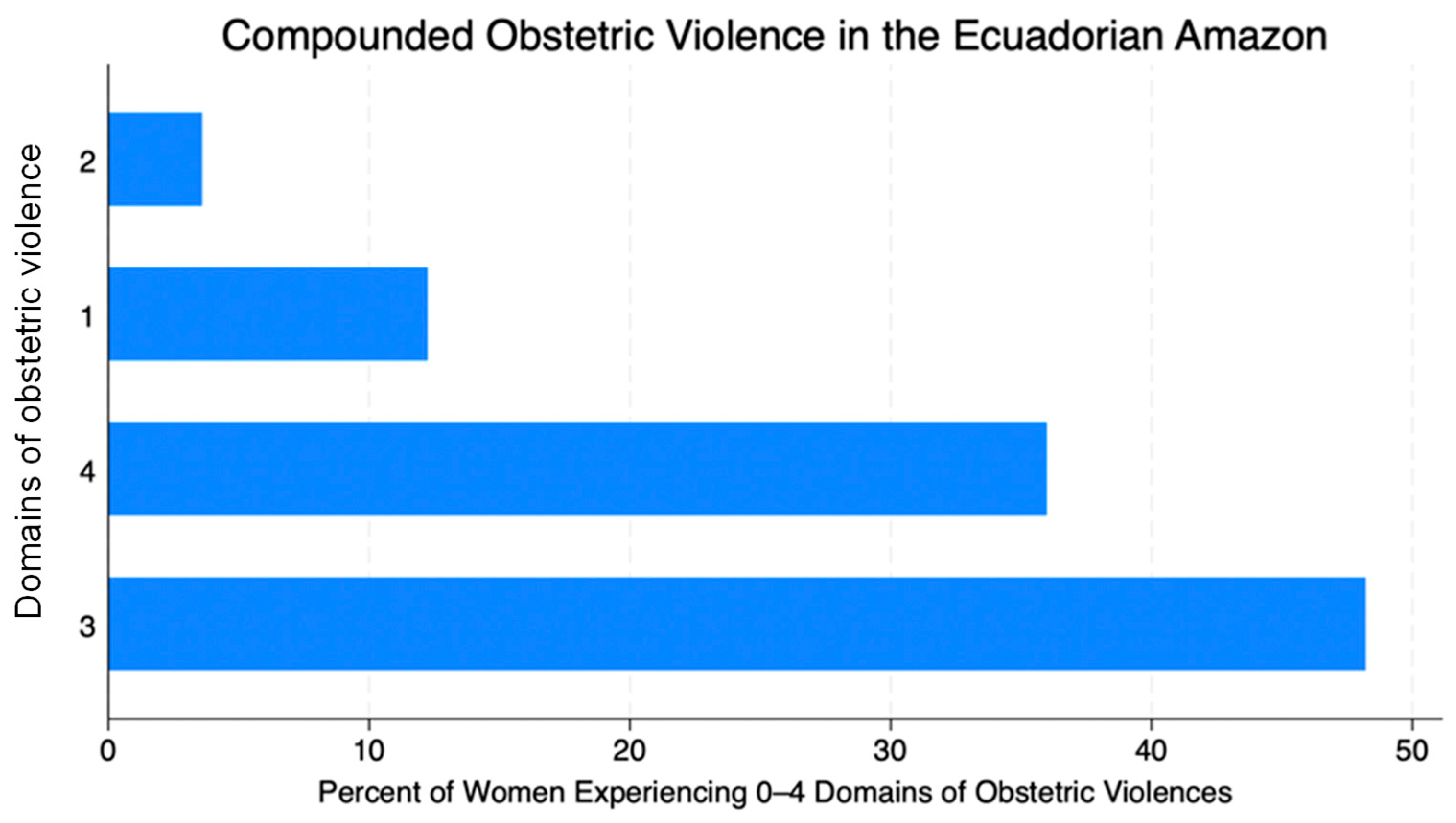
To capture overlapping experiences of harm, we constructed a cumulative index in
Figure 1, reflecting the number of domains of obstetric violence each woman experienced: non-consensual and/or unnecessary medical procedures, verbal or psychological abuse, systemic neglect and barriers, and suppression of traditional care practices. In
Figure 1, we demonstrate how many individuals experienced obstetric violence across one or more domains.
Nearly four out of five women experienced three or more domains of harm, and over one-third experienced all four domains simultaneously. Of those surveyed, every participant reported experiencing at least one domain of obstetric violence.
These patterns highlight obstetric violence in the Amazon not as a discrete event but as a compounded, cumulative phenomenon. Structural neglect, non-consensual interventions, cultural suppression, and psychological abuse converge within a single birth experience, amplifying risk and harm.
From a population perspective, compounded violence has implications for care-seeking behavior and long-term health trajectories in Indigenous communities. Many participants cited experiences or stories of violence in hospitals as reasons to never return to see a biomedical practitioner again. Others highlighted bad experiences in the hospital as reasons to see a midwife instead of a doctor, potentially strengthening support for the ancestral health movement. Violence experienced in hospital settings is changing how Kichwa women view the health care system as a whole, potentially discouraging them from seeking other forms of necessary health care.
3.8. Policy Implications
The findings of this study have direct relevance for Ecuador’s ongoing commitments to intercultural health policy and maternal health equity. Evidence of widespread, compounded obstetric violence, spanning non-consensual procedures, linguistic exclusion, structural neglect, and cultural suppression, highlights the urgent need for institutional accountability within the Ministry of Public Health. Community-generated data, such as those produced through EPREVO Amazonía, can serve as monitoring tools to evaluate compliance with national mandates of “Intercultural Health” and with global frameworks including the SDG (United Nations Sustainable Development Goal) 3 (maternal health) and SDG 10 (reducing inequalities).
On 25 April 2025, over one hundred Indigenous and Afro-Ecuadorian midwives from all regions of Ecuador came to Amupakin’s clinic and formed the “Consejo Plurinacional de Sabias/os, Parteras/os y Comadronas del Ecuador” (“The Plurinational Council of Healers, Midwives, and Traditional Birth Attendants of Ecuador”). One of their twelve stated goals is to “Ensure dignified, culturally appropriate childbirth by calling attention to and denouncing all forms of violence enacted upon women’s bodies during birth”, directly tying their work into the fight against obstetric violence. They plan to use the data presented in this article to work toward policy change.
We highlight this council as an example of the power of grassroots, autonomous Indigenous groups in fighting for health policy change and recommend that other Indigenous groups facing similar disparities similarly collect data and gather politically to work toward justice in their own communities.
In addition to the Indigenous council, Indigenous leaders in Napo who work in the Ministry of Public Health and within government structures are pushing forward a new program that would pay Indigenous midwives to work in hospital settings. This program is contested among some midwives, who have raised concerns for the potential to continue to prioritize biomedical knowledge above ancestral and midwifery care, but we remain optimistic for the future of this program and its potential to build new intercultural bridges.
Beyond Ecuador, these results contribute to global debates on reproductive justice and the structural determinants of maternal outcomes. As the maternal mortality crisis wages on in the United States, so too does the critique of over-medicalization [
46,
47,
48]. This study contributes to data that charts the harms of over-medicalization and puts the data in the hands of those with the power to change it, i.e., the Indigenous midwives and leaders themselves.
Obstetric violence, as documented here, is not merely an interpersonal phenomenon; it functions as a population-level determinant that shapes birthing decisions, fertility intentions, maternal morbidity, infant health, and mobility among Indigenous women living in rural areas. As health policies funnel births into regional biomedical centers, living far from health centers becomes increasingly disadvantageous, reinforcing spatial and social inequalities.
Strengthening Indigenous-led health initiatives, investing in culturally grounded maternity care, and addressing environmental and infrastructural inequities are questions of not only clinical urgency, but also of structural justice.
4. Limitations
While we highlight the role of Kichwa midwives and women working to collect this data as a strength, we also recognize its potential limitations. When surveying participants, we recognize that the positionality of the Kichwa midwives as researchers may have led participants to avoid speaking negatively about midwifery care. However, we note that the EPREVO Amazonia survey specifically only asks about hospital births, so this limitation should remain controlled. Additionally, the first author is from the United States and is non-Indigenous, which may have made participants feel less comfortable sharing vulnerable experiences. We attempted to control this by offering all surveys and interviews in Kichwa and in private locations, or in one-on-one conversations without the first author present.
We also acknowledge that participants were asked to recall birth experiences from up to five years prior, which may have led to misremembering of details.
Lastly, we recognize the limitation of a cross-sectional study, which captures this data at one moment in time. Due to limitations in grant funding, this was the most feasible study design. We look forward to applying for further grants to conduct follow-up studies and to continue contributing to decolonial demography.