1. Introduction
Tens of thousands of kindergartens in China closed recently because of a sharp decline in enrollment, in the order of 25% from 2020 to 2024 [
1]. Likewise, continued declines in fertility have prompted the closure of thousands of primary schools [
2]. Since 2022, China has experienced negative population growth, the first time since the famine years around 1960. Several years prior, in 2015, the Chinese government discontinued the one-child policy, as an attempt to address concerns over looming population decline, which would adversely affect economic growth, undermine the size of the labor force, and exacerbate the impact of aging. In 2016, China ushered in a two-child policy, and then in 2021, a three-child policy. These new policies are accompanied by provisions to improve healthcare and childcare and reduce the cost of education, aiming to encourage Chinese citizens to increase fertility and to embrace the new values that having more children is a contribution to society [
3]. Cities like Beijing have offered cash handouts, tax cuts, property concessions, and access to in vitro fertilization and other reproductive services to encourage married couples to have more children [
4]. Despite these policy changes and incentives, China’s fertility levels have continued to decline.
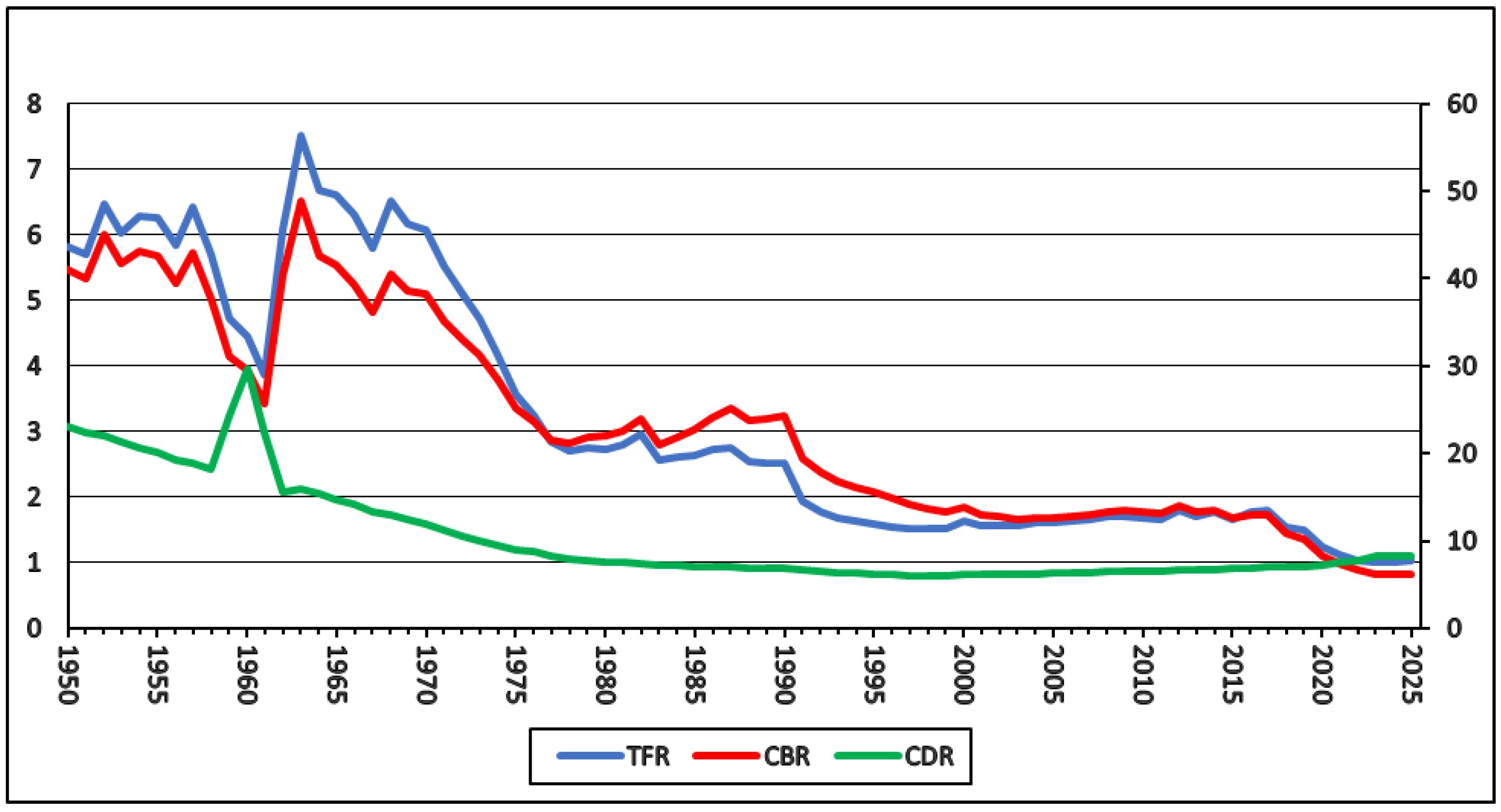
Figure 1 shows that, except for the famine years from about 1959 to 1961, the total fertility rate (TFR) was very high during the 1950s and early 1960s, consistently above 6.0 and even surpassing 7.5 in 1963. Fertility decline began in the mid-1960s and decreased rapidly in the 1970s: TFR fell from 6.61 in 1965 to 5.52 in 1971 and further to 2.74 in 1980. Throughout the 1980s, TFR stayed in the general range of 2.5 to 2.8, with a slight uptick in 1982 to just under 3.0. TFR declined further in the 1990s, to under 2.0 in the early 1990s and then hovered around 1.5 to 1.8 for much of the 1990s, 2000s, and 2010s. This was followed by another significant drop that began in the late 2010s. TFR dipped below 1.5 in 2019, declined to 1.03 in 2022, and remained or was projected to be around 1.0 in 2023–2025. At this level, China’s fertility is considered to be at the lowest-low level [
5], joining the countries and regions with the lowest fertility in the world. Researchers also question if China has already fallen into the “low-fertility trap” [
3,
6], where a continual decline in births has fostered self-reinforcing mechanisms that prevent future increases in fertility.
While there is much research on fertility changes in China, this paper seeks to highlight and synthesize more recent research in order to provide an updated interpretation of the main drivers of fertility decline. What accounted for the drastic changes in fertility over the past decades, and especially the continued fertility decline in recent years? Did birth-control policies and the lifting of these policies achieve their intended goals? What societal changes have contributed to fertility changes? Drawing from select and recent research, the rest of the paper focuses on fertility changes and policy interventions before the one-child policy; the long-term impact of the one-child policy; and social changes that affect, in particular, gender, women, and family in China. The conclusions section summarizes the finding that fertility declines are due to a perfect storm of socioeconomic and demographic processes, long-term effects of the one-child policy, and unprecedented social changes in Chinese society.
2. Fertility Changes and Policy Interventions Before the One-Child Policy
Although data on China’s fertility rates vary across sources [
8], there is considerable consensus among studies on the major trends and changes in fertility over time.
Figure 1 illustrates the TFR, crude birth rate (CBR), and crude death rate (CDR) from 1950 to 2025, based on the United Nations Department of Economic and Social Affairs’ Population Division [
7], which considers a variety of data sources and arrives at numbers that are consistent with many estimates. This paper’s focus is on fertility, and thus, the most useful indicator is the TFR, but the CBR and CDR are also helpful for understanding overall birth and death levels and trends in context, as well as the trajectory of China’s demographic transition.
The original demographic transition model—also referred to as the “first demographic transition”, given the concept of the “second demographic transition” developed since the late 1980s [
9] (see also
Section 4)—describes the historical shift from high birth and death rates to low birth and death rates. In Western Europe, where the transition took place from the mid-18th century to the 1970s, industrialization improved the standard of living, bringing down death rates, followed by a lagged fertility decline as society adjusted to new mortality norms. Transitions of vital rates in less developed economies since the mid-20th century have occurred at higher speeds, due in large part to medical technology that reduces mortality. In China, mortality declined quickly since the 1950s, followed by fertility decline in the 1970s, and by the late 2010s, both fertility and mortality levels were at low levels, so that demographic transition in the conventional sense was completed in less than seven decades.
As summarized earlier and in
Figure 1, China’s fertility levels have experienced many changes over the past seven-and-a-half decades. The 1950s and 1960s were marked by high fertility, except during the 1959–1961 famine due to crop failures and the disastrous Great Leap Forward policy. As an agrarian society—where children were a source of labor, marriage occurred at young ages and so did the onset of childbirth, birth control was mostly not practiced and not available, and mortality was quite high—having a large family was the norm. In addition, the end of the Civil War in 1949, which followed the end of World War II, marked a long-awaited return to peace and optimism, much like the rest of the world that experienced a baby boom in the post-World War II years. Furthermore, Mao maintained a pronatalist view, as summarized by comments like “We have this large population. It is a good thing” [
10]. Despite some attempts to launch birth-control campaigns as early as the 1950s, the Chinese government’s official line described contraceptives as “a means of killing the Chinese people without shedding blood” [
10]. Thus, fertility levels were largely unchecked, resulting in the 1950s and 1960s baby booms, which were only interrupted by the famine years.
The halving of CDR from above 20 per 1000 people in the early 1950s to about 10 per 1000 people in the early 1970s was due to the return of peace but also because of government efforts in making basic health care accessible, such as the nationwide health campaign of the 1950s that prioritized controlling infectious diseases and improving maternal and infant mortality, by, for example, sending “barefoot” doctors to the countryside [
11]. Improvements in access to education, such as the illiteracy elimination campaign of the 1950s, also helped reduce mortality [
5].
The 1950s and 1960s baby booms were followed by a fertility decline, beginning in the mid-1960s and accelerating in the 1970s. The family planning campaign that began in 1971 and expanded throughout the 1970s introduced three demographic mechanisms to lower fertility—“late, sparse, few” (
wan, xi, shao), that is, later marriage, longer spacing between births, and fewer total births. By 1978, the government had set specific targets of a minimum marriage age at 25 years for men and 23 years for women, a minimum birth interval of more than three years, and no more than two children in total [
5]. The 1980 Marriage Law set 22 years and 20 years as the minimum legal age of marriage for, respectively, men and women. While these ages were actually lower than the target ages of “late, sparse, few”, they represented an increase of two years compared with the 1950 Marriage Law. Altogether, these policies aimed at fostering changes in childbearing behavior—changes that might have taken place over a longer period of time as economic development and improvement in women’s status influenced fertility intention and desire—thus accelerating the onset and speed of fertility decline. Unlike the one-child policy (see the next section), which relied on a system of incentives and penalties, the “late, sparse, few” policy focused on education and services.
The 1970s rapid fertility decline has often been regarded as a “miracle” attributable to policy effectiveness, but Zheng [
5] argues that the decline was deeply linked to socioeconomic and demographic changes since the 1950s, which she refers to as two decades of “preparation”. In addition to the mortality decline since the 1950s described earlier, Zheng draws attention to the improvement of women’s educational attainment and their increased labor force participation, both of which enhance their economic independence and autonomy. Due to age-old gender ideology, such as the “inside–outside” norm whereby women are responsible for the domestic sphere and men are responsible for the outside sphere [
12], in traditional Chinese society, women were not encouraged to pursue an education. More than 20% of Chinese rural women and about 10% of rural men born in the early 1950s were illiterate [
13]. Universal primary education was introduced in the 1960s and 1970s, and women’s labor force participation has also increased since the 1950s [
5]. As observed across the world, improvement in women’s educational attainment is associated with a delay in marriage and fertility decline. Zheng [
5] also highlights a lack of public service for childcare and housework. In this light, she argues that the 1970s family planning campaign, which provided free contraceptive services, was “aligned with the desire of both urban and rural couples to limit family size at the individual level” and thus “the family planning program was quickly accepted by the public” ([
5], p. 362). What is also notable is that fertility had already started to decline in the mid-1960s, prior to the launch of the “late, sparse, few” policy. This seems to support Zheng’s thesis that socioeconomic and demographic changes prior to the 1970s had prepared China for the 1970s fertility decline.
The economic reforms that began in the late 1970s enabled rapid industrialization and economic growth, such that China subsequently became the world’s fastest-growing major economy. Such economic growth would have continued to foster the socioeconomic and demographic changes conducive to fertility decline. Still, concerned with the 1950s and 1960s baby boomers entering childbearing years, and with the potential adverse effect of a large population on economic growth, the Chinese government decided to enact the one-child policy in 1979.
3. Long-Term Impact of the One-Child Policy
The one-child policy has been criticized for not only its intrusion into reproductive rights but also its apparent ineffectiveness. For example, Wang et al. [
14] show that the policy did not achieve the reduction in births expected. As shown in
Figure 1, the launch of the one-child policy did not bring about an immediate or significant decline in fertility. Throughout the 1980s, TFR stayed in the general range of 2.5 to 2.8. In fact, CBR increased during the second half of the 1980s, reflecting the entry of the 1950s and 1960s baby boomers into childbearing years. The relative stability of TFR during the 1980s was despite the draconian nature of the one-child policy, which imposed penalties such as loss of government employment in urban areas and hefty fines in rural areas for policy violators. It was not until the 1990s that TFR started to dip below 2.0. In fact, Wang et al. [
14] argue that China’s fertility level would have continued its 1970s trajectory and declined to 1.5 by 2010 even if there were no one-child policy.
One explanation for the relative short-term stability of TFR despite the one-child policy is that there were many exemptions from the one-child rule and that the policy’s implementation was uneven and was more relaxed in rural areas [
15]. Notably, beginning in 1984, rural families were allowed to have a second child if their first child was a girl or if both the husband and wife were singletons themselves; the latter relaxation was extended to urban couples in 2002; and in 2013, all families were allowed to have a second child if either the husband or wife was a singleton [
3]. Another explanation is that persistent fertility preferences led to births that violated the one-child policy despite the penalties. In rural areas, in particular, it was not uncommon for parents to pursue a second child even though their first was a boy, even if they had to pay a big fine and did not receive additional farmland allocation commensurate with the increased family size [
15].
Although studies like Wang et al. [
14] have discussed the consequences of the one-child policy, more recent research using the latest information makes it possible to consider the policy’s long-term effects. At least two major research questions have been identified. The first includes whether being raised as a singleton affects one’s own fertility. Studies that highlight the intergenerational transmission of fertility preferences, intention, and behavior note a positive correlation between the number of one’s siblings and the number of children one has [
16,
17,
18]. In other words, children raised in small families tend to have small families themselves. This is sometimes considered a sociological process, whereby the family size and structure during early formative years will lead one to want to create the same kind of family when one becomes an adult, reflecting an internalization of parents’ expressed ideals as part of the norm of family life [
3,
18,
19]. Similarly, based on Becker’s [
20] theory on human capital and family formation, Wibe [
21] argues that singletons tend to want singletons of their own who will have undivided parental time, money, and energy. In a similar vein, Huang et al. [
22] show that exposure to birth-control policies during a young age has profound effects throughout one’s life, including higher education, higher income, increased female empowerment, delayed marriage, and lower fertility, and they conclude that the effects of fertility restrictions are larger if evaluated over the long term than the short term.
From a more practical perspective, to an only child who has singleton parents, they have the burden of caring for two parents and four grandparents, because there are no siblings, and the parents do not have siblings either. This is the well-known “four–two–one” structure, that is, four grandparents, two parents, and a single child [
6,
23]. Furthermore, China is rapidly aging, thus the top of the age–sex pyramid is expanding at the same time that the bottom is shrinking. To the “one” in the “four–two–one” structure, the burden of providing and caring for the elderly is already heavy, such that they may decide to lessen further burden by reducing the number of children or even remaining childless [
6].
On the other hand, some studies have highlighted the drawbacks of having no siblings, such as loneliness [
24] and the “little emperor” syndrome [
25], as reasons for singleton young adults to prefer two children to just having one child [
18]. Thus, it seems that the verdict is still out on whether the one-child generation prefers to have singleton children themselves or whether they prefer a second or even third child if allowed. The growing literature on the Chinese singletons, such as whether they prefer to marry other singletons [
26,
27], is expected to produce additional information about this unique generation’s marital and fertility behaviors.
Second, have China’s birth-control policies, especially the one-child policy, transformed parental behavior in childrearing? As the one-child policy was strictly enforced in urban areas since 1979—until 2002 when a second child was allowed if both the husband and wife were singletons themselves, and 2016 and 2021 when universal two-child and three-child policies were, respectively, implemented—for more than two decades, childrearing in many urban families was equivalent to raising one child. Parents’ aspirations, along with their anxiety, about the singleton are therefore extremely high. They are anxious about the future of their only child and are willing to provide the best resources to ensure that the child is competitive and can achieve upward social mobility [
3]. Thus, even though public schools are largely tuition-free, children in urban China customarily work with private tutors and attend a myriad of additional classes in out-of-school training institutions, some of which charge high fees by playing on parents’ anxiety and make big profits as a result [
28,
29]. Kim et al. [
30] note that the first cohort born under the one-child policy had to compete for college admissions before the Chinese government greatly expanded seats in universities. In other words, singletons and their parents have been under tremendous pressure to compete and succeed. As the number of parents of singletons increases and as parents concentrate investment in their child, this also spurs sharp increases in the costs of childrearing and education for all parents [
18,
30].
Feng et al. [
23] point out that, especially in urban areas, the family’s center of gravity is shifting to the only children, in contrast to traditional Chinese family life, where the elderly grandparents were the center of the family. Similarly, Yan [
31] postulates that as a result of the reduction in family size, intergenerational hierarchy in Chinese society has reversed from Confucian filial piety which “presupposes that elders have moral authority, social prestige, and political and economic power over younger generations” (p. 762) to “the senior generation’s devotion to and self-sacrifice for the junior generation” (p. 759) in an “inverted family” (p. 761). In other words, the decline in birth rate has transformed intergenerational interactions, shifting the family’s focus to the happiness and success of descendants, as vividly illustrated by the popular saying “emptying six wallets to buy an apartment for the young couple” ([
31], pp. 758–759). Mo and Liu [
32] note that parental support for housing is a significant factor in young people’s fertility intention. This downward flow of financial resources from parents and grandparents to the junior generation reflects parents’ prioritization of the happiness and success of their children as the ultimate purpose of their endeavors, without any consideration of reciprocal rewards. As parents devote more resources to their only child, they also drive up society-wide childrearing costs, which further discourages parents from having more than one child or having any children at all.
Kim et al. [
30] argue that as families pursue meritocratic individual education, where the cost of educating a single child is high, they are hesitant to have a second child even when the policy allows them to. Zhu et al. [
29] observe that the financial burden of education is negatively correlated with fertility willingness. Research has found that economic barriers are a primary reason why fertility preference or intention of having more than one child is not translated into fertility behavior [
33,
34]. Recent studies on fertility preference consistently find that Chinese parents or future parents prefer two children to just one child [
3]. Reasons given include singletons’ feeling of loneliness, sharing of responsibility of caring for elderly parents, and critique of singletons’ tendency to be more self-centered, less independent, and less well-adjusted than people who grew up with siblings [
18,
28]. Zhang and Zheng’s [
24] study on women of childbearing age in Lanzhou City reports an average ideal number of 1.87 children, and Chen [
16] finds that the average fertility desire of women of childbearing age in China is 1.8. Yet, the actual TFR is well below these desired averages.
Parents are worried about their lack of resources to afford the education, living, and housing costs of having a second or third child [
18,
28]. Clark et al. [
35] report a negative relationship between the cost of housing and fertility, especially in large cities, and He [
36] shows that a 1% increase in housing prices in urban areas results in a 17.8% decrease in the second-child fertility rate. Wang et al. [
17] and Lei et al. [
37] draw attention to the pressure to own a home and highlight living space as one of the strongest predictors of couples’ intention for additional children. High costs of living and mortgages in cities like Shanghai further depress the likelihood of couples pursuing a second or third child [
29]. Parents are also concerned with insufficient public childcare services [
5]. While grandparents taking care of young children is a common phenomenon in both rural and urban China, some parents are not satisfied with “generation-skipping” care, reflecting intergenerational differences in childrearing method and philosophy [
28]. Wang et al. [
17] point out insightfully that there could be a social division of fertility intention based on social stratification; that is, the well-off are more likely to choose to have multiple children because they can afford to do so, paying for education, housing, living expenses, childcare, and more. In short, despite parents’ general preference for having more than one child, the childrearing pressure from the financial, competitiveness, space, and caregiving points of view discourages them from pursuing a second, let alone a third, child [
38].
4. Gender, Family, and Social Changes
Since the 1960s, many Western countries have experienced social changes such as increasing ages at marriage and childbirth and a rise in cohabitation, divorce, and childlessness, all related to women’s improved educational attainment and economic independence, as well as increased questioning of traditional gender norms and division of labor. The “second demographic transition” (SDT), a viewpoint formulated by Lesthaeghe and van de Kaa in 1986, focuses precisely on the relationship between these social changes and below-replacement fertility [
9]. Lesthaeghe [
9] argues that between the “first demographic transition” (FDT) and the SDT, the needs of society have changed from material, survival, and economic ones to “higher order” needs such as individual autonomy and self-actualization. While each society has its unique combination of historical, cultural, and social idiosyncrasies, it does appear that various features of the SDT have spread to more regions of the world by the beginning of the 21st century, including Asian societies like Japan, South Korea, Taiwan, Singapore, and Hong Kong, all of which are currently experiencing below-replacement fertility. Research on the relevance of the SDT in mainland China, however, remains scant, which may be due to the dominance of the one-child policy as a demographic and social intervention. On the other hand, Chinese women have indeed experienced increased educational attainment and economic independence.
Over recent decades, in part due to a large-scale expansion of higher education, Chinese women’s educational attainment has increased sharply [
39]. In fact, women have surpassed men in college enrollment, reaching 50.48% in 2009, 51.35% in 2012, and above 52% since 2015 [
40,
41]. Although rural Chinese individuals still tend to devote more resources to the education of boys than girls, nationwide women’s average number of years of schooling is increasingly catching up with that of men, at, respectively, 9.59 years and 9.66 years in 2020 [
41]. Xu et al. [
13] note that beginning with the 1980s birth cohorts, urban women have overtaken urban men in educational attainment, both in terms of years of schooling and higher education rates, and that similar trajectories have occurred for rural women beginning with the 1990s birth cohorts.
As mentioned earlier, historically and across the world, improvement in women’s educational attainment has led to postponed marriage, delay in childbearing, and overall fertility decline. China is no exception. According to the 2020 census, the average age of marriage increased by 3.78 years between 2010 and 2020, reaching 29.38 and 27.95 for men and women, respectively, compared to an increase of only 1.3 years in the 30 years between 1980 and 2010 [
42]. This suggests that a fundamental change in the Chinese family is occurring; that is, the once early and universal-marriage society of China is transitioning to a society of later and fewer marriages. The marriage rate in China has been declining since 2014, and it is expected to continue to decline [
43].
Two features of the marriage market in China are also at play. First, historically, son preference has been prevalent in Chinese society, especially in the countryside—thus, the sex ratio at birth (SRB) is generally higher than the normal range of 103 to 107—due to the need for agrarian labor, the patrilocal family system, and the sociocultural norm that sons will take care of the elderly and continue the family line, all of which are part of the patriarchal culture [
44,
45]. But the SRB has reached extreme levels since the enactment of the one-child policy, increasing sharply from 107.63 in 1982 to 111.45 in 1990, 119.92 in 2000, and 121.21 in 2010 [
46], primarily a result of sex-selective abortion and underreporting of female births [
44]. Even though the SRB has declined to 111.3 in 2020 [
45], reflecting in part a response to the discontinuation of the one-child policy in 2015 [
47], it is still much higher than the normal range. Very high SRBs since the 1980s have resulted in a shortage of women for men of marriageable ages, that is, “marriage squeeze” or “marriage crowding-out” [
44,
45]. While this phenomenon is especially acute in rural China, where son preference remains strong, in both rural and urban areas, many more men than women past marriageable age remain unmarried [
45,
48].
Second, hypergamous marriage is still a persistent norm in China, where marital sorting tends to follow the “men marry down and women marry up” gradient, that is, between A men and B women, B men and C women, and so on [
48,
49]. In such hypergamous matching, A women and D men are squeezed into the categories of “leftover women” and “surplus men”, respectively, facing tremendous challenges finding mates [
49,
50]. Women’s improvement in educational attainment has further boosted the number of A women who cannot marry up. You et al. [
51] report a “marital college discount” of college education: a college degree reduces women’s probability of marriage by 2.9–3.6% and a postgraduate degree further reduces it by 8.4–10.4%. While the “leftover women” phenomenon is most noticeable in big cities, researchers note that it is also increasingly observed in smaller places such as county-level townships [
52]. With the marriage squeeze, persistence of the hypergamous practice, and women’s increased educational attainment, it is no surprise that marriages are later and fewer, childbearing is later, and fertility is declining.
Zheng [
5] reports that the average age at childbearing increased from 26.3 in 2000 to 28.9 in 2020, and the proportions of never-married women and of women who are childless have increased. For cohorts born before 1970, the never-married proportion is close to zero, but for the 1990 cohort, the lifetime never-married proportion is expected to range from 4.6% to 9.0% [
53]. The rate of childlessness for women aged 49 increased from 1.25% in 1990 to 5.16% in 2020 [
54]. In the meantime, the family structure has experienced substantial changes. Chen [
16] reports that in 2020, one-person households and two-person households accounted for, respectively, 1/4th and 30% of all households, and that the proportion of young people (ages 15–34) living alone reached 10%. Similarly, Li [
55] observed that, to Chinese youth, the traditional view of marriage as an essential life milestone has waned, hence the rise in late marriage, single living, and cohabitation [
55]. While globally there has been a decline in household size and an increase in persons living alone, the data in China are especially noteworthy given the strong and long tradition of large families in Chinese society.
Other researchers also note that the meaning of children has changed. Children used to be considered a source of labor and expected to boost production, but now they represent significant consumption and expenses. Some parents have decided to focus on the “quality” rather than the “quantity” of children. While this appears consistent with Becker and Lewis’s [
56] observation that when families perceive limited resources, they often prioritize the quality of upbringing over the number of children, it may also signal a fundamental change in the meaning of parenting. Kim et al. [
30] show that the first cohort born under the one-child policy—those born in the 1980s—wanted their own children to attain a more well-rounded education rather than a narrow focus on academic achievement. Chen et al. [
57] note that some parents consciously limit family size to one child, even if they are allowed and encouraged to have more children, referred to as “one-and-done” parenting, as a deliberate intention to channel resources, attention, and love toward a single offspring, bringing fulfillment to the parents while still allowing them to pursue other personal goals. Similarly, Su-Russell and Sanner [
58] observe that mothers may consider the first child expected or inevitable but are much more deliberate in the decision to have a second child. Chen et al. [
57] indicate that while financial instability is the biggest impediment to having a second child, the second biggest impediment is “individualistic value orientation”, meaning “a preference for being single, seeking personal gratification and enjoyment, longing for freedom, and prioritizing self-care”, which signals a lifestyle choice that rejects traditional responsibilities or societal expectations such as starting a family or raising a child. Indeed, the rise in individualism or individualization, characterized by a cultural or social orientation that places a high value on self-reliance, individual thoughts, personal opinion, and right to privacy [
59], has been observed by many researchers [
30,
60]. In this light, individualism is associated with not only reduced family size but also an inclination toward singlehood and voluntary childlessness.
Similarly, Song and Ji [
61] highlight an increased diversity of Chinese families, accompanied by loosening norms about sexuality and marriage, a rise in divorce rates and a decline in marriage rates, greater tolerance of premarital sex, and a decline in fertility. While Song and Ji [
61] do point to individualism as a factor of the above trends, they argue that in China, different aspects of individualism and familism coexist, and that the individualization process does not simply lead to the deinstitutionalization of marriage and family. For example, nonmarital childbirths are still extremely rare in China. Instead, they draw attention to the fact that “the family has traditionally been an important resource-pooling unit” ([
61], p. 4). As described earlier, parents and grandparents pooling resources together to support an only child’s financial needs, and grandparents providing “generation-skipping” care, are just some of the examples of how familism and intergenerational connections remain strong in China [
62,
63]. Ji [
64] refers to the interplay between tradition and modernity as “mosaic modernity”.
Another observation about the ineffectiveness of recent pronatalist policies is that they tend to ignore gender inequality and discrimination. First of all, these policies put the fertility pressure squarely on women, reinforcing discipline over reproductive timelines and governance and over autonomy of women’s bodies, and stigmatizing decisions about not having children as deviations from femininity that is tied to a motherhood identity [
65,
66]. Second, discrimination in the labor market continues to lead women to postpone childbirth, as having a child has a negative impact on their financial income, job opportunities, and career planning and advancement [
67]. Referred to as “unspoken rules”, labor market practices that penalize women for getting married and having children are often even more influential and effective than the written rules and the law [
67]. Conflict between career aspiration and family duties—given the gender ideology and norm that women are responsible for the domestic sphere—also explains why women have lower fertility intentions than men [
33,
68]. Finally, women are discriminated against in their access to assisted reproductive technology (ART). While China has historically maintained strict regulations for ART, unmarried men are allowed to freeze their sperm, but unmarried women are prohibited from accessing any ARTs, including egg freezing. The case of Zaozao Xu, a 30-year-old unmarried woman whose request for egg freezing in 2018 was refused, despite the fact that her health checks had cleared her for such treatment, has sparked debate over gender inequality in China [
69]. Xu sued the obstetrics hospital and lost, and her appeals were rejected [
4]. As Chinese women exercise their reproductive rights by accessing ART that will allow them to have children later in life, so that they can pursue their careers and other goals before then, they are told that such rights are tied to their getting married. On the other hand, such restrictions do not apply to unmarried men. This is a vivid reminder that the patriarchal culture remains strong in China, and it also speaks to the reluctance of state pronatalist policy to be aligned with updated realities, such as a decline in marriage rates.
Goldin [
70] argues that societies like South Korea, Japan, Greece, Italy, Portugal, and Spain were “catapulted into modernity” as they experienced rapid economic growth, while traditional beliefs and values have not changed as speedily, and that gender conflicts, such as increased differentials between men and women in fertility desires, result in rapid fertility decline. Indeed, gender is a significant factor in South Korea and Japan where fertility levels have declined to very low levels, including improvement in women’s education and employment, delay in marriage and childbirth due to career pressure, gender discrimination in the labor market, and persistent gender norms in the family that impose the double burden of work and domestic duties on women [
71]. In addition, an increasing number of young people decide not to marry and not to have children, referred to as the “Sampo generation” and “Nipo generation” in South Korea and the “Satori generation” in Japan [
71,
72], an indicator of general passivity and pessimism among the youth. It appears that a similar phenomenon is also emerging in China, as “lie flat” (
tang ping) has become a buzzword describing a youth subculture of doing nothing and pursuing nothing—no home purchase, no car purchase, no marriage, no children—partly a rebellious response to the unbearable rat race in Chinese society [
73]. As “lying flatism” gains prominence among Chinese people, especially the youth, President Xi Jinping highlighted it during his speeches as one of the behaviors to avoid [
74].
5. Conclusions
In less than six decades, China’s TFR has declined from about 7.0 to about 1.0. Today, China has joined countries with the lowest-low-fertility levels in the world and is experiencing population decline. Despite the lifting of the one-child policy in 2015 and the launch of the two-child policy and three-child policy in, respectively, 2016 and 2021, fertility has continued to decline. Based on a review of recent research, this paper has summarized that the continual drop in fertility reflects a perfect storm of three forces: socioeconomic and demographic processes; long-term effects of the one-child policy; and unprecedented social changes affecting, in particular, gender, women, and family.
China’s transition from high birth and death rates to low birth and death rates began with socioeconomic changes in the 1950s that first brought down mortality, but it was the rapid fertility decline—often referred to as a “miracle”—during the 1970s that accelerated the transition. Responding to mortality decline, improvement in women’s educational attainment, and an increase in their labor force participation, the Chinese were ready to reduce their family size. In that light, the “late, sparse, few” family planning campaign in the 1970s was simply aligned with what the people wanted, and the result was a sharp drop in fertility.
The one-child policy that was enacted in 1979 did not bring about immediate fertility decline, but its long-term effects are felt even today and probably will be felt for many decades to come. The one-child generation tends to have small families themselves, supporting research that highlights intergenerational transmission of fertility preferences, intention, and behavior, although some studies point to the drawbacks of growing up without siblings. The burden of caring for parents and grandparents in a “four–two–one” family structure may further discourage the one-child generation from having more or any children. And parental behavior in childrearing has changed, as parents’ aspirations and anxiety about their only child’s success and competitiveness in society are extremely high. The “inverted family” phenomenon, where the focus and resources of the parents and grandparents concentrate on one child, has fueled a steep rise in childrearing costs. As a result, although in general Chinese parents prefer to have more than one child, they may settle for one child or even remain childless due to the childrearing pressure from the financial, competitiveness, space, and caregiving points of view.
Finally, unprecedented social changes have taken place that continue to exert downward pressure on fertility. Rapid improvement in women’s educational attainment, combined with a persistent hypergamous norm and marriage squeeze due to a high sex ratio at birth, has led to later and fewer marriages. Rates of single living, never being married, divorce, cohabitation, and premarital sex are all on the rise, challenging the traditional family life and diversifying family structure. The meaning of children and parenting has changed as well, as the rise in individualism places a high value on personal aspirations, goals, enjoyment, and self-care. In that light, having one child can already bring about fulfillment, and voluntary childlessness is acceptable. Researchers have also pointed out that China’s pronatalist policies ignore gender inequality, such as the burden on women to increase the country’s fertility, discrimination in the labor market that leads women to postpone marriage and childbirth, women’s double burden of work and domestic duties, and single women’s inability to access assisted reproductive technology. Finally, the rise of passivity and pessimism among the youth, also observable in other low-fertility countries like South Korea and Japan, is not conducive to increasing fertility.
It appears that China’s transition from high birth and death rates to low birth and death rates is consistent with the FDT model, which prioritizes economic development as a driver that brings down mortality first, followed by fertility decline. Yet, the aggressive use of policy instruments such as the one-child policy sets China apart from most countries that have experienced similar demographic transitions. The FDT model is also not able to explain the continued fertility decline to the lowest-low level in recent years. Neither the long-term effects of the one-child policy nor the unprecedented social changes that affect Chinese women and Chinese families are predictable from the FDT. Research on the SDT, highlighting the connection between very low fertility and individualistic norms and attitudes, which bring about a diversity of union and family types, has primarily focused on Western societies [
75] but appears to also have relevance for East Asian societies like South Korea with lowest-low fertility. While this paper has highlighted social changes that value individualism and individual autonomy as factors of fertility decline, more research is needed to assess to what extent the SDT framework is useful in the Chinese context. For example, while China exhibits delayed marriage and a rise in premarital cohabitation and childlessness, unlike Western societies, there has not been a rise in nonmarital childbirths [
76]. From a policy point of view, it seems quite clear that population policies are only effective when they are aligned with what people want [
58], as was the case of the 1970s fertility decline when Chinese families were already ready for “
wan, xi, shao”. The question for policymakers today is, therefore, why would the Chinese want more children?