
Focal Circular Cubic and Complex Numbers


Faculty of Science, Humanities and Education, Technical University of Liberec, 461 17 Liberec, Czech Republic
Geometry 2026, 3(1), 5; https://doi.org/10.3390/geometry3010005
Submission received: 23 December 2025
/
Revised: 21 February 2026
/
Accepted: 3 March 2026
/
Published: 10 March 2026
Abstract
A focal circular cubic is a locus of the foci of conics tangent to a given quadrilateral. In this article, we derive some of the focal curve’s basic properties. We study the curve in the complex plane and prove that the complex coordinates of pairs of foci satisfy a quadratic equation. This equation can be expressed as a linear combination of two basic quadratic equations, which form a basis of a vector space. Furthermore, we give a nonstandard analytical condition, expressed in complex numbers, under which a circle can be inscribed in a quadrilateral. Finally, we leave the complex plane and show the construction of an arbitrary pair of foci of the curve by Euclidean means.
1. Introduction
In this article, we discuss the so-called focal circular cubic. Its other names are focal of Van Rees, isoptic cubic, and Apollonius cubic. For our purposes, we will use the shorter and slightly inaccurate term “focal curve”. However, this term refers to several distinct objects in geometry. Let be a quadrilateral. Consider all conics inscribed in the given quadrilateral. Then the locus of foci and of these conics forms generally a curve of a third degree, the focal curve (FC). The curve was first studied by Van Rees in 1829 [1] and then by Steiner and Laguerre. In the second half of the 19th century, the curve was investigated by H. Schrötter (1872) [2], H. Durége (1872) [3], and again H. Schrötter (1873) [4]. However, these articles approach the study of the curve from the perspective of projective geometry. In this article, we will examine the curve mainly from the perspective of complex numbers. This approach is not new (see e.g., [5]). A collection of generally known properties of the curve is given on the website https://mathcurve.com/courbes2d.gb/focaledevanrees/focaledevanrees.shtml (accessed on 1 January 2017). In the Section 2, we derive some basic properties of the focal curve. Some of them are known to varying degrees (e.g., Newton–Gauss line or Theorem 2 and Corollary 2). The main objective of this section is the justification of these properties, which we consider elementary. In Section 3 we determine the condition under which FC has a singular point using the language of complex numbers. Finally, in Section 4, we show how any point of the curve is constructed using Euclidean means. The main advantage of this approach is that it constructs the foci in pairs, i.e., two points constructed in this way belong to the same inscribed conic.
2. Focal Curve, Complex Numbers and Basic Properties
In this section we show how some basic properties of the focal curve can be proved. Some of the theorems presented here have already been mentioned or at least hinted at in earlier publications. For example, Theorem 2 has been mentioned in [5,6,7]. However, the justification of the theorem in [5] is not complete, and the proof in [6] is not coherent in the sense that it alternates synthetic and analytic means. The justification in the paper [7] is not effortless in our opinion. The main advantage of the approach presented in this section is that it is both elementary and straightforward. On the other hand, the approach to the examination of the curve in Theorem 3 might be new.
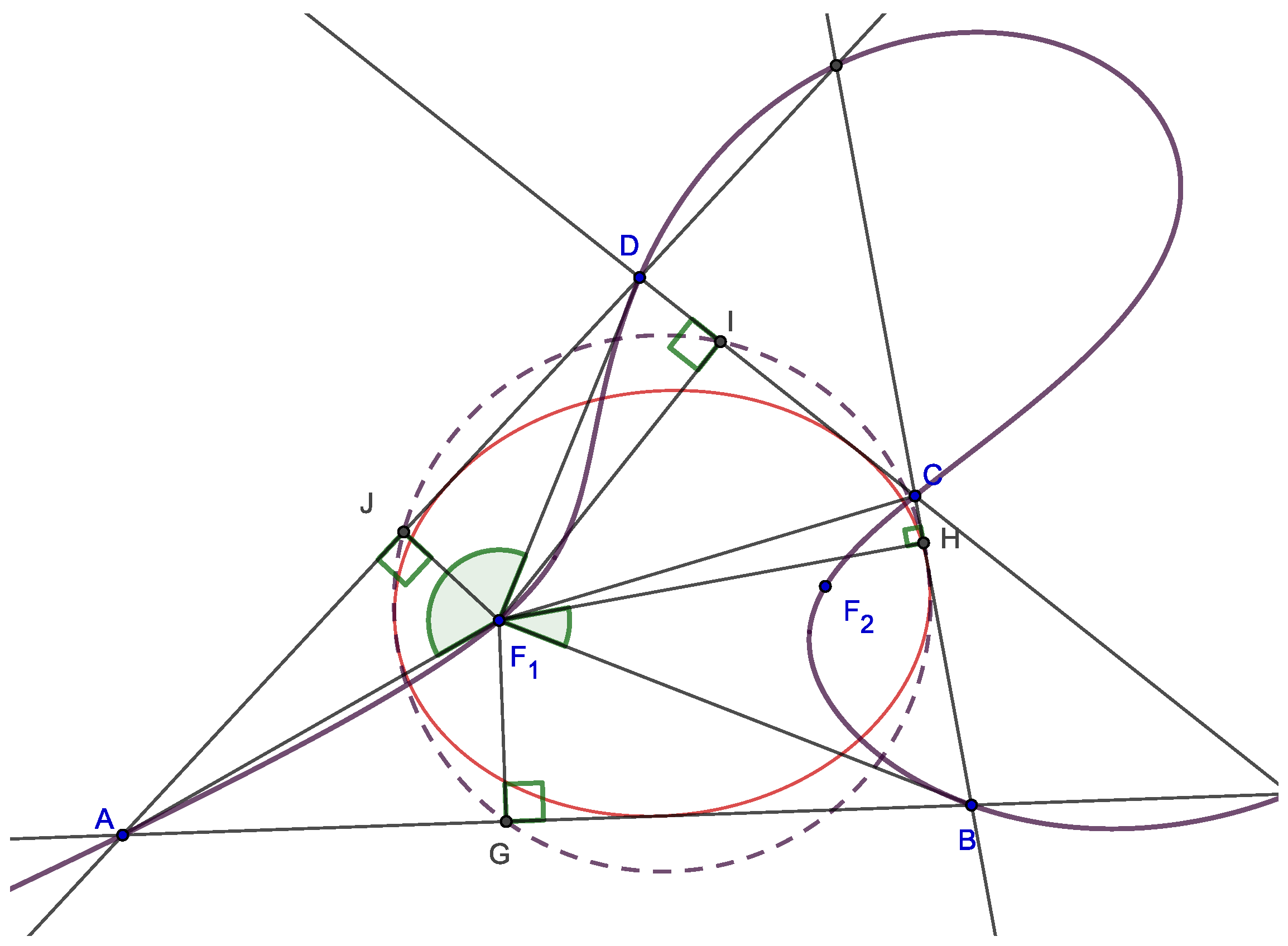
Let us consider the quadrilateral and two foci and of a conic that is tangent to the quadrilateral (Figure 1).
Then it holds the following well-known (see [8], page 492, or [6], where there is an elementary derivation).
Fact 1.
The opposite sides of a quadrilateral subtend at the foci point equal oriented angles. In other words,
Outline of the proof: A point is the focus of a tangent conic iff the feet of the perpendiculars from this point to the sides lie on a circle. Let us denote these feet as in Figure 1; then, . Next steps are an ”angle-chasing” procedure.
Let us now express the coordinates of the points in the form of complex numbers:
Equation (1) can be expressed by the equation
Equation (2) of the focal curve is well known (see [5]). For our purposes, we rewrite it in an equivalent form
where a parameter t is an arbitrary real number.
Theorem 1.
For fixed, Equation (3) is quadratic. The two roots of the equation are the coordinates of the foci that belong to the same conic tangent to the given quadrilateral.
Proof.
We want to prove the equality
where and belong to the same conic.
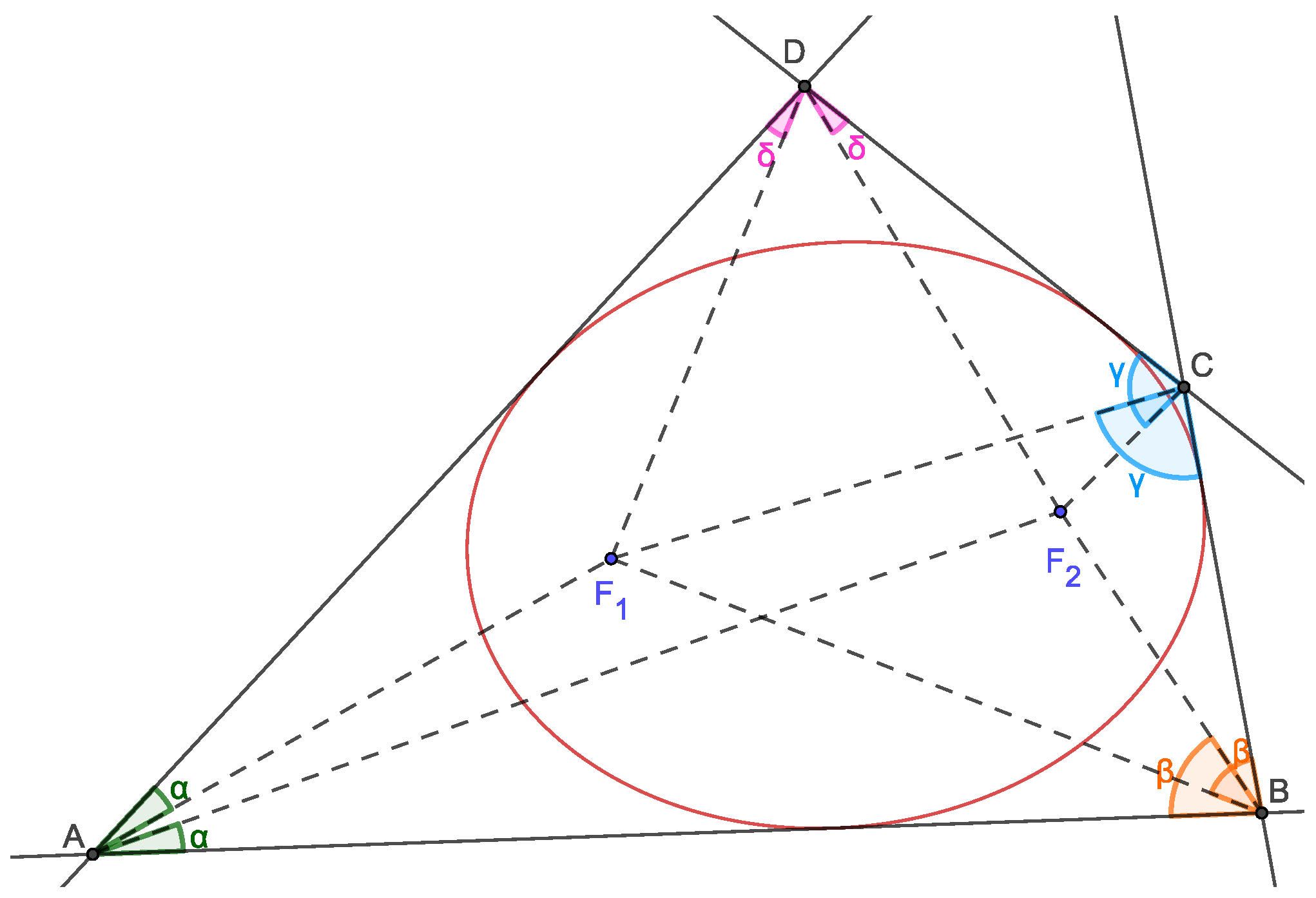
From Equation (3), it is clear that both sides of Equation (4) are real. First we prove that the modulus of both sides is the same, then we prove the same about their argument. By Poncelet’s theorem, the bisectors of the angles and are identical; in other words, . The same holds for the remaining vertices of the quadrilateral (see Figure 2).
Therefore, according to the Sine Theorem,
Similarly, we arrive at equality
It remains to prove that the arguments are also equal. The following reasoning leads to this conclusion: it is clear from Equation (1) that if both angles are positive or both negative, their sum must be , since the oriented angles are less than in absolute value. And thus the right-hand side of Equation (4) takes on a negative value. If one angle is positive and the other negative, the sum is and the right-hand side takes on a positive value. For the equation
the same consideration applies, and, moreover, it can be shown (based on the fact that the line segment either intersects every tangent line, in the case of a hyperbola, or intersects no tangent line, in the case of an ellipse) that both angles and either have the same sign as the corresponding angles and or both have the opposite sign. However, this means that if the sum of Equation (1) took the value , Equation (5) must also take the same value. In the case of values , we apply the same reasoning. □
Corollary 1.
The roots of any equation that results from a linear combination of the quadratic equations
and
over the real numbers , :
are the foci belonging to the same tangent conic of the given quadrilateral .
Theorem 2.
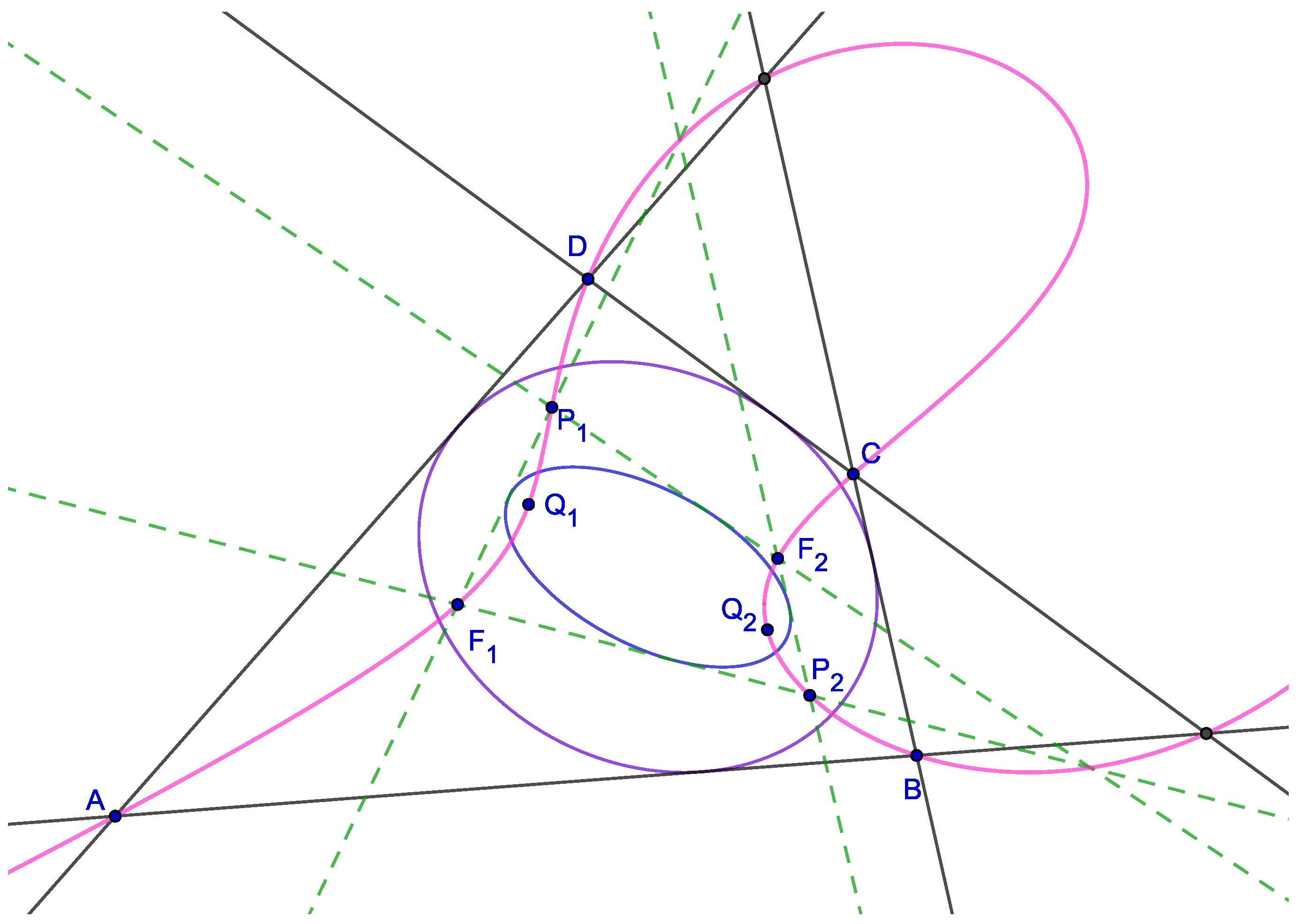
Let , and be three arbitrary pairs of foci of conics tangent to the given quadrilateral . Then the focal curve of the quadrilateral is identical to the focal curve of the quadrilateral , and, in addition, the corresponding pairs of foci are preserved (Figure 3), i.e., if are foci of a conic tangent to , then these foci belong to another conic tangent to
Proof.
The equations and are a basis of a vector space over the real numbers. Let the foci and be the roots of the equations
respectively.
If these equations are linearly independent (which is satisfied if ) then these equations just represent a different basis of the same vector space. □
Note: A geometric analogy can help in the reasoning—two vectors with a common origin define a plane. If we replace them with two other vectors that are linear combinations of the original ones, then these vectors determine the same plane. Different pairs of foci then belong to different vector directions.
Corollary 2.
Let us choose any point P of the focal curve. Then, the bisector of angle is the same for all pairs of foci .
Proof.
As a consequence of Poncelet’s theorem, the bisector of the angle is identical to the “fixed” bisector of the angle . Therefore, the statement holds for point A and, as a consequence of Theorem 2, the statement holds for any point P of the FC. □
Each pair of foci of the tangent conic to the quadrilateral belongs to a different linear combination of (6). We call the pair of real numbers the coordinates of the foci with respect to the reference quadrilateral , if these foci are the roots of Equation (6). The question arises: what is the relationship between the coordinates of these foci with respect to the quadrilateral and with respect to an arbitrary quadrilateral ?
Theorem 3.
Let the coordinates of foci , and with respect to reference quadrilateral be , , respectively, and the coordinates of foci within quadrilateral be . Then the following relation holds:
Note: The coordinates for contain all possible ratios except . For this ratio, we can define a coordinate , . It is the coordinate of the so-called Miquel point [9]; since then, Equation (6) has only one solution, and the tangent conic with a single focus is a parabola.
Proof.
First, note that Equation (6) is not bijective, since its roots depend on the ratio and not on a particular value of these numbers. There are several ways to solve this, for example, by setting . Here we impose the condition that the quadratic equation be monic . In this case a linear equation comes out; see the note above. Thus and . Let us denote
Similarly, let us define , and . Then,
Hence
It implies
□
Note 1: It is easy to verify that the coordinates of the Miquel point are invariant when going from reference quadrilateral to quadrilateral .
Note 2: Since the foci are the roots of the equation
then their sum is equal to
and therefore the centers of the conics lie on a fixed line
where is a parameter. This is the well-known Newton–Gauss line [10]. Note that we can also justify this property of conics by Corollary 2, just making the limit transition of P to infinity,
3. A Singular Point of the Curve and Condition That Determines a Tangential Quadrilateral
The following theorem determines when a focal curve has a singular point.
Theorem 4.
Proof.
(⇐) A tangent circle can be thought of as a conic whose two different foci coincide. It means that at this point the focal curve intersects itself and hence has a singular point. (⇒) Suppose the curve has a singular point S, which is not the center of an inscribed or escribed circle. As we will show, this assumption leads to a contradiction.
According to Equation (3), the focal curve is continuous in the parameter t; close values of the parameter t correspond to close coordinates of foci. The only discontinuity points are at and . The Figure 4 shows a situation in which we depart the singular point S with parameter value on one branch of the curve and return to it with parameter value on another branch. If , it is the case of an inscribed circle, since two foci of a conic with parameter t arbitrarily close to value are arbitrarily close to point S, and hence the two foci coincide at the point S for the value . However, if , then the point S is the root of Equation (3) for two different values of the parameter t. This leads to the equation
and therefore or , which, however, is not possible due to the symmetry of vertices and the possibility of an arbitrary choice of reference quadrilateral. □
Corollary 3.
The curve has a singular point if and only if there is at least one real root t of the quadratic equation
In other words, at least one of the expressions
is real.
Proof.
Note 1: It is possible to show that the expression under the square root is equal [11]
It is unclear whether such rearrangement leads to a deeper understanding of the condition (Equation (8)).
Note 2: The condition that a quadrilateral is tangential can be expressed in terms of the lengths of its sides. However, such an expression would contain complex-conjugate points in addition to square roots. The advantage of the above expression is that it does not include these complex-conjugate points.
4. Euclidean Construction of Points of the Focal Curve
In the Section 2, we used a relatively simple approach to derive several facts, most of which are known. See website https://mathcurve.com/courbes2d.gb/focaledevanrees/focaledevanrees.shtml, accessed on 1 January 2017). Specifically, we proved the following:
- (A)
- The centers of the foci lie on the Newton–Gauss line (7).
- (B)
- Miquel point M, the focus of the tangent parabola, is identical for all quadrilaterals , and, moreover, the product of the distances of any pair of foci from Miquel point is equal to a certain constant (It suffices to substitute in Equation (3), hence X is Miquel point and points are replaceable by any pair of foci due to Theorem 2).
- (C)
- The angle bisector is common to all pairs of foci (Corollary 2). Let us denote this bisector as f.
Based on these three statements, we will show how all points of the focal curve can be in principle constructed using classical Euclidean methods. Let us solve the problem below.
Problem 1.
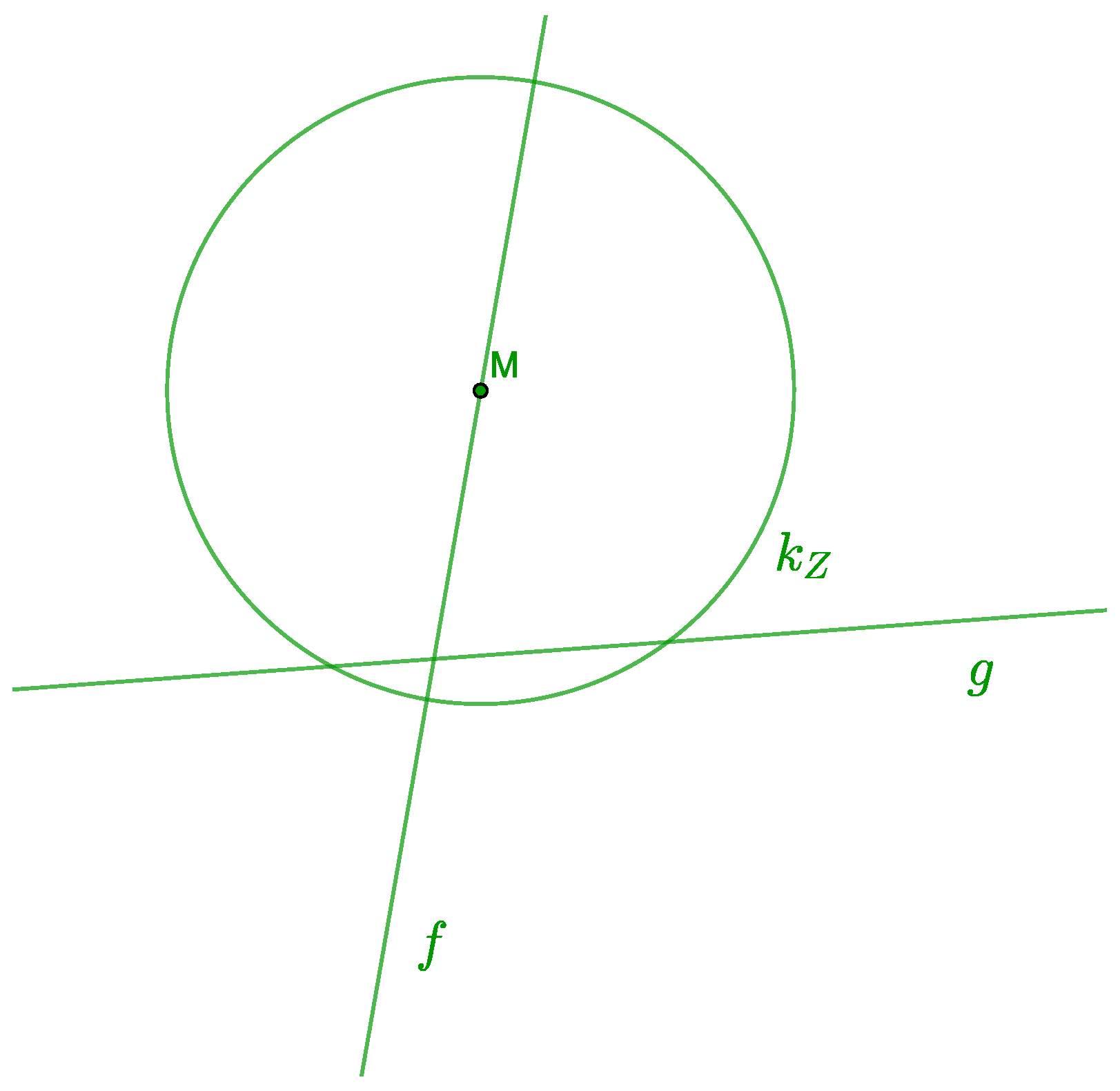
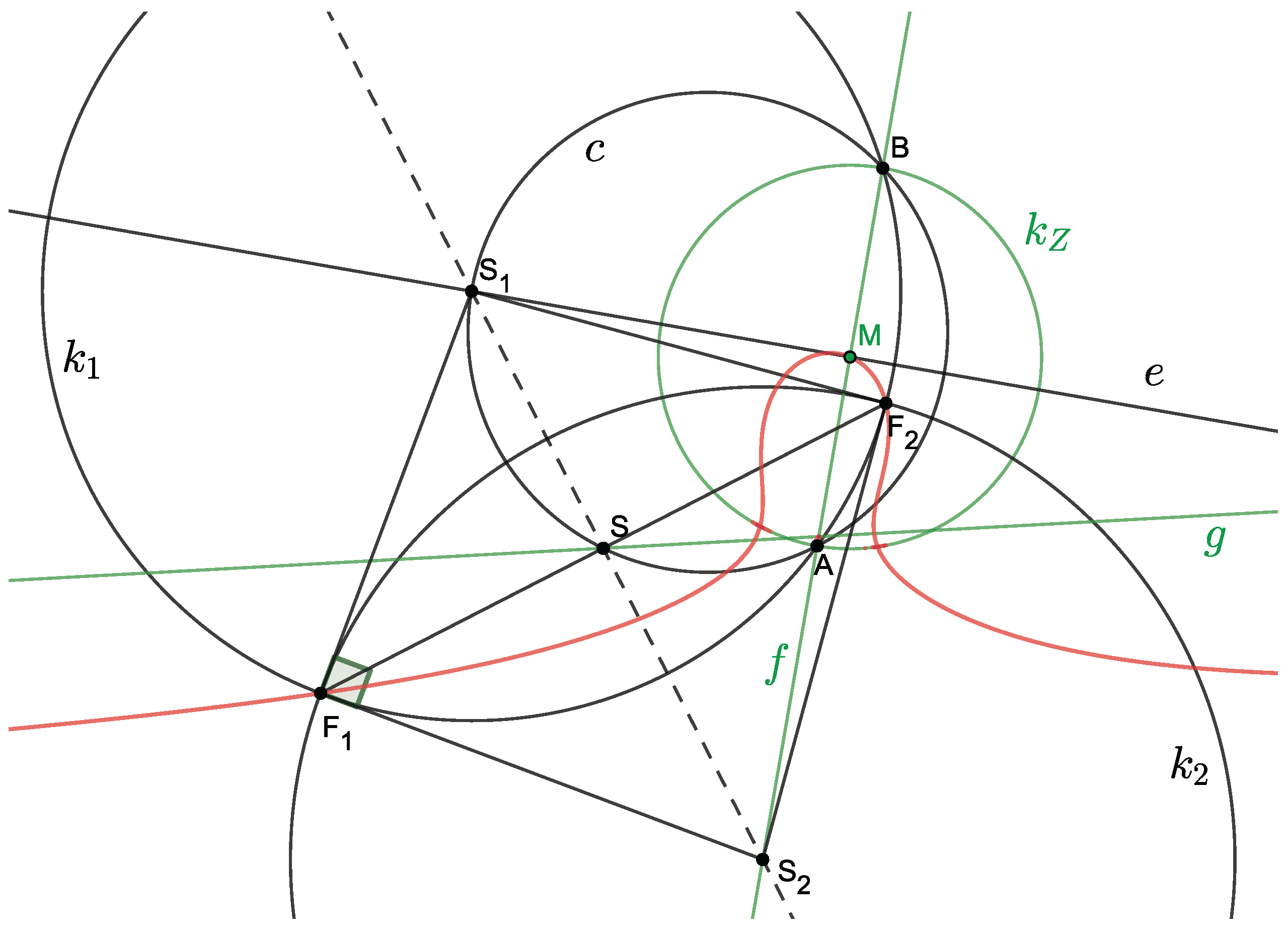
Let Miquel point M, angle bisector f, , circle with radius Z centered at point M, and Newton–Gauss line g be given. Using a ruler and compass, construct any pair of foci belonging to the focal curve specified by these parameters (Figure 5).
Solution: Let the intersections of bisector f with circle be denoted with A and B (Figure 6). Construct a perpendicular e to the line f passing through point M. Construct any circle c passing through points A and B. Let this circle intersect line e at point and line g at point S. Let line intersect axis f at point . Construct a circle with center at point and passing through points A and B. Finally, construct tangents from point to circle and denote the points of contact and . Then these points are a pair of foci of a conic belonging to the focal curve given by the assumptions.
Justification: Properties (B) and (C) actually say that having the point , one obtains the corresponding point by a simple geometric procedure: first constructing the inverse image U of point with respect to circle and then making an axisymmetric image of this point with respect to line f, thus obtaining point .
First, consider the circle with the center circumscribed around the points –it turns out that the above procedure leaves this circle unchanged (the proof is left to the reader). So point also lies on this circle.
However, a circle , which passes through point , whose center lies on the line and which is orthogonal to the circle (otherwise expressed as where R is the radius of the circle ), has the same property. The reasoning is the same: the procedure that transforms point into point leaves this circle unchanged.
The intersection of circles and are therefore points and . It remains to be ensured that the midpoint S of segment lies on given line g.
Since circle passes through points , this means that circle is orthogonal to this circle too, i.e., triangle is right-angled and point S is the foot of the altitude from vertex to hypotenuse . However, this in turn means that
Therefore, a circle c can be circumscribed about the quadrilateral , and point lies at the intersection of lines and .
With the construction described, one can determine foci as the intersections of circles and by constructing any circle c, obtaining points S, and
Note: circle c may have two intersections S with line g. To display the entire focal curve, it is necessary to consider both.
5. Conclusions
In this article, we derived some properties of a focal curve in an elementary way. We also stated the condition under which a quadrilateral has an inscribed circle that does not depend on the lengths of the sides (at least not directly) and does not use complex conjugate points. Finally, we showed a new way of constructing a curve, which has the advantage of obtaining foci in pairs belonging to the same inscribed conic.
There are questions closely related to the approach chosen in this article. For example, from Equation (3) it is not so difficult to calculate the distance between the foci corresponding to a given parameter t (and belonging to a unique conic). It seems much more difficult to calculate other parameters of the conic, e.g., in the case of an ellipse, the lengths of the major and minor axes. If someone were to succeed in this, he or she could ask further questions: for example, how do these parameters change if we move from the reference quadrilateral to another quadrilateral ? This question points in the same direction as Theorem 3, but answering it requires more insight and perhaps much more demanding calculations.
Funding
This research received no external funding.
Data Availability Statement
The original contributions presented in this study are included in the article. Further inquiries can be directed to the corresponding author.
Conflicts of Interest
The author declare no conflicts of interest.
References
- Van Rees, J. Mémoire sur les focalies. Corresp. Mathématique Phys. 1829, V, 361–378. [Google Scholar]
- Schröter, H. Über eine besondere Curve 3-ter Ordnung und eine einfache Erzeugungsart der allgemeinen Curve 3-ter Ordnung. Math. Ann. 1872, 5, 50–82. [Google Scholar] [CrossRef]
- Durège, H. Über die Curve 3-ter Ordnung, welche den geometrischen Ort der Brennpunkte einer Kegelschnittschar bildet. Math. Ann. 1872, 5, 83–94. [Google Scholar] [CrossRef]
- Schröter, H. Über Curven dritter Ordnung. Math. Ann. 1873, 6, 85–111. [Google Scholar] [CrossRef]
- Boyce, M.G. Focal cubics associated with four points in a plane. Amer. Math. 1942, 49, 226–234. [Google Scholar] [CrossRef]
- Blažek, J.; Pech, P. Focal curve and its properties. In Proceedings of the Slovak-Czech Conference on Geometry and Graphics, Trencianske Teplice, Slovakia, 9–12 September 2019; Vydavatelský servis, Republikánská 28, Plzeň. pp. 57–62, ISBN 978-80-86843-65-0. [Google Scholar]
- Hu, D. Constructions in the Locus of Isogonal Conjugates for a Quadrilateral. J. Geom. Graph. 2020, 24, 9–28. [Google Scholar]
- Casey, J. On Bicircular Quartics. Trans. R. Ir. Acad. 1869, 24, 457–569. [Google Scholar]
- Johnson, R.A. Advanced Euclidean Geometry: An Elementary Treatise on the Geometry of the Triangle and the Circle; Dover Publications: New York, NY, USA, 2007. [Google Scholar]
- Daniels, A.E. The locus of the centres of conics inscribed in a given quadrilateral is the straight line joining the mid-points of the diagonals. Math. Gaz. 1898, 1, 161. [Google Scholar] [CrossRef][Green Version]
- Pech, P. (Faculty of Education, University of South Bohemia, České Budějovice, Czech Republic). Personal communication, 2025.
Figure 1.
For arbitrary focus , the sum of oriented angles (1) equals or .
Figure 1.
For arbitrary focus , the sum of oriented angles (1) equals or .

Figure 2.
The angle bisector of is identical to the angle bisector of . The same is valid for other vertices.
Figure 2.
The angle bisector of is identical to the angle bisector of . The same is valid for other vertices.

Figure 3.
The quadrilateral determines the same focal curve as quadrilateral . The pairs of foci are preserved.
Figure 3.
The quadrilateral determines the same focal curve as quadrilateral . The pairs of foci are preserved.

Figure 4.
Singular point S corresponds to a single value of t and hence to the center of circle.
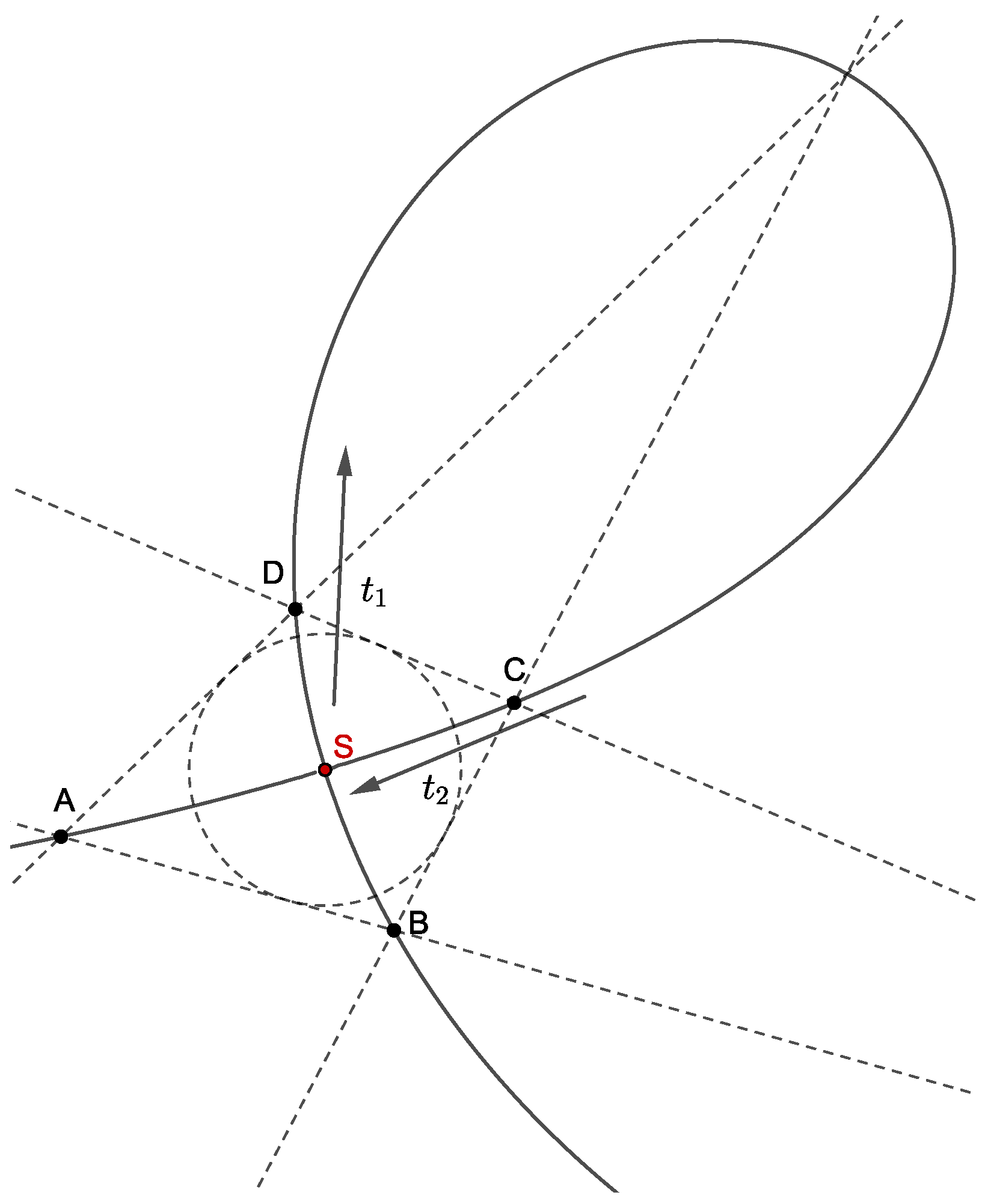
Figure 5.
Problem 1: the assignment.

Figure 6.
Solution of Problem 1.

Disclaimer/Publisher’s Note: The statements, opinions and data contained in all publications are solely those of the individual author(s) and contributor(s) and not of MDPI and/or the editor(s). MDPI and/or the editor(s) disclaim responsibility for any injury to people or property resulting from any ideas, methods, instructions or products referred to in the content. |
© 2026 by the author. Licensee MDPI, Basel, Switzerland. This article is an open access article distributed under the terms and conditions of the Creative Commons Attribution (CC BY) license.
Share and Cite
MDPI and ACS Style
Blažek, J. Focal Circular Cubic and Complex Numbers. Geometry 2026, 3, 5. https://doi.org/10.3390/geometry3010005
AMA Style
Blažek J. Focal Circular Cubic and Complex Numbers. Geometry. 2026; 3(1):5. https://doi.org/10.3390/geometry3010005
Chicago/Turabian StyleBlažek, Jiří. 2026. "Focal Circular Cubic and Complex Numbers" Geometry 3, no. 1: 5. https://doi.org/10.3390/geometry3010005
APA StyleBlažek, J. (2026). Focal Circular Cubic and Complex Numbers. Geometry, 3(1), 5. https://doi.org/10.3390/geometry3010005