
Young Norwegian Football Players’ Cross-Sectional Experiences of Coach Recognition: A Quantitative Survey Study Related to the Pedagogical Approach of Being Seen


Abstract
1. Introduction
Research Questions
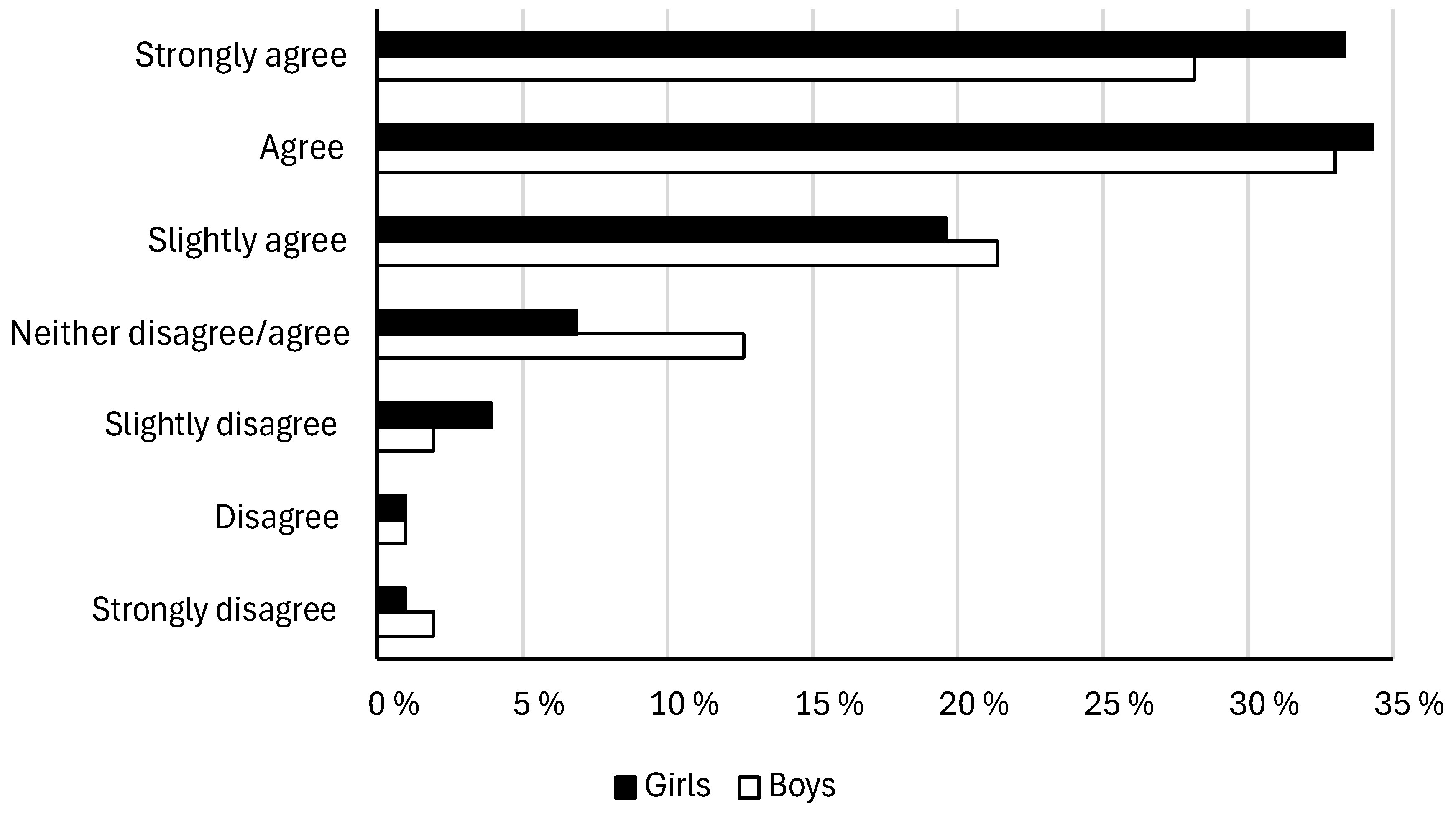
- How do football players perceive the experience of being seen by their head coach during training and matches?
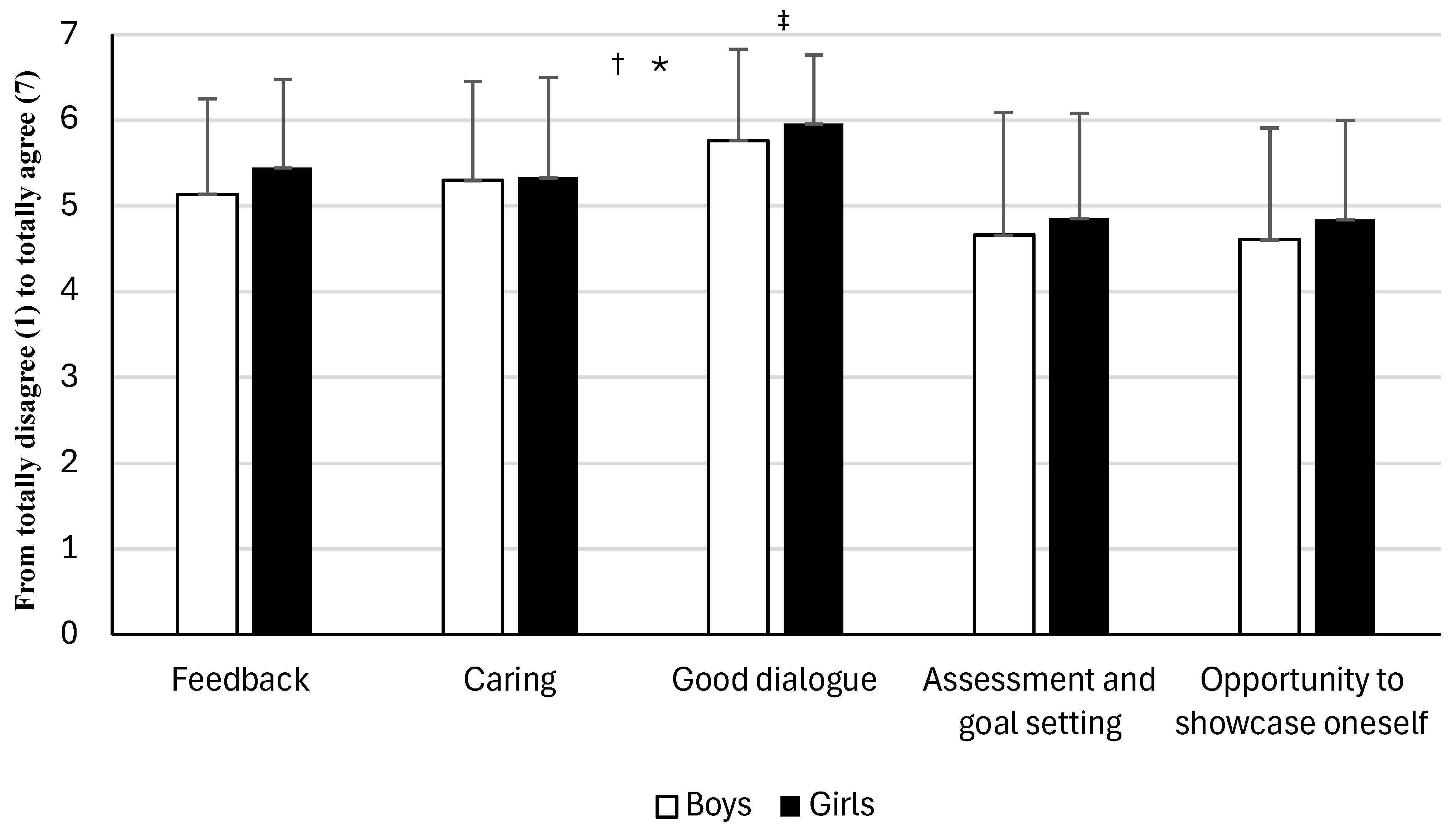
- Are there gender differences in this overall experience and the five underlying factors of being seen?
- How do football players’ experiences vary across the five factors underlying the pedagogical approach of being seen (feedback, care, good dialogue, assessment and goal setting, and opportunity to showcase oneself)?
2. Method
2.1. Participants
2.2. Questionnaire
2.3. Analysis
3. Results
3.1. The Players Experience of Being Seen by Their Head Coach During Training and Matches
3.2. Players’ Experience of the Five Underlying Factors of Being Seen
4. Discussion
Strengths and Limitations of the Study
5. Conclusions
Author Contributions
Funding
Institutional Review Board Statement
Informed Consent Statement
Data Availability Statement
Conflicts of Interest
References
- Abadi, E., & Lidor, R. (2025). Girls’ preferences for coaches’ pedagogical behaviors in sport training. Advances in Physical Education, 15(3), 315–340. [Google Scholar] [CrossRef]
- Adie, J. W., Duda, J. L., & Ntoumanis, N. (2012). Perceived coach autonomy support, basic need satisfaction and well- and ill-being of elite youth soccer players: A longitudinal investigation. Psychology of Sport and Exercise, 13(1), 51–59. [Google Scholar] [CrossRef] [Scilit]
- Andresen, F., Torvik, E., & Lagestad, P. (2023). Students’ experience of being seen by their physical education teachers and associated factors. Frontiers in Sports and Active Living, 5, 1101072. [Google Scholar] [CrossRef] [Scilit]
- Balaguer, I., Castillo, I., Cuevas, R., & Atienza, F. L. (2018). The importance of coaches’ autonomy support in the leisure experience and well-being of young footballers. Frontiers in Psychology, 9, 840. [Google Scholar] [CrossRef] [Scilit] [PubMed]
- Battaglia, A., & Kerr, G. (2024). Youth athletes’ perspectives on developmental influences of relationships in individual and team sports. Cogent Social Sciences, 10(1), 2392023. [Google Scholar] [CrossRef] [Scilit]
- Bell, D. R., Post, E. G., Trigsted, S. M., Hetzel, S., McGuine, T. A., & Brooks, M. A. (2016). Prevalence of sport specialization in high school athletics: A 1-year observational study. American Journal of Sports Medicine, 44(6), 1469–1474. [Google Scholar] [CrossRef] [Scilit] [PubMed]
- Bengtsson, D., Svensson, J., Wiman, V., Stenling, A., Lundkvist, E., & Ivarsson, A. (2025). Health-related outcomes of youth sport participation: A systematic review and meta-analysis. International Journal of Behavioral Nutrition and Physical Activity, 22(1), 89. [Google Scholar] [CrossRef] [Scilit]
- Bergeron, M. F., Mountjoy, M., Armstrong, N., Chia, M., Côté, J., Emery, C. A., Faigenbaum, A., Hall, G., Jr., Kriemler, S., Léglise, M., Malina, R. M., Pensgaard, A. M., Sanchez, A., Soligard, T., Sundgot-Borgen, J., van Mechelen, W., Weissensteiner, J. R., & Engebretsen, L. (2015). International olympic committee consensus statement on youth athletic development. British Journal of Sports Medicine, 49(13), 843–851. [Google Scholar] [CrossRef] [Scilit]
- Berntsen, H., & Kristiansen, E. (2019, February 25). Feilaktig syn på hva som er god “coaching” gir utbrenthet, frafall og mistrivsel [A misguided view of what constitutes good coaching leads to burnout, dropout, and discontent]. Norges idrettshøgskole. Available online: https://www.nih.no/om/aktuelt/bloggen/2019/feilaktig-syn-pa-hva-som-er-god-coaching.html (accessed on 5 October 2025).
- Berntzen, I., & Lagestad, P. (2025). Effects of coaches’ feedback on psychological outcomes in youth football: An intervention study. Frontiers in Sports and Active Living, 7, 1527543. [Google Scholar] [CrossRef] [Scilit]
- Bjørklimark, I., & Lagestad, P. (2025). Importance of being seen as a pedagogical approach among physical education teachers at a lower secondary school—An intervention case study. Frontiers in Education, 10, 1631248. [Google Scholar] [CrossRef] [Scilit]
- Broch, T. B. (2022). The cultural sociology of sport: A study of sports for sociology? American Journal of Cultural Sociology, 10(4), 535–542. [Google Scholar] [CrossRef] [Scilit]
- Bruner, M., McLaren, C., Sutcliffe, J., Gardner, L., Lubans, D., Smith, J., & Vella, S. (2021). The effect of sport-based interventions on positive youth development: A systematic review and meta-analysis. International Review of Sport and Exercise Psychology, 16, 368–395. [Google Scholar] [CrossRef] [Scilit]
- Carifio, J., & Perla, R. J. (2008). Resolving the 50-year debate around using and misusing Likert scales. Medical Education, 42(12), 1150–1152. [Google Scholar] [CrossRef] [Scilit]
- Chu, T. L., & Koppenhaver, P. (2025). One size doesn’t fit all: Gender differences in strategies for satisfying psychological needs through youth sport. Journal of Physical Education, Recreation & Dance, 96(2), 47–53. [Google Scholar] [CrossRef] [Scilit]
- Cohen, J. (1988). Statistical power analysis for the behavioral sciences. Lawrence Erlbaum Associates. [Google Scholar]
- Deci, E. L., & Ryan, R. M. (2000). The “what” and “why” of goal pursuits: Human needs and the self-determination of behavior. Psychological Inquiry, 11(4), 227–268. [Google Scholar] [CrossRef] [Scilit]
- Demiral, Ş., & Nazıroğlu, M. (2024). Examination of experienced coaches and physical education teachers’ teaching methods and their perceptions regarding these methods-2023. Frontiers in Sports and Active Living, 6, 1383361. [Google Scholar] [CrossRef] [Scilit]
- Fernandes, H. M., Costa, H., Esteves, P., Machado-Rodrigues, A. M., & Fonseca, T. (2024). Direct and indirect effects of youth sports participation on emotional intelligence, self-esteem, and life satisfaction. Sports, 12(6), 155. [Google Scholar] [CrossRef] [Scilit]
- Fraser-Thomas, J. L., Côté, J., & Deakin, J. (2005). Youth sport programs: An avenue to foster positive youth development. Physical Education and Sport Pedagogy, 10(1), 19–40. [Google Scholar] [CrossRef] [Scilit]
- Gasana, J., O’Keeffe, T., Withers, T. M., & Greaves, C. J. (2023). A systematic review and meta-analysis of the long-term effects of physical activity interventions on objectively measured outcomes. BMC Public Health, 23(1), 1697. [Google Scholar] [CrossRef] [Scilit] [PubMed]
- Harvey, S., & Jarrett, K. (2014). A review of the game-centred approaches to teaching and coaching literature since 2006. Physical Education and Sport Pedagogy, 19(3), 278–300. [Google Scholar] [CrossRef] [Scilit]
- Hattie, J. (2013). Synlig læring: Et sammendrag av mer enn 800 metaanalyser av skoleprestasjoner [Visible learning: A synthesis of more than 800 meta-analyses on student achievement]. Cappelen Damm Akademisk. [Google Scholar]
- Helsedirektoratet. (2022). Fysisk aktivitet, helse og aktivitetsnivå [Physical activity, health, and activity levels]. I Vunne leveår og helsetapsjusterte leveår (DALYs) ved fysisk aktivitet [Gained life years and disability adjusted life years (DALYs) associated with physical activity]. Helsedirektoratet. Available online: https://www.helsedirektoratet.no/rapporter/vunne-levear-og-helsetapsjusterte-levear-dalys-ved-fysisk-aktivitet/innledning/fysisk-aktivitet-helse-og-aktivitetsniva (accessed on 10 March 2026).
- Honneth, A. (2008). Kamp om anerkjennelse: Om de sosiale konfliktenes moralske grammatikk [Struggle for recognition: On the moral grammar of social conflicts]. Pax. [Google Scholar]
- Hovden, J., & Tjønndal, A. (2019). The gendering of coaching from an athlete perspective: The case of Norwegian boxing. International Review for the Sociology of Sport, 54(2), 239–255. [Google Scholar] [CrossRef] [Scilit]
- Jordet, A. N. (2020). Anerkjennelse i skolen: En forutsetning for læring [Recognition in schools: A prerequisite for learning] (1st ed.). Cappelen Damm Akademisk. [Google Scholar]
- Jowett, S. (2005). The coach-athlete partnership. Psychologist, 18(7), 412. [Google Scholar]
- Jowett, S., & Chaundy, V. (2004). An investigation into the impact of coach leadership and coach-athlete relationship on group cohesion. Group Dynamics: Theory, Research, and Practice, 8(4), 302. [Google Scholar] [CrossRef] [Scilit]
- Jowett, S., & Cockerill, I. (2002). Incompatibility in the coach—Athlete relationship. In I. Cockerill (Ed.), Solutions in sport psychology. Thompson Learning. [Google Scholar]
- Jowett, S., & Ntoumanis, N. (2004). The coach-athlete relationship questionnaire (CART-Q): Development and initial validation. Scandinavian Journal of Medicine & Science in Sports, 14(4), 245–257. [Google Scholar] [CrossRef] [Scilit]
- Keathley, K., Himelein, M. J., & Srigley, G. (2013). Youth soccer participation and withdrawal: Gender similarities and differences. Journal of Sport Behavior, 36(2), 171–188. [Google Scholar]
- Kinnerk, P., Harvey, S., MacDonncha, C., & Lyons, M. (2018). A review of the game-based approaches to coaching literature in competitive team sport settings. Quest, 70(4), 401–418. [Google Scholar] [CrossRef] [Scilit]
- Lagergren, L., & Fundberg, J. (2015). På väg mot eliten: Vad kan förväntas av kvinnliga idrottare? [On the road to the elite: What can be expected of female athletes?]. Idrottsforum.org/Nordic Sport Science Forum. Available online: https://idrottsforum.org/lagergren-fundberg151125/ (accessed on 14 March 2025).
- Lagestad, P. (2017). Å velge aktiviteter selv som grunnlag for trivsel og mestring: En casestudie av kroppsøvingsundervisningen ved en videregående skole [Choosing activities independently as a basis for well-being and mastery: A case study of physical education teaching in an upper secondary school]. Acta Didactica Norge, 11(2), 4. [Google Scholar] [CrossRef] [Scilit]
- Lagestad, P., Lyngstad, I., Bjerke, Ø., & Ropo, E. (2020). High school students’ experiences of being ‘seen’ by their physical education teachers. Sport, Education and Society, 25(2), 173–184. [Google Scholar] [CrossRef] [Scilit]
- Lagestad, P., & Mehus, I. (2018). The importance of adolescents’ participation in organized sport according to VO2peak: A longitudinal study. Research Quarterly for Exercise and Sport, 89(2), 143–152. [Google Scholar] [CrossRef] [Scilit] [PubMed]
- LaVoi, N. M. (2007). Expanding the interpersonal dimension: Closeness in the coach-athlete relationship. International Journal of Sports Science & Coaching, 2(4), 497–512. [Google Scholar] [CrossRef] [Scilit] [PubMed]
- Lawson, H. A. (2005). Empowering people, facilitating community development, and contributing to sustainable development: The social work of sport, exercise, and physical education programs. Sport, Education and Society, 10(1), 135–160. [Google Scholar] [CrossRef] [Scilit]
- Lisinskiene, A. (2018). The effect of a 6-month coach educational program on strengthening coach-athlete interpersonal relationships in individual youth sport. Sports, 6(3), 74. [Google Scholar] [CrossRef] [Scilit]
- Llanos-Muñoz, R., Pulido, J. J., Nobari, H., Raya-González, J., & López-Gajardo, M. A. (2023). Effect of coaches’ interpersonal style on young athletes’ individual resilience and team adherence intention: A season-long investigation. BMC Psychology, 11(1), 412. [Google Scholar] [CrossRef] [Scilit]
- Lyngstad, I., Bjerke, Ø., & Lagestad, P. (2019). ‘The teacher sees my absence, not my participation’: Pupils’ experiences of being seen by their teacher in physical education class. Sport, Education and Society, 24(2), 147–157. [Google Scholar] [CrossRef] [Scilit]
- Lyons, M. J., Conlon, J. A., Nimphius, S., Keller, B. S., & Joyce, C. (2024). An athlete’s perspective: Comparing talent development environments for boys and girls in Western Australia youth soccer. International Journal of Sports Science & Coaching, 19(5), 1995–2005. [Google Scholar] [CrossRef] [Scilit]
- Mageau, G. A., & Vallerand, R. J. (2003). The coach-athlete relationship: A motivational model. Journal of Sports Sciences, 21(11), 883–904. [Google Scholar] [CrossRef] [Scilit]
- Malina, R. M., Bouchard, C., & Bar-Or, O. (2004). Growth, maturation, and physical activity (2nd ed.). Human Kinetics. [Google Scholar]
- Mateo-Orcajada, A., Abenza-Cano, L., Vaquero-Cristóbal, R., Martínez-Castro, S. M., Leiva-Arcas, A., Gallardo-Guerrero, A. M., & Sánchez-Pato, A. (2021). Influence of gender stereotypes, type of sport watched and close environment on adolescent sport practice according to gender. Sustainability, 13(21), 11863. [Google Scholar] [CrossRef] [Scilit]
- McCleery, J., Tereschenko, I., Li, L., & Copeland, N. (2023). Gender differences in coaching behaviors supportive of positive youth sports experience. Women in Sport and Physical Activity Journal, 31(2), 63–72. [Google Scholar] [CrossRef] [Scilit]
- McLellan, M., Allahabadi, S., & Pandya, N. K. (2022). Youth sports specialization and its effect on professional, elite, and olympic athlete performance, career longevity, and injury rates: A systematic review. Orthopaedic Journal of Sports Medicine, 10(11), 23259671221129594. [Google Scholar] [CrossRef] [Scilit]
- Miele, L. M. (2024, April 13). Coach communication is key. Psychology Today. Available online: https://www.psychologytoday.com/us/blog/the-whole-athlete/202404/coach-communication-is-key (accessed on 10 January 2025).
- Norges Idrettsforbund. (n.d.). Retningslinjer for ungdomsidrett [Guidelines for youth sport]. Available online: https://www.idrettsforbundet.no/tema/ungdomsidrett/retningslinjer-for-ungdomsidrett/ (accessed on 16 January 2026).
- Norman, G. (2010). Likert scales, levels of measurement and the “laws” of statistics. Advances in Health Sciences Education, 15(3), 625–632. [Google Scholar] [CrossRef] [Scilit] [PubMed]
- O’Donoghue, P. (2012). Statistics for sport and exercise studies: An introduction. Routledge. [Google Scholar]
- Pan, F., & Sui, W. (2025). Research on coach-athlete relationship and team performance based on 3Cs theory: The chain mediating role of emotional intelligence and athletic engagement. Frontiers in Psychology, 16, 1587900. [Google Scholar] [CrossRef] [Scilit]
- Plaza, M., Boiché, J., Brunel, L., & Ruchaud, F. (2017). Sport = male… but not all sports: Investigating the gender stereotypes of sport activities at the explicit and implicit levels. Sex Roles, 76(3), 202–217. [Google Scholar] [CrossRef] [Scilit]
- Richardson, S. J., McRobert, A. P., Vinson, D., Cronin, C. J., Lee, C., & Roberts, S. J. (2024). Systematic review of sport coaches’ and teachers’ perceptions and application of game-based and constraints-led pedagogy: A qualitative meta-study. Quest, 76(1), 113–134. [Google Scholar] [CrossRef] [Scilit]
- Ringdal, K. (2018). Enhet og mangfold: Samfunnsvitenskapelig forskning og kvantitativ metode [Unity and diversity: Social science research and quantitative method] (4th ed.). Fagbokforlaget. [Google Scholar]
- Simons, E., & Bird, M. (2022). Coach-athlete relationship, social support, and sport-related psychological well-being in National Collegiate Athletic Association Division I student-athletes. Journal for the Study of Sports and Athletes in Education, 17, 1–20. [Google Scholar] [CrossRef] [Scilit]
- Skjesol, K., Ulstad, S. O., Sorensen, A., & Lagestad, P. (2025). Perceptions of interest/enjoyment, perceived competence, and value/usefulness among young soccer players in an 11-week soccer training program: A randomized controlled trial. Psychology International, 7(4), 101. [Google Scholar] [CrossRef] [Scilit]
- Stanford, J., Healy, L., Sarkar, M., & Johnston, J. (2022). Interpersonal perceptions of personality traits in elite coach-athlete dyads. Psychology of Sport and Exercise, 60, 102154. [Google Scholar] [CrossRef] [Scilit]
- Steinberg, L. D. (2014). Age of opportunity: Lessons from the new science of adolescence. Houghton Mifflin Harcourt. [Google Scholar]
- Stone, J., Rothwell, M., Shuttleworth, R., & Davids, K. (2020). Exploring sports coaches’ experiences of using a contemporary pedagogical approach to coaching: An international perspective. Qualitative Research in Sport, Exercise and Health, 13, 639–657. [Google Scholar] [CrossRef] [Scilit]
- Subijana, C. L. d., Martin, L. J., Tejón, O., & Côté, J. (2021). Adolescent athletes’ perceptions of both their coachs’ leadership and their personal motivation. Perceptual and Motor Skills, 128(2), 813–830. [Google Scholar] [CrossRef] [Scilit]
- Thrane, C. (2018). Kvantitativ metode: En praktisk tilnærming [Quantitative method: A practical approach]. Cappelen Damm Akademisk. [Google Scholar]
- Vella, S. A., Oades, L. G., & Crowe, T. P. (2013). The relationship between coach leadership, the coach-athlete relationship, team success, and the positive developmental experiences of adolescent soccer players. Physical Education and Sport Pedagogy, 18(5), 549–561. [Google Scholar] [CrossRef] [Scilit]
- Warburton, D. E., & Bredin, S. S. (2017). Health benefits of physical activity: A systematic review of current systematic reviews. Current opinion in cardiology, 32(5), 541–556. [Google Scholar] [CrossRef] [Scilit] [PubMed]
- Wright, S. C. (2020). Regarding the dual role of teaching and coaching—What conflict? Journal of Physical Education Research, 7(II), 1–17. [Google Scholar]



| Teams | Number of Players with Valid Data |
|---|---|
| Boys team 1 | 19 |
| Boys team 2 | 10 |
| Boys team 3 | 19 |
| Boys team 4 | 10 |
| Boys team 5 | 16 |
| Boys team 6 | 13 |
| Boys team 7 | 16 |
| Girls team 1 | 10 |
| Girls team 2 | 10 |
| Girls team 3 | 13 |
| Girls team 4 | 20 |
| Girls team 5 | 14 |
| Girls team 6 | 10 |
| Girls team 7 | 11 |
| Girls team 8 | 9 |
| Girls team 9 | 5 |
| Age | Boys (N) | Girls (N) |
|---|---|---|
| 15 | 8 | 39 |
| 16 | 8 | 42 |
| 17 | 42 | 21 |
| 18 | 35 | 0 |
| 19 | 10 | 0 |
| Question | Receiving Feedback | Teachers Caring | Good Dialogue | Involvement in Assessment and Goal Setting | The Opportunity to Showcase One’s Skills |
|---|---|---|---|---|---|
| Nr.21 | 0.871 | ||||
| Nr.22 | 0.848 | ||||
| Nr.23 | 0.833 | ||||
| Nr.24 | 0.692 | ||||
| Nr.25 | 0.792 | ||||
| Nr.26 | 0.871 | ||||
| Nr.27 | 0.824 | ||||
| Nr.28 | 0.864 | ||||
| Nr.13 | 0.835 | ||||
| Nr.14 | 0.822 | ||||
| Nr.15 | 0.857 | ||||
| Nr.16 | 0.732 | ||||
| Nr.17 | 0.861 | ||||
| Nr.18 | 0.832 | ||||
| Nr.19 | 0.867 | ||||
| Nr.20 | 0.806 | ||||
| Nr.46 | 0.702 | ||||
| Nr.49 | 0.730 | ||||
| Nr.44 | 0.743 | ||||
| Nr.45 | 0.850 | ||||
| Nr.47 | 0.743 | ||||
| Nr.48 | 0.859 | ||||
| Nr.51 | 0.794 | ||||
| Nr.29 | 0.882 | ||||
| Nr.30 | 0.872 | ||||
| Nr.31 | 0.842 | ||||
| Nr.32 | 0.860 | ||||
| Nr.33 | 0.822 | ||||
| Nr.35 | 0.863 | ||||
| Nr.36 | 0.896 | ||||
| Nr.37 | 0.878 | ||||
| Nr.38 | 0.817 |
| Factor | Number of Questions | Cronbach’s Alpha |
|---|---|---|
| Receiving feedback | 8 | 0.932 |
| Teachers caring | 10 | 0.938 |
| Good dialogue | 5 | 0.872 |
| Involvement in assessment and goal setting | 4 | 0.886 |
| The opportunity to showcase one’s skills | 5 | 0.907 |
| Factor | Mean | Median | Standard Deviation |
|---|---|---|---|
| Being seen by the head coach | |||
| - Total | 5.71 | 6.00 | 1.27 |
| - Boys | 5.62 | 6.00 | 1.30 |
| - Girls | 5.79 | 6.00 | 1.24 |
| Receiving feedback | |||
| - Total | 5.29 | 5.25 | 1.08 |
| - Boys | 5.14 | 5.13 | 1.11 |
| - Girls | 5.45 | 5.50 | 1.24 |
| Teachers caring | |||
| - Total | 5.32 | 5.50 | 1.16 |
| - Boys | 5.29 | 5.50 | 1.16 |
| - Girls | 5.34 | 5.55 | 1.16 |
| Good dialogue | |||
| - Total | 5.85 | 6.00 | 0.96 |
| - Boys | 5.76 | 6.00 | 1.08 |
| - Girls | 5.95 | 6.00 | 0.81 |
| Involvement in assessment and goal setting | |||
| - Total | 4.76 | 4.75 | 1.34 |
| - Boys | 4.66 | 4.50 | 1.44 |
| - Girls | 4.86 | 5.00 | 1.22 |
| The opportunity to showcase one’s skills | |||
| - Total | 4.72 | 4.60 | 1.24 |
| - Boys | 4.61 | 4.60 | 1.31 |
| - Girls | 4.84 | 4.80 | 1.17 |
| Experience of Being Seen | Feedback | Caring | Good Dialogue | Assessment and Goal Setting | |
|---|---|---|---|---|---|
| Feedback | 0.694 ** | ||||
| Caring | 0.762 ** | 0.816 ** | |||
| Good dialogue | 0.675 ** | 0.746 ** | 0.802 ** | ||
| Assessment and goal setting | 0.657 ** | 0.792 ** | 0.756 ** | 0.682 ** | |
| Opportunity to showcase oneself | 0.681 ** | 0.814 ** | 0.767 ** | 0.692 ** | 0.788 ** |
| Experience of Being Seen | Feedback | Caring | Good Dialogue | Assessment and Goal Setting | |
|---|---|---|---|---|---|
| Feedback | 0.649 ** | ||||
| Caring | 0.701 ** | 0.807 ** | |||
| Good dialogue | 0.631 ** | 0.788 ** | 0.773 ** | ||
| Assessment and goal setting | 0.616 ** | 0.797 ** | 0.797 ** | 0.706 ** | |
| Opportunity to showcase oneself | 0.620 ** | 0.780 ** | 0.758 ** | 0.685 ** | 0.760 ** |
| Experience of Being Seen | Feedback | Caring | Good Dialogue | Assessment and Goal Setting | |
|---|---|---|---|---|---|
| Feedback | 0.738 ** | ||||
| Caring | 0.819 ** | 0.813 ** | |||
| Good dialogue | 0.731 ** | 0.693 ** | 0.841 ** | ||
| Assessment and goal setting | 0.705 ** | 0.788 ** | 0.709 ** | 0.646 ** | |
| Opportunity to showcase oneself | 0.720 ** | 0.837 ** | 0.759 ** | 0.686 ** | 0.805 ** |
Disclaimer/Publisher’s Note: The statements, opinions and data contained in all publications are solely those of the individual author(s) and contributor(s) and not of MDPI and/or the editor(s). MDPI and/or the editor(s) disclaim responsibility for any injury to people or property resulting from any ideas, methods, instructions or products referred to in the content. |
© 2026 by the authors. Licensee MDPI, Basel, Switzerland. This article is an open access article distributed under the terms and conditions of the Creative Commons Attribution (CC BY) license.
Share and Cite
Lagestad, P.A.; Bakken, M.G.; Sørensen, A. Young Norwegian Football Players’ Cross-Sectional Experiences of Coach Recognition: A Quantitative Survey Study Related to the Pedagogical Approach of Being Seen. Psychol. Int. 2026, 8, 21. https://doi.org/10.3390/psycholint8010021
Lagestad PA, Bakken MG, Sørensen A. Young Norwegian Football Players’ Cross-Sectional Experiences of Coach Recognition: A Quantitative Survey Study Related to the Pedagogical Approach of Being Seen. Psychology International. 2026; 8(1):21. https://doi.org/10.3390/psycholint8010021
Chicago/Turabian StyleLagestad, Pål Arild, Marianne Granhus Bakken, and Arne Sørensen. 2026. "Young Norwegian Football Players’ Cross-Sectional Experiences of Coach Recognition: A Quantitative Survey Study Related to the Pedagogical Approach of Being Seen" Psychology International 8, no. 1: 21. https://doi.org/10.3390/psycholint8010021
APA StyleLagestad, P. A., Bakken, M. G., & Sørensen, A. (2026). Young Norwegian Football Players’ Cross-Sectional Experiences of Coach Recognition: A Quantitative Survey Study Related to the Pedagogical Approach of Being Seen. Psychology International, 8(1), 21. https://doi.org/10.3390/psycholint8010021