
A Novel Postbiotic Improves Stool Consistency in Dogs: A Randomized, Double-Blind Placebo-Controlled Study


Abstract
1. Introduction
2. Materials and Methods
2.1. Animals and Housing
2.2. Study Design
2.3. Intervention
2.4. Stool Quality Assessment and Stool Collection
2.5. Stool Microbiome Analysis
2.6. Stool Dry Matter Analysis
2.7. Stool pH Analysis
2.8. Stool Calprotectin Analysis
2.9. Stool IgA Analysis
2.10. Stool Short-Chain Fatty Acids
2.11. Dysbiosis Index
2.12. Statistical Analysis
3. Results
4. Discussion
5. Conclusions
Supplementary Materials
Author Contributions
Funding
Institutional Review Board Statement
Informed Consent Statement
Data Availability Statement
Acknowledgments
Conflicts of Interest
Abbreviations
| AhR | Aryl hydrocarbon receptor |
| CCAC | Canadian Council on Animal Care |
| CIHP | Canine immune health postbiotic |
| DI | Dysbiosis index |
| DM | Dry matter |
| FDR | False discovery rate |
| IACUC | Institutional Animal Care and Use Committee |
| OMAFRA | Ontario Ministry of Agriculture, Food and Rural Affairs |
| PXR | Pregnane X receptor |
| rRNA | Ribosomal RNA |
| SCFA | Short chain fatty acid |
| ZOTU | Zero-radius operational taxonomic unit |
References
- Suchodolski, J.S. Analysis of the gut microbiome in dogs and cats. Vet. Clin. Pathol. 2022, 50, 6–17. [Google Scholar] [CrossRef]
- Pilla, R.; Suchodolski, J.S. The Role of the Canine Gut Microbiome and Metabolome in Health and Gastrointestinal Disease. Front. Vet. Sci. 2019, 6, 498. [Google Scholar] [CrossRef] [PubMed]
- Yang, Q.; Wu, Z. Gut Probiotics and Health of Dogs and Cats: Benefits, Applications, and Underlying Mechanisms. Microorganisms 2023, 11, 2452. [Google Scholar] [CrossRef]
- Grześkowiak, L.; Endo, A.; Beasley, S.; Salminen, S. Microbiota and probiotics in canine and feline welfare. Anaerobe 2015, 34, 14–23. [Google Scholar] [CrossRef]
- Hooda, S.; Minamoto, Y.; Suchodolski, J.S.; Swanson, K.S. Current state of knowledge: The canine gastrointestinal microbiome. Anim. Health Res. Rev. 2012, 13, 78–88. [Google Scholar] [CrossRef] [PubMed]
- Mondo, E.; Marliani, G.; Accorsi, P.A.; Cocchi, M.; Di Leone, A. Role of gut microbiota in dog and cat’s health and diseases. Open. Vet. J. 2019, 9, 253–258. [Google Scholar] [CrossRef] [PubMed]
- Guard, B.C.; Barr, J.W.; Reddivari, L.; Klemashevich, C.; Jayaraman, A.; Steiner, J.M.; Vanamala, J.; Suchodolski, J.S. Characterization of Microbial Dysbiosis and Metabolomic Changes in Dogs with Acute Diarrhea. PLoS ONE 2015, 10, e0127259. [Google Scholar] [CrossRef]
- Suchodolski, J.S.; Markel, M.E.; Garcia-Mazcorro, J.F.; Unterer, S.; Heilmann, R.M.; Dowd, S.E.; Kachroo, P.; Ivanov, I.; Minamoto, Y.; Dillman, E.M.; et al. The Fecal Microbiome in Dogs with Acute Diarrhea and Idiopathic Inflammatory Bowel Disease. PLoS ONE 2012, 7, e51907. [Google Scholar] [CrossRef]
- Minamoto, Y.; Cristiane, O.C.; Steelman, S.M.; Büyükleblebici, O.; Steiner, J.M.; Jergens, A.E.; Suchodolski, J.S. Alteration of the fecal microbiota and serum metabolite profiles in dogs with idiopathic inflammatory bowel disease. Gut Microbes 2015, 6, 33–47. [Google Scholar] [CrossRef]
- Herstad, K.M.V.; Vinje, H.; Skancke, E.; Næverdal, T.; Corral, F.; Llarena, A.K.; Heilmann, R.M.; Suchodolski, J.S.; Steiner, J.M.; Nyquist, N.F. Effects of Canine-Obtained Lactic-Acid Bacteria on the Fecal Microbiota and Inflammatory Markers in Dogs Receiving Non-Steroidal Anti-Inflammatory Treatment. Animals 2022, 12, 2519. [Google Scholar] [CrossRef]
- Omori, M.; Maeda, S.; Igarashi, H.; Ohno, K.; Sakai, K.; Yonezawa, T.; Horigome, A.; Odamaki, T.; Matsuki, N. Fecal microbiome in dogs with inflammatory bowel disease and intestinal lymphoma. J. Vet. Med. Sci. 2017, 79, 1840–1847. [Google Scholar] [CrossRef]
- Galler, A.I.; Suchodolski, J.S.; Steiner, J.M.; Sung, C.H.; Hittmair, K.M.; Richter, B.; Burgener, I.A. Microbial dysbiosis and fecal metabolomic perturbations in Yorkshire Terriers with chronic enteropathy. Sci. Rep. 2022, 12, 12977. [Google Scholar] [CrossRef] [PubMed]
- Barry, K.A.; Wojcicki, B.J.; Middelbos, I.S.; Vester, B.M.; Swanson, K.S.; Fahey, G.C. Dietary cellulose, fructooligosaccharides, and pectin modify fecal protein catabolites and microbial populations in adult cats. J. Anim. Sci. 2010, 88, 2978–2987. [Google Scholar] [CrossRef]
- Schauf, S.; de la Fuente, G.; Newbold, C.J.; Salas-Mani, A.; Torre, C.; Abecia, L.; Castrillo, C. Effect of dietary fat to starch content on fecal microbiota composition and activity in dogs. J. Anim. Sci. 2018, 96, 3684–3698. [Google Scholar] [CrossRef]
- Kerr, K.R.; Forster, G.; Dowd, S.E.; Ryan, E.P.; Swanson, K.S. Effects of Dietary Cooked Navy Bean on the Fecal Microbiome of Healthy Companion Dogs. PLoS ONE 2013, 8, e74998. [Google Scholar] [CrossRef] [PubMed]
- Cavett, C.L.; Tonero, M.; Marks, S.L.; Winston, J.A.; Gilor, C.; Rudinsky, A.J. Consistency of faecal scoring using two canine faecal scoring systems. J. Small Anim. Pract. 2021, 62, 167–173. [Google Scholar] [CrossRef]
- Nery, J.; Biourge, V.; Tournier, C.; Leray, V.; Martin, L.; Dumon, H.; Nguyen, P. Influence of dietary protein content and source on fecal quality, electrolyte concentrations, and osmolarity, and digestibility in dogs differing in body size. J. Anim. Sci. 2010, 88, 159–169. [Google Scholar] [CrossRef] [PubMed]
- Jackson, M.I.; Jewell, D.E. Balance of saccharolysis and proteolysis underpins improvements in stool quality induced by adding a fiber bundle containing bound polyphenols to either hydrolyzed meat or grain-rich foods. Gut Microbes 2019, 10, 298–320. [Google Scholar] [CrossRef]
- Vandeputte, D.; Falony, G.; Vieira-Silva, S.; Tito, R.Y.; Joossens, M.; Raes, J. Stool consistency is strongly associated with gut microbiota richness and composition, enterotypes and bacterial growth rates. Gut 2016, 65, 57–62. [Google Scholar] [CrossRef]
- Jackson, M.I.; Wernimont, S.M.; Carnagey, K.; Jewell, D.E. Nutrient Digestive Bypass: Determinants and Associations with Stool Quality in Cats and Dogs. Animals 2024, 14, 2778. [Google Scholar] [CrossRef]
- Deschamps, C.; Humbert, D.; Zentek, J.; Denis, S.; Priymenko, N.; Apper, E.; Blanquet-Diot, S. From Chihuahua to Saint-Bernard: How did digestion and microbiota evolve with dog sizes. Int. J. Biol. Sci. 2022, 18, 5086–5102. [Google Scholar] [CrossRef] [PubMed]
- Waclawiková, B.; Codutti, A.; Alim, K.; El Aidy, S. Gut microbiota-motility interregulation: Insights from in vivo, ex vivo and in silico studies. Gut Microbes 2022, 14, 1997296. [Google Scholar] [CrossRef]
- Vogel, C.L.; Geary, E.L.; Oba, P.M.; Mioto, J.C.; Rudolph, B.C.; Rens, L.; Swanson, K.S. Effects of corn protein inclusion on apparent total tract macronutrient digestibility, palatability, and fecal characteristics, microbiota, and metabolites of healthy adult dogs. J. Anim. Sci. 2025, 103, skaf122. [Google Scholar] [CrossRef] [PubMed]
- Rolfe, V.E.; Adams, C.A.; Butterwick, R.F.; Batt, R.M. Relationship between faecal character and intestinal transit time in normal dogs and diet-sensitive dogs. J. Small Anim. Pract. 2002, 43, 290–294. [Google Scholar] [CrossRef]
- Gómez-Gallego, C.; Junnila, J.; Männikkö, S.; Hämeenoja, P.; Valtonen, E.; Salminen, S.; Beasley, S. A canine-specific probiotic product in treating acute or intermittent diarrhea in dogs: A double-blind placebo-controlled efficacy study. Vet. Microbiol. 2016, 197, 122–128. [Google Scholar] [CrossRef]
- Delucchi, L.; Fraga, M.; Zunino, P. Effect of the probiotic Lactobacillus murinus LbP2 on clinical parameters of dogs with distemper-associated diarrhea. Can. J. Vet. Res. 2017, 81, 118–121. [Google Scholar]
- De Lima, D.C.; Souza, C.M.M.; Nakamura, N.; Mesa, D.; De Oliveira, S.G.; Félix, A.P. Dietary supplementation with Bacillus subtilis C-3102 improves gut health indicators and fecal microbiota of dogs. Anim. Feed Sci. Technol. 2020, 270, 114672. [Google Scholar] [CrossRef]
- Weese, J.S.; Arroyo, L. Bacteriological evaluation of dog and cat diets that claim to contain probiotics. Can. Vet. J. 2003, 44, 212–215. [Google Scholar]
- Zmora, N.; Zilberman-Schapira, G.; Suez, J.; Mor, U.; Dori-Bachash, M.; Bashiardes, S.; Kotler, E.; Zur, M.; Regev-Lehavi, D.; Brik, R.B.Z.; et al. Personalized Gut Mucosal Colonization Resistance to Empiric Probiotics Is Associated with Unique Host and Microbiome Features. Cell 2018, 174, 1388–1405.e21. [Google Scholar] [CrossRef] [PubMed]
- Salminen, S.; Collado, M.C.; Endo, A.; Hill, C.; Lebeer, S.; Quigley, E.M.M.; Sanders, M.E.; Shamir, R.; Swann, J.R.; Szajewska, H.; et al. The International Scientific Association of Probiotics and Prebiotics (ISAPP) consensus statement on the definition and scope of postbiotics. Nat. Rev. Gastroenterol. Hepatol. 2021, 18, 649–667. [Google Scholar] [CrossRef]
- Guo, S.; Ma, T.; Kwok, L.Y.; Quan, K.; Li, B.; Wang, H.; Zhang, H.; Menghe, B.; Chen, Y. Effects of postbiotics on chronic diarrhea in young adults: A randomized, double-blind, placebo-controlled crossover trial assessing clinical symptoms, gut microbiota, and metabolite profiles. Gut Microbes 2024, 16, 2395092. [Google Scholar] [CrossRef]
- Oba, P.M.; Carroll, M.Q.; Sieja, K.M.; de Souza Nogueira, J.P.; Yang, X.; Epp, T.Y.; Warzecha, C.M.; Varney, J.L.; Fowler, J.W.; Coon, C.N.; et al. Effects of a Saccharomyces cerevisiae fermentation product on fecal characteristics, metabolite concentrations, and microbiota populations of dogs subjected to exercise challenge. J. Anim. Sci. 2022, 101, skac424. [Google Scholar] [CrossRef] [PubMed]
- Oba, P.M.; Carroll, M.Q.; Sieja, K.M.; Yang, X.; Epp, T.Y.; Warzecha, C.M.; Varney, J.L.; Fowler, J.W.; Coon, C.N.; Swanson, K.S. Effects of a Saccharomyces cerevisiae fermentation product on fecal characteristics, metabolite concentrations, and microbiota populations of dogs undergoing transport stress. J. Anim. Sci. 2023, 101, skad191. [Google Scholar] [CrossRef]
- Koziol, S.A.; Oba, P.M.; Soto-Diaz, K.; Steelman, A.J.; Suchodolski, J.S.; Eckhardt, E.R.M.; Swanson, K.S. Effects of a Lactobacillus fermentation product on the fecal characteristics, fecal microbial populations, immune function, and stress markers of adult dogs. J. Anim. Sci. 2023, 101, skad160. [Google Scholar] [CrossRef] [PubMed]
- Kayser, E.; He, F.; Nixon, S.; Howard-Varona, A.; Lamelas, A.; Martinez-Blanch, J.; Chenoll, E.; Davenport, G.M.; de Godoy, M.R.C. Effects of supplementation of live and heat-treated Bifidobacterium animalis subspecies lactis CECT 8145 on glycemic and insulinemic response, fecal microbiota, systemic biomarkers of inflammation, and white blood cell gene expression of adult dogs. J. Anim. Sci. 2024, 102, skae291. [Google Scholar] [CrossRef]
- Lin, C.Y.; Carroll, M.Q.; Miller, M.J.; Rabot, R.; Swanson, K.S. Supplementation of Yeast Cell Wall Fraction Tends to Improve Intestinal Health in Adult Dogs Undergoing an Abrupt Diet Transition. Front. Vet. Sci. 2020, 7. [Google Scholar] [CrossRef] [PubMed]
- Wren, J.F.; Wilson, S.M.; Kang, Y.; Oba, P.M.; Menton, J.F.; Vinay, E.; Millette, M.; Kelly, M.R.; Swanson, K.S. Effects of live Bacillus pumilus SG154 or a Lacticaseibacillus paracasei 327 postbiotic on apparent total tract nutrient digestibility and the immune function and fecal characteristics, metabolites, and microbiota of healthy adult dogs. J. Anim. Sci. 2025, 103, skaf231. [Google Scholar] [CrossRef]
- Wren, J.F.; Wilson, S.M.; Kang, Y.; Oba, P.M.; Menton, J.F.; Vinay, E.; Millette, M.; Kelly, M.R.; Swanson, K.S. Effects of Bacillus pumilus SG154 or Lacticaseibacillus paracasei 327 Postbiotic on the Fecal Characteristics and Microbiota of Healthy Adult Dogs Subjected to an Abrupt Diet Change. Pets 2025, 2, 30. [Google Scholar] [CrossRef]
- Timlin, C.L.; Mccracken, F.B.; Dickerson, S.M.; Skaggs, P.M.; Fowler, J.W.; Jalukar, S.; Coon, C.N. Effects of a Saccharomyces cerevisiae-Derived Postbiotic in Adult Labrador Retrievers Undergoing Exercise and Transport Stress. Pets 2024, 1, 350–371. [Google Scholar] [CrossRef]
- Lin, C.Y.; Alexander, C.; Steelman, A.J.; Warzecha, C.M.; de Godoy, M.R.C.; Swanson, K.S. Effects of a Saccharomyces cerevisiae fermentation product on fecal characteristics, nutrient digestibility, fecal fermentative end-products, fecal microbial populations, immune function, and diet palatability in adult dogs1. J. Anim. Sci. 2019, 97, 1586–1599. [Google Scholar] [CrossRef]
- Sordillo, A.; Heldrich, J.; Turcotte, R.; Sheth, R.U. An Indole-Rich Postbiotic Reduces Itching in Dogs: A Randomized, Double-Blinded Placebo-Controlled Study. Animals 2025, 15, 2019. [Google Scholar] [CrossRef]
- Edgar, R.C. UNOISE2: Improved error-correction for Illumina 16S and ITS amplicon sequencing. bioRxiv 2016. [Google Scholar] [CrossRef]
- Wang, Q.; Cole, J.R. Updated RDP taxonomy and RDP Classifier for more accurate taxonomic classification. Microbiol. Resour. Announc. 2024, 13, e0106323. [Google Scholar] [CrossRef]
- McMurdie, P.J.; Holmes, S. phyloseq: An R Package for Reproducible Interactive Analysis and Graphics of Microbiome Census Data. PLoS ONE 2013, 8, e61217. [Google Scholar] [CrossRef] [PubMed]
- Love, M.I.; Huber, W.; Anders, S. Moderated estimation of fold change and dispersion for RNA-seq data with DESeq2. Genome Biol. 2014, 15, 550. [Google Scholar] [CrossRef]
- Kers, J.G.; Saccenti, E. The Power of Microbiome Studies: Some Considerations on Which Alpha and Beta Metrics to Use and How to Report Results. Front. Microbiol. 2022, 12, 796025. [Google Scholar] [CrossRef]
- Enderle, L.L.; Köller, G.; Heilmann, R.M. Verification of the fCAL turbo immunoturbidimetric assay for measurement of the fecal calprotectin concentration in dogs and cats. J. Vet. Diagn. Investig. 2022, 34, 813–824. [Google Scholar] [CrossRef] [PubMed]
- Minamoto, Y.; Minamoto, T.; Isaiah, A.; Sattasathuchana, P.; Buono, A.; Rangachari, V.R.; McNeely, I.H.; Lidbury, J.; Steiner, J.M.; Suchodolski, J.S. Fecal short-chain fatty acid concentrations and dysbiosis in dogs with chronic enteropathy. J. Vet. Intern. Med. 2019, 33, 1608–1618. [Google Scholar] [CrossRef]
- AlShawaqfeh, M.; Wajid, B.; Minamoto, Y.; Markel, M.; Lidbury, J.; Steiner, J.; Serpedin, E.; Suchodolski, J. A dysbiosis index to assess microbial changes in fecal samples of dogs with chronic inflammatory enteropathy. FEMS Microbiol. Ecol. 2017, 93, fix136. [Google Scholar] [CrossRef] [PubMed]
- Johnson, J.S.; Spakowicz, D.J.; Hong, B.Y.; Petersen, L.M.; Demkowicz, P.; Chen, L.; Leopold, S.R.; Hanson, B.M.; Agresta, H.O.; Gerstein, M.; et al. Evaluation of 16S rRNA gene sequencing for species and strain-level microbiome analysis. Nat. Commun. 2019, 10, 5029. [Google Scholar] [CrossRef]
- Murali, A.; Bhargava, A.; Wright, E.S. IDTAXA: A novel approach for accurate taxonomic classification of microbiome sequences. Microbiome 2018, 6, 140. [Google Scholar] [CrossRef]
- Abd El-Wahab, A.; Zeiger, A.L.; Chuppava, B.; Visscher, C.; Kamphues, J. Effects of poultry by-products inclusion in dry food on nutrient digestibility and fecal quality in Beagle dogs. PLoS ONE 2022, 17, e0276398. [Google Scholar] [CrossRef]
- Tress, U.; Suchodolski, J.S.; Williams, D.A.; Steiner, J.M. Development of a fecal sample collection strategy for extraction and quantification of fecal immunoglobulin A in dogs. Am. J. Vet. Res. 2006, 67, 1756–1759. [Google Scholar] [CrossRef] [PubMed]
- Zaine, L.; Ferreira, C.; Gomes, M.O.S.; Monti, M.; Tortola, L.; Vasconcellos, R.S.; Carciofi, A.C. Faecal IgA concentration is influenced by age in dogs. Br. J. Nutr. 2011, 106, S183–S186. [Google Scholar] [CrossRef]
- Satyaraj, E.; Reynolds, A.; Engler, R.; Labuda, J.; Sun, P. Supplementation of diets with Spirulina influences immune and gut function in dogs. Front. Nutr. 2021, 8, 667072. [Google Scholar] [CrossRef]
- Ge, X.; Ding, C.; Zhao, W.; Xu, L.; Tian, H.; Gong, J.; Zhu, M.; Li, J.; Li, N. Antibiotics-induced depletion of mice microbiota induces changes in host serotonin biosynthesis and intestinal motility. J. Transl. Med. 2017, 15, 13. [Google Scholar] [CrossRef]
- Wu, X.; Chen, H.; Gao, X.; Gao, H.; He, Q.; Li, G.; Yao, J.; Liu, Z. Natural Herbal Remedy Wumei Decoction Ameliorates Intestinal Mucosal Inflammation by Inhibiting Th1/Th17 Cell Differentiation and Maintaining Microbial Homeostasis. Inflamm. Bowel Dis. 2022, 28, 1061–1071. [Google Scholar] [CrossRef]
- Seo, S.H.; Unno, T.; Park, S.E.; Kim, E.J.; Lee, Y.M.; Na, C.S.; Son, H.S. Korean Traditional Medicine (Jakyakgamcho-tang) Ameliorates Colitis by Regulating Gut Microbiota. Metabolites 2019, 9, 226. [Google Scholar] [CrossRef] [PubMed]
- Li, Y.; Rahman, S.U.; Huang, Y.; Zhang, Y.; Ming, P.; Zhu, L.; Chu, X.; Li, J.; Feng, S.; Wang, X.; et al. Green tea polyphenols decrease weight gain, ameliorate alteration of gut microbiota, and mitigate intestinal inflammation in canines with high-fat-diet-induced obesity. J. Nutr. Biochem. 2020, 78, 108324. [Google Scholar] [CrossRef] [PubMed]
- Cortese, L.; Terrazzano, G.; Pelagalli, A. Leptin and Immunological Profile in Obesity and Its Associated Diseases in Dogs. Int. J. Mol. Sci. 2019, 20, 2392. [Google Scholar] [CrossRef]
- Thomson, P.; Santibáñez, R.; Rodríguez-Salas, C.; Flores-Yañez, C.; Garrido, D. Differences in the composition and predicted functions of the intestinal microbiome of obese and normal weight adult dogs. PeerJ 2022, 10, e12695. [Google Scholar] [CrossRef]
- Togo, A.H.; Diop, A.; Bittar, F.; Maraninchi, M.; Valero, R.; Armstrong, N.; Dubourg, G.; Labas, N.; Richez, M.; Delerce, J.; et al. Description of Mediterraneibacter massiliensis, gen. nov., sp. nov., a new genus isolated from the gut microbiota of an obese patient and reclassification of Ruminococcus faecis, Ruminococcus lactaris, Ruminococcus torques, Ruminococcus gnavus and Clostridium glycyrrhizinilyticum as Mediterraneibacter faecis comb. nov., Mediterraneibacter lactaris comb. nov., Mediterraneibacter torques comb. nov., Mediterraneibacter gnavus comb. nov. and Mediterraneibacter glycyrrhizinilyticus comb. nov. Antonie Van Leeuwenhoek 2018, 111, 2107–2128. [Google Scholar] [CrossRef]
- Tiffany, E.; Kim, K.S.; Sittipo, P.; Lee, D.W.; Lee, Y.K. Mucin-degrading gut bacteria: Context-dependent roles in intestinal homeostasis and disease. Gut Microbes 2026, 18, 2614054. [Google Scholar] [CrossRef]
- Grabinger, T.; Glaus Garzon, J.F.; Hausmann, M.; Geirnaert, A.; Lacroix, C.; Hennet, T. Alleviation of Intestinal Inflammation by Oral Supplementation with 2-Fucosyllactose in Mice. Front. Microbiol. 2019, 10, 1385. [Google Scholar] [CrossRef]
- Tamura, M.; Hori, S.; Nakagawa, H.; Yamauchi, S.; Sugahara, T. Effects of an equol-producing bacterium isolated from human faeces on isoflavone and lignan metabolism in mice. J. Sci. Food Agric. 2016, 96, 3126–3132. [Google Scholar] [CrossRef] [PubMed]
- Munjoma, P.T.; Chandiwana, P.; Wyss, J.; Mazhandu, A.J.; Jordi, S.B.U.; Gutsire, R.; Katsidzira, L.; Yilmaz, B.; Misselwitz, B.; Duri, K. Immune activation and inflammation in lactating women on combination antiretroviral therapy: Role of gut dysfunction and gut microbiota imbalance. Front. Immunol. 2023, 14, 1280262. [Google Scholar] [CrossRef] [PubMed]
- Maqoud, F.; Calabrese, F.M.; Celano, G.; Mallardi, D.; Goscilo, F.; D’Attoma, B.; Ignazzi, A.; Linsalata, M.; Bitetto, G.; Chito, M.D.; et al. Role of Increasing Body Mass Index in Gut Barrier Dysfunction, Systemic Inflammation, and Metabolic Dysregulation in Obesity. Nutrients 2024, 17, 72. [Google Scholar] [CrossRef]
- Hitch, T.C.A.; Bisdorf, K.; Afrizal, A.; Riedel, T.; Overmann, J.; Strowig, T.; Clavel, T. A taxonomic note on the genus Prevotella: Description of four novel genera and emended description of the genera Hallella and Xylanibacter. Syst. Appl. Microbiol. 2022, 45, 126354. [Google Scholar] [CrossRef] [PubMed]
- Abdelsalam, N.A.; Hegazy, S.M.; Aziz, R.K. The curious case of Prevotella copri. Gut Microbes 2023, 15, 2249152. [Google Scholar] [CrossRef]
- Wang, N.; Sieng, S.; Chen, P.; Liang, T.; Xu, J.; Han, Q. Regulation Effect of Toxocara canis and Anthelmintics on Intestinal Microbiota Diversity and Composition in Dog. Microorganisms 2024, 12, 2037. [Google Scholar] [CrossRef]
- Sepúlveda-Pontigo, A.; Chávez-Villacreses, K.; Madrid-Muñoz, C.; Conejeros-Lillo, S.; Parra, F.; Melo-González, F.; Regaldiz, A.; González, V.P.I.; Méndez-Pérez, I.; Castillo-Godoy, D.P.; et al. Segatella copri Outer-Membrane Vesicles Are Internalized by Human Macrophages and Promote a Pro-Inflammatory Profile. Int. J. Mol. Sci. 2025, 26, 3630. [Google Scholar] [CrossRef]
- Ajith, T.A.; Anita, B. Impact of Gut Microbiota and Probiotics on Rheumatoid Arthritis: A Potential Treatment Challenge. Int. J. Rheum. Dis. 2025, 28, e70266. [Google Scholar] [CrossRef]
- Saral, B.; Atilgan, D.; Adiay, D.; Filazi, N.; Ozturk, H.; Kismali, G.; Da Graca Pereira, G.; Ozkul, A.; Salgirli Demirbas, Y. An exploratory study of behavioral, cognitive, physiological, and microbiota profiles in senior dogs. Front. Behav. Neurosci. 2026, 20, 1689807. [Google Scholar] [CrossRef] [PubMed]
- Jimenez-Trigos, E.; Toquet, M.; Barba, M.; Gómez-Martín, Á.; Quereda, J.J.; Bataller, E. Search of antimicrobial lactic acid bacteria from Salmonella-negative dogs. BMC Vet. Res. 2022, 18, 12. [Google Scholar] [CrossRef] [PubMed]
- Choi, S.Y.; Choi, B.H.; Cha, J.H.; Lim, Y.J.; Sheet, S.; Song, M.J.; Ko, M.J.; Kim, N.Y.; Kim, J.S.; Lee, S.J.; et al. Insight into the Fecal Microbiota Signature Associated with Growth Specificity in Korean Jindo Dogs Using 16S rRNA Sequencing. Animals 2022, 12, 2499. [Google Scholar] [CrossRef]
- Morelli, G.; Patuzzi, I.; Losasso, C.; Ricci, A.; Contiero, B.; Andrighetto, I.; Ricci, R. Characterization of intestinal microbiota in normal weight and overweight Border Collie and Labrador Retriever dogs. Sci. Rep. 2022, 12, 9199. [Google Scholar] [CrossRef] [PubMed]
- Asaduzzaman, M.; Oláh, P.; Yaseen, N.J.; Taifi, A.; Járay, T.; Gulyás, G.; Boldogkői, Z.; Tombácz, D. Longitudinal long-read microbiome profiling in a canine model reveals how age, diet, and birth mode shape gut community dynamics. mSystems 2026, 11, e01279-25. [Google Scholar] [CrossRef]
- Yang, K.; Lin, X.; Jian, S.; Wen, J.; Jian, X.; He, S.; Wen, C.; Liu, T.; Qi, X.; Yin, Y.; et al. Changes in gut microbiota and short-chain fatty acids are involved in the process of canine obesity after neutering. J. Anim. Sci. 2023, 101, skad283. [Google Scholar] [CrossRef]
- González-González, M.; Díaz-Zepeda, C.; Eyzaguirre-Velásquez, J.; González-Arancibia, C.; Bravo, J.A.; Julio-Pieper, M. Investigating Gut Permeability in Animal Models of Disease. Front. Physiol. 2019, 9, 1962. [Google Scholar] [CrossRef]
- Schauss, A.G.; Glavits, R.; Endres, J.; Jensen, G.S.; Clewell, A. Safety evaluation of a proprietary food-grade, dried fermentate preparation of Saccharomyces cerevisiae. Int. J. Toxicol. 2012, 31, 34–45. [Google Scholar] [CrossRef]
- Vinderola, G.; Benkowski, A.; Bernardeau, M.; Chenoll, E.; Collado, M.C.; Cronin, U.; Eckhardt, E.; Green, J.B.; Ipharraguerre, I.R.; Kemperman, R.; et al. Postbiotics: A perspective on their quantification. Front. Nutr. 2025, 12, 1582733. [Google Scholar] [CrossRef] [PubMed]
- Caffrey, E.B.; Sonnenburg, J.L.; Devkota, S. Our extended microbiome: The human relevant metabolites and biology of fermented foods. Cell Metab. 2024, 36, 684–701. [Google Scholar] [CrossRef] [PubMed]



| Group | N | Male:Female | Age (Years) | Body Weight (kg) | Stool Score |
|---|---|---|---|---|---|
| CIHP | 10 | 6:4 | 6 ± 2 | 11.8 ± 3.8 | 3.1 ± 0.4 |
| Placebo | 10 | 6:4 | 8 ± 3 | 13.5 ± 3.4 | 3.1 ± 0.3 |
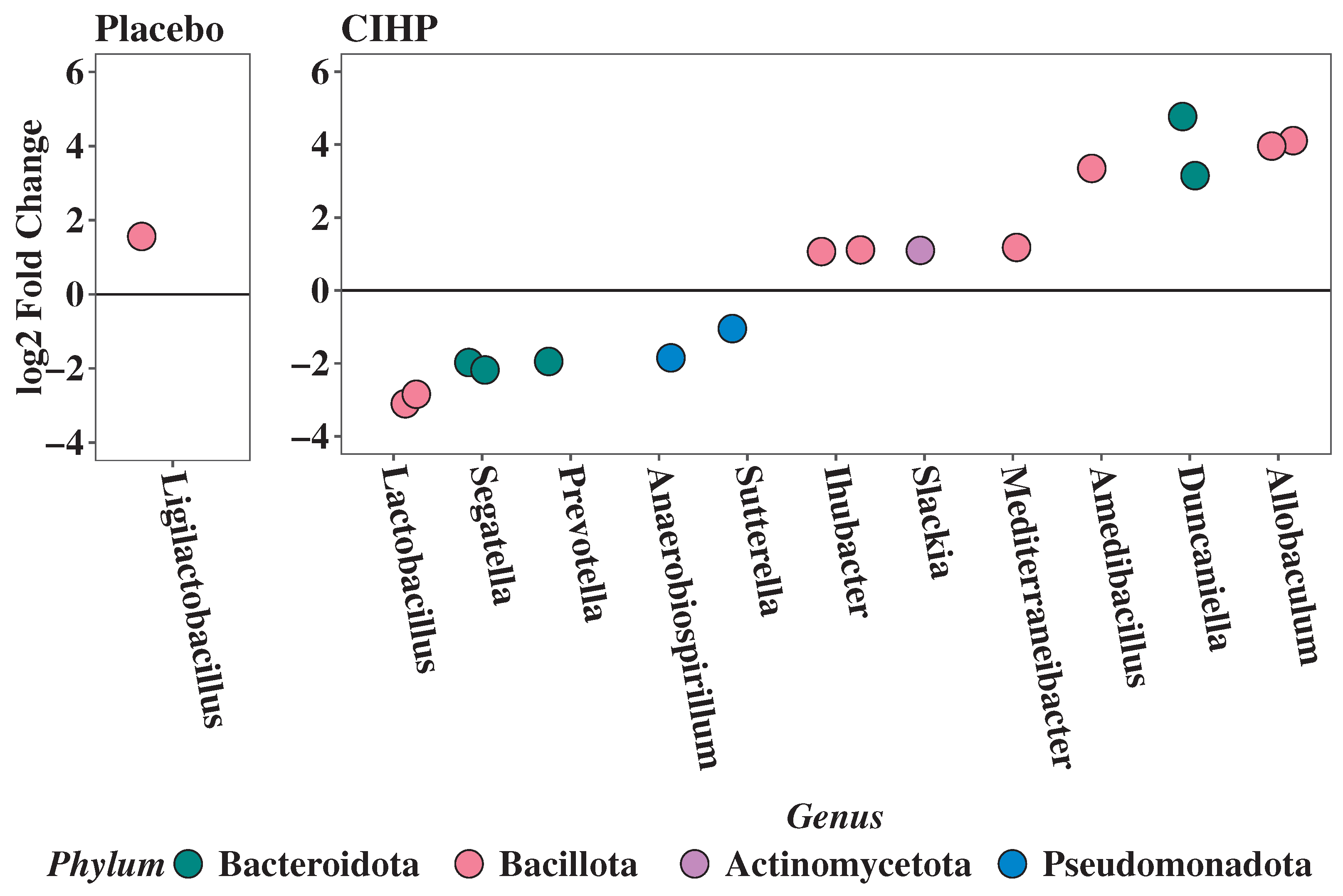
| ZOTU | Phylum | Genus | Genus Confidence | log2 Fold Change | Adjusted p-Value |
|---|---|---|---|---|---|
| Zotu4 | Bacillota | Lactobacillus | 0.87 | −3.11 | 0.0044 |
| Zotu17 | Bacillota | Allobaculum | 0.92 | 4.10 | 0.0019 |
| Zotu27 | Bacteroidota | Prevotella | 0.42 | −1.95 | 0.012 |
| Zotu16 | Bacillota | Allobaculum | 0.89 | 3.99 | 0.015 |
| Zotu24 | Bacteroidota | Segatella | 0.97 | −1.98 | 0.012 |
| Zotu80 | Bacteroidota | Duncaniella | 0.19 | 3.14 | 0.031 |
| Zotu9 | Bacillota | Amedibacillus | 0.20 | 3.35 | 0.031 |
| Zotu37 | Bacillota | Ihubacter | 0.41 | 1.12 | 0.015 |
| Zotu460 | Bacillota | Lactobacillus | 0.33 | −2.85 | 0.028 |
| Zotu58 | Bacteroidota | Duncaniella | 0.49 | 4.77 | 0.015 |
| Zotu69 | Bacillota | Mediterraneibacter | 0.91 | 1.17 | 0.0019 |
| Zotu42 | Pseudomonadota | Sutterella | 0.56 | −1.04 | 0.031 |
| Zotu316 | Bacillota | Ihubacter | 0.70 | 1.07 | 0.015 |
| Zotu81 | Bacteroidota | Segatella | 0.98 | −2.18 | 0.015 |
| Zotu73 | Pseudomonadota | Anaerobiospirillum | 0.72 | −1.84 | 0.012 |
| Zotu85 | Actinomycetota | Slackia | 0.99 | 1.10 | 0.0019 |
| ZOTU | Phylum | Genus | Genus Confidence | log2 Fold Change | Adjusted p-Value |
|---|---|---|---|---|---|
| Zotu2 | Bacillota | Ligilactobacillus | 0.93 | 1.44 | 0.042 |
| Fecal Biomarker | Group | Day 0 (Mean ± SD) | Day 28 (Mean ± SD) | Healthy Range | Significant Change (Test, p-Value) |
|---|---|---|---|---|---|
| pH | CIHP | 6.1 ± 0.2 | 6.2 ± 0.2 | 6.0–6.9 | Paired t-test (D28 < D0), p = 0.9 |
| Placebo | 6.1 ± 0.3 | 6.11 ± 0.19 | Paired t-test (D28 < D0), p = 0.4 | ||
| Dry matter (%) | CIHP | 27 ± 4 | 28 ± 2 | 28–38% [52] | Paired t-test (D28 > D0), p = 0.4 |
| Placebo | 30 ± 3 | 28 ± 4 | Paired t-test (D28 > D0), p = 0.9 | ||
| IgA (mg/g) | CIHP | 10 ± 10 | 16 ± 25 | ≥2.3 mg/g [53,54,55] | Paired Wilcoxon (D28 > D0), p = 0.58 |
| Placebo | 10 ± 13 | 4 ± 4 | Paired Wilcoxon (D28 > D0), p = 0.96 | ||
| Calprotectin 1 (μg/g) | CIHP | 9/10 dogs undetectable | 8/10 dogs undetectable | <133 μg/g 3 | – |
| Placebo | 8/10 dogs undetectable | 10/10 dogs undetectable | – | ||
| SCFA 2 (μg/g) | CIHP | 507 ± 63 | 473 ± 53 | 127–927 μg/g [48] | Paired t-test (D28 > D0), p = 0.88 |
| Placebo | 456 ± 61 | 476 ± 84 | Paired t-test (D28 > D0), p = 0.24 | ||
| Dysbiosis index | CIHP | −2.9 ± 1.2 | −2.3 ± 1.6 | <0 | Paired Wilcoxon (D28 < D0), p = 0.94 |
| Placebo | −3.4 ± 0.9 | −3.6 ± 1.4 | Paired Wilcoxon (D28 < D0), p = 0.95 |
Disclaimer/Publisher’s Note: The statements, opinions and data contained in all publications are solely those of the individual author(s) and contributor(s) and not of MDPI and/or the editor(s). MDPI and/or the editor(s) disclaim responsibility for any injury to people or property resulting from any ideas, methods, instructions or products referred to in the content. |
© 2026 by the authors. Licensee MDPI, Basel, Switzerland. This article is an open access article distributed under the terms and conditions of the Creative Commons Attribution (CC BY) license.
Share and Cite
Sordillo, A.; Heldrich, J.; Turcotte, R.; Sheth, R.U. A Novel Postbiotic Improves Stool Consistency in Dogs: A Randomized, Double-Blind Placebo-Controlled Study. Pets 2026, 3, 19. https://doi.org/10.3390/pets3020019
Sordillo A, Heldrich J, Turcotte R, Sheth RU. A Novel Postbiotic Improves Stool Consistency in Dogs: A Randomized, Double-Blind Placebo-Controlled Study. Pets. 2026; 3(2):19. https://doi.org/10.3390/pets3020019
Chicago/Turabian StyleSordillo, Aylesse, Jonna Heldrich, Raphaël Turcotte, and Ravi U. Sheth. 2026. "A Novel Postbiotic Improves Stool Consistency in Dogs: A Randomized, Double-Blind Placebo-Controlled Study" Pets 3, no. 2: 19. https://doi.org/10.3390/pets3020019
APA StyleSordillo, A., Heldrich, J., Turcotte, R., & Sheth, R. U. (2026). A Novel Postbiotic Improves Stool Consistency in Dogs: A Randomized, Double-Blind Placebo-Controlled Study. Pets, 3(2), 19. https://doi.org/10.3390/pets3020019