1. Introduction
Healthcare-associated infections (HAIs) remain a major global public health problem because of their impact on morbidity, mortality, healthcare costs, and antimicrobial resistance [
1]. In human medicine, contaminated medical devices and environmental surfaces are recognized as important sources of pathogen transmission within healthcare facilities [
2,
3,
4,
5]. Common HAI-associated pathogens include
Staphylococcus aureus,
Acinetobacter baumannii,
Klebsiella pneumoniae,
Pseudomonas aeruginosa, and
Escherichia coli [
6]. Several of these microorganisms have been associated with multidrug resistance, environmental persistence, biofilm formation, and reduced susceptibility to disinfectants, complicating infection prevention and control efforts [
7,
8,
9].
In human healthcare systems, infection prevention and control programs are widely implemented and supported by standardized sterilization and disinfection protocols [
10]. In contrast, infection control practices in veterinary medicine are often more variable, especially in small clinics and resource-limited environments. Veterinary clinical environments are particularly prone to environmental contamination because of continuous exposure to organic material, animal secretions, hair, and high patient turnover [
11]. Previous studies have demonstrated that inadequate infection control practices may contribute to environmental contamination and the persistence of opportunistic pathogens in veterinary hospitals [
12,
13,
14].
Surgical site infections are among the most frequently reported healthcare-associated infections in veterinary medicine and have been associated with increased morbidity, prolonged recovery, additional antimicrobial use, and higher treatment costs [
15]. Surgical instruments that come into contact with sterile tissues are classified as critical devices according to the Spaulding classification system and should be sterilized to eliminate all forms of microbial life, including bacterial spores [
16]. However, in many veterinary settings, chemical disinfectants are routinely used as substitutes for sterilization because of economic limitations, lack of infrastructure, and logistical constraints [
17].
The effectiveness of chemical disinfectants depends on several factors, including concentration, contact time, organic matter, environmental conditions, and intrinsic resistance of microorganisms [
12]. Quaternary ammonium compounds such as benzalkonium chloride are widely used because they are inexpensive and easy to apply. However, these compounds have limited activity against bacterial spores, mycobacteria, and certain Gram-negative bacteria [
18,
19]. Repeated exposure to suboptimal concentrations of disinfectants has also been associated with reduced microbial susceptibility and potential cross-resistance to antibiotics [
20].
In Mexico, only a few studies have evaluated environmental contamination and potential hospital-associated pathogens in veterinary hospitals [
14,
21]. Most available reports focus on university hospitals or multidrug-resistant bacteria, whereas little information exists regarding the real-world effectiveness of routine chemical disinfection practices used in small veterinary clinics. From a One Health perspective, inadequate infection control in veterinary settings may facilitate microbial circulation among animals, humans, and the environment [
22,
23]. Residual contamination of surgical instruments may contribute to indirect transmission pathways and the environmental persistence of opportunistic pathogens. Therefore, this preliminary exploratory study aimed to characterize routine disinfection practices and assess residual bacterial contamination on reprocessed surgical instruments in small animal veterinary clinics in Veracruz, Mexico.
2. Materials and Methods
2.1. Study Area
This study was conducted in small animal veterinary clinics in the metropolitan area of Veracruz, Mexico. The participating clinics routinely performed surgical procedures and relied on chemical disinfectants for the reprocessing of surgical instruments.
2.2. Study Design
A preliminary exploratory cross-sectional study was conducted.
2.3. Selection of Veterinary Clinics
Ten privately operated veterinary clinics were included based on the following criteria: (i) provision of small animal medical and surgical services, (ii) routine use of liquid chemical disinfectants for surgical instrument reprocessing, and (iii) authorization to sample surgical instruments and surgical operative surfaces. Clinics that exclusively used steam sterilization methods were excluded.
2.4. Surgical Instruments and Sampling Procedure
Commonly used surgical instruments and operative surfaces were sampled after the completion of routine disinfection procedures and prior to reuse. Disinfectants were categorized according to manufacturer-reported classification and published disinfection guidelines. The sampled instruments included scalpel handles, Metzenbaum scissors, Kelly forceps, dissection forceps, needle holders, Allis forceps, and surgical tables. Sixty samples were collected. Approximately 5–7 instruments or surfaces were sampled per clinic, depending on instrument availability during the sampling period. For each instrument, approximately 5 cm2 of surface area was sampled using sterile rayon swabs pre-moistened with sterile saline solution. Swabbing was performed immediately after routine chemical disinfection procedures were performed by clinic personnel. The disinfectants used in each clinic, reported contact time, and reported disinfection practices were documented through direct communication with veterinary personnel whenever possible. However, disinfectant concentrations, dilution procedures, and exposure times could not be independently standardized or experimentally verified. After sampling, the swabs were immediately placed in Stuart transport medium and transported under refrigerated conditions to the Laboratory of Parasitology at Posta Zootécnica Torreón del Molino for microbiological processing. Neutralizing agents were not used after the sampling. Residual disinfectant activity during transport may have reduced bacterial recovery and underestimated contamination frequencies.
2.5. Bacterial Isolation
Samples were inoculated onto blood agar and MacConkey agar plates using conventional microbiological methods. Swabs were streaked onto agar surfaces using the quadrant streak method to obtain isolated colonies of the bacteria. The plates were incubated aerobically at 37 °C for 24 h. After incubation, bacterial growth was assessed. Representative colonies were selected based on colony morphology and subjected to Gram staining for preliminary characterization.
2.6. Microbial Identification by MALDI-TOF MS
Positive cultures were identified at the genus and species levels using matrix-assisted laser desorption/ionization time-of-flight mass spectrometry (MALDI-TOF MS) with a Bruker Daltonik MALDI Biotyper system (Bruker Daltonics, Leipzig, Germany). A small portion of a well-isolated colony was transferred to a stainless-steel target plate. After air-drying, 1 µL of concentrated formic acid was added and allowed to dry. Subsequently, 1 µL of α-cyano-4-hydroxycinnamic acid matrix solution was applied and allowed to crystallize. Spectra were acquired using an Autoflex III MALDI-TOF instrument equipped with a 200 Hz SmartBeam laser within a mass range of 2000–20,000 Da. Calibration was performed using the Bruker Bacterial Test Standard. Only identifications with scores ≥ 2.0 were considered reliable for species-level identification.
2.7. Statistical Analysis
Descriptive statistical analysis was performed to summarize the contamination frequency, bacterial distribution, and disinfectant usage patterns among clinics. Categorical variables were expressed as absolute frequency and percentage.
To explore the association between disinfectant category and bacterial contamination, the clinics were grouped according to the predominant disinfectant strategy used by each clinic. Fisher’s exact test was used because of the small sample size and unequal group distributions. Statistical significance was set at p < 0.05.
Statistical analyses were performed using IBM SPSS Statistics (version 25.0; IBM Corp., Armonk, NY, USA). Due to the exploratory nature of the study and the limited number of clinics using high-level disinfectants, the inferential analyses were interpreted cautiously.
3. Results
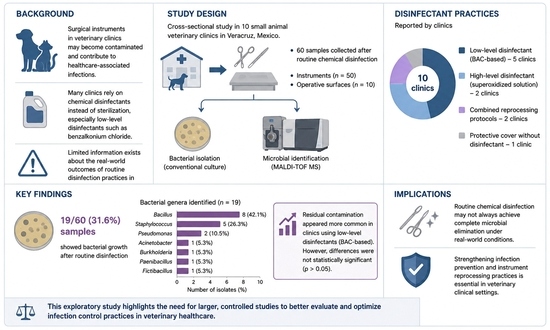
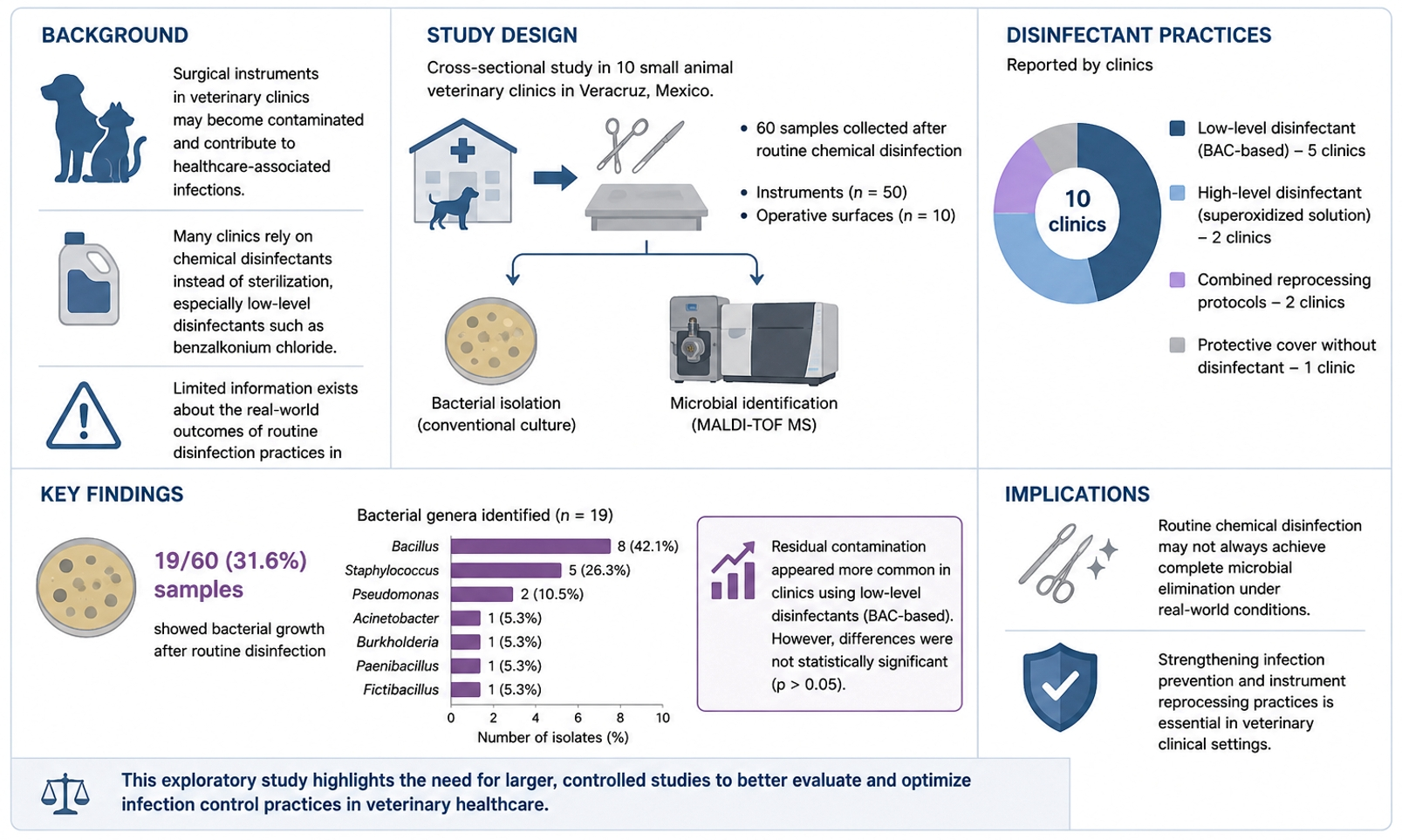
Ten small animal veterinary clinics located in Veracruz, Mexico, were included in this study. All participating clinics routinely performed surgical procedures and relied on chemical disinfectants for the reprocessing of surgical instruments. Most clinics reported the use of low-level disinfectants, particularly benzalkonium chloride-based products, either alone or in combination with chlorine-containing compounds. Two clinics routinely used high-level superoxidized disinfectant protocols, whereas two additional clinics implemented combined reprocessing strategies involving either a superoxidized solution or supplementary iodine-based cleaning procedures.
Sixty samples were collected from surgical instruments and operative surfaces after routine chemical disinfection. The sampled materials included scalpel handles, Metzenbaum scissors, Kelly forceps, needle holders, dissection forceps, Allis forceps, and surgical tables.
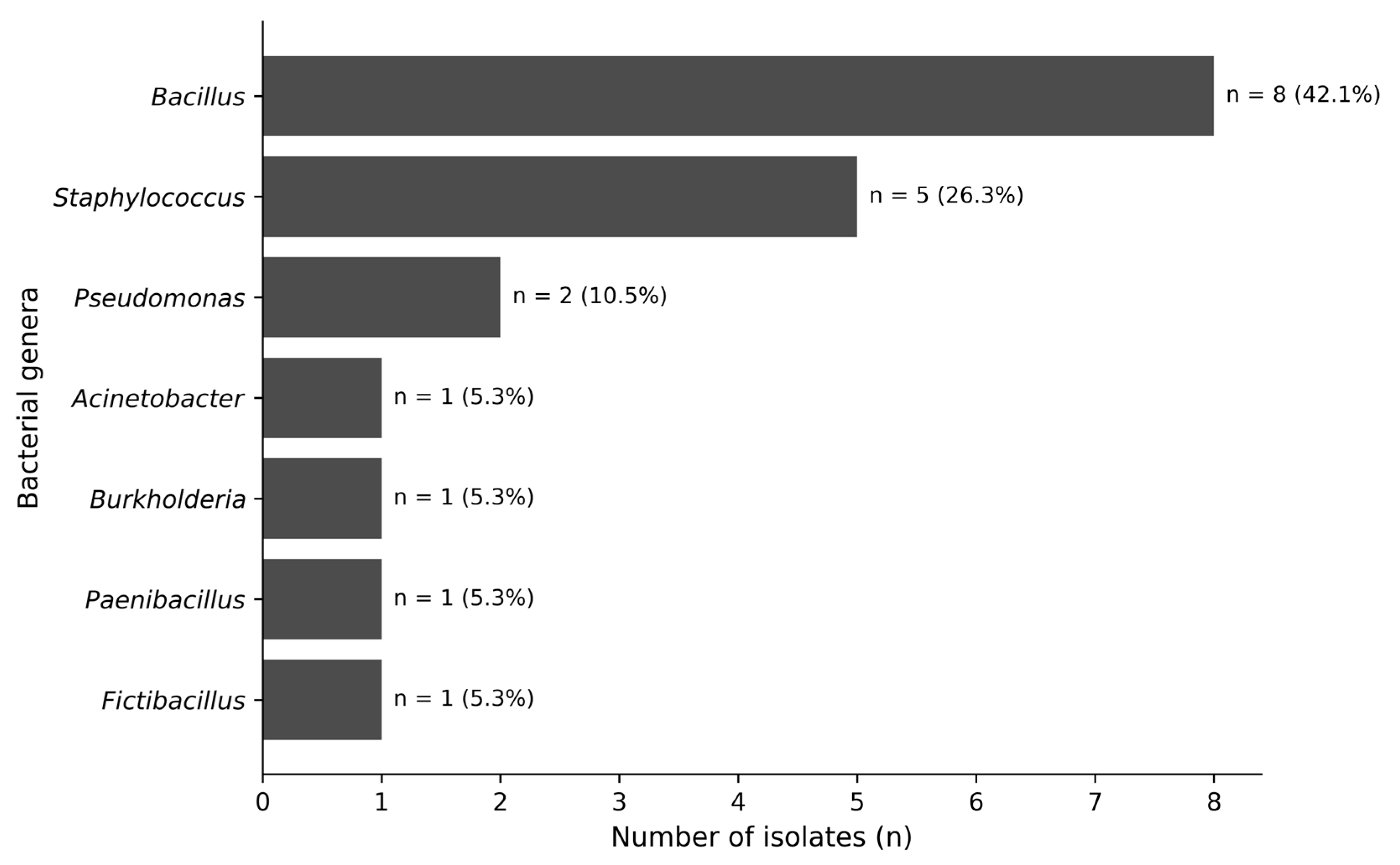
Bacterial growth was detected in 19 of the 60 samples (31.6%). Positive cultures were identified in eight of the ten participating clinics. The distribution of sampled instruments, disinfectants used, and bacterial species identified in each clinic is presented in
Table 1. The distribution of recovered bacterial genera is shown in
Figure 1.
The recovered isolates included species belonging to the genera Bacillus, Staphylococcus, Pseudomonas, Acinetobacter, Burkholderia, Paenibacillus, and Fictibacillus. Among the participating clinics, one clinic reported the use of disposable physical protective covers for some surgical surfaces without routine liquid chemical disinfection, whereas the remaining clinics relied primarily on liquid chemical disinfectants for instrument reprocessing. Clinics using combined reprocessing protocols incorporated additional cleaning procedures such as surgical soap, iodine-based products, or superoxidized solutions.
When clinics were grouped according to disinfectant category, bacterial growth was detected in clinics reporting the use of low-level disinfectants, combined protocols, and one high-level disinfectant protocol. Fisher’s exact test did not identify a statistically significant association between disinfectant category and contamination frequency (p = 0.317). However, these findings should be interpreted cautiously because of the limited sample size and exploratory observational design of the study.
4. Discussion
The persistence of recoverable microorganisms on surgical instruments after routine chemical disinfection suggests that current reprocessing practices used under real-world veterinary clinical conditions may not always achieve complete microbial elimination. Residual microbial contamination appeared to be more commonly observed in clinics reporting the use of low-level disinfectants, particularly benzalkonium chloride-based products, whereas lower contamination frequencies were observed in clinics implementing combined reprocessing strategies or high-level disinfectant protocols. However, because this study was observational and exploratory in nature, these findings should not be interpreted as definitive evidence of differences in disinfectant performance. The widespread use of benzalkonium chloride observed in this study reflects common practices in small veterinary clinics where chemical immersion is frequently used as a substitute for sterilization because of economic and logistical limitations. However, quaternary ammonium compounds have limited antimicrobial activity against bacterial spores and certain Gram-negative organisms [
18,
19]. According to the Spaulding classification system, surgical instruments are considered critical devices and should ideally undergo sterilization procedures capable of eliminating all forms of microbial life [
16]. Therefore, reliance on low-level chemical disinfection alone may represent a limitation in instrument reprocessing practices involving surgical materials.
Bacillus species were among the most frequently recovered microorganisms. Their persistence may be explained by endospore formation, which facilitates prolonged environmental survival despite routine sanitation procedures. Although many
Bacillus species are considered environmental organisms, some have been associated with opportunistic infections and healthcare contamination [
4].
Opportunistic pathogens including
P. aeruginosa,
S. aureus, and
A. schindleri were also identified. These microorganisms are clinically relevant because of their ability to persist on environmental surfaces, survive under stressful conditions, and contribute to healthcare-associated infections in both human and veterinary medicine [
6]. Their presence on reprocessed surgical instruments may represent a potential source of indirect microbial transmission within veterinary healthcare settings. However, the recovery of bacteria after routine disinfection does not necessarily demonstrate a direct infection or transmission risk, since bacterial load, virulence factors, and antimicrobial susceptibility were not evaluated in this study. Similar findings have been reported in previous veterinary studies evaluating environmental contamination and disinfection practices in clinical environments [
12,
14].
Infection prevention and control in veterinary settings can be particularly challenging because of continuous exposure to organic material, animal secretions, hair, and environmental contamination. Residual organic matter and biofilm formation may further reduce disinfectant activity by limiting chemical penetration [
19]. In addition, inconsistent instrument handling, inadequate cleaning before disinfection, and limited infrastructure may contribute to residual contamination in small veterinary clinics. Previous studies have shown that infection prevention and control practices in veterinary medicine are often variable, particularly in resource-limited environments [
15,
17].
From a One Health perspective, inadequate infection prevention practices in veterinary clinical environments may facilitate microbial circulation among animals, veterinary personnel, owners, and contaminated surfaces [
22,
23].
This study had several limitations. The sample size was limited, and the observational cross-sectional design does not allow for causal inferences regarding disinfectant performance. Disinfectant concentrations, dilution procedures, and contact times could not be independently standardized or experimentally verified under field conditions. In addition, pre-cleaning procedures, residual organic material, and instrument handling practices may have influenced bacterial recovery independently of disinfectant category. Neutralizing agents were not used after sampling, which may have reduced bacterial recovery and underestimated contamination frequencies. Quantitative bacterial counts and antimicrobial susceptibility testing were beyond the scope of this preliminary exploratory study. Finally, only a limited number of clinics routinely used high-level disinfectant protocols, which restricted comparisons between disinfectant categories.
Despite these limitations, this study provides preliminary information regarding routine instrument reprocessing practices in small animal veterinary clinics operating under real-world conditions. Collectively, these findings highlight the importance of strengthening sterilization and infection prevention practices in veterinary healthcare settings.
5. Conclusions
Residual bacterial contamination was identified on surgical instruments after routine chemical disinfection in small animal veterinary clinics in Veracruz, Mexico. Although residual contamination appeared to be more frequently detected in clinics reporting the use of low-level disinfectants, the observational exploratory design of the study does not allow for causal inferences regarding disinfectant performance. Multiple factors, including instrument handling, cleaning practices, organic material, and non-standardized disinfectant exposure conditions, may have influenced bacterial recovery. Larger and better-controlled studies are needed to further evaluate routine instrument reprocessing practices in veterinary healthcare settings.
Author Contributions
Conceptualization, A.O.-M. and J.L.B.-R.; methodology, A.O.-M. and Y.L.-G.; validation, J.L.B.-R., S.S.-M. and D.R.S.; formal analysis, A.O.-M.; investigation, A.O.-M., Y.L.-G. and A.A.J.-C.; resources, L.A.O.C., M.G.S.O. and C.P.E.; data curation, A.O.-M.; writing—original draft preparation, A.O.-M.; writing—review and editing, J.L.B.-R., S.S.-M. and D.R.S.; visualization, A.O.-M.; supervision, J.L.B.-R.; project administration, J.L.B.-R. All authors have read and agreed to the published version of the manuscript.
Funding
This research received no external funding.
Institutional Review Board Statement
Not applicable.
Informed Consent Statement
Not applicable.
Data Availability Statement
The data supporting the findings of this study are available from the corresponding author upon reasonable request. The data are not publicly available due to privacy and institutional restrictions related to participating veterinary clinics.
Acknowledgments
The authors would like to thank the participating veterinary clinics in Veracruz, Mexico, for their collaboration and willingness to allow for sample collection.
Conflicts of Interest
The authors declare no conflicts of interest.
References
- Revelas, A. Healthcare-associated infections: A public health problem. Niger. Med. J. 2012, 53, 59–64. [Google Scholar] [CrossRef] [Scilit]
- Weber, D.J.; Rutala, W.A.; Miller, M.B.; Huslage, K.; Sickbert-Bennett, E. Role of hospital surfaces in the transmission of emerg-ing health care-associated pathogens: Norovirus, Clostridium difficile, and Acinetobacter species. Am. J. Infect. Control 2010, 38, S25–S33. [Google Scholar] [CrossRef] [Scilit]
- Otter, J.A.; Yezli, S.; French, G.L. The role played by contaminated surfaces in the transmission of nosocomial pathogens. Infect. Control Hosp. Epidemiol. 2011, 32, 687–699. [Google Scholar] [CrossRef] [Scilit] [PubMed]
- Kramer, A.; Schwebke, I.; Kampf, G. How long do nosocomial pathogens persist on inanimate surfaces? A systematic review. BMC Infect. Dis. 2006, 6, 130. [Google Scholar] [CrossRef] [Scilit] [PubMed]
- Rutala, W.A.; Weber, D.J.; Healthcare Infection Control Practices Advisory Committee (HICPAC). Guideline for Disinfection and Sterilization in Healthcare Facilities, 2008; Updated June 2024; Centers for Disease Control and Prevention: Atlanta, GA, USA, 2024.
- Yehya, A.; Ezzeddine, Z.; Chakkour, M.; Dhaini, Z.; Bou Saba, M.S.; Bou Saba, A.S.; Nohra, L.; Nassar, N.B.; Yassine, M.; Bahmad, H.F.; et al. The intricacies of Acinetobacter baumannii: A multifaceted comprehensive review of a multidrug-resistant pathogen and its clinical significance and implications. Front. Microbiol. 2025, 16, 1565965. [Google Scholar] [CrossRef] [Scilit] [PubMed]
- Abbas, R.; Chakkour, M.; Zein El Dine, H.; Obaseki, E.F.; Obeid, S.T.; Jezzini, A.; Ghssein, G.; Ezzeddine, Z. General Overview of Klebsiella pneumoniae: Epidemiology and the Role of Siderophores in Its Pathogenicity. Biology 2024, 13, 78. [Google Scholar] [CrossRef] [Scilit] [PubMed]
- Ghssein, G.; Ezzeddine, Z. The Key Element Role of Metallophores in the Pathogenicity and Virulence of Staphylococcus aureus: A Review. Biology 2022, 11, 1525. [Google Scholar] [CrossRef] [Scilit] [PubMed]
- Kumari, D.; Kumar, S.; Gangola, S.; Neel, G.R.; Sehrawat, N.; Yadav, M.; Kumar, A. Hospital-acquired fungal infections by Candida auris and Aspergillus species: Pathogenesis, resistance mechanisms, prevention and control measures. Microbes Infect. Dis. 2025. [Google Scholar] [CrossRef] [Scilit]
- World Health Organization (WHO). Decontamination and Reprocessing of Medical Devices for Health-Care Facilities; WHO Press: Geneva, Switzerland, 2016. [Google Scholar]
- Burgess, B.A.; Morley, P.S. Veterinary hospital surveillance systems. Vet. Clin. N. Am. Small Anim. Pract. 2015, 45, 235–242. [Google Scholar] [CrossRef] [Scilit] [PubMed]
- Murphy, C.P.; Weese, J.S.; Reid-Smith, R.J.; McEwen, S.A. Evaluation of bacterial contamination of surgical cold sterilization solutions from veterinary practices. Can. Vet. J. 2010, 51, 1159–1162. [Google Scholar]
- Turk, R.; Singh, A.; Weese, J.S. Prospective surgical site infection surveillance in dogs. Vet. Surg. 2015, 44, 2–8. [Google Scholar] [CrossRef] [Scilit] [PubMed]
- Hernández-Silva, D.J.; Rivera-González, A.I.; Avilés-Benitez, L.K.; Becerra-Reyes, M.M.; Rivera-Ballesteros, C.; Mo-rales-García, R.; García-Ramírez, L.; Chávez-Moreno, O.F.; Aguilar-Tipacamu, G.; Gómez-Soto, J.G.; et al. Detection of Bacteria with Potential to Cause Hospital-Associated Infections in a Small-Species Veterinary Hospital in Mexico. Microbiol. Res. 2024, 15, 1758–1771. [Google Scholar] [CrossRef] [Scilit]
- Singaravelu, A.; Leggett, B.; Leonard, F.C. Improving infection control in a veterinary hospital: A detailed study on patterns of faecal contamination to inform changes in practice. Ir. Vet. J. 2023, 76, 4. [Google Scholar] [CrossRef] [Scilit]
- Spaulding, E.H. Chemical disinfection of medical and surgical materials. In Disinfection, Sterilization, and Preservation; Law-rence, C.A., Block, S.S., Eds.; Lea & Febiger: Philadelphia, PA, USA, 1968; pp. 517–531. [Google Scholar]
- Sasaoka, K.; Sato, T.; Morishita, K.; Hosoya, K.; Yokoyama, N.; Sato, T.; Horiuchi, M.; Takiguchi, M. Antimicrobial resistance and self-reported hand hygiene awareness before and after an infection prevention and control programme: A 7-year analysis in a small animal veterinary teaching hospital. Vet. J. 2024, 306, 106154. [Google Scholar] [CrossRef] [Scilit]
- McDonnell, G.; Russell, A.D. Antiseptics and disinfectants: Activity, action, and resistance. Clin. Microbiol. Rev. 1999, 12, 147–179. [Google Scholar] [CrossRef] [Scilit]
- Rutala, W.A.; Weber, D.J. Disinfection, sterilization, and antisepsis: An overview. Am. J. Infect. Control 2019, 47, A3–A9. [Google Scholar] [CrossRef] [Scilit]
- Kampf, G. Acquired resistance to chlorhexidine—Is it time to establish an antiseptic stewardship initiative? J. Hosp. Infect. 2016, 94, 213–227. [Google Scholar] [CrossRef] [Scilit] [PubMed]
- Rivera González, A.I. Caracterización de Bacterias Nosocomiales y su Perfil de Resistencia a Antibióticos en un Hospital Veterinario de Pequeñas Especies. Bachelor’s Thesis, Universidad Autónoma de Querétaro, Querétaro, Mexico, 2024. Available online: https://ri-ng.uaq.mx/bitstream/123456789/10989/1/CNLIN-290160.pdf (accessed on 12 March 2026).
- Habib, I.; Alshehhi, Z. Zoonotic disease management and infection control practices among veterinarians in the United Arab Emirates. Vet. Sci. 2021, 8, 82. [Google Scholar] [CrossRef] [Scilit] [PubMed]
- Mackenzie, J.S.; Jeggo, M. The One Health Approach—Why Is It So Important? Trop. Med. Infect. Dis. 2019, 4, 88. [Google Scholar] [CrossRef] [Scilit] [PubMed]
| Disclaimer/Publisher’s Note: The statements, opinions and data contained in all publications are solely those of the individual author(s) and contributor(s) and not of MDPI and/or the editor(s). MDPI and/or the editor(s) disclaim responsibility for any injury to people or property resulting from any ideas, methods, instructions or products referred to in the content. |
© 2026 by the authors. Published by MDPI on behalf of the Hellenic Society for Microbiology. Licensee MDPI, Basel, Switzerland. This article is an open access article distributed under the terms and conditions of the Creative Commons Attribution (CC BY) license.




 ,
,