1. Introduction
Rectal bleeding is a frequent clinical presentation that commonly prompts evaluation for colorectal neoplasia, inflammatory bowel disease (IBD), or benign anorectal disorders [
1]. However, in younger patients without established risk factors for malignancy or chronic inflammatory conditions, alternative etiologies should be systematically considered [
2]. In this context, infectious causes—particularly STIs—represent an important yet frequently underrecognized diagnostic category [
3].
Among these, HSV-associated proctitis is an uncommon but clinically relevant entity, especially in immunocompetent individuals. Its presentation may be misleading, as both clinical symptoms and endoscopic findings can closely resemble IBD, ischemic colitis, or even neoplastic lesions [
4]. Failure to recognize this condition may result in delayed diagnosis and inappropriate management.
Herein, we report a case of HSV-2-associated proctitis in an immunocompetent patient, in which the diagnosis was established through endoscopic evaluation complemented by molecular testing, underscoring the importance of maintaining a high index of suspicion in selected clinical scenarios.
2. Case Description
A 34-year-old man with no first-degree family history of colorectal cancer was referred for colonoscopic evaluation due to a three-week history of persistent tenesmus and intermittent rectal bleeding. The bleeding was described as small-volume, bright red blood noted on toilet paper and occasionally mixed with stool. He denied fever, abdominal pain, diarrhea, mucus discharge, weight loss, night sweats, or recent travel. There were no known risk factors for immunosuppression, including no history of Human Immunodeficiency Virus (HIV) infection, chronic corticosteroid use, organ transplantation, or systemic disease. His past medical history was otherwise unremarkable, he was not taking regular medications, and he reported no prior gastrointestinal disorders or similar episodes in the past.
On further clinical assessment, including a detailed sexual history, the patient reported recent episodes of unprotected receptive anal intercourse. He also described mild but persistent anorectal discomfort and a subjective increase in stool frequency, although without urgency, fecal incontinence, or nocturnal symptoms. He did not describe systemic manifestations such as asthenia or anorexia. Physical examination revealed stable vital signs and a soft, non-tender abdomen without palpable masses or organomegaly. No peripheral lymphadenopathy or cutaneous lesions were observed. Digital rectal examination elicited mild tenderness but revealed no palpable masses, induration, or gross blood.
Laboratory investigations demonstrated normal hemoglobin levels, excluding clinically significant anemia, and a normal white blood cell count without leukocytosis. Inflammatory markers, including CRP and erythrocyte sedimentation rate (ESR), were within reference ranges.
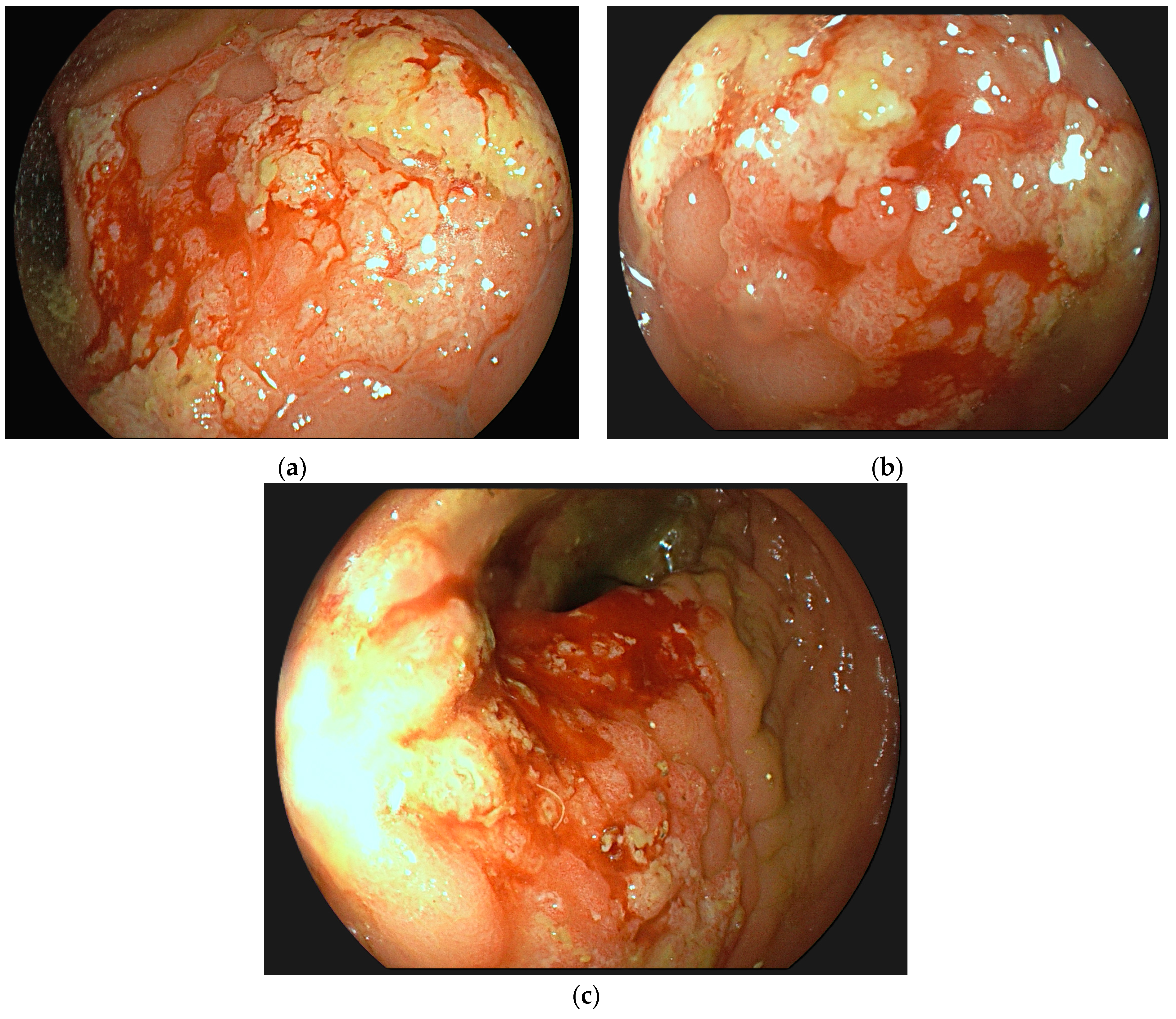
Colonoscopy was performed in an outpatient setting; however, complete examination of the colon was not possible due to inadequate bowel preparation. Despite this limitation, careful inspection of the rectum was achieved. In the rectal ampulla, a well-demarcated, flat mucosal lesion measuring approximately 4–5 cm in maximal diameter was identified. The lesion appeared erythematous and diffusely congested, with a micronodular and finely granular surface pattern (
Figure 1a). Several areas were covered by fibrinous exudate, creating a mottled yellow-white appearance (
Figure 1b). The mucosa was markedly edematous and highly friable, bleeding upon minimal contact with the endoscope (
Figure 1c). Importantly, no deep ulcerations, exophytic masses, luminal narrowing, or features suggestive of invasive malignancy were observed. The adjacent rectal mucosa and the limited segments of colon visualized appeared macroscopically normal. Based on the endoscopic findings, an infectious or inflammatory etiology was considered more probable than a primary neoplastic process. Targeted biopsies were therefore obtained for histopathological and microbiological evaluation, including Polymerase Chain Reaction (PCR) testing for sexually transmitted pathogens.
Histopathologic examination revealed granulation tissue with limited epithelial representation and a moderate lymphoplasmacytic inflammatory infiltrate within the lamina propria. No dysplasia or features suggestive of malignancy were identified. Although classic viral cytopathic changes—such as multinucleation, nuclear molding, or ground-glass nuclei—were not clearly evident on routine staining, PCR analysis for HSV DNA was performed on rectal biopsy specimens in a certified clinical microbiology laboratory and resulted in a positive result for HSV-2. Quantitative viral load was not available as testing was performed for diagnostic purposes.
Screening for additional sexually transmitted infections, including nucleic acid amplification tests (NAAT) for Chlamydia trachomatis and Neisseria gonorrhoeae, as well as serologic testing for Treponema pallidum, was performed and returned negative results.
The patient was started on oral valacyclovir at a dose of 1 g twice daily for 10 days. Clinical response was rapid and favourable. Rectal bleeding resolved within one week of initiating antiviral therapy, and tenesmus progressively subsided over the following days. The patient tolerated treatment well, and no adverse effects were reported.
At three-month follow-up, he remained completely asymptomatic, with no recurrence of rectal bleeding, anorectal discomfort, or altered bowel habits. Given the complete clinical resolution and absence of symptoms, further endoscopic or microbiological follow-up was not performed. Stool PCR testing was not carried out, as it is not routinely recommended in this clinical context once clinical response is achieved.
3. Discussion
HSV proctitis is most commonly reported in immunocompromised individuals or in those engaging in high-risk sexual behaviors, particularly men who have sex with men (MSM). Nevertheless, it may also occur in immunocompetent individuals and should not be overlooked in the differential diagnosis of rectal bleeding in young adults [
5]. The predominant causative subtype remains HSV-2; however, HSV-1 has been increasingly documented in anorectal infections, likely reflecting evolving sexual practices and changes in transmission patterns. Following mucosal inoculation, the virus establishes latency within the sacral dorsal root ganglia, retaining the capacity for periodic reactivation. Viral replication within the anorectal epithelium induces direct cytopathic injury, microvascular compromise, and a localized inflammatory cascade characterized by mucosal edema, friability, erosions, and ulceration. Importantly, the extent of mucosal damage does not necessarily correlate with systemic manifestations, and patients may present with localized anorectal disease in the absence of fever, leukocytosis, or other constitutional symptoms, thereby complicating early clinical recognition.
The clinical presentation is heterogeneous and frequently overlaps with more common conditions such as IBD, ischemic colitis, or rectal neoplasia [
6]. Symptoms may include anorectal discomfort, tenesmus, rectal bleeding, mucous discharge, and altered bowel habits. However, milder forms lacking systemic manifestations may delay clinical suspicion, increasing the risk of misclassification at initial evaluation.
From an endoscopic perspective, HSV-related lesions show considerable variability, ranging from mild erythema and mucosal edema to aphthoid lesions, shallow or deep ulcerations, necrotic exudates, pseudomembranous changes, and mass-like inflammatory presentations. In some cases, large, irregular, or friable lesions may raise concern for malignancy, as observed in our patient and represent a particularly important diagnostic pitfall. This variability underscores a key limitation of endoscopic assessment: macroscopic appearance alone is insufficient to reliably distinguish between infectious, inflammatory, and neoplastic processes.
Histopathological findings are often nonspecific and may not demonstrate classic viral cytopathic changes. While features such as multinucleation, nuclear moulding, and chromatin margination are highly suggestive of HSV infection, they are not consistently present. Early-stage lesions, superficial sampling, or extensive inflammatory exudate may obscure epithelial architecture, resulting in findings such as granulation tissue and lymphoplasmacytic infiltrates, as seen in our case.
Importantly, these histopathological patterns are not pathognomonic and may overlap with those observed in other sexually transmitted infections, particularly Chlamydia trachomatis (including lymphogranuloma venereum) and Treponema pallidum. Consequently, histology alone is insufficient to establish a definitive etiological diagnosis, and additional microbiological testing is required. Molecular and microbiological testing, including PCR and NAAT assays, is essential to accurately differentiate between these pathogens and guide appropriate management.
Even in the absence of overt cytopathic alterations, PCR testing provides high sensitivity and specificity for viral detection and represents a key diagnostic tool, particularly when histological findings are inconclusive. In this context, PCR not only confirms HSV infection but also allows differentiation from other infectious etiologies that may present with overlapping clinical and histopathological features [
7,
8]. In our case, definitive diagnosis was achieved exclusively through molecular analysis, enabling timely initiation of targeted antiviral therapy, preventing unnecessary escalation of diagnostic investigations, and reinforcing the pivotal role of molecular techniques in clarifying the etiology of ambiguous anorectal lesions.
Distinguishing infectious proctitis from IBD remains clinically critical. Infectious forms often present with a more acute onset and may be associated with anorectal pain or purulent discharge, whereas IBD typically follows a chronic relapsing course, with progressive bloody diarrhea and potential extraintestinal manifestations. However, these distinctions are not absolute, and diagnostic overlap remains common. Retrospective analyses have repeatedly highlighted the frequency with which infectious proctitis mimics IBD, occasionally leading to empiric initiation of corticosteroid therapy before microbiological confirmation is obtained [
9]. Such therapeutic misdirection may potentiate viral replication, delay symptom resolution, and complicate clinical evolution. A structured diagnostic approach integrating clinical history, endoscopic assessment, histology, and microbiological testing is therefore essential to minimize diagnostic error.
From a therapeutic perspective, nucleoside analogues such as acyclovir and valacyclovir remain the cornerstone of management. In immunocompetent individuals, clinical response is typically rapid, with symptomatic improvement frequently observed within one to two weeks. Complications are uncommon but may include severe anorectal pain, sacral radiculitis with urinary retention, or, rarely, disseminated infection. Hospitalization is generally reserved for patients unable to tolerate oral therapy or for those with significant immunosuppression. Recurrence rates appear lower following appropriately treated primary episodes, further emphasizing the importance of early diagnosis and timely antiviral intervention. Our patient demonstrated complete clinical recovery following treatment, supporting both the diagnosis and the appropriateness of the therapeutic approach.
Beyond individual patient management, this case reflects evolving epidemiological patterns in anorectal disease. Increasing recognition of STI-related proctitis among individuals without overt risk factors underscores the importance of obtaining a careful and nonjudgmental sexual history when clinical suspicion arises, as patients may not initially disclose sensitive exposures. Accurate identification of HSV infection facilitates appropriate counseling, partner notification, and screening for additional sexually transmitted pathogens when indicated [
10].
Finally, this case reinforces that immunocompetence does not preclude clinically significant HSV infection. Awareness of this possibility helps mitigate anchoring bias and promotes a comprehensive diagnostic perspective when evaluating rectal bleeding in young adults. As the recognized spectrum of infectious proctitis continues to broaden, early integration of molecular diagnostics alongside careful clinical and endoscopic assessment will remain essential to optimize patient outcomes and reduce avoidable diagnostic error.
4. Conclusions
In conclusion, HSV proctitis should be considered in immunocompetent patients presenting with rectal bleeding or inflammatory anorectal lesions, even in the absence of overt risk factors. Given its clinical and endoscopic overlap with IBD and neoplasia, diagnosis requires a structured approach integrating sexual history, endoscopy, histology, and molecular testing. Early recognition is essential to avoid misdiagnosis and ensure appropriate management.