
Lipid Analysis by Thin-Layer Chromatography—Detection, Staining and Derivatization



Abstract
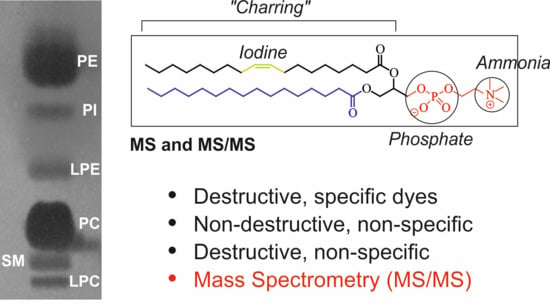
1. Introduction
- Since several samples can be analyzed in parallel, i.e., simultaneously, TLC is typically faster than HPLC.
- TLC is a simple method, and the equipment is relatively inexpensive. It can be easily installed and established in virtually all laboratories. HPTLC, however, relies much more on automated procedures and is, thus, more expensive.
- Only minimal maintenance is required, as there is hardly any risk that devices will need repairs. HPLC columns, in contrast, become easily plugged and/or contaminated.
- TLC requires only small solvent volumes. Therefore, it is considered more sustainable compared to HPLC, which consumes much larger volumes of solvents.
- There are absolutely no memory effects, since a new stationary phase (i.e., a new TLC plate) is always used. In contrast, the HPLC column is used many times and flushed intensively to remove residual components from a previous run, yet contamination may remain in the column.
- Chromatograms can be visually evaluated directly on the plate, and “digital images” of the plates can be obtained, processed, and saved. These images are often more illustrative than “pure” HPLC data.
- i.
- The interaction with the silica gel (normally unmodified silica gel) on the TLC plate;
- ii.
- The interaction of the lipid with the solvent mixture.
2. Making the Analyte Visible
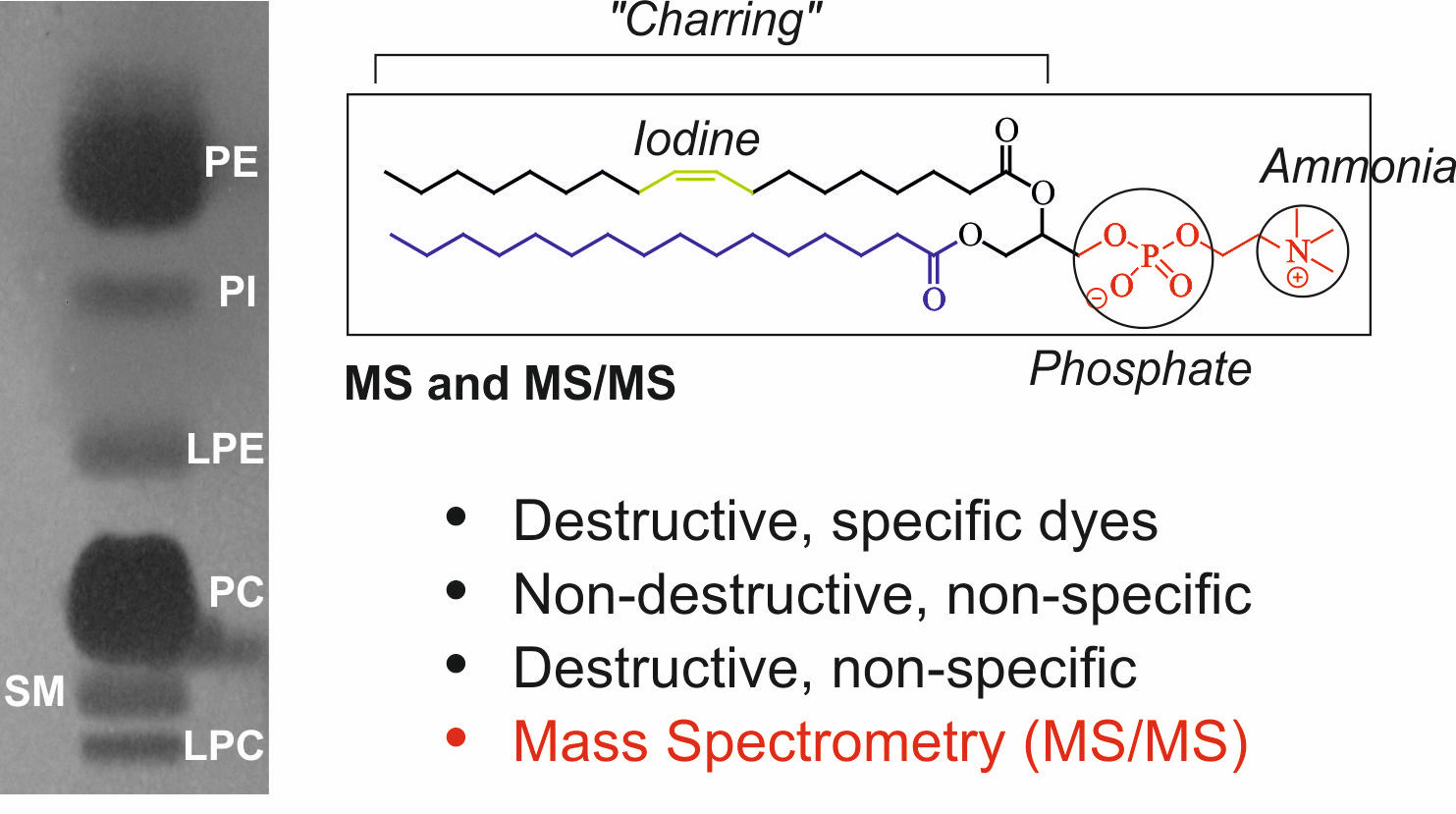
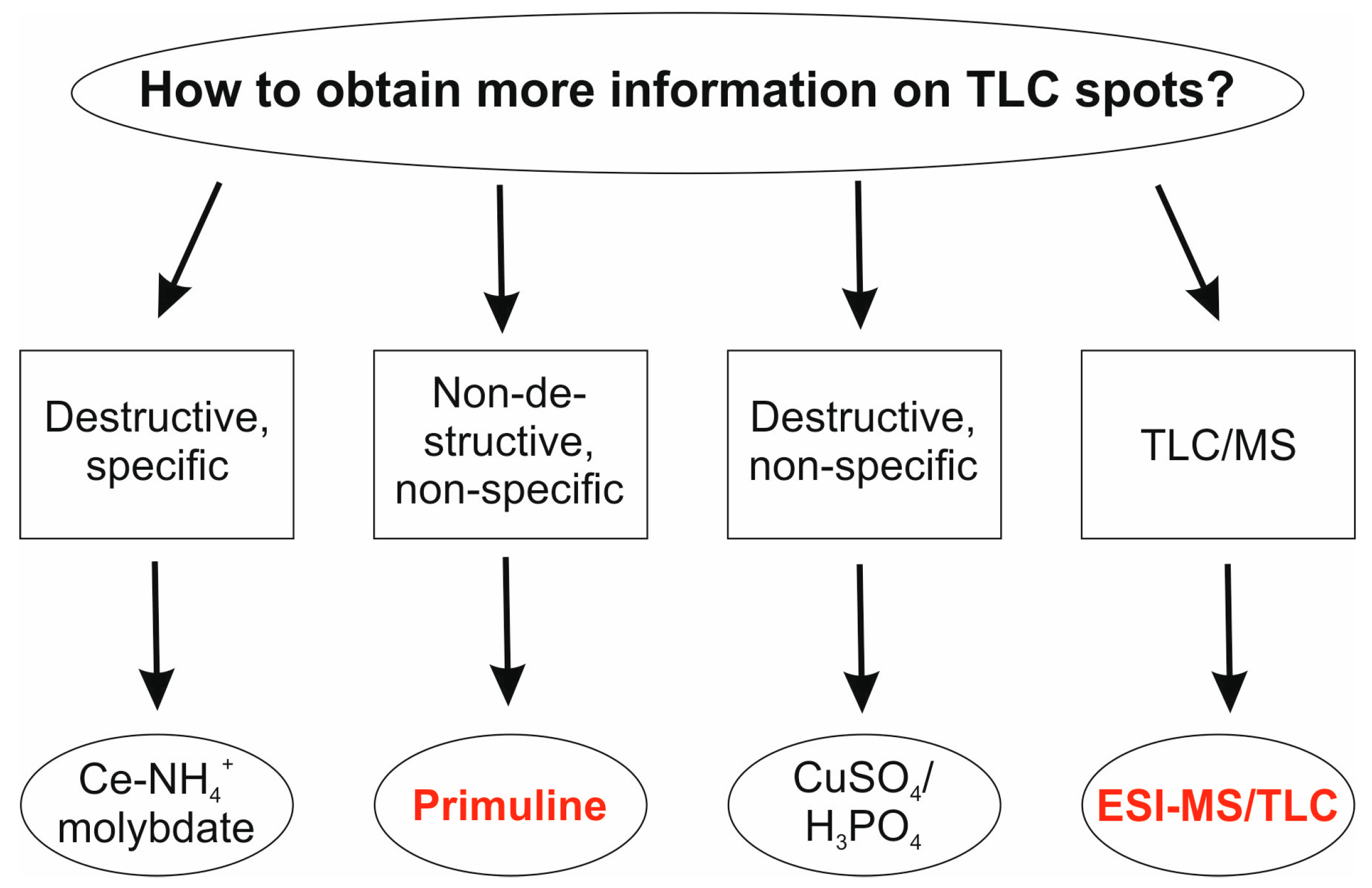
2.1. Destructive, Specific Dyes

| Method | Characteristics/Specificity | Reference |
|---|---|---|
| Ninhydrine | For the detection of lipids with amino groups (phosphatidylserine (PS) and -ethanolamine (PE)) as reddish spots. Ninhydrine staining may be combined with primuline staining to detect all PL classes. | [23] |
| 1,6-diphenyl-1,3,5-hexatriene | A two-step staining protocol. Initially, developed TLC plates are sprayed with the lipophilic fluorochrome 1,6-diphenyl-1,3,5-hexatriene, followed by application of the phosphorus-specific molybdenum blue (Dittmer–Lester) reagent (vide infra). Detection limits of down to 10 ng phospholipid are achieved, which is a considerable sensitivity enhancement compared to the individual dyes. | [24] |
| Dragendorff’s reagent | A complex mixture containing basic bismuth nitrate that exclusively stains choline-containing lipids, particularly PC, lysophosphatidylcholine (LPC) and sphingomyelin (SM). | [25] |
| Molybdenum blue reaction according to Dittmer and Lester | Detects phosphate in phospholipids through a chemical reaction involving molybdenum blue chemistry. The reagent contains ammonium molybdate, which reacts specifically with phosphate ester groups, which reduce molybdate ions to form a colored complex known as molybdenum blue. | [26] |
| Ceric ammonium molybdate (CAM) | Mo (VI) oxidizes unsaturated lipids into carbonyl compounds on the HPTLC plate upon heating, while itself being reduced to Mo (IV). | [22] |
2.2. Non-Destructive, Non-Specific Dyes
2.3. Destructive, Non-Specific Dyes
3. Spectroscopic Detection of Lipids on the TLC Plate
3.1. UV Spectroscopy and/or Quenching
- (1)
- Methods such as infrared (IR) or RAMAN spectroscopy lack specificity, i.e., these methods only detect some characteristic functional groups that enable the detection of lipids (e.g., the carbonyl groups) but without providing further details [61]. Nevertheless, the application of IR in combination with matrix-assisted laser desorption/ionization (MALDI) MS has recently been described [62].
- (2)
- Nuclear magnetic resonance (NMR)-based methods are powerful tools enabling structural as well as quantitative analysis. However, the sensitivity is very low and, accordingly, NMR is only scarcely used in the context of TLC [63] and, to the best of our knowledge, has never been used for the characterization of lipids on a TLC plate.
- (3)
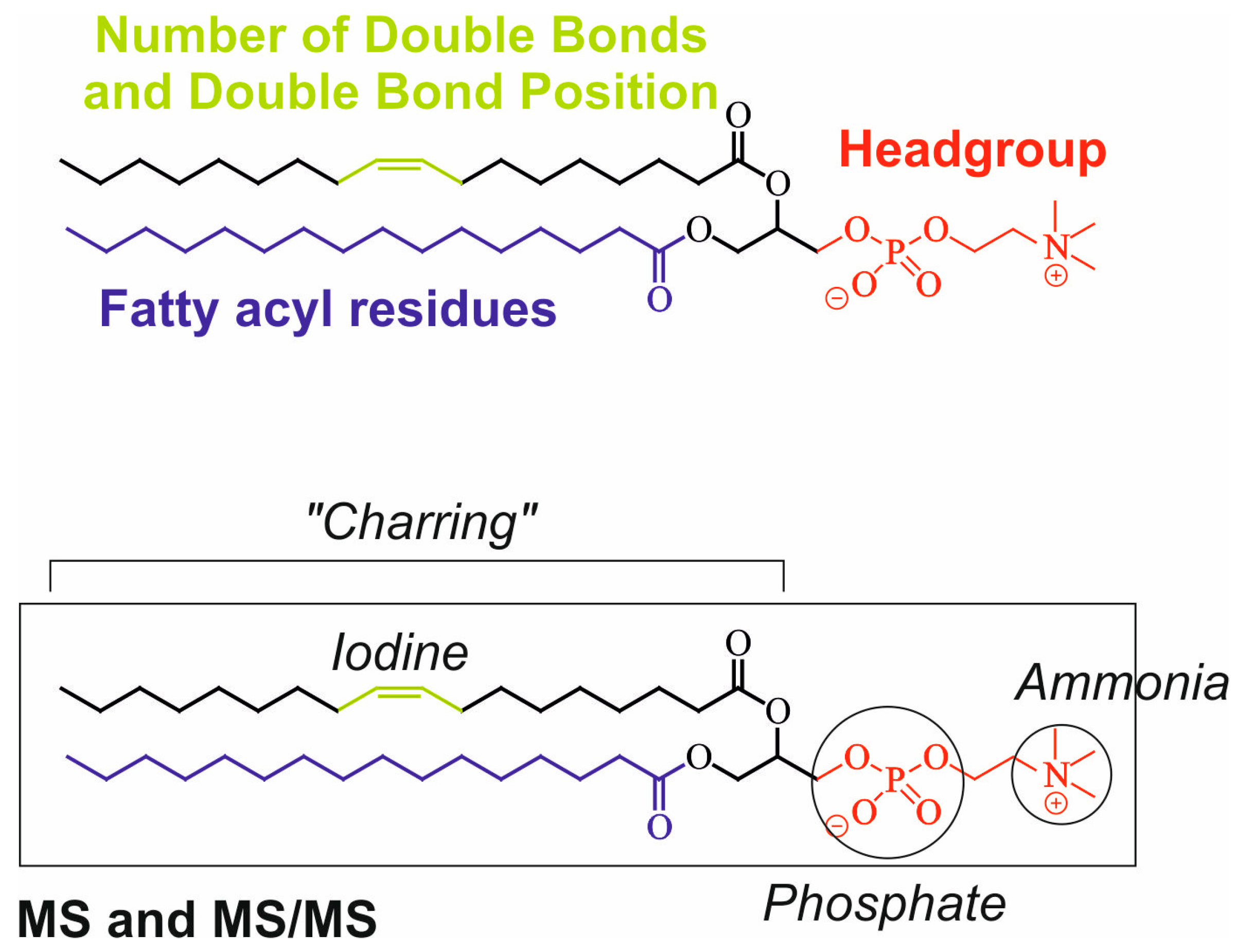
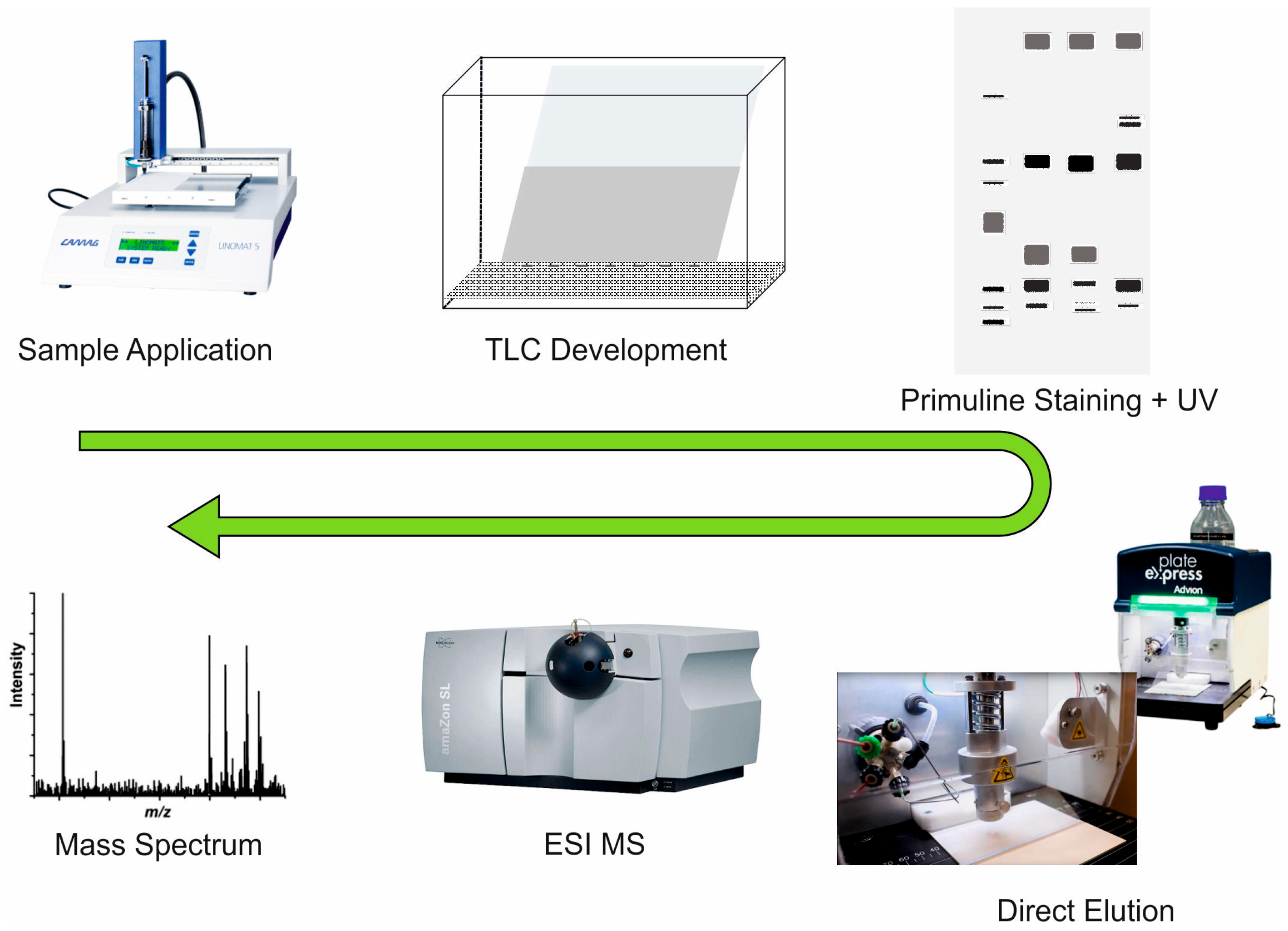
- MS is widely used to elucidate the lipid fractions on a TLC plate [64]. In the following sections, we will focus on the coupling between TLC and soft ionization MS (electrospray ionization (ESI) and MALDI), discussing the application of extraction-based and desorption-based techniques separately.
3.2. Extraction-Based Analysis of Stained TLC Plates
4. Desorption Techniques
- (1)
- There is no need to extract the sample from the TLC plate, since the MS analysis is performed directly on the TLC plate. This is convenient and bears no risk of analyte loss upon the extraction process. However, it remains unclear whether all analytes are desorbed to the same extent from the TLC plate.
- (2)
- Since the analysis of a dedicated spot can be performed within a few seconds, there is no risk of sample alteration, such as unwanted lipid (per)oxidation. This particularly applies because the TLC plate is under high vacuum during data acquisition. For instance, we successfully analyzed lipids in sperm, which are rich in docosahexaenoic acid with six double bonds, without a significant sign of oxidation [75].
- (3)
- Since the spatial resolution is determined by the MALDI laser spot size, the resolving power is much higher compared to common staining and visual inspection [74]. Thus, TLC/MALDI is able to resolve different components within a single TLC spot that cannot be resolved by staining alone, for example, phospholipid species with the same headgroup but different fatty acyl residues.
5. Summary
Author Contributions
Funding
Conflicts of Interest
Abbreviations
| APCI | atmospheric pressure chemical ionization |
| DESI | desorption electrospray ionization |
| ESI | electrospray ionization |
| F254 | fluorescent indicator |
| GC | gas chromatography |
| HPLC | high-performance liquid chromatography |
| HPTLC | high-performance thin-layer chromatography |
| IR | infrared |
| LC | liquid chromatography |
| LPC | lysophosphatidylcholine |
| MALDI | matrix-assisted laser desorption/ionization |
| MS | mass spectrometry |
| MS/MS | tandem mass spectrometry |
| NMR | nuclear magnetic resonance |
| NP | normal phase |
| PBH | 1-pyrenebutyric hydrazide |
| PC | phosphatidylcholine |
| PE | phosphatidylethanolamine |
| PL | phospholipid |
| PS | phosphatidylserine |
| RP | reversed phase |
| SM | sphingomyelin |
| TLC | thin-layer chromatography |
| UV | ultraviolet |
References
- Morlock, G.; Schwack, W. Hyphenations in planar chromatography. J. Chromatogr. A 2010, 1217, 6600–6609. [Google Scholar] [CrossRef]
- Fuchs, B.; Süss, R.; Teuber, K.; Eibisch, M.; Schiller, J. Lipid analysis by thin-layer chromatography—A review of the current state. J. Chromatogr. A 2011, 1218, 2754–2774. [Google Scholar] [CrossRef]
- D’Atri, V.; Murisier, A.; Fekete, S.; Veuthey, J.-L.; Guillarme, D. Current and future trends in reversed-phase liquid chromatography-mass spectrometry of therapeutic proteins. TrAC Trends Anal. Chem. 2020, 130, 115962. [Google Scholar] [CrossRef]
- Zschörnig, K.; Schiller, J. A simple method to generate oxidized phosphatidylcholines in amounts close to one milligram. Chem. Phys. Lipids 2014, 184, 30–37. [Google Scholar] [CrossRef] [PubMed]
- Olsson, N.U. Advances in planar chromatography for the separation of food lipids. J. Chromatogr. 1992, 624, 11–19. [Google Scholar] [CrossRef]
- Leopold, J.; Engel, K.M.; Prabutzki, P.; Schiller, J. Combined Use of MALDI-TOF Mass Spectrometry and 31P NMR Spectroscopy for the Analysis of (Phospho)Lipids. Methods Mol. Biol. 2023, 2625, 183–200. [Google Scholar] [CrossRef]
- Folch, J.; Lees, M.; Sloane Stanley, G.H. A simple method for the isolation and purification of total lipides from animal tissues. J. Biol. Chem. 1957, 226, 497–509. [Google Scholar] [CrossRef]
- Bligh, E.G.; Dyer, W.J. A rapid method of total lipid extraction and purification. Can. J. Biochem. Physiol. 1959, 37, 911–917. [Google Scholar] [CrossRef] [PubMed]
- Dyńska-Kukulska, K.; Ciesielski, W. Methods of extraction and thin-layer chromatography determination of phospholipids in biological samples. Rev. Anal. Chem. 2012, 31, 43–56. [Google Scholar] [CrossRef]
- Leray, C.; Pelletier, X.; Hemmendinger, S.; Cazenave, J.P. Thin-layer chromatography of human platelet phospholipids with fatty acid analysis. J. Chromatogr. 1987, 420, 411–416. [Google Scholar] [CrossRef] [PubMed]
- Christie, W.W.; Han, X. Lipid Analysis: Isolation, Separation, Identification and Lipidomic Analysis, 4th ed.; Oily Press, an Imprint of PJ Barnes & Associates: Bridgwater, UK, 2010; ISBN 9780955251245. [Google Scholar]
- Madureira, A.M.; Ferreira, M.-J.U. 1.5. Thin-Layer Chromatography of Plants Pigments. In Comprehensive Organic Chemistry Experiments for the Laboratory Classroom; Afonso, C.A.M., Candeias, N.R., Simão, D.P., Trindade, A.F., Coelho, J.A.S., Tan, B., Franzén, R., Eds.; The Royal Society of Chemistry: London, UK, 2016; pp. 18–22. ISBN 978-1-84973-963-4. [Google Scholar]
- Wang, Y.; Krull, I.S.; Liu, C.; Orr, J.D. Derivatization of phospholipids. J. Chromatogr. B Analyt. Technol. Biomed. Life Sci. 2003, 793, 3–14. [Google Scholar] [CrossRef] [PubMed]
- Zhu, C.; Liang, Q.-L.; Wang, Y.-M.; Luo, G.-A.; Vreeken, R.J.; Hankmeimer, T. Advance in Analysis and Detection Technologies for Phospholipidomics. Chin. J. Anal. Chem. 2016, 44, 984–993. [Google Scholar] [CrossRef]
- Plekhanov, A.Y. Rapid staining of lipids on thin-layer chromatograms with amido black 10B and other water-soluble stains. Anal. Biochem. 1999, 271, 186–187. [Google Scholar] [CrossRef] [PubMed]
- Teuber, K.; Fedorova, M.; Hoffmann, R.; Schiller, J. 2,4-Dinitrophenylhydrazine as a New Reactive Matrix to Analyze Oxidized Phospholipids by MALDI-TOF Mass Spectrometry. Anal. Lett. 2012, 45, 968–976. [Google Scholar] [CrossRef]
- Prabutzki, P.; Schiller, J.; Engel, K.M. MALDI-TOF MS Detection of Oxidized Major Phospholipids in Biological Samples Using Conventional Matrices and 1-Pyrenebutyric Hydrazide. J. Am. Soc. Mass Spectrom. 2025, 36, 2197–2205. [Google Scholar] [CrossRef]
- Sherma, J.; Bennett, S. Comparison of Reagents for Lipid and Phospholipid Detection and Densitometric Quantitation on Silica Gel and C 18 Reversed Phase Thin Layers. J. Liq. Chromatogr. 1983, 6, 1193–1211. [Google Scholar] [CrossRef]
- Wood, W.G.; Cornwell, M.; Williamson, L.S. High performance thin-layer chromatography and densitometry of synaptic plasma membrane lipids. J. Lipid Res. 1989, 30, 775–779. [Google Scholar] [CrossRef]
- Cebolla, V.L.; Lázaro, M.J.; Herod, A.A. Petroleum Products—Thin Layer (Planar) Chromatography☆. In Reference Module in Chemistry, Molecular Sciences and Chemical Engineering; Elsevier: Amsterdam, The Netherlands, 2016; ISBN 9780124095472. [Google Scholar]
- Vasta, J.V.; Sherma, J. Comparison of spraying, dipping, and the derivapress for postchromatic derivatization with phosphomolybdic acid in the detection and quantification of neutral lipids by high-performance thin-layer chromatography. Acta Chromatogr. 2008, 20, 15–23. [Google Scholar] [CrossRef]
- Asressu, K.H.; Zhang, Q. Detection and Semi-quantification of Lipids on High-Performance Thin-Layer Chromatography Plate using Ceric Ammonium Molybdate Staining. Eur. J. Lipid Sci. Technol. 2023, 125, 2200096. [Google Scholar] [CrossRef]
- Meyer, T.; Knittelfelder, O.; Smolnig, M.; Rockenfeller, P. Quantifying yeast lipidomics by high-performance thin-layer chromatography (HPTLC) and comparison to mass spectrometry-based shotgun lipidomics. Microb. Cell 2024, 11, 57–68. [Google Scholar] [CrossRef]
- Müthing, J.; Radloff, M. Nanogram detection of phospholipids on thin-layer chromatograms. Anal. Biochem. 1998, 257, 67–70. [Google Scholar] [CrossRef]
- Schweisguth, D.C.; Quelle, F.W.; Wachob, G.; Hammerstedt, R.H. Isolation and characterization of brain lipids by solid phase extraction and thin layer chromatography. Biochem. Educ. 1989, 17, 211–213. [Google Scholar] [CrossRef]
- Dittmer, J.C.; Lester, R.L. A simple, specific spray for the detection of phospholipids on thin-layer chromatograms. J. Lipid Res. 1964, 5, 126–127. [Google Scholar] [CrossRef]
- Palumbo, G.; Zullo, F. The use of iodine staining for the quantitative analysis of lipids separated by thin layer chromatography. Lipids 1987, 22, 201–205. [Google Scholar] [CrossRef]
- Coman, V.; Copaciu, F. Analysis of Dyes and Inks. In Instrumental Thin-Layer Chromatography; Elsevier: Amsterdam, The Netherlands, 2015; pp. 555–588. ISBN 9780124172234. [Google Scholar]
- Martínez-Lorenzo, M.J.; Marzo, I.; Naval, J.; Piñeiro, A. Self-staining of polyunsaturated fatty acids in argentation thin-layer chromatography. Anal. Biochem. 1994, 220, 210–212. [Google Scholar] [CrossRef]
- Dołowy, M.; Pyka, A. Chromatographic Methods in the Separation of Long-Chain Mono- and Polyunsaturated Fatty Acids. J. Chem. 2015, 2015, 120830. [Google Scholar] [CrossRef]
- Nakamura, K.; Handa, S. Coomassie brilliant blue staining of lipids on thin-layer plates. Anal. Biochem. 1984, 142, 406–410. [Google Scholar] [CrossRef]
- Hofmann, T.; Barth, M.; Meister, A.; Kastritis, P.L.; Schmidt, C. Thin-Layer Chromatography and Coomassie Staining of Phospholipids for Fast and Simple Lipidomics Sample Preparation. Anal. Sens. 2021, 1, 171–179. [Google Scholar] [CrossRef]
- Kerr, E.; West, C.; Kradtap Hartwell, S. Quantitative TLC-Image Analysis of Urinary Creatinine Using Iodine Staining and RGB Values. J. Chromatogr. Sci. 2016, 54, 639–646. [Google Scholar] [CrossRef]
- Kishimoto, K.; Urade, R.; Ogawa, T.; Moriyama, T. Nondestructive quantification of neutral lipids by thin-layer chromatography and laser-fluorescent scanning: Suitable methods for “lipidome” analysis. Biochem. Biophys. Res. Commun. 2001, 281, 657–662. [Google Scholar] [CrossRef]
- Wagener, H. Detection and documentation of lipids after thin-layer chromatography. Nature 1965, 205, 386–387. [Google Scholar] [CrossRef]
- Fowler, S.D.; Brown, W.J.; Warfel, J.; Greenspan, P. Use of nile red for the rapid in situ quantitation of lipids on thin-layer chromatograms. J. Lipid Res. 1987, 28, 1225–1232. [Google Scholar] [CrossRef]
- Aiken, J.H.; Huie, C.W. Use of hematoporphyrin as a fluorescent stain for detection of lipids in high-performance thin-layer chromatography. J. Chromatogr. A 1991, 588, 295–301. [Google Scholar] [CrossRef]
- Cossio, F.P.; Arrieta, A.; Cebolla, V.L.; Membrado, L.; Vela, J.; Garriga, R.; Domingo, M.P. Berberine cation: A fluorescent chemosensor for alkanes and other low-polarity compounds. An explanation of this phenomenon. Org. Lett. 2000, 2, 2311–2313. [Google Scholar] [CrossRef]
- Laggai, S.; Simon, Y.; Ranssweiler, T.; Kiemer, A.K.; Kessler, S.M. Rapid chromatographic method to decipher distinct alterations in lipid classes in NAFLD/NASH. World J. Hepatol. 2013, 5, 558–567. [Google Scholar] [CrossRef]
- Silversand, C.; Haux, C. Improved high-performance liquid chromatographic method for the separation and quantification of lipid classes: Application to fish lipids. J. Chromatogr. B Biomed. Sci. Appl. 1997, 703, 7–14. [Google Scholar] [CrossRef]
- Nakamura, K.; Suzuki, Y.; Goto-Inoue, N.; Yoshida-Noro, C.; Suzuki, A. Structural characterization of neutral glycosphingolipids by thin-layer chromatography coupled to matrix-assisted laser desorption/ionization quadrupole ion trap time-of-flight MS/MS. Anal. Chem. 2006, 78, 5736–5743. [Google Scholar] [CrossRef]
- Himmelsbach, M.; Varesio, E.; Hopfgartner, G. Liquid extraction surface analysis (LESA) of hydrophobic TLC plates coupled to chip-based nanoelectrospray high-resolution mass spectrometry. Chimia (Aarau) 2014, 68, 150–154. [Google Scholar] [CrossRef]
- Kritchevsky, D.; Davidson, L.M.; Kim, H.K. Quantitation of serum lipids by a simple TLC-charring method. Clin. Chim. Acta 1973, 46, 63–68. [Google Scholar] [CrossRef]
- Jurowski, K.; Kochan, K.; Walczak, J.; Barańska, M.; Piekoszewski, W.; Buszewski, B. Analytical Techniques in Lipidomics: State of the Art. Crit. Rev. Anal. Chem. 2017, 47, 418–437. [Google Scholar] [CrossRef]
- Mountfort, K.A.; Bronstein, H.; Archer, N.; Jickells, S.M. Identification of oxidation products of squalene in solution and in latent fingerprints by ESI-MS and LC/APCI-MS. Anal. Chem. 2007, 79, 2650–2657. [Google Scholar] [CrossRef]
- Pinault, M.; Guimaraes, C.; Dumas, J.-F.; Servais, S.; Chevalier, S.; Besson, P.; Goupille, C. A 1D High Performance Thin Layer Chromatography Method Validated to Quantify Phospholipids Including Cardiolipin and Monolysocardiolipin from Biological Samples. Eur. J. Lipid Sci. Technol. 2020, 122, 1900240. [Google Scholar] [CrossRef]
- Marsh, J.B.; Weinstein, D.B. Simple charring method for determination of lipids. J. Lipid Res. 1966, 7, 574–576. [Google Scholar] [CrossRef]
- Macala, L.J.; Yu, R.K.; Ando, S. Analysis of brain lipids by high performance thin-layer chromatography and densitometry. J. Lipid Res. 1983, 24, 1243–1250. [Google Scholar] [CrossRef]
- TLC Visualization Reagents. Available online: https://www.epfl.ch/labs/lcso/wp-content/uploads/2018/06/TLC_Stains.pdf (accessed on 23 September 2025).
- Visualizing Spray Agents for Thin Layer Chromatography: Chromatography Spray Index-Selection Guide. Available online: http://delloyd.50megs.com/MOBILE/sprayreagents.html (accessed on 23 September 2025).
- Zarzycki, P.; Bartoszuk, M.; Radziwon, A. Optimization of TLC detection by phosphomolybdic acid staining for robust quantification of cholesterol and bile acids. J. Planar Chromatogr.–Mod. TLC 2006, 19, 52–57. [Google Scholar] [CrossRef]
- Yunghans, W.N.; Clark, J.E.; Morré, D.J.; Clegg, E.D. Nature of the phosphotungstic acid-chromic acid (PACP) stain for plasma membranes of plants and mammalian sperm. Cytobiologie 1978, 17, 165–172. [Google Scholar]
- Freeman, C.P.; West, D. Complete separation of lipid classes on a single thin-layer plate. J. Lipid Res. 1966, 7, 324–327. [Google Scholar] [CrossRef]
- Bansal, K.; McCrady, J.; Hansen, A.; Bhalerao, K. Thin layer chromatography and image analysis to detect glycerol in biodiesel. Fuel 2008, 87, 3369–3372. [Google Scholar] [CrossRef]
- Churchward, M.A.; Brandman, D.M.; Rogasevskaia, T.; Coorssen, J.R. Copper (II) sulfate charring for high sensitivity on-plate fluorescent detection of lipids and sterols: Quantitative analyses of the composition of functional secretory vesicles. J. Chem. Biol. 2008, 1, 79–87. [Google Scholar] [CrossRef]
- Gellermann, G.P.; Appel, T.R.; Davies, P.; Diekmann, S. Paired helical filaments contain small amounts of cholesterol, phosphatidylcholine and sphingolipids. Biol. Chem. 2006, 387, 1267–1274. [Google Scholar] [CrossRef]
- Okino, N.; Ito, M. Thin-Layer Chromatography (TLC) of Glycolipids. 2021 Sep 29 [Updated 2022 Mar 22]. Available online: https://www.ncbi.nlm.nih.gov/books/NBK594049/pdf/Bookshelf_NBK594049.pdf (accessed on 4 January 2026).
- Cao, E.; Liu, X.; Xu, N. Direct determination of diene conjugation and deoxyribonucleic acid (DNA) oxidative damage can explain the role of DTPA-Fe2+-O2 complex in a linoleic acid-DNA system. Redox Rep. 1996, 2, 63–68. [Google Scholar] [CrossRef]
- Juszczak, A.M.; Zovko-Končić, M.; Tomczyk, M. Recent Trends in the Application of Chromatographic Techniques in the Analysis of Luteolin and Its Derivatives. Biomolecules 2019, 9, 731. [Google Scholar] [CrossRef] [PubMed]
- Griesinger, H.; Süβ, R.; Leopold, J.; Schulz, M.; Schiller, J. The presence of the fluorescence indicator (F 254) changes the TLC migration properties of selected phospholipids. J. Planar Chromatogr.–Mod. TLC 2018, 31, 409–411. [Google Scholar] [CrossRef]
- Han, C.; Wang, Q.; Yao, Y.; Zhang, Q.; Huang, J.; Zhang, H.; Qu, L. Thin layer chromatography coupled with surface enhanced Raman scattering for rapid separation and on-site detection of multi-components. J. Chromatogr. A 2023, 1706, 464217. [Google Scholar] [CrossRef] [PubMed]
- Schuurman, J.L.; van Tetering, L.; Berden, G.; Oomens, J.; Martens, J. Structure characterisation using thin-layer chromatography-MALDI MS and infrared ion spectroscopy. Int. J. Mass Spectrom. 2025, 518, 117512. [Google Scholar] [CrossRef]
- Wilson, I.D.; Spraul, M.; Humpfer, E. Thin-Layer Chromatography Combined with High-Resolution Solid-State NMR for Compound Identification Without Substance Elution: Preliminary Results. J. Planar Chromatogr. 1997, 10, 217–219. [Google Scholar]
- Fuchs, B.; Süß, R.; Nimptsch, A.; Schiller, J. MALDI-TOF-MS Directly Combined with TLC: A Review of the Current State. Chromatographia 2009, 69, 95–105. [Google Scholar] [CrossRef]
- Killeen, C.; Kropp, A.; Chagunda, I.C.; Jackson, E.C.; Scott McIndoe, J. The amenability of different solvents to electrospray ionization mass spectrometry. Int. J. Mass Spectrom. 2024, 506, 117349. [Google Scholar] [CrossRef]
- Sah, A.K.; Tanase, T. Amine mediated proton transfer reaction and C-Cl bond activation of solvent chloroform by a trinuclear copper(II) complex of a glucopyranosylamine derived ligand. Dalton Trans. 2006, 31, 3742–3751. [Google Scholar] [CrossRef]
- Engel, K.M.; Schiller, J. The value of coupling thin-layer chromatography to mass spectrometry in lipid research—a review. J. Chromatogr. B Analyt. Technol. Biomed. Life Sci. 2021, 1185, 123001. [Google Scholar] [CrossRef]
- Alpmann, A.; Morlock, G. Improved online coupling of planar chromatography with electrospray mass spectrometry: Extraction of zones from glass plates. Anal. Bioanal. Chem. 2006, 386, 1543–1551. [Google Scholar] [CrossRef]
- Sherma, J.; Rabel, F. Review of advances in planar chromatography-mass spectrometry published in the period 2015–2019. J. Liq. Chromatogr. Relat. Technol. 2020, 43, 394–412. [Google Scholar] [CrossRef]
- Luftmann, H. A simple device for the extraction of TLC spots: Direct coupling with an electrospray mass spectrometer. Anal. Bioanal. Chem. 2004, 378, 964–968. [Google Scholar] [CrossRef]
- Schendzielorz, M.; Schmidt, T.; Puchalla, N.; Csuk, R.; Kramell, A.E. TLC and HPTLC-APCI-MS for the rapid discrimination of plant resins frequently used for lacquers and varnishes by artists and conservators. Phytochem. Anal. 2024, 35, 64–76. [Google Scholar] [CrossRef]
- Srimany, A.; Jayashree, B.; Krishnakumar, S.; Elchuri, S.; Pradeep, T. Identification of effective substrates for the direct analysis of lipids from cell lines using desorption electrospray ionization mass spectrometry. Rapid Commun. Mass Spectrom. 2015, 29, 349–356. [Google Scholar] [CrossRef]
- Cebolla, V.L.; Jarne, C.; Vela, J.; Garriga, R.; Membrado, L.; Galbán, J. Scanning densitometry and mass spectrometry for HPTLC analysis of lipids: The last 10 years. J. Liq. Chromatogr. Relat. Technol. 2021, 44, 148–170. [Google Scholar] [CrossRef]
- Engel, K.M.; Prabutzki, P.; Leopold, J.; Nimptsch, A.; Lemmnitzer, K.; Vos, D.R.N.; Hopf, C.; Schiller, J. A new update of MALDI-TOF mass spectrometry in lipid research. Prog. Lipid Res. 2022, 86, 101145. [Google Scholar] [CrossRef]
- Engel, K.M.; Jakop, U.; Müller, K.; Grunewald, S.; Paasch, U.; Schiller, J. MALDI MS Analysis to Investigate the Lipid Composition of Sperm. Curr. Anal. Chem. 2020, 16, 79–91. [Google Scholar] [CrossRef]
- Krüger, S.; Bürmann, L.; Morlock, G.E. Comparison and characterization of soybean and sunflower lecithins used for chocolate production by high-performance thin-layer chromatography with fluorescence detection and electrospray mass spectrometry. J. Agric. Food Chem. 2015, 63, 2893–2901. [Google Scholar] [CrossRef]
- Griesinger, H.; Fuchs, B.; Süß, R.; Matheis, K.; Schulz, M.; Schiller, J. Stationary phase thickness determines the quality of thin-layer chromatography/matrix-assisted laser desorption and ionization mass spectra of lipids. Anal. Biochem. 2014, 451, 45–47. [Google Scholar] [CrossRef] [PubMed]
- Fisk, H.L.; West, A.L.; Childs, C.E.; Burdge, G.C.; Calder, P.C. The use of gas chromatography to analyze compositional changes of fatty acids in rat liver tissue during pregnancy. J. Vis. Exp. 2014, 85, 51445. [Google Scholar] [CrossRef]


| Method | Characteristics/Specificity | Reference |
|---|---|---|
| Iodine (I2) | I2 is non-covalently bound to lipids; spot intensity depends on the number of double bonds. Rather inexpensive and simple [33]. | [27] |
| Rhodamine 6G | For the detection of lipids at long-wavelength UV. Suggested to represent a “lipidomics” approach because virtually all lipids are detectable [34]. | [35] |
| Coomassie brilliant blue | Stains virtually all lipid classes. The sensitivity is about 0.05 to 0.5 µg per lipid. Was recently combined with ESI MS detection of the re-eluted lipids [32]. | [31] |
| Nile red (fluorescent) | Detects most lipids, although the fluorescence intensity varies among the lipid classes. Also, staining is stronger for unsaturated lipids than for saturated ones. To the best of our knowledge, it is the most sensitive assay. Detection limit of 25–100 ng. | [36] |
| Hematoporphyrin | Fluorimetric detection of low nanogram amounts of cholesterol, cholesteryl esters, triolein, sphingomyelin and lecithin by using an argon laser (488 nm). Copper-(II)-nitrate solution attenuates the background fluorescence. | [37] |
| Berberine | Suitable for the estimation of the length of the alkyl chains since the fluorescent emission increases in the presence of molecules with long hydrocarbon chains. | [38] |
| 2′,7′-dichloro-fluorescein | For lipid samples containing 2.5 up to 20 μg lipid. 2′,7′-dichlorofluorescein detects all lipid classes while sulfuric acid/ethanol spray reagent (used for means of comparison) could not detect saturated fatty acids and LPC. | [39,40] |
| Primuline (Direct yellow 59) | Non-covalent interaction with lipids. Perfectly suited for combination with MS detection because primuline can be quantitatively removed from the lipid by exposition to vacuum and/or changing the polarity of the solvent. | [41] |
| Method | Characteristics | Ref. |
|---|---|---|
| Phosphomolybdic acid (MDA) (for detection of reducing compounds such as cholesterol and selected bile acids) | Charring until lipids are visible as brown, gray, or black spots. MDA can be used for NP and RP plates. In the case of octadecylsilica materials, however, the MDA also reacts with some of the C18 groups. The consequence of this is a dark background and, therefore, poorly sensitive analyte detection. | [51] |
| Phosphotungstic acid | For the detection of cholesterol and its esters, reducing compounds, lipids, sterols and steroids. Cholesterol esters will produce red spots. Significantly less often used than MDA but often applied in tissue analysis. | [52] |
| Potassium dichromate (in concentrated sulfuric acid) | Brown, gray, or black spots result. Similar to MDA. | [53] |
| Potassium permanganate/sulfuric acid | Do not use this reagent on polymer-bound TLC plates since it will destroy the binder; use it only with G (gyp-sum) binder plates! Excellent for functional groups sensitive to oxidation. Alkenes and alkynes will appear readily on a TLC plate following immersion into the stain as bright yellow spots on a bright purple background. Alcohols, amines, sulfides, thiols and other oxidizable functional groups often require slight heating. | [54] |
| Copper (II) sulfate in phosphoric acid | Often considered as the optimum method of lipid staining since it stains all major lipid classes to an identical extent. Thus, differences in spot intensities reflect different concentrations. Fast (dipping for 3 s is sufficient). About 1.7 to 2.0 μg of lipids are detectable [55]. | [56] |
| Ceric ammonium molybdate (CAM) staining with charring | Remarkable sensitivity of just about 130 ng of lipid. Useful if the amount of lipids is limited. | [22] |
| Orcinol or resorcinol in sulfuric acid | Spots containing glycolipids develop a pink-violet color on a white background. Detection limit of approximately 0.5 nmol. | [57] |
Disclaimer/Publisher’s Note: The statements, opinions and data contained in all publications are solely those of the individual author(s) and contributor(s) and not of MDPI and/or the editor(s). MDPI and/or the editor(s) disclaim responsibility for any injury to people or property resulting from any ideas, methods, instructions or products referred to in the content. |
© 2026 by the authors. Licensee MDPI, Basel, Switzerland. This article is an open access article distributed under the terms and conditions of the Creative Commons Attribution (CC BY) license.
Share and Cite
Schubarth, J.W.; Leopold, J.; Engel, K.M.; Schiller, J. Lipid Analysis by Thin-Layer Chromatography—Detection, Staining and Derivatization. Lipidology 2026, 3, 3. https://doi.org/10.3390/lipidology3010003
Schubarth JW, Leopold J, Engel KM, Schiller J. Lipid Analysis by Thin-Layer Chromatography—Detection, Staining and Derivatization. Lipidology. 2026; 3(1):3. https://doi.org/10.3390/lipidology3010003
Chicago/Turabian StyleSchubarth, Johanna W., Jenny Leopold, Kathrin M. Engel, and Jürgen Schiller. 2026. "Lipid Analysis by Thin-Layer Chromatography—Detection, Staining and Derivatization" Lipidology 3, no. 1: 3. https://doi.org/10.3390/lipidology3010003
APA StyleSchubarth, J. W., Leopold, J., Engel, K. M., & Schiller, J. (2026). Lipid Analysis by Thin-Layer Chromatography—Detection, Staining and Derivatization. Lipidology, 3(1), 3. https://doi.org/10.3390/lipidology3010003