
Article

Fatty Acids Differentially Induce Lipid Droplet Formation in HeLa Cells
Department of Biological Sciences, Purdue University, West Lafayette, IN 47907, USA
Lipidology 2026, 3(1), 1; https://doi.org/10.3390/lipidology3010001
Submission received: 20 October 2025 / Revised: 24 November 2025 / Accepted: 25 December 2025 / Published: 30 December 2025

Abstract

Background/Objectives: Long-chain fatty acids induce lipid droplet formation in several cell types including cancer cells. These lipid droplets have been shown to accumulate in various cancers and are dysregulated in many pathologies. Thus, this study was designed to examine the many unique long-chain fatty acids and their abilities to induce lipid droplet formation in cancer cells. Methods: HeLa human cervical cancer cells were incubated with individual fatty acids and live-stained for lipid droplets. This study analyzed four saturated, four monounsaturated, and nine polyunsaturated (4 omega-3, 4 omega-6, and 1 omega-9) fatty acids. This diversity of fatty acids was chosen to highlight any important non-uniform differences in the regulation of lipid droplet formation by unsaturated fatty acids. The area of the lipid droplets and the number of lipid droplets per cell were measured and compared between the different fatty acid conditions. Results: Unsaturated fatty acids induced lipid droplets differently compared to saturated fatty acids. Further, an inverse relationship was established between average area of lipid droplets and the average number of lipid droplets per cell. Finally, two perilipin genes (PLIN1/2) involved in lipid droplet formation were shown to have significantly higher expression with the two polyunsaturated fatty acids (alpha- and gamma-linolenic acid) versus the saturated fatty acid (stearic acid) condition. Conclusions: Together, different fatty acids produce structurally different lipid droplets. It will be important to further investigate the biochemistry and mechanistic differences in the formation of these lipid droplets under these specific long-chain fatty acid conditions.

1. Introduction

Lipid droplets (LDs) are organelles that store neutral lipids [1]. LDs are formed when cells either synthesize de novo or uptake extracellular lipids, such as fatty acids [2,3]. There are several biochemical pathways that are involved in LD formation including those involved in triglyceride synthesis [4,5] and those involved in the esterification of cholesterol with fatty acids [4,6]. The larger the area of LDs and their numbers per cell, the more lipids may be stored [7]. LDs are degraded by pathways that include lipolysis (the breakdown of triglycerides) and lipophagy (the use of autophagy to break down LDs) [8]. Together, these lipid metabolism pathways regulate the formation of LDs.
Over the past 20 years, LDs have gained increased interest in the scientific community as they are key players in cancer cells and tumor tissues [9,10]. Cancer cells utilize LDs as a source of lipids for energy for rapid cell proliferation [3,11]. In addition to cancers, LD dysregulation is frequently noted in many different pathologies including obesity, metabolic-associated steatotic liver disease, cardiovascular disease [1], type 2 diabetes [12], and neurodegenerative disorders [13]. LDs are believed to play a role in preventing fatty-acid-induced lipotoxicity by taking up excess fatty acids [14], suggesting a survival pathway for various cancers. Importantly, LDs accumulate in various cancers and have been shown to provide protective roles, especially in response to oxidative and nutrient stressors on cells by sequestering toxic lipids [15]. Specifically, in laryngeal carcinoma cells, LDs are present in chemotherapy-resistant cells and suggest that lipid metabolism could be playing a role in cancer [16]. Importantly, LDs are shown to be involved in cancer initiation and progression [17]. Recently, the accumulation of LDs in cancer cells has been associated with multiple hallmarks of cancer [18,19]. Further, the degradation of these LDs by lipophagy is critical for cancer cell energy homeostasis [20] and these LDs’ release of lipids are important for pro-survival signaling in cancer cells [21]. Thus, it is important that we understand the different methods of LD induction to better understand their role in cancer progression.
Cancer cells use lipids housed in LDs for anabolic cancer processes [22]. These lipids are either extrinsically obtained from neighboring cells in the tumor microenvironment or generated from lipogenesis [22]. There have been several reports in recent years utilizing the mechanism of cellular update of exogenous free fatty acids to induce LD formation in hepatic and non-hepatic cell types [23,24,25,26]. These studies focused on smaller sets of fatty acids and not usually in cancer cell types. This provides us with a critical need to understand how a diverse set of exogenous fatty acids contribute to cancer cell production of LDs.
Fatty acids are structurally unique regarding many properties. One property examined previously with induced LD formation is degree of unsaturation. Some saturated fatty acids have previously been shown to induce LD formation in human hepatocytes Huh-7 cells [27]. Some monounsaturated and polyunsaturated fatty acids have been previously shown to induce LD formation in HeLa cervical cancer cells [26]. However, no previous studies have explored many diverse saturated and unsaturated fatty acids in cancer cells. Further, the importance of unsaturation status of these fatty acids on their effect on cancer has been conflicting. Some polyunsaturated fatty acids have pro-tumor and some anti-tumor impacts [28,29]. A lipid profiling study in breast cancer cells showed that saturated fatty acids were related to more aggressive metastatic cancer phenotypes compared to unsaturated fatty acids [30].
One idea why the unsaturation status might associate with differing impacts is that saturated and unsaturated fatty acids differ in the contribution to lipotoxicity due to triglyceride accumulation in cells. For example, monounsaturated fatty acid oleic acid (C18:1) was found to provide protection against lipotoxicity, whereas the saturated fatty acid palmitic acid (C16:0) did not [14]. Oleic acid supplementation prevented palmitic acid-induced apoptosis by promoting neutral lipid storage as LDs [14]. This indicates that, at least for these two fatty acids, there might be a difference between their impact on triglyceride metabolism. Another report with a more robust analysis showed that this protection against lipotoxicity might not be dependent on LD formation [31]. However, a more recent study indicated that this protection against stress might be dependent on the unsaturation status of the fatty acids themselves [32]. Also, in mouse neuroblastoma cells, the saturated fatty acid palmitic acid (C16:0) again contributed to decreased cell viability; however, this was recovered when co-treated with either monounsaturated or polyunsaturated fatty acids [33]. Further, in C. elegans, stearoyl-CoA desaturase, a key enzyme in de novo lipogenesis and in the desaturation of fatty acids, was determined to be required for the development of LDs with large diameters [34]. Finally, previous work indicates that saturated fatty acids overall might have more tendencies toward lipotoxicity [35]. While this study did not measure specific lipotoxicity effects, it is a common feature difference in the impact that exogenous saturated versus unsaturated fatty acids are having on cells. These more recent studies all indicate that unsaturated fatty acids are having unique impacts on LD formation and lipotoxicity in some cell types compared to those that are fully saturated. Thus, it is important that we investigate here the impact that unsaturation status has on LD formation in human cancer cells.
The biogenesis of LDs use proteins called perilipins located on the surface of LDs [36,37,38,39] and whose gene expression has previously been used to indicate LD formation patterns [7,31]. In adipocytes, where LD formation area can vary widely, it was shown that, when larger-diameter LDs formed, there were increases in PLIN1/2 gene expression [40]. Additionally, PLIN1-complexes have been shown to promote large-diameter LDs in adipocytes [39]. Finally, perilipins help control the transition of LDs from lipid storage to lipid release via lipophagy [41] and may help provide a key role in LD involvement in energy regulation for a cancer tumor [10,18].
Perilipins have previously been shown to be dependent on unsaturation status. For example, the saturated palmitic acid (C16:0) alone could not induce PLIN1/2 gene expression. However, two monounsaturated fatty acids (oleic acid and gondoic acid) were able to significantly induce PLIN1/2 gene expression. These monounsaturated fatty-acid-induced LD formations were shown to be dependent upon PLIN1 and PLIN2 gene expression [31]. This induction of PLIN1/2 by monounsaturated fatty acids is likely thought to be an indirect effect via Peroxisome Proliferator-Activator Receptor γ (PPARγ) activation or via Sterol Regulatory Element-Binding Protein-1 (SREBP-1) [42]. There are other perilipin isoforms; however, based upon previous reported data, they do not seem to be consistently impacted by exogenous fatty acids in cells [40]. PLIN1/2 have previously been reported to be impacted by both unsaturated and saturated fatty acids, whereas PLIN4/5 have been responsive only to unsaturated fatty acids and PLIN3 was not responsive [43]. Further, previous studies have focused on PLIN1/2 as their main readouts [31]. Also, in preparation of this work, there were no previously verified primers for PLIN 3/4/5 in human cells. We wanted to make sure that primers that were used for PCR in this study would provide quality results. Therefore, it is important that we understand how exogenous saturated and unsaturated fatty acids influence the gene expression of perilipins to better understand a possible role for perilipins in LD formation.
Therefore, in this study, a wide range of saturated and unsaturated fatty acids was examined and the area and number of LDs in cancer cells were evaluated. Some specific saturated and polyunsaturated fatty acids not previously examined for their impacts on PLIN1/2 gene expression were also examined. Together, our goal was to provide evidence of the impact that saturated versus unsaturated fatty acids have on LD formation in cervical cancer cells.

2. Materials and Methods

2.1. Imaging

In total, 10,000 HeLa cells were plated per well in an eight-well chamber slide and were grown for 24 h. Individual fatty acids were prepared as previously described in [44] and dissolved in a 50% ethanol in water solution that was filtered. These fatty acids as salts or concentrated solutions were then adjusted to a final concentration of 21 mM in the 50% ethanol solution. Then fatty acid solutions were warmed to 37 °C and mixed in equal volumes with a 3.5 mM stock solution of defatted bovine serum albumin (BSA) in sterile water to a final concentration of fatty acid at 10.5 mM, resulting in a 6:1 molar ratio (BSA: fatty acid). Solutions were mixed by vortexing for about 5 min. Then cells were incubated at 37 °C for 24 h with 400 µM of the fatty acid or vehicle control (solvent only). This concentration and time was determined based upon previous studies [27,45,46]. The complete list of fatty acids used in this study are as follows. Saturated fatty acids used in this study include lauric acid (C12:0), myristic acid (C14:0), palmitic acid (C16:0), and stearic acid (C18:0). Monounsaturated fatty acids used in this study include palmitoleic acid (C16:1), oleic acid (C18:1), lysophosphatidic acid (LPA) (C18:1 + P), and nervonic acid (C24:1). Polyunsaturated fatty acids used in this study include linoleic acid (C18:2), 9Z, 11E-conjugated linoleic acid (CLA) (9Z, 11E-CLA C18:2), α-linolenic acid (α-C18:3), γ-linolenic acid (γ-C18:3), stearidonic acid (C18:4), mead acid (C20:3), arachidonic acid (C20:4), eicosapentaenoic acid (EPA) (C20:5), and docosahexaenoic acid (DHA) (C22:6). Live cell co-staining was carried out using LipidSpot 488 Lipid Droplet Stain (Biotium, Fremont, CA, USA, #70065), CF594 WGA (Biotium #29023-1), and NucBlue Live Cell Stain (Invitrogen, Carlsbad, CA, USA, #R37605) according to manufacturer’s directions. Cells were visualized using an EVOS FL Imaging System (Life Technologies, Carlsbad, CA, USA, AMF4300). Images were analyzed using ImageJ Software version 1.52e and Microsoft Excel. Detailed protocols of these methods can be found in [44]. Data were represented as box-and-whisker plots showing the Log10(X + 1) area of LDs (N ≥ 100 LDs) and the Log10(X + 1) number of LDs per cell (N ≥ 20 cells). Log10(X + 1) was used to analyze the data based upon previous work showing that this analysis technique is best used for data that have a large range of values tailing in one direction [47]. A 20-cell minimum was used because, experimentally, consistent graphs were established even with data over 20 cells while still balancing accuracy with the practicality of counting individual cells. One-way ANOVA analysis for independent measures was performed to compare more than two conditions in Excel. Tukey’s HSD post hoc analysis was performed to compare the conditions using the algorithm described previously in [48] and details can be found in Supplementary Tables S1–S6. For the comparison of the two conditions, palmitic acid versus palmitoleic acid, a two-sided unpaired assuming unequal variance t-test was performed.

2.2. Real-Time PCR

In total, 300,000 HeLa cells were plated per plate and were grown on 35 mm plates for 24 h. Then cells were incubated at 37 °C for 24 h with 400 µM of the fatty acid or vehicle control (solvent only). Total RNA was extracted using PureLink RNA Mini Kit (Invitrogen, Carlsbad, CA, USA, 12183020) according to the manufacturer’s instructions. cDNA was synthesized using High-Capacity cDNA Reverse Transcription Kit (Applied Biosystems, Foster City, CA, USA, 4368814) according to the manufacturer’s instructions. Relative quantification was performed using PowerUp SYBR Green Master Mix (Applied Biosystems, A25741) by real-time PCR using a BioRad iQ5 (Hercules, CA, USA). In brief, all the following primers were used as reported previously in [49]: PLIN1 F: 5′-ATTGCTCTGAGCTGAAGGACACCA-3′ and PLIN1 R: 5′-AGCTCGAGTGTTGGCAGCAAATTC-3′; PLIN2 F: 5′-TGAGATGGCAGAGAACGGTGTGAA-3′ and PLIN2 R: 5′-TTGCGGCTCTAGCTTCTGGATGAT-3′. The housekeeping gene 18S ribosomal RNA was used for all experiments; F: 5′-CGTTCTTAGTTGGTGGAGCG-3′ and R: 5′- CGCTGAGCCAGTCAGTGTAG-3′ have been used in previous studies with PLIN genes [49,50,51]. Real-time PCR reactions were performed in duplicate in the same run and each run was repeated twice for all measurements. A reference sample (control cells) with no fatty acid added (solvent only) was used as the internal calibrator in each run. Three no-template control samples were included as a negative control and showed no amplification of signal. Also, the no-reverse transcriptase control samples were included for each experiment and showed no amplification of signal. Relative gene expression of PLIN1 and PLIN2 was reported across the six samples per condition (N = 6) as box-and-whisker plots. One-way ANOVA analysis for independent measures was performed to compare the three conditions in Excel. Tukey’s HSD post hoc analysis was performed to compare the three conditions using the algorithm described previously in [48].

3. Results

3.1. Impact of Unsaturation in 18-Carbon Fatty Acids on Lipid Droplet Formation

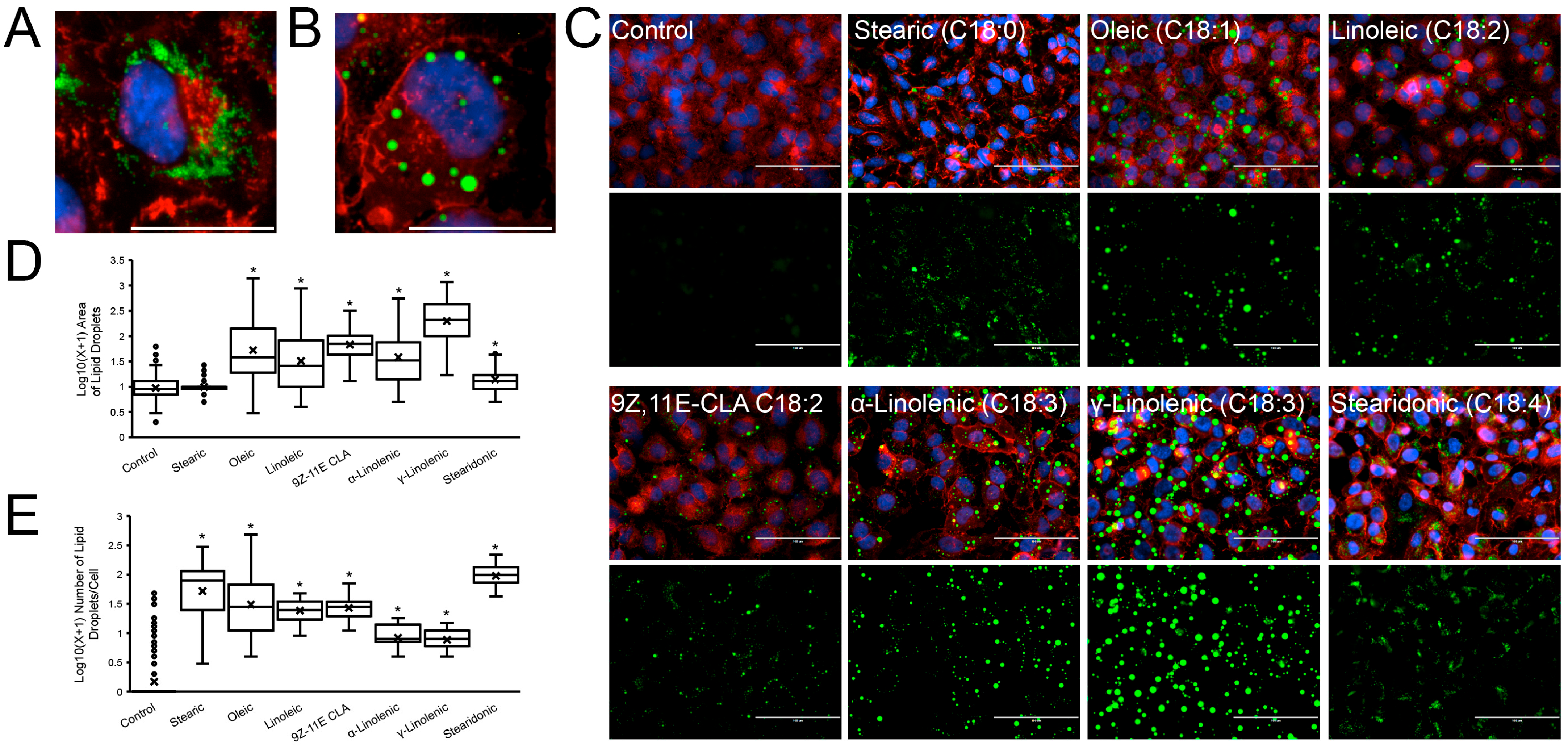
Seventeen unique fatty acids were examined individually, creating the largest evaluation to date of the effect of individual fatty acids on lipid droplet formation in cells. The phospholipid, lysophosphatidic acid (LPA), was even examined for lipid droplet formation. Further, we noticed that some of these exogenous fatty acids caused nuclear deformation, which has been a previous indication of successful induction of LD formation in HeLa cells [52], likely via indentation of the perinuclear actomyosin and dilution of lamin-B1 [53]. See Supplementary Figure S1 for an example of oleic acid induction of nuclear deformation. Interestingly, these 17 fatty acids do not have a uniform impact on LD formation in HeLa cells. Some fatty acids produce a lot of small-diameter LDs (Figure 1A), while others produce fewer but larger-diameter LDs (Figure 1B).
When the 18-carbon chain length (C18) fatty acids from the study were compared (C18:0, C18:1, C18:2, 9Z, 11E-CLA C18:2, C18:3, C18:3, C18:4) (Figure 1C), a pattern was observed that all the unsaturated fatty acids produced a significant increase in the area of LDs induced in HeLa cells (p-value < 0.01) when compared to cells subjected to the vehicle (solvent only) (Figure 1D). This contrasts with the saturated stearic acid (C18:0), for which LD areas were like that of control cells (p-value = 0.90) (Figure 1D). A previous study of cultured insulin-producing cells from mice showed similar findings, where unsaturated fatty acids of similar carbon chain length produced larger relative LD areas compared to those of their saturated partner for C12, C14, C16, C18, C20, and C24 fatty acids [31]. In this same previous study, having more double bonds beyond two did not seem to cause a change in LD area. In fact, in some instances, more than two double bonds actually induced similar LD areas as control conditions (α-C18:3, γ-C18:3, and C18:4) [31]. In contrast to this report, in our study with HeLa cells, we see significant increases in LD area (p-value < 0.01) for these polyunsaturated fatty acids including the two isoforms of linolenic acid (α-C18:3, γ-C18:3) compared to control conditions. Also, for the polyunsaturated fatty acid stearidonic acid (C18:4) in our study, the area was significantly higher than control cells (p-value < 0.01); however, uniquely compared to the other C18 fatty acids, the area was like that of the saturated fatty acid stearic acid (C18:0) (p-value = 0.07) (Figure 1D).
All the tested C18 fatty acids were able to significantly increase the number of induced LDs per cell compared to control (p-value < 0.01) (Figure 1E), as reported previously [25,26,27,31]. Interestingly, again, stearidonic acid (C18:4) induced numbers of LDs per cell more like that of the saturated fatty acid stearic acid (p-value = 0.47) compared to the other C18 fatty acids (p-value < 0.01).

3.2. Impact of Carbon Length in Saturated Fatty Acids on Lipid Droplet Formation

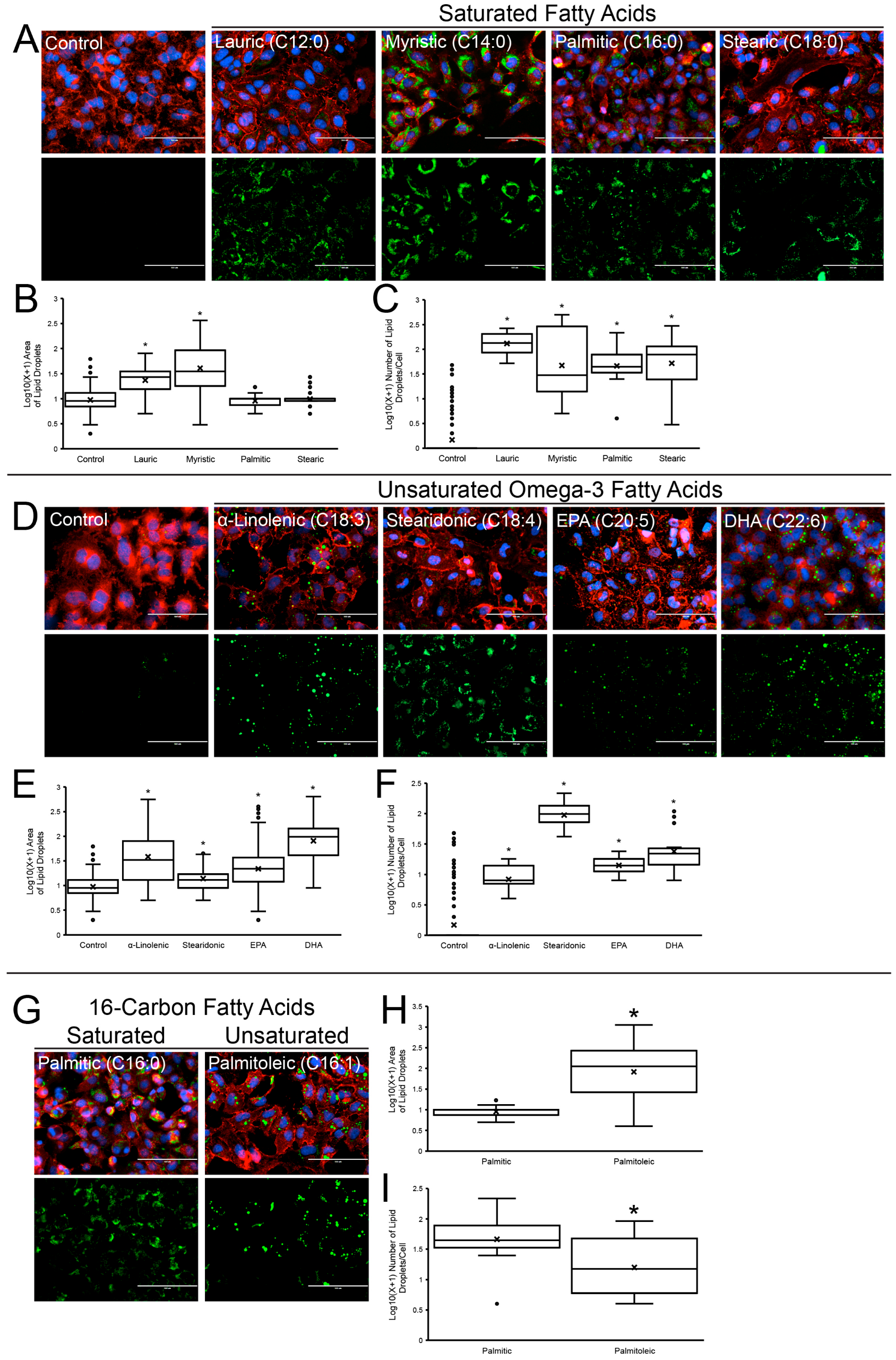
A previous study showed that palmitic acid (C16:0), a saturated fatty acid, could not induce LD formation in cultured insulin-producing cells from mice [31]. They did not examine, however, other saturated fatty acids for changes in LD formation in these cells. They did show that these saturated fatty acids produced LDs that were similar in area to control cells in all cases (C12, C14, C16, C18, C20, C24) [31]. In our study, we compared multiple saturated fatty acids listed in increasing order of carbon content: lauric acid (C12:0), myristic acid (C14:0), palmitic acid (C16:0), and stearic acid (C18:0) (Figure 2A). In congruence with the previous report [31], the palmitic acid (C16:0) and stearic acid (C18:0) induced LDs similar in area to control cells (p-value = 0.90) (Figure 2B). However, the smaller fatty acids lauric acid (C12:0) and myristic acid (C14:0) induced LD areas that were significantly larger than control cells (p-value < 0.01) (Figure 2B). Importantly, we show that all these saturated long-chain fatty acids can induce a significant increase in the number of LDs per cell (p-value < 0.01) (Figure 2C).

3.3. Impact of Unsaturated Omega-3 Fatty Acids on Lipid Droplet Formation

Additionally, we examined all the omega-3 polyunsaturated fatty acids from the study in increasing order of carbon content and number of carbon–carbon double bonds (C18:3, C18:4, C20:5, and C22:6) (Figure 2D). All the omega-3 polyunsaturated fatty acids studied were able to induce significant increases in LD area (Figure 2E) formation and number of LDs per cell (Figure 2F) above that of control conditions (p-value < 0.01). This indicates a relatively similar theme among omega-3 polyunsaturated fatty acids in their ability to induce LD formation.

3.4. Impact of Unsaturation in 16-Carbon Fatty Acids on Lipid Droplet Formation

Together, it seems that unsaturation status of exogenous fatty acids impacts LD formation in HeLa cells. To provide a specific example of this, the impact of the saturated palmitic acid (C16:0) on LD formation was examined and compared to the monounsaturated fatty acid palmitoleic (C16:1) that has the same number of carbons (Figure 2G). The pattern here holds true with significantly higher LD area (Figure 2H) and lower number of LDs per cell (Figure 2I) for the monounsaturated palmitoleic acid compared to the saturated palmitic acid (p-value < 0.001).

3.5. Relationship Between the Area of Lipid Droplets and Their Numbers per Cell

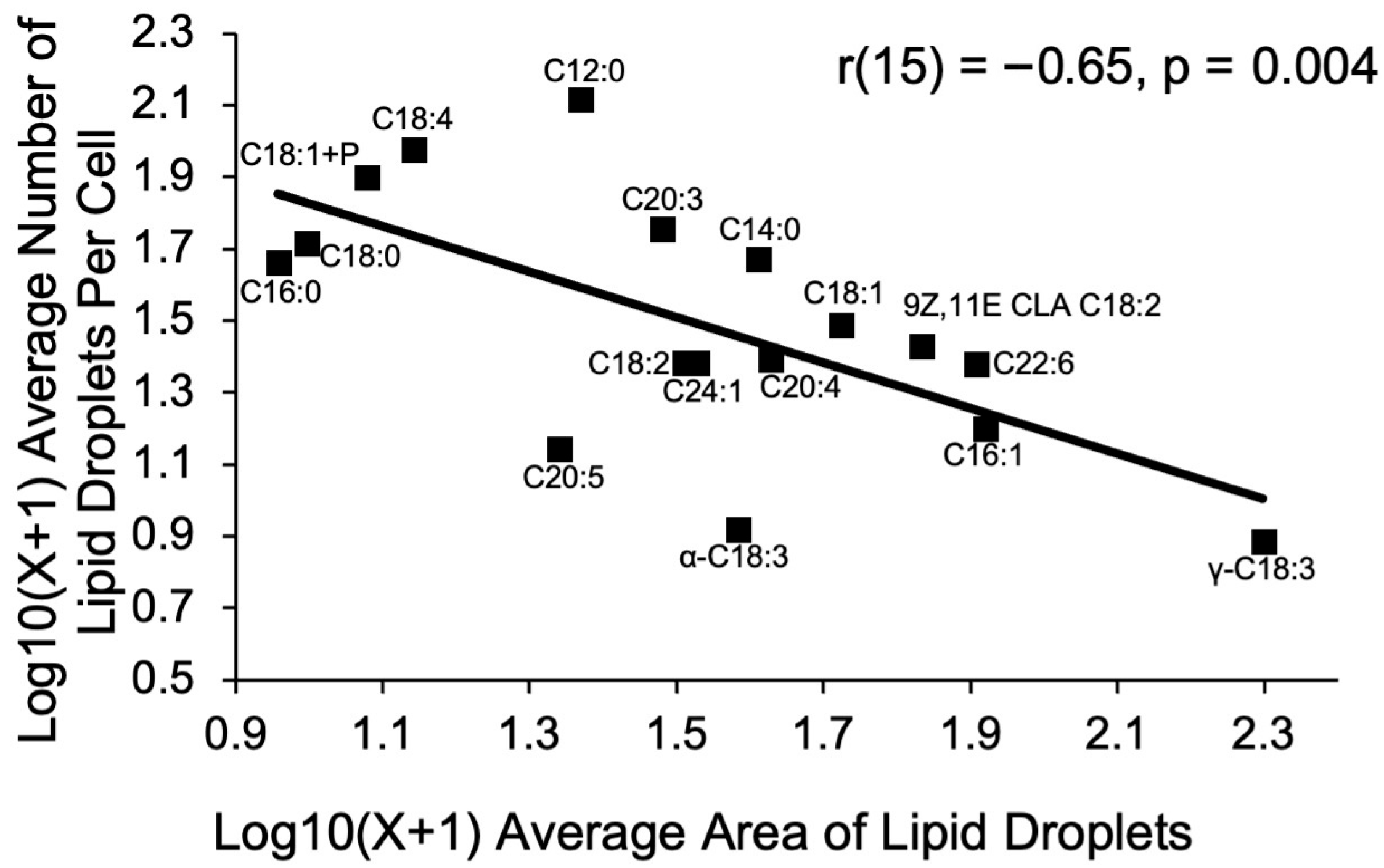
Overall, patterns were noticed when viewing these LDs in HeLa cells. To determine whether a relationship exists between the average area of LDs and the average number of LDs per cell, all 17 fatty acids in this study were examined together. When the average number of LDs per cell is compared to the average area of LDs, we see a significant inverse relationship between these two variables (Pearson Correlation Coefficient = r (15) = −0.65, p = 0.004, alpha critical value = 0.05) (Coefficient of Determination = R2 value = 0.43) (Figure 3).

3.6. PLIN1/2 Genes Differentially Expressed in the Presence of Polyunsaturated Fatty Acids

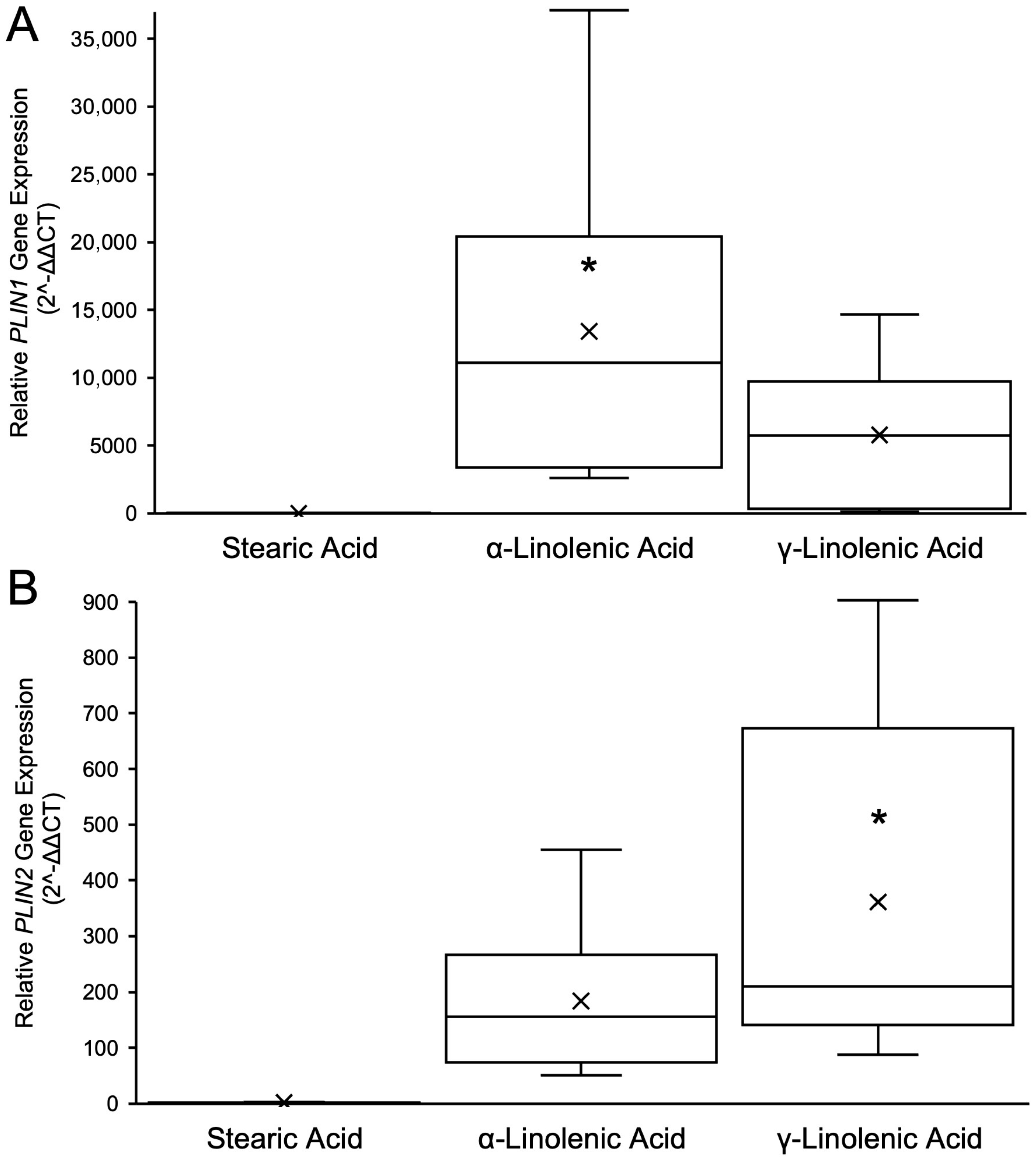
Based upon the changes in LD formation when comparing saturated versus unsaturated long-chain fatty acids, we examined the transcript expression levels of the perilipin genes PLIN1 and PLIN2. In adipocytes, where LD formation area can vary widely, it was shown that, when larger-diameter LDs formed, there were increases in PLIN1/2 gene expression [40]. Three C18 long-chain fatty acids were examined, the saturated stearic acid (C18:0) and the polyunsaturated two isoforms of linolenic acid (α-C18:3 and γ-C18:3), for their impact on the expression of PLIN1/2 (Figure 4). The expression levels of both PLIN1 and PLIN2 were very low under stearic acid conditions. There were increases in PLIN1 and PLIN2 under both α- and γ-linolenic acid conditions. The three conditions were compared and it was demonstrated that the expression of PLIN1 was significantly higher in the α-linolenic acid (p-value < 0.05) (Figure 4A), while PLIN2 was significantly higher in the γ-linolenic acid (p-value < 0.05) (Figure 4B). Together, it appears that PLIN1/2 expression is increased in the presence of the polyunsaturated C18 isoforms of linolenic acid compared to the saturated stearic acid.

4. Discussion

Our study adds to the literature with a large-scale analysis of various long-chain fatty acids on LD formation in cervical cancer cells. Unsaturated fatty acids significantly increased the area of LDs compared to their saturated counterparts, like with previous studies in hepatocytes [25] and insulin-producing cells [27]. Previous reports identify a relationship between unsaturation status of exogenous fatty acids and prevention of lipotoxicity via reduced cell stress [31,54]. We too see observations of lipotoxicity with all saturated fatty acids more so compared to the unsaturated fatty acids in this study. Thus, the protective effect of unsaturated fatty acids on palmitic-acid-induced apoptosis may revolve around the type of LD being induced. It is not simply the area, but a product of the area and number of LDs that may be important. This led us to inventory the fatty acid response on LD formation not only for area, but also for number of LDs per cell. By examining both area and number of LDs per cell, we were able to discover an inverse relationship between the two factors. This pattern is interesting and might reflect mechanistic differences in the packaging and storage of these fatty acids [55] or maybe variation in LD fusion [56] or LD biogenesis regulation [57].
Importantly, the unsaturation status of exogenous fatty acids may be playing a large role in the formation of LDs. LDs have been shown previously to have a protective adaptation for the cell in times of stress [14,58,59]. The protective activity of LDs has been shown to be enhance by the conversion of saturated fatty acids into unsaturated fatty acids. Not only are unsaturated fatty acids better at this protective role, they also are better substrates for triacylglycerol (TAG) synthesis and thus facilitate unique LD formation patterns [14]. Further, unsaturated fatty acids have previously been demonstrated to assist in the upregulation of the number of LDs and help with pro-survival signals [57]. In alignment with the protective role of LDs against oxidative stress, the presence of polyunsaturated fatty acids promotes the sequestration of the TAG pool to help reduce lipid oxidation and cell damage. This occurs via numerous gene expression changes in the cell, including the recruitment of PLIN proteins to support the production of LDs [55]. Future studies will need to examine the specific proteins involved in LD formation in response to these exogenous fatty acids. Further, it remains of interest to see how unsaturated exogenous fatty acids are contributing to LD formation, lipid metabolism, and, ultimately, cancer cell proliferation. Previous findings have shown that unsaturated fatty acids can promote LD formation in mice renal tissue in the prevention of diabetic kidney disease by preventing lipid bilayer stress compared to saturated fatty acids that produce more cell damage [60]. Further, unsaturated fatty acids have been shown to promote cancer cell survival under stress conditions [32]. This could be a method by which exogenous unsaturated fatty acids might act as a signal to promote cancer cell survival, and saturated fatty acids, based upon our data, might not be able to provide the same effect. It is also interesting how not all saturated fatty acids in our study contributed to LD formation uniformly. The shorter-chained saturated fatty acids were able to induce larger LDs compared to the longer-chained saturated fatty acids. Thus, understanding the role and mechanism of exogenous saturated and unsaturated fatty acids in LD formation is critical to understanding how cancer cells respond to stress and provides a possible mechanism for future therapies. Future research could examine the impact that these settings have on cell stress, proliferation, and apoptosis.
The mechanism by which unsaturated fatty acids influence LD formation could involve the perilipin proteins. In our study, PLIN1/2 genes were expressed at higher levels in cancer cells with polyunsaturated fatty acids compared to a saturated fatty acid. This indicates that the perilipin proteins could be contributing to the unique phenotypes witnessed in our study. The PLIN1/2 genes did not express the same in the presence of the two linolenic acid isoforms. This phenomenon has been observed before in human muscle, where PLIN2 expression but not PLIN1 increased in aging patients’ muscles [32]. Therefore, we believe that there might be overlapping roles of the PLIN1/2 proteins in terms of their biochemical responsibilities in LD formation. Future research could focus on discovering the biochemical pathways involved in LD formation under specific fatty acid conditions. While PLIN1/2 proteins are likely playing a role, the precise mechanisms remain of interest. This could further be examined by monitoring the subcellular localization and expression of the PLIN1/2 proteins to provide some evidence on how different fatty acids are inducing LD formation. Also, it would be interesting to examine these effects in other cancer cell lines.
The findings presented here showcase that the PLIN1/2 proteins likely participate in the exogenous fatty acid promotion of LD formation, likely via altering the buildup of neutral fatty acid production via these exogenous fatty acids’ unique melting points, which has previously been determined to play a role in the growth of LD size and type [61]. For example, increasing the length of carbons in the chain weakly increases the melting point, whereas fatty acid unsaturation can decrease the melting point significantly [61]. Thus, the fluidity of these fatty acids may be playing a role in their ability to differentially induce LD formation size and numbers. In conclusion, our study demonstrates that long-chain fatty acids, particularly polyunsaturated fatty acids, significantly influence LD formation and perilipin expression in HeLa cells. This study demonstrates how LDs accumulate differently for unsaturated fatty acids compared to saturated fatty acids. These findings further demonstrate how, if cancer cells have access to these unsaturated fatty acids, they could promote the cancer cell’s survival [62] and its metastatic potential [63]. This could, in turn, impact outcomes for cancer tumor metabolism. These findings contribute to our understanding of LD metabolism and point towards future lipid–cancer metabolism studies.

Supplementary Materials

The following supporting information can be downloaded at: https://www.mdpi.com/article/10.3390/lipidology3010001/s1, Supplementary Material found as a single file containing: Supplementary Tables S1–S8 and Supplementary Figures S1 and S2. Supplementary Figure S1. Nuclear deformation is induced by fatty acids. Supplementary Figure S2. Lipid droplet formation is induced via various fatty acids. Supplementary Table S1: ANOVA and Tukey’s HSD Test Results for data in Manuscript Figure 1D: Area of Lipid Droplets in the presence of 18C fatty acids. Supplementary Table S2: ANOVA and Tukey’s HSD Test Results for data in Manuscript Figure 1E: Number of Lipid Droplets per cell in the presence of 18C fatty acids. Supplementary Table S3: ANOVA and Tukey’s HSD Test Results for data in Manuscript Figure 2B: Area of Lipid Droplets in the presence of saturated fatty acids. Supplementary Table S4: ANOVA and Tukey’s HSD Test Results for data in Manuscript Figure 2C: Number of Lipid Droplets per cell in the presence of saturated fatty acids. Supplementary Table S5: ANOVA and Tukey’s HSD Test Results for data in Manuscript Figure 2E: Area of Lipid Droplets in the presence of omega-3 fatty acids. Supplementary Table S6: ANOVA and Tukey’s HSD Test Results for data in Manuscript Figure 2F: Number of Lipid Droplets per cell in the presence of omega-3 fatty acids. Supplementary Table S7: ANOVA and Tukey’s HSD Test Results for data in Supplemental Materials Supplementary Figure S2B: Area of Lipid Droplets in the presence of fatty acids. Supplementary Table S8: ANOVA and Tukey’s HSD Test Results for data in Supplemental Materials Supplementary Figure S2C: Number of Lipid Droplets per cell in the presence of fatty acids.

Funding

This research was funded by the NSF-RCN-UBE Award #1827066 via the Cell Biology Education Consortium and the Department of Education Title III Strengthen Institutions Program Grant via Brescia University.

Institutional Review Board Statement

Not applicable.

Informed Consent Statement

Not applicable.

Data Availability Statement

The raw data supporting the conclusions of this article will be made available by the authors on request.

Acknowledgments

We acknowledge the work of a previous undergraduate student at Brescia University, Patrick Edge, who, as a part of their course, gathered the data from thousands of data points to complete the data set for Figure 3. They were asked to be an author on this manuscript but did not respond to correspondence. Secondly, this data set was obtained from over 7 years of undergraduate-student-generated data from their course-based undergraduate research work as a part of their course. Without the contributions of all these undergraduates, this work would not have been possible.

Conflicts of Interest

The author declares no conflicts of interest. The funders had no role in the design of the study; in the collection, analyses, or interpretation of data; in the writing of the manuscript; or in the decision to publish the results.

Abbreviations

The following abbreviations are used in this manuscript:
LDLipid Droplet
TAGTriacylgycerol

References

  1. Olzmann, J.A.; Carvalho, P. Dynamics and Functions of Lipid Droplets. Nat. Rev. Mol. Cell Biol. 2019, 20, 137–155. [Google Scholar] [CrossRef]
  2. Rosas-Ballina, M.; Guan, X.L.; Schmidt, A.; Bumann, D. Classical Activation of Macrophages Leads to Lipid Droplet Formation Without de Novo Fatty Acid Synthesis. Front. Immunol. 2020, 11, 131. [Google Scholar] [CrossRef]
  3. Jin, Y.; Tan, Y.; Wu, J.; Ren, Z. Lipid Droplets: A Cellular Organelle Vital in Cancer Cells. Cell Death Discov. 2023, 9, 254. [Google Scholar] [CrossRef]
  4. Cheng, C.; Geng, F.; Cheng, X.; Guo, D. Lipid Metabolism Reprogramming and Its Potential Targets in Cancer. Cancer Commun. 2018, 38, 27. [Google Scholar] [CrossRef] [PubMed]
  5. McLelland, G.-L.; Lopez-Osias, M.; Verzijl, C.R.C.; Ellenbroek, B.D.; Oliveira, R.A.; Boon, N.J.; Dekker, M.; van den Hengel, L.G.; Ali, R.; Janssen, H.; et al. Identification of an Alternative Triglyceride Biosynthesis Pathway. Nature 2023, 621, 171–178. [Google Scholar] [CrossRef]
  6. Chistiakov, D.A.; Bobryshev, Y.V.; Orekhov, A.N. Macrophage-Mediated Cholesterol Handling in Atherosclerosis. J. Cell. Mol. Med. 2016, 20, 17–28. [Google Scholar] [CrossRef]
  7. Jackson, C.L. Lipid Droplet Biogenesis. Curr. Opin. Cell Biol. 2019, 59, 88–96. [Google Scholar] [CrossRef]
  8. Corbo, J.H.; Chung, J. Mechanisms of Lipid Droplet Degradation. Curr. Opin. Cell Biol. 2024, 90, 102402. [Google Scholar] [CrossRef] [PubMed]
  9. Tirinato, L.; Pagliari, F.; Limongi, T.; Marini, M.; Falqui, A.; Seco, J.; Candeloro, P.; Liberale, C.; Di Fabrizio, E. An Overview of Lipid Droplets in Cancer and Cancer Stem Cells. Stem Cells Int. 2017, 2017, e1656053. [Google Scholar] [CrossRef]
  10. Gu, Q.; Wang, Y.; Yi, P.; Cheng, C. Theoretical Framework and Emerging Challenges of Lipid Metabolism in Cancer. Semin. Cancer Biol. 2025, 108, 48–70. [Google Scholar] [CrossRef] [PubMed]
  11. Accioly, M.T.; Pacheco, P.; Maya-Monteiro, C.M.; Carrossini, N.; Robbs, B.K.; Oliveira, S.S.; Kaufmann, C.; Morgado-Diaz, J.A.; Bozza, P.T.; Viola, J.P.B. Lipid Bodies Are Reservoirs of Cyclooxygenase-2 and Sites of Prostaglandin-E2 Synthesis in Colon Cancer Cells. Cancer Res. 2008, 68, 1732–1740. [Google Scholar] [CrossRef]
  12. Horii, T.; Kozawa, J.; Fujita, Y.; Kawata, S.; Ozawa, H.; Ishibashi, C.; Yoneda, S.; Nammo, T.; Miyagawa, J.; Eguchi, H.; et al. Lipid Droplet Accumulation in β Cells in Patients with Type 2 Diabetes is Associated with Insulin Resistance, Hyperglycemia and β Cell Dysfunction Involving Decreased Insulin Granules. Front. Endocrinol. 2022, 13, 996716. [Google Scholar] [CrossRef]
  13. Farmer, B.C.; Walsh, A.E.; Kluemper, J.C.; Johnson, L.A. Lipid Droplets in Neurodegenerative Disorders. Front. Neurosci. 2020, 14, 742. [Google Scholar] [CrossRef]
  14. Listenberger, L.L.; Han, X.; Lewis, S.E.; Cases, S.; Farese, R.V.; Ory, D.S.; Schaffer, J.E. Triglyceride Accumulation Protects against Fatty Acid-Induced Lipotoxicity. Proc. Natl. Acad. Sci. USA 2003, 100, 3077–3082. [Google Scholar] [CrossRef] [PubMed]
  15. Petan, T.; Jarc, E.; Jusović, M. Lipid Droplets in Cancer: Guardians of Fat in a Stressful World. Molecules 2018, 23, 1941. [Google Scholar] [CrossRef] [PubMed]
  16. Rak, S.; Zan, T.D.; Stefulj, J.; Kosović, M.; Gamulin, O.; Osmak, M. FTIR Spectroscopy Reveals Lipid Droplets in Drug Resistant Laryngeal Carcinoma Cells through Detection of Increased Ester Vibrational Bands Intensity. Analyst 2014, 139, 3407–3415. [Google Scholar] [CrossRef] [PubMed]
  17. Jovičić, E.J.; Janež, A.P.; Eichmann, T.O.; Koren, Š.; Brglez, V.; Jordan, P.M.; Gerstmeier, J.; Lainšček, D.; Golob-Urbanc, A.; Jerala, R.; et al. Lipid Droplets Control Mitogenic Lipid Mediator Production in Human Cancer Cells. Mol. Metab. 2023, 76, 101791. [Google Scholar] [CrossRef]
  18. Cruz, A.L.S.; Barreto, E.d.A.; Fazolini, N.P.B.; Viola, J.P.B.; Bozza, P.T. Lipid Droplets: Platforms with Multiple Functions in Cancer Hallmarks. Cell Death Dis. 2020, 11, 105. [Google Scholar] [CrossRef]
  19. Safi, R.; Menéndez, P.; Pol, A. Lipid Droplets Provide Metabolic Flexibility for Cancer Progression. FEBS Lett. 2024, 598, 1301–1327. [Google Scholar] [CrossRef]
  20. Singh, R.; Kaushik, S.; Wang, Y.; Xiang, Y.; Novak, I.; Komatsu, M.; Tanaka, K.; Cuervo, A.M.; Czaja, M.J. Autophagy Regulates Lipid Metabolism. Nature 2009, 458, 1131–1135. [Google Scholar] [CrossRef]
  21. Majuelos-Melguizo, J.; Rodríguez-Vargas, J.M.; Martínez-López, N.; Delgado-Bellido, D.; García-Díaz, Á.; Yuste, V.J.; García-Macía, M.; López, L.M.; Singh, R.; Oliver, F.J. Glioblastoma Cells Counteract PARP Inhibition through Pro-Survival Induction of Lipid Droplets Synthesis and Utilization. Cancers 2022, 14, 726. [Google Scholar] [CrossRef] [PubMed]
  22. Fu, Y.; Zou, T.; Shen, X.; Nelson, P.J.; Li, J.; Wu, C.; Yang, J.; Zheng, Y.; Bruns, C.; Zhao, Y.; et al. Lipid Metabolism in Cancer Progression and Therapeutic Strategies. MedComm 2020, 2, 27–59. [Google Scholar] [CrossRef]
  23. Berk, P.D.; Stump, D.D. Mechanisms of Cellular Uptake of Long Chain Free Fatty Acids. Mol. Cell Biochem. 1999, 192, 17–31. [Google Scholar] [CrossRef] [PubMed]
  24. den Hartigh, L.J.; Connolly-Rohrbach, J.E.; Fore, S.; Huser, T.R.; Rutledge, J.C. Fatty Acids from Very Low-Density Lipoprotein Lipolysis Products Induce Lipid Droplet Accumulation in Human Monocytes. J. Immunol. 2010, 184, 3927–3936. [Google Scholar] [CrossRef]
  25. Rohwedder, A.; Zhang, Q.; Rudge, S.A.; Wakelam, M.J.O. Lipid Droplet Formation in Response to Oleic Acid in Huh-7 Cells is Mediated by the Fatty Acid Receptor FFAR4. J. Cell Sci. 2014, 127, 3104–3115. [Google Scholar] [CrossRef] [PubMed]
  26. Guštin, E.; Jarc, E.; Kump, A.; Petan, T. Lipid Droplet Formation in HeLa Cervical Cancer Cells Depends on Cell Density and the Concentration of Exogenous Unsaturated Fatty Acids. Acta Chim. Slov. 2017, 64, 549–554. [Google Scholar] [CrossRef]
  27. Fujimoto, Y.; Onoduka, J.; Homma, K.J.; Yamaguchi, S.; Mori, M.; Higashi, Y.; Makita, M.; Kinoshita, T.; Noda, J.; Itabe, H.; et al. Long-Chain Fatty Acids Induce Lipid Droplet Formation in a Cultured Human Hepatocyte in a Manner Dependent of Acyl-CoA Synthetase. Biol. Pharm. Bull. 2006, 29, 2174–2180. [Google Scholar] [CrossRef]
  28. Chénais, B.; Blanckaert, V. The Janus Face of Lipids in Human Breast Cancer: How Polyunsaturated Fatty Acids Affect Tumor Cell Hallmarks. Int. J. Breast Cancer 2012, 2012, 712536. [Google Scholar] [CrossRef]
  29. D’Eliseo, D.; Velotti, F. Omega-3 Fatty Acids and Cancer Cell Cytotoxicity: Implications for Multi-Targeted Cancer Therapy. J. Clin. Med. 2016, 5, 15. [Google Scholar] [CrossRef]
  30. Nieva, C.; Marro, M.; Santana-Codina, N.; Rao, S.; Petrov, D.; Sierra, A. The Lipid Phenotype of Breast Cancer Cells Characterized by Raman Microspectroscopy: Towards a Stratification of Malignancy. PLoS ONE 2012, 7, e46456. [Google Scholar] [CrossRef]
  31. Plötz, T.; Hartmann, M.; Lenzen, S.; Elsner, M. The Role of Lipid Droplet Formation in the Protection of Unsaturated Fatty Acids against Palmitic Acid Induced Lipotoxicity to Rat Insulin-Producing Cells. Nutr. Metab. 2016, 13, 16. [Google Scholar] [CrossRef]
  32. Jarc, E.; Kump, A.; Malavašič, P.; Eichmann, T.O.; Zimmermann, R.; Petan, T. Lipid Droplets Induced by Secreted Phospholipase A2 and Unsaturated Fatty Acids Protect Breast Cancer Cells from Nutrient and Lipotoxic Stress. Biochim. Biophys. Acta (BBA)—Mol. Cell Biol. Lipids 2018, 1863, 247–265. [Google Scholar] [CrossRef] [PubMed]
  33. Urso, C.J.; Zhou, H. Differential Effects of Unsaturated Fatty Acids and Saturated Fatty Acids on Lipotoxicity and Neutral Lipid Accumulation in Neuro-2a Cells. Biomed. J. Sci. Tech. Res. 2021, 37, 29516–29524. [Google Scholar] [CrossRef]
  34. Shi, X.; Li, J.; Zou, X.; Greggain, J.; Rødkær, S.V.; Færgeman, N.J.; Liang, B.; Watts, J.L. Regulation of Lipid Droplet Size and Phospholipid Composition by Stearoyl-CoA Desaturase. J. Lipid Res. 2013, 54, 2504–2514. [Google Scholar] [CrossRef]
  35. Nolan, C.J.; Larter, C.Z. Lipotoxicity: Why Do Saturated Fatty Acids Cause and Monounsaturates Protect against It? J. Gastroenterol. Hepatol. 2009, 24, 703–706. [Google Scholar] [CrossRef]
  36. Brasaemle, D.L. Thematic Review Series: Adipocyte Biology. The Perilipin Family of Structural Lipid Droplet Proteins: Stabilization of Lipid Droplets and Control of Lipolysis. J. Lipid Res. 2007, 48, 2547–2559. [Google Scholar] [CrossRef]
  37. Hsieh, K.; Lee, Y.K.; Londos, C.; Raaka, B.M.; Dalen, K.T.; Kimmel, A.R. Perilipin Family Members Preferentially Sequester to Either Triacylglycerol-Specific or Cholesteryl-Ester-Specific Intracellular Lipid Storage Droplets. J. Cell Sci. 2012, 125, 4067–4076. [Google Scholar] [CrossRef] [PubMed]
  38. McIntosh, A.L.; Senthivinayagam, S.; Moon, K.C.; Gupta, S.; Lwande, J.S.; Murphy, C.C.; Storey, S.M.; Atshaves, B.P. Direct Interaction of Plin2 with Lipids on the Surface of Lipid Droplets: A Live Cell FRET Analysis. Am. J. Physiol.-Cell Physiol. 2012, 303, C728–C742. [Google Scholar] [CrossRef]
  39. Grahn, T.H.M.; Zhang, Y.; Lee, M.-J.; Sommer, A.G.; Mostoslavsky, G.; Fried, S.K.; Greenberg, A.S.; Puri, V. FSP27 and PLIN1 Interaction Promotes the Formation of Large Lipid Droplets in Human Adipocytes. Biochem. Biophys. Res. Commun. 2013, 432, 296–301. [Google Scholar] [CrossRef]
  40. Barneda, D.; Christian, M. Lipid Droplet Growth: Regulation of a Dynamic Organelle. Curr. Opin. Cell Biol. 2017, 47, 9–15. [Google Scholar] [CrossRef]
  41. García-Macia, M.; Santos-Ledo, A.; Leslie, J.; Paish, H.L.; Collins, A.L.; Scott, R.S.; Watson, A.; Burgoyne, R.A.; White, S.A.; French, J.; et al. A Mammalian Target of Rapamycin-Perilipin 3 (mTORC1-Plin3) Pathway is Essential to Activate Lipophagy and Protects Against Hepatosteatosis. Hepatology 2021, 74, 3441–3459. [Google Scholar] [CrossRef] [PubMed]
  42. Takahashi, Y.; Shinoda, A.; Furuya, N.; Harada, E.; Arimura, N.; Ichi, I.; Fujiwara, Y.; Inoue, J.; Sato, R. Perilipin-Mediated Lipid Droplet Formation in Adipocytes Promotes Sterol Regulatory Element-Binding Protein-1 Processing and Triacylglyceride Accumulation. PLoS ONE 2013, 8, e64605. [Google Scholar] [CrossRef]
  43. Bindesbøll, C.; Berg, O.; Arntsen, B.; Nebb, H.I.; Dalen, K.T. Fatty Acids Regulate Perilipin5 in Muscle by Activating PPARδ. J. Lipid Res. 2013, 54, 1949–1963. [Google Scholar] [CrossRef]
  44. Adler, J.J. Fatty Acid Induction of Lipid Droplets in Cancer Cells. CourseSource 2023, 10, 1–11. [Google Scholar] [CrossRef]
  45. Gunn, P.J.; Pramfalk, C.; Millar, V.; Cornfield, T.; Hutchinson, M.; Johnson, E.M.; Nagarajan, S.R.; Troncoso-Rey, P.; Mithen, R.F.; Pinnick, K.E.; et al. Modifying Nutritional Substrates Induces Macrovesicular Lipid Droplet Accumulation and Metabolic Alterations in a Cellular Model of Hepatic Steatosis. Physiol. Rep. 2020, 8, e14482. [Google Scholar] [CrossRef]
  46. Turner, M.C.; Rimington, R.P.; Martin, N.R.W.; Fleming, J.W.; Capel, A.J.; Hodson, L.; Lewis, M.P. Physiological and Pathophysiological Concentrations of Fatty Acids Induce Lipid Droplet Accumulation and Impair Functional Performance of Tissue Engineered Skeletal Muscle. J. Cell. Physiol. 2021, 236, 7033–7044. [Google Scholar] [CrossRef] [PubMed]
  47. West, R.M. Best Practice in Statistics: The Use of Log Transformation. Ann. Clin. Biochem. 2022, 59, 162–165. [Google Scholar] [CrossRef]
  48. Gleason, J.R. An Accurate, Non-Iterative Approximation for Studentized Range Quantiles. Comput. Stat. Data Anal. 1999, 31, 147–158. [Google Scholar] [CrossRef]
  49. Conte, M.; Vasuri, F.; Trisolino, G.; Bellavista, E.; Santoro, A.; Degiovanni, A.; Martucci, E.; D’Errico-Grigioni, A.; Caporossi, D.; Capri, M.; et al. Increased Plin2 Expression in Human Skeletal Muscle is Associated with Sarcopenia and Muscle Weakness. PLoS ONE 2013, 8, e73709. [Google Scholar] [CrossRef]
  50. McManaman, J.L.; Bales, E.S.; Orlicky, D.J.; Jackman, M.; MacLean, P.S.; Cain, S.; Crunk, A.E.; Mansur, A.; Graham, C.E.; Bowman, T.A.; et al. Perilipin-2-Null Mice Are Protected against Diet-Induced Obesity, Adipose Inflammation, and Fatty Liver Disease. J. Lipid Res. 2013, 54, 1346–1359. [Google Scholar] [CrossRef]
  51. Takahashi, Y.; Shinoda, A.; Kamada, H.; Shimizu, M.; Inoue, J.; Sato, R. Perilipin2 Plays a Positive Role in Adipocytes during Lipolysis by Escaping Proteasomal Degradation. Sci. Rep. 2016, 6, 20975. [Google Scholar] [CrossRef]
  52. Takir, G.G.; Ohsaki, Y.; Morotomi-Yano, K.; Yano, K.; Saitoh, H. Linkage between Lipid Droplet Formation and Nuclear Deformation in HeLa Human Cervical Cancer Cells. Biochem. Biophys. Res. Commun. 2018, 504, 485–490. [Google Scholar] [CrossRef]
  53. Ivanovska, I.L.; Tobin, M.P.; Bai, T.; Dooling, L.J.; Discher, D.E. Small Lipid Droplets Are Rigid Enough to Indent a Nucleus, Dilute the Lamina, and Cause Rupture. J. Cell Biol. 2023, 222, e202208123. [Google Scholar] [CrossRef]
  54. Gehrmann, W.; Würdemann, W.; Plötz, T.; Jörns, A.; Lenzen, S.; Elsner, M. Antagonism Between Saturated and Unsaturated Fatty Acids in ROS Mediated Lipotoxicity in Rat Insulin-Producing Cells. Cell. Physiol. Biochem. 2015, 36, 852–865. [Google Scholar] [CrossRef] [PubMed]
  55. Danielli, M.; Perne, L.; Jarc Jovičić, E.; Petan, T. Lipid Droplets and Polyunsaturated Fatty Acid Trafficking: Balancing Life and Death. Front. Cell Dev. Biol. 2023, 11, 1104725. [Google Scholar] [CrossRef] [PubMed]
  56. Wang, Y.; Li, C.; Zhang, J.; Xu, X.; Fu, L.; Xu, J.; Zhu, H.; Hu, Y.; Li, C.; Wang, M.; et al. Polyunsaturated Fatty Acids Promote the Rapid Fusion of Lipid Droplets in Caenorhabditis Elegans. J. Biol. Chem. 2022, 298, 102179. [Google Scholar] [CrossRef]
  57. Papsdorf, K.; Miklas, J.W.; Hosseini, A.; Cabruja, M.; Morrow, C.S.; Savini, M.; Yu, Y.; Silva-García, C.G.; Haseley, N.R.; Murphy, L.M.; et al. Lipid Droplets and Peroxisomes Are Co-Regulated to Drive Lifespan Extension in Response to Mono-Unsaturated Fatty Acids. Nat. Cell Biol. 2023, 25, 672–684. [Google Scholar] [CrossRef] [PubMed]
  58. Piccolis, M.; Bond, L.M.; Kampmann, M.; Pulimeno, P.; Chitraju, C.; Jayson, C.B.K.; Vaites, L.P.; Boland, S.; Lai, Z.W.; Gabriel, K.R.; et al. Probing the Global Cellular Responses to Lipotoxicity Caused by Saturated Fatty Acids. Mol. Cell 2019, 74, 32–44.e8. [Google Scholar] [CrossRef]
  59. Chitraju, C.; Mejhert, N.; Haas, J.T.; Diaz-Ramirez, L.G.; Grueter, C.A.; Imbriglio, J.E.; Pinto, S.; Koliwad, S.K.; Walther, T.C.; Farese, R.V. Triglyceride Synthesis by DGAT1 Protects Adipocytes from Lipid-Induced ER Stress during Lipolysis. Cell Metab. 2017, 26, 407–418.e3. [Google Scholar] [CrossRef]
  60. Pérez-Martí, A.; Ramakrishnan, S.; Li, J.; Dugourd, A.; Molenaar, M.R.; De La Motte, L.R.; Grand, K.; Mansouri, A.; Parisot, M.; Lienkamp, S.S.; et al. Reducing Lipid Bilayer Stress by Monounsaturated Fatty Acids Protects Renal Proximal Tubules in Diabetes. eLife 2022, 11, e74391. [Google Scholar] [CrossRef]
  61. Meyers, A.; Weiskittel, T.M.; Dalhaimer, P. Lipid Droplets: Formation to Breakdown. Lipids 2017, 52, 465–475. [Google Scholar] [CrossRef] [PubMed]
  62. Pucer, A.; Brglez, V.; Payré, C.; Pungerčar, J.; Lambeau, G.; Petan, T. Group X Secreted Phospholipase A2 Induces Lipid Droplet Formation and Prolongs Breast Cancer Cell Survival. Mol. Cancer 2013, 12, 111. [Google Scholar] [CrossRef] [PubMed]
  63. Yorek, M.; Jiang, X.; Liu, S.; Hao, J.; Yu, J.; Avellino, A.; Liu, Z.; Curry, M.; Keen, H.; Shao, J.; et al. FABP4-Mediated Lipid Accumulation and Lipolysis in Tumor-Associated Macrophages Promote Breast Cancer Metastasis. eLife 2024, 13, RP101221. [Google Scholar] [CrossRef] [PubMed]
Figure 1. Impact of unsaturation in 18-carbon fatty acids on lipid droplet formation. HeLa cells were incubated with fatty acids listed at 400 µM for 24 h or cells subjected to solvent only (control). A new live cell co-staining protocol to stain LD structures in cells that our lab developed recently was used. LDs (green, using LipidSpot488 Lipid Droplet Stain, Biotium, Fremont, CA, USA, #70065), membranes (red, using CF594 WGA, Biotium #29023-1), and nuclei (blue, using NucBlue Live Cell Stain, Invitrogen, Carlsbad, CA, USA, #R37605) were visualized for each condition. LDs were visualized as described in [44]. Representative live merged images of individual cells using a 40× objective with an EVOS FL microscope (Life Technologies, Carlsbad, CA, USA, AMF4300) were selected from the collection: (A) a saturated fatty acid [stearic acid (C18:0)] and (B) an unsaturated fatty acid [α-linolenic acid (α-C18:3)] showcasing the two different types of LDs formed with different fatty acid incubation. Scale bar of these two single cell images represents 75 µm. Representative images of each 18-carbon fatty acid are provided in (C). Scale bar for these images represents 100 µm. Top images of each condition are merged images of all three channels in overlay. The lower image is the green channel only of each condition highlighting the LDs present in those cells. Data are represented as box-and-whisker plots showing the Log10(X + 1) area of LDs (N ≥ 100 LDs) (D) or the Log10(X + 1) number of LDs per cell (N ≥ 20 cells) (E). The open circles (when present) are individual data points, and the x represents the mean of the condition in these graphs. These data compare all the 18-carbon chain length fatty acids from the study listed in increasing order of number of carbon–carbon double bonds: stearic (C18:0), oleic (C18:1), linoleic (C18:2), 9Z-11E-conjugated linoleic acid (CLA) (9Z, 11E-CLA C18:2), α-linolenic (α-C18:3), γ-linolenic (γ-C18:3), and stearidonic (C18:4). One-way ANOVA analysis for independent measures was performed to compare conditions in (B,C). There were significant differences with both ANOVA analyses. See Supplementary Tables S1 and S2 for detailed ANOVA results. Tukey’s HSD post hoc analysis was performed to compare all conditions. * denotes a significant Tukey’s HSD p-value < 0.01 for comparisons between individual fatty acids and control in (B,C). For all other comparisons, see details in the Tukey’s HSD post hoc analyses presented as tables in Supplementary Tables S1 and S2. Scale bar: 100 µm.
Lipidology 03 00001 g001
Figure 2. Impact of saturated and unsaturated fatty acids on lipid droplet formation. HeLa cells were incubated with fatty acids listed at 400 µM for 24 h or cells subjected to solvent only (control). LDs were visualized as described in [44]. LDs (green, using LipidSpot488 Lipid Droplet Stain, Biotium, Fremont, CA, USA, #70065), membranes (red, using CF594 WGA, Biotium #29023-1), and nuclei (blue, using NucBlue Live Cell Stain, Invitrogen, Carlsbad, CA, USA, #R37605) were visualized for each condition. Representative images of each condition are provided (A,D,G). Scale bar for these images represents 100 µm. Top images of each condition are merged images of all three channels in overlay. The lower image is the green channel only of each condition highlighting the LDs present in those cells. Data are represented as box-and-whisker plots showing the Log10(X + 1) area of LDs (N ≥ 100 LDs) (B, E, H) or the Log10(X + 1) number of LDs per cell (N ≥ 20 cells) (C,F,I). The open circles (when present) are individual data points, and the x represents the mean of the condition in these graphs. One-way ANOVA analysis for independent measures was performed to compare conditions in (B,C,E,F). There were significant differences with all ANOVA analyses. See Supplementary Tables S3–S6 for detailed ANOVA results. Tukey’s HSD post hoc analysis was performed to compare all conditions. * denotes a significant Tukey’s HSD p-value < 0.01 for comparisons between individual fatty acids and cells subjected to solvent only (control) in (B,C,E,F). For all other comparisons, see details in the Tukey’s HSD post hoc analyses presented as tables in Supplementary Tables S3–S6. A two-sided unpaired assuming unequal variance t-test was performed to compare the conditions in (H,I). There was a significant difference with the t-test (* = p-value < 0.001) when comparing the conditions. Impact of saturated fatty acids on lipid droplet formation. These data compare all the saturated fatty acids from the study listed in increasing order of carbon content: lauric (C12:0), myristic (C14:0), palmitic (C16:0), and stearic (C18:0). Impact of unsaturated omega-3 fatty acids on lipid droplet formation. These data compare all the omega-3 fatty acids from the study in increasing order of carbon content and number of carbon–carbon double bonds: α-linolenic (α-C18:3), stearidonic (C18:4), EPA (C20:5), and DHA (C22:6). Impact of unsaturation in 16-carbon fatty acids on lipid droplet formation. These data compare a saturated fatty acid, palmitic acid (C16:0), to an unsaturated fatty acid, palmitoleic acid (C16:1), that has the same number of carbons. Scale bar: 100 µm.
Lipidology 03 00001 g002
Figure 3. Linear negative correlation between the number of lipid droplets per cell and the area of lipid droplets. HeLa cells were incubated with 1 of 17 conditions below at 400 µM for 24 h. LDs were visualized as described in [44]. Data are represented in a scatter plot showing the Log10(X + 1) average (mean) number of LDs per cell (N ≥ 20 cells) compared to Log10(X + 1) average (mean) area of LDs (N ≥ 100 LDs). The Pearson Correlation Coefficient was calculated as r(15) = −0.65, p = 0.004. The alpha critical value was set at 0.05. The Coefficient of Determination (R2 value) was calculated as = 0.43. The complete list of fatty acids used in this study is as follows. Saturated fatty acids used in this study include lauric acid (C12:0), myristic acid (C14:0), palmitic acid (C16:0), and stearic acid (C18:0). Monounsaturated fatty acids used in this study include palmitoleic acid (C16:1), oleic acid (C18:1), lysophosphatidic acid (LPA) (C18:1 + P), and nervonic acid (C24:1). Polyunsaturated fatty acids used in this study include linoleic acid (C18:2), 9Z, 11E-conjugated linoleic acid (CLA) (9Z, 11E-CLA C18:2), α-linolenic acid (α-C18:3), γ-linolenic acid (γ-C18:3), stearidonic acid (C18:4), mead acid (C20:3), arachidonic acid (C20:4), eicosapentaenoic acid (EPA) (C20:5), and docosahexaenoic acid (DHA) (C22:6). Representative images of each condition in this study are presented in Figure 1 and Figure 2 and in Supplementary Figure S2.
Lipidology 03 00001 g003
Figure 4. PLIN1/2 genes differentially expressed in the presence of unsaturated fatty acids. HeLa cells were incubated with one of the fatty acid conditions listed above at 400 µM for 24 h. The saturated fatty acid stearic acid (C18:0) or the unsaturated fatty acids α-linolenic acid (α-C18:3) or γ-linolenic acid (γ-C18:3) were used for this experiment. Total RNA from HeLa cells was extracted using PureLink RNA Mini Kit (Invitrogen, Carlsbad, CA, USA, 12183020) according to the manufacturer’s instructions. cDNA was synthesized using High-Capacity cDNA Reverse Transcription Kit (Applied Biosystems, Foster City, CA, USA, 4368814) according to the manufacturer’s instructions. Relative quantification was performed using PowerUp SYBR Green Master Mix (Applied Biosystems, A25741) by real-time PCR using a BioRad iQ5. In brief, the following primers for the target genes were used as reported previously in [49]. The housekeeping gene 18S ribosomal RNA was used for all experiments. Real-time PCR reactions were performed in duplicate in the same run and each run were repeated twice for all measurements. A reference sample (control cells) with no fatty acid added (solvent only) was used as internal calibrator in each run. Three no-template control samples were included as a negative control and showed no amplification of signal. Also, the no-reverse transcriptase control samples were included for each experiment and showed no amplification of signal. Relative gene expression of PLIN1 (A) and PLIN2 (B) was reported across the six samples per condition (N = 6) as box-and-whisker plots. The x represents the mean of the condition in these graphs. One-way ANOVA analysis for independent measures was performed to compare the three conditions. For (A) PLIN1: F score = 4.31 F critical = 3.68, p-value = 0.03. For (B) PLIN2: F score = 4.71 F critical = 3.68, p-value = 0.02. Tukey’s HSD post hoc analysis was performed to compare the three conditions. * denotes a significant Tukey’s HSD p-value < 0.05 when comparing that condition to stearic acid (C18:0). There were no significant differences between α-linolenic acid (α-C18:3) and γ-linolenic acid (γ-C18:3) conditions.
Lipidology 03 00001 g004
Disclaimer/Publisher’s Note: The statements, opinions and data contained in all publications are solely those of the individual author(s) and contributor(s) and not of MDPI and/or the editor(s). MDPI and/or the editor(s) disclaim responsibility for any injury to people or property resulting from any ideas, methods, instructions or products referred to in the content.