2. The Pre-Middle Pleistocene Fossil Record of Otididae (A Critical Review)
This review covers only the pre-Middle Pleistocene fossil record of Otididae, as only modern species are confidently known from younger deposits. Outside Eurasia, the family’s fossil record is scarce (see Refs. [
4,
14]), confined to several isolated finds of modern genera
Otis,
Chlamydotis,
Lophotis,
Ardeotis, and
Neotis in Miocene through Early Pleistocene of Africa (reviewed in Ref. [
4]), and a record of the extant genus
Ardeotis from the Pliocene of Australia [
23]. The globally earliest documented occurrence of the family is from the lower Middle Miocene of Namibia (Arrisdrift), represented by a partial distal tibiotarsus and tarsometatarsus (highly diagnostic elements for Otididae) of an unidentified bustard [
12]. The extant genus
Eupodotis is recorded from the Upper Miocene of Kenya [
24]. The generic identification of the African fossil findings of Otididae must be considered preliminary and requires confirmation.
The oldest Eurasian records of Otididae (
Table 1) date to the second half of the Middle Miocene (MN 6–8) in India (Siwalik) and Mongolia [
13,
14,
25]. These finds consist primarily of partial distal tibiotarsi, which are reliably diagnostic for many genera of Otididae. At the Sharga locality in western Mongolia, two forms are present:
Shargaotis ignipes Zelenkov, 2025, considered a stem representative of the
Otis and
Chlamydotis lineage, and another unnamed taxon superficially similar to modern
Lophotis, but represented by poorly preserved material [
14]. Additional finds of the Middle to Late Miocene bustards from India represent several taxa but await detailed description [
13].
Apart from the Siwalik records, Late Miocene Eurasian bustards include
Miootis compactus Umanskaya, 1979 from the Upper Miocene (MN 13) of Ukraine [
26] and the southern part of European Russia [
27,
28]. The assignment of this species to Otididae has been confirmed by subsequent authors [
14,
28,
29,
30], yet its relationships within the family remain unclear. I here preliminarily refer a proximal tibiotarsus from the Polgárdi-5 locality (MN 13) in Hungary, originally described as
Otis kalmani ([
31]; see below), to this species. An unidentified bustard, comparable in size to the extant
Tetrax tetrax, has also been reported from the Upper Miocene (MN 13) of Italy based on a fragmentary distal tibiotarsus [
32].
Otis bessarabicus Kessler and Gal, 1996, from the lower Upper Miocene (MN 9) of Moldova [
33], is excluded here from Otididae (see below).
The only fossil bustard previously known from substantial osteological material is
Gryzaja odessana Zubareva, 1939 [
34]. It was originally described from two tibiotarsi exhibiting an unusual craniocaudal swelling of the shaft, from the Lower Pliocene (MN 15) of the Odessa Catacombs in Ukraine ([
34]; see also Ref. [
5]). Additional postcranial remains from the type locality, including a complete tibiotarsus, were later referred to this taxon [
35]. The systematic position of this taxon within birds was initially uncertain. Later, Voinstvensky [
36,
37] reported more bones from the Odessa Catacombs, which he attributed to this species and placed
Gryzaja within the Otidiformes. He further synonymized it with the genus
Otis (using the new name
Otis gryzaja Voinstvensky, 1967 [
37]) and placed
Chlamydotis pliodeserti Serebrovsky, 1941—a species previously described [
38] from the same locality based on two coracoids—into the synonymy of
G. odessana. Brodkorb [
39] subsequently erected a new family, Gryzajidae, for
G. odessana. Later, Kurochkin and Khosazky [
40] described new material of
G. odessana, including a similarly modified tibiotarsal shaft from the Early Pliocene (MN 15) of the Etulia locality in Moldova and a distal tarsometatarsus from the Pliocene–Pleistocene locality of Kotlovina in Ukraine. The specimen from Etulia, originating from a separate locality, confirms that the distinctive tibiotarsal morphology of
G. odessana is a natural feature, as earlier authors had suggested [
37,
40].
The second specimen from Kotlovina (a distal tarsometatarsus), attributed to
G. odessana by Kurochkin and Khosazky [
40], was initially thought to be of a similar Early Pliocene age. However, this multilayered locality spans a broad interval from the Early Pliocene to the Early Pleistocene, with most avian material actually dating to the Early Pleistocene (upper part of MN 17; see Ref. [
19]: pp. 1118, 1170), making it considerably younger than the fossils from the Odessa Catacombs. The tarsometatarsus in question (PIN 2614/42) lacks the medioplantar flattening of the shaft that is characteristic of the tibiotarsus and, crucially, the proximal tarsometatarsus in specimens of
G. odessana from Odessa and Etulia [
35]. This specimen is therefore excluded here from
G. odessana. In size, it corresponds to the largest specimens of the modern
Chlamydotis macqueenii (reconstructed distal width of PIN no. 2614/42 is ~15.5 mm) and thus may represent this extant species or its direct ancestor.
The largest fossil bustards of the Palearctic region, comparable in size to the extant
Otis tarda, have often been designated as
Otis lambrechti Kretzoi, 1941 [
41]. Mlíkovský [
29] treated this species as a synonym of modern
O. tarda (see below).
Otis lambrechti was originally described from the latest Early Pleistocene (late Calabrian) of Betfia-5 in Romania [
41] and later reported from several other Early and Middle Pleistocene sites in Europe [
31,
42,
43,
44,
45]. Here, a bustard from the Early Pleistocene (MN 17) of Varshets in Bulgaria, originally described as
Otis aff.
khosatzkii [
15], is reassigned to this species (see
Section 4 below). A much older, Early Pliocene (MN 15b) record, represented by an ungual phalanx from the Beremend 26 site in Hungary [
31], cannot be confirmed, at least at the species level, due to the poor diagnostic value of this skeletal element. Even its attribution to Otididae requires confirmation.
Otis lambrechti was previously known only from very fragmentary material. New substantial material of this species, which confirms its validity, is described below.
Large bustards comparable in size to
O. lambrechti have been reported as
Otis sp. from the Early Pleistocene (Gelasian; MN 17) of Morocco and France [
46,
47], although both are known only from fragmentary ulnar fragments. Another large bustard, identified as
Otis sp., is known from the Senèze locality in France (late Gelasian; 2.2–2.1 Ma), where it is represented by a very fragmentary proximal femur [
48]. A large bustard designated as
O. tarda (following the taxonomical treatment by Mlíkovský [
29]) was described based on a proximal tibiotarsus and a pedal phalanx from the Early Pleistocene (late Calabrian) of Pirro Nord in Italy [
49]. A complete tarsometatarsus from the same locality, identified as
Otis tarda, was illustrated later [
50]; here this specimen is assigned to
O. lambrechti (see below). Another similarly sized bustard, described as
Otis sp., was reported from the late Early Pleistocene (Calabrian) of Cişmichioi in Moldova based on a distal fragment of radius [
51]. This latter find was originally erroneously referred to the Pliocene (but see Ref. [
19]: p. 1171). The specimen (PIN 2614/57) indeed resembles modern
Otis tarda morphologically—in particular, it has a similarly prominent and elongate tuberculum bicipitale ([
51]; original observation) and thus may be providently assigned to
O. lambrechti based on geography, geological age and size.
Otis sp. from the Early Pliocene (MN 15) of Maluşteni-Bereşti in Romania [
52] is known from a single cervical vertebra. Although the generic and specific status of this form is unclear, it apparently indeed belongs to Otididae (judging from the general shape of the bone) and hence represents one of the earliest fossil finds of large-sized bustards, comparable to the modern
Otis tarda. Another rather large bustard is represented by a fragmentary distal tarsometatarsus from the Chono-Harayah 2 (also spelled as “Chono-Khariakh 2”) locality in Western Mongolia [
53]; in size, it agrees with
Otis aff.
khosatzkii from Varshets (see below) and is thus comparable to females of modern
O. tarda. Fossil bustard remains identified as the extant
O. tarda are known from many localities starting from the Middle Pleistocene, and they are especially common in the Upper Pleistocene [
44]; see also Refs. [
54,
55,
56,
57].
Another fossil bustard, morphologically close to
Otis but notably smaller (slightly larger than modern
Ch. macqueenii), was described as
Otis khosatzkii based on a distal tibiotarsal fragment and a scapula from the presumably Early Pliocene of Moldova [
51] (for a discussion of the Etulia locality’s age, see Ref. [
19]). Supposedly similar forms (designated as
Otis aff.
khosatzkii) were subsequently reported from the Upper Miocene (MN 13) Polgárdi-5 locality in Hungary [
58] based on a tarsometatarsus and coracoid, and from the Early Pleistocene (Gelasian; MN 17) Varshets locality in Bulgaria based on several bones, including a fragmentary distal tarsometatarsus [
15,
57]. The Bulgarian finds are comparable in size to the smallest modern specimens of
Otis tarda and likely represent a larger species; they are therefore transferred here to
O. lambrechti (see below). A tarsometatarsus and a pedal phalanx from the Upper Pliocene (MN 16) of Beremend 15 in Hungary were described as
Otis khosatzkii beremendensis Jánossy [
58,
59]. The systematic position of this taxon remains unclear: it is metrically similar to
Ch. macqueenii but was noted to share structural similarities with the genus
Tetrax [
58].
Otis khosatzkii was synonymized with the extant
Ch. undulata by Mlíkovský [
29] without morphological justification but was later classified within the genus
Otis s.s. by Zelenkov and Kurochkin [
28] and is here also considered a valid taxon (see also
Section 5 below). A tibiotarsus from the Lower Pliocene (MN 15b) of Csarnota 2, previously reported as
O. kalmani ([
31]; see below), corresponds in both size and age to
Otis khosatzkii and can be reliably assigned to this species.
Chlamydotis mesetaria Sanchez Marco, 1990 is the only known fossil taxon that can be confidently attributed to the
Chlamydotis evolutionary lineage [
60]. This species is known from a single tibiotarsus from the Early Pliocene (MN 15) of the Layna locality in Spain; it was larger than the extant
Ch. macqueenii but morphologically similar [
60]. A similar form was reported based on a fragmentary tarsometatarsus from the earliest Pleistocene (MN 17) of Morocco [
47]. A bustard of comparable size (i.e., somewhat larger than extant
Ch. macqueenii) is known from a pedal phalanx from the Upper Pliocene (MN 16) of Shaamar in Northern Mongolia [
61]. The above-mentioned distal tarsometatarsus from Kotlovina in Ukraine, originally attributed to
G. odessana by Kurochkin and Khosazky [
40], apparently belongs to this phylogenetic lineage as well (see above).
The third modern lineage of bustards in Europe is represented by species of the genus
Tetrax. The best-known fossil species,
Otis (Tetrax) kalmani Jánossy, 1972 [
62], was described from a coracoid and distal tibiotarsus from the Early Pleistocene (Calabrian; 1.2–1.3 Ma) of Betfia-2 in Romania, with additional material from the early Middle Pleistocene of Stránská skála, Capek site 5 in the Czech Republic (0.6–0.77 Ma [
62]). It was diagnosed as a species close to the modern
Tetrax tetrax but with some proportional differences (but see below). The validity of this species, which Mlíkovský [
29] considered a junior synonym of
T. tetrax, is confirmed below. Additional materials from the late Early Pleistocene (Calabrian) sites of Betfia-5 and 9 in Romania, as well as Beremend Crystal Cave (“Beremend-16”) and Nagyharsányhegy in Hungary, were later attributed to this species; these mostly remain undescribed and unillustrated, which is also true for the type specimens of the species [
31,
43,
59]. Kessler [
31] (see also [
45]) provided measurements of remains attributed to
O. kalmani from localities in the Carpathian Basin, which can be used to assess the size and possible taxonomic attribution of some specimens. A distal tarsometatarsus from the Upper Pliocene (MN 16) of Beremend 38 in Hungary agrees in size with
O. kalmani and may belong to this species. However, this find is much older than other confirmed remains, which are otherwise confidently known only from the second half of the Early Pleistocene and the early Middle Pleistocene.
Tetrax tetrax was identified in the Early Pleistocene locality Pirro Nord in Italy (late Calabrian; 1.6–1.3 Ma [
49]), which, in accordance with the age, may indeed represent
T. kalmani.
The taxonomic identity of several other specimens attributed to
Otis kalmani [
31], including some older finds, is highly questionable. In particular, a very fragmentary proximal tibiotarsus from the Upper Miocene (MN 13) of Polgárdi-5 in Hungary [
31], which I was able to examine firsthand, likely belongs to Otididae, but its much older age (more than 5 Ma) precludes its assignment to this particular species. In size (larger than
T. tetrax but smaller than
Ch. macqueenii), this tibiotarsus agrees with the coeval taxon
Miootis compactus and is here provisionally referred to that species (see above). A radius from Polgárdi-4 [
31] has already been transferred to Tytonidae [
63]. A distal tibiotarsus from the late Early Pleistocene (MQ 1) of Beremend 17 in Hungary [
31] agrees with
O. kalmani in the width of the distal end but has an unusually wide shaft, even wider than in
Ch. macqueenii. Another tibiotarsus from Villány 5 (MQ 1) appears to be too small for
Otis kalmani, though the species identification could be correct if it belongs to a subadult individual. As these specimens were never figured, their attribution to
Otis kalmani, and to Otididae in general, requires confirmation.
Otis cf.
tetrax was reported from Kryzhanovka-4 (upper layer, 2.1–1.9 Ma) in the North Black Sea region [
64]. I was able to examine this specimen, which is represented by a very fragmentary distal tibiotarsus. It is similar in size to
O. kalmani and may be attributed to this species. This find may represent the oldest reliable record of this fossil species.
Tetrax paratetrax Bocheński & Kurochkin, 1987 [
51] is known from a partial coracoid from the Early Pliocene of the Etulia locality in Moldova. It is the smallest fossil bustard in Europe, slightly smaller than the modern
T. tetrax and notably smaller than the extinct
T. kalmani, and is further morphologically distinct from these species [
51]. Examination of the original material confirms its morphological peculiarity, and its specific identity is accepted here. Mlíkovský [
29] synonymized both
Otis kalmani and
Otis paratetrax with the extant
T. tetrax without justification.
Non-Otididae. A number of fossil remains have been incorrectly attributed to Otididae.
Otis affinis Lydekker, 1891 [
65] from the Middle Miocene of Steinheim in Germany was long considered the oldest member of Otididae but was recently excluded from the family and may instead represent Threskiornithidae [
5]. Additional remains from Polgárdi-5, originally described as
Otis kalmani (see above), are now [
63] referred to
Tyto campiterrae Jánossy, 1991 [
58]. A presumed large bustard
Otis hellenica Boev et al., 2013 [
66] from the upper Miocene of Greece was transferred to Ergilornithidae [
67].
Pleotis lius Hou, 1993 [
68] was described from a sternum found in the Pleistocene deposits of Zhoukoudian-20 in China [
68]. This specimen has never been revised, and its assignment to Otididae remains unconfirmed. It belongs to a very large bird, exceeding the extant
Ardeotis kori in size. The sternum differs significantly from those of all examined otidid genera (
Ardeotis,
Neotis,
Otis,
Chlamydotis, and
Tetrax). In particular, the trabecula medialis (hereafter, sternal terminology follows [
69]) forms a caudally convex, bulbous structure, whereas in Otididae this trabecula is thin and pointed. In
P. lius, the incisura caudolateralis is positioned very close to the caudal point of the costal articular margin, whereas in Otididae this incisura (if present) terminates far from the costal articulation. The sulcus articularis coracoidei is largely ventrally oriented in Otididae (in lateral view), whereas in
P. lius it curves dorsally at its cranial apex. The spina externa rostralis is pointed in
P. lius, unlike in Otididae where its apex is blunt. The spina interna is bifurcated in Otididae, which does not appear to be the case in
P. lius. On the dorsal (cardiac) surface, pneumatic foramina in Otididae are concentrated in the craniomedial area, whereas in
P. lius they are absent in this region but present caudally and laterally (including two symmetrical large foramina not found in Otididae). No analogous sternal structure was found among other birds, and thus the systematic position of this enigmatic taxon remains unclear. Given the numerous structural differences, its attribution to Otididae seems unlikely.
Otis bessarabicus Kessler and Gal, 1996 [
33] was described from a fragmentary ulna from the lower Upper Miocene (MN 9) of Moldova [
33]. The taxonomic identity of this species has been considered uncertain [
14,
29]. The holotype shows a characteristic tuberculum carpale with an elongate and highly convex proximal part (see Ref. [
33]: Figure 3e). Such a tubercle is unusual among birds and is found only in Gaviidae. Otididae possess a much shorter and non-convex tuberculum carpale. Based on this evidence,
Otis bessarabicus is here excluded from Otididae and may represent stem-Gaviidae.
The referral of
Ioriortis gabuniae Burchak-Abramovich and Vekua, 1981 [
70], a large bird from the Pliocene of Georgia, to Otididae was never confirmed [
28]. The only known humerus of this species exhibits a peculiar morphology not seen in other Otididae, which was originally interpreted as a specific feature indicative of limited flight capabilities. However, the outlines of the caput humeri and the tuberculum ventrale are much more consistent with those of
Cygnus.
Ioriortis gabuniae is therefore transferred here from Otididae to Anseriformes, and specifically to Cygnini, although the poor preservation of the single known specimen renders this taxon a nomen dubium.
4. Systematic Paleontology
Class Aves Linnaeus, 1758 [
74].
Order Otidiformes Wagler, 1830 [
75].
Family Otididae Rafinesque, 1815 [
76].
Genus
Otis Linnaeus, 1758 [
74].
Otis lambrechti Kretzoi, 1941 [
41].
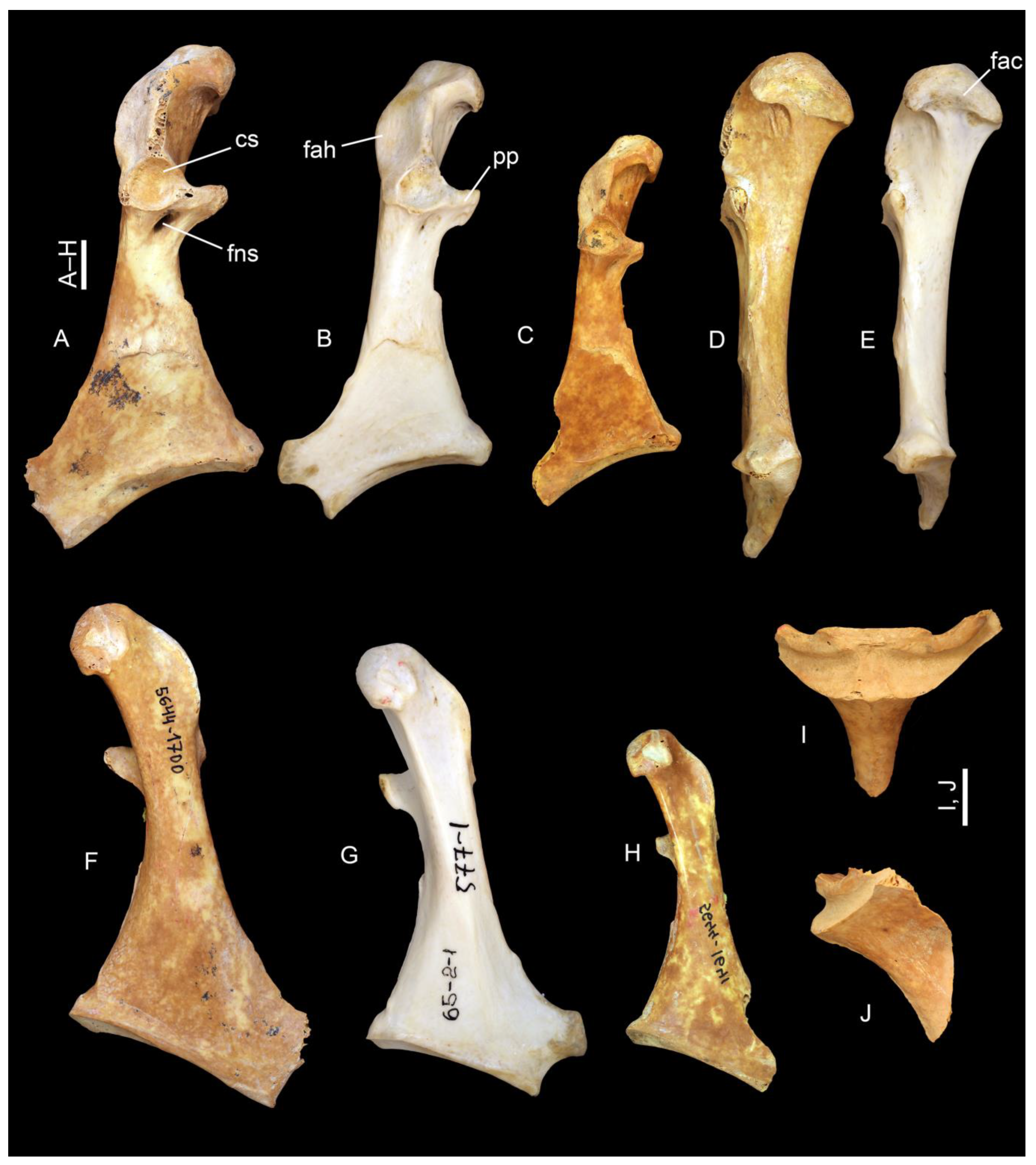
Figure 1A,C,D,F,H,I,J and
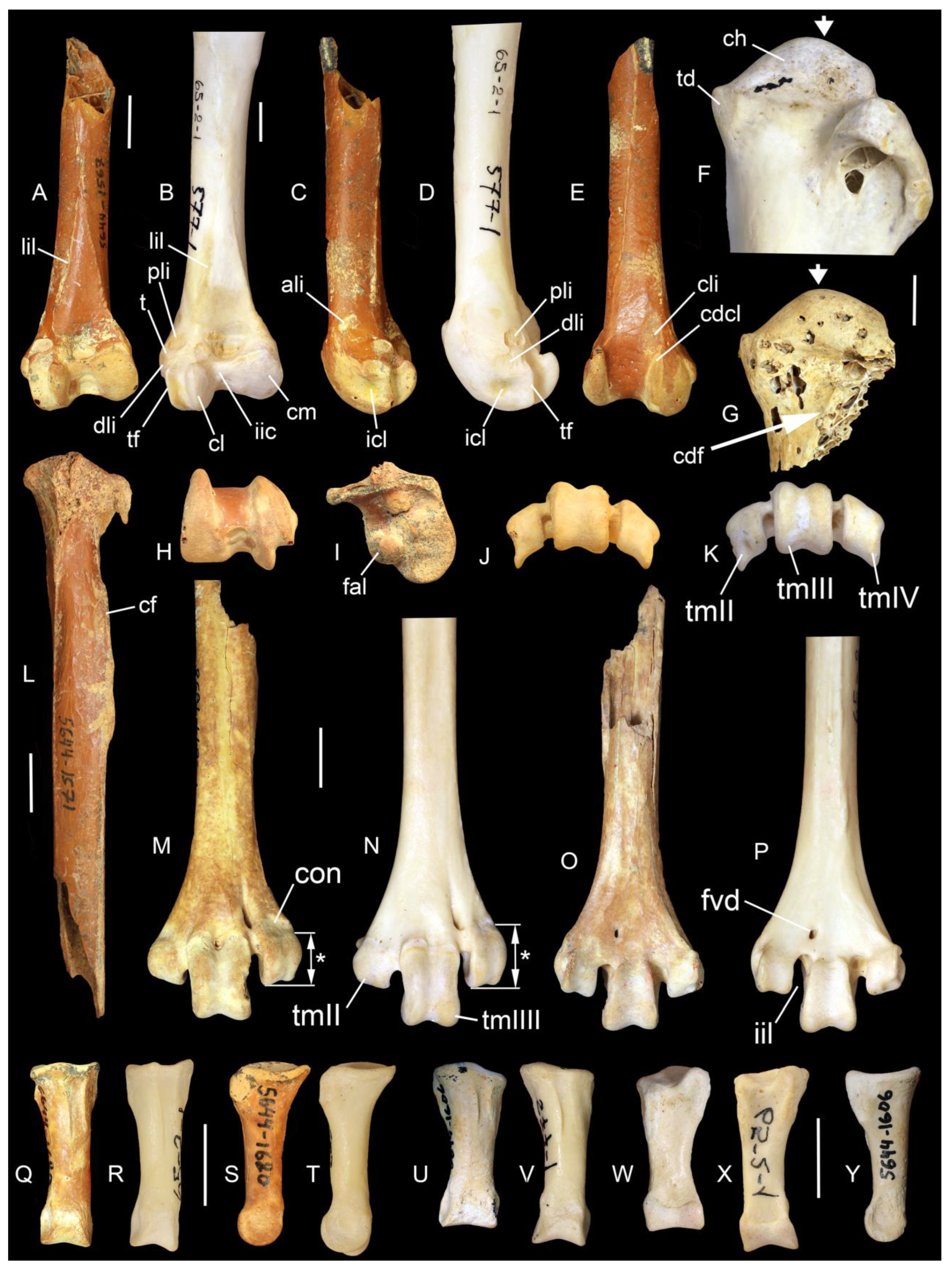
Figure 2A,C,E,G,H–J,L,M,O,Q,S,U,W,X.
1941
Otis lambrechti Kretzoi [
41], p. 253.
1980
Otis lambrechti Kretzoi; Jánossy [
43], p. 21.
1987
Otis sp.; Bocheński and Kurochkin [
51], p. 182.
1999
Otis aff.
khosatzkii; Boev [
15], p. 97, Figures 1 and 2.
2002
Otis tarda Linnaeus; Mlíkovský (pars) [
29], p. 99.
2002
Otis lambrechti Kretzoi; Gal [
45], p. 127, pl. XIII, Figures 6–8.
2009
Otis lambrechti Kretzoi; Kessler (pars) [
31], p. 261.
2015
Otis sp.; Zelenkov and Kurochkin [
28], p. 235.
Holotype. Geological Institute, Budapest (Hungary), uncatalogued specimen; fragmentary distal end of a tarsometatarsus (see [
29]).
Type locality and horizon. Betfia 5; Romania. Upper strata of the Calabrian, Menapian glacial; Lower Pleistocene [
77,
78].
Diagnosis (emended). Femur with prominent ligament impression on the lateral surface of the distal end. Tarsometatarsus comparable with O. tarda in overall proportions and dimensions, but differs in wider trochlea metatarsi III, shorter trochlea metatarsi IV and incisura intertrochlearis lateralis in dorsal view, with broad and transversely oriented ligament impression just proximal to the latter. In distal view, trochlea metatarsi III is asymmetrical, with medial rim protruding further dorsally than the lateral one. Humerus with a narrower area between tuberculum dorsale and crus dorsale fossae than in O. tarda due to mode dorsal position of the crus.
Newly referred material. Cranial fragment of sternum (PIN 5644/1615); complete left coracoid of a male (PIN 5644/1700); complete right coracoid of a female (PIN 5644/1641); proximal fragment of a left humerus of a male (PIN 5644/1844); fragmentary shaft of a left humerus of a female (PIN 5644/1849); distal fragment of left femur of a female (PIN 5644/1567); proximal fragment of left tibiotarsus of a female (PIN 644/1571); distal fragment of a left tarsometatarsus of a male (PIN 5644/1698); proximal phalange of right pedal digit II of a male (PIN 5644/1680); proximal phalange of right pedal digit IV of a male (PIN 5644/1606).
Measurements. Coracoid (PIN 5644/1700, 1641): total length, 106.5, 76.2; medial length, 87.3, 63.5; length of cranial end (from cranial apex to caudal margin of cotyla scapularis) 39.1, 27.1; minimal shaft width, 12.7, 9.2; length of sternal articulation, 45.5; 30.1. Humerus (PIN 5644/1844): width of caput humeri + tuberculum dorsale, 30.0. Femur (PIN 5644/1567): minimal shaft width, 9.4; distal width, 22.0; depth of condylus medialis, 16.9; depth of condylus lateralis 16.8. Tibiotarsus (PIN 55644/1571): mediolateral width of proximal end, 15.4; shaft width distal to crista fibularis, 9.1. Tarsometatarsus (PIN 5644/1698): minimal shaft width, 9.7; distal width, 26.1; depth of trochlea metatarsi III, 13.0; width of trochlea metatarsi III, 10.0; distal depth across trochleae, 14.7.
Description and comparisons. Coracoid. The complete bone of a male bustard (PIN 5644/1700;
Figure 1A,D,F) is massive, with a dorsoventrally broader omal part (visible in medial view) and a craniocaudally wider facies articularis clavicularis than in
O. tarda. The foramen n. supracoracoidei is very large—a condition found only in immature individuals of modern
O. tarda—and the processus procoracoideus is narrow. The articular surface with the sternum differs from that of
O. tarda: the ventral labrum widens gradually medially and does not form a pronounced tubercle near its medial end, and the dorsal margin is more elongated mediolaterally.
The complete coracoid of a female (PIN 5644/1641;
Figure 1C,H) is similar to the above-described male specimen in the general morphology of the sternal articular facet. However, it differs from PIN 5644/1700 in its distinctly smaller size, a more triangular (rather than circular) cotyla scapularis, a narrower facies articularis clavicularis, and a better-pronounced crista acrocoracoidea (resulting from a more developed concavity in the dorsal part of the sulcus m. supracoracoidei). The foramen n. supracoracoidei is almost closed in this specimen, and the processus procoracoideus is moderately thick.
Humerus. A proximal bone fragment (PIN 5644/1844;
Figure 2G) is poorly preserved but agrees with modern
O. tarda in the shape of the caput humeri and the proximally pointed, subcircular, and caudally elevated (above the level of the bone surface) tuberculum dorsale. As in
O. tarda, the caudal margin of the caput humeri forms a distinct step with the adjacent shaft. In
Ardeotis kori, the caput humeri is more obliquely oriented and continuous with the shaft surface, lacking a clear step. However, the dorsalmost part of the crus dorsale fossae is positioned at about the level of the top of the caput humeri, whereas in
O. tarda it is shifted notably more ventrally (
Figure 2: arrow). Consequently, the distance between the crus dorsale fossae and the tuberculum dorsale is narrower than in
O. tarda.
Sternum. The cranial fragment (PIN 5644/1615;
Figure 1I,J) is distinguished from that of
O. tarda by a narrower articular surface for the coracoid in cranial view. However, as sternal morphology is rather variable in birds, this difference must be treated with caution.
Femur. The distal bone fragment (PIN 5644/1567;
Figure 2A,C,E,H) can be unambiguously referred to Otididae based on the presence of a prominent tuberculum at the caudal end of the crista fibularis (
Figure 2: t), a mediolaterally extended impression caudal to the trochlea fibularis, a proximodistally extended condylus medialis, a well-developed crest just proximal to this condyle, and a concavity on the caudal surface of the incisura intercondylaris (in caudal view). In the superficially similar
Pavo spp. (Phasianidae), the crest medial to the condylus medialis is poorly pronounced, the incisura intercondylaris is flat in distal view, the tuberculum near the caudal end of the crista fibularis is absent, and the impression near the caudal end of the trochlea is circular rather than mediolaterally extended. Additionally, two muscular lines on the caudal surface of the bone form a triangular section distally, unlike in Phasianidae, where only one line is present, aligned with the longitudinal axis of the bone. Specimen PIN 5644/1567 matches the dimensions of smaller (female) specimens of modern
O. tarda (see [
15]) and thus clearly represents a female. It differs from
O. tarda in having an oval, caudally positioned ligamental impression (
Figure 2: pli) located just proximal to the trochlea fibularis. In
O. tarda, this impression is more circular and positioned more laterally and cranially (most of the impression lies cranial to the level of the trochlea, whereas it is shifted caudally in the fossil). Another, more distally located impression (“epicondylus lateralis” sensu [
15]) is more elevated and less elongate (sub-circular) than in
O. tarda, where it is less prominent and craniocaudally elongate (
Figure 2: dli). The impression of the lateral collateral ligament (
Figure 2: icl) is positioned closer to the crista fibularis in the fossil than in
O. tarda. Yet another distinct ligament impression (
Figure 2: ali) is visible on the lateral side of the bone in the fossil, adjacent to the proximal end of the dorsal condylar crest; this impression is vestigial in
O. tarda. In caudal view, the lateral muscular line is positioned close to the lateral margin of the bone, whereas it is shifted medially in
O. tarda. On the cranial surface, a clear ligament impression (
Figure 2: cli) is present just medial and proximal to the crista dorsalis cartilaginis lateralis, a feature not evident in the studied specimen of
O. tarda. The impression of the medial collateral ligament on the medial surface of the distal end is shorter (less oval) than in
O. tarda.
Tibiotarsus. A proximal bone fragment (PIN 5644/1571;
Figure 2L,I) corresponds in size to the femur described above and thus also belongs to a female. The shape of its proximal articular surface is similar to
O. tarda but differs in having a larger and less laterally prominent facies articularis lateralis (with a poorly developed incisura caudal to it) and a more proximally extended crista fibularis.
Chlamydotis has much better-developed incisurae on the lateral margin of the proximal end, just caudal and cranial to the facies articularis lateralis.
Tarsometatarsus. The distal bone fragment from Taurida Cave (PIN 5644/1698;
Figure 2J,M,O) is similar in overall size to the larger specimens of modern
O. tarda and agrees with previously reported [
31] specimens of
O. lambrechti (distal width: 26.1 mm; width of trochlea metatarsi III: 10.1 mm). Consistent with the original diagnosis, it has a generally broader appearance and further differs from
O. tarda in the proportions of trochleae metatarsorum III and IV. In the fossil, trochlea metatarsi III is shorter, broader, and distinctly asymmetrical in distal view (especially dorsally); in
O. tarda, it is narrower, more elongate proximodistally, and more symmetrical. In dorsal view, the asymmetry of trochlea metatarsi III is also more pronounced in
O. lambrechti than in
O. tarda. Trochlea metatarsi IV is also notably shorter (
Figure 2: asterisk) and slightly wider in dorsal view than in
O. tarda, and it has a large, mediolaterally oriented concavity (
Figure 2: con) just proximal to it. In
O. tarda, this concavity is considerably smaller and oriented more obliquely. The incisura intertrochlearis lateralis is notably shorter in
O. lambrechti than in
O. tarda. The plantar vascular foramen is positioned more proximally than in the studied specimens of
O. tarda, although this character may be subject to individual variation.
The tarsometatarsus of Ardeotis kori has an even more symmetrical and proximodistally longer trochlea metatarsi III than O. tarda and especially O. lambrechti. It further differs from O. lambrechti in having a wider trochlea metatarsi IV with a poorly visible ligamental impression proximal to it, a distinctly wider plantar base of trochlea metatarsi III (which narrows slightly proximally in O. tarda and O. lambrechti), a larger plantar opening of the foramen vasculare distale (potentially variable individually), and a notably wider but shorter incisura intertrochlearis lateralis, which forms a concavity on the medioplantar margin of trochlea metatarsi IV in plantar view (this margin is straight in O. tarda and O. lambrechti).
Specimen PIN 5644/1698 preserves a distal portion of the shaft with two shallow but distinct dorsal ridges marking the borders of the sulcus extensorius, which continues distally as a clear tendinous impression. The position of the sulcus extensorius relative to the distal end is roughly similar to that in O. tarda, suggesting similar tarsometatarsal proportions in these species. Ardeotis kori has a similarly sized distal end but a notably longer tarsometatarsus, with the sulcus extensorius terminating more proximally (resulting in a larger flat dorsal surface on the distal shaft in this species).
Pedal phalanges. The first (proximal) phalanges of the side toes (PIN 5644/1606, 1680;
Figure 2Q,S,U,W,Y) agree in morphology and proportions with those of
O. tarda but are more robust, corresponding to the broader distal tarsometatarsus of
O. lambrechti.
Remarks. Otis lambrechti is a very poorly known species of large bustard. It was originally described from a partial distal tarsometatarsus (according to [
29]) from Betfia 5 (late Calabrian; ~1 Ma; [
77]), which was reported to be broader and shorter than in the extant
O. tarda [
41]. No clear diagnosis was provided for this species, and referred materials were illustrated in only one unpublished work [
45]. Jánossy [
43] assigned additional fragmentary remains from several Early Pleistocene (Calabrian) localities in Central Europe to this species (see
Table 1), noting the massiveness of trochlea metatarsi III in the tarsometatarsus, suggesting that
O. lambrechti had stronger feet than
O. tarda. Mlíkovský [
29] subsequently synonymized the species with the extant
O. tarda without justification. More recently, Kessler [
31] again treated it as distinct, summarizing some (but not all) records and adding new ones. However, the oldest reported find from the Lower Pliocene of Hungary (Beremend 26; [
31]) cannot be confirmed at the species level (see above).
The new material of large-sized bustards from Taurida Cave includes several well-preserved bones, such as two complete coracoids (previously unknown for
O. lambrechti), a partial but diagnostic proximal humerus, and a morphologically distinctive distal tarsometatarsus. These elements confirm the osteological distinctness of this taxon from
O. tarda. The relative robustness of the pes is also supported by the new material; in accordance with the previously reported massiveness of the distal tarsometatarsus [
41], the proximal phalanges of pedal digits from Taurida are more robust than those of
O. tarda. Although the complete tarsometatarsus of
O. lambrechti was unknown (but see below), the distal fragment indicates that its proportions were still similar to those of
O. tarda.
A complete tarsometatarsus from the Early Pleistocene of Pirro Nord in Italy (Museo di Geologia e Paleontologia, Universit`a degli Studi di Torino; MGPT-PU 125266), figured in [
50], agrees morphologically with the specimen from Taurida and thus can be referred to
O. lambrechti. MGPT-PU 125266 is smaller than PIN 5644/1698 and obviously belongs to a female; it also has in dorsal view a massive trochlea metatarsi III with a similarly asymmetrical distal margin and a shortened trochlea metatarsi IV with a well-developed ligamental concavity just proximal to it. Measurements of MGPT-PU 125266 are as follows (in mm): greatest length, 134.1; proximal width, 21.1; proximal depth, 17.7; distal width, 21.3; distal depth, 12.1; shaft width, 7.7; shaft depth, 8.5 (courtesy of M. Pavia). This specimen shows that proportions of the tarsometatarsus in
O. lambrechti were generally similar to those of modern
O. tarda, at least in females.
Remains of a bustard from the Early Pleistocene (Gelasian) of Varshets in Bulgaria, initially described as
Otis aff.
khosatzkii [
15,
57], are here transferred to
O. lambrechti. The tarsometatarsus from Varshets (NMNHS 142) represents a subadult individual and matches the size of modern subadult
O. tarda (see Ref. [
15]). Although its morphology is not fully definitive, NMNHS 142 agrees with PIN 5644/1698 in possessing a well-visible, short and broad incisura intertrochlearis lateralis, broad trochlea metatarsi III, and a wide, mediolaterally oriented ligament impression on the dorsal surface just proximal to trochlea metatarsi IV. In these features, the Varshets bustard differs from
O. tarda, similarly to
O. lambrechti from Taurida.
Otis khosatzkii, the species to which the Varshets specimen was originally referred, was smaller, with adults comparable in size to the modern
Chlamydotis macqueenii [
15].
Previously, Boev [
15] noted that specimen NMNHS 142 differs from modern
O. tarda and resembles
Tetrax in having a “deeper fovea ligamenti collateralis,” possibly referring to the medial impression of the two impressions of collateral ligaments on the distal tarsometatarsus, as illustrated in Nomina Anatomica Avium ([
71]: Figure 14A; the second, lateral impression is not indicated there). However, I could not confirm this difference or the purported greater development of this impression in
Tetrax compared to
Otis (this character may be subject to individual and age-related variation).
A distal femoral fragment from Varshets [
15] possesses a prominent ligament impression (“epicondylus lateralis” sensu [
15]), as seen in the Taurida fossil. This feature distinguishes both specimens from
O. tarda and supports their assignment to a single taxon. The two specimens are further similar in size, although the Varshets individual is a subadult and thus slightly larger. In any case, both are significantly larger than expected for
O. khosatzkii, which has a hindlimb size similar to
Ch. macqueenii [
51]. Boev [
15] also noted a “sharper caudal edge of the condylus medialis,” but I have observed individual variation in this feature in modern
O. tarda, with a sharp margin also present in subadult individuals. So the observed morphology does not preclude assigning fossil otidids from Varshets to
O. lambrechti—this implies that
O. khosatzkii is currently not known from the Pleistocene (see also
Section 5 below).
In summary, the fossil species
O. lambrechti is presently confidently known from the Early Pleistocene (Gelasian and Calabrian;
Table 1) of Central and southern Europe (Hungary, Romania, Italy, Bulgaria, and Crimea; see above). The Middle Pleistocene record from Austria [
42] requires confirmation, as it may belong to
O. tarda.
Genus Tetrax T. Forster, 1817 [79].
Tetrax kalmani (Jánossy, 1972) [
62], comb. nov.
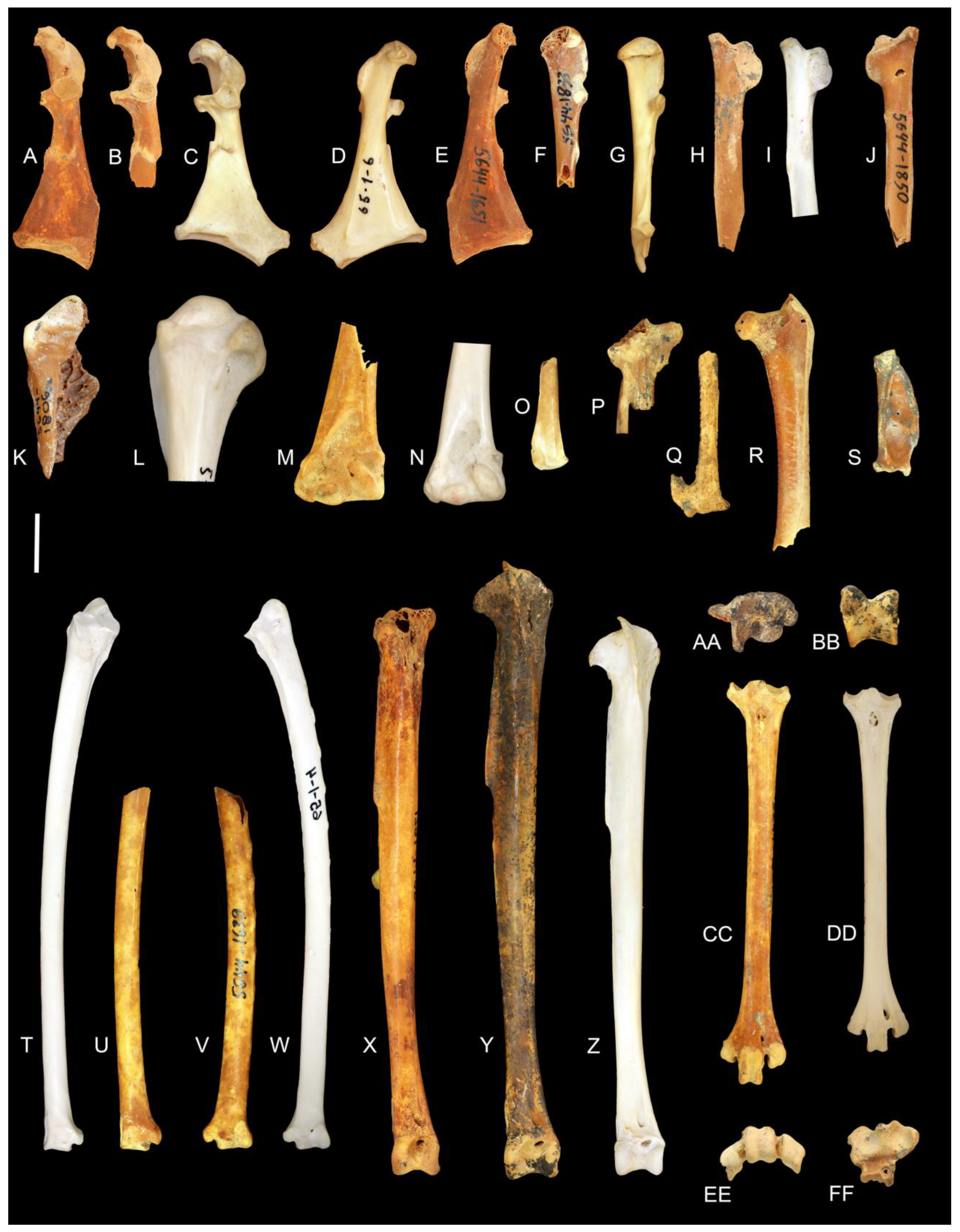
Figure 3A,B,E,F,H,J,K,M,O–S,U,V,X,Y,AA–CC,EE,FF.
1972
Otis (Tetrax) kalmani; Jánossy [
62], p. 50.
1980
Otis kalmani Jánossy; Jánossy [
43], p. 23.
1992
Otis kalmani Jánossy; Jánossy [
59], Figure 4: 9.
2002
Tetrax tetrax: Mlíkovský [
29] (pars), p. 99.
2002
Otis kalmani Jánossy; Gal [
45], p. 126, pl. XIII, Figures 1–5.
2009
Otis kalmani Jánossy; Kessler [
31] (pars), p. 261.
Holotype. Geological Institute, Budapest (Hungary), specimen GIB Ob-4845; cranial end of left coracoid (see [
29]).
Type locality and horizon. Betfia 2; Romania. Upper strata of the Calabrian, Waalian interglacial; Lower Pleistocene [
78].
Diagnosis (emended). A species morphologically very close to modern T. tetrax but distinctly larger. In the coracoid, facies articularis clavicularis not overhanging significantly sulcus m. supracoracoidei, cotyla scapularis relatively large.
Newly referred material. Almost complete left (PIN 5644/1574, 1626, 1831) and right (PIN 56544/1651, 1702) coracoids; partial left (PIN 5644/1832, 1834, 1847) and right (PIN 5644/1652, 1711, 1833) coracoids; cranial parts of right (PIN 5644/1850, 1608, 1860) and left (PIN 5644/1826, 1829) scapulae; fragmentary proximal left humerus (PIN 5644/1806); fragmentary distal left humeri (PIN 5644/1676, 1677); distal parts of left (PIN 5644/1639) and right (PIN 5644/1638, 1681, 1841) ulnae; fragmentary distal radius (PIN 5644/1612); fragmentary left (PIN 5644/1836) and right (PIN 5644/1566) carpometacarpi; basal phalanx of left major wing digit (PIN 5644/1807); fragment of a pelvis (PIN 5644/1588); proximal fragments of left (PIN 5644/1575, 1674, 1835) and right (PIN 5644/1656, 1827) femora; distal fragments of left (PIN 5644/1686, 1851) and right (PIN 5644/1645) femora; complete (PIN 5644/1830, 1621, 1699), fragmentary proximal (PIN 5644/1587) and distal (PIN 5644/1539, 1619, 1622, 1632, 1679) left tibiotarsi; fragmentary distal right tibiotarsus (PIN 5644/1854); complete (PIN 5644/1568, 1623, 1624) and fragmentary proximal (PIN 5644/1538, 1630, 1843) left tarsometatarsi; complete (PIN 5644/1848) and fragmentary proximal (PIN 5644/1843, 1855) right tarsometatarsi; pedal phalanges (PIN 5644/1613, 1842).
Description and comparisons. Coracoid. Several partial to nearly complete coracoids from Taurida are attributed to this species. They are structurally and proportionally very similar to those of
T. tetrax (
Figure 3A–G) but are somewhat larger (
Table 2) and tend to have a larger cotyla scapularis. The facies articularis clavicularis is preserved in only one fossil specimen (PIN 5644/1832), where it does not significantly overhang the sulcus m. supracoracoidei. In modern
T. tetrax, the facies does visibly overhang the sulcus. No other clear differences in the coracoid are discernible. The coracoids of
T. kalmani differ from those of
Chlamydotis macqueenii in their smaller size, smaller base of the processus procoracoideus, and a more cranially positioned muscular impression on the dorsal surface (which is shifted caudally in
Ch. macqueenii).
Humerus. A very fragmentary proximal bone fragment (PIN 5644/1806;
Figure 3K) preserves part of the caput humeri, the complete tuberculum dorsale, and an adjacent portion of the deltopectoral crest and shaft. The tuberculum dorsale projects considerably relative to the caudal surface of the bone, and its ligamentous surface is oriented largely dorsocaudally, as in
T. tetrax. In
Ch. macqueenii, the tuberculum dorsale is predominantly caudally oriented and projects less caudally, a difference especially visible in dorsal view. In size, the fossil is larger than modern
T. tetrax, being closer to
Ch. macqueenii.
Two distal humeri from Taurida Cave (
Figure 3M) are larger than those of
T. tetrax. Unambiguously distinguishing
T. tetrax and
Ch. macqueenii based on distal humerus morphology appears impossible; these specimens are therefore referred to
T. kalmani based on their relative size, which is consistent with other elements attributed to this species. A previously published complete humerus from the Early Pleistocene of Pirro Nord in Italy, identified as
T. tetrax ([
49]: pl. 1, fig. t), is also large. Although measurements of this specimen were not published, the provided scale bar indicates that it was slightly longer than 100 mm, whereas available specimens of modern
T. tetrax measure up to 90 mm in length (
n = 4; PIN osteology collection).
Ulna. Only distal ulnae are present in the collection. They are slightly larger than those of
T. tetrax but have a morphologically similar distal end (
Figure 3U,V). However, the bone appears more curved than in
T. tetrax, suggesting it may have been relatively shortened. They differ from the corresponding element in
Ch. macqueenii by having a proximodistally shorter and more caudally positioned condylus dorsalis in ventral view, and a distally curved tuberculum carpale. In
Ch. macqueenii, the condylus dorsalis is distinctly more elongate with its proximal apex displaced cranially (toward the center of the shaft), and the tuberculum carpale is not curved (pointing cranially).
Carpometacarpus. The carpometacarpi are too poorly preserved for informative comparisons (
Figure 3P,Q). A proximal fragment (PIN 5644/1836) is obviously larger than those of
T. tetrax, approaching the smallest specimens of
Ch. macqueenii. However, it shows a specific morphology on the caudal surface: as in modern
T. tetrax, the dorsal margin of the minor metacarpal extends proximally to the fovea carpalis caudalis, and is thus positioned close to the distally extending ventral rim of the trochlea carpalis. In
Ch. macqueenii, the dorsal margin of the trochlea carpalis merges with the caudal surface of the bone notably more distally and is thus not distinct in the proximal part of the bone adjacent to the fovea carpalis caudalis and trochlea carpalis.
Femur. The femora (
Figure 3R) are partially preserved (no complete specimens are known) but also appear larger than those of
T. tetrax. In the distal end, specimen PIN 5644/1686 preserves a large cranial medial crest (the proximal continuation of the condylus medialis), much like in
T. tetrax, whereas this crest is shallow in
Ch. macqueenii. The sulcus patellaris is narrow and deep, as in
T. tetrax, but is shallow and notably wider in
Ch. macqueenii. Proximal femora from Taurida agree with modern
T. tetrax in general size and morphology but vary in the development of the proximal vascular foramen, which was also found to be quite variable in the modern sample.
Tibiotarsus. The tibiotarsi from Taurida fall into two size groups (
Figure 3X,Y,AA,BB), interpreted here as representing males and females. A set of five smaller specimens, with a distal width of 8.5–9.0 mm, roughly corresponds to modern
T. tetrax (distal width 8.4–8.6 mm [
51]; personal data). Two distinctly larger specimens, presumably males, have a distal width of 9.5–9.9 mm, clearly exceeding the modern species. Morphologically, the tibiotarsi are clearly separable from
Ch. macqueenii by the absence of a distinct medial protrusion just proximal to the condylus medialis. In medial view, the condylus medialis is oriented distocranially, as in
T. tetrax, whereas in
Ch. macqueenii it is oriented transversely to the longitudinal axis of the bone (i.e., cranially). The crista cartilaginis tibiotarsi is proximodistally extended in medial view, as in
T. tetrax, but is short in
Ch. macqueenii. No clear morphological differences from modern
T. tetrax are discernible apart from the larger size.
Tarsometatarsus. The sample of tarsometatarsi from Taurida includes four complete and two partial bones. They are clearly larger (
Figure 3CC) than those of
T. tetrax, with variation in robustness and total length that may be explained by sexual dimorphism. Morphologically, they are similar to extant
T. tetrax in having a pronounced medial protrusion of the proximal end (not expressed in
Ch. macqueenii) and a trochlea metatarsi IV that deviates only slightly laterally (it is well offset from the shaft in
Ch. macqueenii). The proximal continuation of the distal vascular foramen on the dorsal side is shallow and not clearly marked, similar to the condition in modern
T. tetrax (it forms a defined groove in
Ch. macqueenii). A tarsometatarsus from Stránska skála, previously attributed to
T. kalmani ([
62]: pl. II, Figure 11), appears too large for this species (with a very broad shaft and a mediolaterally expanded proximal end) and agrees with
Ch. macqueenii.
Other skeletal elements (partial scapulae, distal ulnae, and the basal phalanx of the major digit) are morphologically inseparable from those of modern T. tetrax but are larger.
Remarks. As detailed in the Introduction,
Otis (Tetrax) kalmani was described from the upper Lower Pleistocene of Romania (Betfia-2), with additional material from the lower Middle Pleistocene of Czechia [
62]. Curiously, in the original description, Jánossy [
62] illustrated additional materials from the Stránska skála locality, but not the type specimens. A tarsometatarsus from Stránska skála may, however, represent
Chlamydotis (see above). The species attribution of the Stránska skála material originally referred to
T. kalmani requires confirmation, as it may instead represent
T. tetrax. The fossil species
T. kalmani is thus confidently known only from the second half of the Early Pleistocene (Calabrian) of Southern and Central Europe as well as the northern Black Sea region in Eastern Europe (
Table 1), although some earlier (Gelasian or Late Pliocene) finds from the same area may also represent this taxon (see above).
The species was diagnosed as being similar to the modern
Tetrax but possessing a “wider coracoid, tibiotarsus and tarsometatarsus” [
62], although the type material remains unfigured. Additional fragmentary specimens referred to this species [
31,
43,
59] have also not been illustrated, with the exception of a single pedal phalanx from Beremend 17 in Hungary [
59], and thus require confirmation. Bocheński and Kurochkin [
51] provided measurements for three coracoids (the holotype and two others) and two distal tibiotarsi from the type locality. Gál [
45] figured a few specimens (including a partial coracoid and distal tibiotarsus) from Betfia-2 and Betfia-9 localities in Romania. Mlíkovský [
29] synonymized this species with the modern
Tetrax tetrax, while Kessler [
31] retained it as
O. kalmani; neither author provided justification for their taxonomic conclusions.
The remains of small bustards from Taurida Cave correspond metrically to the original
T. kalmani material from its type locality, Betfia-2 [
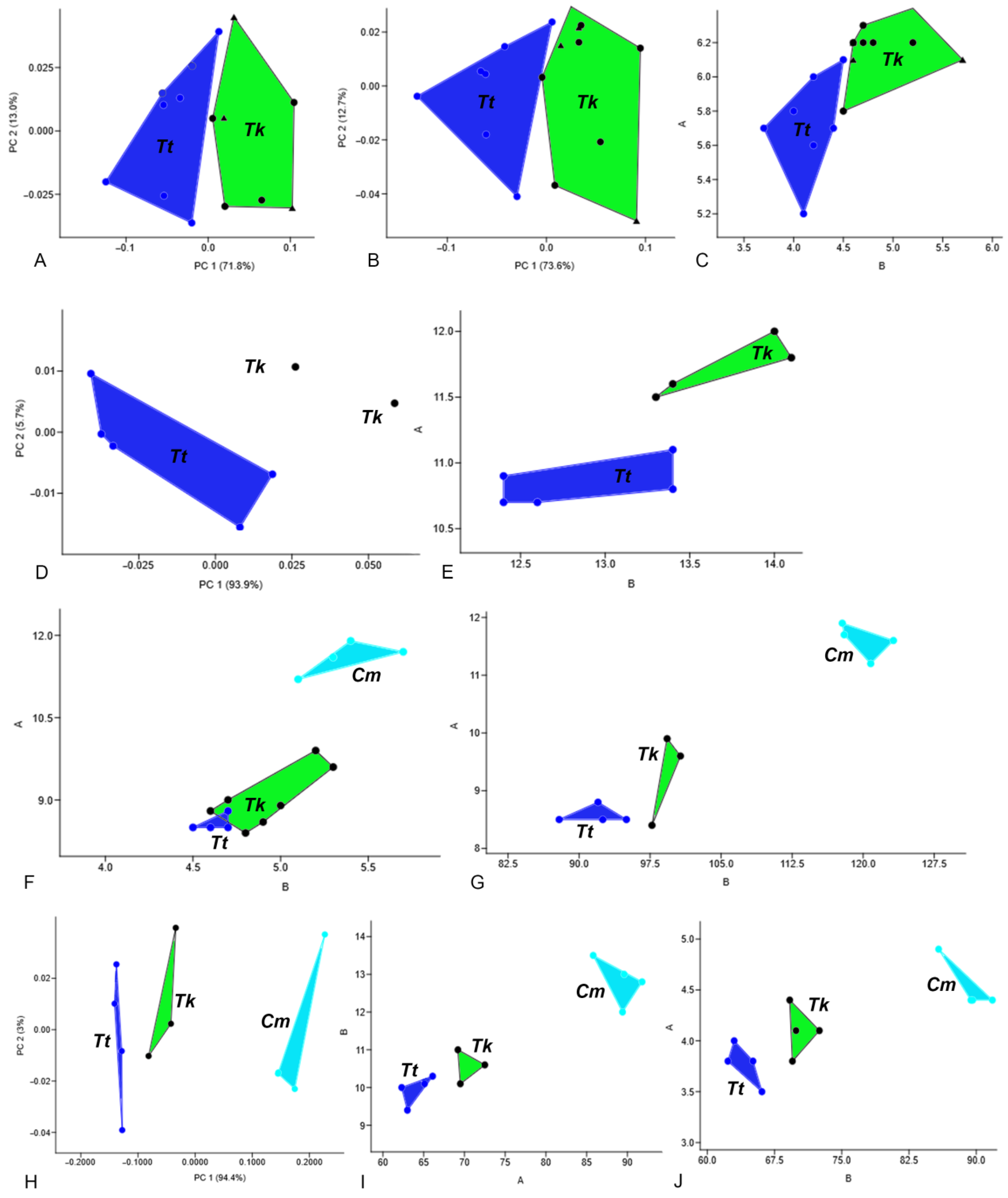
62], and are therefore attributed to this fossil species. The metrical and proportional similarity is best demonstrated by the coracoids (
Figure 4A–C), which are known from both localities and are well-represented in the Taurida sample. In Principal Component Analysis, the coracoids from Betfia-2 (including the holotype) cluster with those from Taurida (
Figure 4A,B). These analyses were performed on specimens both with and without the acrocoracoid process to increase the sample size.
The new material from Taurida further confirms the distinctiveness of
T. kalmani from the modern
T. tetrax, supporting its status as a separate species. The most complete bones—coracoids, femora, tibiotarsi, and tarsometatarsi— show either no overlap or only limited overlap in various measurements, suggesting differences in intraskeletal proportions (
Figure 4D–J,
Table 2). For example, the tarsometatarsus is absolutely longer in
T. kalmani, but its proximal end and shaft dimensions show slight overlap with those of
T. tetrax. However, the new material does not support the original diagnosis that the coracoid, tibiotarsus, and tarsometatarsus of
T. kalmani were wider than those of
T. tetrax [
62]. While the fragmentary type specimens had wider shafts and ends, the more complete remains indicate that the bones were larger in all dimensions, yet not more robust. The only structural difference from the modern species noted here is in the coracoid, a skeletal element known to evolve rapidly in birds. Although the wing bones of
T. kalmani are poorly known, they appear relatively larger, approaching the absolute size of
Chlamydotis macqueenii (while its hind limb bones are notably smaller). This suggests that
T. kalmani may have had relatively larger forelimbs than
T. tetrax, possibly as a compensation for its greater body weight.
The new material also allows for an assessment of sexual dimorphism in this fossil species, which is only weakly expressed in modern
T. tetrax [
80]. The tibiotarsi and tarsometatarsi from Taurida show a greater degree of size variation, which may be correlated with the larger body size of
T. kalmani.
Otididae gen. indet. (?Chlamydotis sp.)
Material. Fragmentary left coracoid (PIN 5644/2838).
Remarks. A fragmentary coracoid is larger than the specimens from this locality attributed to T. kalmani and corresponds in size with the extant Ch. macqueenii. The preserved length of the facies articularis humeralis and cotyla scapularis is 12.3 mm, but was apparently slightly larger originally. This measurement falls within the range for Ch. macqueenii (12.0–12.5 mm), whereas in T. kalmani from Taurida it ranges from 10.9–11.4 mm (and 9.7–10.4 mm in modern T. tetrax). Thus, this specimen represents another bustard taxon in the local fauna.