Article

Effects of Preceding Anesthesia Protocols on Insulin and Glucagon Secretion from Isolated Perfused Rat Pancreas Preparations


by
Valentina Abba
1,
Amalie B. E. Nielsen
1,
Petra Buhr
2,
Karsten Pharao Hammelev
2,
Jens J. Holst
1,3 and
Carolina B. Lobato
1,4,*
1
Department of Biomedical Sciences, Faculty of Health and Medical Sciences, University of Copenhagen, 2200 Copenhagen, Denmark
2
Animal Core Facility, Center for Core Facilities, Faculty of Health and Medical Sciences, University of Copenhagen, 2200 Copenhagen, Denmark
3
Novo Nordisk Foundation Center for Basic Metabolic Research, University of Copenhagen, 2200 Copenhagen, Denmark
4
Department of Medicine, Copenhagen University Hospital, Amager and Hvidovre, Section of Endocrinology, 2650 Hvidovre, Denmark
*
Author to whom correspondence should be addressed.
Anesth. Res. 2026, 3(1), 6; https://doi.org/10.3390/anesthres3010006
Submission received: 20 December 2025 / Revised: 29 January 2026 / Accepted: 4 March 2026 / Published: 8 March 2026

Abstract

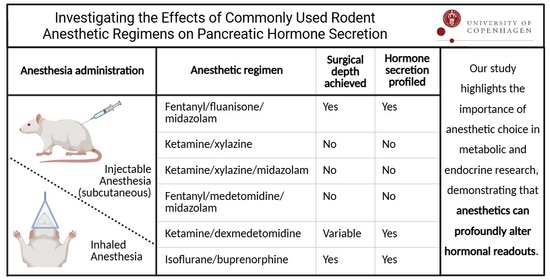
Background/Objectives: Insulin and glucagon are key hormones in metabolic regulation. There are limited comparative data on how common rodent anesthetic regimens influence hormone secretion, leading to misinterpretation of results. We aimed to compare the effects of several anesthetic regimens on insulin and glucagon secretion using the physiologically relevant isolated perfused rat pancreas model. Methods: Six commonly used rodent anesthetic regimens were assessed for their ability to induce surgical depth of anesthesia. Once achieved, the pancreas was vascularly isolated and perfused. After euthanasia, the pancreas was stimulated with glucose and glucagon-like peptide-1 (GLP-1). Insulin and glucagon were measured in the effluent using radioimmunoassay. Results: Anesthesia with Hypnorm® (fentanyl/fluanisone)/midazolam produced the most physiological responses, meaning that insulin was secreted in response to hyperglycemia and GLP-1, and glucagon was secreted under hypoglycemia. Ketamine/dexmedetomidine anesthesia abolished insulin dynamic secretion and blunted glucagon secretion. Isoflurane/buprenorphine anesthesia partially suppressed insulin secretion, but it still followed a physiological pattern in response to glucose fluctuations. However, it abolished the dynamic glucagon responses to glucose. Three additional anesthetic regimens failed to produce surgical depth anesthesia and were therefore not further analyzed. Conclusions: Different anesthetic regimens altered pancreatic hormone secretion. Fentanyl/fluanisone/midazolam was associated with dynamic insulin and glucagon secretion, whereas ketamine/dexmedetomidine and isoflurane/buprenorphine altered the pattern and/or magnitude of hormone secretion. Overall, the choice of anesthesia is a critical variable in animal experimentation for metabolic studies and may confound the interpretation of results.

Graphical Abstract

1. Introduction

The use of rodents in metabolic research is extensive because they can model human metabolic diseases like obesity and diabetes [1]. The endocrine pancreas tightly regulates glycemic homeostasis, with insulin being secreted from pancreatic β-cells when blood glucose rises and glucagon being secreted from pancreatic α-cells as blood glucose lowers [2]. Other hormones are also of interest in the context of diabetes and obesity. Glucagon-like peptide-1 (GLP-1) has proven to be highly relevant in the treatment of these diseases [3,4]. GLP-1 is secreted from intestinal enteroendocrine cells in response to dietary stimuli. It is an incretin hormone that potently stimulates glucose-induced insulin secretion (GSIS). GLP-1 is also a powerful suppressor of glucagon secretion under euglycemia, but not during hypoglycemia [5]. Understanding how GLP-1 modulates hormone secretion is highly relevant for drug development.
There are many models to study hormone secretion, ranging from in vitro to in vivo and even computational models. One of the most physiologically relevant models is the isolated perfused organ model, which allows the study of real-time hormone secretion dynamics without systemic interference while completely preserving organ structure. This can be done on several organs such as the intestine and the pancreas. Both organs are highly complex, with many specialized cells organized around the vascular supply in a complicated pattern that is difficult to replicate in simpler in vitro models. In the perfusion models, paracrine interactions are intact as well as neuronal signaling, both of which are relevant for the functions of both the intestines and pancreas [6,7]. However, organ isolations and perfusions are invasive, non-recovery procedures that involve opening the abdominal cavity (laparotomy) to expose the abdominal organs. This requires surgical depth anesthesia combined with analgesia to ensure pain-free procedures. Many anesthetics involve a mixture of compounds to ensure that they induce sedation, muscle relaxation and analgesia; most of these compounds work synergistically [8].
Effects of different anesthetic compounds on glucose homeostasis are well-reported, where blood glucose or insulin are the primary outcomes; indeed, hyperglycemia is common [9,10,11,12,13,14,15,16,17]. This is highly relevant in the context of metabolic studies, as it likely reflects anesthetic-induced disruption of endocrine function and regulation. Observations of anesthetic effects on other metabolic hormones are scarce and are based on in vivo observations which, while physiological, are diffuse due to systemic interactions. In contrast, the perfusion model used in this study allows for specific and real-time measurement of hormone secretion.
Rodent anesthesia is commonly achieved using injectable ketamine-based or inhalant anesthetics, which can be combined with opioid analgesia in most anesthetic protocols [18,19]. Opioids, such as fentanyl and buprenorphine, primarily activate the µ-receptor to provide strong pain relief [20]. Alternatively, surgical general anesthesia can be achieved using neuroleptanalgesia in combination with a benzodiazepine (e.g., midazolam) or another hypnotic [21,22]. Neuroleptanalgesia refers to a state of deep analgesia achieved through combination of anti-psychotics (e.g., fluanisone) and opioids [23].
Ketamine is an N-methyl-D-aspartate (NMDA) receptor antagonist and, when administered alone, is not sufficient to reach the depth of anesthesia required for surgery. It can result in muscle hypertonia if not combined with a sedative or muscle relaxant [24]. For this reason, it is commonly administered alongside an α2 adrenergic receptor agonist (e.g., xylazine, medetomidine, and dexmedetomidine) [25,26,27]. Because of the widespread expression of α2-receptors and the inhibitory effect of α2-receptor activation on the sympathetic nervous system, gastrointestinal and endocrine functions might also be affected [27,28]. Despite this, anesthetic mixtures containing an α2 adrenergic receptor agonist are regularly used to anesthetize rodents in research models [25,28].
Inhaled anesthetics are also widely used, with isoflurane being the most common [29]. Its exact mechanism of action is not well characterized, but isoflurane may affect a number of both extracellular and intracellular pathways [30,31].
Rodents have high metabolic rates, meaning that high anesthetic doses are required, and the duration of anesthesia may also be reduced compared to other species [27]. Exceeding recommended dosages can be lethal; hence, selecting an appropriate anesthetic regimen is of high importance. Similarly, understanding the potential effects of anesthetic compounds is important for understanding experimental outcomes and should guide the selection of anesthesia regimens. Indeed, misinterpretation of data can occur if these effects are not accounted for.
The aim of this study was to assess the effectiveness of six commonly used rodent anesthetic regimens in achieving surgical depth of anesthesia and to assess the effects of the anesthetic protocols on physiological hormone secretion, with a particular focus on insulin and glucagon secretion in the isolated perfused rat pancreas.

2. Materials and Methods

2.1. Animals

The experiments were approved by the Department of Experimental Medicine, University of Copenhagen, under the animal licenses nr 2018-15-0201-01397 and 2023-15-0201-01408 and were performed by FELASA ABD certified personnel.
Male Wistar rats were purchased from Janvier Labs (Le Genest-Saint-Isle, France) and group-housed under a 12:12 h light–dark cycle. The rats used in all the experiments weighed 250–350 g and had free access to a chow diet and water. Animals were acclimatized for at least one week before any study interventions.

2.2. Anesthetic Protocols

Different anesthesia protocols were applied in collaboration with the Animal Core Facility (ACF) veterinarians, necessitated by a Hypnorm® commercial shortage. These are well-established protocols [22,27,32] and are detailed below:
Protocol 1: Subcutaneous injection of Hypnorm® (fentanyl/fluanisone)/midazolam (3 mL/ kg body weight: Hypnorm®: fentanyl citrate 0.95 mg/kg + fluanisone 30 mg/kg (Skanderborg Apotek, Skanderborg Denmark); midazolam 15 mg/kg (Hameln Pharma, Hameln, Germany)). Supplementation with half of the initial dose as needed.
Protocol 2: Subcutaneous injection of ketamine/xylazine (5 mL/kg body weight: ketamine 100 mg/kg, (Ketamidor®, VetViva, Wels, Austria); xylazine 10 mg/kg, (20 mg/mL, CP-Pharma Handelsgesellschaft mbH, Burgdorf, Germany)). Supplementation with half of the initial dose every 20 min.
Protocol 3: Subcutaneous injection of ketamine/xylazine/midazolam (3 mL/kg body weight: ketamine 100 mg/kg (Ketamidor®, VetViva, Wels, Austria); xylazine 10 mg/kg, (20 mg/mL, CP-Pharma Handelsgesellschaft mbH, Burgdorf, Germany); midazolam 5 mg/kg (Hameln Pharma, Hameln, Germany)). Supplementation with half of the initial dose every 20 min.
Protocol 4: Subcutaneous injection of fentanyl/medetomidine/midazolam (4 mL/kg body weight: fentanyl 0.005 mg/kg; medetomidine 0.15 mg/kg; midazolam 2 mg/kg). Supplementation with half of the initial dose every 20 min.
Protocol 5: Subcutaneous injection of ketamine/dexmedetomidine (4–5 mL/kg body weight: ketamine 75 mg/kg (Ketamidor®, VetViva, Wels, Austria); dexmedetomidine 0.75 mg/kg (Dexdomitor®, Orion Pharma, Ørestad, Denmark)). Supplementation with half of the initial dose as needed.
Protocol 6: Inhaled isoflurane (Attane Vet®, Piramal Critical Care B.V., Voorschoten, The Netherlands) with subcutaneous buprenorphine supplementation (0.83 mL/kg body weight: buprenorphine 0.03 mg/kg administered one hour prior to the induction of isoflurane anesthesia at 4–5% 1 L per minute and maintained at 2–2.5% 1 L during surgery).

2.3. Assessment of Surgical Depth of Anesthesia

Prior to commencement of the surgical procedure, loss of the righting reflex was the first indicator of sedation, and the absence of the pedal withdrawal reflex was a sign that a surgical depth of anesthesia had been reached. Anesthesia was supplemented according to the individual protocols (see above) if reflexes were still present 15 min after the initial dose. Throughout the surgical procedure, the animal was placed on a heated operating table to prevent hypothermia, and reflexes were tested by an interdigital web pinch. Respiratory rate regularity and depth were monitored by chest inspection throughout the surgeries. Oxygenation of the animal was also considered by monitoring the color of the mucus membranes, i.e., whether they remained adequately perfused and not pale. Depth of anesthesia was assessed by the researcher carrying out the surgical procedure, consulting a colleague if needed.

2.4. Isolated Perfused Rat Pancreas

Nonfasted rats were anesthetized (see above) and placed on an operating table heated to 37 °C. The surgical procedure used to isolate the pancreas has been described elsewhere [33,34]. Briefly, a laparotomy was performed, and the colon, small intestine (distal to the duodenojejunal flexure), spleen, and stomach were removed after tying off the supplying vasculature. The kidneys were also vascularly isolated. The abdominal aorta was closed right below the diaphragm, and, immediately after, unidirectional perfusion of the pancreas was established through catheterization of the lower abdominal aorta. This catheter was used for perfusion buffer infusion using a single pass system (UNIPER UP-100, Hugo Sachs Elektronik-Harvard apparatus, March-Hugstetten, Germany). Subsequently, a draining catheter was inserted into the portal vein, allowing collection of the effluent after it has gone through the vasculature in the pancreas. Once flow was established, the animal was euthanized by diaphragmatic perforation followed by cardiac perforation. The perfusion buffer consisted of a modified Krebs–Ringer bicarbonate buffer containing 5% dextran T-70 (Pharmacia Biotech, Uppsala, Sweden), 5 mM pyruvate, 0.1% bovine serum albumin (BSA, Sigma-Aldrich, Merck, Darmstadt, Germany) or 4% Gelofusine® (B. Braun Melsungen, Melsungen, Germany), and 1.5–10 mM glucose (depending on protocol). The pH of the buffer was adjusted to 7.4, heated to 37 °C, and continuously gassed with 95% O2 and 5% CO2. The flow rate was kept constant at 5 mL/min, and after a 30 min wash to stabilize the preparation and wash out anesthetics, samples were collected at one-minute intervals, cooled off on ice, and stored at −20 °C until analysis.

2.5. Experimental Protocol

After a 30 min equilibrium period, various experimental protocols were applied:
(1)
Glucose variations: The pancreas was exposed to varying glucose concentrations ranging from low (1.5 or 3.5 mM), intermediate (6.0 mM) or high (8.0 or 10 mM) in the perfusion buffer. Perfusion with each concentration lasted 15–20 min.
(2)
Repeated stimulations with GLP-1: During pancreas perfusion with a perfusion buffer containing 6.0 mM glucose, three stimulations with 1 nM GLP-1 (7-36) were performed. Each lasted 10 min and they were separated by a washout period of 10 or 40 min.
At the end of each experiment, 10 mM L-arginine (Sigma-Aldrich, Steinheim, Germany) was infused as a positive control [35,36].

2.6. Test Substances

Experimental compounds included D-glucose, 10% (w/v) (cat no. G8270, Merck, Darmstadt, Germany) and GLP-1 (7-36) (, CAS: 107444-51-9 Bachem®, Bubendorf, Switzerland), which was dissolved in water with 1% albumin to 1516 nM (5 µg/mL), stored at −20 °C in aliquots, and further diluted in perfusion buffer on the day of each experiment.

2.7. Hormone Analysis

Insulin and glucagon concentrations in the venous effluent were analyzed using in-house radioimmunoassays (RIA). Insulin measurements were done using a standard curve created using Actrapid® as the standard and the antibody coded 2006, which cross-reacts strongly with rodent insulin [37]. Glucagon assays were performed using a standard curve created with glucagon from Bachem® as the standard and an antibody coded 4305, which reacts equally with rodent and human glucagon [38]. The 125I-labeled insulin and glucagon tracers were gifted by Novo Nordisk, Bagsværd, Denmark. The sensitivity of both assays was in the low picomolar range, which is sufficient for accurate measurement of hormone levels in the perfusate.

3. Results

3.1. Assessment of Anesthetic Adequacy for Surgical General Anesthesia

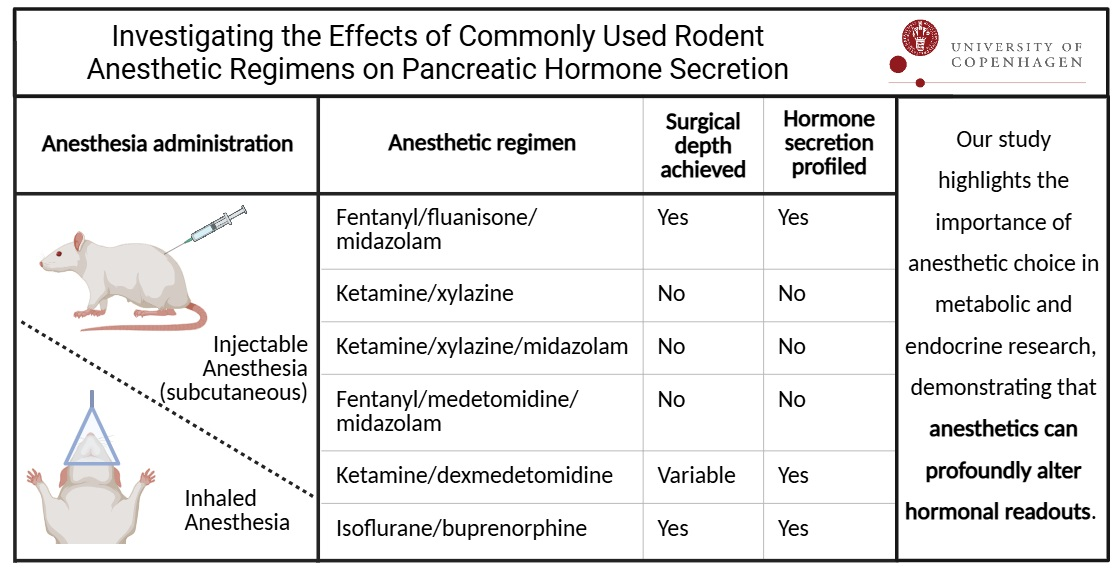
A range of anesthetic regimens were tested to assess both the depth of anesthesia achieved and their suitability for hormone secretion studies. Out of the six regimens tested, only fentanyl/fluanisone/midazolam, ketamine/dexmedetomidine, and isoflurane/buprenorphine resulted in surgical depth of anesthesia. This enabled the surgical procedure to be carried out and the experiments to proceed with sample collection and hormone measurements. Rats that received ketamine/xylazine, ketamine/xylazine/midazolam, or fentanyl/medetomidine/midazolam did not reach surgical depth of anesthesia, as evidenced by the presence of reflexes, despite strict compliance with the surgical protocol (Table 1).

3.2. Glucose-Stimulated Insulin and Glucagon Secretion

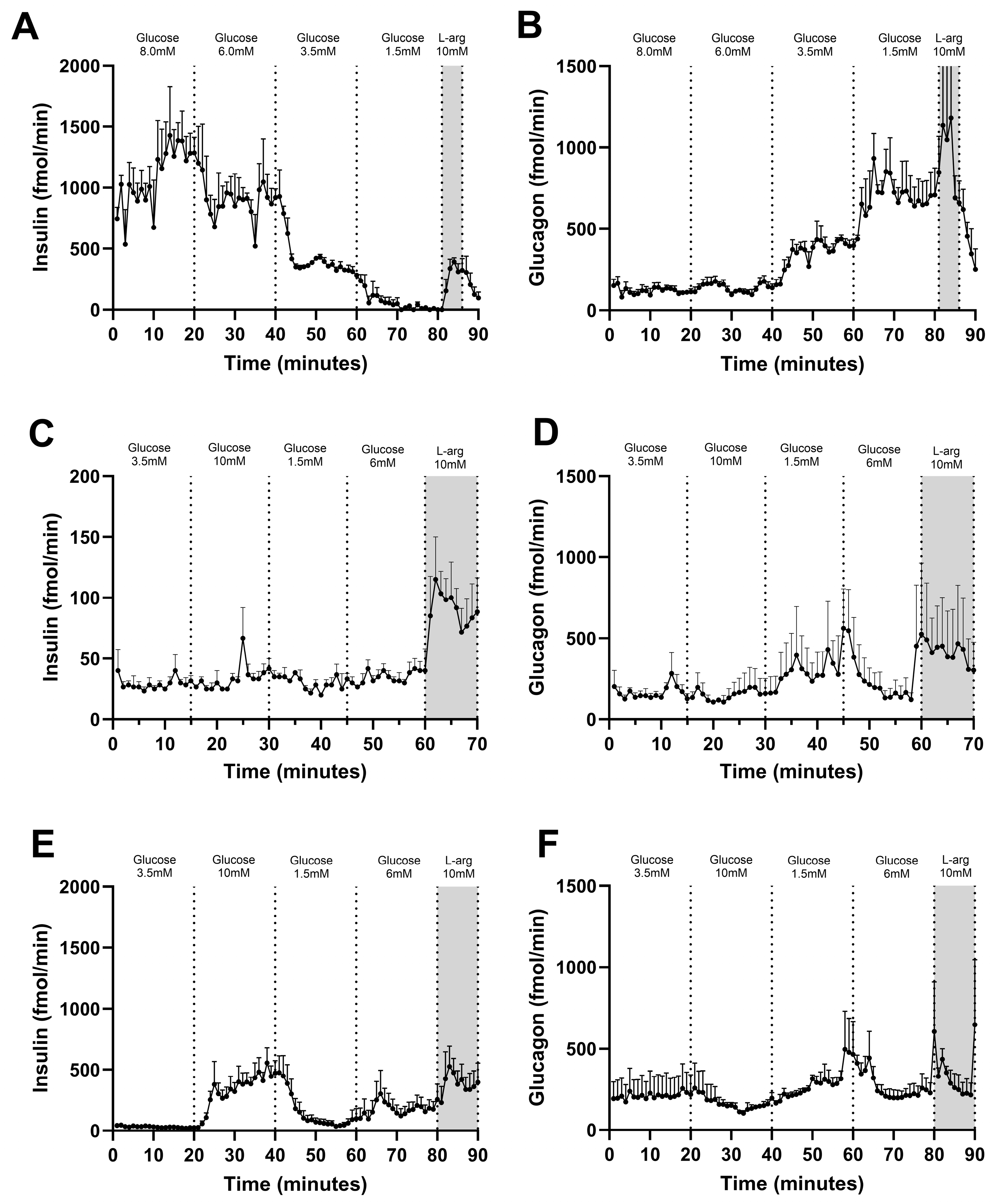
The rats that received fentanyl/fluanisone/midazolam anesthesia (protocol 1) showed dynamic insulin (Figure 1A) and glucagon (Figure 1B) secretion in response to varying glucose concentrations, with high insulin secretion and low glucagon secretion at 8.0 mM glucose, and the opposite pattern at low glucose concentrations (3.5–1.5 mM), with low insulin and high glucagon secretion. The pattern of insulin secretion in rats anesthetized with ketamine/dexmedetomidine (protocol 5) was constant despite changes in glucose concentrations (Figure 1C). However, glucagon secretion in these animals did respond to glucose changes, increasing when glucose was reduced from 10 mM to 1.5 mM and decreasing when glucose was raised from 1.5 mM to 6 mM. Notably, the magnitude of glucagon secretion at low glucose seems to be lower than that observed in fentanyl/fluanisone/midazolam at the same glucose concentration (protocol 1). In rats anesthetized with isoflurane/buprenorphine (protocol 6), insulin secretion changed in response to glucose, with increased secretion at 10 mM and 6 mM and suppression at 3.5 mM and 1.5 mM glucose (Figure 1E). In contrast, glucagon secretion did not respond appropriately to the changes in glucose, as low glucose concentrations fail to markedly augment glucagon secretion (Figure 1F).

3.3. Incretin-Stimulated Insulin Secretion

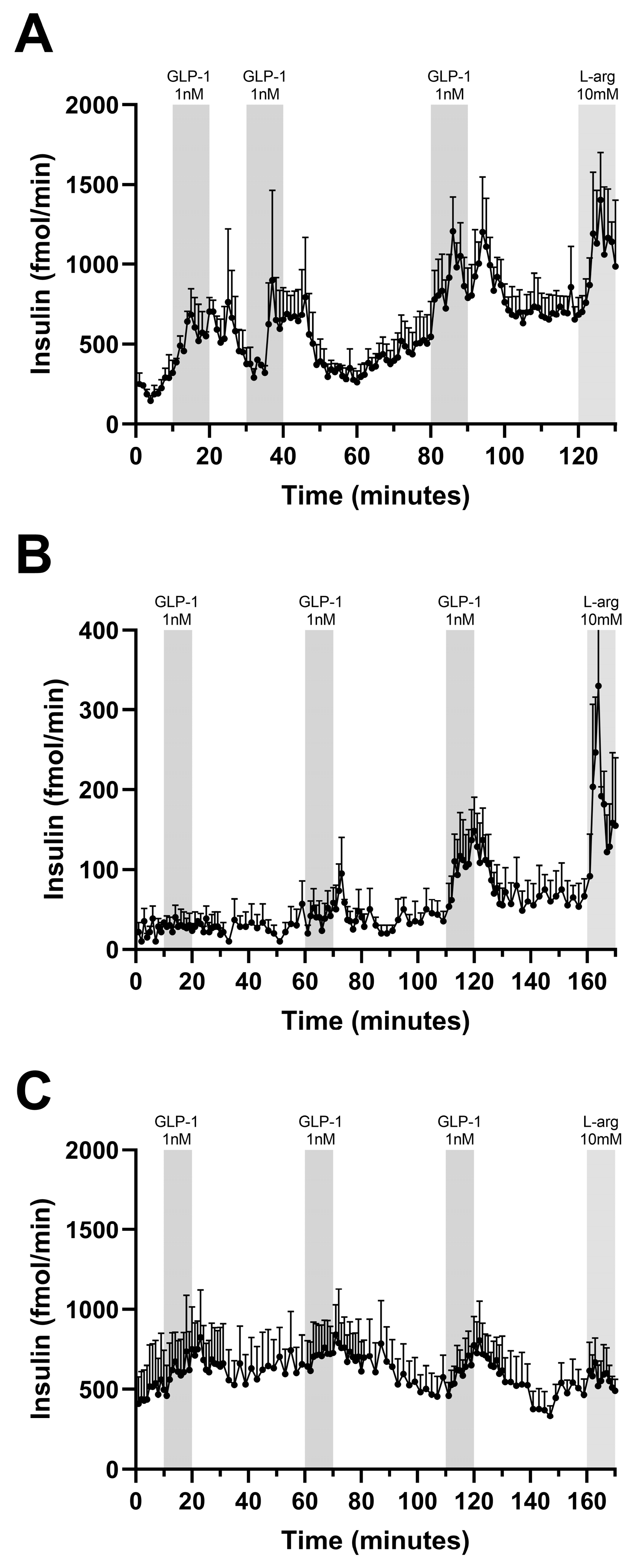
Rats that were anesthetized with fentanyl/fluanisone/midazolam anesthesia (protocol 1) exhibited increased insulin secretion from baseline in response to GLP-1 infusion (Figure 2A). Ketamine/dexmedetomidine anesthesia (protocol 5) prompted low insulin secretion at 6 mM glucose (Figure 2B), both during stimulation with GLP-1 and prior to any stimulation. Repeated stimulations with GLP-1 led to progressively greater insulin secretion (Figure 2B). The baseline secretion of insulin, as well as insulin secretion following GLP-1 stimulation in isoflurane/buprenorphine anesthetized rats (protocol 6, Figure 2C), was much higher than in rats anesthetized with ketamine/dexmedetomidine (protocol 5, Figure 2B).

4. Discussion

We conducted a pilot study aimed at understanding which anesthetic protocols are suitable for rat surgery and how they influence pancreatic hormone secretion. This is also highly relevant for in vivo metabolic studies in rodents, where study procedures may necessarily need to be carried out under anesthesia that, as we proved in this study, highly impacts the endocrine dynamics observed. From the six anesthetic protocols tested, only three achieved adequate anesthetic deepness, with highly variable impacts on hormone secretion.
When considering the use of anesthesia in animal studies, the first question is what degree of anesthesia is required. Not all anesthetic mixtures are sufficient to produce the depth of general anesthesia required for extensive intra-abdominal surgery. Ketamine/xylazine (protocol 2), ketamine/xylazine/midazolam (protocol 3), and fentanyl/medetomidine/midazolam (protocol 4) were not able to induce surgical depth of anesthesia in our study, despite being widely recommended for general anesthesia in rodents [32].
Indeed, ketamine/xylazine is one of the most commonly used injectable anesthetics in animals and is listed in many protocols for anesthesia in rodents [27,32,39]. Despite this, many studies report inconsistent effects with this combination. Thus, it may provide sufficient sedation, as indicated by the lack of righting reflex, but variable analgesic effects, with some rats still presenting interdigital pinch reflexes despite administration of lethal doses [25,26,39]. Addition of midazolam to the ketamine/xylazine mix can enhance the effects of this mixture to improve the anesthetic effect, as has been reported [27,40], but this was still ineffective in our hands.
While the anesthesia depth with fentanyl/fluanisone/midazolam (protocol 1) and isoflurane/buprenorphine (protocol 6) was very consistent, it varied with ketamine/dexmedetomidine (protocol 5). The latter was likely due to stress from handling when we first used this protocol. As this became a common anesthetic protocol in our lab (for other kinds of experiments requiring general anesthesia as well), we had a progressively higher success rate with this mixture. Increased stress from transporting and handling is a common reason why different animals may react differently to the same anesthetic protocol [41], and thus acclimatization after transport should always be prioritized. Other potential factors include sex, strain and age of the animals [39,41,42], all of which were controlled for in our study.
Fentanyl/fluanisone/midazolam, ketamine/dexmedetomidine and isoflurane/buprenorphine resulted in surgical depth of anesthesia. Accordingly, in those animals, the planned experiments were carried out, the surgical isolation of the pancreas was completed, and perfusate samples were collected for hormone analysis.
From data collected during in vivo studies, both in rodents [43,44] and in humans [45,46], glucose is a strong stimulator of insulin secretion and a suppressor of glucagon secretion, whereas low glucose has opposite effects: it suppresses insulin secretion and stimulates glucagon secretion. Furthermore, GLP-1 is known to be a powerful stimulator of insulin secretion, resulting in preserved or even augmented responses to consecutive repeated stimulation [47]. The impact of these anesthetic protocols on hormone secretion is thus confronted with these data.
Hypnorm® is a mixture of fentanyl and fluanisone; fentanyl is an opioid analgesic and fluanisone is an anti-psychotic and tranquilizer [21]. Fentanyl/fluanisone/midazolam is known to induce marked hyperglycemia in rodents and to potentiate insulin secretion [9,16], although conducting experiments on fasted rats might mitigate these effects [9]. Among all the anesthetic protocols tested, fentanyl/fluanisone/midazolam emerged as the most satisfactory at mimicking this physiological hormone secretion across all experiments, with insulin and glucagon responding to stimuli as expected. Nevertheless, we cannot exclude the possibility that even after the fentanyl/fluanisone/midazolam protocol, the pattern or magnitude of hormone secretion in the perfusion model may be altered, given its known effects on glucose homeostasis [9].
Dexmedetomidine is an α2-adrenergic receptor agonist [27], and increased sympathetic activity dampens endocrine activity [48]. Dexmedetomidine is the active isomer of medetomidine, and both are more selective agonists compared to xylazine and are therefore thought to have fewer side effects [27]. Our results in the perfused pancreas show that anesthesia with ketamine/dexmedetomidine profoundly inhibited GSIS, as observed by the lack of insulin secretion in response to both high concentrations of glucose and GLP-1 [49]. A similar effect on GSIS has been reported in in vivo and in vitro studies in rodents [14,15], as well as in non-rodent species [50]. The mechanism of inhibition of insulin secretion from the pancreatic islets seems to involve activation of the adrenergic system by dexmedetomidine, as the infusion of a specific α2-adrenergic receptor antagonist inhibited the acute response to hyperglycemia [11]. Specifically, activation of the Gi/o-coupled-α2A-adrenoceptor subtype found in β-cells is associated with a reduction in cAMP, β-cell hyperpolarization, and therefore inhibition of insulin secretion [51]. Ketamine alone does not appear to have an effect on blood glucose [11]. The increased insulin secretion in response to L-arginine, used here as a positive control, indicates that GSIS is specifically inhibited and not amino acid-stimulated insulin secretion. In this case, L-arginine is a cationic amino acid and may directly depolarize the β-cell membrane, resulting in the influx of Ca2+ into the cell. The effect of α2-receptor agonism on glucagon secretion has been variable, with some reporting it to be stimulatory [52,53], to have no effect [11], or to be inhibitory [17]. In our experiments, the secretion of glucagon responded to changes in glucose as expected, albeit at a lower magnitude than with fentanyl/fluanisone/midazolam anesthesia, as evidenced by lower baseline levels and secretion during glucose stimulations.
The final anesthetic regimen tested was isoflurane in combination with buprenorphine to reinforce analgesia, as isoflurane alone does not provide analgesia unless given at very high doses. A well-known effect of isoflurane anesthesia is hyperglycemia, likely due to impaired clearance of glucose and increased glucose production [10]. As it is an inhaled anesthetic (rather than subcutaneous), we expected the effects of isoflurane to wash off fast and not significantly impact hormone secretion after the 30 min stabilization period, which turned out not to be true. While the effects of isoflurane on glucose homeostasis are well-known, there is only one study demonstrating inhibition of GLP-1 secretion under isoflurane anesthesia [54]. This same report also found that, while GLP-1 secretion is impaired, the insulinotropic action of GLP-1 is maintained [54]. The latter is consistent with our findings, especially when focusing on the response to repeated stimulation with GLP-1. The GSIS response was preserved, but the magnitude of insulin secretion was lower in the rats anesthetized with isoflurane/buprenorphine compared to those anesthetized with fentanyl/fluanisone/midazolam. The diminished insulin secretion with isoflurane is very likely mediated by isoflurane-induced activation of ATP-regulated K+ (KATP) channels [13]. In β-cells, these channels are essential for GSIS, as high glucose concentrations increase the production of ATP, which closes the KATP channels and results in cell depolarization and exocytosis of insulin granules [55]. Finally, glucagon secretion in rats anesthetized with isoflurane/buprenorphine lacked dynamic regulation, as glucagon secretion was unresponsive to glucose fluctuations compared to the other anesthetic regimens. While the effects of isoflurane anesthesia on glucagon secretion have not been formally described, KATP channel activity can also affect hormone release by α-cells [56], and thus this mechanism is likely involved in the impaired glucagon secretion observed.
This pilot study has some limitations. Firstly, only rats were used in these experiments, so we cannot extrapolate that the documented effects would also be observed in mice, nor whether these findings might be translatable to clinical anesthesiology in humans. However, based on the literature, these effects are similar in mice and other small rodents [16,40,57,58], and potentially also in humans [12,59,60]. Additionally, these studies were underpowered. Nevertheless, we obtained rather clear results even with such small numbers. Thus, as soon as it became clear that the anesthetic protocol being used did not support the physiological response of interest, we chose to reduce the number of animals being used, in keeping with the principles of the 3 Rs (replace, reduce, refine) for humane animal experimentation [61].
Different anesthetics have different mechanisms of action and pharmacological profiles, meaning they can directly affect endocrine cells or even disrupt neuronal signaling. We expected the 30 min stabilization and wash period to be sufficient to mitigate the effects of the anesthetics, but that turned out not to be true. Our results suggest that these commonly used anesthetic compounds have some effect on glucose homeostasis, which warrants caution when interpreting the results of metabolic studies in anesthetized animals. On the practical side, inhaled anesthetics require a vaporizer to deliver the anesthesia, a scavenging system to collect waste gases, and good air ventilation, which can be costly to acquire and maintain. Nonetheless, they may be preferred for surgical procedures where dynamic management of surgical depth is required. Injectable anesthetics are likely easier to implement, but controlling the depth of anesthesia is harder and reversal is complicated.
All in all, there is no ‘gold standard’ anesthetic protocol for use in metabolic studies, as the common anesthetics all appear to affect glucose homeostasis. However, understanding exactly which effects each anesthetic protocol might have is crucial for adequate selection in line with the study goals.

5. Conclusions

Anesthetic protocols have a major impact on the outcomes of research endpoints, particularly when focusing on hormone secretion. These results show the distinct effects of different anesthetic regimens on hormone secretion in a pancreas model. Fentanyl/fluanisone/midazolam resulted in hormone secretion patterns that mimic the expected physiological hormone secretion both in response to GLP-1 and glucose, whereas ketamine/dexmedetomidine suppressed insulin secretion in response to glucose and GLP-1. Insulin secretion was preserved after isoflurane/buprenorphine anesthesia, but its magnitude was attenuated, whereas glucagon secretion was unresponsive to glucose fluctuations. Overall, our study highlights the importance of anesthetic choice in metabolic and endocrine research, demonstrating that anesthetics can profoundly alter hormonal readouts. Understanding these effects helps guide the appropriate selection of anesthesia for future perfusion and metabolic studies.

Author Contributions

Conceptualization, V.A., J.J.H. and C.B.L.; methodology, V.A., P.B., K.P.H., J.J.H. and C.B.L.; formal analysis, V.A. and C.B.L.; investigation, V.A., A.B.E.N., P.B., K.P.H. and C.B.L.; data curation, C.B.L.; writing—original draft preparation, V.A.; writing—review and editing, V.A., A.B.E.N., P.B., K.P.H., J.J.H. and C.B.L.; visualization, V.A. and C.B.L.; supervision, J.J.H. and C.B.L.; project administration, J.J.H. and C.B.L.; funding acquisition, J.J.H. and C.B.L. All authors have read and agreed to the published version of the manuscript.

Funding

CBL is supported by a research grant from the Danish Diabetes Academy (grant-ID PhD013-20), which is funded by the Novo Nordisk Foundation, grant nr. NNF17SA0031406; by a grant from the “la Caixa” Foundation (ID 100010434, code LCF/BQ/EU21/11890081); and by the BRIDGE—Translational Excellence Programme (bridge.ku.dk) at the Faculty of Health and Medical Sciences, University of Copenhagen, funded by the Novo Nordisk Foundation (grant agreement no. NNF23SA0087869). The Novo Nordisk Foundation Center for Basic Metabolic Research is an independent research center at the University of Copenhagen, partially funded by an unrestricted donation from the Novo Nordisk Foundation (NNF23SA0084103).

Institutional Review Board Statement

The animal study protocol was approved by the Department of Experimental Medicine, University of Copenhagen (protocol code 2018-15-0201-01397, approval date 01-05-2018, and protocol code 2023-15-0201-01408, approval date 14-04-2023).

Informed Consent Statement

Not applicable.

Data Availability Statement

The raw data supporting this article will be made available by the authors on request.

Conflicts of Interest

The authors declare no conflicts of interest.

Abbreviations

The following abbreviations are used in this manuscript:
GLP-1Glucagon-like peptide-1
GSISGlucose-induced insulin secretion
NMDAN-methyl-D-aspartate
FELASAFederation of Laboratory Animal Science Associations
ACFAnimal Core Facility
RIARadioimmunoassay
cAMPCyclic adenosine monophosphate

References

  1. Brown, L.; Panchal, S.K. Rodent Models for Metabolic Syndrome Research. J. Biomed. Biotechnol. 2010, 2011, 351982. [Google Scholar] [CrossRef]
  2. Ojha, A.; Ojha, U.; Mohammed, R.; Chandrashekar, A.; Ojha, H. Current Perspective on the Role of Insulin and Glucagon in the Pathogenesis and Treatment of Type 2 Diabetes Mellitus. Clin. Pharmacol. Adv. Appl. 2019, 11, 57. [Google Scholar] [CrossRef] [PubMed]
  3. Frías, J.P.; Davies, M.J.; Rosenstock, J.; Pérez Manghi, F.C.; Fernández Landó, L.; Bergman, B.K.; Liu, B.; Cui, X.; Brown, K. Tirzepatide versus Semaglutide Once Weekly in Patients with Type 2 Diabetes. N. Engl. J. Med. 2021, 385, 503–515. [Google Scholar] [CrossRef] [PubMed]
  4. Jastreboff, A.M.; Aronne, L.J.; Ahmad, N.N.; Wharton, S.; Connery, L.; Alves, B.; Kiyosue, A.; Zhang, S.; Liu, B.; Bunck, M.C.; et al. Tirzepatide Once Weekly for the Treatment of Obesity. N. Engl. J. Med. 2022, 387, 205–216. [Google Scholar] [CrossRef]
  5. Holst, J.J. GLP-1 Physiology in Obesity and Development of Incretin-Based Drugs for Chronic Weight Management. Nat. Metab. 2024, 6, 1866–1885. [Google Scholar] [CrossRef]
  6. Agerskov, R.H.; Nyeng, P. Innervation of the Pancreas in Development and Disease. Development 2024, 151, dev202254. [Google Scholar] [CrossRef]
  7. Chmelir, T.; Jarkovska, D.; Pandey, S.; Chottova Dvorakova, M. Neurogastroenterology: Current Insights into Gastrointestinal Innervation in Health and Disease. Auton. Neurosci. 2025, 261, 103339. [Google Scholar] [CrossRef]
  8. Hendrickx, J.F.A.; Eger, E.I.; Sonner, J.M.; Shafer, S.L. Is Synergy the Rule? A Review of Anesthetic Interactions Producing Hypnosis and Immobility. Anesth. Analg. 2008, 107, 494–506. [Google Scholar] [CrossRef]
  9. Johansen, O.; Vaaler, S.; Jorde, R.; Reikerås, O. Increased Plasma Glucose Levels after Hypnorm® Anaesthesia, but Not after Pentobarbital® Anaesthesia in Rats. Lab. Anim. 1994, 28, 244–248. [Google Scholar] [CrossRef]
  10. Lattermann, R.; Schricker, T.; Wachter, U.; Georgieff, M.; Goertz, A. Understanding the Mechanisms by Which Isoflurane Modifies the Hyperglycemic Response to Surgery. Anesth. Analg. 2001, 93, 121–127. [Google Scholar] [CrossRef]
  11. Saha, J.K.; Xia, J.; Grondin, J.M.; Engle, S.K.; Jakubowski, J.A. Acute Hyperglycemia Induced by Ketamine/Xylazine Anesthesia in Rats: Mechanisms and Implications for Preclinical Models. Exp. Biol. Med. 2005, 230, 777–784. [Google Scholar] [CrossRef]
  12. Tanaka, T.; Nabatame, H.; Tanifuji, Y. Insulin Secretion and Glucose Utilization Are Impaired under General Anesthesia with Sevoflurane as Well as Isoflurane in a Concentration-Independent Manner. J. Anesth. 2005, 19, 277–281. [Google Scholar] [CrossRef]
  13. Zuurbier, C.J.; Keijzers, P.J.M.; Koeman, A.; Van Wezel, H.B.; Hollmann, M.W. Anesthesia’s Effects on Plasma Glucose and Insulin and Cardiac Hexokinase at Similar Hemodynamics and without Major Surgical Stress in Fed Rats. Anesth. Analg. 2008, 106, 135–142. [Google Scholar] [CrossRef] [PubMed]
  14. Yamato Kodera, S.; Yoshida, M.; Dezaki, K.; Yada, T.; Murayama, T.; Kawakami, M.; Kakei, M. Inhibition of Insulin Secretion from Rat Pancreatic Islets by Dexmedetomidine and Medetomidine, Two Sedatives Frequently Used in Clinical Settings. Endocr. J. 2013, 60, 337–346. [Google Scholar] [CrossRef] [PubMed]
  15. Takahashi, T.; Kawano, T.; Eguchi, S.; Chi, H.; Iwata, H.; Yokoyama, M. Effects of Dexmedetomidine on Insulin Secretion from Rat Pancreatic β Cells. J. Anesth. 2014, 29, 396–402. [Google Scholar] [CrossRef] [PubMed]
  16. Windeløv, J.A.; Pedersen, J.; Holst, J.J. Use of Anesthesia Dramatically Alters the Oral Glucose Tolerance and Insulin Secretion in C57Bl/6 Mice. Physiol. Rep. 2016, 4, e12824. [Google Scholar] [CrossRef]
  17. Bouillon, J.; Duke, T.; Focken, A.P.; Snead, E.C.; Cosford, K.L. Effects of Dexmedetomidine on Glucose Homeostasis in Healthy Cats. J. Feline Med. Surg. 2019, 22, 344. [Google Scholar] [CrossRef]
  18. Murphy, K.L.; Roughan, J.V.; Baxter, M.G.; Flecknell, P.A. Anaesthesia with a Combination of Ketamine and Medetomidine in the Rabbit: Effect of Premedication with Buprenorphine. Vet. Anaesth. Analg. 2010, 37, 222–229. [Google Scholar] [CrossRef]
  19. LaTourette, P.C.; David, E.M.; Pacharinsak, C.; Jampachaisri, K.; Smith, J.C.; Marx, J.O. Effects of Standard and Sustained-Release Buprenorphine on the Minimum Alveolar Concentration of Isoflurane in C57BL/6 Mice. J. Am. Assoc. Lab. Anim. Sci. JAALAS 2020, 59, 298. [Google Scholar] [CrossRef]
  20. Pathan, H.; Williams, J. Basic Opioid Pharmacology: An Update. Br. J. Pain 2012, 6, 11. [Google Scholar] [CrossRef]
  21. Flecknell, P.A.; Mitchell, M. Midazolam and Fentanyl-Fluanisone: Assessment of Anaesthetic Effects in Laboratory Rodents and Rabbits. Lab. Anim. 1984, 18, 143–146. [Google Scholar] [CrossRef] [PubMed]
  22. Tremoleda, J.L.; Kerton, A.; Gsell, W. Anaesthesia and Physiological Monitoring During In Vivo Imaging of Laboratory Rodents: Considerations on Experimental Outcomes and Animal Welfare. EJNMMI Res. 2012, 2, 1–23. [Google Scholar] [CrossRef] [PubMed]
  23. Flecknell, P.; Lofgren, J.L.S.; Dyson, M.C.; Marini, R.R.; Michael Swindle, M.; Wilson, R.P. Preanesthesia, Anesthesia, Analgesia, and Euthanasia. In Laboratory Animal Medicine: Third Edition; Academic Press: Cambridge, MA, USA, 2015; pp. 1135–1200. [Google Scholar] [CrossRef]
  24. Winters, W.D.; Ferrar-Allado, T.; Guzman-Flores, C.; Alcaraz, M. The Cataleptic State Induced by Ketamine: A Review of the Neuropharmacology of Anesthesia. Neuropharmacology 1972, 11, 303–315. [Google Scholar] [CrossRef] [PubMed]
  25. Van Pelt, L.F.; Alegado, D.B.; Howard, E.B. Ketamine and Xylazine for Surgical Anesthesia in Rats. J. Am. Vet. Med. Assoc. 1977, 171, 842–844. [Google Scholar] [CrossRef]
  26. Green, C.J.; Knight, J.; Precious, S.; Simpkin, S. Ketamine Alone and Combined with Diazepam or Xylazine in Laboratory Animals: A 10 Year Experience. Lab. Anim. 1981, 15, 163–170. [Google Scholar] [CrossRef]
  27. Oh, S.S.; Narver, H.L. Mouse and Rat Anesthesia and Analgesia. Curr. Protoc. 2024, 4, e995. [Google Scholar] [CrossRef]
  28. Lindh, E.; Meller, A.; Raekallio, M. Effects of Vatinoxan in Rats Sedated with a Combination of Medetomidine, Midazolam and Fentanyl. Acta Vet. Scand. 2024, 66, 23. [Google Scholar] [CrossRef]
  29. Grubb, T. Inhalant Anesthetics: He’s Got Gas! In Questions and Answers in Small Animal Anesthesia; Wiley: Hoboken, NJ, USA, 2015; pp. 93–99. [Google Scholar] [CrossRef]
  30. Jedlicka, J.; Groene, P.; Linhart, J.; Raith, E.; Mustapha, D.; Conzen, P. Inhalational Anaesthetics: An Update on Mechanisms of Action and Toxicity. J. Exp. Neurol. 2021, 2, 62–69. [Google Scholar] [CrossRef]
  31. Adam, C.; Kayal, C.; Ercole, A.; Contera, S.; Ye, H.; Jerusalem, A. Action of the General Anaesthetic Isoflurane Reveals Coupling between Viscoelasticity and Electrophysiological Activity in Individual Neurons. Commun. Phys. 2023, 6, 174. [Google Scholar] [CrossRef]
  32. Flecknell, P.A. Laboratory Animal Anaesthesia and Analgesia (Fifth Edition): Chapter 6: Anaesthesia of Common Laboratory Species: Special Considerations; Academic Press: Cambridge, MA, USA, 2023; pp. 215–282. [Google Scholar] [CrossRef]
  33. De Heer, J.; Holst, J.J. Sulfonylurea Compounds Uncouple the Glucose Dependence of the Insulinotropic Effect of Glucagon-Like Peptide 1. Diabetes 2007, 56, 438–443. [Google Scholar] [CrossRef]
  34. Christiansen, C.B.; Svendsen, B.; Holst, J.J. The VGF-Derived Neuropeptide TLQP-21 Shows No Impact on Hormone Secretion in the Isolated Perfused Rat Pancreas. Horm. Metab. Res. 2015, 47, 537–543. [Google Scholar] [CrossRef] [PubMed]
  35. Aguilar-Parada, E.; Eisentraut, A.M.; Unger, R.H. Pancreatic Glucagon Secretion in Normal and Diabetic Subjects. Am. J. Med. Sci. 1969, 257, 415–419. [Google Scholar] [CrossRef] [PubMed]
  36. Sener, A.; Lebrun, P.; Blachier, F.; Malaisse, W.J. Stimulus-Secretion Coupling of Arginine-Induced Insulin Release: Insulinotro Action of Agmatine. Biochem. Pharmacol. 1989, 38, 327–330. [Google Scholar] [CrossRef] [PubMed]
  37. Brand, C.L.; Jorgensen, P.N.; Knigge, U.; Warberg, J.; Svendsen, I.; Kristensen, J.S.; Holst, J.J. Role of Glucagon in Maintenance of Euglycemia in Fed and Fasted Rats. Am. J. Physiol. Metab. 1995, 269, E469–E477. [Google Scholar] [CrossRef]
  38. Ørskov, C.; Jeppesen, J.; Madsbad, S.; Holst, J.J. Proglucagon Products in Plasma of Noninsulin-Dependent Diabetics and Nondiabetic Controls in the Fasting State and after Oral Glucose and Intravenous Arginine. J. Clin. Investig. 1991, 87, 415–423. [Google Scholar] [CrossRef]
  39. Smith, W. Responses of Laboratory Animals to Some Injectable Anaesthetics. Lab. Anim. 1993, 27, 30–39. [Google Scholar] [CrossRef]
  40. Buhr, P.; Kolstrup, S.; Nikolajsen, L.L.; Bollen, P. The Anaesthetic Effects of Ketamine/Xylazine/Midazolam in C57Bl/6JRj Mice. Scand. J. Lab. Anim. Sci. 2023, 49, 21–27. [Google Scholar] [CrossRef]
  41. Wang, L.; Holland, L.; Fong, R.; Khokhar, S.; Fox, A.P.; Xie, Z. A Pilot Study Showing That Repeated Exposure to Stress Produces Alterations in Subsequent Responses to Anesthetics in Rats. PLoS ONE 2019, 14, e0214093. [Google Scholar] [CrossRef]
  42. Chemali, J.J.; Kenny, J.D.; Olutola, O.; Taylor, N.E.; Kimchi, E.Y.; Purdon, P.L.; Brown, E.N.; Solt, K. Ageing Delays Emergence from General Anaesthesia in Rats by Increasing Anaesthetic Sensitivity in the Brain. BJA Br. J. Anaesth. 2015, 115, i58. [Google Scholar] [CrossRef]
  43. Hendrick, G.K.; Gjinovci, A.; Baxter, L.A.; Mojsov, S.; Wollheim, C.B.; Habener, J.F.; Weir, G.C. Glucagon-like Peptide-I-(7–37) Suppresses Hyperglycemia in Rats. Metabolism 1993, 42, 1–6. [Google Scholar] [CrossRef]
  44. Galsgaard, K.D.; Abba, V.; Kuhre, R.E.; Holst, J.J.; Hartmann, B. In Vivo Inhibition of Dipeptidyl Peptidase 4 and Neprilysin Activity Enables Measurement of GLP-1 Secretion in Male Rats. J. Endocr. Soc. 2025, 9, bvaf173. [Google Scholar] [CrossRef]
  45. Zander, M.; Madsbad, S.; Madsen, J.L.; Holst, J.J. Effect of 6-Week Course of Glucagon-like Peptide 1 on Glycaemic Control, Insulin Sensitivity, and β-Cell Function in Type 2 Diabetes: A Parallel-Group Study. Lancet 2002, 359, 824–830. [Google Scholar] [CrossRef] [PubMed]
  46. Svane, M.S.; Bojsen-Møller, K.N.; Martinussen, C.; Dirksen, C.; Madsen, J.L.; Reitelseder, S.; Holm, L.; Rehfeld, J.F.; Kristiansen, V.B.; van Hall, G.; et al. Postprandial Nutrient Handling and Gastrointestinal Hormone Secretion After Roux-En-Y Gastric Bypass vs Sleeve Gastrectomy. Gastroenterology 2019, 156, 1627–1641.e1. [Google Scholar] [CrossRef] [PubMed]
  47. Quddusi, S.; Vahl, T.P.; Hanson, K.; Prigeon, R.L.; D’Alessio, D.A. Differential Effects of Acute and Extended Infusions of Glucagon-Like Peptide-1 on First- and Second-Phase Insulin Secretion in Diabetic and Nondiabetic Humans. Diabetes Care 2003, 26, 791–798. [Google Scholar] [CrossRef] [PubMed][Green Version]
  48. Angel, I.; Bidet, S.; Langer, S.Z. Pharmacological Characterization of the Hyperglycemia Induced by Alpha-2 Adrenoceptor Agonists. J. Pharmacol. Exp. Ther. 1988, 246, 1098–1103. [Google Scholar] [CrossRef]
  49. Kjems, L.L.; Holst, J.J.; Vølund, A.; Madsbad, S. The Influence of GLP-1 on Glucose-Stimulated Insulin Secretion Effects on β-Cell Sensitivity in Type 2 and Nondiabetic Subjects. Diabetes 2003, 52, 380–386. [Google Scholar] [CrossRef]
  50. Vaughan, K.L.; Szarowicz, M.D.; Herbert, R.L.; Mattison, J.A. Comparison of Anesthesia Protocols for Intravenous Glucose Tolerance Testing in Rhesus Monkeys. J. Med. Primatol. 2014, 43, 162–168. [Google Scholar] [CrossRef]
  51. Fagerholm, V.; Haaparanta, M.; Scheinin, M. α 2-Adrenoceptor Regulation of Blood Glucose Homeostasis. Basic Clin. Pharmacol. Toxicol. 2011, 108, 365–370. [Google Scholar] [CrossRef]
  52. Samols, E.; Weir, G.C. Adrenergic Modulation of Pancreatic A, B, and D Cells Alpha-Adrenergic Suppression and Beta-Adrenergic Stimulation of Somatostatin Secretion, Alpha-Adrenergic Stimulation of Glucagon Secretion in the Perfused Dog Pancreas. J. Clin. Investig. 1979, 63, 230–238. [Google Scholar] [CrossRef]
  53. Saito, M.; Saitoh, T.; Inoue, S. Alpha 2-Adrenergic Modulation of Pancreatic Glucagon Secretion in Rats. Physiol. Behav. 1992, 51, 1165–1171. [Google Scholar] [CrossRef]
  54. Kawano, T.; Tanaka, K.; Chi, H.; Eguchi, S.; Yamazaki, F.; Kitamura, S.; Kumagai, N.; Yokoyama, M. Biophysical and Pharmacological Properties of Glucagon-like Peptide-1 in Rats under Isoflurane Anesthesia. Anesth. Analg. 2012, 115, 62–69. [Google Scholar] [CrossRef]
  55. Rorsman, P.; Ramracheya, R.; Rorsman, N.J.G.; Zhang, Q. ATP-Regulated Potassium Channels and Voltage-Gated Calcium Channels in Pancreatic Alpha and Beta Cells: Similar Functions but Reciprocal Effects on Secretion. Diabetologia 2014, 57, 1749–1761. [Google Scholar] [CrossRef]
  56. MacDonald, P.E.; Marinis, Y.Z.D.; Ramracheya, R.; Salehi, A.; Ma, X.; Johnson, P.R.V.; Cox, R.; Eliasson, L.; Rorsman, P. A KATP Channel-Dependent Pathway within α Cells Regulates Glucagon Release from Both Rodent and Human Islets of Langerhans. PLoS Biol. 2007, 5, e143. [Google Scholar] [CrossRef]
  57. Wewer Albrechtsen, N.J.; Kuhre, R.E.; Windeløv, J.A.; Ørgaard, A.; Deacon, C.F.; Kissow, H.; Hartmann, B.; Holst, J.J. Dynamics of Glucagon Secretion in Mice and Rats Revealed Using a Validated Sandwich ELISA for Small Sample Volumes. Am. J. Physiol. Metab. 2016, 311, E302–E309. [Google Scholar] [CrossRef]
  58. Yu, Q.; Li, J.; Dai, C.L.; Li, H.; Iqbal, K.; Liu, F.; Gong, C.X. Anesthesia with Sevoflurane or Isoflurane Induces Severe Hypoglycemia in Neonatal Mice. PLoS ONE 2020, 15, e0231090. [Google Scholar] [CrossRef]
  59. Nummela, A.J.; Laaksonen, L.T.; Laitio, T.T.; Kallionpää, R.E.; Långsjö, J.W.; Scheinin, J.M.; Vahlberg, T.J.; Koskela, H.T.; Aittomäki, V.; Valli, K.J.; et al. Effects of Dexmedetomidine, Propofol, Sevoflurane and S-Ketamine on the Human Metabolome: A Randomised Trial Using Nuclear Magnetic Resonance Spectroscopy. Eur. J. Anaesthesiol. 2022, 39, 521–532. [Google Scholar] [CrossRef]
  60. Tharp, W.G.; Breidenstein, M.W.; Friend, A.F.; Bender, S.P.; Raftery, D. The Neuroendocrine Stress Response Compensates for Suppression of Insulin Secretion by Volatile Anesthetic Agents: An Observational Study. Physiol. Rep. 2023, 11, e15603. [Google Scholar] [CrossRef]
  61. Russell, W.; Burch, R. The Principles of Humane Experimental Technique; Methuen & Co. Limited: London, UK, 1959. [Google Scholar] [CrossRef]
Figure 1. Secretion of insulin (A,C,E) and glucagon (B,D,F) induced by varying concentrations of glucose (1.5–10 mM) under different anesthesia types: (A,B) fentanyl/fluanisone/midazolam (protocol 1), buffer with albumin, n = 3 for insulin and n = 4 for glucagon; (C,D) ketamine/dexmedetomidine (protocol 5), buffer with Gelofusine®, n = 3; (E,F) isoflurane/buprenorphine (protocol 6), buffer with albumin n = 4 for insulin and n = 3 for glucagon. 10 mM of L-arginine (L-arg) was infused at the end of experiment as a positive control (represented by the grey bars). Data are represented as mean + SEM.
Anesthres 03 00006 g001
Figure 2. Secretion of insulin induced by glucagon-like peptide-1 (GLP-1) at 6 mM glucose under different anesthesia types: (A) fentanyl/fluanisone/midazolam, buffer with albumin, n = 3; (B) ketamine/dexmedetomidine, buffer with albumin n = 4; (C) isoflurane/buprenorphine, buffer with Gelofusine®, n = 4. A total of 10 mM of L-arginine (L-arg) was infused at the end of experiment as a positive control. Stimulation periods with GLP-1 or L-arg are represented by the grey bars. Data are represented as mean + SEM.
Anesthres 03 00006 g002
Table 1. Summary of anesthetic regimens tested.
Anesthetic RegimenSurgical Depth Achieved?Stability of PreparationHormone Assays?
Protocol 1: Fentanyl/fluanisone/midazolamYesStableYes
Protocol 2: Ketamine/xylazineNoInadequate depthNo
Protocol 3: Ketamine/xylazine/midazolamNoInadequate depthNo
Protocol 4: Fentanyl/medetomidine/midazolamNoInadequate depthNo
Protocol 5: Ketamine/dexmedetomidineVariableOccasionally some reflexesYes
Protocol 6: Isoflurane/buprenorphineYesStableYes
Disclaimer/Publisher’s Note: The statements, opinions and data contained in all publications are solely those of the individual author(s) and contributor(s) and not of MDPI and/or the editor(s). MDPI and/or the editor(s) disclaim responsibility for any injury to people or property resulting from any ideas, methods, instructions or products referred to in the content.