Article

Methadone as an Additive to Multimodal Analgesia vs. Epidural Analgesia in Open and Minimal Invasive Pancreatic Surgery: A Retrospective Analysis


by
Tom Pisters
1,
Annemarie Akkermans
2,3,
Ignace H. J. T. de Hingh
4,5,
Misha D. P. Luyer
3,4 and
Harm J. Scholten
2,3,*
1
Department of Anesthesiology, Maaastricht Univerity Medical Center, 6229 HX Maastricht, The Netherlands
2
Department of Anesthesiology, Catharina Hospital, 5623 EJ Eindhoven, The Netherlands
3
Department of Electrical Engineering, Eindhoven University of Technology, 5612 AZ Eindhoven, The Netherlands
4
Department of Surgery, Catharina Hospital, 5623 EJ Eindhoven, The Netherlands
5
Department of Epidemiology, GROW-School for Oncology and Developmental Biology, Maastricht University, 6229 HX Maastricht, The Netherlands
*
Author to whom correspondence should be addressed.
Anesth. Res. 2026, 3(1), 3; https://doi.org/10.3390/anesthres3010003
Submission received: 12 November 2025 / Revised: 17 December 2025 / Accepted: 1 January 2026 / Published: 22 January 2026

Abstract

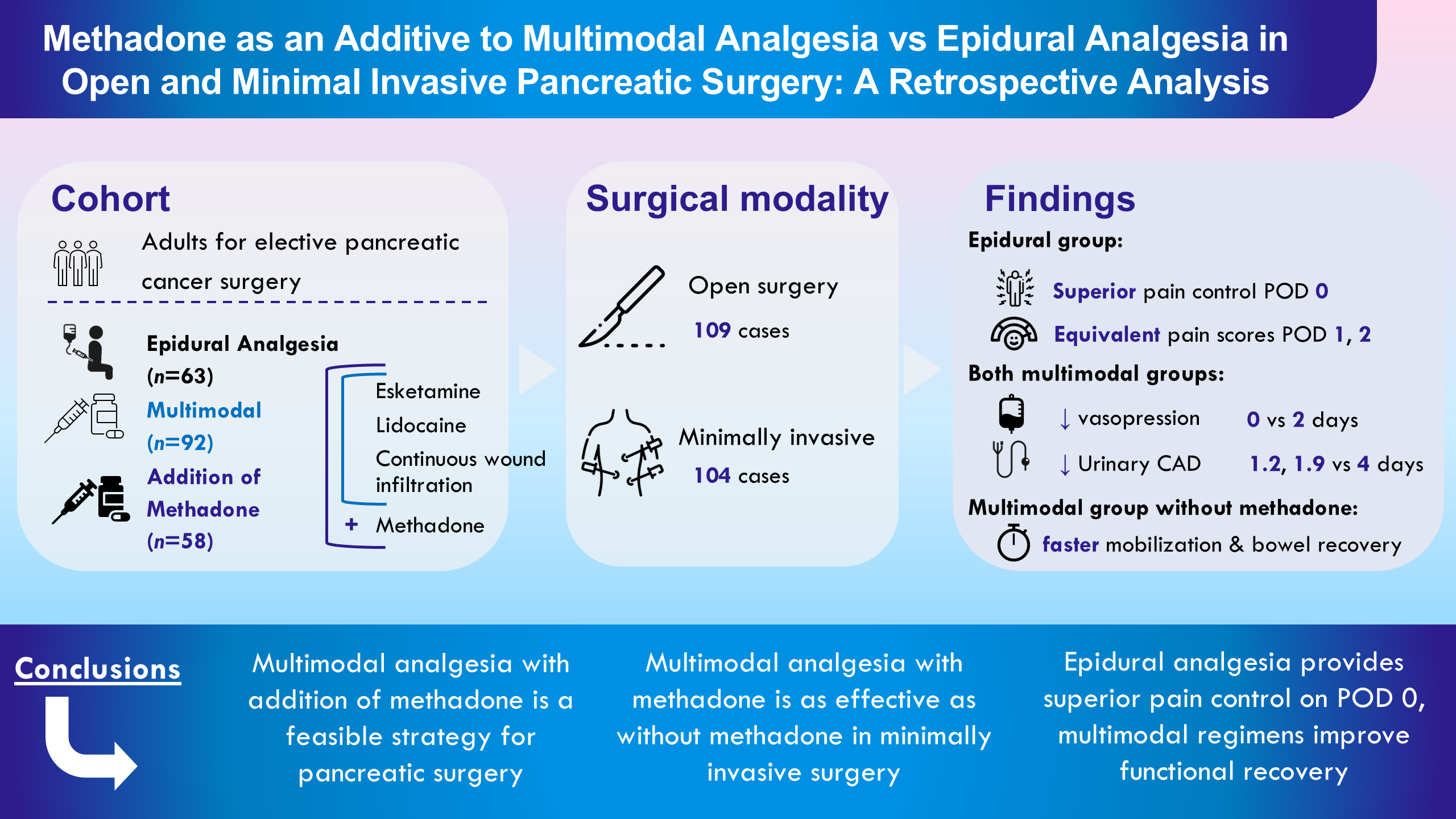
Background: Epidural analgesia (EA) is widely used in pancreatic surgery but is associated with hypotension and delayed recovery. The shift towards minimally invasive surgery has led to the exploration of alternative multimodal analgesia strategies. Methadone, with its unique pharmacological properties, may further optimize recovery. Methods: This retrospective cohort study included 213 patients undergoing pancreatic resection, receiving EA (n = 63), multimodal analgesia without methadone (MA; n = 92), or with methadone (MM; n = 58). MA and MM included intravenous ketamine, lidocaine and continuous wound infiltration. Primary outcome was maximum daily postoperative pain scores. Secondary outcomes included opioid consumption, vasopressor use, mobilization, bowel recovery, urinary catheter duration, and ICU/hospital stay. Results: Compared with EA, pain scores were slightly higher in MM (mean difference 2.22; 95% CI 1.22–3.90; p = 0.01) and in MA (mean difference 2.06; 95% CI 0.99–4.30; p = 0.06). Opioid use was comparable between MM and EA (OR 0.99, 95% CI [0.98, 1.00], p = 0.20), and significantly lower in MA (OR 0.97, 95% CI [0.96, 0.98], p < 0.001). Both MA and MM demonstrated reduced vasopressor requirements (both 0 vs. 2.0 median days) and shorter urinary catheterization durations (MA 1.2 MM 1.9 vs. EA 4.0 median days). MA improved mobilization (0 vs. 1 median days; OR 0.52, p = 0.03) and bowel recovery (OR 0.76, p = 0.02). ICU stay was longer in EA due to routine ICU admission for open surgery. Conclusions: Multimodal analgesia, with or without methadone, offers alternative strategies in pancreatic surgery. While EA provides superior pain control, multimodal regimens are associated with improved functional recovery.

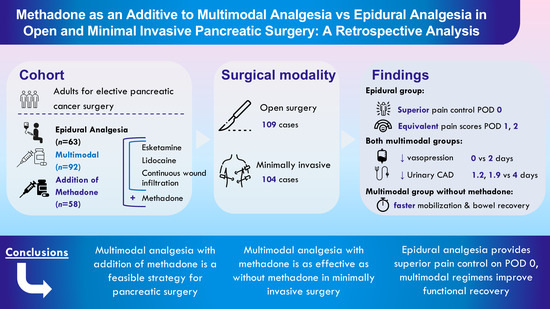
Graphical Abstract

1. Introduction

Optimizing postoperative analgesia is an important component of Enhanced Recovery After Surgery (ERAS) protocols as it can improve patient outcomes [1,2,3]. In current clinical practice, epidural analgesia (EA) is still considered the gold standard for perioperative analgesia in pancreatic surgery. Despite its proven efficacy in pain control, epidural analgesia presents several limitations that may hinder recovery in some patients [4,5,6]. Sympathetic blockade resulting in hypotension often requires vasopressor support, even when combined with proper depth of anesthesia monitoring [7]. Also, resulting urinary retention necessitates prolonged catheterization. Both factors can impede early postoperative mobilization [8,9]. Indeed, mobilization on the first postoperative day (POD) is an indicator for improved short-term outcomes [10]. Furthermore, there is the risk of rare but serious neurological complications such as epidural hematoma or abscesses [11]. Additionally, epidural placement can be technically demanding and time consuming, with unsuccesful or ineffective placement reported in up to 30% of cases. Also, the placement itself can be burdensome for patients [12]. The evolving transition from open to minimal invasive and also robotic pancreatic surgery has contributed to a decreasing use of epidural analgesia within ERAS pathways [13,14,15] as minimally invasive procedures are associated with a decrease in postoperative pain, and alternative analgesic strategies were developed. However, studies of multimodal regimens have shown that pain control needs further optimization [16]. Alternative multimodal strategies, including continuous wound infiltration catheters, have shown promise. However, pain control remains inferior to epidural analgesia, particularly during the first 24 h postoperatively, and the use of multiple catheters may negatively affect mobilization and patient satisfaction [17,18]. Recently, methadone has gained attention in early recovery programs given its unique role of the agonistic effect on opioid receptors combined with non-competitive antagonism of the NMDA receptor [19,20]. Earlier studies demonstrate that the use of perioperative methadone in other types of surgery is safe and provides excellent prolonged pain control, resulting in lower postoperative opioid requirements [20,21,22,23]. However, in pancreatic surgery the perioperative use of methadone has not been previously reported.
This retrospective cohort study aims to compare postoperative outcomes between EA, multimodal analgesia without methadone (MA), and multimodal analgesia with methadone (MM) in patients undergoing pancreatic resections. We hypothesized that multimodal analgesia, particularly with methadone, would result in comparable pain control and enhanced functional recovery compared to EA, while minimizing opioid-related side effects and ICU burden.

2. Materials and Methods

2.1. Study Design

This retrospective cohort study was conducted in accordance with the Declaration of Helsinki, and the protocol was approved by the Medical Ethics Committee (METC) of the Catharina Hospital and Medical Ethics Committees United (MEC-U, W23.265) on 20 December 2023 and is reported according to the STROBE criteria [24]. Surgical data were prospectively collected in the Dutch Pancreatic Cancer Audit (DPCA), coordinated by the Dutch Institute for Clinical Auditing (DICA). The DPCA collects and analyzes clinical data from patients undergoing elective surgical treatment for primary pancreatic cancer. These data were retrospectively complemented with perioperative and postoperative data from the medical records, including administered anesthetic and analgesic drugs, postoperative pain scores, opioid administration and functional recovery-related parameters.

2.2. Participants

All consecutive adult patients undergoing laparoscopic, robotic, or open pancreatic cancer surgery at Catharina Hospital Eindhoven between January 2020 and February 2024 were screened. Patients were included if they received either thoracic epidural analgesia or multimodal analgesia (with or without methadone), according to institutional protocols. Patients were excluded if surgery was aborted due to intraoperative detection of inoperable disease, if multiple major abdominal procedures were performed concurrently, or if postoperatively sedated up until postoperative day 2.

2.3. Analgesic Procedures

All patients received an analgesic regimen in accordance with the standardized institutional protocol of our hospital. General anesthesia was induced with sufentanil, propofol and rocuronium, and maintained using propofol. All patients received postoperative nausea and vomiting (PONV) prophylaxis with both dexamethasone 8 mg and granisetron 1 mg iv, and all patients were postoperative consulted and monitored by the Acute Pain Service (APS). All study patients received paracetamol 1000 mg TID and metamizole 1000 mg TID, unless contraindicated, as part of the standard protocol.

2.3.1. Epidural Analgesia (EA)

A thoracic epidural catheter was inserted prior to anesthesia induction with placement confirmed via standard clinical testing. Intra- and postoperatively, EA patients received continuous infusion of bupivacaine 0.125% with additional sufentanil 1 µg/mL at an infusion rate of 4 to 8 mL/h. This standardized dosing regimen is used uniformly across adult patients, irrespective of body weight. The fixed-rate approach reflects local practice and was consistently applied within this study cohort.

2.3.2. Multimodal Analgesia Without Methadone (MA)

Patients received intraoperative sufentanil boluses (5 µg/mL), continuous esketamine (0.125 mg/kg/h), and lidocaine (1.5 mg/kg/h). Postoperatively, these patients received oxycodone PRN. In cases where oxycodone provided insufficient pain relief, patient controlled intravenous analgesia (PCIA) with morphine or piritramide 1 mg/mL and droperidol 0.04 mg/mL with optional esketamine 0.4 mg/mL was offered. Continuous wound infiltration was administered using an elastomeric pump that delivered bupivacaine 0.125% at a standard infusion rate of 6.25 mg/h (5 mL/h), with a maximum rate of 10 mg/h (8 mL/h).

2.3.3. Multimodal Analgesia with Methadone (MM)

Patients received the same multimodal regimen, but now including methadone (0.2 mg/kg) at induction, with minimized use of additional opioids intra- and postoperatively. Postoperatively, oxycodone and PCIA were provided similarly to the MA group.

2.4. Outcome Measures

The primary outcome of this study was postoperative pain using the daily maximum pain scores (Numeric Rating Scale; NRS; range: 0–10) on postoperative day (POD) 0, 1 and 2. Secondary outcome measures were postoperative opioid consumption (in oral morphine equivalents), vasopressor requirements, length of ICU and hospital stay, time until mobilization, complications according to Clavien–Dindo, PONV, time to mobilization, time to first passage of stool and duration of urinary bladder catheterization.

2.5. Statistical Analysis

Baseline characteristics were compared between patients who received EA and patients who received multimodal analgesia with and without methadone using a χ2 test, Fisher’s exact test, independent t test or Mann–Whitney U test where appropriate. Continuous variables were checked for normality using the Kolmogorov–Smirnov test.
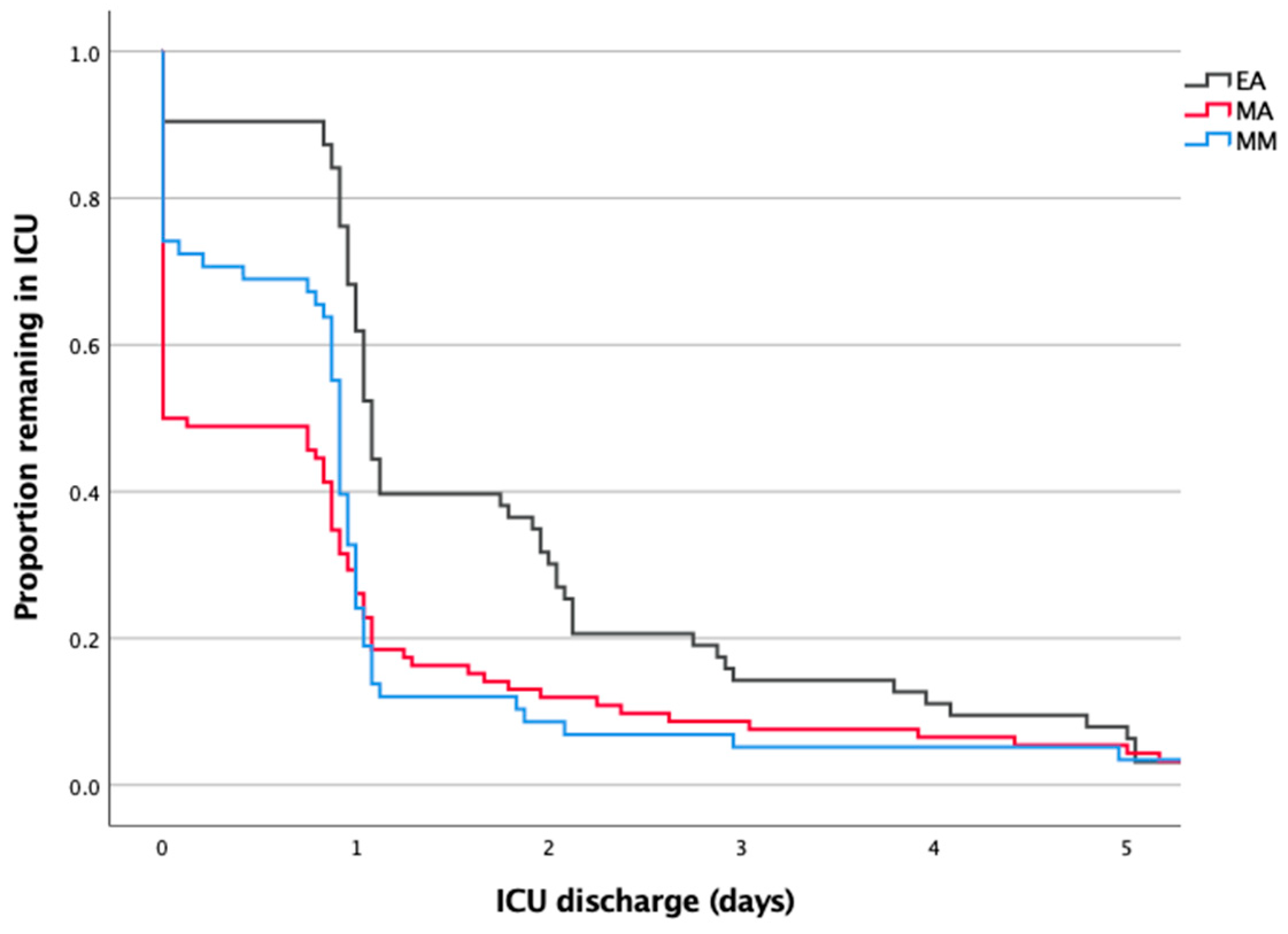
First, we built an univariable linear mixed-effects model with maximum NRS score on day 0, 1 and 2 as the dependent variable, using day of measurement as a random effect nested within the patient. Akaike’s Information Criterion was used to determine the best fit for a model with a random intercept, a random slope or both [25]. Next, univariable Poisson or gamma regression models were built where applicable, based on distribution of the outcome variables, and when applicable, models were compared using Akaike’s Information Criterion for the best fit [26,27,28]. Dependent variables were first day of stool, number of days of vasopressor requirement, first day of mobilization, number of days with PONV, number of days with CAD and total amount of opioids in morphine equivalents used within the first three postoperative days. An univariable logistic regression was built using complications (Clavien–Dindo ≥ 3a) as the dependent variable. Finally, length of stay was analyzed after inspection of the data. For further analysis, length of stay was right-censored, in case of in-hospital mortality, at 30 days. Additionally, length of ICU stay was truncated at 30 days as this has been shown to enhance model performance and was considered clinically reasonable as well [26]. A negative binomial regression model, a Poisson regression model and gamma regression model were tested for the best fit for ICU length of stay and hospital length of stay [26]. A Kaplan–Meier curve was made to visualize difference in length of stay for the different types of analgesia.
Afterwards, we built multivariable models for all previously mentioned models. Variables under consideration for inclusion in our multivariable model were checked for collinearity using a correlation matrix. Those variables deemed to be collinear (defined as a correlation of ≥0.70) were either combined into a single variable or removed. All non-collinear variables were entered into the models. The included variables were selected based on clinical relevance and included age, sex, body mass index (BMI), duration of the procedure, ASA physical status and procedure type (laparoscopic or robotic vs. open). For the models using NRS and first day of stool, we also added preoperative opioid use. For the model using days of vasopressor requirement, we added preoperative use of antihypertensive drugs to the included variables.
A p-value of <0.05 was considered statistically significant. All statistical tests were two-tailed. The statistical analyses were performed with R (Version 2024.09.1+394—© 2024-11-04, R, Inc., Vienna, Austria, for Macintosh) [29].

Missing Data

Missing data were tracked and filled by patient status review were possible. As complete case analyses are known to lead to biased effect estimates, we planned to impute missing values in case of >2% missingness in our outcome measures or confounders [30].

3. Results

3.1. Study Population

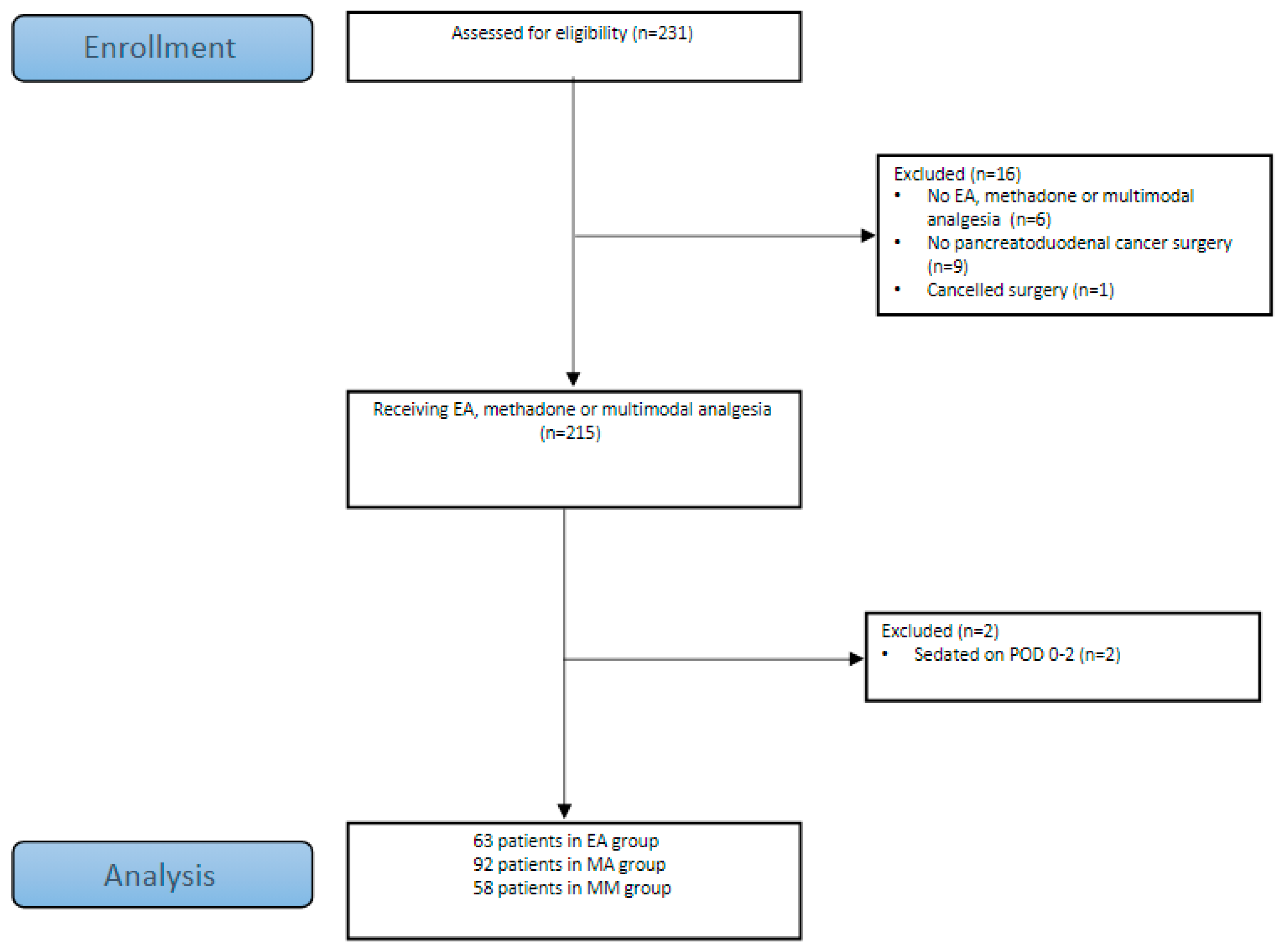
Based on our sampling criteria a total of 231 patients were scheduled for pancreatic cancer surgery between 1 January 2020 and 31 January 2024. A total of 213 patients were included in the analyses: 63 (30%) in the EA group, 92 (43%) in the MA group and 58 (27%) in the MM group (Figure 1). In total, 2.6% of data was missing (Supplementary Table S1, Missing data).
Baseline characteristics of the patients in all study groups are presented in Table 1. Groups were comparable for sex distribution, age, height, weight, ASA classification, the prevalence of hypertension and pre-admission opioid use. The MA group had a modestly higher median BMI (p = 0.049). Surgical modality differed significantly (p < 0.001), with open surgery predominating in the EA group (98%). In the MM group, 62% of procedures were open, while in the MA group, minimally invasive surgery accounted for 88% of procedures. Duration of surgery and general anesthesia did not differ significantly among the groups.

3.2. Postoperative Pain

The daily medians of maximum pain scores are presented in Table 2. In the multivariate linear mixed-effect model, the MM group demonstrated higher pain scores compared to the EA group (NRS 2.22, 95% CI [1.22, 3.90], p = 0.01). The MA group also displayed higher pain scores relative to EA; however, this difference was not statistically significant (NRS 2.06, 95% CI [0.99, 4.30], p = 0.06).

3.3. Opioid Consumption

Postoperative opioid consumption was quantified in terms of oral morphine equivalents. Across POD 0–2, the MM group showed opioid consumption comparable to EA (OR 0.99, 95% CI [0.98, 1.00], p = 0.20). In contrast, the MA group required significantly fewer opioids compared to EA (OR 0.97, 95% CI [0.96, 0.98], p < 0.001).

3.4. Length of Stay

The median [IQR] hospital length of stay in the EA group was 10.0 days [7.9, 18.8] vs. 8.0 days [5.2, 15.4] in the MA group and 8.8 days [6.2, 17.8] in the MM group. Multivariable analysis revealed no significant differences between groups. ICU length of stay was similarly nonsignificant, with median [IQR] stays of 1.1 days [1.0, 2.1] in the EA group, 0.0 days [0.0, 1.0] in the MA group and 0.9 days [0.0, 1.0] in the MM group.
Despite similar median durations, the distribution of ICU stay varied markedly (Figure 2 and Table 3). In the EA group, 42.9% of patients required ≥2 days in ICU and only 3.2% had no ICU admission. In contrast, 29.3% of MM patients avoided ICU entirely, with just 5.2% requiring >1 day. Over half of patients in the MA group had no ICU stay.
The hospital readmission rates within 30 days after surgery were comparable across all study groups (Table 2). ICU readmission rates were higher in the MA group, but the difference was not statistically significant.

3.5. Vasopressor Requirements

Compared to EA, both the MA and MM group demonstrated a reduction in median days of norepinephrine usage (Table 2), which was confirmed in multivariate analysis (MA: OR 0.28, 95% CI [0.12, 0.65], p < 0.001; OR 0.02,95% CI [0.00, 0.13], p < 0.001).

3.6. Functional Recovery and Related Side Effects

The median time to mobilization was shorter in both the MA and MM group (Table 2). Multivariate regression analysis showed that the MA group mobilized significantly earlier than the EA group (OR 0.52, 95% CI [0.28, 0.95], p = 0.03). The MM group, while demonstrating faster mobilization than EA, did not reach statistical significance (OR 0.77, 95% CI [0.49, 1.22], p = 0.27).
Recovery of bowel function, assessed by time to first stool, differed slightly among the groups. Multivariate analysis revealed no significant difference for the MM group compared to EA (OR 0.87, 95% CI [0.72, 1.04], p = 0.13). In contrast, the MA group demonstrated a significantly shorter time to bowel recovery compared to EA (OR 0.76, 95% CI [0.60, 0.96], p = 0.02).
The duration of urinary bladder catheterization was significantly reduced in the MM and MA groups compared to EA. The median duration was longest by 4.0 days (IQR [3.2, 4.3]) in the EA group, followed by 1.9 days (IQR [1.1, 3.0]) in the MM group and 1.2 days (IQR [1.0, 2.7]) in the MA group. Regression analysis confirmed significantly shorter catheterization times in the MM group (OR 0.70, 95% CI [0.51, 0.95], p = 0.03) and the MA (OR 0.54, 95% CI [0.36, 0.82], p = 0.003).
PONV occurred infrequently across all groups, without statistically significant differences in days with PONV between the groups.

3.7. Complications

Complication rates were comparable across groups. Overall complications occurred in 33 patients (52.4%) in the EA group, 32 patients (55.2%) in the MM group, and 49 patients (53.3%) in the MA group. Multivariate regression analysis showed no significant differences in major complication rates (Clavien–Dindo ≥ IIIa).

3.8. Open Surgery

A subgroup analysis was performed for patients who underwent open pancreatic surgery only (Table 4). On postoperative day 1, the MM group reported significantly higher NRS pain scores compared to the EA group, although overall opioid consumption remained similar. Notably, vasopressor requirements were significantly lower and duration of urinary catheterization was shorter in the MM group. While differences did not reach statistical significance, the MM group demonstrated consistent trends toward improved functional recovery, including earlier mobilization and faster return of bowel function.
Table 2. Postoperative outcomes.
Outcome Univariate Analysis Multivariate Analysis
Postoperative painMedian NRS max [IQR]
POD 0POD 1POD 2NRS max95% CIp valueNRS max95% CIp value
EA0.0 [0.0, 2.0]3.0 [1.0, 4.5]3.0 [2.0, 5.0]
MA4.0 [2.0, 6.0]4.0 [2.0, 5.0]3.0 [2.0, 5.0]2.45(1.47–4.08)<0.0012.06(0.99–4.30)0.06
MM4.0 [2.0, 5.8]3.0 [2.0, 4.0]3.0 [2.0, 4.0]2.21(1.25–3.90)0.012.22(1.22–4.01)0.01
Opioid consumptionMedian total MorfEq per day [IQR] MorfEq per 10 mg MorfEq per 10 mg
POD 0POD 1POD 2OR95% CIp valueOR95% CIp value
EA105.0 [60.0, 150.0]0.0 [0.0, 0.0]0.0 [0.0, 3.8]
MA196.5 [150.0, 261.0]0.0 [0.0, 13.0]0.0 [0.0, 13.5]0.97(0.96–0.98)<0.0010.97(0.96–0.98)<0.001
MM134.3 [96.4, 171.4]0.0 [0.0, 7.5]0.0 [0.0, 7.5]0.99(0.98–1.00)0.230.99(0.98–1.00)0.20
Length of Hospital StayMedian days [IQR]Re-admission rate n (%)OR95% CIp valueOR95% CIp value
EA10.0 [7.9, 18.9]14 (22.2)
MA8.0 [5.2, 15.4]19 (20.7) 1.02(1.00–1.03)0.071.01(0.99–1.02)0.54
MM8.8 [6.2, 17.8]11 (19.0) 1.01(0.99–1.02)0.501.00(0.99–1.02)0.76
Length of ICU stayMedian days [IQR]Re-admission rate n (%)OR95% CIp valueOR95% CIp value
EA1.1 [1.0, 2.1]0 (0.0)
MA0.0 [0.0, 1.0]8 (8.7) 1.72(1.01–2.92)0.050.84(0.56–1.28)0.42
MM0.9 [0.0, 1.0]1 (1.7) 1.11(0.72–1.73)0.630.97(0.75–1.26)0.84
Time to first stoolMedian days [IQR] OR95% CIp valueOR95% CIp value
EA5.0 [4.0, 6.0]
MA4.0 [3.0, 5.0] 0.80(0.69–0.93)<0.0010.76(0.60–0.96)0.02
MM4.0 [3.0, 5.0] 0.90(0.76–1.06)0.190.87(0.72–1.04)0.13
Time until mobilizationMedian days [IQR] OR95% CIp valueOR95% CIp value
EA1.0 [0.5, 1.0]
MA0.0 [0.0, 1.0] 0.49(0.32–0.73)<0.0010.52(0.28–0.95)0.03
MM0.0 [0.0, 1.0] 0.68(0.45–1.03)0.070.77(0.49–1.22)0.27
Norepinephrine supportMedian days [IQR] OR95% CIp valueOR95% CIp value
EA2.0 [0.0, 3.0]
MA0.0 [0.0, 0.0] 0.13(0.08–0.21)<0.0010.28(0.12–0.65)<0.001
MM0.0 [0.0, 0.0] 0.01(0.00–0.08)<0.0010.02(0.00–0.13)<0.001
Urinary catheterizationMedian days [IQR] OR95% CIp valueOR95% CIp value
EA4.0 [3.2, 4.3]
MA1.2 [1.0, 2.7] 0.48(0.36–0.65)<0.0010.54(0.36–0.82)<0.001
MM1.9 [1.1, 3.0] 0.67(0.50–0.91)0.010.70(0.51–0.95)0.03
PONVMedian days [IQR] OR95% CIp valueOR95% CIp value
EA0.0 [0.0, 1.5]
MA0.0 [0.0, 1.0] 0.78(0.53–1.15)0.210.65(0.36–1.17)0.15
MM0.0 [0.0, 1.0] 0.86(0.57–1.32)0.500.80(0.49–1.29)0.36
ComplicationsOverall complications n (%)30 day mortality n (%)OR95% CIp valueOR95% CIp value
EA33 (52.4)1 (1.6)
MA49 (53.3)4 (4.3) 0.82(0.43–1.57)0.550.62(0.22–1.70)0.35
MM32 (55.2)3 (5.2) 1.01(0.49–2.08)0.980.86(0.38–1.95)0.72
Data are n (%) or median [IQR]. Multivariate analyses were adjusted for age, sex, BMI, ASA score, pre-admission opioid use, surgical time and surgical modality. EA, epidural analgesia; MA, multimodal analgesia without methadone; MM, multimodal analgesia with methadone; PONV, postoperative nausea and vomiting.
Table 3. Days of ICU stay for each study group.
Study GroupLength of ICU Stay
0 days1 day≥2 days
EA2 (3.2)34 (54.0)27 (42.9)
MA47 (51.1)32 (34.8)13 (14.1)
MM17 (29.3)38 (65.5)3 (5.2)
Data are n (%). EA, epidural analgesia; MA, multimodal analgesia without methadone; MM, multimodal analgesia with methadone.
Table 4. Postoperative outcomes for open surgery.
OutcomeUnivariate AnalysisMultivariate AnalysisUnivariate Analysis OpenMultivariate Analysis Open
Postoperative pain
NRS max95% CIp valueNRS max95% CIp valueNRS max95% CIp valueNRS max95% CIp value
EA
MA2.45(1.47–4.08)<0.012.06(0.99–4.30)0.062.70(0.99–7.41)0.061.88(0.71–5.01)0.21
MM2.21(1.25–3.90)0.012.22(1.22–4.01)0.011.86(0.97–3.54)0.062.15 (1.15–4.01)0.02
Opioid consumptionMorfEq per 10 mg
OR95% CIp valueOR95% CIp valueOR95% CIp valueOR95% CIp value
EA
MA0.97(0.96–0.98)<0.010.97(0.96–0.98)<0.01 0.97(0.95–0.99)<0.01 0.98 (0.96–0.99)0.01
MM0.99(0.98–1.00)0.230.99(0.98–1.00)0.200.99(0.97–1.01)0.19 0.99 (0.97–1.00) 0.12
Length of Hospital StayOR95% CIp valueOR95% CIp valueOR95% CIp valueOR95% CIp value
EA
MA1.02(1.00–1.03)0.071.01(0.99–1.02)0.541.01(0.98–1.04)0.571.00(0.98–1.03)0.83
MM1.01(0.99–1.02)0.501.00(0.99–1.02)0.761.01(0.99–1.03)0.511.01(0.99–1.02)0.32
Length of ICU stayOR95% CIp valueOR95% CIp valueOR95% CIp valueOR95% CIp value
EA
MA1.72(1.01–2.92)0.050.84(0.56–1.28)0.421.28(0.57–2.89)0.551.01(0.64–1.60)0.96
MM1.11(0.72–1.73)0.630.97(0.75–1.26)0.840.91 (0.65–1.28)0.600.94(0.82–1.09)0.43
Time to first stoolOR95% CIp valueOR95% CIp valueOR95% CIp valueOR95% CIp value
EA
MA0.80(0.69–0.93)<0.010.76(0.60–0.96)0.020.90 (0.66–1.22)0.510.90(0.65–1.24)0.53
MM0.90(0.76–1.06)0.190.87(0.72–1.04)0.130.88 (0.7301.07)0.210.87(0.70–1.06)0.17
Time until mobilizationOR95% CIp valueOR95% CIp valueOR95% CIp valueOR95% CIp value
EA
MA0.49(0.32–0.73)<0.010.52(0.28–0.95)0.030.70(0.32–1.55)0.380.60(0.27–1.37)0.23
MM0.68(0.45–1.03)0.070.77(0.49–1.22)0.270.70(0.43–1.14)0.150.74(0.45–1.12)0.25
Norepinephrine supportOR95% CIp valueOR95% CIp valueOR95% CIp valueOR95% CIp value
EA
MA0.13(0.08–0.21)<0.010.28(0.12–0.65)<0.01 0.25(0.09–0.67)0.010.22(0.08–0.61)<0.01
MM0.01(0.00–0.08)<0.010.02(0.00–0.13)<0.01 0.02 (0.00–0.13)<0.010.02(0.00–0.16)<0.01
Urinary catheterizationOR95% CIp valueOR95% CIp valueOR95% CIp valueOR95% CIp value
EA
MA0.48(0.36–0.65)<0.010.54(0.36–0.82)<0.01 0.78 (0.53–1.14)0.190.77(0.53–1.12)0.17
MM0.67(0.50–0.91)0.010.70(0.51–0.95)0.030.65(0.50–0.84)<0.010.64(0.50–0.83)<0.01
PONVOR95% CIp valueOR95% CIp valueOR95% CIp valueOR95% CIp value
EA
MA0.78(0.53–1.15)0.210.65(0.36–1.17)0.150.92(0.44–1.94)0.830.85(0.40–1.82)0.68
MM0.86(0.57–1.32)0.500.80(0.49–1.29)0.360.67 (0.39–1.13)0.140.73(0.42–1.26)0.26
ComplicationsOR95% CIp valueOR95% CIp valueOR95% CIp valueOR95% CIp value
EA
MA0.82(0.43–1.57)0.550.62(0.22–1.70)0.350.79(0.21–2.99)0.730.75 (0.18–3.06)0.69
MM1.01(0.49–2.08)0.980.86(0.38–1.95)0.720.99(0.43–2.27)0.980.86 (0.36–2.09)0.74
Left panel: entire study population. Right panel: subgroup of open pancreatic surgeries only. Data are n (%) or median [IQR]. Multivariate analyses were adjusted for age, sex, BMI, ASA score, pre-admission opioid use, surgical time and surgical modality. EA, epidural analgesia; MA, multimodal analgesia without methadone; MM, multimodal analgesia with methadone; PONV, postoperative nausea and vomiting.

4. Discussion

This study shows that a multimodal analgesic strategy with and without methadone is associated with slightly higher postoperative pain scores compared to epidural analgesia within the first 3 postoperative days after pancreatic surgery. However, median NRS scores were still within an acceptable range of 3–4, and pain control was achieved with comparable or reduced amounts of opioids. Functional outcomes further support the use of multimodal analgesia. Time to mobilization and bowel recovery were significantly faster in the MA group, and both MM and MA groups exhibited shorter urinary catheterization durations and a reduced need for vasopressors. There was no difference in complication rate, PONV or length of stay. Although median ICU length of stay was statistically similar between groups, ICU stay distribution suggests a clinically relevant advantage for multimodal regimens. Over 40% of EA patients required ≥2 ICU days, compared to <6% in the MM group and 14% in the MA group, with the majority of multimodal patients discharged from ICU within one day. While analgesia is not the sole determinant of ICU stay, our findings suggest that physiological side effects associated with epidural analgesia—particularly hypotension and delayed urinary catheter removal—may prolong ICU monitoring requirements even in the absence of complications. Our findings align with two meta-analyses that demonstrated comparable pain control outcomes between EA and wound catheters in patients undergoing pancreatic resection [4,31]. Other RCTs have confirmed these findings, reporting only marginally improved pain scores with EA but with increased hemodynamic instability in the immediate postoperative period [6,32]. However, pain control using multimodal analgesia alone may be suboptimal in open procedures. Methadone’s extended half-life and NMDA-antagonism may provide additional and prolonged pain relief with opioid-sparing effects. Recent evidence supports methadone’s role in major abdominal procedures, demonstrating improved pain scores and reduced opioid use postoperatively [20].
To address the potential confounding effect of the surgical approach, we performed a subgroup analysis including only patients who underwent open pancreatic surgery. Within this more homogeneous subgroup, the use of multimodal analgesia—particularly with methadone—was associated with reduced vasopressor requirements, shorter urinary catheter duration, and trends toward earlier mobilization and bowel recovery compared to epidural analgesia. These findings suggest that methadone-enhanced multimodal analgesia may confer specific physiological advantages—such as improved hemodynamic stability and faster return of function—that go beyond the effects of the surgical approach alone.
This study has several strengths. First, the amount of missing data was limited as many outcome parameters were prospectively collected. Second, we studied an extensive set of recovery-related postoperative outcomes. Nevertheless, this study has some obvious limitations. First, although we adjusted for potentially important confounders, residual confounding might influence the results due to the retrospective nature of this study. Particularly, the strong association between analgesia type and surgical approach might have influenced the results. Second, oral morphine equivalents were not calculated for the epidural sufentanil as perfusor pump speeds and boluses were not adequately documented in the electronic patient database. Therefore, OMEs are likely underestimated in the epidural group, and postoperative opioid consumption in the multimodal and methadone groups could potentially be lower compared to EA. The amount of pain scores per patient per day varied, and we chose to use a maximum rather than a mean pain score. This may also influence the evaluation of postoperative analgesia, and limit comparability with other studies. Finally, the sample size is too limited to fully explore the impact of the analgesic regimen on the secondary outcome measures.
This study implicates that multimodal analgesia with continuous wound infiltration is a valid alternative to EA in minimally invasive pancreatic surgery. In open procedures, the addition of methadone to this multimodal regimen appears to enhance functional recovery and reduce ICU burden. While statistical significance was not achieved for all outcomes, the consistent trends in both opioid consumption and functional recovery parameters warrant further study of methadone in pancreatic surgery. Prospective randomized trials focusing on opioid requirements, ICU utilization and functional recovery are needed to define methadone’s exact role within ERAS protocols.

5. Conclusions

This study demonstrates that multimodal analgesia regimens, combining wound catheters and methadone, are an effective and well-tolerated alternative for EA in pancreatic surgery. Despite slightly higher pain scores than EA, these regimens demonstrate multiple clinical advantages, including reduced vasopressor use, shorter urinary catheterization and earlier mobilization. Considering trends in minimally invasive surgery and ERAS pathways, epidural analgesia may no longer be the optimal analgesic option. Multimodal strategies, with methadone particular for open surgery, seem to be promising options for postoperative pain management.

Supplementary Materials

The following supporting information can be downloaded at: https://www.mdpi.com/article/10.3390/anesthres3010003/s1, Table S1. Missing data.

Author Contributions

Conceptualization, H.J.S., T.P., I.H.J.T.d.H. and M.D.P.L.; methodology, H.J.S. and A.A.; formal analysis, A.A.; investigation, H.J.S. and T.P.; resources, I.H.J.T.d.H. and M.D.P.L.; writing—original draft preparation, T.P.; writing—review and editing, H.J.S., A.A., I.H.J.T.d.H. and M.D.P.L.; supervision, H.J.S. All authors have read and agreed to the published version of the manuscript.

Funding

This research received no external funding.

Institutional Review Board Statement

This retrospective cohort study was approved by the Medical Ethics Committee (METC) of the Catharina Hospital and Medical Ethics Committees United (protocol code MEC-U, W23.265 and 23 December 2023).

Informed Consent Statement

Informed consent was waived since this retrospective cohort study evaluated standard of care, in accordance with the national legislation and the institutional requirements.

Data Availability Statement

The raw data supporting the conclusions of this article will be made available by the authors on request.

Conflicts of Interest

The authors declare no conflicts of interest.

Abbreviations

The following abbreviations are used in this manuscript:
EAEpidural Analgesia
ERASEnhanced Recovery After Surgery
MMMultimodal analgesia including Methadone
MAMultimodal analgesia without Methadone
PCIAPatient Controlled Intravenous Analgesia
PONVpostoperative nausea and vomiting

References

  1. Pecorelli, N.; Nobile, S.; Partelli, S.; Cardinali, L.; Crippa, S.; Balzano, G.; Beretta, L.; Falconi, M. Enhanced Recovery Pathways in Pancreatic Surgery: State of the Art. World J. Gastroenterol. 2016, 22, 6456–6468. [Google Scholar] [CrossRef]
  2. Mărgărit, S.; Bartoș, A.; Laza, L.; Osoian, C.; Turac, R.; Bondar, O.; Leucuța, D.C.; Munteanu, L.; Vasian, H.N. Analgesic Modalities in Patients Undergoing Open Pancreatoduodenectomy—A Systematic Review and Meta-Analysis. J. Clin. Med. 2023, 12, 4682. [Google Scholar] [CrossRef] [PubMed]
  3. Ellwanger, M.P.; Ellwanger, M.P.; Jardine, M.B.; Bramucci, V.; Hammes, S.A.P.; Lopes, L.M.; Munhoz, A.C.M. Effectiveness of Enhanced Recovery After Surgery Protocol in Pancreatic Surgery: A Systematic Review and Meta-Analysis of Randomized Controlled Trials. J. Gastrointest. Surg. 2025, 29, 101939. [Google Scholar] [CrossRef] [PubMed]
  4. Akter, N.; Ratnayake, B.; Joh, D.B.; Chan, S.J.; Bonner, E.; Pandanaboyana, S. Postoperative Pain Relief after Pancreatic Resection: Systematic Review and Meta-Analysis of Analgesic Modalities. World J. Surg. 2021, 45, 3165–3173. [Google Scholar] [CrossRef]
  5. Kim, S.S.; Niu, X.; Elliott, I.A.; Jiang, J.P.; Dann, A.M.; Damato, L.M.; Chung, H.; Girgis, M.D.; King, J.C.; Hines, O.J.; et al. Epidural Analgesia Improves Postoperative Pain Control but Impedes Early Discharge in Patients Undergoing Pancreatic Surgery. Pancreas 2019, 48, 719–725. [Google Scholar] [CrossRef] [PubMed]
  6. Klotz, R.; Larmann, J.; Klose, C.; Bruckner, T.; Benner, L.; Doerr-Harim, C.; Tenckhoff, S.; Lock, J.F.; Brede, E.M.; Salvia, R.; et al. Gastrointestinal Complications after Pancreatoduodenectomy with Epidural vs Patient-Controlled Intravenous Analgesia: A Randomized Clinical Trial. JAMA Surg. 2020, 155, e200794. [Google Scholar] [CrossRef]
  7. Stasiowski, M.J.; Król, S.; Wodecki, P.; Zmarzły, N.; Grabarek, B.O. Adequacy of Anesthesia Guidance for Combined General/Epidural Anesthesia in Patients Undergoing Open Abdominal Infrarenal Aortic Aneurysm Repair; Preliminary Report on Hemodynamic Stability and Pain Perception. Pharmaceuticals 2024, 17, 1497. [Google Scholar] [CrossRef]
  8. Gramigni, E.; Bracco, D.; Carli, F. Epidural Analgesia and Postoperative Orthostatic Haemodynamic Changes. Eur. J. Anaesthesiol. 2013, 30, 398–404. [Google Scholar] [CrossRef]
  9. Grass, F.; Slieker, J.; Frauche, P.; Solà, J.; Blanc, C.; Demartines, N.; Hübner, M. Postoperative Urinary Retention in Colorectal Surgery within an Enhanced Recovery Pathway. J. Surg. Res. 2017, 207, 70–76. [Google Scholar] [CrossRef]
  10. Ritter, A.S.; Welsch, T.; Brodersen, F.; Auinger, J.; Moll-Khosrawi, P.; Goetz, M.R.; Bardenhagen, J.; Nitschke, C.; Schneider, T.; Wellge, B.; et al. Impact of Enhanced Recovery After Surgery Protocol Compliance on Outcome After Pancreatic Surgery: Results From a Certified ERAS Center. Ann. Surg. Open 2024, 5, e501. [Google Scholar] [CrossRef]
  11. Bos, E.M.E.; Haumann, J.; de Quelerij, M.; Vandertop, W.P.; Kalkman, C.J.; Hollmann, M.W.; Lirk, P. Haematoma and Abscess after Neuraxial Anaesthesia: A Review of 647 Cases. Br. J. Anaesth. 2018, 120, 693–704. [Google Scholar] [CrossRef] [PubMed]
  12. Hermanides, J.; Hollmann, M.W.; Stevens, M.F.; Lirk, P. Failed Epidural: Causes and Management. Br. J. Anaesth 2012, 109, 144–154. [Google Scholar]
  13. Nappo, G.; Perinel, J.; El Bechwaty, M.; Adham, M. Minimally Invasive Pancreatic Resection: Is It Really the Future? Dig. Surg. 2016, 33, 284–289. [Google Scholar] [CrossRef] [PubMed]
  14. Dunn, L.K.; Grant, M.C.; Gan, T.J. Is There Still a Role For Neuraxial Analgesia in Cancer Surgery? Anesth. Analg. 2025, 140, 795–797. [Google Scholar] [PubMed]
  15. Liu, Q.; Li, M.; Gao, Y.; Jiang, T.; Han, B.; Zhao, G.; Lin, C.; Lau, W.Y.; Zhao, Z.; Liu, R. Effect of Robotic versus Open Pancreaticoduodenectomy on Postoperative Length of Hospital Stay and Complications for Pancreatic Head or Periampullary Tumours: A Multicentre, Open-Label Randomised Controlled Trial. Lancet Gastroenterol. Hepatol. 2024, 9, 428–437. [Google Scholar] [CrossRef]
  16. Melloul, E.; Lassen, K.; Roulin, D.; Grass, F.; Perinel, J.; Adham, M.; Wellge, E.B.; Kunzler, F.; Besselink, M.G.; Asbun, H.; et al. Guidelines for Perioperative Care for Pancreatoduodenectomy: Enhanced Recovery After Surgery (ERAS) Recommendations 2019. World J. Surg. 2020, 44, 2056–2084. [Google Scholar] [CrossRef]
  17. Groen, J.V.; Slotboom, D.E.F.; Vuyk, J.; Martini, C.H.; Dahan, A.; Vahrmeijer, A.L.; Bonsing, B.A.; Mieog, J.S.D. Epidural and Non-Epidural Analgesia in Patients Undergoing Open Pancreatectomy: A Retrospective Cohort Study. J. Gastrointest. Surg. 2019, 23, 2439–2448. [Google Scholar] [CrossRef]
  18. Pirie, K.; Traer, E.; Finniss, D.; Myles, P.S.; Riedel, B. Current Approaches to Acute Postoperative Pain Management after Major Abdominal Surgery: A Narrative Review and Future Directions. Br. J. Anaesth. 2022, 129, 378–393. [Google Scholar] [CrossRef]
  19. Kharasch, E.D. Intraoperative Methadone: Rediscovery, Reappraisal, and Reinvigoration? Anesth. Analg. 2011, 112, 13–16. [Google Scholar] [CrossRef]
  20. Murphy, G.S.; Szokol, J.W. Intraoperative Methadone in Surgical Patients: A Review of Clinical Investigations. Anesthesiology 2019, 131, 678–692. [Google Scholar] [CrossRef]
  21. Machado, F.C.; Vieira, J.E.; De Orange, F.A.; Ashmawi, H.A. Intraoperative Methadone Reduces Pain and Opioid Consumption in Acute Postoperative Pain: A Systematic Review and Meta-Analysis. Anesth. Analg. 2019, 129, 1723–1732. [Google Scholar] [CrossRef]
  22. Mercadante, S.; David, F.; Villari, P.; Spedale, V.M.; Casuccio, A. Methadone versus Morphine for Postoperative Pain in Patients Undergoing Surgery for Gynecological Cancer: A Randomized Controlled Clinical Trial. J. Clin. Anesth. 2020, 61, 109627. [Google Scholar] [CrossRef]
  23. Cheng, J.; Peng, E.; Wong, K.; Pad, R.; Mason, N.; Maravillas, M.A.; Ding, X. The Role of Methadone in Postoperative Analgesia in Esophagectomy Patients–A Retrospective Study. Healthcare 2025, 13, 2153. [Google Scholar] [CrossRef]
  24. von Elm, E.; Altman, D.G.; Egger, M.; Pocock, S.J.; Gøtzsche, P.C.; Vandenbroucke, J.P. The Strengthening the Reporting of Observational Studies in Epidemiology (STROBE) Statement: Guidelines for Reporting Observational Studies. J. Clin. Epidemiol. 2008, 61, 344–349. [Google Scholar] [CrossRef]
  25. Harre, F.E.; Lee, K.L.; Pollock, B.G. Regression Models in Clinical Studies: Determining Relationships Between Predictors and Response. JNCI J. Natl. Cancer Inst. 1988, 80, 1198–1202. [Google Scholar] [CrossRef]
  26. Verburg, I.W.M.; De Keizer, N.F.; De Jonge, E.; Peek, N. Comparison of Regression Methods for Modeling Intensive Care Length of Stay. PLoS ONE 2014, 9, e109684. [Google Scholar] [CrossRef]
  27. Moran, J.L.; Solomon, P.J. A Review of Statistical Estimators for Risk-Adjusted Length of Stay: Analysis of the Australian and New Zealand Intensive Care Adult Patient Data-Base, 2008–2009. BMC Med. Res. Methodol. 2012, 12, 68. [Google Scholar] [CrossRef]
  28. Akram, M.; Cerin, E.; Lamb, K.E.; White, S.R. Modelling Count, Bounded and Skewed Continuous Outcomes in Physical Activity Research: Beyond Linear Regression Models. Int. J. Behav. Nutr. Phys. Act. 2023, 20, 57. [Google Scholar] [CrossRef]
  29. R Core Team. R: A Language and Environment for Statistical Computing; R Foundation for Statistical Computing: Vienna, Austria, 2016; Available online: https://www.R-project.org/ (accessed on 12 November 2025).
  30. Donders, A.R.T.; van der Heijden, G.J.M.G.; Stijnen, T.; Moons, K.G.M. Review: A Gentle Introduction to Imputation of Missing Values. J. Clin. Epidemiol. 2006, 59, 1087–1091. [Google Scholar] [CrossRef]
  31. Groen, J.V.; Khawar, A.A.J.; Bauer, P.A.; Bonsing, B.A.; Martini, C.H.; Mungroop, T.H.; Vahrmeijer, A.L.; Vuijk, J.; Dahan, A.; Mieog, J.S.D. Meta-Analysis of Epidural Analgesia in Patients Undergoing Pancreatoduodenectomy. BJS Open 2019, 3, 559–571. [Google Scholar] [CrossRef]
  32. Mungroop, T.H.; Bond, M.J.; Lirk, P.; Busch, O.R.; Hollmann, M.W.; Veelo, D.P.; Besselink, M.G. Preperitoneal or Subcutaneous Wound Catheters as Alternative for Epidural Analgesia in Abdominal Surgery: A Systematic Review and Meta-Analysis. Ann. Surg. 2019, 269, 252–260. [Google Scholar] [CrossRef] [PubMed]
Figure 1. Study flow diagram.
Anesthres 03 00003 g001
Figure 2. Kaplan–Meier survival curve for length of ICU stay; log-rank p < 0.001.
Anesthres 03 00003 g002
Table 1. Baseline patient characteristics in the EA, MA and MM group.
Variable EA (n = 63) MA (n = 92) MM (n = 58) p Value
Sex 0.29
    Male38 (60.3) 44 (47.8) 29 (50.0)
    Female25 (39.7) 48 (52.2) 29 (50.0)
Age67 [61, 73] 71 [66, 76] 69 [60, 75] 0.11
Length (cm)174 [168, 180] 170 [164, 178] 170.5 [164, 180] 0.35
Height (kg)73.0 [64.9, 80.1] 75.0 [65.4, 85.3] 74.5 [60.3, 79.0] 0.35
BMI24.4 [22.0, 26.5] 25.5 [23.1, 28.5] 23.8 [21.3, 27.0] 0.05
ASA Classification (%) 0.10
    230 (47.6) 59 (64.1) 35 (60.3)
    333 (52.4) 32 (34.8) 21 (36.2)
    40 (0.0) 1 (1.1) 2 (3.4)
Hypertension (yes)30 (47.6) 46 (50.0) 22 (37.9) 0.34
Pre-admission opioid use 8 (12.7) 18 (19.6) 7 (12.1) 0.36
Duration of general anesthesia (min) 301 [261, 332] 306 [219, 357] 279 [241, 332] 0.62
Duration of surgery (min) 230 [200, 265] 251 [169, 299] 227 [188, 270] 0.64
Intraoperative blood loss (ml) 500 [375, 1000] 250 [100, 450] 300 [200, 600] <0.001
Surgical modality <0.001
    Open 62 (98.4) 11 (12.0) 36 (62.1)
    Laparoscopic 0 (0.0) 18 (19.6) 1 (1.7)
    Robot 1 (1.6) 63 (68.5) 21 (36.2)
Data are n (%) or median [IQR]. EA, epidural analgesia; MA, multimodal analgesia without methadone; MM, multimodal analgesia with methadone; BMI, body mass index; ASA, American Society of Anesthesiologists Physical Status Classification.
Disclaimer/Publisher’s Note: The statements, opinions and data contained in all publications are solely those of the individual author(s) and contributor(s) and not of MDPI and/or the editor(s). MDPI and/or the editor(s) disclaim responsibility for any injury to people or property resulting from any ideas, methods, instructions or products referred to in the content.