Article

Impact of Bioaerosol Particles on Atmospheric Charging/Discharging and Conductivity in the Global Electric Circuit (GEC)

Sustainable System Research Laboratory (SSRL), Central Research Institute of Electric Power Industry, Abiko 270-1194, Japan
Aerobiology 2026, 4(1), 6; https://doi.org/10.3390/aerobiology4010006
Submission received: 11 December 2025 / Revised: 6 February 2026 / Accepted: 12 February 2026 / Published: 14 February 2026

Abstract

Understanding the dynamics of atmospheric ions, the carriers of electrons and ions in the global electric circuit (GEC), is necessary to fully understand Earth’s atmospheric electricity. Because atmospheric ions are too small to be influenced by gravity, the gravitational settling of aerosol particle in fair weather has not been considered as a driving force in the GEC model. However, the attachment of these particles to other coarse particles can cause them to move in gravity’s direction. In this study, the influence of the gravitational settling of various bioaerosol particles with electrostatic force on the GEC is calculated. The results show the importance of considering bioaerosol particles in the GEC model, and that pollen grains can carry the order of 0.1% of ions and electrons carried by atmospheric ions due to their weight and charging efficiencies. Also, the reduction in atmospheric conductivity in the presence of bioaerosol particles was calculated. Bioaerosol particles can reduce atmospheric conductivity by an order of  0.01 %  due to pollen and by an order of  0.1 %  due to microbes.

1. Introduction

The global electric circuit (GEC) is a conceptual electric circuit sandwiched between the ionosphere and Earth’s surface [1,2,3]. The electric current in the GEC is generated by electrons and ions in the atmosphere. The atmospheric electric field is known to exhibit globally identical variation under fair weather conditions, which are characterized by the Carnegie curve [4]. Previous studies have examined the relationships between the Carnegie curve and meteorological factors [5,6], seasonal changes in environmental conditions [7], and the atmospheric environment [8,9] as indicators of GEC conditions. The relationship between the GEC and biosphere provides new research opportunities [10].
The GEC spans from Earth’s surface to the ionosphere, and previous research has shown that it is influenced by activity both on Earth’s surface and from the space environment [11]. For example, large-scale volcanic eruptions [12] and increases in aerosol concentrations [13] have been shown to cause lightning activities and promote charging of the GEC. Additionally, the formation of electric currents due to cosmic plasma has also been demonstrated in a previous study [14]. Understanding the conductivity of atmospheric ions and electrons is also important since they are functionally equivalent to the electrons in conductors, and prior studies have simulated the conductivity of the atmosphere [15] and the vertical profiles associated with it [16].
Aerosol particles can act as carriers of atmospheric ions and electrons. Aerosol particles include inorganic particles and biological particles (bioaerosol particles) [17,18] such as viruses, bacterial particles, fungal spores, and pollen grains [19].
These primary biological aerosol particles (PBAPs), especially fungal spores and pollen grains, are generally larger than most other aerosol particles, and previous studies have indicated that PBAPs carry more electric charges than inorganic aerosol particles [20]. In addition, when ions and electrons are carried by aerosol particles, small aerosol particles are the main carriers of the ions and electrons because of their large mobilities; however, their mobilities are significantly reduced when they become aggregated or attached to dust particles [21]. The contribution of particles larger than the Aitken mode to the GEC model has yet to be studied. However, when it comes to even larger particles with sizes in the coarse mode, the gravitational force on them is significant enough to cause them to move in the direction of gravity (forward in the GEC model). Therefore, bioaerosol particles may carry electrical charge and to efficiently charge or discharge the capacitor formed with the ionosphere and Earth through gravity’s influence on their motion.
In this study, we aim to estimate the net charging or discharging induced by gravity and investigate the relationship between bioaerosol particles and the global atmospheric electric field. In addition, because atmospheric conductivity decreases under high aerosol concentration (Kamsali et al., 2011) [22], we estimate the potential change in atmospheric conductivity caused by multiple-charged bioaerosols in this study.

2. Materials and Methods

2.1. Calculation Theory

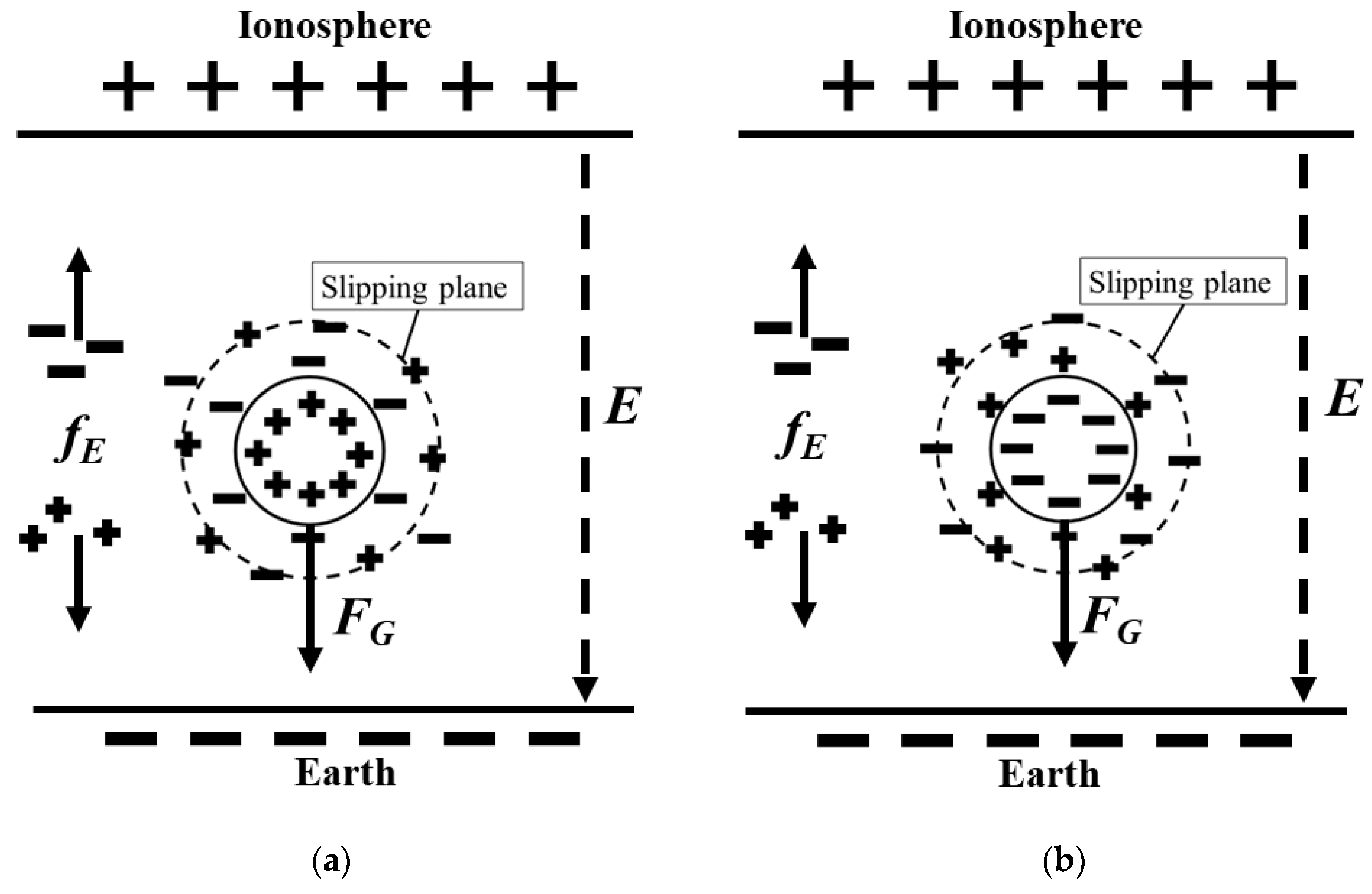
The ratio of the influence of the charge carried by bioaerosol particles influenced by gravity (bacteria, fungal spores, and pollen grains) to the atmospheric electric field under fair weather conditions, in which small atmospheric ions are attached to a bioaerosol particle, was calculated (Figure 1).
The relationship between the terminal velocity  u e  and the electrical mobility  Z p  of a particle is given by [23].
u e = Z p E a t m o s ,
where  E a t m o s  is the atmospheric electric field. Although the atmospheric electric field is not uniform in the ionosphere [24], because the concentrations of airborne bioaerosol particles decrease logarithmically with height [25] and the altitude range in which the bioaerosol particles exist is limited, the atmospheric electricity was assumed to be uniform.
The mobility of a particle is
Z p = C c p i o n e 3 π μ D i o n ,
where  C c  is the Cunningham slip correction factor,  p i o n  is the number of elementary charges, which was assumed to be 1 in this study,  e  is the magnitude of the elementary charge (1.60 × 10⁻¹⁹ C),  μ  is the viscosity of the air, and  D i o n  is the diameter of an aerosol particle with atmospheric ions attached.
Thus, the amount of charge carried by the atmospheric electric field per unit area per unit time is expressed as
Q v o l t = C i o n u e p i o n e = C i o n Z p E a t m o s p i o n e = C i o n C c p i o n 2 e 2 E a t m o s 3 π μ D i o n ,
where  C i o n  is the concentration of airborne atmospheric ions.
The deposition speed of a particle due to gravity is calculated using Stokes’ law and is given by
u g = ρ p ρ a t m o s g D 2 18 μ ,
where  ρ p  is the particle density,  ρ a t m o s  is the air density, and  D  is the particle diameter.
Assuming that the atmospheric electric field is uniform regardless of height, the number of elementary charges carried by a bioaerosol particle driven by gravity is given by
Q g r a v = C b i o u g p = α β f p p c e = C b i o ρ p ρ a t m o s g D b i o 2 18 μ p = α β f p p c e   ,
where  C b i o  is the concentration of airborne bioaerosol particles,  D b i o  is the diameter of the bioaerosol particle, and  p c  is the number of elementary charges carried by a bioaerosol particle.  f p  is the probability of the bioaerosol particle having  p  elementary charges, and  α  and  β  are determined based on the bioaerosol particle charging distribution and atmospheric net ion concentrations.
Given that atmospheric ions and bioaerosol particles can be either positively or negatively charged, when the ratio of the number of charges of a bioaerosol particle to the number of charges attached to the bioaerosol particle ( p b i o ) is  r , Equation (6) holds.
p c ± = r p b i o   ,
Considering the relationship between the charge of the bioaerosol particle and the ambient atmospheric ions, when both the net ion and the bioaerosol particle are positive, or when they are both negative,  Q g r a v  becomes zero.
When the atmospheric net charge is negative and the bioaerosol particle is positive (charging in GEC) (Figure 1a), the electric charge transferred through the gravitational deposition of the bioaerosol particles is
Q g r a v = C b i o ρ p ρ a t m o s g D b i o 2 18 μ lim X + p = 0 X f p r p b i o e   ,
When the atmospheric net charge is positive and the bioaerosol particle is negative (discharging in GEC) (Figure 1b), it is
Q g r a v = C b i o ρ p ρ a t m o s g D b i o 2 18 μ lim X p = 0 X f p r p b i o e   ,
Thus, the ratio of the amount of charge carried by Earth’s atmospheric electrical field and the ionosphere in the GEC to the amount of charge transported by gravity is
γ = Q g r a v Q v o l t = π D i o n C b i o ρ p ρ a t m o s g D b i o 2 lim X ( + or ) p = 0 X f p r p b i o 6 C i o n C c p i o n 2 e E a t m o s   ,
Although  Q v o l t  is given by Equation (3), because the atmospheric current in fair weather is approximately 2 pA m−2 [26],  Q v o l t = 2  pA was substituted in this study.

2.2. Reduction in Electrical Conductivity of the Atmosphere

Because bioaerosol particles are often multiply charged, the amount of reduction in electrical conductivity was calculated by refining the ion–aerosol interaction theory introduced by Gringel (1978) and Kamsali et al. (2011) considering that a multiply charged bioaerosol particle is an aggregate of particles with a single charge [22,27].
When  q  is the production rate of the atmospheric ion and recombination between bioaerosol particles is ignored, the interaction between the atmospheric ion and bioaerosol particles with  n  charge is described by Equations (10)–(12).
d C i o n 0 d t = q α i C i o n 0 2 ,
d C i o n ± d t = q α i C i o n ± 2 β n C b i o ( n ) 0 C i o n ± α s n C b i o ( n ) ± C ,
d C b i o ( n ) ± d t = β n C b i o n 0 C i o n ± α s n C b i o n ± C i o n ,
where  C i o n ±  is the concentration of atmospheric ions in the presence of bioaerosol particles,  C b i o ( n ) 0  is the concentration of neutral bioaerosol particles that will be  n -charged,  C b i o ( n ) ±  is the concentration of charged bioaerosol particles,  α i  is the ion–ion recombination coefficient,  α s  is the charged bioaerosol–ion recombination coefficient, and  β  is the bioaersol–ion biding coefficient.
When the interactions reached steady state:
q α i C i o n 0 2 = 0   ,
q α i C i o n ± 2 β n C b i o ( n ) 0 C i o n ± α s n C b i o ( n ) ± C = 0   ,
β n C b i o n 0 C i o n ± α s n C b i o ( n ) ± C i o n = 0 ,
Equations (13)–(15) give Equation (16).
C i o n ± = β n C b i o n 0 ± β 2 n 2 C b i o n 0 2 + α i 2 C i o n 0 2 α i   ,
The atmospheric conductivity in the absence ( σ 0 ) and presence ( σ ± ) of bioaerosol particles is calculated as follows:
σ 0 = C i o n 0 e Z i ± ,
σ ± = C i o n ± e Z i ± ,
where  Z i ±  is the mobility of the atmospheric ion. Thus, the ratio of the changes in the atmospheric conductivity caused by bioaerosol particles to the atmospheric conductivity in the absence of bioaerosol particles is given as
Δ σ σ 0 = 1 σ ± σ 0                         = 1 C i o n ± C i o n 0 = 1 β n C b i o n 0 ± β 2 n 2 C b i o n 0 2 + α i 2 C i o n 0 2 α i N 0 ,
Since  β 2 n 2 C b i o n 0 2 + α i 2 C i o n 0 2 > β n Z n  and  Δ σ σ 0 > 1 ,
Δ σ t o a l σ 0 = n = 1 β n C b i o n 0 ± β 2 n 2 C b i o n 0 2 + α i 2 C i o n 0 2 α i C i o n 0 ,
where,
n = C b i o n 0 = C b i o 0 ,
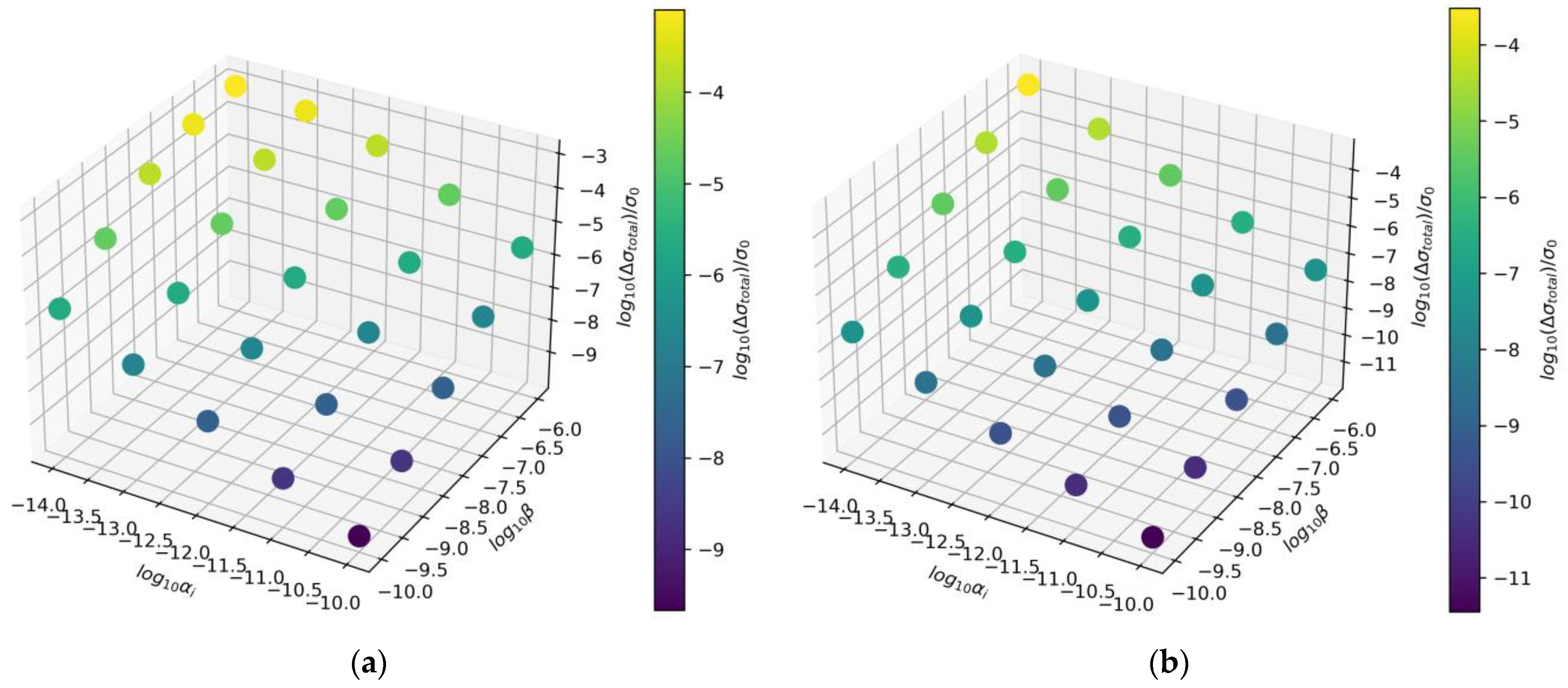
The impact of bioaerosol particles in atmospheric conductivity was calculated using Equation (20). For  α i  and  β 1.0 × 10 14 α i 1.0 × 10 10  and  1.0 × 10 10 m 3 β 1.0 × 10 6  were substituted as representative values [28,29].

2.3. Implementation of Theory

Data obtained from previous research were used to estimate the actual influence of the bioaerosol particles; atmospheric ion data were obtained from previous research performed at various sites [30] (Table 1). Although the sizes of the aerosol particle with atmospheric ion attached in each study varied, the range of particle sizes covered most of the main small aerosol particle sizes. Thus, the net ion concentrations calculated from these data are assumed to correspond to the actual net ion concentrations in the atmosphere.

2.4. Airborne Bioaerosol Concentration Data

Various bioaerosol particles, including bacteria and pollen, were considered in this study (Table 2). Because the total airborne concentrations of microbes vary depending on atmospheric conditions and weather [31], no specific value other than the orders of magnitude of their concentrations was used. For airborne fungal spore (Alternaria, Aspergillus, Penicillium, Clasosporium, and Xerophilic) and mesospheric bacteria concentrations, one colony forming unit (CFU) was assumed to represent one fungal spore [32,33]. Acer [34] and Juniperus [35] were chosen as representative pollen because the electric charge information of these two pollen types has been studied in previous studies.
Although bacteria are often attached to dust particles, the composite particles are often smaller than 2.1 μm [36].

2.5. Bioaerosol Charging Data

As the amount of charge of bioaerosol particles has seldomly been investigated, little data are available. However, charge data are available for Pseudomonas fluorescence particles [20] and basidiospores [37]. Thus, it was assumed that all bacteria had the same charging conditions as Pseudomonas fluorescence and all fungal spores had the same charging conditions as basidiospore. Acer and Juniperus were chosen for pollen owing to the availability of airborne concentration data for them [38] (Table 3). It is reasonable to assume that the amount of charge evaluated above represents the zeta potential of each bioaerosol particle. Fitting the number of elementary charges yields
f p = 1 2 π σ p 2 exp p m e a n p 2 2 σ p 2 ,
where  σ p  is the standard deviation of the number of elementary charges, and  p m e a n  is the mean number of elementary charges for each bioaerosol particle.
In the calculation, 100 Vm−1 was used for  E a t m o s  as a typical electric field [39], 1000 kg m−3 was used for  ρ p , and 1.29 kg m−3 was used for  ρ a t m o s . In addition, the fair weather conditions, in which the ionosphere is the cathode and Earth is the anode, were assumed to be a typical GEC model [11]. In addition,  r = 0.5  in Equation (6) was substituted assuming that the ion flux to and from the slipping plane—where the zeta potential is defined—reaches equilibrium for a bioaerosol particle.

3. Results and Discussion

The ratio of the influence of the charge carried by bioaerosol particles influenced by gravity (bacteria, fungal spores, and pollen grains) to the atmospheric electric field under fair weather conditions was calculated based on data obtained from previous research.
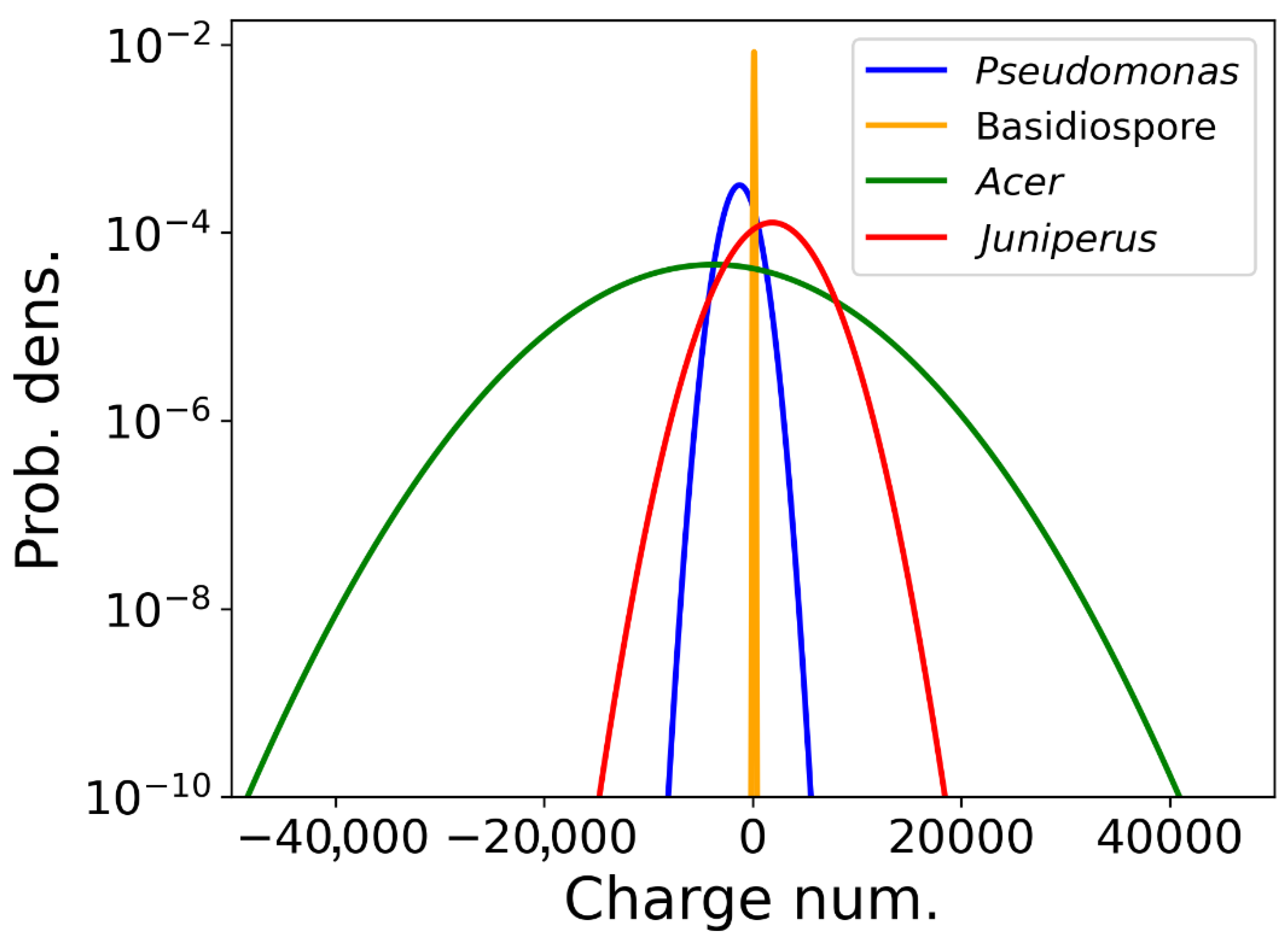
The electric charge of pollen grains had a wider standard deviation than that of other bioaerosol particles (Figure 2). The mean charge of fungal spores was positive, and because the standard deviation of the number of charges was small, the probability density showed a sharp decline when spores were negatively charged. Because this does not contradict the established theory (Wiedensohler, 1988) [40], the calculation results seem to be somewhat applicable to other sites. As seen in the charge distributions of Acer and Juniperus, different pollen types have different electrical properties. It was assumed that all fungal spores have the same electrical properties owing to the lack of existing data; however, it would be reasonable to consider that electrical properties vary depending on the spore type. In addition to fungal spores, bacterial aerosol particles were assumed to have the same electrical properties in this study. Although a previous study showed that Gram+ and Gram- bacteria exhibit no significant differences in their electric properties [17], differences in their aggregation properties or environment might lead to varying electrical properties. In addition, bacteria are usually found in dust aerosol particles [41]. The actual bacterial particle deposition speeds are expected to be faster, which in turn leads to an increase in the number of carried atmospheric ions.
According to the results of the calculations, pollen grains are the most influential bioaerosol particles, carrying ions and electrons that account for the order of 0.1% of the atmospheric current in fair weather while bacteria carry ions and electrons that account for the order of 1.0 × 10⁻⁷% (Table 4). The ratio of the electric charge carried by the gravitational settling of bioaerosol particles to the force exerted on atmospheric ions by the electric field was calculated using Equation (9) is shown to be an effective index of the influence that gravity and bioaerosol particles have on the GEC. However, the variables in the equations must be identified experimentally to quantify the amount of charge carried by bioaerosol particles.
To calculate the changes in atmospheric conductivity caused by the presence of bioaerosol particles, the atmospheric ion concentration of the city center from Table 1 was substituted as the representative atmospheric ion concentration. The airborne concentration of microbes and Juniperus from Table 2 were used as representative bioaerosol particles. Neither microbes nor Juniperus showed a significant influence on atmospheric conductivity. When the representative values for  α i  and  β  were substituted ( α i = 1.0 × 10 12  (m3 s−1),  β = 1.0 × 10 7 (m3 s−1)) [28,29],  Δ σ t o a l σ 0  was on the order of  1.0 × 10 3  (order of 0.1%) for microbes and  1.0 × 10 4  (order of 0.01%) for Juniperus (Figure 3). Although Kamsali et al. (2011) reported that atmospheric conductivity was reduced by 30% when the concentration of aerosol particles increased from approximately  1.0 × 10 9  (m3 s−1) to  4.0 × 10 9  (m3 s−1) [22], the impacts of the bioaerosol particles are much smaller than those of aerosol particles because of their considerably lower atmospheric density.
Previous research indicates that the charge in clouds plays an important role in the fair weather portion of the GEC [42]. Bioaerosol particles have been shown to function efficiently as cloud condensation nuclei (CCN) [43,44,45], so the charging property of bioaerosol particles may explain the importance of clouds in the GEC model. Furthermore, bioaerosol particles in the stratosphere are of interest to researchers in the fields of astrobiology and aerobiology [46,47,48]. Although the mechanism by which bioaerosol particles in the stratosphere reach stratospheric levels is not well understood, a previous study indicated that electrostatic forces acting on bioaerosol particles may cause them to be uplifted to the stratosphere [49]. Hence, the results of this study raise new questions regarding whether the GEC contributes to bioaerosol transport to the stratosphere.
Although this study focused on the relationship between bioaerosol particles and the GEC owing to their highly efficient charging properties, highly charged particles can be produced from anthropogenic sources [50]. Therefore anthropogenic activities may also influence GEC.
The combined use of observational data from global-scale atmospheric electricity networks, such as the Global Coordination of Atmospheric Electricity Measurements (GLoCAEM) [6], and global/regional bioaerosol transport models, such as WRF-Chem [51], would be useful as future work to understand how seasonal and diurnal variations in bioaerosol source dynamics [52,53,54] modulate the global electric circuit (GEC). For example, measuring the temporal variation in the near-surface atmospheric electric field during the pollen season and analyzing its relationship with pollen concentration would help quantify the actual atmospheric-electrical impact of pollen grains.
The atmospheric-electrical impacts of bioaerosol particles, such as those quantified in this study, have not been extensively discussed to date. However, it has been argued that charged bioaerosols can exert ecological effects [55]. For example, wind-dispersed pollen may increase pollination success through interactions with floral electric fields [56]. It has also been shown that spiderlings can disperse and be transported over long distances as airborne particles by becoming electrically charged [57]. Although the atmospheric-electrical impacts estimated here remain largely unresolved experimentally, studies have reported that coarse particles such as dust can affect the atmospheric electric field in complex ways [58]. Therefore, continued refinement of theory together with targeted observations may enable a clearer understanding of the atmospheric-electrical role of bioaerosols in the future.

4. Conclusions

This study shows that bioaerosol particles, especially pollen grains, can weaken or strengthen the current in the GEC. These results show that the charging or discharging effect of bioaerosol particles can account for the order of 0.1% of the atmospheric current. In addition, the atmospheric conductivity can decrease by the order of  0.1 %  due to airborne microbes and  0.01 %  due to pollen. These results provide a new perspective on the role of aerosol particle mobility in the global electric circuit and the complex relationship between gravity, the biospheric activities, and the global-scale electric field generated by the Earth and ionosphere.

Funding

This research received no external funding.

Data Availability Statement

No new data were created or analyzed in this study.

Conflicts of Interest

The author declares no conflicts of interest.

References

  1. Williams, E.R. The global electrical circuit: A review. Atmos. Res. 2009, 91, 140–152. [Google Scholar] [CrossRef]
  2. Denisenko, V.V.; Rycroft, M.J.; Harrison, R.G. Mathematical simulation of the ionospheric electric field as a part of the global electric circuit. Surv. Geophys. 2019, 40, 1–35. [Google Scholar] [CrossRef]
  3. Jánský, J.; Pasko, V.P. Effects of conductivity perturbations in time-dependent global electric circuit model. J. Geophys. Res. Space Phys. 2015, 120, 10654–10668. [Google Scholar] [CrossRef]
  4. Harrison, R.G. Behind the curve: A comparison of historical sources for the Carnegie curve of the global atmospheric electric circuit. Hist. Geo. Space Sci. 2020, 11, 207–213. [Google Scholar] [CrossRef]
  5. Burns, G.B.; Frank-Kamenetsky, A.V.; Tinsley, B.A.; French, W.J.R.; Grigioni, P.; Camporeale, G.; Bering, E.A. Atmospheric global circuit variations from Vostok and Concordia electric field measurements. J. Atmos. Sci. 2017, 74, 783–800. [Google Scholar] [CrossRef]
  6. Nicoll, K.A.; Harrison, R.G.; Barta, V.; Bor, J.; Brugge, R.; Chillingarian, A.; Chum, J.; Georgoulias, A.K.; Guha, A.; Kourtidis, K.; et al. A global atmospheric electricity monitoring network for climate and geophysical research. J. Atmos. Sol.-Terr. Phys. 2019, 184, 18–29. [Google Scholar] [CrossRef]
  7. Blakeslee, R.J.; Mach, D.M.; Bateman, M.G.; Bailey, J.C. Seasonal variations in the lightning diurnal cycle and implications for the global electric circuit. Atmos. Res. 2014, 135–136, 228–243. [Google Scholar] [CrossRef]
  8. Tacza, J.; Raulin, J.-P.; Macotela, E.; Marun, A.; Fernandez, G.; Bertoni, F.C.P.; Lima, L.M.; Samanes, J.; Buleje, Y.; Correia, E.; et al. Local and global effects on the diurnal variation of the atmospheric electric field in South America by comparison with the Carnegie curve. Atmos. Res. 2020, 240, 104938. [Google Scholar] [CrossRef]
  9. Velazquez, Y.R.; Nicora, M.G.; Galligani, V.S.; Wolfram, E.A.; Salio, P.V.; D’elia, R.L. Exploring the global thunderstorm influence on the fair weather electric field in Buenos Aires. Atmos. Res. 2024, 299, 107182. [Google Scholar] [CrossRef]
  10. Hunting, E.R.; Matthers, J.; de Arróyabe Hernáez, P.F.; England, S.J.; Kourtidis, K.; Koh, K.; Nicoll, K.; Harrison, R.G.; Manser, K.; Price, C.; et al. Challenges in coupling atmospheric electricity with biological systems. Int. J. Biometeorol. 2021, 65, 45–58. [Google Scholar] [CrossRef]
  11. Rycroft, M.J.; Nicoll, K.A.; Aplin, K.L.; Harrison, R.G. Recent advances in global electric circuit coupling between the space environment and the troposphere. J. Asmos. Sol.-Tess. Phys. 2012, 90–91, 198–211. [Google Scholar] [CrossRef]
  12. Bór, J.; Bozóki, T.; Sátori, G.; Williams, E.; Behnke, S.A.; Rycroft, M.J.; Buzás, A.; Silva, H.G.; Kubicki, M.; Said, R.; et al. Responses of the AC/DC global electric circuit to volcanic electrical activity in the Hunga Tonga-Hunga Ha’apai eruption on 15 January 2022. J. Geophys. Res. Atmos. 2023, 128, e2022JD038238. [Google Scholar] [CrossRef]
  13. Zhao, P.; Yin, Y.; Xiao, H. The effects of aerosol on development of thunderstorm electrification: A numerical study. Atmos. Res. 2015, 153, 376–391. [Google Scholar] [CrossRef]
  14. Kostrov, A.V. Cosmic dusty plasma and the global electric circuit of the earth. Plasma Phys. Rep. 2020, 46, 443–451. [Google Scholar] [CrossRef]
  15. Baumgaertner, A.J.G.; Thayer, J.P.; Neely, R.R.; Lucas, G. Toward a comprehensive global electric circuit model: Atmospheric conductivity and its variability in CESM 1 (WACCM) model simulations. J. Geophys. Res. Atmos. 2013, 18, 9221–9232. [Google Scholar] [CrossRef]
  16. Kudintseva, I.G.; Nickolaenko, A.P.; Rycroft, M.J.; Odzimek, A. AC and DC global electric circuit properties and the height profile of atmospheric conductivity. Ann. Geophys. 2016, 59, A0545. [Google Scholar] [CrossRef]
  17. Wei, K.; Zou, Z.; Yao, M. Charge levels and Gram (±) fractions of environmental bacterial aerosols. J. Aerosol Sci. 2014, 74, 52–62. [Google Scholar] [CrossRef]
  18. Gollakota, A.R.K.; Gautam, S.; Santosh, M.; Sudan, H.A.; Gandhi, R.; Jebadurai, V.S.; Shu, C.-M. Bioaerosols: Characterization, pathways, sampling strategies, and challenges to geo-environment and health. Gondwana Res. 2021, 99, 178–203. [Google Scholar] [CrossRef]
  19. Fröhlich-Nowoisky, J.; Kamapf, C.J.; Weber, B.; Huffman, J.A.; Pöhlker, C.; Andreae, M.O.; Lang-Yona, N.; Burrows, S.M.; Gunthe, S.S.; Elbert, W.; et al. Bioaerosols in the Earth system: Climate, health, and ecosystem interactions. Atmos. Res. 2016, 182, 346–376. [Google Scholar] [CrossRef]
  20. Mainelis, G.; Willeke, K.; Baron, P.; Reponen, T.; Grinshpun, S.A.; Górny, R.L.; Trakumas, S. Electrical charge on airborne microorganisms. J. Aerosol Sci. 2001, 32, 1087–1110. [Google Scholar] [CrossRef]
  21. Nakae, S. Properties of atmospheric ions and the measuring techniques. Earozoru Kenkyu 1987, 2, 111–116. (In Japanese) [Google Scholar]
  22. Kamsali, N.; Prasad, B.S.N.; Datt, J. The electrical conductivity as an index of air pollution in the atmosphere. In Advanced Air Pollution; InTech: Hyogo, Japan, 2011. [Google Scholar]
  23. Knutson, E.O.; Whitby, K.T. Aerosol classification by electric mobility: Apparatus, theory, and applications. J. Aerosol Sci. 1975, 6, 443–451. [Google Scholar] [CrossRef]
  24. Haldoupis, C.; Rycroft, M.; Williams, E.; Price, C. Is the “Earth-ionosphere capacitor” a valid component in the atmospheric global electric circuit? J. Atmos. Sol.-Terr. Phys. 2017, 164, 127–131. [Google Scholar] [CrossRef]
  25. Zawadowicz, M.A.; Froyd, K.D.; Perring, A.E.; Murphy, D.M.; Spracklen, D.V.; Heald, C.L.; Buseck, P.R.; Cziczo, D.J. Model-measurement consistency and limits of bioaerosol abundance over the continental United States. Atmos. Chem. Phys. 2019, 19, 13859–13870. [Google Scholar] [CrossRef]
  26. Rycroft, M.J.; Israelsson, S.; Price, C. The global atmospheric electric circuit, solar activity and climate change. J. Atmos. Sol.-Terr. Phys. 2000, 62, 1563–1576. [Google Scholar] [CrossRef]
  27. Gringel, W.; Käselau, K.H.; Mühleisen, R. Recombination rates of small ions and their attachment to aerosol particles. Pageoph 1978, 116, 1101–1113. [Google Scholar] [CrossRef]
  28. Harrison, R.G.; Carslaw, K.S. Ion-aerosol-cloud process in the lower atmosphere. Rev. Geophys. 2003, 41, 1012. [Google Scholar] [CrossRef]
  29. Zauner-Wieczorek, M.; Curtius, J.; Kürten, A. The ion-ion recombination coefficient α: Comparison of temperature- and pressure-dependent parameterisations for the troposphere and stratosphere. Atmos. Chem. Phys. 2022, 22, 12443–12465. [Google Scholar] [CrossRef]
  30. Ling, X.; Jayaratne, R.; Morawska, L. Air ion concentrations in various urban outdoor environments. Atmos. Environ. 2010, 44, 2186–2193. [Google Scholar] [CrossRef]
  31. Xie, Z.; Li, Y.; Lu, R.; Fan, C.; Liu, P.J.; Wang, W. Characteristics of total airborne microbes at various air quality levels. J. Aerosol Sci. 2018, 116, 57–65. [Google Scholar] [CrossRef]
  32. Abdel Hameed, A.A.; Khoder, M.I.; Yuosra, S.; Osman, A.M.; Ghanem, S. Diurnal distribution of airborne bacteria and fungi in the atmosphere of Helwan area, Egypt. Sci. Total Environ. 2009, 407, 6217–6222. [Google Scholar] [CrossRef] [PubMed]
  33. Haas, D.; Galler, H.; Luxner, J.; Zarfel, G.; Buzina, W.; Friedl, H.; Marth, E.; Habib, J.; Reinthaler, F.F. The concentrations of culturable microorganisms in relation to particulate matter in urban air. Atmos. Environ. 2013, 65, 215–222. [Google Scholar] [CrossRef]
  34. Ribeiro, H.; Abreu, I. A 10-year survey of allergenic airborne pollen in the city of Porto (Portugal). Aerobiologia 2014, 30, 333–344. [Google Scholar] [CrossRef]
  35. Flonard, M.; Lo, E.; Levetin, E. Increasing Juniperus virginiana L. pollen in the Tulsa atmosphere: Long-term trends, variability, and influence of meteorological conditions. Int. J. Biometeorol. 2018, 62, 229–241. [Google Scholar] [CrossRef] [PubMed]
  36. Jeong, S.B.; Ko, H.S.; Heo, K.J.; Shin, J.H.; Jung, J.H. Size distribution and concentration of indoor culturable bacterial and fungal bioaerosols. Atmos. Environ. X 2022, 15, 100182. [Google Scholar] [CrossRef]
  37. Saar, M. Investigation of the electrostatic charge of basidiospores of the Phellinus igniarius group. Cent. Eur. J. Biol. 2013, 8, 410–422. [Google Scholar] [CrossRef]
  38. Bowker, G.E.; Crenshaw, H.C. Electrostatic forces in wind-pollination—Part 1: Measurement of the electrostatic charge on pollen. Atmos. Environ. 2007, 41, 1587–1595. [Google Scholar] [CrossRef]
  39. Bennett, A.J.; Harrison, R.G. Variability in surface atmospheric electric field measurements. J. Phys. Conf. Ser. 2008, 142, 012046. [Google Scholar] [CrossRef]
  40. Wiedensohler, A. An approximation of the bipolar charge distribution for particles in the submicron size range. J. Aerosol Sci. 1988, 19, 387–389. [Google Scholar] [CrossRef]
  41. Marone, A.; Kane, C.T.; Mbengue, M.; Jenkins, G.S.; Niang, D.N.; Drame, M.S.; Gernand, J.M. Characterization of bacteria on aerosols from dust events in Dakar, Senegal, West Africa. GeoHealth 2020, 4, e2019GH000216. [Google Scholar] [CrossRef]
  42. Harrison, R.G.; Nicoll, K.A.; Mareev, E.; Slyunyaev, N.; Rycroft, M.J. Extensive layer clouds in the global electric circuit: Their effects on vertical charge distribution and storage. Proc. R. Soc. A 2020, 476, 20190758. [Google Scholar] [CrossRef]
  43. Ariya, P.A.; Sun, J.; Eltouny, N.A.; Hudson, E.D.; Hayes, C.T.; Kos, G. Physical and chemical characterization of bioaerosols—Implications for nucleation processes. Int. Rev. Phys. Chem. 2009, 28, 1–32. [Google Scholar] [CrossRef]
  44. Tang, K.; Sánchez-Parra, B.; Yordanova, P.; Wehking, J.; Backes, A.T.; Pickersgill, D.A.; Maier, S.; Sciare, J.; Pöschl, U.; Weber, B.; et al. Bioaerosols and atmospheric ice nuclei in a Mediterranean dryland: Community changes related to rainfall. Biogeosciences 2022, 19, 71–91. [Google Scholar] [CrossRef]
  45. Maki, T.; Hosaka, K.; Lee, K.C.; Kawabata, Y.; Kajino, M.; Uto, M.; Kita, K.; Igarashi, Y. Vertical distribution of airborne microorganisms over forest environments: A potential source of ice-nucleating bioaerosols. Atmos. Environ. 2023, 302, 119726. [Google Scholar] [CrossRef]
  46. Wainwright, M.; Alharbi, S.; Wickramasinghe, N.C. How do microorganisms reach the stratosphere? Int. J. Astrobiol. 2006, 5, 2682–2690. [Google Scholar] [CrossRef]
  47. Smith, D.J.; Griffin, D.W.; Schuerger, A.C. Stratospheric microbiology at 20 km over the Pacific Ocean. Aerobiologia 2010, 26, 35–46. [Google Scholar] [CrossRef]
  48. Miki, K. Particle motion determines the types of bioaerosol particles in the stratosphere. Int. J. Astrobiol. 2023, 22, 205–215. [Google Scholar] [CrossRef]
  49. Dehel, T.; Lorge, F.; Dickinson, M. Uplift of microorganisms by electric field above thunderstorms. J. Electrostat 2008, 66, 463–466. [Google Scholar] [CrossRef]
  50. Thomas, A.E.; Bauer, P.S.; Dam, M.; Perraud, V.; Wingen, L.M.; Smith, J.N. Automotive braking is a source of highly charged aerosol particles. Proc. Natl. Acad. Sci. USA 2024, 121, e2313897121. [Google Scholar] [CrossRef] [PubMed]
  51. Werner, M.; Guzikowski, J.; Kryza, M.; Malkiewicz, M.; Bilińska, D.; Skjøth, C.A.; Rapiejko, P.; Chłopek, K.; Dąbrowska-Zapart, K.; Lipiec, A.; et al. Extension of WRF-Chem for birch pollen modelling—A case study for Poland. Int. J. Biometeorol. 2021, 65, 513–526. [Google Scholar] [CrossRef] [PubMed]
  52. Yang, L.; Shen, Z.; Wang, D.; Wei, J.; Wang, X.; Sun, J.; Xu, H.; Cao, J. Diurnal variations of size-resolved bioaerosols during autumn and winter over a semi-arid megacity in northwest China. GeoHealth 2021, 5, e2021GH000411. [Google Scholar] [CrossRef]
  53. Zhang, L.; Liu, T.; Zhang, J.; Zhu, B.; Xiang, D.; Zhao, X.; Liu, X. Bioaerosol seasonal variation and contribution to airborne particulate matter in Huangshi city of central China. Atmosphere 2022, 13, 909. [Google Scholar] [CrossRef]
  54. Miki, K. Dynamics of pollen-generating environment producing impact on society based on the relative humidity of the previous year and flowering synchrony. Sci. Total Environ. 2023, 892, 164745. [Google Scholar] [CrossRef] [PubMed]
  55. England, S.J.; Robert, D. The ecology of electricity and electroreception. Biol. Rev. 2022, 97, 383–413. [Google Scholar] [CrossRef] [PubMed]
  56. Armbruster, W.S. Evolution of floral form: Electrostatic forces, pollination, and adaptive compromise. New Phytol. 2001, 152, 181–183. [Google Scholar] [CrossRef]
  57. Morley, E.L.; Gorham, P.W. Evidence for nanocoulomb charges on spider ballooning silk. Phys. Rev. E 2020, 102, 012403. [Google Scholar] [CrossRef]
  58. Daskalopoulou, V.; Mallios, S.A.; Ulanowski, Z.; Hloupis, G.; Gialitaki, A.; Tsikoudi, I.; Tassis, K.; Amiridis, V. The electrical activity of Saharan dust as perceived from surface electric field observations. Atmos. Chem. Phys. 2021, 21, 927–949. [Google Scholar] [CrossRef]
Figure 1. (a) Schematic drawing of charging of GEC by gravitational settling of a charged particle; (b) Schematic drawing of discharging of GEC by gravitational settling of a charged particle. FG is gravity acting on the bioaerosol particle, fE is the electrostatic force on the atmospheric ions, and E is the electric field. The ionosphere is the cathode, and Earth is the anode. The number of charges represents the zeta potential of the slipping plane.
Aerobiology 04 00006 g001
Figure 2. Probability density of the number of charges for each type of bioaerosol particle based on previous studies.
Aerobiology 04 00006 g002
Figure 3. (a) Ratio of the changes in atmospheric conductivity due to the presence of bioaerosol particles microbes to atmospheric conductivity in absence of bioaerosol particles; (b) Ratio of the changes in atmospheric conductivity due to the presence of bioaerosol particles Juniperus to atmospheric conductivity in absence of bioaerosol p articles.
Aerobiology 04 00006 g003
Table 1. Airborne concentrations of atmospheric ions reported in previous research.
Ling et al. [30]
Conc. (cm−3)−69−1399501275
Objective ion (nm)Net small ion (>1)
SiteWoodlandCity centerPowerline
without corona
Powerline
with corona
Australia
Table 2. Airborne concentrations of bioaerosol particles from previous research.
Xie et al. [31]Abdel Hameed et al. [32]Haas et al. [33]Ribeiro and Abreu [34]Flonard et al. [35]
Conc.1.0 × 105
(m−3)
8.7 × 10
(CFU m−3)
1.4 × 10²
(CFU m−3)
9.0 × 10
(CFU m−3)
2.0 × 10²
(CFU m−3)
1.2 × 10²
(CFU m−3)
3.9 × 10²
(CFU m−3)
3.3 × 10²
(grains m−3)
1.5 × 10³
(grains m−3)
ObjectTotal airborne microbes
(order of magnitude)
Alternatia
(Daily peak)
Aspergillus
(Daily peak)
Penicillium
(Daily peak)
Clasosporium
(Daily peak)
Mesophilic bacteria
(Median)
Xerophilic fungal spore
(Median)
Acer
(Median)
Juniperus
(Mean)
SiteXi’an, ChinaHelwan, EgyptGraz, AustriaPorto, PortugalTulsa,
Oklahoma
Table 3. Average and standard deviation of the number of charges for each types of bioaerosol particle based on previous research.
Mainelis et al. [20]Saar [37]Bowker and Crenshaw [38]
Charge
avg.
−1250 elementary charge146 elementary charge−3750 elementary charge
(−0.6 fC)
1875 elementary charge
(0.3 fC)
Charge
std.
1250 elementary charge48 elementary charge8750 elementary charge
(1.4 fC)
3125 elementary charge
(0.5 fC)
ObjectPseudomonas fluorescensBasidiosporeAcer rubrumJuniperus virginiana
Size0.72 μm5.0 μm38 μm18 μm
Table 4. Ratio of the amount of charge carried by the atmospheric electrical field formed by Earth.
Total
Microbes
Mesophilic BacteriaAlternariaAspergillusPenicilliumClasosporiumXerophilic Fungal SporeAcerJuniperus
6.8 × 10−68.2 × 10−94.0 × 10−76.4 × 10−74.1 × 10−79.2 × 10−71.8 × 10−61.2 × 10−31.5 × 10⁻³
Disclaimer/Publisher’s Note: The statements, opinions and data contained in all publications are solely those of the individual author(s) and contributor(s) and not of MDPI and/or the editor(s). MDPI and/or the editor(s) disclaim responsibility for any injury to people or property resulting from any ideas, methods, instructions or products referred to in the content.