1. Introduction
Immune surveillance is a key mechanism through which the immune system detects and eliminates transformed cells, thereby preventing tumour development [
1]. When this control fails, tumours can evade immune detection, establish tolerance and promote disease progression. Tumour cells orchestrate immune evasion through multiple strategies, including downregulation of major histocompatibility complex (MHC) molecules, secretion of immunosuppressive factors and inhibition of cytotoxic T cells via immune checkpoints [
2].
Over the past decade, immunotherapy has revolutionized the treatment of genitourinary cancers (GUcs), demonstrating efficacy in both renal cell carcinoma (RCC) and urothelial tumours (UCs). Immune checkpoint inhibitors (ICIs), such as antibodies against CTLA-4, PD-1, and PD-L1, enhance immune activity, reactivate T cells against tumour cells and remodel the immunosuppressive tumour microenvironment, producing significant clinical and pathological benefit [
3].
In metastatic RCC (mRCC), the combination of ICIs with tyrosine kinase inhibitors (TKIs) has redefined standard first-line treatment. Based on the survival benefits reported in pivotal trials including KEYNOTE-426, JAVELIN Renal 101, IMmotion151, CheckMate 214, CheckMate 9ER, and CLEAR, major oncology societies such as EAU, ESMO, and NCCN strongly recommend ICI-based combinations for first-line treatment of metastatic RCC. Likewise, guidelines from EAU, ESMO, and NCCN [
4,
5,
6] recommend ICIs as a therapeutic option for metastatic urothelial carcinoma (mUC), both as first line treatment in patients deemed ineligible for chemotherapy and as maintenance after platinum-based chemotherapy or in later lines setting.
Building on the transformative activity observed in metastatic disease, the clinical success of ICIs in advanced renal cell carcinoma provided the biological and clinical rationale for their evaluation in earlier disease settings.
In the phase III CheckMate 214 trial [
7], nivolumab plus ipilimumab demonstrated superior overall survival and objective response rates compared with sunitinib, with complete responses observed in approximately 10% of patients and durable long-term disease control. Similarly, KEYNOTE-426 [
8,
9] showed that pembrolizumab combined with axitinib significantly improved overall survival and progression-free survival versus sunitinib, establishing PD-1-based combinations as standards of care in advanced disease.
These trials also defined the immune-related toxicity profile associated with checkpoint inhibition, encompassing endocrine, dermatologic, hepatic, gastrointestinal, and renal adverse events. Although most events were manageable with established immunosuppressive strategies, their potential persistence and the need for long-term hormone replacement rendered them particularly relevant in earlier-stage and adjuvant treatment settings.
Together, the magnitude and durability of benefit observed in advanced disease prompted the investigation of ICIs in the adjuvant setting following radical surgery, with the aim of eradicating micrometastatic disease and reducing recurrence risk. Clinical evidence in this setting is largely derived from the pivotal KEYNOTE-564 and CheckMate-274 trials, which form the central focus of this review [
10,
11]. Prostate cancer represents a notable exception. Its “cold” tumor microenvironment, characterized by low antigen presentation, limited cytotoxic T-cell activity, high checkpoint expression, immunosuppressive cytokines, and abundant regulatory cells, reduces ICI efficacy [
12]. Therefore, the role of ICIs in the adjuvant setting remains undefined.
Despite their effectiveness, ICIs can cause irAEs, which differ from toxicities observed with cytotoxic or targeted therapies. IrAEs result from excessive immune activation, loss of tolerance, and activation of autoreactive T cells, macrophages, or B cells [
2]. They may involve skin, lungs, gastrointestinal tract, endocrine glands and musculoskeletal system, with variable severity. Most events are self-limiting or respond to corticosteroids, while refractory cases require targeted immunomodulation. Early recognition and management are essential to prevent severe complications and, whenever possible, continue cancer therapy [
13,
14].
Large analyses of 48 trials including 6938 patients have shown distinct irAE profiles for anti-CTLA-4 versus anti-PD-1 antibodies, suggesting that the tumor microenvironment may influence toxicity in a histology-specific manner. A systematic review and meta-analysis focusing on genitourinary cancers reported an overall irAE incidence of 34.3% for all grades and 10.2% for grade ≥ 3 events, with higher rates in RCC (42.7%) compared with UC (24.9%). Combination therapies increased the likelihood of irAEs: dual ICIs (78%) and ICIs plus TKIs (48.8%) versus single-agent ICIs (24.9%). Most events resolved after treatment interruption and prolonged high-dose corticosteroid therapy [
15]. This review provides an updated overview of immune-related adverse events associated with adjuvant immune checkpoint inhibitors in RCC and UC. It focuses on pembrolizumab and nivolumab as investigated in the pivotal KEYNOTE-564 and CheckMate-274 trials, highlighting the incidence, spectrum, and clinical management of irAEs based on both trial and real-world evidence. The scope of the review is intentionally limited to these two landmark adjuvant studies.
2. Immunotherapy in the Adjuvant Setting of GUc
Recent advances in the treatment of urological cancers have highlighted the potential role of adjuvant immunotherapy in reducing recurrence risk after surgical resection.
2.1. Rationale for Adjuvant Immunotherapy
Biological and Immunological Basis
Most patients with RCC are diagnosed at a localized stage, for which radical or partial nephrectomy remains the standard of care. However, despite apparently curative surgery, a subset of patients [
16] eventually experience recurrence, reflecting the likely presence of micrometastatic disease at the time of surgery, with 5-year recurrence-free survival ranging from 42% to 98% [
17]. Identifying patients at high risk using validated prognostic tools such as SSIGN, UISS, or Leibovich scores is crucial for selecting those who may benefit from adjuvant therapy [
18,
19,
20]. Following the success of ICIs in advanced RCC, their use has been explored in the adjuvant setting [
21]. The biological rationale posits that, despite complete tumor resection, residual micrometastatic foci may persist within an immunologically active tumor microenvironment. Through the restoration of robust T-cell effector function, ICIs have the potential to eliminate these occult micrometastases prior to their progression into clinically detectable recurrence, thereby offering a means to meaningfully prolong long-term disease control [
22,
23].
A similar rationale applies to UC, which is associated with a high risk of metastasis and poor prognosis, particularly in patients with nodal involvement [
24]. Standard therapy combines cisplatin-based neoadjuvant chemotherapy with surgery [
25,
26,
27].
However, many patients are ineligible for cisplatin and fail to achieve a complete response, or decline radical surgery due to associated morbidity and quality-of-life concerns. In this context, adjuvant ICIs provide a promising alternative, as the residual tumor microenvironment after surgery—characterized by high tumor mutational burden, CD8
+ T-cell infiltration, and interferon-γ gene signatures—represents a favorable target for immune-based therapy [
16].
2.2. Key Clinical Trials in RCC and UC
Evidence from Pivotal Trials
The KEYNOTE-564 trial evaluated 12 months of adjuvant pembrolizumab in patients with intermediate-high or high-risk RCC following complete nephrectomy. Eligible tumors required predominantly clear-cell histology, including sarcomatoid components, and negative surgical margins. Risk groups included pT2 high-grade or pT3 disease, pT4 or node-positive tumors, and an M1 NED cohort with fully resected synchronous or early metastases. Patients were randomized 4–12 weeks post-surgery and needed ECOG 0–1 and adequate organ function. Individuals with prior systemic therapy, active autoimmune disease, need for immunosuppression, or residual metastatic disease were excluded [
21]. At a median follow-up of 57.2 months, pembrolizumab improved 24-month disease free survival (DFS) (77.3% versus 68.1%; HR 0.68; 95% CI 0.53–0.87;
p = 0.002) and showed consistent benefit across key subgroups. Estimated overall survival (OS) at 48 months was 91.2% with pembrolizumab versus 86.0% with placebo [
10]. Differences in trial designs and eligibility criteria may explain why other adjuvant ICIs did not meet primary endpoints [
16].
Similarly, the CheckMate-274 trial evaluated adjuvant nivolumab in patients with high-risk muscle-invasive urothelial carcinoma following radical surgery. Eligible patients had predominant urothelial histology from the bladder, ureter, or renal pelvis, with pT3–T4a or pN+ disease, or pT2 tumors if neoadjuvant chemotherapy had not been administered. Those previously treated with cisplatin were required to have residual ≥ pT2 or node-positive disease. All patients needed complete resection with negative margins, no radiographic evidence of recurrence, randomization within 120 days of surgery, ECOG 0–1, and adequate organ function. Key exclusions included active autoimmune disease, immunosuppression, prior PD-1/PD-L1 or CTLA-4 inhibitors, and unresected or metastatic disease.
The trial demonstrated a durable long-term benefit: median DFS was 21.9 versus 11.0 months (HR 0.74), with an even greater effect in PD-L1 ≥ 1% tumors (55.5 versus 8.4 months; HR 0.58) [
11]. Exploratory ctDNA analyses identified a subgroup with particularly high risk, showing marked benefit in ctDNA-positive patients (HR 0.35) but no advantage in ctDNA-negative cases (HR 0.99). Additional biomarker work suggested increased sensitivity to PD-1 blockade in tumors with high TMB, dense CD8
+ infiltration, and strong interferon-γ signatures [
28].
Together, these studies highlight that adjuvant ICIs can provide meaningful clinical benefit in both renal and urothelial malignancies, particularly by targeting residual micrometastatic disease in an immunologically active post-surgical microenvironment.
3. Mechanisms and Spectrum of irAEs
IrAEs represent a spectrum of toxicities arising from the enhanced immune activity induced by checkpoint inhibitors, and their understanding is crucial for optimizing both safety and efficacy in genitourinary cancers.
3.1. Pathophysiology of irAEs in GUc
Biological Mechanisms and Clinical Implications of irAEs in GUs
Understanding the biological mechanisms underlying irAEs is essential to interpret their clinical heterogeneity and to optimize patient management, particularly in GUc, where tumor immunogenicity significantly influences toxicity profiles.
Immune-related toxicities arise from a breakdown of immune tolerance induced by the blockade of PD-1/PD-L1 and CTLA-4 checkpoints. Inhibition of these “immune inhibitory pathways” leads to hyperactivation of autoreactive T cells against self-antigens, resulting in inflammatory infiltration of normal tissue [
29]. The same mechanisms that enhance antitumor immunity thus compromise peripheral tolerance, promoting the development of systemic autoimmune phenomena.
GU tumors, particularly RCC and UC, are known for their high immunogenicity. RCC is characterized by a tumor microenvironment enriched in CD8
+ T cells and NK cells, often functionally inhibited [
30].
Similarly, UC exhibits a high mutational burden and a remarkable density of neoantigens capable of eliciting immune activation [
31].
Recent studies confirm that these GUc possess immunologically active microenvironments with strong expression of co-stimulatory molecules, a feature that explains their particular sensitivity to immune checkpoint inhibition [
30].
Several studies have reported a positive correlation between the occurrence of irAEs and clinical benefit. In mRCC, [
32] observed that patients experiencing immune-related toxicities—particularly thyroiditis and cutaneous eruptions—had significantly longer progression-free survival (PFS) compared with those without irAEs. Similarly, in advanced UC, the occurrence of irAEs, especially dermatologic events, was associated with improved OS and PFS [
33]. These findings suggest that irAEs may serve as potential biomarkers of immune efficacy, reflecting a more robust immune response against the tumor.
From a pathological standpoint, autoimmune renal lesions have been described in RCC treated with immune checkpoint inhibitors [
34] reported cases of lymphocytic vasculitis involving medium-sized vessels and non-necrotizing granulomatous infiltrates in residual renal parenchyma following ICI therapy.
In UC patients receiving adjuvant treatment, as observed in the Checkmate 274 trial the most frequent irAEs were cutaneous (pruritus) and endocrine toxicities (hypothyroidism), followed by gastrointestinal (diarrhea), hepatic (ALT increase), and pulmonary events (pneumonitis). Grade ≥ 3 irAEs were infrequent, and treatment-related deaths due to irAEs were rare [
11].
Recent investigations have also highlighted a key role of the interleukin-17 (IL-17) pathway in the pathogenesis of irAEs demonstrated that experimental blockade of the IL-17RA receptor, a co-receptor for IL-17A and IL-25, markedly reduced lymphocytic infiltration in affected tissues while maintaining antitumor efficacy. In other words, inhibition of the IL-17/IL-25 signaling axis appears to mitigate off-target immune toxicity without compromising treatment effectiveness, paving the way for immune-modulatory strategies aimed at preventing irAEs while preserving antitumor activity [
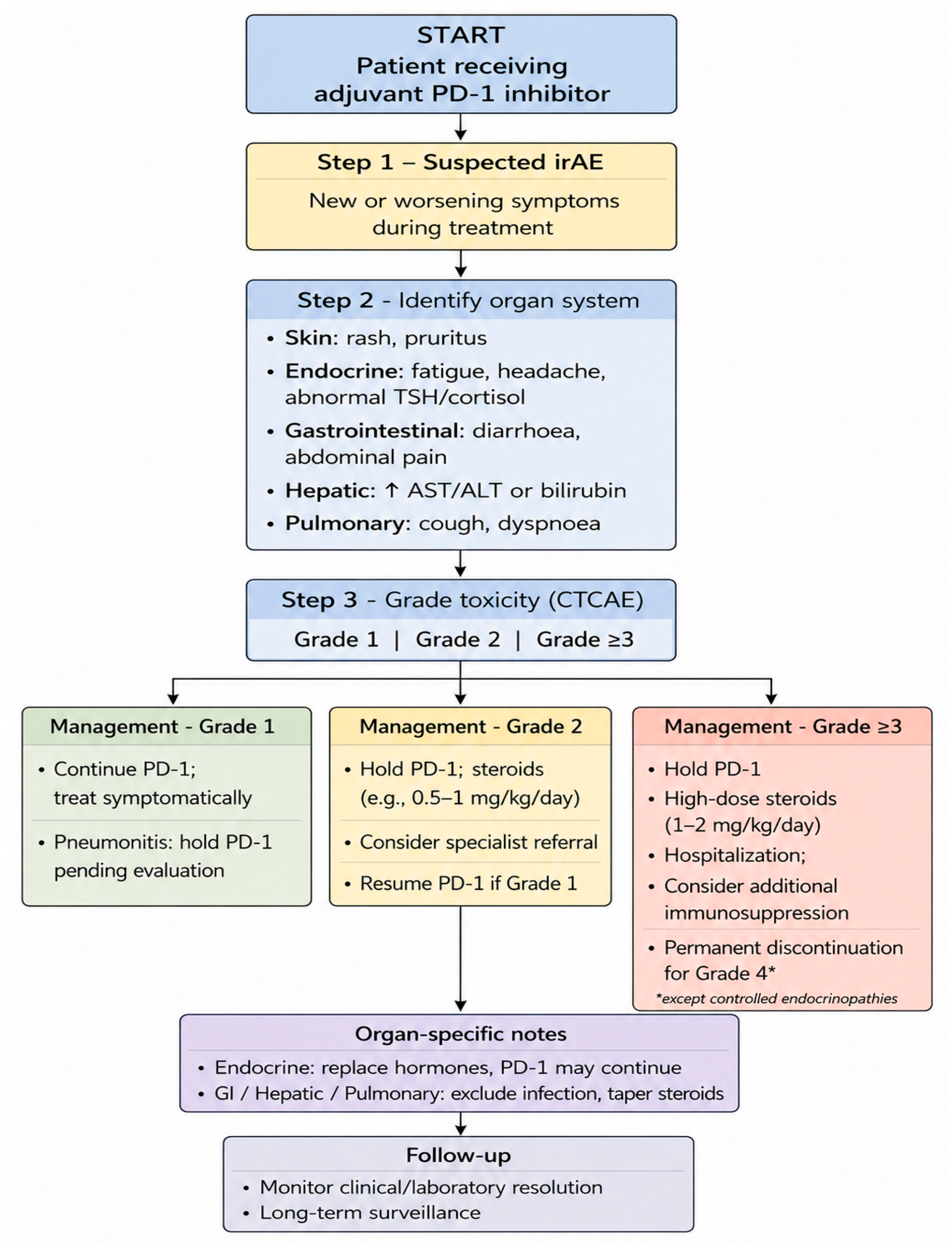
35].The recognition and management of common immune-related adverse events during adjuvant PD-1 inhibitor therapy are summarized in
Figure 1.
4. Safety and irAEs in GUc
In this section, we reviewed the safety and irAEs of adjuvant PD-1 inhibitors in GUc, drawing on data from KEYNOTE-564 in RCC and CheckMate-274 in MIUC, with a focus on both the initial trial findings and long-term follow-up to provide a comprehensive perspective on tolerability and management of toxicities.
4.1. Safety in Pivotal Trials
4.1.1. RCC–KEYNOTE-564 Study
Safety outcomes from the KEYNOTE-564 trial were evaluated across primary, interim, and extended follow-up analyses [
10,
21,
36].
Overall, adjuvant pembrolizumab demonstrated a consistent, predictable, and clinically manageable safety profile, in line with that previously observed in metastatic and neoadjuvant settings.
Even when administered in a potentially cured population—where the threshold for toxicity is inherently lower—the treatment was generally well tolerated, with a manageable incidence of severe adverse events and a favourable risk–benefit balance.
In the safety population (488 patients treated with pembrolizumab and 496 receiving placebo), the median treatment duration was 11.1 months in both groups, and most treatment-related adverse events occurred within the first 6 months.
Grade ≥ 3 adverse events of any cause were reported in 32% of patients receiving pembrolizumab compared with 18% in the placebo group; treatment discontinuation due to adverse events was more frequent in the pembrolizumab arm (21% versus 2%).
Protocol-defined irAEs occurred in 36% of patients treated with pembrolizumab versus 7% in the placebo group. Grades 3–4 immune-mediated adverse events were observed in 9% of patients in the pembrolizumab arm and in 1% of those receiving placebo; no grade 5 immune-mediated events were reported.
irAEs predominantly involved the endocrine system, with hypothyroidism (21%) and hyperthyroidism (13%) as the most common events. Less frequent endocrine irAEs included adrenal insufficiency (2%), type 1 diabetes mellitus (2%), and hypophysitis (<1%). Gastrointestinal and hepatic irAEs were uncommon, including colitis (2%) and hepatitis (1%), while pneumonitis occurred in 2% of patients. Severe cutaneous irAEs of grades 3–4 were reported in 2% of cases.
Rare irAEs (≤1%) included nephritis, vasculitis, encephalitis, myocarditis, myasthenia gravis, sarcoidosis, myositis, and uveitis, and infusion-related reactions occurred in 1% of patients and were mostly low grade.
The extended 57-month follow-up confirmed that the safety profile of pembrolizumab remained stable over time, without the emergence of new toxicities or an increased incidence or severity of late-onset irAEs.
These findings reinforce the durability and long-term tolerability of adjuvant pembrolizumab, suggesting that a finite exposure (approximately one year) does not entail cumulative immunologic risk.
Collectively, results of KEYNOTE-564 define a favorable and predictable safety profile for pembrolizumab in the adjuvant treatment of RCC, consistent with its established immune-related toxicity pattern across disease settings [
10,
37].
4.1.2. MIUC-CheckMate-274 Study
The safety outcomes of the CheckMate-274 study, evaluating immunotherapy in the adjuvant setting of muscle-invasive urothelial carcinoma (MIUC), demonstrated an overall tolerability profile consistent with prior experience of nivolumab in other disease settings. In line with findings from KEYNOTE-564, treatment-related toxicity was predictable and generally manageable (
Table 1).
In the safety population of the CheckMate-274 trial (351 patients treated with nivolumab and 348 receiving placebo), the median treatment duration was 8.8 months in the nivolumab arm and 8.2 months in the placebo arm. Grade ≥ 3 adverse events of any cause were reported in 42.7% of patients receiving nivolumab compared with 36.8% in the placebo group. Treatment discontinuation due to adverse events occurred in 12.8% of patients in the experimental arm and in 2.0% of those receiving placebo.
In CheckMate-274, immune-mediated toxicities were captured as treatment-related select adverse events; these are referred to here as irAEs. These irAEs predominantly involved the skin (40.7%), endocrine system (19.1%), and gastrointestinal tract (18.5%), followed by hepatic (8.3%) and pulmonary (5.4%) involvement, reflecting the typical toxicity pattern associated with PD-1 blockade. The most frequently reported irAEs included pruritus (23.1%), hypothyroidism (9.7%), and diarrhea (16.8%), with the majority of events being low- to moderate-grade.
Grade ≥ 3 irAEs were rare and primarily included diarrhea (0.9%), pneumonitis (0.9%), alanine aminotransferase (ALT) increase (0.6%), rash (0.6%), maculopapular rash (0.6%), blood creatinine increase (0.3%), and diabetic ketoacidosis (0.3%), consistent with the known safety profile of anti-PD-1 therapies. Fatal immune-related events were exceptional, including two cases of immune-mediated pneumonitis and one case of bowel perforation [
11] (
Table 1).
Overall, the safety profile observed in CheckMate-274 confirmed the predictable nature of the irAEs described above and, in line with findings in the adjuvant RCC setting with pembrolizumab, extended follow-up analyses—including a median follow-up of approximately 3 years and longer-term follow-up analyses—have reinforced the robustness of the nivolumab safety profile in the adjuvant setting, with no new safety signals identified [
28].
5. Clinical Management of irAEs in RCC and UC Adjuvant Trials
The use of ICIs in the adjuvant setting poses unique challenges related to irAEs, which result from immune hyperactivation and can affect normal tissues, particularly the endocrine system, skin, and gastrointestinal tract. As previously observed in adjuvant RCC (KEYNOTE-564) and MIUC (CheckMate-274) trials, the most common irAEs included hypo-/hyperthyroidism, rash, pruritus, diarrhea, and colitis, with delayed-onset endocrine events sometimes persisting long-term and representing a chronic health burden [
11,
36,
38].
Aggregated data from meta-analyses including 14,899 patients reported treatment-related mortality of 0.94%, with immune-related deaths occurring in 0.26% of cases. The main causes of mortality included pneumonia, respiratory failure, sepsis, cardiac arrest, and gastrointestinal complications. Among irAEs, the most frequent were rash (13.8%), hypothyroidism (11%), and diarrhea (10.4%), while the most common grade ≥ 3 events were diarrhea (2.7%), severe cutaneous reactions (2.2%), and elevated ALT (2%) [
15]. Clinical management, according to international recommendations, relies on CTCAE grading, exclusion of alternative diagnoses, and prompt initiation of corticosteroids for grade ≥ 2 events, administered at the lowest effective dose with gradual tapering. Importantly, in the adjuvant PD-1 monotherapy setting, tolerance for toxicity is lower and thresholds for treatment interruption or discontinuation are more conservative given the curative intent [
39].
Endocrine irAEs, particularly thyroid dysfunction, require serial monitoring of thyroid function tests. Grade 1 events are usually managed with observation, while symptomatic hypothyroidism is treated with hormone replacement without mandatory ICI discontinuation; permanent discontinuation is generally reserved for severe cases. Symptomatic hyperthyroidism may necessitate temporary treatment interruption and symptomatic management, with short-term corticosteroids considered in inflammatory thyroiditis.
Gastrointestinal irAEs require exclusion of infectious causes and management escalation based on severity: grade 1 events may be treated conservatively, grade 2 typically requires systemic corticosteroids, and grades 3–4 mandates hospitalization, intravenous steroids, and escalation to targeted immunosuppression (e.g., infliximab or vedolizumab) in refractory cases.
Immune-mediated hepatitis requires routine liver function monitoring, with observation for grade 1 events and temporary treatment interruption plus corticosteroids for grade ≥ 2 toxicity, followed by second-line immunosuppression in non-responders. Pulmonary irAEs, although relatively uncommon, represent potentially severe toxicities requiring prompt imaging evaluation, treatment interruption, and systemic corticosteroids. Renal irAEs, while rare, similarly require early recognition, treatment interruption, and corticosteroids, with multidisciplinary management and individualized decisions regarding treatment resumption [
38].
6. The Real-World irAEs
The real-world cohort included 13 consecutive patients who received adjuvant PD-1 inhibitors following radical surgery, treated between July 2024 and December 2025. Patients were identified through a retrospective review of consecutive medical records from a single institution and entered into an anonymized database. The median age was 68 years (range 33–76), and the population was predominantly male (84.6%), consistent with the epidemiology of renal and urothelial cancers. Nine patients had renal cell carcinoma and were treated with pembrolizumab, four patients had muscle-invasive bladder cancer treated with nivolumab (
Table 2). Patients were followed from initiation of adjuvant therapy until last available clinical follow-up, with a median follow-up of approximately 12 months from treatment initiation at the time of data cut-off.
Patients underwent standardized clinical and laboratory monitoring during adjuvant immunotherapy, including periodic thyroid function tests, liver function tests, renal function assessment, and clinical evaluation at each treatment cycle, in accordance with institutional practice.
All patients had completed standard surgical procedures prior to initiating adjuvant therapy and exhibited a performance status of 0–1. Baseline clinical characteristics relevant to immune-related toxicity were collected, including major comorbidities and baseline organ functional parameters. Baseline serum creatinine and thyroid function tests (TSH) were within normal limits in all patients, and none had a documented history of autoimmune disease. None of the bladder cancer patients had received prior neoadjuvant chemotherapy. The median interval between surgery and ICI initiation was approximately 10 weeks (range 6–12) (
Table 2).
Disease characteristics were compatible with those observed in registrational trials, ensuring consistency between real-world and trial data.
The primary objective was to evaluate the incidence, type, timing, and management of irAEs, comparing local findings with those reported in the KEYNOTE-564 and CheckMate-274 trials. IrAEs were identified based on clinical evaluation, laboratory assessments, and imaging when appropriate, and adjudicated by the treating oncologist according to institutional clinical practice. In our cohort, 5 of 13 patients experienced at least one immune-related adverse event, corresponding to an overall incidence of 38.5%, which is broadly consistent with data from larger clinical cohorts. Overall, six irAE events were recorded, as one patient experienced two distinct immune-related toxicities.
Regarding the type of toxicities, events primarily affected the endocrine system and skin, in line with the expected profile of anti-PD-1 monotherapy. Endocrinopathies were the most frequent irAEs, occurring in three patients (23%), including two cases of hypothyroidism and one case of hyperthyroidism. These events were generally mild to moderate in severity. Cutaneous toxicities were also observed, though less frequently, in two patients (15%) as grade 1 dermatitis. These events were effectively managed with topical therapy or short courses of systemic corticosteroids, without significant impact on the continuation of immunotherapy. A single case of renal toxicity was observed, characterized by an increase in serum creatinine occurring early after the first treatment cycle (
Table 2). Baseline renal function was normal before treatment initiation. A grade 3 increase in serum creatinine occurred shortly (20 days) after the first PD-1 infusion. A complete diagnostic workup excluded dehydration, urinary obstruction, infection, and nephrotoxic concomitant medications, as well as exposure to iodinated contrast media, recent modifications in home medications, and other concomitant conditions potentially affecting renal function, leading to a clinical suspicion of immune-mediated nephritis. Systemic corticosteroid therapy was initiated at 1 mg/kg/day and continued until toxicity improved to grade ≤ 1, followed by gradual tapering and definitive discontinuation 30 days after initiation. Adjuvant PD-1 therapy was permanently discontinued, and management followed guideline-based recommendations, with subsequent improvement in renal function during follow-up. This was the only adverse event in our series that required permanent discontinuation of adjuvant therapy. Overall, the severity of irAEs was predominantly grade 1–2 according to CTCAE criteria (version 5.0).
Table 2 summarizes clinical characteristics and immune-related adverse events.
7. Discussion
Adjuvant immunotherapy with immune checkpoint inhibitors (ICIs) represents a major therapeutic advancement in the management of high-risk genitourinary malignancies. Evidence from pivotal clinical trials, including KEYNOTE-564 and CheckMate-274, indicates that postoperative ICIs are associated with improved progression-free survival and a reduced risk of recurrence in the adjuvant setting, particularly in patients at higher risk of relapse, such as those with residual micrometastatic disease. The influence of tumor- and host-related immune factors has been hypothesized but remains unvalidated for guiding treatment decisions.
Despite their clinical benefit, ICIs are associated with immune-related adverse events (irAEs), which represent a key challenge in clinical practice. This consideration is particularly relevant in the adjuvant setting, where patients are typically postoperative, radiologically disease-free, and treated with curative intent. In this context, the tolerance threshold for treatment-related toxicity is inherently lower, as adverse events may affect quality of life and result in long-term sequelae in otherwise asymptomatic individuals.
In KEYNOTE-564, irAEs occurred in 36% of patients receiving pembrolizumab versus 7% in the placebo arm, with grade 3–4 events reported in 9% and no grade 5 toxicities. Endocrine toxicities predominated, including hypothyroidism (21%) and hyperthyroidism (13%), while gastrointestinal, hepatic, pulmonary, and severe cutaneous irAEs were less frequent. Treatment discontinuation due to adverse events occurred in 21% of patients, and extended follow-up (approximately 57 months) confirmed a generally stable long-term safety profile.
Similarly, in CheckMate-274, nivolumab demonstrated a predictable and manageable safety profile. Immune-related toxicities most frequently involved the skin, endocrine system, and gastrointestinal tract, with pruritus, hypothyroidism, and diarrhea among the most commonly reported events. Grade ≥ 3 irAEs were uncommon, and treatment discontinuation occurred in 12.8% of patients. Long-term follow-up analyses up to five years identified no new safety signals.
Overall, these data confirm that adjuvant PD-1 blockade is associated with an increased incidence of irAEs compared with placebo, predominantly low-grade and manageable, with a safety profile that remains stable over time.
Notably, differences in the spectrum of immune-related adverse events were observed between KEYNOTE-564 and CheckMate-274, particularly the predominance of endocrine toxicities in the former and cutaneous and gastrointestinal events in the latter. These variations should be interpreted with caution and are likely multifactorial. Tumor type may partially contribute, given the distinct immune microenvironments characterizing renal cell carcinoma and urothelial carcinoma [
40].
In addition, pharmacodynamic differences between PD-1 inhibitors may influence tissue-specific immune activation [
29]. Baseline patient and treatment-related characteristics may further modulate susceptibility to specific irAEs. Variables such as comorbidity burden, extent of surgery, perioperative recovery, and baseline organ function may affect both the incidence and clinical severity of immune-related toxicities in the adjuvant setting [
37].
Recent data from perioperative settings further expand the understanding of immune-related toxicities in early-stage disease. A decade-long, machine-learning-driven informatics analysis characterized irAEs following neoadjuvant checkpoint inhibition across multiple tumour types, identifying reproducible toxicity clusters—most commonly dermatologic, endocrine, gastrointestinal, and hepatic—with a clinically relevant proportion of grade ≥ 3 events. Notably, immune-related toxicities frequently extended into the postoperative period, supporting the concept of a perioperative immune-toxicity continuum.
Although derived from neoadjuvant populations, these findings provide additional context for toxicity surveillance and multidisciplinary management in patients receiving immunotherapy with curative intent, including the adjuvant genitourinary setting [
41].
In our real-world cohort, although limited in size and not statistically powered, the observed safety profile was broadly consistent with clinical trial findings, with primarily low-grade events and no emergence of novel toxicities. Nevertheless, the small sample size, potential under-capture of events, and relatively short follow-up necessitate caution in interpretation and preclude broad generalization.
The potential role of irAEs as biomarkers of treatment response is an area of ongoing interest. While some evidence suggests that immune-mediated toxicities may reflect more robust antitumor immune activation, these associations remain exploratory and hypothesis-generating, and are not validated for adjuvant treatment decisions. Experience with prostate cancer and other “cold” genitourinary tumors remains limited, as their immunosuppressive microenvironment markedly restricts ICI efficacy. These tumors are characterized by low T-cell infiltration, low tumor mutational burden, and impaired antigen presentation, contributing to primary resistance to checkpoint blockade [
42,
43,
44].
Key gaps in current knowledge include the lack of validated predictive biomarkers, limited understanding of optimal treatment sequencing, and uncertainty regarding the benefit–risk balance of combination strategies in the perioperative setting. Future research should focus on approaches to enhance tumor immunogenicity, including rational combination strategies such as radiotherapy, androgen receptor pathway inhibition, or DNA damage response-targeted therapies [
45], alongside biomarker-driven patient selection. In particular, circulating tumor DNA minimal residual disease assessment and immune gene-expression signatures may help refine treatment allocation and identify patients most likely to benefit from adjuvant immunotherapy [
46]. In summary, adjuvant immunotherapy in genitourinary cancers represents a significant therapeutic progression, characterized by a generally favorable safety profile and meaningful clinical impact. Careful and individualized management of irAEs, together with additional prospective and real-world evidence, will be essential to further refine and strengthen the role of ICIs in the postoperative treatment landscape.
8. Conclusions
Adjuvant ICIs are an effective therapeutic option with a generally favorable safety profile. The most common toxicities are endocrine (hypothyroidism), cutaneous (rash, pruritus), and gastrointestinal (diarrhea, colitis), mostly manageable and reversible. In our real-world cohort, the safety profile is consistent with that reported in registration trials, without new toxicities. Appropriate management of irAEs and additional evidence will be essential to consolidate the post-operative role of ICIs.




 and
and