1. Introduction
Over the last decade, Extended Reality (XR)—an umbrella term encompassing Virtual Reality (VR), Augmented Reality (AR), and Mixed Reality (MR)—has increasingly been explored as a tool for supporting teaching and learning in higher education. Early investigations often focused on the novelty and immersive affordances of these technologies, highlighting their capacity to enhance engagement, motivation, and experiential learning [
1,
2]. Recent developments in generative Artificial Intelligence (AI) and Large Language Models (LLM) have further expanded the capabilities of immersive simulations, enabling more adaptive and conversational virtual student agents. As immersive technologies have matured, however, research attention has gradually shifted toward more pedagogically grounded questions concerning how XR can support professional learning processes and the development of teaching competencies.
This shift is particularly visible in the context of Initial Teacher Education (ITE). Preparing Pre-Service Teachers (PSTs) for classroom practice remains a persistent challenge for universities, as traditional teacher preparation models frequently rely on theoretical instruction combined with limited practicum opportunities [
3]. XR technologies offer a means of bridging this gap by providing simulated classroom environments where PSTs can rehearse pedagogical strategies, receive feedback, and reflect on their decision-making processes before entering real classrooms [
4,
5]. A growing body of research has therefore examined the use of immersive simulations to support the development of professional teaching competencies, particularly classroom management and pedagogical reasoning. For instance, immersive VR environments have been used to simulate disruptive classroom behaviour and allow PSTs to experiment with different management strategies [
6,
7]. Other studies have explored how XR-supported microteaching activities enable peer feedback and reflective practice within teacher education programmes [
8]. This developmental trajectory was significantly accelerated by the COVID-19 pandemic, which transformed XR from a largely experimental innovation into a practical medium for supporting “virtual internships” and remote clinical practice when access to physical classrooms became restricted. During this period, immersive simulations enabled teacher education programmes to sustain elements of practicum preparation despite disruptions to school placements. As a result, XR is increasingly viewed not only as a supplementary pedagogical tool but also as a strategic mechanism for ensuring the continuity and resilience of clinical teacher preparation in higher education contexts [
9].
Despite this expanding body of work, the literature remains fragmented across technological modalities, disciplinary contexts, and pedagogical designs. Studies vary widely in terms of the XR technologies used, the competencies targeted, and the methodological approaches adopted. Consequently, a systematic synthesis of the available evidence is necessary to better understand how XR is currently being integrated into university-based teacher education and what implications this integration has for teacher preparation.
1.1. Conceptual and Theoretical Framing
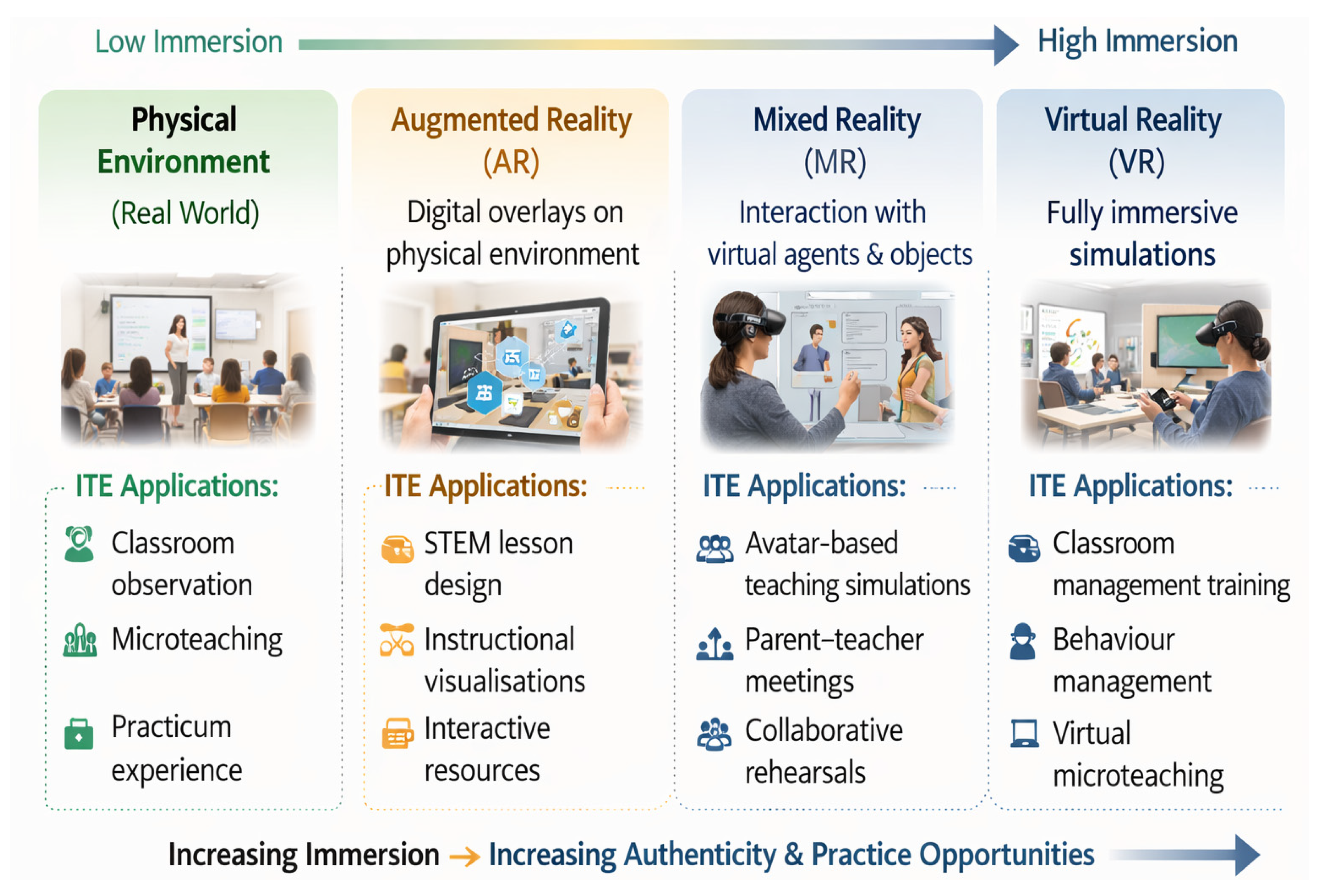
XR technologies are typically conceptualized along the Reality–Virtuality Continuum, which describes a spectrum of environments ranging from fully physical to fully virtual contexts [
10]. Within this continuum (
Figure 1), Augmented Reality overlays digital elements onto physical environments, Mixed Reality enables interaction between virtual and physical objects, and Virtual Reality immerses users within entirely simulated spaces.
In teacher education research, these modalities serve different pedagogical functions (
Figure 1). VR environments are frequently used to simulate classroom interactions and behavioural scenarios, allowing PSTs to practice classroom management strategies in controlled settings [
4,
11]. Such environments can replicate classroom dynamics with varying degrees of fidelity, enabling repeated practice and reflection without the risks associated with real classroom experimentation [
5]. Augmented Reality applications are often employed in subject-specific contexts, particularly in STEM education, where they support the visualization of complex phenomena and facilitate the design of interactive learning activities [
12,
13]. Mixed Reality systems, including avatar-based simulations, have also been used to support professional communication skills and collaborative teaching practices within teacher education programmes [
14,
15].
Figure 1.
The Reality—Virtuality Continuum and its Applications in Initial Teacher Education (adapted from Milgram & Kishino [
10] with pedagogical applications based on Dai et al. [
4], Huang et al. [
6], and Cohen et al. [
15]).
Figure 1.
The Reality—Virtuality Continuum and its Applications in Initial Teacher Education (adapted from Milgram & Kishino [
10] with pedagogical applications based on Dai et al. [
4], Huang et al. [
6], and Cohen et al. [
15]).
These differing technological affordances suggest that XR technologies should not be considered as a single pedagogical intervention. Instead, each modality provides distinct opportunities for supporting teacher learning, depending on the instructional goals and the stage of professional development. The integration of XR technologies into teacher education can be understood through several theoretical perspectives that explain how immersive environments support professional learning.
The Technological Pedagogical Content Knowledge (TPACK) framework provides a useful lens for examining how teachers integrate digital tools into their pedagogical practice. According to TPACK, effective technology-enhanced teaching emerges from the intersection of technological knowledge, pedagogical knowledge, and subject content knowledge [
16]. XR environments may support the development of this integrated knowledge by allowing PSTs to experiment with technology-mediated instructional strategies in simulated teaching contexts [
17]. Another relevant perspective is Embodied Cognition, which suggests that learning processes are influenced by physical interaction with environments [
18]. Immersive technologies may support embodied learning by allowing users to engage with spatially situated scenarios and interact physically with simulated classroom elements. Such interactions can strengthen the connection between conceptual understanding and practical action, particularly in the context of professional skill training [
19]. Teacher learning in XR environments can also be interpreted through the Interconnected Model of Professional Growth [
20], which conceptualizes teacher development as a process involving interactions between external stimuli, classroom practice, personal beliefs, and reflective processes. XR simulations can function as powerful external stimuli by exposing PSTs to realistic teaching situations that trigger cycles of experimentation and reflection. Together, these theoretical perspectives suggest that immersive technologies have the potential to support forms of experiential and reflective learning that are particularly relevant to teacher education.
1.2. Research Gaps in XR Applications for Initial Teacher Education
Several systematic reviews have examined XR in educational contexts, but each carries limitations that leave meaningful gaps. Radianti et al. [
1] reviewed 38 VR applications in higher education and identified positive effects on engagement and perceived learning. Their analysis was restricted to VR and did not address teacher education specifically, nor did it examine pedagogical design features or accessibility. More recently, Burke et al. [
21] reviewed XR use across higher education more broadly, confirming growing adoption. However, they noted that most studies rely on short-term, self-reported outcomes and that evidence for learning transfer remains weak. Lindberg and Jönsson [
22] focused specifically on avatar-based “human-in-the-loop” simulations in teacher and special education. They highlighted that these environments support communication and behaviour management skills; however, their review was limited to a single technological configuration and did not cover VR-based or AI-enhanced simulations, nor accessibility considerations. These reviews do not address ITE as a distinct context, treat XR modalities inconsistently, and say little about how competencies developed in immersive environments are assessed, recognized, or transferred to real classroom practice. While positive outcomes related to engagement and self-efficacy are frequently reported, fewer studies have examined how skills developed in XR environments transfer to authentic classroom practice during teacher practicums [
3,
7]. The present review addresses these gaps directly.
A small number of recent studies suggest that generative AI agents may allow simulations to more closely approximate the variability of real classroom interactions [
23], though the empirical evidence for this remains preliminary and is largely based on pilot or proof-of-concept work. Similarly, multimodal learning analytics, including gaze tracking, speech analysis, and behavioural detection, have been explored as tools for capturing instructional behaviour in simulated contexts, but their integration into formal teacher education assessment or credentialing systems remains limited and largely untested [
23].
This review does not simply add to the accumulation of studies on XR in education; it responds to a specific epistemological need. The existing literature has produced a fragmented body of evidence in which findings are difficult to compare across modalities, contexts, and outcome measures. Individual empirical studies, however well-designed, cannot on their own resolve questions about patterns, tensions, or evidence quality across the field. A systematic review is therefore methodologically justified as an analytical act that: (i) makes the structure of the evidence base visible, (ii) identifies where claims are well-supported and where they are not, and (iii) distinguishes between findings that hold across multiple high-quality studies and those that rest on exploratory or methodologically limited work. The 2016–2026 timeframe is also analytically motivated. It captures a decade in which XR moved from a largely experimental technology to an increasingly institutionalized component of teacher preparation. Also, during this decade the emergence of AI-enhanced simulations began to shift the field toward new pedagogical questions that prior reviews were not designed to address. The contribution of this review is therefore synthetic and critical, as it offers an evidence-mapped account of what is known, what is contested, and what remains genuinely open. The review addresses the following research questions:
What learning outcomes for pre-service teachers have been reported in studies using XR technologies in teacher education?
What instructional design features characterize XR-based learning experiences in ITE programmes?
What accessibility and inclusion strategies are implemented in XR environments used for teacher training?
How are competencies developed through XR-supported learning experiences assessed and recognized within higher education?
To what extent do XR learning experiences support the transfer of pedagogical skills from university settings to classroom practice?
2. Methodology
This study adopts a systematic literature review methodology to synthesize empirical research examining the use of XR technologies in ITE. The review was conducted and reported in accordance with the PRISMA 2020 guidelines [
24,
25], which provide a standardized framework for the identification, screening, eligibility assessment, and inclusion of relevant studies [
25]. The use of PRISMA enables transparency in reporting the search strategy and study selection process while facilitating replicability of the review.
The objective of the review is to examine how XR technologies—specifically VR, AR, and MR—have been integrated into university-based teacher education programmes between 2016 and 2026. Particular attention is given to the pedagogical design of XR learning environments, the competencies developed by PSTs, and the accessibility and assessment practices associated with immersive training environments. Given the methodological diversity of the literature in this field, which includes experimental studies, qualitative case studies, mixed-method research, and design-based studies, a narrative synthesis approach was adopted. This approach is commonly employed in systematic reviews within educational technology research where studies differ in methodological design, context, and outcome measures [
1].
2.1. Eligibility Criteria and Search Strategy
The eligibility criteria were developed using the PICOS framework (Population, Intervention, Comparison, Outcomes, and Study design), which is widely applied in systematic review methodologies to define the scope of included studies [
25]. The population of interest consisted of pre-service teachers enrolled in ITE programmes offered by higher education institutions. Studies focusing exclusively on in-service teachers participating in professional development initiatives were excluded, unless the intervention was clearly embedded within a university-based teacher education course or practicum. With regard to the intervention, studies were included if they examined the use of XR technologies, including VR, AR, MR, or hybrid XR environments incorporating intelligent agents or artificial intelligence components. Studies focusing on non-immersive digital simulations or conventional digital learning environments without XR elements were excluded. The review considered studies that investigated learning outcomes associated with XR-based teacher training. Relevant outcomes included the development of classroom management skills, pedagogical reasoning, instructional design competencies, teacher self-efficacy, technology integration abilities, and inclusive teaching practices. These outcomes reflect competencies commonly emphasized within contemporary teacher education frameworks such as TPACK [
16]. A comparison group was not required for inclusion because many XR studies employ exploratory or qualitative research designs. However, studies that compared XR environments with traditional instructional approaches—such as video-based training, role-playing activities, or lecture-based instruction—were included when available. The review included empirical studies employing quantitative, qualitative, or mixed-method methodologies. Conference proceedings and doctoral dissertations were also considered when they reported original empirical findings relevant to teacher education contexts. Systematic reviews, theoretical papers, and policy reports were excluded from the primary dataset but were used to contextualize the discussion of findings. To capture recent developments in immersive technologies, filters were applied to restrict results to publications between 2016 and 2026 and to English-language sources.
The literature search was conducted in January 2026, across three major academic databases that provide comprehensive coverage of research in education and educational technology: Scopus, Web of Science, and ERIC. These databases were selected because they index a broad range of peer-reviewed journals and conference proceedings relevant to teacher education and digital learning. To complement database searches and reduce the risk of publication bias, additional sources of grey literature (such as dissertations, conference proceedings, and citation tracking) were also considered. These included targeted searches in Google Scholar, reference list screening of relevant articles, and the identification of doctoral dissertations and conference papers reporting empirical studies on XR in teacher education. This multi-source search strategy aimed to ensure comprehensive coverage of the existing literature while capturing studies that may not yet be indexed in major databases. Formal statistical assessment of reporting bias was not conducted due to the absence of meta-analysis and the heterogeneity of study designs.
The search strategy was designed to identify studies examining XR technologies within the context of teacher education. Keywords were developed around three main conceptual clusters: (1) XR technologies, (2) teacher education, and (3) higher education contexts. Search terms included variations of extended reality, virtual reality, augmented reality, and mixed reality, combined with terms such as pre-service teacher, initial teacher education, teacher education programme, and teacher training. These terms were further combined with context-related keywords including higher education, university, and practicum. Boolean operators and truncation were used to construct the search queries. The full search strings adapted for each database are presented below (Equations (1)–(3)).
2.2. Selection Process and Quality Appraisal
The selection process followed the stages outlined in the PRISMA framework [
24,
25]. After importing all retrieved records into the Zotero reference management system, duplicate entries were automatically identified and manually verified before removal. The remaining records were screened in two sequential stages. In the first stage, titles and abstracts were reviewed to assess their relevance to the research scope. Screening focused on identifying studies that examined the use of XR technologies within university-based teacher education contexts. Articles that clearly addressed unrelated populations (e.g., K–12 students without a teacher education component), non-XR technologies, or non-empirical publications were excluded at this stage. In the second stage, full-text articles were retrieved and evaluated against the predefined eligibility criteria. Full-text screening ensured that each study explicitly involved pre-service teachers enrolled in ITE programmes and reported empirical findings related to the use of XR technologies in teacher preparation contexts. To increase methodological transparency and reduce selection bias, the screening process was conducted independently by the two authors. Titles and abstracts were first screened for relevance, followed by full-text assessment of potentially eligible studies. Inter-rater agreement was high at both screening stages, with disagreements arising in a small number of borderline cases. These concerned studies where the population (e.g., mixed pre-service and in-service samples) or the intervention scope (e.g., partially XR-integrated courses) did not clearly meet the inclusion criteria. Discrepancies were resolved through a structured discussion process in which both authors revisited the eligibility criteria, examined the relevant study sections, and reached consensus before proceeding to the next screening stage. No studies remained disputed after this process.
For each included study, relevant information was extracted using a structured data extraction protocol developed specifically for this review. The extraction framework was designed to capture both descriptive characteristics of the studies and analytical dimensions related to XR-based teacher education practices. The extracted variables included:
Bibliographic information (authors, year, publication type);
Geographic context of the study;
Participant characteristics (sample size and teacher education stage);
XR modality employed (VR, AR, MR, or hybrid XR environments);
Pedagogical context (e.g., classroom simulation, microteaching, practicum preparation);
Instructional design features of the XR environment;
Learning outcomes related to teacher competencies;
Accessibility and inclusion strategies;
Assessment approaches used to evaluate PST performance.
To support the analytical coding process, the extracted data were imported into ATLAS.ti (version 25), a qualitative data analysis software widely used in systematic reviews and thematic synthesis. ATLAS.ti enabled the organization, categorization, and coding of textual data from the included studies. The coding process followed an iterative thematic analysis approach, combining both deductive and inductive coding strategies. Initial deductive codes were derived directly from the five research questions and the conceptual framework, producing a preliminary codebook organised around six main categories: XR modality, pedagogical context, instructional design features, teacher competencies, accessibility practices, and assessment mechanisms. This codebook was developed collaboratively by the two authors prior to coding and served as the primary reference for analytical consistency throughout the process. Coding was conducted independently by both authors on a subset of studies (n = 8) to establish initial alignment, followed by a joint review meeting in which discrepancies were examined, category definitions were refined, and the codebook was updated accordingly. The remaining studies were then coded individually, with a further alignment meeting held at the midpoint of the process to ensure interpretive consistency. Inductive codes that emerged from the data and fell outside the initial deductive framework, such as patterns related to agentic AI integration and cross-modal orchestration, were discussed and integrated into the coding structure where they appeared consistently across multiple studies. The final coding scheme and category definitions are documented in
Table 1. All analytical decisions were recorded within ATLAS.ti to ensure interpretive traceability across the coding process. Initial deductive codes were derived from the review objectives and the conceptual framework of teacher education research, including categories such as pedagogical competencies, XR design features, accessibility practices, and assessment mechanisms. During the coding process, additional inductive codes emerged from the data, allowing the identification of recurring themes and patterns across studies. Coding was conducted in multiple rounds to refine category definitions and ensure consistency in the interpretation of the extracted data.
Because accessibility was a central focus of the review, specific attention was given to identifying design practices aligned with Universal Design for Learning (UDL) principles. Studies were examined for explicit references to accessibility features within XR environments, including adaptive interaction modes, alternative navigation systems, captioning or audio descriptions, and sensory adjustments aimed at supporting diverse users. In addition, studies that used XR simulations to prepare PSTs for teaching students with special educational needs were also coded separately. This distinction allowed the review to differentiate between XR used as a tool for teaching inclusive pedagogy and XR systems designed to be accessible to teacher candidates themselves.
The methodological quality of the included studies was assessed using the Mixed Methods Appraisal Tool (MMAT), a validated instrument designed to evaluate the rigor of qualitative, quantitative, and mixed-method studies within systematic reviews [
26]. Each study was assessed according to the MMAT criteria relevant to its research design, covering the clarity of research questions, the adequacy of data collection methods, the appropriateness of analytical procedures, and the coherence between research design and reported findings. Quality appraisal was conducted independently by both authors, and any discrepancies were resolved through discussion until consensus was reached. The results of the quality appraisal (
Section 3.4) were not used to exclude studies but to explicitly weight the interpretation of findings: conclusions drawn from High and Moderate–High quality studies are treated as more robust, while findings from Moderate and Low–Moderate quality studies are interpreted with greater caution and noted as exploratory or preliminary. No standardized effect measures (e.g., risk ratios or mean differences) were defined, as given the methodological heterogeneity of the included studies—including experimental designs, qualitative case studies, mixed-method research, and design-based studies—a meta-analysis was not feasible. Instead, a narrative synthesis approach was adopted to integrate the findings. Additionally, no subgroup or sensitivity analyses were conducted due to the heterogeneity of the included studies and the absence of comparable quantitative effect measures.
The synthesis process followed three analytical steps. The data extracted were organized according to the major analytical categories defined in the coding framework. This allowed the identification of patterns in how XR technologies are implemented within teacher education programmes. Moreover, thematic relationships were examined across studies to identify recurring pedagogical approaches, instructional design features, and reported learning outcomes associated with XR-based teacher training. Finally, the findings were synthesized into a structured evidence map that categorizes the included studies according to XR modality, pedagogical context, and competency outcomes. Evidence mapping was used to visualize the distribution of research across different technological configurations and training contexts.
This combined approach of thematic coding and evidence mapping enabled the identification of emerging research trends as well as gaps in the current literature on XR applications in ITE.
3. Results
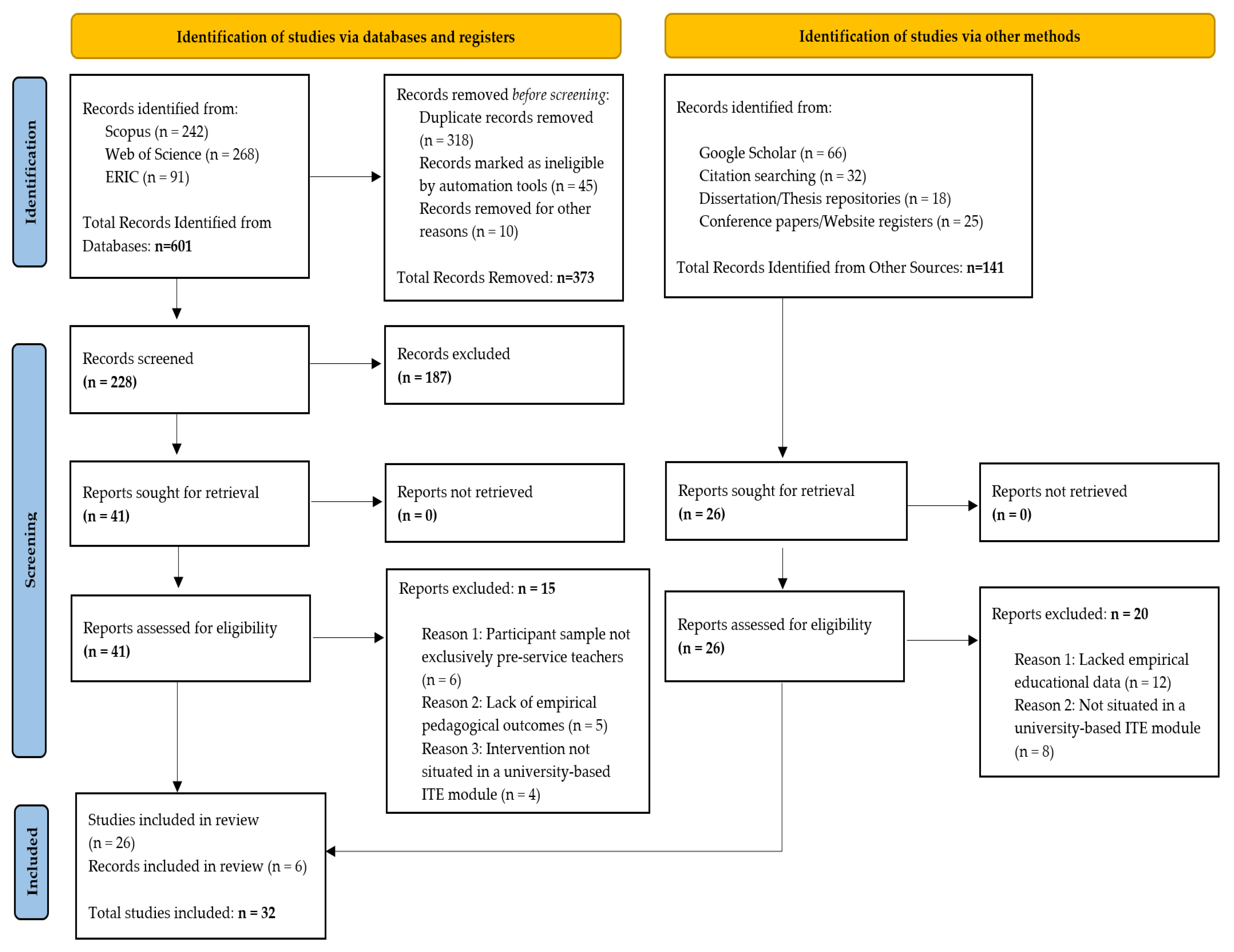
The systematic search across the three primary academic databases identified a total of 601 records. Specifically, 242 records were retrieved from Scopus, 268 records from Web of Science, and 91 records from ERIC. These databases were selected due to their broad coverage of research in education, educational technology, and higher education pedagogy. Prior to screening, records were processed within the Zotero reference management system to remove duplicate and ineligible entries. A total of 373 records were removed at this stage, including 318 duplicate records, 45 records marked as ineligible through automated filtering procedures, and 10 records removed for other reasons such as incomplete metadata or inaccessible sources. After this initial filtering stage, 228 records remained for title and abstract screening.
During the screening stage, 187 records were excluded because they did not meet the eligibility criteria defined in
Section 2.1. The main reasons for exclusion included studies that did not examine XR technologies, studies conducted outside teacher education contexts, or publications that did not report empirical educational data. Following title and abstract screening, 41 reports were retrieved for full-text assessment. All identified reports were successfully retrieved, and therefore no records were excluded due to retrieval failure. During the full-text eligibility assessment, 15 reports were excluded based on the predefined inclusion criteria. The primary reasons for exclusion were: (i) the participant sample did not consist exclusively of pre-service teachers (n = 6), (ii) the study lacked clearly defined empirical pedagogical outcomes (n = 5), or (iii) the intervention was not situated within a university-based ITE module (n = 4). After this process, 26 studies identified through database searches met the inclusion criteria and were retained for the systematic review.
To complement the database search and reduce potential publication bias, additional studies were identified through other search strategies. These additional methods identified 141 records, consisting of 66 records from Google Scholar, 32 records from citation searching, 18 records from dissertation repositories, and 25 records from conference proceedings or project websites. From these sources, 25 reports were retrieved for full-text screening. All reports were successfully accessed and assessed. During eligibility evaluation, 20 reports were excluded, primarily because they lacked empirical educational data (n = 12) or were not situated within university-based teacher education contexts (n = 8). As a result, 6 additional studies were included in the review dataset.
To sum up, the systematic review includes 32 empirical studies, representing the final dataset used for the evidence synthesis. The complete study identification and screening process is illustrated in
Figure 2, which presents the PRISMA flow diagram [
24,
25].
3.1. Characteristics of Included Studies
Table 2 presents an overview of the 32 empirical studies included in this review, summarizing their geographic contexts, participant samples, research designs, XR modalities, pedagogical implementations, and reported learning outcomes. The studies span a ten-year period between 2016 and 2026 and reflect the gradual integration of immersive technologies within university-based teacher education programmes.
3.1.1. Geographic Distribution of Studies
The geographic distribution of the studies reveals a clear concentration of research activity in North America and Europe. The United States accounts for the largest proportion of studies (n = 13; 40.6%), reflecting the strong presence of simulation-based teacher training initiatives and platforms like TeachLivE and simSchool in American teacher education programs [
3,
15,
29]. European countries collectively represent a significant share of the literature (n = 11; 34.4%), particularly Germany (n = 4; 12.5%), the Netherlands (n = 4; 12.5%), Denmark (n = 1; 3.1%), Greece (n = 1; 3.1%), and Spain (n = 1; 3.1%), where immersive classroom simulation platforms have been widely implemented for teacher training and research purposes. Additional studies originate from a highly diverse range of global contexts. These include Australia, China, Indonesia, Ireland, New Zealand, Rwanda, and Türkiye, as well as a multi-national collaboration across Uzbekistan, Vietnam, and Kyrgyzstan (all with n = 1; 3.1%). Although these contributions are fewer in number, they suggest the increasing internationalization of XR-based teacher education research, indicating that immersive technologies are gradually being adopted in a broader range of educational systems, beyond the traditionally dominant English-speaking regions. This distribution highlights the continued dominance of research conducted in technologically advanced higher education systems while also indicating the emergence of meaningful XR experimentation in developing and transitional educational contexts.
3.1.2. Research Design Distribution
The methodological approaches used in the reviewed studies demonstrate a diverse and evolving research landscape, characterized by a shift toward capturing the complexity of teacher identity and performance. Of the 32 studies included in the review:
Quantitative studies: 10 (31.3%);
Qualitative studies: 7 (21.9%);
Mixed-method studies: 15 (46.9%).
Quantitative studies typically employ experimental or quasi-experimental designs that measure changes in variables such as teacher self-efficacy, classroom management competence, or learning performance following immersive training interventions (e.g., [
5,
6]). These studies frequently use pre-test/post-test designs and statistical analysis to evaluate the impact of XR-based learning environments. Qualitative studies, in contrast, often explore the experiential dimensions of immersive simulations, focusing on how pre-service teachers interpret and reflect upon their simulated teaching experiences [
3,
43]. Such studies typically rely on interviews, reflective journals, or observational data to analyse participants’ perceptions and learning processes. Mixed-method studies represent the largest methodological category in the dataset. These studies combine quantitative measures with qualitative data sources to capture both the measurable outcomes and the experiential aspects of XR-supported learning environments [
8,
26]. The prevalence of mixed-method designs reflects the complex and multifaceted nature of immersive learning environments, where both behavioural outcomes and reflective processes are important for understanding teacher development.
3.1.3. XR Modality Distribution
The analysis of XR modalities indicates a strong predominance of fully immersive Virtual Reality, though there is a significant shift toward cross-modal and AI-enhanced configurations. Across the dataset:
Virtual Reality (VR): 20 studies (62.5%);
Mixed Reality (MR): 3 studies (9.4%);
Augmented Reality (AR): 1 study (3.1%);
Hybrid/AI-Enhanced & Cross-Modal (XR): 8 studies (25.0%).
Fully immersive virtual reality (VR) constitutes the dominant technological modality used in teacher education contexts. Most interventions employ VR environments designed to simulate classroom scenarios, allowing pre-service teachers to interact with virtual students or practice teaching strategies in controlled settings. Such environments frequently aim to replicate common classroom challenges, so that teacher candidates can experiment with different pedagogical responses without the risks associated with real classroom settings [
5,
11].
Mixed Reality (MR) simulations represent a second major category of XR applications within the dataset. These systems typically combine physical interaction with avatar-based virtual students, often mediated by a human facilitator who controls the behaviour of simulated learners. MR environments have been widely used in teacher education programmes to support coaching and professional communication training [
15,
35]. In such settings, the simulation environment allows teacher candidates to engage in realistic teaching dialogues while receiving immediate feedback from instructors or peers.
Augmented Reality (AR) applications appear less frequently within the literature and are typically associated with subject-specific teacher education contexts. For example, AR environments have been employed to support STEM instruction by enabling teacher candidates to visualize complex scientific phenomena or design interactive learning activities for their future classrooms [
39]. Compared with VR-based simulations, AR interventions tend to emphasize content representation and instructional design rather than behavioural classroom management.
The most recent studies (2024–2026) highlight the emergence of Agentic AI within Hybrid XR environments. In these systems, such as TeacherGen@i, Generative AI-powered student agents provide unscripted, adaptive responses that challenge a PST’s improvisational decision-making. These advanced configurations allow for cross-modal orchestration, sequencing structured tasks (e.g., eBooks) with fully immersive simulations to manage cognitive load in early teacher preparation [
26]. Although such systems remain relatively rare in the current literature, they signal a broader shift toward more sophisticated simulation environments that aim to capture the complexity and unpredictability of real classroom interactions.
3.1.4. Sample Size Distribution
Participant samples vary substantially across the 32 reviewed studies, reflecting a diverse landscape of research designs and implementation stages. Sample sizes range from small exploratory qualitative studies involving fewer than 10 participants—such as the intrinsic case study of one exemplary teacher by Han and Patterson [
28], the evaluation of three undergraduate majors by Fairchild [
30], and the exploratory study of eight postgraduate students in Rwanda [
46]—to large-scale investigations including more than 100 pre-service teachers, exemplified by Huang et al. [
6] (N = 141), Cherner et al. [
40] (N = 113), and Jacobsen et al. [
8] (N = 150).
The majority of studies involve sample sizes between 20 and 80 participants, aligning with typical cohort sizes within university-based teacher education programmes. Representative examples of this distribution include: Lugrin et al. [
11] (N = 54), Meivawati and Meiliza [
42] (N = 60), Hu et al. [
5] (N = 57), Al Shorman [
39] (N = 59), and Parong and Mayer [
19] (N = 78).
Smaller sample sizes are more common in qualitative or design-based research studies, which often focus on in-depth analysis of learning experiences within pilot XR interventions, such as the qualitative evaluation of 21 participants by Mouw et al. [
27] or the exploratory qualitative design involving 21 PSTs by Dittrich et al. [
31]. In contrast, quantitative and comparative studies tend to utilize larger samples to ensure statistical power for identifying the effectiveness of immersive interventions.
This variation in sample sizes illustrates the exploratory stage of XR integration within teacher education, where pilot implementations and experimental prototypes coexist alongside more structured empirical investigations. The high cost of equipment and computational resources often necessitates smaller, convenience-based samples, which can limit the generalizability of findings.
3.1.5. Pedagogical Contexts and Instructional Design Features
The pedagogical contexts in which XR technologies are implemented vary across teacher education programmes but generally, fall into three main categories: classroom management training, microteaching and instructional practice, and technology-enhanced curriculum design. The largest body of studies focuses on the use of immersive simulations for classroom management training. Systems such as ClassMaster [
5], simSchool [
3], and Breaking Bad Behaviors [
7,
11] allow pre-service teachers to practice responding to challenging student behaviours, such as disruptions, disengagement, or classroom conflict. In many cases, the simulations are designed as scenario-based learning environments in which participants select and implement appropriate management strategies while interacting with virtual students. Such simulations often include structured reflection activities following the immersive experience, enabling teacher candidates to analyse their decisions and consider alternative approaches [
3,
7].
A second group of studies examines the use of XR technologies within microteaching and simulated practicum experiences [
7,
8,
29,
35,
42,
44,
45]. In these contexts, immersive environments provide opportunities for teacher candidates to rehearse instructional practices, deliver short lessons, or participate in peer-feedback activities. VR-based microteaching environments are particularly useful when access to real classrooms is limited, allowing teacher education programmes to provide structured practice opportunities that complement traditional practicum placements [
8]. These environments often integrate video recording or peer observation tools that facilitate reflective discussion among teacher candidates.
A smaller but growing body of research investigates XR technologies as tools for instructional design and curriculum development within teacher education programmes. In these studies, teacher candidates engage directly in the design of XR-supported learning activities or digital games, thereby developing competencies related to technology integration and digital pedagogy [
17]. Such approaches emphasize the role of XR as a creative platform for designing innovative learning experiences, rather than only as a training environment.
Across these contexts, recurring instructional design principles are grounded in Experiential Learning Theory and Situated Cognition. The VISION framework [
35] illustrates a typical three-stage sequence: (1) Observation of 360° classroom videos to build situational awareness; (2) Creation of virtual manipulatives to understand content structures; and (3) Interactive Immersion for behavior management rehearsal. Finally, recent evidence [
41,
47] highlights a shift toward “accessibility-by-design,” integrating UDL strategies such as multimodal representation (e.g., haptic feedback, captions) and configurable interaction modes to ensure that the training platforms themselves are inclusive to all teacher candidates. These design elements align closely with experiential learning approaches that emphasize practice, feedback, and reflection as key mechanisms for professional development.
3.1.6. Learning Outcomes and Competency Development
The learning outcomes reported across the 32 reviewed studies indicate that XR-supported training can contribute to several dimensions of teacher professional development, encompassing cognitive, affective, and behavioral growth. Among the most frequently examined outcomes are classroom management competence, teacher self-efficacy, and instructional decision-making.
Classroom management skills represent the most widely investigated competency within the literature, addressing a primary driver of early-career teacher attrition. Numerous studies report improvements in participants’ confidence and perceived preparedness to address disruptive behaviours following immersive simulation experiences [
5,
6]. Research using the ClassMaster system [
5] found that while both video-based training and VR improve immediate competence, fully immersive VR leads to significantly higher long-term knowledge retention, as evidenced by delayed test performance. In these environments, teacher candidates can repeatedly practice classroom management strategies and observe the consequences of their actions within a “safe-failure” simulated environment. More specialized investigations [
30,
35] demonstrate that 360° virtual reality videos can successfully train pre-service teachers (PSTs) to implement trial-based functional behavioral analysis, with participants reaching 100% procedural fidelity. Furthermore, recent advancements [
9,
45] have shifted the focus toward equitable classroom management, prompting PSTs to recognize personal biases and rethink discipline practices during digital clinical simulations. Such repeated exposure appears to support the development of procedural knowledge related to classroom interaction and behaviour regulation.
Several studies also examine the impact of XR environments on teacher self-efficacy, particularly with respect to managing complex classroom situations. Immersive simulations can provide teacher candidates with opportunities to rehearse teaching actions before entering real classrooms [
19]. In the context of STEM teacher education [
39], engaging with AR-based activities (e.g., GeoGebra AR) led to substantial enhancements in both technological and subject-specific self-efficacy, as PSTs transitioned from being activated technologists to confident practitioners. Quantitative modeling further reveals that Perceived Ease of Use (PEOU) is a powerful predictor of pedagogical development, with technology acceptance accounting for 82.8% of the variance in pedagogical competence [
42].
Beyond behavioral and affective gains, XR technologies support higher-order pedagogical reasoning and reflective practice. Advanced simulations like TeacherGen@i [
26] utilize Generative AI to provide adaptive, unscripted student agents, challenging PSTs to engage in real-time pedagogical reasoning and differentiated instruction. Furthermore, VR-based microteaching activities enable teacher candidates to review recorded simulation sessions and discuss their instructional decisions with peers or instructors [
8]. Such reflective practices align with models of teacher professional growth that emphasize the importance of iterative cycles of action and reflection [
20].
3.1.7. Accessibility and Inclusive Design
Despite the increasing use of XR technologies in teacher education, explicit attention to accessibility and inclusive design remains limited within the reviewed literature. Only a small number of studies report specific design features intended to support diverse learners or reduce potential barriers associated with immersive technologies [
41,
45,
47]. Some studies describe technical adjustments intended to improve usability, such as simplified user interfaces or adaptive visual settings, and the use of high-contrast markers to ensure robust tracking [
41]. These features can facilitate the participation of individuals with varying levels of digital literacy or sensory preferences, particularly in rural or resource-limited contexts where providing equitable access to high-quality simulations is a critical factor in shaping teacher quality. Similarly, certain XR environments incorporate captioning or audio-based guidance systems designed to support users who may experience difficulties with standard immersive interfaces [
26]. To further minimize fine-motor demands, systems such as the Solar System Experience (SSE) utilize gaze-triggered dwell activation and teleportation, which accommodate young learners or candidates with limited motor coordination [
47]. Additionally, the inclusion of audio narration overlays and adjustable textual elements has been highlighted as a strategy to support diverse learning profiles within a “low-friction design” framework [
41].
In other cases, XR technologies are employed not only as accessible tools but as training environments for inclusive pedagogy. Simulations such as those developed by Mavrides Calderon and Gordon [
45] prompt pre-service teachers to practice equitable classroom management and reflect on personal biases during digital clinical simulations. Similarly, programs like AutismXR [
41] expose teacher candidates to scenarios involving students with diverse learning needs, allowing them to rehearse de-escalation strategies and de-center their perspectives within a “safe-failure” environment.
Nevertheless, a significant gap persists between the accessibility features described in a small number of studies and the broader pattern of the reviewed literature, in which most studies either do not report accessibility considerations or address them only in passing. It would be premature to characterise accessibility-by-design as an established trend within the field; the evidence currently supports only the conclusion that isolated examples of accessible XR design exist, and that they have not yet been systematically adopted or evaluated within ITE contexts.
3.2. Assessment and Higher Education Recognition
Assessment practices represent a critical dimension of XR-supported teacher education, as they determine how competencies developed within immersive simulations are evaluated and formally recognized within higher education programmes. Across the reviewed studies, assessment approaches varied substantially, reflecting differences in both research design and institutional integration of XR technologies. Most studies relied on formative assessment strategies designed to capture changes in teacher competencies during or immediately after immersive learning experiences. These assessments frequently involved validated survey instruments measuring constructs such as teacher self-efficacy, perceived preparedness, or technology acceptance [
6,
40]. In experimental studies, pre-test/post-test designs were commonly used to measure changes in participants’ confidence or pedagogical reasoning following XR interventions [
5,
19]. Although such approaches provide valuable insights into perceived learning gains, they often rely on self-reported data.
Several studies incorporated performance-based assessment mechanisms, particularly in simulation-based training environments. In these cases, teacher candidates’ actions within the immersive environment were evaluated using structured observation protocols or instructional rubrics aligned with teacher competency frameworks. For example, VR classroom simulations allowed instructors to evaluate how participants responded to disruptive behaviours, managed student engagement, or implemented pedagogical strategies in real time [
7,
11]. Such approaches provide a more authentic measure of teaching competence by focusing on observable pedagogical actions.
Another frequently used strategy involves peer-feedback and reflective evaluation, particularly in XR-supported microteaching environments. In these contexts, simulation sessions are often recorded and subsequently analysed during reflective discussions among teacher candidates. Studies such as Jacobsen et al. [
8] demonstrate how VR-based microteaching environments can facilitate structured peer feedback, enabling participants to examine their instructional decisions and reflect on alternative pedagogical approaches. This reflective dimension is consistent with established models of teacher professional development that emphasize iterative cycles of action and reflection [
20].
Despite the variety of assessment approaches observed, relatively few studies report formal mechanisms for recognizing XR-based competencies within higher education curricula. In most cases, immersive simulations function as learning activities embedded within existing courses rather than as independently assessed modules or credential-bearing experiences. Consequently, competencies developed within XR environments are typically evaluated indirectly through course participation or reflective assignments instead of dedicated certification frameworks. A small number of studies explore the potential integration of XR training with learning analytics systems, where data generated within immersive environments can be used to evaluate instructional decision-making [
26]. However, such approaches remain experimental and are not yet widely integrated into formal teacher education assessment practices. The limited adoption of analytics-based assessment suggests that the potential of XR technologies to generate detailed performance data has not yet been fully realized within teacher preparation programmes.
To sum up, the findings indicate that while XR environments are increasingly used to support experiential learning in teacher education, their integration into formal assessment and recognition frameworks remains relatively limited. Future research may therefore benefit from exploring how immersive simulations can be aligned with competency-based assessment models and digital credentialing systems within higher education.
3.3. Practicum Transfer and Classroom Enactment
A central question in the integration of XR technologies within teacher education concerns the extent to which competencies developed in simulated environments transfer to authentic classroom practice. While immersive simulations offer opportunities for repeated practice and experimentation, the ultimate objective of teacher preparation programmes is to ensure that such learning experiences translate into effective teaching during practicum placements and professional practice. Across the 32 reviewed studies, XR environments are most frequently positioned as pre-practicum preparation tools, enabling teacher candidates to rehearse pedagogical strategies and build professional identity before entering real classrooms. Classroom management simulations are particularly prominent in this regard. By exposing pre-service teachers to disruptive classroom scenarios within a controlled environment, VR simulations allow participants to experiment with different behavioural management strategies without the risks associated with real classroom interactions [
5,
11].
Several studies report that immersive simulations can improve pre-service teachers’ perceived readiness for classroom teaching. Participants often report increased confidence in their ability to manage classroom situations or respond to unexpected student behaviour after engaging in XR-based training experiences [
6]. Mouw and Fokkens-Bruinsma [
33] reported that pre-service teachers who practiced in a VR kindergarten classroom felt the experience directly supported their mastery of strategies and helped them manage behaviors during their real-world internships. Supporting this, Meivawati and Meiliza [
42] found that immersive simulations are effective for bridging the gap between theoretical instruction and classroom practice. Furthermore, the work of Landon-Hays et al. [
29] and Lee et al. [
44] suggests that these technologies allow candidates to rehearse specific instructional sub-dimensions, thereby strengthening their professional identity before they enter authentic educational environments.
The empirical evidence concerning actual transfer of XR-supported learning into real classroom practice remains limited. Only a small number of studies explicitly examine how competencies developed in immersive environments influence teacher behaviour during subsequent practicum experiences, with most research designs focusing on short-term learning outcomes or engagement immediately following the intervention. Some studies provide indirect evidence that immersive simulations may support the development of professional noticing and pedagogical reasoning, competencies that are essential for effective classroom enactment. For example, VR microteaching environments allow teacher candidates to review recordings of their simulated teaching sessions and reflect on their instructional decisions [
8]. Such reflective analysis, often supported by instructor or peer feedback, contributes to the development of “professional vision”—the ability to recognize and interpret significant classroom events in real time. Advanced systems like TeacherGen@i [
26] further this by using multimodal analytics to make “black-box” pedagogical reasoning visible through traceable data logs and gaze patterns.
In addition, several authors emphasize that XR environments can function as bridging tools between theoretical coursework and practicum experiences. Simulations can provide opportunities to apply pedagogical theories introduced in university courses to realistic teaching scenarios, thereby strengthening the connection between conceptual knowledge and practical teaching skills [
29]. This bridging function may be particularly valuable in teacher education programmes where access to real classroom practice is limited or highly variable. Despite the potential benefits, researchers highlight limitations associated with the transfer of simulation-based learning to real classroom environments. Simulated classrooms, even when highly immersive, cannot fully reproduce the complexity, unpredictability, and social dynamics of authentic educational settings. As a result, immersive simulations should be understood not as replacements for practicum experiences but as complementary tools that support early-stage professional development.
The findings across the 32 included studies reveal not only consistent patterns but also meaningful tensions that complicate straightforward conclusions about XR in ITE. First, there is a recurring contradiction between reported outcome gains and the methodological conditions under which those gains were measured. Several studies report improvements in classroom management competence or self-efficacy, yet the majority rely on self-report instruments administered immediately after the intervention, without follow-up or comparison against control conditions. This makes it difficult to determine whether observed gains reflect durable learning or a transient engagement effect associated with the novelty of immersive technology. Second, findings on the relative effectiveness of different XR modalities are inconsistent. Hu et al. [
5] and Huang et al. [
6] report that fully immersive VR outperforms video-based instruction on selected outcome measures, while other studies find no statistically significant differences between modalities, suggesting that pedagogical design may matter more than technological sophistication. Third, the evidence base is uneven in quality. High and Moderate–High quality studies tend to involve larger samples, more rigorous designs, and clearer outcome definitions, and their findings are broadly consistent with the patterns described above. However, five studies rated as Moderate or Low–Moderate quality (including Docter and van der Vossen [
38], Arkabaev et al. [
41], and Grassetti [
36]), report findings that are less replicable and more exploratory in nature, and should be interpreted accordingly. Fourth, the accessibility dimension stands in sharp contrast to the other findings: while most sections of this review can draw on converging evidence across multiple studies, the accessibility evidence rests on only three studies that address it explicitly [
41,
45,
47], which significantly limits the generalisability of any conclusions in this domain. These tensions do not undermine the overall findings of the review, but they indicate that the field is still in a formative stage where heterogeneity of evidence is the norm rather than the exception.
3.4. Risk of Bias in Included Studies
The methodological quality of the included studies was assessed using the MMAT. Study-level appraisal results are presented in
Table 3. Of the 32 included studies, 7 (21.9%) were rated as High quality, 16 (50.0%) as Moderate–High, 6 (18.8%) as Moderate, and 5 (15.6%) as Low–Moderate. No formal statistical assessment of reporting bias was conducted. However, the inclusion of grey literature aimed to mitigate potential publication bias. The most common sources of methodological limitation were small or convenience-based samples, reliance on self-reported outcome measures, and limited integration between qualitative and quantitative components in mixed-method designs. Quantitative studies generally employed appropriate measurement and statistical procedures, although many relied on self-reported outcomes. Qualitative studies were coherent in design and interpretation but often involved small, context-specific samples. Mixed-method studies varied in the extent to which qualitative and quantitative components were integrated. These quality ratings are reflected in the interpretation of findings throughout the results and discussion sections: conclusions drawn from High and Moderate–High quality studies are treated as more robust, while findings from Moderate and Low–Moderate quality studies are noted as exploratory or preliminary.
4. Discussion
The present systematic review set out to examine how XR technologies have been used in ITE between 2016 and 2026, with particular attention to learning outcomes, instructional design features, accessibility, assessment and recognition, and transfer to classroom practice. The 32 studies included in the review suggest that XR has moved beyond its earlier role as a novel or exploratory technology and is increasingly being positioned as a pedagogically purposeful component of university-based teacher education. At the same time, the review also reveals important tensions in the field. While the literature demonstrates encouraging results in areas such as classroom management, self-efficacy, and reflective practice, the evidence remains uneven in relation to accessibility, formal recognition within higher education, and the actual transfer of learning from simulations to practicum and classroom enactment.
Viewed as a whole, this review makes three contributions to the emerging literature on XR in teacher education. First, it narrows the focus specifically to ITE in higher education contexts, thereby distinguishing itself from broader reviews of XR in education or teacher professional development [
1,
21,
22]. Second, it brings together strands of literature that are often treated separately—classroom management, microteaching, accessibility, AI-enhanced simulation, and practicum preparation—into a common analytical frame. Third, it highlights an important shift in the field: from asking whether XR is engaging or innovative to asking how, for whom, and under what conditions it becomes pedagogically meaningful.
4.1. Learning Outcomes for Pre-Service Teachers
With regard to the first research question, the findings indicate that XR-supported interventions are most consistently associated with gains in classroom management competence, teacher self-efficacy, pedagogical reasoning, and, to a lesser extent, technology integration skills. Most of the reviewed studies used immersive environments specifically to simulate classroom interaction, behavioural complexity, or instructional decision-making under pressure, which means that these outcomes were also the most likely to be observed and measured [
5,
6,
7,
8,
11,
27].
The strongest cluster of evidence concerns classroom management. Across multiple studies, immersive simulations enabled pre-service teachers to rehearse responses to disruption, disengagement, and classroom tension in conditions that were sufficiently realistic to trigger decision-making, but sufficiently safe to allow repetition and error without real-world consequences [
5,
6,
11]. This is an important contribution, particularly in the context of teacher education, where classroom management is frequently reported as one of the areas in which beginning teachers feel the least prepared [
3]. The reviewed studies therefore suggest that XR environments may help address a persistent structural limitation of university-based teacher preparation: the limited number of opportunities available for repeated, low-risk practice prior to practicum.
The most methodologically robust evidence in this area comes from studies rated High or Moderate–High in the MMAT appraisal [
5,
6,
7,
11], which employed pre-registered designs, larger samples, or validated assessment instruments. Findings from Moderate-rated studies in this cluster [
27,
29] are broadly consistent with these patterns but should be interpreted with greater caution given smaller samples and less rigorous outcome measurement.
At the same time, the findings should not be overstated. Many of the reported gains concern perceived preparedness, confidence, or simulation-based performance, rather than demonstrated competence in real classrooms. In other words, the evidence is strongest for what XR appears to help teacher candidates do within and immediately around the simulation, and less robust when it comes to establishing lasting effects on actual classroom practice. This distinction matters, because it cautions against equating immersive success with professional readiness. What the literature shows most clearly is that XR can support the developmental conditions for learning to teach, but not yet that it can replace the situated, relational, and unpredictable nature of live practice.
4.2. Instructional Design Features of XR Learning in ITE
The second research question concerned the instructional design features that characterize XR-based learning experiences in teacher education. Here, the review suggests that the effectiveness of XR interventions depends far less on the technology itself than on the pedagogical architecture built around it. Across the reviewed studies, the most productive implementations were not simply immersive; they were structured, scaffolded, and reflective. Three design patterns appeared repeatedly: (i) many interventions relied on scenario-based learning, particularly in classroom management and conflict-oriented contexts [
4,
5,
7,
43]—these scenarios were effective because they translated abstract pedagogical concepts into situated decision points; (ii) several studies integrated reflection and debriefing immediately after the immersive activity, allowing participants to revisit their decisions, discuss alternatives, and connect the experience with broader pedagogical principles [
3,
8,
29]; (iii) in microteaching and practicum-adjacent contexts, XR was often most valuable when paired with peer feedback, facilitator guidance, or video-supported review, rather than when used as a stand-alone immersive activity [
8,
33,
42].
These findings are consistent with the theoretical framing set out earlier in the paper. From a TPACK perspective, XR becomes educationally meaningful only when technological affordances are aligned with pedagogical purpose and content-specific intentions [
16]. From the perspective of embodied cognition and professional growth, the key issue is not simply whether learners are immersed, but whether immersion is coupled with opportunities for action, feedback, and interpretation [
18,
19,
20]. In this sense, the review suggests that XR is pedagogically strongest when it is treated not as content delivery, but as a practice space.
A further development, evident mainly in the most recent studies, is the move toward AI-enhanced and agentic simulation environments [
23,
26,
38]. These studies suggest a shift from scripted simulations toward more adaptive environments in which virtual students can respond dynamically to teacher actions. Conceptually, this shift is notable because it raises questions about ecological validity and improvisational pedagogical reasoning that scripted simulations cannot easily address. Whether it represents a genuine improvement in learning outcomes, however, remains an open empirical question. This strand of the literature remains relatively new, and the current evidence base is not yet large enough to support strong claims about its superiority over more traditional simulation models. It is also worth noting that the studies in this strand are among the more methodologically limited in the corpus: Docter et al. [
38] is explicitly positioned as a proof-of-concept pilot, and Rashid [
23] is an unpublished thesis. The conceptual importance of agentic AI simulations should therefore be distinguished from the current strength of the empirical evidence, which remains preliminary.
4.3. Accessibility and Inclusive Design
The third research question focused on accessibility and inclusion. This was one of the areas in which the review identified the clearest gap between stated pedagogical ambitions and actual implementation practices. A recurring pattern in the literature is that XR is often used to teach pre-service teachers about inclusive pedagogy, yet comparatively little attention is given to whether the XR systems themselves are inclusive by design [
41,
45,
47]. Some studies did identify meaningful accessibility features, including captioning, audio guidance, simplified interfaces, adaptive settings, and low-friction interaction designs [
26,
41,
47]. These examples are important because they show that accessibility is neither technically impossible nor pedagogically marginal. They also suggest that accessibility can be treated not as a remedial add-on, but as a design principle shaping how immersive learning environments are experienced from the outset.
However, the broader pattern remains one of underreporting and underdevelopment. In many studies, accessibility is either absent from the design description or reduced to a general statement about inclusivity without technical or pedagogical specification. This is particularly striking given that immersive environments can create distinct barriers related to motion, vision, audio processing, cognitive load, and interaction demands. As a result, the review confirms the existence of a double gap: a gap between XR’s promise as a tool for inclusive teacher education and the actual accessibility of the environments used and a gap between general discussions of inclusion and concrete implementation of UDL-aligned design principles. This is one of the strongest implications of the review. If XR is to become a serious component of teacher education rather than a specialized enrichment tool, future work will need to move toward accessibility-by-design, with explicit reporting of the interaction, sensory, and navigational choices that shape participation in immersive learning.
4.4. Assessment and Higher Education Recognition
The fourth research question asked how competencies developed through XR-supported learning are assessed and recognized within higher education. The results suggest that this is an area of conceptual interest but limited institutional maturity. The gap between assessment and recognition is not simply a technical or administrative problem; it reflects a deeper tension between the competency-based ambitions of XR-enhanced teacher education and the credential structures of higher education institutions, which have not yet developed the frameworks needed to formally validate simulation-derived learning. Assessment is present in most studies, but recognition is much less developed. Most studies assessed XR experiences through self-report measures, pre- and post-intervention surveys, reflective journals, or performance observations [
5,
6,
40]. These approaches are useful for identifying changes in confidence, usability, and perceived learning, and some studies moved further by employing observation protocols or performance-oriented criteria within the simulation itself [
7,
11]. In microteaching contexts, peer feedback also played a meaningful role in supporting formative assessment [
8].
Yet there is a clear difference between evaluating an intervention for research purposes and embedding XR-derived evidence into official higher education assessment structures. The latter remains rare. Few studies describe XR activities as formally graded components of a teacher education course, and even fewer show how competencies developed in immersive environments are translated into recognizable curricular outcomes, badges, or micro-credentials. This is notable given the increasing interest in competency-based higher education, authentic assessment, and digital credentialing across the broader educational landscape.
The recent emergence of AI-enhanced simulations and multimodal analytics adds an additional layer to this issue [
23,
26]. On the one hand, such systems create the possibility of capturing more nuanced forms of performance evidence, including interaction patterns, discourse features, and moment-to-moment instructional responses. On the other hand, the review shows that these capacities are not yet systematically integrated into institutional assessment frameworks. In this sense, the field appears to be technologically ahead of its assessment practices. At the same time, the studies reporting on analytics-enhanced assessment [
23,
26,
38] are among the newer and less consolidated in the corpus. Their findings point to genuinely interesting possibilities, but the evidence for their practical implementation within formal higher education structures is still at an early stage.
4.5. Practicum Transfer and Classroom Enactment
The fifth research question concerned transfer from simulated learning to real classroom practice. This is also the area where the gap between what simulations can do and what real teaching requires is most exposed. It is also the area where the literature remains most cautious. The reviewed studies provide reasonably consistent evidence that XR can support pre-practicum readiness, reduce anxiety, and strengthen participants’ sense of preparedness for classroom teaching [
6,
29,
33,
42,
44]. For teacher educators, this matters. The transition from coursework to practicum is often characterized by uncertainty, uneven mentoring, and limited opportunities for rehearsal. In this respect, XR simulations appear to function as a form of intermediate pedagogical space: not yet the classroom, but no longer purely theoretical. However, the evidence for actual transfer into classroom enactment is still limited. Only a relatively small number of studies followed participants into practicum or made direct claims about the impact of XR-trained competencies on real teaching performance. More commonly, studies inferred transfer from increased confidence, improved simulation performance, or participant reflections about readiness. These findings are still valuable, but they are not equivalent to longitudinal evidence of enacted classroom competence.
Several of the studies reporting the most positive transfer-adjacent outcomes are also among those with more limited methodological scope, short single-institution interventions using self-report measures [
33,
42,
44]. This does not invalidate their findings, but it does mean that the evidence for transfer should be read as preliminary rather than consolidated.
This distinction points to a broader issue in the field: immersive environments can reproduce selected dimensions of classroom life, but they do not reproduce the full social, emotional, institutional, and relational complexity of authentic teaching. The real classroom is not simply more dynamic than the simulation; it is differently structured, involving sustained relationships, institutional expectations, embodied co-presence, and unpredictability that exceeds even well-designed virtual scenarios. For that reason, the review supports the view that XR should be understood as a bridge to practicum, not a substitute for it. At the same time, some recent studies point toward more adaptive environments, reflective replay tools, and analytics-enhanced simulations as potential supports for professional noticing, situated judgment, and reflective enactment [
8,
26]. Whether these developments translate into measurable gains in classroom readiness, however, remains to be established through more rigorous longitudinal research. The challenge for future research is to demonstrate more clearly how these capacities carry over into actual practicum performance over time.
4.6. Limitations of the Evidence Base
Given the absence of formal certainty grading, the strength of evidence should be interpreted cautiously, particularly in relation to long-term outcomes and transfer to classroom practice. The conclusions of this review should be interpreted in light of several limitations within the underlying evidence base. The first relates to the literature which is methodologically heterogeneous, comprising experimental, qualitative, mixed-method, conference-based, and dissertation studies. While this diversity provides a broad picture of the field, it also limits direct comparability across studies. Outcomes are measured differently, interventions vary substantially in duration and purpose, and some studies report detailed pedagogical findings while others focus more heavily on perceptions or technology acceptance.
Another limitation relates to the fact that many studies rely on small or context-specific samples, especially in qualitative, pilot, or design-based research. This is understandable given the resource demands of XR implementation, but it restricts the generalizability of findings. Even in larger studies, the use of convenience samples within single institutions is common. Additionally, the evidence base remains geographically concentrated, with a strong predominance of work conducted in the United States and selected European contexts. This means that the current literature may reflect the assumptions, infrastructures, and institutional possibilities of relatively well-resourced higher education systems more than the global reality of teacher education.
Moreover, the literature remains stronger on immediate or perceived outcomes than on longitudinal professional development. In particular, evidence for transfer into practicum and early career teaching remains limited. This makes it difficult to determine whether XR-supported gains are durable, cumulative, or contextually transferable over time. Finally, accessibility reporting is uneven, and in many cases minimal. As a result, it is difficult to assess whether the reviewed interventions were inclusive by design or simply silent on accessibility issues.
It is also important to note that accessibility in XR extends well beyond interface-level accommodations such as captions or simplified controls. Deeper structural barriers include the physical and cognitive demands of head-mounted displays, motion sickness and vestibular responses that disproportionately affect certain users, the sensory overwhelm that immersive environments can produce for neurodivergent learners, and the economic barriers associated with accessing the necessary hardware outside institutional settings. None of the reviewed studies engaged systematically with these dimensions, which suggests that the field’s understanding of accessibility remains largely surface-level.
Beyond these empirical limitations, the evidence base as a whole reflects a degree of techno-optimism that deserves scrutiny. The majority of included studies were conducted by researchers with an invested interest in demonstrating the value of XR technologies, and publication bias likely favours positive results. Several studies do not control for the novelty effect (the tendency for any new technology to produce short-term engagement and performance gains that diminish as familiarity increases), which means that some reported benefits may not persist beyond initial exposure. The increasing integration of AI-enhanced simulations and multimodal analytics also raises concerns about datafication. For example, the collection and algorithmic processing of granular behavioural data from pre-service teachers during simulated teaching raises questions about surveillance, consent, and the reduction of complex pedagogical judgement to measurable performance indicators. Institutional sustainability is a further concern that the literature largely overlooks. High-quality XR infrastructure requires significant financial investment, technical maintenance, and staff expertise, and there is limited evidence that institutions have moved beyond pilot projects toward sustainable programmatic integration. Finally, the epistemological assumptions embedded in some simulations (e.g., that teaching competence can be decomposed into discrete, trainable behaviours) deserve scrutiny, as they risk reinforcing reductive models of teacher professionalism that the broader teacher education literature has long critiqued.
This is particularly acute in AI-driven simulation environments, where the algorithmic profiling of teaching behaviour may construct normative models of “good teaching” that reflect the biases embedded in the training data and design choices of the system rather than the pedagogical values of the institution or the professional community. Pre-service teachers operating in such systems may be assessed against an implicit model of teaching competence that is technically constructed rather than professionally negotiated.
Related to this is the question of institutional inequality. The geographic and resource concentration of the reviewed literature (predominantly well-funded universities in North America and Western Europe) raises legitimate concerns about who benefits from XR-enhanced teacher education and who does not. Institutions in under-resourced contexts, both within and across countries, may lack the hardware, technical infrastructure, or staff capacity to implement XR in any meaningful way. If access to immersive teacher preparation is conditioned on institutional wealth, XR risks deepening rather than reducing existing inequalities in teacher education quality. Technological dependency is a further concern that deserves more critical attention than the literature currently gives it. Several reviewed studies were built around commercial simulation platforms whose long-term availability, pricing, and institutional control cannot be assumed. When a teacher education programme’s practicum preparation depends on a proprietary XR system, the curriculum becomes vulnerable to platform discontinuation, licensing changes, or vendor decisions that lie entirely outside institutional control.
4.7. Limitations of the Review Process
This review also has limitations related to its own design and execution. First, the search was restricted to publications in English, which may have excluded relevant research published in other languages, particularly from regions where immersive technologies in teacher education are emerging but not widely indexed in Anglophone databases. Second, although the review employed a multi-source strategy including Scopus, Web of Science, ERIC, Google Scholar, dissertation repositories, and conference sources, it remains possible that some relevant studies were not retrieved, especially those published in local conference proceedings, institutional repositories, or non-indexed journals.
Third, the review focused specifically on pre-service teachers in university-based ITE programmes. This decision strengthened conceptual clarity, but it also meant excluding some adjacent literature on in-service professional development, school-based innovation, or K–12 XR initiatives that may still offer relevant pedagogical insights. Fourth, because the studies differed substantially in design, outcomes, and reporting conventions, meta-analysis was not feasible. The review therefore relies on narrative synthesis and evidence mapping, which are appropriate for heterogeneous studies but also involve interpretive decisions in coding and thematic grouping.
Finally, although the screening and coding procedures were conducted systematically and independently by the two authors, thematic synthesis inevitably involves a degree of analytic judgment, particularly when categorizing studies that sit at the boundary between modalities, pedagogical purposes, or competency domains.
5. Conclusions
This systematic review examined the use of XR technologies in ITE between 2016 and 2026, focusing on learning outcomes, instructional design features, accessibility and inclusion, assessment and higher education recognition, and the transfer of learning to classroom practice. The findings show that XR has begun to establish a presence within university-based teacher education, though the evidence base remains uneven and the field is still in a largely exploratory stage. Across the reviewed studies, immersive environments were used most frequently to support classroom management training, microteaching, reflective practice, and selected forms of technology-enhanced instructional design.
The review suggests that XR-supported learning shows promise for contributing to several dimensions of pre-service teacher development, though most evidence is based on self-reported outcomes, short intervention periods, and small or context-specific samples [
3,
4,
5,
6,
7,
8,
11,
27,
29]. This includes findings from the five studies rated Moderate or Low–Moderate in the MMAT appraisal [
19,
20,
36,
38,
46], which contribute useful exploratory perspectives but do not carry the same evidential weight as the 23 studies rated High or Moderate–High. These benefits appear strongest when immersive technologies are embedded in carefully designed pedagogical sequences that include structured scenarios, guided reflection, peer or instructor feedback, and explicit connections to coursework [
3,
4,
8,
29,
33]. In this sense, the pedagogical value of XR does not lie in immersion alone, but in the way immersive environments are orchestrated as spaces for rehearsal, interpretation, and feedback. At the same time, the review also demonstrates that the field has not yet reached the level of maturity sometimes implied in more optimistic discussions of immersive learning. Important gaps remain. Accessibility is still inconsistently addressed, formal recognition of XR-based competencies within higher education assessment systems is limited, and evidence for transfer to practicum and authentic classroom enactment remains comparatively weak [
23,
26,
41,
45,
47]. Much of the current literature documents immediate or perceived gains, but fewer studies provide longitudinal or ecologically grounded evidence of how these gains shape actual teaching practice over time.
Even with these limitations, the review suggests that XR can play a strategically important role in teacher preparation. It appears particularly valuable as a bridge space between theory and practicum, allowing teacher candidates to rehearse responses to complex situations before encountering them in live classrooms. It also provides teacher education programmes with more consistent and repeatable practice environments, which is especially important when access to classroom placements is limited or uneven [
9,
29,
42,
44]. The findings support a balanced conclusion: XR should neither be treated as a pedagogical novelty nor as a replacement for practicum, but as a potentially powerful component of a broader teacher education ecology. Its greatest contribution lies in expanding the range of structured, reflective, and practice-oriented learning experiences available to pre-service teachers in higher education. The transformative potential of XR in teacher education remains a hypothesis rather than a demonstrated outcome, and realising it will depend as much on institutional commitment, pedagogical design, and equitable access as on technological capability.
6. Future Directions
The next phase of research on XR in ITE should move beyond proof-of-concept studies and toward more programmatically integrated, longitudinal, and pedagogically explicit investigations. Based on the evidence synthesized in this review, several priorities emerge. Future studies should place greater emphasis on longitudinal designs that follow pre-service teachers beyond the immediate intervention period and into practicum or early professional practice. This is essential if the field is to move from claims about perceived readiness to stronger evidence about enacted competence and durable professional learning. Research that connects immersive training with classroom observation, supervisor evaluations, or repeated practicum data would significantly strengthen the evidence base.
There is also a need for more work on assessment and formal recognition. If XR is to become a sustained component of teacher education rather than an enrichment activity, the competencies developed in these environments need to be more clearly aligned with course outcomes, assessment frameworks, and institutional recognition systems. Future research could therefore explore how simulation-derived evidence, peer-feedback data, performance rubrics, or analytics outputs might be incorporated into course assessment, portfolios, micro-credentials, or digital badges [
23,
26]. These are promising directions, but it should be noted that the current evidence for such integration is limited to conceptual proposals and early-stage implementations rather than sustained institutional practice.
Accessibility and inclusive design should become a more central design and research priority. Future XR interventions should report accessibility features more systematically and align more explicitly with frameworks such as Universal Design for Learning. This includes not only training teacher candidates for inclusive teaching, but also ensuring that immersive systems themselves are usable and meaningful for candidates with diverse sensory, cognitive, linguistic, and physical needs [
41,
45,
47]. Greater transparency in reporting accessibility design decisions would be a significant step forward for the field.
Recently, the emergence of AI-enhanced and agentic XR systems merits careful study. Generative AI and large language model-based agents introduce new possibilities for adaptive simulation, conversational interaction, and multimodal performance feedback [
23,
26]. However, they also raise important pedagogical and ethical questions. Future studies should examine not only whether these systems increase realism, but also how they shape teacher candidates’ decision-making, cognitive load, interpretive skills, and professional judgment. In parallel, attention should be given to issues of data privacy, transparency, bias, and the responsible use of learning analytics.
Future work would benefit from greater geographic and contextual diversity. The literature remains concentrated in a relatively small number of higher education systems, especially in the United States and parts of Europe. Studies from a wider range of educational contexts would improve the ecological validity of the field and help identify how XR can be adapted to different infrastructures, teacher education traditions, and resource conditions.
There is a need for more research that treats XR not simply as a technology, but as part of a pedagogical design ecosystem. This means examining how immersive simulations interact with mentoring, coursework, reflection, peer learning, practicum supervision, and institutional policy. The most promising future work is likely to be that which situates XR within coherent teacher education models rather than studying it as an isolated intervention. In summary, the future of XR in ITE depends less on increasingly sophisticated hardware and more on the development of pedagogically grounded, accessible, assessable, and context-sensitive models of implementation. The challenge ahead is to make immersive learning more educationally meaningful.