Article

Educating in the Age of GenAI: Exploring AI Literacy Through Mutual Reinforcement in Higher Education


1
Teaching and Learning Centre Science, Faculty Science, University of Amsterdam, 1000GG Amsterdam, The Netherlands
2
Informatics Institute, Faculty Science, University of Amsterdam, 1000GG Amsterdam, The Netherlands
3
Centre for Teaching and Learning, Free University, 1081HV Amsterdam, The Netherlands
4
Educational Service Centre, Faculty Science, University of Amsterdam, 1000GG Amsterdam, The Netherlands
*
Author to whom correspondence should be addressed.
Trends High. Educ. 2026, 5(2), 47; https://doi.org/10.3390/higheredu5020047
Submission received: 15 March 2026 / Revised: 21 May 2026 / Accepted: 26 May 2026 / Published: 30 May 2026

Abstract

Generative AI (GenAI) is transforming higher education, prompting institutions to rethink pedagogical practices, governance, and learning experiences. This study addresses this shift by (i) synthesizing recent literature on GenAI in education, (ii) proposing a four-quadrant AI literacy framework that distinguishes between learning about AI and learning with AI for both students and lecturers, and (iii) conducting an exploratory evaluation of 19 course-embedded pilots (2024–2025), including an in-depth case study. The pilots aimed to explore the educational potential of GenAI within existing curricular structures, with emphasis on the perceived value of GenAI, ethical considerations, and usability. Conducted in a privacy-preserving Azure environment with opt-in participation and non-AI alternatives, data were collected via student (n = 184) and lecturer (n = 42) surveys and focus groups. Students reported perceived benefits, including improved understanding (54%), added course value (67%), and positive attitudes toward GenAI (66% across different cohorts). However, they also expressed concerns about hallucinations, loss of authentic voice, and over-reliance. Lecturers indicated that GenAI enabled a shift from routine feedback to higher-order coaching, with purpose-built custom GPTs improving alignment with intended learning outcomes, though these required didactic and technical support. The study suggests a potential mutual reinforcement between lecturers’ and students’ AI literacy. Lecturers’ growing familiarity with GenAI appeared to improve student experiences by providing clearer parameters and more aligned assessments. The proposed framework offers preliminary guidance for curriculum design, lecturer development, and governance, emphasizing responsible, equitable, and pedagogically aligned GenAI integration.

1. Introduction

The integration of artificial intelligence (AI), particularly generative AI (GenAI), has disrupted conventions in higher education. Its impact spans pedagogical practices, institutional governance, and teaching and student learning experiences [1,2,3]. While a growing body of literature addresses the opportunities and risks of GenAI, less attention has been paid to how these insights translate into coherent educational design choices at course and program level.
This paper addresses that gap by proposing a framework for AI literacy that supports the integration of GenAI into teaching and learning. The framework distinguishes between learning about AI and learning with AI and considers the roles of both students and lecturers in shaping meaningful educational use. Rather than offering a comprehensive competency model, it focuses on how these distinctions can inform curriculum design, assessment practices, and pedagogical decision-making.
The framework was developed in close interaction with a faculty-wide series of GenAI pilots (2024–2025), in which 19 courses explored different forms of AI integration. The empirical material is used to identify how GenAI-supported interventions are implemented and experienced in practice.

1.1. Theoretical Background

Context and scope. The transformation that GenAI brings to higher education unfolds within broader shifts toward digitalization, personalized learning, and the imperative to manage increasing faculty workloads with limited resources [1,2,3,4]. Outside higher education, AI algorithms and educational robots have already become integral to learning management and training systems, supporting a wide range of activities [3]. An example is Khan Academy’s Khanmigo for personalized tutoring and intelligent feedback [3]. These developments outside academia are now entering higher education and reshape pedagogical practices and student learning experiences [1,2,3]. For clarity, we use “GenAI” to denote large language models (LLMs) that generate text, code, images, or feedback for educational use.
Ethics, equity, and inclusivity. Meaningful use of GenAI emerges when ethics, equity and inclusivity guide its design and use, with explicit attention to access, bias, and context. Key issues include data privacy, security, and algorithmic bias [1,5,6,7,8]. Surveys indicate that a majority of students express concerns about the accuracy and reliability of AI, privacy, and the potential for academic dishonesty if not properly governed [6,9]. Without explicit attention to access, bias, and governance, GenAI risks amplifying existing inequalities [8,10]. Inclusive integration therefore requires more than technical accessibility; it calls for sensitivity to cultural and pedagogical diversity, ensuring that AI tools and practices align with different learners’ backgrounds, disciplines, and values. This, in turn, must be supported by institutional policies that promote fairness, transparency, and accountability in both the design and use of AI in education [2,4,5,9,11].
Human autonomy. A central question is how to balance human and AI agency in the learning process. A central pedagogical consideration is not whether AI replaces or preserves human agency, but how lecturers can consciously calibrate the balance between human and machine agency throughout the learning process. Literature on lecturer agency emphasizes that lecturer autonomy remains anchored in professional judgment, mentorship, and the ethical framing of knowledge [12]. For students, autonomy is developmental rather than absolute. They are still in a learning process. Consequently, lecturers must make deliberate choices about when students should act autonomously and when AI-augmented learning can strengthen that development. In some cases, students must first demonstrate autonomous reasoning (i.e., writing, analyzing, or problem-solving) independently, before engaging with AI. Such delayed scaffolding helps prevent epistemic dependence and fosters deeper understanding [13,14]. Conversely, at other stages, structured AI support can serve as temporary scaffolding that enables safe experimentation and feedback [10]. Over time, this scaffolding can be gradually removed as students gain self-regulation, critical reasoning, and ethical discernment. Thus, autonomy in AI-supported education should be understood as a dynamic continuum of responsible agency—sometimes preceding, sometimes following AI engagement—cultivated through intentional instructional design [10,13].

1.2. Learning About AI & Learning with AI

Against this backdrop, GenAI occupies a dual role in higher education: it functions both as an instrument for learning and as a learning objective. As an instrument, it supports active, scaffolded learning through low-stakes experimentation, coding practice, personalized feedback, and adaptive support [4,15,16]. At the same time, AI literacy becomes a learning objective, as students (and lecturers) must develop knowledge about AI and meta-AI skills such as prompt engineering and critical output evaluation. Sidorkin’s [10] distinction between temporary and permanent scaffolding clarifies this duality: while AI may initially serve as temporary support that fades as learners gain autonomy, it will also persist as a permanent professional tool [10]. Yet despite this growing ubiquity, readiness remains uneven—only about half of students feel comfortable using AI for academic purposes, and even fewer consider themselves adequately trained [6,9,17].
Instruction should move beyond transmission and recall, instead emphasizing the modeling of balanced human–AI collaboration and the cultivation of discernment, knowing when to trust AI-generated outputs and when to rely on human judgment [8,10]. Learning outcomes, learning activities and assessment require redesigning to evidence these capabilities: for example, transparent workflow documentation, explicit justification of tool choice and prompts, critical evaluation of outputs (including bias and error analysis), and demonstration of autonomous reasoning alongside AI-augmented work. Lecturer roles then also include coaching responsible, critical AI use while protecting the spaces for human autonomy. Likewise, program policies (e.g., data protection, disclosure norms, academic integrity) should be compliant with these pedagogical aims [8,9].

1.3. Framework for AI Literacy

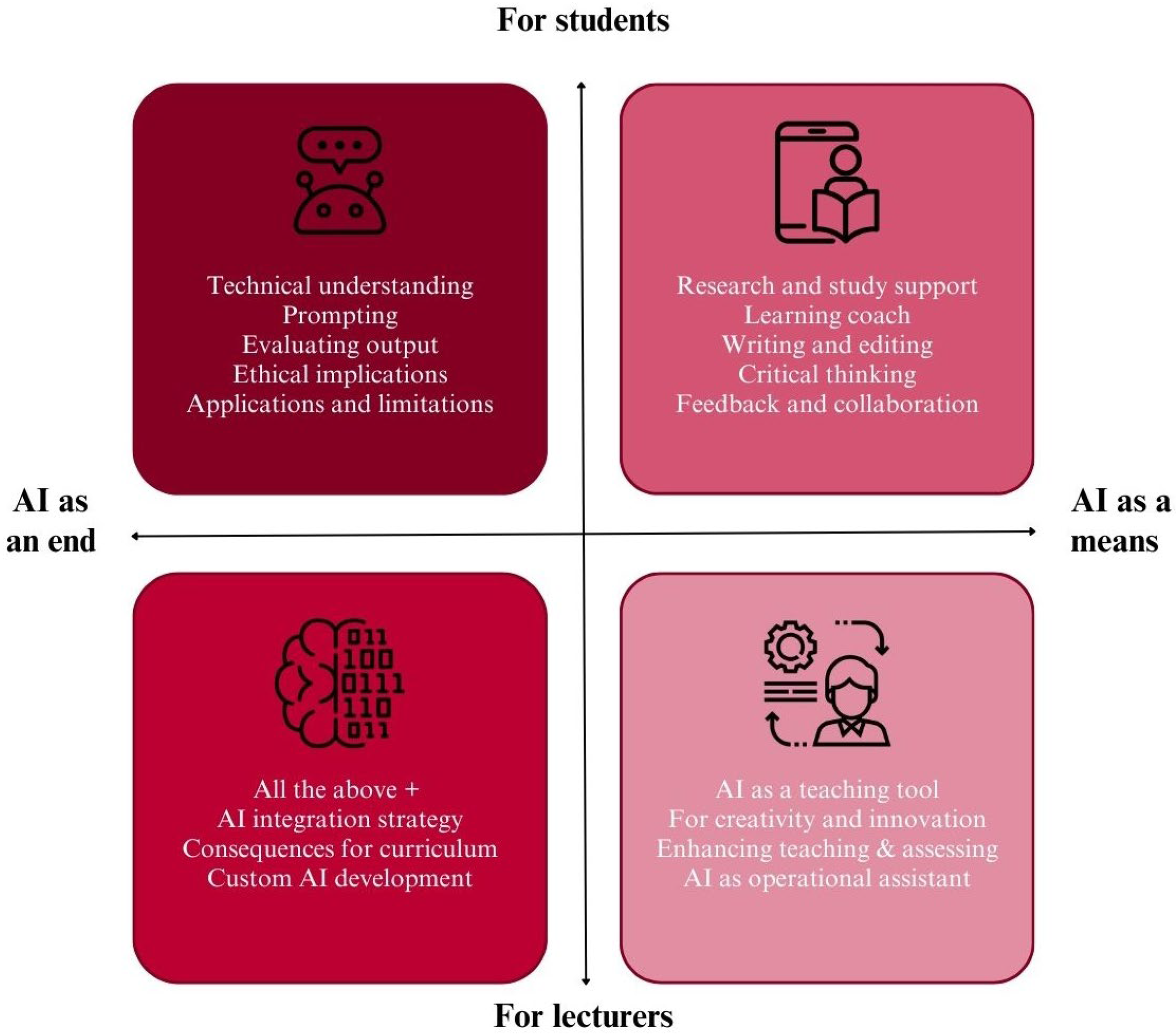
Existing frameworks for AI in education provide an important foundation for understanding how artificial intelligence can be integrated into higher education. For example, UNESCO’s AI competency frameworks articulate the knowledge, skills, and values required for responsible AI use, with a strong emphasis on ethics, human rights, and societal impact [18,19]. The European DigComp framework structures digital competencies across proficiency levels, including elements related to data literacy, problem-solving, and responsible technology use [20]. In higher education, Jisc’s strategic frameworks focus on institutional and organizational responses to AI, addressing governance, policy, assessment integrity, staff development, and leadership considerations [21]. While these frameworks differ in scope and emphasis, they share a common orientation toward defining competencies, principles, and institutional conditions for AI use. At the same time, these approaches offer more limited support for translating such principles into concrete educational design decisions at the level of courses and programs. In practice, educators are required to make situated decisions about when AI use should be encouraged or constrained, how it should be integrated into learning activities, and how it should be reflected in assessment. Building on these observations, a framework for AI literacy was developed within the Teaching & Learning Centre Science (TLC-Science) and the Visible Learning Trajectories Programme at the University of Amsterdam. The framework distinguishes between learning about AI and learning with AI, across both students and lecturers, and operationalizes these distinctions in a four-quadrant model (Figure 1). This model makes explicit how AI use relates to educational design, particularly in terms of pedagogy, assessment, and broader instructional conditions. In doing so, the framework provides a structured way to consider how these elements can be aligned in the context of course and program design.
For students as learners about AI (upper left quadrant), students develop AI literacy comprising conceptual knowledge of model capabilities, limitations, and uncertainty; ethical discernment regarding bias, provenance, privacy, and academic integrity; and operational competence in task formulation, prompt and retrieval design, grounded output evaluation and verification, and transparent disclosure of AI use. Program-, learning trajectory- and course-level intended learning outcomes articulate the expected outcomes regarding AI literacy.
For lecturers as learners about AI (lower left quadrant), professional development in AI literacy builds capability parity with students, conceptual understanding, ethical discernment, and operational competence, and translates into a program-level implementation strategy. This entails principled decisions about when AI use enhances learning, explicit identification of learning outcomes that require student autonomy versus those suitable for AI-augmented work, and anticipation of consequences for assessment design at both course and program levels. Together, these moves strengthen didactic coherence and reduce assessment vulnerability to misuse [10].
For students as users (upper right quadrant), GenAI supports academic and professional learning processes (e.g., writing, programming, argumentation, feedback) enabling practice with higher-order skills through guidance and responsible use.
For lecturers as users (lower right quadrant), AI supports the full teaching cycle: upstream it accelerates content preparation (e.g., drafting materials, exemplars, cases and rubrics); during learning it enables formative feedback timely, personalized and at scale; downstream it assists with assessment design and moderation. Purpose-built Custom GPTs align these functions.
Taken together, the four quadrants provide a coherent pathway to integrate AI responsibly at program level while enhancing pedagogical quality, academic integrity, and equitable access. The framework translates the twin commitments—to human autonomy and to AI-enabled augmentation—into curriculum design principles and professional development aims.
The quadrants are inherently interdependent: without conceptual literacy (left side), the effective and ethical use of AI (right side) remains superficial. Conversely, applied use of AI strengthens conceptual literacy through reflection, experimentation, and feedback. This reciprocity applies to both lecturers and students: as lecturers design and implement AI-enabled assignments, they deepen their own literacy; as students engage in structured AI-supported learning, they build critical awareness of its workings and limits. This reciprocity also operates horizontally between lecturers and students.
In the context of this paper, two quadrants are foregrounded: AI as means for students (upper right) and AI as end for lecturers (lower left). These are mutually constitutive within a continuous feedback loop. As lecturers advance in AI literacy, they refine task design and assessment, moving from substitution toward pedagogical transformation. In turn, students’ interaction data and reflective artefacts (e.g., contribution statements, prompt logs, error patterns, comparative drafts) provide actionable evidence for lecturers, informing responsible tool configuration and task redesign. This iterative loop is sustained by three mechanisms:
  • Design iteration—progressive alignment of learning activities and assessment with higher-order learning outcomes;
  • Risk control—enabling practice with higher-order skills through structured guidance and responsible use that mitigate overreliance and bias;
  • Equity calibration—ensuring secure access, multilingual prompting, and alternative learning routes.
In sum, application of the framework creates a reciprocal learning loop that benefits both educators and students, with iterative design, risk management, and equitable access as key success factors.

1.4. Aim of the Study

This study aims to explore the educational potential of GenAI within existing curricular structures, in diverse settings, with emphasis on ethical, inclusive, and pedagogically aligned applications.
This leads to the research question: What considerations emerge in relation to the use of GenAI in teaching and learning, particularly regarding the perceived value of GenAI, ethical concerns, and usability?

2. Materials and Methods

This exploratory study describes experiences and considerations based on survey and focus group data. It presents findings from a large pilot project with 19 courses. Each pilot combined structured classroom experimentation with structured evaluation by lecturers and students. To illustrate how GenAI-supported learning was experienced in practice, one pilot course was selected for an in-depth case study.
Therefore, the following sections of the paper are divided into 2 parts:
  • Part 1: Pilots in 19 Courses.
  • Part 2: Case Study.

2.1. Part 1: Pilots in 19 Courses

The innovation project under study is a faculty-wide innovation program at the Faculty of Science at the University of Amsterdam, where 19 GenAI pilots were implemented between February 2024 and July 2025.
The project was designed to experiment with GenAI. The privacy office of the faculty gave their approval on the execution of the project to ensure the data safety and privacy of students, lecturers, and university content. In agreement with the faculty policy, the following design conditions were implemented:
  • Data security and privacy protection. All interactions took place in secure cloud environment, the university’s Azure-based AI environment. This privacy-preserving Azure tenant followed institutional policies for data ethics, privacy, and accessibility. Data that was entered was only stored locally and only stored during the use of the interface. As a result, there was no record of the number of lecturers and students using the interface, frequency of use, and content of prompts and chats.
  • Ethical compliance. Each pilot course underwent alignment checks, before it was sent for final approval by the faculty’s privacy officer. The alignment checks regarded data privacy and ethical safeguards; didactic value and constructive alignment; accessibility and inclusiveness; technical feasibility within the university’s Azure-based AI environment.
  • Information and transparency. All participating lecturers were informed about data protection measures before the start of the pilot. Students were informed about the pilot, about data protection measures, and their right to opt out at the start of the pilot course. E-learnings on AI literacy for students and for lecturers were available and shared [22,23]. Student participation was voluntary and comparable non-AI alternative assignments were available. Consequently, GenAI use was not embedded in the learning outcomes of the courses. There was also no permission to adapt the assessment to reflect GenAI-supported learning at the course level.
  • Inclusivity and accessibility. All users had access to the same (latest) ChatGPT-4 data and interface. Non-participation students were offered comparable non-AI alternative assignments.
  • Monitoring and evaluation. The pilots were monitored and evaluated, also on privacy and ethical compliance.
  • Technical implementation. The use of GenAI tools was restricted to the university’s Azure-based AI environment. Technical performance and reliability were continuously monitored and any issues addressed.
Pilot Design. Each pilot was co-developed with educational experts of the Teaching and Learning Centre Science, AI experts from the Faculty of Science, and the course coordinators and lecturers during a structured intake and co-design phase. This process started with an initial needs assessment interview with the program director and course coordinator. Based on the outcomes, the course coordinator, lecturers, educational experts, and AI experts engaged in collaborative design session(s) to create a GenAI-enhanced learning activity. In most pilots, a Custom GPT was co-developed with the course coordinator, equipped with tailored instructions and course documents to ensure it responded to students in a controlled and task-appropriate manner. For example, an AI writing coach gave specific feedback on a research question, such as indicating when a question was not sufficiently testable, rather than rewriting it. In other cases, students used a personal AI assistant during technical projects. This approach allowed lecturers to maintain control of how the tool was used, while integrating GenAI into their course.
Data Collection and Evaluation. Every pilot was evaluated in multiple ways:
  • All students enrolled in a pilot course received a survey midway through and shortly after the course. The survey provided statements on perceived value of GenAI, ethical concerns, and usability. Respondents answered on a five-point Likert scale: either strongly agree—agree—neutral—disagree—strongly disagree, or very positive—fairly positive—neutral—fairly negative—very negative. For every topic, there was an open space for comments.
  • All lecturers involved in the pilot course received a survey shortly after the pilot. The survey again provided statements on perceived value of GenAI, ethical concerns, and usability. Respondents answered on a five-point Likert scale: either strongly agree—agree—neutral—disagree—strongly disagree, or very positive—fairly positive—neutral—fairly negative—very negative. For every topic, there was an open space for comments.
  • Focus group sessions were conducted to complement the survey data and to provide more detailed insight into participants’ experiences with GenAI-supported learning. A structured discussion guide was used to ensure consistency across sessions. Topics aligned with the survey and included perceived learning value, ethical concerns, usability, and experiences with the use of GenAI in teaching and learning. Student focus group sessions were organized at the end of each course. Participants were recruited during one of the final contact hours. Lecturer focus group sessions were conducted shortly after course completion and included lecturers from two or three courses per session. All lecturers involved in the pilots were invited to participate.
Qualitative data from open-ended survey responses and focus group transcripts were analysed using a thematic analysis approach. Author 3 conducted the analysis iteratively: after verbatim transcription, the data were coded within predefined themes (perceived value, ethical concerns, and usability). The coding process was discussed and reviewed with author 1 to challenge interpretations and reduce bias. Quantitative survey data (Likert-scale responses) were analysed descriptively using Excel and triangulated with qualitative findings to contextualise the results.

2.2. Part 2: Case Study

The course Data Futures Lab (DFL) of Amsterdam University College is presented as an example of AI as a means for students (the upper right quadrant of the framework). The case focused on how GenAI was integrated as a learning support and how students engaged with it in relation to argumentation tasks and the exploration of multiple perspectives. The case study is a four-week intensive course which was run in June 2024 and June 2025. The number of students was 20 and 17, respectively. It is offered in year 2 of the bachelor program Liberal Arts and Sciences.
The course content centers on the interaction between technological innovation and societal change, particularly in the context of geostrategic competition. Accordingly, the use of GenAI was relevant both in terms of content and for didactic purposes. One of the primary learning outcomes for DFL was to train students to defend policy positions concerning socio-technical dilemmas. To this end, GenAI was deployed as a debating partner to support practice and strengthen this skill. Specifically, students were offered four different custom-trained Large Language Models (LLMs), each representing distinct ideological perspectives:
  • Neoliberalism;
  • Progressivism;
  • Right wing populism;
  • Social democracy.
The LLMs were configured to represent distinct ideological perspectives, based on a set of predefined dimensions (i.e., conservative versus progressive; globalist versus nationalist; left versus right; idealism versus realism; libertarianism versus authoritarianism; social awareness versus social neutrality). The LLM prompts are available online [24]. Students were then invited to input discussion questions and learn to defend their policy positions from multiple perspectives.
GenAI-supported debate preparation was integrated into the course as a learning activity, allowing students to engage with AI-based debating partners. In this way, GenAI functioned both as a learning support and as a learning objective, as students were expected to use the tool while critically reflecting on its application. Students were required to reflect on their use of GenAI, including through a contribution paragraph in their written assignments. Additional learning objectives focused on engaging with diverse perspectives, critically using GenAI, and developing prompt formulation skills. Ethical considerations were addressed through discussions on bias in AI-generated content, guidance aimed at preventing over-reliance, and the option to disclose LLM interaction logs.
Data Collection and Evaluation. This case study generated data that complemented the broader pilot study with course deliverables (logs of LLM interactions). These materials were used descriptively, solely to illustrate how students engaged with GenAI in relation to argumentation tasks and to provide qualitative context for interpreting the survey findings.

3. Results

3.1. Part 1: Pilots in 19 Courses

The 19 GenAI pilots were implemented across 11 bachelor-level courses and two master-level courses within the Faculty of Science. Seven courses participated in the pilot twice. The pilots target the upper right quadrant of the framework (AI as means for students). Across these courses, 1400 students had access to GenAI-supported learning activities. Informative short videos are available online [24]. Participation was optional in line with faculty-level conditions for the pilots, and alternative assignments were available for students who chose not to use GenAI. As a result, GenAI use was not formally embedded in learning outcomes or assessment. Of the 1400 students it is unknown how many students used GenAI, either within the secure cloud environment as part of the pilot, or other GenAI tools based on personal choice and availability. In addition, it was not possible to determine how many students actively used GenAI, either within the pilot environment or through external tools.
The results presented below focus on how these GenAI-supported interventions were experienced by students and lecturers, based on survey responses and focus group data.

3.1.1. Student Learnings

Of the 1400 students receiving the student questionnaires, 184 students responded (response rate of 13%). The presented results reflect the responses of these participants.
Perceived value of GenAI. Students generally reported positive experiences with GenAI-supported learning. Survey results indicate that:
  • 54% of the 184 students agreed or strongly agreed that GenAI enhanced their understanding of course content;
  • 67% reported that GenAI added value to their course;
  • In 2024 (12 pilots, n = 121), 66% agreed that GenAI contributed to their learning experience;
  • In 2025 (7 pilots, n = 63), 66% reported very or fairly positive attitude about using GenAI for their studies.
Focus group discussions indicate that students used GenAI as a writing and research assistant, as coding aid, debate partner, project partner, and as conceptual clarifier. A recurring theme was the value of immediate, non-judgmental feedback and the ability to explore alternative perspectives, which students described as supporting their understanding of complex topics.
Students described GenAI as supporting learning processes in several ways, including enhanced understanding, immediate feedback, and exposure to diverse perspectives, as well as supporting reflective thinking, helping overcome learning obstacles, and enabling more efficient processing of academic content.
Potential risks included over-reliance, which students feared could undermine deep learning, learning autonomy or authentic voice in their work.
Regarding AI as an end (upper left quadrant of the AI literacy framework), students indicated that using the tools helped them explore the strengths and limitations of GenAI and supported a more critical view of its role in their studies.
Ethical Concerns. In the focus group sessions, the following concerns were expressed:
  • Loss of authentic writing style;
  • Hallucinated content (inaccurate or fabricated information);
  • Over-reliance on GenAI, potentially reducing independent thinking;
  • Diminished deep learning, as surface-level engagement might replace critical analysis;
  • Uncertainty about appropriate use, particularly in relation to assessment and academic integrity.
Students experienced equitable access to GenAI tools through the Azure cloud environment. Non-native English speakers sometimes preferred prompting in their native language, though this raised challenges in evaluating output consistency. Students reported no major technical or digital literacy barriers but emphasized the need for clear guidance and expectations at the start of courses. Structured onboarding and prompt training were seen as key to equitable engagement.
Usability. Students generally experienced GenAI as accessible and easy to use. Reported uses included:
  • Summarizing and structuring ideas;
  • Generating practice questions;
  • Improving academic English;
  • Supporting reflective thinking and overcoming learning obstacles;
  • Enabling efficient processing of academic content.
They valued the speed, adaptability, and diverse perspectives GenAI offered, and indicated this contributed to perceived increased efficiency and engagement in discussions.

3.1.2. Lecturer Learnings

Across 2024 and 2025, 50 lecturers participated in the pilot, with 42 respondents (84% response rate).
Perceived value of GenAI. Lecturers reported that GenAI supported several aspects of teaching practice:
  • Reduced time spent on first-round feedback.
  • Professionalized commentary.
  • Shift in attention toward higher-order aspects of student work (e.g., critical thinking, content depth).
  • Enabled low-threshold formative feedback for students.
  • Supported project planning and enabling more time for content-focused engagement.
  • Control and alignment with course Intended Learning Outcomes (ILOs) through the use of Custom GPTs.
Lecturers also observed stronger critical engagement by students in courses that explicitly incorporated reflection and discussion about GenAI.
Lecturers reported that the integration of GenAI created opportunities for more individualized guidance and deeper interaction with students. Lecturers expressed an increased interest in continued use, with lecturers requesting institutional support for GenAI-integrated assessment design. Moreover, lecturers expressed recognition that meaningful GenAI integration requires curriculum-level consideration, not just course-level implementation. Some lecturers expressed reservations about the use of GenAI in early-stage courses, citing concerns about student dependency.
Ethical Concerns. Lecturers emphasized the need to:
  • Frame GenAI integration from the outset with clear didactic and ethical parameters.
  • Address concerns about accuracy, potential bias, plagiarism, and over-reliance on GenAI tools.
  • Ensure transparency in usage, as highlighted in the broader pilot context.
Usability. Lecturers reported GenAI useful for lightening workload in preliminary feedback (e.g., grammar, structure, coherence), for streamlining draft reviews and rubric alignment and preparing instructional materials (e.g., learning activities, slide planning, prompt-assisted outlines).
At the same time, they reported a learning curve in configuring and maintaining tools, especially when using customized AI applications. Sustained use was seen to depend on the availability of technical and pedagogical support.

3.2. Part 2: Case Study

The case study concerns the Data Futures Lab (DFL), taught at Amsterdam University College in June 2024 and 2025 under the Liberal Arts and Sciences program. The course is used to illustrate how GenAI can function both as a learning support and as a learning objective in a specific educational context. Students engaged with multiple LLM-based agents to support argumentation tasks, while also reflecting on the use, limitations, and potential biases of these tools. Focus group discussions indicate that students actively engaged with LLMs, particularly those representing viewpoints they initially disagreed with. In addition, students reported:
  • That interacting with contrasting perspectives supported a more critical examination of assumptions;
  • Stronger critical engagement with alternative ideologies, as they encountered arguments, they had not previously considered;
  • Developing greater awareness of potential bias in generative AI systems through direct interaction;
  • That using GenAI contributed to their ability to formulate prompts and engage with multiple perspectives;
  • That it contributed to greater political diversity in classroom discussions, counterbalancing the course’s predominantly progressive and left-leaning demographic.
The interactions between students and LLMs provide further illustration of how GenAI was integrated in the course. Box 1 presents selected excerpts from student–LLM exchanges.
Box 1. Examples of student logs in DFL course.
Example 1. Critical Engagement with Ideological Diversity
Students questioned assumptions embedded in the LLM responses. When engaging with the neoliberal LLM on digitization, one student challenged the LLM’s optimism about balancing productivity and well-being. The LLM argued:
“The concern regarding burnout and depression… may be viewed from a perspective of adaptation challenges rather than inherent flaws in digitization and neoliberal policies.”
The student, however, challenged this framing by invoking philosopher Byung-chul Han’s critique of the digital age:
“Information in nature… lacks the stability of time… Thus, this nature of information allows us to not contemplate, act, and thus, not resist. Although digitization seems inevitable, I am still very pessimistic about ever reaching this turning point and golden age.”
This example illustrates how students used external knowledge to critically engage with AI-generated arguments.
Example 2. Synthesizing Multiple Perspectives
Students also compared and contrasted responses from LLMs with differing ideologies to explore contrasting viewpoints. For instance, when discussing universal basic income, the neoliberal LLM emphasized potential risks to work incentives:
“Implementing a universal income could risk undermining the incentives for work and productivity…”
Meanwhile, the progressive LLM framed universal basic income as a tool for economic justice:
“Universal basic income could actually create more entrepreneurs… When people aren’t bound to jobs merely to meet basic needs, they might take more creative risks.”
The student reflected on these contrasting views, noting:
“Version A suggested that a different approach is better and version B said that it’s great and that what the other suggested is worse because of bureaucracy and stigma around receiving aid.”
This illustrates how exposure to multiple perspectives supported more nuanced consideration of the topic.
Example 3. Real-World Application and Skepticism
Students applied real-world observations to critique the LLMs’ theoretical arguments. When the social democracy LLM described how social power could drive industries toward sustainability, one student responded with skepticism:
“I am skeptical as to this AI’s belief that social power has such an impact on industry and financial markets. A lot of the actions that corporations have taken to show their environmental concern is mostly for show, and does not actually change products or industry practices.”
This suggests that students did not rely solely on AI outputs but related them to their own observations and reasoning.
Students mentioned the following applications of GenAI use for written assignments:
  • Editing and improving paper structure
  • Generating counterarguments
  • Brainstorming
  • Translation (particularly for non-native English speakers)
Focus group discussions indicate that students were selective in their use of AI-generated content, often preferring their own formulations over generated text. Students also raised concerns about the broader use of GenAI, including the role of large technology companies and the potential use of AI in assessment. These concerns highlight the importance of transparency and clear boundaries in the use of GenAI within educational settings.

4. Discussion

This exploratory study examined how GenAI-supported interventions are experienced by students and lecturers in higher education, and which considerations arise in their use. Overall, the results indicate that GenAI is generally experienced as a useful addition to teaching and learning, particularly in supporting feedback, structuring ideas, and exploring multiple perspectives. At the same time, these experiences are accompanied by concerns about over-reliance, accuracy, and appropriate use. This suggests that the value of GenAI is not inherent to the technology itself but depends on how its use is structured and framed within educational contexts. Across the findings, lecturer literacy, design choices, and student experiences appear closely connected. The data suggest that clearer structuring of GenAI use by lecturers may contribute to students’ experiences of the learning process. The framework presented in this paper provides a way to articulate these relationships by distinguishing between learning about AI and learning with AI, and by highlighting the roles of both lecturers and students.

4.1. Lecturers’ AI Literacy in Practice

Across the 2024–2025 pilots, lecturers reported that GenAI helped shift effort from first-round, routine feedback to higher-order coaching, such as guiding students in critical thinking and content depth. Custom GPTs were perceived to increase alignment with intended learning outcomes and enable low-threshold feedback. These observed trends may reflect the importance of the lower-left quadrant of our framework (AI as an end for lecturers), where professional development in AI literacy could build capability parity with students. At the same time, lecturers described a learning curve in configuring and maintaining these tools and emphasized the need for pedagogical and technical support. These observations are consistent with Chan’s AI policy education framework that locate lecturer capacity at the center of responsible AI adoption, linking pedagogy, governance, and operations [8]. Our results also align with system-level guidance that argues against “prohibit/detect” approaches and instead calls for structured, supported integration that treats AI as an educational opportunity and requires new competencies for lecturers [10]. Focus group discussions further suggest a potential relationship between lecturer experience with GenAI and the clarity of course design. As lecturers became more familiar with the tools, they appeared to define more explicit parameters for use, which students described as helpful for their engagement. This points to the importance of supporting lecturers in developing AI literacy through practice.
Implication: Investing in practice-based professional development for lecturers, supported by Teaching & Learning Centres, may contribute to sustaining a reinforcing dynamic between lecturer practices and student experiences.

4.2. Conditions for Responsible Integration?

The pilots highlight several conditions that appear relevant for the responsible integration of GenAI. Design choices such as opt-in participation, alternative assignments, disclosure norms, and secure deployment environments were described by participants as supporting transparency and access. At the same time, students and lecturers consistently raised concerns related to bias, accuracy, over-reliance, and unclear expectations. These concerns suggest that clear guidance at the start of a course, as well as alignment between learning activities and assessment, is important for effective use. While these findings are based on a specific institutional context, they resonate with broader literature emphasizing the role of governance, data protection, and equitable access in AI adoption [2,4,5]. Literature highlights how socio-economic and ethical factors constrain equitable AI uptake [7]. Within the pilots, availability, secure access and opt-out options were implemented to address these considerations. Together, they indicate that responsible integration involves a combination of course-level design choices and institutional support structures.
Implication: formalizing governance (decision rights, roles) and policy (guidelines, procedures), requiring course-level disclosure norms, and resourcing privacy-preserving deployments could support inclusive access.

4.3. Perceived Value of GenAI Integration

Survey data indicate that students generally perceive GenAI as valuable for their learning, particularly in supporting understanding, providing feedback, and enabling the exploration of multiple perspectives. These findings are consistent with existing studies that highlight the potential of AI as a scaffolded learning support.
The case study provides a more detailed illustration of how GenAI can be used in this way. Students described how interacting with ideologically diverse LLMs encouraged them to engage with alternative viewpoints and reflect on their own positions. The examples presented in this study illustrate how students critically engage with AI-generated outputs, rather than adopting them uncritically. This is compatible with reviews and meta-analyses showing positive learning effects (e.g., in language achievement) when AI is embedded as a scaffolded learning partner with explicit reflection [17].
At the same time, these observations are based on qualitative data from a single course context and should be interpreted as illustrative rather than generalizable. They nevertheless highlight how specific design choices, such as exposing students to contrasting perspectives, may shape how GenAI is used and experienced. The results echo evidence that AI can support adaptive tutoring and feedback yet brings trade-offs that require careful pedagogy and evaluation [3,17].
Implication: Integrating GenAI into learning activities that explicitly require comparison, reflection, and justification may support more critical engagement with AI-generated outputs.

4.4. Limitations

This study has several important limitations that must be considered when interpreting the findings. First, the exploratory nature of the research means that our conclusions are based on perceived experiences rather than objective measures of effectiveness or learning outcomes. While students and lecturers reported gains in understanding, efficiency, and engagement, we cannot establish causality or generalizability beyond our specific context. Moreover, the response rate of 13% is very low and may have introduced biases in the results.
Second, the pilots were conducted within a single faculty and under specific design conditions (e.g., opt-in participation, Azure environment), which limits the external validity of our findings.
Third, the study focused on short-term perceptions rather than longitudinal effects. Future research should triangulate perception data with performance metrics to assess whether GenAI’s perceived benefits translate into measurable learning outcomes. Extending the research beyond a single faculty and incorporating longitudinal or experimental designs would strengthen the evidence base for GenAI’s role in higher education.
Despite these limitations, the consistency of patterns across diverse courses (Section 3.1) suggests that our framework and recommendations may offer transferable insights for other contexts, provided similar ethical and pedagogical safeguards are in place.

4.5. Interpreting the Findings Through the Framework

The framework introduced in this study helps to articulate how GenAI is positioned in educational practice, by distinguishing between learning with AI (as a means) and learning about AI (as a learning objective). This distinction becomes visible across the findings, where the use of GenAI in learning activities is closely connected to how students and lecturers reflect on its role, limitations, and appropriate use.
Across the pilots, these two dimensions appear to be interrelated. Students described using GenAI to support tasks such as writing, coding, and argumentation, while at the same time reflecting on the quality, bias, and reliability of its outputs. Similarly, lecturers reported integrating GenAI into their teaching practices while simultaneously developing a clearer understanding of when and how its use is pedagogically appropriate. In this way, engaging with GenAI as a learning support was often accompanied by learning about its functioning and limitations. This interplay is central to how GenAI is experienced in educational contexts.
This relationship also introduces a tension between support and autonomy. While GenAI can facilitate learning processes by providing feedback and alternative perspectives, participants expressed concerns about over-reliance and reduced critical engagement. At the same time, developing AI literacy appears to require moments of independent reasoning that may not always align with AI-supported workflows. These observations suggest that the relationship between learning with and learning about AI is shaped by how GenAI use is structured within the course.
The framework provides a way to make this interplay explicit and to support reflection on how GenAI use relates to learning objectives, activities, and assessment. It highlights how decisions about using AI as a learning support (learning with AI) are closely connected to decisions about developing AI literacy (learning about AI). These dimensions are not only conceptually linked but also distributed across the roles of students and lecturers. Students engage with AI in learning activities while developing awareness of its use and limitations, whereas lecturers shape these conditions through design choices and their own developing AI literacy. The findings suggest that these elements are interdependent in educational practice and need to be addressed in relation to each other when designing courses. In this sense, the framework contributes to making explicit the design considerations that underpin responsible integration of GenAI in higher education.

Author Contributions

All authors were involved in the conceptualization and methodology, including development and execution of the pilots. P.V., E.M.W. and S.G.U. analyzed and interpreted the data and S.G.U. and I.B. were major contributors in original draft preparation. All authors reviewed and edited the manuscript. All authors have read and agreed to the published version of the manuscript.

Funding

This research received no external funding.

Institutional Review Board Statement

The Privacy Office of the Faculty of Science at the University of Amsterdam gave its approval on 1 February 2024, on the execution of the project to ensure the data safety and privacy of students, lecturers, and university content.

Informed Consent Statement

Students were informed about the pilot, the data protection measures, and their right to opt out at the start of their course.

Data Availability Statement

The data supporting the findings of this study are available from TLC-Science, University of Amsterdam, but restrictions apply, and the data are not publicly available. The anonymized data are available from the authors upon reasonable request.

Acknowledgments

We extend our sincere gratitude to the course coordinators and lecturers at the University of Amsterdam Faculty of Science for their participation in the GenAI pilots. Their dedication, feedback, and willingness to explore innovative pedagogical approaches were essential to the success of this study and the development of the framework. During the writing phase of this manuscript, the authors used OpenAI ChatGPT-5 for ideation. The output was heavily revised and edited during the production of the manuscript. The used tool was chosen for its ability to provide sophisticated feedback on textual outputs. This tool was used in a supportive way without replacing core author responsibilities or activities. The authors reviewed and edited the output and take full responsibility for the content of this publication.

Conflicts of Interest

The authors declare no conflicts of interest.

Abbreviations

The following abbreviations are used in this manuscript:
AIArtificial intelligence
GenAIGenerative artificial intelligence
TLCTeaching and Learning Centre
LLMLarge language model
DFLData Futures Lab

References

  1. Nurmuhammedovna, F. Integration of Artificial Intelligence in The Higher Education Institutions. Curr. Res. J. Pedagog. 2025, 6, 50–52. [Google Scholar] [CrossRef]
  2. Mariam, G.; Adil, L.; Zakaria, B. The integration of artificial intelligence (AI) into education systems and its impact on the governance of higher education institutions. Int. J. Prof. Bus. Rev. 2024, 9, e05176. [Google Scholar] [CrossRef]
  3. Wang, S.; Wang, F.; Zhu, Z.; Wang, J.; Tran, T.; Du, Z. Artificial intelligence in education: A systematic literature review. Expert Syst. Appl. 2024, 252, 124167. [Google Scholar] [CrossRef]
  4. Nayak, R.; Yassin, H.; Ramesh, G.; Godishala, A. Inclusive Learning and Assessment in the Era of AI. SN Comput. Sci. 2024, 5, 975. [Google Scholar] [CrossRef]
  5. Alotaibi, N. The Impact of AI and LMS Integration on the Future of Higher Education: Opportunities, Challenges, and Strategies for Transformation. Sustainability 2024, 16, 10357. [Google Scholar] [CrossRef]
  6. Crain, C.; Ewing, A.; Billy, I.; Anush, H. The advantages and disadvantages of AI in higher education. Bus. Manag. Rev. 2024, 15, 168–178. [Google Scholar] [CrossRef]
  7. Vergara, J.; Achig, M.; Molina, G.; Núñez, C.; Umajinga, N. Factors impacting the integration of AI in Ecuadorian higher education: Perspectives and implications. Sapienza Int. J. Interdiscip. Stud. 2024, 5, e24075. [Google Scholar] [CrossRef]
  8. Chan, C.K.Y. A comprehensive AI policy education framework for university teaching and learning. Int. J. Educ. Technol. High. Educ. 2023, 20, 38. [Google Scholar] [CrossRef]
  9. Maziah, N.; Barkhaya, M. Integrating AI into Higher Education Students’ Learning: Experiences, Attitudes, Acceptance, and Challenges. J. Inf. Syst. Eng. Manag. 2025, 10, 266–272. [Google Scholar] [CrossRef]
  10. Sidorkin, A. AI Integration Blueprint. AI-EDU Arxiv 2025. [Google Scholar] [CrossRef]
  11. Mahmud, M.; Wong, S.; A’Seri, M.; Ahmad, R.; Yaacob, Y.; Qazi, A.; Mustamam, N.; Nagasundram, U. Exploring Academic Perceptions and Challenges in AI Integration in Higher Education. In Proceedings of the 16th International Conference on Education Technology and Computers, New York, NY, USA, 18–21 September 2024; pp. 167–172. [Google Scholar] [CrossRef]
  12. Biesta, G. What is Education For? On Good Education, Teacher Judgement, and Educational Professionalism. Eur. J. Educ. 2015, 50, 75–87. [Google Scholar] [CrossRef]
  13. Chi, M.T.H.; Wylie, R. The ICAP Framework: Linking Cognitive Engagement to Active Learning Outcomes. Educ. Psychol. 2014, 49, 219–243. [Google Scholar] [CrossRef]
  14. van Merriënboer, J.J.G.; Kirschner, P.A. Ten Steps to Complex Learning: A Systematic Approach to Four-Component Instructional Design, 3rd ed.; Routledge: New York, NY, USA, 2017. [Google Scholar] [CrossRef]
  15. Hardini, M.; Hetilaniar, H.; Girsang, S.; Putra, S.; Hikam, I. Advancing Higher Education: Longitudinal Study on AI Integration and Its Impact on Learning. Int. J. Cyber IT Serv. Manag. 2025, 5, 23–30. [Google Scholar] [CrossRef]
  16. Widodo, J.; Hariyanto, H.; Arbi, A. A systematic literature review on the integration of AI in higher education. Magister Sci. 2024, 52, 126–133. [Google Scholar] [CrossRef]
  17. Tianyuan, X.; Huang, W. The effectiveness of artificial intelligence on English language learning achievement. System 2024, 125, 103428. [Google Scholar] [CrossRef]
  18. UNESCO. AI Competency Framework for Students; UNESCO Publishing: Paris, France, 2023. [Google Scholar] [CrossRef]
  19. UNESCO. AI Competency Framework for Teachers; UNESCO Publishing: Paris, France, 2023. [Google Scholar] [CrossRef]
  20. Vuorikari, R.; Kluzer, S.; Punie, Y. DigComp 2.2: The Digital Competence Framework for Citizens—With New Examples of Knowledge, Skills and Attitudes; Publications Office of the European Union: Luxembourg, Luxembourg, 2022. [Google Scholar] [CrossRef]
  21. Jisc. Leading AI in Colleges: A Strategic Framework; Jisc: London, UK, 2023; Available online: https://www.jisc.ac.uk/guides/leading-ai-in-colleges-a-strategic-framework (accessed on 15 May 2026).
  22. E-Learning AI Literacy for Students. Available online: https://share.articulate.com/d3fzd00d9dXBlGA9BMr2y (accessed on 21 May 2026).
  23. E-Learning AI Literacy for Staff. Available online: https://share.articulate.com/RoMQC5qv9KmeRmXFLQtsd (accessed on 21 May 2026).
  24. Gen-AI Pilots. Available online: https://tlc.uva.nl/en/article-category/ai-pilots-tlc-science/?faculty=53 (accessed on 21 May 2026).
Figure 1. AI literacy framework.
Higheredu 05 00047 g001
Disclaimer/Publisher’s Note: The statements, opinions and data contained in all publications are solely those of the individual author(s) and contributor(s) and not of MDPI and/or the editor(s). MDPI and/or the editor(s) disclaim responsibility for any injury to people or property resulting from any ideas, methods, instructions or products referred to in the content.