
Structural Regulation and Therapeutic Perspectives of JAK2 Kinase

 , , and
Abstract
1. Introduction
2. Domain Architecture and Regulatory Mechanisms of JAK2
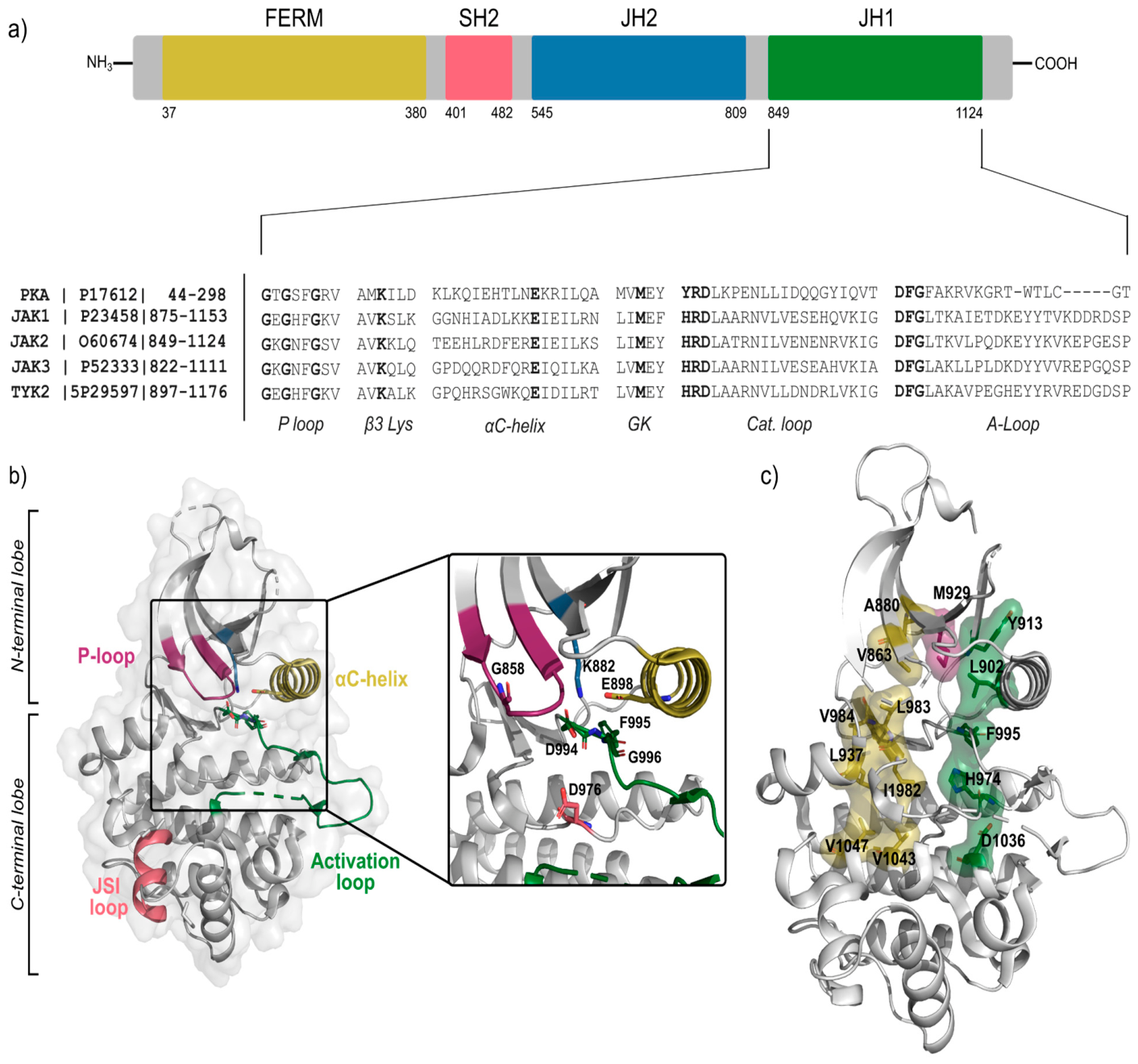
2.1. Kinase Domain (JH1)
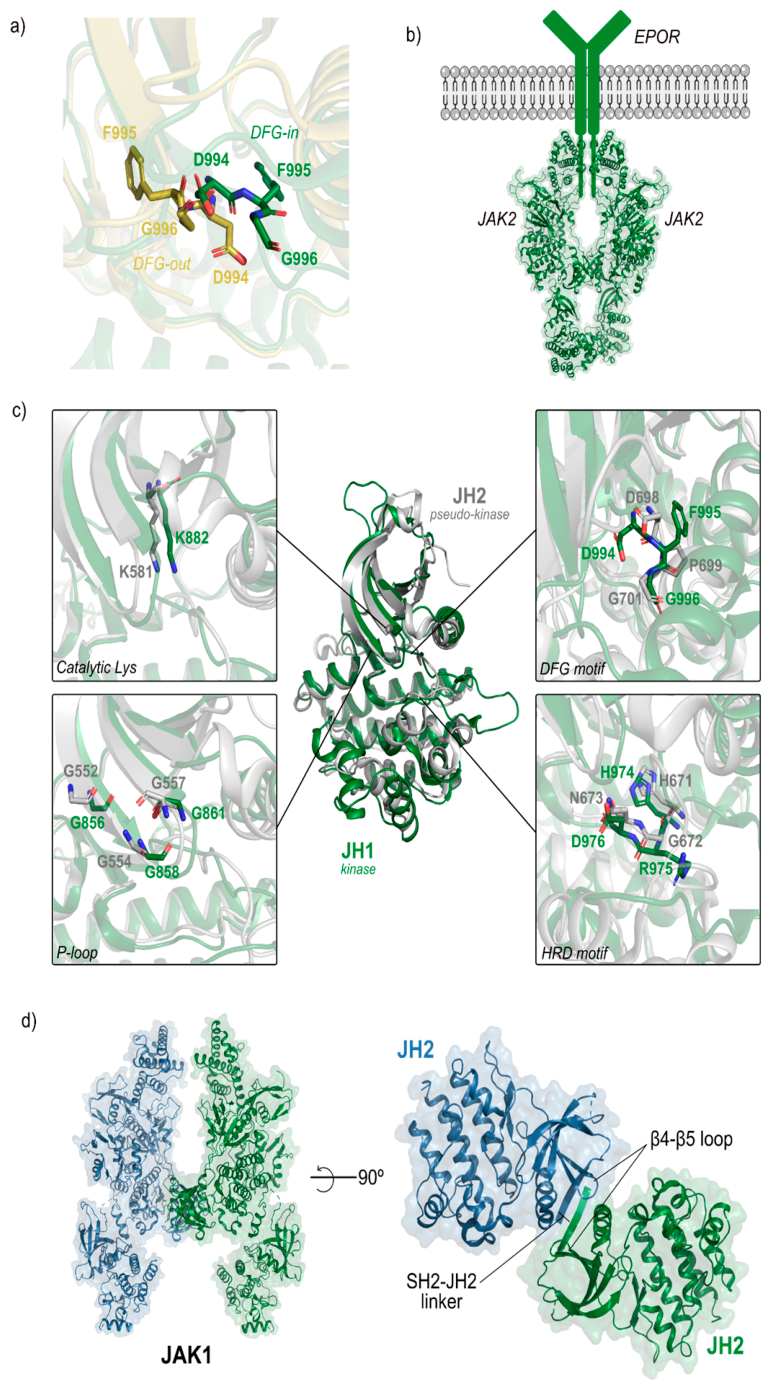
2.2. Pseudokinase Domain (JH2)
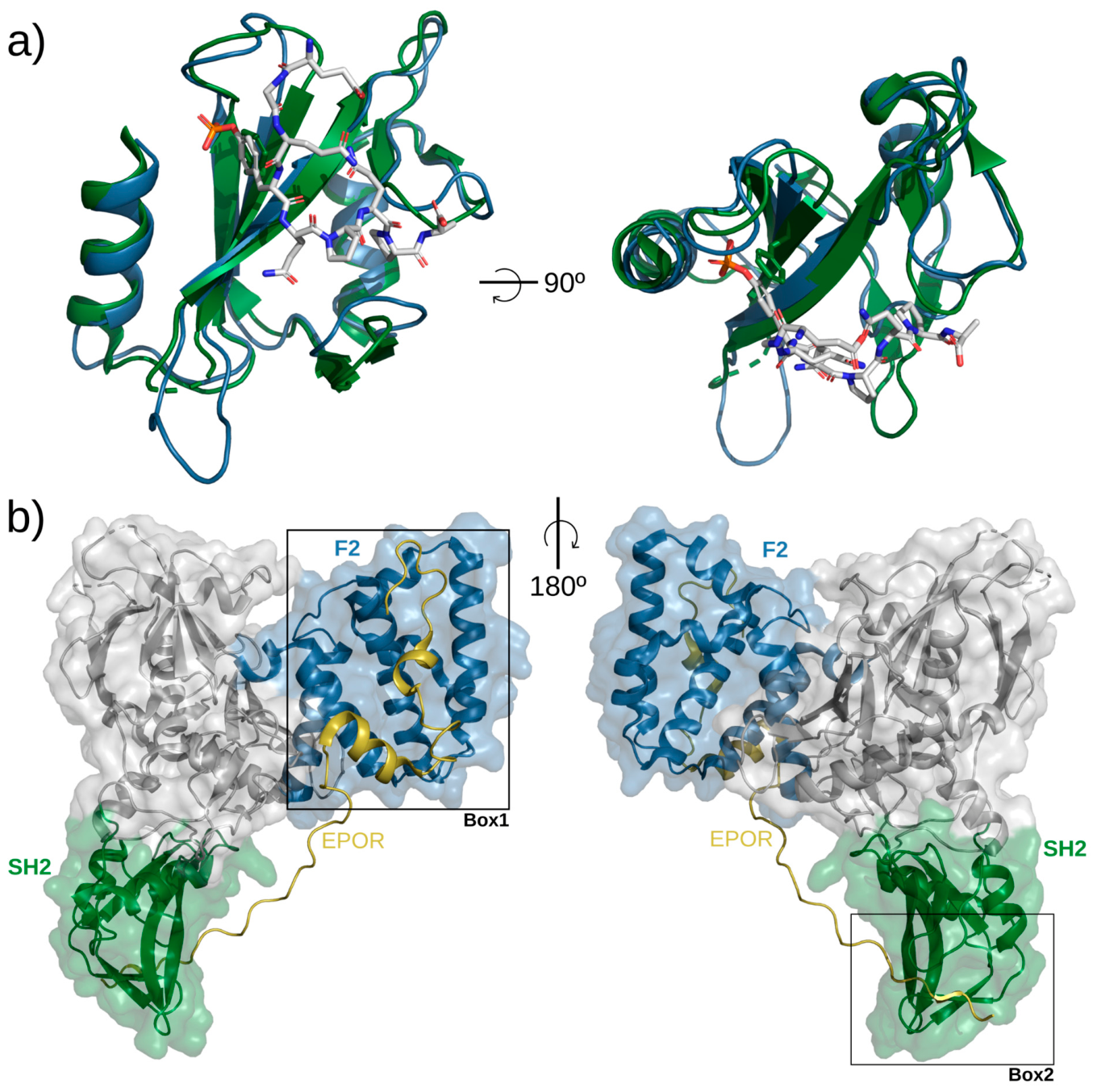
2.3. SH2-Like Domain (JH3–JH4)
2.4. FERM Domain (JH5–JH7)
3. Principles of Signaling and Mechanism of Deregulation
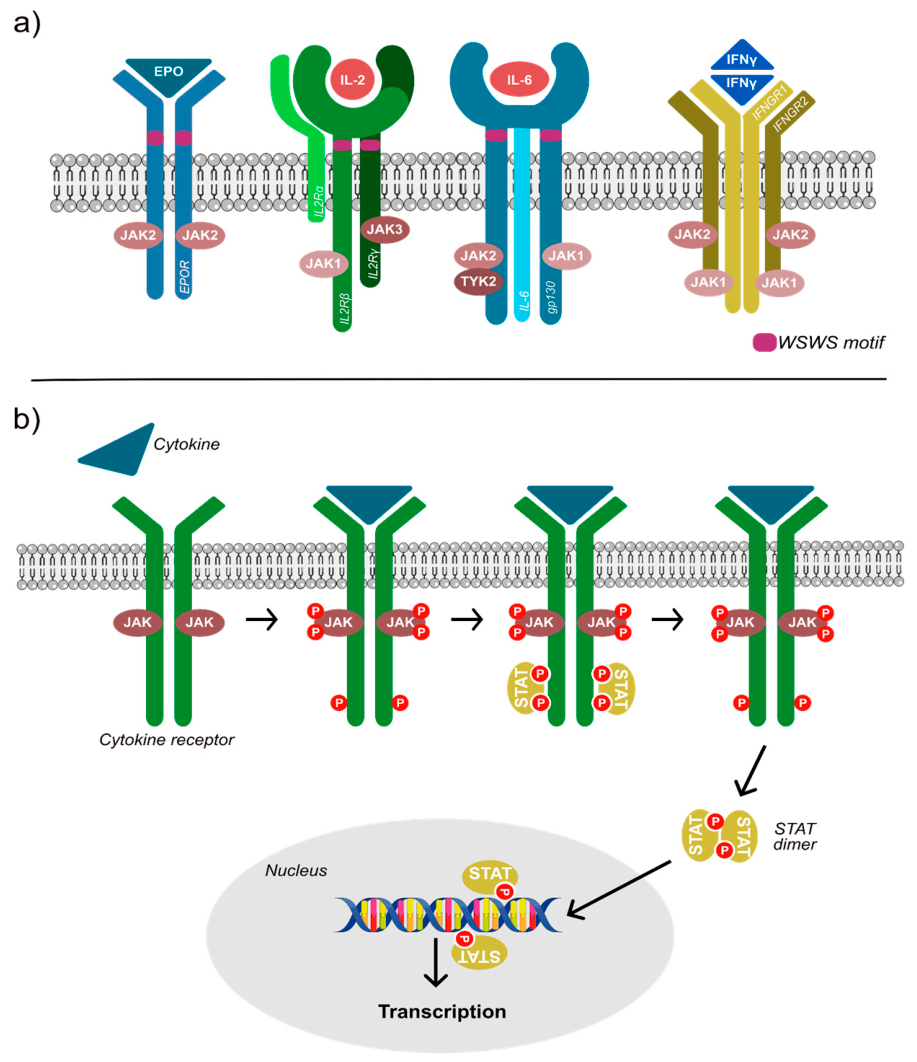
3.1. JAK-STAT Signaling Pathways
3.2. Basis of Pathogenic Activation
3.2.1. Physiological Autoinhibition and Allosteric Control
3.2.2. Structural Mechanisms of Pathogenic Activation
- JH2–JH1 interface destabilization: mutations such as R683S/G in exon 16 weaken the electrostatic and hydrophobic clamp between JH2 and JH1, uncoupling the autoinhibitory brace that restricts the catalytic cleft. This loss of interdomain restraint allows the kinase lobes to adopt an open, phosphorylation-competent geometry even in the absence of receptor engagement [51]. These mutations are commonly observed in lymphoid malignancies, where they drive hyperactivation of STAT1 and STAT3 signaling [76].
- SH2–JH2 linker perturbation: Mutations within exon 12, typified by K539L, alter the helical hinge connecting the SH2 and JH2 domains. This linker functions as a flexible tether transmitting receptor-derived mechanical signals to JH2. Its destabilization promotes partial opening of the JH2–JH1 assembly and increases basal catalytic turnover [51]. Such mutants show modest ligand-independent signaling but heightened responsiveness to low cytokine concentrations, consistent with the polycythemia vera phenotype.
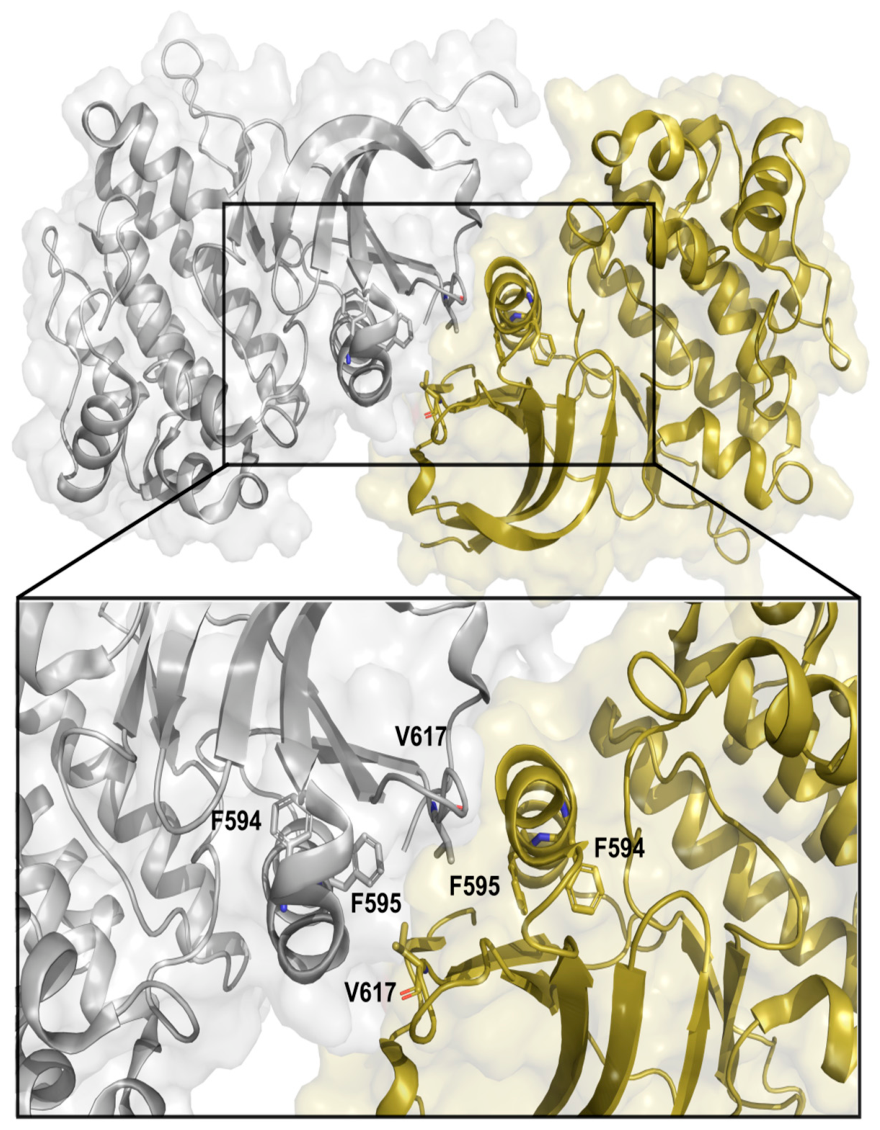
- JH2 core activation and dimer stabilization: The archetypal V617F mutation, located on the αC-helix of JH2, introduces an aromatic residue that forms π–π stacking across JH2 dimers (Figure 5), stabilizing a configuration equivalent to cytokine-induced receptor dimerization [82]. This conformational lock enforces persistent juxtaposition of JH1 domains, enabling unrestrained trans-phosphorylation and constitutive activation of STAT5. Cryo-EM reconstructions and molecular simulations confirm that the V617F-driven JH2–JH2 interface mimics the spatial orientation observed in ligand-bound EpoR–JAK2 complexes [28].
3.2.3. Pathway Bias, Functional Divergence, and Functional Consequences
4. Pharmacological Strategies for JAK2 Inhibition
4.1. Classification of Protein Kinase Inhibitors
4.2. JAK2-Approved Inhibitors
4.2.1. Binding Mode and Stereoselectivity
4.2.2. Series B (Piperidine–Aniline Analogs of Ruxolitinib)
4.2.3. Fedratinib and Series C Analogs
4.3. Emerging Strategies for Next-Generation JAK2 Inhibition
4.3.1. Covalent and Isoform-Selective Inhibitors Targeting Unique Residues
4.3.2. Type II JAK2 Inhibitors: Stabilizing the Inactive “DFG-Out” Conformation
4.3.3. Macrocyclic JAK2 Inhibitors: Conformational Pre-Organization for Selectivity
- Targeting the Pseudokinase Domain (JH2): Developing allosteric inhibitors that exploit the lower sequence conservation in JH2 to achieve selectivity, particularly against mutants like V617F.
- Modulating Protein Interactions: Designing compounds that disrupt JAK2-receptor binding, mimic the inhibitory function of SOCS proteins, or compete with substrate recruitment.
- Exploiting Allosteric Sites: Discovering Type II inhibitors that stabilize inactive kinase conformations or developing molecules that target the interface between JAK2’s regulatory domains.
4.3.4. Targeting the Pseudokinase (JH2) Regulatory Domain
5. A Practical Example: Clinical–Laboratory Features and Management of JAK2-Mutated Myeloproliferative Neoplasms
6. Outlook and Future Directions
7. Conclusions
Author Contributions
Funding
Data Availability Statement
Acknowledgments
Conflicts of Interest
References
- Ardito, F.; Giuliani, M.; Perrone, D.; Troiano, G.; Muzio, L. Lo The Crucial Role of Protein Phosphorylation in Cell Signalingand Its Use as Targeted Therapy (Review). Int. J. Mol. Med. 2017, 40, 271–280. [Google Scholar] [CrossRef]
- Khoury, G.A.; Baliban, R.C.; Floudas, C.A. Proteome-Wide Post-Translational Modification Statistics: Frequency Analysis and Curation of the Swiss-Prot Database. Sci. Rep. 2011, 1, 90. [Google Scholar] [CrossRef]
- Kannan, N.; Taylor, S.S.; Zhai, Y.; Venter, J.C.; Manning, G. Structural and Functional Diversity of the Microbial Kinome. PLoS Biol. 2007, 5, e17. [Google Scholar] [CrossRef]
- Oruganty, K.; Talevich, E.E.; Neuwald, A.F.; Kannan, N. Identification and Classification of Small Molecule Kinases: Insights into Substrate Recognition and Specificity. BMC Evol. Biol. 2016, 16, 7. [Google Scholar] [CrossRef]
- Roskoski, R., Jr. Properties of FDA-Approved Small Molecule Protein Kinase Inhibitors: A 2025 Update. Pharmacol. Res. 2025, 216, 107723. [Google Scholar] [CrossRef]
- Firmbach-Kraft, I.; Byers, M.; Shows, T.; Dalla-Favera, R.; Krolewski, J.J. Tyk2, Prototype of a Novel Class of Non-Receptor Tyrosine Kinase Genes. Oncogene 1990, 5, 1329–1336. [Google Scholar] [PubMed]
- Silvennoinen, O.; Ihle, J.N.; Schlessinger, J.; Levy, D.E. Interferon-Induced Nuclear Signalling by Jak Protein Tyrosine Kinases. Nature 1993, 366, 583–585. [Google Scholar] [CrossRef]
- Wilks, A.F.; Harpur, A.G.; Kurban, R.R.; Ralph, S.J.; Zurcher, G.; Ziemiecki, A. Two Novel Protein-Tyrosine Kinases, Each with a Second Phosphotransferase-Related Catalytic Domain, Define a New Class of Protein Kinase. Mol. Cell. Biol. 1991, 11, 2057–2065. [Google Scholar] [CrossRef]
- Witthuhn, B.A.; Silvennoinen, O.; Miura, O.; Lai, K.S.; Cwik, C.; Liu, E.T.; Ihle, J.N. Involvement of the Jak-3 Janus Kinase in Signalling by Interleukins 2 and 4 in Lymphoid and Myeloid Cells. Nature 1994, 370, 153–157. [Google Scholar] [CrossRef] [PubMed]
- Gaffen, S.L. Signaling Domains of the Interleukin 2 Receptor. Cytokine 2001, 14, 63–77. [Google Scholar] [CrossRef] [PubMed]
- Larner, A.C.; Finbloom, D.S. Protein Tyrosine Phosphorylation as a Mechanism Which Regulates Cytokine Activation of Early Response Genes. Biochim. Biophys. Acta 1995, 1266, 278–287. [Google Scholar] [CrossRef][Green Version]
- Seavey, M.M.; Dobrzanski, P. The Many Faces of Janus Kinase. Biochem. Pharmacol. 2012, 83, 1136–1145. [Google Scholar] [CrossRef] [PubMed]
- Roskoski, R. Janus Kinase (JAK) Inhibitors in the Treatment of Neoplastic and Inflammatory Disorders. Pharmacol. Res. 2022, 183, 106362. [Google Scholar] [CrossRef] [PubMed]
- Ugo, V.; James, C.; Vainchenker, W. A Unique Clonal JAK2 Mutation Leading to Constitutive Signalling Causes Polycythaemia Vera. Med./Sci. 2005, 21, 669–670. [Google Scholar] [CrossRef]
- Baxter, E.J.; Scott, L.M.; Campbell, P.J.; East, C.; Fourouclas, N.; Swanton, S.; Vassiliou, G.S.; Bench, A.J.; Boyd, E.M.; Curtin, N.; et al. Acquired Mutation of the Tyrosine Kinase JAK2 in Human Myeloproliferative Disorders. Lancet 2005, 365, 1054–1061. [Google Scholar] [CrossRef]
- Teo, S.; Tiedt, R.; Ph, D.; Passweg, J.R.; Tichelli, A.; Cazzola, M.; Skoda, R.C. A Gain-of-Function Mutation of JAK2 in myeloproliferative disorders. N. Engl. J. Med. 2026, 28, 1779–1790. [Google Scholar]
- Peeters, P.; Raynaud, S.D.; Cools, J.; Wlodarska, I.; Grosgeorge, J.; Philip, P.; Monpoux, F.; Van Rompaey, L.; Baens, M.; den Berghe, H.; et al. Fusion of TEL, the ETS-Variant Gene 6 (ETV6), to the Receptor-Associated Kinase JAK2 as a Result of t(9; 12) in a Lymphoid and t(9; 15; 12) in a Myeloid Leukemia. Blood 1997, 90, 2535–2540. [Google Scholar] [CrossRef]
- Lacronique, V.; Boureux, A.; Della Valle, V.; Poirel, H.; Quang, C.T.; Mauchauffé, M.; Berthou, C.; Lessard, M.; Berger, R.; Ghysdael, J.; et al. A TEL-JAK2 Fusion Protein with Constitutive Kinase Activity in Human Leukemia. Science 1997, 278, 1309–1312. [Google Scholar] [CrossRef]
- Parganas, E.; Wang, D.; Stravopodis, D.; Topham, D.J.; Marine, J.-C.; Teglund, S.; Vanin, E.F.; Bodner, S.; Colamonici, O.R.; van Deursen, J.M.; et al. Jak2 Is Essential for Signaling through a Variety of Cytokine Receptors. Cell 1998, 93, 385–395. [Google Scholar] [CrossRef]
- Waters, M.J.; Brooks, A.J. JAK2 Activation by Growth Hormone and Other Cytokines. Biochem. J. 2015, 466, 1–11. [Google Scholar] [CrossRef]
- Igelmann, S.; Neubauer, H.A.; Ferbeyre, G. STAT3 and STAT5 Activation in Solid Cancers. Cancers 2019, 11, 1428. [Google Scholar] [CrossRef]
- Zou, S.; Tong, Q.; Liu, B.; Huang, W.; Tian, Y.; Fu, X. Targeting STAT3 in Cancer Immunotherapy. Mol. Cancer 2020, 19, 145. [Google Scholar] [CrossRef]
- Hu, Y.; Dong, Z.; Liu, K. Unraveling the Complexity of STAT3 in Cancer: Molecular Understanding and Drug Discovery. J. Exp. Clin. Cancer Res. 2024, 43, 23. [Google Scholar] [CrossRef] [PubMed]
- Levine, R.L.; Pardanani, A.; Tefferi, A.; Gilliland, D.G. Role of JAK2 in the Pathogenesis and Therapy of Myeloproliferative Disorders. Nat. Rev. Cancer 2007, 7, 673–683. [Google Scholar] [CrossRef] [PubMed]
- Andraos, R.; Qian, Z.; Bonenfant, D.; Rubert, J.; Vangrevelinghe, E.; Scheufler, C.; Marque, F.; Régnier, C.H.; De Pover, A.; Ryckelynck, H.; et al. Modulation of Activation-Loop Phosphorylation by JAK Inhibitors Is Binding Mode Dependent. Cancer Discov. 2012, 2, 512–523. [Google Scholar] [CrossRef]
- Vainchenker, W.; Leroy, E.; Gilles, L.; Marty, C.; Plo, I.; Constantinescu, S.N. JAK Inhibitors for the Treatment of Myeloproliferative Neoplasms and Other Disorders. F1000Research 2018, 7, 82. [Google Scholar] [CrossRef]
- Miao, Y.; Virtanen, A.; Zmajkovic, J.; Hilpert, M.; Skoda, R.C.; Silvennoinen, O.; Haikarainen, T. Functional and Structural Characterization of Clinical-Stage Janus Kinase 2 Inhibitors Identifies Determinants for Drug Selectivity. J. Med. Chem. 2024, 67, 10012–10024. [Google Scholar] [CrossRef]
- Glassman, C.R.; Tsutsumi, N.; Saxton, R.A.; Lupardus, P.J.; Jude, K.M.; Garcia, K.C. Structure of a Janus Kinase Cytokine Receptor Complex Reveals the Basis for Dimeric Activation. Science 2022, 376, 163–169. [Google Scholar] [CrossRef] [PubMed]
- Ferrao, R.; Lupardus, P.J. The Janus Kinase (JAK) FERM and SH2 Domains: Bringing Specificity to JAK-Receptor Interactions. Front. Endocrinol. 2017, 8, 71. [Google Scholar] [CrossRef]
- Ferrao, R.; Wallweber, H.J.A.; Ho, H.; Tam, C.; Franke, Y.; Quinn, J.; Lupardus, P.J. The Structural Basis for Class II Cytokine Receptor Recognition by JAK1. Structure 2016, 24, 897–905. [Google Scholar] [CrossRef]
- Haan, C.; Behrmann, I.; Haan, S. Perspectives for the Use of Structural Information and Chemical Genetics to Develop Inhibitors of Janus Kinases. J. Cell. Mol. Med. 2010, 14, 504–527. [Google Scholar] [CrossRef] [PubMed]
- Caspers, N.L.; Han, S.; Rajamohan, F.; Hoth, L.R.; Geoghegan, K.F.; Subashi, T.A.; Vazquez, M.L.; Kaila, N.; Cronin, C.N.; Johnson, E.; et al. Development of a High-Throughput Crystal Structure-Determination Platform for JAK1 Using a Novel Metal-Chelator Soaking System. Acta Crystallogr. Sect. F. 2016, 72, 840–845. [Google Scholar] [CrossRef]
- Wan, X.; Ma, Y.; McClendon, C.L.; Huang, L.J.S.; Huang, N. Ab Initio Modeling and Experimental Assessment of Janus Kinase 2 (JAK2) Kinase-Pseudokinase Complex Structure. PLoS Comput. Biol. 2013, 9, e1003022. [Google Scholar] [CrossRef]
- Ung, P.M.-U.; Rahman, R.; Schlessinger, A. Redefining the Protein Kinase Conformational Space with Machine Learning. Cell Chem. Biol. 2018, 25, 916–924.e2. [Google Scholar] [CrossRef] [PubMed]
- Davis, R.R.; Li, B.; Yun, S.Y.; Chan, A.; Nareddy, P.; Gunawan, S.; Ayaz, M.; Lawrence, H.R.; Reuther, G.W.; Lawrence, N.J.; et al. Structural Insights into JAK2 Inhibition by Ruxolitinib, Fedratinib, and Derivatives Thereof. J. Med. Chem. 2021, 64, 2228–2241. [Google Scholar] [CrossRef]
- Leroy, E.; Constantinescu, S.N. Rethinking JAK2 Inhibition: Towards Novel Strategies of More Specific and Versatile Janus Kinase Inhibition. Leukemia 2017, 31, 1023–1038, Erratum in Leukemia 2017, 31, 2853. https://doi.org/10.1038/leu.2017.158. [Google Scholar] [CrossRef]
- Arwood, M.L.; Liu, Y.; Harkins, S.K.; Weinstock, D.M.; Yang, L.; Stevenson, K.E.; Plana, O.D.; Dong, J.; Cirka, H.; Jones, K.L.; et al. New Scaffolds for Type II JAK2 Inhibitors Overcome the Acquired G993A Resistance Mutation. Cell Chem. Biol. 2023, 30, 618–631.e12. [Google Scholar] [CrossRef]
- Kulagowski, J.J.; Blair, W.; Bull, R.J.; Chang, C.; Deshmukh, G.; Dyke, H.J.; Eigenbrot, C.; Ghilardi, N.; Gibbons, P.; Harrison, T.K.; et al. Identification of Imidazo-Pyrrolopyridines as Novel and Potent JAK1 Inhibitors. J. Med. Chem. 2012, 55, 5901–5921. [Google Scholar] [CrossRef]
- Feng, J.; Witthuhn, B.A.; Matsuda, T.; Kohlhuber, F.; Kerr, I.M.; Ihle, J.N. Activation of Jak2 Catalytic Activity Requires Phosphorylation of Y1007 in the Kinase Activation Loop. Mol. Cell. Biol. 1997, 17, 2497–2501. [Google Scholar] [CrossRef] [PubMed]
- Gorantla, S.P.; Oelschläger, L.; Prince, G.; Osius, J.; Kolluri, S.B.; Maluje, Y.; Fähnrich, A.; Ernst, N.; Barbosa Gulde, A.; Ludwig, R.J.; et al. Ruxolitinib Mediated Paradoxical JAK2 Hyperphosphorylation Is Due to the Protection of Activation Loop Tyrosines from Phosphatases. Leukemia 2025, 39, 1678–1691. [Google Scholar] [CrossRef]
- Ungureanu, D.; Saharinen, P.; Junttila, I.; Hilton, D.J.; Silvennoinen, O. Regulation of Jak2 through the Ubiquitin-Proteasome Pathway Involves Phosphorylation of Jak2 on Y1007 and Interaction with SOCS-1. Mol. Cell. Biol. 2002, 22, 3316–3326. [Google Scholar] [CrossRef]
- Shan, Y.; Gnanasambandan, K.; Ungureanu, D.; Kim, E.T.; Hammarén, H.; Yamashita, K.; Silvennoinen, O.; Shaw, D.E.; Hubbard, S.R. Molecular Basis for Pseudokinase-Dependent Autoinhibition of JAK2 Tyrosine Kinase. Nat. Struct. Mol. Biol. 2014, 21, 579–584. [Google Scholar] [CrossRef]
- Lucet, I.S.; Fantino, E.; Styles, M.; Bamert, R.; Patel, O.; Broughton, S.E.; Walter, M.; Burns, C.J.; Treutlein, H.; Wilks, A.F.; et al. The Structural Basis of Janus Kinase 2 Inhibition by a Potent and Specific Pan-Janus Kinase Inhibitor. Blood 2006, 107, 176–183. [Google Scholar] [CrossRef]
- Roskoski, R. Janus Kinase (JAK) Inhibitors in the Treatment of Inflammatory and Neoplastic Diseases. Pharmacol. Res. 2016, 111, 784–803. [Google Scholar] [CrossRef]
- Kornev, A.P.; Taylor, S.S.; Eyck, L.F. Ten A Helix Scaffold for the Assembly of Active Protein Kinases. Proc. Natl. Acad. Sci. USA 2008, 105, 14377–14382. [Google Scholar] [CrossRef] [PubMed]
- Taylor, S.S.; Kornev, A.P. Protein Kinases: Evolution of Dynamic Regulatory Proteins. Trends Biochem. Sci. 2011, 36, 65–77. [Google Scholar] [CrossRef] [PubMed]
- Roskoski, R. Properties of FDA-Approved Small Molecule Protein Kinase Inhibitors: A 2023 Update. Pharmacol. Res. 2023, 187, 106552. [Google Scholar] [CrossRef]
- Virtanen, A.T.; Haikarainen, T.; Sampathkumar, P.; Palmroth, M.; Liukkonen, S.; Liu, J.; Nekhotiaeva, N.; Hubbard, S.R.; Silvennoinen, O. Identification of Novel Small Molecule Ligands for JAK2 Pseudokinase Domain. Pharmaceuticals 2023, 16, 75. [Google Scholar] [CrossRef]
- Bandaranayake, R.M.; Ungureanu, D.; Shan, Y.; Shaw, D.E.; Silvennoinen, O.; Hubbard, S.R. Crystal Structures of the JAK2 Pseudokinase Domain and the Pathogenic Mutant V617F. Nat. Struct. Mol. Biol. 2012, 19, 754–759. [Google Scholar] [CrossRef] [PubMed]
- Philips, R.L.; Wang, Y.; Cheon, H.; Kanno, Y.; Gadina, M.; Sartorelli, V.; Horvath, C.M.; Darnell, J.E.J.; Stark, G.R.; O’Shea, J.J. The JAK-STAT Pathway at 30: Much Learned, Much More to Do. Cell 2022, 185, 3857–3876. [Google Scholar] [CrossRef]
- Abraham, B.G.; Haikarainen, T.; Vuorio, J.; Girych, M.; Virtanen, A.T.; Kurttila, A.; Karathanasis, C.; Heilemann, M.; Sharma, V.; Vattulainen, I.; et al. Molecular Basis of JAK2 Activation in Erythropoietin Receptor and Pathogenic JAK2 Signaling. Sci. Adv. 2024, 10, eadl2097. [Google Scholar] [CrossRef]
- Raivola, J.; Haikarainen, T.; Silvennoinen, O. Characterization of JAK1 Pseudokinase Domain in Cytokine Signaling. Cancers 2019, 12, 78. [Google Scholar] [CrossRef] [PubMed]
- Newton, A.S.; Deiana, L.; Puleo, D.E.; Cisneros, J.A.; Cutrona, K.J.; Schlessinger, J.; Jorgensen, W.L. JAK2 JH2 Fluorescence Polarization Assay and Crystal Structures for Complexes with Three Small Molecules. ACS Med. Chem. Lett. 2017, 8, 614–617. [Google Scholar] [CrossRef]
- Murphy, J.M.; Zhang, Q.; Young, S.N.; Reese, M.L.; Bailey, F.P.; Eyers, P.A.; Ungureanu, D.; Hammaren, H.; Silvennoinen, O.; Varghese, L.N.; et al. A Robust Methodology to Subclassify Pseudokinases Based on Their Nucleotide-Binding Properties. Biochem. J. 2014, 457, 323–334. [Google Scholar] [CrossRef] [PubMed]
- Argetsinger, L.S.; Kouadio, J.-L.K.; Steen, H.; Stensballe, A.; Jensen, O.N.; Carter-Su, C. Autophosphorylation of JAK2 on Tyrosines 221 and 570 Regulates Its Activity. Mol. Cell. Biol. 2004, 24, 4955–4967. [Google Scholar] [CrossRef]
- Kovanen, P.E.; Junttila, I.; Takaluoma, K.; Saharinen, P.; Valmu, L.; Li, W.; Silvennoinen, O. Regulation of Jak2 Tyrosine Kinase by Protein Kinase C during Macrophage Differentiation of IL-3-Dependent Myeloid Progenitor Cells. Blood 2000, 95, 1626–1632. [Google Scholar] [CrossRef]
- Pogozheva, I.D.; Cherepanov, S.; Park, S.-J.; Raghavan, M.; Im, W.; Lomize, A.L. Structural Modeling of Cytokine-Receptor-JAK2 Signaling Complexes Using AlphaFold Multimer. J. Chem. Inf. Model. 2023, 63, 5874–5895. [Google Scholar] [CrossRef] [PubMed]
- Zhang, D.; Wlodawer, A.; Lubkowski, J. Crystal Structure of a Complex of the Intracellular Domain of Interferon λ Receptor 1 (IFNLR1) and the FERM/SH2 Domains of Human JAK1. J. Mol. Biol. 2016, 428, 4651–4668. [Google Scholar] [CrossRef]
- Radtke, S.; Haan, S.; Jörissen, A.; Hermanns, H.M.; Diefenbach, S.; Smyczek, T.; Schmitz-VandeLeur, H.; Heinrich, P.C.; Behrmann, I.; Haan, C. The Jak1 SH2 Domain Does Not Fulfill a Classical SH2 Function in Jak/STATSignaling but Plays a Structural Role for Receptor Interaction AndUp-Regulation of Receptor SurfaceExpression. J. Biol. Chem. 2005, 280, 25760–25768. [Google Scholar] [CrossRef]
- McNally, R.; Toms, A.V.; Eck, M.J. Crystal Structure of the FERM-SH2 Module of Human Jak2. PLoS ONE 2016, 11, e0156218. [Google Scholar] [CrossRef] [PubMed]
- Wallweber, H.J.A.; Tam, C.; Franke, Y.; Starovasnik, M.A.; Lupardus, P.J. Structural Basis of Recognition of Interferon-α Receptor by Tyrosine Kinase 2. Nat. Struct. Mol. Biol. 2014, 21, 443–448. [Google Scholar] [CrossRef]
- Doggett, K.; Keating, N.; Dehkhoda, F.; Bidgood, G.M.; Meza Guzman, L.G.; Leong, E.; Kueh, A.; Nicola, N.A.; Kershaw, N.J.; Babon, J.J.; et al. The SOCS1 KIR and SH2 Domain Are Both Required for Suppression of Cytokine Signaling in Vivo. Cytokine 2023, 165, 156167. [Google Scholar] [CrossRef]
- Ferrao, R.D.; Wallweber, H.J.A.; Lupardus, P.J. Receptor-Mediated Dimerization of JAK2 FERM Domains Is Required for JAK2 Activation. Elife 2018, 7, e38089. [Google Scholar] [CrossRef]
- Zhou, Y.J.; Chen, M.; Cusack, N.A.; Kimmel, L.H.; Magnuson, K.S.; Boyd, J.G.; Lin, W.; Roberts, J.L.; Lengi, A.; Buckley, R.H.; et al. Unexpected Effects of FERM Domain Mutations on Catalytic Activity of Jak3: Structural Implication for Janus Kinases. Mol. Cell 2001, 8, 959–969. [Google Scholar] [CrossRef]
- Funakoshi-Tago, M.; Pelletier, S.; Matsuda, T.; Parganas, E.; Ihle, J.N. Receptor Specific Downregulation of Cytokine Signaling by Autophosphorylation in the FERM Domain of Jak2. EMBO J. 2006, 25, 4763–4772. [Google Scholar] [CrossRef]
- Funakoshi-Tago, M.; Tago, K.; Sato, Y.; Tominaga, S.; Kasahara, T. JAK2 Is an Important Signal Transducer in IL-33-Induced NF-ΚB Activation. Cell. Signal. 2011, 23, 363–370. [Google Scholar] [CrossRef]
- Morris, R.; Kershaw, N.J.; Babon, J.J. The Molecular Details of Cytokine Signaling via the JAK/STAT Pathway. Protein Sci. 2018, 27, 1984–2009. [Google Scholar] [CrossRef] [PubMed]
- Nosaka, T.; Kawashima, T.; Misawa, K.; Ikuta, K.; Mui, A.L.F.; Kitamura, T. STAT5 as a Molecular Regulator of Proliferation, Differentiation and Apoptosis in Hematopoietic Cells. EMBO J. 1999, 18, 4754–4765. [Google Scholar] [CrossRef]
- Smith, M.R.; Satter, L.R.F.; Vargas-Hernández, A. STAT5b: A Master Regulator of Key Biological Pathways. Front. Immunol. 2023, 13, 1025373. [Google Scholar] [CrossRef] [PubMed]
- Villarino, A.V.; Laurence, A.D.; Davis, F.P.; Nivelo, L.; Brooks, S.R.; Sun, H.-W.; Jiang, K.; Afzali, B.; Frasca, D.; Hennighausen, L.; et al. A Central Role for STAT5 in the Transcriptional Programing of T Helper Cell Metabolism. Sci. Immunol. 2022, 7, eabl9467. [Google Scholar] [CrossRef] [PubMed]
- Kurzer, J.H.; Argetsinger, L.S.; Zhou, Y.-J.; Kouadio, J.-L.K.; O’Shea, J.J.; Carter-Su, C. Tyrosine 813 Is a Site of JAK2 Autophosphorylation Critical for Activation of JAK2 by SH2-Bβ. Mol. Cell. Biol. 2004, 24, 4557–4570. [Google Scholar] [CrossRef]
- Babon, J.J.; Lucet, I.S.; Murphy, J.M.; Nicola, N.A.; Varghese, L.N. The Molecular Regulation of Janus Kinase (JAK) Activation. Biochem. J. 2014, 462, 1–13. [Google Scholar] [CrossRef]
- Argetsinger, L.S.; Stuckey, J.A.; Robertson, S.A.; Koleva, R.I.; Cline, J.M.; Marto, J.A.; Myers, M.G.; Carter-Su, C. Tyrosines 868, 966, and 972 in the Kinase Domain of JAK2 Are Autophosphorylated and Required for Maximal JAK2 Kinase Activity. Mol. Endocrinol. 2010, 24, 1062–1076. [Google Scholar] [CrossRef]
- Liau, N.P.D.; Laktyushin, A.; Lucet, I.S.; Murphy, J.M.; Yao, S.; Whitlock, E.; Callaghan, K.; Nicola, N.A.; Kershaw, N.J.; Babon, J.J. The Molecular Basis of JAK/STAT Inhibition by SOCS1. Nat. Commun. 2018, 9, 1558. [Google Scholar] [CrossRef]
- Morelli, M.; Madonna, S.; Albanesi, C. SOCS1 and SOCS3 as Key Checkpoint Molecules in the Immune Responses Associated to Skin Inflammation and Malignant Transformation. Front. Immunol. 2024, 15, 1393799. [Google Scholar] [CrossRef]
- Hu, X.; Li, J.; Fu, M.; Zhao, X.; Wang, W. The JAK/STAT Signaling Pathway: From Bench to Clinic. Signal Transduct. Target. Ther. 2021, 6, 402. [Google Scholar] [CrossRef] [PubMed]
- Xu, D.; Qu, C.-K. Protein Tyrosine Phosphatases in the JAK/STAT Pathway. Front. Biosci. 2008, 13, 4925–4932. [Google Scholar] [CrossRef] [PubMed]
- Miller, C.J.; Turk, B.E. Homing in: Mechanisms of Substrate Targeting by Protein Kinases. Trends Biochem. Sci. 2018, 43, 380–394. [Google Scholar] [CrossRef]
- Amanchy, R.; Zhong, J.; Molina, H.; Chaerkady, R.; Iwahori, A.; Kalume, D.E.; Grønborg, M.; Joore, J.; Cope, L.; Pandey, A. Identification of C-Src Tyrosine Kinase Substrates Using Mass Spectrometry and Peptide Microarrays. J. Proteome Res. 2008, 7, 3900–3910. [Google Scholar] [CrossRef]
- Leonard, W.J.; O’shea, J.J. JAKS AND STATS: Biological Implications. Annu. Rev. Immunol. 1998, 16, 293–322. [Google Scholar] [CrossRef] [PubMed]
- Lv, Y.; Qi, J.; Babon, J.J.; Cao, L.; Fan, G.; Lang, J.; Zhang, J.; Mi, P.; Kobe, B.; Wang, F. The JAK-STAT Pathway: From Structural Biology to Cytokine Engineering. Signal Transduct. Target. Ther. 2024, 9, 221, Erratum in Signal Transduct. Target. Ther. 2024, 9, 290. https://doi.org/10.1038/s41392-024-01975-1. [Google Scholar] [CrossRef] [PubMed]
- Caveney, N.A.; Saxton, R.A.; Waghray, D.; Glassman, C.R.; Tsutsumi, N.; Hubbard, S.R.; Garcia, K.C. Structural Basis of Janus Kinase Trans-Activation. Cell Rep. 2023, 42, 112201. [Google Scholar] [CrossRef]
- Hu, Q.; Bian, Q.; Rong, D.; Wang, L.; Song, J.; Huang, H.S.; Zeng, J.; Mei, J.; Wang, P.Y. JAK/STAT Pathway: Extracellular Signals, Diseases, Immunity, and Therapeutic Regimens. Front. Bioeng. Biotechnol. 2023, 11, 1110765. [Google Scholar] [CrossRef] [PubMed]
- Shao, T.; Gan, M.; Yin, Q.; Bai, J.; Yang, J.; Sun, S. Divergent Conformational Mechanisms of JAK2V617F and TYK2V678F Mutations in Thrombocythemia and Related Disorders: Molecular Dynamics Insights into Pathway Activation and Therapeutic Targeting. bioRxiv 2025. [Google Scholar] [CrossRef]
- Scott, L.M.; Tong, W.; Levine, R.L.; Scott, M.A.; Beer, P.A.; Stratton, M.R.; Futreal, P.A.; Erber, W.N.; McMullin, M.F.; Harrison, C.N.; et al. JAK2 Exon 12 Mutations in Polycythemia Vera and Idiopathic Erythrocytosis. N. Engl. J. Med. 2007, 356, 459–468. [Google Scholar] [CrossRef]
- Grisouard, J.; Li, S.; Kubovcakova, L.; Rao, T.N.; Meyer, S.C.; Lundberg, P.; Hao-Shen, H.; Romanet, V.; Murakami, M.; Radimerski, T.; et al. JAK2 Exon 12 Mutant Mice Display Isolated Erythrocytosis and Changes in Iron Metabolism Favoring Increased Erythropoiesis. Blood 2016, 128, 839–851. [Google Scholar] [CrossRef]
- Wanlong, M.; Kantarjian, H.; Zhang, X.; Yen, C.H.; Zhang, Z.J.; Verstovsek, S.; Albitar, M. Mutation Profile of JAK2 Transcripts in Patients with Chronic Myeloproliferative Neoplasias. J. Mol. Diagn. 2009, 11, 49–53. [Google Scholar] [CrossRef]
- Hardwick, R.N.; Brassil, P.; Badagnani, I.; Perkins, K.; Obedencio, G.P.; Kim, A.S.; Conner, M.W.; Bourdet, D.L.; Harstad, E.B. Gut-Selective Design of Orally Administered Izencitinib (TD-1473) Limits Systemic Exposure and Effects of Janus Kinase Inhibition in Nonclinical Species. Toxicol. Sci. 2022, 186, 323–337. [Google Scholar] [CrossRef]
- Dusa, A.; Mouton, C.; Pecquet, C.; Herman, M.; Constantinescu, S.N. JAK2 V617F Constitutive Activation Requires JH2 Residue F595: A Pseudokinase Domain Target for Specific Inhibitors. PLoS ONE 2010, 5, e11157. [Google Scholar] [CrossRef]
- Pastore, F.; Krishnan, A.; Hammarén, H.M.; Silvennoinen, O.; Yan, B.; Levine, R.L. JAK2S523L, a Novel Gain-of-Function Mutation in a Critical Autoregulatory Residue in JAK2V617F-MPNs. Blood Adv. 2020, 4, 4554–4559. [Google Scholar] [CrossRef]
- Perner, F.; Pahl, H.L.; Zeiser, R.; Heidel, F.H. Malignant JAK-Signaling: At the Interface of Inflammation and Malignant Transformation. Leukemia 2025, 39, 1011–1030. [Google Scholar] [CrossRef]
- Deisseroth, A.; Kaminskas, E.; Grillo, J.; Chen, W.; Saber, H.; Lu, H.L.; Rothmann, M.D.; Brar, S.; Wang, J.; Garnett, C.; et al. U.S. Food and Drug Administration Approval: Ruxolitinib for the Treatment of Patients with Intermediate and High-Risk Myelofibrosis. Clin. Cancer Res. 2012, 18, 3212–3217. [Google Scholar] [CrossRef] [PubMed]
- Traynor, K. FDA Approves Tofacitinib for Rheumatoid Arthritis. Am. J. Health-Syst. Pharm. 2012, 69, 2120. [Google Scholar] [CrossRef]
- Mayence, A.; Eynde, J.J. Vanden Baricitinib: A 2018 Novel FDA-Approved Small Molecule Inhibiting Janus Kinases. Pharmaceuticals 2019, 12, 37. [Google Scholar] [CrossRef] [PubMed]
- Duggan, S.; Keam, S.J. Upadacitinib: First Approval. Drugs 2019, 79, 1819–1828. [Google Scholar] [CrossRef] [PubMed]
- Talpaz, M.; Kiladjian, J.J. Fedratinib, a Newly Approved Treatment for Patients with Myeloproliferative Neoplasm-Associated Myelofibrosis. Leukemia 2021, 35, 1–17. [Google Scholar] [CrossRef]
- U.S. Food and Drug Administration. JAKAFI/JAKAFI XR (Ruxolitinib): Prescribing Information; FDA: Silver Spring, MD, USA, 2026. Available online: https://dailymed.nlm.nih.gov/dailymed/drugInfo.cfm?setid=f1c82580-87ae-11e0-bc84-0002a5d5c51b (accessed on 3 June 2026).
- European Medicines Agency. Jakavi: EPAR—Product Information; EMA: Amsterdam, The Netherlands, 2025; Available online: https://www.ema.europa.eu/en/medicines/human/EPAR/jakavi (accessed on 3 June 2026).
- U.S. Food and Drug Administration. OJJAARA (Momelotinib) Tablets: Prescribing Information; FDA: Silver Spring, MD, USA, 2023. Available online: https://www.accessdata.fda.gov/drugsatfda_docs/label/2023/216873s000lbl.pdf (accessed on 3 June 2026).
- European Medicines Agency. Omjjara: EPAR—Product Information; EMA: Amsterdam, The Netherlands, 2026; Available online: https://www.ema.europa.eu/en/medicines/human/EPAR/omjjara (accessed on 3 June 2026).
- U.S. Food and Drug Administration. INREBIC (Fedratinib) Capsules: Prescribing Information; FDA: Silver Spring, MD, USA, 2025. Available online: https://www.accessdata.fda.gov/drugsatfda_docs/label/2025/212327s007lbl.pdf (accessed on 3 June 2026).
- European Medicines Agency. Inrebic: EPAR—Product Information; EMA: Amsterdam, The Netherlands, 2025; Available online: https://www.ema.europa.eu/en/medicines/human/EPAR/inrebic (accessed on 3 June 2026).
- U.S. Food and Drug Administration. VONJO (Pacritinib) Capsules: Prescribing Information; FDA: Silver Spring, MD, USA, 2025. Available online: https://www.accessdata.fda.gov/drugsatfda_docs/label/2025/208712s004lbl.pdf (accessed on 3 June 2026).
- European Medicines Agency. Enpaxiq: Withdrawal of the Marketing Authorisation Application for Pacritinib; EMA: Amsterdam, The Netherlands, 2017; Available online: https://www.ema.europa.eu/en/medicines/human/EPAR/enpaxiq (accessed on 3 June 2026).
- U.S. Food and Drug Administration. XELJANZ/XELJANZ XR/XELJANZ Oral Solution (Tofacitinib): Prescribing Information; FDA: Silver Spring, MD, USA, 2026. Available online: https://www.accessdata.fda.gov/drugsatfda_docs/label/2026/208246s027lbl.pdf (accessed on 3 June 2026).
- European Medicines Agency. Xeljanz: EPAR—Product Information; EMA: Amsterdam, The Netherlands, 2026; Available online: https://www.ema.europa.eu/en/medicines/human/EPAR/xeljanz (accessed on 3 June 2026).
- U.S. Food and Drug Administration. OLUMIANT (Baricitinib) Tablets: Prescribing Information; FDA: Silver Spring, MD, USA, 2022. Available online: https://www.accessdata.fda.gov/drugsatfda_docs/label/2022/207924s006lbl.pdf (accessed on 3 June 2026).
- European Medicines Agency. Olumiant: EPAR—Product Information; EMA: Amsterdam, The Netherlands, 2026; Available online: https://www.ema.europa.eu/en/medicines/human/EPAR/olumiant (accessed on 3 June 2026).
- Pharmaceuticals and Medical Devices Agency. Report on the Deliberation Results: Smyraf Tablets 50 mg and 100 mg, Peficitinib Hydrobromide; PMDA: Tokyo, Japan, 2019; Available online: https://www.pmda.go.jp/files/000233074.pdf (accessed on 3 June 2026).
- Takeuchi, T.; Tanaka, Y.; Iwasaki, M.; Ishikura, H.; Saeki, S.; Kaneko, Y. Safety and effectiveness of peficitinib in patients with rheumatoid arthritis: Final results from a post-marketing surveillance study. Rheumatol. Ther. 2021, 8, 1129–1145. [Google Scholar] [CrossRef]
- U.S. Food and Drug Administration. RINVOQ/RINVOQ LQ (Upadacitinib): Prescribing Information; FDA: Silver Spring, MD, USA, 2025. Available online: https://www.accessdata.fda.gov/drugsatfda_docs/label/2025/211675s025lbl.pdf (accessed on 3 June 2026).
- European Medicines Agency. Rinvoq: EPAR—Product Information; EMA: Amsterdam, The Netherlands, 2026; Available online: https://www.ema.europa.eu/en/medicines/human/EPAR/rinvoq (accessed on 3 June 2026).
- European Medicines Agency. Jyseleca: EPAR—Product Information; EMA: Amsterdam, The Netherlands, 2026; Available online: https://www.ema.europa.eu/en/medicines/human/EPAR/jyseleca (accessed on 3 June 2026).
- Roskoski, R. Classification of Small Molecule Protein Kinase Inhibitors Based upon the Structures of Their Drug-Enzyme Complexes. Pharmacol. Res. 2016, 103, 26–48. [Google Scholar] [CrossRef]
- Koppikar, P.; Bhagwat, N.; Kilpivaara, O.; Manshouri, T.; Adli, M.; Hricik, T.; Liu, F.; Saunders, L.M.; Mullally, A.; Abdel-Wahab, O.; et al. Heterodimeric JAK–STAT activation as a mechanism of persistence to JAK2 inhibitor therapy. Nature 2014, 489, 155–159. [Google Scholar] [CrossRef]
- Ramírez-Marín, H.A.; Tosti, A. Evaluating the Therapeutic Potential of Ritlecitinib for the Treatment of Alopecia Areata. Drug Des. Devel. Ther. 2022, 16, 363–374. [Google Scholar] [CrossRef]
- Martin, D.A.; Telliez, J.B.; Pleasic-Williams, S.; Zhang, Y.; Tierney, B.; Blatnik, M.; Gale, J.D.; Banfield, C.; Zhou, Y.; Lejeune, A.; et al. Target Occupancy and Functional Inhibition of JAK3 and TEC Family Kinases by Ritlecitinib in Healthy Adults: An Open-Label, Phase 1 Study. J. Clin. Pharmacol. 2024, 64, 67–79. [Google Scholar] [CrossRef]
- Nair, P.C.; Piehler, J.; Tvorogov, D.; Ross, D.M.; Lopez, A.F.; Gotlib, J.; Thomas, D. Next-Generation JAK2 Inhibitors for the Treatment of Myeloproliferative Neoplasms: Lessons from Structure-Based Drug Discovery Approaches. Blood Cancer Discov. 2023, 4, 352–364. [Google Scholar] [CrossRef]
- Pandey, G.; Kuykendall, A.T.; Reuther, G.W. JAK2 Inhibitor Persistence in MPN: Uncovering a Central Role of ERK Activation. Blood Cancer J. 2022, 12, 13. [Google Scholar] [CrossRef]
- Grabek, J.; Straube, J.; Bywater, M.; Lane, S.W. MPN: The Molecular Drivers of Disease Initiation, Progression and Transformation and Their Effect on Treatment. Cells 2020, 9, 1901. [Google Scholar] [CrossRef]
- Qin, S.; Wu, R.; Tian, Y.; Tang, M.; Yan, W.; Cen, X.; Chen, L.; Yang, T. Discovery of Highly Selective and Potent Macrocyclic JAK2 Inhibitors for the Treatment of MPNs. J. Med. Chem. 2025, 68, 17933–17959. [Google Scholar] [CrossRef]
- Kingston, P.; Blauvelt, A.; Strober, B.; Armstrong, A.W. Deucravacitinib: A Novel TYK2 Inhibitor for the Treatment of Moderate-to-Severe Psoriasis. J. Psoriasis Psoriatic Arthritis 2023, 8, 156–165. [Google Scholar] [CrossRef]
- Liosi, M.E.; Ippolito, J.A.; Henry, S.P.; Krimmer, S.G.; Newton, A.S.; Cutrona, K.J.; Olivarez, R.A.; Mohanty, J.; Schlessinger, J.; Jorgensen, W.L. Insights on JAK2 Modulation by Potent, Selective, and Cell-Permeable Pseudokinase-Domain Ligands. J. Med. Chem. 2022, 65, 8380–8400. [Google Scholar] [CrossRef] [PubMed]
- Arber, D.A.; Orazi, A.; Hasserjian, R.P.; Borowitz, M.J.; Calvo, K.R.; Kvasnicka, H.-M.; Wang, S.A.; Bagg, A.; Barbui, T.; Branford, S.; et al. International Consensus Classification of Myeloid Neoplasms and Acute Leukemias: Integrating Morphologic, Clinical, and Genomic Data. Blood 2022, 140, 1200–1228. [Google Scholar] [CrossRef] [PubMed]
- Marchetti, M.; Vannucchi, A.M.; Griesshammer, M.; Harrison, C.; Koschmieder, S.; Gisslinger, H.; Álvarez-Larrán, A.; De Stefano, V.; Guglielmelli, P.; Palandri, F.; et al. Appropriate Management of Polycythaemia Vera with Cytoreductive Drug Therapy: European LeukemiaNet 2021 Recommendations. Lancet Haematol. 2022, 9, e301–e311. [Google Scholar] [CrossRef]
- Tremblay, D. Cytoreduction for ET and PV: Who, What, When, and How? Hematology 2023, 2023, 660–666. [Google Scholar] [CrossRef] [PubMed]
- Gisslinger, H.; Klade, C.; Georgiev, P.; Krochmalczyk, D.; Gercheva-Kyuchukova, L.; Egyed, M.; Dulicek, P.; Illes, A.; Pylypenko, H.; Sivcheva, L.; et al. Event-Free Survival in Patients with Polycythemia Vera Treated with Ropeginterferon Alfa-2b versus Best Available Treatment. Leukemia 2023, 37, 2129–2132. [Google Scholar] [CrossRef] [PubMed]
- Kremyanskaya, M.; Kuykendall, A.T.; Pemmaraju, N.; Ritchie, E.K.; Gotlib, J.; Gerds, A.; Palmer, J.; Pettit, K.; Nath, U.K.; Yacoub, A.; et al. Rusfertide, a Hepcidin Mimetic, for Control of Erythrocytosis in Polycythemia Vera. N. Engl. J. Med. 2024, 390, 723–735. [Google Scholar] [CrossRef]
- Tefferi, A.; Vannucchi, A.M.; Barbui, T. Essential Thrombocythemia: 2024 Update on Diagnosis, Risk Stratification, and Management. Am. J. Hematol. 2024, 99, 697–718. [Google Scholar] [CrossRef] [PubMed]
- Tefferi, A. Primary Myelofibrosis: 2023 Update on Diagnosis, Risk-Stratification, and Management. Am. J. Hematol. 2023, 98, 801–821. [Google Scholar] [CrossRef]
- Verstovsek, S.; Gerds, A.T.; Vannucchi, A.M.; Al-Ali, H.K.; Lavie, D.; Kuykendall, A.T.; Grosicki, S.; Iurlo, A.; Goh, Y.T.; Lazaroiu, M.C.; et al. Momelotinib versus Danazol in Symptomatic Patients with Anaemia and Myelofibrosis (MOMENTUM): Results from an International, Double-Blind, Randomised, Controlled, Phase 3 Study. Lancet 2023, 401, 269–280, Erratum in Lancet 2023, 401, 1426. https://doi.org/10.1016/S0140-6736(23)00819-X. Erratum in Lancet 2023, 402, 2196. https://doi.org/10.1016/S0140-6736(23)02708-3. [Google Scholar] [CrossRef]
- Oh, S.T.; Mesa, R.A.; Harrison, C.N.; Bose, P.; Gerds, A.T.; Gupta, V.; Scott, B.L.; Kiladjian, J.-J.; Lucchesi, A.; Kong, T.; et al. Pacritinib Is a Potent ACVR1 Inhibitor with Significant Anemia Benefit in Patients with Myelofibrosis. Blood Adv. 2023, 7, 5835–5842. [Google Scholar] [CrossRef] [PubMed]
- Verstovsek, S.; Mesa, R.A.; Livingston, R.A.; Hu, W.; Mascarenhas, J. Ten Years of Treatment with Ruxolitinib for Myelofibrosis: A Review of Safety. J. Hematol. Oncol. 2023, 16, 82. [Google Scholar] [CrossRef]



| JH Region | Functional Name | Function |
|---|---|---|
| JH1 | Kinase domain | Catalyzes the phosphorylation reaction |
| JH2 | Pseudokinase domain | Modulates JH1’s catalytic activity |
| JH3–JH4 | SH2-like domain | Regulates kinase activity, receptor stability, and intramolecular interactions |
| JH5–JH7 | FERM domain | Mediates receptor binding and membrane association |
| Mutation | Structural Location | Mechanism of Activation | Predominant Signaling Output | Associated Diseases | References |
|---|---|---|---|---|---|
| V617 | JH2 αC-helix (exon 14) | Stabilization of JH2 dimer interface and disruption of autoinhibitory control | Strong STAT5 activation; erythroid and megakaryocytic proliferation | Essential thrombocythemia, Polycythemia vera, Primary myelofibrosis | [51,84] |
| Exon 12 mutation (e.g., K539L, N542-E543 del) | SH2-JH2 Linker | Destabilization of JH2-mediated autoinhibition | Predominantly STAT5 signaling | JAK2 V617F-negative polycythemia vera; idiopathic erythrocytosis-like presentations | [85,86,87] |
| R683S/G | JH2–JH1 interface | Disruption of inhibitory interdomain interactions | STAT1/STAT3 bias; cytokine-independent growth | B-cell acute lymphoblastic leukemia, especially Down syndrome-associated ALL and CRLF2-rearranged/Ph-like ALL | [88] |
| F595 substitutions | JH2 αC-helix region | Altered pseudokinase regulatory network | Variable STAT activation depending on substitution | Experimental and disease-associated activating variants | [89] |
| M535I | Exon 12/SH2–JH2 region | Destabilization of autoinhibitory conformation | Enhanced JAK–STAT signaling | Acute megakaryoblastic leukemia, particularly pediatric non-Down syndrome AMKL | [90] |
| Inhibitor | Main Target/Selectivity | Binding Class/Type | Regulatory Status | Approved Usage | Selected Advanced Trials/Non-Approved Uses | References |
|---|---|---|---|---|---|---|
| Ruxolitinib | JAK1/JAK2 | Type I; ATP-competitive JAK inhibitor | FDA and EMA approved | Oral: intermediate/high-risk myelofibrosis; polycythemia vera after inadequate response/intolerance to hydroxyurea; steroid-refractory or steroid-dependent acute and chronic GVHD (age restrictions vary by label/region). Topical formulation has separate dermatologic approvals in some regions. | Investigational or additional contexts include alopecia areata, atopic dermatitis, psoriasis, T-ALL, essential thrombocythaemia, COVID-19, HLH, pancreatic cancer and vitiligo; these should not be presented as universal oral systemic approvals. | [91,97] |
| Momelotinib | JAK1/JAK2 plus ACVR1 activity | Type I; ATP-competitive | FDA and EMA approved | Adults with intermediate/high-risk myelofibrosis, including primary MF, post-PV MF and post-ET MF, with anemia or moderate-to-severe anemia depending on jurisdiction; indicated for disease-related splenomegaly/symptoms. | Other MPN/solid-tumor entries should be listed only if directly supported by a current trial registry search. | [98,99] |
| Fedratinib | JAK2-selective; also inhibits FLT3 | Type I; ATP-competitive | FDA and EMA approved | Adults with primary MF, post-PV MF or post-ET MF with disease-related splenomegaly/symptoms; used in JAK-inhibitor-naive patients or after ruxolitinib according to regional wording. | No additional indication should be listed without current registry confirmation. | [100] |
| Pacritinib | JAK2/IRAK1/ACVR1; also reported FLT3 activity | Type I; ATP-competitive | FDA approved; not EMA approved | Adults with intermediate- or high-risk primary or secondary MF with platelet count below 50 × 109/L. | Continued clinical investigation in cytopenic MF settings; not an EMA-approved medicine. | [101,102,103,104] |
| Tofacitinib | JAK1/JAK2/JAK3; functional JAK1/JAK3 predominance | Type I; ATP-competitive | FDA and EMA approved | Rheumatoid arthritis, psoriatic arthritis, ulcerative colitis, ankylosing spondylitis and polyarticular-course juvenile idiopathic arthritis/juvenile idiopathic arthritis indications, with wording and age restrictions varying by region. | Alopecia areata, psoriasis, Takayasu arteritis and other immune-mediated conditions should be listed as investigational/off-label unless label-confirmed for the target region. | [105] |
| Baricitinib | JAK1/JAK2 | Type I; ATP-competitive | FDA and EMA approved | FDA: rheumatoid arthritis, severe alopecia areata in adults and COVID-19 in selected hospitalized patients. EMA: rheumatoid arthritis, atopic dermatitis, alopecia areata and selected pediatric/inflammatory indications depending on current product information. | Juvenile idiopathic arthritis, systemic lupus erythematosus and other indications require region-specific confirmation. | [105,106] |
| Peficitinib | Pan-JAK; JAK3 > JAK1/JAK2/TYK2 reported | Type I; ATP-competitive | Not FDA or EMA approved; approved in Japan, Korea and Taiwan | Rheumatoid arthritis in approved Asian jurisdictions. | Not an FDA/EMA advanced clinical candidate unless supported by an active current trial. | [107,108] |
| Upadacitinib | JAK1-selective over JAK2/JAK3/TYK2 | ATP-competitive JAK inhibitor; type not usually stated in labels | FDA and EMA approved | Rheumatoid arthritis, psoriatic arthritis, axial spondyloarthritis/ankylosing spondylitis, atopic dermatitis, ulcerative colitis, Crohn’s disease, polyarticular-course JIA and giant cell arteritis, with label-specific restrictions. | Additional vasculitis/immune indications may be under study; AD, UC and Crohn’s disease should not be left only in the clinical-trials column because they are approved indications. | [109,110] |
| Filgotinib | JAK1-selective over JAK2 | Type I/ATP-competitive JAK inhibitor | EMA approved; not FDA approved | EU/EMA: moderate-to-severe active rheumatoid arthritis and moderate-to-severe active ulcerative colitis in adults. | Crohn’s disease and psoriatic arthritis should be kept as investigational/non-approved unless region-specific approval is documented. | [110] |
| Deucravacitinib | TYK2; allosteric pseudokinase/JH2 binding | Type IV; allosteric TYK2 inhibitor | FDA and EMA approved for plaque psoriasis; FDA also approved active psoriatic arthritis in adults | FDA: moderate-to-severe plaque psoriasis in adults; active psoriatic arthritis in adults. EMA: moderate-to-severe plaque psoriasis in adults eligible for systemic therapy. | PsA should no longer be listed as merely Phase 3 for the US. Other TYK2 development areas require current trial confirmation. | [111] |
| Ritlecitinib | Covalent JAK3 and TEC-family kinase inhibitor | Type VI/covalent irreversible inhibitor | FDA and EMA approved | Severe alopecia areata in adults and adolescents 12 years and older. | Other autoimmune indications are investigational unless label-confirmed. | [112] |
| Izencitinib | Gut-selective pan-JAK: JAK1/JAK2/JAK3/TYK2 | ATP-competitive; formal binding class not consistently specified | Not approved; development status uncertain/discontinued after Phase 2/2b-3 programs | No approved indication. | Crohn’s disease Phase 2 study and ulcerative colitis Phase 2b/3 program were completed/terminated; UC Phase 2b did not meet the primary endpoint. Do not list as active Phase 3 Crohn’s disease candidate without fresh registry evidence. | [113] |
Disclaimer/Publisher’s Note: The statements, opinions and data contained in all publications are solely those of the individual author(s) and contributor(s) and not of MDPI and/or the editor(s). MDPI and/or the editor(s) disclaim responsibility for any injury to people or property resulting from any ideas, methods, instructions or products referred to in the content. |
© 2026 by the authors. Licensee MDPI, Basel, Switzerland. This article is an open access article distributed under the terms and conditions of the Creative Commons Attribution (CC BY) license.
Share and Cite
Pereira, M.S.; Arruda, H.O.M.; Martins, D.M.; Fernandes, P.O.; Sabino, A.P.; Moraes, A.H. Structural Regulation and Therapeutic Perspectives of JAK2 Kinase. Kinases Phosphatases 2026, 4, 17. https://doi.org/10.3390/kinasesphosphatases4020017
Pereira MS, Arruda HOM, Martins DM, Fernandes PO, Sabino AP, Moraes AH. Structural Regulation and Therapeutic Perspectives of JAK2 Kinase. Kinases and Phosphatases. 2026; 4(2):17. https://doi.org/10.3390/kinasesphosphatases4020017
Chicago/Turabian StylePereira, Mozart Silvio, Heveline Oliveira Morais Arruda, Diego Magno Martins, Philipe Oliveira Fernandes, Adriano Paula Sabino, and Adolfo Henrique Moraes. 2026. "Structural Regulation and Therapeutic Perspectives of JAK2 Kinase" Kinases and Phosphatases 4, no. 2: 17. https://doi.org/10.3390/kinasesphosphatases4020017
APA StylePereira, M. S., Arruda, H. O. M., Martins, D. M., Fernandes, P. O., Sabino, A. P., & Moraes, A. H. (2026). Structural Regulation and Therapeutic Perspectives of JAK2 Kinase. Kinases and Phosphatases, 4(2), 17. https://doi.org/10.3390/kinasesphosphatases4020017