Article

Nutritional Value and In Vitro Fermentation of Two Oat (Avena sativa L.) Varieties in Six Phenological Stages


by
Fernando Lucio-Ruíz
1,
Juan Eduardo Godina-Rodríguez
2,
Jonathan Raúl Garay-Martínez
3,
Mauricio Velázquez-Martínez
1,
Santiago Joaquín-Cancino
4 and
José Felipe Orzuna-Orzuna
5,*
1
Campo Experimental San Luis, Instituto Nacional de Investigaciones Forestales, Agrícolas y Pecuarias, Palma de la Cruz C.P. 78432, San Luis Potosí, Mexico
2
Campo Experimental Valle de Apatzingán, Instituto Nacional de Investigaciones Forestales, Agrícolas y Pecuarias, km 17.5 Carretera Apatzingán-Cuatro Caminos, Parácuaro C.P. 60781, Michoacán, Mexico
3
Campo Experimental Las Huastecas, Instituto Nacional de Investigaciones Forestales, Agrícolas y Pecuarias, Altamira C.P. 89610, Tamaulipas, Mexico
4
Facultad de Ingeniería y Ciencias, Universidad Autónoma de Tamaulipas, Centro Universitario, Ciudad Victoria C.P. 87000, Tamaulipas, Mexico
5
Unidad Regional Universitaria de Zonas Áridas, Universidad Autónoma Chapingo, Bermejillo C.P. 35230, Durango, Mexico
*
Author to whom correspondence should be addressed.
Grasses 2026, 5(3), 33; https://doi.org/10.3390/grasses5030033
Submission received: 10 July 2026 / Revised: 20 August 2026 / Accepted: 26 August 2026 / Published: 28 August 2026

Highlights

What are the main findings?
  • Phenological maturity decreases the nutritional quality and in vitro digestibility of both oat varieties.
  • Maturity increases fiber content and fermentable fractions.
What are the implications of the main findings?
  • Phenological stage is a determining factor for optimizing the nutritional quality of oats.

Abstract

In northeastern Mexico, forage shortages during the cold season limit the availability of high-quality forage for ruminant production systems, as the growth of warm-season C4 forages declines significantly. Forage oats are widely grown to address this seasonal shortage; however, information on the optimal harvest stage and its effect on gas fermentation kinetics of commercially important cultivars under regional semi-arid conditions remains limited. Therefore, this study evaluated the nutritional value and in vitro fermentation parameters of two oat varieties (Chihuahua and Cuauhtémoc) at six phenological stages: tillering (Z2), stem elongation (Z3), stuffing (Z4), milky grain (Z7), doughy grain (Z8), and physiological maturity (Z9). The experiment was carried out using a completely randomized design, with a 2 × 6 factorial arrangement, where the fixed effects corresponded to the oat variety (Chihuahua and Cuauhtémoc), the phenological stage (Z2, Z3, Z4, Z7, Z8, Z9), and their interaction. Crude protein, ash, digestible dry matter, and relative forage value contents decreased (p < 0.05) with increasing phenological stage of the two oat varieties. In contrast, neutral detergent fiber, acid detergent fiber, and hemicellulose contents increased (p < 0.05) with increasing phenological stage of the two oat varieties. Gas production rate, lag phase, and in vitro dry matter digestibility at 72 h decreased (p < 0.05) with increasing phenological stage of the two oat varieties. In contrast, the fast fermentable fraction and total fermentable fraction increased (p < 0.05) with increasing phenological stage in both oat varieties. In conclusion, the nutritional value, gas production, lag phase, and in vitro dry matter digestibility of oats decreased as the phenological stage increased.

1. Introduction

Forages constitute the main component in ruminant feeding due to their low cost and their contribution of fiber and essential nutrients for adequate productive performance [1]. In northeastern Mexico, particularly in the semi-arid regions of Tamaulipas and neighboring states, beef and dairy production systems rely primarily on warm-season C4 forages such as sorghum, maize, and perennial grasses during summer. However, forage availability and nutritional quality decline markedly during the cool season because low temperatures, frost events, and reduced photoperiod restrict the growth of these C4 species [2]. This seasonal forage deficit represents one of the major nutritional constraints for ruminant production in the region, increasing the need for high-quality cool-season forages capable of sustaining animal performance.
Under this context, the use of forage crops adapted to low temperatures and limited water availability, such as oats (Avena sativa L.), represents a strategic alternative to maintain forage supply [3]. Oats are widely recognized for their tolerance to cold, drought, and nutrient deficiency stress, as well as for their rapid growth, high palatability, and versatility for conservation as hay or silage [4,5]. In northeastern Mexico, forage oats are typically harvested during the winter season for use in ruminant feeding systems. Therefore, identifying the optimal harvest stage is essential for maximizing both silage quality and animal performance. The Chihuahua and Cuauhtémoc oat varieties were developed in 1967 by the Instituto Nacional de Investigaciones Forestales, Agrícolas y Pecuarias, selected for their yield, tolerance to lodging, and resistance to stem rust (Puccinia graminis f. sp. avena Erikss & Henning), making them the most suitable and widely used varieties in semi-arid regions due to their adaptation to adverse environmental conditions and their stable biomass production in both rainfed and supplemental irrigation systems [6,7].
Although Chihuahua and Cuauhtémoc are established cultivars rather than newly released genotypes, they remain relevant because of their continued use in forage production and their adaptation to regional production conditions. However, their importance lies not in varietal novelty, but in characterizing how forage quality and ruminal fermentation change throughout phenological development under the specific semi-arid conditions of northeastern Mexico.
Despite these advantages, the nutritional value of forage oats is closely influenced by phenological stage. As plant maturity advances, crude protein content decreases, while structural components such as neutral detergent fiber, acid detergent fiber, and lignin increase, resulting in lower digestibility and reduced voluntary intake by ruminants [8,9,10,11]. Therefore, determining the optimal harvest time represents a key management decision that directly impacts forage quality, its intake potential, and animal performance.
In this context, the in vitro gas production technique has been widely used to evaluate ruminal fermentation kinetics and to estimate the nutritive value of forages [12,13,14]. This technique provides relevant information on substrate degradability, energy availability, and fermentation patterns in the rumen [15]. Although several studies have evaluated the nutritional quality and fermentation of forage oats, most have focused on a single harvest stage or on conserved forages such as silage [16,17,18], which limits the understanding of how phenological progression affects fermentation dynamics.
Therefore, there is limited information integrating the effect of phenological stage on nutritional composition and ruminal fermentation kinetics in widely used oat varieties under semi-arid conditions. Moreover, few studies have simultaneously evaluated the changes in forage quality and ruminal fermentation throughout the complete phenological development of commercially important oat cultivars under the environmental conditions of northeastern Mexico. Consequently, producers lack locally generated information that supports the selection of the harvest stage that best balances forage yield, nutritive value, and fermentation characteristics for silage production. This knowledge is essential to define harvest strategies that allow balancing forage quality and biomass production.
Despite the well-established effect of plant maturity on forage quality, less is known about whether commercially important oat varieties differ in the magnitude and direction of these changes under the semi-arid conditions of northeastern Mexico. In particular, integrating forage nutritive value, dry matter yield, and in vitro fermentation kinetics across multiple phenological stages may help identify harvest windows that balance forage quality with biomass production. The hypothesized that the response of nutritional composition and fermentation kinetics to advancing phenological stage would differ between Chihuahua and Cuauhtémoc, and that this interaction could identify harvest windows with contrasting advantages for forage quality and biomass production. Therefore, the objective of this study was to evaluate the nutritional value, and in vitro fermentation kinetics of Chihuahua and Cuauhtémoc oats at six phenological stages under semi-arid conditions of northeastern Mexico, providing region-specific information to support harvest decisions for ruminant feeding prior to any preservation process.

2. Materials and Methods

2.1. Location of the Experimental Site, Oat Sowing and Treatments Evaluated

The establishment and development of the oat crop was carried out from November 2021 to March 2022 at the “Ingeniero Herminio García González” Zootechnical Field, located in Güémez, Tamaulipas, Mexico (23°56′28″ N, 99°06′24″ W; 190 msnm), under semi-arid climate conditions [BS1(h′)hw].
The forage oat varieties Chihuahua and Cuauhtémoc, both released in 1967, were evaluated. The experimental design was completely randomized, with four replicates per variety. Each experimental unit consisted of a 6 × 6 m (36 m2) plot.
Sowing was done by broadcasting at a density of 120 kg ha−1 of seed with 85% germination. Subsequently, a branch was passed over the surface to cover the seed with a light layer of soil. Land preparation consisted of cross-harrowing prior to sowing.
Agronomic management included three sprinkler irrigations: at sowing, during tillering, and at flowering. Fertilization was applied at a rate of 120-40-00 (N-P-K), split into two applications: 50% at sowing and 50% during tillering. Puccinia spp. was also treated. (Rust) Propiconazole® was used at a dose of 125 g of active ingredient ha−1.
Sampling was carried out by harvesting a 1 m2 area within each plot when more than 50% of the plants reached the phenological stage corresponding to Z2 (tillering), Z3 (stem elongation), Z4 (stem filling), Z7 (milk stage), Z8 (dough stage), and Z9 (physiological maturity), according to the scale of Zadoks et al. [19].
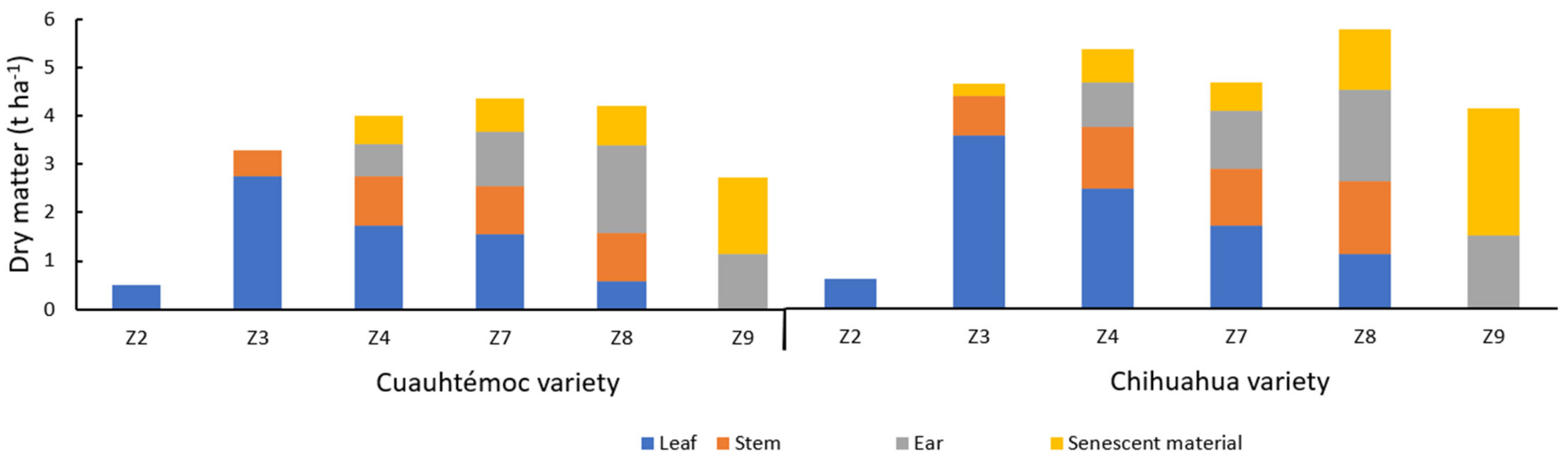
The samples were weighed immediately after harvest and separated by morphological components (leaf, stem, ear, and senescent material). They were then dried in a forced-air oven at 60 °C until constant weight was reached, to determine the total dry matter yield and the yield of each morphological component (t ha−1). The dry matter yield and morphological composition data presented in Figure 1 were obtained from a previous experiment conducted by the authors under the same production conditions and have been previously reported [20]. Prior to conducting the present study, a preliminary experiment [20] was conducted to determine the phenological stages of the two oat varieties evaluated. However, none of the data reported in this study were taken from that preliminary study, as the two studies had different objectives and were conducted separately.
Once dry, the forage samples were ground through a 1 mm sieve using a Wiley mill (model 4, Arthur Thomas Co., Philadelphia, PA, USA), according to the procedure described by Baeg et al. [14], for subsequent chemical and fermentative analysis.

2.2. Nutritional Value

Ground oat forage samples were analyzed for crude protein (CP), neutral detergent fiber (NDF), acid detergent fiber (ADF), and ash. Crude protein was determined by the Kjeldahl procedure through sequential digestion, distillation, and titration, and nitrogen concentration was converted to CP using a factor of 6.25 [21]. Neutral detergent fiber and acid detergent fiber were determined using an ANKOM 200 Fiber Analyzer (ANKOM Technology, Macedon, NY, USA) following the manufacturer’s procedures for the filter-bag technique [1,22]. Hemicellulose (HEM) was calculated by difference as HEM = NDF − ADF. Ash content was determined following the procedures described by AOAC [21], which consisted of incineration of the dried samples at 550 °C for 4 h. Digestible dry matter (DDM), dry matter intake (DMI), and relative forage value (RFV) were estimated using the following equations developed by Moore and Undersander et al. [23] based on the ADF and NDF contents of the forage.
DDM   ( % ) = 88.9 − [ 0.779   ×   ( ADF ,   %   DM ) ]  
DMI   ( %   BW ) = 120 / ( NDF ,   %   DM )
RFV = ( DDM   ×   DMI ) / 1.29  
where ADF: acid detergent fiber; DM: dry matter; BW: body weight; NDF: neutral detergent fiber.

2.3. In Vitro Gas Production Kinetics

The fermentation kinetics of the oat forage samples were determined using the in vitro gas production technique, based on the methodology of Menke and Steingass [24] and Theodorou et al. [25], with modifications described by Miranda-Romero et al. [26]. The rumen fluid donors were clinically healthy from two cannulated Holstein cattle weighing 570 ± 21 kg. The fluid was collected at the Postgraduate College, Montecillo Campus. The animals were maintained under the routine feeding conditions of the experimental facility and had ad libitum access to corn silage, fresh water, and a commercial mineral supplement (Vitasal Bovino, Vitasal®, Texcoco, Mexico). The Research Ethics and Bioethics Committee of the Autonomous University of the State of Mexico evaluated and approved the experimental procedures applied to the Holstein cattle used in this study as rumen fluid donors, through Protocol #30-09-2020 (unique identification code 24189-C-67). The filtered ruminal fluid from both donor animals was pooled in equal proportions to reduce individual animal variation. The inoculum was transported immediately to the laboratory in pre-warmed thermos flasks (39 °C) and processed within 20 min after collection. Incubations were initiated immediately after inoculum preparation. The rumen fluid was obtained manually after a 12 h fast, filtered through four layers of gauze to remove solid particles, and mixed with a reduced-mineral solution at a 1:9 (v/v) ratio to maintain microbial activity. The solution contained mineral salts such as K2HPO4, (NH4)2SO4, NaCl, MgSO4, CaCl2, and Na2CO3, as well as a reducing agent composed of L-cysteine, Na2S, and resazurin to maintain an anaerobic environment.
For each treatment, six replicates were prepared [14]. In each replicate, 0.5 g of dry matter sample was weighed and placed in 125 mL amber flasks, and 90 mL of diluted rumen fluid was added under a continuous flow of CO2 to remove oxygen. Plain flasks without substrate were included as a control. The flasks were then hermetically sealed with rubber stoppers and aluminum rings, the internal pressure was set to zero, and they were incubated in a water bath at 39 °C. Gas production from microbial fermentation was measured with a manometer at 2, 4, 6, 8, 10, 12, 16, 20, 24, 30, 36, 42, 48, 60, and 72 h of incubation [10,11,14]. Subsequently, the recorded values were converted to gas volume and used to estimate the maximum volume (mV, mL/g), lag phase (L, mL/h), and rate (S, h) of the gas production (GP) parameters using the nonlinear regression (NLIN) procedure of the SAS 9.4 software [27], as previously described by Miranda-Romero et al. [13]. Gas production kinetics, were described using the logistic model proposed by Pitt et al. [28]: V = mV/1 + e [2–4 × S (t − L)], where V = gas volume at time (t), mV = maximum gas volume, S = GP rate, and L = duration of the lag phase. In addition, the gas volume was fractionated to estimate the rapid fermentation fraction (RFF, 0–8 h), the medium fermentation fraction (MFF, 8–24 h), the slow fermentation fraction (SFF, 24–72 h), and the total fermentable fraction (TFF, 0–72 h) of the incubated substrate. After incubation, the residues were filtered, dried at 65 °C for 48 h, and weighed. IVDMD was calculated as the difference between the initial and residual dry matter [10,14]. This procedure was repeated twice over time.

2.4. Statistical Analysis

Nutritional variables and in vitro fermentation parameters were analyzed using a 2 × 6 factorial arrangement in a completely randomized design, with fixed effects for oat variety (Chihuahua and Cuauhtémoc), phenological stage (Z2, Z3, Z4, Z7, Z8, Z9), and their interaction. All data were analyzed using Statistical Analysis System (SAS) version 9 software [27]. The statisticalmodel used was:
Y i j k = μ +   V i + E j + ( V × E ) i j + ε i j k
where Yijk represents the observed response variable, μ is the overall mean, Vi is the fixed effect of the variety, Ej is the fixed effect of the phenological stage, (V × E)ij is the fixed effect of the interaction between variety and phenological stage, and εijk is the experimental error.
Before the analysis, the statistical model’s assumptions were verified. The normality of the residuals was assessed using the Shapiro–Wilk test, and the homogeneity of variances between treatment combinations was determined using Levene’s test. When the assumptions were met (p > 0.05), the means were compared using Tukey’s test at α = 0.05.

3. Results and Discussion

3.1. Nutritional Value

Table 1 shows that the factors variety and phenological stage had a significant effect (p ≤ 0.05) on all response variables, except for variety on the variable hemicellulose (p > 0.05). However, an interaction (p ≤ 0.05) between variety and phenological state was observed only in the variables ADF, NDF, hemicellulose, ash, DMI, and RFV. The interaction indicates that the nutritional response to plant maturity was not completely consistent between Chihuahua and Cuauhtémoc. This interaction is particularly relevant because these variables are closely associated with forage intake and the availability of nutrients to ruminal microorganisms. Although both varieties followed an overall pattern of increasing structural carbohydrate concentration as maturity advanced, the magnitude and timing of these changes differed between varieties. Such differences may reflect variation in the partitioning of biomass between leaves, stems, and reproductive structures during plant development, as well as differences in the accumulation and dilution of cell-wall components.
From a practical perspective, the interactions indicate that variety selection and harvest timing should not be considered independently. Chihuahua and Cuauhtémoc may provide different combinations of fiber concentration, mineral content, potential intake, and relative forage value depending on the phenological stage at harvest. Therefore, producers should select the variety and harvest stage according to the desired production objective rather than assuming that one phenological stage provides the same nutritional advantage for both varieties. For systems prioritizing forage quality and potential intake, earlier harvest stages may be advantageous, whereas later harvest may be considered when greater dry matter accumulation and a higher proportion of fermentable carbohydrates are desired.
Table 2 shows that the crude protein (CP) content of the two forage oat varieties decreased (p < 0.05) as the phenological stage increased on the Zadoks scale. Specifically, in the Chihuahua oat variety, CP content decreased from the tillering stage to the milky grain stage and subsequently remained constant until physiological maturity. On the other hand, the Cuauhtémoc oat variety decreased (p < 0.05) by 159 g kg−1 from tillering to booting. This reduction in CP was greater than the 154 g kg−1 reported by Ramírez-Ordóñes et al. [9] in another forage oat variety from tillering to booting. The reduction in crude protein (CP) observed as the phenological stage of oats increases is due to the accelerated increase in non-nitrogenous dry matter, which exceeds nitrogen absorption by the root system [4,5]. Reducing CP limits nitrogen availability to rumen microorganisms, which restricts microbial synthesis and consequently, fiber degradation; however, in the present study, all phenological stages of the two oat varieties had CP values greater than 60 and 80 g kg−1 DM. These CP values suggest that oat forage can be used in ruminant feed regardless of its phenological stage, since, according to some authors [14,29], ruminants require feeds with approximately 80 g kg−1 DM for optimal growth and rumen microbiota function. However, the nutritional suitability of forage harvested at a specific phenological stage must be considered in relation to the animal’s needs and the contribution of other ingredients in the diet.
Table 2 shows that, at the tillering stage, the Chihuahua oat variety exhibited lower NDF values (446 g kg−1; p < 0.05), which increased in both varieties as the phenological stage progressed. It was also observed that, upon transitioning from the dough stage to physiological maturity, the NDF content decreased by 77 and 53 g kg−1 for Chihuahua and Cuauhtémoc, respectively (Table 2). Table 2 shows that, at the physiological maturity stage, the Chihuahua variety had the lowest ADF values at 392 g kg−1. This value is higher than the 308 g kg−1 reported by Mamani and Cotacallapa [30] in oat hay. It has been established that ADF values above 420 g kg−1 decrease the digestibility and potential consumption of forage dry matter, because fiber limits both the rate of degradation and the retention time in the rumen [1,17]. Consequently, in the current study, the milky and dough grain stages are not viable options for utilizing the forage of Chihuahua and Cuauhtémoc oats. Similar to the results of this study, Rosser et al. [31] observed lower NDF and ADF in oats, barley, and wheat as they transitioned from dough grain to physiological maturity, due to higher proportions of grain (rich in starch and low in fiber) relative to the total crop yield. Therefore, harvesting at physiological maturity is proposed as an alternative to monetize the yield potential of oat varieties [6,9]. However, considering the interaction observed in NDF and, similarly, in hemicellulose, it is suggested that the choice between Chihuahua and Cuauhtémoc may influence the extent to which the concentration of forage fibers changes as the crop matures.
In the current study, hemicellulose content in forage oats ranged from 145 to 243 g kg−1 DM, with an average of 194 g kg−1 DM across the two oat varieties evaluated (Table 2). This average hemicellulose value was higher than the 182 g kg−1 DM reported by Mamani and Cotacallapa [30] for the Tayco oat variety at the milky and dough grain stages. In contrast, Ramírez-Ordóñes et al. [9] reported hemicellulose values of 242, 241, and 222 g kg−1 DM at the booting, dough grain, and physiological maturity stages of forage oats, respectively. These values are higher than those obtained in the present study for the Cuauhtémoc variety. Furthermore, the comparison of phenological stages showed a relationship with increases in stem dry matter and crop maturation. Therefore, as the stem dry matter yield increased due to maturation (Figure 1), there was an increase in hemicellulose. This is due to the high starch content, which reduces the hemicellulose concentration relative to the dry matter yield [9,32].
Ash values decreased by 83 and 80 g kg−1 from tillering to physiological maturity in the Chihuahua and Cuauhtémoc oat varieties, respectively (Table 2). Similarly, Mendoza-Pedroza et al. [6] observed a lower (49 g kg−1) ash concentration in Chihuahua forage oats from 45 days after sowing to physiological maturity. The ash values (92 and 84 g kg−1 DM) observed in the current study at the time of physiological maturity of the forage oats are within the normal range found in grass forages [33]. In contrast, ash values above 100 g kg−1 DM in forage grasses could indicate soil contamination or increased absorption of exogenous minerals under conditions of high nutritional demand [34]. Thus, the significant variety × stage interaction indicates that mineral concentration should also be considered when comparing forage quality between oat varieties at different harvest times.
Table 2 shows that the highest digestible dry matter (DDM), dry matter intake (DMI), and relative forage value (RFV) were observed for the two oat varieties evaluated at stage Z2 (tillering) (p ≤ 0.05). However, DDM, DMI, and RFV decreased as the phenological stage of the forage oats progressed from Z2 to Z8. Nevertheless, at stage Z9, the DDM, DMI, and RFVs increased significantly (p ≤ 0.05) to values similar to those obtained at stage Z4 (Table 2). Similar results were previously reported by Ramírez et al. [32], who observed higher DDM, DMI, and RFV in oat forage as it progressed from stage Z8 (dough stage) to Z9 (physiological maturity). The higher DMD and RFVs observed in oats at phenological stage Z9 in the current study could be directly related to the low NDF and ADF values observed at stage Z9 of the two oat varieties evaluated. This hypothesis is supported by the previously reported negative correlation (r = −0.571 to −0.769) between DMD and ADF and NDF content of forage grasses [35]. Furthermore, a higher DMD leads to a higher DMI because it decreases the retention time of feed particles in the rumen, which allows for increased frequency and quantity of forage intake [1]. According to Grummer et al. [36], when the NDF content of the forage decreases by 120 g kg−1 DM, the DMI increases by 0.35% of body weight in cattle. Therefore, it is evident that physiological maturity does not necessarily imply the worst quality, but a change in the type of nutrients available.
On the other hand, Huaraca-Oré et al. [1] indicate that RFV is a parameter that uses digestibility data and the intake potential of a forage to provide an approximate value of its quality or nutritional value. In the current study, RFV decreased as the phenological stage of the two oat varieties advanced, due to a decrease in DDM. Forages with RFVs below 110 are considered to be of “fair quality,” while forages with RFVs above 110 are considered to be of “good quality” [23].
In relation to nutritional value, from the productive point of view, the results indicate that the early stages (Z2–Z3) are more suitable for systems that require high quality, for example, dairy cattle, while Z9 can be used strategically in fattening systems or balanced diets where the lower protein is compensated with supplementation.

3.2. In Vitro Gas Production Kinetics

In the present study, maximum gas volume (MV) increased (p < 0.05) as the phenological stage of the two oat varieties evaluated progressed (Table 3). In contrast, the gas production rate (S), lag phase (L), and in vitro dry matter digestibility at 72 h (IVDMD72) decreased (p < 0.05) as the phenological stage of the two oat varieties evaluated progressed (Table 3). This contrasting response indicates that forage maturity modified not only the amount of substrate potentially available for fermentation, but also its accessibility to ruminal microorganisms. During early vegetative development, oat tissues contain a greater proportion of soluble and readily degradable compounds, whereas advancing maturity is accompanied by greater accumulation and organization of structural carbohydrates within the plant cell wall. The increasing NDF, ADF, and hemicellulose concentrations observed in the present study support this shift in substrate composition. Because microbial degradation of plant cell walls depends on physical access to cellulose and hemicellulose and on the activity of fibrolytic enzymes, greater structural complexity can reduce the rate at which microorganisms colonize and hydrolyze the substrate. Lignin and its association with structural polysaccharides constitute an important barrier to microbial degradation of forage cell walls [37,38].
The reduction in S observed with advancing maturity may therefore reflect a progressive decrease in the accessibility of fermentable carbohydrates rather than a simple reduction in the total amount of fermentable substrate. Ruminal fiber degradation depends on the coordinated activity of fibrolytic microorganisms, including bacteria of the genera Fibrobacter and Ruminococcus, as well as anaerobic fungi, which colonize plant tissues and contribute to the degradation of cellulose and hemicellulose [38,39]. As plant tissues become more structurally complex, the accessibility of these microorganisms and their carbohydrate-active enzymes to the cell wall may be reduced. Thus, the lower S values observed in the later phenological stages are consistent with a slower microbial degradation of the substrate, even though the total amount of potentially fermentable material may remain substantial.
In the current study, the observed increase in MV could be associated with the increase in total fermentable fraction (TFF) values as the phenological stage of the two oat varieties evaluated progressed, since, according to Baffa et al. [10], the TFF of forages is positively correlated (r = 0.960) with their in vitro gas production MV values. On the other hand, Ortiz-Robledo et al. [37] reported that the oat varieties (Chihuahua and Cuauhtémoc) evaluated in the current study exhibit increasing concentrations of avenanthramides as their phenological stage progresses.
This effect could explain the observed reduction in S values in the current study, since, according to Wang et al. [38], avenanthramides are polyphenolic compounds that inhibit the growth of ruminal bacteria involved in the degradation of structural carbohydrates (Fibracter and Ruminococcus). Likewise, the reduction in S suggests that, although there is a greater quantity of forage in advanced stages, its degradation is slower, which may affect the efficiency of energy utilization in the rumen. Furthermore, in the current study, FFF values increased as the phenological stage of the evaluated oats progressed. This effect could explain the observed reduction in L values since FFF and L values in forages have a strong negative correlation (r = −0.750), and immersed in this event allows for faster microbial colonization [10]. Finally, the reduction in in vitro digestibility is closely related to the decrease in CP (r = 0.642) and the increase in fiber, which confirms that the quality of forage does not depend only on the quantity of fermentable substrate, but also on its accessibility and nutritional balance, so the importance of simultaneously considering the chemical composition and fermentation kinetics is reinforced in the evaluation and selection of forages [35].
The fermentation fractions of the two oat varieties at the six phenological stages evaluated are shown in Table 4. In both oat varieties, the rapid fermentation fraction (RFF) was significantly higher (p < 0.05) at phenological stage Z9 (physiological maturity) than at the other stages. According to Pan et al. [17], oats at stage Z9 (physiological maturity) contain a higher proportion of soluble carbohydrates that are rapidly ruminally fermented, which would explain the higher RFF observed in the current study. A higher RFF indicates a greater proportion of rapidly fermentable substrate and, therefore, may reflect a greater potential for rapid ruminal fermentation [14]. On the other hand, the values of the medium fermentation fraction (MFF) changed (p < 0.05) as the phenological stage of the two oat varieties increased. According to Baffa et al. [10], MFF is related to the starch content of forages. Therefore, the differences in MFF observed in the current study may indicate changes in the availability of starch and other moderately fermentable substrates as plant development progressed. Furthermore, the slow fermentation fraction (SFF) increased (p < 0.05) as the phenological stage advanced, and across the two oat varieties evaluated, the highest values were observed at phenological stage Z8. In the current study, the lowest crude protein (CP) values and the highest values of neutral detergent fiber (NDF), acid detergent fiber (ADF), and hemicellulose were observed at phenological stage Z8 in the two oat varieties evaluated. This could explain the higher SFF observed in the current study, as De la Miranda-Romero et al. [13] reported that low CP content leads to higher SFF in forages. Likewise, the NDF, ADF, and hemicellulose content of forages are positively correlated (r = 0.566 to 0.675) with SFF [35].
From an applied perspective, the results indicate that the Z3 and Z9 states could represent contrasting but functional strategies, the first optimizes the fermentation rate and digestibility, while the second maximizes the availability of fermentable carbohydrates, so the selection of the cut must be adjusted to the type of production system and the feeding strategy used.
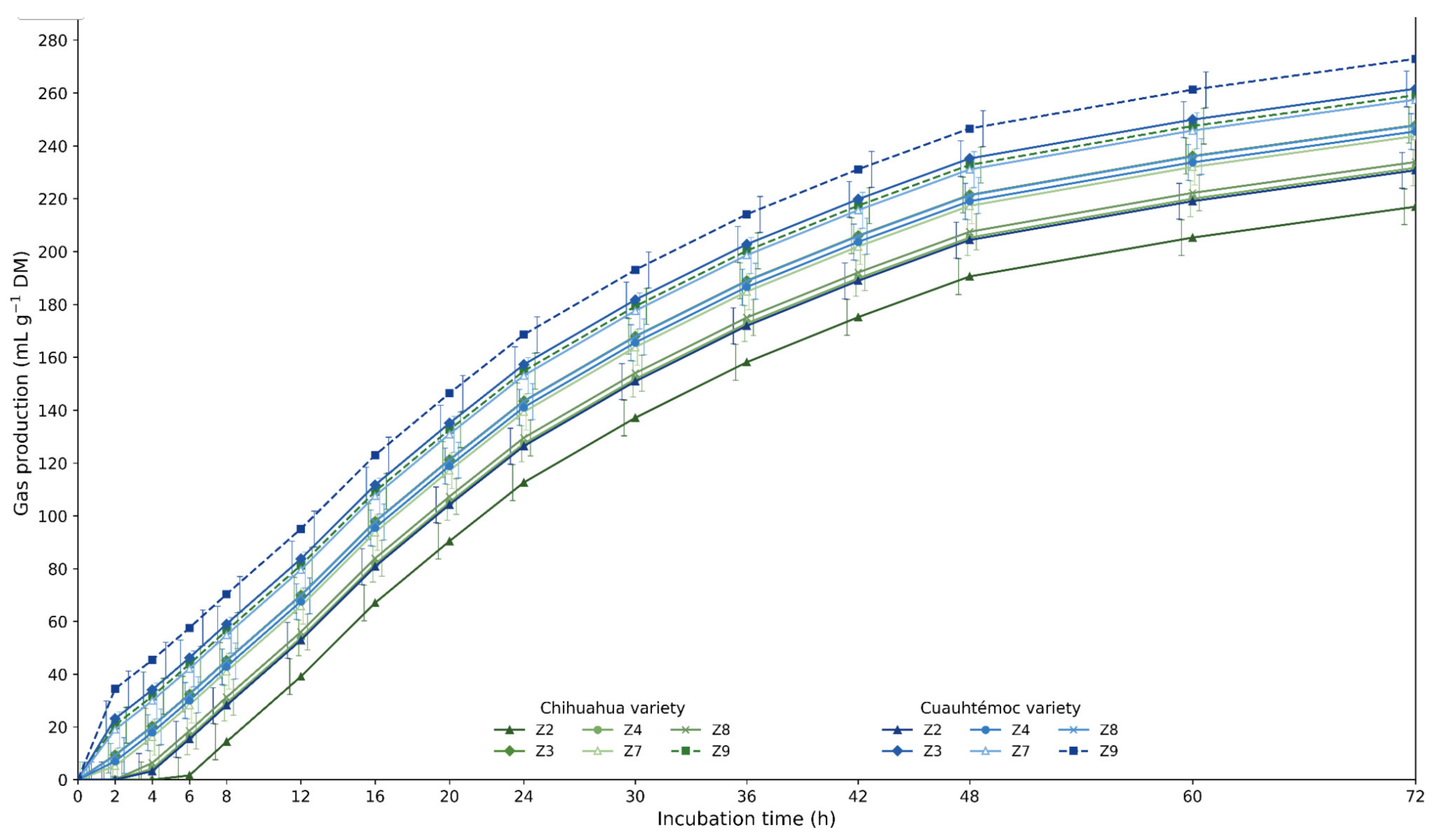
In the two oat varieties evaluated, gas production increased progressively with incubation time, although the magnitude of this response differed among phenological stages (Figure 2). The main effect of phenological stage was not significant (p = 0.2885); however, the significant phenological stage × incubation time interaction (p < 0.0001) indicates that gas production profiles over time differed among phenological stages. In the Chihuahua variety, Z2 showed the lowest gas production compared with the other phenological stages from 4 h of incubation onward, whereas in Cuauhtémoc, this pattern was evident from 2 h onward. In contrast, Z3 and Z9 generally showed the highest gas production values during the incubation period, particularly during the early stages of fermentation. The effect of incubation time was highly significant (p < 0.0001), confirming the progressive increase in cumulative gas production throughout the 72 h incubation period. A significant variety × incubation time interaction was also detected (p < 0.0001), indicating that the kinetics of gas production differed between Chihuahua and Cuauhtémoc. In addition, the variety × phenological stage interaction (p = 0.8809) and the variety × phenological stage × incubation time interaction (p = 0.9925) were not significant. It has been reported that forages exhibiting greater gas production during the first hours of in vitro incubation may have a greater proportion of readily fermentable substrates and, consequently, greater potential for rapid ruminal fermentation [13,39]. Therefore, the greater early gas production observed for stages Z3 and Z9 suggests a higher availability of rapidly fermentable substrates in these phenological stages. However, this interpretation should be considered in the context of the in vitro system and should not be directly interpreted as greater voluntary intake by ruminants without confirmation under in vivo conditions.
The differences in gas production among phenological stages may be associated with changes in the concentration and availability of soluble carbohydrates and structural carbohydrates as plant maturity progresses. Because volatile fatty acid production was not measured in the present study, potential changes in individual fermentation products, such as acetate, propionate, and butyrate, cannot be directly confirmed from the present results; however, forages with high structural carbohydrate content (cellulose and hemicellulose) produce more acetic acid and butyric acid, which are necessary for milk fat synthesis [1,14].

4. Conclusions

In conclusion, phenological stage affected the nutritional composition and in vitro fermentation characteristics of the Chihuahua and Cuauhtémoc oat varieties. Early stages (Z2–Z3) showed greater nutritional quality and digestibility, whereas advancing maturity increased structural carbohydrates and fermentable fractions. The results indicate that harvest time should be defined according to production objectives: early harvest to optimize nutritional quality and ruminal digestibility, or later harvest to increase dry matter yield and the supply of fermentable carbohydrates.

Author Contributions

Conceptualization, F.L.-R. and S.J.-C.; methodology, F.L.-R.; resources, F.L.-R., S.J.-C. and J.F.O.-O.; software, J.E.G.-R. and J.R.G.-M.; validation, M.V.-M., S.J.-C. and J.F.O.-O.; formal analysis, F.L.-R.; investigation, F.L.-R.; resources, F.L.-R., M.V.-M. and S.J.-C.; data curation J.E.G.-R.; writing—original draft preparation, F.L.-R.; writing—review and editing, J.E.G.-R., J.R.G.-M., M.V.-M., S.J.-C. and J.F.O.-O.; visualization, F.L.-R. and J.E.G.-R.; supervision, S.J.-C. and J.F.O.-O.; project administration, S.J.-C. and J.F.O.-O.; funding acquisition, F.L.-R., S.J.-C. and J.F.O.-O. All authors have read and agreed to the published version of the manuscript.

Funding

This research received no external funding.

Institutional Review Board Statement

The Research Ethics and Bioethics Committee of the Autonomous University of the State of Mexico evaluated and approved the experimental procedures applied to the Holstein cattle used in this study as rumen fluid donors, through Protocol #30-09-2020 (unique identification code 24189-C-67).

Data Availability Statement

The data presented in this study are available on request from the corresponding author due to restrictions on privacy.

Acknowledgments

The authors thank Luis Alberto Miranda-Romero for facilitating the use of the Livestock Microbiology Laboratory at the Chapingo Autonomous University.

Conflicts of Interest

The authors declare no conflicts of interest.

Abbreviations

The following abbreviations are used in this manuscript:
DMDry matter
CPCrude protein
NDFNeutral detergent fiber
ADFAcid detergent fiber
HEMHemicellulose
IVDMDIn vitro dry matter digestibility
RFVRelative forage value

References

  1. Huaraca-Oré, A.N.; Molina-Botero, I.C.; Alvarado-Bolovich, V.; DiLorenzo, N.; Gómez-Bravo, C. Oat–Vetch Hay as a Dry Season Feed for Grazing Heifers in the Peruvian Andes: Effects on Performance and Methane Emission Intensity. Grasses 2026, 5, 18. [Google Scholar] [CrossRef] [Scilit]
  2. Sinclair, T.R.; Mislevy, P.; Ray, J.D. Short photoperiod inhibits winter growth of subtropical grasses. Rapid Commun. 2001, 213, 488–491. [Google Scholar] [CrossRef] [Scilit]
  3. Liu, W.; Du, S.; Sun, L.; Wang, Z.; Ge, G.; Jia, Y. Study on Dynamic Fermentation of Oat Silage Assisted by Exogenous Fibrolytic Enzymes. Plants 2024, 13, 6. [Google Scholar] [CrossRef] [Scilit]
  4. Tahir, M.; Li, J.; Xin, Y.; Wang, T.; Chen, C.; Zhong, Y.; Zhang, L.; Liu, H.; He, Y.; Wen, X.; et al. Response of fermentation quality and microbial community of oat silage to homofermentative lactic acid bacteria inoculation. Front. Microbiol. 2023, 13, 5452. [Google Scholar] [CrossRef] [Scilit]
  5. Gadisa, B.; Debela, M.; Dinkale, T.; Tulu, A. Forage yield and quality parameters of eight oat (Avena sativa L.) genotypes at multilocation trials in Eastern Oromia, Ethiopia. Cogent Food Agric. 2023, 9, 2259521. [Google Scholar] [CrossRef] [Scilit]
  6. Mendoza-Pedroza, S.I.; Sosa-Montes, E.; Rodríguez-Ortega, L.T.; Vasques-Gomez, I.L.; Ramírez-Bribiesca, J.E.; Hernández-Guzmán, F.J. Composición química de los componentes del cultivo de avena (Avena sativa L.), variedad Chihuahua. Ecosist. Recur. Agropec. 2021, 2, e2966. [Google Scholar] [CrossRef] [Scilit]
  7. Villaseñor-Mir, H.E.; Huerta-Espino, J.; Rodríguez-García, M.F.; Santa-Rosa, R.H.; Espitia-Rangel, E.; Martínez-Cruz, E. Mejoramiento genético de avena en México. Rev. Mex. Cien. Agríc. 2021, 25, 21–25. [Google Scholar] [CrossRef] [Scilit]
  8. Arzani, H.; Zohdi, M.; Fish, E.; Amiri, G.; Nikkhah, A.; Wester, D. Phenological Effects on Forage Quality of Five Grass Species. Rangel. Ecol. Manag. 2004, 57, 624–629. [Google Scholar] [CrossRef] [Scilit]
  9. Ramírez-Ordóñes, S.; Domínguez-Díaz, D.; Salmerón-Zamora, J.J.; Villalobos-Villalobos, G.; Ortega-Gutiérrez, J.A. Producción y calidad del forraje de variedades de avena en función del sistema de siembra y de la etapa de madurez al corte. Rev. Fitotec. Mex. 2013, 36, 395–403. [Google Scholar] [CrossRef] [Scilit]
  10. Baffa, D.F.; Oliveira, T.S.; Fernandes, A.M.; Camilo, M.G.; Silva, I.N.; Meirelles Júnior, J.R.; Aniceto, E.S. Evaluation of Associative Effects of In Vitro Gas Production and Fermentation Profile Caused by Variation in Ruminant Diet Constituents. Methane 2023, 2, 344–360. [Google Scholar] [CrossRef] [Scilit]
  11. Chávez-Solis, A.U.; Ábrego-García, A.; Albores-Moreno, S.; Hernández-Sánchez, D.; Yáñez-Vergara, A.G.; Escobar-Álvarez, J.L.; López-Perea, P. In vitro methods for assessing gas production and rumen digestibility: Methodological considerations, advantages, and limitations. J. Microbiol. Meth. 2026, 247, 107566. [Google Scholar] [CrossRef] [Scilit]
  12. Zicarelli, F.; Calabrò, S.; Iommelli, P.; Grossi, M.; Infascelli, F.; Tudisco, R. Comparison of In Vitro Fermentation Characteristics Among Five Maize Varieties. Fermentation 2025, 11, 285. [Google Scholar] [CrossRef] [Scilit]
  13. Miranda-Romero, L.A.; Tirado-González, D.N.; Tirado-Estrada, G.; Améndola-Massioti, R.; Sandoval-González, L.; Ramírez-Valverde, R.; Salem, A.Z.M. Quantifying non-fibrous carbohydrates, acid detergent fiber and cellulose of forage through an in vitro gas production technique. J. Sci. Food Agric. 2020, 100, 3099–3110. [Google Scholar] [CrossRef] [Scilit]
  14. Baeg, C.-H.; Jeong, S.-M.; Wardani, A.R.D.; Kim, J.-Y.; Choi, B.-G.; Joo, Y.-H.; Kim, H.-S.; Do, Y.-H.; Park, J.-J.; Kim, S.-C. Blanching Effects of Undaria pinnatifida on Chemical Compositions, Rumen Fermentation Characteristics, Greenhouse Gas Emissions, and Rumen Microbes In Vitro. Agriculture 2026, 16, 912. [Google Scholar] [CrossRef] [Scilit]
  15. Ítavo, L.C.V.; Gurgel, A.L.C.; Ferreira Ítavo, C.C.B.; Cunha, C.S.; Longhini, V.Z.; Difante, G.d.S.; Dias, A.M.; Santana, J.C.S.; Arcanjo, A.H.M.; Niwa, M.V.G.; et al. In Vitro Digestibility and Models of Cumulative Gas Production of Forage-Free Diet. Animals 2023, 13, 3515. [Google Scholar] [CrossRef] [Scilit]
  16. Nguyen, H.T.D.; Derix, J.; Hendriks, W.H.; Schonewille, J.T.; Nguyen, T.X.; Pellikaan, W.F. Species and Harvest Time of Fresh Tropical Grasses Affect Rumen Fermentation as Determined by In Sacco and In Vitro Incubations. Fermentation 2025, 11, 276. [Google Scholar] [CrossRef] [Scilit]
  17. Pan, L.; Huang, K.H.; Middlebrook, T.; Zhang, D.; Bryden, W.L.; Li, X. Rumen Degradability of Barley, Oats, Sorghum, Triticale, and Wheat In Situ and the Effect of Pelleting. Agriculture 2021, 11, 647. [Google Scholar] [CrossRef] [Scilit]
  18. Xiong, Y.; Xu, J.; Guo, L.; Chen, F.; Jiang, D.; Lin, Y.; Guo, C.; Li, X.; Chen, Y.; Ni, K.; et al. Exploring the Effects of Different Bacteria Additives on Fermentation Quality, Microbial Community and In Vitro Gas Production of Forage Oat Silage. Animals 2022, 12, 1122. [Google Scholar] [CrossRef] [Scilit]
  19. Zadoks, J.C.; Chang, T.T.; Konzak, C.F. A decimal code for the growth stages of cereals. Weed Res. 1974, 14, 415–421. [Google Scholar] [CrossRef] [Scilit]
  20. Lucio-Ruiz, F.; Joaquín-Cancino, S.; Garay-Martínez, J.R.; Estrada-Drouaillet, B.; Bautista-Martínez, Y.; Limas-Martínez, A.G. Thermal sum in the determination of the phenological stages of Chihuahua and Cuauhtémoc oats in Güémez Tamaulipas. Agroproductividad 2022, 15, 103–110. [Google Scholar] [CrossRef] [Scilit]
  21. AOAC. Official Methods of Analysis, 21st ed.; Association of Official Analytical Chemists: Gaithersburg, MD, USA, 2019. [Google Scholar]
  22. Van Soest, P.J.; Robertson, J.B.; Lewis, B.A. Methods for dietary fiber, neutral detergent fiber and non-starch polysaccharides in relation to animal nutrition. J. Dairy Sci. 1991, 74, 3583–3597. [Google Scholar] [CrossRef] [Scilit]
  23. Undersander, D.; Moore, J.E.; Schneider, N. Relative forage quality. Focus Forage 2002, 4, 1–2. [Google Scholar]
  24. Menke, K.H.; Steingass, H. Estimation of the energetic feed value obtained from chemical analysis and in vitro gas production using rumen fluid. Anim. Res. Dev. 1988, 28, 7–55. [Google Scholar]
  25. Theodorou, M.K.; Williams, B.A.; Dhanoa, M.S.; McAllan, A.B.; France, J. A simple gas production method using a pressure transducer to determine the fermentation kinetics of ruminant feeds. Anim. Feed. Sci. Technol. 1994, 48, 185–197. [Google Scholar] [CrossRef] [Scilit]
  26. Miranda-Romero, L.A.; Vazquez-Mendoza, P.; Burgueño-Ferreira, J.A.; Aranda-Osorio, G. Nutritive value of cactus pear silages for finishing lambs. J. Prof. Assoc. Cactus Dev. 2018, 20, 196–215. [Google Scholar] [CrossRef] [Scilit]
  27. SAS (Statistical Analysis System). SAS/STAT User’s Guide (Release 6.4); SAS Institute: Cary, NC, USA, 2017. [Google Scholar]
  28. Pitt, R.E.; Cross, T.L.; Pell, A.N.; Schofield, P.; Doane, P.H. Use of In Vitro Gas Production Models in Ruminal Kinetics. Math. Biosci. 1999, 159, 145–163. [Google Scholar] [CrossRef] [Scilit]
  29. Lazzarini, I.; Detmann, C.E.; Batista, S.; Fonseca, P.M.; Valadares, F.S.C.; Augusto, S.M.; Albani, O.F. Intake and digestibility in cattle fed low-quality tropical forage and supplemented with nitrogenous compounds. R. Bras. Zootec. 2009, 38, 2021–2030. [Google Scholar] [CrossRef] [Scilit]
  30. Mamani, P.J.; Cotacallapa, G.F.H. Rendimiento y calidad nutricional de avena forrajera en la región de Puno. J. High Andean Res. 2018, 20, 385–400. [Google Scholar] [CrossRef] [Scilit]
  31. Rosser, C.L.; Górka, P.; Beattie, A.D.; Block, H.C.; McKinnon, J.J.; Lardner, H.A.; Penner, G.B. Effect of maturity at harvest on yield, chemical composition, and in situ degradability for annual cereals used for swath grazing. J. Anim. Sci. 2013, 91, 3815–3826. [Google Scholar] [CrossRef] [Scilit]
  32. Ramírez, S.; Domínguez, D.; Salmerón, J.J.; Villalobos, G.; Ortega, J.A. Contreo en surcos y etapa de madurez sobre la producción y calidad del forraje de variedades de avena. Arch. Zootec. 2015, 64, 237–244. [Google Scholar] [CrossRef] [Scilit][Green Version]
  33. Salamanca-Carreño, A.; Vélez-Terranova, M.; Vargas-Corzo, O.M.; Parés-Casanova, P.M.; Bentez-Molano, J. Productive and Nutritional Characteristics of Native Grasses from the Floodplain Banks Ecosystem in the Colombian Orinoquia. Sustainability 2022, 14, 15151. [Google Scholar] [CrossRef] [Scilit]
  34. Wróbel, B.; Zielewicz, W.; Paszkiewicz-Jasińska, A. Improving Forage Quality from Permanent Grasslands to Enhance Ruminant Productivity. Agriculture 2025, 15, 1438. [Google Scholar] [CrossRef] [Scilit]
  35. Álvarez-Torres, J.N.; Ramírez-Bribiesca, J.E.; Bautista-Martínez, Y.; Crosby-Galván, M.M.; Granados-Rivera, L.D.; Ramírez-Mella, M.; Ruiz-González, A. Stability and Effects of Protected Palmitic Acid on In Vitro Rumen Degradability and Fermentation in Lactating Goats. Fermentation 2024, 10, 110. [Google Scholar] [CrossRef] [Scilit]
  36. Grummer, R.R.; Mashek, D.G.; Hayirli, A. Dry matter intake and energy balance in the transition period. Vet. Clin. N. Am. Food Anim. Pract. 2004, 20, 447–470. [Google Scholar] [CrossRef] [Scilit]
  37. Ortiz-Robledo, F.; Villanueva-Fierro, I.; Oomah, B.D.; Lares-Asef, I.; Proal-Najera, J.B.; Navar-Chaidez, J.J. Avenanthramides and nutritional components of four mexican oat (Avena Sativa L.) varieties. Agrociencia 2013, 47, 225–232. [Google Scholar]
  38. Wang, Y.; Li, T.; Chen, X.; Liu, C.; Jin, X.; Tan, H.; Long, M. Preliminary Investigation of Mixed Orchard Hays on the Meat Quality, Fatty Acid Profile, and Gastrointestinal Microbiota in Goat Kids. Animals 2022, 12, 780. [Google Scholar] [CrossRef] [Scilit]
  39. Hetta, M.; Cone, J.W.; Bernes, G.; Gustavsson, A.M.; Martinsson, K. Voluntary intake of silages in dairy cows depending on chemical composition and in vitro gas production characteristics. Lives. Sci. 2007, 106, 47–56. [Google Scholar] [CrossRef] [Scilit]
Figure 1. Total dry matter yield and yield of each morphological component of the Cuauhtémoc and Chihuahua oat varieties at different phenological stages. Z2: tillering; Z3: stem elongation; Z4: stuffing; Z7: milky grain; Z8: doughy grain; Z9: physiological maturity [20]. Data reported by Lucio-Ruiz et al. [20] on the forage used for this research.
Grasses 05 00033 g001
Figure 2. Kinetics of gas production from the in vitro fermentation of oat forage varieties Chihuahua and Cuauhtémoc at different phenological stages using the Zadoks et al. [19] scale. Z2 = tillering; Z3 = stem elongation; Z4 = stuffing; Z7 = milky grain; Z8 = doughy grain; Z9 = physiological maturity. p-values for the fixed effects were: variety, p = 0.0057; phenological stage, p = 0.2885; incubation time, p < 0.001; variety × phenological stage, p = 0.8809; variety × incubation time, p < 0.001; phenological stage × incubation time, p < 0.001; and variety × phenological stage × incubation time, p = 0.9925.
Grasses 05 00033 g002
Table 1. Summary of the analysis of variance of the effect of variety and phenological stage on the forage quality variables of oat sativa varieties Chihuahua and Cuauhtémoc.
FactorCPADFNDFHemicelluloseAshDDMDMIRFV
Variety0.05290.00030.12150.1142<0.00010.00630.00710.0001
Phenological state<0.0001<0.00010.00300.0035<0.00010.00630.0094<0.0001
Variety × Phenological state0.07400.00120.01410.00180.00180.01470.0091<0.0001
p-values ≤ 0.05 indicate statistically significant effects and are presented in bold; CP: crude protein; ADF: acid detergent fiber; NDF: neutral detergent fiber; DDM: digestible dry matter; DMI: dry matter intake; RFV: relative forage value.
Table 2. Nutritional value of forage from Chihuahua and Cuauhtémoc oat varieties in different phenological states.
PSCrude ProteinNeutral Detergent FiberAcid Detergent FiberHemicellulose
ChCuChCuChCuChCu
g kg−1
Z2261Aa286Aa446Cb559Da300Ca326Da145Bb233Aba
Z3153Ba166Ba581Ba607Ca374Ba388Ca207Aba197Ba
Z4128Ca127Ca609ABa649Ba397Ba415BCa213Aba204Aba
Z796Da104CDa683Aa673Aa459Aa455Aa223Aa218Aba
Z897Da99CDa687Aa679Aa444Aa440Aba243Aa238Aa
Z992Da85Da610ABa626Ba392Bb408BCa218Aa216Aba
SEM0.493.691.610.96
PSAshDigestible Dry MatterDry Matter IntakeRelative Forage Value
ChCuChCuChCuChCu
g kg−1% of body weight
Z2175Aa164Aa655Aa635Aa2.69Aa2.15Ab137Aa106Ab
Z3154Ba135Bb597Ba587Ba2.07Ba2.05Ba96Ba93Ba
Z4121Ca102Cb580Ba566BCa1.97BCa1.94Ca89Ba85Cb
Z7110CDa94Cb531Ca534Da1.76Ca1.78Da72Ca74Da
Z889Ea99Ca543Ca546CDa1.75Ca1.77Da74Ca75Da
Z992DEa84Db584Ba571BCb1.97BCa1.92Ca89Ba85Ca
SEM0.277.591.651.96
Different superscripts between rows within the same column (ABCDE) and between columns within the same row (ab) for each response variable indicate statistical differences (Tukey α = 0.05). PS = phenological stage on the scale of Zadoks et al. [19]: Z2 = tillering; Z3 = stem elongation; Z4 = stuffing; Z7 = milky grain; Z8 = doughy grain; Z9 = physiological maturity; Ch = Chihuahua; Cu = Cuauhtémoc; SEM = standard error of the mean. PS = physiological stage.
Table 3. Digestibility and parameters of in vitro gas production kinetics of oat forage varieties Chihuahua and Cuauhtémoc in different phenological stages.
PSMVSLIVDMD72h
(mL g−1)(mL h−1)(h)(%)
ChihuahuaCuauhtémocChihuahuaCuauhtémocChihuahuaCuauhtémocChihuahuaCuauhtémoc
Z2186.20Ca196.75Ba0.0323ABa0.0332Aa5.43Aba5.27Aa81.66Aa77.39Aa
Z3218.70ABCb224.50Ab0.0330Aa0.0305Aba4.81BCa3.38Bb80.14Aa77.26Aa
Z4207.48BCb244.25Aa0.0306BCa0.0300BCa5.63Aba5.49Aa78.67Aa77.44Aa
Z7230.23ABa261.28Aa0.0300Ca0.0297BCa5.71Aa3.86Bb75.44Aba71.24Aba
Z8233.75ABa265.85Aa0.0270Da0.0272Ca3.98Ca3.14Bb65.42BCa66.74Ba
Z9252.40Aa260.68Aa0.0278Db0.0286BCa1.98Da1.56Cb61.65Ba65.56Ba
SEM12.89570.000650.353914.0849
p-value
V0.00430.09510.01720.6170
PS0.4992<0.0001<0.00010.0009
V × PS 0.01600.21450.58120.9077
Different superscripts between rows within the same column (ABCD) and between columns within the same row (ab) for each response variable indicate statistical differences (Tukey’s test, p < 0.05). PS = phenological stage on the scale of Zadoks et al. [19]: Z2 = tillering; Z3 = stem elongation; Z4 = stuffing; Z7 = milky grain; Z8 = doughy grain; Z9 = physiological maturity; MV = maximum volume; S = gas production rate; L = Lag phase; IVDMD72h = in vitro digestibility of dry matter at 72 h of incubation; SEM = standard error of the mean. p-values correspond to the fixed effects of variety (V), phenological stage (PS), and their interaction (V × PS).
Table 4. Fermentable fractions of oat forage from Chihuahua and Cuauhtémoc in different phenological states.
PSFFFMFFSFFTFF
g Kg−1 MS
ChihuahuaCuauhtémocChihuahuaCuauhtémocChihuahuaCuauhtémocChihuahuaCuauhtémoc
Z265.60Da70.07Da142.57BCb155.49CDa179.56Ca183.34Ba387.73Ca408.90Ca
Z389.24BCb125.68Ba167.50Aa186.25Aa203.62BCa249.17Aa460.36ABCb561.10Aa
Z471.50CDb89.25CDa148.46ABCb172.05ABCa212.93ABCb248.62Aa432.89BCb509.92ABa
Z776.71CDb116.83Ba163.67Aba177.92Aba237.06Aba257.31Aa477.43ABa552.06ABa
Z8102.78BCa105.59BCa141.79Ca140.56Da246.68Aa222.14Aba491.24ABa468.28BCa
Z9145.09Ab157.30Aa155.76ABCb164.06BCa233.46Aba235.83Aa534.31Aa557.19ABa
SEM10.628.926611.999728.1001
p-value
V0.35430.00350.00030.0040
PS0.02690.04010.8380.4828
V × PS 0.27780.02260.00140.0136
Different superscripts between rows within the same column (ABCD) and between columns within the same row (ab) for each response variable indicate statistical differences (Tukey’s test, p < 0.05). PS = phenological stage on the scale of Zadoks et al. [19]: Z2 = tillering; Z3 = stem elongation; Z4 = stuffing; Z7 = milky grain; Z8 = doughy grain; Z9 = physiological maturity; FFF = fast fermentable fraction; MFF = medium fermentable fraction; SFF = slow fermentable fraction; TFF = total fermentable fraction; SEM = standard error of the mean. PS = physiological stage. p-values correspond to the fixed effects of variety (V), phenological stage (PS), and their interaction (V × PS).
Disclaimer/Publisher’s Note: The statements, opinions and data contained in all publications are solely those of the individual author(s) and contributor(s) and not of MDPI and/or the editor(s). MDPI and/or the editor(s) disclaim responsibility for any injury to people or property resulting from any ideas, methods, instructions or products referred to in the content.