
Article

Stomatal Characterization of Grasses Present in an Oak-Pine Ecosystem

by
Jaime Neftalí Márquez-Godoy
1,
Edith Ramírez-Segura
2,*,
Abieser Vázquez-González
3,
Alan Álvarez-Holguín
4,
Carlos Raúl Morales-Nieto
4,*,
Raúl Corrales-Lerma
4 and
José Humberto Vega-Mares
4
1
Instituto Nacional de Investigaciones Forestales, Agrícolas y Pecuarias (INIFAP), Campo Experimental Valle de Culiacán, Culiacán 80398, Mexico
2
Instituto Nacional de Investigaciones Forestales, Agrícolas y Pecuarias (INIFAP), Sitio Experimental Metepec, Toluca 52140, Mexico
3
Instituto Nacional de Investigaciones Forestales, Agrícolas y Pecuarias (INIFAP), Campo Experimental Santiago Ixcuintla, Santiago Ixcuintla, Nayarit 63300, Mexico
4
Departamento de Recursos Naturales, Facultad de Zootecnia y Ecología, Universidad Autónoma de Chihuahua, Periférico Francisco R. Almada km 1, Chihuahua 31000, Mexico
*
Authors to whom correspondence should be addressed.
Grasses 2026, 5(2), 16; https://doi.org/10.3390/grasses5020016
Submission received: 9 February 2026 / Revised: 31 March 2026 / Accepted: 2 April 2026 / Published: 8 April 2026

Abstract

Forage grasses are an important component of livestock systems due to their contribution to animal feed, soil conservation, and carbon sequestration. In the face of climate change, analyzing stomatal characteristics allows us to understand the mechanisms of adaptation and tolerance to environmental stress. Therefore, the objective of this study was to determine the stomatal characteristics and trichome density of ten forage grasses present in a pine-oak dominated ecosystem. Sampling was carried out in October and November 2022 on a 1938 ha area. Mature, healthy leaves were selected, and epidermal impressions were obtained from the adaxial and abaxial surfaces using the cyanoacrylate method. Observations were made with an optical microscope at 400× magnification, quantifying stomatal density, trichome density, number of epidermal cells, and stomatal index per mm2. The results indicated that nine species were amphistomatic, while Schizachyrium scoparium exhibited an epistomatic pattern. Muhlenbergia arizonica showed the highest stomatal density, and Setaria parviflora the lowest. It is concluded that there is high stomatal variability among species, highlighting its importance for the management and improvement of pastures.

Graphical Abstract

1. Introduction

Grasses constitute an important component of livestock production systems, serving as the primary feed source in extensive grazing systems [1]. Beyond their role in animal nutrition, grasses contribute substantially to carbon sequestration and soil conservation, and overall ecosystem stability. Their ability to adapt to extreme conditions is fundamental for maintaining these ecosystem services and sustaining livestock production in the face of climate change [2,3,4].
Climate change, such as increased temperatures [5] and decreased precipitation [6] poses significant challenges to grassland ecosystems. These changes can trigger morphophysiological and genetic responses in plants, including shifts in growth patterns, phenology, geographic distribution, and physiology processes such as photosynthesis and respiration [7]. In severe cases, such pressures may even lead to local species loss [8]. Understanding plant morphoanatomical traits is crucial for evaluating species’ adaptive capacity, tolerance, resilience, and evolutionary responses, as well as for predicting productivity under environmental stress [9]. Wu et al. [10] reported that variations in temperature and solar radiation, along with changes in precipitation distribution, have resulted in a 6.1% decrease in the productivity and growth of grasslands globally.
Among plant adaptative traits, stomata play a central role in maintaining and regulating plant homeostasis [11]. Their regulation of gas exchange directly influences photosynthesis, transpiration, and water-use efficiency. The broad ecological amplitude of grasses, from arid and semi-arid lands to tropical regions, is strongly linked to their physiological and morphological plasticity, and adaptation including stomatal characteristics [12]. Stomatal traits are therefore critical for optimizing carbon dioxide (CO2) uptake while minimizing water loss, especially in environments where water availability is limited [12,13,14].
Several grass species, such as sideoats grama (Bouteloua curtipendula) and wolftail grass (Muhlenbergia phleoides), have shown remarkable adaptation to arid, semi-arid, and tropical environments, making them valuable for the restoration and improvement of vulnerable grasslands [15,16]. Álvarez-Holguín et al. [15] performed a stomatal characterization of three commercial varieties of sideoats grama (El Reno, Niner, and Vaughn) and two native genotypes from the state of Chihuahua (E-689 and E-592). These authors concluded that the native genotypes exhibited lower stomatal density (152.7 stomata µm−2) and stomatal index (13.41%), which were associated with greater biomass production. Furthermore, species with a lower density of stomata cause a decrease in evapotranspiration, thus increasing the efficiency of water use and exhibiting greater tolerance to water stress without compromising the growth and development of the plant [17,18].
Pine-oak ecosystems in northern Mexico are characterized by strong environmental gradients, including high solar radiation, seasonal water limitation, and wide thermal fluctuations associated with elevation and climate conditions [19]. These environmental factors may influence leaf anatomical traits in grasses. However, despite the ecological importance of these ecosystems, information on stomatal traits of native forage grasses growing in pine-oak environments remains limited. Characterizing stomatal traits in grasses occurring under these conditions may therefore provide valuable insight into anatomical strategies associated with plant adaptation and ecological performance in mountain ecosystems. In addition to stomatal traits, trichomes can also play an important role in plant responses to environmental stress by influencing leaf temperature, radiation reflection, and water loss. Therefore, evaluating both stomatal and trichome traits may contribute to more comprehensive understanding of leaf anatomical adaptations in grasses. In this study, ten forage grass species were selected because they represent the most abundant and ecologically representative grasses in the study area. Based on the environmental conditions typical of pine-oak ecosystems, we hypothesized that most grass species occurring in this ecosystem would exhibit amphistomatic leaves, a trait commonly associated with species growing under high radiation and open canopy conditions, and that significant interspecific variation in stomatal density, stomatal index, and trichome density would occur among species, reflecting different anatomical strategies related to environmental stress tolerance. Accordingly, the objective of this study was to characterize stomatal distribution, stomatal density, stomatal index, epidermal cell number, and trichome density in ten forage grass species growing in a pine-oak ecosystem.

2. Materials and Methods

2.1. Study Area

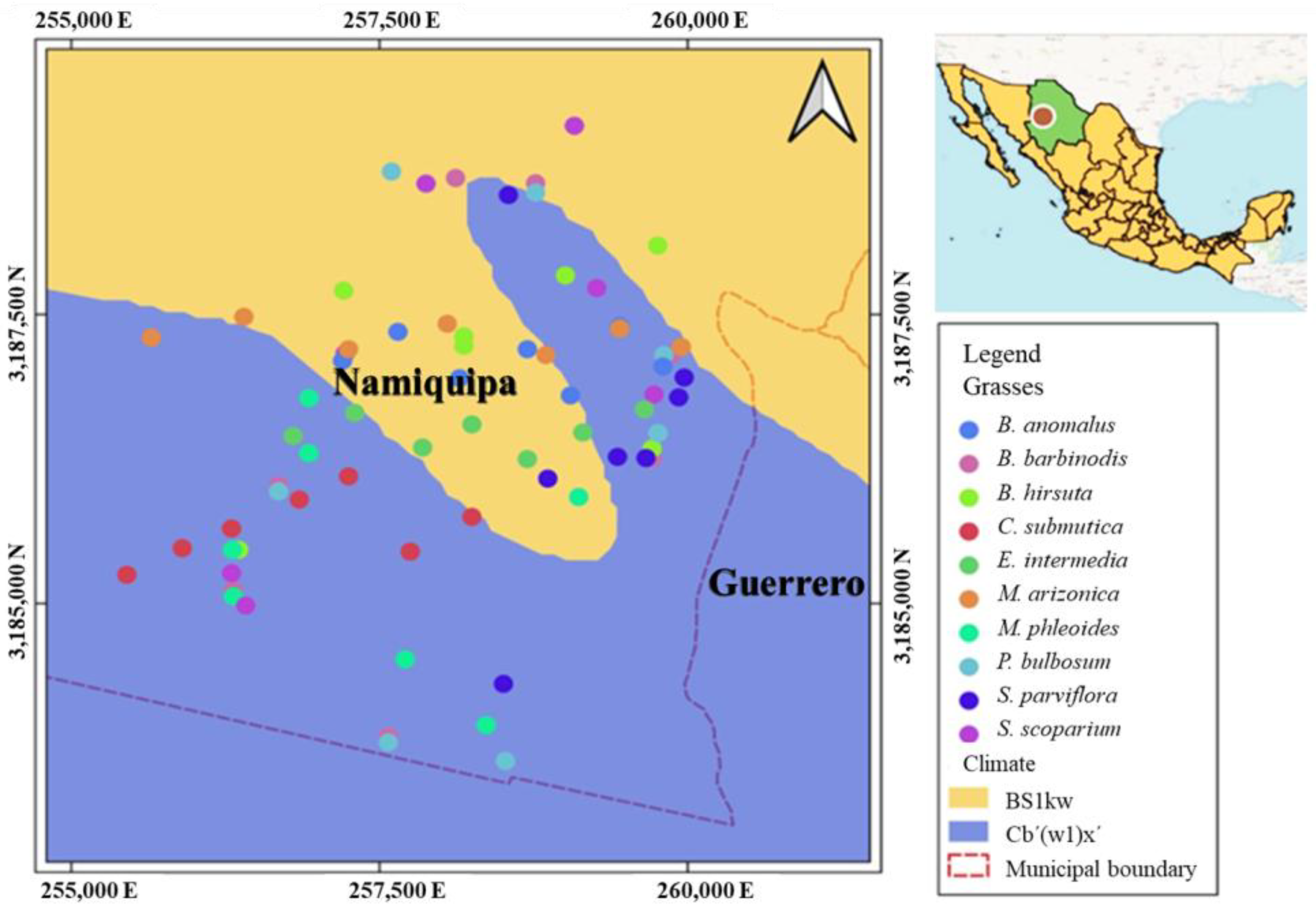
The study was conducted in the municipality of Namiquipa, Chihuahua, Mexico (Figure 1). The region is characterized by a wide thermal range, with recorded temperature from −14.6 °C to 36 °C, a mean annual precipitation of 580 mm and an altitude ranging from 1900 to 2800 m [20]. Vegetation varies along this elevational gradient. Higher elevations are dominated by pine species (Pinus cembroides and Pinus arizonica). Mid-elevations zones characterized by oak woodlands, where Quercus oblongifolia, Quercus aizonica, and Quercus hypoleucoides are predominant. In the lower areas and open hillsides, grasses predominate, with representative species including Bouteloua gracilis, Muhlenbergia phleoides, M. arizonica, B. hirsuta, among others.

2.2. Sample Collection

Field sampling was conducted during October and November 2022, corresponding to the late growing season in the region, when grasses present fully developed and mature leaves suitable for anatomical analysis. A systematic field survey was conducted across approximately 1938 hectares of a pine-oak forest. The ten most abundant species in the area were identified (Table 1), and their presence was recorded every 200 m to document their distribution and relative abundance. For each species, seven randomly selected individuals were sampled across the study area, and one fully expanded leaf was collected from each plant. Leaves were selected from the mid-canopy, and only mature and healthy leaves without visible damage, wilting, or pest infestation were used form analysis. Three epidermal impressions were obtained from each leaf to assess intrafoliar variability. Leaf epidermal impressions were prepared using the cyanoacrylate (instant glue) method. A drop of cyanoacrylate glue was applied to a microscope slide, and the leaf surface was pressed onto the glue for approximately 30 s before being removed. This procedure was performed on both the adaxial and abaxial surfaces of each leaf.
The resulting prints were observed under a bright-field microscope at 400× magnification. Images were captured from three optical fields, each with an area of 0.0946 mm2. In each image, stomatal density (SD), trichomes density (TD), epidermal cell count (EC), and stomatal index (SI) per square millimeter (mm−2) were recorded. ZEN 3.4 (blue edition) software was used for image capture and analysis. The IE was calculated using the formula proposed by Wilkinson [23]: % SI = [SD/(EC + SD)] × 100, which indicates the percentage of stomata relative to the total number of stomatal and epidermal cells.
All variables (SD, TD, EC, and IE) were calculated independently for both surfaces (upper and lower). This allowed for detailed information to be obtained about the structure and distribution of cells and stomata on each leaf surface.

2.3. Statistical Analysis

Descriptive statistics, including maximum, mean, minimum, and coefficient of variation (CV), were calculated for all variables. Assumptions of normality and homogeneity of variance were valuated prior to analysis; however, the data did not meet the normality assumption. Therefore, non-parametric statistics were used to compare ranks between leaf surfaces (adaxial vs. abaxial) and species evaluated, using the Kruskal–Wallis test. When significant differences were detected (p < 0.05), Dunn’s post hoc test was applied to identify which species differed significantly. The analyses were performed using the statistical package SAS 9.1.3 (Statistical Analysis System [24]).

3. Results

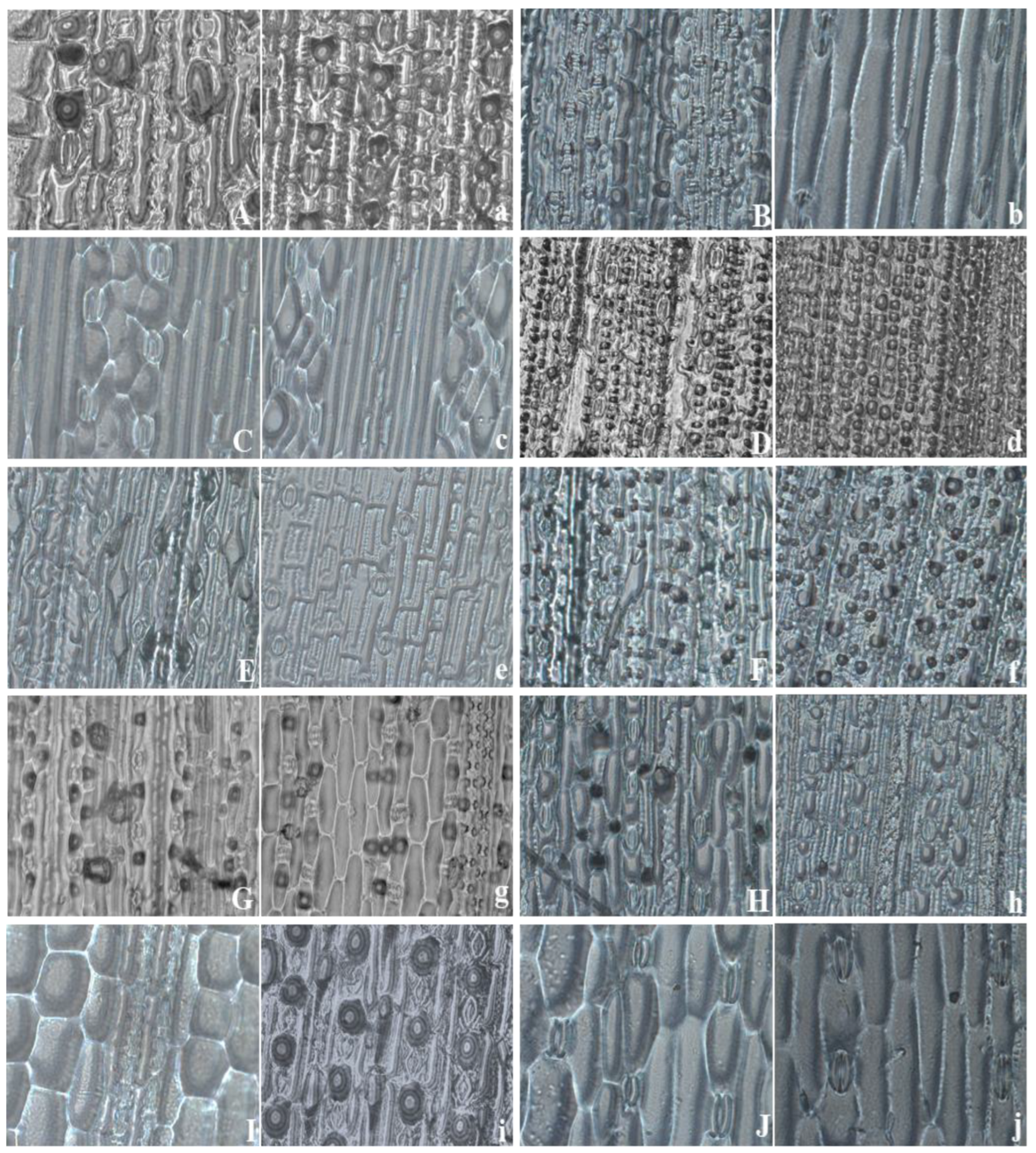
The results revealed that nine of the ten species evaluated were amphistomatic, indicating the presence of stomata on both leaf surfaces. In this study, species were considered amphistomatic when stomata were observed on both the adaxial and abaxial epidermis, regardless of their relative abundance. In contrast, Schizachyrium scoparium was epistomatic, with stomata restricted to the adaxial surface (Figure 2; Table 2). These results indicate that amphistomatic leaves predominate among grasses growing in the studied pone-oak ecosystem.
Table 2 summarizes the descriptive statistics of stomatal density (SD), trichome density (TT), stomatal index (SI), and number of epidermal cells (EC) measured on both adaxial and abaxial leaf surface. Overall, the evaluated anatomical variables showed wide variation among species, indicating substantial diversity in epidermal structure among grasses present in the studied ecosystem.
Stomatal density (SD) varied markedly among species on both leaf surfaces. On the adaxial surface, mean SD values ranged from 60.0 stomata mm−2 in Setaria parviflora to 299.8 stomata mm−2 in Muhlenbergia arozonica. On the abaxial surface, mean SD ranged from 38.8 stomata mm−2 in Bouteloua hirsute to 317.5 stomata mm−2 in Muhlenbergia arizonica. The coefficient of variation (CV) for SD ranges from 5.8% to 39.5% on the adaxial surface and from 5.8 to 24.0% on the abaxial surface, indicating moderate variability among species.
Trichome density (TD) showed the greatest variation among the evaluated anatomical variables. Mean TD values ranged from 0 trichomes mm−2 in Setaria parviflora, Bouteloua hirsute and Eragrostis intermedia on the abaxial surface to 1777.8 trichomes mm−2 in Chloris submutica. The highest TD values were consistently recorded in Chloris submutica, with mean values of 1590.8 and 1777.8 trichomes mm−2 on the adaxial and abaxial surface, respectively. Other species, such as Muhlenbergia arizonica and Muhlenbergia phleoides, also presented relatively high trichome densities compared to the remaining species. The coefficient of variation for TD ranged from 6.1% to 25.5% on the adaxial surface and from 0% to 42.2% on the abaxial surface, indicating high variability in trichome distribution among species.
The stomatal index (SI) also varied among species and between leaf surfaces. On the adaxial surface, SI values ranged from 11.2% in Chloris submutica to 19.9% in Setaria parviflora. On the abaxial surface, SI ranged from 10.9% in Eragrostis intermedia to 20.1% in Schizachyrium scoparium, representing the highest SI recorded in the evaluated species. Intermediate SI values were observed in Panicum bulbosum (18% adaxial and 16.8% abaxial) and Muhlenbergia arizonica (16.7% adaxial and 17.2% abaxial).
Finally, the number of epidermal cells (EC) also showed variation among species. On the adaxial surface, EC range from 243.4 cells mm−2 in Setaria parviflora to 1499.1 cells mm−2 in Muhlenbergia arizonica. On the abaxial surface, values ranged from 222.2 cells mm−2 in Setaria parviflora to 1527.3 cells mm−2 in Muhlenbergia arizonica. High EC values were also observed in Muhlenbergia phleoides, which showed mean values of 1358.0 ells mm−2 on the adaxial surface.

4. Discussion

The predominance of amphistomatic leaves observed in the evaluated grass species suggests an anatomical trait that may enhance gas exchange under the environmental conditions of the studied pine-oak ecosystem. The presence of stomata on both leaf surfaces has been associated with a greater capacity for gas exchange, allowing increased CO2 uptake in environments with high solar radiation and elevated evaporative demand [25]. In amphistomatic species, stomata on the two leaf surfaces may respond independently to environmental stress conditions [25]. Stomata on the adaxial surface are often more sensitive to water and heat stress [26], likely because this surface is more directly exposed to solar radiation. Under such conditions, amphistomatic species may close stomata on the adaxial surface to reduce transpiration while maintaining partial opening on the abaxial surface, thereby sustaining CO2 uptake and photosynthesis [25]. Furthermore, stomatal conductance has been reported to be higher on the adaxial surface in some C3 and C4 grass species, suggesting differentiated functional regulation between the two leaf surfaces [27]. These anatomical characteristics may help explain the functional relevance of stomatal distribution in grasses growing in environments with high radiation and periodic water limitation.
The variation in trichome density observed among the evaluated grass species suggests potential differences in anatomical strategies related to environmental stress tolerance in the studied pine-oak ecosystem. Trichomes are known to contribute to plant protection by reducing transportational water loss, reflecting excess solar radiation, moderating leaf temperature, and providing defense against herbivores and insects [28,29]. High trichome density is commonly associated with greater tolerance to abiotic stress conditions such as drought, high temperatures, and intense solar radiation [30]. For instance, Ahmad et al. [31] evaluated ecotypes of Bermuda grass (Cynodon dactylon) collects at different altitudes (700, 1571, and 2804 m) on Pir Chinasi Mountain in the Himalayas and found that ecotypes from the highest altitude exhibited higher trichome density (84.87 mm−2), which may represent an adaptive advantage under increased solar radiation [32]. Trichomes may also provide thermal insulation by buffering temperature fluctuations and protecting mesophyll cells [33]. In addition, a greater number of trichomes can generate a boundary layer on the leaf surface that decreases air velocity and reduce water loss through transpiration [31]. These mechanisms may help explain the functional relevance of trichome density variation observed among the grass species evaluated in this study.
The highest SI were recorded in Schizachyrium scoparium (20.1% on the abaxial surface) and Setaria parviflora (19.9% on the adaxial surface). Muhlenbergia arizonica had the highest number of epidermal cells (1672.0 cells mm−2) and adaxial (1661.4 cells mm−2) surfaces, followed by Muhlenbergia phleoides with 1407.4 cells mm2 epidermal cells on the adaxial surface. The importance of the stomatal index lies in its close relationship with gas exchange and transpiration processes, which are fundamental for photosynthesis and water balance in plants [17,34]. A high SI indicates a greater proportion of stomata relative to total epidermal cells and is often associated with conditions where water is not strongly limiting, allowing enhanced CO2 uptake. Ochoa-Lechuga et al. [35] performed a stomatal characterization on three native Mexican grasses (Bouteloua curtipendula, Muhlenbergia phleoides, and Leptochloa dubia) in a pine forest in Tamaulipas, Mexico, and described that Muhlenbergia phleoides had the highest stomatal index (16.2%), suggesting that it may increase CO2 absorption for photosynthesis. This trait is often associated with environmental conditions where water supply is not a limiting factor, favoring a greater capacity for gas exchange [17]. Conversely, a low stomatal index is common in plants subjected to extreme climatic conditions. For example, Ganem et al. [36] assessed that exposure to low temperatures (5 °C vs. 25 °C) reduced SI in wheat (11.5 vs. 8.6%), barley (13.4 vs. 12.2%), rye (12.0 vs. 10.9%), and oats (16.2 vs. 12.8%), indicating a structural adjustment that may limit water loss under stress. Similarly, under water deficit conditions, increased stomatal resistance—often linked to fewer functional stomata or greater stomatal closure—significantly reduces transpiration [37]. Thakur [38] further demonstrated that the stomatal density influences diffusive resistance, with drought-resistant cultivars showing stomatal traits that increase resistance and limit excessive water loss. Overall, both stomatal density and stomatal index are strongly influenced by environmental stressors such as drought and salinity, highlighting their importance as adaptive anatomical traits.
These anatomical characteristics determine how plants respond to challenging environmental conditions and can also influence their photosynthetic efficiency. Molina-Salazar et al. [39] studied the relationship between photosynthetic efficiency and stomatal characteristics in 51 populations of sideoats grama (Bouteloua curtipendula) from the state of Chihuahua, Mexico. These authors reported and average maximum quantum efficiency of photosystem II (Fv/Fm) of 0.33, which may indicate reduced PSII efficiency under stress conditions. In general, lower Fv/Fm values are associated with limitations in photochemical performance, reflecting potential stress effects on the photosynthetic apparatus rather than a universal threshold. Furthermore, this study reported a negative relationship between stomatal size and photochemical efficiency (rxy = −0.30), indicating an association between stomatal traits and photosynthetic performance under stress conditions such as high temperatures or low humidity. Similarly, Álvarez-Holguín et al. [40] demonstrated that in Bouteloua curtipendula, genotypes with lower stomatal density (152.7 stomata µm2) and larger stomatal area (361.7 µm2) produced greater biomass, highlighting the positive relationship between stomatal traits and productivity. Monzón-Burgos et al. [41] further reported that populations of this species characterized by low stomatal density but larger stomata showed a greater establishment success under field conditions than those with numerous smaller stomata. More recently, Álvarez-Holguín et al. [40] evaluated the acclimatization responses to drought in Bouteloua curtipendula seedlings and found that drought-tolerant populations increased stomatal area while reducing stomatal density, a combination associated with improved water use efficiency under drought conditions. Márquez-Godoy et al. [16] identified stomatal anatomical adaptations in Muhlenbergia phleoides that facilitate efficient regulation of gas exchange, increasing resistance to water stress. Likewise, Trod et al. [42] demonstrated that phenotypic plasticity in stomatal density is a key adaptive trait in Trichloris crinita and T. pluriflora, enabling these species to adjust to contrasting water availability regimes. Stomatal characterization offers valuable information for breeding programs focused on developing more resilient plant varieties. Hernández-Hernández et al. [43] demonstrated that anatomical differences in stomata among rose cultivars directly influenced their responses to water stress, emphasizing the functional importance of these traits in ornamental crops. This finding underscores that stomatal analysis is not only useful in agricultural and forage species, but also in ornamental plants, expanding its application in various breeding programs. In forage grasses, the selection of species with advantageous stomatal traits can significantly enhance water use efficiency and increase forage productivity in arid and semi-arid zones. Incorporating stomatal characteristics into breeding programs facilitates the development of varieties better adapted to future climate scenarios, thereby supporting the long-term sustainability of agricultural systems. Consistent with this perspective, Aliscioni [44] analyzed the leaf anatomy of various species of the genus Paspalum and observed stomatal adaptations that allow these plants to thrive in diverse habitats, from humid environments to dry and saline soils. These adaptations include variations in stomatal density and distribution, which directly influence water use efficiency and tolerance to water stress, highlighting the phenotypic plasticity of these species in response to their environment.
Continued evaluation of forage species will facilitate the integration of stomatal traits into genetic improvement programs, supporting the development of grass cultivars that are more water-efficient, enhanced tolerance to water stress, and improved adaptation to the soil and climate conditions in arid and semi-arid regions. Such strategies can increase the productivity and resilience of forage systems and the sustainability of livestock systems by ensuring a supply of quality biomass under varying climatic conditions. In the context of climate change, stomatal characterization emerges as a key tool in the selection and management of pastures adapted to extreme environmental scenarios, promoting more sustainable and resilient agricultural practices.

5. Conclusions

This study revealed significant interspecific variation in stomatal distribution, stomatal density, stomatal index, epidermal cell number, and trichome density among forage grasses growing in a pine-oak ecosystem. Most evaluated species were amphistomatic, suggesting a common anatomical strategy associated with gas exchange regulation under conditions of high radiation and seasonal water limitation. The observed variation in stomatal and trichome traits highlights the importance of leaf anatomical characteristics in understanding the ecological responses of grasses to environmental stress and may contribute to improved management and selection of forage species in environments.

Author Contributions

Conceptualization, J.N.M.-G. and E.R.-S.; methodology, J.H.V.-M. and R.C.-L.; software, A.V.-G. and A.Á.-H.; validation, C.R.M.-N.; formal analysis, E.R.-S.; investigation, J.N.M.-G.; resources, J.N.M.-G. and E.R.-S.; writing—original draft preparation, J.N.M.-G. and E.R.-S.; writing—review and editing, A.Á.-H. and C.R.M.-N.; visualization, A.V.-G. All authors have read and agreed to the published version of the manuscript.

Funding

This research was funded by the “Creole Cattle” project, run by the Autonomous University of Chihuahua, through the Faculty of Animal Science and Ecology. No project number was assigned.

Data Availability Statement

The data presented in this study are available upon request to the corresponding authors due to the restrictions of the research project agreements.

Acknowledgments

We are grateful to the Faculty of Zootechnics and Ecology for providing the equipment and facilities necessary for the development of this research, as well as to doctors of the institution for their valuable support, advice and guidance during the performance of the activities.

Conflicts of Interest

The authors declare no conflicts of interest.

References

  1. López-Gónzales, F.; Rosas-Dávila, M.; Celis-Álvarez, M.D.; Morales-Almaraz, E.; Domínguez-Vara, I.A.; Arriaga-Jordán, C.M. Milk production under grazing of different pasture grasses in small-scale dairy systems in the highlands of central Mexico. J. Livest. Sci. 2017, 8, 92–97. [Google Scholar]
  2. Zhang, C.; Hang, D.W.; Deng, X.G.; Tian, Z.H.; Zou, L.J.; Li, M.Q.; Lin, H.H. Various adaptations of meadow forage grasses in response to temperature changes on the Qinghai-Tibet Plateau, China. Plant Growth Regul. 2019, 88, 181–193. [Google Scholar] [CrossRef]
  3. Baron, V.S.; Bélanger, G. Climate, climate-change and forage adaptation. Forages Sci. Grassl. Agric. 2020, 2, 151–186. [Google Scholar] [CrossRef]
  4. Bai, Y.; Cotrufo, M.F. Grassland soil carbon sequestration: Current understanding, challenges, and solutions. Science 2022, 377, 603–608. [Google Scholar] [CrossRef]
  5. Dumont, B.; Andueza, D.; Niderkorn, V.; Lüscher, A.; Porqueddu, C.; Picon-Cochard, C. A meta-analysis of climate change effects on forage quality in grasslands: Specificities of mountain and Mediterranean areas. Grass Forage Sci. 2015, 70, 239–254. [Google Scholar] [CrossRef]
  6. Wilcox, K.R.; Shi, Z.; Gherardi, L.A.; Lemoine, N.P.; Koerner, S.E.; Hoover, D.L.; Luo, Y. Asymmetric responses of primary productivity to precipitation extremes: A synthesis of grassland precipitation manipulation experiments. Glob. Change Biol. 2017, 23, 4376–4385. [Google Scholar] [CrossRef]
  7. Zi, L.; Gargallo-Garriga, A.; Oravec, M.; Abdelgawad, H.; Nijs, I.; De Boeck, H.J.; Asard, H. Ecometabolomic analysis of the effect of more persistent precipitation regimes reveals common and tolerance related metabolic adjustments in four grassland species. Environ. Exp. Bot. 2023, 215, 105489. [Google Scholar] [CrossRef]
  8. Reynaert, S.; De Boeck, H.J.; Verbruggen, E.; Verlinden, M.; Flowers, N.; Nijs, I. Risk of short-term biodiversity loss under more persistent precipitation regimes. Glob. Change Biol. 2021, 21, 1614–1626. [Google Scholar] [CrossRef]
  9. Bartoli, G.; Bottega, S.; Spanò, C. Morpho-anatomical and physiological traits of Agrostis castellana living in an active geothermal alteration field. Biologia 2015, 70, 744–752. [Google Scholar] [CrossRef]
  10. Wu, G.L.; Cheng, Z.; Alatalo, J.M.; Zhao, J.; Liu, Y. Climate warming consistently reduces grassland ecosystem productivity. Earth’s Future 2021, 9, e2020EF001837. [Google Scholar] [CrossRef]
  11. Toral, M.; Manríquez, A.; Navarro-Cerrillo, R.; Tersi, D.; Naulin, P. Características de los estomas, densidad e índice estomático en secuoya (Sequoia sempervirens) y su variación en diferentes plantaciones de Chile. Bosque 2001, 31, 157–164. [Google Scholar] [CrossRef]
  12. Pardo, J.; Vanburen, R. Evolutionary innovations driving abiotic stress tolerance in C4 grasses and cerals. Plant Cell 2021, 33, 3391–3401. [Google Scholar] [CrossRef] [PubMed]
  13. Nunez, T.D.; Zhang, D.; Raissig, M.T. Form, development and function of Grass stomata. Plant J. 2020, 101, 780–799. [Google Scholar] [CrossRef] [PubMed]
  14. Israel, W.K.; Watson-Lazowski, A.; Chen, Z.H.; Ghannoum, O. High intrinsic wáter use efficiency is underpinned by high stomatal apertura and guard cell potassium flux in C3 and C4 grasses grown at glacial CO2 and low light. J. Exp. Bot. 2022, 73, 1546–1565. [Google Scholar] [CrossRef]
  15. Álvarez-Holguín, A.; Morales-Nieto, C.R.; Corrales-Lerma, R.; Avendaño-Arrazate, C.H.; Rubio-Arias, H.O.; Villarreal-Guerrero, F. Caracterización estomática, concentración de clorofila y su relación con producción de biomasa en Bouteloua curtipendula. Agron. Mesoam. 2018, 29, 251–261. [Google Scholar] [CrossRef]
  16. Márquez-Godoy, J.N.; Morales-Nieto, C.R.; Corrales-Lerma, R.; Álvarez-Holguín, A. Caracterización estomática de poblaciones de pasto Lobero [Muhlenbergia phleoides (Kunth) Columbus] en el estado de Chihuahua, México. Tecnociencia Chihuah. 2024, 18, e1376. [Google Scholar] [CrossRef]
  17. Xu, Z.; Zhou, G. Responses of leaf stomatal density to water status and its relationship with photosynthesis in a grass. J. Exp. Bot. 2008, 59, 3317–3325. [Google Scholar] [CrossRef]
  18. Franks, P.J.; Doheny-Adams, W.T.; Britton-Harper, Z.J.; Gray, J.E. Increasing wáter-use efficiency directly through genetic manipulation of stomatal density. New Phytol. 2015, 207, 188–195. [Google Scholar] [CrossRef]
  19. Poulos, H.M. A review of the evidence for pine-oak niche differentiation in the American Southwest. J. Sustain. For. 2009, 28, 92–107. [Google Scholar] [CrossRef]
  20. Instituto Nacional de Estadística y Geografía (INEGI). Principales Resultados de la Encuesta Intercensal 2015; INEGI: Aguascalientes, Mexico, 2016; Available online: https://www.inegi.org.mx/app/biblioteca/ficha.html?upc=702825079741 (accessed on 21 December 2025).
  21. García, E. Modificación al Sistema de Clasificación Climática de Köppen, 5th ed.; Instituto de Geografía, Universidad Nacional Autónoma de México: Mexico City, Mexico, 2004; Available online: https://librosoa.unam.mx/handle/123456789/1372 (accessed on 5 December 2025).
  22. Instituto Nacional de Estadística y Geografía (México). Aspectos Geográficos de Chihuahua: Compendio 2022; Instituto Nacional de Estadística y Geografía (México) INEGI: Chihuahua, Mexico, 2023; Available online: https://www.inegi.org.mx/contenidos/productos/prod_serv/contenidos/espanol/bvinegi/productos/nueva_estruc/889463913375.pdf (accessed on 21 December 2025).
  23. Wilkinson, R. The plant surface (mainly leaf). In Anatomy of the Dicotyledons; Claredon Press: Oxford, UK, 1979; Available online: https://cir.nii.ac.jp/crid/1571980075013058688 (accessed on 7 December 2025).
  24. SAS Institute Inc. Base SAS® 9.1.3 Procedures Guide (Versión Ilustrada); SAS Institute Inc.: Cary, NC, USA, 2006. [Google Scholar]
  25. Richardson, F.; Brodribb, T.J.; Jordan, G.J. Amphistomatic leaf surfaces independently regulate gas exchange in response to variations in evaporative demand. Tree Physiol. 2017, 37, 869–878. [Google Scholar] [CrossRef]
  26. Driesen, E.; De Proft, M.; Saeys, W. Drought stress triggers alterations of adaxial and abaxial stomatal development in basil leaves increasing water-use efficiency. Hortic. Res. 2023, 10, uhad075. [Google Scholar] [CrossRef]
  27. Hardy, J.P.; Anderson, V.J.; Gardner, J.S. Stomatal characteristics, conductance ratios, and drought-induced leaf modifications of semiarid grassland species. Am. J. Bot. 1995, 82, 1–7. [Google Scholar] [CrossRef]
  28. Chen, J.J.; Sun, Y.; Kopp, K.; Oki, L.; Jones, S.B.; Hipps, L. Effects of water availability on leaf trichome density and plant growth and development of Shepherdia ×utahensis. Front. Plant Sci. 2022, 13, 855858. [Google Scholar] [CrossRef]
  29. Dixon, C.W.; Gschwend, A.R. Trichomes and unique gene expression confer insect herbivory resistance in Vitis labrusca grapevines. BMC Plant Biol. 2024, 24, 609. [Google Scholar] [CrossRef] [PubMed]
  30. Zhang, Y.; Song, H.; Wang, X.; Zhou, X.; Zhang, K.; Chen, X.; Wang, A. The roles of different types of trichomes in tomato resistance to cold, drought, whitefilies, and botrytis. Agronomy 2020, 10, 411. [Google Scholar] [CrossRef]
  31. Ahmad, K.S.; Hameed, M.; Deng, J.; Ashraf, M.; Hamid, A.; Ahmad, F.; Akhtar, N. Ecotypic adaptations in Bermuda grass (Cynodon dactylon) for altitudinal stress tolerance. Biologia 2016, 71, 885–895. [Google Scholar] [CrossRef]
  32. Liu, L.X.; Xu, S.M.; Woo, K.C. Solar UV-B radiation on growth, photosynthesis and the xanthophyl II cycle in tropical acacias and eucalyptus. Environ. Exp. Bot. 2005, 54, 121–130. [Google Scholar] [CrossRef]
  33. Taguchi, Y.; Wada, N. Variations of leaf traits of an alpine shrub Sieversia pentapetala along an altitudinal gradient and under a simulated environmental change. Polar Biosci. 2001, 14, 79–87. [Google Scholar] [CrossRef]
  34. Zhang, Y.; Wang, Z.; Wu, Y.; Zhang, X. Stomatal characteristics of different green organs in wheat under different irrigation regimes. Zou Wu Xue Bao 2006, 32, 70–75. [Google Scholar]
  35. Ochoa-Lechuga, J.E.; Garay-Martínez, J.R.; Ramírez-Segura, E.; Lucio-Ruíz, F.; Poot-Poot, W.A.; Vázquez-Rocha, L.; Joaquín-Cancino, S. Atributos forrajeros y características estomáticas de tres pastos nativos en un bosque de pino en clima semiárido. Chil. J. Agric. Y Anim. Sci. 2025, 41, 545–556. [Google Scholar] [CrossRef]
  36. Ganem, D.G.; Equiza, M.A.; Lorenzo, M.; Tognetti, J.A. Cambios en la anatomía epidérmica foliar de cereales de clima templado en respuesta al frío. Rev. Fac. Agron. 2015, 113, 157–164. [Google Scholar]
  37. Rubino, P.; Magliulo, V.; d’Andria, R. Stomatal and non-stomatal resistance to transpiration of tomato (Lycopersicon esculentum Mill.) as affected by soil water deficit. Riv. Agron. 1989, 23, 192–198. [Google Scholar]
  38. Thakur, P.S. Different physiological responses of tomato (Lycopersicon esculentum Mill.) cultivars to drought. Acta Physiol. Plant. 1990, 12, 175–182. [Google Scholar]
  39. Molina-Salazar, C.Y.; Morales-Nieto, C.R.; Álvarez-Holguín, A.; Corrales-Lerma, R.; Santellano-Estrada, E. Relación de la eficiencia fotosintética, características estomáticas y producción forrajera en poblaciones de pasto banderita. Rev. Fitotec. Mex. 2024, 47, 147–155. [Google Scholar] [CrossRef]
  40. Álvarez-Holguín, A.; Villarreal-Guerrero, F.; Monzón-Burgos, C.G.; Morales-Nieto, C.R.; Corrales-Lerma, R.; Ramírez-Segura, E.; Ochoa-Rivero, J.M. Respuesta de aclimatación a la sequía en plántulas de pasto Banderita [Bouteloua curtipendula (MICHX) Toor.]. Rev. Fitotec. Mex. 2025, 48, 45. [Google Scholar] [CrossRef]
  41. Monzón-Burgos, C.G.; Morales-Nieto, C.R.; Domínguez-Martínez, P.A.; Corrales-Lerma, R.; Ochoa-Rivero, J.M.; Aguillar-Palma, G.N.; Álvarez-Holguín, A. Relationship between germination under osmotic stress and development in Bouteloua curtipendula genotypes: Implications for restoration management. Arid Land Res. Manag. 2023, 37, 92–114. [Google Scholar] [CrossRef]
  42. Trod, M.A.; Tomas, P.A.; Cervigni, G.D.L.; Zabala, J.M.; Marinoni, L.D.R.; Giavedoni, J.A. Análisis de la distribución y densidad estomática en Trichloris crinita y T. pluriflora bajo diferentes regímenes hídricos. J. Arid Environ. 2018, 150, 55–62. [Google Scholar] [CrossRef]
  43. Hernández-Hernández, F.; Arévalo-Galarza, M.L.; Colinas-León, M.T.; Zavaleta-Mancera, H.A. Diferencias anatómicas y uso de soluciones de pulso en dos cultivares de rosa (Rosa sp.). Rev. Chapingo Ser. Hortic. 2009, 15, 11–16. [Google Scholar]
  44. Aliscioni, S.S. Anatomía ecológica de algunas especies del género Paspalum (Poaceae, Panicoideae, Paniceae). Darwiniana 2000, 38, 187–207. [Google Scholar]
Figure 1. Geographic location of the sampling sites in the municipality of Namiquipa, Chihuahua, Mexico, showing their distribution across climate types according to the Köppen classification modified by García [21], based on the INEGI climate map [22] corresponding to the state of Chihuahua.
Grasses 05 00016 g001
Figure 2. Stomata seen under a light microscope at 400×. Images labeled with uppercase letters correspond to the adaxial (upper) leaf surface, whereas lowercase letters indicate the abaxial (lower; (aj)) surface. Species shown are: (A) Bothriochloa barbinodis, (B) Bouteloua hirsuta, (C) Bromus anomalus, (D) Chloris submutica, (E) Eragrostis intermedia, (F) Muhlenbergia arizonica, (G) Muhlenbergia phleoides, (H) Panicum bulbosum, (I) Schizachyrium scoparium, (J) Setaria parviflora. Each image includes a scale bar representing 200 µm.
Grasses 05 00016 g002
Table 1. Common, scientific and importance name of forage grass species sampled in pine-oak forest.
OriginCommon NameScientific NameImportance
NativeCane BluestemBothriochloa barbinodisForage for grazing animals and as plant cover for the revegetation of cleared land.
Hairy gramaBouteloua hirsutaWildlife uses it for nesting; it attracts butterflies and is a host to the giant orange and green manakin.
Nodding bromeBromus anomalusForage species for livestock and wildlife. Also used for restoration and erosion control.
Mexican windmill grassChloris submuticaForage.
Arizona muhly Muhlenbergia arizonicaForage and with potential for the ornamental industry.
Wolftail grassMuhlenbergia phleoidesForage for livestock and wildlife.
Bulb panic grass Panicum bulbosumErosion control, forage and landscaping to stabilize soils and create visual barriers.
Little bluestem Schizachyrium scopariumIt is used in natural landscaping, erosion control on riverbanks and slopes, and meadow restoration.
Knotroot bristlegrass Setaria parvifloraConsidered a weed in crops.
IntroducedPlains lovegrass Eragrostis intermediaForage.
Table 2. Descriptive statistics and significant differences in anatomical characteristics of blades of 10 species of grasses, present in the Pine-Oak grassland of the state of Chihuahua.
SpeciesStoma PositionVariableAdaxialAbaxial
SD (mm−2)TD (mm−2)SI (%)EC (mm−2)SD (mm−2)TD (mm−2)SI (%)EC (mm−2)
Bothriochloa barbinodisAnfiEsMaximum84.6148.112.3603.2179.9804.219.1804.2
Minimum63.5105.810.5486.8158.7550.316.4761.9
Average70.5 e123.5 e11.4 de543.2 e172.8 c631.4 c18.2 ab776.0 d
CV (%)14.114.67.78.85.819.48.22.6
Bouteloua hirsutaAnfiEsMaximum211.6211.615.71238.042.3018.1190.5
Minimum158.7158.711.31079.331.7016.6158.7
Average190.5 b186.9 d14.2 bc1149.9 b38.8 f0 e17.6 sb179.9 f
CV (%)12.011.617.65.712.904.98.3
Bromus anomalusAnfiEsMaximum148.195.222.2666.7116.495.217.1624.3
Minimum63.563.510518.595.274.110.6560.8
Average95.2 de81.1 f14.1 bc578.5 e95.2 e84.7 de13.7 c599.6 e
CV (%)39.516.349.011.018.110.224.04.6
Chloris submuticaAnfiEsMaximum105.82042.313.0878.3169.32021.222.0740.7
Minimum63.51142.910423.3105.81587.312.5486.8
Average81.1 e1590.8 a11.2 e624.3 de137.6 d1777.8 a18.4 ab624.3 e
CV (%)22.223.114.116.818.810.228.016.8
Eragrostis intermediaAnfiEsMaximum179.984.714.51121.7116.40.014.1899.5
Minimum127.074.110.3994.763.50.07.2645.5
Average158.7 c81.1 f12.9 cde1072.3 bc95.2 e0.0 e10.9 c786.6 d
CV (%)14.46.117.45.224.00.031.613.4
Muhlenbergia arizonicaAnfiEsMaximum317.5825.517.71672.0359.81047.619.51661.4
Minimum275.1486.815.91407.4285.7751.314.61439.2
Average299.8 a606.7 b16.7 ab1499.1 a317.5 a945.3 b17.2 b1527.3 a
CV (%)6.025.55.88.29.814.514.26.3
Muhlenbergia phleoidesAnfiEsMaximum243.4761.914.81407.4222.2359.820.0963.0
Minimum137.6560.89.71269.8179.9296.315.7888.9
Average190.5 b659.6 b12.1 cde1358.0 a208.1 b324.5 d18.4 ab924.2 c
CV (%)22.712.420.84.69.68.112.63.3
Panicum bulbosumAnfiEsMaximum169.3254.020.5709.0275.1423.318.11322.8
Minimum127.0222.215.7656.1211.6127.015.11153.4
Average151.7 cd243.4 c18.2 a680.8 d246.9 b292.8 d16.8 b1220.5 b
CV (%)11.96.112.93.210.742.28.873.5
Schizachyrium scopariumEpiEsMaximum0.00.00.0497.4285.7328.021.71026.5
Minimum0.00.00.0486.8222.2254.018.9952.4
Average0.0 f0.0 g0.0 f493.8 e250.4 b285.7 d20.1 a987.7 c
CV (%)0.00.00.01.010.510.97.230.3
Setaria parvifloraAnfiEsMaximum63.50.023.1275.142.30.017.3243.4
Minimum52.90.016.1211.631.70.011.5201.1
Average60.0 e0.0 g19.9 a243.4 f38.8 f0.0 e14.9 bc222.2 f
CV (%)8.30.017.610.612.90.020.47.8
Classification of species according to the presence of stomata on their leaf blades; Amphistomatica = AnfiEs; Epistomatica = EpiEs; SD = stomatal density, TD = trichome density, SI = stomatal index, EC = number of epidermal cells. Literals within the same column indicate significant differences (p < 0.05) according to the Kruskal-Walli’s test followed by Dunn’s post hoc comparison.
Disclaimer/Publisher’s Note: The statements, opinions and data contained in all publications are solely those of the individual author(s) and contributor(s) and not of MDPI and/or the editor(s). MDPI and/or the editor(s) disclaim responsibility for any injury to people or property resulting from any ideas, methods, instructions or products referred to in the content.