Article

Microbial Responses and Maize Performance in Soil Treated with Leaf and Seed Extracts of Neem

by
Dayanne Camelo
1,*,
Leila Maria de Sousa Tavares
2,
Emanuel Dias Freitas
3 and
Paulo Furtado Mendes Filho
4
1
Departamento de Zootecnia, Universidade Federal Rural de Pernambuco, Recife 52171-900, Pernambuco, Brazil
2
Instituto Federal de Educação, Ciência e Tecnologia do Piauí, Pio IX 64660-000, Piauí, Brazil
3
Instituto Federal de Educação, Ciência e Tecnologia do Ceará, Umirim 62660-000, Ceará, Brazil
4
Departamento de Ciências do Solo, Universidade Federal do Ceará, Fortaleza 60355-636, Ceará, Brazil
*
Author to whom correspondence should be addressed.
Grasses 2026, 5(2), 17; https://doi.org/10.3390/grasses5020017
Submission received: 5 December 2025 / Revised: 6 March 2026 / Accepted: 1 April 2026 / Published: 10 April 2026

Abstract

Neem (Azadirachta indica A. Juss) extracts are widely used in agriculture as organic pesticides, but their effects on soil microbiota are uncertain. This study evaluated the impact of aqueous extracts of neem leaves and seeds on soil microbial activity, maize (Zea mays L.) development, and arbuscular mycorrhizal fungus (AMF) dynamics. The experiment used a 2 × 3 + 1 factorial design, with two extract sources (leaf and seed), three concentrations (5%, 10%, and 20%), and a control. The soil treated with 20% seed extract showed the highest microbial respiration (16,512 mg C-CO2·kg−1·day−1) and total organic carbon (15.10 g·kg−1) but the lowest microbial biomass (1330 mg·kg−1) and microbial quotient (0.10%), indicating a stressed microbial environment. Paradoxically, maize plants under this same treatment exhibited a superior height, stem diameter, and biomass. Furthermore, the AMF spore density significantly increased in the seed extract treatments, suggesting a stress-induced reproductive response. These findings reveal that, although neem seed extract can negatively affect soil microbiota, it promotes maize growth, likely due to its organic and bioactive compounds. Thus, neem extract demonstrates potential as an organic input, but its application must be carefully managed due to potential ecological trade-offs.

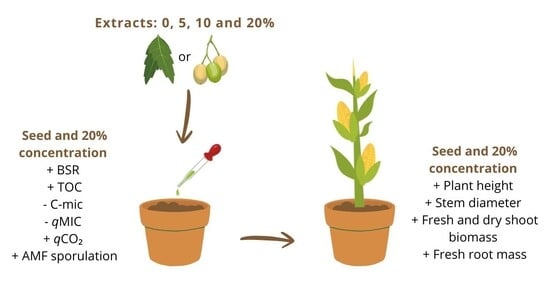
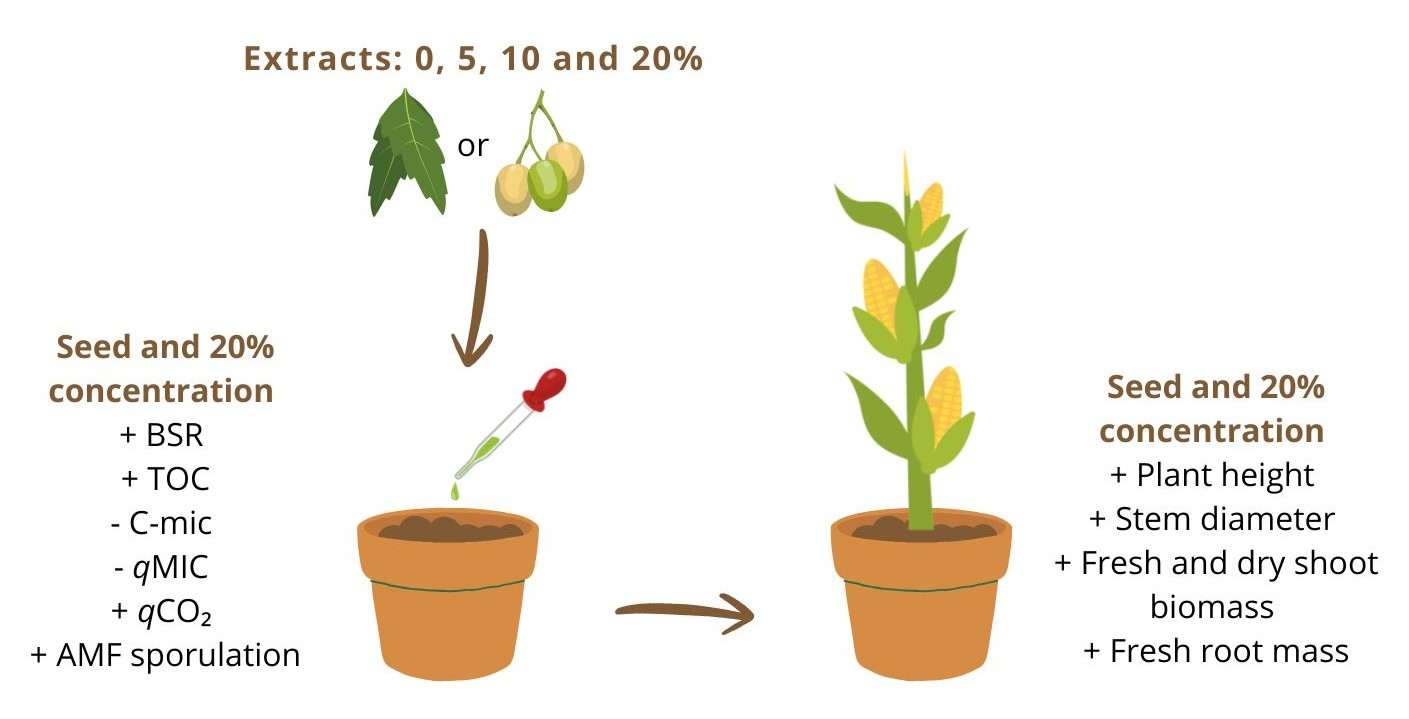
Graphical Abstract

1. Introduction

Neem (Azadirachta indica A. Juss) is native to India, belongs to the Meliaceae family, and is widely distributed across tropical and subtropical regions worldwide [1]. It is currently cultivated in nearly 80 countries, with an estimated global population of approximately 91 million trees [2]. Neem contains more than 40 bioactive compounds, including azadirachtin, salanin, melantriol, and nimbin [3]. Due to its rapid growth and allelopathic potential, neem may also behave as an invasive species in certain environments [4].
Neem-derived products containing azadirachtin concentrations between 300 and 1300 mg·kg−1 have proven effective against a wide range of agricultural pests, such as aphids, mites, mealybugs, psyllids, mosquitoes, and thrips [5,6]. The insecticidal activity of azadirachtin and related compounds is associated with antifeedant effects, suppression of fecundity, ovicidal and larvicidal activity, growth regulation, and repellency [7,8].
Beyond pest control, neem compounds may also interfere with soil microbial communities, including arbuscular mycorrhizal fungi (AMF) and nitrifying and denitrifying bacteria [9]. However, evidence remains inconsistent, as some studies have reported no inhibitory effects of A. indica extracts on soil enzymatic activity or microbial functioning [10]. These contrasting findings highlight the need for further investigation into neem-induced soil microbial responses. Indicators such as basal respiration and microbial biomass are widely used to assess soil biological alterations, as they reflect key ecosystem processes and biogeochemical cycling [11].
Soil microorganisms play a fundamental role in organic matter decomposition and nutrient mineralization, thereby sustaining soil fertility [12]. Among them, AMF (phylum Glomeromycota) establish mutualistic associations with plant roots, enhancing nutrient uptake and increasing plant tolerance to biotic and abiotic stresses [13]. Maize (Zea mays L.) is a crop of major global importance that benefits substantially from this symbiotic association [14]. Mycorrhizal colonization in maize has been associated with improved plant growth, enhanced photosynthetic efficiency, increased tolerance to cadmium toxicity, drought resistance, and heat stress adaptation [15,16,17].
In agroecosystems where plant-derived bioproducts are applied to the soil, plant performance results from a complex tripartite interaction involving the plant, soil microorganisms, and bioactive compounds. Neem-derived extracts, while widely recognized for their pesticidal and allelopathic properties, may indirectly influence plant growth by altering soil microbial processes, including AMF dynamics [8,9,10].
In this context, neem compounds can modify microbial metabolic activity, nutrient cycling, and symbiotic efficiency, thereby influencing plant nutrient acquisition and stress responses. Arbuscular mycorrhizal fungi play a central role in phosphorus uptake, water relations, and soil aggregation, and changes in their colonization patterns or sporulation behavior may reflect adaptive or stress-mediated responses to neem-derived bioactive molecules [13]. Consequently, both beneficial and adverse plant responses may emerge from indirect microbial-mediated pathways rather than from direct phytotoxic effects alone. Despite its ecological relevance, this tripartite interaction remains insufficiently explored, particularly under semiarid soil conditions.
Therefore, this study hypothesized that neem extracts influence soil microbial activity and mycorrhizal functioning, thereby modulating maize growth under semiarid conditions. The objective was to identify the neem extract source (leaf or seed) and concentration (0%, 5%, 10%, and 20%) that pose the least risk to soil microbial functioning while promoting maize development.

2. Materials and Methods

2.1. Experimental Area Description, Design, and Treatments

The experiment was conducted at the Federal Institute of Education, Science and Technology of Ceará (IFCE), Crateús Campus (5°08′42″ S and 40°41′04″ W). Soil samples were collected from the Experimental Farm Junco—Água Branca. The local climate is classified as BSw’h’, according to the Köppen classification, characterized as hot and semi-arid, with an average annual temperature between 26 and 28 °C and an average annual precipitation of 731.2 mm. The substrate used in the experiment was taken from the topsoil layer (0–10 cm) of an Ultisol from the campus experimental farm. After collection, the soil was physically and chemically characterized (Table 1) following the methodology described by Texeira et al. [18].
The experimental design was completely randomized, arranged in a 2 × 3 + 1 factorial scheme, corresponding to two extract sources (seed and leaf), three concentrations (5%, 10%, and 20%), and a control treatment. Thus, seven treatments were evaluated, with five replicates, totaling 35 experimental units (pots). Each unit consisted of a pot containing 5 kg of soil.

2.2. Stage 1: Soil Microbiological Analysis

The extracts were prepared according to Viana & Ribeiro [19]. Based on this protocol, the necessary dilutions for each treatment were made by dissolving the leaf and seed powders in water. The mixture was then left to macerate at room temperature for 24 h. After this period, the solution was filtered and stored in a refrigerator until use. The extracts used in this study were prepared exclusively using water as solvent. Therefore, the chemical composition of the extracts mainly comprised water-soluble compounds, while hydrophobic or poorly water-soluble constituents present in neem leaves and seeds were not extracted. This approach was adopted to simulate traditional agricultural practices and to evaluate the effects of readily bioavailable neem compounds on soil microbial activity and maize growth.
The experiment was conducted in two stages. In the first, the extracts were applied to the pots using a manual sprayer. Each pot received 250 mL of extract per week for four weeks, totaling 1000 mL per experimental unit. To avoid potential effects of the spraying procedure itself on soil microbial activity, all treatments, including the control, received the same volume and frequency of application. Control pots were sprayed with water only, ensuring that any observed differences in microbial responses were attributable to the neem extracts rather than to the spraying process or moisture input. At the end of the application period, soil samples (500 g) were collected after removal of the surface litter and the uppermost exposed soil layer, from the 0–10 cm depth, which represents the biologically active topsoil layer.
Basal soil respiration (BSR) was determined by quantifying the CO2 released through microbial respiration. For this, 50 g of soil was placed in hermetically sealed jars covered with parafilm to prevent the entry of external CO2 and/or the loss of internally produced CO2 over 13 days [20].
Microbial biomass carbon (C-mic) was estimated using the fumigation-extraction method, as described by Vance et al. [21]. The analysis was performed with two subsamples: one non-fumigated (water extraction) and one fumigated (chloroform), with microbial carbon released through cell lysis caused by chloroform vapor (CHCl3).
Total organic carbon (TOC) was determined according to the method proposed by Yeomans & Bremner [22]. The metabolic quotient (qCO2) was calculated as the ratio between BSR and C-mic [23], and the microbial quotient (qMIC) was obtained as the ratio between MBC and TOC.

2.3. Stage 2: Maize Cultivation and Plant Analysis

After soil sampling for Stage 1 analyses, the remaining soil in the same experimental units was reused for maize cultivation, constituting Stage 2 of the experiment. Stage 2 followed the same completely randomized design used in Stage 1, with seven treatments and five replicates, totaling 35 experimental units (pots). Each pot contained one maize plant after thinning.
After soil samples were collected for Stage 1 analyses, the remaining soil in the pots was reused for maize cultivation (cultivar BR 5011 Sertanejo), initiating Stage 2 of the study. Sowing was performed by placing five seeds per pot, and seven days after sowing (DAS), thinning was carried out, leaving only one plant per pot. Daily irrigation was performed to maintain the soil moisture near field capacity. Based on the results of the soil chemical analysis, fertilization was not required in the experimental units.
At 40 DAS, plant height (PH) and stem diameter (SD) were measured. Plants were then harvested, and the fresh biomass of the shoot (FBS) and root (FBR) were weighed using an analytical balance. The shoot was placed in labeled paper bags and placed in a forced-air circulation oven at 55 °C until constant weight. After drying, the dry shoot biomass (DSB) was obtained. The dried material was ground to determine the total nitrogen (TN) content using the Kjeldahl method [24].
To determine the percentage of arbuscular mycorrhizal fungi (AMF) colonization, fine root samples were cleared in 10% (w/v) KOH and subsequently treated with 10% H2O2, followed by staining with pen blue ink and acetic acid, according to the method described by Vierheilig et al. [25]. Root colonization was quantified using the gridline intersect method, in which stained root segments were mounted on microscope slides and examined under a light microscope at 400× magnification.
The number of AMF spores was determined using the wet sieving and decanting technique described by Gerdemann and Nicolson [26], based on a 100 g soil aliquot per sampling point. The extracted material was subjected to sucrose centrifugation, and spores were counted under a stereomicroscope at 40× magnification.

2.4. Statistical Analysis

The data obtained were subjected to analysis of variance (ANOVA) using SAS® (version 14.1) OnDemand for Academics (SAS) [27]. Prior to ANOVA, the assumptions of normality and homogeneity of variances were verified by analysis of residuals, using the Shapiro–Wilk test for normality and Levene’s test for homoscedasticity. Treatment means were compared using Tukey’s test at a 5% significance level (p < 0.05).

3. Results

3.1. Effects on Soil Microbial Activity

No significant interaction effects between the extract source and concentration were observed (p > 0.05); therefore, only main effects are presented. Soils treated with neem seed extract (Table 2) exhibited the highest values of cumulative basal respiration (14,950.00 mg C-CO2 kg−1 day−1), total organic carbon (13.90 g kg−1), and metabolic quotient (9.34%), along with the lowest microbial quotient (11.51%) compared to other treatments.
Similarly, when analyzing extract concentration (Table 3), the 20% neem extract significantly increased BSR (16,512.00 mg C-CO2 kg−1 day−1) and TOC (15.10 g kg−1), while reducing microbial biomass carbon (133.0 mg kg−1) and qMIC (8.81%), resulting in a higher qCO2 (12.41%).

3.2. Effects on Maize Development and AMF Dynamics

The seed extract treatment resulted in the most favorable plant performance (Table 4), with the highest values for plant height (PH, 42.30 cm), stem diameter (SD, 20.44 mm), fresh and dry shoot biomass (FBS, 39.60 g and DSB, 0.20 g), and fresh root mass (FBR, 170.30 g). This trend was also evident in Table 5, where the 20% concentration yielded the tallest plants (43.02 cm), highest shoot dry mass (0.19 g), and highest root fresh mass (190.42 g).
Regarding arbuscular mycorrhizal fungi (AMF), root colonization (COL) was not significantly affected (p > 0.05). However, spore density (SPO) was significantly higher in the seed extract treatment (44.15 spores per 50 g of soil—Table 4) and in the 20% concentration treatment (37.73—Table 5).

4. Discussion

4.1. Effects of Neem Extracts on Soil Microbial Activity

The pronounced increases in basal soil respiration (BSR) and total organic carbon (TOC) observed under the seed extract and 20% concentration treatments (Table 2 and Table 3) are likely associated with the greater input of organic compounds from the seed material. Neem seeds are known to be richer in easily metabolizable carbon sources, including lipids, proteins, flavonoids, and triterpenoids like azadirachtin, compared to leaves [3]. This high organic input stimulates microbial respiration, resulting in the highest BSR recorded.
However, the lack of a corresponding increase in microbial biomass carbon (C-mic), coupled with the low microbial quotient (qMIC) and high metabolic quotient (qCO2), suggests that the microbial community is under stress [28]. The high qCO2 indicates that microorganisms are redirecting a greater proportion of their energy toward cell maintenance rather than growth and biomass production. This stress condition is consistent with the presence of neem’s secondary metabolites, such as azadirachtin, which have been reported to exert toxic effects on soil microorganisms, leading to a decline in microbial performance [29,30].
Previous studies have demonstrated that azadirachtin exerts selective toxicity on soil microbial communities, with differential sensitivity among microbial functional groups. Sarawaneeyaruk and Krajangsang [29] reported that azadirachtin reduced the abundance of soil and rhizosphere microorganisms, particularly affecting beneficial groups such as Rhizobium spp. and Trichoderma spp., while some phytopathogenic bacteria exhibited higher tolerance. These effects were observed in both agricultural and natural soils, indicating that microbial responses depend not only on the compound itself but also on soil characteristics and exposure duration.
The progressive increase in BSR and TOC with increasing extract concentration, accompanied by notable reductions in C-mic and qMIC (Table 3), reinforces the hypothesis of a dose-dependent stress response in the soil microbiota. Thus, the elevated respiration rates observed in the present study likely reflect intensified microbial metabolic activity under stress, rather than an increase in microbial growth or efficiency, supporting the interpretation of a disturbance-driven stimulation of soil respiration.

4.2. Maize Growth Promotion and AMF Stress Response

The superior performance of maize in the seed extract treatment, particularly at the 20% concentration (Table 4 and Table 5), suggests that the benefits of the organic and bioactive compounds outweigh the potential negative effects on the soil microbiota. The high TOC values in these treatments indicate a significant input of organic matter, which likely served as a direct nutrient source for the maize plants, contributing to the increased biomass. This finding aligns with studies indicating that neem extracts can act as biostimulants, promoting plant growth even in the presence of allelopathic or toxic effects on certain microbial groups [31,32].
Recent syntheses on plant extracts emphasize that botanical compounds applied to soil can modulate soil–plant–microbe interactions, promoting plant growth indirectly through changes in nutrient availability, microbial activity, and rhizosphere dynamics, even when certain microbial groups experience stress [31]. In this context, the enhanced maize growth observed in the present study may result from a combination of direct nutrient supply from the extract and indirect biostimulatory effects, rather than from improvements in microbial efficiency per se.
The dynamics of arbuscular mycorrhizal fungi (AMF) present a complex ecological trade-off. While root colonization (COL) remained unaffected, spore density (SPO) significantly increased in the seed extract and 20% concentration treatments. Sporulation is a common survival strategy used by AMF under stress conditions, such as the presence of allelochemicals or high concentrations of organic matter that favor saprophytic competition [33].
The increase in AMF sporulation observed here, despite stable root colonization, suggests a stress-induced reproductive strategy aimed at ensuring fungal persistence under adverse soil conditions. This response is consistent with environments enriched in bioactive plant secondary metabolites, where AMF maintain symbiotic function but allocate more resources to reproduction.
The increased sporulation, despite the low microbial quotient (qMIC) suggesting microbial stress, indicates a reproductive response by the AMF community to the environmental pressure exerted by the neem seed extract. This suggests that the extract promotes maize growth but simultaneously stresses the soil microbial community, including the AMF, forcing them into a reproductive phase to ensure survival.

4.3. Integrated Effects of Neem Extracts, Soil Microbial Responses, and Maize Growth

Although no significant interaction effects were detected between neem extract source and concentration in the factorial analysis, the results indicate a clear functional integration between soil microbial responses, arbuscular mycorrhizal fungi (AMF) dynamics, and maize performance. The absence of statistical interaction suggests that the evaluated factors acted additively rather than synergistically; however, this does not preclude biologically meaningful interdependencies among soil processes and plant responses, as frequently reported for soil–plant–microorganism systems [11,28].
The increase in basal soil respiration and total organic carbon observed under seed extract and higher concentration treatments reflects enhanced microbial metabolic activity driven by inputs of labile organic compounds derived from neem residues [3,29]. Conversely, the reduction in microbial biomass carbon and microbial quotient, accompanied by elevated metabolic quotient values, indicates a stress condition within the soil microbial community, consistent with the documented effects of neem secondary metabolites on soil microorganisms [29,30]. Such metabolic shifts are commonly associated with increased microbial turnover and energy expenditure for maintenance rather than growth [28].
Arbuscular mycorrhizal fungi appear to play a mediating role within this system. Although root colonization was not significantly affected, the increased spore density observed under seed extract and 20% concentration treatments suggests a stress-induced reproductive strategy, as reported for AMF exposed to allelochemicals or adverse soil conditions [30,32]. Sporulation under stress may represent an adaptive mechanism to preserve mycorrhizal functionality and ensure persistence within the soil environment, thereby sustaining nutrient acquisition and plant performance [13,17].
Therefore, the combined effects of neem-derived compounds, soil microbial metabolic responses, and AMF dynamics should be interpreted within an integrated soil–plant–microorganism framework, in which maize growth responses emerge from indirect and compensatory mechanisms rather than from statistically detectable interaction effects alone. This interpretation aligns with previous studies highlighting that functional soil indicators and microbial adaptations can buffer plant growth against microbial stress caused by bioactive plant extracts [10,31,32].
Future studies should include field-based experiments under different soil and climatic conditions, longer evaluation periods, and repeated applications of neem extracts to better assess their cumulative effects on soil microbial communities, arbuscular mycorrhizal fungi dynamics, and crop performance. Investigations integrating molecular approaches to characterize microbial community structure and functional diversity would also contribute to a deeper understanding of the ecological trade-offs associated with neem extract use in sustainable agriculture.
It should be noted that the use of aqueous neem extracts represents a methodological limitation, as non-polar or poorly water-soluble compounds were not evaluated. Consequently, the observed microbial and plant responses reflect the effects of the water-soluble fraction of neem extracts. Future studies should compare aqueous extracts with organic solvent-based extracts or purified compounds to better elucidate the full spectrum of neem chemical effects on soil microbial communities and plant performance.
This study was conducted under controlled pot conditions, which may not fully represent the complexity of field environments, particularly regarding soil–plant–microorganism interactions over longer time scales. Additionally, the evaluation was limited to short-term microbial responses and early maize growth, without assessing long-term effects on soil biological resilience or crop productivity across successive cycles.

5. Conclusions

The application of neem seed extract, particularly at the 20% concentration, significantly increased soil organic carbon and microbial respiration but reduced the microbial biomass and microbial quotient, indicating a stressed microbial environment. Paradoxically, this same treatment resulted in superior maize growth, with taller plants, thicker stems, and greater biomass, suggesting that the compounds present in the seeds act as nutrient sources and biostimulants.
The 20% concentration and the seed-derived extract were the most effective at improving plant development, despite adverse effects on soil microorganisms. These findings highlight the potential of neem extract as an organic input but warn of the need for cautious management of its application, considering the potential ecological trade-offs and the complexity of soil–plant–microorganism interactions.
However, these results should be interpreted considering the limitations of the study, which was conducted under controlled pot conditions and evaluated short-term responses using aqueous neem extracts, thus not capturing the full complexity of field environments or the effects of poorly water-soluble compounds. Future research should include field-based experiments, longer evaluation periods, and molecular approaches to better understand the long-term impacts on soil microbial communities, arbuscular mycorrhizal fungi dynamics, and crop productivity.

Author Contributions

Conceptualization, D.C. and L.M.d.S.T.; Methodology, D.C., L.M.d.S.T. and E.D.F.; Validation, D.C. and L.M.d.S.T.; Formal Analysis, D.C., L.M.d.S.T., E.D.F. and P.F.M.F.; Investigation, D.C., L.M.d.S.T. and E.D.F.; Resources, D.C. and L.M.d.S.T.; Data Curation, D.C. and L.M.d.S.T.; Writing—Original Draft Preparation: D.C., L.M.d.S.T., E.D.F. and P.F.M.F.; Writing—Review and Editing, D.C., L.M.d.S.T., E.D.F. and P.F.M.F.; Visualization, D.C., L.M.d.S.T., E.D.F. and P.F.M.F.; Supervision, E.D.F. and P.F.M.F.; Project Administration, E.D.F.; Funding Acquisition, E.D.F. All authors have read and agreed to the published version of the manuscript.

Funding

This research received no external funding.

Data Availability Statement

The data presented in this study are available upon request to the corresponding author due to the restrictions of the research project agreements.

Acknowledgments

The authors would like to thank the Federal Institute of Education, Science and Technology of Ceará for the structure provided, and the Federal University of Ceará for carrying out the microbiological analysis.

Conflicts of Interest

The authors declare no conflicts of interest.

References

  1. Devi, J.; Sharma, R.B. Medicinal importance of Azadirachta indica: An overview. J. Drug Deliv. Ther. 2023, 13, 159–165. [Google Scholar] [CrossRef]
  2. Ezin, V.; Chabi, I.B. Azadirachta indica: Its biological, pharmacological, antidiabetic potential, and omics applications. In Antidiabetic Plants for Drug Discovery; Apple Academic Press: Waretown, NJ, USA, 2022; pp. 1–22. [Google Scholar]
  3. Akbar, S. Azadirachta indica A. Juss. (Meliaceae). In Handbook of 200 Medicinal Plants; Springer: Cham, Switzerland, 2020. [Google Scholar]
  4. Kolawole, O.S.; Abubakar, A.; Iliya, D.; Memi, G.G.; Ogah, J.J. Germination and growth performance of two leafy vegetables in response to the allelopathic effects of Azadirachta indica A. Juss. J. Agric. Food Secur. Sustain. Environ. 2018, 1, 87–94. [Google Scholar]
  5. Amaral, K.D.; Gandra, L.C.; Oliveira, M.A.; Souza, D.J.; Della Lucia, T.M. Effect of azadirachtin on mortality and immune response of leaf-cutting ants. Ecotoxicology 2019, 28, 1190–1197. [Google Scholar] [CrossRef] [PubMed]
  6. Seye, F.; Fall, A.; Dia, C.A.K.; Toure, M.; Ndione, R.D.; Ndiaye, M. Effect of neem derivatives (Azacdirachta indica) on the mango mealybug (Rastrococcus invadens) for biological control. GSC Adv. Res. Rev. 2022, 10, 25–31. [Google Scholar] [CrossRef]
  7. Ayinde, A.A.; Morakinyo, O.M.; Sridhar, M.K.C. Repellency and larvicidal activities of Azadirachta indica seed oil on Anopheles gambiae in Nigeria. Heliyon 2020, 6, e03920. [Google Scholar] [CrossRef]
  8. Gnanamani, R.; Ramanathan, B.; Indira, R.G. Bioassay study of azadirachtin and plumbagin on Pericallia ricini (Lepidoptera: Arctiidae). Curr. Agric. Res. J. 2024, 12, 231–241. [Google Scholar] [CrossRef]
  9. Okon, O.G.; Antia, U.E. Plants and soil microbiota health implications of agrochemicals: Potential alternatives for the safe propagation of food crops. In One Health Implications of Agrochemicals and Their Sustainable Alternatives; Springer Nature: Singapore, 2023; pp. 441–460. [Google Scholar]
  10. Suciu, N.; Vasileiadis, S.; Puglisi, E.; Pertile, G.; Tourna, M.; Karas, P.A.; Papolla, A.; Ferrarini, A.; Sulowic, S.; Fornasier, F.; et al. Azadirachtin and trifloxystrobin had no inhibitory effects on key soil microbial functions even at high dose rates. Appl. Soil Ecol. 2019, 137, 29–38. [Google Scholar] [CrossRef]
  11. Bhaduri, D.; Sihi, D.; Bhowmik, A.; Verma, B.C.; Munda, S.; Dari, B. A review on effective soil health bio-indicators for ecosystem restoration and sustainability. Front. Microbiol. 2022, 13, 938481. [Google Scholar] [CrossRef]
  12. Bhattacharyya, S.S.; Ros, G.H.; Furtak, K.; Iqbal, H.M.; Parra-Saldívar, R. Soil carbon sequestration—An interplay between soil microbial community and soil organic matter dynamics. Sci. Total Environ. 2022, 815, 152928. [Google Scholar]
  13. Wahab, A.; Muhammad, M.; Munir, A.; Abdi, G.; Zaman, W.; Ayaz, A.; Khizar, C.; Reddy, S.P.P. Role of arbuscular mycorrhizal fungi in regulating growth, enhancing productivity, and potentially influencing ecosystems under abiotic and biotic stresses. Plants 2023, 12, 3102. [Google Scholar] [CrossRef]
  14. Saboor, A.; Ali, M.A.; Hussain, S.; El Enshasy, H.A.; Hussain, S.; Ahmed, N.; Gafur, A.; Sayyed, R.; Fahad, S.; Danish, S.; et al. Zinc nutrition and arbuscular mycorrhizal symbiosis effects on maize (Zea mays L.) growth and productivity. Saudi J. Biol. Sci. 2021, 28, 6339–6351. [Google Scholar] [CrossRef] [PubMed]
  15. Mathur, S.; Sharma, M.P.; Jajoo, A. Improved photosynthetic efficacy of maize (Zea mays) plants with arbuscular mycorrhizal fungi (AMF) under high temperature stress. J. Photochem. Photobiol. B Biol. 2018, 180, 149–154. [Google Scholar] [CrossRef] [PubMed]
  16. Begum, N.; Ahanger, M.A.; Su, Y.; Lei, Y.; Mustafa, N.S.A.; Ahmad, P.; Zhang, L. Improved drought tolerance by AMF inoculation in maize (Zea mays) involves physiological and biochemical implications. Plants 2019, 8, 579. [Google Scholar] [CrossRef] [PubMed]
  17. Diagne, N.; Ngom, M.; Djighaly, P.I.; Fall, D.; Hocher, V.; Svistoonoff, S. Roles of arbuscular mycorrhizal fungi on plant growth and performance: Importance in biotic and abiotic stressed regulation. Diversity 2020, 12, 370. [Google Scholar] [CrossRef]
  18. Teixeira, P.C.; Donagemma, G.K.; Fontana, A.; Teixeira, W.G. Manual de Análises de Solo, 3rd ed.; Revisado e Ampliado; Embrapa: Brasília, DF, Brazil, 2017; 574p. [Google Scholar]
  19. Viana, P.A.; Ribeiro, P.D.A. Efeito do extrato aquoso de folhas verdes de nim (Azadirachta indica) e do horário de aplicação sobre o dano e o desenvolvimento larval de Spodoptera frugiperda (JE Smith, 1797) (Lepidoptera: Noctuidae) na cultura do milho. In Embrapa Milho e Sorgo; Artigo em Periódico Indexado (ALICE); Embrapa: Brasília, DF, Brazil, 2010. [Google Scholar]
  20. Mendonça, E.S.; Matos, E.S. Matéria Orgânica do Solo: Métodos de Análises; UFV: Viçosa, Brazil, 2005; 107p. [Google Scholar]
  21. Vance, E.D.; Brookes, P.C.; Jenkinson, D.S. An extraction method for measuring soil microbial biomass C. Soil Biol. Biochem. 1987, 19, 703–707. [Google Scholar] [CrossRef]
  22. Yeomans, J.C.; Bremner, J.M. A rapid and precise method for routine determination of organic carbon in soil. Commun. Soil Sci. Plant Anal. 1988, 19, 1467–1476. [Google Scholar] [CrossRef]
  23. Anderson, T.H.; Domsch, K.H. The metabolic quotient for CO2 (qCO2) as a specific activity parameter to assess the effects of environmental conditions, such as pH, on the microbial biomass of forest soils. Soil Biol. Biochem. 1993, 25, 393–395. [Google Scholar] [CrossRef]
  24. Malavolta, E.; Vitti, G.C.; Oliveira, S.A. Princípios, métodos e técnicas de avaliação do estado nutricional. In Avaliação do Estado Nutricional das Plantas: Princípios e Aplicações, 2nd ed.; POTAFOS: Piracicaba, Brazil, 1997; 319p. [Google Scholar]
  25. Vierheilig, H.; Coughlan, A.P.; Wyss, U.R.S.; Piché, Y. Ink and vinegar, a simple staining technique for arbuscular-mycorrhizal fungi. Appl. Environ. Microbiol. 1998, 64, 5004–5007. [Google Scholar] [CrossRef]
  26. Gerdemann, J.W.; Nicolson, T.H. Spores of mycorrhizal endogone species extracted from soil by wet sieving and decanting. Trans. Br. Mycol. Soc. 1963, 46, 235–244. [Google Scholar] [CrossRef]
  27. SAS. SAS/STAT® 14.1 User’s Guide; SAS Institute Inc.: Cary, NC, USA, 2015. [Google Scholar]
  28. Ashraf, M.N.; Waqas, M.A.; Rahman, S. Microbial metabolic quotient is a dynamic indicator of soil health: Trends, implications and perspectives. Eurasian Soil Sci. 2022, 55, 1794–1803. [Google Scholar] [CrossRef]
  29. Sarawaneeyaruk, S.; Krajangsang, S.; Pringsulaka, O. The effects of neem extract and azadirachtin on soil microorganisms. J. Soil Sci. Plant Nutr. 2015, 15, 1071–1083. [Google Scholar]
  30. Mishra, T.; Govindharaj, G.P.P.; Gadratagi, B.G.; Patil, N.B.; Yadav, M.K.; Munda, S.; Mukherjee, A.K.; Jena, M.; Adak, T. Deciphering the associated risk on soil microbes upon use of biopesticides in rice ecosystem. Environ. Monit. Assess. 2019, 191, 654. [Google Scholar] [CrossRef]
  31. Han, M.; Kasim, S.; Yang, Z.; Deng, X.; Saidi, N.; Uddin, M.; Shuib, E. Plant extracts as biostimulant agents: A promising strategy for managing environmental stress in sustainable agriculture. Phyton 2024, 93, 2149. [Google Scholar] [CrossRef]
  32. Kyari, E.M.; Mbaya, Y.A.; Umar, K.H.; Olajemilo, M.E.; Umar, M.; Kumar, R. Effects of soil under the canopy of Azadirachta indica (neem) and Khaya senegalensis l (mahogany) and inorganic fertilizer on growth and development of maize. Int. J. Eng. Appl. Sci. Technol. 2020, 4, 414–420. [Google Scholar] [CrossRef]
  33. Branco, S.; Schauster, A.; Liao, H.L.; Ruytinx, J. Mechanisms of stress tolerance and their effects on the ecology and evolution of mycorrhizal fungi. New Phytol. 2022, 235, 2158–2175. [Google Scholar] [CrossRef]

Table 1. Chemical and physical characteristics of soil collected at a depth of 0–10 cm.
Chemical Characteristics
CNPK+Ca+2Mg+2Na+pH
(H2O)
CEOMC/NV%
g kg−1mg kg−1Cmolc kg−1 dS m−1g kg−1
5.280.54380.392.001.600.166.50.229.101078
Physical Characteristics
Coarse sandFine sandSiltClayNatural clayTextural classification
g kg−1
1426401734537Loamy sand
OM: organic matter; CE: electrical conductivity; V%: base saturation.
Table 2. Soil microbial indicators under different neem extract sources.
SourceBSRC-micTOCqCO2qMIC
mg C-CO2 kg−1 day−1mg kg−1g kg−1%
Control1196.62 c154.0 a7.30 c0.78 b21.10 a
Leaf5602.46 b181.0 a10.67 b3.10 b16.96 b
Seed14,950.00 a160.0 a13.90 a9.34 a11.51 c
CV (%)30.6417.8818.8422.5124.85
p<0.00010.0183<0.0001<0.0001<0.0001
Accumulated basal respiration (BSR), microbial biomass carbon (C-mic), total organic carbon (TOC), microbial quotient (qMIC) and metabolic quotient (qCO2). Means followed by the same lowercase letter in the column do not differ from each other by the Tukey test at 5%.
Table 3. Soil microbial indicators under different neem extract concentrations.
Concentrations (%)BSRC-micTOCqCO2qMIC
mg C-CO2 kg−1 day−1mg kg−1g kg−1%
01196.62 c160.0 ab7.30 c0.75 b21.92 a
54925.85 c184.0 a9.83 bc2.68 b18.72 ab
109391.23 b185.0 a11.92 b5.07 b15.52 b
2016,512.00 a133.0 b15.10 a12.41 a8.81 c
CV (%)30.6417.8818.8472.5127.18
p<0.00010.0005<0.0001<0.0001<0.0001
Accumulated basal respiration (BSR), microbial biomass carbon (C-mic), total organic carbon (TOC), microbial quotient (qMIC) and metabolic quotient (qCO2). Means followed by the same lowercase letter in the column do not differ from each other by the Tukey test at 5%.
Table 4. Maize growth and AMF responses to neem extract sources.
SourcePHSDFBSDSBFBRTNCOLSPO
cmmmg%Number of Spores (50 g−1 Soil)
Control29.80 b17.67 ab19.29 b0.08 b106.19 ab0.4826.6021.26 b
Leaf31.46 b16.83 b20.25 b0.09 b97.93 b0.5035.1019.55 b
Seed42.30 a20.44 a39.60 a0.20 a170.30 a0.5134.3044.15 a
CV (%)20.6015.4040.3249.0946.7817.7425.4927.18
p0.00040.0017<0.0001<0.00010.00300.60870.1621<0.0001
Height (PH), stem diameter (SD), fresh and dry mass of the aerial part (FBS and DSB), fresh root mass (FBR), total nitrogen (TN), mycorrhizal colonization (COL) of maize and density of mycorrhizal fungi spores (SPO). Means followed by the same lowercase letter in the column do not differ from each other by the Tukey test at 5%.
Table 5. Maize growth and AMF responses to neem extract concentrations.
Concentrations (%)PHSDFBSDSBFBRTNCOLSPO
cmmmg%Number of Spores (50 g−1 Soil)
029.80 b17.6719.290.08 b106.19 b0.4826.6021.26 b
532.46 b17.5724.360.11 ab104.08 ab0.5134.0029.30 b
1035.17 ab18.8529.770.15 ab107.84 b0.4831.1028.53 ab
2043.02 a19.4735.650.19 a190.42 a0.5338.9037.73 a
CV (%)20.6015.4040.3249.0946.7817.7425.4927.18
p0.00960.32940.1060.04260.0050.3820.13770.0338
Height (PH), stem diameter (SD), fresh and dry mass of the aerial part (FBS and DSB), fresh root mass (FBR), total nitrogen (TN), mycorrhizal colonization (COL) of maize and density of mycorrhizal fungi spores (SPO). Means followed by the same lowercase letter in the column do not differ from each other by the Tukey test at 5%.
Disclaimer/Publisher’s Note: The statements, opinions and data contained in all publications are solely those of the individual author(s) and contributor(s) and not of MDPI and/or the editor(s). MDPI and/or the editor(s) disclaim responsibility for any injury to people or property resulting from any ideas, methods, instructions or products referred to in the content.