
African Grass Invasion Threatens Tropical Wetland Biodiversity: Experimental Evidence from Echinochloa pyramidalis Invasion in a Mexican Ramsar Site



Abstract
1. Introduction
2. Materials and Methods
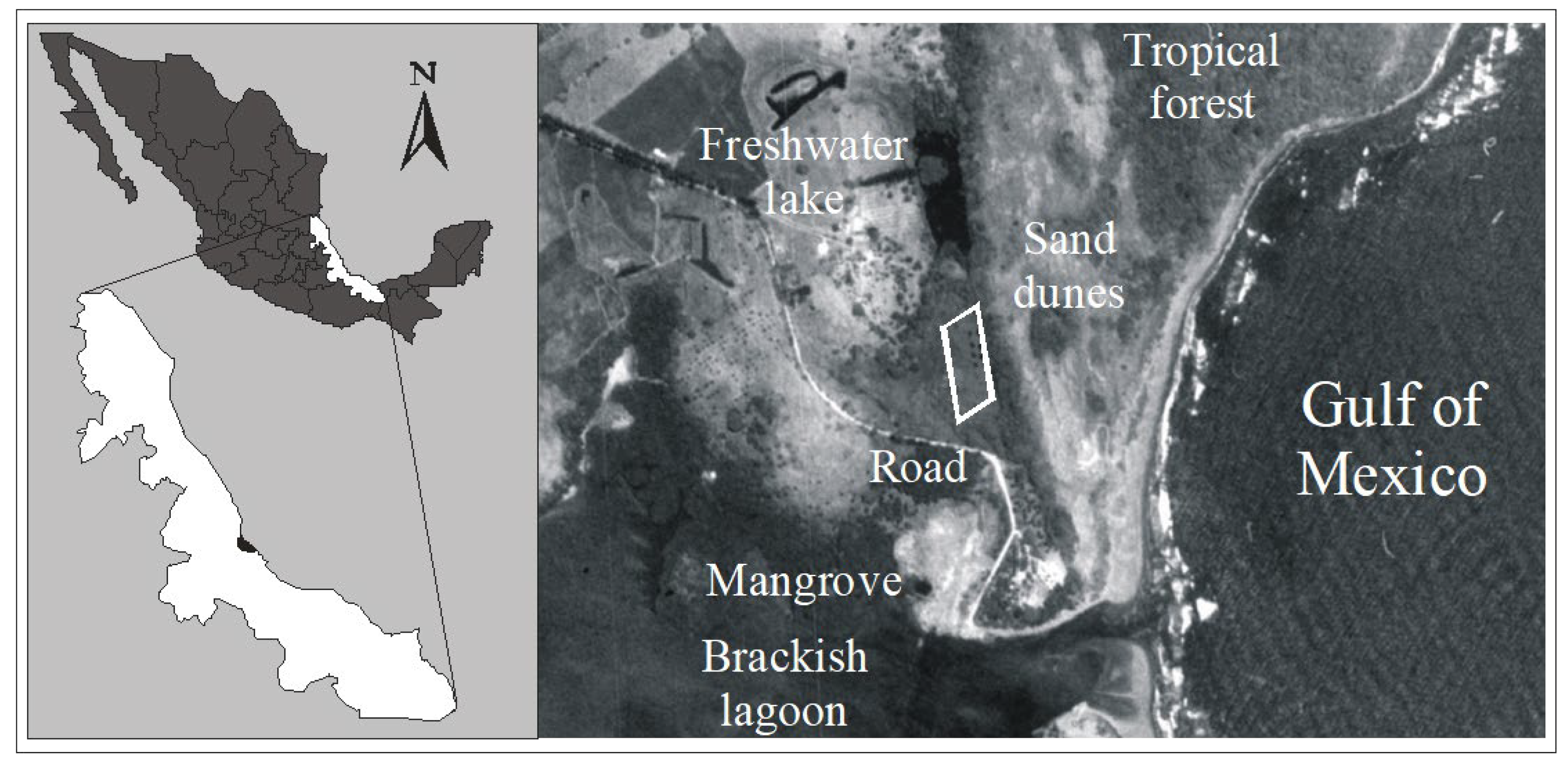
2.1. Study Site
2.2. Experimental Design
2.2.1. Experiment 1: Invasion Potential in Sagittaria Zone
- Control: Quadrats were left under natural conditions with no manipulation.
- Kill: All vegetation within quadrats was eliminated by spraying with a glyphosate herbicide (Round Up, 2% solution) to create open space for potential colonization.
- Transplant Echinochloa: Five individuals of E. pyramidalis were transplanted from the Echinochloa-dominated zone to test active establishment capacity in the native zone.
- Kill + Echinochloa: All existing vegetation was eliminated with glyphosate, and five E. pyramidalis individuals were subsequently transplanted to simulate invasion into a disturbed habitat.
2.2.2. Experiment 2: Natural Invasion Dynamics at the Ecotone
- Control in Echinochloa zone (Control_Echino): Quadrats in the Echinochloa zone were left unmanipulated to track natural Sagittaria advance.
- Control in Sagittaria zone (Control_Sagit): Quadrats in the Sagittaria zone were left unmanipulated to track natural Echinochloa invasion.
- Kill Sagittaria in Echinochloa zone (Kill_Sagit_Echino): All Sagittaria individuals in the Echinochloa side were removed to test whether the native species was actively colonizing the invaded zone.
- Kill Sagittaria in Sagittaria zone (Kill_Sagit_Sagit): All plants in Sagittaria-side quadrats were eliminated with glyphosate to create reference conditions.
- Kill Echinochloa in Echinochloa zone (Kill_Echino_Echino): All vegetation in Echinochloa-side quadrats was eliminated with glyphosate to assess reinvasion capacity and native recovery potential.
- Kill Echinochloa in Sagittaria zone (Kill_Echino_Sagit): All Echinochloa individuals in the Sagittaria side were removed to prevent any invasion attempts.
2.3. Vegetation Sampling and Analysis
2.4. Statistical Analyses
3. Results
3.1. Invasion Potential in Sagittaria Zone (Experiment 1)
3.1.1. Temporal Dynamics of Relative Importance Values
Echinochloa pyramidalis
Sagittaria lancifolia
3.1.2. Biomass Accumulation
Echinochloa pyramidalis
Sagittaria lancifolia
3.2. Natural Invasion Dynamics at the Ecotone (Experiment 2)
3.2.1. Temporal Dynamics of Relative Importance Values
Echinochloa pyramidalis
Sagittaria lancifolia
3.2.2. Final Biomass Responses
Echinochloa pyramidalis
Sagittaria lancifolia
4. Discussion
4.1. Invasion Requires Disturbance: E. pyramidalis Cannot Invade Intact Native Communities
4.2. Propagule Limitation, Not Competitive Exclusion, Constrains Natural Invasion Spread
4.3. Coexistence Mechanisms: Sagittaria Persistence Despite E. pyramidalis Dominance
4.4. Conservation Implications for Mexican Ramsar Wetlands
4.5. Context: African Grass Invasions and Alternative Stable States
5. Conclusions
Author Contributions
Funding
Institutional Review Board Statement
Data Availability Statement
Acknowledgments
Conflicts of Interest
References
- López Rosas, H.; Moreno-Casasola, P.; Mendelssohn, I.A. Effects of an African grass invasion on vegetation, soil and interstitial water characteristics in a tropical freshwater marsh in La Mancha, Veracruz (Mexico). J. Plant Interact. 2005, 1, 187–195. [Google Scholar] [CrossRef]
- López Rosas, H.; Moreno-Casasola, P.; Mendelssohn, I.A. Effects of experimental disturbances on a tropical freshwater marsh invaded by the African grass Echinochloa pyramidalis. Wetlands 2006, 26, 593–604. [Google Scholar] [CrossRef]
- Williams, D.G.; Baruch, Z. African grass invasion in the Americas: Ecosystem consequences and the role of ecophysiology. Biol. Invasions 2000, 2, 123–140. [Google Scholar] [CrossRef]
- D’Antonio, C.M.; Vitousek, P.M. Biological invasions by exotic grasses, the grass/fire cycle, and global change. Annu. Rev. Ecol. Syst. 1992, 23, 63–87. [Google Scholar] [CrossRef]
- Boyden, J.; Wurm, P.; Joyce, K.E.; Boggs, G. Spatial dynamics of invasive Pará grass on a monsoonal floodplain, Kakadu National Park, Northern Australia. Remote Sens. 2019, 11, 2090. [Google Scholar] [CrossRef]
- Hoffmann, W.A.; Haridasan, M. The invasive grass, Melinis minutiflora, inhibits tree regeneration in a Neotropical savanna. Austral Ecol. 2008, 33, 29–36. [Google Scholar] [CrossRef]
- Barbosa, F.G. The future of invasive African grasses in South America under climate change. Ecol. Inform. 2016, 36, 114–117. [Google Scholar] [CrossRef]
- Pivello, V.R.; Shida, C.N.; Meirelles, S.T. Alien grasses in Brazilian savannas: A threat to the biodiversity. Biodivers. Conserv. 1999, 8, 1281–1294. [Google Scholar] [CrossRef]
- Osborne, C.P.; Freckleton, R.P. Ecological selection pressures for C4 photosynthesis in the grasses. Proc. R. Soc. B 2009, 276, 1753–1760. [Google Scholar] [CrossRef]
- Zedler, J.B.; Kercher, S. Causes and consequences of invasive plants in wetlands: Opportunities, opportunists, and outcomes. Crit. Rev. Plant Sci. 2004, 23, 431–452. [Google Scholar] [CrossRef]
- Richardson, D.M.; Holmes, P.M.; Esler, K.J.; Galatowitsch, S.M.; Stromberg, J.C.; Kirkman, S.P.; Pyšek, P.; Hobbs, R.J. Riparian vegetation: Degradation, alien plant invasions, and restoration prospects. Divers. Distrib. 2007, 13, 126–139. [Google Scholar] [CrossRef]
- Kengne, I.M.; Akoa, A.; Soh, E.K.; Tsama, V.; Ngoutane, M.M.; Dodane, P.H.; Koné, D. Effects of faecal sludge application on growth characteristics and chemical composition of Echinochloa pyramidalis (Lam.) Hitchc. and Chase and Cyperus papyrus L. Ecol. Eng. 2008, 34, 233–242. [Google Scholar] [CrossRef]
- Cook, B.G.; Pengelly, B.C.; Brown, S.D.; Donnelly, J.L.; Eagles, D.A.; Franco, M.A.; Hanson, J.; Mullen, B.F.; Partridge, I.J.; Peters, M.; et al. Tropical Forages: An Interactive Selection Tool; CSIRO; DPI&F(Qld); CIAT; ILRI: Brisbane, Australia, 2005; Available online: https://tropicalforages.info/text/intro/index.html (accessed on 30 October 2025).
- Clayton, W.D.; Phillips, S.M.; Renvoize, S.A. Poaceae (Gramineae). In Flora of Tropical East Africa; Polhill, R.M., Ed.; Royal Botanic Gardens, Kew: Richmond, UK, 1974. [Google Scholar]
- Clayton, W.D.; Vorontsova, M.S.; Harman, K.T.; Williamson, H. GrassBase—The Online World Grass Flora. Available online: https://www.kew.org/data/grasses-db.html (accessed on 30 October 2025).
- Royal Botanic Gardens Kew. Plants of the World Online. Available online: https://powo.science.kew.org/taxon/urn:lsid:ipni.org:names:88106-2 (accessed on 29 November 2025).
- CABI. Echinochloa pyramidalis (antelope grass). In Invasive Species Compendium; CAB International: Wallingford, UK, 2024; Available online: https://www.cabidigitallibrary.org/doi/abs/10.1079/cabicompendium.113990 (accessed on 30 October 2025).
- Center for Invasive Species and Ecosystem Health. Invasive.org. Antelope Grass (Echinochloa pyramidalis). Available online: https://www.invasive.org/browse/subinfo.cfm?sub=24115 (accessed on 29 November 2025).
- Skerman, P.J.; Riveros, F. Tropical Grasses; FAO Plant Production and Protection Series No. 23; Food and Agriculture Organization of the United Nations: Rome, Italy, 1990; 832p. [Google Scholar]
- López Rosas, H.; Espejel González, V.E.; Moreno-Casasola, P. Zacate alemán (Echinochloa pyramidalis): Planta invasora de humedales costeros del sureste mexicano. Investig. Ambient. Cienc. Política Pública 2013, 5, 53–63. [Google Scholar]
- Cornette, J.; Clementson, C.; Fredericks, D. Environmentally sustainable management of water hyacinth (Eichhornia crassipes) in Guyana. Int. J. Agric. Forest. 2018, 8, 4–9. [Google Scholar] [CrossRef]
- USDA-APHIS. Weed Risk Assessment for Echinochloa pyramidalis (Lam.) Hitchc. & Chase (Poaceae)—Antelope Grass; United States Department of Agriculture, Animal and Plant Health Inspection Service: Raleigh, NC, USA, 2012; 20p. [Google Scholar]
- Flores-Verdugo, F.; Moreno-Casasola, P.; Agraz-Hernández, C.M.; López-Rosas, H.; Benítez-Pardo, D.; Travieso-Bello, A.C. La topografía y el hidroperiodo: Dos factores que condicionan la restauración de los humedales costeros. Bol. Soc. Bot. Mex. 2007, 80, 33–47. [Google Scholar] [CrossRef]
- Moreno-Casasola, P.; Infante-Mata, D.; López-Rosas, H. Tropical freshwater marshes and swamps of North America. In Wetland Habitats of North America: Ecology and Conservation Concerns; Batzer, D., Ed.; University of California Press: Berkeley, CA, USA, 2012; pp. 267–282. [Google Scholar]
- Beck, H.J.; Dugas, J.; Garber, A.; Couvillion, B.; Fischer, M. Coastwide Reference Monitoring System (CRMS) 2005, 2008, 2012, 2015/2016, 2018, and 2021 Land-Water Matrices, Eastern Louisiana; U.S. Geological Survey: Reston, VA, USA, 2023. [Google Scholar] [CrossRef]
- Sjögersten, S.; de la Barreda-Bautista, B.; Brown, C.; Boyd, D.; Lopez-Rosas, H.; Hernández, E.; Monroy, R.; Rincón, M.; Vane, C.; Moss-Hayes, V.; et al. Coastal wetland ecosystems deliver large carbon stocks in tropical Mexico. Geoderma 2021, 403, 115173. [Google Scholar] [CrossRef]
- Moreno-Casasola, P.; López-Rosas, H.; Infante-Mata, D.; Peralta, L.A.; Travieso-Bello, A.C.; Warner, B.G. Environmental and anthropogenic factors associated with coastal wetland differentiation in La Mancha, Veracruz, Mexico. Plant Ecol. 2009, 200, 37–52. [Google Scholar] [CrossRef]
- Castillo-Campos, G.; Travieso-Bello, A.C. La flora. In Entornos Veracruzanos: La Costa de La Mancha; Moreno-Casasola, P., Ed.; Instituto de Ecología, A.C.: Xalapa, Mexico, 2006; pp. 171–208. [Google Scholar]
- Hernández-Sánchez, M.; González-García, M.; Rojas-Soto, O.R.; Macgregor-Fors, I. Density and habitat associations of the Altamira Yellowthroat Geothlypis flavovelata in Veracruz, Mexico: An endemic vulnerable species. Bird Conserv. Int. 2020, 30, 355–364. [Google Scholar] [CrossRef]
- González-Romero, A.; Lara-López, M.S. Los anfibios, los reptiles y los mamíferos. In Entornos Veracruzanos: La Costa de La Mancha; Moreno-Casasola, P., Ed.; Instituto de Ecología, A.C.: Xalapa, Mexico, 2006; pp. 407–422. [Google Scholar]
- Campos, A.; Hernández, M.E.; Moreno-Casasola, P.; Cejudo-Espinosa, E.; Robledo, R.A.; Infante-Mata, D. Soil water retention and carbon pools in tropical forested wetlands and marshes of the Gulf of Mexico. Hydrol. Sci. J. 2011, 56, 1388–1406. [Google Scholar] [CrossRef]
- López Rosas, H.; López-Barrera, F.; Moreno-Casasola, P.; Aguirre-León, G.; Cázares-Hernández, E.; Sánchez-Higueredo, L. Indicators of recovery in a tropical freshwater marsh invaded by an African grass. Ecol. Restor. 2010, 28, 324–332. [Google Scholar] [CrossRef]
- López Rosas, H.; Moreno-Casasola, P.; Espejel González, V.E. Shade treatment affects structure and recovery of invasive C4 African grass Echinochloa pyramidalis. Ecol. Evol. 2015, 5, 1327–1342. [Google Scholar] [CrossRef]
- López Rosas, H.; Moreno-Casasola, P. Invader versus natives: Effects of hydroperiod on competition between hydrophytes in a tropical freshwater marsh. Basic Appl. Ecol. 2012, 13, 40–49. [Google Scholar] [CrossRef]
- Pyšek, P.; Richardson, D.M. Invasive species, environmental change and management, and health. Annu. Rev. Environ. Resour. 2010, 35, 25–55. [Google Scholar] [CrossRef]
- Saltonstall, K. Cryptic invasion by a non-native genotype of the common reed, Phragmites australis, into North America. Proc. Natl. Acad. Sci. USA 2002, 99, 2445–2449. [Google Scholar] [CrossRef] [PubMed]
- Lavergne, S.; Molofsky, J. Reed canary grass (Phalaris arundinacea) as a biological model in the study of plant invasions. Crit. Rev. Plant Sci. 2004, 23, 415–429. [Google Scholar] [CrossRef]
- Levine, J.M.; Adler, P.B.; Yelenik, S.G. A meta-analysis of biotic resistance to exotic plant invasions. Ecol. Lett. 2004, 7, 975–989. [Google Scholar] [CrossRef]
- Catford, J.A.; Jansson, R.; Nilsson, C. Reducing redundancy in invasion ecology by integrating hypotheses into a single theoretical framework. Divers. Distrib. 2009, 15, 22–40. [Google Scholar] [CrossRef]
- Kettenring, K.M.; Adams, C.R. Lessons learned from invasive plant control experiments: A systematic review and meta-analysis. J. Appl. Ecol. 2011, 48, 970–979. [Google Scholar] [CrossRef]
- Gioria, M.; Pyšek, P. Early bird catches the worm: Germination as a critical step in plant invasion. Biol. Invasions 2017, 19, 1055–1080. [Google Scholar] [CrossRef]
- Quinn, G.P.; Keough, M.J. Experimental Design and Data Analysis for Biologists; Cambridge University Press: Cambridge, UK, 2002; 537p. [Google Scholar]
- Kent, M. Vegetation Description and Data Analysis: A Practical Approach, 2nd ed.; Wiley-Blackwell: Chichester, UK, 2012; 428p. [Google Scholar]
- Curtis, J.T.; McIntosh, R.P. The interrelations of certain analytic and synthetic phytosociological characters. Ecology 1950, 31, 434–450. [Google Scholar] [CrossRef]
- Curtis, J.T.; McIntosh, R.P. An upland forest continuum in the prairie-forest border region of Wisconsin. Ecology 1951, 32, 476–496. [Google Scholar] [CrossRef]
- Zuur, A.F.; Ieno, E.N.; Walker, N.J.; Saveliev, A.A.; Smith, G.M. Mixed Effects Models and Extensions in Ecology with R; Springer: New York, NY, USA, 2009; 574p. [Google Scholar]
- Pinheiro, J.C.; Bates, D.M. Mixed-Effects Models in S and S-PLUS; Springer: New York, NY, USA, 2000; 528p. [Google Scholar]
- Bolker, B.M.; Brooks, M.E.; Clark, C.J.; Geange, S.W.; Poulsen, J.R.; Stevens, M.H.H.; White, J.S.S. Generalized linear mixed models: A practical guide for ecology and evolution. Trends Ecol. Evol. 2009, 24, 127–135. [Google Scholar] [CrossRef] [PubMed]
- Von Holle, B.; Simberloff, D. Ecological resistance to biological invasion overwhelmed by propagule pressure. Ecology 2005, 86, 3212–3218. [Google Scholar] [CrossRef]
- Fukami, T. Historical contingency in community assembly: Integrating niches, species pools, and priority effects. Annu. Rev. Ecol. Evol. Syst. 2015, 46, 1–23. [Google Scholar] [CrossRef]
- Edwards, E.J.; Osborne, C.P.; Strömberg, C.A.E.; Smith, S.A.; C4 Grasses Consortium; Bond, W.J.; Christin, P.-A.; Cousins, A.B.; Duvall, M.R.; Fox, D.L.; et al. The origins of C4 grasslands: Integrating evolutionary and ecosystem science. Science 2010, 328, 587–591. [Google Scholar] [CrossRef]
- Grace, J.B. On the relationship between plant traits and competitive ability. In Perspectives on Plant Competition; Grace, J.B., Tilman, D., Eds.; Academic Press: San Diego, CA, USA, 1990; pp. 51–65. [Google Scholar]
- Wardle, D.A.; Karban, R.; Callaway, R.M. The ecosystem and evolutionary contexts of allelopathy. Trends Ecol. Evol. 2011, 26, 655–662. [Google Scholar] [CrossRef]
- Singh, M.; Daehler, C.C. Meta-analytic evidence that allelopathy may increase the success and impact of invasive grasses. PeerJ 2024, 11, e14858. [Google Scholar] [CrossRef]
- Davis, M.A.; Grime, J.P.; Thompson, K. Fluctuating resources in plant communities: A general theory of invasibility. J. Ecol. 2000, 88, 528–534. [Google Scholar] [CrossRef]
- Lockwood, J.L.; Cassey, P.; Blackburn, T. The role of propagule pressure in explaining species invasions. Trends Ecol. Evol. 2005, 20, 223–228. [Google Scholar] [CrossRef]
- Colautti, R.I.; Grigorovich, I.A.; MacIsaac, H.J. Propagule pressure: A null model for biological invasions. Biol. Invasions 2006, 8, 1023–1037. [Google Scholar] [CrossRef]
- Pringle, A.; Bever, J.D.; Gardes, M.; Parrent, J.L.; Rillig, M.C.; Klironomos, J.N. Mycorrhizal symbioses and plant invasions. Annu. Rev. Ecol. Evol. Syst. 2009, 40, 699–715. [Google Scholar] [CrossRef]
- Reinhart, K.O.; Callaway, R.M. Soil biota and invasive plants. New Phytol. 2006, 170, 445–457. [Google Scholar] [CrossRef]
- Petitpierre, B.; Kueffer, C.; Broennimann, O.; Randin, C.; Daehler, C.; Guisan, A. Climatic niche shifts are rare among terrestrial plant invaders. Science 2012, 335, 1344–1348. [Google Scholar] [CrossRef] [PubMed]
- Lishawa, S.C.; Carson, B.D.; Brandt, J.S.; Tallant, J.M.; Reo, N.J.; Albert, D.A.; Monks, A.M.; Lautenbach, J.M.; Clark, E. Mechanical harvesting effectively controls young Typha spp. invasion and unmanned aerial vehicle data enhances post-treatment monitoring. Front. Plant Sci. 2017, 8, 619. [Google Scholar] [CrossRef]
- Silvertown, J.; Araya, Y.; Gowing, D. Hydrological niches in terrestrial plant communities: A review. J. Ecol. 2015, 103, 93–108. [Google Scholar] [CrossRef]
- Keddy, P.A. Assembly and response rules: Two goals for predictive community ecology. J. Veg. Sci. 1992, 3, 157–164. [Google Scholar] [CrossRef]
- Wolkovich, E.M.; Cleland, E.E. Phenological niches and the future of invaded ecosystems with climate change. AoB Plants 2014, 6, plu013. [Google Scholar] [CrossRef]
- Howard, R.J.; Mendelssohn, I.A. Effect of increased water depth on growth of a common perennial freshwater-intermediate marsh species in coastal Louisiana. Wetlands 1995, 15, 82–91. [Google Scholar] [CrossRef]
- Klimešová, J.; Klimeš, L. Bud banks and their role in vegetative regeneration—A literature review and proposal for simple classification and assessment. Perspect. Plant Ecol. Evol. Syst. 2007, 8, 115–129. [Google Scholar] [CrossRef]
- Ott, J.P.; Klimešová, J.; Hartnett, D.C. The ecology and significance of below-ground bud banks in plants. Ann. Bot. 2019, 123, 1099–1118. [Google Scholar] [CrossRef]
- Suding, K.N.; Gross, K.L.; Houseman, G.R. Alternative states and positive feedbacks in restoration ecology. Trends Ecol. Evol. 2004, 19, 46–53. [Google Scholar] [CrossRef] [PubMed]
- Chase, J.M. Community assembly: When should history matter? Oecologia 2003, 136, 489–498. [Google Scholar] [CrossRef] [PubMed]
- MacDougall, A.S.; Gilbert, B.; Levine, J.M. Plant invasions and the niche. J. Ecol. 2009, 97, 609–615. [Google Scholar] [CrossRef]
- Miller, R.C.; Zedler, J.B. Responses of native and invasive wetland plants to hydroperiod and water depth. Plant Ecol. 2003, 167, 57–69. [Google Scholar] [CrossRef]
- Vivian-Smith, G.; Stiles, E.W. Dispersal of salt marsh seeds on the feet and feathers of waterfowl. Wetlands 1994, 14, 316–319. [Google Scholar] [CrossRef]
- Ramsar Convention Secretariat. The Ramsar Convention Manual: A Guide to the Convention on Wetlands (Ramsar, Iran, 1971), 6th ed.; Ramsar Convention Secretariat: Gland, Switzerland, 2013; 112p. [Google Scholar]
- Pérez-Arteaga, A.; Gaston, K.J.; Kershaw, M. Undesignated sites in Mexico qualifying as wetlands of international importance. Biol. Conserv. 2002, 107, 47–57. [Google Scholar] [CrossRef]
- Muñoz-Piña, C.; Guevara, A.; Torres, J.M.; Braña, J. Paying for the hydrological services of Mexico’s forests: Analysis, negotiations and results. Ecol. Econ. 2008, 65, 725–736. [Google Scholar] [CrossRef]
- Beisner, B.E.; Haydon, D.T.; Cuddington, K. Alternative stable states in ecology. Front. Ecol. Environ. 2003, 1, 376–382. [Google Scholar] [CrossRef]
- Scheffer, M.; Carpenter, S.; Foley, J.A.; Folke, C.; Walker, B. Catastrophic shifts in ecosystems. Nature 2001, 413, 591–596. [Google Scholar] [CrossRef]
- Zweig, C.L.; Newman, S.; Saunders, C.J. Applied use of alternate stable state modeling in restoration ecology. Ecol. Appl. 2020, 30, e02195. [Google Scholar] [CrossRef]
- Suding, K.N.; Hobbs, R.J. Threshold models in restoration and conservation: A developing framework. Trends Ecol. Evol. 2009, 24, 271–279. [Google Scholar] [CrossRef]
- Leung, B.; Roura-Pascual, N.; Bacher, S.; Heikkilä, J.; Brotons, L.; Burgman, M.A.; Dehnen-Schmutz, K.; Essl, F.; Hulme, P.E.; Richardson, D.M.; et al. TEASIng apart alien species risk assessments: A framework for best practices. Ecol. Lett. 2012, 15, 1475–1493. [Google Scholar] [CrossRef]


| Source | Species | SS | df | MS | F | p |
|---|---|---|---|---|---|---|
| Between subjects | ||||||
| Treatment | E. pyramidalis | 123,281 | 3 | 41,094 | 21.42 | <0.001 |
| S. lancifolia | 12,264 | 3 | 4088 | 7.59 | 0.004 | |
| Block | E. pyramidalis | 5780 | 4 | 1445 | ||
| S. lancifolia | 5530 | 4 | 1382 | |||
| Error (between) | E. pyramidalis | 23,021 | 12 | 1918 | ||
| S. lancifolia | 6461 | 12 | 538 | |||
| Within subjects | ||||||
| Time | E. pyramidalis | 50,372 | 5 | 10,074 | 24.88 | <0.001 |
| S. lancifolia | 58,202 | 5 | 11,640 | 26.78 | <0.001 | |
| Treatment × Time | E. pyramidalis | 57,057 | 15 | 3804 | 9.40 | <0.001 |
| S. lancifolia | 3795 | 15 | 253 | 0.58 | 0.877 | |
| Error (within) | E. pyramidalis | 24,291 | 60 | 405 | ||
| S. lancifolia | 26,078 | 60 | 435 | |||
| Source | Species | SS | df | MS | F | p | Treatment Means ± SD |
|---|---|---|---|---|---|---|---|
| Treatment | E. pyramidalis | 4,104,629.54 | 2 | 2,052,314.77 | 9.84 | 0.029 | Kill: 1457.8 ± 799.4 ᵃ |
| Transplant: 25.9 ᵇ | |||||||
| Kill + Transplant: 281.8 ± 173.4 ᵇ | |||||||
| S. lancifolia | 6723.72 | 3 | 2241.24 | 2.67 | 0.099 | Control: 94.4 ± 19.1 | |
| Kill: 50.5 ± 27.0 | |||||||
| Transplant: 65.0 ± 22.7 | |||||||
| Kill + Transplant: 93.3 ± 40.2 | |||||||
| Block | E. pyramidalis | 1,842,362.66 | 4 | 460,590.67 | 2.21 | 0.231 | |
| S. lancifolia | 2050.65 | 4 | 512.66 | 0.61 | 0.663 | ||
| Error | E. pyramidalis | 834,293.95 | 4 | 208,573.49 | |||
| S. lancifolia | 9229.98 | 11 | 839.09 | ||||
| Total | E. pyramidalis | 6,781,286.16 | 10 | ||||
| S. lancifolia | 18,004.34 | 18 |
| Species/Zone | Effect | β | SE | z | p |
|---|---|---|---|---|---|
| Echinochloa pyramidalis | |||||
| Echinochloa zone | Time | 9.98 | 2.09 | 4.77 | <0.001 |
| Kill_Sagit × Time | −6.44 | 2.96 | −2.18 | 0.030 | |
| Kill_Echino × Time | −4.15 | 2.96 | −1.40 | 0.161 | |
| Sagittaria zone | Time | −1.04 | 1.84 | −0.57 | 0.570 |
| Kill_Sagit × Time | 7.22 | 2.60 | 2.78 | 0.006 | |
| Sagittaria lancifolia | |||||
| Echinochloa zone | Time | −0.50 | 1.12 | −0.45 | 0.653 |
| Kill_Echino (main) | 21.04 | 12.38 | 1.70 | 0.089 | |
| Kill_Echino × Time | −0.70 | 1.58 | −0.44 | 0.659 | |
| Sagittaria zone | Time | 5.51 | 1.20 | 4.58 | <0.001 |
| Kill_Echino × Time | −4.09 | 1.70 | −2.40 | 0.016 | |
| Species/Zone | Treatment | Biomass (g) | Statistic | p |
|---|---|---|---|---|
| Echinochloa pyramidalis | ||||
| Echinochloa zone | F2,15 = 4.67 | 0.027 | ||
| Control_Echino | 982.4 ± 308.5 ᵃ | |||
| Kill_Sagit_Echino | 979.8 ± 357.0 ᵃ | |||
| Kill_Echino_Echino | 515.4 ± 237.0 ᵇ | |||
| Sagittaria zone | t10 = −1.19 | 0.261 | ||
| Control_Sagit | 365.7 ± 301.1 | |||
| Kill_Sagit_Sagit | 565.4 ± 279.1 | |||
| Sagittaria lancifolia | ||||
| Echinochloa zone | H = 1.09 | 0.579 | ||
| Control_Echino | 8.2 ± 11.1 | |||
| Kill_Sagit_Echino | 11.7 ± 17.6 | |||
| Kill_Echino_Echino | 14.0 ± 9.9 | |||
| Sagittaria zone | t10 = 0.33 | 0.750 | ||
| Control_Sagit | 18.5 ± 21.0 | |||
| Kill_Echino_Sagit | 15.5 ± 8.9 | |||
Disclaimer/Publisher’s Note: The statements, opinions and data contained in all publications are solely those of the individual author(s) and contributor(s) and not of MDPI and/or the editor(s). MDPI and/or the editor(s) disclaim responsibility for any injury to people or property resulting from any ideas, methods, instructions or products referred to in the content. |
© 2026 by the authors. Licensee MDPI, Basel, Switzerland. This article is an open access article distributed under the terms and conditions of the Creative Commons Attribution (CC BY) license.
Share and Cite
López Rosas, H.; Moreno-Casasola, P. African Grass Invasion Threatens Tropical Wetland Biodiversity: Experimental Evidence from Echinochloa pyramidalis Invasion in a Mexican Ramsar Site. Grasses 2026, 5, 6. https://doi.org/10.3390/grasses5010006
López Rosas H, Moreno-Casasola P. African Grass Invasion Threatens Tropical Wetland Biodiversity: Experimental Evidence from Echinochloa pyramidalis Invasion in a Mexican Ramsar Site. Grasses. 2026; 5(1):6. https://doi.org/10.3390/grasses5010006
Chicago/Turabian StyleLópez Rosas, Hugo, and Patricia Moreno-Casasola. 2026. "African Grass Invasion Threatens Tropical Wetland Biodiversity: Experimental Evidence from Echinochloa pyramidalis Invasion in a Mexican Ramsar Site" Grasses 5, no. 1: 6. https://doi.org/10.3390/grasses5010006
APA StyleLópez Rosas, H., & Moreno-Casasola, P. (2026). African Grass Invasion Threatens Tropical Wetland Biodiversity: Experimental Evidence from Echinochloa pyramidalis Invasion in a Mexican Ramsar Site. Grasses, 5(1), 6. https://doi.org/10.3390/grasses5010006