Article

Selection of Morphoagronomic Traits for Screening Tropical Forage Genotypes for Waterlogging Tolerance Under Controlled Conditions

by
Clemeson Silva de Souza
1,
Marcio de Oliveira Martins
2,
Liana Jank
3,
Sanzio Carvalho Lima Barrios
3,
Carlos Mauricio Soares de Andrade
4,
Márcia Silva de Mendonça
5 and
Giselle Mariano Lessa de Assis
3,*
1
Federal Institute of Education, Science and Technology of Rondônia-Guajará-Mirim Campus, Av. 15 de Novembro, 4849, Planalto, Guajará-Mirim 76850-000, RO, Brazil
2
Department of Biochemistry and Molecular Biology, Federal University of Ceara, Campus do Pici, Av. Humberto Monte, s/n, Pici, Fortaleza 60440-900, CE, Brazil
3
Brazilian Agricultural Research Corporation-Embrapa Beef Cattle, Av. Rádio Maia, 30-Vila Popular, Campo Grande 79106-550, MS, Brazil
4
Brazilian Agricultural Research Corporation-Embrapa Acre, Rodovia BR 364, Km 14, Rio Branco 69900-970, AC, Brazil
5
Center of Biological and Natural Sciences, Federal University of Acre, Rio Branco 69917-560, AC, Brazil
*
Author to whom correspondence should be addressed.
Submission received: 30 September 2025 / Revised: 1 December 2025 / Accepted: 6 January 2026 / Published: 15 January 2026

Abstract

Poorly drained pastures in tropical America are recurrently degraded by Marandu Death Syndrome (MDS), affecting beef and dairy production. This study screened genotypes of Megathyrsus maximus and Urochloa spp. for waterlogging tolerance under controlled conditions to identify discriminant, easily measurable morphoagronomic traits suitable for breeding programs. Four experiments were conducted in factorial arrangement (five genotypes × two water regimes, with four replications), where morphoagronomic and physiological variables were analyzed using multivariate techniques. The first two principal components explained 75.17–88.60% of the total variation and stayed above 70% after variable reduction, without significantly altering genotype dispersion. Physiological responses showed a strong correlation with morphoagronomic traits. The most informative traits were the number of yellow and senescent leaves, number of tillers, SPAD index, leaf dry mass, and root dry mass. Genotypes were grouped by tolerance level. Among M. maximus, ‘Mombaça’ was the most tolerant, while PM13 and PM21 were the least. In Urochloa spp., U. humidicola cv. Tully was the most tolerant and ‘Marandu’ the least tolerant. Screening under controlled conditions is an alternative to distinguish genotypes with contrasting tolerance; however, because controlled environments do not fully reproduce the multifactorial nature of MDS, this approach is recommended only for early stages of breeding programs. Nevertheless, field evaluations on poorly drained soils under grazing remain essential to confirm tolerance to MDS.

1. Introduction

Pastures are the predominant source of forage for grazing animals worldwide, and the sustainability of these agroecosystems is a global priority [1]. A critical need in many global grazing systems is to improve resilience by increasing the diversity of forage species [2]. However, in countries like Brazil—where pasture area expanded by 51% over a 32-year period (1985 to 2017) [3]—approximately 85% of the cultivated pasturelands are composed solely of grasses from the Urochloa genus [4], with the Marandu cultivar being the most significant monoculture, covering more than 50 million hectares in 2014 [5].
In 2022, livestock farming in Brazil relied on 161 million hectares of pasture, accounting for about 19% of the national territory [6]. Grasses from Urochloa spp. (syn. Brachiaria spp.) are the most preferred in cultivated pastures in Brazil and are widely distributed throughout the tropical zone [4]. Cultivars of Megathyrsus maximus (syn. Panicum maximum) are also traditionally important, as they contribute to the intensification of livestock production due to their high diversity and adaptability to various environments [7]. In addition to their role in animal feed, Urochloa spp. and M. maximus grasses are key to the Brazilian tropical forage seed industry, which reached US $67.1 million in exports in 2022, supplying all Latin American countries [5,8].
In the Amazon biome, pastures are commonly established in poorly drained and/or waterlogged soils, exposed to high rainfall rates that can exceed 500 mm/month during the rainy season [9]. This condition is the primary predisposing factor for the Marandu Death Syndrome (MDS), a complex, multifactorial disease [10,11,12]. MDS is characterized by the interaction between the physiological stress caused by soil waterlogging and the subsequent proliferation and action of soil-borne pathogens [10,11]. It is important to note that while controlled experiments often isolate the waterlogging component to study plant tolerance mechanisms, these conditions are not a perfect analogue of the full field MDS, which involves pathogen interaction. This syndrome leads to severe pasture degradation and significant losses in meat and milk production.
MDS has been reported in several tropical regions of the Americas, including Costa Rica [13], Brazilian Amazon states [14], and pastures in Colombia, Venezuela, and Guyana [15]. This has led the Brazilian Agricultural Research Corporation (Embrapa) and the International Center for Tropical Agriculture (CIAT) to invest in research to identify causes and develop solutions to this issue [16,17,18,19,20].
The study of the response mechanisms inherent to the natural variation in flooding tolerance in plants is an important step for managing waterlogged pastures. Based on this, several studies have been conducted on genotypes from the Urochloa genus [17,18,19,20] and M. maximus [8,21,22]. These studies primarily target morphological, physiological, and anatomical changes, which are relevant because such information supports the selection of genotypes tolerant to poorly drained soils.
In the Urochloa and Megathyrsus genera, some cultivars are recommended for pastures under waterlogged conditions. Urochloa humidicola (syn. Brachiaria humidicola) is among the most tolerant forage species [16,19], playing an important role in systems affected by MDS. In M. maximus, cultivars such as ‘Mombaça’ and ‘BRS Zuri’ have been recommended to increase the persistence of pastures in poorly drained soils [9,21,23]. These recommendations are often based on field observations of persistence under poorly drained conditions. Although the recommendation of cultivars for use in waterlogged and/or flooded soils has increased, identifying genotypes that combine excellent flooding tolerance with high biomass production and nutritional quality is still necessary [20]. To accelerate the breeding process, effective selection requires a controlled-environment screening method using simple methodology, based on the evaluation of easily measurable traits. While physiological traits are difficult to assess, they are important for identifying tolerance to this stress [18,24,25]. Currently, employed methods generally assess a small number of genotypes and focus on selection for flooding tolerance. The use of multivariate analysis techniques and selection indices may help define easily measurable discriminant traits and identify more tolerant genotypes.
This study aimed to identify morphoagronomic traits that discriminate waterlogging tolerance in tropical forage grasses and to assess the performance of genotypes with contrasting responses under controlled conditions, providing practical criteria for early-stage selection in breeding programs.

2. Materials and Methods

2.1. Experimental Site

This study was conducted at Embrapa Acre, located in Rio Branco, Acre (latitude 9°58′22″ S; longitude 67°48′40″ W; altitude 159 m above sea level). The region has an average annual precipitation of 2022 mm, an average annual temperature of 25.46 °C, and an average relative humidity of 85.2% [26].

2.2. Plant Material and Experimental Design

Between 2019 and 2021, four experiments were conducted in a controlled environment (screen house) using M. maximus and Urochloa spp. genotypes with contrasting tolerance levels to Marandu Death Syndrome (MDS) (Table 1).
The plants were grown in a substrate composed of soil and sand, which were chemically analyzed separately (Table 2). The soil was collected from the surface layer (0–20 cm) of a Latosol in an agricultural area of the experimental field at Embrapa Acre. After being sieved and dried, it was mixed with washed and dried sand in a 1:1 ratio, with no mineral fertilizer added.
All genotypes were obtained from seeds provided by Embrapa Beef Cattle, except for Ub001, which was propagated from cuttings collected from clumps in the experimental field of Embrapa Acre. The seeds were germinated in trays filled with a substrate composed of ashes and decomposed pine bark. Ten days after sowing, three uniform and similarly vigorous seedlings were transplanted into 5-L plastic pots containing 5 kg of substrate. The Ub001 seedlings (tillers with 10 cm and the same number of leaves) were collected and directly planted in triplicate in the pots on the same day as the seedling transplant. After ten days, plants were thinned to one per pot, retaining the most vigorous and uniform individual in each pot. The plants were then allowed to grow for another ten days before the imposition of water availability regimes. Prior to the initiation of the water treatments, pots were irrigated until reaching 90% of the pot capacity, monitored daily using a digital scale. This percentage was calculated based on the water mass retained at 100% of pot capacity.
Pot capacity was determined before the beginning of each experiment through gravimetric drainage. In four pots, 5 kg of dry substrate were placed over 500 g of gravel (granulometry between 19 mm and 25 mm). Pots were weighed to record the initial weight (IW). Then, water was added until complete saturation of the substrate. Pots were left on the bench for free drainage and weighed every 2 h during the first 10 h, with a final weighing after 24 h. To prevent water loss by evapotranspiration, the pots were sealed with plastic film. After full drainage, pots were weighed again to register the final weight (FW). Pot capacity (PC) was calculated using the equation PC = FW − IW.
Experiments 1 and 3 were conducted in a completely randomized design, while Experiments 2 and 4 followed a randomized block design. All experiments followed a factorial combination of five genotypes and two water availability conditions (waterlogged and well-drained), with four replications. Twenty days after transplanting, the genotypes were subjected to two water availability regimes: in Experiments 1 and 3, the well-drained treatment (control) was maintained at 90% of pot capacity, and in the flooded treatment, a 3 cm water layer was imposed above the soil surface. In Experiments 2 and 4, the control treatment was maintained at 80% of pot capacity and the flooded treatment at 120% of pot capacity (approximately 1 cm water layer above the soil surface). The 3 cm water layer used in Experiments 1 and 3 followed the methodology classically adopted in waterlogging studies with tropical forage grasses [15,16,17,18,19], ensuring comparability with previous research. In contrast, the 1 cm water layer imposed in Experiments 2 and 4 was chosen to better simulate the shallow water accumulation typically observed in poorly drained pastures affected by Marandu Death Syndrome under field conditions. This adjustment allowed us to evaluate whether a milder flooding level would improve the discrimination of genotypic responses under more realistic environmental conditions. The levels of 80%, 90%, and 120% of pot capacity were determined as fractions of 100% of PC. In the waterlogged treatment, water drainage was prevented by placing the pots into other containers with sealed drainage using plastic bags.
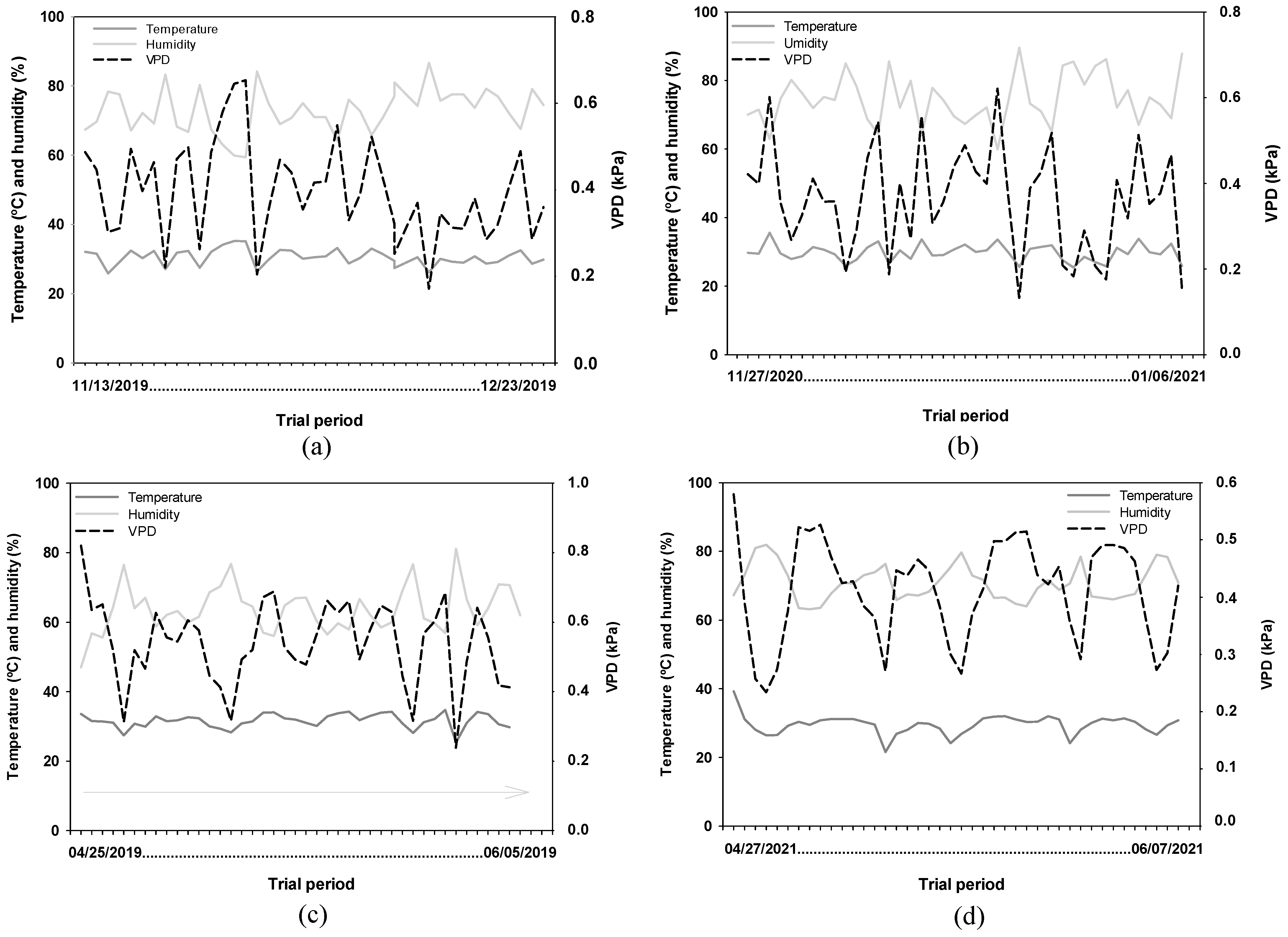
In each experiment, temperature and humidity inside the screen house were recorded, and vapor pressure deficit was calculated according to the Tetens equation [29]. Although the experiments took place in different years and seasons, they were conducted in a greenhouse (semi-controlled environment), which minimized the influence of external factors such as precipitation. The daily environmental variation (temperature, relative humidity, and VPD) for each experiment is shown in Figure 1. Despite being carried out in a semi-controlled environment and in different years, the statistical analyses were performed independently, and no cross-experiment comparisons were made.

2.3. Plant Measurements

Morphoagronomic traits, SPAD index, membrane damage, relative water content, and physiological traits related to gas exchange were evaluated once, after 21 days of growth under well-drained or waterlogged conditions. This treatment period followed the methodology developed by CIAT [30], which describes a screening protocol in which Urochloa plants are grown under controlled conditions and subsequently subjected to 21 days of continuous waterlogging, allowing the assessment of key morphophysiological traits, including green leaf biomass, SPAD index, and photosynthetic performance.
The number of green, yellowed, and senescent leaves was counted on fully expanded leaves per pot, and the totals were summed to obtain the total leaf number. The number of live and dead tillers was determined by counting green and dry tillers per pot, respectively.
Leaf elongation rate was measured according to Dias-Filho and Carvalho [16]. The SPAD (Soil Plant Analysis Development) index was assessed with three consecutive measurements on the middle third of three fully expanded leaves using a Minolta SPAD-502 chlorophyll meter [31].
At the end of the experiment, the dry mass of leaves, stems, and roots were determined by cutting the aerial biomass at soil level and separating leaves (leaf blades) and stems (including leaf sheaths) at the ligule junction. The substrate was removed from the roots with running water. Samples were dried in an oven at 65 °C and weighed after 72 h. Total dry mass was calculated as the sum of the dry masses of leaves, stems, and roots.
Membrane damage and relative water content analyses were performed only in Experiments 1 and 3, following the procedures described by Liu et al. [32], with modifications.
For membrane damage (MD) evaluation, ten leaf discs were taken from a fully expanded leaf and immersed in 10 mL of deionized water for 8 h. Subsequently, the conductivity of the suspension was measured using a benchtop conductivity meter calibrated with a standard solution, obtaining the first conductivity reading (C1). Then, the discs were incubated in a water bath at 100 °C for 1 h. After cooling, electrical conductivity was measured again (C2). Membrane damage was calculated as follows: MD = (C1/C2) × 100.
For relative water content (RWC) analysis, 100 mg of leaf discs from the same leaf used for MD were weighed to obtain fresh mass (FM). Discs were immersed in 20 mL of deionized water in Petri dishes for 24 h at 4 °C in darkness. After this period, discs were weighed to obtain turgid mass (TM). Subsequently, discs were dried in an oven at 65 °C with forced air circulation until constant weight was achieved and then weighed to obtain dry mass (DM). Finally, RWC was calculated by the expression: RWC = [(FM − DM)/(TM − DM)] × 100.
Gas exchange measurements were always performed in the morning between 9:00 and 11:00 a.m. using an infrared gas analyzer (IRGA; portable LI-6400xt model, LI-COR Biosciences Inc., Lincoln, NE, USA). Measurements were taken on a fully expanded young leaf blade. Photosynthetically active radiation (PAR) in the cuvette was maintained at 1200 μmol photons m−2 s−1, atmospheric CO2 concentration at 400 ppm, and temperature at 30 °C. The following parameters were evaluated: net photosynthesis (Pn), stomatal conductance (gs), leaf transpiration (E), and intercellular CO2 concentration (Ci). Carboxylation efficiency (CE) and water use efficiency (WUE) were calculated as the ratios Pn/Ci and Pn/E, respectively.

2.4. Statistical Analysis

All statistical analyses were performed using R software, version 4.1.3 [33]. Principal component analyses (PCA) were conducted using the FactoMineR package version 2.4 [34] to select variables and evaluate the distance among genotypes. Analyses were based on the relative average percentage (RAP) between plants under control treatment (CT) and waterlogging treatment (WT) within the same genotype (RAP = WT × 100/CT) for all variables except total leaf number and total dry mass.
After performing PCA with all variables, variable selection was conducted with the main criterion being the retention of variance explained by the first two principal components above 70% [35,36,37]. Additionally, biological relevance and/or ease of evaluation were considered. Thus, variables that were difficult to assess and/or had low biological importance were excluded whenever possible.
Standardized Euclidean distances from the genotype scores for the first two principal components were calculated using the R function dist. These distances were used to generate clusters via the Tocher optimization method in the MultivariateAnalysis package version 0.4.4 [38].
The sum of ranks index [39] was applied to classify genotypes according to their level of tolerance to soil waterlogging, using the R function rank. Classification was carried out with two sets of variables selected from PCA: morphoagronomic variables (MAV) and morphoagronomic plus physiological variables (MAV + PV). Spearman correlation coefficients between the sum of ranks of MAV, PV, and MAV + PV were obtained using the R function cor.test.

3. Results

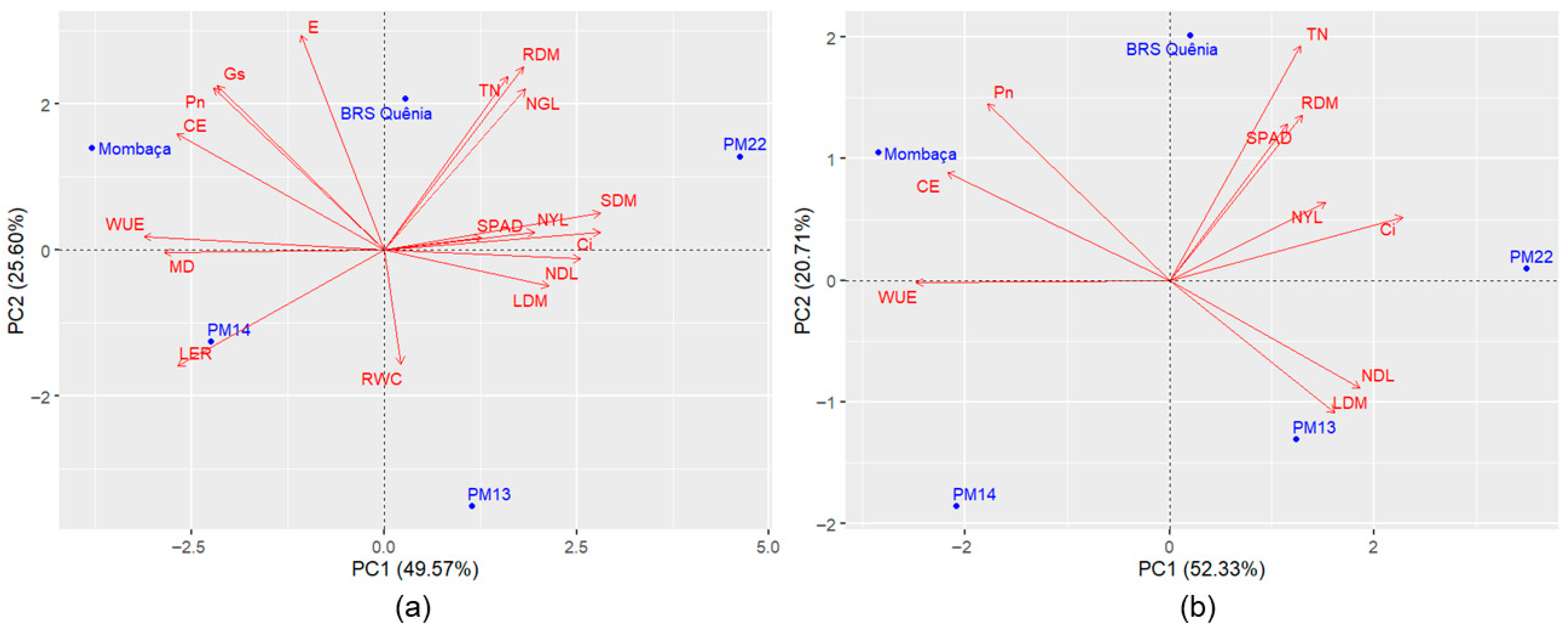
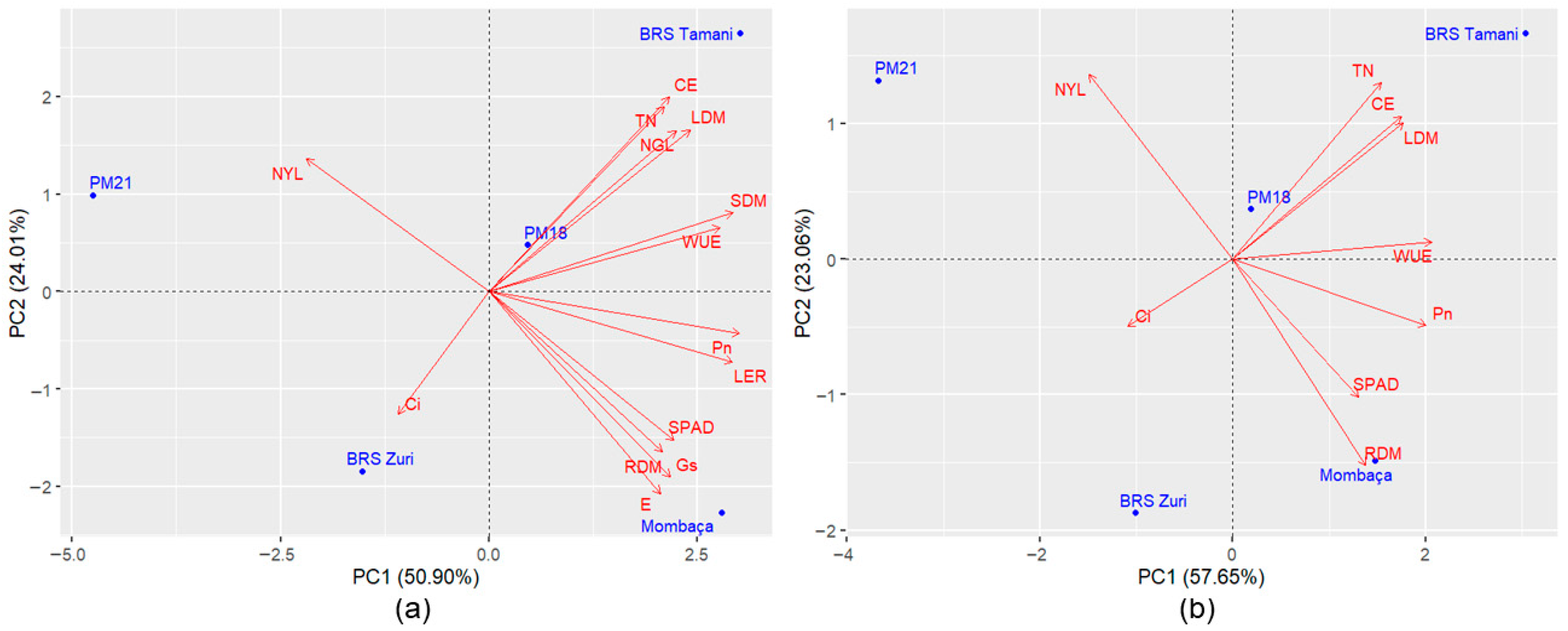
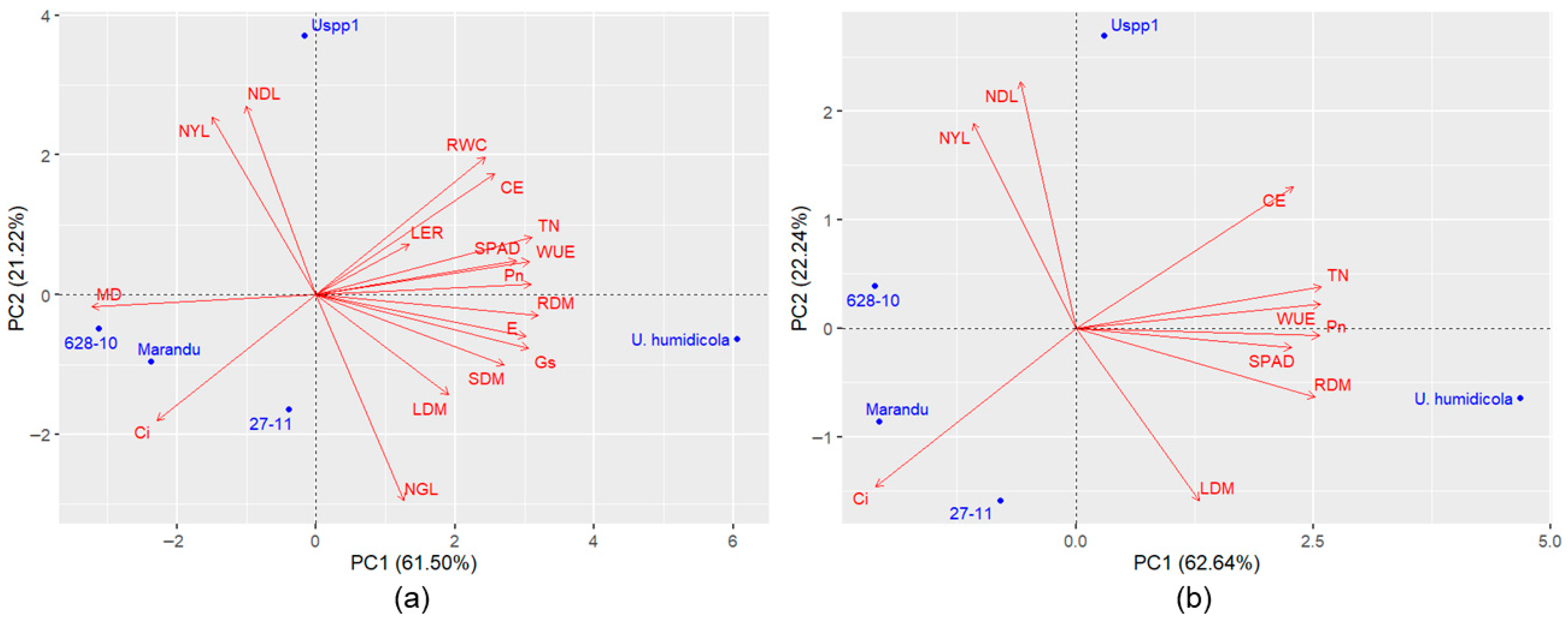
Principal component analyses revealed variation among genotypes for tolerance to waterlogging. The first two components of the dataset containing all traits accounted for 75.17% to 88.60% of the total variation (Figure 2a, Figure 3a, Figure 4a and Figure 5a), indicating that graphical interpretation could be performed based on the two-dimensional dispersion.
Based on the PCA including all variables, a variable reduction process was conducted. The main criterion adopted for this step was the preservation of the variance retained in the first two principal components, maintaining an explanatory power above 70%. Additionally, the difficulty of measurement and the biological relevance of each trait were also considered. Among the evaluated traits, the number of green leaves, stem dry mass, leaf elongation rate, relative water content, membrane damage, transpiration, and stomatal conductance were excluded.
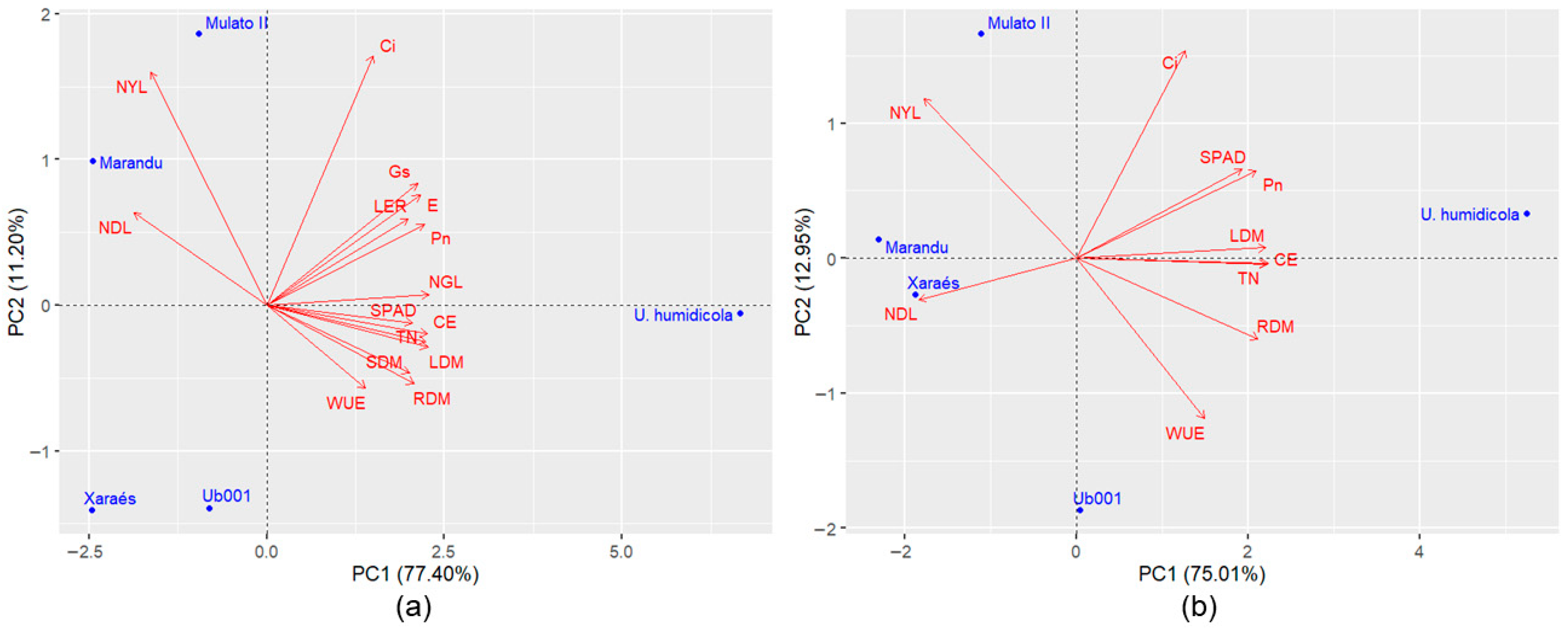
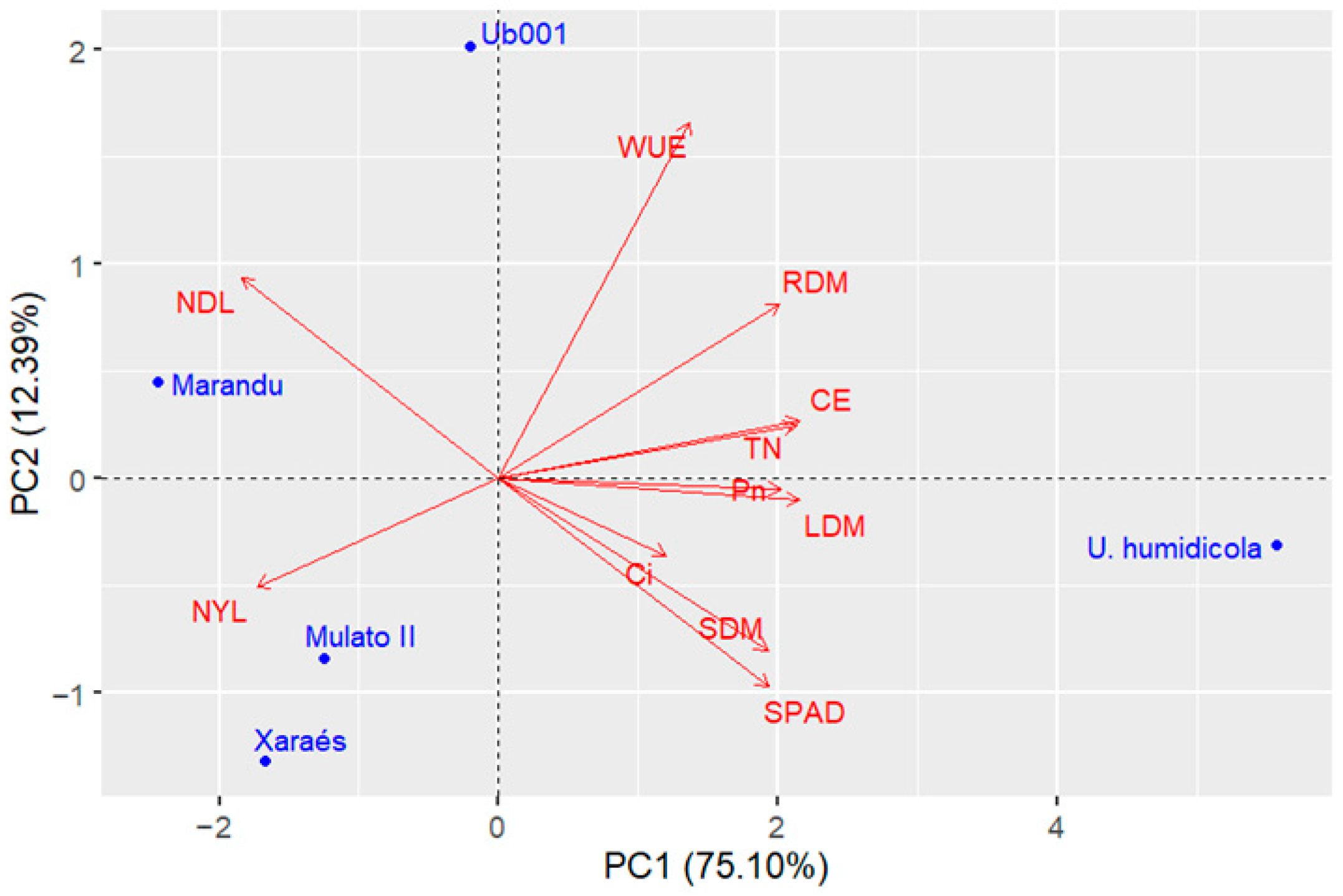
After variable reduction, the accumulated variance in the first two principal components was slightly reduced in Experiment 1 (by 2.13%) (Figure 2a,b) and in Experiment 4 (by 0.64%) (Figure 5a,b); however, retained variance remained above 70%. In Experiments 2 and 3 (Figure 3 and Figure 4), the accumulated variance in the first two principal components increased by 2.16% and 0.57%, respectively. The genotype dispersion pattern in Experiments 1, 2, 3, and 4 was minimally altered after variable reduction. In the M. maximus experiments, the genotypes shifted slightly within the two-dimensional space, but the distances between them remained nearly unchanged (Figure 2 and Figure 3). The most notable changes, albeit minor, were observed in the experiments with Urochloa spp. genotypes. In Experiment 3, after variable reduction, hybrid 628-10 became more distant from cv. Marandu (Figure 4), while in Experiment 4, cv. Xaraés moved away from accession Ub001 and became closer to cv. Marandu (Figure 5). Due to this last change in Urochloa spp. experiment, new analyses were conducted, and it was found that the inclusion of the variable stem dry mass maintained a dispersion pattern like that of Figure 5a, with ‘Xaraés’ remaining more distant from ‘Marandu’ (Figure 6). For the other experiments, the inclusion of this trait caused minimal changes in the graphical dispersions of PCA. However, in the subsequent cluster and ranking analyses using the selection index, the results were not consistent, indicating that it is more appropriate not to include stem dry mass in all experiments. It is worth noting that this variable may be important depending on the population under analysis. Therefore, validation trials with populations composed of a larger number of genotypes are recommended. Despite these differences, in general, the variable reduction process proved effective, indicating that the excluded traits were not essential for assessing genotype divergence.
Using Tocher’s optimization method based on the standardized Euclidean distance of principal component scores, the genotypes were clustered into distinct groups. The M. maximus genotypes were separated into three groups in both experiments (Table 3 and Table 4). In Experiment 1, Group I included ‘Mombaça’ and ‘BRS Quênia’, Group II comprised PM13 and PM22, and Group III contained PM14. In Experiment 2, Group I was composed of three genotypes (‘Mombaça’, ‘BRS Zuri’, and PM18), while Groups II (‘BRS Tamani’) and III (PM21) each contained a single genotype. Based on the biplots, no clear clustering pattern was observed for these genotypes (Figure 2b and Figure 3b).
In Experiments 3 and 4, the Urochloa spp. genotypes were separated into two groups using the Tocher optimization method (Table 5 and Table 6), with U. humidicola allocated to a group distinct from the other genotypes. The high level of waterlogging tolerance exhibited by U. humidicola compared to the others likely hindered the Tocher method from effectively discriminating among the remaining Urochloa spp. genotypes. Consequently, the groups formed by these genotypes (Group I in Experiments 3 and 4) were subjected to additional clustering analyses to form subgroups.
When analyzing Urochloa spp. genotypes without U. humidicola, two groups were formed by Tocher’s method in Experiment 3. Cultivar Marandu and the hybrids 27-11 and 628-10 were clustered into one group, while Uspp1 was allocated to a separate group (Table 7), a result consistent with the two-dimensional dispersion observed in Figure 4b. In Experiment 4, Tocher’s method also resulted in the formation of two groups, with one being a single group composed of the Ub001 accession, and the other including the remaining genotypes (Table 8). Graphical dispersion analysis (Figure 5b) revealed greater proximity between cv. Marandu and cv. Xaraés. However, according to Tocher’s method, the hybrid Mulato II was clustered with these two genotypes, likely due to the large distance exhibited by accession Ub001 in relation to all other genotypes.
Tocher’s method allowed greater objectivity in genotype discrimination when compared to PCA, mainly due to its ability to group M. maximus genotypes (Table 3 and Table 4), which did not show a clear clustering pattern in the PCA biplots (Figure 2b and Figure 3b). Moreover, Tocher’s method enabled the subdivision of Urochloa spp. genotypes allocated to Group I in Experiments 3 and 4. Therefore, these techniques were complementary, as the standardized Euclidean mean distances used in Tocher’s method were calculated based on PC1 and PC2.
The M. maximus and Urochloa spp. genotypes were ranked according to their tolerance to soil waterlogging using two sets of variables selected in the principal component analysis: morphoagronomic (MAV) and morphoagronomic plus physiological (MAV + PV). The ranking results based on the Rank Sum Index are presented in Table 9, Table 10, Table 11 and Table 12.
When comparing the genotype ranking based solely on morphoagronomic variables with the classification that also included physiological variables, differences were observed in the ranking of PM14 and PM22 in Experiment 1 (Table 9), and between ‘BRS Zuri’ and PM18 in Experiment 2 (Table 10), indicating that physiological variables influenced the ordering of these genotypes. Although these changes were attributed to the influence of physiological variables, the Spearman correlation coefficient showed that morphoagronomic variables can be used for the indirect selection of physiological traits, as the correlations between these two sets of variables were all significantly high (p < 0.05) across the four experiments (Table 13).
In the experiments with M. maximus, cv. Mombaça was classified as the most tolerant to waterlogging, followed by cv. BRS Quênia and cv. BRS Tamani in Experiments 1 and 2, respectively (Table 9 and Table 10). On the other hand, genotypes PM13 (Experiments 1) and PM21 (Experiment 2) had the lowest tolerance to the stress, according to MAV and MAV + PV.
In Experiments 3 and 4, regardless of the set of variables, the index confirmed the high tolerance of U. humidicola to waterlogging (Table 11 and Table 12). Marandu was found to have the lowest tolerance in all scenarios, tying with hybrid 628-10 in Experiment 3. Using the Tocher method, these genotypes were allocated to the same group (Table 7), confirming that the tolerance of hybrid 628-10 was low and similar to that of cv. Marandu. Uspp1 was ranked higher than hybrid 27-11 in both sets of variables. Using Tocher’s method, these genotypes were allocated to distinct groups.
In Experiment 4, accession Ub001 demonstrated intermediate tolerance, being the second highest-ranked genotype, followed by cv. Xaraés, hybrid Mulato II, and cv. Marandu. According to Tocher’s analysis, these last three genotypes showed low distances from each other, as they comprised the same group (Table 8) and divergence with accession Ub001, which was separated into a separate group.

4. Discussion

Although all experiments were conducted under controlled greenhouse conditions, natural seasonal variation in factors such as light availability, temperature, and vapor pressure deficit (VPD), as well as the use of an unfertilized substrate applied uniformly to all genotypes and treatments, may have contributed to subtle differences in plant growth between experimental periods. However, these factors did not compromise the consistency of the multivariate patterns observed, and the overall responses remained highly compatible with findings previously reported in the literature [15,16,17,18,19,20,21]. It is worth emphasizing that all statistical analyses were performed independently for each experiment, with no cross-trial comparisons.

4.1. Selection of Traits and Genotype Grouping

The selection of variables was appropriately performed through principal component analysis (PCA). In PCA, the majority of data variation should be explained by the first two or three principal components [40], which preferably should encompass 80% or more of the original variation contained in the data [41], allowing visual evaluation of bi- or tridimensional scatter plots. However, a minimum of 70% of the total accumulated variation in the first two or three principal components is also a commonly accepted criterion in studies [34,35,36,42] and has proven effective for interpreting results. This minimum variation percentile was strictly preserved after variable exclusion in all four experiments (Figure 2, Figure 3, Figure 4 and Figure 5).
Regardless of the objective, early stages of forage breeding programs involve excessive numbers of genotypes [5]. Therefore, an additional selection criterion was the difficulty of trait evaluation, aiming to preserve those requiring less effort. Biological importance was also considered, contributing to the preservation of physiological characters. Gas exchange-related aspects, such as CO2 assimilation, stomatal conductance, and transpiration, were used to help identify flooding effects in small Urochloa grass populations [18,24,25].
Among discarded traits, membrane damage and relative water content indicate cellular integrity and wilting [37], providing relevant biological information. However, analysis of these traits involves laborious and time-consuming laboratory techniques, complicating their use in large samples. Physiological gas exchange traits are biologically important but their use is also limited to a small number of genotypes. Leaf elongation rate is described as a good indicator of flooding tolerance in Urochloa grasses [16], but monitoring responses requires daily effort, making it difficult to apply in evaluations involving hundreds or thousands of genotypes.
Although root dry mass requires additional effort in soil removal during washing, it is biologically important for plants grown in poorly drained soils, as roots undergo various changes such as aerenchyma formation and exodermis cell suberization, which are criteria used for Urochloa genotype evaluation under flooding [25]. The number of yellow and dead leaves are good indicators of flooding effects and are observed in plants that are not tolerant to MDS [43]. Aerial dry mass, especially leaves, and tillering are easy-to-measure traits and have been evaluated in forage grasses grown in pots under flooded soil [7,18].
Stem dry mass (SDM) was excluded from the final set of selection variables due to its influence on the inconsistent behavior of genotypes across experiments. However, its inclusion in Experiment 4 improved the graphical discrimination between contrasting genotypes in the PCA biplot, particularly between the Marandu and Xaraés cultivars, which responded differently to water stress (Figure 6). This improvement in dispersion is likely related to the strong influence of plant architecture and tillering pattern on stem biomass, characteristics that are markedly distinct among Urochloa genotypes. However, SDM tends to respond more slowly to short-term flooding compared to leaf and root-related traits, and this biological lag may have contributed to unstable clustering and classification patterns in the other experiments. For this reason, despite its localized usefulness in Experiment 4, SDM was not retained as a robust variable for the overall discrimination of flood tolerance.
Although the architectural differences and the physiological patterns related to photosynthetic parameters discussed above help explain part of the contrasting responses observed among Urochloa spp. and M. maximus genotypes, such as ‘Xaraés’ and ‘BRS Tamani’, additional physiological and anatomical mechanisms also contribute to their performance under waterlogging. Traits such as root plasticity, including the ability to adjust lateral and superficial root growth, may influence oxygen supply and the maintenance of nutrient uptake under hypoxic conditions [19]. Aerenchyma formation—previously reported in U. humidicola and other tolerant genotypes—is a critical mechanism that facilitates internal oxygen diffusion and may occur at different intensities among cultivars. Furthermore, processes such as exodermis suberization can reduce the entry of water and soil-derived toxins under anoxic conditions, contributing to greater cellular stability [20].
Generally, genotypes with contrasting tolerance levels appeared in opposite extremes in the four experiments, such as the cultivars Marandu and U. humidicola (Figure 4 and Figure 5). This observation corroborates the factorial analysis performed by Caetano and Dias-Filho [18], who found that among six Urochloa genotypes, the most tolerant cultivar (cv. Arapoty) and the least tolerant (cv. Marandu) were distinctly separated at opposite extremes. This shows that two-dimensional analyses can allocate genotypes with highly divergent waterlogging tolerance to distant points.
The grouping generated in Experiments 3 and 4 (Table 5 and Table 6) showed great di-vergence between U. humidicola and other Urochloa genotypes. These findings align with previous studies highlighting the much higher waterlogging tolerance of U. humidicola compared to other Urochloa species [16,19,20]. However, even among genotypes of the same Urochloa species, tolerance variability exists [17,44], which in this study was evident only after excluding U. humidicola. The strategy of forming subgroups from large genotype groups was previously tested successfully to analyze divergence among U. humidicola hybrids without the cv. Tully [45].
When analyzing the known cultivars regarding their degree of tolerance to waterlogged in the field (Table 1), it was found that the clusters did not always occur based on the levels of tolerance to this stress. This is the case of cv. BRS Quênia, considered to have low/intermediate tolerance [10,28,46], which in Experiment 1 was grouped with cv. Mombaça (Table 3), a genotype described as having medium/high tolerance [21,27,28]. On the other hand, in Experiment 2 (Table 4), there was relative coherence, such that cv. BRS Zuri, which exhibits medium/high tolerance to waterlogged soils [23,27,28], was associated with cv. Mombaça and both were separated from BRS Tamani, which is not suitable for cultivation in waterlogged soils [47]. However, it is worth highlighting that the separation of cv. BRS Tamani into a unitary group is not indicative of low tolerance to waterlogged soils, so that under pot conditions this genotype showed a good response in this study (Table 10) and in Maranhão et al. [22].
Among Urochloa cultivars, cv. Marandu is recognized as having very low tolerance to flooded soils [17,18], while genotypes 27-10, 678-10 and Uspp1 were classified as highly susceptible [28] and as having low to moderate susceptibility, respectively. Thus, the segregation of Uspp1 into a distinct group in Experiment 3 (Table 7) indicates its superior relative tolerance. On the other hand, similarity observed between cvs. Marandu, Mulato II, and Xaraés in Group I of Experiment 4 (Table 8) did not reflect their respective field performances under waterlogged soils, as their tolerance to Marandu Death Syndrome is classified as very low, low, and medium/high, respectively [27,28].

4.2. Genotype Selection Based on Selection Index

Despite considerable advances in understanding the responses of forage grasses to waterlogging [16,17,19,20], the problem of MDS still persists [10], which makes the search for more tolerant genotypes a necessary demand, especially in the Amazon biome [48]. Given this issue, two sets of variables selected from the principal component analysis (morphoagronomic and morphoagronomic plus physiological) were used to classify the analyzed genotypes regarding their tolerance levels to waterlogging through the sum of ranks index [39].
In the experiments with M. maximus, ‘Mombaça’ was classified as the most tolerant (Table 9 and Table 10), corroborating Silva et al. [21], who indicated this cultivar as promising for cultivation in waterlogged areas. The accession PM13 (classified with the lowest tolerance to stress) and ‘BRS Tamani’ (ranked as the second most tolerant genotype) showed contrasting responses to waterlogging, even though PM13 is one of the parents of ‘BRS Tamani’ [45]. It is worth noting that ‘BRS Tamani’ was positioned above PM18 and ‘BRS Zuri’, genotypes usually recognized as more tolerant [28]. This result reinforces that, although the classification method proves to be suitable for contrasting genotypes, it may present inconsistencies in specific cases, as observed for ‘BRS Tamani’. This highlights the need for careful interpretation and validation using field-based experimental data. Moreover, this cultivar displays a distinct plant architecture and tillering pattern compared to the others [47], which may have influenced the observed results. Therefore, as previously noted for B. humidicola, it is important to consider the use of populations with more similar plant architecture, as this factor may influence the relative responses obtained, and still requires further investigation.
The sum of ranks index results, combined with the Tocher’s optimization method, confirmed the high tolerance of U. humidicola and indicated Uspp1 as intermediate.
The hybrids Mulato II and 628-10 showed the second lowest ranking among U. brizantha genotypes, being grouped with cv. Marandu by Tocher’s optimization method, which indicates similarity in their low tolerance to waterlogging. The cv. Xaraés was also clustered with Marandu in the cluster analysis, suggesting low tolerance. However, the rank-sum index placed Xaraés in the third-best ranking, evidencing intermediate tolerance. This result is consistent with Tonato et al. [27], who described cv. Xaraés as moderately tolerant to MDS. On the other hand, it differs from the findings of Assis et al. [28], who classified it as tolerant, and from Andrade et al. [49], who highlighted this cultivar as the most widely planted in Acre, a state located in the Amazon region, characterized by large areas subject to temporary soil waterlogging.

4.3. Divergence Between Waterlogging Tolerance and Marandu Death Syndrome

The scope of this study was restricted to assessing tolerance to waterlogging, whereas MDS in field conditions involves other contributing factors: the presence of pathogenic fungi such as Pythium, Rhizoctonia, and Fusarium [10]. Thus, since evaluations in controlled environments do not exactly reflect field conditions, different results may occur. This is the case, for example, of the cv. BRS Tamani, which was released with cultivation restrictions for waterlogged soils [46], but in this study, as well as in observations by Maranhão et al. [22], showed good performance under flooded soil in pot experiments. Conversely, the cv. Xaraés, classified as moderately/highly tolerant to MDS [27,28], expressed poor results in pots under flooded soil [9].
Although it does not exactly reflect what occurs in the field, most screening studies to identify waterlogging tolerant forage grasses are conducted in pots [9,17,18,19,20,21]. Examples include ‘Marandu’ and U. humidicola, which show poor and excellent tolerance to the MDS, respectively [10], a fact also consistently observed in pots under waterlogged soil [16,19,50]. Consistent observations also occur regarding Mulato II hybrid, which has poor tolerance to the MDS [10] and to flooding imposed in pots [20]. Another example is the cv. Mombaça, classified as tolerant to waterlogging in the field [10] and to flooded soils in pots [21].
It is noteworthy that the aforementioned studies, conducted by EMBRAPA and CIAT breeding programs, were limited to the evaluation of few genotypes (units or dozens). This limitation is due to the lack of screening methods capable of evaluating many genotypes simultaneously, which is a problem for forage breeding programs at early stages, where about 2000 genotypes are evaluated [5].
Researchers at CIAT developed a screening method for tolerance to waterlogging in Urochloa grasses based on the evaluation of greater green leaf biomass production, higher proportion of green leaf biomass relative to total leaf biomass, lower levels of dead leaf biomass, larger green leaf area, SPAD index, and photosynthetic efficiency [15]; however, the maximus number of genotypes tested by this method was 71 hybrids [51].
In the present study, it was possible to identify a group of morphoagronomic traits that are relatively easy to measure and demonstrated that M. maximus and Urochloa spp. genotypes can be discriminated in terms of tolerance to waterlogging in short-term experiments under controlled conditions. It is suggested that these traits be validated in a large number of genotypes so that a screening method aimed at selecting waterlogging tolerance can be consolidated and applied in early stages of tropical forage grass breeding programs.
It is emphasized that this technique does not replace field selection for tolerance to the MDS evaluated under poorly drained soil and grazing but is only indicated for selection in the first phases of breeding programs. Moreover, validation of a screening method in controlled environments with a large number of genotypes must be carried out cautiously, as shown in this study: the techniques used are efficient for selecting the most contrasting tolerant genotypes but may cause confusion, especially when evaluating intermediate genotypes.

5. Conclusions

The physiological traits—photosynthetic rate, internal CO2 concentration, carboxylation efficiency, and water use efficiency—are recommended as selection criteria for identifying M. maximus and Urochloa spp. genotypes tolerant to waterlogged soils.
The morphoagronomic traits—number of yellow and senescent leaves, number of tillers, SPAD index, leaf dry mass, and root dry mass—are recommended as selection criteria for identifying M. maximus and Urochloa spp. genotypes tolerant to waterlogging under controlled conditions and can also be used for the indirect assessment of physiological traits.
Among the M. maximus genotypes evaluated, cv. Mombaça is the most waterlogging tolerant, while PM13 and PM21 are the least tolerant.
Among the Urochloa spp. genotypes evaluated, U. humidicola is the most tolerant to this stress. Xaraés, Uspp1, hybrid 27-11, and Ub001 showed intermediate tolerance. The hybrids Mulato II and 628-10 were classified as having low tolerance to waterlogging, and cv. Marandu exhibited very poor tolerance.
The use of U. humidicola cv. Tully as a control in experiments with Urochloa spp. genotypes should be performed with caution, as the high tolerance level of this species may impair the identification of tolerance levels in other genotypes.
The classification of forage grass genotypes for waterlogging tolerance, based on pot experiments under controlled conditions, does not necessarily reflect their degree of tolerance to Marandu Death Syndrome when grown in poorly drained soils under grazing conditions.
Future studies may include field validation in poorly drained soils and under grazing conditions, since responses under controlled conditions may not fully capture the multifactorial nature of MDS. Furthermore, complementary analyses, such as detailed anatomical characterization of the roots (e.g., aerenchyma development in M. maximus), evaluation of oxidative enzyme activity, and analysis of gene expression patterns associated with hypoxia tolerance, may help elucidate the underlying mechanisms responsible for the contrasting responses observed among the genotypes.


Author Contributions

Conceptualization, C.S.d.S., G.M.L.d.A., C.M.S.d.A., L.J. and S.C.L.B.; methodology, C.S.d.S., G.M.L.d.A. and M.d.O.M.; investigation, C.S.d.S. and M.S.d.M.; data curation, C.S.d.S. and G.M.L.d.A.; formal analysis, C.S.d.S. and G.M.L.d.A.; writing—original draft preparation, C.S.d.S.; writing—review and editing, M.d.O.M., L.J., S.C.L.B., C.M.S.d.A. and G.M.L.d.A.; supervision, M.d.O.M. and G.M.L.d.A.; project administration, G.M.L.d.A. All authors have read and agreed to the published version of the manuscript.

Funding

This research was funded by the Association for the Promotion of Forage Breeding Research (UNIPASTO) (10200.17/0006-5), the Brazilian Agricultural Research Corporation (Embrapa), and the Coordination for the Improvement of Higher Education Personnel (CAPES) (001) through a scholarship.

Institutional Review Board Statement

Not applicable.

Informed Consent Statement

Not applicable.

Data Availability Statement

The data that support this study will be shared upon reasonable request to the corresponding author.

Acknowledgments

We would like to thank the Brazilian Agricultural Research Corporation, Embrapa Acre Unit, for their support and assistance. We also acknowledge the collaboration and contributions of Embrapa Gado de Corte and the Federal University of Acre to this research.

Conflicts of Interest

Authors Liana Jank, Sanzio Carvalho Lima Barrios, Carlos Mauricio Soares de Andrade, and Giselle Mariano Lessa de Assis are employed by the company Brazilian Agricultural Research Corporation.

Abbreviations

The following abbreviations are used in this manuscript:
CiIntercellular CO2 Concentration
CECarboxylation efficiency
ETranspiration
GsStomatal conductance
LDMLeaf dry mass
LERLeaf elongation rate
MAVMorphoagronomic variables
MDMembrane damage
NDLNumber of dry leaves
NGLNumber of green leaves
NYLNumber of yellow leaves
PnPhotosynthesis
PVPhysiological variables
RDMRoot dry mass
RWCRelative water content
SDMStem dry mass
SPADSPAD index
TNTiller number
WUEWater use efficiency

References

  1. Michalk, D.L.; Kemp, D.R.; Badgery, W.B.; Wu, J.; Zhang, Y.; Thomassin, P.J. Sustainability and future food security—A global perspective for livestock production. Land Degrad. Dev. 2019, 30, 561–573. [Google Scholar] [CrossRef]
  2. Tracy, B.F.; Foster, J.L.; Butler, T.J.; Islam, M.A.; Toledo, D.; Vendramini, J.M.B. Resilience in forage and grazinglands. Crop Sci. 2018, 58, 31–42. [Google Scholar] [CrossRef]
  3. Parente, L.; Mesquita, V.; Miziara, F.; Baumann, L.; Ferreira, L. Assessing the pasturelands and livestock dynamics in Brazil, from 1985 to 2017: A novel approach based on high spatial resolution imagery and Google Earth Engine cloud computing. Remote Sens. Environ. 2019, 232, 111301. [Google Scholar] [CrossRef]
  4. Silva, C.T.R.; Bonfim-Silva, E.M.; Silva, T.J.A.; Pinheiro, E.A.R.; José, J.V.; Ferraz, A.P.F. Yield component responses of the Brachiaria brizantha forage grass to soil water availability in the Brazilian Cerrado. Agriculture 2020, 10, 13. [Google Scholar] [CrossRef]
  5. Jank, L.; Barrios, S.C.; do Valle, C.B.; Simeão, R.M.; Alves, G.F. The value of improved pastures to Brazilian beef production. Crop Pasture Sci. 2014, 65, 1132–1137. [Google Scholar] [CrossRef]
  6. Lapig. Laboratório de Processamento de Imagens e Geoprocessamento. Available online: https://atlasdaspastagens.ufg.br (accessed on 19 August 2022).
  7. Oliveira, E.M.D.; Martuscello, J.A.; Jank, L.; Cunha, D.D.N.F.V.D.; Santos, M.F. Evaluation of Megathyrsus maximus genotypes under water stress conditions. Acta Sci. Anim. Sci. 2022, 44, e54975. [Google Scholar] [CrossRef]
  8. World Bank. Brazil Other Seeds of Forage Plants, of a Kind Used for Exports. 2022. Available online: https://wits.worldbank.org/trade/comtrade/en/country/BRA/year/2022/tradeflow/Exports/partner/ALL/product/120929 (accessed on 22 November 2025).
  9. Mass Junior, R.; Domiciano, L.F.; Ribeiro, L.F.C.; Pedreira, B.C. Growth responses of nine tropical grasses under flooding conditions. Trop. Grassl.-Forrajes Trop. 2016, 4, 1–7. [Google Scholar] [CrossRef]
  10. Pedreira, B.C.; Dias-Filho, M.B.; Andrade, C.; Pereira, D.H.; Holschuch, S.G.; Cavalli, J. Convivendo com a síndrome da morte do braquiarão na Amazônia. In Recuperação de Pastagens Degradadas na Amazônia, 1st ed.; Dias-Filho, M.B., de Andrade, C.M.S., Eds.; EMBRAPA: Brasília, Brazil, 2019; pp. 127–151. [Google Scholar]
  11. Ribeiro-Júnior, N.G.; Fagundes, O.S.; Benevenuti, A.S.; Yamashita, O.M.; Rossi, A.A.B.; Carvalho, M.A.C.; Silva, I.V. Tropical forages: Morphoanatomy of plants grown in areas with the death of pasture syndrome. Braz. J. Biol. 2017, 77, 868–875. [Google Scholar] [CrossRef][Green Version]
  12. Eri, M.; da Silva Junior, C.A.; Lima, M.; Júnior, N.L.S.; De Oliveira-Junior, J.F.; Teodoro, P.E.; Peres, C.A. Capitalizing on opportunities provided by pasture sudden death to enhance livestock sustainable management in Brazilian Amazonia. Environ. Dev. 2020, 33, 100499. [Google Scholar] [CrossRef]
  13. Argel, P.J.; Keller-Grein, G. Experiencia regional con Brachiaria: Región de América Tropical—Tierras Bajas Húmedas. In Brachiaria: Biología, Agronomía y Mejoramiento, 1st ed.; Miles, J.W., Maass, B.L., Valle, C.B., Eds.; CIAT: Cali, Colombia, 1998; pp. 226–246. [Google Scholar]
  14. Silva, M.A.; Lima, M.; Silva Junior, C.A.; Costa, G.M.; Peres, C.A. Achieving low-carbon cattle ranching in the Amazon: ‘Pasture sudden death’ as a window of opportunity. Land Degrad. Dev. 2018, 29, 3535–3543. [Google Scholar] [CrossRef]
  15. Cardoso, J.A.; Jiménez, J.; Rincón, J.; Guevara, E.; Van der Hoek, R.; Jarvis, A.; Rao, I. Advances in improving tolerance to waterlogging in Brachiaria grasses. Trop. Grassl.-Forrajes Trop. 2013, 1, 197–201. [Google Scholar] [CrossRef]
  16. Dias-Filho, M.B.; de Carvalho, C.J.R. Physiological and morphological responses of Brachiaria spp. to flooding. Pesqui. Agropecu. Bras. 2000, 35, 1959–1966. [Google Scholar] [CrossRef]
  17. Dias-Filho, M.B. Tolerance to flooding in five Brachiaria brizantha accessions. Pesqui. Agropecu. Bras. 2002, 37, 439–447. [Google Scholar] [CrossRef]
  18. Caetano, L.P.D.S.; Dias-Filho, M.B. Responses of six Brachiaria spp. accessions to root zone flooding. Rev. Bras. Zootec. 2008, 37, 795–801. [Google Scholar] [CrossRef]
  19. Cardoso, J.A.; Jiménez, J.D.L.C.; Rao, I.M. Waterlogging-induced changes in root architecture of germplasm accessions of the tropical forage grass Brachiaria humidicola. AoB Plants 2014, 6, plu017. [Google Scholar] [CrossRef] [PubMed]
  20. Jiménez, J.D.L.C.; Cardoso, J.A.; Kotula, L.; Veneklaas, E.J.; Pedersen, O.; Colmer, T.D. Root length is proxy for high-throughput screening of waterlogging tolerance in Urochloa spp. grasses. Funct. Plant Biol. 2020, 48, 411–421. [Google Scholar] [CrossRef]
  21. Silva, A.S.; Laura, V.A.; Jank, L. Soil flood tolerance of seven genotypes of Panicum maximum Jacq. Braz. Arch. Biol. Technol. 2009, 52, 1341–1348. [Google Scholar] [CrossRef]
  22. Maranhão, S.R.; Pompeu, R.C.F.F.; de Araújo, R.A.; Lopes, M.N.; de Souza, H.A.; Cavalcante, A.; Rogerio, M. Morphophysiology of tropical grasses under different water supply in two growing seasons: II. BRS Massai and BRS Tamani grasses. Semin. Ciênc. Agrár. 2021, 42, 301–318. [Google Scholar] [CrossRef]
  23. Silva, E.B.D.; Carneiro, M.S.D.S.; Furtado, R.N.; Lopes, M.N.; Braga, M.D.M. Chemical composition of Panicum maximum ‘BRS Zuri’ subjected to levels of salinity and irrigation depths. Rev. Ciênc. Agron. 2020, 51, e20175997. [Google Scholar] [CrossRef]
  24. Ramos, T.J.N.; Souza, C.M.; Carvalho, C.J.R.; Vieira, I.M.S. Respostas fisiológicas e metabólicas de gramíneas ao alagamento. Rev. Ciênc. Agrár. 2011, 54, 78–84. [Google Scholar] [CrossRef][Green Version]
  25. Jiménez, J.D.L.C.; Cardoso, J.A.; Dominguez, M.; Fischer, G.; Rao, I. Morpho-anatomical traits of root and non-enzymatic antioxidant system of leaf tissue contribute to waterlogging tolerance in Brachiaria grasses. Grassl. Sci. 2015, 61, 243–252. [Google Scholar] [CrossRef]
  26. de Sousa, J.W. Características climáticas do município de Rio Branco, Acre, período de 1990–2019. Sci. Nat. 2020, 2, 723–740. Available online: https://periodicos.ufac.br/index.php/SciNat/article/view/4231 (accessed on 8 May 2022).
  27. Tonato, F.; Perin, R.; Dias-Filho, M.B. Opções de forrageiras para pastagens na Amazônia. In Recuperação de Pastagens Degradadas na Amazônia; Dias-Filho, M.B., de Andrade, C.M.S., Eds.; EMBRAPA: Brasília, Brazil, 2019; pp. 79–126. [Google Scholar]
  28. de Assis, G.M.L.; de Andrade, C.M.S.; Jank, L.; Barrios, S.C.L.; Valentim, J.F. Metodologia para Avaliação e Seleção a Campo de Genótipos de Gramíneas Forrageiras para Tolerância à Síndrome da Morte do Braquiarão; Embrapa Acre, Documentos; Embrapa Acre: Rio Branco, Brazil, 2023; 42p. [Google Scholar]
  29. Tetens, O. Über einige meteorologische Begriffe. Z. Geophys. 1930, 6, 297–309. [Google Scholar]
  30. Rao, I.M.; Rincon, J.; Garcia, R.; Miles, J.R.J. Screening for tolerance to waterlogging in Brachiaria hybrids. In Proceedings of the ASA-CSSA-SSSA International Annual Meeting 2007, New Orleans, LA, USA, 4–8 November 2007. [Google Scholar]
  31. Minolta, C. Manual for Chlorophyll Meter SPAD-502; Minolta Radiometric Instruments Divisions: Osaka, Japan, 1989; 22p. [Google Scholar]
  32. Liu, H.; Yu, C.; Li, H.; Ouyang, B.; Wang, T.; Zhang, J.; Ye, Z. Overexpression of ShDHN, a dehydrin gene from Solanum habrochaites enhances tolerance to multiple abiotic stresses in tomato. Plant Sci. 2015, 231, 198–211. [Google Scholar] [CrossRef] [PubMed]
  33. R Core Team. R: A Language and Environment for Statistical Computing; R Foundation for Statistical Computing: Vienna, Austria, 2022. [Google Scholar]
  34. Husson, F.; Josse, J.; Le, S.; Mazet, J. Multivariate Exploratory Data Analysis and Data Mining, R package version 1.2.2; CRAN: Rennes, France, 2013; Available online: https://cran.r-project.org/web/packages/FactoMineR (accessed on 10 May 2022).
  35. Brunetti, H.B.; Cavalcanti, P.P.; Dias, C.T.S.; Pezzopane, J.R.M.; Santos, P.M. Climate risk and seasonal forage production of Marandu palisadegrass in Brazil. An. Acad. Bras. Ciênc. 2020, 92, e20190046. [Google Scholar] [CrossRef]
  36. Sivakumar, J.; Prashanth, J.E.P.; Rajesh, N.; Reddy, S.M.; Pinjari, O.B. Principal component analysis approach for comprehensive screening of salt stress-tolerant tomato germplasm at the seedling stage. J. Biosci. 2020, 45, 141. [Google Scholar] [CrossRef]
  37. Seymen, M. How does the flooding stress occurring in different harvest times affect the morpho-physiological and biochemical characteristics of spinach? Sci. Hortic. 2021, 275, 109713. [Google Scholar] [CrossRef]
  38. Azevedo, A. Multivariate Analysis: Pacote para Analise Multivariada, R package version 0.4.4; CRAN: Vienna, Austria, 2021; Available online: https://CRAN.R-project.org/package=MultivariateAnalysis (accessed on 18 May 2022).
  39. Mulamba, N.N.; Mock, J.J. Improvement of yield potential of the ETO blanco maize (Zea mays L.) population by breeding for plant traits. Egypt. J. Genet. Cytol. 1978, 7, 40–51. [Google Scholar]
  40. Lever, J.; Krzywinski, M.; Altman, N. Points of significance: Principal component analysis. Nat. Methods 2017, 14, 641–642. [Google Scholar] [CrossRef]
  41. Cruz, C.D.; Regazzi, A.J.; Carneiro, P.C.S. Modelos Biométricos Aplicados ao Melhoramento Genético; UFV: Viçosa, Brazil, 2004; 480p. [Google Scholar]
  42. Seymen, M.; Yavuz, D.; Dursun, A.; Kurtar, E.S.; Türkmen, Ö. Identification of drought-tolerant pumpkin (Cucurbita pepo L.) genotypes associated with certain fruit characteristics, seed yield, and quality. Agric. Water Manag. 2019, 221, 150–159. [Google Scholar] [CrossRef]
  43. Andrade, C.M.; Valentim, J.F. Síndrome da Morte do Capim-Brizantão no Acre: Características, Causas e Soluções Tecnológicas; Technical notice No. 138; Embrapa Acre: Rio Branco, Brazil, 2007; 41p. [Google Scholar]
  44. Dias-Filho, M.B.; Freitas, M.V.; Lopes, M.D.S.; Cruz, E.; Barrios, S.; do Valle, C.B. Tolerância Relativa de Híbridos de Brachiaria Decumbens ao Alagamento do Solo; Research and development newsletter No. 127; Embrapa Amazônia Oriental: Belém, Brazil, 2018; 23p. [Google Scholar]
  45. de Assis, G.M.L.; dos Santos, C.F.; Flores, P.S.; do Valle, C.B. Genetic divergence among Brachiaria humidicola (Rendle) Schweick hybrids evaluated in the Western Brazilian Amazon. Crop Breed. Appl. Biotechnol. 2014, 14, 224–231. [Google Scholar] [CrossRef][Green Version]
  46. Jank, L.; Andrade, C.M.S.; Barbosa, R.A.; Macedo, M.C.M.; Valério, J.R.; Verzignassi, J.; Simeão, R.M. O Capim-BRS Quênia (Panicum maximum Jacq.) na Diversificação e Intensificação das Pastagens; Documents No. 105; Embrapa Gado de Corte: Campo Grande, Brazil, 2017; 18p. [Google Scholar]
  47. Jank, L.; Santos, M.; Maciel, G.; Braga, G.; Zimmer, A.; Macedo, M.; Reis, F. Capim-BRS Tamani (Panicum maximum Jacq.), Híbrido de Maior Qualidade, Porte Baixo e Fácil Manejo; Technical notice No. 161; Embrapa Gado de Corte: Campo Grande, Brazil, 2021; 48p. [Google Scholar]
  48. Dias-Filho, M.B. Características morfoanatômicas e fisiológicas de gramíneas associadas à tolerância a alagamento e encharcamento. In Construção de Ideótipos de Gramíneas para Usos Diversos; de Souza, F.H.D., de Pina Matta, F., Fávero, A.P., Eds.; EMBRAPA: Brasília, Brazil, 2013; pp. 125–150. [Google Scholar]
  49. de Andrade, C.M.S.; Macedo, V.H.M.; Sales, M.F.L. Pecuária de Cria no Acre: Uso de Pastagens e Suplementação do Rebanho; Embrapa Acre, Documentos; Embrapa Acre: Rio Branco, Brazil, 2024; 34p. [Google Scholar]
  50. Cardoso, J.A.; Rincón, J.; Jiménez, J.D.L.C.; Noguera, D.; Rao, I.M. Morpho-anatomical adaptations to water-logging by germplasm accessions in a tropical forage grass. AoB Plants 2013, 5, plt047. [Google Scholar] [CrossRef]
  51. Rincón, J.; García, R.; Miles, J.; Rao, I.M. Genotypic variation in waterlogging tolerance of 71 promising Brachiaria hybrids. In Improved Multipurpose Forages for the Developing World: SBA3; Annual Report; CIAT: Cali, Colombia, 2008; pp. 45–49. [Google Scholar]
Figure 1. Daily means of temperature (°C), relative air humidity (%), and vapor pressure deficit (VPD, kPa) inside the screen house at Embrapa Acre: Experiment 1 with M. maximus (a); Experiment 2 with M. maximus (b); Experiment 3 with Urochloa spp. (c); Experiment 4 with Urochloa spp. (d).
Grasses 05 00005 g001
Figure 2. Biplot of five Megathyrsus maximus genotypes evaluated in Experiment 1, based on principal component scores (PC1 and PC2) obtained using all morphoagronomic and physiological variables (a) and only the selected variables (b). Variables: number of green leaves (NGL); number of yellow leaves (NYL); number of dry leaves (NDL); tiller number (TN); leaf elongation rate (LER); SPAD index (SPAD); membrane damage (MD); relative water content (RWC); leaf dry mass (LDM); stem dry mass (SDM); root dry mass (RDM); photosynthesis (Pn); transpiration (E); stomatal conductance (Gs); internal CO2 concentration (Ci); carboxylation efficiency (CE); and water use efficiency (WUE). Blue labels represent the forage genotypes, and red labels represent the abbreviations of the variables.
Grasses 05 00005 g002
Figure 3. Biplot of five Megathyrsus maximus genotypes evaluated in Experiment 2, based on principal component scores (PC1 and PC2) obtained using all morphoagronomic and physiological variables (a) and only the selected variables (b). Variables: number of green leaves (NGL); number of yellow leaves (NYL); tiller number (TN); leaf elongation rate (LER); SPAD index (SPAD); leaf dry mass (LDM); stem dry mass (SDM); root dry mass (RDM); photosynthesis (Pn); transpiration (E); stomatal conductance (Gs); internal CO2 concentration (Ci); carboxylation efficiency (CE); and water use efficiency (WUE). Blue labels represent the forage genotypes, and red labels represent the abbreviations of the variables.
Grasses 05 00005 g003
Figure 4. Biplot of five Urochloa spp. genotypes evaluated in Experiment 3, based on principal component scores (PC1 and PC2) obtained using all morphoagronomic and physiological variables (a) and only the selected variables (b). Variables: number of green leaves (NGL); number of yellow leaves (NYL); number of dry leaves (NDL); tiller number (TN); leaf elongation rate (LER); SPAD index (SPAD); membrane damage (MD); relative water content (RWC); leaf dry mass (LDM); stem dry mass (SDM); root dry mass (RDM); photosynthesis (Pn); transpiration (E); stomatal conductance (Gs); internal CO2 concentration (Ci); carboxylation efficiency (CE); and water use efficiency (WUE). Blue labels represent the forage genotypes, and red labels represent the abbreviations of the variables.
Grasses 05 00005 g004
Figure 5. Biplot of five Urochloa spp. genotypes evaluated in Experiment 4, based on principal component scores (PC1 and PC2) obtained using all morphoagronomic and physiological variables (a) and only the selected variables (b). Variables: number of green leaves (NGL); number of yellow leaves (NYL); number of dry leaves (NDL); tiller number (TN); leaf elongation rate (LER); SPAD index (SPAD); leaf dry mass (LDM); stem dry mass (SDM); root dry mass (RDM); photosynthesis (Pn); transpiration (E); stomatal conductance (Gs); internal CO2 concentration (Ci); carboxylation efficiency (CE); and water use efficiency (WUE). Blue labels represent the forage genotypes, and red labels represent the abbreviations of the variables.
Grasses 05 00005 g005
Figure 6. Biplot of five Urochloa spp. genotypes evaluated in Experiment 4, based on principal component scores (PC1 and PC2) obtained using only the selected variables plus SDM. Variables: number of yellow leaves (NYL); number of dry leaves (NDL); tiller number (TN); SPAD index (SPAD); leaf dry mass (LDM); stem dry mass (SDM); root dry mass (RDM); photosynthesis (Pn); internal CO2 concentration (Ci); carboxylation efficiency (CE); and water use efficiency (WUE). Blue labels represent the forage genotypes, and red labels represent the abbreviations of the variables.
Grasses 05 00005 g006
Table 1. Species and genotypes of tropical forages used in the experiments, with previously reported tolerance levels to Marandu Death Syndrome.
ExperimentSpeciesGenotypeTolerance LevelReferences
1M. maximuscv. MombaçaMedium; tolerant[27,28]
cv. BRS QuêniaLow; intermediate[27,28]
PM13Highly susceptible[28]
PM14Tolerant[28]
PM22Susceptible[28]
2M. maximuscv. MombaçaMedium; tolerant[27,28]
cv. BRS TamaniLow[27]
cv. BRS ZuriMedium; tolerant[27,28]
PM18Tolerant[28]
PM21Highly susceptible[28]
3U. humidicolacv. TullyHigh; Highly tolerant[27,28]
U. brizanthacv. MaranduVery Low; Highly susceptible[27,28]
Urochloa spp.Uspp1Low/MediumUnpublished data
Urochloa hybrid27-11Highly susceptible[28]
Urochloa hybrid628-10Susceptible[28]
4U. humidicolacv. TullyHigh; Highly tolerant[27,28]
U. brizanthacv. MaranduVery Low; Highly susceptible[27,28]
U. brizanthacv. XaraésMedium; tolerant[27,28]
Urochloa hybridcv. Mulato IILow; intermediate[27,28]
U. brizanthaUb001Low/MediumUnpublished data
Table 2. Chemical composition of the soil and sand.
SubstratepHPKCaMgH + AlAlOMBSCEC
H2Omg dm−3--------------cmolc dm−3-------------g kg−1%pH7
Soil6.9127.640.756.251.250.710.0122.4492.119.01
Sand5.9028.660.161.721.020.190.010.3694.053.11
Abbreviations: pH—hydrogen potential; P—phosphorus; K—potassium; Ca—calcium; Mg—magnesium; H + Al—potential acidity; Al—aluminum; OM—organic matter; BS—base saturation; CEC—cation exchange capacity.
Table 3. Clustering of five Megathyrsus maximus genotypes using the Tocher optimization method based on standardized Euclidean distance. Experiment 1.
GroupsGenotypesMean Distance
IMombaça e BRS Quênia1.34
IIPM13 e PM221.24
IIIPM140.00
Between groups-6.26
Cophenetic correlation: 0.69 (p < 0.05).
Table 4. Clustering of five Megathyrsus maximus genotypes using the Tocher optimization method based on standardized Euclidean distance. Experiment 2.
GroupsGenotypesMean Distance
IMombaça, BRS Zuri e PM181.25
IITamani0.00
IIIPM210.00
Between groups-6.87
Cophenetic correlation: 0.76 (p < 0.05).
Table 5. Clustering of five Urochloa spp. genotypes using Tocher’s optimization method based on standardized Euclidean mean distance. Experiment 3.
GroupsGenotypesMean Distance
IMarandu, Uspp1, 27-11 e 628-102.68
IIU. humidicola0.00
Between groups-6.17
Cophenetic correlation: 0.84 (p < 0.05).
Table 6. Clustering of five Urochloa spp. genotypes using Tocher’s optimization method based on standardized Euclidean mean distance. Experiment 4.
GroupsGenotypesMean Distance
IMarandu, Xaraés, Mulato II e Ub0012.32
IIU. humidicola0.00
Between groups-6.70
Cophenetic correlation: 0.92 (p < 0.05).
Table 7. Clustering of four Urochloa spp. genotypes using Tocher’s optimization method, based on standardized Euclidean mean distance. Experiment 3.
GroupsGenotypesMean Distance
IMarandu, 27-11 e 628-101.70
IIUspp10.00
Between groups-4.01
Cophenetic correlation: 0.92 (p < 0.05).
Table 8. Clustering of four Urochloa spp. genotypes using Tocher’s optimization method, based on standardized Euclidean mean distance. Experiment 4.
GroupsGenotypesMean Distance
IMarandu, Xaraés e Mulato II1.54
IIUb0010.00
Between groups-3.10
Cophenetic correlation: 0.80 (p < 0.05).
Table 9. Ranking of M. maximus genotypes for waterlogging tolerance based on the sum of ranks of morphoagronomic and physiological variables selected by PCA, evaluated in Experiment 1.
MorphoagronomicMorphoagronomic + Physiological
RankGenotypeSum of RanksRankGenotypeSum of Ranks
1Mombaça131Mombaça18
2BRS Quênia162BRS Quênia27
3PM22173PM1428
4PM14204PM2235
5PM13245PM1342
Table 10. Ranking of M. maximus genotypes for waterlogging tolerance based on the sum of ranks of morphoagronomic and physiological variables selected by PCA, evaluated in Experiment 2.
MorphoagronomicMorphoagronomic + Physiological
RankGenotypeSum of RanksRankGenotypeSum of Ranks
1Mombaça101Mombaça20
2BRS Tamani122BRS Tamani21
3BRS Zuri143PM1825
4PM18164BRS Zuri29
5PM21235PM2140
Table 11. Ranking of Urochloa spp. genotypes for waterlogging tolerance based on the sum of ranks of morphoagronomic and physiological variables selected by PCA, evaluated in Experiment 3.
MorphoagronomicMorphoagronomic + Physiological
RankGenotypeSum of RanksRankGenotypeSum of Ranks
1U. humidicola091U. humidicola13
2Uspp1172Uspp127
327-1119327-1134
4628-10234628-1036
4Marandu235Marandu41
Table 12. Ranking of Urochloa spp. genotypes for waterlogging tolerance based on the sum of ranks of morphoagronomic and physiological variables selected by PCA, evaluated in Experiment 4.
MorphoagronomicMorphoagronomic + Physiological
RankGenotypeSum of RanksRankGenotypeSum of Ranks
1U. humidicola071U. humidicola14
2Ub001212Ub00129
2Xaraés213Xaraés35
3Mulato II244Mulato II39
4Marandu325Marandu48
Table 13. Spearman correlation coefficients between the rank sums of morphoagronomic variables (MAV), physiological variables (PV), and all variables combined (MAV + PV) across four experiments.
VariablesExperiment 1Experiment 2Experiment 3Experiment 4
MAVPVMAVPVMAVPVMAVPV
MAV + PV0.99 **0.94 *0.99 **0.94 *0.91 *0.98 **0.96 **0.98 **
MAV 0.93 * 0.92 * 0.94 * 0.99 **
Experiment 1 and 2: M. maximus; Experiment 3 and 4: Urochloa spp. * and **: significant at 5% and 1% probability by t-test.
Disclaimer/Publisher’s Note: The statements, opinions and data contained in all publications are solely those of the individual author(s) and contributor(s) and not of MDPI and/or the editor(s). MDPI and/or the editor(s) disclaim responsibility for any injury to people or property resulting from any ideas, methods, instructions or products referred to in the content.