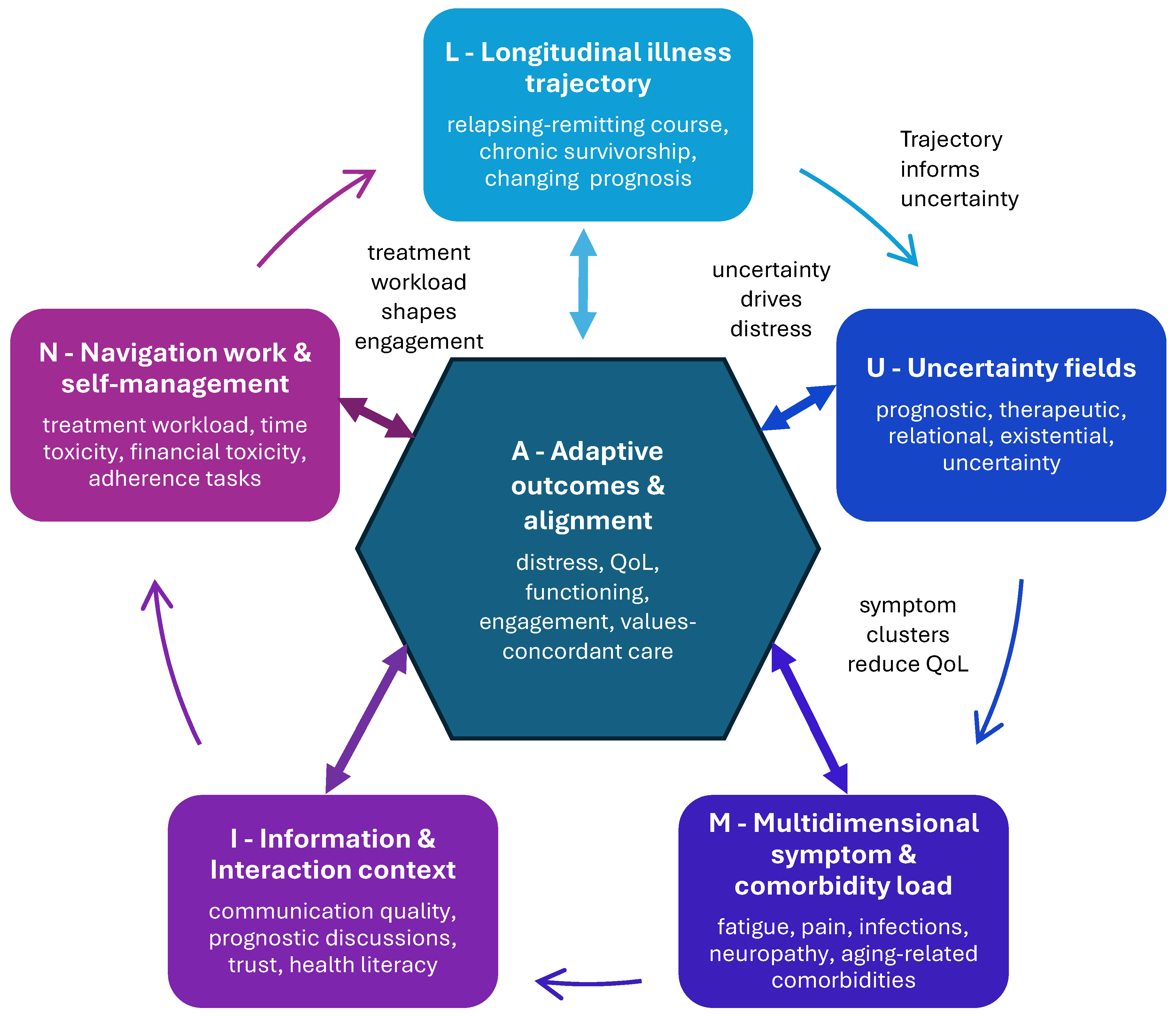
The LUMINA Framework: Development of a Theory-Informed Conceptual Model for Chronic Uncertainty and Treatment Burden in Lymphoid Neoplasms


Abstract
1. Introduction
2. Results
2.1. Literature-Informed Conceptual Foundations
2.1.1. Uncertainty in Illness Theory
2.1.2. Lymphoma-Specific Uncertainty Management and Psychosocial Adaptation
2.1.3. Burden of Treatment and Workload–Capacity Frameworks
2.1.4. Financial Toxicity and Time Burden as Core Dimensions of Treatment Burden
2.1.5. Fear of Recurrence/Progression and Distress as Psycho-Oncological Outputs and Targets
2.2. Development of the LUMINA Framework
2.2.1. Longitudinal Trajectories and Surveillance States
2.2.2. Uncertainty, Prognostic Understanding, and Fear of Progression
2.2.3. Symptom, Comorbidity, and Functional Burden
2.2.4. Communication, Information, and Interaction Context
2.2.5. Navigation Work, Self-Management, Time Burden, and Financial Toxicity
2.2.6. Adaptive Outcomes: Distress, QoL, Coping, Functioning, and Alignment
2.2.7. Cross-Entity Synthesis
2.3. The LUMINA Framework: Domains and Conceptual Relationships
2.3.1. Rationale and Overview
- L—Longitudinal illness trajectory;
- U—Uncertainty fields;
- M—Multidimensional symptom and comorbidity load;
- I—Information and interaction context;
- N—Navigation work and self-management load;
- A—Adaptive outcomes and alignment.
2.3.2. Domain Definitions and Conceptual Implications
L—Longitudinal Illness Trajectory
U—Uncertainty Fields
- Prognostic uncertainty: relapse timing, survival horizon, durability of response.
- Therapeutic uncertainty: which option will work, toxicity trade-offs, sequence of therapies.
- Relational uncertainty: roles in family/work, caregiver expectations, dependence/independence.
- Existential uncertainty: meaning, identity, future planning.
M—Multidimensional Symptom and Comorbidity Load
I—Information and Interaction Context
A—Adaptive Outcomes and Alignment

| LUMINA Domain | Key Constructs | Representative Instruments (Examples) |
|---|---|---|
| L—Longitudinal illness trajectory | time since diagnosis, line of therapy, relapse history, surveillance vs. active treatment, prior toxicities | structured clinical variables; registry fields; treatment history |
| U—Uncertainty fields | illness uncertainty, prognostic understanding/awareness, fear of recurrence/progression | Mishel Uncertainty in Illness Scale (MUIS) [42]; Fear of Cancer Recurrence Inventory (FCRI) [37]; tailored prognosis perception items |
| M—Symptom/comorbidity load | symptom clusters (fatigue, pain, sleep), toxicities, functional limits, comorbidities | EORTC QLQ-C30 ± disease modules; PRO-CTCAE; comorbidity indices |
| I—Information/interaction context | communication quality, shared decision-making, trust, health literacy | shared decision-making scales (e.g., SDM-Q-9); communication quality measures; health literacy tools |
| N—Navigation/self-management load | treatment workload, time burden, indirect costs, financial toxicity, adherence work | COST (financial toxicity) [22]; time-use diaries/time-toxicity measures; treatment burden questionnaires; medication adherence tools |
| A—Adaptive outcomes/alignment | distress (anxiety/depression/PTSS), QoL, functioning, activation, goal concordance | Hospital Anxiety and Depression Scale (HADS); Distress Thermometer; PROMIS profiles; goal-concordant care measures |
2.3.3. Positioning LUMINA Relative to Existing Models
3. Discussion
3.1. Potential Applications and Future Research Directions
3.1.1. Structured Assessment Research
3.1.2. Communication and Shared Decision-Making Research
3.1.3. Intervention-Development Hypotheses
3.1.4. Illustrative LUMINA-Informed Research Hypotheses Across MM, iNHL, and CLL
3.2. Staged Validation Agenda
3.2.1. Stage 1: Feasibility and Acceptability
3.2.2. Stage 2: Construct Validity and Domain Overlap
3.2.3. Stage 3: Predictive Validity
3.2.4. Stage 4: Advanced Modeling and Intervention Development
3.3. Strengths and Limitations
4. Materials and Methods
4.1. Literature-Informed Conceptual Grounding
4.2. Literature Selection Logic
4.3. Conceptual Extraction and Model-Building Logic
4.4. Framework Development
5. Conclusions
Funding
Institutional Review Board Statement
Informed Consent Statement
Data Availability Statement
Conflicts of Interest
References
- Wang, S.; Zhou, H.; Liu, Y.; Li, Y.; Nie, L. Trends and projections of Non-Hodgkin lymphoma burden (1990–2040): A global burden of disease 2021 analysis. BMC Public Health 2025, 25, 1223. [Google Scholar] [CrossRef] [Scilit]
- Rajkumar, S.V. Multiple myeloma: 2024 update on diagnosis, risk-stratification, and management. Am. J. Hematol. 2024, 99, 1802–1824. [Google Scholar] [CrossRef] [Scilit]
- Fleischer, A.; Roll, M.; Frenking, J.H.; Panther, F.; Gelbrich, G.; Strunz, P.; Riedhammer, C.; Peter, J.; Mersi, J.; Waldschmidt, J.; et al. Talquetamab-Related Dysgeusia in Multiple Myeloma Compared to BCMA-Targeted Bispecifics and High-Dose Melphalan. Cancer Med. 2025, 14, e71401. [Google Scholar] [CrossRef] [Scilit] [PubMed]
- Pennings, E.R.A.; Spanjaart, A.M.; Thielen, F.W.; Oerlemans, S.; Fleischer, A.; Sanges, C.; Da Silva, M.G.; Cabrerizo, Y.; Lecot, P.; Roux-Opstaele, L.; et al. Patient-reported outcomes in patients with hematologic malignancies treated with CAR T-cell therapy in Europe. Blood Adv. 2025, 9, 6380–6393. [Google Scholar] [CrossRef] [Scilit] [PubMed]
- Fleischer, A.; Zapf, L.; Allgaier, J.; Jordan, K.; Gelbrich, G.; Pryss, R.; Schobel, J.; Bittrich, M.; Einsele, H.; Kortüm, M.; et al. A patient survey indicates quality of life and progression-free survival as equally important outcome measures in multiple myeloma clinical trials. J. Cancer Res. Clin. Oncol. 2023, 149, 12897–12902. [Google Scholar] [CrossRef] [Scilit]
- Jurczyszyn, A.; Bator, M.; Vesole, D.H.; Salman, T.; Richardson, P.G.; Anderson, K. New therapies in multiple myeloma: Benefits and limitations. Pol. Arch. Intern. Med. 2025, 135, 16994. [Google Scholar] [CrossRef] [Scilit]
- Leslie, L.A. Novel Therapies for Follicular Lymphoma and Other Indolent Non-Hodgkin Lymphomas. Curr. Treat. Options Oncol. 2021, 22, 111. [Google Scholar] [CrossRef] [Scilit]
- Molica, S.; Allsup, D. Pirtobrutinib in Chronic Lymphocytic Leukemia: Navigating Resistance and the Personalisation of BTK-Targeted Therapy. Cancers 2025, 17, 2974. [Google Scholar] [CrossRef] [Scilit] [PubMed]
- Bakker, M.; Kuipers, M.T.; Kersten, M.J.; Tonino, S.H.; Serroukh, Y.I. Perspectives on T-cell engaging therapies in relapsed/refractory indolent non-Hodgkin lymphoma. Curr. Opin. Oncol. 2025, 37, 393–400. [Google Scholar] [CrossRef] [Scilit]
- Muchtar, E.; Kay, N.E.; Parikh, S.A. Early intervention in asymptomatic chronic lymphocytic leukemia. Clin. Adv. Hematol. Oncol. 2021, 19, 92–103. [Google Scholar]
- McKeague, S.; Seymour, J.F. Triplet regimens for frontline treatment of CLL-Great company or just a crowd? Hemasphere 2026, 10, e70303. [Google Scholar] [CrossRef] [Scilit]
- Taylor, J.; Xiao, W.; Abdel-Wahab, O. Diagnosis and classification of hematologic malignancies on the basis of genetics. Blood 2017, 130, 410–423. [Google Scholar] [CrossRef] [Scilit]
- Minson, A.; Tam, C.; Dickinson, M.; Seymour, J.F. Targeted Agents in the Treatment of Indolent B-Cell Non-Hodgkin Lymphomas. Cancers 2022, 14, 1276. [Google Scholar] [CrossRef] [Scilit] [PubMed]
- Levin, T.T.; Li, Y.; Riskind, J.; Rai, K. Depression, anxiety and quality of life in a chronic lymphocytic leukemia cohort. Gen. Hosp. Psychiatry 2007, 29, 251–256. [Google Scholar] [CrossRef] [Scilit]
- Holtzer-Goor, K.M.; Schaafsma, M.R.; Joosten, P.; Posthuma, E.F.M.; Wittebol, S.; Huijgens, P.C.; Mattijssen, E.J.M.; Vreugdenhil, G.; Visser, H.; Peters, W.G.; et al. Quality of life of patients with chronic lymphocytic leukaemia in The Netherlands: Results of a longitudinal multicentre study. Qual. Life Res. 2015, 24, 2895–2906. [Google Scholar] [CrossRef] [Scilit] [PubMed]
- Sugimoto, M.; Yagasaki, K.; Matsuki, E.; Shimizu, T.; Sakurai, M.; Kataoka, K.; Doorenbos, A.Z. Unmet Needs and Health-Related Quality of Life Among Patients with Relapsed/Refractory Indolent Non-Hodgkin Lymphoma: A Mixed-Methods Study. Psychooncology 2025, 34, e70103. [Google Scholar] [CrossRef] [Scilit] [PubMed]
- Sportoletti, P.; Laurenti, L.; Chiarenza, A.; Gaidano, G.; Albi, E.; Mauro, F.R.; Trentin, L.; Vallisa, D.; Pane, F.; Cuneo, A.; et al. Patients’ preferences for chronic lymphocytic leukemia treatment: The CHOICE study. Hematol. Oncol. 2024, 42, e3216. [Google Scholar] [CrossRef] [Scilit]
- Sears-Smith, M.; Knight, T.G. Financial Toxicity in Patients with Hematologic Malignancies: A Review and Need for Interventions. Curr. Hematol. Malig. Rep. 2023, 18, 158–166. [Google Scholar] [CrossRef] [Scilit]
- Matheson, L.; Boulton, M.; Lavender, V.; Collins, G.; Mitchell-Floyd, T.; Watson, E. The Experiences of Young Adults with Hodgkin Lymphoma Transitioning to Survivorship: A Grounded Theory Study. Oncol. Nurs. Forum 2016, 43, E195–E2014. [Google Scholar] [CrossRef] [Scilit]
- May, C.R.; Eton, D.T.; Boehmer, K.; Gallacher, K.; Hunt, K.; MacDonald, S.; Mair, F.S.; May, C.M.; Montori, V.M.; Richardson, A.; et al. Rethinking the patient: Using Burden of Treatment Theory to understand the changing dynamics of illness. BMC Health Serv. Res. 2014, 14, 281. [Google Scholar] [CrossRef] [Scilit]
- Zafar, S.Y.; Abernethy, A.P. Financial toxicity, Part. I: A new name for a growing problem. Oncology 2013, 27, 80–81, 149. [Google Scholar]
- de Souza, J.A.; Yap, B.J.; Wroblewski, K.; Blinder, V.; Araújo, F.S.; Hlubocky, F.J.; Nicholas, L.H.; O’Connor, J.M.; Brockstein, B.; Ratain, M.J.; et al. Measuring financial toxicity as a clinically relevant patient-reported outcome: The validation of the Comprehensive Score for financial Toxicity (COST). Cancer 2017, 123, 476–484. [Google Scholar] [CrossRef] [Scilit]
- Evans, J.; Ziebland, S.; Pettitt, A.R. Incurable, invisible and inconclusive: Watchful waiting for chronic lymphocytic leukaemia and implications for doctor-patient communication. Eur. J. Cancer Care 2012, 21, 67–77. [Google Scholar] [CrossRef] [Scilit]
- McCaughan, D.; Roman, E.; Sheridan, R.; Hewison, A.; Smith, A.G.; Patmore, R.; Howell, D.A. Patient perspectives of ‘Watch and Wait’ for chronic haematological cancers: Findings from a qualitative study. Eur. J. Oncol. Nurs. 2023, 65, 102349. [Google Scholar] [CrossRef] [Scilit]
- Newcomb, R.A.; Johnson, P.C.; Yang, D.; Holmbeck, K.; Choe, J.; Nabily, A.; Lark, P.; Dhawale, T.; Amonoo, H.L.; El-Jawahri, A. Coping and Perception of Prognosis in Patients with Indolent Non-Hodgkin’s Lymphoma. Oncologist 2024, 29, 441–449. [Google Scholar] [CrossRef] [Scilit]
- Howell, D.A.; McCaughan, D.; Smith, A.G.; Patmore, R.; Roman, E. Incurable but treatable: Understanding, uncertainty and impact in chronic blood cancers-A qualitative study from the UK’s Haematological Malignancy Research Network. PLoS ONE 2022, 17, e0263672. [Google Scholar] [CrossRef] [Scilit] [PubMed]
- Zaleta, A.K.; Miller, M.F.; Olson, J.S.; Yuen, E.Y.; LeBlanc, T.W.; Cole, C.E.; McManus, S.; Buzaglo, J.S. Symptom Burden, Perceived Control, and Quality of Life Among Patients Living with Multiple Myeloma. J. Natl. Compr. Cancer Netw. 2020, 18, 1087–1095. [Google Scholar] [CrossRef] [Scilit]
- Eek, D.; Blowfield, M.; Krogh, C.; Chung, H.; Eyre, T.A. Development of a Conceptual Model of Chronic Lymphocytic Leukemia to Better Understand the Patient Experience. Patient 2021, 14, 75–87. [Google Scholar] [CrossRef] [Scilit]
- Wang, Y.; Chen, T.; Niu, H. Psychosocial burden and coping strategies among lymphoma patients: A nurse-led hematology care approach. Front. Psychol. 2026, 17, 1783426. [Google Scholar] [CrossRef] [Scilit] [PubMed]
- Roman, E.; Howell, D.; Smith, A.; Crouch, S.; Bagguley, T.; Painter, D.; Sheridan, R.; McCaughan, D.; Blase, J.; Curson, W.; et al. Programme Grants for Applied Research. In Pathways of Patients with Chronic Haematological Malignancies: A Report from the UK’s Population-Based HMRN; National Institute for Health and Care Research: Southampton, UK, 2024. [Google Scholar]
- Parker, C.; Berkovic, D.; Ayton, D.; Zomer, E.; Liew, D.; Wei, A. Patient Perceived Financial Burden in Haematological Malignancies: A Systematic Review. Curr. Oncol. 2022, 29, 3807–3824. [Google Scholar] [CrossRef] [Scilit] [PubMed]
- Beaven, A.W.; Samsa, G.; Zimmerman, S.; Smith, S.K. Quality of Life is Similar between Long-term Survivors of Indolent and Aggressive Non-Hodgkin Lymphoma. Cancer Investig. 2016, 34, 279–285. [Google Scholar] [CrossRef] [Scilit]
- Banerjee, R.; Cowan, A.J.; Ortega, M.; Missimer, C.; Carpenter, P.A.; Oshima, M.U.; Salit, R.B.; Vo, P.T.; Lee, C.J.; Mehta, R.S.; et al. Financial Toxicity, Time Toxicity, and Quality of Life in Multiple Myeloma. Clin. Lymphoma Myeloma Leuk. 2024, 24, 446–454.e3. [Google Scholar] [CrossRef] [Scilit] [PubMed]
- Huntington, S.F.; Weiss, B.M.; Vogl, D.T.; Cohen, A.D.; Garfall, A.L.; Mangan, P.A.; Doshi, J.A.; Stadtmauer, E.A. Financial toxicity in insured patients with multiple myeloma: A cross-sectional pilot study. Lancet Haematol. 2015, 2, e408–e416. [Google Scholar] [CrossRef] [Scilit]
- Mishel, M.H. Uncertainty in illness. Image J. Nurs. Sch. 1988, 20, 225–232. [Google Scholar] [CrossRef] [Scilit]
- Wang, C.; Wu, Y.; Hu, R. Managing uncertainty: A grounded theory study of restoring normality in young and middle-aged patients with lymphoma. Int. J. Nurs. Sci. 2025, 12, 393–400. [Google Scholar] [CrossRef] [Scilit] [PubMed]
- Simard, S.; Savard, J. Fear of Cancer Recurrence Inventory: Development and initial validation of a multidimensional measure of fear of cancer recurrence. Support. Care Cancer 2009, 17, 241–251. [Google Scholar] [CrossRef] [Scilit]
- Rifkin, R.M.; Bell, J.A.; DasMahapatra, P.; Hoole, M.; Lowe, M.; Curran, C.; Campbell, S.; Hou, P.; Romanus, D. Treatment Satisfaction and Burden of Illness in Patients with Newly Diagnosed Multiple Myeloma. Pharmacoecon. Open 2020, 4, 473–483. [Google Scholar] [CrossRef] [Scilit] [PubMed]
- O’dOnnell, E.K.; Shapiro, Y.N.; Yee, A.J.; Nadeem, O.; Hu, B.Y.; Laubach, J.P.; Branagan, A.R.; Anderson, K.C.; Mo, C.C.; Munshi, N.C.; et al. Quality of life, psychological distress, and prognostic perceptions in patients with multiple myeloma. Cancer 2022, 128, 1996–2004. [Google Scholar] [CrossRef] [Scilit]
- Markowitz, J.T.; Mazerolle, F.; Lovell, T.; Hess, L.M.; Abada, P.B.; Regnault, A.; Payakachat, N. Mixed-methods research to support the use of new lymphoma-specific patient-reported symptom measures derived from the EORTC item library. J. Patient Rep. Outcomes 2024, 8, 8. [Google Scholar] [CrossRef] [Scilit]
- Rittenmeyer, L.; Huffman, D.; Alagna, M.; Moore, E. The experience of adults who choose watchful waiting or active surveillance as an approach to medical treatment: A qualitative systematic review. JBI Database Syst. Rev. Implement. Rep. 2016, 14, 174–255. [Google Scholar] [CrossRef] [Scilit]
- Mishel, M.H. The measurement of uncertainty in illness. Nurs. Res. 1981, 30, 258–263. [Google Scholar] [CrossRef] [Scilit] [PubMed]
- Leppin, A.L.; Montori, V.M.; Gionfriddo, M.R. Minimally Disruptive Medicine: A Pragmatically Comprehensive Model for Delivering Care to Patients with Multiple Chronic Conditions. Healthcare 2015, 3, 50–63. [Google Scholar] [CrossRef] [Scilit]

| Disease Context/Phase | Typical LUMINA Pattern | Candidate Concepts for Future Testing |
|---|---|---|
| Newly diagnosed MM; intensive induction ± transplant | High U, high M, emerging N | Early screening (A/U/M); anticipatory guidance; symptom optimization; brief coping skills; caregiver inclusion; rapid referral pathways for high distress |
| MM on maintenance/multiple relapses | Chronic high U (fear), high N (workload/financial), variable M | Regular re-assessment of U/N/A; FCR-focused CBT; navigation + financial counseling; regimen optimization to reduce time burden; monitor cumulative toxicities |
| Newly diagnosed iNHL on watch and wait | High U, low–moderate M, moderate I/N needs | Structured explanation of surveillance rationale; uncertainty-management support; scheduled “reassurance checkpoints”; monitor for distress spikes before scans/visits |
| Relapsed/refractory iNHL | High U, rising M, rising N | Explicit goal setting and trade-off discussion; intensified symptom management; navigation support; peer support options; screen unmet needs systematically |
| Early-stage CLL on watch and wait | High chronic U, low–moderate M, moderate I | Education + roadmap; validate “invisible cancer” stress; regular brief screening; support for lifestyle and infection-risk management; address scan/visit anxiety |
| CLL on long-term oral targeted therapy | Moderate-high N (adherence/monitoring/financial), variable M, moderate U | Adherence workflow; simplify regimens; proactive toxicity monitoring; financial navigation; periodic review of goals, QoL, and burden to prevent silent disengagement |
Disclaimer/Publisher’s Note: The statements, opinions and data contained in all publications are solely those of the individual author(s) and contributor(s) and not of MDPI and/or the editor(s). MDPI and/or the editor(s) disclaim responsibility for any injury to people or property resulting from any ideas, methods, instructions or products referred to in the content. |
© 2026 by the author. Licensee MDPI, Basel, Switzerland. This article is an open access article distributed under the terms and conditions of the Creative Commons Attribution (CC BY) license.
Share and Cite
Fleischer, A. The LUMINA Framework: Development of a Theory-Informed Conceptual Model for Chronic Uncertainty and Treatment Burden in Lymphoid Neoplasms. Lymphatics 2026, 4, 32. https://doi.org/10.3390/lymphatics4020032
Fleischer A. The LUMINA Framework: Development of a Theory-Informed Conceptual Model for Chronic Uncertainty and Treatment Burden in Lymphoid Neoplasms. Lymphatics. 2026; 4(2):32. https://doi.org/10.3390/lymphatics4020032
Chicago/Turabian StyleFleischer, Anna. 2026. "The LUMINA Framework: Development of a Theory-Informed Conceptual Model for Chronic Uncertainty and Treatment Burden in Lymphoid Neoplasms" Lymphatics 4, no. 2: 32. https://doi.org/10.3390/lymphatics4020032
APA StyleFleischer, A. (2026). The LUMINA Framework: Development of a Theory-Informed Conceptual Model for Chronic Uncertainty and Treatment Burden in Lymphoid Neoplasms. Lymphatics, 4(2), 32. https://doi.org/10.3390/lymphatics4020032