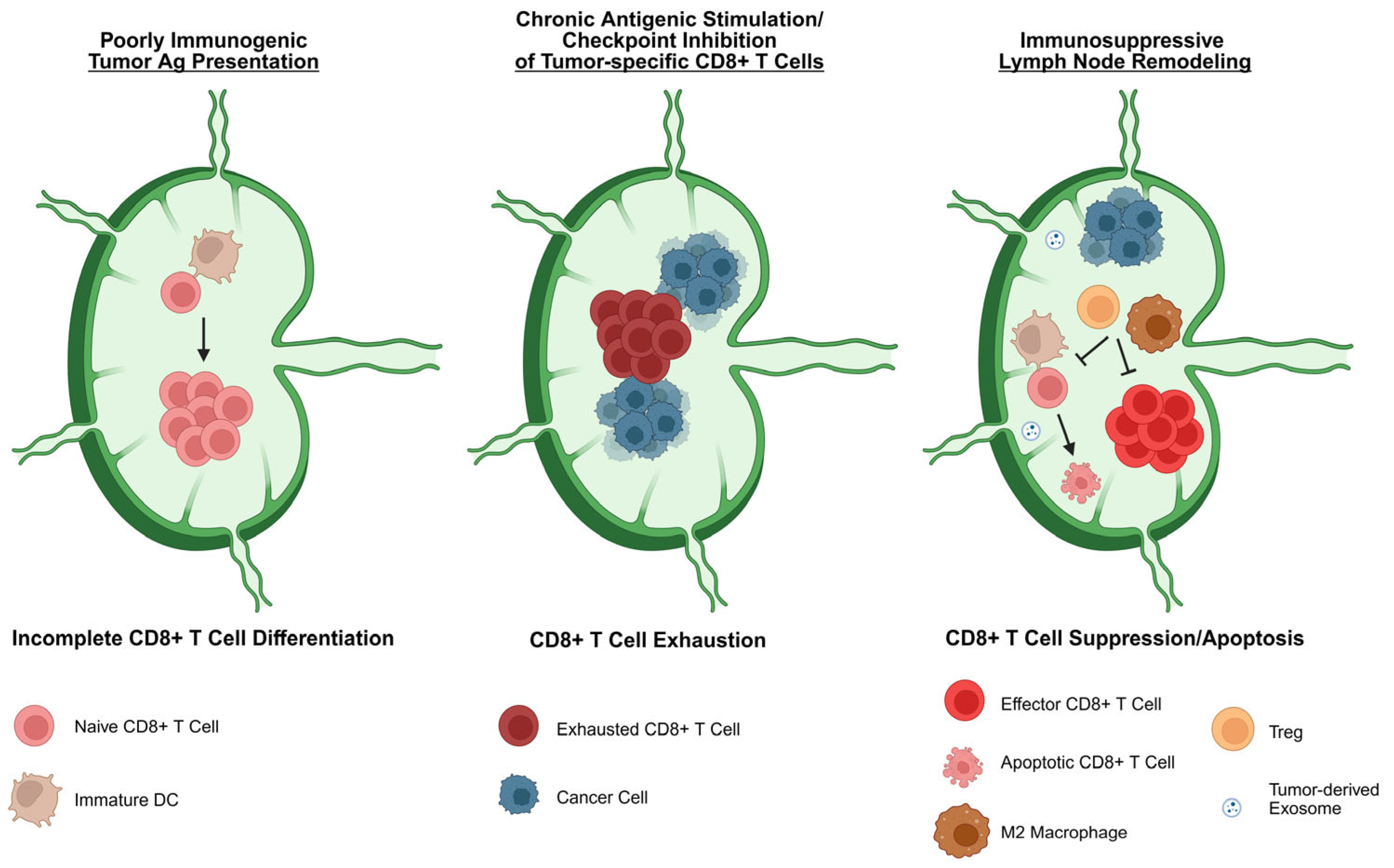

CD8+ T Cell Dysfunction in Tumor-Draining Lymph Nodes: A Hallmark of Tumor Immune Escape That May Arise Early During the Course of Cancer Progression

Abstract
1. Introduction
2. CD8+ T Cell Dysfunction Within Tumor-Draining Lymph Nodes
3. Implications of Lymph-Node-Resident CD8+ T Cell Dysfunction for Cancer Immunotherapy
4. Lymph-Node-Resident CD8+ T Cell Dysfunction as an Early Factor in the Establishment of a Pre-Metastatic Niche That Supports Tumor Progression
5. Conclusions
Funding
Data Availability Statement
Conflicts of Interest
Abbreviations
| Ag | antigen |
| APC | antigen-presenting cell |
| CTL | cytotoxic T lymphocyte |
| HNSCC | head and neck squamous cell carcinoma |
| LN | lymph node |
| NGFR | nerve growth factor receptor |
| NSCLC | non-small-cell lung cancer |
| TDLN | tumor-draining lymph node |
| TME | tumor microenvironment |
| Tex-int | intermediate exhausted T cell |
| Tex-term | terminally exhausted T cell |
| Tpex | progenitor exhausted T cell |
| Tregs | regulatory T cells |
| TTSM | tumor-specific memory T cell |
References
- Chen, D.S.; Mellman, I. Oncology meets immunology: The cancer-immunity cycle. Immunity 2013, 39, 1–10. [Google Scholar] [CrossRef] [PubMed]
- Pereira, E.R.; Kedrin, D.; Seano, G.; Gautier, O.; Meijer, E.F.J.; Jones, D.; Chin, S.-M.; Kitahara, S.; Bouta, E.M.; Chang, J.; et al. Lymph node metastases can invade local blood vessels, exit the node, and colonize distant organs in mice. Science 2018, 359, 1403–1407. [Google Scholar] [CrossRef] [PubMed]
- Brown, M.; Assen, F.P.; Leithner, A.; Abe, J.; Schachner, H.; Asfour, G.; Bago-Horvath, Z.; Stein, J.V.; Uhrin, P.; Sixt, M.; et al. Lymph node blood vessels provide exit routes for metastatic tumor cell dissemination in mice. Science 2018, 359, 1408–1411. [Google Scholar] [CrossRef]
- Lughezzani, G.; Capitanio, U.; Jeldres, C.; Isbarn, H.; Shariat, S.F.; Arjane, P.; Widmer, H.; Perrotte, P.; Montorsi, F.; Karakiewicz, P.I. Prognostic significance of lymph node invasion in patients with metastatic renal cell carcinoma: A population-based perspective. Cancer 2009, 115, 5680–5687. [Google Scholar] [CrossRef] [PubMed]
- Chen, J.; Xu, Y.; Zhou, Y.; Wang, Y.; Zhu, H.; Shi, Y. Prognostic role of sentinel lymph node biopsy for patients with cutaneous melanoma: A retrospective study of surveillance, epidemiology, and end-result population-based data. Oncotarget 2016, 7, 45671–45677. [Google Scholar] [CrossRef]
- Doepker, M.P.; Thompson, Z.J.; Harb, J.N.; Messina, J.L.; Puleo, C.A.; Egan, K.M.; Sarnaik, A.A.; Gonzalez, R.J.; Sondak, V.K.; Zager, J.S. Dermal melanoma: A report on prognosis, outcomes, and the utility of sentinel lymph node biopsy. J. Surg. Oncol. 2016, 113, 98–102. [Google Scholar] [CrossRef]
- Scheipner, L.; Barletta, F.; Cano Garcia, C.; Incesu, R.B.; Morra, S.; Baudo, A.; Assad, A.; Tian, Z.; Saad, F.; Shariat, S.F.; et al. Prognostic significance of pathologic lymph node invasion in metastatic renal cell carcinoma in the immunotherapy era. Ann. Surg. Oncol. 2023, 30, 8780–8785. [Google Scholar] [CrossRef]
- Jaganmurugan, R.; Arora, A.; Chandankhede, U.; Prakash, G.; Bakshi, G.; Joshi, A.; Menon, S.; Murthy, V.; Pal, M. Prognostic Significance of lymph node density in pathological node positive urothelial carcinoma of the bladder -upfront surgery and post neoadjuvant chemotherapy cohorts. Clin. Genitourin. Cancer 2024, 22, 385–393. [Google Scholar] [CrossRef]
- Pilko, G.; Zgajnar, J.; Music, M.; Hocevar, M. Lower tumour burden and better overall survival in melanoma patients with regional lymph node metastases and negative preoperative ultrasound. Radiol. Oncol. 2012, 46, 60–68. [Google Scholar] [CrossRef]
- Ulmer, A.; Dietz, K.; Hodak, I.; Polzer, B.; Scheitler, S.; Yildiz, M.; Czyz, Z.; Lehnert, P.; Fehm, T.; Hafner, C.; et al. Quantitative measurement of melanoma spread in sentinel lymph nodes and survival. PLoS Med. 2014, 11, e1001604. [Google Scholar] [CrossRef]
- Kim, C.; Economou, S.; Amatruda, T.T.; Martin, J.C.; Dudek, A.Z. Prognostic significance of microscopic tumor burden in sentinel lymph node in patients with cutaneous melanoma. Anticancer Res. 2015, 35, 301–309. [Google Scholar] [PubMed]
- Anichini, A.; Scarito, A.; Molla, A.; Parmiani, G.; Mortarini, R. Differentiation of CD8+ T cells from tumor-invaded and tumor-free lymph nodes of melanoma patients: Role of common gamma-chain cytokines. J. Immunol. 2003, 171, 2134–2141. [Google Scholar] [CrossRef] [PubMed]
- Zippelius, A.; Batard, P.; Rubio-godoy, V.; Bioley, G.; Lie, D.; Lejeune, F.; Rimoldi, D.; Guillaume, P.; Meidenbauer, N.; Mackensen, A.; et al. Effector function of human tumor-specific CD8 T cells in melanoma lesions: A state of local functional tolerance. Cancer Res. 2004, 64, 2865–2873. [Google Scholar] [CrossRef] [PubMed]
- Mortarini, R.; Piris, A.; Maurichi, A.; Molla, A.; Bersani, I.; Bono, A.; Bartoli, C.; Santinami, M.; Lombardo, C.; Ravagnani, F.; et al. Lack of terminally differentiated tumor-specific CD8+ T cells at tumor site in spite of antitumor immunity to self-Ags in human metastatic melanoma. Cancer Res. 2003, 63, 2535–2545. [Google Scholar]
- Negin, B.; Panka, D.; Wang, W.; Siddiqui, M.; Tawa, N.; Mullen, J.; Tahan, S.; Mandato, L.; Polivy, A.; Mier, J.; et al. Effect of melanoma on immune function in the regional lymph node basin. Clin. Cancer Res. 2008, 14, 654–659. [Google Scholar] [CrossRef][Green Version]
- Baitsch, L.; Baumgaertner, P.; Devêvre, E.; Raghav, S.K.; Legat, A.; Barba, L.; Wieckowski, S.; Bouzourene, H.; Deplancke, B.; Romero, P.; et al. Exhaustion of tumor-specific CD8+ T cells in metastases from melanoma patients. J. Clin. Investig. 2011, 121, 2350–2360. [Google Scholar] [CrossRef]
- Hargadon, K.M.; Brinkman, C.C.; Sheasley-O’neill, S.L.; Nichols, L.A.; Bullock, T.N.J.; Engelhard, V.H. Incomplete differentiation of Ag-specific CD8 T cells in tumor-draining lymph nodes. J. Immunol. 2006, 177, 6081–6090. [Google Scholar] [CrossRef]
- Hargadon, K.M. Tumor microenvironmental influences on dendritic cell and T cell function: A focus on clinically relevant immunologic and metabolic checkpoints. Clin. Transl. Med. 2020, 10, 374–411. [Google Scholar] [CrossRef]
- Reticker-Flynn, N.E.; Zhang, W.; Belk, J.A.; Basto, P.A.; Escalante, N.K.; Pilarowski, G.O.W.; Bejnood, A.; Martins, M.M.; Kenkel, J.A.; Linde, I.L.; et al. Lymph node colonization induces tumor-immune tolerance to promote distant metastasis. Cell 2022, 185, 1924–1942.e23. [Google Scholar] [CrossRef]
- Rahim, M.K.; Okholm, T.L.H.; Jones, K.B.; McCarthy, E.E.; Liu, C.C.; Yee, J.L.; Tamaki, S.J.; Marquez, D.M.; Tenvooren, I.; Wai, K.; et al. Dynamic CD8+ T cell responses to cancer immunotherapy in human regional lymph nodes are disrupted in metastatic lymph nodes. Cell 2023, 186, 1127–1143.e18. [Google Scholar] [CrossRef]
- Hargadon, K.M.; Goodloe, T.B.; Woodall, S.L. Lymph node invasion by melanoma cells is not required for the induction of incomplete differentiation by tumor-specific CD8+ T cells. Cancer Rep. 2025, 8, e70145. [Google Scholar] [CrossRef] [PubMed]
- Prokhnevska, N.; Cardenas, M.A.; Valanparambil, R.M.; Sobierajska, E.; Barwick, B.G.; Jansen, C.; Reyes Moon, A.; Gregorova, P.; delBalzo, L.; Greenwald, R.; et al. CD8+ T cell activation in cancer comprises an initial activation phase in lymph nodes followed by effector differentiation within the tumor. Immunity 2023, 56, 107–124.e5. [Google Scholar] [CrossRef] [PubMed]
- Connolly, K.A.; Kuchroo, M.; Venkat, A.; Khatun, A.; Wang, J.; William, I.; Hornick, N.I.; Fitzgerald, B.L.; Damo, M.; Kasmani, M.Y.; et al. A reservoir of stem-like CD8+ T cells in the tumor-draining lymph node preserves the ongoing antitumor immune response. Sci. Immunol. 2021, 6, eabg7836. [Google Scholar] [CrossRef] [PubMed]
- Ferguson, A.R.; Nichols, L.A.; Zarling, A.L.; Thompson, E.D.; Brinkman, C.; Hargadon, K.M.; Bullock, T.N.; Engelhard, V.H. Strategies and challenges in eliciting immunity to melanoma. Immunol. Rev. 2008, 222, 28–42. [Google Scholar] [CrossRef]
- Horton, B.L.; Morgan, D.M.; Momin, N.; Zagorulya, M.; Torres-Meji, E.; Bhandarkar, V.; Wittrup, K.D.; Love, J.C.; Spranger, S. Lack of CD8+ T cell effector differentiation during priming mediates checkpoint blockade resistance in non-small cell lung cancer. Sci. Immunol. 2021, 6, eabi8800. [Google Scholar] [CrossRef]
- Cruz de Casas, P.; Knöpper, K.; Dey Sarkar, R.; Kastenmüller, W. Same yet different—How lymph node heterogeneity affects immune responses. Nat. Rev. Immunol. 2023, 24, 358–374. [Google Scholar] [CrossRef]
- Zagorulya, M.; Yim, L.; Morgan, D.M.; Edwards, A.; Torres-Mejia, E.; Momin, N.; McCreery, C.V.; Zamora, I.L.; Horton, B.L.; Fox, J.G.; et al. Tissue-specific abundance of interferon-gamma drives regulatory T cells to restrain DC1-mediated priming of cytotoxic T cells against lung cancer. Immunity 2023, 56, 386–405.e10. [Google Scholar] [CrossRef]
- Canale, F.P.; Ramello, M.C.; Núñez, N.; Furlan, C.L.A.; Bossio, S.N.; Serrán, M.G.; Boari, J.T.; del Castillo, A.; Ledesma, M.; Sedlik, C.; et al. CD39 expression defines cell exhaustion in tumor-infiltrating CD8+ T cells. Cancer Res. 2018, 78, 115–128. [Google Scholar] [CrossRef]
- Pauken, K.E.; Sammons, M.A.; Odorizzi, P.M.; Manne, S.; Godec, J.; Khan, O.; Drake, A.M.; Chen, Z.; Sen, D.R.; Kurachi, M.; et al. Epigenetic stability of exhausted T cells limits durability of reinvigoration by PD-1 blockade. Science 2016, 354, 1160–1165. [Google Scholar] [CrossRef]
- Francis, D.M.; Manspeaker, M.P.; Schudel, A.; Sestito, L.F.; O’Melia, M.J.; Kissick, H.T.; Pollack, B.P.; Waller, E.K.; Thomas, S.N. Blockade of immune checkpoints in lymph nodes through locoregional delivery augments cancer immunotherapy. Sci. Transl. Med. 2020, 12, eaay3575. [Google Scholar] [CrossRef]
- Fransen, M.F.; Schoonderwoerd, M.; Knopf, P.; Camps, M.G.; Hawinkels, L.J.; Kneilling, M.; van Hall, T.; Ossendorp, F. Tumor-draining lymph nodes are pivotal in PD-1/PD-L1 checkpoint therapy. JCI Insight 2018, 3, e124507. [Google Scholar] [CrossRef] [PubMed]
- Dammeijer, F.; van Gulijk, M.; Mulder, E.E.; Lukkes, M.; Klaase, L.; van den Bosch, T.; van Nimwegen, M.; Lau, S.P.; Latupeirissa, K.; Schetters, S.; et al. The PD-1/PD-L1-checkpoint restrains T cell immunity in tumor-draining lymph nodes. Cancer Cell 2020, 38, 685–700.e8. [Google Scholar] [CrossRef]
- Huang, Q.; Wu, X.; Wang, Z.; Chen, X.; Wang, L.; Lu, Y.; Xiong, D.; Liu, Q.; Tian, Y.; Lin, H.; et al. The primordial differentiation of tumor-specific memory CD8+ T cells as bona fide responders to PD-1/PD-L1 blockade in draining lymph nodes. Cell 2022, 185, 4049–4066.e25. [Google Scholar] [CrossRef] [PubMed]
- Im, S.J.; Hashimoto, M.; Gerner, M.Y.; Lee, J.; Kissick, H.T.; Burger, M.C.; Shan, Q.; Hale, J.S.; Lee, J.; Nasti, T.H.; et al. Defining CD8+ T cells that provide the proliferative burst after PD-1 therapy. Nature 2016, 537, 417–421. [Google Scholar] [CrossRef] [PubMed]
- Miller, B.C.; Sen, D.R.; Al Abosy, R.; Bi, K.; Virkud, Y.V.; LaFleur, M.W.; Yates, K.B.; Lako, A.; Felt, K.; Naik, G.S.; et al. Subsets of exhausted CD8+ T cells differentially mediate tumor control and respond to checkpoint blockade. Nat. Immunol. 2019, 20, 1556, Erratum in: Nat Immunol. 2019, 11, 1556. https://doi.org/10.1038/s41590-019-0528-5.. [Google Scholar] [CrossRef]
- Schenkel, J.M.; Herbst, R.H.; Canner, D.; Li, A.; Hillman, M.; Shanahan, S.L.; Gibbons, G.; Smith, O.C.; Kim, J.Y.; Westcott, P.; et al. Conventional type I dendritic cells maintain a reservoir of proliferative tumor-Ag specific TCF-1+ CD8+ T cells in tumor-draining lymph nodes. Immunity 2021, 54, 2338–2353.e6. [Google Scholar] [CrossRef]
- Yang, H.; Sun, B.; Ma, W.; Fan, L.; Xu, K.; Jia, Y.; Xu, J.; Wang, Z.; Yao, F. Multi-scale characterization of tumor-draining lymph nodes in resectable lung cancer treated with neoadjuvant immune checkpoint inhibitors. eBioMedicine 2022, 84, 104265. [Google Scholar] [CrossRef]
- Ma, R.; Yang, H.; Ge, Y.; Ma, T.; Wang, J.; Li, S.; Feng, T.; Feng, S.; Zhang, C.; Sun, T.; et al. Prognostic implications of lymph node status in non–small-cell lung cancer patients before and after neoadjuvant chemoimmunotherapy: A multicenter retrospective study. Clin. Lung Cancer 2025, 26, 370–383. [Google Scholar] [CrossRef]
- Hargadon, K.M.; Ararso, Y.T.; Forrest, O.A.; Harte, C.M. Melanoma-associated suppression of the dendritic cell lines DC2.4 and JAWSII. Am. J. Immunol. 2012, 8, 179–190. [Google Scholar] [CrossRef][Green Version]
- Hargadon, K.M.; Bishop, J.D.; Brandt, J.P.; Hand, Z.C.; Ararso, Y.T.; Forrest, O.A. Melanoma-derived factors alter the maturation and activation of differentiated tissue-resident dendritic cells. Immunol. Cell Biol. 2016, 94, 24–38. [Google Scholar] [CrossRef]
- Salmon, H.; Idoyaga, J.; Rahman, A.; Leboeuf, M.; Remark, R.; Jordan, S.; Casanova-Acebes, M.; Khudoynazarova, M.; Agudo, J.; Tung, N.; et al. Expansion and activation of CD103+ dendritic cell progenitors at the tumor site enhances tumor responses to therapeutic PD-L1 and BRAF inhibition. Immunity 2016, 44, 924–938. [Google Scholar] [CrossRef] [PubMed]
- Svensson-Arvelund, J.; Cuadrado-Castano, S.; Pantsulaia, G.; Kim, K.; Aleynick, M.; Hammerich, L.; Upadhyay, R.; Yellin, M.; Marsh, H.; Oreper, D.; et al. Expanding Cross-presenting dendritic cells enhances oncolytic virotherapy and is critical for long-term anti-tumor immunity. Nat. Commun. 2022, 13, 7149. [Google Scholar] [CrossRef] [PubMed]
- Ferris, S.T.; Durai, V.; Wu, R.; Theisen, D.J.; Ward, J.P.; Bern, M.D.; Davidson, J.T.; Bagadia, P.; Liu, T.; Briseño, C.G.; et al. CDC1 prime and are licensed by CD4+ T cells to induce anti-tumour immunity. Nature 2020, 584, 624–629. [Google Scholar] [CrossRef] [PubMed]
- Spranger, S.; Bao, R.; Gajewski, T.F. Melanoma-Intrinsic β-Catenin Signalling Prevents Anti-Tumour Immunity. Nature 2015, 523, 231–235. [Google Scholar] [CrossRef]
- Spranger, S.; Dai, D.; Horton, B.; Gajewski, T.F. Tumor-residing Batf3 dendritic cells are required for effector T cell trafficking and adoptive T cell therapy. Cancer Cell 2017, 31, 711–723.e4. [Google Scholar] [CrossRef]
- Paget, S. The distribution of secondary growths in cancer of the breast. Lancet 1889, 133, 571–573. [Google Scholar] [CrossRef]
- Wang, Y.; Jia, J.; Wang, F.; Fang, Y.; Yang, Y.; Zhou, Q.; Yuan, W.; Gu, X.; Hu, J.; Yang, S. Pre-metastatic niche: Formation, characteristics and therapeutic implication. Signal Transduct. Target. Ther. 2024, 9, 236. [Google Scholar] [CrossRef]
- Hood, J.L.; San, R.S.; Wickline, S.A. Exosomes released by melanoma cells prepare sentinel lymph nodes for tumor metastasis. Cancer Res. 2011, 71, 3792–3801. [Google Scholar] [CrossRef]
- Morrissey, S.M.; Zhang, F.; Ding, C.; Montoya-Durango, D.E.; Hu, X.; Yang, C.; Wang, Z.; Yuan, F.; Fox, M.; Zhang, H.G.; et al. Tumor-derived exosomes drive immunosuppressive macrophages in a pre-metastatic niche through glycolytic dominant metabolic reprogramming. Cell Metab. 2021, 33, 2040–2058.e10. [Google Scholar] [CrossRef]
- García-Silva, S.; Benito-Martín, A.; Nogués, L.; Hernández-Barranco, A.; Mazariegos, M.S.; Santos, V.; Hergueta-Redondo, M.; Ximénez-Embún, P.; Kataru, R.P.; Lopez, A.A.; et al. Melanoma-derived small extracellular vesicles induce lymphangiogenesis and metastasis through an NGFR-dependent mechanism. Nat. Cancer 2021, 2, 1387–1405. [Google Scholar] [CrossRef]
- Leary, N.; Walser, S.; He, Y.; Cousin, N.; Pereira, P.; Gallo, A.; Collado-Diaz, V.; Halin, C.; Garcia-Silva, S.; Peinado, H.; et al. Melanoma-derived extracellular vesicles mediate lymphatic remodelling and impair tumour immunity in draining lymph nodes. J. Extracell. Vesicles 2022, 11, e12197. [Google Scholar] [CrossRef]
- Kahn, B.M.; Ng, R.W.S.; Kim, I.-K.; Eskandarian, C.; Chen, C.O.; Huang, B.; Lucas, A.; Li, L.; Maillard, I.; Stanger, B.Z. Intrinsic properties of the lymph node render it immunologically susceptible to metastasis. Cancer Discov. 2025, 15, 1949–1968. [Google Scholar] [CrossRef]
- Hargadon, K. 2026. Available online: https://BioRender.com/e63k0jp (accessed on 7 December 2025).

Disclaimer/Publisher’s Note: The statements, opinions and data contained in all publications are solely those of the individual author(s) and contributor(s) and not of MDPI and/or the editor(s). MDPI and/or the editor(s) disclaim responsibility for any injury to people or property resulting from any ideas, methods, instructions or products referred to in the content. |
© 2026 by the author. Licensee MDPI, Basel, Switzerland. This article is an open access article distributed under the terms and conditions of the Creative Commons Attribution (CC BY) license.
Share and Cite
Hargadon, K.M. CD8+ T Cell Dysfunction in Tumor-Draining Lymph Nodes: A Hallmark of Tumor Immune Escape That May Arise Early During the Course of Cancer Progression. Lymphatics 2026, 4, 2. https://doi.org/10.3390/lymphatics4010002
Hargadon KM. CD8+ T Cell Dysfunction in Tumor-Draining Lymph Nodes: A Hallmark of Tumor Immune Escape That May Arise Early During the Course of Cancer Progression. Lymphatics. 2026; 4(1):2. https://doi.org/10.3390/lymphatics4010002
Chicago/Turabian StyleHargadon, Kristian M. 2026. "CD8+ T Cell Dysfunction in Tumor-Draining Lymph Nodes: A Hallmark of Tumor Immune Escape That May Arise Early During the Course of Cancer Progression" Lymphatics 4, no. 1: 2. https://doi.org/10.3390/lymphatics4010002
APA StyleHargadon, K. M. (2026). CD8+ T Cell Dysfunction in Tumor-Draining Lymph Nodes: A Hallmark of Tumor Immune Escape That May Arise Early During the Course of Cancer Progression. Lymphatics, 4(1), 2. https://doi.org/10.3390/lymphatics4010002