
Review

Nodes of Contention: The Role of Lymphadenectomy in Adrenocortical Cancer Management

by
Joanna Aldoori
1,
Rajeev Parameswaran
2,* and
Mechteld C. de Jong
1,*
1
Division of Endocrine Surgery, St James’s University Hospital, Leeds Teaching Hospitals NHS Trust, Leeds LS9 7TF, UK
2
Division of Endocrine Surgery, National University Hospital, National University Health System, Lower Kent Ridge Road, Singapore 119074, Singapore
*
Authors to whom correspondence should be addressed.
Lymphatics 2026, 4(1), 12; https://doi.org/10.3390/lymphatics4010012
Submission received: 17 October 2025 / Revised: 7 February 2026 / Accepted: 11 February 2026 / Published: 18 February 2026

Abstract

Adrenocortical carcinoma (ACC) is a rare, aggressive endocrine malignancy with poor survival outcomes and high recurrence rates. Whilst surgical resection is the cornerstone of curative treatment, the role of lymphadenectomy remains debated. “Nodes of contention” in ACC management center on balancing accurate staging and potential oncologic benefit against added operative time, complexity, and morbidity. We reviewed the available published literature over the last 20 years, including retrospective series, to evaluate the prognostic and therapeutic significance of lymphadenectomy in ACC. Though systematic lymph node dissection improves staging accuracy and may identify patients at higher risk who could benefit from adjuvant therapy, evidence demonstrating a survival benefit is inconsistent. This is largely due to the rarity of the condition, heterogeneity in surgical approaches, and lack of standardized nodal templates. Concerns regarding increased operative morbidity further limit widespread adoption. This review synthesizes current evidence on nodal assessment in ACC and highlights gaps in prospective data. While nodal involvement is a strong prognostic factor, the therapeutic impact of lymphadenectomy remains unclear. Prospective, multicenter trials are urgently needed to define its role in ACC management.

1. Introduction

Adrenal cortical cancer (ACC) is a rare cancer, with an approximate incidence of one per million per year [1,2,3]. It accounts for a very small number of overall cancer related deaths and is often thought of as an orphan disease. Surgery remains the cornerstone of treatment for ACC; however, recurrence rates are high, reaching up to 70% [4,5]. The role of lymphadenectomy in the management of ACC remains controversial and poorly defined, with studies reporting conflicting outcomes ranging from potential survival benefit to no effect, or even negative associations [6,7,8]. The aim of this paper is to clarify the role of lymphadenectomy in the treatment of ACC, identify gaps in the existing literature, and highlight priorities for future research. For this narrative review, we conducted a literature search of PubMed/MEDLINE using the search terms related to adrenocortical carcinoma and lymphadenectomy/lymph node dissection (“adrenocortical carcinoma” OR “adrenal cortical cancer” AND “lymphadenectomy” OR “lymph node dissection” OR “nodal dissection” OR “lymph node yield”) published in English since 1990. We included studies reporting clinical outcomes (overall survival, recurrence-free/disease-free survival, staging, or complications) following adrenalectomy with or without lymphadenectomy, as well as relevant guidelines and anatomical studies informing nodal templates.

Guidelines for ACC

The European Society of Endocrine Surgeons (ESES) and the European Network for the Study of Adrenal Tumors (ENSAT) published guidelines in 2017 outlining twenty-five recommendations for the surgical management of ACC. Their recommendations were produced following a Delphi methodology of surgeons with an interest in adrenal surgery, who were part of a multidisciplinary team managing ACC patients [9]. The strength of their recommendations were categorized according to the Grading of Recommendations, Assessment, Development and Evaluation (GRADE) system, with the panel adopting the phrase ‘the panel suggests’ to reflect weak level of evidence, in which further research is likely to have an important impact on the panel’s confidence in the estimate of the effect to change the estimate of their recommendation [9]. The panel suggested “that routine locoregional lymphadenectomy should be performed with adrenalectomy for highly suspected or proven ACC. It should include (as a minimum) the peri-adrenal and renal hilum nodes. All suspicious or enlarged lymph nodes identified on preoperative imaging should be removed”. Specifically, the panel suggested that “routine locoregional lymphadenectomy should be performed with adrenalectomy for highly suspected or proven ACC. It should include, at a minimum, the peri-adrenal and renal hilum nodes. All suspicious or enlarged lymph nodes identified on preoperative imaging should be removed”. This guidance was based on strong agreement within the panel but classified as a weak recommendation supported by low-level evidence. In addition, the guidelines suggested that “removal of the coeliac axis, superior mesenteric artery, para-aortic nodes, and/or paracaval lymphadenectomy ipsilateral to the tumour should be considered in ACC”. This advice was based on very low-level evidence, weak GRADE strength, and comparatively low agreement within the panel [9].
In 2018, Fassnacht et al. published the European Society of Endocrinology Clinical Practice Guidelines on the management of ACC in adults, in collaboration with ENSAT, further highlighting these 2017 recommendations [10]. The United States National Comprehensive Cancer Network (NCCN) published the Neuroendocrine and Adrenal Tumors Guidelines, recommending surgical resection of ACC with adjacent lymph nodes in 2021, and that the removal of adjacent structures such as liver, kidney, pancreas, spleen and/or diagram may be required for complete resection in patients with non-metastatic ACC [11].
In summary, both the European and US guidelines advise locoregional lymphadenectomy and the removal of adjacent lymph nodes as part of the surgical treatment of ACC. However, neither guideline specifies a minimum number of nodes that should be removed. Despite these recommendations, the reported rate of lymphadenectomy at the time of adrenalectomy in clinical practice remains low, ranging from 5.4% to 32.5% [8,12].

2. Results

Surgical Anatomy of the Lymphatic Drainage of the Adrenal Glands

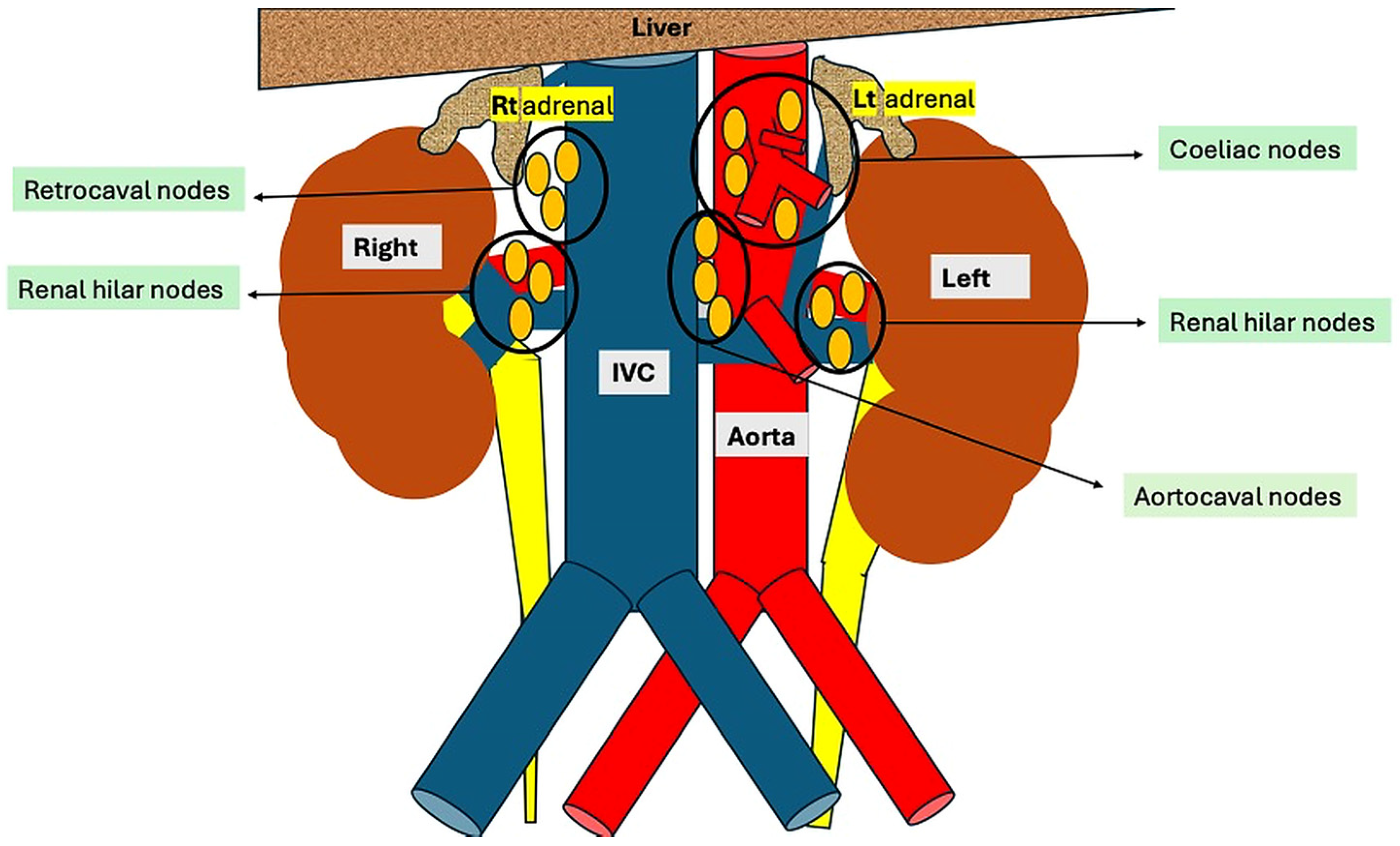
The earliest descriptions of adrenal lymphatic drainage date back to the latter half of the 18th century. In 2024, De Ponthaud and colleagues published a comprehensive review of 18 anatomical studies of non-diseased adrenal glands describing lymphatic drainage of the adrenal glands [13]. They identified lymphatic drainage pathways to the renal hilar, paracaval, retrocaval, inter-aortocaval, para-aortic, and coeliac trunk lymph nodes, as well as to the diaphragmatic pillars and mediastinal lymph nodes [13], as shown in Figure 1. The anatomical differences in lymphatic drainage of the left and right adrenal glands were described in the work of Sada et al. [14]. In their study, dyes were injected into the adrenal glands of 25 unembalmed neonatal cadavers. For the right adrenal gland, drainage was observed to the coeliac trunk, inter-aortocaval, paracaval, retrocaval, and anterocaval nodes. In contrast, the left adrenal gland drained into the coeliac trunk, para-aortic, posterior mediastinal, and inferior diaphragmatic nodes [13]. De Ponthaud and colleagues conducted a cadaveric study (n = 6) to delineate the lymphatic drainage of the adrenal gland and clarify its clinical implications [13]. They examined 12 non-diseased adrenal glands and, after injecting blue dye, identified more lymph nodes draining the left adrenal gland compared to the right (5.5 versus 2.5 nodes). These findings suggest that the differences in lymphatic drainage and lymph node number between the left and right adrenal glands may indicate distinct anatomical boundaries for lymph node dissection depending on the laterality of ACC.
The most common sites for lymph node metastases in patients with right ACC were paracaval, whereas in the left ACC, they were para-aortic and within the left renal hilum [14].
Patterns of lymph node recurrence in ACC were examined within the ENSAT registry. It included patients (n = 56) with non-metastatic ACC stage I to III, R0 resection of the primary tumor, disease-free interval of more than 3 months, and the presence of lymph node metastases at the first relapse of the disease course as identified on either CT, MRI, or FDG-PET/CT. Recurrence patterns again varied by laterality: in left-sided ACC, most recurrences were located in the left renal hilum around the renal artery, followed by the para-aortic nodes. In contrast, right-sided ACC recurrences were most frequently observed in the perirenal fat above the renal hilum and in the inter-aortocaval nodes [15].
In 2012, Gaujoux and Brennan [16] proposed a standardized approach to the surgical management of primary ACC. Their recommendations included removal of first-order drainage nodes, en bloc resection of locally involved organs or large veins, and tumor thrombus embolectomy when R0 resection was considered achievable. They defined first-order drainage nodes as “the celiac lymph nodes, renal hilum lymph nodes, and the para-aortic and paracaval lymph nodes extending from the aortic hiatus near the origin of the celiac artery to the renal pedicle, ipsilateral to the tumor” [16]. Drawing a parallel with total mesorectal excision in rectal cancer—which is now the standard of care and closely associated with prognostic outcomes following lymphadenectomy—they emphasized the potential value of adopting a standardized lymphadenectomy strategy in the surgical management of ACC [16].

3. Impact on Survival of Lymphadenectomy in ACC

Several studies have examined the relationship between lymphadenectomy and survival. Data is limited to retrospective studies of small population numbers over long periods of time. Despite being important for assessing trends and long-term follow-up, long durations may reflect heterogeneity in clinical practice, which is likely to change over time. In addition, retrospective cohort studies have inherent limitations due to documentation and recall bias, while it is also difficult to draw conclusions due to heterogeneity of the data (disease stage, surgical approach and lymphadenectomy). Studies include data on overall survival, but there is a sparsity of studies assessing the risk of recurrence and disease-free survival. Most studies include the use of data from two main cohort studies within the US: The Surveillance, Epidemiology, and End Results (SEER) Program and NCDB. These studies include data from a specific cohort, which may not be generalizable to other populations.
When adjusted for stage, a few studies have shown a positive association between lymphadenectomy and improved survival in stage I to III ACC. A study using NCDB data showed lymphadenectomy to be associated with improved overall survival (HR 0.817, [95% CI 0.670–0.997], p = 0.047) in patients with stage I to III ACC [17]. Similarly, a multicenter study from the US demonstrated a positive association between lymphadenectomy and overall survival in ACC for patients with R0 resections (n = 32 of 120 patients who underwent lymph node dissection, 1993 to 2014) [18]. In a univariate analysis, 5-year overall survival was 76% versus 59% (p = 0.041). This difference was even more pronounced in multivariate analysis, adjusting for tumor size, palpable mass, irregular tumor edges, suspicious nodes on imaging and multi-visceral resection (HR 0.17 [95%CI 0.05–0.61], p = 0.005); however, the wide confidence interval may reflect a small sample size [18].
Data from the German ACC Registry (1981–2009) including 283 patients, 47 of whom underwent lymphadenectomy, showed that lymph node dissection was associated with improved recurrence-free survival (HR 0.65, 95% CI 0.43–0.98; p = 0.042) and disease-free survival (HR 0.54, 95% CI 0.30–0.99; p = 0.049) compared with patients who did not undergo lymph node dissection [19]. The study population included patients with stage I–III disease who underwent R0 resection, had more than 6 months of follow-up, and received lymphadenectomy involving the excision of ≥5 lymph nodes. A SEER cohort study (1988–2009) including patients with stage III or IV ACC found that lymph node dissection was associated with improved cancer-specific survival in those with T4 tumors (p = 0.044), although the number of lymph nodes excised was not reported [20]. Similarly, a NCDB study (2004–2015, n = 3185) demonstrated improved overall survival for patients with stage IV ACC who underwent lymphadenectomy (15 vs. 6 months; p < 0.001) [21].

Negative Impact of Lymphadenectomy

Lack of association between lymphadenectomy and overall survival in the treatment of ACC has been shown in few studies. Four studies using the SEER cohort support this finding: He et al. (2010 to 2019, n = 876) reported that lymphadenectomy was not associated with improved overall survival (HR 1.12 [95% CI 0.86–1.46], p = 0.39) [22]; Saade et al. (1998 to 2009, n = 259) described no difference between overall or cancer-free survival in patients undergoing regional lymph node dissection of ≥5 lymph nodes versus no lymph node dissection [23]; Wang et al. (1963 to 2014, n = 749) also showed no association with overall survival (HR 0.88 [95% CI 0.685–1.130], p = 0.317) [24] and Nilubol et al. (1973 to 2011, n = 1525) reported no association between lymphadenectomy and disease-free survival [25].
In a study within the NCDB cohort by Deschner et al. (2004 to 2015), only 16.4% of patients included in the study (n = 147 of 897 patients) underwent lymph node dissection (median number of lymph nodes examined was 2 [interquartile range 1 to 6]) [7]. In their analysis, lymph node dissection was not associated with improved overall survival. It was, however, associated with increasing tumor size, extra-adrenal extension, an open operation, and treatment at an academic center (p < 0.001) [7]. The findings reflected in these studies may relate to heterogeneity of the study population, which, for instance, is not adjusted for stage.
In a study comparing the outcomes of pediatric and adult patients undergoing surgery for ACC, pediatric patients were more likely to undergo lymphadenectomy compared to adult patients (31/71 [43.7%] versus 559/2482 [22.5%], p < 0.001), and they are associated with worse overall survival (HR 1.30 [95% CI 1.14–1.48]) [6]. A different study with the SEER cohort (1975 to 2016, n = 2170) showed that lymphadenectomy was associated with worse cancer-specific survival, possibly related to tumor characteristics that were not completely described within the study due to limitations with the data [26]. Alanee et al. [12] also conducted a study with the SEER dataset from 1991 to 2011 (n = 1037, of which 58 underwent a lymph node dissection), lymphadenectomy was associated with an increased risk of cancer-specific death (n = 36/58 versus 538/979, p = 0.002). However, these findings may relate to the small study numbers (5.39% of the study population underwent lymph node dissection) [12].

4. Lymph Node Numbers and Their Significance

Data from a study of 185 patients with stage T2–T4 non-metastatic ACC showed that resection of ≥4 lymph nodes, compared with resection of 1–3 nodes, was associated with lower cancer-specific mortality (HR 0.52, 95% CI 0.30–0.91; p = 0.02), suggesting that a threshold of ≥4 nodes may have prognostic significance [27]. The authors also proposed that identification of nodal metastases enables more accurate staging, which could have clinical implications for planning adjuvant therapy, such as mitotane chemotherapy [27]. Similar results were shown in a NCDB study of 156 patients where excision of ≥4 lymph nodes was associated with improved overall survival [28]. In contrast, analysis of the SEER cohort (1988–2009) found that dissection of ≥5 lymph nodes was not associated with improved overall or disease-free survival in patients with non-metastatic ACC [23].

5. Complications of Lymphadenectomy

Adrenalectomy is considered a major surgical procedure, and the addition of concurrent lymphadenectomy may further increase postoperative morbidity by prolonging operative time, coupled with increased risk of bleeding, lymphatic leakage, and anesthesia-related complications. There is, however, limited data on complications associated with combined adrenalectomy and lymphadenectomy, and they are largely limited to retrospective cohort studies.
A study from the Mayo Clinic found no statistically significant difference in 30-day complication rates between patients who underwent lymphadenectomy and those who did not (48.1% vs. 35.7%, p = 0.27) [14]. In the study, lymphadenectomy was associated with a higher likelihood of Clavien–Dindo class III/IV complications (38.5% vs. 14.3%, p = 0.06), which the authors attributed primarily to multi-visceral en bloc resections rather than the lymphadenectomy itself. The authors also reported a case of chylous ascites that required dietary management and paracentesis [14].
Another multi-institutional study across 13 US centers reported no significant differences in median length of stay, in-hospital mortality, reoperation, postoperative transfusion, 90-day readmission, or grade III/IV complications between patients who did (n = 32) and did not (n = 88) undergo lymphadenectomy at the time of R0 resection for non-metastatic ACC [18]. Analysis of the NCDB also found no significant differences in 30- or 90-day mortality among patients with stage I–III ACC who underwent adrenalectomy with (n = 386/1683) or without (n = 1297/1683) lymphadenectomy [17].
By contrast, Deschner et al. [7] reported a longer median length of stay in patients undergoing lymphadenectomy compared to those who did not (5 days [IQR 4–7] vs. 4 days [IQR 2–6], p < 0.001), although rates of unplanned readmission within 30 days and 90-day mortality did not differ. The longer hospitalization was thought to reflect the higher proportion of open procedures among patients undergoing lymphadenectomy (37.4% vs. 24.8%, p < 0.001) [7].

6. Conclusions and Future Direction

The performance of lymphadenectomy for ACC remains a subject of debate, as robust data to confidently support or oppose the performance of routine lymphadenectomy for patients who undergo surgery for ACC is severely limited. While both European and US guidelines advise locoregional lymphadenectomy and the removal of adjacent lymph nodes, as part of the initial surgical treatment of ACC, these guidelines recognize limitations due to both the low incidence of the disease as well as to the availability of almost exclusively retrospective cohort data, where even a systematic review would likely be hampered by the heterogeneity. There is, however, evidence to suggest benefits for lymphadenectomy for ACC among certain subgroups, such as a lower stage of the disease (stage I to III) and the number of lymph nodes excised (≥4), and have included a checkbox for surgeons as shown in Table 1.
There appears to be no significant increase in morbidity or postoperative mortality associated with lymphadenectomy. Of note, it is currently unclear what the impact of robotic surgery or other advances will have on the risk of complications, recurrence, and overall survival. To clarify the role for lymphadenectomy in the treatment of ACC further, there may be benefits from a worldwide database or collaboratives studies, compiling multicenter data on the outcomes of ACC, to improve understanding and to aid future research. In addition, standardized guidelines and/or standardization of surgical practices are needed to clarify its role in the management of this aggressive cancer.

Author Contributions

Conceptualization, R.P. and M.C.d.J.; methodology, J.A. and M.C.d.J.; software, R.P.; validation, R.P., M.C.d.J.; resources, J.A., M.C.d.J. data curation, J.A. and M.C.d.J.; writing—original draft preparation, J.A.; writing—review and editing, R.P. and M.C.d.J.; visualization, M.C.d.J.; supervision, R.P.; project administration, R.P. and M.C.d.J. All authors have read and agreed to the published version of the manuscript.

Funding

This research received no external funding.

Institutional Review Board Statement

Ethical review and approval were waived for this study due to the fact the results obtained in the study is from existing published literature.

Informed Consent Statement

The study is a review of articles already published in the literature.

Data Availability Statement

No new data was generated from the study as the results published were synthesized from published literature.

Acknowledgments

The authors have reviewed and edited the output and take full responsibility for the content of this publication.

Conflicts of Interest

The authors declare no conflicts of interest.

Abbreviations

The following abbreviations are used in this manuscript:
ACCAdrenal cortical cancer
CTComputerized Tomography
ENSATEuropean Network for the Study of Adrenal Tumours
ESESEuropean Society of Endocrine Surgeons
GRADEGrading of Recommendations, Assessment, Development and Evaluation
MRIMagnetic Resonance Imaging
NCCNNational Comprehensive Cancer Network
SEERSurveillance, Epidemiology, and End Results

References

  1. Golden, S.H.; Robinson, K.A.; Saldanha, I.; Anton, B.; Ladenson, P.W. Clinical review: Prevalence and incidence of endocrine and metabolic disorders in the United States: A comprehensive review. J. Clin. Endocrinol. Metab. 2009, 94, 1853. [Google Scholar] [CrossRef] [Scilit] [PubMed]
  2. Kerkhofs, T.M.; Verhoeven, R.; van der Zwan, J.-M.; Dieleman, J.; Kerstens, M.N.; Links, T.P.; Van de Poll-Franse, L.; Haak, H.R. Adrenocortical carcinoma: A population-based study on incidence and survival in the Netherlands since 1993. Eur. J. Cancer 2013, 49, 2579–2586. [Google Scholar] [CrossRef] [Scilit] [PubMed]
  3. Sharma, E.; Dahal, S.; Sharma, P.; Bhandari, A.; Gupta, V.; Amgai, B.; Dahal, S. The Characteristics and Trends in Adrenocortical Carcinoma: A United States Population Based Study. J. Clin. Med. Res. 2018, 10, 636–640. [Google Scholar] [CrossRef] [Scilit] [PubMed]
  4. Amini, N.; Margonis, G.A.; Kim, Y.; Tran, T.B.; Postlewait, L.M.; Maithel, S.K.; Wang, T.S.; Evans, D.B.; Hatzaras, I.; Shenoy, R.; et al. Curative Resection of Adrenocortical Carcinoma: Rates and Patterns of Postoperative Recurrence. Ann. Surg. Oncol. 2016, 23, 126–133. [Google Scholar] [CrossRef] [Scilit]
  5. Glenn, J.A.; Else, T.; Hughes, D.T.; Cohen, M.S.; Jolly, S.; Giordano, T.J.; Worden, F.P.; Gauger, P.G.; Hammer, G.D.; Miller, B.S. Longitudinal patterns of recurrence in patients with adrenocortical carcinoma. Surgery 2019, 165, 186–195. [Google Scholar] [CrossRef] [Scilit]
  6. Akinkuotu, A.C.; Peace, A.; Maduekwe, U.N.; Hayes, A.A. Surgical outcomes and survival of adrenocortical carcinoma between children and adults. Am. J. Surg. 2022, 224, 1090–1094. [Google Scholar] [CrossRef] [Scilit]
  7. Deschner, B.W.; Stiles, Z.E.; DeLozier, O.M.; Drake, J.A.; Tsao, M.; Glazer, E.S.; Do, J.L.D.; Yakoub, D.; Dickson, P.V. Critical analysis of lymph node examination in patients undergoing curative-intent resection for adrenocortical carcinoma. J. Surg. Oncol. 2020, 122, 1152–1162. [Google Scholar] [CrossRef] [Scilit]
  8. Icard, P.; Goudet, P.; Charpenay, C.; Andreassian, B.; Carnaille, B.; Chapuis, Y.; Cougard, P.; Henry, J.; Proye, C. Adrenocortical carcinomas: Surgical trends and results of a 253-patient series from the French Association of Endocrine Surgeons study group. World J. Surg. 2001, 25, 891–897. [Google Scholar] [CrossRef] [Scilit]
  9. Gaujoux, S.; Mihai, R.; Carnaille, B.; Dousset, B.; Fiori, C.; Porpiglia, F.; Hellman, P.; Iacobone, M.; Kraimps, J.-L.; Donatini, G.; et al. European Society of Endocrine Surgeons (ESES) and European Network for the Study of Adrenal Tumours (ENSAT) recommendations for the surgical management of adrenocortical carcinoma. Br. J. Surg. 2017, 104, 358–376. [Google Scholar] [CrossRef] [Scilit]
  10. Fassnacht, M.; Dekkers, O.M.; Else, T.; Baudin, E.; Berruti, A.; de Krijger, R.R.; Haak, H.R.; Mihai, R.; Assie, G.; Terzolo, M. European Society of Endocrinology Clinical Practice Guidelines on the management of adrenocortical carcinoma in adults, in collaboration with the European Network for the Study of Adrenal Tumors. Eur. J. Endocrinol. 2018, 179, G1–G46. [Google Scholar] [CrossRef] [Scilit]
  11. Shah, M.H.; Goldner, W.S.; Benson, A.B.; Bergsland, E.; Blaszkowsky, L.S.; Brock, P.; Chan, J.; Das, S.; Dickson, P.V.; Fanta, P.; et al. Neuroendocrine and adrenal tumors, version 2.2021, NCCN clinical practice guidelines in oncology. J. Natl. Compr. Cancer Netw. 2021, 19, 839–868. [Google Scholar] [CrossRef] [Scilit] [PubMed]
  12. Alanee, S.; Dynda, D.; Holland, B. Prevalence and Prognostic Value of Lymph Node Dissection in Treating Adrenocortical Carcinoma: A National Experience. Anticancer. Res. 2015, 35, 5575–5579. [Google Scholar] [PubMed]
  13. de Ponthaud, C.; Bekada, S.; Buffet, C.; Roy, M.; Bachelot, A.; Ayed, A.; Menegaux, F.; Gaujouxe, S. Which lymphadenectomy for adrenocortical carcinoma? Surgery 2024, 176, 1635–1644. [Google Scholar] [CrossRef] [Scilit] [PubMed]
  14. Sada, A.; Glasgow, A.E.; Lyden, M.L.; Dy, B.M.; Foster, T.R.; Habermann, E.B.; Bancos, I.; McKenzie, T.J. Informing therapeutic lymphadenectomy: Location of regional metastatic lymph nodes in adrenocortical carcinoma. Am. J. Surg. 2022, 223, 1042–1045. [Google Scholar] [CrossRef] [Scilit]
  15. Reibetanz, J.; Rinn, B.; Kunz, A.S.; Flemming, S.; Ronchi, C.L.; Kroiss, M.; Deutschbein, T.; Pulzer, A.; Hahner, S.; Kocot, A.; et al. Patterns of Lymph Node Recurrence in Adrenocortical Carcinoma: Possible Implications for Primary Surgical Treatment. Ann. Surg. Oncol. 2019, 26, 531–538. [Google Scholar] [CrossRef] [Scilit]
  16. Gaujoux, S.; Brennan, M.F. Recommendation for standardized surgical management of primary adrenocortical carcinoma. Surgery 2012, 152, 123–132. [Google Scholar] [CrossRef] [Scilit]
  17. Tseng, J.; DiPeri, T.; Chen, Y.; Shouhed, D.; Ben-Shlomo, A.; Burch, M.; Phillips, E.; Jain, M. Adrenocortical Carcinoma: The Value of Lymphadenectomy. Ann. Surg. Oncol. 2022, 29, 1965–1970. [Google Scholar] [CrossRef] [Scilit]
  18. Gerry, J.M.; Tran, T.B.; Postlewait, L.M.; Maithel, S.K.; Prescott, J.D.; Wang, T.S.; Glenn, J.A.; Phay, J.E.; Keplinger, K.; Fields, R.C.; et al. Lymphadenectomy for Adrenocortical Carcinoma: Is There a Therapeutic Benefit? Ann. Surg. Oncol. 2016, 23, 708–713. [Google Scholar] [CrossRef] [Scilit]
  19. Reibetanz, J.; Kroiss, M.; Deutschbein, T.; Fenske, W.; Gasser, M.; Jurowich, C.; Germer, C.T.; Allolio, B.; Fassnacht, M. German adrenocortical carcinoma registry. Surgical therapy results and follow-up treatment. Chir. Z. Alle Geb. Oper. Med. 2012, 83, 528–535. [Google Scholar]
  20. Tran, T.B.; Liou, D.; Menon, V.G.; Nissen, N.N. Surgical management of advanced adrenocortical carcinoma: A 21-year population-based analysis. Am. Surg. 2013, 79, 1115–1118. [Google Scholar] [CrossRef] [Scilit]
  21. Tella, S.H.; Kommalapati, A.; Yaturu, S.; Kebebew, E. Predictors of Survival in Adrenocortical Carcinoma: An Analysis from the National Cancer Database. J. Clin. Endocrinol. Metab. 2018, 103, 3566–3573. [Google Scholar] [CrossRef] [Scilit]
  22. He, S.; Huang, X.; Zhao, P.; Zhang, P. The prognosis difference between elderly and younger patients with adrenocortical carcinoma. Front. Genet. 2022, 13, 1029155. [Google Scholar] [CrossRef] [Scilit]
  23. Saade, N.; Sadler, C.; Goldfarb, M. Impact of Regional Lymph Node Dissection on Disease Specific Survival in Adrenal Cortical Carcinoma. Horm. Metab. Res. 2015, 47, 820–825. [Google Scholar] [CrossRef] [Scilit]
  24. Wang, S.; Chen, S.-S.; Gao, W.-C.; Bai, L.; Luo, L.; Zheng, X.-G.; Luo, Y. Prognostic Factors of Adrenocortical Carcinoma: An Analysis of the Surveillance Epidemiology and End Results (SEER) Database. Asian Pac. J. Cancer Prev. 2017, 18, 2817–2823. [Google Scholar]
  25. Nilubol, N.; Patel, D.; Kebebew, E. Does Lymphadenectomy Improve Survival in Patients with Adrenocortical Carcinoma? A Population-Based Study. World J. Surg. 2016, 40, 697–705. [Google Scholar] [CrossRef] [Scilit]
  26. Reibetanz, J.; Jurowich, C.; Erdogan, I.; Nies, C.; Rayes, N.; Dralle, H.; Behrend, M.; Allolio, B.; Fassnacht, M. Impact of lymphadenectomy on the oncologic outcome of patients with adrenocortical carcinoma. Ann. Surg. 2012, 255, 363–369. [Google Scholar] [CrossRef] [Scilit] [PubMed]
  27. Assad, A.; Barletta, F.; Incesu, R.-B.; Scheipner, L.; Morra, S.; Baudo, A.; Garcia, C.C.; Tian, Z.; Ahyai, S.; Longo, N.; et al. Prognostic significance of lymph node count in surgically treated patients with T(2–4) stage nonmetastatic adrenocortical carcinoma. Urol. Oncol. 2024, 42, 248.e1–248.e9. [Google Scholar] [CrossRef] [Scilit] [PubMed]
  28. Panjwani, S.; Moore, M.D.; Gray, K.D.; Finnerty, B.M.; Beninato, T.; Brunaud, L.; Fahey, T.J.; Zarnegar, R. The Impact of Nodal Dissection on Staging in Adrenocortical Carcinoma. Ann. Surg. Oncol. 2017, 24, 3617–3623. [Google Scholar] [CrossRef] [Scilit] [PubMed]
Figure 1. Lymphatic drainage of the adrenal glands. Abbreviation: IVC—inferior vena cava.
Lymphatics 04 00012 g001
Table 1. Surgeon’s checklist for lymphadenectomy in ACC.
When to perform a lymphadenectomy:
  • Suspected or confirmed ACC and surgery is with curative intent (especially stage I–III), even if clinically N0.
  • Any suspicious/enlarged nodes on CT/MRI/FDG-PET or encountered intra-op.
  • High-risk primary (large tumor, invasive features, open/en bloc resection planned)
Minimal nodal dissection (bilateral):
  • Peri-adrenal nodes.
  • Renal hilar nodes (ipsilateral).
Right-sided ACC (to include):
  • Paracaval nodes.
  • Retrocaval nodes.
  • Aortocaval nodes (especially for medial tumors or suspicious imaging).
Left-sided ACC (to include):
  • Para-aortic nodes (from the aortic hiatus/celiac origin region down toward the renal pedicle, ipsilateral).
  • Consider celiac region nodes when imaging suggests involvement or for upper pole/medial tumors.
Disclaimer/Publisher’s Note: The statements, opinions and data contained in all publications are solely those of the individual author(s) and contributor(s) and not of MDPI and/or the editor(s). MDPI and/or the editor(s) disclaim responsibility for any injury to people or property resulting from any ideas, methods, instructions or products referred to in the content.