
Review

Plant-Based Insecticides for Controlling Drosophila suzukii: Opportunities and Challenges for Biorational Nanoproducts


by
Gabriel N. Araújo
1,
Luis O. Viteri Jumbo
2,3,*,
Pedro B. Silva
1,
Leonardo B. Souza
1,
Anielle C. A. Silva
4,
Lucas Anhezini
5,
Gil. R. Santos
2,
Raimundo W. S. Aguiar
2,
Eugênio E. Oliveira
1,2 and
Jerusa M. Oliveira
4,*
1
Departamento de Entomologia, Universidade Federal de Viçosa, Viçosa 36570-900, MG, Brazil
2
Programa de Pós-Graduação em Biotecnologia, Universidade Federal do Tocantins, Gurupi 77402-970, TO, Brazil
3
Programa de Pós-Graduação em Biologia Animal, Universidade Federal de Viçosa, Viçosa 36570-900, MG, Brazil
4
Instituto de Física, Universidade Federal de Alagoas, Maceió 57072-970, AL, Brazil
5
Instituto de Ciências Biológicas e da Saúde, Universidade Federal de Alagoas, Maceió 57072-970, AL, Brazil
*
Authors to whom correspondence should be addressed.
Agrochemicals 2026, 5(1), 8; https://doi.org/10.3390/agrochemicals5010008
Submission received: 20 October 2025 / Revised: 17 December 2025 / Accepted: 18 December 2025 / Published: 2 February 2026
(This article belongs to the Section Pesticides)

Abstract

Drosophila suzukii (Diptera) is a polyphagous fly responsible for a huge loss in production of thin-skinned berries, usually controlled with low-selective synthetic pesticides, which can be toxic for biodiversity and human health. Biorational control of D. suzukii is challenging, despite many known lethal compounds, since most experiments happen in laboratory conditions, and agroecosystems include complex biotic and abiotic variables. Nanoencapsulation rises as an efficient alternative for optimizing pesticide development by protecting active ingredients and increasing selectivity. This review aimed to gather recent (over the last 5 years) research about plant-derived insecticides with the potential to control D. suzukii, examining their toxicity mechanisms and exposure methods, and to identify research gaps and perspectives, especially for nanoproducts. These efforts resulted in the selection of 31 articles, evaluating lethality and behavioral modulation caused by plant-based compounds, which exerted mainly attraction, repellency, and oviposition deterrence. Most studies were carried out under laboratory conditions, mostly testing plants from the Lamiaceae and Asteraceae botanical families, indicating essential oils as potential short-life pesticides against every life stage of D. suzukii, although their physicochemical instability limits field application. There are few studies addressing nano-pesticides for controlling D. suzukii, and these data contribute to botanical prospection for pesticide compounds and point to the development of plant-based nano-pesticides for controlling D. suzukii as a research gap with potential to enable field trials.

1. Introduction

Agriculture is under constant threat from phytophagous insects, which damage plants and reduce fruit production, which is reflected in market prices [1] and, consequently, the population’s feeding quality. Berry crops like strawberry (Fragaria ananassa Duchesne), blueberry (Vaccinium corymbosum L.), and other thin-skinned fruits are facing a challenge: the invasive fly Drosophila suzukii (Diptera: Drosophilidae) is a polyphagous threat [2], able to cause losses in berry production, estimated at 20−30% in extreme cases [1].
Drosophila suzukii females have a serrated ovipositor, which allows penetration of unripe fruits’ thin skin and egg laying. The eggs hatch as larvae that feed on the fruit, allowing infection from opportunist pathogens [3] and speeding up fruit rotting [4]. Since the eggs are small and hard to see with untrained eyes, a healthy fruit may be packed and sold, but with D. suzukii eggs and possibly larvae. A female can lay up to 350 eggs during their lifetime, and each egg develops into an adult within 11 days, granting D. suzukii a great invasive potential [5].
To optimize food production, D. suzukii control is mainly based on synthetic molecules such as spinosyns (spinetoram and spinosad), diamides (cyantraniliprole and cyclaniliprole), neonicotinoids (acetamiprid), carbamates, organophosphates (malathion and phosmet), and pyrethroids (zeta-cypermethrin and fenpeopathrin) [3,4,6]. A table containing brand names and recommended field concentrations for most of these has already been published by [6] These compounds are usually sprayed over crops, and it is estimated that >90% of the active ingredients (a.i.) do not hit their targets [7], either by water or wind drift of the formulation. That, together with misapplication, pollutes natural resources and affects non-target organisms, such as pollinators and natural enemies [8].
Since most of the A.I. follow the formulated products’ drift, their concentration at the target site is reduced over time, and the environment’s influence [7] results in a higher chance of selecting resistant populations. Drosophila suzukii is a species with high potential for resistance development [9], which is facilitated by the intensive use of a few chemical compounds [3,10]. Therefore, the development of effective target-selective, compound-rich alternatives to conventional D. suzukii control is highly desirable in order to mitigate environmentally negative impacts. Essential oils are volatile specialized metabolites from plants (mainly terpenes and phenylpropanoids), which are semiochemicals known for behavioral modulation and lethality in insects, including D. suzukii [3]. Essential oils are easy to obtain (through distillation), which makes them a relatively affordable product [4,11]. Meanwhile, essential oils’ yield can vary according to species, genotypes, environmental conditions, and management techniques, among other factors, which can interfere with obtention costs [11,12,13,14].
Biorational pesticides are those that cause selective toxicity against target organisms, while causing no or reduced harm to beneficial organisms [15]. Research on D. suzukii biorational control often evaluates plant-based compounds, mainly essential oils, because of their residue-free, compound-rich, and potentially synergic toxicity [16]. Essential oils can trigger the insects’ defense systems against pesticides through different mechanisms, and, therefore, there is a reduced propensity for selecting organisms resistant to a single toxicity mechanism [9,16].
The toxicity of a compound varies according to its chemical nature, molecular targets, and exposure [17], and, therefore, its overall selectivity is complex to predict, since agricultural systems contain distinct biodiversity [3]. Essential oils’ volatile compounds can enter the insect respiratory system, avoiding the cuticle and quickly reaching their targets. Their lipophilic nature and low molecular weight allow these compounds to cause lipid peroxidation [4] or even penetrate cell membranes, leading to physiological disbalance and cell death [9]. The bioactivity of these natural compounds is associated with their high reactivity, which can interfere with the oxidant/antioxidant balance and be toxic in many ways through oxidative stress [3]. This stress can cause tissue damage, namely, digestive tract necrosis [4] and thickness reduction [3], Malpighian tubules’ brush border disintegration [9], cuticle malformation [3,4], and other damages that can lead to the insect’s death.
The potential toxicity of essential oils varies with the exposure method: topical exposure to essential oils can kill D. suzukii up to 10x quicker than ingestion exposure [9], although topical spraying is a challenge in the field because D. suzukii can hide in a huge variety of crops and non-crop plants [18]. Essential oils are reactive biodegradable compounds, and their stability is subject to environmental variations, such as temperature and humidity. Due to essential oils’ high instability, the maintenance of desired concentrations of a.i.s in the field is still a challenge [5]. Considering the insecticide potential of essential oils, it is desirable to find ways to mitigate the barriers to the development of plant-based biorational products that are efficient in the field.
The growing commercial interest in the field of nano-biopesticides is evidenced by a significant increase in patent filings for innovative formulations of plant-based active ingredients. Patents such as WO2018122860A1, which describes nanoemulsions of essential oils for pest control, and US20210015021A1, which protects lipid nanoparticles containing terpene compounds, illustrate the industrial effort to overcome fundamental challenges like stability and controlled release of botanical actives. These innovations aim to enhance efficacy, prolong field persistence, and reduce the volatility and photodegradation of natural compounds, factors that have traditionally limited the commercial adoption of botanical biopesticides [19,20].
Strategies such as nanoencapsulation, nanoemulsions, and smart delivery systems have been widely studied and show potential to improve the physicochemical stability, bioavailability, and efficiency of plant-based insecticides, while also minimizing environmental impacts and risks to non-target organisms [19,21]. Despite laboratory advances and the growing number of patents, there remains a gap between research and large-scale commercialization, mainly due to the need for more field studies, validation across different crops and agricultural environments, and regulatory and scalability challenges [19,21,22]. Nevertheless, the patent landscape indicates a robust pipeline of products in development, suggesting that as technical and regulatory barriers are overcome, new nano-botanical formulations are likely to reach the market, offering more sustainable and effective alternatives for agricultural pest management [23,24]. Although essential oil nano-encapsulates are being studied as insecticides, there is only one study [23] published about their efficiency against D. suzukii, leaving a great knowledge gap that should be fulfilled, aiming to optimize D. suzukii control.
This review’s objectives were to gather recent knowledge about plant-based biorational control of D. suzukii, evaluate the primary botanical groups used in it, and examine nanotechnology’s potential to enhance D. suzukii control. This article indicates recent (2019–2024) trends in the investigation of botanical groups toxic to D. suzukii and highlights the relevance of studies approaching plant-based insecticides to control D. suzukii and the potential of nano-biopesticides’ ecotoxicity (to both D. suzukii and beneficial organisms).

2. Materials and Methods

2.1. Search Strategy

We used the following search query in the field of “topics, titles, abstracts and keywords” in the Web of Science and Scopus renowned databases: (“Drosophila suzukii”) AND (“Biorational” OR “nanopartic*” OR “lipossome*” OR “liposome*” OR “synerg*” OR “insecticid*” OR “nanoinsecticide*” OR “nanoemulsion” OR “nanoformulation*” OR “nanoscience*” OR “nanotechnolog*”). This review considered only articles published during the last 5 years (2019–2024). Also, to compare these terms’ relevance among overall D. suzukii articles, we also performed a search for “Drosophila suzukii” in the Web of Science and Scopus databases with no data limit, which retrieved the first articles published back in 1965.

2.2. Screening Strategy and Eligibility Criteria

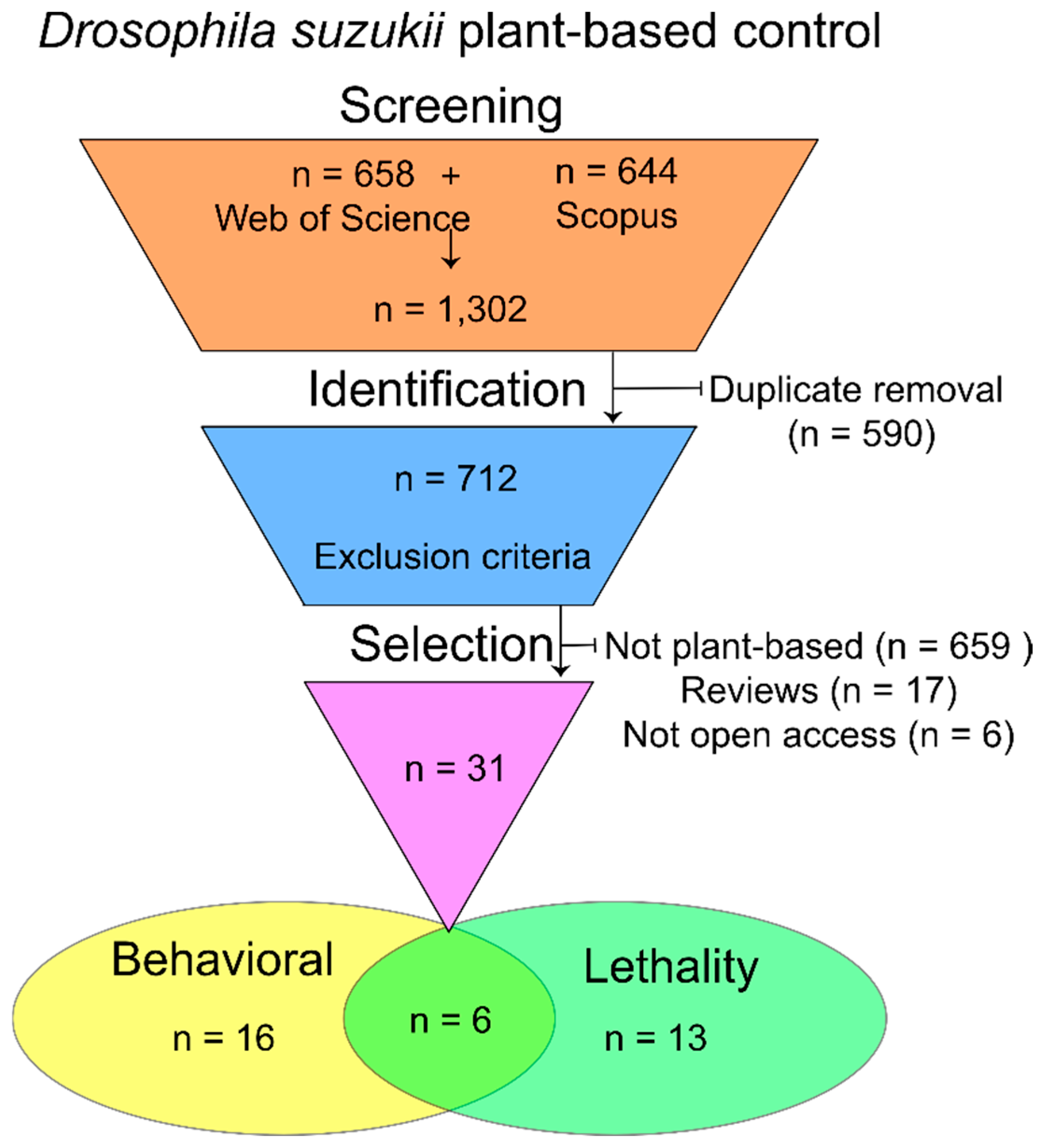
The screening of the articles consisted of database merging and duplicate removal using the Bibliometrix R package version 4.0.1, and subsequent analysis according to the pre-established exclusion criteria. Articles that did not evaluate plant-based compounds’ potential for the biorational control of D. suzukii, or review articles, were excluded. Experimental articles that tested plant-based compounds, isolated or in formulations, against any instar of D. suzukii, were included in this review. The process is described as a flowchart in Figure 1.

2.3. Data Extraction

The selected articles were analyzed, and the following data were extracted into an Excel sheet: type of assay (lethality or behavioral), experimental design (field or laboratory), and botanical family of the plants tested. The results are presented as a doughnut chart, obtained through the GraphPad PRISM V10 software.

3. Results

3.1. Bibliometrics

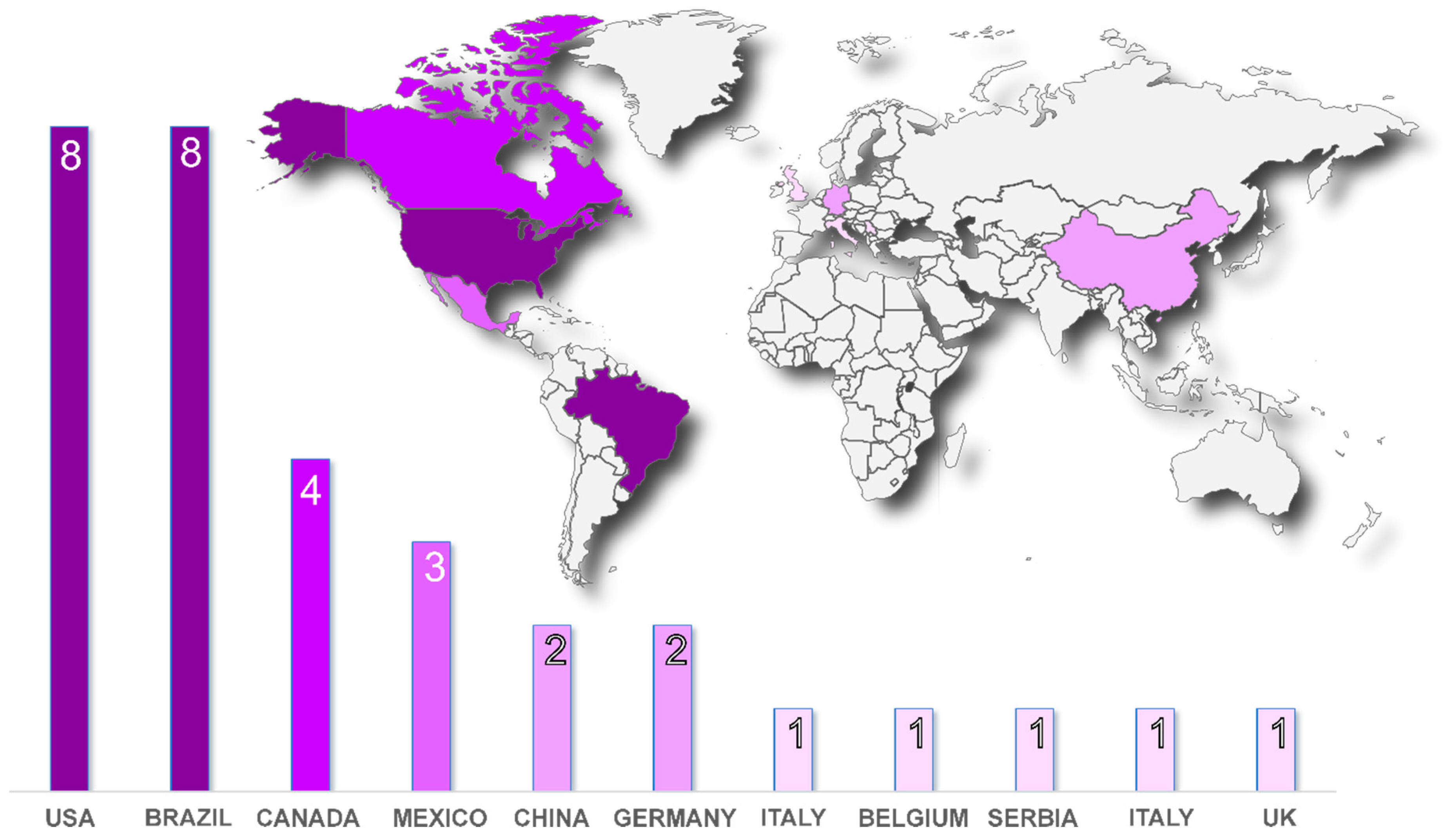
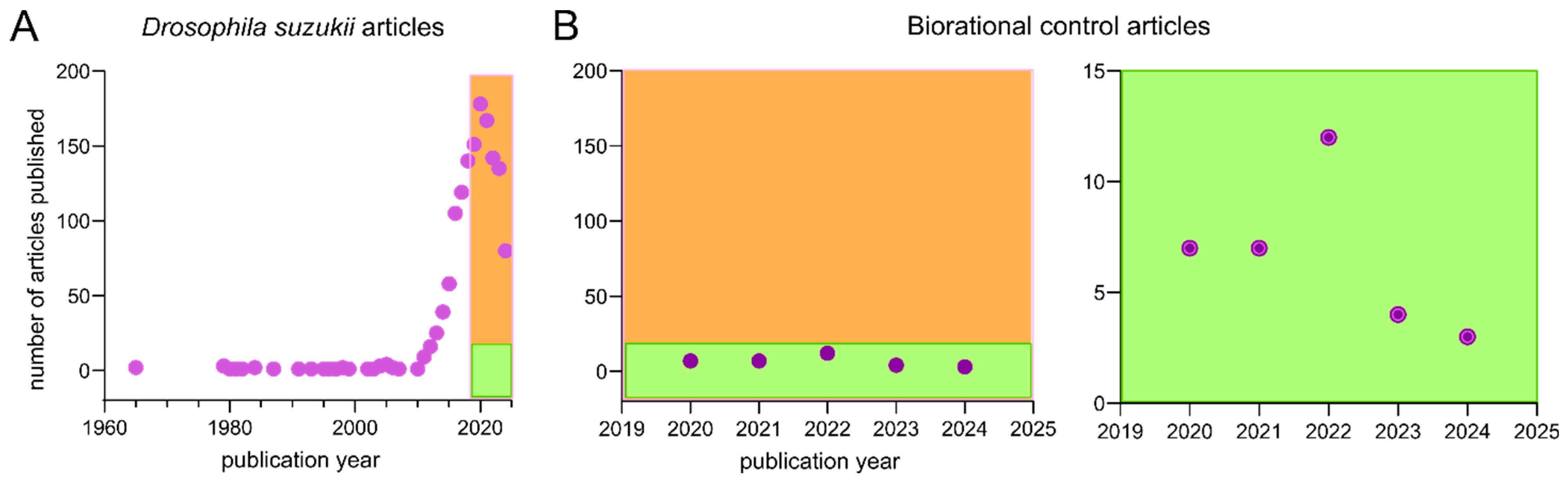
A total of 1302 references were identified, 644 from the Scopus database and 658 from the Web of Science database. After the initial screening, 590 duplicates were identified and removed from the dataset. Subsequently, more in-depth analyses of the titles and abstracts of the remaining articles were conducted, leading to the exclusion of 681 articles that did not meet the pre-established inclusion criteria. Nineteen selected papers evaluated compounds’ lethality (Table 1), and twenty-two articles evaluated compounds’ behavioral induction (attraction, repellence, or oviposition inhibition) in D. suzukii (Table 2). After meticulous analysis, we selected 31 articles that aligned with the objectives and scope of this study: to gather trends in the bioprospecting of biorational compounds with the potential to control D. suzukii, with a focus on developing new technologies. Articles that presented new substances or strategies for controlling D. suzukii were considered relevant, whether through lethality or behavioral induction, for any life stage of the organism (egg, larva, pupa, or adult). The leading countries in publications were Brazil and the United States of America (USA), both with eight published articles each (Figure 2), indicating a higher interest in D. suzukii control. When we compare the general D. suzukii literature, we can notice an ascending publication rate from 2010 until 2020, although the articles addressing biorational D. suzukii control are still scarce (Figure 3).

3.2. Toxicity of Botanical Derivatives Against Drosophila suzukii

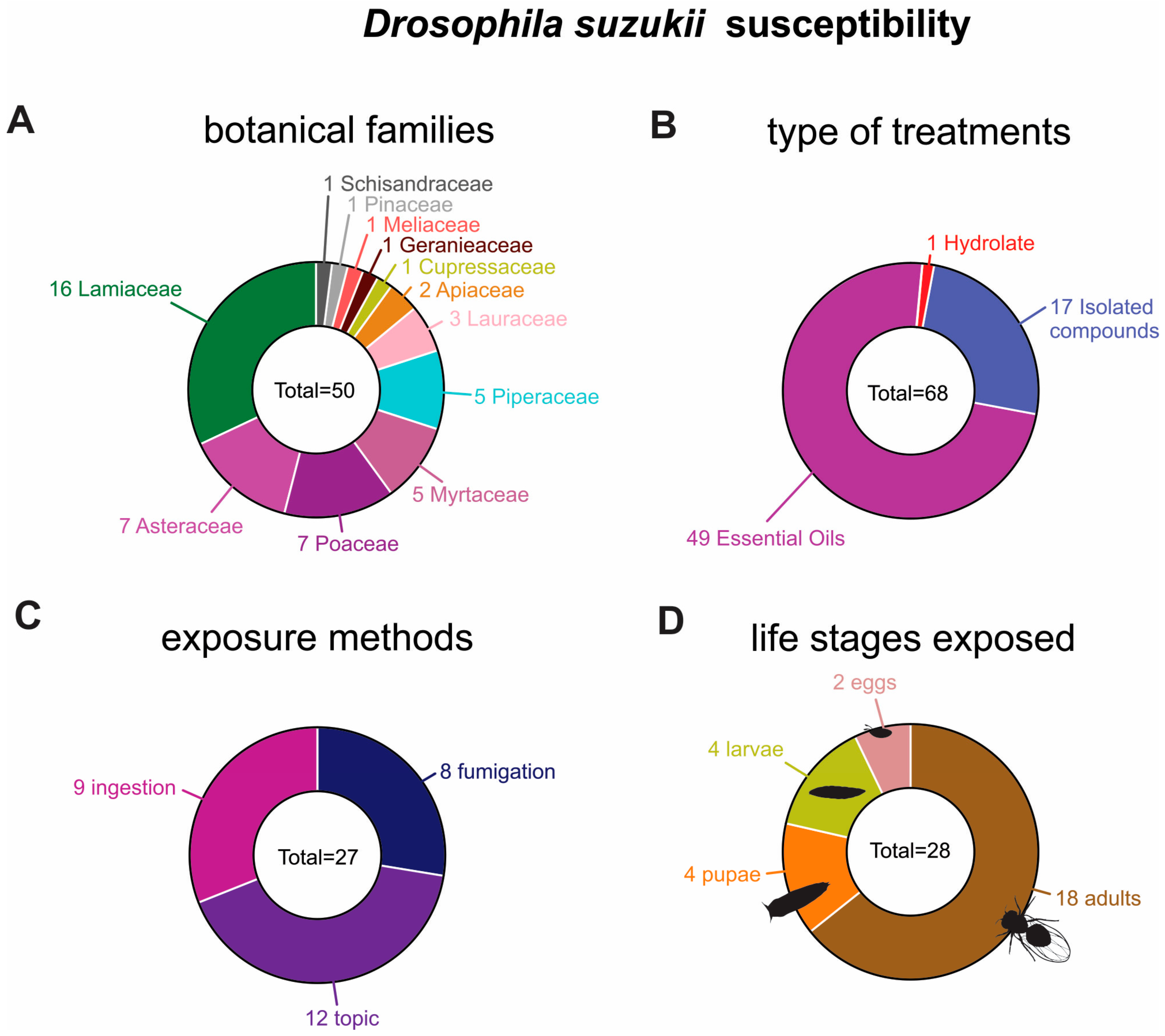
Fifty plant species, primarily from Lamiaceae (16), Asteraceae (7), and Poaceae (7), were tested for lethality (Figure 4A). Together, these experiments tested the lethality of 49 essential oils and 17 isolated compounds (mostly components of the essential oils) (Figure 4B). These bioassays were realized mostly by topical contact, but also through ingestion and fumigation (Figure 4C). Also, most of the mortality assays were realized with adult D. suzukii, while only a few articles tested toxicity to other life stages.
Table 1. Studies approaching botanical derivatives’ lethality against Drosophila suzukii.
Life StageCompoundsExposure MethodConcentration RangeMost Significant FindingsReferences
AdultsEssential oil from Litsea cubebaFumigation20–100 µL/L80–100% mortality[4]
LarvaeEssential oil from Litsea cubeba and citralContact0.01–1 µL/cm2Mortality: 1–80% (LCEO);
3.33–94% (citral)
AdultsEssential oils from P. aduncum, P. crassinervium, P. malacophyllum, P. gaudichaudianum, P. marginatum, and limoneneIngestion0.2–2.0%Mortality at 120 h: P. aduncum—80.0%, P. gaudichaudianum—80.0%, P. marginatum—78.4%, P. crassinervium—50.7%, P. malacophyllum—47.5%, and limonene botanical insecticide—43.0%[24]
Larvae and adultsContact (sprayed with potter’s tower)0.4 mL/mL (air)P. marginatum: 100.0%, P. aduncum: 100.0%, P. gaudichaudianum: 98.5%, spinetoram: 98.5%, P. malacophyllum: 36.2%, P. crassinervium: 63.27%, and limonene: 71.2%
AdultsEssential oils from Rosmarinus officinalis (3 chemotypes)Topic2.5–80 mg/L85–100% mortality[23]
PupaeIngestion65–80% mortality
PupaeContact70–100% mortality
LarvaeContact87–98% mortality
AdultsEssential oils from Cinnamomum verum, Cupressus sempervirens, Cymbopogon citratus CT citratus, C. martinii, C. flexuosus, C. citratus CT mirceno, C. winterianus, Eucalyptus globulus, E. radiata, E. staigeriana, E. citriodora, Mentha arvensis, M. cardiaca, M. spicata, M. piperita, M. citrata, Melaleuca alternifolia, Ocimum basilicum, and Pogostemon cablinTopic2.5–80 mg/LLC90 = 15.62–25.23 mg/L[25]
AdultsIngestion2.5–80 mg/LLC90 = 25.44–36.78 mg/L
AdultsOviposition80 mg/LHighest oviposition deterrence rates: 84.5% (C. verum) and 71.3% (C. citratus CT citratus)
AdultsGaseous ozone Topic14,600 and 30,100 ppmvInstant mortality[26]
AdultsEssential oils from Pelargonium graveolens, Anethum graveolens, and Pinus sylvestrisContact1–10% (v/v)32.80–100% mortality[27]
AdultsEssential oils from Baccharis anomala, B. calvescens, B. mesoneura, B. milleflora, B. oblongifolia, B. trimera, and B. uncinellaTopic25–80 mg/LLC90: 16.11–22.15 mg/L, LC50: 3.12–7.76 mg/L, and 0–50% significant oviposition deterrence[9]
LarvaeContact80 mg/L85.0–100% mortality
PupaeContact80 mg/L95.3–100% mortality
AdultsEssential oils from Azadirachta indica, Pogostemon cablin, Apium graveolens, and Nepeta cataria; isolated compounds: p-menthane-3,8-diol and 3-butylidenephthalideContact1–10%Significant oviposition deterrence (p-menthane-3,8-diol 1 and 10% and neem oil 1%)[28]
AdultsEssential oil from Eucalyptus globulusIngestion0.22–1.57 µL/mLLC90 = 1.57 µL/mL; LC50 = 0.67 µL/mL[29]
PupaeContact0.22–1.57 µL/mLPupal mass reduction under sublethal doses
AdultsHydrolate from Monarda didymaContact0.001–1000 µL/mLLC90 = 100.04 µL/mL; LC50 = 5.03 µL/mL[30]
AdultsThymol, carvacrol, and α-terpineolFumigant (no contact)0.067–0.67 µL/mL (acetone)LC90: 3.075–6.117 µL/L; LC50: 0.844–1.494 µL/L[31]
PupaeEssential oil from Plectranthus amboinicusVolatiles nearby?15–30 g/LReduced D. suzukii emergence[32]
AdultsEssential oil from Ocotea indecoraIngestion0.2–3.0 µL/mLLC95 = 2.20 µL/mL; LC50 = 0.72 µL/mL[33]
AdultsContact0.2–2.0 µL/mLLC95 = 0.55 µL/mL; LC50 = 0.43 µL/mL
AdultsCinnamaldehyde, cinnamon alcohol, cinnamon oil, citral, citronellol, ethyl cinnamate, eugenol, farnesol, and lemongrass oilContact0.1–10%LC90 = 2.12–>10%[34]
EggsCinnamaldehyde, citral, ethyl cinnamate, and star anise oilContact1 µL/mL100% mortality
AdultsBenzaldehyde, allyl isothiocyanate, and trans-cinnamaldehydeFumigation0.10–3.00 µL/L (air)80–100% mortality[35]
Eggs40–100% mortality
AdultsEssential oil from Illicium verumIngestion0.1–100 µL/mLLC95 = 9.2 µL/mL; LC50 = 1.9 µL/mL[36]
AdultsEssential oil from Rosmarinus officinalis (free or incorporated into nanoparticles)Ingestion5–100 mL/LFree essential oil: LD95 = 20.23 mL/L and LD50 = 5.7 mL/L; incorporated into nanoparticles: LD95 = 64.20 mL/L and LD50 = 17.5 mL/L[23]

3.3. Behavioral Responses of D. suzukii Exposed to Plant-Based Compounds

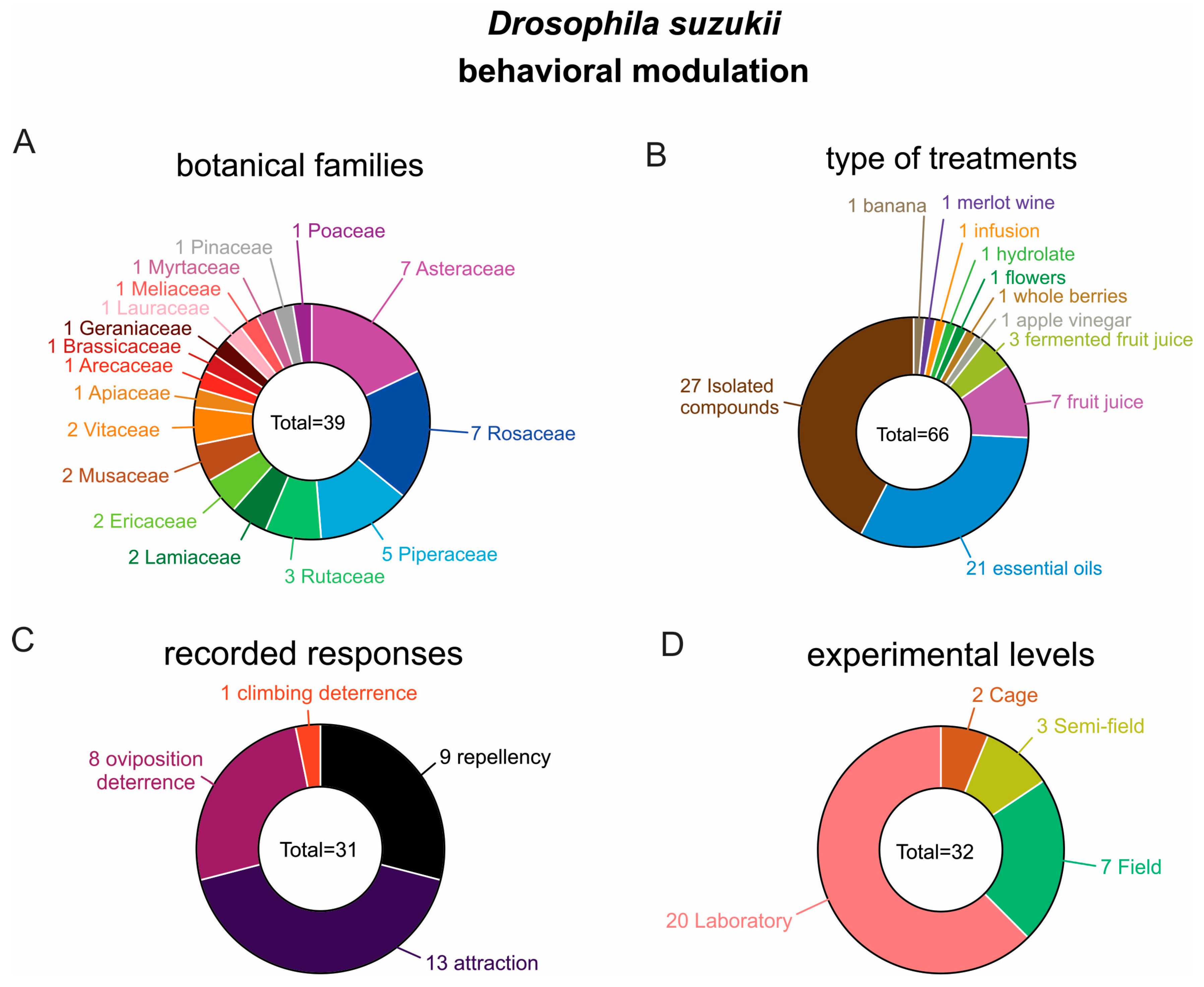
For the behavioral modulation bioassays, 39 vegetal species (mainly from the Asteraceae and Rosaceae families) were tested for their behavioral impacts on D. suzukii (Figure 5A). We observed that the most tested treatments consisted of isolated compounds (27), followed by essential oils (21) and common household substances such as flowers, fruits and fruit juice (fermented or not), wine, berries, and apple vinegar (Figure 5B). Thirteen of the treatments attracted D. suzukii adults, while nine were repellent and eight deterred oviposition (Figure 5C). Twenty out of thirty-two behavioral experiments were carried out in the laboratory, while only seven were conducted in the field (Figure 5D).
Table 2. Studies addressing plant-based compounds’ behavioral modulation of Drosophila suzukii.
Flies’ SourceCompoundsExposure MethodConcentration RangeMost Significant FindingsReferences
Rubus idaeus primocane raspberries (USA)Essential oils from Lavandula angustifolia2-choice (lab)Pure (12.5 µL dose)Significant repellency[5]
Fragaria × ananassa strawberry fields (Brazil)Essential oils from Baccharis anomala, B. calvescens, B. mesoneura, B. milleflora, B. oblongifolia, B. trimera, and B. uncinella2-choice (lab)80 mg/L acetoneSignificant repellency[9]
Laboratory-reared (Germany)LimoneneOdorant0.1–10%100% oviposition deterrence[34]
Vaccinium corymbosum blueberry crops (Mexico)Lures from fermented fruits’ juices (blueberry, strawberry, and blackberry)Field (blueberry crops, Vaccinium corymbosum250 g/L (fruit/water); 100 mL/trapSignificant attraction[37]
‘Black mission’ fig orchards (Mexico)Lure from bananaTrap (field)Banana 50% water (w/v)Attraction as significant as commercial trap[38]
Rubus ulmifolius blackberry (Mexico)Apple vinegar, merlot wine, orange juice, and bananaMultiple-choice (cage and field)Pure; orange juice: 35:27 mL water (v/v)65–80% capture rate; wine and orange juice most attractive (blackberry plot)[39]
Psidium cattleyanum sabine strawberry guava (Hawaii)Coconut’s free fatty acidsField-treated fruits100 mg/mL (hexane)50–100% oviposition deterrence[40]
Blueberries and raspberries (Italy)Essential oils: Citrus reticulata and Melaleuca alternifolia2-choice tests (lab)0.3–23.87 µL/L (hexane); 0.7–4.2 µL/L (ethanol)Repellence observed (≥2.39 µL/L); attractance (≤1.19 µL/L); oviposition deterrence: 25–100%[41]
Laboratory-reared (USA)Blends of hexyl acetate, methyl butyrate, methyl isovalerate, 2-heptanone, ethyl hexanoate, ethyl acetate, and butyl acetate + α-cyclocitral2-choice tests (lab)10−2–10−8 µL/mL (mineral oil)Ethyl hexanoate, 2-heptanone + α-cyclocitral = most attractive blend[42]
Laboratory-reared (Italy) and wild (Serbia)Essential oils: Pelargonium graveolens, Anethum graveolens, Pinus sylvestris, and Citrus bergamia2-choice (lab)1–10% (acetone)P. sylvestris: highest repellence; C. bergamia: attractive at 5%[27]
Laboratory-reared (Italy)Ethyl propionate, methyl N,N-dimethylanthranilate, and benzaldehyde2-choice (lab)0.1–10% (hexane)Significant repellence at 10%; benzaldehyde: significant at 1%[43]
Multiple-choice (lab)60–99% oviposition deterrenceObserved 60% to 99% deterrence of egg laying
Trap (semi-field, Italy)Polytunnel and strawberry cropDistance-dependent testNot specifiedDeterrence of pupal emergence based on distance
Vaccinium corymbosum blueberry crops (Mexico)Berries’ fermented juice (blueberry, strawberry, blackberry, and mixed)Trap (field)25% (m/v) (250g/kg water)As attractive as commercial trap[37]
10th generation, laboratory-rearedEssential oils from Piper aduncum, P. crassinervium, P. malacophyllum, P. gaudichaudianum, and P. marginatumNo-choice artificial fruit (lab)0.2–2%Significant oviposition deterrence[24]
Prunus avium cherries (Belgium)Rubus fruticosus berries (whole, cut, frozen, and juice)2-choice (lab)Equivalent of 1 berryJuice: less attractive[44]
Volatile compounds from Rubus fruticosus (individually)0.0002–2 μL/mL (mineral oil) (equivalent of 10 berries)Most attractive: acetaldehyde, camphene, L-limonene, hexyl acetate, myrtenol, and linalool
Laboratory-reared (Italy)Hydrolate from Monarda didymaArtificial diets/treated cherries100–1000 µL/mLSignificant oviposition deterrence at high concentrations[30]
Laboratory-reared (Italy)α-terpineolFumigation0.067–0.67 µL/mLSignificant reduction in climbing height[31]
Laboratory-reared (USA)Neem-based insecticides2-choice (lab)0.03–0.83% (v/v water)Oviposition deterrence (max.: 66%)[45]
Myrica rubra bayberries (China)α-pinene, methylbutyl acetate, 2-hexanol, E-β-ocimene, Z-3-hexenol, caryophyllene, and α-humulene3-choice test (lab)0.01–0.1 µg/µLOviposition deterrence (max.: 50%)[46]
Myrica rubra bayberries (China)Same as above3-choice test (lab)Not specified6–8x more attractive than control[18]
Laboratory-reared (China)Essential oil from Litsea cubeba and citral2-choice test0.01–1.0 µL/µLConcentration-dependent repellency[4]
Laboratory-reared (USA)Grape juice + NaCl2-choice test (cage)2% and 4% (w/v)Significantly increased attractiveness[2]
Murraya paniculata orange jasmine (USA)Lobularia maritima’s flowers, acetophenone, and benzaldehydeTrap (field); 2-choice50% (v/v) (mineral oil)>50% repellence after 10 h; 90% larval reduction[47]

4. Discussion

Our search did not include essential oils, and yet they represent the majority across the selected studies, which indicates strong recent efforts to study and apply them to D. suzukii control. Essential oils show potential for application in biorational D. suzukii integrated pest management (IPM), which often uses diverse complementary techniques, such as behavioral modulation and target lethality. These compounds can interfere with the physiological balance, which causes toxicity in every D. suzukii life stage [9] and can still exert behavioral modulations, such as attraction, repellence, or inhibition of oviposition [5].
Despite the huge potential of essential oils, their applicability faces a challenge: the low stability in field conditions, attributed to high volatility and biodegradability, which makes the maintenance of the desired concentrations of essential oils in the field difficult [18]. Recent research points toward nanoencapsulation of these compounds as an alternative to improve the essential oils’ physicochemical stability [16], target delivery, and surface covering [48]. However, this search only found one article testing a nanoencapsulated essential oil for D. suzukii control [23], indicating a lack of research with this aim.
Here, we discuss the potential of nanotechnology in integrated pest management, its feasibility barriers, and knowledge gaps for product development.

4.1. Plant-Based Lethality and Sub-Lethality

Drosophila suzukii adults can be exposed to essential oils through different ways that facilitate the compounds’ delivery to determined systems: topical contact takes the compounds directly to the hemolymph through the respiratory system and cuticle absorption, and, consequently, to the whole body of the insect, and, thus, can cause generalized toxicity [9]. Residual contact delivers the compounds to transient receptor potential (TRP) channels, tarsal chemoreceptors that induce direct neurophysiological responses, such as repellence and discoordination [4,25,33]. Still, once essential oils reach the nervous system, they can interfere with gamma-aminobutyric acid (GABA) receptors, inhibit acetylcholinesterase, or dysregulate the tyramine/octopamine system (TAR1), which, together, result in neuronal and locomotion disorders, such as tremors, paralysis, or hyperexcitation [4,36]. These disorders, although sub-lethal, can disable D. suzukii’s survivability by its inability to escape natural enemies and topical insecticide contact. TAR1 is also responsible for Drosophila’s physiological response to resist starvation [30,49], suggesting essential oils can interfere with the survival of D. suzukii during the off-season.
The ingestion of essential oils results in prolonged interaction with the digestive system. Due to their slow metabolism and excretion, these compounds may persist in tissues, potentially leading to chronic exposure and sustained damage [9]. These compounds can diffuse into epithelial cells’ membranes and cause cell death by membrane disruption, dehydration, or triggering detoxifying physiological responses [4]. Thus, it is expected that application methods through topical or tarsal contact are more toxic to D. suzukii than methods based on ingestion [24,30]. In field reality, these ways work together depending on the application method, e.g., spray, fumigation, and diverse baits.
Terpene exposure can interfere with the genetic expression of detoxifying enzyme families cytochrome P450 monooxygenase (CYP), esterase (EST), and glutathione S-transferase (GST) [31]. This interference may cause cell vacuolization and apoptosis, resulting in tissue degeneration or even necrosis [4], which hinders tissue function. Additionally, acetylcholinesterase’s (AChE) inhibition of D. suzukii digestive tissues can function as a phagodeterrent or phagostimulant.
Essential oils’ insecticide capacities are attributed to their high reactivity [18], namely, their antioxidant potential, provided mainly by the aromatic ring with organic oxygenated functions, such as aldehyde and carbonyl [3]. Such reactivity can interfere with the balance between oxidizing (reactive oxygen species [ROS]) and antioxidant agents like superoxide dismutase (SOD) and catalase (CAT), causing oxidative stress and eventually molecular damage [3]. SOD neutralizes ROS to maintain redox homeostasis [4], while CAT is responsible for neutralizing hydrogen peroxide (H2O2) [3].
Despite the huge toxicity potential of essential oils against D. suzukii, they are highly volatile and lipophilic, so it is a challenge to maintain them for longer periods of time in the field and efficiently realize their application. Even though there is only one paper [23] published testing nanoparticles loaded with essential oils on D. suzukii, there has been a lot of research on these nanosystems as insecticides for other species [50]. Nanoemulsions are considered the most effective technique for nanoencapsulation of essential oils as insecticides [50] because of their potential to enhance essential oil efficacy, hydrophilicity, and surface coverage, while requiring smaller quantities of the active compounds [50]. Actually, nanoemulsions can increase the physicochemical stability of essential oils, protecting them from degradation by environmental factors and, thus, increasing their duration in the field [7,50], reducing maintenance costs and increasing efficiency [16].

4.2. Essential Oils as Behavioral Modulators

Once essential oils’ volatiles reach TRP channels or insect antennae, they exert nervous system behavioral responses, such as repellency [5,18,47], attraction [38], disorientation [36], phagodeterrency [30], and oviposition deterrence [9,30]. Attraction and repellency responses together compose the push–pull (P&P) technique, which consists of the use of repellent compounds near crops and attractive compounds on the edges of the crops’ plots so that the flies tend to accumulate on the plots’ edges and the pesticide application is facilitated [5]. Also, attraction-and-kill (A&K) techniques can merge attraction and lethality, facilitating the meeting between D. suzukii and the lethal compounds, improving their efficiency [51,52]. The only article in this study’s scope that evaluated climbing capacity [31] found that exposure to α-terpineol through fumigation could reduce D. suzukii adults’ climbing capacity, which reduces their survival chances against natural enemies in the field and makes access to berries difficult.
Although essential oils’ volatiles can modulate D. suzukii’s spatial distribution, it is still a challenge to maintain desirable concentrations of them in the air, which requires controlled release rates [53]. Essential oils’ release rate is concentration-dependent, which means their concentration in the air tends to reduce as time passes [54]. That represents a barrier for essential oils’ use since D. suzukii’s behavioral response is influenced by both the field volatile background and the concentration to which the insect is exposed. The same compounds may be deterrents or stimulants at high or low concentrations [5,41]. Additionally, the volatiles from the field background can interfere with D. suzukii’s perception and response to essential oils, which inhibits or increases the essential oils’ effect [55].
Volatile compounds hold a key role in D. suzuki control; they can influence the adult spatial distribution and be included in diverse control techniques. However, their field instability can result in unpredictable results [55], so deeper research is necessary to better understand the behavior of D. suzukii exposed to essential oils in different field conditions and volatile backgrounds, together with technologies that improve essential oils’ stability. Today, it is already possible to produce nanofibers conjugated with essential oils, which enhance the physicochemical stability of essential oils while allowing a linear application around crops [56].
The release rate can also be regulated with nanotechnologies, like nanoencapsulation into matrices that release the content under biotic or abiotic triggering [56]. Abiotic triggering is interesting, especially to ensure a nanosystem’s environmental durability, while biotic triggering is especially useful for granting selective release upon D. suzukii contact. To achieve this, a deeper understanding of D. suzukii’s molecular receptors (e.g., TRP channels) is essential. Such knowledge would enable molecular-docking studies and the design of selective nanosystems [33], ensuring biopesticide release exclusively upon contact with D. suzukii while minimizing effects on non-target organisms.

4.3. Development Impairment

Even though essential oils can deter adult D. suzukii in many ways, it is also desirable that biopesticides hold developmental impairment potential; otherwise, new adults may emerge from pupae located in the soil or even in the fruits, which can be exported with larvae inside [35]. Although few studies have evaluated essential oils’ toxicity to D. suzukii eggs, larvae, and pupae, it is already understood that these compounds can also impair D. suzukii development. The volatiles can enter through the eggs’ spiracles and disrupt homeostasis, which can lead to yellow–brownish pigmentation, possibly as an indicator of lipid peroxidation [4,9] and even death [34].
The lipophilic characteristic of essential oils allows them to diffuse through the larval body and react in diverse systems. The larvae become generalized and diffusely pigmented, deformed, and flaky [4,9]. Sensory structures are distorted [4], and the digestive tract and Malpighian tubules may become thin and necrosed, while the cells’ cytoplasm is vacuolized [3]. Also, larval metabolism is affected, and fat body cells become irregular and vacuolized, which can be indicative of cellular death [9]. Also, aldehyde functions present in essential oils’ compounds are attributed to protein denaturation and cellular dehydration, leading to flaccid, dead larvae [4]. We found no article evaluating whether aldehyde functions, or complex essential oils, can also degrade D. suzukii eggs’ proteic chorion.
Among the surviving exposed insects, some larvae can have a thickened cuticle, probably as a defense mechanism [3], and in those that could pass the pupal phase, it is common to find malformations, including twisted legs, folded wings, abdomen reduction and wrinkling, and an irregular pronotum surface [3]. Also, some adults cannot complete their emergence, getting stuck in the pupal shell [3], possibly because of nervous disorders, since some essential oils are neurotoxic and can lead to neurodegeneration and nervous system morphological change [9]. These malformations affect the adult fly’s capacity to survive natural enemies and seek food and a reproducing partner.
Even though essential oils can be very toxic to every D. suzukii life stage, their developmental influence has only recently been studied, and it is not yet clear how these data can be applied to field IPM, since these life stages are usually hidden inside the host fruits, which makes it difficult for the biopesticides to reach the target animals [35].
Methyl anthranilate, found in some Fragaria spp., is a volatile organic compound that attracts D. suzukii females and can induce them to oviposit [5]. Although methyl anthranilate stimulates oviposition, it also holds larvicidal and ovicidal potential in D. suzukii [5], which highlights it as a potential compound to compose baits that attract pregnant females and kill their offspring. It is an interesting alternative that requires research on adequate formulations, which should use nanoencapsulation of bioactive compounds to make the bait physicochemically stable, durable, and attractive to D. suzukii females.

4.4. Nanoparticles for Pest Management

Nanoencapsulation of essential oils can be achieved using a wide range of techniques (ionic gelation, complexation, sonification, emulsion, etc.) and materials (organic, inorganic, and biological), which results in products with different physicochemical properties [51], which are important for nano-biopesticides’ functionality and durability.
There are limited plant-based products commercially available for efficient D. suzukii control, especially allowed for organic cultivation [5], possibly due to the lack of studies. The first concern about using essential oils as insecticides is the intraspecific variation in their composition [3], whose compounds may be flammable and phytotoxic [9]. Also, their obtention yield is low, and their stability is low, making market research needed, together with the best application methods, considering release rate, durability, and biodisponibility [3,5]. Still, few studies have evaluated the developmental toxicity, sublethal toxicity, and mechanisms through which essential oils act.
Among the articles reviewed, only [23] tested a nanoparticle with botanical derivatives against D. suzukii: poly(ε-caprolactone) containing Rosmarinus officinalis essential oil. The results showed increased durability and a controlled release rate when compared with the free essential oil. The lack of studies about nanoparticles conjugated with plant-based compounds for D. suzukii control reveals an opportunity for researchers to develop stable biorational formulations for controlling D. suzukii.
There are few studies about botanical derivative nanopesticides used for D. suzukii control, but some studies have addressed the development of nanosystems with different matrices applied to other pests’ management [50,57]. Evidence of efficacy has been reported across different insect groups. For stored-product pests, such as Tribolium castaneum, Sitophilus oryzae [58], and Lasioderma serricorne [59], peppermint oil encapsulated in chitosan nanoparticles induced 80–90% mortality within 72 h, while reducing volatility by more than 50%. In lepidopterans, polymeric liposomes showed strong activity against Spodoptera frugiperda, with an LC50 of 0.046 mg/L after 48 h [46]. Nanostructured lipid carriers extended repellency against Spodoptera littoralis to up to 72 h and reduced a.i. oxidative degradation by 60% [60]. Similar formulations also proved effective against hemipterans such as Aphis gossypii [60].
Dipterans have also been targeted. Microemulsions of Apiaceae oils achieved LC50 values of 12–18 mg/L against Aedes aegypti [61]. Additionally, hemp (Cannabis sativa cv. Kompolti) nanoemulsions caused >80% mortality in T. castaneum and S. oryzae within 48 h, but adverse effects on non-target microcrustaceans appeared above 50 mg/L [62], as a warning for ecotoxicological studies. Polymeric nanoparticles with peppermint and palmarosa oils reached 70–85% mortality in L. serricorne, though sub-lethal effects were observed in aquatic organisms at concentrations exceeding 100 mg/L [59].
There is still a lack of published research on nanoparticles’ field application for D. suzukii control since they are potentially toxic to any organism until real validation in agricultural environments. It is necessary to understand what the ideal a.i. release rate is in relation to the area expected to be covered, and how nanosystems can release the a.i.s at the desired rate [18].
Most studies on essential oil-based nanoformulations remain confined to laboratory assays, with limited evidence of their performance under field conditions. Critical aspects such as residual efficacy, environmental stability, and cost-effectiveness are still poorly addressed, despite being decisive for agricultural adoption ([63]). For instance, while nanoemulsions and nanostructured lipid carriers have demonstrated enhanced stability and prolonged activity in controlled environments [64,65], their persistence under variable field factors, such as UV exposure, humidity, and temperature, remains uncertain.
Moreover, commercialization prospects are hindered by low essential oil yields, physicochemical instability, and high production costs, which demand scale-up studies that consider spatial constraints and economic feasibility [66]. A “green nano-biopesticide policy” has been proposed to guide future development, ensuring that nanosystems are not only effective but also sustainable and economically viable [67].

5. Conclusions

Altogether, these studies confirm that nanoencapsulation enhances essential oils’ stability and bioefficacy, reduces required doses, and prolongs their activity. At the same time, they highlight the urgency for field ecotoxicological evaluation to ensure safety for non-target species, such as humans and crop-friendly organisms. Still, studies on scale-up that consider both spatial constraints and cost implications are of great interest.

Author Contributions

Conceptualization, G.N.A., E.E.O., J.M.O., R.W.S.A. and G.R.S.; methodology, G.N.A., P.B.S., L.B.S., A.C.A.S. and L.A.; software, G.N.A., P.B.S., L.B.S. and A.C.A.S.; validation, E.E.O., R.W.S.A. and G.R.S.; formal analysis, L.O.V.J., E.E.O., R.W.S.A. and J.M.O.; investigation, G.N.A., P.B.S., L.B.S., A.C.A.S., L.A. and L.O.V.J.; data curation, G.N.A., P.B.S. and E.E.O.; writing—original draft preparation, G.N.A., J.M.O., L.O.V.J. and E.E.O.; writing—review and editing, G.N.A., E.E.O., L.O.V.J. and G.R.S.; visualization, G.N.A., L.O.V.J. and E.E.O.; supervision, G.R.S., J.M.O. and E.E.O.; project administration, E.E.O. All authors have read and agreed to the published version of the manuscript.

Funding

This research received no external funding.

Institutional Review Board Statement

Not applicable.

Informed Consent Statement

Not applicable.

Data Availability Statement

No new data were created or analyzed in this study.

Acknowledgments

We would like to thank the Federal University of Viçosa (UFV) and the Federal University of Tocantins (UFT) for all the collaboration given to this research.

Conflicts of Interest

The authors declare no conflicts of interest.

Abbreviations

TRPtransient receptor potential
IPMintegrated pest management
GABAgamma-aminobutyric acid
TAR1tyramine/octopamine system
CYPcytochrome P450 monooxygenase
ESTesterase
GSTglutathione S-transferase
AChEacetylcholinesterase
ROSreactive oxygen species
SODsuperoxide dismutase
CATcatalase
H2O2hydrogen peroxide
A&Kattraction-and-kill
a.i.active ingredient

References

  1. de Ros, G. The Economic Analyses of the Drosophila suzukii’s Invasions: A Mini-Review. Neotrop. Entomol. 2024, 53, 244–253. [Google Scholar] [CrossRef] [PubMed]
  2. Piñero, J.C.; Godoy-Hernandez, H.; Giri, A.; Wen, X. Sodium Chloride Added to Diluted Concord Grape Juice Prior to Fermentation Results in a Highly Attractive Bait for Drosophila suzukii (Diptera: Drosophilidae). Front. Ecol. Evol. 2022, 9, 813455. [Google Scholar] [CrossRef]
  3. Souza, L.; Cardoso, M.d.G.; Konig, I.; de Souza, S.P.; Silva, A.L.R.; Melo, N.; Marucci, R.C.; Haddi, K. Terpenes and Phenylpropanoids for the Control of Drosophila suzukii (Diptera: Drosophilidae): Toxicity, Oxidative Stress, Histopathology, and Selectivity. Ind. Crops Prod. 2024, 220, 119159. [Google Scholar] [CrossRef]
  4. Pan, Z.; Liu, S.; Chen, Y.C.; Wang, Y.D.; Gu, Q.; Song, D. As Natural Phytocide: Biomarker Assessment of Litsea Cubeba (Lour.) Persoon Essential Oil against Drosophila suzukii Matsumura (Diptera: Drosophilidae.). Ind. Crops Prod. 2022, 187, 115421. [Google Scholar] [CrossRef]
  5. Gullickson, M.; Hodge, C.F.; Hegeman, A.; Rogers, M. Deterrent Effects of Essential Oils on Spotted-Wing Drosophila (Drosophila suzukii): Implications for Organic Management in Berry Crops. Insects 2020, 11, 536. [Google Scholar] [CrossRef]
  6. Mermer, S.; Pfab, F.; Tait, G.; Isaacs, R.; Fanning, P.D.; Van Timmeren, S.; Loeb, G.M.; Hesler, S.P.; Sial, A.A.; Hunter, J.H.; et al. Timing and Order of Different Insecticide Classes Drive Control of Drosophila suzukii; a Modeling Approach. J. Pest Sci. 2021, 94, 743–755. [Google Scholar] [CrossRef]
  7. Gahukar, R.T.; Das, R.K. Plant-Derived Nanopesticides for Agricultural Pest Control: Challenges and Prospects. Nanotechnol. Environ. Eng. 2020, 5, 3. [Google Scholar] [CrossRef]
  8. Tait, G.; Mermer, S.; Stockton, D.; Lee, J.; Avosani, S.; Abrieux, A.; Anfora, G.; Beers, E.; Biondi, A.; Burrack, H.; et al. Drosophila suzukii (Diptera: Drosophilidae): A Decade of Research towards a Sustainable Integrated Pest Management Program. J. Econ. Entomol. 2021, 114, 1950–1974. [Google Scholar] [CrossRef]
  9. de Souza, M.T.; de Souza, M.T.; Bernardi, D.; Melo, D.J.; Zarbin, P.H.G.; Zawadneak, M.A.C. Insecticidal and Oviposition Deterrent Effects of Essential Oils of Baccharis spp. and Histological Assessment against Drosophila suzukii (Diptera: Drosophilidae). Sci. Rep. 2021, 11, 3944. [Google Scholar] [CrossRef]
  10. Gress, B.E.; Zalom, F.G. Development and Validation of a Larval Bioassay and Selection Protocol for Insecticide Resistance in Drosophila suzukii. PLoS ONE 2022, 17, e0270747. [Google Scholar] [CrossRef]
  11. Kant, R.; Kumar, A. Review on Essential Oil Extraction from Aromatic and Medicinal Plants: Techniques, Performance and Economic Analysis. Sustain. Chem. Pharm. 2022, 30, 100829. [Google Scholar] [CrossRef]
  12. Zhang, T.; Zheng, Y.; Fu, C.; Yang, H.; Liu, X.; Qiu, F.; Wang, X.; Wang, Z. Chemical Variation and Environmental Influence on Essential Oil of Cinnamomum Camphora. Molecules 2023, 28, 973. [Google Scholar] [CrossRef] [PubMed]
  13. Fu, C.; Liu, X.; Liu, Q.; Qiu, F.; Yan, J.; Zhang, Y.; Zhang, T.; Li, J. Variations in Essential Oils from the Leaves of Cinnamomum Bodinieri in China. Molecules 2023, 28, 3659. [Google Scholar] [CrossRef] [PubMed]
  14. Mugao, L. Factors Influencing Yield, Chemical Composition and Efficacy of Essential Oils. Int. J. Multidiscip. Res. Growth Eval. 2024, 5, 169–178. [Google Scholar] [CrossRef]
  15. Kadanakuppe Thammayya, S.; Manikyanahalli Chandrashekara, K.; Chinapolaiah, A.; Ramesan Syamala, R.; Kadukothanahalli Veerabhadraiah, S.; Somanna Gotyal, B.; Channappa, M.; Casini, R.; Mohamed Moussa, I.; Elansary, H.O.; et al. Comparative Effectiveness of Biorational Pesticides for Management of Phenacoccus Solenopsis Tinsley and Paracoccus Marginatus Williams & Granara de Willink in Gymnema Sylvestre (Retz.) R.Br. Ex Sm. Heliyon 2024, 10, e23648. [Google Scholar] [CrossRef]
  16. Pavoni, L.; Perinelli, D.R.; Bonacucina, G.; Cespi, M.; Palmieri, G.F. An Overview of Micro- and Nanoemulsions as Vehicles for Essential Oils: Formulation, Preparation and Stability. Nanomaterials 2020, 10, 135. [Google Scholar] [CrossRef]
  17. Popescu, I.E.; Gostin, I.N.; Blidar, C.F. An Overview of the Mechanisms of Action and Administration Technologies of the Essential Oils Used as Green Insecticides. AgriEngineering 2024, 6, 1195–1217. [Google Scholar] [CrossRef]
  18. Liu, Y.; Cui, Z.; Shi, M.; Kenis, M.; Dong, W.; Zhang, F.; Zhang, J.; Xiao, C.; Chen, L. Antennal and Behavioral Responses of Drosophila suzukii to Volatiles from a Non-Crop Host, Osyris Wightiana. Insects 2021, 12, 166. [Google Scholar] [CrossRef]
  19. Sarmah, K.; Anbalagan, T.; Marimuthu, M.; Mariappan, P.; Angappan, S.; Vaithiyanathan, S. Innovative Formulation Strategies for Botanical- and Essential Oil-Based Insecticides. J. Pest Sci. 2025, 98, 1–30. [Google Scholar] [CrossRef]
  20. Anjaneyulu, B.; Chauhan, V.; Mittal, C.; Afshari, M. Innovative Nanocarrier Systems: A Comprehensive Exploration of Recent Developments in Nano-Biopesticide Formulations. J. Environ. Chem. Eng. 2024, 12, 113693. [Google Scholar] [CrossRef]
  21. Ayilara, M.S.; Adeleke, B.S.; Akinola, S.A.; Fayose, C.A.; Adeyemi, U.T.; Gbadegesin, L.A.; Omole, R.K.; Johnson, R.M.; Uthman, Q.O.; Babalola, O.O. Biopesticides as a Promising Alternative to Synthetic Pesticides: A Case for Microbial Pesticides, Phytopesticides, and Nanobiopesticides. Front. Microbiol. 2023, 14, 1040901. [Google Scholar] [CrossRef]
  22. Ivănescu, B.; Burlec, A.F.; Crivoi, F.; Roșu, C.; Corciovă, A. Secondary Metabolites from Artemisia Genus as Biopesticides and Innovative Nano-based Application Strategies. Molecules 2021, 26, 3061. [Google Scholar] [CrossRef]
  23. Caetano, A.R.S.; Cardoso, M.d.G.; Haddi, K.; Campolina, G.A.; Souza, B.M.; Silva Lunguinho, A.; Souza, L.; Nelson, D.L.; Oliveira, J.E. Rosmarinus Officinalis Essential Oil Incorporated into Nanoparticles as an Efficient Insecticide against Drosophila suzukii (Diptera: Drosophilidae). Aust. Entomol. 2022, 61, 265–272. [Google Scholar] [CrossRef]
  24. Souza, M.T.; Souza, M.T.; Bernardi, D.; Krinski, D.; de Melo, D.J.; da Costa Oliveira, D.; Rakes, M.; Zarbin, P.H.G.; de Noronha Sales Maia, B.H.L.; Zawadneak, M.A.C. Chemical Composition of Essential Oils of Selected Species of Piper and Their Insecticidal Activity against Drosophila suzukii and Trichopria Anastrephae. Environ. Sci. Pollut. Res. 2020, 27, 13056–13065. [Google Scholar] [CrossRef]
  25. de Souza, M.T.; de Souza, M.T.; Morais, M.C.; Oliveira, D.d.C.; de Melo, D.J.; Figueiredo, L.; Zarbin, P.H.G.; Zawadneak, M.A.C.; Bernardi, D. Essential Oils as a Source of Ecofriendly Insecticides for Drosophila suzukii (Diptera: Drosophilidae) and Their Potential Non-Target Effects. Molecules 2022, 27, 6215. [Google Scholar] [CrossRef]
  26. Savage, B.A.; Masten, S.; Chung, H.; Grieshop, M. Exploring the Insecticidal Potential of Gaseous and Aqueous Ozone to Control Spotted-Wing Drosophila, Drosophila suzukii (Diptera: Drosophilidae). J. Econ. Entomol. 2022, 115, 1203–1212. [Google Scholar] [CrossRef]
  27. Bošković, D.; Vuković, S.; Lazić, S.; Baser, N.; Čulum, D.; Tekić, D.; Žunić, A.; Šušnjar, A.; Šunjka, D. Insecticidal Activity of Selected Essential Oils against Drosophila suzukii (Diptera: Drosophilidae). Plants 2023, 12, 3727. [Google Scholar] [CrossRef] [PubMed]
  28. Wernicke, M.; Lethmayer, C.; Blümel, S. Laboratory Trials to Investigate Potential Repellent/Oviposition Deterrent Effects of Selected Substances on Drosophila suzukii Adults. Bull. Insectology 2020, 73, 249–255. [Google Scholar]
  29. Pineda, M.; Alves, E.L.d.A.; Antunes, J.A.; Carvalho, V.d.C.; Haddi, K. Low Concentrations of Eucalyptus Essential Oil Induce Age, Sex, and Mating Status-Dependent Stimulatory Responses in Drosophila suzukii. Agriculture 2023, 13, 404. [Google Scholar] [CrossRef]
  30. Finetti, L.; Civolani, S.; Mirandola, D.; Benetti, L.; Francati, S.; Albanese, F.; Menicucci, F.; Michelozzi, M.; Bellardi, M.G.; Dindo, M.L.; et al. Monarda Didyma Hydrolate Affects the Survival and the Behaviour of Drosophila suzukii. Insects 2022, 13, 280. [Google Scholar] [CrossRef]
  31. Finetti, L.; Tiedemann, L.; Zhang, X.; Civolani, S.; Bernacchia, G.; Roeder, T. Monoterpenes Alter TAR1-Driven Physiology in Drosophila Species. J. Exp. Biol. 2021, 224, jeb232116. [Google Scholar] [CrossRef] [PubMed]
  32. Gowton, C.M.; Reut, M.; Carrillo, J. Peppermint Essential Oil Inhibits Drosophila suzukii Emergence but Reduces Pachycrepoideus Vindemmiae Parasitism Rates. Sci. Rep. 2020, 10, 9090. [Google Scholar] [CrossRef]
  33. Toledo, P.F.S.; da Cruz Araujo, S.H.; Mantilla Afanador, J.G.; Silva, A.C.F.; Machado, F.P.; Rocha, L.M.; Oliveira, E.E. Potential of Ocotea Indecora Essential Oil for Controlling Drosophila suzukii: Molecular Predictions for Toxicity and Selectivity to Beneficial Arthropods. Neotrop. Entomol. 2024, 53, 189–199. [Google Scholar] [CrossRef]
  34. Eben, A.; Sporer, F.; Vogt, H.; Wetterauer, P.; Wink, M. Search for Alternative Control Strategies of Drosophila suzukii (Diptera: Drosophilidae): Laboratory Assays Using Volatile Natural Plant Compounds. Insects 2020, 11, 811. [Google Scholar] [CrossRef]
  35. Jabeen, A.; Zaitoon, A.; Lim, L.T.; Scott-Dupree, C. Toxicity of Five Plant Volatiles to Adult and Egg Stages of Drosophila suzukii Matsumura (Diptera: Drosophilidae), the Spotted-Wing Drosophila. J. Agric. Food Chem. 2021, 69, 9511–9519. [Google Scholar] [CrossRef]
  36. Souza, L.; Cardoso, M.d.G.; Konig, I.F.M.; Ferreira, V.R.F.; Caetano, A.R.S.; Campolina, G.A.; Haddi, K. Toxicity, Histopathological Alterations and Acetylcholinesterase Inhibition of Illicium Verum Essential Oil in Drosophila suzukii. Agriculture 2022, 12, 1667. [Google Scholar] [CrossRef]
  37. Cruz-Esteban, S.; Rojas-Sanchez, M.L.; Soto-Cuellar, E.; Alavez-Rosas, D.; Rojas, J.C. Comparison of Home-Made and Commercial Baits for Trapping Drosophila suzukii (Diptera: Drosophilidae) in Blueberry Crops. Fla. Entomol. 2024, 107, 20240003. [Google Scholar] [CrossRef]
  38. Arios-Caro, L.; López-Martínez, V.; Pérez-De La O, N.B.; Aragón-García, A.; Castañeda-Vildózola, Á.; Hernández-Fuentes, L.M. Natural Food Baits for Capturing Adults of Zaprionus indianus and Drosophila suzukii in Fig Orchards. Southwest. Entomol. 2024, 49, 30–38. [Google Scholar] [CrossRef]
  39. Tadeo, E.; Mendoza-López, M.R.; Lima, I.; Ruiz-Montiel, C. Response of Drosophila suzukii (Diptera: Drosophilidae) to Non-Host Fruit Volatile Compounds. Biologia 2022, 77, 2829–2841. [Google Scholar] [CrossRef]
  40. Roh, G.H.; Meier, L.; Shrestha, B.; Hesler, S.P.; Zhu, J.J.; Kendra, P.E.; Loeb, G.M.; Tay, J.W.; Cha, D.H. A 2-Component Blend of Coconut Oil-Derived Fatty Acids as an Oviposition Deterrent against Drosophila suzukii (Drosophilidae: Diptera). J. Econ. Entomol. 2023, 116, 1671–1678. [Google Scholar] [CrossRef]
  41. Bedini, S.; Cosci, F.; Tani, C.; Pierattini, E.C.; Venturi, F.; Lucchi, A.; Ioriatti, C.; Ascrizzi, R.; Flamini, G.; Ferroni, G.; et al. Essential Oils as Post-Harvest Crop Protectants against the Fruit Fly Drosophila suzukii: Bioactivity and Organoleptic Profile. Insects 2020, 11, 508. [Google Scholar] [CrossRef]
  42. Bolton, L.G.; Piñero, J.C.; Barrett, B.A. Behavioral Responses of Drosophila suzukii (Diptera: Drosophilidae) to Blends of Synthetic Fruit Volatiles Combined With Isoamyl Acetate and β-Cyclocitral. Front. Ecol. Evol. 2022, 10, 825653. [Google Scholar] [CrossRef]
  43. Conroy, C.; Fountain, M.T.; Whitfield, E.C.; Hall, D.R.; Farman, D.; Bray, D.P. Methyl N, N-dimethylanthranilate and Ethyl Propionate: Repellents Effective against Spotted Wing Drosophila, Drosophila suzukii. Pest. Manag. Sci. 2024, 80, 3160–3171. [Google Scholar] [CrossRef] [PubMed]
  44. Dewitte, P.; Van Kerckvoorde, V.; Beliën, T.; Bylemans, D.; Wenseleers, T. Identification of Blackberry (Rubus fruticosus) Volatiles as Drosophila suzukii Attractants. Insects 2021, 12, 417. [Google Scholar] [CrossRef] [PubMed]
  45. Gyawaly, S.; Rijal, J. Neem-Based Insecticides Deter Oviposition Activity in Spotted Wing Drosophila (Diptera: Drosophilidae) in Sweet Cherries. J. Econ. Entomol. 2022, 115, 1310–1313. [Google Scholar] [CrossRef]
  46. Little, C.M.; Dixon, P.L.; Moreau, D.L.; Chapman, T.W.; Hillier, N.K. Assessment of Attractant Lures and Monitoring Traps for Drosophila suzukii (Diptera: Drosophidae) Using Electrophysiology, Laboratory Choice Assays, and Field Trials. J. Econ. Entomol. 2021, 114, 652–675. [Google Scholar] [CrossRef] [PubMed]
  47. Renkema, J.M.; Smith, D. Effects of Sweet Alyssum Flowers and Their Volatile Compounds on Drosophila suzukii (Matsumura) in the Laboratory. J. Appl. Entomol. 2020, 144, 968–971. [Google Scholar] [CrossRef]
  48. Modafferi, A.; Giunti, G.; Benelli, G.; Campolo, O. Ecological Costs of Botanical Nano-Insecticides. Curr. Opin. Environ. Sci. Health 2024, 42, 100579. [Google Scholar] [CrossRef]
  49. Damrau, C.; Toshima, N.; Tanimura, T.; Brembs, B.; Colomb, J. Octopamine and Tyramine Contribute Separately to the Counter-Regulatory Response to Sugar Deficit in Drosophila. Front. Syst. Neurosci. 2018, 11, 100. [Google Scholar] [CrossRef]
  50. Gharsan, F.N. Bioactivity of Plant Nanoemulsions against Stored-Product Insects (Order Coleoptera): A Review. J. Entomol. Sci. 2024, 59, 355–365. [Google Scholar] [CrossRef]
  51. Babu, A.; Rhodes, E.M.; Rodriguez-Saona, C.; Liburd, O.E.; Fair, C.G.; Sial, A.A. Comparison of Multimodal Attract-and-Kill Formulations for Managing Drosophila suzukii: Behavioral and Lethal Effects. PLoS ONE 2023, 18, e0293587. [Google Scholar] [CrossRef]
  52. Rice, K.B.; Short, B.D.; Leskey, T.C. Development of an Attract-and-Kill Strategy for Drosophila suzukii (Diptera: Drosophilidae): Evaluation of Attracticidal Spheres under Laboratory and Field Conditions. J. Econ. Entomol. 2017, 110, 535–542. [Google Scholar] [CrossRef] [PubMed]
  53. Liu, X.; Vinson, D.; Abt, D.; Hurt, R.H.; Rand, D.M. Differential Toxicity of Carbon Nanomaterials in Drosophila: Larval Dietary Uptake Is Benign, but Adult Exposure Causes Locomotor Impairment and Mortality. Environ. Sci. Technol. 2009, 43, 6357–6363. [Google Scholar] [CrossRef]
  54. Cai, J.; Xiao, J.; Chen, X.; Liu, H. Essential Oil Loaded Edible Films Prepared by Continuous Casting Method: Effects of Casting Cycle and Loading Position on the Release Properties. Food Packag. Shelf Life 2020, 26, 100555. [Google Scholar] [CrossRef]
  55. Urbaneja-Bernat, P.; Cloonan, K.; Zhang, A.; Salazar-Mendoza, P.; Rodriguez-Saona, C. Fruit Volatiles Mediate Differential Attraction of Drosophila suzukii to Wild and Cultivated Blueberries. J. Pest Sci. 2021, 94, 1249–1263. [Google Scholar] [CrossRef]
  56. Abdollahdokht, D.; Gao, Y.; Faramarz, S.; Poustforoosh, A.; Abbasi, M.; Asadikaram, G.; Nematollahi, M.H. Conventional Agrochemicals towards Nano-Biopesticides: An Overview on Recent Advances. Chem. Biol. Technol. Agric. 2022, 9, 13. [Google Scholar] [CrossRef]
  57. Fincheira, P.; Hoffmann, N.; Tortella, G.; Ruiz, A.; Cornejo, P.; Diez, M.C.; Seabra, A.B.; Benavides-Mendoza, A.; Rubilar, O. Eco-Efficient Systems Based on Nanocarriers for the Controlled Release of Fertilizers and Pesticides: Toward Smart Agriculture. Nanomaterials 2023, 13, 1978. [Google Scholar] [CrossRef] [PubMed]
  58. Rajkumar, V.; Gunasekaran, C.; Paul, C.A.; Dharmaraj, J. Development of Encapsulated Peppermint Essential Oil in Chitosan Nanoparticles: Characterization and Biological Efficacy against Stored-Grain Pest Control. Pestic. Biochem. Physiol. 2020, 170, 104679. [Google Scholar] [CrossRef]
  59. Yeguerman, C.A.; Urrutia, R.I.; Jesser, E.N.; Massiris, M.; Delrieux, C.A.; Murray, A.P.; González, J.O.W. Essential Oils Loaded on Polymeric Nanoparticles: Bioefficacy against Economic and Medical Insect Pests and Risk Evaluation on Terrestrial and Aquatic Non-Target Organisms. Environ. Sci. Pollut. Res. 2022, 29, 71412–71426. [Google Scholar] [CrossRef]
  60. Tortorici, S.; Cimino, C.; Ricupero, M.; Musumeci, T.; Biondi, A.; Siscaro, G.; Carbone, C.; Zappalà, L. Nanostructured Lipid Carriers of Essential Oils as Potential Tools for the Sustainable Control of Insect Pests. Ind. Crops Prod. 2022, 181, 114766. [Google Scholar] [CrossRef]
  61. Ferreira, T.P.; Haddi, K.; Corrêa, R.F.T.; Zapata, V.L.B.; Piau, T.B.; Souza, L.F.N.; Santos, S.M.G.; Oliveira, E.E.; Jumbo, L.O.V.; Ribeiro, B.M.; et al. Prolonged Mosquitocidal Activity of Siparuna guianensis Essential Oil Encapsulated in Chitosan Nanoparticles. PLoS Negl. Trop. Dis. 2019, 13, e0007624. [Google Scholar] [CrossRef] [PubMed]
  62. Mazzara, E.; Spinozzi, E.; Maggi, F.; Petrelli, R.; Fiorini, D.; Scortichini, S.; Perinelli, D.R.; Bonacucina, G.; Ricciardi, R.; Pavela, R.; et al. Hemp (Cannabis sativa Cv. Kompolti) Essential Oil and Its Nanoemulsion: Prospects for Insecticide Development and Impact on Non-Target Microcrustaceans. Ind. Crops Prod. 2023, 203, 117161. [Google Scholar] [CrossRef]
  63. Omidian, H.; Cubeddu, L.X.; Gill, E.J. Harnessing Nanotechnology to Enhance Essential Oil Applications. Molecules 2025, 30, 520. [Google Scholar] [CrossRef] [PubMed]
  64. Ayllón-Gutiérrez, R.; Díaz-Rubio, L.; Montaño-Soto, M.; Haro-Vázquez, M.d.P.; Córdova-Guerrero, I. Applications of Plant Essential Oils in Pest Control and Their Encapsulation for Controlled Release: A Review. Agriculture 2024, 14, 1766. [Google Scholar] [CrossRef]
  65. Das, S.; Singh, V.K.; Dwivedy, A.K.; Chaudhari, A.K.; Dubey, N.K. Insecticidal and Fungicidal Efficacy of Essential Oils and Nanoencapsulation Approaches for the Development of next Generation Ecofriendly Green Preservatives for Management of Stored Food Commodities: An Overview. Int. J. Pest. Manag. 2024, 70, 235–266. [Google Scholar] [CrossRef]
  66. Modafferi, A.; Urbaneja, A.; Aure, C.M.; Laudani, F.; Palmeri, V.; Giunti, G.; Campolo, O.; Pérez-Hedo, M. Green Pest Control Strategies: Essential Oil-Based Nano-Emulsions for Delottococcus aberiae Management. J. Pest Sci. 2025, 98, 1263–1275. [Google Scholar] [CrossRef]
  67. Machado, S.; Ganilho, C.; Andreani, T.; Sousa, R.M.O.F.; Ribeiro, A.; Pereira, R. Montmorillonite-Based Essential Oil Carrier and Its Effects on Non-Target Species: An Environmental Perspective on Its Risk Assessment. Front. Toxicol. 2025, 7, 1696913. [Google Scholar] [CrossRef]
Figure 1. Flowchart describing data gathering and filtering from scientific papers published in Web of Science and Scopus databases (2019–2024).
Agrochemicals 05 00008 g001
Figure 2. World map representing countries’ scientific production, addressing biorational plant-based products for controlling Drosophila suzukii. Darker purple indicates higher scientific production.
Agrochemicals 05 00008 g002
Figure 3. Drosophila suzukii scientific production timeline: (A) general investigations with D. suzukii in the title; (B) investigations addressing biorational control of D. suzukii. Green inlet shows a smaller scale for “Y”-axis.
Agrochemicals 05 00008 g003
Figure 4. (A) Botanic families tested for lethality (total = 50 plant species); (B) treatments tested for lethality (total = 68 treatments); (C) exposure methods for lethality bioassays (total = 27 exposures); and (D) life stages exposed (total = 28 exposures).
Agrochemicals 05 00008 g004
Figure 5. (A) Botanic families tested for behavioral modulation (total = 39 plant species); (B) treatments tested for behavioral effects (total = 66 treatments); (C) exposure methods for behavioral bioassays (total = 31 responses); and (D) behavioral studies’ conditions (total = 32 studies).
Agrochemicals 05 00008 g005
Disclaimer/Publisher’s Note: The statements, opinions and data contained in all publications are solely those of the individual author(s) and contributor(s) and not of MDPI and/or the editor(s). MDPI and/or the editor(s) disclaim responsibility for any injury to people or property resulting from any ideas, methods, instructions or products referred to in the content.