


Abstract
Background/Objectives: Gait impairment is a common finding in multiple sclerosis (MS). Clinicians have used both treadmill and overground walking for its evaluation and treatment. However, there is little evidence that these two types of walking are equivalent. Methods: An incidental finding from another study revealed differences between treadmill and overground walking speed in 24 persons with MS. We compared this to walking speed in healthy controls walking in the same two conditions. Results: Walking speed was significantly reduced on the treadmill relative to overground walking in persons with MS, while there was no difference between the two conditions for controls. Conclusions: Clinicians should consider that treadmill walking may not generalize to overground walking in this population.
1. Introduction
Multiple sclerosis (MS) is a progressive disease of the central nervous system (CNS) that can result in a wide variety of mobility restrictions. Walking impairment is one of the most common findings, and persons with MS (pwMS) describe difficulty with walking as one of its most troubling effects [1]. Due to its multifactorial nature, walking difficulty can take many forms in MS; impairments with strength, motor control, sensation, and fatigue can all contribute, both singly and in combination [2]. Unlike other neurologic health conditions with more stereotypical clinical presentations, such as stroke and Parkinson’s disease, the variability of gait and walking impairment in MS makes accurate evaluation of walking difficult for clinicians. In order for gait and walking evaluation in pwMS to be valid and reliable, it must be generalizable to real-world walking. However, clinical research requires careful control of unrelated variables in order to ensure sameness of experience for all participants, but this uniformity may not be adequately representative of the highly variable individual walking experiences of pwMS. The question of validity in walking evaluation for pwMS is further complicated by the fact that due to fatigue [3], pwMS have less exercise capacity, and therefore lengthy walking evaluations are not always feasible.
Treadmills are often used to evaluate gait both in nondisabled [4] and disabled [5] populations. The use of a treadmill has advantages for conducting valid and reliable research. Treadmills can offer strict control of walking speed, grade, and environment, and have the added advantage of taking up less space than overground walking. However, the degree to which treadmill walking can be generalized to real-world walking is unclear. The sameness of experience offered by a treadmill may not accurately reflect real-world, overground walking, where variability in the walking surface, speed, grade, and environmental constraints are typical. In a study of non-disabled adults, Hollman et al. noted that mean values of several temporal-spatial gait parameters were equivalent between overground and treadmill walking, but stride-to-stride variability across the two walking conditions indicated that the treadmill alters the way in which people ambulate [6]. However, a systematic review comparing treadmill and overground walking found comparable results between the conditions in healthy participants [7], indicating that treadmill walking may be generalizable to overground walking.
Treadmill training has been utilized as both an examination tool and an intervention. In a study comparing treadmill and overground walking in patients with stroke, Brouwer et al. found differences in temporal-spatial gait parameters, kinematics, and physiological cost between the two conditions [8]. Bayat and Barbeau found that people with stroke walked slower on the treadmill compared to overground. They also used a different strategy to increase gait speed, relying mostly on increasing stride length during treadmill ambulation [9]. Lazzarini and Kataris found differences in gait smoothness and rhythmicity in older adults between treadmill and overground conditions [10]. In patients with Parkinson’s disease, Bello found that walking on a treadmill led to significant increases in stride length and step height, while reducing cadence, step width, and step width variability compared to walking overground [11].
Treadmill training has been investigated in MS as a tool to improve gait and walking [12,13], but only Kalron et al. [14] investigated a treadmill as a tool to evaluate walking in this population. Although Kalron found that EDSS scores significantly correlated with temporal-spatial gait parameters, no comparison between treadmill and overground walking was made. Thus, the question of whether treadmill walking is a valid tool for assessing overground walking was not addressed.
The primary purpose of this report was to compare walking speed in pwMS on a treadmill to overground walking speed. We used a comfortable gait speed as our primary outcome measure, as the data from this study were generated from a previous study in which walking speed was of interest [15]. We assumed that there would be no difference between overground and treadmill walking speed. If our assumption was correct, it would suggest that treadmill walking could be a valid means of assessing gait and walking in this population. A secondary purpose was to compare the difference between the walking conditions in pwMS to a control group of persons without MS to assess whether treadmill walking had a different effect on pwMS than on healthy controls.
2. Materials and Methods
Twenty-four adults with MS were recruited from a larger study examining different treadmill walking training paradigms (continuous vs. intermittent) on walking endurance. A comparison sample of 17 healthy adults was also included. PwMS were included in the study if they had a positive MS diagnosis, could walk continuously for 2 min (with or without an assistive device (AD)), were between 18 and 85 years old, and could read and understand informed consent. Exclusion criteria included recent MS exacerbation or use of steroids, or non-MS-related disabilities that could prevent walking. The study was approved by the Institutional Review Board of Hunter College, City University of New York, New York, NY, USA.
All participants signed the informed consent form, then completed a demographic and participant characteristics form. Demographic data included the Multiple Sclerosis Impact Scale (MSIS-29) and the Fatigue Severity Scale (FSS). Participants were asked to perform an overground 2-min walk (2 MW) at their best comfortable speed using any AD they would normally use. The best comfortable speed was chosen for the 2MW rather than the maximum achievable speed, as we felt it better represented real-life walking for these patients and therefore had greater ecological validity. Average walking speed was then calculated in m/s by the quotient of total distance walked divided by the time of the 2 MW. Participants were then given a 15-min seated rest to mitigate the effects of fatigue before going on a treadmill. Although more recovery time would have been offered if requested, all participants stated that they were ready to proceed at the end of the designated rest period.
Participants were given five minutes of time on the treadmill to familiarize themselves, then were asked to walk on the treadmill at their overground speed. Participants who utilized an AD for overground walking were instructed to utilize the railing(s) of the treadmill. Participants who used a unilateral device for overground walking (e.g., a single-point cane) were instructed to hold one railing on the same side as they used for their assistive device. Those who used a bilateral device (e.g., walker) were instructed to hold both sides. The treadmill started at the slowest possible pace (0.1 mph). Then the examiners asked if the speed could be increased. If the participant affirmed, treadmill speed was increased by 0.1 mph. This continued until either overground speed was matched or the participant felt that they could not further increase their speed. The maximum speed was recorded.
SPSS 24 (IBM Corp., New York, NY, USA) was used for statistical analysis. Two-way mixed analysis of covariance (ANCOVA) compared means within overground overall speed and treadmill maximum speed, and between pwMS and healthy adults. Given the significant age difference between pwMS and healthy adults, t(39) = 4.93, p < 0.001, age was included as a covariate to control for its effect. Post hoc paired t-tests analyzed specific comparisons based on the ANCOVA findings. The a priori alpha level was set at <0.05. The alpha value for the post hoc t-tests was adjusted by applying the Sidak correction.
3. Results
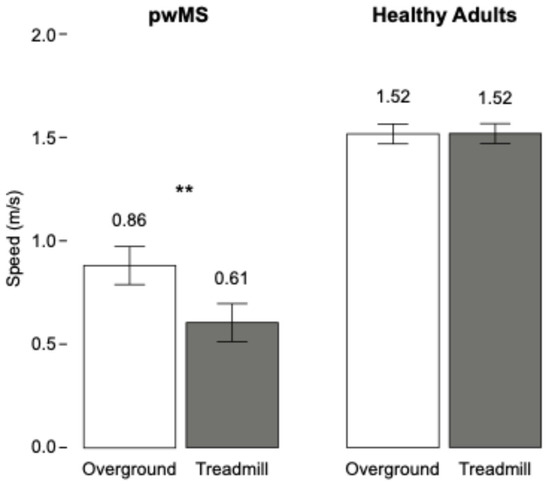
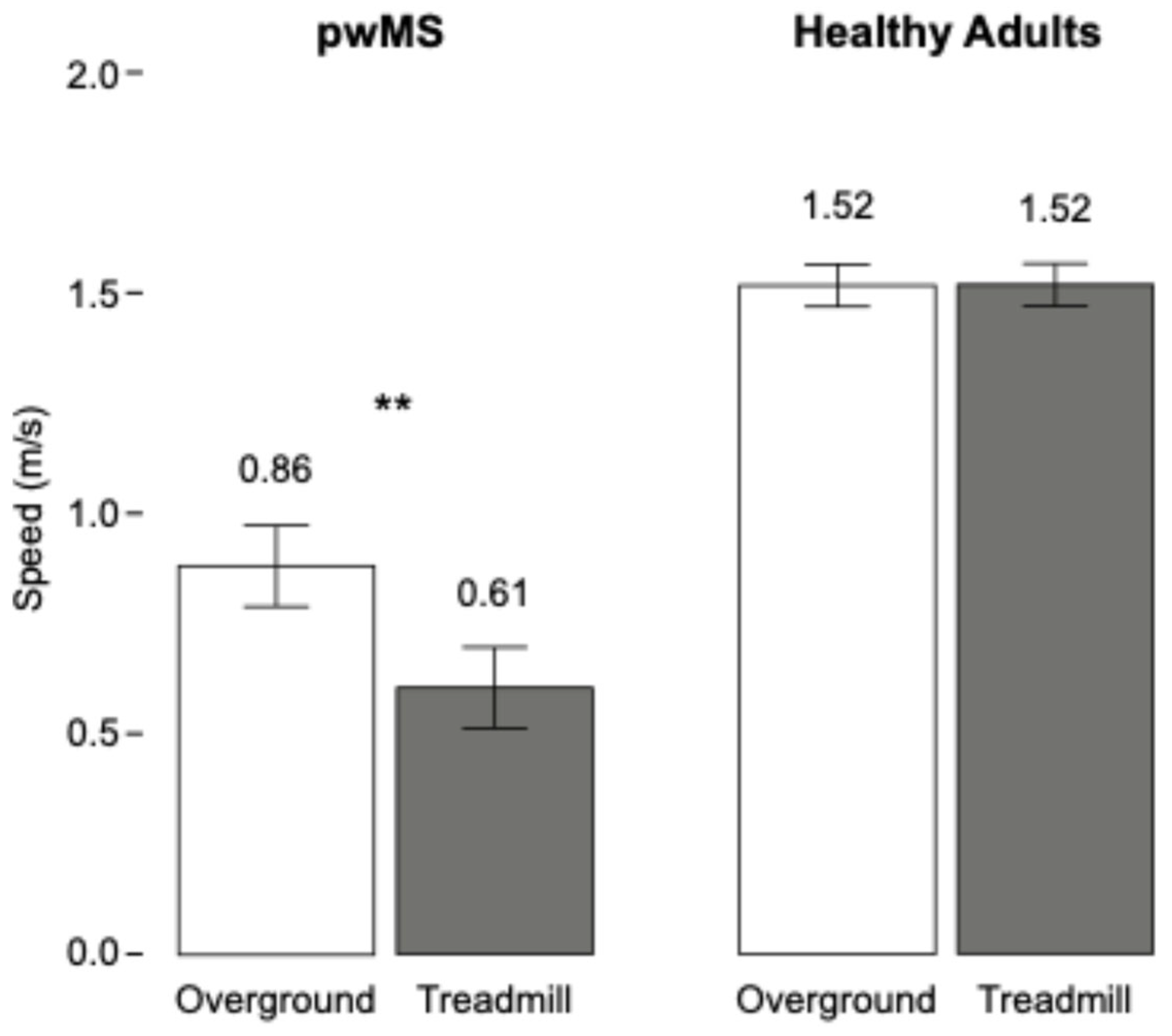
Participant characteristics are reported in Table 1. We could not collect treadmill data from 2 adults with MS. During the 2-minute overground walk, 8 pwMS walked with a cane, and 9 pwMS walked with crutches or a walker. Figure 1 shows the average speed during overground and treadmill conditions for pwMS and controls. Average speed showed a significant interaction effect, F(1, 36) = 9.78, p = 0.003, ηp2 = 0.214. For pwMS, average speed was greater in the overground condition (M = 0.88 m/s, SD = 0.44) compared to the treadmill condition (M = 0.60 m/s, SD = 0.43), p < 0.001. However, for healthy adults, average speed in the overground condition (M = 1.52 m/s, SD = 0.20) and treadmill condition (M = 1.52 m/s, SD = 0.20) was identical, p = 0.802.
Table 1.
Participant characteristics.
Figure 1.
Bar graph showing average speed during overground and treadmill conditions for persons with multiple sclerosis (pwMS) and healthy adults. Numbers on top of bars represent mean values. Error bars represent ± 1 SE. ** = p < 0.001.
4. Discussion
In this report, we compared walking speed overground and on the treadmill in a sample of pwMS and healthy controls. We assumed that the speeds between the two conditions would be similar, as we intentionally chose a comfortable overground walking pace for the treadmill. However, there was a significant difference between the speed of pwMS walking overground compared to the treadmill. This differed from healthy controls, who did not show differences between the two conditions. The healthy controls appeared to adapt to the different conditions, while pwMS did not. In this study, participants were given up to five minutes to familiarize themselves with the treadmill before data collection, but this may not have been sufficient for pwMS to adapt to the different task demands of the treadmill. It is possible that there may be less difference between the two conditions if the pwMS had more practice time on the treadmill. However, the finding might also indicate that pwMS have a reduced ability to adapt to different constraints induced by the treadmill.
The underlying factors that could explain the difference in walking between these two conditions in the sample of pwMS are diverse; disease-specific attributes, as well as constraints specific to the two walking conditions, must be considered. PwMS can present with a wide variability of CNS impairments, which all can contribute to difficulties with gait. Sensory impairment is one of the most common findings in MS [16]. Kelleher et al. [17] suggested that impaired plantar sensation in pwMS compared to non-MS controls leads to decreased push-off force and lower gait speed. Because it utilizes a moving rather than a stationary walking surface, treadmill walking requires a greater need for sensory feedback in pwMS who may have impaired plantar sensation. Similarly, lower extremity strength loss is common in MS and is considered to be a common factor in walking difficulties [18].
Disease-specific findings alone may not account for this discrepancy between walking conditions; task-specific differences must also be taken into account. Treadmill walking and overground walking are distinct tasks. Both require walking, but task constraints differ in each condition. On the treadmill, the participant must adapt to the speed of a moving surface, while in overground walking, the support surface is stationary. Each condition requires different responses from the central nervous system. Visual input is mostly unchanging on a treadmill when compared to overground. Additionally, during treadmill walking, there is no visual flow from the linear movement of the environment, while overground walking includes this information [19]. The consistent belt speed of the treadmill necessitates a similarly consistent symmetrical motor output from the person walking; however, PwMS often present with an asymmetrical gait pattern [20], where right and left legs may need to walk at different paces and with different biomechanical strategies. The novel rhythm imposed by the treadmill may force persons accustomed to walking with asymmetries to slow down to accommodate treadmill task demands.
This study resulted from an incidental finding in a previous study [13], where we used an overground 2 MW as a means of determining treadmill speed for a separate task. To our surprise, none of the pwMS were able to attain the same speed on the treadmill as was attained during the overground walk. This discrepancy led us to question whether the difference was a result of overarching differences between the walking conditions or due to the MS diagnosis. In order to answer this question, we had persons without an MS diagnosis perform the same protocol, and found no difference between the treadmill and overground conditions.
It may be that a longer familiarization period with the treadmill for the sample of pwMS may have resulted in a lesser difference between the treadmill and overground walking speed. We chose five minutes as the familiarization time, as we felt that a longer period might have contributed to an increase in fatigue, which could have impacted the previous study. However, for clinical purposes, a longer familiarization period could enhance the effectiveness of treadmill training.
An obvious limitation of this study is that there was only a single outcome measure: walking speed. This was due to the fact that the speed discrepancy between the two walking conditions was identified as an incidental finding from a previous study. Clearly, further studies utilizing more granular measurements of gait and walking kinetics and kinematics are needed to better elucidate the mechanism behind the difference between these two conditions.
Because this report reflects an unexpected finding from another study, there was no opportunity to use a preplanned analysis, and as a result, random assignment could not be used. All participants first underwent the 2-minute overground walk, followed by the walk on the treadmill. It is possible that the absence of random assignment resulted in an uncontrolled order effect that impacted our data.
The median EDSS score of the sample of pwMS was 4.93, indicating a moderate degree of disability. It may be that pwMS with less severe disability might not have had as large a discrepancy between the walking conditions. Additionally, the age of the control group, chosen from a sample of convenience, was younger than that of the MS group. Although we attempted to control for this by treating age as a covariate, it is possible that the age discrepancy may have had an impact on the different findings between the groups. A larger study examining differences across the MS-disability spectrum, with more extensive measurement of gait and walking, and with more tightly matched controls, would enable sounder conclusions regarding the appropriateness of overground and treadmill walking in the rehabilitation of pwMS.
This report should not be construed as a directive to clinicians to avoid using treadmills as a means of improving gait and walking in pwMS, as it can offer unique advantages. The imposition of symmetry afforded by walking on the treadmill may facilitate a more symmetrical gait. This may be an important consideration given the preponderance of gait asymmetry in this population [17]. Treadmill training has been shown to improve gait symmetry in other neurologic diagnoses such as stroke [21], and pwMS may reap similar benefits. The controlled conditions of the treadmill may allow participants to be less limited by anxiety, especially if a safety harness is used, as we did in this study. Treadmill walking also allows participants to walk longer distances without leaving the safety of their home or clinic. The combination of increased ease and safety may allow pwMS to walk greater distances with less supervision and therefore achieve a greater volume of walking than overground. This is critical, as increased practice volume is a critical component needed to drive positive neuroplasticity [22]. Newman and colleagues [3] stated, “treadmill training (TT) is a highly repetitive form of gait training that promotes both specific practice and use of systems concerned with walking and can provide an aerobic training stimulus.” However, Newman offered no specific reasoning for why the treadmill should be used instead of overground walking.
Previous studies have found improvements in overground walking following treadmill walking, but a comparison of the effects of treadmill vs. overground training has not been performed. However, the principles of task-dependent neuroplasticity suggest that in order to improve in overground walking, overground walking should be practiced. The criterion for walking performance in MS should be overground walking performance, not treadmill walking. For this reason, we suggest that treadmill walking might be a useful component of gait training for pwMS, but not a predominant one. One suggestion could be to compare treadmill walking speed to overground walking speed and measure the discrepancy between the two. As walking improves as a result of training, this discrepancy may decrease.
It is worth re-emphasizing that the purpose of the current data presented in this study predominantly serves to generate hypotheses for future research, rather than providing conclusive evidence to change clinical practice. Our findings, however interesting and provocative, do not come from a randomized controlled trial but can serve to ask questions, the answers to which can have meaningful impacts on clinical care for the MS population.
5. Conclusions
Although this report is based on incidental findings from another study, these findings do warrant greater investigation. The use of a treadmill to evaluate walking in pwMS may not be ideal, as the constraints of treadmill walking differ from those of overground walking. This may not be the case for persons with lower levels of disability (EDSS 0–3). Additionally, the finding does not rule out the use of a treadmill as a treatment for gait and walking dysfunction in pwMS, but its ability to generalize to overground walking must be considered.
Author Contributions
Conceptualization, H.K., E.T.C., and J.R.; methodology, H.K., E.T.C., and J.R.; formal analysis, J.R.; investigation, G.H., A.R., L.R., and R.R.; writing—original draft preparation, H.K., E.T.C., J.R., G.H., A.R., L.R., and R.R.; writing—review and editing, H.K., E.T.C., J.R., G.H., A.R., L.R., and R.R. All authors have read and agreed to the published version of the manuscript.
Funding
This research received no external funding.
Institutional Review Board Statement
The study was conducted in accordance with the Declaration of Helsinki and approved by the Institutional Review Board of Hunter College, City University of New York, IRB file 20180343.
Informed Consent Statement
Informed consent was obtained from all subjects involved in the study.
Data Availability Statement
Supporting data can be obtained upon request from the PI.
Conflicts of Interest
The authors declare no conflicts of interest.
References
- LaRocca, N.G. Impact of walking impairment in multiple sclerosis. Patient Patient-Centered Outcomes Res. 2011, 4, 189–201. [Google Scholar] [CrossRef] [Scilit]
- Socie, M.J.; Sosnoff, J.J. Gait variability and multiple sclerosis. Mult. Scler. Int. 2013, 2013, 645197. [Google Scholar] [CrossRef] [Scilit] [PubMed]
- Leone, C.; Severijns, D.; Doležalová, V.; Baert, I.; Dalgas, U.; Romberg, A.; Bethoux, F.; Gebara, B.; Medina, C.S.; Feys, P. Prevalence of walking-related motor fatigue in persons with multiple sclerosis: Decline in walking distance induced by the 6-minute walk test. Neurorehabilit. Neural Repair 2016, 30, 373–383. [Google Scholar] [CrossRef] [Scilit]
- Parvataneni, K.; Ploeg, L.; Olney, S.J.; Brouwer, B. Kinematic, kinetic and metabolic parameters of treadmill versus overground walking in healthy older adults. Clin. Biomech. 2009, 24, 95–100. [Google Scholar] [CrossRef] [Scilit]
- Gelaw, A.Y.; Janakiraman, B.; Teshome, A.; Ravichandran, H. Effectiveness of treadmill assisted gait training in stroke survivors: A systematic review and meta-analysis. Glob. Epidemiol. 2019, 1, 100012. [Google Scholar] [CrossRef] [Scilit]
- Hollman, J.H.; Watkins, M.K.; Imhoff, A.C.; Braun, C.E.; Akervik, K.A.; Ness, D.K. A comparison of variability in spatiotemporal gait parameters between treadmill and overground walking conditions. Gait Posture 2016, 43, 204–209. [Google Scholar] [CrossRef] [Scilit] [PubMed]
- Semaan, M.B.; Wallard, L.; Ruiz, V.; Gillet, C.; Leteneur, S.; Simoneau-Buessinger, E. Is treadmill walking biomechanically comparable to overground walking? A systematic review. Gait Posture 2022, 92, 249–257. [Google Scholar] [CrossRef] [Scilit]
- Brouwer, B.; Parvataneni, K.; Olney, S.J. A comparison of gait biomechanics and metabolic requirements of overground and treadmill walking in people with stroke. Clin. Biomech. 2009, 24, 729–734. [Google Scholar] [CrossRef] [Scilit]
- Bayat, R.; Barbeau, H.; Lamontagne, A. Speed and temporal-distance adaptations during treadmill and overground walking following stroke. Neurorehabilit. Neural Repair 2005, 19, 115–124. [Google Scholar] [CrossRef] [Scilit]
- Lazzarini, B.S.R.; Kataras, T.J. Treadmill walking is not equivalent to overground walking for the study of walking smoothness and rhythmicity in older adults. Gait Posture 2016, 46, 42–46. [Google Scholar] [CrossRef] [Scilit] [PubMed]
- Bello, O.; Sánchez, J.A.; Lopez-Alonso, V.; Márquez, G.; Morenilla, L.; Castro, X.; Giraldez, M.; Santos-García, D.; Fernández-del-Olmo, M. The effects of treadmill or overground walking training program on gait in Parkinson’s disease. Gait Posture 2013, 38, 590–595. [Google Scholar] [CrossRef] [Scilit]
- Gervasoni, E.; Cattaneo, D.; Jonsdottir, J. Effect of treadmill training on fatigue in multiple sclerosis: A pilot study. Int. J. Rehabil. Res. 2014, 37, 54–60. [Google Scholar] [CrossRef] [Scilit]
- Newman, M.A.; Dawes, H.; Van den Berg, M.; Wade, D.T.; Burridge, J.; Izadi, H. Can aerobic treadmill training reduce the effort of walking and fatigue in people with multiple sclerosis: A pilot study. Mult. Scler. J. 2007, 13, 113–119. [Google Scholar] [CrossRef] [Scilit]
- Kalron, A.; Dvir, Z.; Frid, L.; Achiron, A. Quantifying gait impairment using an instrumented treadmill in people with multiple sclerosis. Int. Sch. Res. Not. 2013, 2013, 867575. [Google Scholar] [CrossRef] [Scilit]
- Karpatkin, H.; Rachwani, J.; Rhodes, R.; Rodriguez, L.; Rodriguez, R.; Rubeo, A.; Cohen, E. The effect of intermittent vs. continuous walking on distance to fatigue in persons with multiple sclerosis. Disabil. Rehabil. 2022, 44, 8429–8435. [Google Scholar] [CrossRef] [Scilit]
- Uszynski, M.; Purtill, H.; Coote, S. Interrater reliability of four sensory measures in people with multiple sclerosis. Int. J. MS Care 2016, 18, 86–95. [Google Scholar] [CrossRef] [Scilit]
- Kelleher, K.J.; Spence, W.D.; Solomonidis, S.E.; Apatsidis, D.P. The effect of impaired plantar sensation on gait in people with multiple sclerosis. Int. J. MS Care 2009, 11, 25–31. [Google Scholar] [CrossRef] [Scilit]
- Ramari, C.; Hvid, L.G.; de David, A.C.; Dalgas, U. The importance of lower-extremity muscle strength for lower-limb functional capacity in multiple sclerosis: Systematic review. Ann. Phys. Rehabil. Med. 2020, 63, 123–137. [Google Scholar] [CrossRef] [Scilit]
- Hirjaková, Z.; Bizovska, L.; Bzdúšková, D.; Hlavačka, F.; Janura, M. Postural stability after treadmill and overground walking in young and elderly. Gait Posture 2020, 80, 84–89. [Google Scholar] [CrossRef] [Scilit] [PubMed]
- Plotnik, M.; Wagner, J.M.; Adusumilli, G.; Gottlieb, A.; Naismith, R.T. Gait asymmetry, and bilateral coordination of gait during a six-minute walk test in persons with multiple sclerosis. Sci. Rep. 2020, 10, 12382. [Google Scholar] [CrossRef] [Scilit] [PubMed]
- Combs, S.A.; Dugan, E.L.; Ozimek, E.N.; Curtis, A.B. Bilateral coordination and gait symmetry after body-weight supported treadmill training for persons with chronic stroke. Clin. Biomech. 2013, 28, 448–453. [Google Scholar] [CrossRef] [Scilit] [PubMed]
- Kleim, J.A.; Jones, T.A. Principles of experience-dependent neural plasticity: Implications for rehabilitation after brain damage. J. Speech Lang. Hear. Res. 2008, 51, S225–S239. [Google Scholar] [CrossRef] [Scilit] [PubMed]

Disclaimer/Publisher’s Note: The statements, opinions and data contained in all publications are solely those of the individual author(s) and contributor(s) and not of MDPI and/or the editor(s). MDPI and/or the editor(s) disclaim responsibility for any injury to people or property resulting from any ideas, methods, instructions or products referred to in the content. |
© 2026 by the authors. Licensee MDPI, Basel, Switzerland. This article is an open access article distributed under the terms and conditions of the Creative Commons Attribution (CC BY) license.