Systematic Review

Extrapyramidal Movement Disorders in Multiple Sclerosis Patients: A Systematic Review

by
Mai M. Anwar
1,2,
Rosie Heartshorne
3 and
Sundus H. Alusi
3,*
1
Department of Psychology, School of Life and Medical Sciences, University of Hertfordshire Hosted by Global Academic Foundation, R5 New Garden City, New Administrative Capital, Cairo 11835, Egypt
2
Department of Biochemistry, National Organization for Drug Control and Research (NODCAR)/Egyptian Drug Authority (EDA), Giza 12553, Egypt
3
The Walton Centre NHS Foundation Trust, Liverpool L9 7LJ, UK
*
Author to whom correspondence should be addressed.
Sclerosis 2025, 3(4), 42; https://doi.org/10.3390/sclerosis3040042
Submission received: 1 November 2025 / Revised: 24 November 2025 / Accepted: 10 December 2025 / Published: 16 December 2025

Abstract

Background: Although multiple sclerosis (MS)-associated tremor and ataxia are well described in the neurological literature, other extrapyramidal movement disorders (MDs), including Holmes tremor, dystonia, chorea, myoclonus, parkinsonism, and restless legs syndrome, have received far less attention and are generally regarded as rare manifestations of MS. Rationale: Although MS is traditionally considered a white matter disease, increasing evidence has demonstrated clinically relevant grey matter involvement, particularly within the basal ganglia, thalamus, and cerebellar–brainstem pathways. Understanding extrapyramidal MDs in MS may therefore provide important insights into the functional networks disrupted by demyelination and inflammation. Aim: This review aims to highlight the available literature on extrapyramidal MDs in MS, outlining their clinical presentations, lesion correlates, and proposed mechanisms. We examined reported cases, reviews, and findings in the literature explaining these disorders and their occurrence in association with acute relapses, as well as their development during the progressive phase of MS. Conclusions: By integrating clinical and pathophysiological evidence, this review highlights how rare extrapyramidal MDs may reflect underlying grey matter pathology and network-level disruption, with potential implications for diagnosis, monitoring, and treatment.

1. Introduction

Multiple sclerosis (MS) is a chronic, immune-mediated disorder characterized by the loss of oligodendrocytes in the central nervous system (CNS), resulting in demyelination [1,2,3]. This disease clinically manifests as relapsing–remitting disease (RRMS), with the development of subacute neurological deficits secondary to CNS inflammatory lesions. Demyelination is secondary to a complex array of aberrant immune-mediated processes, largely comprising T- and B-lymphocyte autoreactivity against antigens exclusively expressed in the CNS [1,2]. In addition to these adaptive immune mechanisms, microglial activation, axonal degeneration, and astrocytic gliosis also contribute to disease progression [1,2,4,5]. MS also affects grey matter and juxtacortical regions, and the extent of grey matter involvement correlates with cognitive dysfunction in the later stages of disease [6,7].
In recent years, increasing attention has been given to grey matter pathology in MS, particularly within deep nuclei such as the basal ganglia, thalamus, and cerebellar–brainstem pathways [8,9]. These regions play key roles in motor control, and their involvement has broadened our understanding of MS beyond white matter disorders [10]. Recent neuroimaging techniques, including high-resolution MRI, diffusion tensor imaging, and functional connectivity analyses, have demonstrated that MS affects distributed motor networks rather than isolated anatomical regions [11,12,13]. This perspective provides an optional rationale to re-examine movement disorders in MS through a lens of network neuroscience, along with grey matter pathology.
Movement disorders can be defined as clinical syndromes in which there is either an excess of movements (hyperkinesia) or a paucity of voluntary and automatic movements unrelated to weakness or spasticity of muscles (hypokinesia) [14]. Ataxia can be defined as the incoordination of voluntary movements and has been considered a movement disorder in a broad sense. Indeed, movement disorders have been classified in some studies into hyperkinetic disorders, hypokinetic disorders, and ataxia [14,15]. With the exception of ataxia, movement disorders are largely extrapyramidal disorders associated with dysfunction of the basal ganglia and its connections with the thalamus and midbrain [16,17]. The development of these extrapyramidal movement disorders is rare in MS despite MS lesions frequently involving the basal ganglia [16,17]. Nociti et al. reported that movement disorders were present in only 12 of 733 patients with MS, among whom 3 patients had parkinsonism, 2 patients had blepharospasm, 5 patients had hemifacial spasm, 1 patient had hemidystonia, and 1 patient had tourettism [12]. These authors concluded that these MDs were usually secondary to an area of demyelination. However, the absence of a corresponding demyelinating lesion does not exclude a causal link between MS and MD, as there may be some network disruption that is not detectable on conventional imaging [18]. The idea of network dysfunction is increasingly recognized in MS. Damage affecting nodes or connections within motor circuits may alter basal ganglia–thalamocortical or cerebellar pathways and thereby lead to extrapyramidal movement disorders [8,19]. This may help explain why MDs occasionally arise without a clear structural correlate on routine imaging, highlighting the limitations of conventional MRI in capturing complex network-level changes.
The development of an evolving, subacute movement disorder may prompt clinicians to investigate alternative diagnoses or additional pathologies. However, it is important to be aware of MD as an initial presentation of MS or as a feature of relapse in patients with established MS. There have been several review articles summarizing the prevalence of movement disorders in MS [18,20,21,22,23,24,25]. However, estimates vary widely depending on how the MDs are defined. For example, a study reporting a prevalence “as high as 80%” [20] used a broad case definition that included tonic spasms, clonus, pseudoathetosis, and other paroxysmal spinal phenomena rather than focusing on extrapyramidal syndromes. In that cohort, only one patient exhibited a movement disorder attributed to basal ganglia pathology, whereas the remainder were associated with spinal lesions [20]. This therefore reflects the prevalence of all MS-related motor phenomena, not extrapyramidal MDs specifically. Other main reviews have included additional syndromes, such as tonic spasms, pseudoathetosis, fasciculations, clonus, spinal segmental, propriospinal myoclonus, and restless legs syndrome [20,21,24,25]. Cerebellar tremor and ataxia, although often listed under movement disorders [23,26], represent cerebellar rather than extrapyramidal dysfunction. In contrast, true extrapyramidal MDs such as dystonia, chorea, parkinsonism, myoclonus, and Holmes tremor remain rare in MS patients, even in cohorts with frequent basal ganglia involvement on MRI. RLS will also be included because of its association with abnormalities in the dopaminergic system, but its neuropathology is not clear.
By focusing on extrapyramidal MDs, this review aims to address an important gap in the literature. These syndromes, although rare, may offer valuable clinical insights into grey matter involvement, MDs arising from basal ganglia–thalamocortical and/or related dopaminergic network relapse mechanisms, and progression patterns in MS. Improved recognition and understanding of these disorders may therefore refine diagnostic assessment, support earlier diagnosis of atypical presentations, and highlight the need for advanced imaging and mechanistic studies in this underexplored area.

2. Methods

Our narrative review was conducted following PRISMA 2020 principles for transparent findings (registration link https://osf.io/n7je3/overview, accessed on 17 October 2025). Searches were performed in PubMed, Scopus, and Web of Science from January 1975 to November 2025. The search strategy followed MeSH terms and keywords related to multiple sclerosis and movement disorders, including “multiple sclerosis”, “movement disorder”, “tremor”, “Holmes tremor”, “dystonia”, “chorea”, “choreoathetosis”, “myoclonus”, “parkinsonism”, and “restless legs syndrome”.

2.1. Eligibility Criteria

The search included peer-reviewed case reports, case series, observational studies, imaging studies, and clinical reviews that described extrapyramidal or mixed movement disorders occurring in patients with multiple sclerosis. Only English-language articles were considered.

2.2. The Exclusion Criteria Were as Follows

  • non-MS demyelinating disorders unless used for differential diagnosis,
  • studies without extractable clinical or neuroimaging data,
  • conference abstracts lacking full text and findings,
  • and animal studies and preclinical studies.

2.3. Study Selection and Data Extraction

All the authors screened the titles and abstracts of all the retrieved records. The full texts were examined for relevance and eligibility. The extracted variables included the movement-disorder phenotype, cases related to MS disease activity, lesion location, treatments attempted, and clinical outcomes. Given that the available evidence was predominantly case-level, the data were highlighted narratively without quantitative findings.

3. Results of the Search

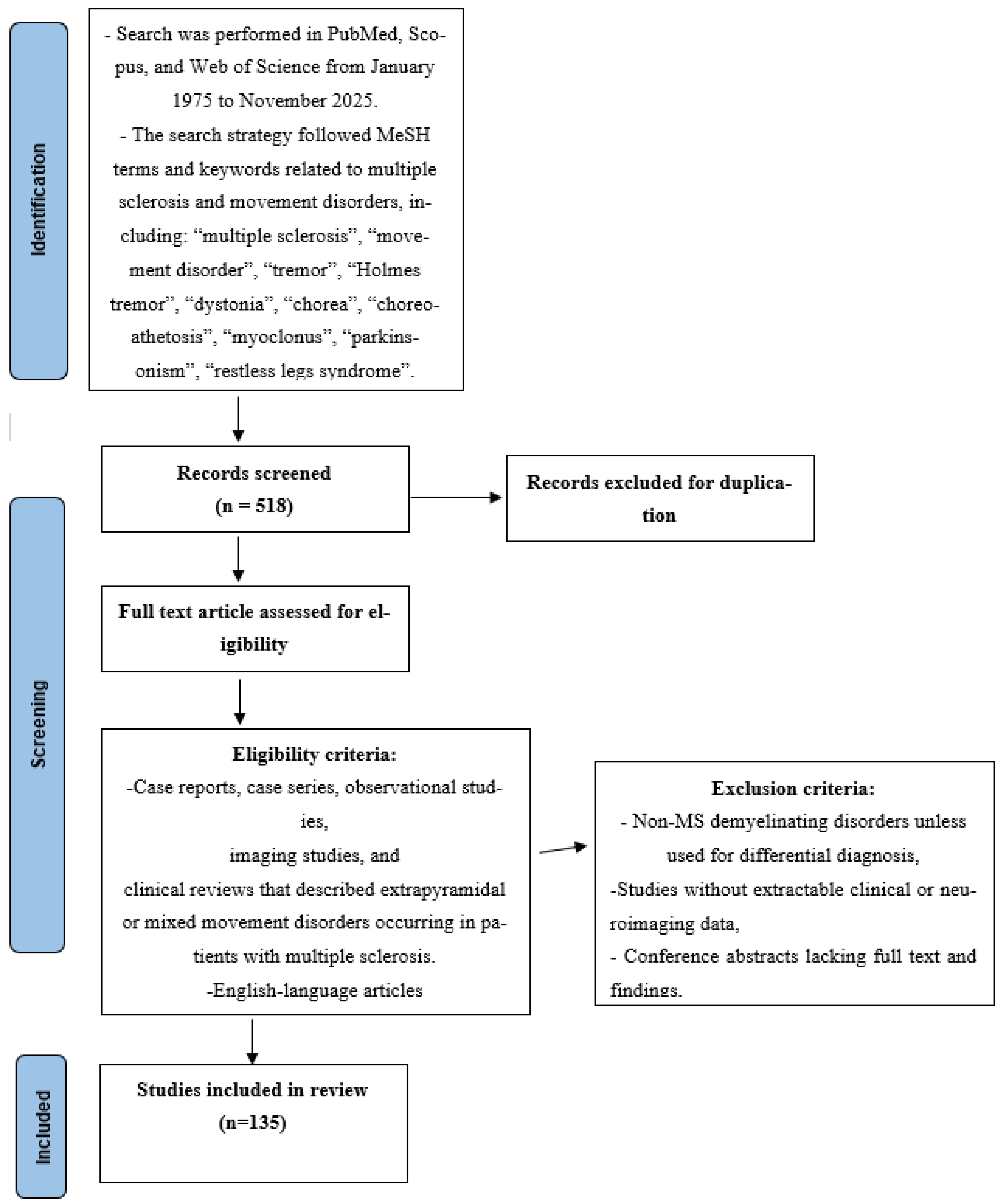
The search identified 606 records. After 88 duplicates were removed, 518 articles underwent title and abstract screening. A total of 383 full-text articles were reviewed, 135 of which met the inclusion criteria and were included in the narrated review. The designed PRISMA 2020 flow diagram summarizing the study selection and search methods is presented in Figure 1.

3.1. Holmes’ Tremor

Holmes tremor (HT) is a rare extrapyramidal syndrome in MS. Its precise prevalence is unknown, but only isolated case reports exist or have previously been reported. Clinically, HT presents with a combination of rest, postural, and intention tremors [27,28]. Lesions typically involve the brainstem, thalamus, cerebellum, or basal ganglia. HT reflects disruption of both the nigrostriatal dopaminergic system and cerebellothalamic pathways [29,30,31]. Treatment responses are variable, with occasional levodopa benefits reported [32,33], as illustrated and summarized in Table 1 and Table 2.
Tremor is common in MS and has been previously well described [15,26,34]. It is known to be associated with cerebellar or brainstem lesions and their connections. It is characterized clinically by an action tremor [15]. Tremor is often embedded in an ataxic syndrome and hence can be largely considered an ataxic tremor [15]. However, Holmes’ tremor (HT) is a specific clinical entity characterized by the presence of rest and action tremors and is associated with other MDs. HTs are rarely reported in MS [15].
HT is a slow-frequency (<4.5 Hz) irregular tremor that is present at rest and increases in amplitude in posture and in goal-directed movements [35]. It is usually, but not always, unilateral and associated with dystonic posture of the affected limb as well as brain stem and cerebellar signs [36,37]. Two types of Holmes tremors have been recently described, depending on the associated clinical features: those of midbrain origin and those of thalamic origin [38].
Alqwaifly et al. reported a 31-year-old man with a diagnosis of RRMS who developed right upper and lower limb hyperkinetic movements in addition to irregular rhythmic slow frequency tremors (~3 Hz) present at rest, during posture, and kinetic movements [25]. Additionally, Potulska-Chromick et al. reported a 37-year-old woman with a five-year history of MS who presented with multiple tremor types, including resting tremors and hand disability [26]. Brain MRI revealed lesions in the cerebellum, pons, thalamus, bilateral pallidum, and substantia nigra. Another study reported a 50-year-old woman with secondary progressive MS (SPMS) who developed resting and kinetic tremors [12]. Brain MR images revealed several supra- and infratentorial lesions along with the involvement of the thalamus and basal ganglia. Alqwaifly et al. also reported a patient with MS with the classical features of HT associated with lesions in the pons and midbrain [25]. Such cases and others demonstrate occasional involvement of the basal ganglia, dentate-thalamic, and nigrostriatal tracts, resulting in both action and resting tremors [39,40,41].

3.2. Dystonia

Dystonia in MS is uncommon, with a prevalence based mostly on case reports and study reports. It may present as focal, segmental, hemidystonic, or paroxysmal dystonia [42,43]. Lesions typically involve the basal ganglia, thalamus, cerebellum, or brainstem [42,43]. However, dystonia reflects a loss of inhibitory control within basal ganglia–cerebellar networks. Treatment ranges from symptomatic therapy, such as benzodiazepines and antiepileptics, to corticosteroids in relapse-associated cases [44,45,46].
Dystonia is characterized by sustained or intermittent muscle contractions that cause abnormal, often repetitive, movements, postures, or both. Dystonic movements are typically patterned and twisting and may be tremulous. Dystonia is often initiated or worsened by voluntary action and is associated with overflow muscle activation [47]. Various dystonic subtypes have been reported to be associated with MS, including blepharospasm, cervical dystonia, writer’s cramp, and hemidystonia, although the pathogenic connection is unclear [48,49,50,51]. Goldman reported a patient with left-sided hemidystonia associated with demyelinating plaques in the left posterolateral spine [34]. Nociti et al. also reported a 23-year-old woman who experienced persistent dystonic posturing of the right limbs [12]. This was a background of known RRMS with extensive supra- and infra-tentorial and cervical lesions along with diffuse cerebellar, brainstem, and brain atrophy. Additionally, [52] Potulska-Chormick described a 33-year-old man with two relapses of cervical dystonia with an MRI scan demonstrating demyelinating lesions in the cerebellum, left thalamus, and periventricular area [26]. He was diagnosed with MS according to McDonald’s criteria as having RRMS along with severe cervical dystonia, as illustrated and summarized in Table 1 and Table 2.
Paroxysmal movement disorders are rare neurological diseases that typically manifest with intermittent attacks of abnormal involuntary movements with a well-defined onset and termination of each episode [53,54]. Paroxysmal dystonia is one such disorder that is associated with certain genetic disorders, but has also been reported in patients with multiple sclerosis. Indeed, it has been reported in the context of a relapse or presenting feature [55]. In contrast to HT, a consistent temporal relationship with MS relapses has been described, and several cases reported clinical improvement with high-dose corticosteroids when new demyelinating lesions were identified [44,45,46]. However, all such evidence is case-level, and no systematic studies confirm this effect. Symptomatic agents such as carbamazepine, clonazepam, or other antiepileptics also show benefits in case reports, but again without controlled trials.

3.3. Chorea

Chorea is very rare in MS and usually occurs in the context of acute relapse [56,57]. Reported lesions include those of the contralateral subthalamic nucleus, caudate, putamen, pallidum, and thalamus. Mechanisms involve disruption of inhibitory basal ganglia circuits [56,57]. Symptomatic therapy is typical, but relapse-related cases may improve with corticosteroids [57,58,59,60]. Chorea is characterized by irregular, purposeless, arrhythmic, nonstereotyped involuntary movements that flow from one body part to another [61], as illustrated and summarized in Table 1 and Table 2.
Chorea has been reported to be associated with demyelination lesions in different brain regions, including the contralateral subthalamus, striatum, pallidum, thalamus, and other regions of the basal ganglia [62,63,64]. Potulska-Chromick reported a 45-year-old man with chorea and cognitive dysfunction with a family history of MS in his brother. After the appropriate exclusion of other causes of chorea, the authors concluded that the observed chorea was secondary to widespread demyelinating lesions in the periventricular region, frontal and parietal lobes, and left cerebellar hemisphere [26]. Giovannini et al. reported two patients who presented with acute chorea, choreoathetosis, and dystonia in association with large demyelinating lesions in the contralateral subthalamic nucleus [42].

3.4. Myoclonus

Myoclonus is uncommon in MS patients and, when present, can arise from the cortex, subcortical structures, brainstem, or spinal cord [65,66]. Lesion sites vary widely, including the dentato-rubro-olivary pathway in oculopalatal tremor, depending on subtype, ranging from cortical hyperexcitability to deafferentation [65,66]. Treatment may include clonazepam, antiepileptics, or relapse therapy, depending on the mechanism [67,68], as illustrated and summarized in Table 1 and Table 2.
Myoclonus is characterized by sudden, brief, involuntary movement secondary to abrupt muscular contraction (positive myoclonus) or relaxation (negative myoclonus) [66]. Classification is most commonly performed according to the presumed site of generation: cortical, subcortical (segmental/palatal and nonsegmental), and spinal (either segmental or propriospinal) [66]. Oculopalatal tremor (OPT) is a form of subcortical myoclonus referred to as low-frequency oscillations of the eyes and palate that occur secondary to interruption in the network of the dentato-rubro-olivary tract (Guillain-Mollaret triangle) and the resulting hypertrophic olivary degeneration (HON) secondary to deafferentation. There have been several case reports of OPT in patients with MS [20,69,70,71,72]. However, on close reading, only two patients had a confirmed diagnosis of MS with demyelination within Mollaret’s triangle, the most likely cause of presentation [69,70]. One patient was a 16-year-old male who presented with a subacute onset of oscillopsia [70]. The examination findings consisted of vertical pendular nystagmus, bilateral internuclear ophthalmoplegia (INO), and palatal myoclonus. Imaging revealed contrast-enhancing lesions in the pons, bilateral superior cerebellar peduncles, and inferior olivary nuclei. The signs and symptoms had completely resolved at four months, with a persisting nonenhancing lesion. The second patient was a 33-year-old female who was found to have palatal myoclonus and pendular nystagmus associated with a contrast-enhancing lesion in the pons [69]. Acquired pendular nystagmus is far more likely to occur in MS than in OPT, and there are important differences in the presentation of nystagmus that can help differentiate MS from OPT [73]. Nevertheless, these two cases highlight the occurrence of OPT secondary to MS. Without close examination of the palate in patients with pendular nystagmus, this may be missed. Differentiation is important, as treatment options may differ [73]. Moreover, the occurrence of Oculopalatal tremors may not necessarily indicate a recent relapse, considering the time delay needed for the development of HON. However, it is noteworthy that both of these cases were linked to contrast-enhancing lesions, implying a potentially accelerated process of HON secondary to demyelination compared with other causes [74].
Other forms of subcortical and cortical myoclonus associated with MS are even less frequently reported than OPT. Smith et al. reported a single case of a 48-year-old female with established MS and extensive stimulus-sensitive myoclonus of the face and all four limbs with associated hyperekplexia [75]. Improvement was observed with the introduction of clonazepam. Imaging demonstrated widespread periventricular lesions, with no apparent brainstem demyelination. The authors concluded that this was most compatible with reticular myoclonus owing to its widespread distribution, although EEG-EMG with back averaging was not performed for confirmation.
Both segmental and propriospinal spinal myoclonus have also been described in patients with MS [76]. In the latter case, a woman previously diagnosed with clinical relapse developed jerking movements of the arm, right shoulder, and right leg. These movements were at times preceded by a tingling sensation of the neck, and the movements could not be suppressed voluntarily. Electrophysiological studies confirmed that the myoclonus originated from the cervical segments, and the MR image demonstrated a corresponding demyelinating lesion. The myoclonic jerks of this patient sometimes spread to other spinal segments, and these more widespread jerks were associated with neurophysiological features of propriospinal myoclonus [76]. Finally, an observational study of 60 patients with MS reported one case of cortical myoclonus, two cases of subcortical myoclonus, and seven cases of mixed brainstem/spinal myoclonus in their cohort [16]. However, no clinical details of their presentation or corresponding data are available, and no patients underwent electrophysiology. Indeed, the case of cortical myoclonus was presumed to be due to the absence of demyelinating lesions in the brainstem and spinal cord.

3.5. Parkinsonism

Parkinsonism is uncommon and often found incidentally in multiple sclerosis; however, cases have been related to demyelinating lesions affecting the nigrostriatal pathway, basal ganglia, or midbrain [77,78]. Distinguishing MS-related parkinsonism from idiopathic PD requires the assessment of levodopa responsiveness, DAT imaging, and correlations with new lesions [79]. Treatment responses vary; corticosteroids may help in relapse-induced cases [80,81], as illustrated and summarized in Table 1 and Table 2.
Parkinsonism is thought to be rare in multiple sclerosis patients. While there are reports of cases of parkinsonism associated with MS [82,83], the majority of cases of parkinsonism are thought to be a result of coincidental idiopathic Parkinson’s disease [77,78]. Two MS patients with parkinsonism were previously reported by Barun et al., and highlighted the possible correlation between them by suggesting that MS demyelinating lesions may affect dopaminergic pathways, resulting in parkinsonism [84]. These findings were supported by a number of cases reporting the coexistence of these two diseases in addition to the presence of MS lesions in the nucleus ruber, globus pallidus, and nigrostriatal pathway, and associated with the remarkable improvement of parkinsonian features with corticosteroids [83,85,86]. Unfortunately, no head MRI was performed at the time of presentation, so we do not know if there was an associated new lesion to correlate with the observed clinical findings [83]. Moreover, in their 5-year prospective study of patients with MS, identified parkinsonism in 3.6% of patients, 75% of whom were thought to be unrelated to MS. However, one patient with primary progressive MS and parkinsonism had a normal DAT scan and exhibited stabilization of parkinsonism with ocrelizumab.
Differentiating a neurodegenerative cause of parkinsonism from one secondary to demyelination can be difficult on the basis of imaging alone. Therefore, responsiveness to levodopa and immunotherapy is suggested to be helpful in differentiating demyelination-related parkinsonism in MS [85,86]. MS plaques reportedly have the potential to generate basal ganglia lesions. This occurrence may be induced by an inflammatory cascade, ultimately leading to dysfunctions in the extrapyramidal pathway and resulting in parkinsonism.

3.6. Restless Leg Syndrome

RLS is more common in MS patients than in the general population, with prevalence estimates of up to 57%. Lesions of the cervical cord, brainstem, and subcortical motor regions have been reported [87,88]. Mechanisms may involve spinal hyperexcitability, dopaminergic dysfunction, iron deficiency, or network disconnection [89]. Dopaminergic therapies, iron supplementation, and physical activity may be beneficial [89,90], as illustrated and summarized in Table 1 and Table 2.
Restless leg syndrome (RLS) is characterized by irresistible discomfort in the legs that worsens with rest and at night [91]. Patients with MS are more likely to have RLS than the general population. Lebrato Hernández reported that the estimated prevalence of RLS in patients with MS ranges from 12.1% to 57.5% and is more prevalent in women than in men [59]. Other studies [92,93,94,95,96] reported that RLS in MS may be associated with cervical lesions [60,61,62,63,64,65]. Fröhlich et al. studied a cohort of patients with MS with and without RLS [66]. The authors reported an association between RLS in MS patients and a cluster of lesions in the subcortex region close to the left gyrus precentralis. Irkec et al. reported a 44-year-old man who suffered from a sudden onset of lower extremity paresthesia and a great urge to move his legs during rest due to an unpleasant sensation, especially at night [67].
The patient’s brain MR images revealed demyelinating plaques among the supraventricular, periventricular, pons, and middle cerebellar peduncles, along with the observed lesions in the thoracic cord. This may suggest that the pathophysiological mechanism of RLS in MS may be related to demyelination [97,98].
Table 1. Summary of extrapyramidal movement disorders in patients with multiple sclerosis.
DisorderPrevalenceClinical FeaturesProposed MechanismsReferences
Holmes’ TremorVery rare; case studiesRest + postural + intention tremor (<4.5 Hz), often unilateralCombined cerebellothalamic + nigrostriatal disruption[25,26,35,36,37,38]
DystoniaRare; focal/segmental/par-oxysmalSustained contractions, abnormal postures, and pain in paroxysmal formsLoss of inhibition; basal ganglia–cerebellar network dysfunction[44,45,46,47,48,49,50,51,52]
ChoreaVery rareIrregular, flowing involuntary movementsDisinhibition of basal ganglia pathways[56,57,58,59,60,61,62,63,64]
MyoclonusRare; oculopalatal tremor (OPT) is the most reportedSudden jerks; OPT = ocular + palatal oscillationCortical hyperexcitability; spinal disinhibition[65,66,67,68,69,70,71,72,73,74]
ParkinsonismUncommon; often coincidentalBradykinesia, rigidity, tremorDemyelination of dopaminergic circuits vs. coexistent Parkinson’s disease[78,79,80,81,82,83,84,85,86,87,88,89]
Restless Legs Syndrome (RLS)Common in MS (12–57%)Urge to move legs, worse at nightDopaminergic dysfunction, iron deficiency, and spinal hyperexcitability[92,93,94,95,96,97,98,99,100,101,102]
Table 2. Extrapyramidal movement disorders in MS: lesions and treatment responses.
Movement DisorderLesion Site(s) ReportedLatency From Lesion to OnsetTreatments TriedEvidence LevelReported ResponseReferences
Holmes’ TremorMidbrain, red nucleus, thalamus, cerebellar outflow tractsWeeks-months (subacute chronic)Levodopa, clonazepam, DBS, steroidsCase reports onlyTreatment responses are variable, with occasional levodopa benefit reported[29,30,31,32,33]
DystoniaInternal capsule, basal ganglia, mesencephalon, periventricular white matterAcute–subacute, often during relapseSteroids, carbamazepine, clonazepamCase reportsTreatment ranges from symptomatic therapy, such as benzodiazepines and antiepileptics, to corticosteroids in relapse-associated cases[42,43,44,45,46]
ChoreaThalamus, subthalamic nucleus, postthalamic pathwaysAcute or relapse-relatedVMAT2 inhibitors, dopamine blockers, steroidsCase reportsSymptomatic therapy is typical, while relapse-related cases may improve with corticosteroids[56,57,58,59,60,61]
Myoclonuscortex, subcortical structures, the brainstem, or the spinal cordVariableClonazepam, levetiracetam, valproateCase reportsTreatment may include clonazepam, antiepileptics, or relapse therapy, depending on the mechanism[65,66,67,68]
Parkinsonismnigrostriatal pathway, basal ganglia, or midbrainAcute with relapse or chronicSteroids, levodopaCase reportsTreatment responses vary; corticosteroids may help in relapse-induced cases[78,79,80,81,82,83]
Restless Legs Syndrome (RLS)Cervical cord, brainstem, and subcortical motor regionsChronicDopaminergic meds, α-2-δ ligands, iron, exerciseObservational studies; one small RCT (exercise)Dopaminergic therapies, iron supplementation, and physical activity may be beneficial[90,91,92,93]

4. Discussion

Extrapyramidal MDs associated with MS are rare but well-documented. They are broadly divided into those associated with an acute relapse, such as chorea, choreoathetosis, and dystonia, in particular paroxysmal dystonia. The other group includes chronic MDs, for which it is difficult to know if they are coincidental or represent an association with a secondary degenerative process. While identifying a new demyelinating lesion in the expected region can lead to the identification of a pathological structural link, the absence of a lesion on standard imaging does not exclude causality. This is particularly the case in view of the limitations of the currently available imaging techniques. Furthermore, connectivity studies have established that certain MDs result from interruptions to a more extensive neural network.
Growing evidence suggests that extrapyramidal manifestations in MS may reflect complex interactions between inflammatory demyelination, impaired network connectivity, and evolving neurodegeneration [99,100,101]. Structural lesions in key regions, including the thalamus, basal ganglia, cerebellum, red nucleus, and brainstem, may interfere with long-range communication within cortico–striato–thalamo–cerebellar pathways, which are essential for regulating movement precision and suppressing involuntary motor output [102,103,104]. This network-level vulnerability provides a coherent physiological framework through which diverse case presentations can be interpreted.
The pathophysiology of Holmes tremor (HT) is intricate and potentially arises from various abnormalities in the nigrostriatal system and from dento-rubro-olivary connections [105]. The anatomical substrate of HT has been mapped to a circuit with nodes in the red nucleus, pallidus, thalamus, and cerebellum [106]. These represent both grey and white matter fibres. Demyelinating lesions involving any of these areas can potentially disrupt normal neural circuits and result in the development of Holmes’ tremor. Thus, as these regions contribute to two converging motor pathways, the cerebello-thalamic system and the dopaminergic nigrostriatal system, HT in MS patients is best interpreted as a network-level disorder rather than a single focal lesion. Theoretically, this may suggest that it would be amenable to treatment with corticosteroids. However, the only reported successful treatment for HT in MS patients is levodopa, which is used to treat symptoms rather than the underlying disease process [106]. This is in keeping with the fact that the development of tremors generally reflects a degenerative process. Tremor in MS has been shown to develop years after disease onset [23] and commonly occurs in the progressive phase of the disease [23], indicating that the pathophysiology of tremor is likely linked to a degenerative process in the cerebellum and its connections. The latter applies to postural and ataxic tremors [107]. However, this is not the case with tremors with a prominent rest component, such as Holmes tremor, whereby pathophysiology involves two circuits involving the cerebellar outflow tracts and the basal ganglia connections. Holmes tremors of midbrain or thalamic origin, such as a bleed or vascular infarct, have been demonstrated to manifest in the subacute–chronic phase after an insult or injury. It is therefore reasonable to consider that the use of steroids for treating Holmes’ tremor in MS patients is unlikely to be helpful once the tremor is established; other treatment modalities, such as levodopa or invasive surgical therapies, may need to be considered. These treatment patterns suggest that symptomatic therapies may be more effective than immunotherapy when network degeneration predominates, as in HT, which involves dopaminergic pathways.
The pathophysiology of dystonia is also complex. It is hypothesized to develop due to loss of inhibition in genetically susceptible individuals [108]. Studies also suggest that dystonia is likely to result from the interruption of both the cerebellar and the basal ganglia networks [109]. Resting-state functional MRI studies have demonstrated altered functional connectivity in multiple brain regions, including the basal ganglia, cerebellum, and sensory, motor, and visual areas [110]. In other words, interruption of any of these nodes by demyelination may result in dystonia, especially in genetically susceptible individuals [110]. Paroxysmal dystonia is a heterogeneous group of disorders that are characterized by a wide range of genetic and acquired conditions. The various genetic abnormalities associated with paroxysmal dystonia implicate several brain regions in its pathophysiology, mainly the brainstem and the cerebellum [53,54]. It can be a presenting feature in MS patients [111]. Unlike genetic forms, attacks are usually painful and have been reported to occur in association with lesions in the internal capsule, basal ganglia, mesencephalon, or posterior periventricular white matter [112]. It can be differentiated from the tonic spasms of MS by the associated pain in paroxysmal dystonia [53,54]. In a broad sense, MS paroxysmal attacks are thought to result from transverse activation of axons within partially demyelinated fibres [113]. Although symptomatic treatment with clonazepam or antiepileptics is useful, steroids have also been demonstrated to be effective, especially if new lesions are demonstrated by imaging [114]. The strong temporal association between paroxysmal dystonia and MS relapse, together with consistent steroid responsiveness, supports an inflammatory mechanism superimposed on network susceptibility. Demyelination in nodes of the basal ganglia–cerebellar loop may lower inhibitory thresholds, allowing inflammatory activity to precipitate dystonic attacks in predisposed individuals.
Chorea has been reported to be associated with thalamic and subthalamic etiologies such as ischemia, metabolic disturbances, infections, and autoimmune and paraneoplastic as well as acute lesions during thalamic surgery. Chorea-pseudoatheosis is described with postthalamic lesions [115], and choreoathetosis has also been commonly described with lesions or hypoactivity of the subthalamic nuclei. In MS patients, demyelination of the thalamus is common and can be observed relatively early; however, thalamus-related MDs, particularly chorea, are rare. This may be because the development of chorea requires the lesion to be in a specific area to disrupt the neural circuit, resulting in chorea development. This selective vulnerability indicates that chorea in MS arises only when demyelination affects a critical inhibitory node, most often the subthalamic nucleus or its efferent pathways, highlighting the specificity of network disruption required to produce the phenotype [64,116]. This rarity of chorea in MS necessitates investigations to look for other aetiologies, such as those mentioned above, depending on its laterality and associated features [115].
The pathophysiology of myoclonus is complex and depends on the clinical type. Various types of myoclonus, including action and propriospinal myoclonus, have been observed in individuals with MS [48,55,56]. The most clear-cut association is that of OPT associated with a demyelinating lesion in the inferior olivary nucleus. Action myoclonus is an infrequent occurrence in MS and has been linked to neuronal loss attributed to demyelination in the red nuclei. These myoclonic jerks may resemble flexor spasms, which are common in individuals with spasticity and MS. Therefore, a meticulous clinical differentiation between the two can facilitate accurate clinical interpretation and treatment [86]. Spinal segmental myoclonus, marked by involuntary, semirhythmic contractions of skeletal muscle groups innervated by a specific spinal cord region, presents a diagnostic challenge upon initial presentation. Potential pathophysiological mechanisms include axonal hyperexcitability and spontaneous discharge, resulting in disinhibition of alpha-motor neurons and disruption of the spinal interneuronal circuitry [72]. The pathophysiology of MS-induced spinal myoclonus remains speculative. One proposed theory suggests that MS may lead to demyelinating plaques at root exit zones involving contiguous spinal segments [117]. Taken together, these observations suggest that myoclonus in MS patients reflects the disruption of inhibitory mechanisms at multiple hierarchical levels—cortical, brainstem, and spinal—depending on the site and extent of demyelination. Consequently, treatment must be tailored to the underlying generator rather than the symptoms alone.
Parkinsonism, characterized by symptoms such as tremor, rigidity, bradykinesia, and postural disturbances, is uncommon in MS patients. The development of parkinsonism in MS patients can be considered secondary to the involvement of basal ganglia or midbrain lesions and may demonstrate improvement with corticosteroids [20,86]. The presence of myelinated fibres in subcortical grey matter may elucidate the involvement of structures such as the striatum, pallidum, thalamus, and brainstem in the context of MS. Antibasal ganglia antibodies have been detected in one case of acute parkinsonism/dystonic seizure associated with MS [118]. These proteins exhibited high binding specificity for caudate and putaminal neurons. Over a two-year period, serial brain MRI scans indicated a consistent increase in white matter lesion load and progressive brain atrophy. Notably, there were no observed lesions involving the basal ganglia or the brainstem. The presence of antibasal ganglia antibodies in this patient suggests a potential causal relationship between MS and parkinsonism [118]. When parkinsonism emerges in close temporal relation to a relapse or responds to immunotherapy, an inflammatory mechanism affecting the nigrostriatal pathway becomes likely. This finding reinforces the role of network-based evaluation in distinguishing MS-related parkinsonism from coincidental idiopathic Parkinson’s disease.
Recent genetic evidence has revealed the possibility of a connection between MS and parkinsonism. Elevated expression of α-synuclein has been noted in astrocytes within normal-appearing white matter adjacent to MS lesions in cases of secondary progressive MS. Neuronal loss is observed in both white and grey matter structures, including the thalamus, suggesting shared features between immune-mediated demyelinating diseases and other neurodegenerative conditions, such as parkinsonism [119,120]. Furthermore, increased cerebrospinal fluid (CSF) α-synuclein in MS patients may indicate axonal injury around inflammatory lesions. The PARK2 gene, which is linked to young-onset parkinsonism, is highly expressed in acute plaques in MS patients. Similarly, PTEN-induced kinase 1, which has a protective role against stress-induced mitochondrial dysfunction, shows notable astrocytic immunostaining in demyelinating MS lesions. The genetic variability of HLA-DRB5 also suggests a possible genetic link between MS and parkinsonism, given its role in inflammatory processes in both diseases [121]. Several converging molecular findings suggest that, in a subset of patients, overlapping inflammatory and neurodegenerative pathways may contribute to the emergence of parkinsonism within the spectrum of MS-related neurological manifestations.
The prevalence of RLS in patients with MS is significantly greater than that in the general population, particularly among women and those with severe sensory and motor disabilities. Cervical cord lesions are more prevalent in MS patients with RLS symptoms than in those without RLS symptoms. MS-related inflammatory damage may induce secondary RLS. Dysfunction of the efferent motor system is also suggested as a predisposing factor for RLS pathophysiology in MS [96,98,122,123]. Iron deficiency anaemia, a known risk factor for RLS in MS, is believed to cause a decrease in dopaminergic function in the brain, leading to spinal hyperexcitability and the characteristic movements of RLS. In premenopausal MS patients, RLS is particularly common because of a greater likelihood of reduced iron stores resulting from menstrual loss. A ferritin level lower than 75 μg/L is considered an indication for iron replacement in MS patients with RLS [124,125]. The role of dopaminergic function in RLS is considered significant, particularly given the observed benefits of dopaminergic drugs in treating RLS. Dopaminergic mechanisms are thought to be involved, as evidenced by the circadian manifestation of RLS symptoms coinciding with lower levels of central dopamine activity. Instead, these studies suggest a functional impairment or a modulating effect of the dopaminergic system in the basal ganglia and the hypothalamus in RLS [126,127]. The correlation between increased melatonin secretion at night and the severity of RLS symptoms supports the dopamine hypothesis. This is because melatonin, which inhibits central dopamine secretion, has an inhibitory effect on dopamine, providing further support for the involvement of the dopaminergic system in RLS [127]. A recent clinical trial suggested that a 16-week physical activity regimen can effectively reduce RLS severity and improve sleep outcomes in MS patients [94]. Primary or idiopathic RLS, accounting for 70–80% of cases, usually manifests before the age of 40 years and tends to run in families [128]. Genetic analysis, prompted by an increased prevalence of RLS among first-degree relatives, has identified several genes of interest, including the RLS1 linkage locus on chromosome 12 [129]. A study comparing MS patients with and without RLS revealed that those with RLS had more severe cervical cord damage, as highlighted by diffusion tensor MRI, indicating a strong potential association between the severity of cervical cord damage and RLS in MS patients. This significant association can be attributed to the interruption of both the ascending and the descending pathways from the cord lesion, leading to a disconnection between the spinal cord and the brain [87]. These findings support the idea that RLS in MS is best understood as a disorder of network disconnection involving combined spinal pathway interruption and altered dopaminergic modulation rather than a purely primary sensory phenomenon.

5. Clinical Implications

Recognizing extrapyramidal movement disorders in MS has important clinical value. Movement disorders that appear abruptly, such as chorea or paroxysmal dystonia, may serve as markers of active inflammation and should prompt evaluation for possible relapse. On the other hand, persistent syndromes such as Holmes tremor or chronic dystonia can indicate grey matter involvement or progressive network disruption, particularly in advanced disease stages. Treatment responses also offer diagnostic clues: corticosteroids may be effective for treating relapse-associated disorders, levodopa may benefit patients with dopaminergic pathway injury, and benzodiazepines or antiepileptics may be preferable for treating cortical or spinal myoclonus. Because standard MRI can fail to detect subtle or network-level abnormalities, clinicians may need to consider advanced imaging or electrophysiological assessment when symptoms appear disproportionate to the visible lesions. Interpreting these movement disorders within a network-based framework can therefore improve diagnostic accuracy, guide targeted treatment, and help identify atypical or progressive disease activity earlier. Additionally, awareness of the prevalence and typical presentation of these movement disorders in MS can help prevent unnecessary investigations or misdiagnosis of secondary neurological conditions.

6. Conclusions

Various movement disorders have been documented in patients with MS. Some case reports suggest a potential cause-and-effect relationship between MS and relevant MDs, whereas others describe the coexistence of two distinct conditions in a single individual. Abnormal movements in MS patients often stem from demyelinating lesions affecting the basal ganglia, cerebellum, and related neuroanatomic pathways. However, substantiating these connections would benefit from more extensive epidemiological, neuroimaging, and neuropathological investigations. Rather than viewing these disorders simply as rare complications, their presence may offer important clues about grey matter involvement, network disruption, and stages of MS disease activity. Improved clinician awareness of these manifestations is therefore essential for early recognition, accurate diagnosis, and timely therapeutic intervention.
Future research should prioritize the use of advanced imaging modalities, such as diffusion tensor imaging, quantitative susceptibility mapping, and functional connectivity analysis, as well as electrophysiological studies, to better define the mechanisms underlying these movement disorders. The incorporation of extrapyramidal features into broader epidemiological and longitudinal MS cohorts would also help clarify their true prevalence, prognostic significance, and potential role as markers of disease progression or relapse.
Clinicians should be aware of red flags such as acute-onset chorea or paroxysmal dystonia, which may indicate MS relapse and require MRI evaluation and consideration of corticosteroid therapy. Chronic or progressive movement disorders such as Holmes tremor may benefit more from symptomatic dopaminergic therapy and, in selected refractory cases, referrals for deep-brain stimulation. A practical work-up may include MRI with attention to deep grey nuclei and the brainstem, metabolic screening, autoimmune marker detection, and a review of medication exposure. The evidence remains limited to case-level reports, underscoring the need for systematic studies to establish clearer diagnostic and therapeutic pathways.

Author Contributions

Conceptualization: S.H.A., M.M.A. and R.H.; Writing—Original Draft Preparation: S.H.A., M.M.A. and R.H.; Writing—Figure Preparation: M.M.A.; Writing—Review and Editing: S.H.A., M.M.A. and R.H.; Supervision: S.H.A. All authors have read and agreed to the published version of the manuscript.

Funding

This review article received no funding.

Conflicts of Interest

The authors declare no conflicts of interest.

References

  1. Dobson, R.; Giovannoni, G. Multiple sclerosis—A review. Eur. J. Neurol. 2019, 26, 27–40. [Google Scholar] [CrossRef] [PubMed]
  2. Thompson, A.J.; Baranzini, S.E.; Geurts, J.; Hemmer, B.; Ciccarelli, O. Multiple sclerosis. Lancet 2018, 391, 1622–1636. [Google Scholar] [CrossRef]
  3. Ford, H. Clinical presentation and diagnosis of multiple sclerosis. Clin. Med. 2020, 20, 380–383. [Google Scholar] [CrossRef]
  4. Anwar, M.M.; Özkan, E.; Shomalizadeh, N.; Sapancı, S.; Özler, C.; Kesibi, J.; Gürsoy-Özdemir, Y. Assessing the role of primary healthy microglia and gap junction blocker in hindering Alzheimer’s disease neuroinflammatory type: Early approaches for therapeutic intervention. Front. Neurosci. 2023, 16, 1041461. [Google Scholar] [CrossRef]
  5. Anwar, M.M.; Fathi, M.H. Early approaches of YKL-40 as a biomarker and therapeutic target for Parkinson’s disease. Neurodegener. Dis. Manag. 2023, 13, 85–99. [Google Scholar] [CrossRef]
  6. Mukherji, S. Imaging in Multiple Sclerosis: Diagnosis and Management. Neuroimaging Clin. N. Am. 2017, 27, xv. [Google Scholar] [CrossRef] [PubMed]
  7. Dekker, I.; Wattjes, M.P. Brain and Spinal Cord MR Imaging Features in Multiple Sclerosis and Variants. Neuroimaging Clin. N. Am. 2017, 27, 205–227. [Google Scholar] [CrossRef]
  8. Khan, S.; Aldawood, Y.; Kazi, N.; Sideeque, S.; Ansari, N.; Mohammed, H.; Byroju, V.V.; Fornari Caprara, A.L.; Rissardo, J.P. Brain structural and functional alteration in movement disorders: A narrative review of markers and their dynamic changes. NeuroMarkers 2025, 100130. [Google Scholar] [CrossRef]
  9. Maxwell, D.L.; Orian, J.M. Cerebellar pathology in multiple sclerosis and experimental autoimmune encephalomyelitis: Current status and future directions. J. Cent. Nerv. Syst. Dis. 2023, 15, 11795735231211508. [Google Scholar] [CrossRef] [PubMed]
  10. Cooze, B.J.; Dickerson, M.; Loganathan, R.; Watkins, L.M.; Grounds, E.; Pearson, B.R.; Bevan, R.J.; Morgan, B.P.; Magliozzi, R.; Reynolds, R.; et al. The association between neurodegeneration and local complement activation in the thalamus to progressive multiple sclerosis outcome. Brain Pathol. 2022, 32, e13054. [Google Scholar] [CrossRef]
  11. Li, Y.; Jewells, V.; Kim, M.; Chen, Y.; Moon, A.; Armao, D.; Troiani, L.; Markovic-Plese, S.; Lin, W.; Shen, D. Diffusion Tensor Imaging Based Network Analysis Detects Alterations of Neuroconnectivity in Patients with Clinically Early Relapsing-Remitting Multiple Sclerosis. Hum. Brain Mapp. 2013, 34, 3376–3391. [Google Scholar] [CrossRef] [PubMed]
  12. Anwar, M.M. Brain-printing biometrics underlying mechanism as an early diagnostic technique for Alzheimer’s disease neurodegenerative type. Curr. Res. Physiol. 2021, 4, 216–222. [Google Scholar] [CrossRef] [PubMed]
  13. Elahi, R.; Taremi, S.; Najafi, A.; Karimi, H.; Asadollahzadeh, E.; Sajedi, S.A.; Rad, H.S.; Sahraian, M.A. Advanced MRI Methods for Diagnosis and Monitoring of Multiple Sclerosis (MS). J. Magn. Reson. Imaging 2025, 62, 1546–1578. [Google Scholar] [CrossRef]
  14. Goldman, J.S.; Fahn, S. Chapter 68—Genetics of Parkinson Disease and Related Diseases. In Rosenberg’s Molecular and Genetic Basis of Neurological and Psychiatric Disease, 5th ed.; Rosenberg, R.N., Pascual, J.M., Eds.; Academic Press: Boston, MA, USA, 2015; pp. 769–778. [Google Scholar]
  15. Brandsma, R.; van Egmond, M.E.; Tijssen, M.A.J. Diagnostic approach to paediatric movement disorders: A clinical practice guide. Dev. Med. Child Neurol. 2021, 63, 252–258. [Google Scholar] [CrossRef]
  16. Abboud, H.; Yu, X.X.; Knusel, K.; Fernandez, H.H.; Cohen, J.A. Movement disorders in early MS and related diseases: A prospective observational study. Neurol. Clin. Pract. 2019, 9, 24–31. [Google Scholar] [CrossRef]
  17. Wichmann, T.; Dostrovsky, J.O. Pathological basal ganglia activity in movement disorders. Neuroscience 2011, 198, 232–244. [Google Scholar] [CrossRef]
  18. Candeias da Silva, C.; Bichuetti, D.B.; Azevedo Silva, S.M.C.; Ferraz, H.B.; Oliveira, E.M.L.; Borges, V. Movement disorders in multiple sclerosis and neuromyelitis optica: A clinical marker of neurological disability. Park. Relat. Disord. 2018, 51, 73–78. [Google Scholar] [CrossRef] [PubMed]
  19. Obeso, J.; Rodriguez-Oroz, M.; Díaz, M.; Arbizu, J.; Giménez-Amaya, J. The Basal Ganglia and Disorders of Movement: Pathophysiological Mechanisms. Physiology 2002, 17, 51–55. [Google Scholar] [CrossRef]
  20. Tranchant, C.; Bhatia, K.P.; Marsden, C.D. Movement disorders in multiple sclerosis. Mov. Disord. Off. J. Mov. Disord. Soc. 1995, 10, 418–423. [Google Scholar] [CrossRef]
  21. Viallet, F.; Witjas, T.; Gayraud, D.; Pelletier, J.; Regis, J. Tremor and abnormal movement in multiple sclerosis: Symptomatic therapeutic indications. Rev. Neurol. 2001, 157, 1079–1084. [Google Scholar]
  22. Nociti, V.; Bentivoglio, A.R.; Frisullo, G.; Fasano, A.; Soleti, F.; Iorio, R.; Loria, G.; Patanella, A.K.; Marti, A.; Tartaglione, T.; et al. Movement disorders in multiple sclerosis: Causal or coincidental association? Mult. Scler. 2008, 14, 1284–1287. [Google Scholar] [CrossRef] [PubMed]
  23. Alusi, S.H.; Worthington, J.; Glickman, S.; Bain, P.G. A study of tremor in multiple sclerosis. Brain 2001, 124, 720–730. [Google Scholar] [CrossRef]
  24. Mehanna, R.; Jankovic, J. Movement disorders in multiple sclerosis and other demyelinating diseases. J. Neurol. Sci. 2013, 328, 1–8. [Google Scholar] [CrossRef]
  25. Oakes, P.K.; Srivatsal, S.R.; Davis, M.Y.; Samii, A. Movement disorders in multiple sclerosis. Phys. Med. Rehabil. Clin. N. Am. 2013, 24, 639–651. [Google Scholar] [CrossRef]
  26. Koch, M.; Mostert, J.; Heersema, D.; De Keyser, J. Tremor in multiple sclerosis. J. Neurol. 2007, 254, 133–145. [Google Scholar] [CrossRef]
  27. Rojas, N.G.; Cesarini, M.; Etcheverry, J.L.; Da Prat, G.; Viera Aramburu, T.; Gatto, E.M. Holmes Tremor Partially Responsive to Topiramate: A Case Report. Tremor Other Hyperkinet. Mov. 2018, 8, 565. [Google Scholar] [CrossRef]
  28. Tayade, K.; Chavan, A.; Bharote, H.; Asole, D.; Venkitachalam, A.; Karle, A.; Morey, J. Holmes Tremor as a Delayed Sequelae of Cerebral Venous Sinus Thrombosis: A Case Report. Ann. Mov. Disord. 2025, 8, 141–144. [Google Scholar] [CrossRef]
  29. Seidel, S.; Kasprian, G.; Leutmezer, F.; Prayer, D.; Auff, E. Disruption of nigrostriatal and cerebellothalamic pathways in dopamine responsive Holmes’ tremor. J. Neurol. Neurosurg. Psychiatry 2009, 80, 921–923. [Google Scholar] [CrossRef] [PubMed]
  30. Yen, K.; Yaworski, A.; Bussiere, M.; Ba, F. Pearls & Oy-sters: A Case Report of Holmes Tremor Due to Nigrostriatal Dopamine Disruption That Responded to Dopamine Replacement Therapy. Neurology 2022, 99, 480–483. [Google Scholar] [CrossRef]
  31. Ortega-Robles, E.; Arias-Carrión, O. Tremor: Clinical Frameworks, Network Dysfunction and Therapeutics. Brain Sci. 2025, 15, 799. [Google Scholar] [CrossRef]
  32. Baizabal-Carvallo, J.F.; Alonso-Juarez, M.; Fekete, R. Head tremor in Parkinson’s Disease, clinical Associations and response to therapy. Clin. Park Relat. Disord. 2025, 12, 100328. [Google Scholar] [PubMed]
  33. Wang, K.L.; Wong, J.K.; Eisinger, R.S.; Carbunaru, S.; Smith, C.; Hu, W.; Wagle Shukla, A.; Hess, C.W.; Okun, M.S.; Ramirez-Zamora, A. Therapeutic Advances in the Treatment of Holmes Tremor: Systematic Review. Neuromodulation Technol. Neural Interface 2022, 25, 796–803. [Google Scholar] [CrossRef]
  34. Pittock, S.J.; McClelland, R.L.; Mayr, W.T.; Rodriguez, M.; Matsumoto, J.Y. Prevalence of tremor in multiple sclerosis and associated disability in the Olmsted County population. Mov. Disord. Off. J. Mov. Disord. Soc. 2004, 19, 1482–1485. [Google Scholar] [CrossRef]
  35. Bhatia, K.P.; Bain, P.; Bajaj, N.; Elble, R.J.; Hallett, M.; Louis, E.D.; Raethjen, J.; Stamelou, M.; Testa, C.M.; Deuschl, G. Consensus Statement on the classification of tremors. from the task force on tremor of the International Parkinson and Movement Disorder Society. Mov. Disord. 2018, 33, 75–87. [Google Scholar] [CrossRef]
  36. Raina, G.B.; Cersosimo, M.G.; Folgar, S.S.; Giugni, J.C.; Calandra, C.; Paviolo, J.P.; Tkachuk, V.A.; Zuñiga Ramirez, C.; Tschopp, A.L.; Calvo, D.S.; et al. Holmes tremor: Clinical description, lesion localization, and treatment in a series of 29 cases. Neurology 2016, 86, 931–938. [Google Scholar] [CrossRef] [PubMed]
  37. Mossuto-Agatiello, L.; Puccetti, G.; Castellano, A.E. “Rubral” tremor after thalamic haemorrhage. J. Neurol. 1993, 241, 27–30. [Google Scholar] [CrossRef]
  38. Nsengiyumva, N.; Barakat, A.; Macerollo, A.; Batla, A.; Quinn, N.P.; Pal, P.K.; Bhatia, K.P. Thalamic versus midbrain tremor; two distinct types of Holmes’ Tremor: A review of 17 cases. J. Neurol. 2021, 268, 4152–4162. [Google Scholar] [CrossRef]
  39. Peterson, B.S.; Thomas, P.; Kane, M.J.; Scahill, L.; Zhang, H.; Bronen, R.; King, R.A.; Leckman, J.F.; Staib, L. Basal Ganglia volumes in patients with Gilles de la Tourette syndrome. Arch. Gen. Psychiatry 2003, 60, 415–424. [Google Scholar] [CrossRef] [PubMed]
  40. Kutzelnigg, A.; Lucchinetti, C.F.; Stadelmann, C.; Brück, W.; Rauschka, H.; Bergmann, M.; Schmidbauer, M.; Parisi, J.E.; Lassmann, H. Cortical demyelination and diffuse white matter injury in multiple sclerosis. Brain 2005, 128, 2705–2712. [Google Scholar] [CrossRef]
  41. Filippi, M.; Bozzali, M.; Rovaris, M.; Gonen, O.; Kesavadas, C.; Ghezzi, A.; Martinelli, V.; Grossman, R.I.; Scotti, G.; Comi, G.; et al. Evidence for widespread axonal damage at the earliest clinical stage of multiple sclerosis. Brain 2003, 126, 433–437. [Google Scholar] [CrossRef]
  42. Corp, D.T.; Greenwood, C.J.; Morrison-Ham, J.; Pullinen, J.; McDowall, G.M.; Younger, E.F.P.; Jinnah, H.A.; Fox, M.D.; Joutsa, J. Clinical and Structural Findings in Patients With Lesion-Induced Dystonia: Descriptive and Quantitative Analysis of Published Cases. Neurology 2022, 99, e1957–e1967. [Google Scholar] [CrossRef]
  43. Aguirregomozcorta, M.; Ramió-Torrentà, L.; Gich, J.; Quiles, A.; Genis, D. Paroxysmal dystonia and pathological laughter as a first manifestation of multiple sclerosis. Mult. Scler. 2008, 14, 262–265. [Google Scholar] [CrossRef]
  44. Thenganatt, M.; Jankovic, J. Treatment of Dystonia. Neurotherapeutics 2014, 11, 139–152. [Google Scholar] [CrossRef]
  45. van den Heuvel, C.; Tijssen, M.A.J.; van de Warrenburg, B.P.C.; Delnooz, C.C.S. The Symptomatic Treatment of Acquired Dystonia: A Systematic Review. Mov. Disord. Clin. Pract. 2016, 3, 548–558. [Google Scholar] [CrossRef] [PubMed]
  46. Sarin, S.; Lawal, T.; Abboud, H. Spinal dystonia and other spinal movement disorders. Dystonia 2023, 2, 11303. [Google Scholar] [CrossRef]
  47. Albanese, A.; Bhatia, K.; Bressman, S.B.; Delong, M.R.; Fahn, S.; Fung, V.S.; Hallett, M.; Jankovic, J.; Jinnah, H.A.; Klein, C.; et al. Phenomenology and classification of dystonia: A consensus update. Mov. Disord. Off. J. Mov. Disord. Soc. 2013, 28, 863–873. [Google Scholar] [CrossRef]
  48. Minagar, A.; Sheremata, W.A.; Weiner, W.J. Transient movement disorders and multiple sclerosis. Park. Relat. Disord. 2002, 9, 111–113. [Google Scholar] [CrossRef]
  49. Shiraishi, K.; Higuchi, Y.; Ozawa, K. Dystonia in a 13-year-old boy with secondary progressive multiple sclerosis. Brain Dev. 2004, 26, 539–541. [Google Scholar] [CrossRef] [PubMed]
  50. Meierkord, H.; Fish, D.R.; Smith, S.J.; Scott, C.A.; Shorvon, S.D.; Marsden, C.D. Is nocturnal paroxysmal dystonia a form of frontal lobe epilepsy? Mov. Disord. Off. J. Mov. Disord. Soc. 1992, 7, 38–42. [Google Scholar] [CrossRef]
  51. Goldman, J.G. Writer’s cramp. Toxicon Off. J. Int. Soc. Toxinology 2015, 107, 98–104. [Google Scholar] [CrossRef] [PubMed]
  52. Potulska-Chromik, A.; Rudzinska, M.; Nojszewska, M.; Podlecka-Piętowska, A.; Szczudlik, A.; Zakrzewska-Pniewska, B.; Gołębiowski, M. Clinical and neuroimaging correlation of movement disorders in multiple sclerosis: Case series and review of the literature. Folia Neuropathol. 2014, 52, 92–100. [Google Scholar] [CrossRef]
  53. Wirth, T.; Garone, G.; Kurian, M.A.; Piton, A.; Millan, F.; Telegrafi, A.; Drouot, N.; Rudolf, G.; Chelly, J.; Marks, W.; et al. Highlighting the Dystonic Phenotype Related to GNAO1. Mov. Disord. 2022, 37, 1547–1554. [Google Scholar] [CrossRef] [PubMed]
  54. Garone, G.; Capuano, A.; Travaglini, L.; Graziola, F.; Stregapede, F.; Zanni, G.; Vigevano, F.; Bertini, E.; Nicita, F. Clinical and Genetic Overview of Paroxysmal Movement Disorders and Episodic Ataxias. Int. J. Mol. Sci. 2020, 21, 3603. [Google Scholar] [CrossRef] [PubMed]
  55. Al Dehailan, A.S. Paroxysmal dystonia as an initial presentation of multiple sclerosis posing a diagnostic challenge. Neurosciences 2019, 24, 236–239. [Google Scholar] [CrossRef] [PubMed]
  56. Nikseresht, A.; Ostovan, V.R.; Asgari, Y. Hemiballismus and choreoathetosis as a relapse in multiple sclerosis: A case report and review of literature. Rom. J. Neurol. 2020, 19, 119–122. [Google Scholar] [CrossRef]
  57. Martinez-Ramirez, D.; Walker, R.H.; Rodríguez-Violante, M.; Gatto, E.M. Review of Hereditary and Acquired Rare Choreas. Tremor Other Hyperkinet. Mov. 2020, 10, 24. [Google Scholar]
  58. Cappellari, A.M.; Rogani, G.; Filocamo, G.; Petaccia, A. Corticosteroid Treatment in Sydenham Chorea: A 27-Year Tertiary Referral Center Experience. Children 2023, 10, 262. [Google Scholar] [CrossRef]
  59. Kelly, H.; Sun, R.; Elkasaby, M.; Wang, A.; Abboud, H. Movement disorders in relapsing and progressive MS: A comprehensive prospective evaluation of a large real-life cohort. J. Neurol. Sci. 2025, 472, 123468. [Google Scholar] [CrossRef]
  60. Dean, S.L.; Singer, H.S. Treatment of Sydenham’s Chorea: A Review of the Current Evidence. Tremor Other Hyperkinet. Mov. 2017, 7, 456. [Google Scholar] [CrossRef]
  61. Burnett, L.; Jankovic, J. Chorea and ballism. Curr. Opin. Neurol. Neurosurg. 1992, 5, 308–313. [Google Scholar]
  62. Kay, C.S.; Scola, R.H.; Lorenzoni, P.J.; Teive, H.A.; Gasparetto, E.L.; Werneck, L.C. Complex hyperkinetic movement disorders: An unusual presentation in multiple sclerosis. Arq. De Neuro-Psiquiatr. 2009, 67, 902–903. [Google Scholar] [CrossRef]
  63. Masucci, E.F.; Saini, N.; Kurtzke, J.F. Bilateral ballism in multiple sclerosis. Neurology 1989, 39, 1641–1642. [Google Scholar] [CrossRef] [PubMed]
  64. Lee, M.S.; Marsden, C.D. Movement disorders following lesions of the thalamus or subthalamic region. Mov. Disord. Off. J. Mov. Disord. Soc. 1994, 9, 493–507. [Google Scholar] [CrossRef]
  65. Riva, A.; D’Onofrio, G.; Ferlazzo, E.; Pascarella, A.; Pasini, E.; Franceschetti, S.; Panzica, F.; Canafoglia, L.; Vignoli, A.; Coppola, A.; et al. Myoclonus: Differential diagnosis and current management. Epilepsia Open 2024, 9, 486–500. [Google Scholar] [CrossRef]
  66. Kojovic, M.; Cordivari, C.; Bhatia, K. Myoclonic disorders: A practical approach for diagnosis and treatment. Ther. Adv. Neurol. Disord. 2011, 4, 47–62. [Google Scholar] [CrossRef]
  67. Caviness, J.N. Treatment of myoclonus. Neurotherapeutics 2014, 11, 188–200. [Google Scholar] [CrossRef] [PubMed]
  68. Pena, A.B.; Caviness, J.N. Physiology-Based Treatment of Myoclonus. Neurotherapeutics 2020, 17, 1665–1680. [Google Scholar] [CrossRef]
  69. Revol, A.; Vighetto, A.; Confavreux, C.; Trillet, M.; Aimard, G. Oculo-palatal myoclonus and multiple sclerosis. Rev. Neurol. 1990, 146, 518–521. [Google Scholar]
  70. Sudhakar, P.; Parmar, H.; Cornblath, W.T. Oculopalatal tremor in multiple sclerosis with spontaneous resolution. Neurol. Clin. Pract. 2012, 2, 255–257. [Google Scholar] [CrossRef] [PubMed]
  71. Gresty, M.A.; Ell, J.J.; Findley, L.J. Acquired pendular nystagmus: Its characteristics, localising value and pathophysiology. J. Neurol. Neurosurg. Psychiatry 1982, 45, 431–439. [Google Scholar] [CrossRef]
  72. Jankovic, J.; Pardo, R. Segmental myoclonus. Clinical and pharmacologic study. Arch. Neurol. 1986, 43, 1025–1031. [Google Scholar] [CrossRef]
  73. Tilikete, C.; Jasse, L.; Pelisson, D.; Vukusic, S.; Durand-Dubief, F.; Urquizar, C.; Vighetto, A. Acquired pendular nystagmus in multiple sclerosis and oculopalatal tremor. Neurology 2011, 76, 1650–1657. [Google Scholar] [CrossRef]
  74. Wildner, P.; Stasiołek, M.; Matysiak, M. Differential diagnosis of multiple sclerosis and other inflammatory CNS diseases. Mult. Scler. Relat. Disord. 2020, 37, 101452. [Google Scholar] [CrossRef]
  75. Smith, C.R.; Scheinberg, L. Coincidence of myoclonus and multiple sclerosis: Dramatic response to clonazepam. Neurology 1990, 40, 1633–1634. [Google Scholar] [CrossRef]
  76. Kapoor, R.; Brown, P.; Thompson, P.D.; Miller, D.H. Propriospinal myoclonus in multiple sclerosis. J. Neurol. Neurosurg. Psychiatry 1992, 55, 1086–1088. [Google Scholar] [CrossRef]
  77. Sarin, S.; Wang, A.; Elkasaby, M.; Abboud, H. Parkinsonism in multiple sclerosis patients: A prospective observational study. Mult. Scler. Relat. Disord. 2022, 62, 103796. [Google Scholar] [CrossRef] [PubMed]
  78. Berlot, R.; Pavlović, A.; Kojović, M. Secondary parkinsonism associated with focal brain lesions. Front. Neurol. 2024, 15, 1438885. [Google Scholar] [CrossRef]
  79. Vasta, R.; Nicoletti, A.; Mostile, G.; Dibilio, V.; Sciacca, G.; Contrafatto, D.; Cicero, C.E.; Raciti, L.; Luca, A.; Zappia, M. Side effects induced by the acute levodopa challenge in Parkinson’s Disease and atypical parkinsonisms. PLoS ONE 2017, 12, e0172145. [Google Scholar] [CrossRef] [PubMed]
  80. Nishimura, H.; Tachibana, H.; Makiura, N.; Okuda, B.; Sugita, M. Corticosteroid-responsive parkinsonism associated with primary Sjögren’s syndrome. Clin. Neurol. Neurosurg. 1994, 96, 327–331. [Google Scholar] [CrossRef]
  81. Saidha, S.; Mok, T.H.; Butler, M.; Fanning, N.; Harrington, H. Multiple sclerosis exceptionally presenting as parkinsonism responds to intravenous methylprednisolone. J. Clin. Neurosci. 2010, 17, 654–655. [Google Scholar] [CrossRef] [PubMed]
  82. Federlein, J.; Postert, T.; Allgeier, A.; Hoffmann, V.; Pöhlau, D.; Przuntek, H. Remitting parkinsonism as a symptom of multiple sclerosis and the associated magnetic resonance imaging findings. Mov. Disord. Off. J. Mov. Disord. Soc. 1997, 12, 1090–1091. [Google Scholar] [CrossRef] [PubMed]
  83. Folgar, S.; Gatto, E.M.; Raina, G.; Micheli, F. Parkinsonism as a manifestation of multiple sclerosis. Mov. Disord. Off. J. Mov. Disord. Soc. 2003, 18, 108–110. [Google Scholar] [CrossRef] [PubMed]
  84. Barun, B.; Brinar, V.V.; Zadro, I.; Lusić, I.; Radović, D.; Habek, M. Parkinsonism and multiple sclerosis—Is there association? Clin. Neurol. Neurosurg. 2008, 110, 958–961. [Google Scholar] [CrossRef]
  85. Etemadifar, M.; Afshar, F.; Nasr, Z.; Kheradmand, M. Parkinsonism associated with multiple sclerosis: A report of eight new cases and a review on the literature. Iran. J. Neurol. 2014, 13, 88–93. [Google Scholar] [PubMed]
  86. Ghosh, R.; Roy, D. Movement Disorders in Multiple Sclerosis: An Update. Tremor Other Hyperkinetic Mov. 2022, 12, 14. [Google Scholar] [CrossRef]
  87. Manconi, M.; Rocca, M.A.; Ferini-Strambi, L.; Tortorella, P.; Agosta, F.; Comi, G.; Filippi, M. Restless legs syndrome is a common finding in multiple sclerosis and correlates with cervical cord damage. Mult. Scler. 2008, 14, 86–93. [Google Scholar] [CrossRef]
  88. Meshref, M.; Mansour, F.M.; Rashad, M.H.; Abdelsayed, M.M.; Gad, H.; El-Adawy, A.F.I. Prevalence and radiological characteristics of movement disorders among patients with multiple sclerosis: An observational study. Brain Disord. 2025, 19, 100250. [Google Scholar] [CrossRef]
  89. Gossard, T.R.; Trotti, L.M.; Videnovic, A.; St Louis, E.K. Restless Legs Syndrome: Contemporary Diagnosis and Treatment. Neurotherapeutics 2021, 18, 140–155. [Google Scholar] [CrossRef]
  90. Allen, R. Dopamine and iron in the pathophysiology of restless legs syndrome (RLS). Sleep Med. 2004, 5, 385–391. [Google Scholar] [CrossRef]
  91. Lebrato Hernández, L.; Prieto León, M.; Cerdá Fuentes, N.A.; Uclés Sánchez, A.J.; Casado Chocán, J.L.; Díaz Sánchez, M. Restless legs syndrome in patients with multiple sclerosis: Evaluation of risk factors and clinical impact. Neurology 2022, 37, 83–90. [Google Scholar] [CrossRef]
  92. Minár, M.; Petrleničová, D.; Valkovič, P. Higher prevalence of restless legs syndrome/Willis-Ekbom disease in multiple sclerosis patients is related to spinal cord lesions. Mult. Scler. Relat. Disord. 2017, 12, 54–58. [Google Scholar] [CrossRef] [PubMed]
  93. Zecca, C.; Manconi, M.; Fulda, S.; Gobbi, C. Restless Legs Syndrome in Multiple Sclerosis. CNS Neurol. Disord.—Drug Targets 2012, 11, 1061–1069. [Google Scholar] [CrossRef]
  94. Cederberg, K.L.J.; Jeng, B.; Sasaki, J.E.; Braley, T.J.; Walters, A.S.; Motl, R.W. Restless legs syndrome and health-related quality of life in adults with multiple sclerosis. J. Sleep Res. 2020, 29, e12880. [Google Scholar] [CrossRef] [PubMed]
  95. Ozdogar, A.T.; Kalron, A. Restless legs syndrome in people with multiple sclerosis: An updated systematic review and meta-analyses. Mult. Scler. Relat. Disord. 2021, 56, 103275. [Google Scholar] [CrossRef]
  96. Guo, S.; Diep, D.; Plongthongkum, N.; Fung, H.L.; Zhang, K.; Zhang, K. Identification of methylation haplotype blocks aids in deconvolution of heterogeneous tissue samples and tumor tissue-of-origin mapping from plasma DNA. Nat. Genet. 2017, 49, 635–642. [Google Scholar] [CrossRef] [PubMed]
  97. Irkec, C.; Vurallı, D.; Karacay Ozkalaycı, S. Restless Legs Syndrome as the Initial Presentation of Multiple Sclerosis. Case Rep. Med. 2013, 2013, 290719. [Google Scholar] [CrossRef] [PubMed]
  98. Italian REMS Study Group; Manconi, M.; Ferini-Strambi, L.; Filippi, M.; Bonanni, E.; Iudice, A.; Murri, L.; Gigli, G.L.; Fratticci, L.; Merlino, G.; et al. Multicenter case-control study on restless legs syndrome in multiple sclerosis: The REMS study. Sleep 2008, 31, 944–952. [Google Scholar] [CrossRef]
  99. Groppa, S.; Gonzalez-Escamilla, G.; Eshaghi, A.; Meuth, S.G.; Ciccarelli, O. Linking immune-mediated damage to neurodegeneration in multiple sclerosis: Could network-based MRI help? Brain Commun. 2021, 3, fcab237. [Google Scholar] [CrossRef]
  100. Carotenuto, A.; Wilson, H.; Giordano, B.; Caminiti, S.P.; Chappell, Z.; Williams, S.C.R.; Hammers, A.; Silber, E.; Brex, P.; Politis, M. Impaired connectivity within neuromodulatory networks in multiple sclerosis and clinical implications. J. Neurol. 2020, 267, 2042–2053. [Google Scholar] [CrossRef]
  101. Pérez-Cerdá, F.; Sánchez-Gómez, M.V.; Matute, C. The link of inflammation and neurodegeneration in progressive multiple sclerosis. Mult. Scler. Demyelinating Disord. 2016, 1, 9. [Google Scholar] [CrossRef]
  102. Singh, R.; Pandey, S. Movement Disorder in Demyelinating Disease: Tracing the Charcot’s Foot Print. Ann. Indian Acad. Neurol. 2022, 25, 821–831. [Google Scholar] [CrossRef]
  103. Dogonowski, A.M.; Andersen, K.W.; Madsen, K.H.; Sørensen, P.S.; Paulson, O.B.; Blinkenberg, M.; Siebner, H.R. Multiple sclerosis impairs regional functional connectivity in the cerebellum. Neuroimage Clin. 2014, 4, 130–138. [Google Scholar] [CrossRef]
  104. Bisecco, A.; Rocca, M.A.; Pagani, E.; Mancini, L.; Enzinger, C.; Gallo, A.; Vrenken, H.; Stromillo, M.L.; Copetti, M.; Thomas, D.; et al. Connectivity-based parcellation of the thalamus in multiple sclerosis and its implications for cognitive impairment: A multicenter study. Hum. Brain Mapp. 2015, 36, 2809–2825. [Google Scholar] [CrossRef] [PubMed]
  105. Rieder, C.; Rebouças, R.; Ferreira, M. Holmes tremor in association with bilateral hypertrophic olivary degeneration and palatal tremor: Chronological considerations. Case report. Arq. de Neuro-Psiquiatr. 2003, 61, 473–477. [Google Scholar] [CrossRef] [PubMed]
  106. Joutsa, J.; Shih, L.C.; Fox, M.D. Mapping holmes tremor circuit using the human brain connectome. Ann. Neurol. 2019, 86, 812–820. [Google Scholar] [CrossRef]
  107. Lai, R.Y.; Tomishon, D.; Figueroa, K.P.; Pulst, S.M.; Perlman, S.; Wilmot, G.; Gomez, C.M.; Schmahmann, J.D.; Paulson, H.; Shakkottai, V.G.; et al. Tremor in the Degenerative Cerebellum: Towards the Understanding of Brain Circuitry for Tremor. Cerebellum 2019, 18, 519–526. [Google Scholar] [CrossRef] [PubMed]
  108. Hallett, M. Neurophysiology of dystonia: The role of inhibition. Neurobiol. Dis. 2011, 42, 177–184. [Google Scholar] [CrossRef] [PubMed]
  109. Neychev, V.K.; Fan, X.; Mitev, V.I.; Hess, E.J.; Jinnah, H.A. The basal ganglia and cerebellum interact in the expression of dystonic movement. Brain 2008, 131, 2499–2509. [Google Scholar] [CrossRef]
  110. Jochim, A.; Li, Y.; Gora-Stahlberg, G.; Mantel, T.; Berndt, M.; Castrop, F.; Dresel, C.; Haslinger, B. Altered functional connectivity in blepharospasm/orofacial dystonia. Brain Behav. 2018, 8, e00894. [Google Scholar] [CrossRef]
  111. de Seze, J.; Stojkovic, T.; Destée, M.; Destée, A.; Vermersch, P. Paroxysmal kinesigenic choreoathetosis as a presenting symptom of multiple sclerosis. J. Neurol. 2000, 247, 478–480. [Google Scholar] [CrossRef]
  112. Ciampi, E.; Uribe-San-Martín, R.; Godoy-Santín, J.; Cruz, J.P.; Cárcamo-Rodríguez, C.; Juri, C. Secondary paroxysmal dyskinesia in multiple sclerosis: Clinical–radiological features and treatment. Case report of seven patients. Mult. Scler. J. 2017, 23, 1791–1795. [Google Scholar] [CrossRef]
  113. Ostermann, P.O.; Westerberg, C.E. Paroxysmal attacks in multiple sclerosis. Brain 1975, 98, 189–202. [Google Scholar] [CrossRef]
  114. Mehanna, R.; Jankovic, J. Movement disorders in cerebrovascular disease. Lancet Neurol. 2013, 12, 597–608. [Google Scholar] [CrossRef]
  115. Kin, S.; Taniwaki, T.; Shigeto, H.; Nomura, T.; Ohyagi, Y. A case of adult-onset Sydenham chorea accompanied with psychiatric symptoms. No Shinkei=Brain Nerve 2006, 58, 155–159. [Google Scholar]
  116. Taff, I.; Sabato, U.C.; Lehrer, G. Choreoathetosis in multiple sclerosis. Clin. Neurol. Neurosurg. 1985, 87, 41–43. [Google Scholar] [CrossRef]
  117. Raisa, N.; Munir, B.; Rianawati, S. Spinal myoclonus in secondary progressive multiple sclerosis. Mov. Disord. Off. J. Mov. Disord. Soc. 2021, 36, S118. [Google Scholar]
  118. Delgado, S.; Baez, S.; Singer, C.; Sengun, C.; Sheremata, W.A.; Papapetropoulos, S. Parkinsonism/dystonia syndrome secondary to multiple sclerosis with anti-basal-ganglia antibodies. Mov. Disord. Off. J. Mov. Disord. Soc. 2009, 24, 309–311. [Google Scholar] [CrossRef]
  119. Evangelou, N.; Konz, D.; Esiri, M.M.; Smith, S.; Palace, J.; Matthews, P.M. Regional axonal loss in the corpus callosum correlates with cerebral white matter lesion volume and distribution in multiple sclerosis. Brain 2000, 123, 1845–1849. [Google Scholar] [CrossRef]
  120. Papadopoulos, D.; Ewans, L.; Pham-Dinh, D.; Knott, J.; Reynolds, R. Upregulation of alpha-synuclein in neurons and glia in inflammatory demyelinating disease. Mol. Cell. Neurosci. 2006, 31, 597–612. [Google Scholar] [CrossRef]
  121. Witte, M.E.; Bol, J.G.; Gerritsen, W.H.; van der Valk, P.; Drukarch, B.; van Horssen, J.; Wilhelmus, M.M. Parkinson’s disease-associated parkin colocalizes with Alzheimer’s disease and multiple sclerosis brain lesions. Neurobiol. Dis. 2009, 36, 445–452. [Google Scholar] [CrossRef]
  122. Sünter, G.; Kilinç, Ö.; Berk, A.; Akçabey, S.; Saldüz, E.; Öztürkçü, H.; Günal, D.İ.; Agan, K. Restless Legs Syndrome/Willis-Ekbom Disease in Multiple Sclerosis Patients with Spinal Cord Lesions. Noro Psikiyatr. Ars. 2020, 57, 299–302. [Google Scholar] [CrossRef]
  123. Baba, C.; Ozdogar, A.T.; Ozcelik, S.; Kaya, E.; Ozakbas, S. Relationship between presence of spinal cord lesion and restless legs syndrome in multiple sclerosis. Somatosens. Mot. Res. 2022, 39, 116–120. [Google Scholar] [CrossRef]
  124. Winkelman, J.W.; Berkowski, J.A.; DelRosso, L.M.; Koo, B.B.; Scharf, M.T.; Sharon, D.; Zak, R.S.; Kazmi, U.; Falck-Ytter, Y.; Shelgikar, A.V.; et al. Treatment of restless legs syndrome and periodic limb movement disorder: An American Academy of Sleep Medicine clinical practice guideline. J. Clin. Sleep Med. 2025, 21, 137–152. [Google Scholar] [CrossRef] [PubMed]
  125. Silber, M.H.; Buchfuhrer, M.J.; Earley, C.J.; Koo, B.B.; Manconi, M.; Winkelman, J.W. The Management of Restless Legs Syndrome: An Updated Algorithm. Mayo Clin. Proc. 2021, 96, 1921–1937. [Google Scholar] [CrossRef]
  126. Ferré, S.; García-Borreguero, D.; Allen, R.P.; Earley, C.J. New Insights into the Neurobiology of Restless Legs Syndrome. Neuroscientist 2019, 25, 113–125. [Google Scholar] [CrossRef]
  127. Tang, M.; Sun, Q.; Zhang, Y.; Li, H.; Wang, D.; Wang, Y.; Wang, Z. Circadian rhythm in restless legs syndrome. Front. Neurol. 2023, 14, 1105463. [Google Scholar] [CrossRef] [PubMed]
  128. Bassetti, C.L.; Mauerhofer, D.; Gugger, M.; Mathis, J.; Hess, C.W. Restless legs syndrome: A clinical study of 55 patients. Eur. Neurol. 2001, 45, 67–74. [Google Scholar] [CrossRef] [PubMed]
  129. Pichler, I.; Hicks, A.A.; Pramstaller, P.P. Restless legs syndrome: An update on genetics and future perspectives. Clin. Genet. 2008, 73, 297–305. [Google Scholar] [CrossRef] [PubMed]
Figure 1. PRISMA 2020 flow diagram summarizing the identification, screening, eligibility assessment, and final inclusion of studies used in the narrative review.
Sclerosis 03 00042 g001
Disclaimer/Publisher’s Note: The statements, opinions and data contained in all publications are solely those of the individual author(s) and contributor(s) and not of MDPI and/or the editor(s). MDPI and/or the editor(s) disclaim responsibility for any injury to people or property resulting from any ideas, methods, instructions or products referred to in the content.