Review

Bruton’s Tyrosine Kinase Inhibitors and Autologous Hematopoietic Stem Cell Transplantation in Multiple Sclerosis: A Review of Complementary Paradigms for a Divergent Disease


by
Wilhelmina Hauwanga
1,
Mariyam Fathima Salim
2,
Maha Awan
3,
Lynda Amaka Ezike
4,
Ida Ann Veronica Fredrick Luther
2,
Mustafa Suliman
5,
Jeshua Nathaniel Devan
6 and
Billy McBenedict
7,*
1
Internal Medicine, Gaffrée and Guinle University Hospital, Federal University of the State of Rio de Janeiro, Maracanã, Rio de Janeiro CEP 20270-004, Brazil
2
Faculty of Medicine, Tbilisi State Medical University, Vazapshavela Avenue, Tbilisi 0186, Georgia
3
College of Medicine, Sulaiman Al Rajhi University, Bukairiyah 51941, Saudi Arabia
4
Garki Hospital, Tafawa Balewa Way, Area 8, Garki, Abuja 900211, Nigeria
5
Internal Medicine, Faculty of Medicine, University of Science and Technology, Omdurman MFCP+HX7, Sudan
6
Internal Medicine, Selayang Hospital, Ministry of Health Malaysia, Batu Caves 68100, Malaysia
7
Neurosurgery, Antônio Pedro University Hospital, Faculty of Medicine, Fluminense Federal University, Icaraí, Niterói CEP 24220-900, Brazil
*
Author to whom correspondence should be addressed.
Sclerosis 2026, 4(1), 1; https://doi.org/10.3390/sclerosis4010001

Submission received: 20 October 2025 / Revised: 3 December 2025 / Accepted: 23 December 2025 / Published: 4 January 2026

Abstract

Multiple sclerosis (MS) is a heterogeneous autoimmune disease driven by peripheral immune dysregulation and compartmentalized central nervous system (CNS) inflammation. Despite more than 20 approved disease-modifying therapies, disability accrual remains common, particularly in patients with highly active relapsing disease and progressive phenotypes characterized by silent progression and smoldering neuroinflammation. Two emerging therapeutic strategies address these unmet needs: Bruton’s tyrosine kinase (BTK) inhibitors and autologous haematopoietic stem cell transplantation (HSCT). Although mechanistically distinct, both aim to overcome limitations of conventional immunosuppression by intervening more deeply in the autoimmune cascade. This narrative review synthesized mechanistic, clinical, and translational evidence identified through a comprehensive search of PubMed, Scopus, Web of Science, and ClinicalTrials.gov from January 2010 to August 2025. BTK inhibitors are oral, CNS-penetrant therapies that selectively modulate B-cell signaling and CNS-resident myeloid cells without broad lymphocyte depletion, enabling continuous immunomodulation. Phase II–III trials of evobrutinib, tolebrutinib, and fenebrutinib show consistent MRI activity suppression but variable effects on relapses and disability, suggesting relevance in microglial-driven, relapse-independent disease. HSCT is a one-time immune reconstitution therapy that eradicates autoreactive immune clones and restores immune tolerance. Randomized and real-world studies demonstrate profound suppression of inflammatory activity, stabilization or improvement of disability, and durable treatment-free remission in selected patients with highly active relapsing–remitting MS, although procedure-related risks require strict eligibility criteria and experienced centers. Together with BTK inhibitors, HSCT represents a complementary strategy within an increasingly personalized MS treatment paradigm, emphasizing biomarker-guided patient selection and optimized therapeutic sequencing.

1. Introduction

Multiple sclerosis (MS) is a chronic autoimmune disorder of the central nervous system (CNS) characterized by inflammatory demyelination, neuroaxonal loss, and accumulating disability. Although more than 20 disease-modifying therapies (DMTs) are now available, including interferon-β, glatiramer acetate, dimethyl fumarate, teriflunomide, fingolimod, natalizumab, ocrelizumab, and alemtuzumab, substantial unmet needs persist, particularly for individuals with aggressive relapsing disease or progressive forms where smoldering neurodegeneration continues despite effective relapse suppression [1,2,3,4,5,6]. These limitations reflect the dual nature of MS pathology: peripheral immune-mediated relapses and compartmentalized CNS inflammation that drives silent progression independent of relapse activity [1,2,3].
This recognition has stimulated interest in therapeutic approaches that extend beyond broad immunosuppression to either precisely modulate discrete immune signaling pathways or fundamentally reconstitute the adaptive immune repertoire. Among these, two mechanistically divergent strategies have gained prominence: Bruton’s tyrosine kinase (BTK) inhibitors, oral agents capable of targeting B-cell signaling and CNS-resident microglia without inducing lymphocyte depletion, and autologous hematopoietic stem cell transplantation (HSCT), an intensive one-time procedure designed to eliminate autoreactive lymphocytes and rebuild a self-tolerant immune system [7,8,9,10,11,12,13,14]. Despite growing interest in both modalities, their comparative positioning within the MS therapeutic landscape remains insufficiently clarified.
The rationale for examining these approaches together arises from their contrasting immunological philosophies. BTK inhibitors aim to achieve continuous, selective immunomodulation across both adaptive and innate immune compartments, including the compartmentalized inflammation behind an intact blood–brain barrier [12,13,14]. HSCT, in contrast, seeks discontinuous, systemic immune renewal through high-dose immunoablation followed by de novo immune reconstitution [9,10,11]. Understanding how these strategies differ and where they may complement each other is essential for optimizing treatment in phenotypically diverse MS populations.
Accordingly, the objective of this narrative review is to synthesize current evidence on BTK inhibitors and autologous HSCT, compare their mechanisms of action, evaluate their clinical efficacy and safety, and delineate patient populations most likely to benefit from each approach. By integrating mechanistic, clinical, and translational insights, this review aims to clarify how these two therapeutic paradigms fit within the evolving landscape of MS management.

2. Methodological Approach

This narrative review was conducted to synthesize mechanistic, clinical, and translational evidence on BTK inhibitors and autologous HSCT in MS. A comprehensive literature search was performed in PubMed, Scopus, Web of Science, and ClinicalTrials.gov, covering publications from January 2010 to August 2025. Search terms included combinations of “multiple sclerosis”, “Bruton’s tyrosine kinase inhibitors”, “BTK inhibitors”, “tolebrutinib”, “evobrutinib”, “fenebrutinib”, “hematopoietic stem cell transplantation”, “immune reconstitution”, and “disease-modifying therapies”.
Given the aims of this manuscript, all study designs contributing mechanistic, preclinical, or clinical insight were considered, including randomized controlled trials (RCTs), observational cohorts, mechanistic studies, registries, and high-quality reviews. Studies were included if they (1) addressed immunological mechanisms relevant to MS; (2) reported clinical or preclinical findings on BTK inhibitors or HSCT; or (3) provided evidence on therapeutic efficacy, safety, or patient selection. Exclusion criteria comprised studies lacking mechanistic or clinical applicability, publications unrelated to BTK inhibitors or HSCT, and non–peer-reviewed sources such as commentaries or conference abstracts.
Reference lists of key papers were manually screened to ensure capture of additional relevant literature. Because this is a narrative rather than a systematic review, no formal risk-of-bias assessment or quantitative synthesis was performed. Instead, evidence was integrated qualitatively to compare mechanistic foundations, highlight areas of divergence and complementarity, and contextualize the positioning of BTK inhibitors and HSCT within the evolving MS therapeutic landscape.

3. Discussion

3.1. BTK Inhibitors: Dual Targeting of Adaptive and Innate Immunity in Multiple Sclerosis

Recent advances in MS immunopathology emphasize the importance of targeting both peripheral immune dysregulation and the compartmentalized inflammation that persists within the CNS. This evolving understanding has driven interest in therapeutic strategies that move beyond traditional lymphocyte-directed approaches. In this context, Bruton’s tyrosine kinase (BTK) inhibitors have emerged as a promising new class capable of modulating immune activity across multiple cell populations implicated in MS pathogenesis [8,15].
Unlike anti-CD20 monoclonal antibodies, which act through broad B-cell depletion, BTK inhibitors modify intracellular signaling pathways without inducing widespread cytolysis. This mechanism may confer a more favorable long-term immunomodulatory profile by attenuating pathogenic activation while preserving protective immunity [7,16]. BTK is a cytoplasmic kinase expressed in B lymphocytes and in myeloid-lineage cells, including macrophages, dendritic cells, and CNS-resident microglia [16]. In B cells, BTK governs key processes such as receptor-mediated activation, proliferation, and antigen presentation mechanisms central to MS pathogenesis [17]. Within innate immune cells, BTK integrates signals from Toll-like and Fc receptors to regulate cytokine production, phagocytic function, and cellular activation [18]. Through these complementary actions on adaptive and innate immune networks, BTK acts as a central regulator of both peripheral and CNS inflammation, positioning BTK inhibitors as a mechanistically distinct and potentially transformative therapeutic option in MS.
The therapeutic relevance of BTK inhibition in MS centers on its ability to modulate two key immune cell populations: peripheral B cells and CNS-resident microglia. B cells contribute to MS pathology through antigen presentation, proinflammatory cytokine secretion, and the formation of ectopic lymphoid follicles functions that are attenuated by BTK inhibition without inducing full depletion [14,19]. Microglia, by contrast, sustain smoldering inflammation, oxidative injury, and neurodegeneration characteristic of progressive disease. Preclinical findings demonstrate that BTK inhibitors suppress microglial activation and may enhance remyelination [20,21], mechanisms thought to underlie potential benefits in progressive MS [22].
A major differentiating factor among BTK inhibitors is their ability to cross the blood–brain barrier (BBB). CNS-penetrant agents such as tolebrutinib, an irreversible covalent inhibitor, and fenebrutinib, a reversible non-covalent inhibitor, can directly engage compartmentalized inflammation occurring behind an intact BBB. By modulating microglia and infiltrating lymphocytes that drive slowly expanding lesions and cortical atrophy, these agents may offer a therapeutic advantage in progressive MS [8,14,15].
A central question is whether the clinical effects of BTK inhibitors arise predominantly from peripheral B-cell modulation or from direct inhibition of microglial activity. Anti-CD20 therapies, such as rituximab, effectively deplete peripheral B cells and are highly efficacious in relapsing MS; however, their limited effect on chronic progression and CNS-compartmentalized inflammation suggests peripheral modulation alone is insufficient. BTK inhibitors, particularly those with CNS penetrance, may address this gap by combining peripheral B-cell attenuation with direct suppression of microglial activation. Increasing evidence supports the hypothesis that modulation of CNS-resident innate immunity may be the principal mechanism capable of altering progressive MS trajectories [8,14,15]. This paradigm is now being rigorously tested in late-phase clinical trials.
Notable programs include the HERCULES Phase III trial of tolebrutinib in non-relapsing secondary progressive MS, which reported a 31% reduction in the risk of 6-month confirmed disability progression compared with placebo [23]. Additional late-phase studies include the evolutionRMS1 and evolutionRMS2 Phase III trials evaluating evobrutinib in relapsing MS [24], as well as the GEMINI Phase III program examining tolebrutinib in relapsing MS [25]. Collectively, these trials aim to determine whether CNS-penetrant BTK inhibitors, through integrated effects on B-cell signaling and microglial activation can meaningfully modify disease progression across the MS spectrum.

3.2. Hematopoietic Stem Cell Transplantation: Immune Ablation and Reset

In contrast to the targeted, cell-specific modulation achieved by BTK inhibitors, autologous hematopoietic stem cell transplantation (HSCT) induces disease control through profound immune ablation followed by immune reconstitution, an approach often referred to as an “immune reset”. This reset is believed to restore self-tolerance through several interrelated mechanisms. First, immune ablation is followed by de novo lymphopoiesis and thymic reactivation, generating a newly diversified T-cell receptor repertoire that is re-educated to tolerate self-antigens. Second, the reconstituted immune system shows a relative enrichment and functional enhancement of FoxP3+ (Forkhead Box P3) T cells, which play a critical role in sustaining peripheral tolerance and suppressing autoreactive responses [26]. Finally, HSCT effectively eliminates long-lived, self-reactive memory T- and B-cell clones that perpetuate chronic inflammation cells that most conventional DMTs cannot fully eradicate [27].
The therapeutic principle of HSCT is straightforward: high-dose immunosuppression eradicates the patient’s autoreactive immune system, and reinfused autologous hematopoietic stem cells give rise to a new, self-tolerant immune repertoire [26,28]. The procedure comprises three main steps:
  • Collection and cryopreservation of autologous hematopoietic stem cells;
  • Administration of a conditioning regimen, typically high-dose chemotherapy (e.g., cyclophosphamide, carmustine, etoposide) with or without anti-thymocyte globulin (ATG), to achieve profound immunoablation [13,29];
  • Reinfusion and engraftment of the stored stem cells, which restore hematopoiesis and regenerate immune competence.
The newly reconstituted immune system differs fundamentally from the pre-HSCT immune landscape. Thymic reactivation repopulates a naïve T-cell pool with reduced autoreactivity; expansion of regulatory T cells strengthens peripheral tolerance; and long-lived pathogenic T- and B-cell clones are depleted [26,30]. Collectively, these mechanisms “reset” immune homeostasis and suppress autoimmune activity.
Clinical evidence robustly supports HSCT’s efficacy in aggressive relapsing-remitting MS (RRMS). A large real-world cohort (n = 507) using non-myeloablative conditioning reported an 80% five-year relapse-free survival, alongside clinically meaningful disability improvement, with mean EDSS scores declining from 3.87 at baseline to approximately 2.19 at follow-up [31]. These results illustrate HSCT’s unique ability not only to halt inflammatory disease activity but also to reverse neurological deficits in appropriately selected patients.
Safety profiles have improved markedly: treatment-related mortality with modern regimens has fallen to 0.2–1%, compared with 3–5% in early protocols, reflecting the adoption of reduced-intensity conditioning and enhanced supportive care [32]. Nonetheless, HSCT remains a high-intensity intervention with risks including prolonged cytopenias, infectious complications, infertility, and organ toxicity. Thus, optimal outcomes require careful patient selection and management within experienced multidisciplinary transplant centers [32].
In summary, HSCT offers a one-time, high-potency intervention capable of inducing long-term, treatment-free remission in aggressive RRMS. Its efficacy in halting inflammatory activity is unparalleled by existing DMTs; however, its procedural risks and limited effectiveness in progressive MS underscore the need for precise selection of candidates. As highlighted by the consensus statement, “HSCT is an accepted therapy today with different uses and needs worldwide. Availability of resources, governmental support, and access to specialized teams are key determinants of transplant rates” [33].

3.3. Comparative Mechanistic Analysis: Precision Modulation Versus Systemic Reset

The therapeutic philosophies of BTK inhibitors and HSCT embody two fundamentally different strategies in MS care. BTK inhibitors apply continuous, targeted modulation, whereas HSCT delivers a one-time systemic immune reconstitution [8,13,16]. This contrast highlights a broader paradigm in autoimmunity: precision versus profundity. BTK inhibitors exemplify precision immunomodulation. Their effects are reversible and dependent on sustained dosing, tuning signaling pathways in specific immune subsets such as B cells and microglia. The goal is to control chronic drivers of inflammation and neurodegeneration while maintaining protective immunity [8,13,16]. This strategy aligns with progressive MS, where compartmentalized CNS inflammation predominates. However, it commits patients to long-term therapy, with as yet unknown cumulative risks.
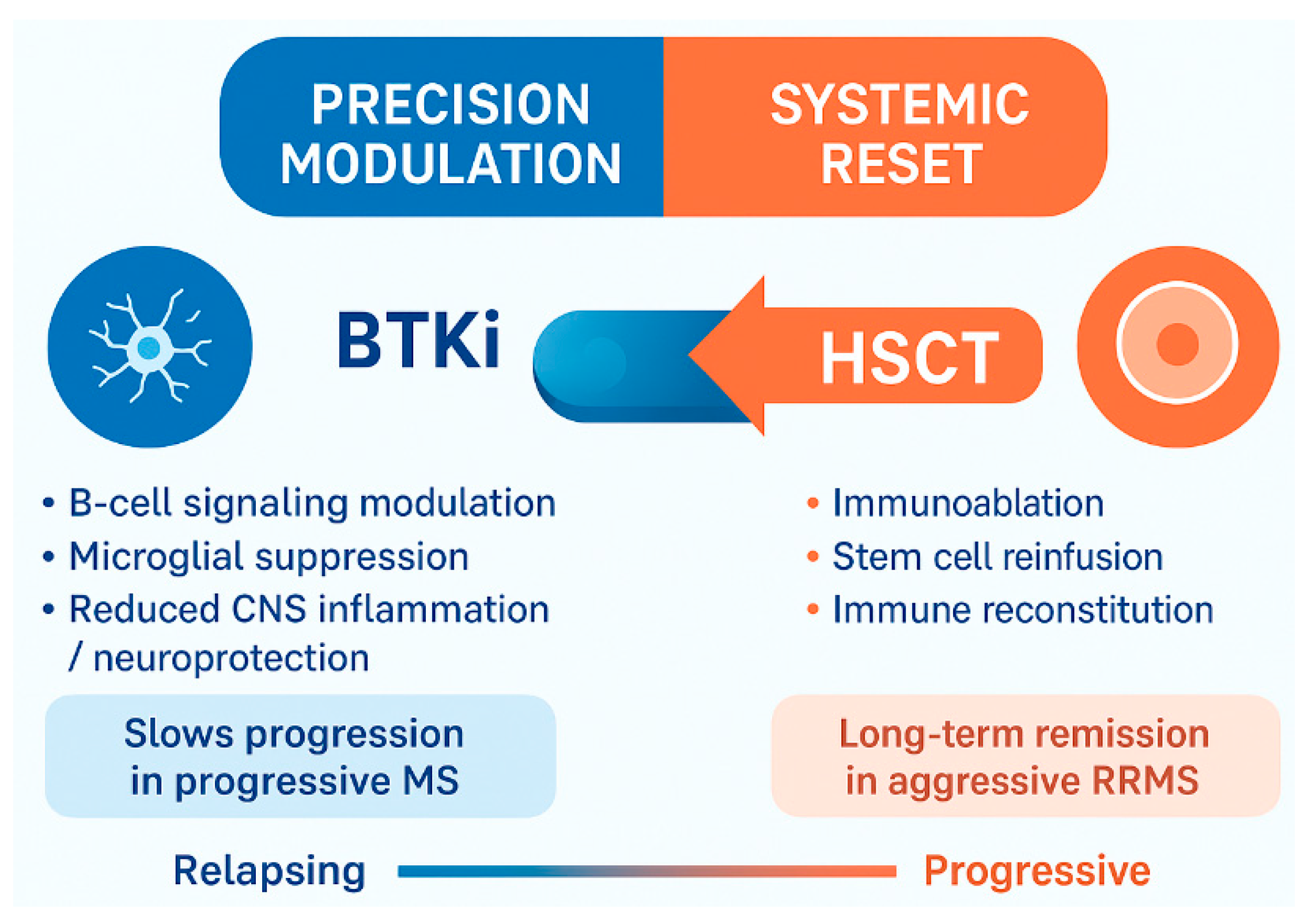
In contrast, HSCT represents systemic immune reset. Through complete immunoablation followed by regeneration, HSCT seeks not modulation but renewal eradicating pathogenic immune memory and fostering durable remission without continuous treatment [8,13,16]. This approach is highly effective in aggressive RRMS, where halting fulminant inflammatory activity is paramount. Yet its benefits are less pronounced once neurodegeneration becomes dominant, and it carries significant short-term risks that limit its applicability [8,13,16]. Ultimately, the choice between these strategies hinges on a risk–benefit calculus tailored to disease biology. BTK inhibitors may be suited for patients with progressive disease driven by smoldering inflammation [12], while HSCT offers unmatched efficacy in younger patients with aggressive, relapsing disease unresponsive to conventional therapies. Their contrasting mechanisms and profiles are summarized in Table 1 and visually illustrated in Figure 1.

3.4. BTK Inhibitors: From Phase II to Phase III Trials

The clinical development of Bruton’s tyrosine kinase (BTK) inhibitors in MS has been marked by proof-of-concept successes, unexpected challenges, and a gradual reframing of their therapeutic niche. Their dual mechanism, suppressing peripheral B-cell activity and modulating CNS-resident microglia, promised to impact both acute relapses and progressive disability. Translating this into consistent clinical benefit, however, has proven complex.
Phase II trials provided strong biological validation. Evobrutinib, the first to reach proof-of-concept, significantly reduced gadolinium-enhancing (Gd+) lesions compared to placebo, confirming target engagement and impact on blood–brain barrier breakdown [34]. Similar MRI efficacy was observed with fenebrutinib in Phase II trials [35]. Tolebrutinib similarly demonstrated MRI suppression in early studies [25]. Yet across these studies, clinical outcomes such as annualized relapse rate (ARR) and confirmed disability progression did not reach significance. This disconnect reflects trial design rather than inefficacy. Most Phase II studies were powered for MRI endpoints, had short durations, and enrolled heterogeneous populations [36].
Phase III programs have yielded mixed results that warrant deeper interrogation. The GEMINI trials of tolebrutinib in relapsing MS failed to show superiority over teriflunomide for ARR, though hints of benefit on disability were observed [25]. Similarly, the evobrutinib evolution RMS 1 and 2 studies did not meet their primary ARR endpoints [34]. Rather than dismissing these outcomes as simple failures, we must consider the underlying mechanistic explanations. The failure of BTK inhibitors to outperform established therapies in relapsing MS, despite demonstrable suppression of MRI activity, suggests a critical insight: in the highly inflammatory context of relapsing-remitting disease, broad B-cell depletion via anti-CD20 monoclonal antibodies may be functionally superior to signaling modulation alone. This discordance between robust MRI effects and clinical relapse rates likely reflects redundancy in B-cell effector pathways, where multiple downstream signaling cascades can perpetuate antigen presentation, cytokine production, and ectopic germinal center formation even when individual pathways like BTK are inhibited. Additionally, the peripheral lymphocyte compartment in aggressive relapsing disease may be the dominant driver of disease activity, making complete depletion as achieved by anti-CD20 therapies more effective than modulation of signaling in a compartment that remains numerically intact. This mechanistic consideration fundamentally reshapes the therapeutic positioning of BTK inhibitors. Rather than being universal B-cell modulators suitable across all MS phenotypes, they appear better suited to disease contexts where peripheral depletion strategies have proven insufficient. This observation reinforces the niche for HSCT in the most aggressive, treatment-refractory inflammatory cases, where the autoreactive repertoire itself, not merely its signaling state, must be eradicated.
In contrast, progressive MS trials have been more encouraging. The HERCULES study of tolebrutinib in non-relapsing secondary progressive MS (nrSPMS) demonstrated a 31% reduction in the risk of 6-month confirmed disability progression [23]. This represents one of the first definitive signals that BTK inhibitors can slow disability accumulation, supporting the hypothesis that CNS-penetrant inhibition of microglial activity addresses a pathophysiological process largely untouched by current therapies. From a safety standpoint, BTK inhibitors show a generally manageable profile, though hepatotoxicity has emerged as a class concern. Elevations in aminotransferases, and in rare cases severe liver injury, have led to clinical holds and mandate close monitoring [19]. Long-term risks such as infection susceptibility and cumulative immune effects remain under investigation. More information regarding the Phase Il and Ill clinical trials are shown below (Table 2).
In summary, BTK inhibitors have evolved from being positioned as contenders for relapsing MS to emerging as potentially transformative agents in progressive disease. While Phase III disappointments temper enthusiasm for their role in relapse control, the success of tolebrutinib in nrSPMS signals a new therapeutic niche targeting smoldering, compartmentalized CNS inflammation to slow progression.

3.5. Hematopoietic Stem Cell Transplantation: Efficacy in Aggressive MS

While BTK inhibitors represent a novel pharmacological frontier, autologous hematopoietic stem cell transplantation (HSCT) has already established itself as a definitive, high-efficacy intervention for aggressive, treatment-refractory relapsing-remitting MS (RRMS). Its rationale eradicating autoreactive immunity and rebuilding tolerance from a “clean slate” has been validated by randomized trials and large registries.
The MIST trial, a pivotal head-to-head RCT, compared non-myeloablative HSCT with best-available disease-modifying therapies (DMTs) in patients with highly active RRMS. Outcomes were striking: at three years, only 6% of the HSCT group had disability progression compared to 60% of the DMT group, with near-complete suppression of relapses and MRI activity. Most transplant recipients achieved no evidence of disease activity (NEDA) [9].
Durability is a defining feature. The HALT-MS Phase II trial reported a five-year event-free survival rate of 69% without ongoing DMT use [37]. Registry data from the European Society for Blood and Marrow Transplantation (EBMT), covering more than 1000 procedures, show consistent five-year progression-free survival rates of 70–80% in relapsing MS cohorts [31,38]. These data underscore HSCT’s unique ability to induce long-term, treatment-free remission, a property unmatched by any pharmacologic DMT.
Safety has improved substantially over two decades. Early protocols carried treatment-related mortality (TRM) rates up to 5%, but contemporary regimens using reduced-intensity conditioning and enhanced supportive care have lowered TRM to 0.2–1% in experienced centers [21,31]. Nevertheless, risks remain non-trivial, including cytopenias, opportunistic infections, infertility, and chemotherapy-related organ toxicity.
Patient selection is critical. The best outcomes are consistently seen in younger patients with short disease duration, high inflammatory activity, and lower fixed disability (EDSS ≤ 6.5). In contrast, outcomes are less favorable in progressive MS without ongoing inflammation, where HSCT’s anti-inflammatory mechanism has limited impact on neurodegeneration. In summary, HSCT offers unparalleled efficacy for halting inflammatory disease in aggressive RRMS and remains the only intervention capable of inducing durable, treatment-free remission. However, its procedural risks and restricted suitability demand careful selection and performance in specialized centers.

3.6. Cross-Strategy Efficacy Comparison: Challenges and Inferences

A direct randomized trial comparing autologous hematopoietic stem cell transplantation (HSCT) and Bruton’s tyrosine kinase (BTK) inhibitors is neither feasible nor ethical. The two approaches differ fundamentally: HSCT is a one-time, high-intensity procedure with acute procedural risks, while BTK inhibitors are chronic oral therapies with lower short-term risk but uncertain long-term safety profiles. Randomizing patients between such divergent therapeutic strategies would be impractical and inappropriate. Consequently, comparative efficacy assessment relies on indirect evidence synthesis and mechanistic reasoning. Table 1 presents a structured comparison of these two therapeutic modalities across eight key dimensions: core philosophy, primary mechanism, immune targets, therapeutic goals, nature of effect, theoretical strengths, theoretical limitations, and ideal patient populations. This table reveals that the two strategies operate on fundamentally different pathological substrates and employ opposing therapeutic principles, continuous targeted modulation versus discontinuous systemic reconstitution rather than competing for the same therapeutic niche [8,13,16]
The weight of evidence clearly positions HSCT as the most potent intervention for aggressive, relapsing-remitting MS. The MIST trial demonstrated striking superiority over high-efficacy disease-modifying therapies, with only 6% of the HSCT group experiencing disability progression compared to 60% of the control group at three years, coupled with near-complete suppression of relapses and MRI activity and NEDA rates exceeding 90% [9]. No pharmacological agent has achieved comparable outcomes. However, HSCT’s benefits diminish substantially in non-relapsing progressive disease, where fixed disability and neurodegeneration predominate over acute inflammatory activity [10,38]. The immune reset mechanism loses efficacy once the disease phenotype shifts from explosive peripheral inflammation to smoldering, compartmentalized pathology.
By contrast, BTK inhibitors are carving out a distinct therapeutic role in progressive MS. While Phase III trials in relapsing disease yielded disappointing results, the HERCULES trial demonstrated that tolebrutinib achieved a 31% reduction in the risk of confirmed disability progression in non-relapsing secondary progressive MS [23]. This finding is pivotal because it establishes that targeted modulation of CNS innate immunity can meaningfully slow progression in a population with limited therapeutic options. The mechanism reflects a critical distinction: tolebrutinib’s blood–brain barrier penetration enables direct suppression of microglial activation, addressing compartmentalized inflammation that escapes peripheral restriction and that HSCT does not substantially alter [15,21,22].
This mechanistic divergence clarifies the emerging therapeutic paradigm. HSCT functions as a systemic firebreak for explosive inflammatory activity, offering durable treatment-free remission in aggressive RRMS. BTK inhibitors serve as precision modulators of smoldering CNS inflammation in progressive disease. Therefore, the choice between them is not which therapy is superior, but which disease process is dominant: explosive peripheral inflammation driven by B-cell dysfunction favors HSCT [28] while smoldering, compartmentalized CNS inflammation driven by microglial activation favors BTK inhibitors [12].
Across five randomized controlled trials (n = 3812), BTK inhibitors demonstrated variable efficacy in relapsing MS. Evobrutinib 45–75 mg BID significantly reduced gadolinium-enhancing (Gd+) lesions compared with placebo, consistent with prior analyses [34]. However, neither evobrutinib nor teriflunomide achieved a reduction in annualized relapse rate (ARR) despite favorable MRI lesion outcomes. Tolebrutinib did not outperform placebo for Gd+ lesions but reduced new/enlarging T2 lesions and showed acceptable early-phase safety. Higher doses of evobrutinib were associated with increased hepatobiliary adverse events, and alanine aminotransferase (ALT) elevations occurred most frequently with evobrutinib, followed by teriflunomide and tolebrutinib. Evidence certainty was limited due to the small number of trials, reliance on indirect comparisons, and minimal disability-progression data Several Phase III programs of newer BTK inhibitors remain ongoing and unpublished [39].
A separate network meta-analysis of 10 RCTs (>11,000 patients with relapsing MS) compared tolebrutinib with five biologics [40]. Alemtuzumab and natalizumab produced the largest ARR reductions, whereas ocrelizumab was most effective in preventing confirmed disability progression (CDP). Natalizumab demonstrated the lowest serious adverse event rates. Tolebrutinib was less effective at reducing ARR but showed CDP and safety outcomes comparable to those of several biologics, with moderate certainty of evidence. Despite advantages in oral dosing and CNS penetration, interpretation is constrained by between-trial heterogeneity, indirect comparisons, short follow-up durations for tolebrutinib, and limitations inherent to SUCRA rankings.
Phase II data for evobrutinib showed durable disease control, with low ARR maintained for more than 3.5 years and stable safety from double-blind phase to open-label extension [41]. Cerebrospinal fluid analyses confirmed therapeutic exposure consistent with high BTK occupancy, and BID dosing outperformed QD regimens in exposure–response and occupancy modeling. Transient early liver enzyme elevations were the principal safety signal. Evobrutinib also reduced neurofilament light chain (NfL) levels and MRI lesion activity, with biochemical improvements paralleling reductions in T1 Gd+ lesions and slowly expanding lesions. Interpretation is tempered by open-label design, small cohort size, MRI-driven endpoints, and annual assessment intervals.
Across more than 1000 participants in Phase II MS programs, evobrutinib demonstrated a safety profile comparable to placebo, with similar overall adverse event rates (66.2% vs. 62.4%) [34]. No new safety concerns emerged during extended follow-up, and aminotransferase elevations were transient and typically occurred early in treatment. Evobrutinib significantly reduced ARR at the 75 mg BID dose. Despite study heterogeneity and incomplete safety reporting, current evidence indicates that evobrutinib provides effective and well-tolerated disease control for relapsing MS, supporting ongoing long-term evaluation [42].
In summary, the respective efficacy profiles of BTK inhibitor and HSCT reflect not competition but complementarity in addressing distinct MS phenotypes across the disease trajectory. Their mechanistic distinction elucidates their potential complementarity in clinical practice: HSCT acts as a high-intensity “induction” therapy designed to halt active, relapsing inflammation by resetting the systemic immune repertoire, whereas BTK inhibitors are uniquely positioned to serve as a “maintenance” or “consolidation” strategy targeting the residual, compartmentalized neuroinflammation that HSCT may fail to clear. By combining a systemic immune reset with subsequent precision modulation of CNS-resident microglia, these two paradigms could theoretically be sequenced to address both the acute inflammatory and chronic neurodegenerative phases of the disease, offering a more complete therapeutic coverage than either approach alone.

3.7. BTK Inhibitors: On-Target and Off-Target Effects

The safety profile of BTK inhibitors reflects a combination of on-target immunological effects and off-target toxicities. On-target risks arise from sustained interference with B-cell signaling and innate immune activation, potentially leading to infection susceptibility and impaired vaccine responses. Compared to anti-CD20 monoclonal antibodies, however, BTK inhibitors appear less immunosuppressive, as they modulate rather than deplete lymphocyte populations [16,19]. This distinction may preserve immunological reserve, but long-term consequences of chronic signaling inhibition remain unknown.
Hepatotoxicity has emerged as the most significant off-target concern. Across multiple BTKi trials, including tolebrutinib and evobrutinib programs, dose-dependent elevations in aminotransferases were observed, with rare cases of severe liver injury leading to trial suspensions [19,25]. The underlying mechanism is not fully understood and may involve off-target interactions beyond BTK. As a result, regulatory agencies mandate regular liver function monitoring, and hepatotoxicity is now considered a class-related signal requiring careful surveillance. Other off-target risks have been described; first-generation BTK inhibitors used in hematologic malignancies were associated with bleeding diathesis and cardiac arrhythmias due to inhibition of kinases such as TEC (Tec Protein Tyrosine Kinase) and EGFR (Epidermal Growth Factor Receptor) [16]. Newer, more selective CNS-penetrant compounds appear to have reduced these liabilities, though vigilance remains essential as large MS populations are exposed in long-term use.
Overall, BTK inhibitors currently display a manageable safety profile, with reversible transaminase elevations as the most consistent signal. However, uncertainties remain regarding cumulative effects of chronic kinase inhibition, particularly in younger patients expected to remain on therapy for decades. Long-term extension studies and post-marketing surveillance will be critical to establish their risk–benefit balance in routine practice.

3.8. HSCT: Risks, Toxicities, and Evolving Safety Profile

The safety profile of autologous hematopoietic stem cell transplantation (HSCT) has improved substantially, but risks remain inherent to its intensity and complexity. Toxicities can be grouped into acute procedural risks, intermediate-term complications, and long-term consequences.
Acute risks are driven by conditioning regimens and include prolonged cytopenias, febrile neutropenia, mucositis, and life-threatening infections. Early experiences reported treatment-related mortality (TRM) rates up to 5%. With reduced-intensity regimens, better antimicrobial prophylaxis, and improved supportive care, TRM in modern series has declined to 0.2–1% in experienced centers [31,32].
Intermediate-term toxicities include opportunistic infections, delayed immune reconstitution, and autoimmune complications such as thyroiditis or idiopathic thrombocytopenia, reported in 5–10% of cases [38]. Although most are manageable, they highlight the profound immunological reset that HSCT entails.
Long-term effects primarily relate to gonadotoxicity and chemotherapy exposure. Infertility is common, particularly in women, and should be addressed with fertility preservation counseling before transplantation. Rare but serious late toxicities such as secondary malignancies and organ dysfunction (e.g., cardiac, pulmonary) have also been described, though less frequently with current regimens [43,44].
Safety outcomes are highly center-dependent. Optimal results are achieved in specialized programs with multidisciplinary expertise, where protocols, infection control, and patient selection are standardized. Outcomes outside such environments may be less favorable, underscoring the importance of concentrating HSCT in accredited centers. Overall, HSCT now carries an acceptable risk profile for selected patients with aggressive RRMS, but its acute toxicity and long-term consequences remain substantial compared to pharmacological therapies. Safety considerations therefore remain central to its clinical positioning.

3.9. Risk–Benefit Stratification and Patient Selection

The choice between BTK inhibitors and HSCT is not a matter of superiority but of matching therapy to disease biology and patient context. Each strategy carries distinct efficacy potential, risks, and practical considerations that guide selection. Disease phenotype is the strongest determinant:
HSCT provides the most benefit in younger patients with aggressive, treatment-refractory RRMS, where halting fulminant inflammatory activity is critical.
BTK inhibitors appear most promising in progressive MS with active smoldering inflammation, where their ability to penetrate the CNS and modulate microglia may slow disability accumulation.
Patient-specific factors also shape decision-making. Age, comorbidities, fertility considerations, and tolerance for procedural risk weigh heavily when considering HSCT. By contrast, BTK inhibitors, as oral agents, offer convenience and lower short-term risk, but commit patients to lifelong therapy with still-uncertain cumulative effects. System-level factors are equally relevant. HSCT is resource-intensive, requiring specialized centers and prolonged hospitalization, and remains limited by access and insurance coverage. BTK inhibitors, once approved, are expected to be broadly available but at high cumulative cost. Ultimately, patient selection requires a personalized risk–benefit analysis that integrates disease phenotype, safety profile, and patient preferences. HSCT should be viewed as an intervention for a narrow but highly impactful window in aggressive RRMS, while BTK inhibitors may offer broader applicability in progressive disease. For clinicians, the key is not choosing one strategy over the other, but recognizing which tool best matches the patient’s disease trajectory and risk tolerance.

3.10. Future Directions

Complementarity versus Competition. The evolution of BTK inhibitors and HSCT should not be framed as a contest but as complementary strategies addressing distinct aspects of MS pathophysiology. HSCT halts explosive inflammatory activity through immune reset, while BTK inhibitors aim to dampen the compartmentalized, smoldering inflammation that drives progression. Recognizing these therapies as parallel tools rather than competitors will be central to optimizing patient care.
Sequencing Strategies. Future practice may move beyond “either or” to dynamic sequencing. BTK inhibitors could serve as a bridge in patients awaiting HSCT or as consolidation afterward to suppress residual compartmentalized activity. Conversely, HSCT might be considered after BTKi failure in younger, aggressive phenotypes. Prospective studies are needed to test whether such staged approaches improve long-term outcomes compared to monotherapy.
Toward Endotype-Driven Personalization. The convergence of immunology, imaging, and data science may allow treatments to be tailored to disease endotypes rather than broad phenotypes. Biomarkers such as serum neurofilament light (sNfL), microglial PET ligands, or single-cell immune profiling may help identify patients whose disease is driven predominantly by peripheral lymphocytes (favoring HSCT) versus CNS innate immunity (favoring BTKi). Machine learning and AI-driven predictive models could integrate these data into clinical decision tools, enabling precision matching of therapy to biology.
Ethical and Access Considerations. Wider adoption of both approaches will raise pressing questions of equity and sustainability. HSCT remains accessible only in select tertiary centers, limiting availability for many patients worldwide. BTK inhibitors, while likely more broadly distributed, will carry high cumulative costs given lifelong dosing. Ensuring global access will require international guidelines, cost-effectiveness analyses, and health policy frameworks that prevent disparities between high-resource and low-resource settings.
Emerging BTK Nanotechnology Formulations.
Although still experimental, nanotechnology-based delivery platforms for BTK inhibitors, including nanoparticle carriers, liposomal formulations, and polymer-based delivery systems may enhance CNS penetration, improve pharmacokinetic stability, and reduce systemic toxicity. While current evidence remains preclinical and outside the primary scope of this review, these technologies represent a promising future direction for optimizing BTK inhibitor bioavailability and targeting, particularly in progressive MS where deep CNS engagement is essential

Limitations

This narrative review does not follow the methodological standards of a systematic review and is therefore subject to selection bias and variability in study quality. No formal risk-of-bias assessment or quantitative synthesis was performed, so the influence of individual studies remains qualitative and effect estimates for BTK inhibitors and HSCT should be interpreted cautiously. The evidence base, particularly for BTK inhibitors in progressive MS and HSCT in non-relapsing phenotypes remains incomplete, with several key trials having limited follow-up or unpublished data. Indirect comparisons between BTK inhibitors and HSCT rely on cross-trial inferences across heterogeneous populations and center-specific HSCT outcomes, limiting the validity of direct comparison. Finally, this review focuses on these two approaches and does not comprehensively address other high-efficacy DMTs, emerging neuroprotective strategies, or real-world access constraints, all of which may influence their positioning in clinical practice.

4. Conclusions

Bruton’s tyrosine kinase (BTK) inhibitors and autologous hematopoietic stem cell transplantation (HSCT) represent two mechanistically distinct yet potentially complementary therapeutic paradigms in multiple sclerosis (MS). HSCT offers high-efficacy immune reconstitution capable of inducing durable remission in carefully selected individuals with aggressive relapsing disease. In contrast, BTK inhibitors provide sustained, selective modulation of B-cell and myeloid signaling with CNS penetration, positioning them as promising candidates for disease stages dominated by compartmentalized inflammation and progression independent of relapse activity.
Rather than competing strategies, HSCT and BTK inhibitors occupy distinct therapeutic niches, HSCT delivering systemic immune renewal for explosive peripheral inflammatory activity, and BTK inhibitors addressing smoldering, microglia-driven pathology less amenable to conventional disease-modifying therapies. Optimal integration into clinical practice will require precise patient stratification, biomarker-driven endotyping, and careful consideration of safety, accessibility, and economic constraints.
Looking forward, MS care is likely to shift toward complementarity: rational sequencing of immune reconstitution and CNS-targeted modulation, endotype-guided treatment allocation, and the exploration of integrated therapeutic frameworks to maximize durable disease modification. Together, BTK inhibitors and HSCT exemplify the field’s evolution from broad immunosuppression toward personalized, biology-based recalibration, and when appropriate, reconstruction of the immune system in MS.

Author Contributions

Conceptualization, W.H. and B.M.; methodology, M.A., M.F.S., L.A.E., J.N.D., I.A.V.F.L., M.S., W.H. and B.M.; writing—original draft preparation, M.A., M.F.S., L.A.E., J.N.D., I.A.V.F.L. and M.S.; writing, review and editing, W.H. and B.M.; images, B.M.; supervision, W.H. and B.M.; project administration, W.H. and B.M. Revision of reviewer comments: W.H., M.F.S., M.A., L.A.E., I.A.V.F.L., M.S., J.N.D. and B.M. All authors have read and agreed to the published version of the manuscript.

Funding

This research received no external funding.

Institutional Review Board Statement

The study did not require ethical approval.

Informed Consent Statement

The study did not require an informed consent statement.

Data Availability Statement

Not applicable.

Acknowledgments

We acknowledge Anna Pogodina for her initial input on the introduction. We also thank Muhammad Yaseen and Ahmed Hashim Mohamad for their contribution to the initial draft of the manuscript. The final version of the article underwent extensive revision, and authorship has been adjusted accordingly to reflect contributions to the revised work, in accordance with journal and COPE guidelines. During the preparation of this manuscript, GenAI (ChatGPT Plus 5.0) was used to refine an image included in the text (Figure 1). All generated material was reviewed, edited, and validated by the authors, who take full responsibility for the final content.

Conflicts of Interest

The authors declare no conflicts of interest.

Abbreviations

The following abbreviations are used in this manuscript:
CNSCentral Nervous System
DMTsDisease Modifying Therapies
BTKBruton’s Tyrosine Kinase
BTKiBruton’s Tyrosine Kinase Inhibitors
HSCTHematopoietic Stem Cell Transplantation
BBBBlood–Brain Barrier
RRMSRelapsing Remitting Multiple Sclerosis
nrSPMSNon Relapsing Secondary Progressive Multiple Sclerosis
EDSSExpanded Disability Status Scale
TRMTreatment Related Mortality
MRIMagnetic Resonance Imaging
Gd+Gadolinium Enhancing
ARRAnnualized Relapse Rate
NEDANo Evidence of Disease Activity
ATGAnti Thymocyte Globulin
TregsRegulatory T Cells
RCTRandomized Controlled Trial
sNfLSerum Neurofilament Light
PETPositron Emission Tomography
CDPConfirmed Disability Progression
ALTAlanine Aminotransferase

References

  1. Albelo-Martínez, M.; Rizvi, S. Progressive multiple sclerosis: Evaluating current therapies and exploring future treatment strategies. Neurother. J. Am. Soc. Exp. Neurother. 2025, 22, e00601. [Google Scholar] [CrossRef] [PubMed]
  2. Hauser, S.L.; Cree, B.A.C. Treatment of Multiple Sclerosis: A Review. Am. J. Med. 2020, 133, 1380–1390.e2. [Google Scholar] [CrossRef] [PubMed]
  3. Mehr, S.R.; Zimmerman, M.P. Reviewing the Unmet Needs of Patients with Multiple Sclerosis. Am. Health Drug Benefits 2015, 8, 426–431. [Google Scholar] [PubMed]
  4. Amin, M.; Hersh, C.M. Updates and advances in multiple sclerosis neurotherapeutics. Neurodegener. Dis. Manag. 2023, 13, 47–70. [Google Scholar] [CrossRef]
  5. Yang, J.H.; Rempe, T.; Whitmire, N.; Dunn-Pirio, A.; Graves, J.S. Therapeutic Advances in Multiple Sclerosis. Front. Neurol. 2022, 13, 824926. [Google Scholar] [CrossRef]
  6. Filippi, M.; Amato, M.P.; Centonze, D.; Gallo, P.; Gasperini, C.; Inglese, M.; Patti, F.; Pozzilli, C.; Preziosa, P.; Trojano, M. Early use of high-efficacy disease-modifying therapies makes the difference in people with multiple sclerosis: An expert opinion. J. Neurol. 2022, 269, 5382–5394. [Google Scholar] [CrossRef]
  7. Dolgin, E. BTK blockers make headway in multiple sclerosis. Nat. Biotechnol. 2021, 39, 3–5. [Google Scholar] [CrossRef]
  8. Schneider, R.; Oh, J. Bruton’s Tyrosine Kinase Inhibition in Multiple Sclerosis. Curr. Neurol. Neurosci. Rep. 2022, 22, 721–734. [Google Scholar] [CrossRef]
  9. Burt, R.K.; Balabanov, R.; Burman, J.; Sharrack, B.; Snowden, J.A.; Oliveira, M.C.; Farge, D.; Muraro, P.A.; Atkins, H.L. Autologous hematopoietic stem cell transplantation for multiple sclerosis—Status report. J. Am. Med. Assoc. 2019, 321, 165–174. [Google Scholar] [CrossRef]
  10. Boffa, G.; Signori, A.; Massacesi, L.; Mariottini, A.; Sbragia, E.; Cottone, S.; Amato, M.P.; Gasperini, C.; Moiola, L.; Meletti, S.; et al. Italian BMT-MS Study Group and the Italian MS Register Hematopoietic Stem Cell Transplantation in People with Active Secondary Progressive Multiple Sclerosis. Neurology 2023, 100, e1109–e1122. [Google Scholar] [CrossRef]
  11. Bakhuraysah, M.M.; Siatskas, C.; Petratos, S. Hematopoietic stem cell transplantation for multiple sclerosis: Is it a clinical reality? Stem Cell Res. Ther. 2016, 7, 12. [Google Scholar] [CrossRef] [PubMed]
  12. Li, C.; Morch, M.T.; Gorter, R.; Lozinski, B.; Ghorbani, S.; Dong, Y.; Shen, Y.A.; Harp, C.; Zandee, S.; Klement, W.; et al. Bruton Tyrosine Kinase in Lesions of Multiple Sclerosis and 3 of Its Models. Neurol.® Neuroimmunol. Neuroinflamm. 2025, 12, e200413. [Google Scholar] [CrossRef] [PubMed]
  13. Atkins, H.L.; Freedman, M.S. Hematopoietic stem cell therapy for multiple sclerosis: Top 10 lessons learned. Neurother. J. Am. Soc. Exp. Neurother. 2013, 10, 68–76. [Google Scholar] [CrossRef] [PubMed]
  14. Contentti, E.C.; Correale, J. Current Perspectives: Evidence to Date on BTK Inhibitors in the Management of Multiple Sclerosis. Drug Des. Dev. Ther. 2022, 16, 3473. [Google Scholar] [CrossRef]
  15. Krämer, J.; Bar-Or, A.; Turner, T.J.; Wiendl, H. Bruton tyrosine kinase inhibitors for multiple sclerosis. Nat. Rev. Neurol. 2023, 19, 289–304. [Google Scholar] [CrossRef]
  16. McDonald, C.; Xanthopoulos, C.; Kostareli, E. The role of Bruton’s tyrosine kinase in the immune system and disease. Immunology 2021, 164, 722–736. [Google Scholar] [CrossRef]
  17. Neys, S.F.H.; Hendriks, R.W.; Corneth, O.B.J. Targeting Bruton’s tyrosine kinase in inflammatory and autoimmune pathologies. Front. Cell Dev. Biol. 2021, 9, 668131. [Google Scholar] [CrossRef]
  18. Jiang, Q.; Peng, Y.; Herling, C.D.; Herling, M. The immunomodulatory mechanisms of BTK inhibition in CLL and beyond. Cancers 2024, 16, 3574. [Google Scholar] [CrossRef]
  19. Airas, L.; Bermel, R.A.; Chitnis, T.; Hartung, H.P.; Nakahara, J.; Stuve, O.; Williams, M.J.; Kieseier, B.C.; Wiendl, H. A review of Bruton’s tyrosine kinase inhibitors in multiple sclerosis. Ther. Adv. Neurol. Disord. 2024, 17, 17562864241233041. [Google Scholar] [CrossRef]
  20. Martin, E.; Aigrot, M.-S.; Grenningloh, R.; Stankoff, B.; Lubetzki, C.; Boschert, U.; Zalc, B. Bruton’s tyrosine kinase inhibition promotes myelin repair. Brain Plast. 2020, 5, 123–133. [Google Scholar] [CrossRef]
  21. Geladaris, A.; Torke, S.; Saberi, D.; Alankus, Y.B.; Streit, F.; Zechel, S.; Stadelmann-Nessler, C.; Fischer, A.; Boschert, U.; Häusler, D.; et al. BTK inhibition limits microglia-perpetuated CNS inflammation and promotes myelin repair. Acta Neuropathol. 2024, 147, 75. [Google Scholar] [CrossRef] [PubMed]
  22. Geladaris, A.; Torke, S.; Weber, M.S. Bruton’s tyrosine kinase inhibitors in multiple sclerosis: Pioneering the path towards treatment of progression? CNS Drugs 2022, 36, 1019–1030. [Google Scholar] [CrossRef] [PubMed]
  23. Fox, R.J.; Bar-Or, A.; Traboulsee, A.; Oreja-Guevara, C.; Giovannoni, G.; Vermersch, P.; Syed, S.; Li, Y.; Vargas, W.S.; Turner, T.J.; et al. Tolebrutinib in nonrelapsing secondary progressive multiple sclerosis. New Engl. J. Med. 2025, 392, 1883–1892. [Google Scholar] [CrossRef] [PubMed]
  24. Montalban, X.; Vermersch, P.; Arnold, D.L.; Bar-Or, A.; Cree, B.A.C.; Cross, A.H.; Havrdova, E.K.; Kappos, L.; Stuve, O.; Wiendl, H.; et al. Safety and efficacy of evobrutinib in relapsing multiple sclerosis (evolutionRMS1 and evolutionRMS2): Two multicentre, randomised, double-blind, active-controlled, phase 3 trials. Lancet Neurol. 2024, 23, 1119–1132. [Google Scholar] [CrossRef]
  25. Oh, J.; Arnold, D.L.; Cree, B.A.C.; Ionete, C.; Kim, H.J.; Sormani, M.P.; Syed, S.; Chen, Y.; Maxwell, C.R.; Benoit, P.; et al. Tolebrutinib versus teriflunomide in relapsing multiple sclerosis. N. Engl. J. Med. 2025, 392, 1893–1904. [Google Scholar] [CrossRef]
  26. Ng, S.A.; Sullivan, K.M. Application of stem cell transplantation in autoimmune diseases. Curr. Opin. Hematol. 2019, 26, 392–398. [Google Scholar] [CrossRef]
  27. Arruda, L.C.; Clave, E.; Moins-Teisserenc, H.; Douay, C.; Farge, D.; Toubert, A. Resetting the immune response after autologous hematopoietic stem cell transplantation for autoimmune diseases. Curr. Res. Transl. Med. 2016, 64, 107–113. [Google Scholar] [CrossRef]
  28. Atkins, H.L.; Bowman, M.; Allan, D.; Anstee, G.; Arnold, D.L.; Bar-Or, A.; Bence-Bruckler, I.; Birch, P.; Bredeson, C.; Chen, J.; et al. Immunoablation and autologous haemopoietic stem-cell transplantation for aggressive multiple sclerosis: A multicentre single-group phase 2 trial. Lancet 2016, 388, 576–585. [Google Scholar] [CrossRef]
  29. Patti, F.; Chisari, C.G.; Toscano, S.; Arena, S.; Finocchiaro, C.; Cimino, V.; Milone, G. Autologous Hematopoietic Stem Cell Transplantation in Multiple Sclerosis Patients: Monocentric Case Series and Systematic Review of the Literature. J. Clin. Med. 2022, 11, 942. [Google Scholar] [CrossRef]
  30. Massey, J.C.; Sutton, I.J.; Ma, D.D.F.; Moore, J.J. Regenerating Immunotolerance in Multiple Sclerosis with Autologous Hematopoietic Stem Cell Transplant. Front. Immunol. 2018, 9, 410. [Google Scholar] [CrossRef]
  31. Sormani, M.P.; Muraro, P.A.; Burman, J. Real-world effectiveness of autologous HSCT in multiple sclerosis: A multicenter cohort study of 507 patients. Ann. Neurol. 2021, 90, 707–718. [Google Scholar] [CrossRef]
  32. Alexander, T.; Farge, D.; Badoglio, M.; Lindsay, J.O.; Muraro, P.A.; Snowden, J.A. Autoimmune Diseases Working Party (ADWP) of the European Society for Blood and Marrow Transplantation (EBMT). Hematopoietic stem cell therapy for autoimmune diseases—Clinical experience and mechanisms. J. Autoimmun. 2018, 92, 35–46. [Google Scholar] [CrossRef]
  33. Gratwohl, A.; Baldomero, H.; Aljurf, M.; Pasquini, M.C.; Bouzas, L.F.; Yoshimi, A.; Szer, J.; Lipton, J.; Schwendener, A.; Gratwohl, M.; et al. Hematopoietic stem cell transplantation: A global perspective. JAMA 2010, 303, 1617–1624. [Google Scholar] [CrossRef] [PubMed]
  34. Montalban, X.; Arnold, D.L.; Weber, M.S.; Staikov, I.; Piasecka-Stryczynska, K.; Willmer, J.; Martin, E.C.; Dangond, F.; Syed, S.; Wolinsky, J.S.; et al. Evobrutinib Phase 2 Study Group. Placebo-controlled trial of an oral BTK inhibitor in multiple sclerosis. New Engl. J. Med. 2019, 380, 2406–2417. [Google Scholar] [CrossRef] [PubMed]
  35. Bar-Or, A.; Dufek, M.; Budincevic, H.; Drulovic, J.; Habek, M.; Hua, L.H.; Weber, M.S.; Thomas, P.; Napieralski, J.; Mitzner, M.; et al. Safety and efficacy of fenebrutinib in relapsing multiple sclerosis (FENopta): A multicentre, double-blind, randomised, placebo-controlled, phase 2 trial and open-label extension study. Lancet Neurol. 2025, 24, 656–666. [Google Scholar] [CrossRef] [PubMed]
  36. Krämer, J.; Wiendl, H. Bruton tyrosine kinase inhibitors in multiple sclerosis: Evidence and expectations. Curr. Opin. Neurol. 2024, 37, 237–244. [Google Scholar]
  37. Nash, R.A.; Hutton, G.J.; Racke, M.K.; Popat, U.; Devine, S.M.; Steinmiller, K.C.; Griffith, L.M.; Muraro, P.A.; Openshaw, H.; Sayre, P.H.; et al. High-dose immunosuppressive therapy and autologous HCT for relapsing-remitting MS. Neurology 2017, 88, 842–852. [Google Scholar] [CrossRef]
  38. Muraro, P.A.; Pasquini, M.; Atkins, H.L.; Bowen, J.D.; Farge, D.; Fassas, A.; Freedman, M.S.; Georges, G.E.; Gualandi, F.; Hamerschlak, N.; et al. Long-term outcomes after autologous hematopoietic stem cell transplantation for multiple sclerosis. JAMA Neurol. 2017, 74, 459–469. [Google Scholar] [CrossRef]
  39. Abbas, A.; Sabet, H.; Abouelmagd, M.E.; El-Moslemani, M.; Ewis, D.K.; Soliman, S.M.; Hefnawy, M.T.; Hassan, M.A.; Youssef, R.A.; Awad, H.; et al. Safety and efficacy of Bruton’s tyrosine kinase inhibitors in multiple sclerosis: A systematic review and network meta-analysis of randomized controlled trials. Brain Netw. Disord. 2025, 1, 230–238. [Google Scholar] [CrossRef]
  40. Yin, Y.; Gao, J.; Zhao, D. Comparative efficacy and safety of tolebrutinib versus biologic agents in relapsing multiple sclerosis: A systematic review and network meta-analysis. J. Clin. Quest. 2025, 2, e82. [Google Scholar] [CrossRef]
  41. Montalban, X.; Piasecka-Stryczynska, K.; Kuhle, J.; Benkert, P.; Arnold, D.L.; Weber, M.S.; Seitzinger, A.; Guehring, H.; Shaw, J.; Tomic, D.; et al. Efficacy and safety results after >3.5 years of treatment with the Bruton’s tyrosine kinase inhibitor evobrutinib in relapsing multiple sclerosis: Long-term follow-up of a Phase II randomised clinical trial with a cerebrospinal fluid sub-study. Mult. Scler. 2024, 30, 558–570. [Google Scholar] [CrossRef]
  42. Samudra, E.; Sutanto, A. Efficacy and safety of evobrutinib in relapsing multiple sclerosis: A systematic review of randomized controlled trials. Magna Neurol. 2025, 3, 138–149. [Google Scholar] [CrossRef]
  43. Galitzia, A.; Maccaferri, M.; Mauro, F.R.; Murru, R.; Marasca, R. Chronic Lymphocytic Leukemia: Management of Adverse Events in the Era of Targeted Agents. Cancers 2024, 16, 1996. [Google Scholar] [CrossRef]
  44. Thanarajasingam, G.; Minasian, L.M.; Baron, F.; Cavalli, F.; De Claro, R.A.; Dueck, A.C.; El-Galaly, T.C.; Everest, N.; Geissler, J.; Gisselbrecht, C.; et al. Beyond maximum grade: Modernising the assessment and reporting of adverse events in haematological malignancies. Lancet Haematol. 2018, 5, E563–E598. [Google Scholar] [CrossRef]
Figure 1. Conceptual framework contrasting BTK inhibitors and HSCT in multiple sclerosis. BTK inhibitors: Bruton’s Tyrosine Kinase, CNS: Central Nervous System, MS: Multiple Sclerosis, RRMS: Relapsing-Remitting Multiple Sclerosis, HSCT: Haematopoietic Stem Cell Transplantation.
Sclerosis 04 00001 g001
Table 1. Mechanistic comparison of BTK inhibitors and autologous HSCT in multiple sclerosis *.
FeatureBTK InhibitorsAutologous HSCT
Core philosophyContinuous Precision ModulationOne-time Systemic Reset
Primary mechanismInhibition of BTK signaling in B cells and myeloid cells (e.g., microglia)Immunoablation followed by autologous stem cell reconstitution
Key immune targetsPeripheral B cells, CNS microglia, other innate immune cellsThe entire autoreactive T and B cell repertoire
Therapeutic goalSuppress inflammation and neurodegeneration; control diseaseInduce durable, treatment-free remission; “re-educate” immune system
Nature of effectReversible; requires continuous dosingDiscontinuous; intended to be permanent after recovery
Theoretical strengthTargets compartmentalized CNS inflammation; potential for neuroprotection; oral administrationUnmatched efficacy in halting inflammatory activity; potential for long-term treatment-free survival
Theoretical limitationChronic, long-term safety unknown; may not fully abrogate all disease processesSignificant acute morbidity/mortality risk; limited efficacy in non-inflammatory progressive MS; infertility
Ideal patient profilePatients with progressive disease features and active smoldering pathologyYoung patients with highly active, inflammatory RRMS refractory to high-efficacy DMTs
* Synthesized from the included studies [8,13,16]. BTK: Bruton’s Tyrosine Kinase, CNS: Central Nervous System, DMTs: Disease-Modifying Therapies, RRMS: Relapsing-Remitting Multiple Sclerosis, HSCT: Haematopoietic Stem Cell Transplantation.
Table 2. Summary of Phase II and Phase III clinical trials evaluating Bruton’s tyrosine kinase (BTK) inhibitors in multiple sclerosis. Mechanistic comparison of BTK inhibitors and autologous HSCT in multiple sclerosis *.
AgentTrial (Phase)MS PhenotypeKey Efficacy FindingsSafety and ObservationsSource
TolebrutinibHERCULES
(Phase III)
nrSPMSDemonstrated the percentage of participants with confirmed disability progression sustained for at least 6 months during the trial was 22.6% in the tolebrutinib group and 30.7% in the placebo groupResulted in a lower risk of disability progression than placebo. These results support the role of tolebrutinib in slowing disability accrual in persons with nonrelapsing secondary progressive multiple sclerosis[23]
TolebrutinibGEMINI 1 and 2
(Phase III)
Relapsing MSTolebrutinib was not superior to teriflunomide in decreasing annualized relapse rates among participants with relapsing multiple sclerosisThe percentage of participants who had adverse events was similar in the two treatment groups, although the percentage with minor bleeding was higher in the tolebrutinib group than in the teriflunomide group[25]
EvobrutinibevolutionRMS 1 and 2
(Phase III)
Relapsing MSEvobrutinib is not superior to Teriflunomide in terms of clinical, imaging, and biomarker endpoints, and has no clinically relevant effects on CNS compartmentalized inflammationResults more positive efficacy results, the liver-related safety findings indicate a clinically relevant risk for drug-induced liver injury that would prevent broader clinical use.[24]
EvobrutinibPhase II TrialRelapsing MSPatients with relapsing MS who received 75 mg of evobrutinib once daily had significantly fewer enhancing lesions during weeks 12 through 24 than those who received placeboElevations in liver aminotransferase values [34]
FenebrutinibPhase II TrialRelapsing MSFenebrutinib was well tolerated and exerted an early, robust, and sustained effect of limiting new focal brain lesionsCommon adverse events in the fenebrutinib group than in the placebo group were hepatic enzyme elevations, headache and nasopharyngitis. No serious adverse events or deaths occurred[35]
* CNS: Central Nervous System, MS: Multiple Sclerosis, nrSPMS: Non-relapsing Secondary Progressive Multiple Sclerosis.
Disclaimer/Publisher’s Note: The statements, opinions and data contained in all publications are solely those of the individual author(s) and contributor(s) and not of MDPI and/or the editor(s). MDPI and/or the editor(s) disclaim responsibility for any injury to people or property resulting from any ideas, methods, instructions or products referred to in the content.