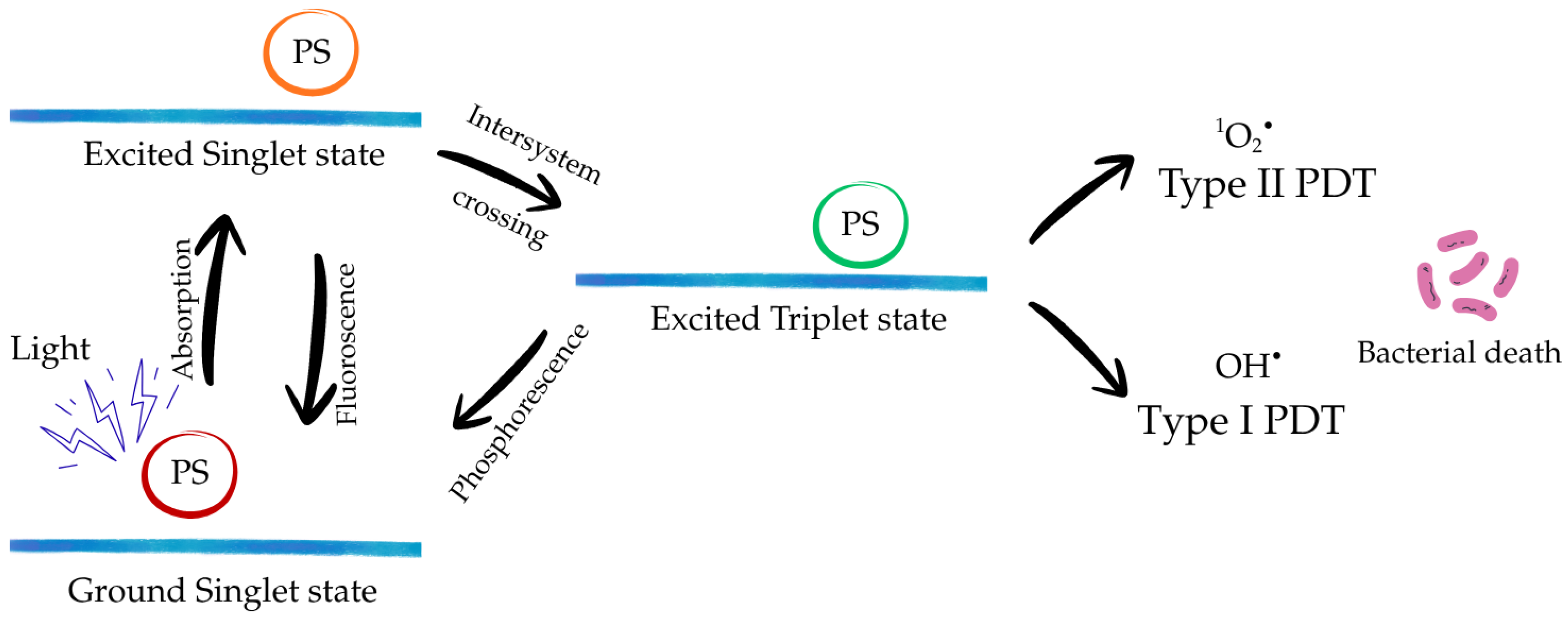

Use of Antimicrobial Photodynamic Therapy to Inactivate Multidrug-Resistant Enterobacter spp.: Scoping Review


Abstract
1. Introduction
2. Results
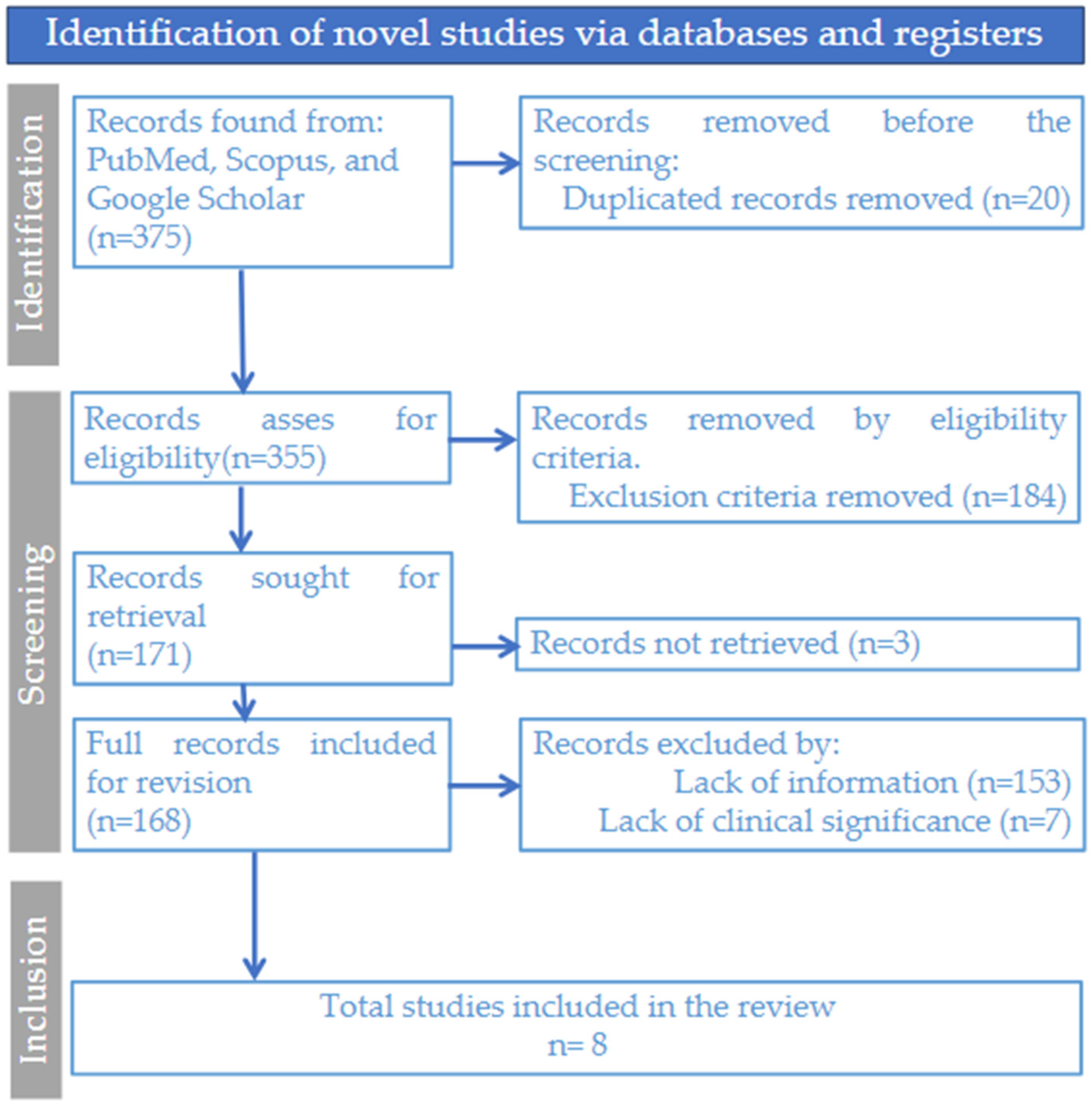
2.1. Choosing Sources of Evidence
2.2. PSs Used for Enterobacter spp. aPDT
2.2.1. Methylene Blue as the Most Common PS
2.2.2. Other PSs Used Against Enterobacter spp.
2.3. Nanoparticles with aPDT Activity Against Enterobacter spp.
2.4. Uses of PSs Against Enterobacter spp.
2.4.1. In Vivo Studies
2.4.2. PSs for Environmental Improvement
2.5. Limitations and Future Perspectives
3. Discussion
3.1. Summary of Evidence
3.2. Limitations
4. Materials and Methods
4.1. Protocol and Registration
4.2. Search Strategy and Eligibility Criteria
4.3. Information Sources and Search
4.4. Selection of Sources of Evidence and Data Charting Process
4.5. Data Items and Synthesis of Results
5. Conclusions
- Engineering: Development of next-generation light delivery systems, such as flexible Organic Light-Emitting Diodes (OLEDs) and biocompatible optical fibers for internal infections or colonized medical devices.
- Synergy: Investigating the potential of sub-lethal aPDT to “resensitize” MDR strains to previously ineffective carbapenems or aminoglycosides through membrane permeabilization. In addition, it would be of great value to explore other promising and/or novel photosensitizers, as well as the synergism with inorganic salts or antibiotics to potentiate aPDT.
- Translational Research: Implementing standardized in vivo models to establish definitive dosimetry protocols. Harnessing the full potential of light-based therapies is essential to mitigate the escalating threat posed by carbapenem-resistant Enterobacteriaceae in the 21st century.
Supplementary Materials
Author Contributions
Funding
Institutional Review Board Statement
Data Availability Statement
Acknowledgments
Conflicts of Interest
References
- World Health Organization. Antibacterial Agents in Clinical Development: An Analysis of the Antibacterial Clinical Development Pipeline and Push and Pull Incentives for Sustainable Innovation; World Health Organization: Geneva, Switzerland, 2019. [Google Scholar]
- Centers for Disease Control and Prevention. Antibiotic Resistance Threats in the United States, 2019; U.S. Department of Health and Human Services, CDC: Atlanta, GA, USA, 2019.
- De Oliveira, D.M.P.; Forde, B.M.; Kidd, T.J.; Harris, P.N.A.; Schembri, M.A.; Beatson, S.A.; Paterson, D.L.; Walker, M.J. Antimicrobial Resistance in ESKAPE Pathogens. Clin. Microbiol. Rev. 2020, 33, e00181-19. [Google Scholar] [CrossRef]
- Álvarez-Ainza, M.L.; Fong-Coronado, P.A.; Ruiz-Bustos, E.; Castillón-Campaña, L.G.; Quintero-Reyes, I.E.; Duarte-Zambrano, L.A.; Bolado-Martínez, E. Antibiotic Resistance of ESKAPE Group-Microorganisms in Health Institutions from Hermosillo and Ciudad Obregón, Sonora, México. Front. Cell. Infect. Microbiol. 2024, 14, 1348093. [Google Scholar] [CrossRef] [PubMed]
- Mezzatesta, M.L.; Gona, F.; Stefani, S. Enterobacter cloacae Complex: Clinical Impact and Emerging Antibiotic Resistance. Future Microbiol. 2012, 7, 887–902. [Google Scholar] [CrossRef] [PubMed]
- Davin-Regli, A.; Lavigne, J.-P.; Pagès, J.-M. Enterobacter spp.: Update on Taxonomy, Clinical Aspects, and Emerging Antimicrobial Resistance. Clin. Microbiol. Rev. 2019, 32, e00002-19. [Google Scholar] [CrossRef]
- Green, L.H.; Goldman, E. Practical Handbook of Microbiology; Green, L.H., Goldman, E., Eds.; CRC Press: Boca Raton, FL, USA, 2021; ISBN 9781003099277. [Google Scholar]
- Giono-Cerezo, S.; Santos-Preciado, J.I.; Morfín-Otero, M.d.R.; Torres-López, F.J.; Alcántar-Curiel, M.D. Antimicrobial Resistance. Its Importance and Efforts to Control It. Gac. Med. Mex. 2023, 156, 171–178. [Google Scholar] [CrossRef]
- Husna, A.; Rahman, M.M.; Badruzzaman, A.T.M.; Sikder, M.H.; Islam, M.R.; Rahman, M.T.; Alam, J.; Ashour, H.M. Extended-Spectrum β-Lactamases (ESBL): Challenges and Opportunities. Biomedicines 2023, 11, 2937. [Google Scholar] [CrossRef]
- Zeng, Z.; Wei, Y.; Ye, C.; Jiang, Y.; Feng, C.; Guo, T.; Song, M.; Ding, Y.; Zhan, P.; Liu, J. Carbapenem-Resistant Enterobacter cloacae Complex in Southwest China: Molecular Characteristics and Risk Factors Caused by NDM Producers. Infect. Drug Resist. 2024, 17, 1643–1652. [Google Scholar] [CrossRef]
- Poirel, L.; Naas, T.; Nordmann, P. Diversity, Epidemiology, and Genetics of Class D β-Lactamases. Antimicrob. Agents Chemother. 2010, 54, 24–38. [Google Scholar] [CrossRef] [PubMed]
- Bodendoerfer, E.; Marchesi, M.; Imkamp, F.; Courvalin, P.; Böttger, E.C.; Mancini, S. Co-Occurrence of Aminoglycoside and β-Lactam Resistance Mechanisms in Aminoglycoside- Non-Susceptible Escherichia coli Isolated in the Zurich Area, Switzerland. Int. J. Antimicrob. Agents 2020, 56, 106019. [Google Scholar] [CrossRef]
- Wang, T.; Xue, C.; Zhao, X.; Liu, Y.; Wang, Y.; Shi, L.; Shuai, Q. Single NIR Laser-Activated Synergistic Low-Temperature Photothermal Therapy and Self-Oxygenated Photodynamic Therapy Nano-Platforms for Bacteria Infection. Dye. Pigment. 2024, 225, 112066. [Google Scholar] [CrossRef]
- Kim, H.; Lee, Y.R.; Jeong, H.; Lee, J.; Wu, X.; Li, H.; Yoon, J. Photodynamic and Photothermal Therapies for Bacterial Infection Treatment. Smart Mol. 2023, 1, e20220010. [Google Scholar] [CrossRef] [PubMed]
- Valenzuela-Valderrama, M.; Gonzalez, I.A.; Palavecino, C.E. Photodynamic Treatment for Multidrug-Resistant Gram-Negative Bacteria: Perspectives for the Treatment of Klebsiella pneumoniae Infections. Photodiagnosis Photodyn. Ther. 2019, 28, 256–264. [Google Scholar] [CrossRef]
- Miretti, M.; Clementi, R.; Tempesti, T.C.; Baumgartner, M.T. Photodynamic Inactivation of Multiresistant Bacteria (KPC) Using Zinc(II)Phthalocyanines. Bioorg. Med. Chem. Lett. 2017, 27, 4341–4344. [Google Scholar] [CrossRef]
- Bravo, A.R.; Fuentealba, F.A.; González, I.A.; Palavecino, C.E. Use of Antimicrobial Photodynamic Therapy to Inactivate Multidrug-Resistant Klebsiella pneumoniae: Scoping Review. Pharmaceutics 2024, 16, 1626. [Google Scholar] [CrossRef]
- Hormazábal, D.B.; Reyes, Á.B.; Castro, F.; Cabrera, A.R.; Dreyse, P.; Melo-González, F.; Bueno, S.M.; González, I.A.; Palavecino, C.E. Synergistic Effect of Ru(II)-Based Type II Photodynamic Therapy with Cefotaxime on Clinical Isolates of ESBL-Producing Klebsiella pneumoniae. Biomed. Pharmacother. 2023, 164, 114949. [Google Scholar] [CrossRef]
- Das, K.; Roychoudhury, A. Reactive Oxygen Species (ROS) and Response of Antioxidants as ROS-Scavengers during Environmental Stress in Plants. Front. Environ. Sci. 2014, 2, 53. [Google Scholar] [CrossRef]
- Liu, C.; Zhou, Y.; Wang, L.; Han, L.; Lei, J.; Ishaq, H.M.; Nair, S.P.; Xu, J. Photodynamic Inactivation of Klebsiella pneumoniae Biofilms and Planktonic Cells by 5-Aminolevulinic Acid and 5-Aminolevulinic Acid Methyl Ester. Lasers Med. Sci. 2016, 31, 557–565. [Google Scholar] [CrossRef] [PubMed]
- Pereira de Lima Carvalho, D.; Guerra Pinto, J.; Di Paula Costa Sorge, C.; Rodrigues Benedito, F.R.; Khouri, S.; Ferreira Strixino, J. Study of Photodynamic Therapy in the Control of Isolated Microorganisms from Infected Wounds—an in Vitro Study. Lasers Med. Sci. 2014, 29, 113–120. [Google Scholar] [CrossRef]
- Costa Magacho, C.; Guerra Pinto, J.; Muller Nunes Souza, B.; Correia Pereira, A.H.; Ferreira-Strixino, J. Comparison of Photodynamic Therapy with Methylene Blue Associated with Ceftriaxone in Gram-Negative Bacteria; an in Vitro Study. Photodiagnosis Photodyn. Ther. 2020, 30, 101691. [Google Scholar] [CrossRef] [PubMed]
- Feng, Y.; Palanisami, A.; Ashraf, S.; Bhayana, B.; Hasan, T. Photodynamic Inactivation of Bacterial Carbapenemases Restores Bacterial Carbapenem Susceptibility and Enhances Carbapenem Antibiotic Effectiveness. Photodiagnosis Photodyn. Ther. 2020, 30, 101693. [Google Scholar] [CrossRef]
- Piksa, M.; Fortuna, W.; Lian, C.; Gacka, M.; Samuel, I.D.W.; Matczyszyn, K.; Pawlik, K.J. Treatment of Antibiotic-Resistant Bacteria Colonizing Diabetic Foot Ulcers by OLED Induced Antimicrobial Photodynamic Therapy. Sci. Rep. 2023, 13, 14087. [Google Scholar] [CrossRef]
- Gueorgieva, T.; Gergova, R. Comparative Study of Antibacterial Activity of Photoactivated Disinfection with Fotosan and Standard Endodontic Treatment. J. IMAB—Annu. Proceeding (Sci. Pap.) 2021, 27, 3712–3717. [Google Scholar] [CrossRef]
- Kustov, A.V.; Berezin, D.B.; Zorin, V.P.; Morshnev, P.K.; Kukushkina, N.V.; Krestyaninov, M.A.; Kustova, T.V.; Strelnikov, A.I.; Lyalyakina, E.V.; Zorina, T.E.; et al. Monocationic Chlorin as a Promising Photosensitizer for Antitumor and Antimicrobial Photodynamic Therapy. Pharmaceutics 2022, 15, 61. [Google Scholar] [CrossRef] [PubMed]
- Marković, Z.M.; Jovanović, S.P.; Mašković, P.Z.; Danko, M.; Mičušík, M.; Pavlović, V.B.; Milivojević, D.D.; Kleinová, A.; Špitalský, Z.; Todorović Marković, B.M. Photo-Induced Antibacterial Activity of Four Graphene Based Nanomaterials on a Wide Range of Bacteria. RSC Adv. 2018, 8, 31337–31347. [Google Scholar] [CrossRef]
- Manoharan, R.K.; Raorane, C.J.; Ishaque, F.; Ahn, Y.-H. Antimicrobial Photodynamic Inactivation of Wastewater Microorganisms by Halogenated Indole Derivative Capped Zinc Oxide. Environ. Res. 2022, 214, 113905. [Google Scholar] [CrossRef] [PubMed]
- Aspiroz, C.; Sevil, M.; Toyas, C.; Gilaberte, Y. Photodynamic Therapy With Methylene Blue for Skin Ulcers Infected With Pseudomonas aeruginosa and Fusarium spp. Actas Dermosifiliogr. 2017, 108, e45–e48. [Google Scholar] [CrossRef]
- Seitkazina, A.; Yang, J.-K.; Kim, S. Clinical Effectiveness and Prospects of Methylene Blue: A Systematic Review. Precis. Future Med. 2022, 6, 193–208. [Google Scholar] [CrossRef]
- Songsantiphap, C.; Vanichanan, J.; Chatsuwan, T.; Asawanonda, P.; Boontaveeyuwat, E. Methylene Blue–Mediated Antimicrobial Photodynamic Therapy Against Clinical Isolates of Extensively Drug Resistant Gram-Negative Bacteria Causing Nosocomial Infections in Thailand, An In Vitro Study. Front. Cell. Infect. Microbiol. 2022, 12, 929242. [Google Scholar] [CrossRef] [PubMed]
- Gambarini, G.; Plotino, G.; Grande, N.M.; Nocca, G.; Lupi, A.; Giardina, B.; De Luca, M.; Testarelli, L. In Vitro Evaluation of the Cytotoxicity of FotoSanTM Light-Activated Disinfection on Human Fibroblasts. Med. Sci. Monit. 2011, 17, MT21-5. [Google Scholar] [CrossRef]
- Parisay, I.; Talebi, M.; Asadi, S.; Sharif Moghadam, A.; Nikbakht, M.H. Antimicrobial Efficacy of 2.5% Sodium Hypochlorite, 2% Chlorhexidine, and 1.5% Hydrogen Peroxide on Enterococcus faecalis in Pulpectomy of Necrotic Primary Teeth. J. Dent. Mater. Tech. 2021, 10, 94. [Google Scholar]
- Fakudze, N.; Abrahamse, H.; George, B. Nanoparticles Improved Pheophorbide-a Mediated Photodynamic Therapy for Cancer. Lasers Med. Sci. 2025, 40, 78. [Google Scholar] [CrossRef] [PubMed]
- Gomer, C.J. Preclinical examination of first and second generation photosensitizers used in photodynamic therapy. Photochem. Photobiol. 1991, 54, 1093–1107. [Google Scholar] [CrossRef] [PubMed]
- Gomaa, I.; Sebak, A.; Afifi, N.; Abdel-Kader, M. Liposomal Delivery of Ferrous Chlorophyllin: A Novel Third Generation Photosensitizer for in Vitro PDT of Melanoma. Photodiagnosis Photodyn. Ther. 2017, 18, 162–170. [Google Scholar] [CrossRef]
- Szunerits, S.; Boukherroub, R. Antibacterial Activity of Graphene-Based Materials. J. Mater. Chem. B 2016, 4, 6892–6912. [Google Scholar] [CrossRef]
- Tabish, T.A.; Zhang, S.; Winyard, P.G. Developing the next Generation of Graphene-Based Platforms for Cancer Therapeutics: The Potential Role of Reactive Oxygen Species. Redox Biol. 2018, 15, 34–40. [Google Scholar] [CrossRef]
- Karahan, H.E.; Wiraja, C.; Xu, C.; Wei, J.; Wang, Y.; Wang, L.; Liu, F.; Chen, Y. Graphene Materials in Antimicrobial Nanomedicine: Current Status and Future Perspectives. Adv. Healthc. Mater. 2018, 7, 1701406. [Google Scholar] [CrossRef] [PubMed]
- Angjelova, A.; Jovanova, E.; Polizzi, A.; Santonocito, S.; Lo Giudice, A.; Isola, G. The Potential of Nano-Based Photodynamic Treatment as a Therapy against Oral Leukoplakia: A Narrative Review. J. Clin. Med. 2023, 12, 6819. [Google Scholar] [CrossRef]
- Lin, L.; Song, X.; Dong, X.; Li, B. Nano-Photosensitizers for Enhanced Photodynamic Therapy. Photodiagnosis Photodyn. Ther. 2021, 36, 102597. [Google Scholar] [CrossRef]
- Huang, Y.-Y.; Sharma, S.K.; Dai, T.; Chung, H.; Yaroslavsky, A.; Garcia-Diaz, M.; Chang, J.; Chiang, L.Y.; Hamblin, M.R. Can Nanotechnology Potentiate Photodynamic Therapy? Nanotechnol. Rev. 2012, 1, 111–146. [Google Scholar] [CrossRef]
- Pérez-Laguna, V.; García-Luque, I.; Ballesta, S.; Pérez-Artiaga, L.; Lampaya-Pérez, V.; Rezusta, A.; Gilaberte, Y. Photodynamic Therapy Using Methylene Blue, Combined or Not with Gentamicin, against Staphylococcus aureus and Pseudomonas aeruginosa. Photodiagnosis Photodyn. Ther. 2020, 31, 101810. [Google Scholar] [CrossRef]
- Soares, J.M.; Corrêa, T.Q.; Barrera Patiño, C.P.; Gonçalves, I.S.; dos Santos, G.G.; Guimarães, G.G.; de Lima, R.V.; Lima, T.H.N.; Corrêa, B.C.; Cappellini, T.C.d.S.; et al. Synergistic Paradigms in Infection Control: A Review on Photodynamic Therapy as an Adjunctive Strategy to Antibiotics. ACS Infect. Dis. 2025, 11, 2671–2691. [Google Scholar] [CrossRef] [PubMed]
- Zangirolami, A.C.; Yerra, K.R.; Yakovlev, V.V.; Blanco, K.C.; Bagnato, V.S. Combined Antibiotic and Photodynamic Therapies in Pseudomonas aeruginosa: From Synergy to Antagonism. Antibiotics 2024, 13, 1111. [Google Scholar] [CrossRef] [PubMed]
- Bendsoe, N. Photodynamic Therapy: Superficial and Interstitial Illumination. J. Biomed. Opt. 2010, 15, 041502. [Google Scholar] [CrossRef] [PubMed]
- Baran, T.M.; Foster, T.H. Comparison of Flat Cleaved and Cylindrical Diffusing Fibers as Treatment Sources for Interstitial Photodynamic Therapy. Med. Phys. 2014, 41, 022701. [Google Scholar] [CrossRef]
- Rubilar-Huenchuman, M.; Ortega-Villanueva, C.; González, I.A.; Palavecino, C.E. The Effect of Photodynamic Therapy on Enterococcus spp. and Its Application in Dentistry: A Scoping Review. Pharmaceutics 2024, 16, 825. [Google Scholar] [CrossRef]
- Tricco, A.C.; Lillie, E.; Zarin, W.; O’Brien, K.K.; Colquhoun, H.; Levac, D.; Moher, D.; Peters, M.D.J.; Horsley, T.; Weeks, L.; et al. PRISMA Extension for Scoping Reviews (PRISMA-ScR): Checklist and Explanation. Ann. Intern. Med. 2018, 169, 467–473. [Google Scholar] [CrossRef]
- Amir-Behghadami, M.; Janati, A. Population, Intervention, Comparison, Outcomes and Study (PICOS) Design as a Framework to Formulate Eligibility Criteria in Systematic Reviews. Emerg. Med. J. 2020, 37, 387. [Google Scholar] [CrossRef]
- Ouzzani, M.; Hammady, H.; Fedorowicz, Z.; Elmagarmid, A. Rayyan—a Web and Mobile App for Systematic Reviews. Syst. Rev. 2016, 5, 210. [Google Scholar] [CrossRef]



| Bacteria | PS/Dose | Dose/aPDT | Effect/Reduction | Applications | Ref. |
|---|---|---|---|---|---|
| Isolates from infected wounds (Enterobacter spp.) | MB 0.1 mg/mL | 50 J/cm2 LED red light 660 nm, 1 h | In vitro 100% Reduction of CFU | aPDT for treating infected wounds | [21] |
| E. aerogenes E. coli K. pneumoniae (MDR) | MB 100 μg/mL | 25 J/cm2 LED red light 660 nm, 15 min | In vitro >3 log10 Reduction in CFU | aPDT to treat MDR bacteria from clinical isolates | [22] |
| E. aerogenes S. aureus S. marcescens K. pneumoniae (MDR) | MB 100 μM | 10 J/cm2 Laser red light 660 nm, 20 min | In vitro 3 log10 Reduction in CFU | aPTD for MDR bacteria | [23] |
| Isolates from diabetic foot ulcers (MDR E. cloacae) | MB 16 μM | 54 J/cm2 Red Light OLED 669–737 nm | In vitro 8 log10 Reduction of CFU | OLED light source implementation for aPDT | [24] |
| Clinical isolates from dental samples (MDR E. cloacae) | TB 1 mg/mL | 200 mW/cm2 Laser red light 630 nm, 1 min | In vivo 3 log10 Reduction in CFU | In vivo aPDT for dental infections (FotoSan 630®) | [25] |
| E. cloacae P. aeruginosa E. coli A. baumanii (HAI, MDR) | McChl 25 and 50 μM | 40–80 J/cm2 LED red light 660 nm 7–14 min | In vitro 99.99% inactivation with both concentrations | For in vivo studies of antitumor activity | [26] |
| Various Gram + and – (E. aerogenes) | GQD 10 mg/mL CQD and N-CQD 5 mg/mL | 10 W Blue LED light 465–470 nm | MBC for GQD and for CQD 15.6 μg/mL, and N-CQD 7.8 μg/mL | Graphene NPs with bactericidal activity | [27] |
| Isolates from Wastewater Treatment Plants (E. tabaci E2) | 5BZN 20 μg/mL | 12,5 mW/cm2 Blue LED light ~500 nm | In vitro 40 min–2 log10 80 min–3.9 log10 | aPDT for in situ MDR bacteria from WWTPs | [28] |
Disclaimer/Publisher’s Note: The statements, opinions and data contained in all publications are solely those of the individual author(s) and contributor(s) and not of MDPI and/or the editor(s). MDPI and/or the editor(s) disclaim responsibility for any injury to people or property resulting from any ideas, methods, instructions or products referred to in the content. |
© 2026 by the authors. Licensee MDPI, Basel, Switzerland. This article is an open access article distributed under the terms and conditions of the Creative Commons Attribution (CC BY) license.
Share and Cite
Bravo, A.R.; Cuevas, M.F.; Palavecino, C.E. Use of Antimicrobial Photodynamic Therapy to Inactivate Multidrug-Resistant Enterobacter spp.: Scoping Review. Drugs Drug Candidates 2026, 5, 28. https://doi.org/10.3390/ddc5020028
Bravo AR, Cuevas MF, Palavecino CE. Use of Antimicrobial Photodynamic Therapy to Inactivate Multidrug-Resistant Enterobacter spp.: Scoping Review. Drugs and Drug Candidates. 2026; 5(2):28. https://doi.org/10.3390/ddc5020028
Chicago/Turabian StyleBravo, Angélica R., Matías F. Cuevas, and Christian Erick Palavecino. 2026. "Use of Antimicrobial Photodynamic Therapy to Inactivate Multidrug-Resistant Enterobacter spp.: Scoping Review" Drugs and Drug Candidates 5, no. 2: 28. https://doi.org/10.3390/ddc5020028
APA StyleBravo, A. R., Cuevas, M. F., & Palavecino, C. E. (2026). Use of Antimicrobial Photodynamic Therapy to Inactivate Multidrug-Resistant Enterobacter spp.: Scoping Review. Drugs and Drug Candidates, 5(2), 28. https://doi.org/10.3390/ddc5020028