Article

Mechanical Thrombectomy with the Vecta 46 Catheter: A Safety and Outcome Analysis

1
College of Medicine, University of Florida, Gainesville, FL 32610, USA
2
Lillian S. Wells Department of Neurosurgery, University of Florida, Gainesville, FL 32610, USA
*
Author to whom correspondence should be addressed.
These authors contributed equally to this work.
J. Vasc. Dis. 2026, 5(3), 20; https://doi.org/10.3390/jvd5030020
Submission received: 9 February 2026 / Revised: 31 March 2026 / Accepted: 22 April 2026 / Published: 27 April 2026

Abstract

Objective: The AXS Vecta 46 intermediate catheter (Stryker) features a large inner diameter, enabling effective aspiration, combined with a small outer diameter and soft distal-tip flexibility, which allows for safe tracking through more tortuous and smaller arterial segments to target medium vessel occlusions non-traumatically. The efficacy of the Vecta 46 in the spectrum of large and medium vessel occlusions has not been well elucidated in the literature. Methods: This retrospective cohort study included patients who underwent MT for acute ischemic stroke at our institution between July 2022 and June 2024. The outcomes of patients treated with Vecta 46 were compared to those of all other catheters used at the institution. Results: The distribution of aspiration and stent retriever attempts in Vecta 46 procedures versus non-Vecta 46 procedures was significantly different (p = 0.00325). Aspiration was attempted 1.66 ± 0.936 times in the Vecta 46 group and 1.12 ± 0.650 times in the non-Vecta 46 group (p = 0.00135). More mechanical thrombectomies with the Vecta 46 included aspiration of a secondary thrombus (p = 0.0314), despite no difference in the distribution of the primary or secondary occlusion location. There were no statistically significant differences in recanalization success (p = 0.800), recanalization time (p = 0.245), procedure duration (p = 0.580), discharge modified Rankin Score (p = 0.875), or intracranial hemorrhage rate (p = 0.720) between non-Vecta 46 and Vecta 46 procedures. Conclusions: Vecta 46 has similar safety and functional outcomes compared to other endovascular treatment options despite procedural differences.

1. Introduction

Acute ischemic stroke caused by proximal large vessel occlusions (LVOs) has conclusively been shown to benefit from mechanical thrombectomy (MT) over the past decade, as the result of multiple large randomized controlled trials, cementing this procedure as the standard of care for eligible LVO patients. MT for acute ischemic stroke has led to significantly improved recanalization rates and functional outcomes compared to medical therapy alone across numerous landmark clinical trials [1,2,3]. These trials, however, predominantly enrolled patients with proximal occlusions, such as those in the internal carotid or proximal middle cerebral arteries, and had only small fractions of patients with more distal occlusions. They also focused on stent retriever (SR) devices, which have since been augmented with other viable reperfusion techniques, such as direct aspiration [4,5,6,7,8,9]. Thus, the efficacy of MT for medium vessel occlusions (MeVOs), such as the M2/3 and analogous segments in the anterior and posterior cerebral arteries, remains less certain in early trial data. In pooled subgroup analyses across multiple trials, MT for M2 occlusions showed a non-significant trend toward benefit; thus, current guidelines endorse MT in only select distal vessels with a ‘weak’ recommendation level [10,11].
Nonetheless, MeVO strokes are increasingly recognized as clinically impactful, and growing experience in high-volume stroke centers is driving broadening of MT indications to include distal occlusions in select cases. There is emerging evidence from several retrospective studies and registries that show that MeVO MT is both technically feasible, and associated with similar recanalization rates and outcome measures as those in LVO MT [12]. However, the recent DISTAL and ESCAPE-MeVO trials showed that MT for medium or distal vessel occlusions did not improve functional outcomes, which has generated significant discussion on how to optimize MeVO treatment [13,14].
The technical nuance of MeVO MT lies in the anatomy: distal intracranial vessels are narrower, more tortuous, and more fragile compared to proximal vessels, increasing the difficulty of navigation and procedural complications due to vessel injury from catheter-associated mechanical trauma. Despite these thrombi being smaller in size, medical therapy still fails to recanalize a substantial number of MeVO cases, which provided the impetus to create novel devices optimized for distal circulation MT to help circumvent the anatomic barrier that limits access to these MeVOs. Newer generation aspiration catheters feature reduced outer diameters and better distal flexibility, with enough lumen size to generate effective aspiration. One such catheter in use in our center is the AXS Vecta 46 Intermediate catheter (Stryker), which has an inner diameter of 0.046″, straddling the line between that of smaller bore aspiration catheters (on the order of 0.035″) and larger/super-bore catheters (frequently 0.070″–0.088″). There are many such devices that have subsequently been released on the market (such as the Penumbra 4MAX [0.041″], or Sofia 5F [0.055″]), and the general principle across all these innovations is to enable a large enough inner diameter to achieve effective aspiration, but a small enough outer diameter with soft distal-tip flexibility to track safely through more tortuous and smaller arterial segments to non-traumatically target MeVOs.
Despite the availability of these newer intermediate aspiration devices, there is a notable lack of published clinical data evaluating their safety and effectiveness in routine stroke MT practice. Early experiences have been limited to small case series or conference reports focusing on distal vessel usage, and Vecta 46 catheter performance has not been well characterized in the literature [15,16,17]. To address this gap, we conducted a retrospective safety and feasibility study of the Vecta 46 intermediate catheter in acute ischemic stroke MT in our university’s Comprehensive Stroke Center. Our primary aim was to describe the safety profile and clinical outcomes associated with Vecta 46 use in MeVO and LVO cases, given its unique size, and to determine whether these outcomes are comparable to those achieved with catheters of other sizes used at our institution.

2. Materials and Methods

2.1. Study Design and Population

This retrospective cohort study included patients who underwent MT for acute ischemic stroke at our institution between July 2022 and June 2024 by three different operators. The Vecta 46 catheter choice was determined by operator preference for significant navigation to medium vessels based on angiography. A total of 174 MT procedures were reviewed. Inclusion criteria included adult patients (≥18 years old) who underwent MT. Patients with incomplete procedural or outcome data were excluded from this analysis. Patients who underwent MT with the Vecta 46 catheter, along with other catheters, were included and compared. The study was approved by the local Institutional Review Board with a waiver of informed consent.

2.2. Data Collection

Patient demographic information, clinical risk factors, stroke characteristics, procedural details, and outcomes were extracted from the electronic medical record. The specific demographic and clinical information collected includes age, sex, comorbidities (including atrial fibrillation, diabetes mellitus, hypertension, coronary artery disease, prior cerebrovascular events, and smoking history), baseline modified Rankin Scale (mRS), and initial stroke severity score (National Institute of Health Stroke Scale (NIHSS) score on admission). Technique used (aspiration or SR), number of aspiration and SR attempts, vessel of primary occlusion, and vessel of secondary occlusion were included in the procedure details. The occlusion locations included the anterior cerebral artery (ACA), middle cerebral artery (MCA), internal carotid artery (ICA), common carotid artery (CCA), posterior cerebral artery (PCA), basilar artery, and vertebral artery. Segments (1, 2, or 3) of ACA and MCA occlusions were also recorded. PCA, basilar artery, and vertebral artery occlusions were grouped as “posterior circulation”.

2.3. Outcomes

The primary measure was the rate of successful revascularization, which we defined using the Thrombolysis in Cerebral Infarction (TICI) scale. A successful revascularization was defined as TICI 2b or greater. Procedure outcomes included time to recanalization, procedure duration, mRS at discharge, and intracranial hemorrhage (ICH) incidence. Follow-up was defined as any documented outpatient neurology or stroke clinic visit where mRS was reassessed, with time from discharge to follow-up measured in days.

2.4. Statistical Analysis

Comparisons between Vecta 46 and non-Vecta MTs were made using chi-square for categorical variables, Student’s t-tests for parametric numerical variables, and Mann–Whitney U tests for non-parametric numerical variables. The distribution of the data was determined with the Shapiro–Wilk test. Linear and logistic regression was used for multivariate analysis of variables where appropriate. The significance of logistic regression variables was determined using the Wald test. The linear regression variable significance was determined with t-tests. A p-value < 0.05 was defined as statistically significant. All clinical data were extracted from electronic medical records and analyzed in R (R Core Team 2025. Vienna, Austria: R Foundation for Statistical Computing).

3. Results

3.1. Baseline Characteristics of Patients

A total of 174 patient MTs were analyzed. Vecta 46 catheters were used in 32 MTs and other catheters were used in 142 MTs. The baseline characteristics of the patients treated with the Vecta 46 or other catheters were not significantly different. The mean age of the non-Vecta 46 cohort was 69.4 ± 14.9 years old and 68.7 ± 17.8 years old (p = 0.537). There were 75 (54.0%) male and 65 (46.0%) female patients in the non-Vecta 46 group. There were 16 (50%) male and 16 (50%) female patients in the Vecta 46 group. The non-Vecta 46 group included 37 (26.0%) patients with atrial fibrillation, 21 (15.0%) patients with diabetes mellitus, 92 (66.0%) with hypertension, 39 (28.0%) patients with coronary artery disease (CAD), 25 (18.0%) patients with a history of cerebrovascular accident/transient ischemic attack (CVA/TIA), and 44 (31.0%) patients who were current smokers. The Vecta 46 group included 4 (13.0%) patients with atrial fibrillation, 7 (22.0%) patients with diabetes mellitus, 22 (69.0%) patients with hypertension, 6 (19.0%) patients with CAD, 5 (16.0%) patients with a history of CVA/TIA, and 7 (22.0%) patients who were current smokers. The mean baseline mRS was 0.570 ± 1.01 in the non-Vecta 46 group and 0.81 ± 1.62 in the Vecta 46 group. The mean admission NIHSS was 17.2 ± 7.66 in the non-Vecta 46 group and 17.2 ± 10.1 in the Vecta 46 group. There were no statistically significant differences in patient sex, comorbidities, or baseline presentation between the non-Vecta 46 and Vecta 46 groups. These baseline characteristics and significant values for differences between groups are listed in Table 1.

3.2. Procedure Details

The use of aspiration versus SR differed significantly between the non-Vecta 46 and Vecta 46 groups (p = 0.00325). Aspiration alone was used most frequently in both the Vecta 46 and non-Vecta 46 group and aspiration alone was used in 70 (50.0%) non-Vecta 46 MTs and in 18 (56.0%) Vecta 46 MTs. Aspiration failed and was rescued with SRs in 25 (18.0%) non-Vecta 46 MTs and 6 (19.0%) Vecta 46 MTs. SR alone was used in 37 (26.0%) non-Vecta 46 MTs and 4 (13.0%) Vecta 46 MTs. SRs failed and required aspiration rescue in 1 (0.7%) non-Vecta 46 MT and 4 (13.0%) Vecta 46 MTs. Other techniques were used in 7 (5.0%) non-Vecta 46 MTs and 0 Vecta 46 MTs. There was a statistically significant difference in the number of aspiration attempts, with 1.12 ± 0.650 attempts in the non-Vecta 46 group and 1.66 ± 0.963 attempts in the Vecta 46 group (p = 0.00135). The number of SR attempts did not differ significantly between the groups, with 1.38 ± 1.23 attempts in the non-Vecta 46 group and 1.79 ± 2.15 attempts in the Vecta 46 group (p = 0.866). These results are listed in Table 2.
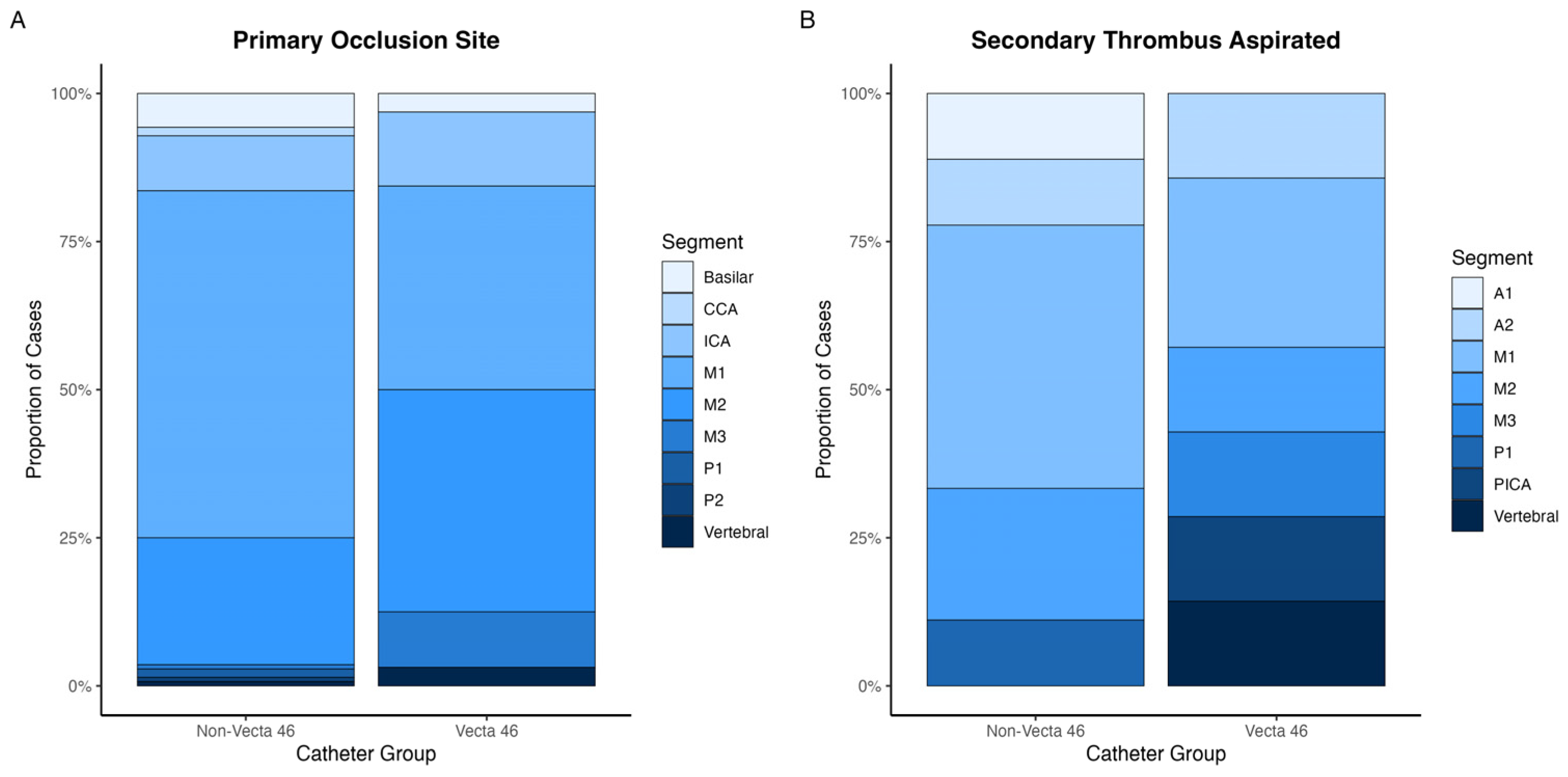
The rate of secondary thrombus aspiration differed significantly between the non-Vecta 46 and Vecta 46 groups, with 20 (14.1%) secondary aspirations in the non-Vecta 46 group and 12 (37.5%) secondary aspirations in the Vecta 46 group. There was no statistically significant difference in the location of primary (p = 0.09) or secondary (p = 0.11) occlusions aspirated between the non-Vecta 46 and Vecta 46 groups. Figure 1 displays the distribution of primary and secondary occlusion locations in the non-Vecta 46 and Vecta 46 groups. Primary occlusions aspirated in the non-Vecta 46 group were M1 > M2 > ICA = Basilar > CCA > P1 > M3 = P2 = Vert and M1 > M2 > M3 > Vertebral > Basilar in the Vecta 46 group (Figure 1A). Secondary occlusions aspirated in the non-Vecta 46 group were M2 > M1 > posterior circulation > M3 and M2 = M3 > M1 > A2 (Figure 1B).

3.3. Outcomes

Table 3 lists the procedure outcomes in the Vecta 46 and non-Vecta 46 group. The procedure outcomes did not differ significantly between groups. Successful canalization occurred in 141 (99.3%) patients in the non-Vecta 46 cohort and 31 (96.9%) patients in the Vecta 46 cohort (p = 0.800). The time to recanalization was 23.1 ± 20.8 min in the non-Vecta 46 cohort and 22.6 ± 11.1 min in the Vecta 46 cohort (p = 0.245). The procedure duration was 57.8 ± 43.92 in the non-Vecta 46 group and 47.6 ± 26.4 in the Vecta 46 group (p = 0.580). The discharge mRS score was 2.82 ± 2.06 in the non-Vecta 46 group and 2.81 ± 2.16 in the Vecta 46 group (p = 0.875). Hemorrhage occurred in 8 (5.63%) patients in the non-Vecta 46 group and 4 (12.5%) patients in the Vecta 46 group (p = 0.720). Multivariate analysis of these outcome variables revealed no significant differences between the Vecta 46 and non-Vecta 46 group. The results of this multivariate analysis can be found in Supplemental Table S1.

4. Discussion

This single-center retrospective investigation compared the safety and efficacy profile of the Vecta 46 intermediate catheter in MT of LVOs and MeVOs to MTs performed with all other catheter configurations. Distal access catheters are growing in popularity for MT as they provide rapid, stable intracranial access [18]. As new devices, such as the Vecta 46, come to market, it is important to compare their safety and efficacy to established options. There were no statistically significant differences in revascularization time, intracranial hemorrhage, or functional outcome between Vecta 46 and other catheter configurations. These results agree with previous literature reporting no significant difference between distal access catheters, stent retrievers, and aspiration catheters reported in the literature [19], as well as no significant difference between the larger Vecta 71 and HiPoint Reperfusion distal catheters [20]. Given this parity, our results support the Vecta 46 as a viable option to be chosen based on anatomy and operator preference, as supported by the American Heart Association Scientific Statement [21].
Revascularization time is critical in acute ischemic strokes [22]. Every 15 min delay in revascularization time significantly increases the likelihood of symptomatic intracranial hemorrhage, failure to discharge home, and in-hospital mortality [23]. There were no statistically significant differences in revascularization time between Vecta 46 and other catheter configurations, the primary endpoint of our investigation. Patients treated with the Vecta 46 also had functional outcomes similar to those with other catheter configurations, reflecting no statistically significant difference in revascularization time [24].
Despite no difference in revascularization and functional outcome, Vecta 46 thrombectomies had a unique profile of treatment compared to other options in our cohort, initiating MT with direct aspiration and failing attempts initiating with SRs more often. This likely reflects the intended design of the Vecta 46 for direct aspiration and operator experience with Vecta 46’s significantly higher SR failure rate. This is the first report of the poor efficacy of preliminary SR use with Vecta 46, an important consideration when selecting the catheter system if the anatomy is unfavorable for aspiration [25]. Another important consideration in use of the Vecta 46 is a requirement for more attempts at direct aspiration to achieve reperfusion. Compared to thrombectomies with other catheter systems, it was more likely to require 2, 3, or 4 attempts at direct aspiration. A similar trend is seen in the larger sized Vecta 71, indicating possible inferiority in achieving first-pass revascularization throughout the Vecta group of catheters [20]. This may be a reflection of the Vecta 46’s smaller size, as decreasing the catheter size reduces the rate of first-pass recanalization, as aspiration force scales with diameter [26]. Overall, we have elucidated a significant difference in procedure characteristics but also demonstrated no statistically significant differences in safety or efficacy outcomes for the Vecta 46, reflecting changing practices in thrombectomies to prioritize faster access while sacrificing procedure brevity.
The strength of this investigation is the breadth of procedure details, occlusion types, and a comparison to thrombectomies completed by the same operators. Current literature on the Vecta 46 is minimal, only including MeVO thrombectomies and lacking a control group, making it poorly generalizable [17]. Our results provide a broader investigation of the full spectrum of indications for Vecta 46, including direct aspiration and SR MT for LVOs and MeVOs. Although there were no statistically significant differences in primary or secondary occlusion location between Vecta 46 and non-Vecta 46 thrombectomies, Vecta 46 was used to aspirate secondary occlusions more often, likely due to versatility and trackability in navigating distal vasculature while retaining sufficient aspiration force to provide good results for thrombectomy. A direct comparison in another study is needed to determine whether passes previously attempted with SR rescues can be replaced with aspiration attempts when using intermediate catheters, given the Vecta 46’s potential inferiority in SR rescue.
A limitation of this investigation is that it is a single-center, retrospective study, which requires careful consideration before integration into wider clinical practice. Although baseline patient characteristics were similar, more secondary occlusions were aspirated with the Vecta 46, meaning that the reported outcomes may be skewed by the analysis of two different patient populations. Randomized controlled trials and meta-analyses agree with our results, strengthening our conclusions; however, randomized controlled trials comparing the efficacy of the Vecta 46 to other aspiration and SR options in both LVOs and MeVOs are needed to confirm its efficacy [27,28]. Another important limitation is that our small sample size for the Vecta 46 required grouping of primary and secondary MeVOs, each of which has unique technical aspects that were not controlled for. Follow-up outcomes are an important variable that our study was unable to report because over 50% of patients did not follow up after discharge. We emphasize that our analysis is not a clinical trial; rather, it is an observational comparison intended to demonstrate that the introduction of a novel intermediate catheter has yielded outcomes in line with our historical experience using standard devices, and to further provide context for the expanding role of MT in MeVO stroke. By sharing our single-center experience, we aim to contribute needed clinical data on the feasibility of using an intermediate-caliber aspiration catheter for both LVO and MeVO MT, as such data are crucial for guiding device selection and supporting the safe expansion of MT to MeVOs. This may provide further impetus for evaluating new device innovations in both distal and proximal occlusion MTs

5. Conclusions

Overall, the Vecta 46 intermediate catheter is a versatile option for endovascular treatment of ischemic stroke. At our institution, it is employed for LVOs and MeVOs with similar safety and efficacy to other endovascular treatment options. Compared to other catheters, direct aspiration is more likely to be attempted with the Vecta 46 than SR and more passes are required to achieve revascularization. Despite these procedural differences, there are no differences in time or rate of intracranial hemorrhage, or discharge mRS. Altogether, the Vecta 46 has similar safety and outcomes compared to other endovascular treatment options despite procedural differences.

Supplementary Materials

The following supporting information can be downloaded at: https://www.mdpi.com/article/10.3390/jvd5030020/s1, Table S1: Multivariate analysis of recanalization time, procedure duration, discharge, discharge analysis, and hemorrhage. Linear regression was used for recanalization time, procedure duration, and discharge mRS. Logistic regression was used for hemorrhage. CI = confidence interval; OR = odds ratio.

Author Contributions

D.S., B.L.-W. and M.K. contributed to the conceptualization and methodology. H.H. and M.A.B.C. contributed software for statistical analysis. H.H., S.A. and M.A.B.C. contributed to formal statistical analysis. H.H., C.D., D.S., G.H. and W.G. contributed to data collection. S.A. facilitated data curation. H.H., C.D., D.S., G.H., W.G., S.A., B.L.-W., Z.S. and M.K. contributed to manuscript drafting. H.H. and S.A. contributed to figure creation. D.S., B.L.-W. and M.K. contributed to project supervision. S.A. contributed to project administration. All authors have read and agreed to the published version of the manuscript.

Funding

This research received no external funding.

Institutional Review Board Statement

The study was conducted in accordance with the Declaration of Helsinki, and approved by the Institutional Review Board (or Ethics Committee) of the University of Florida IRB-01 (IRB202400732) on 10 June 2024.

Informed Consent Statement

This retrospective study conducted under a full waiver of consent involved collection and analysis of existing clinical data obtained during routine medical care. This research poses no more than minimal risk to participants and does not involve direct contact. Obtaining informed consent from eligible subjects would be impractical due to the retrospective nature in which patients could no longer be followed by the institution, had relocated, or may have been deceased.

Data Availability Statement

The authors will make data available upon request. The de-identified dataset cannot be shared externally because it contains detailed clinical variables and specific characteristics that could increase the risk of re-identification and the data use is restricted by institutional policy and limits distribution of clinical information outside the study team.

Acknowledgments

The authors would like to thank all staff involved in data charting and patient care at the UF Department of Neurology and Neurosurgery.

Conflicts of Interest

The authors declare no conflicts of interest.

Abbreviations

The following abbreviations are used in this manuscript:
LVOLarge vessel occlusion
MTMechanical thrombectomy
SRStent retriever
MeVOMedium vessel occlusion

References

  1. Sarraj, A.; Hassan, A.E.; Abraham, M.G.; Ortega-Gutierrez, S.; Kasner, S.E.; Hussain, M.S.; Chen, M.; Blackburn, S.; Sitton, C.W.; Churilov, L.; et al. Trial of Endovascular Thrombectomy for Large Ischemic Strokes. N. Engl. J. Med. 2023, 388, 1259–1271. [Google Scholar] [CrossRef]
  2. Elgendy, I.Y.; Kumbhani, D.J.; Mahmoud, A.; Bhatt, D.L.; Bavry, A.A. Mechanical Thrombectomy for Acute Ischemic Stroke: A Meta-Analysis of Randomized Trials. J. Am. Coll. Cardiol. 2015, 66, 2498–2505. [Google Scholar] [CrossRef]
  3. Costalat, V.; Jovin, T.G.; Albucher, J.F.; Cognard, C.; Henon, H.; Nouri, N.; Gory, B.; Richard, S.; Marnat, G.; Sibon, I.; et al. Trial of Thrombectomy for Stroke with a Large Infarct of Unrestricted Size. N. Engl. J. Med. 2024, 390, 1677–1689. [Google Scholar] [CrossRef]
  4. Albers, G.W.; Marks, M.P.; Kemp, S.; Christensen, S.; Tsai, J.P.; Ortega-Gutierrez, S.; McTaggart, R.A.; Torbey, M.T.; Kim-Tenser, M.; Leslie-Mazwi, T.; et al. Thrombectomy for Stroke at 6 to 16 Hours with Selection by Perfusion Imaging. N. Engl. J. Med. 2018, 378, 708–718. [Google Scholar] [CrossRef]
  5. Berkhemer, O.A.; Fransen, P.S.S.; Beumer, D.; van den Berg, L.A.; Lingsma, H.F.; Yoo, A.J.; Schonewille, W.J.; Vos, J.A.; Nederkoorn, P.J.; Wermer, M.J.H.; et al. A Randomized Trial of Intraarterial Treatment for Acute Ischemic Stroke. N. Engl. J. Med. 2015, 372, 11–20. [Google Scholar] [CrossRef]
  6. Campbell, B.C.V.; Mitchell, P.J.; Kleinig, T.J.; Dewey, H.M.; Churilov, L.; Yassi, N.; Yan, B.; Dowling, R.J.; Parsons, M.W.; Oxley, T.J.; et al. Endovascular Therapy for Ischemic Stroke with Perfusion-Imaging Selection. N. Engl. J. Med. 2015, 372, 1009–1018. [Google Scholar] [CrossRef] [PubMed]
  7. Goyal, M.; Demchuk, A.M.; Menon, B.K.; Eesa, M.; Rempel, J.L.; Thornton, J.; Roy, D.; Jovin, T.G.; Willinsky, R.A.; Sapkota, B.L.; et al. Randomized Assessment of Rapid Endovascular Treatment of Ischemic Stroke. N. Engl. J. Med. 2015, 372, 1019–1030. [Google Scholar] [CrossRef] [PubMed]
  8. Jovin, T.G.; Chamorro, A.; Cobo, E.; de Miquel, M.A.; Molina, C.A.; Rovira, A.; San Román, L.; Serena, J.; Abilleira, S.; Ribó, M.; et al. Thrombectomy within 8 Hours after Symptom Onset in Ischemic Stroke. N. Engl. J. Med. 2015, 372, 2296–2306. [Google Scholar] [CrossRef] [PubMed]
  9. Nogueira, R.G.; Jadhav, A.P.; Haussen, D.C.; Bonafe, A.; Budzik, R.F.; Bhuva, P.; Yavagal, D.R.; Ribo, M.; Cognard, C.; Hanel, R.A.; et al. Thrombectomy 6 to 24 Hours after Stroke with a Mismatch between Deficit and Infarct. N. Engl. J. Med. 2018, 378, 11–21. [Google Scholar] [CrossRef]
  10. Turc, G.; Bhogal, P.; Fischer, U.; Khatri, P.; Lobotesis, K.; Mazighi, M.; Schellinger, P.D.; Toni, D.; De Vries, J.; White, P.; et al. European Stroke Organisation (ESO)—European Society for Minimally Invasive Neurological Therapy (ESMINT) Guidelines on Mechanical Thrombectomy in Acute Ischaemic StrokeEndorsed by Stroke Alliance for Europe (SAFE). Eur. Stroke J. 2019, 4, 6–12. [Google Scholar] [CrossRef]
  11. Powers, W.J.; Rabinstein, A.A.; Ackerson, T.; Adeoye, O.M.; Bambakidis, N.C.; Becker, K.; Biller, J.; Brown, M.; Demaerschalk, B.M.; Hoh, B.; et al. Guidelines for the Early Management of Patients with Acute Ischemic Stroke: 2019 Update to the 2018 Guidelines for the Early Management of Acute Ischemic Stroke: A Guideline for Healthcare Professionals From the American Heart Association/American Stroke Association. Stroke 2019, 50, e344–e418. [Google Scholar] [CrossRef]
  12. Saber, H.; Narayanan, S.; Palla, M.; Saver, J.L.; Nogueira, R.G.; Yoo, A.J.; Sheth, S.A. Mechanical Thrombectomy for Acute Ischemic Stroke with Occlusion of the M2 Segment of the Middle Cerebral Artery: A Meta-Analysis. J. Neurointerv. Surg. 2018, 10, 620–624. [Google Scholar] [CrossRef]
  13. Goyal, M.; Ospel, J.M.; Ganesh, A.; Dowlatshahi, D.; Volders, D.; Möhlenbruch, M.A.; Jumaa, M.A.; Nimjee, S.M.; Booth, T.C.; Buck, B.H.; et al. Endovascular Treatment of Stroke Due to Medium-Vessel Occlusion. N. Engl. J. Med. 2025, 392, 1385–1395. [Google Scholar] [CrossRef]
  14. Psychogios, M.; Brehm, A.; Ribo, M.; Rizzo, F.; Strbian, D.; Räty, S.; Arenillas, J.F.; Martínez-Galdámez, M.; Hajdu, S.D.; Michel, P.; et al. Endovascular Treatment for Stroke Due to Occlusion of Medium or Distal Vessels. N. Engl. J. Med. 2025, 392, 1374–1384. [Google Scholar] [CrossRef]
  15. Goyal, N.; Khattar, N.K.; Peterson, J.; Dashti, R.; Sims, J.J.; Baumeister, M.; Williams, A.; Amadi, I.; Ebersole, K.; Madigan, D.; et al. The RED 43 Catheter for Aspiration Thrombectomy of Distal Medium Vessel Occlusions (DMVOs): A Multicenter Experience. J. Neurointerv. Surg. 2025, 18, 684–689. [Google Scholar] [CrossRef] [PubMed]
  16. Russo, R.; Mistretta, F.; Molinaro, S.; Bergui, M. 5F SOFIA Intermediate Catheter in the Treatment of Acute Ischemic Stroke: A Retrospective Observational Study. Interv. Neuroradiol. 2023, 29, 583–588. [Google Scholar] [CrossRef]
  17. Choi, J.W.; Qiao, Y.; Mehta, T.I.; Clausen, T.M.; Zhang, Y.J.; Tsappidi, S.; Hui, F.K. The Vecta 46 Intermediate Catheter for Mechanical Thrombectomy of Distal Medium Vessel Occlusions: A Single-Center Experience. Interv. Neuroradiol. 2024, 15910199241283513. [Google Scholar] [CrossRef]
  18. Dornbos, D.; Arthur, A.S. Current State of the Art in Endovascular Stroke Treatment. Neurol. Clin. 2022, 40, 309–319. [Google Scholar] [CrossRef]
  19. Bai, X.; Zhang, X.; Gong, H.; Wang, T.; Wang, X.; Wang, W.; Yang, K.; Yang, W.; Feng, Y.; Ma, Y.; et al. Different Types of Percutaneous Endovascular Interventions for Acute Ischemic Stroke. Cochrane Database Syst. Rev. 2023, 5, CD014676. [Google Scholar] [CrossRef] [PubMed]
  20. Nguyen, T.N.; Dabus, G.; McGuinness, B.; Caldwell, J.; Priest, R.; Rai, A.T.; Zaidat, O.O.; Gross, B.A.; Hanel, R.; Lee, S.; et al. SUMMIT MAX: A Randomized Trial of the Super Large Bore HiPoint Reperfusion System Versus Vecta System for Aspiration Thrombectomy. Stroke 2025, 56, 1980–1990. [Google Scholar] [CrossRef] [PubMed]
  21. Eskey, C.J.; Meyers, P.M.; Nguyen, T.N.; Ansari, S.A.; Jayaraman, M.; McDougall, C.G.; DeMarco, J.K.; Gray, W.A.; Hess, D.C.; Higashida, R.T.; et al. Indications for the Performance of Intracranial Endovascular Neurointerventional Procedures: A Scientific Statement From the American Heart Association. Circulation 2018, 137, e661–e689. [Google Scholar] [CrossRef]
  22. Bourcier, R.; Goyal, M.; Liebeskind, D.S.; Muir, K.W.; Desal, H.; Siddiqui, A.H.; Dippel, D.W.J.; Majoie, C.B.; van Zwam, W.H.; Jovin, T.G.; et al. Association of Time From Stroke Onset to Groin Puncture with Quality of Reperfusion After Mechanical Thrombectomy: A Meta-Analysis of Individual Patient Data from 7 Randomized Clinical Trials. JAMA Neurol. 2019, 76, 405–411. [Google Scholar] [CrossRef]
  23. Jahan, R.; Saver, J.L.; Schwamm, L.H.; Fonarow, G.C.; Liang, L.; Matsouaka, R.A.; Xian, Y.; Holmes, D.N.; Peterson, E.D.; Yavagal, D.; et al. Association Between Time to Treatment with Endovascular Reperfusion Therapy and Outcomes in Patients with Acute Ischemic Stroke Treated in Clinical Practice. JAMA 2019, 322, 252–263. [Google Scholar] [CrossRef] [PubMed]
  24. Mulder, M.J.H.L.; Jansen, I.G.H.; Goldhoorn, R.-J.B.; Venema, E.; Chalos, V.; Compagne, K.C.J.; Roozenbeek, B.; Lingsma, H.F.; Schonewille, W.J.; van den Wijngaard, I.R.; et al. Time to Endovascular Treatment and Outcome in Acute Ischemic Stroke: MR CLEAN Registry Results. Circulation 2018, 138, 232–240. [Google Scholar] [CrossRef] [PubMed]
  25. Primiani, C.T.; Vicente, A.C.; Brannick, M.T.; Turk, A.S.; Mocco, J.; Levy, E.I.; Siddiqui, A.H.; Mokin, M. Direct Aspiration versus Stent Retriever Thrombectomy for Acute Stroke: A Systematic Review and Meta-Analysis in 9127 Patients. J. Stroke Cerebrovasc. Dis. 2019, 28, 1329–1337. [Google Scholar] [CrossRef]
  26. Alawieh, A.; Chatterjee, A.R.; Vargas, J.; Chaudry, M.I.; Lena, J.; Turner, R.; Turk, A.; Spiotta, A. Lessons Learned Over More than 500 Stroke Thrombectomies Using ADAPT with Increasing Aspiration Catheter Size. Neurosurgery 2020, 86, 61–70. [Google Scholar] [CrossRef] [PubMed]
  27. Le Blanc, M.; Maus, V.; Kabbasch, C.; Dorn, F.; Chang, D.-H.; Liebig, T.; Mpotsaris, A.; Borggrefe, J. Effects of Intermediate Catheter Evolution on Technical Outcome of Mechanical Thrombectomy-A Comparison of the Performance of Two Distal Access Catheters in Mechanical Thrombectomy of Acute Ischemic Stroke. World Neurosurg. 2019, 123, e433–e439. [Google Scholar] [CrossRef]
  28. Texakalidis, P.; Giannopoulos, S.; Karasavvidis, T.; Rangel-Castilla, L.; Rivet, D.J.; Reavey-Cantwell, J. Mechanical Thrombectomy in Acute Ischemic Stroke: A Meta-Analysis of Stent Retrievers vs Direct Aspiration vs a Combined Approach. Neurosurgery 2020, 86, 464–477. [Google Scholar] [CrossRef]
Figure 1. Distribution of (A) primary thrombi and (B) secondary thrombi aspirated in the non-Vecta 46 vs. Vecta 46 group.
Jvd 05 00020 g001
Table 1. Baseline characteristics of patients treated with versus without the Vecta 46. Variables are bolded with a breakdown of categorical variables not bolded.
Total n = 172Vecta 46 n = 32Non-Vecta 46 n = 140p-Value
Age (years)69.47 ± 16.068.7 ± 17.869.4 ± 14.90.537
Patient Sex 0.715
Male91 (53%)16 (50%)75 (54%)
Female81 (47%)16 (50%)65 (46%)
Risk Factors
Atrial Fibrillation41 (24%)4 (13%)37 (26%)0.095
Diabetes Mellitus28 (16%)7 (22%)21 (15%)0.342
Hypertension114 (66%)22 (69%)92 (66%)0.743
CAD45 (26%)6 (19%)39 (28%)0.290
CVA/TIA30 (17%)5 (16%)25 (18%)0.764
Smoking51 (30%)7 (22%)44 (31%)0.286
Baseline mRS0.615 ± 1.140.813 ± 1.620.570 ± 1.010.804
NIHSS on Admission17.2 ± 8.1517.2 ± 10.117.2 ± 7.660.758
Table 2. Details of mechanical thrombectomies with versus without the Vecta 46. Variables are bolded with a breakdown of categorical variables not bolded.
Total n = 172Vecta 46 n = 32Non-Vecta 46
n = 140
p-Value
Treatment Strategy 0.010
ADAPT88 (51%)70 (50%)18 (56%)
ADAPT Fail, Stentriever Rescue31 (18%)25 (18%)6 (19%)
Stentriever41 (24%)37 (26%)4 (13%)
Stentriever Fail, ADAPT Rescue5 (2.9%)1 (0.7%)4 (13%)
Other Techniques7 (4.1%)7 (5.0%)0
Number of Attempts of Aspiration1.23 ± 0.7481.66 ± 0.9361.12 ± 0.6500.001
Number of Attempts of SR1.46 ± 1.441.79 ± 2.151.38 ± 1.230.866
Primary Vessel Occlusion Site 0.027
Basilar9 (5.2%)1 (3.1%)8 (5.7%)
CCA3 (1.7%)0 (0%)3 (2.1%)
ICA8 (4.6%)0 (0%)8 (5.7%)
M1100 (58%)14 (44%)86 (61%)
M244 (25%)13 (41%)31 (22%)
M34 (2.3%)3 (9.4%)1 (0.7%)
P12 (1.2%)0 (0%)2 (1.4%)
P21 (0.6%)0 (0%)1 (0.7%)
Vertebral2 (1.2%)1 (3.1%)1 (0.7%)
Secondary Thrombus Aspirated20 (14.1%)12 (37.5%)290.0314
Secondary Occlusion Location 0.843
A12 (1.2%)0 (0%)2 (1.4%)
A23 (1.7%)1 (3.1%)2 (1.4%)
Basilar9 (5.2%)1 (3.1%)8 (5.7%)
CCA3 (1.7%)0 (0%)3 (2.1%)
ICA8 (4.6%)0 (0%)8 (5.7%)
M198 (57%)14 (44%)84 (60%)
M241 (24%)12 (38%)29 (21%)
M34 (2.3%)3 (9.4%)1 (0.7%)
Table 3. Outcomes of patients treated with versus without the Vecta 46.
Total n = 172Non-Vecta 46 n = 140Vecta 46 n = 32p-Value
Successful Recanalization172 (98.9%)141 (99.3%)31 (96.9%)0.800
Time to Recanalization (Minutes)23.0 ± 19.323.1 ± 20.822.6 ± 11.10.245
Procedure Duration (Minutes)56.0 ± 41.4257.8 ± 43.9247.6 ± 26.40.580
Discharge mRS Score2.82 ± 2.072.82 ± 2.062.81 ± 2.160.875
ICH12 (6.90%)8 (5.63%)4 (12.5%)0.720
Disclaimer/Publisher’s Note: The statements, opinions and data contained in all publications are solely those of the individual author(s) and contributor(s) and not of MDPI and/or the editor(s). MDPI and/or the editor(s) disclaim responsibility for any injury to people or property resulting from any ideas, methods, instructions or products referred to in the content.