


Total Energy Production and Financial Development: Evidence from Selected EMEs


Abstract
1. Introduction
2. Theoretical and Empirical Literature
2.1. Financial Development and Total Energy Production
2.2. Total Energy Production and Financial Development
2.3. Long-Run Equilibrium and Short-Run Adjustment
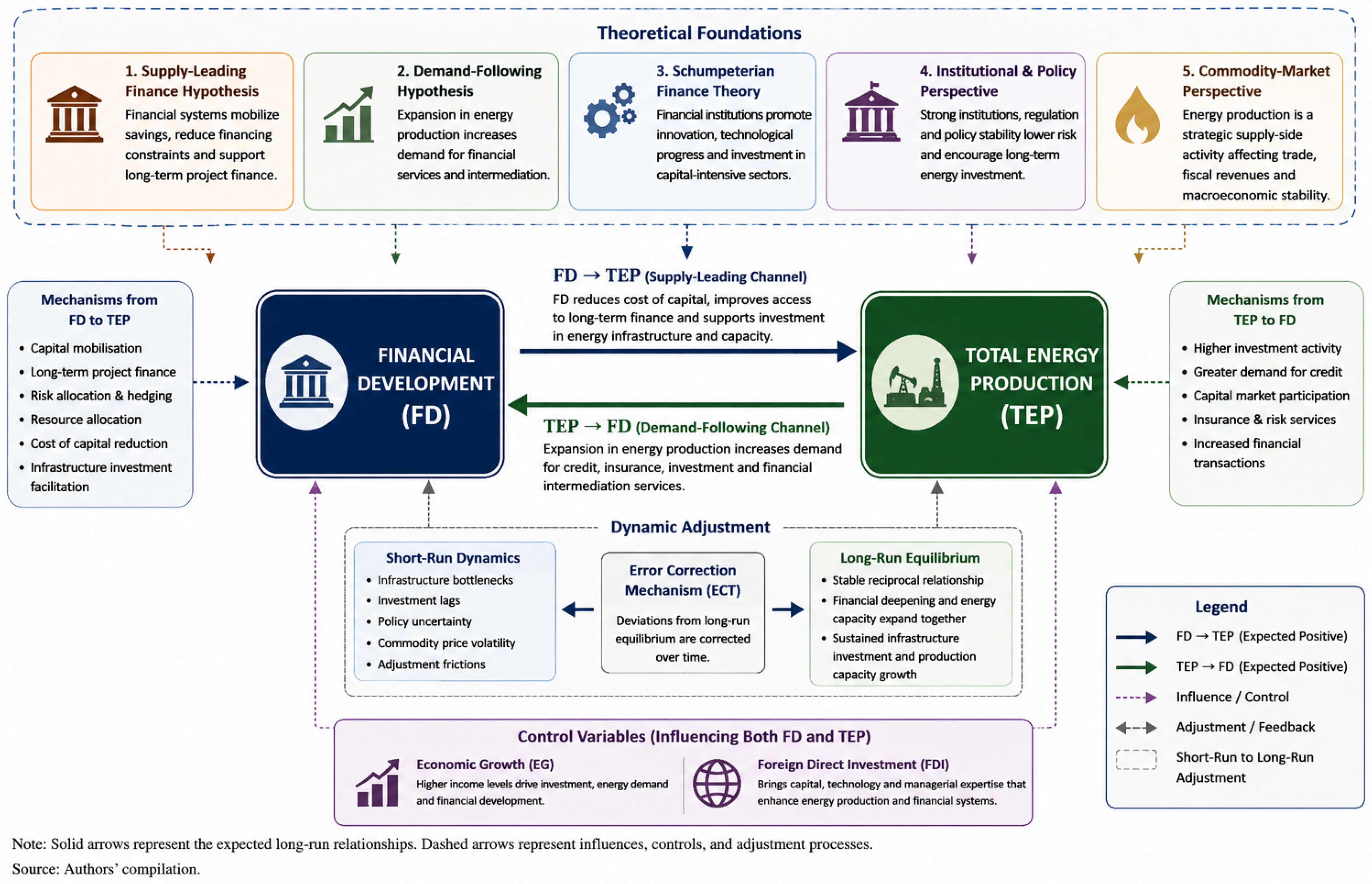
2.4. Conceptual Framework
2.5. Empirical Literature Review
2.6. Hypothesis Development
3. Data and Methodology
3.1. Data and Variables
3.2. Methodology
3.2.1. Panel ARDL–PMG Estimation
3.2.2. Robustness Check: Two-Step System GMM
4. Results
4.1. Panel Unit Root Tests Results
4.2. Descriptive Statistics
4.3. Correlation Analysis
4.4. PMG Estimation Results
5. Discussion
6. Conclusion, Policy Recommendations, and Future Recommendations
6.1. Conclusions
6.2. Policy Recommendations
6.3. Limitations and Future Research
Author Contributions
Funding
Institutional Review Board Statement
Informed Consent Statement
Data Availability Statement
Conflicts of Interest
Appendix A
Appendix A.1. Cointegrating and Causal Relationship Between Financial Development and Total Energy Production

| PMG | PMG | PMG | PMG | Two-Step System GMM | |
|---|---|---|---|---|---|
| Variables | D.FD | D.TEP | D.EG | D.FDI | FD |
| Long-Run | |||||
| EG | 0.0196 *** (−4.77) | 0.0447 *** (2.78) | −0.206 (−1.92) | 0.0105 ** (0.00407) | |
| TEP | 0.724 *** (15.95) | 0.807 *** (0.80) | 0.330 (0.21) | 0.0552 ** (0.0204) | |
| FD | 1.830 (7.17) | 8.030 *** (3.87) | −1.447 (−0.79) | 0.532 *** (0.116) | |
| FDI | 0.00145 (1.40) | −0.000424 (−0.26) | 0.0141 (0.85) | 0.000201 *** (0.0000531) | |
| ECT | −0.277 *** (−4.23) | −0.0952 *** (−4.54) | −0.106 ** (−3.05) | −0.596 *** (−8.27) | |
| Short-Run | |||||
| D.EG | 0.0678 ** (2.75) | 0.0919 (1.94) | −1.133 (−0.66) | ||
| D.TEP | −0.270 *** (−2.32) | 0.845 (0.68) | −12.09 (0.64) | ||
| FD | 0.112 * (1.98) | −1.139 (−1.15) | 13.69 (1.02) | ||
| D. FDI | 0.000645 (0.55) | 0.0000282 (0.02) | 0.0143 (0.63) | ||
| _cons | −0.208 *** (−4.33) | 0.0523 ** (−4.75) | 0.0800 ** (1.85) | 2.662 *** (3.65) | |
| Dummy1 | 0.00432 (0.00497) | ||||
| Dummy2 | 0.0205 *** (0.00333) | ||||
| N | 399 | 399 | 399 | 399 | 359 |
| Groups | - | - | - | - | 20 |
| Instruments | - | - | - | - | 14 |
| Arellano Bond AR 1 | - | - | - | - | −2.97 |
| Arrellano Bond AR 2 Sargan Test | - | - | - | - | −0.51 41.38 |
| Hansen Test | - | - | - | - | 9.69 |
| Hausman | 44.75 *** | 39.55 *** | 64.80 *** | 9.42 * |
Appendix A.2. Unit Root Tests
| Variable | No Trend | Intercept and Trend | Individual Effects | Decision |
|---|---|---|---|---|
| (1) | ||||
| EG | −9.00243 *** | −1.63121 *** | −14.8932 *** | I (1) |
| TEP | −8.95893 *** | −3.51018 *** | −2.01543 *** | I (1) |
| FDI | −3.73481 *** | −3.84931 *** | −3.59057 *** | I (1) |
| FD | −12.5368 *** | −5.76010 *** | −7.01951 *** | I (1) |
| (2) | ||||
| EG | - | −7.32238 *** | −8.86368 *** | I (1) |
| TEP | - | −1.63121 *** | −2.01543 *** | I (1) |
| FDI | - | −3.15388 *** | −4.64037 *** | I (1) |
| FD | - | −6.80194 *** | −8.89608 *** | I (1) |
| (3) | ||||
| EG | 162.126 *** | 119.625 *** | 165.202 *** | I (1) |
| TEP | 153.122 *** | 96.8223 *** | 123.489 *** | I (1) |
| FDI | 58.5960 *** | 69.1745 *** | 95.5074 *** | I (1) |
| FD | 205.413 ** | 121.031 *** | 155.718 *** | I (1) |
| (4) | ||||
| EG | 288.937 *** | 183.140 *** | 211.156 *** | I (1) |
| TEP | 206.953 *** | 96.8223 *** | 191.210 *** | I (1) |
| FDI | 62.4167 *** | 99.6138 *** | 125.058 *** | I (1) |
| FD | 342.526 *** | 282.882 *** | 338.690 *** | I (1) |
Appendix A.3. Descriptive Statistics
| Mean | Median | Minimum | Maximum | Std. Dev | Skewness | Kurtosis | Jarque–Bera | Observ | |
|---|---|---|---|---|---|---|---|---|---|
| FD | 0.42 | 0.42 | 0.09 | 0.74 | 0.14 | 0.08 | 2.39 | 6.90 | 419 |
| TEP | 12.05 | 5.20 | 0.02 | 127.00 | 22.13 | 13.78 | 27.32 | 2768.91 | 419 |
| EG | 8264.37 | 6141.83 | 755.48 | 59,986.44 | 9618.28 | 3.51 | 13.50 | 4062.22 | 419 |
| FDI | 3.08 | 219 | −40.09 | 106.60 | 7.81 | 7.76 | 93.34 | 146,682.60 | 419 |
Appendix A.4. Correlation Analysis
| Variables | FD | EC | EG | FDI |
|---|---|---|---|---|
| FD | 1 | |||
| TEP | 0.2556 *** | 1 | ||
| EG | −0.2951 *** | −0.0266 | 1 | |
| FDI | 0.0977 ** | −0.0564 | −0.0788 | 1 |
References
- Nwangwu, G.A. The link between energy access and economic development. In Africa’s Energy Transition: Pathways from Dependence to Leadership; Springer Nature: Cham, Switzerland, 2025; pp. 17–34. [Google Scholar] [CrossRef] [Scilit]
- Naidu, S.; Chand, A.; Pandaram, A.; Vosikata, S. Electricity consumption, renewable energy production, and current account of Organisation for Economic Co-Operation and Development countries: Implications for sustainability. Sustainability 2024, 16, 3722. [Google Scholar] [CrossRef] [Scilit]
- International Energy Agency. Global Energy Review 2025; International Energy Agency: Paris, France, 2025. [Google Scholar]
- Malhotra, P.; Kumar, S.; Gubareva, M.; Mendes, J.Z. Dynamic nexus of clean energy metals, energy commodities and traditional assets: Multidimensional techniques and portfolio analysis. Res. Int. Bus. Financ. 2026, 81, 103182. [Google Scholar] [CrossRef] [Scilit]
- Wanzala, R.W.; Obokoh, L.O. Sustainability implications of commodity price shocks and commodity dependence in selected Sub-Saharan countries. Sustainability 2024, 16, 8928. [Google Scholar] [CrossRef] [Scilit]
- Ductor, L.; Grechyna, D. Financial development, real sector, and economic growth. Int. Rev. Econ. Financ. 2015, 37, 393–405. [Google Scholar] [CrossRef] [Scilit]
- International Energy Agency. World Energy Outlook 2022: Executive Summary; International Energy Agency: Paris, France, 2022. [Google Scholar]
- Ji, Q.; Zhang, D. How much does financial development contribute to renewable energy growth and upgrading of energy structure in China? Energy Policy 2019, 128, 114–124. [Google Scholar] [CrossRef] [Scilit]
- Demirgüç-Kunt, A.; Levine, R. Finance, Financial Sector Policies, and Long-Run Growth; Policy Research Working Paper; World Bank: Washington, DC, USA, 2008; p. 4469. [Google Scholar] [CrossRef] [Scilit]
- King, R.G.; Levine, R. Finance and growth: Schumpeter might be right. Q. J. Econ. 1993, 108, 717–737. [Google Scholar] [CrossRef] [Scilit]
- Levine, R.; Wiegand, J. Finance, Growth, and Inequality; IMF Staff Discussion Note; International Monetary Fund: Washington, DC, USA, 2021. [Google Scholar] [CrossRef] [Scilit]
- Levine, R.; Zervos, S. Stock markets, banks, and economic growth. Am. Econ. Rev. 1998, 88, 537–558. [Google Scholar]
- Qin, L.; Hou, Y.; Miao, X.; Zhang, X.; Rahim, S.; Kirikkaleli, D. Revisiting financial development and renewable energy electricity role in attaining China’s carbon neutrality target. J. Environ. Manag. 2021, 297, 113335. [Google Scholar] [CrossRef] [Scilit] [PubMed]
- Hussain, S.; Gul, R.; Ullah, S.; Waheed, A.; Naeem, M. Empirical nexus between financial inclusion and carbon emissions: Evidence from heterogeneous financial economies and regions. Heliyon 2023, 9, e13164. [Google Scholar] [CrossRef] [Scilit] [PubMed]
- Xie, N.; Hu, H.; Fang, D.; Shi, X.; Luo, S.; Burns, K. An empirical analysis of financial markets and instruments influencing the low-carbon electricity production transition. J. Clean. Prod. 2021, 280, 124415. [Google Scholar] [CrossRef] [Scilit]
- Sadorsky, P. The impact of financial development on energy consumption in emerging economies. Energy Policy 2010, 38, 2528–2535. [Google Scholar] [CrossRef] [Scilit]
- Geyikci, U.B.; Çınar, S.; Sancak, F.M. Analysis of the relationships among financial development, economic growth, energy use, and carbon emissions by Co-integration with multiple structural breaks. Sustainability 2022, 14, 6298. [Google Scholar] [CrossRef] [Scilit]
- International Energy Agency. World Energy Outlook 2024; IEA: Paris, France, 2024. [Google Scholar]
- Brunnschweiler, C.N. Finance for renewable energy: An empirical analysis of developing and transition economies. Environ. Dev. Econ. 2010, 15, 241–274. [Google Scholar] [CrossRef] [Scilit]
- International Renewable Energy Agency. Geopolitics of the Energy Transition: Energy Security; IRENA: Abu Dhabi, United Arab Emirates, 2024. [Google Scholar]
- International Renewable Energy Agency. Renewable Power Generation Costs in 2024; IRENA: Abu Dhabi, United Arab Emirates, 2025. [Google Scholar]
- Khan, H.; Weili, L.; Khan, I. The role of financial development and institutional quality in environmental sustainability: Panel data evidence from the BRI countries. Environ. Sci. Pollut. Res. 2022, 29, 83624–83635. [Google Scholar] [CrossRef] [Scilit] [PubMed]
- Omri, A.; Daly, S.; Rault, C.; Chaibi, A. Financial development, environmental quality, trade and economic growth: What causes what in MENA countries. Energy Econ. 2015, 48, 242–252. [Google Scholar] [CrossRef] [Scilit]
- Donou-Adonsou, F.; Basnet, H.; Mathey, S. Energy poverty and financial development: Evidence from developing countries. Energy Econ. 2025, 147, 108563. [Google Scholar] [CrossRef] [Scilit]
- Kutan, A.M.; Paramati, S.R.; Ummalla, M.; Zakari, A. Financing renewable energy projects in major emerging market economies. Emerg. Mark. Financ. Trade 2018, 54, 1762–1778. [Google Scholar] [CrossRef] [Scilit]
- Paramati, S.R.; Ummalla, M.; Apergis, N. The effect of foreign direct investment and stock market growth on clean energy use across emerging markets. Energy Econ. 2016, 56, 29–41. [Google Scholar] [CrossRef] [Scilit]
- Sahay, R.; Cihak, M.; N’DIaye, P.; Barajas, A.; Pena, D.A.; Bi, R.; Gao, Y.; Kyobe, A.; Nguyen, L.; Saborowski, C.; et al. Rethinking Financial Deepening: Stability and Growth in Emerging Markets; IMF Staff Discussion Note; International Monetary Fund: Washington, DC, USA, 2015. [Google Scholar]
- Nadeem, M.; Sabir, A.A.; Khan, M.T. Nexus among energy consumption, financial development, trade openness and economic growth: Evidence from South Asian countries. Acad. J. Soc. Sci. (AJSS) 2022, 6, 54–68. [Google Scholar] [CrossRef] [Scilit]
- Marozva, G.; Magwedere, M.R. COVID-19 and stock market liquidity: An analysis of emerging and developed markets. Sci. Ann. Econ. Bus. 2021, 68, 129–144. [Google Scholar] [CrossRef] [Scilit]
- Jebli, M.B.; Youssef, S.B.; Ozturk, I. Testing the environmental Kuznets curve hypothesis: The role of renewable and non-renewable energy consumption and trade in OECD countries. Ecol. Indic. 2016, 60, 824–831. [Google Scholar] [CrossRef] [Scilit]
- Graff, M. Financial Development and Economic Growth: A New Empirical Analysis; Dresden Discussion Paper Series in Economics 1999, No. 05/99; Technische Universität Dresden: Dresden, Germany, 1999; Available online: https://hdl.handle.net/10419/48112 (accessed on 19 February 2026).
- Shan, J.; Qi, J. Does Financial Development ‘Lead’ Economic Growth? The Case of China. Ann. Econ. Financ. 2006, 7, 197–216. [Google Scholar]
- Levine, R. Finance and Growth: Theory and Evidence; NBER Working Paper Series; Elsevier: Amsterdam, The Netherlands, 2004. [Google Scholar]
- Shahbaz, M.; Abosedra, S.; Sbia, R. Energy Consumption, Financial Development and Growth: Evidence from Cointegration with Unknown Structural Breaks in Lebanon; MPRA Paper; University Library of Munich: Munich, Germany, 2013. [Google Scholar]
- Yadav, A.; Bekun, F.V.; Ozturk, I.; Ferreira, P.J.S.; Karalinc, T. Unravelling the role of financial development in shaping renewable energy consumption patterns: Insights from BRICS countries. Energy Strat. Rev. 2024, 54, 101434. [Google Scholar] [CrossRef] [Scilit]
- Liu, H.; Saleem, M.M.; Al-Faryan, M.A.S.; Khan, I.; Zafar, M.W. Impact of governance and globalization on natural resources volatility: The role of financial development in the Middle East and North Africa countries. Resour. Policy 2022, 78, 102881. [Google Scholar] [CrossRef] [Scilit]
- Romer, P.M. Increasing returns and long-run growth. J. Politi. Econ. 1986, 94, 1002–1037. [Google Scholar] [CrossRef] [Scilit]
- Lucas, R.E. On the mechanics of economic development. J. Monet. Econ. 1988, 22, 3–42. [Google Scholar] [CrossRef] [Scilit]
- Balcilar, M.; Usman, O.; Ike, G.N. Investing green for sustainable development without ditching economic growth. Sustain. Dev. 2023, 31, 728–743. [Google Scholar] [CrossRef] [Scilit]
- Schumpeter, J.A. The Theory of Economic Development: An Inquiry into Profits, Capital, Credit, Interest and the Business Cycle; Harvard University Press: Cambridge, MA, USA, 1934. [Google Scholar]
- Apergis, N.; Payne, J.E. A dynamic panel study of economic development and the electricity consumption–growth nexus. Energy Econ. 2011, 33, 770–781. [Google Scholar] [CrossRef] [Scilit]
- Grossman, G.M.; Krueger, A.B. Economic growth and the environment. Q. J. Econ. 1995, 110, 353–377. [Google Scholar] [CrossRef] [Scilit]
- Rodrik, D. Institutions and economic performance: Getting institutions right. CESifo DICE Rep. 2004, 2, 10–15. [Google Scholar]
- Khan, H.H. Bank competition, financial development and macroeconomic stability: Empirical evidence from emerging economies. Econ. Syst. 2022, 46, 101022. [Google Scholar] [CrossRef] [Scilit]
- Paramati, S.R.; Mo, D.; Huang, R. The role of financial deepening and green technology on carbon emissions: Evidence from major OECD economies. Financ. Res. Lett. 2021, 41, 101794. [Google Scholar] [CrossRef] [Scilit]
- Teklie, D.K.; Yağmur, M.H. The role of green innovation, renewable energy, and institutional quality in promoting green growth: Evidence from African countries. Sustainability 2024, 16, 6166. [Google Scholar] [CrossRef] [Scilit]
- Khan, H.; Khan, S.; Zuojun, F. Institutional quality and financial development: Evidence from developing and emerging economies. Glob. Bus. Rev. 2022, 23, 971–983. [Google Scholar] [CrossRef] [Scilit]
- Pesaran, M.H.; Shin, Y.; Smith, R.J. Bounds testing approaches to the analysis of level relationships. J. Appl. Econom. 2001, 16, 289–326. [Google Scholar] [CrossRef] [Scilit]
- Shin, Y.; Smith, R.P.; Pesaran, M.H. Pooled Mean Group Estimation of Dynamic Heterogeneous Panels; Econometrics and Quantitative Economics Working Paper; University of Edinburgh: Edinburgh, UK, 1998. [Google Scholar]
- Engle, R.F.; Granger, C.W.J. Co-integration and error correction: Representation, estimation, and testing. Econometrica 1987, 55, 251–276. [Google Scholar] [CrossRef] [Scilit]
- Narayan, P.K. Fiji’s tourism demand: The ARDL approach to cointegration. Tour. Econ. 2004, 10, 193–206. [Google Scholar]
- Nxumalo, I.S.; Makoni, P.L. Analysis of international capital inflows and institutional quality in emerging markets. Economies 2021, 9, 179. [Google Scholar] [CrossRef] [Scilit]
- Wehncke, F.C.; Marozva, G.; Makoni, P.L. Economic growth, foreign direct investments and official development assistance nexus: Panel ARDL approach. Economies 2023, 11, 4. [Google Scholar] [CrossRef] [Scilit]
- Baltagi, B.H. Econometric Analysis of Panel Data, 3rd ed.; John Wiley & Sons: Chichester, UK, 2005. [Google Scholar]
- Hsiao, C. Analysis of Panel Data, 3rd ed.; Cambridge University Press: Cambridge, UK, 2014. [Google Scholar]
- Nkalu, C.N.; Ugwu, S.C.; Asogwa, F.O.; Kuma, M.P.; Onyeke, Q.O. Financial development and energy consumption in Sub-Saharan Africa: Evidence from panel vector error correction model. SAGE Open 2020, 10, 2158244020935432. [Google Scholar] [CrossRef] [Scilit]
- Toktaş, Y.; Bozkurt, E.; Altiner, A. Energy consumption and financial development: Evidence from MENA countries with panel hidden cointegration. J. Emerg. Econ. Policy 2022, 7, 253. [Google Scholar]
- Wang, Y.; Pan, L. Application and practice of intelligent infrastructure in urban transportation management. In Advances in Urban Engineering and Management Science; CRC Press: Boca Raton, FL, USA, 2022; Volume 1, pp. 473–481. [Google Scholar] [CrossRef] [Scilit]
- International Monetary Fund. Global Financial Stability Report: Safeguarding Financial Stability amid High Inflation and Geopolitical Risks; IMF: Washington, DC, USA, 2023. [Google Scholar]
- International Energy Agency. World Energy Investment 2025, 10th ed.; IEA: Paris, France, 2025. [Google Scholar]
| Technology | Total Installed Costs (2010) | Total Installed Costs (2024) | % Change | Capacity Factor (2010) | Capacity Factor (2024) | % Change | LCOE (2010) | LCOE (2024) | % Change |
|---|---|---|---|---|---|---|---|---|---|
| Bioenergy | 3082 | 3242 | 5% | 72 | 73 | 1% | 0.086 | 0.087 | 1% |
| Geothermal | 3083 | 4015 | 30% | 87 | 88 | 1% | 0.055 | 0.060 | 9% |
| Hydropower | 1494 | 2267 | 52% | 44 | 48 | 9% | 0.044 | 0.057 | 30% |
| Solar PV | 5283 | 691 | −87% | 15 | 17 | 13% | 0.417 | 0.043 | −90% |
| CSP | 10703 | 3677 | −66% | 30 | 41 | 37% | 0.402 | 0.092 | −77% |
| Onshore Wind | 2324 | 1041 | −55% | 27 | 34 | 26% | 0.113 | 0.034 | −70% |
| Offshore Wind | 5518 | 2852 | −48% | 38 | 42 | 11% | 0.208 | 0.079 | −62% |
| Authors | Countries | Methodology | Results |
|---|---|---|---|
| [34] | 22 EMEs | Panel regression | Financial development → energy consumption |
| [31] | South Africa | ARDL+ Granger | Finance → energy in the long run |
| [20] | Mena & BRICS | Panel FMOLS | Bidirectional causality |
| [39] | EMEs | Panel ARDL–PMG | Finance ↔ renewable energy |
| [48] | Developing Countries | Panel ARDL | Threshold effect: finance boosts renewables |
| [46] | Developing Countries | System GMM | Conditional effect via institutions |
| [47] | African (49 Countries) | PMG Estimator | Weak/no direct effect of finance on energy output |
| Variable | Description | Role in the Model | Source | Expected Relationship |
|---|---|---|---|---|
| FD | Financial Development Index | Core endogenous variable | IMF Financial Development Database | Bidirectional relationship with TEP |
| TEP | Total Energy Production (MMBtu) | Core endogenous variable | International Energy Agency (IEA) | Bidirectional relationship with FD |
| EG | Real GDP per capita | Control variable | World Development Indicators | Positive or negative |
| FDI | Foreign direct investment | Control variable | World Development Indicators | Positive |
| Direction | Long-Run Effect | Short-Run Effect | Causal Interpretation |
|---|---|---|---|
| EG → FD | (0.0196) *** | (0.0678 **) | Economic Growth stimulates financial development in both the short and long run. |
| TEP → FD | (0.724) *** | (−0.270 ***) | Energy production promotes financial development in the long run, while short-run adjustment shows a temporary adverse effect. |
| FD → TEP | (1.830) ** | (0.112 *) | Financial development enhances total energy production in both horizons. |
| FD → EG | (0.830) *** | (−1.139) | Financial development drives long-run economic growth, but short-run effects are negligible. |
| ECT (FD) | (−0.277) *** | - | 27.7% speed of adjustment toward the long-run equilibrium for financial development. |
| ECT (TEP) | (−0.0952) *** | - | 9.5% adjustment speed, indicating slower convergence in total energy production. |
Disclaimer/Publisher’s Note: The statements, opinions and data contained in all publications are solely those of the individual author(s) and contributor(s) and not of MDPI and/or the editor(s). MDPI and/or the editor(s) disclaim responsibility for any injury to people or property resulting from any ideas, methods, instructions or products referred to in the content. |
© 2026 by the authors. Licensee MDPI, Basel, Switzerland. This article is an open access article distributed under the terms and conditions of the Creative Commons Attribution (CC BY) license.
Share and Cite
Mugodzva, C.; Marozva, G.; Magwedere, M. Total Energy Production and Financial Development: Evidence from Selected EMEs. Commodities 2026, 5, 13. https://doi.org/10.3390/commodities5030013
Mugodzva C, Marozva G, Magwedere M. Total Energy Production and Financial Development: Evidence from Selected EMEs. Commodities. 2026; 5(3):13. https://doi.org/10.3390/commodities5030013
Chicago/Turabian StyleMugodzva, Collen, Godfrey Marozva, and Margaret Magwedere. 2026. "Total Energy Production and Financial Development: Evidence from Selected EMEs" Commodities 5, no. 3: 13. https://doi.org/10.3390/commodities5030013
APA StyleMugodzva, C., Marozva, G., & Magwedere, M. (2026). Total Energy Production and Financial Development: Evidence from Selected EMEs. Commodities, 5(3), 13. https://doi.org/10.3390/commodities5030013

