Systematic Review

Digital Forest Bathing: A Systematic Review

1
Department of Psychology and Psychotherapy, Witten/Herdecke University, Alfred-Herrhausen-Strasse 50, 58448 Witten, Germany
2
Institute for General Practice and Interprofessional Care, University Hospital Tübingen, 72076 Tübingen, Germany
3
Robert Bosch Center for Integrative Medicine and Health, Bosch Health Campus, 70376 Stuttgart, Germany
*
Author to whom correspondence should be addressed.
Virtual Worlds 2026, 5(1), 9; https://doi.org/10.3390/virtualworlds5010009
Submission received: 21 December 2025 / Revised: 16 January 2026 / Accepted: 29 January 2026 / Published: 6 February 2026

Abstract

In recent years, forest bathing has gained popularity worldwide due to its many positive effects on health. In the face of increasing urbanization and limited access to natural forests, digital forest bathing is a promising alternative. Digital forest bathing could also be an option for people with restricted mobility, which could be a way to make the health-promoting effects of forests more accessible. This systematic review examines the current state of research on digital forest bathing, considers the associated effects, and highlights the technical possibilities and thereby consolidates the currently limited evidence base in this emerging field. For literature identification, the databases APA, PsycInfo, PubMed, PubPsych, Scopus, and Google Scholar were searched. A total of four studies were included. The results indicate that digital forest bathing could have positive effects on relaxation and well-being that could be comparable to real-life forest bathing, and summarize how interventions were technically implemented across the included studies. As there are still a few studies on digital forest bathing, the implementation of the research varies greatly, and some studies have risks of bias; the results presented here should be interpreted with caution. In addition to a critical examination of the study designs and quality, suggestions for further research in this area are given, and key methodological constraints relevant for interpreting early effects are outlined.

1. Introduction

Natural areas are of great importance to humans as they provide food and shelter as well as symbolic and cultural significance [1]. In addition, numerous studies confirm the many positive effects of nature on health. A recent meta-analysis showed that even short periods spent in nature significantly promote social, mental, and physical well-being [2]. In Japan, the health-promoting effects of spending time in nature in the form of forest bathing (Shinrin-Yoku) have been used as a preventative measure since the 1980s [3]. Forest bathing is also becoming increasingly popular outside Japan, which is reflected in the rapidly growing number of research papers [4]. Several systematic reviews and meta-analyses report that forest bathing reduces stress [5], as well as having a positive influence on anxiety and depression [6,7,8,9,10,11]. It has also been shown that forest bathing has positive effects on sleep quality [12,13], mood and well-being [11,14], as well as on physiological, cardiovascular and metabolic functions [15,16,17,18,19].
In addition, studies indicate that forest bathing has positive effects on physical and mental recovery [20]. In view of the increasing complexity and acceleration of modern society, which presents many people with challenges due to the demands of everyday work and daily pressures [21], methods for reducing stress and promoting recovery are becoming increasingly important [22]. In this context, forest bathing represents an effective and cost-effective method for reducing stress and promoting recovery [23]. People with high chronic stress levels, in particular, benefit significantly from forest visits and show a significant reduction in their stress levels [24].
However, due to increasing urbanization, fewer and fewer people have access to forests. It is estimated that 55% of the world’s population currently lives in cities, and this proportion is expected to rise to 68.6% by 2050 [25]. There are currently 34 megacities worldwide (at least 10 million inhabitants), and the United Nations estimates that by 2030, the number of megacities worldwide will increase to 43 [26]. It often takes several hours to reach a forest or to reach a forest or other natural landscape from these cities [27]. Other groups of people are also affected by mobility restrictions. It is estimated that 16% of the world’s population has limited mobility [28]. Older people in particular, who often suffer from physical and cognitive limitations [29] (Robert Koch Institute, 2015), are particularly affected by mobility restrictions. Nevertheless, this population group in particular benefits from the positive effects of forest bathing [30]. In view of these facts, the search for alternative ways of experiencing is becoming increasingly important. In such cases, virtual environments of forest landscapes provide a valuable alternative to real forest bathing and offer a substitute for those who have limited access to the forest [27]. With the use of virtual reality (VR), immersive forest bathing experiences can be simulated, a tool known as digital forest bathing or digital Shinrin-Yoku [31]. With the recent technological advances, VR has become a promising tool in preventive healthcare that offers new opportunities to improve mental opportunities to improve mental well-being [32]. It is currently being used more and more frequently as an intervention method in psychotherapy [33]. Current research is investigating digital forest bathing as a possible intervention method. Apparently, no systematic review on this topic does exist yet.
The aim of this systematic review is to examine the current state of research on digital forest bathing and to examine the effects and technical possibilities of this approach. In addition, the question is asked to what extent digital forest bathing is comparable to real forest bathing.

2. Materials and Methods

The following systematic review has been reported in accordance with the Preferred Reporting Items for Systematic Reviews and Meta-Analyses (PRISMA Statement), describing the study selection process (including reasons for exclusion), data extraction, and risk-of-bias assessment [34]. The completed PRISMA Checklist is available as Supplementary Material S1. For the development of a searchable question, the PICOS scheme (population, intervention, comparison, outcomes, and study designs) was used [35], with which the original question was broken down into named components in order to better structure relevant information [36]. The central questions of the review are: What is the current state of research on digital forest bathing? What are the effects of digital forest bathing? It also examines which technical possibilities for digital forest bathing exist and to what extent digital forest bathing is comparable to physical forest bathing.
The review was not registered in a public database, and post hoc registration was not pursued.

2.1. Search Strategy

A systematic database search was conducted on 10 October 2025 in the five databases APA PsycInfo, PubMed, PubPsych, Scopus, and Google Scholar. The search terms are derived from the research question and refer to the intervention according to the PICOS scheme. Synonyms were searched for, and the terms were translated into English. The following search term was used in all databases, except for the search with Google Scholar: (forest bathing OR Shinrin-Yoku) AND (virtual reality OR digital). When searching in Google Scholar, the “allintitle” function was used and four separate searches with the terms forest bathing AND virtual reality; forest bathing AND digital; Shinrin-Yoku AND virtual reality; Shinrin-Yoku AND digital.

2.2. Inclusion and Exclusion Criteria

Based on the research question, the PICOS scheme was used to define inclusion and exclusion criteria for the systematic review, which were defined based on the research question. The PICOS scheme provides a framework for defining precise research questions and guiding the research structure [35].
The components of the scheme are the population (P), the intervention (I), the Iparison (C), the outcome or result (O) and the study outcome (O) and the study design (S). Population (P): It was decided to include every population in order to obtain a comprehensive database. Intervention (I): The intervention was defined as digital forest bathing, with a focus on virtual reality (VR). Therefore, a VR experience with a head-mounted display (HMD) was defined as the interventioIComparison (C): A comparison was omitted here, as this paper does not include a comparison with an alternative measure to digital forest bathing. Outcome (O): An open outcome was selected as the outcome, as this systematic review should first investigate whether digital forest bathing has any effects at all. Study design (S): It was decided that clinical studies, experimental studies, case studies, technical publications, case studies, technical publications and conference reports were included in order to provide the broadest possible overview.
The PICOS scheme of this systematic review is shown in Table 1.
The following inclusion and exclusion criteria were defined: Studies were included were included if they involved (a) a VR experience with a head-mounted display (HMD), (b) digital forest bathing or digital Shinrin-Yoku as an intervention, (c) clinical studies, experimental studies, case studies, technical publications or conference proceedings, (d) were published in English or German. Exclusion criteria were (a) Reviews, qualitative study designs, study protocols, books, and book chapters, (b) studies that did not have forest bathing as an intervention, (c) studies with VR without HMD, and (d) studies in languages other than English or German.

2.3. Study Selection Process

The previously defined search terms were entered into the databases APA PsycInfo, PubMed, PubPsych, Scopus, and Google Scholar. The identified articles were fully documented. All duplicates were then removed.
The articles were then checked for titles and abstracts. Studies that did not meet the predefined inclusion and exclusion criteria were removed in this phase. Articles were shortlisted if the title or abstract indicated that the study could fulfill the inclusion criteria. From this selection, in the final step, full texts were reviewed to determine whether they actually met the inclusion criteria.

2.4. Data Extraction

The characteristics of the four included studies are presented in three tables. The content of the tables includes the first author, the year of publication, the country of survey, the subjects, the intervention, the study objective, characteristics of the experimental condition, measurement instruments, measurement times, and results.

2.5. Assessment of the Risk of Bias

The quality of the included studies was assessed using the Cochrane ‘Risk of bias’ instrument [35]. This involved an assessment of the risk of bias (hereafter abbreviated to RoB), which was undertaken. The Cochrane RoB instrument for randomized controlled trials consists of seven domains. For each study, the individual domains are assigned either a low RoB, a high RoB, or an unclear RoB [35].
The domains are (1) Generation of the randomization sequence, (2) Secrecy and unpredictability of group allocation, (3) blinding of study personnel/participants during treatment, (4) Blinding of endpoint collection/assessment, (5) Missing data at endpoint collection (6) Selective reporting of outcomes and (7) Other causes of bias.
The Cochrane RoB instrument for non-randomized studies also consists of seven domains. The domains are (1) RoB due to confounding factors, (2) bias due to selection participants into the study groups, (3) bias due to recording of the intervention, (4) bias by deviation in the intervention phase, (5) bias due to missing data, (6) bias in the endpoint survey, and endpoint collection, and (7) bias due to selective reporting of endpoints. The studies were assessed individually on the basis of the domains and the reasons for the respective Cochrane RoB tables.

3. Results

3.1. Search Results

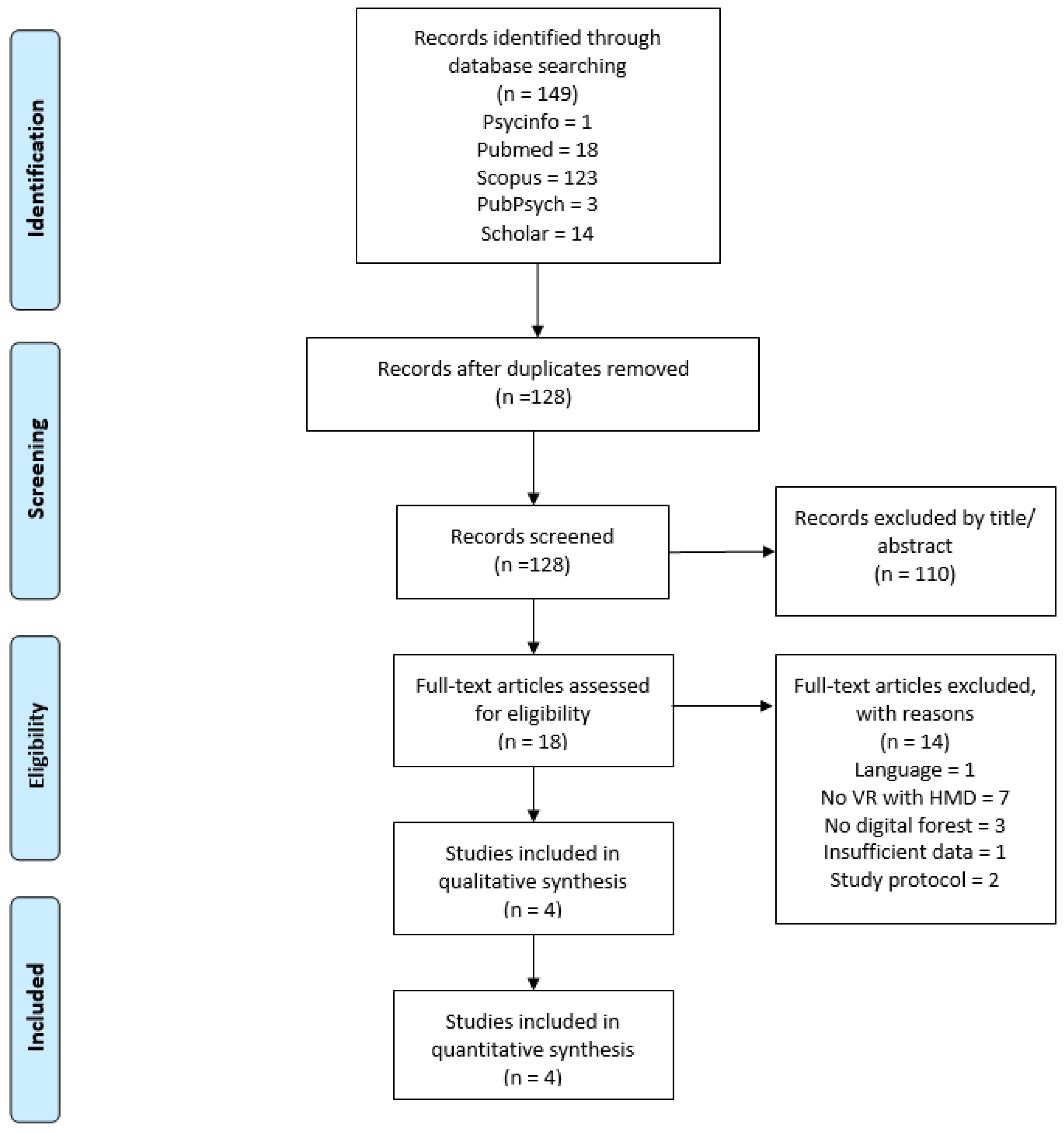
Based on the literature search according to the PICOS scheme, a total of 149 articles were identified: 1 article in APA PsycInfo, 18 articles in PubMed, 123 articles in Scopus, 3 articles in PubPsych, and 14 articles in Google Scholar. Of the identified articles, 21 were removed due to duplicates.
Of the remaining 128 studies, titles and abstracts were checked. In the first pass, 110 studies were excluded because they did not meet the inclusion criteria, leaving 14 documents for a detailed full-text review.
In this round, one study was excluded because it was only published in Japanese, seven studies were excluded because they did not include virtual experience with a head-mounted display, three studies were excluded because they did not include a virtual forest environment, one study was excluded because it did not include any information on the VR used and two studies reported only a study protocol.
Thus, four studies (one randomized controlled trial and three experimental studies) with a total of 117 participants were included in this review. Figure 1 shows the complete study selection process.

3.2. Characteristics of the Included Studies

All four included studies [27,31,37,38] were published in 2022 (see Table 2). The sample sizes for three of the four included studies are small, with 16 [31], 25 [31], and 26 subjects [37] (Masters et al., 2022). The samples consist predominantly of young participants, some of whom are university students [37], who often do not represent the full spectrum of age, socioeconomic status, and ethnicity. In addition, some studies do not have a balanced gender ratio in the sample [31,38].
Table 3 describes the experimental conditions of the studies. Both, the virtual forest environment and the duration of the digital forest bathing experience varied considerably in the included studies: while all studies had visual and auditory stimuli, the study of Lopes et al. [31] also included olfactory and tactile stimuli as well as a scent device, heating elements, and fans. Also, the duration varied across the included studies, ranging from just over one minute [31] to an average of around seven minutes [38] and ten minutes [37] to thirty minutes [27].

3.3. Health Outcomes

Only one of the four studies [31] recorded objective, physiological parameters, while the other three studies only investigated subjective, psychological variables. In the study by Hejtmánek et al. (2022) [27], digital forest bathing led to a smaller increase in recovery than real forest bathing (Physical forest: Cohen’s d = 0.516, Digital forest = 0.250). However, in this study, a significant correlation was reported between the occurrence of cyber sickness and a reduction in relaxation. In the study by Reese et al. (2022) [38], digital forest bathing led to a similar increase in positive effects (Physical forest: Cohen’s d = 0.49, Digital forest = 0.30) and a decrease in negative effects (Physical forest: Cohen’s d = 0.81, Digital forest = 0.59) as with real forest bathing.
In addition, both the digital and the real forest led to a slight reduction in stress. The virtual forest was rated as similarly relaxing as the real forest, and the participants felt almost as relaxed after digital forest bathing as after real forest bathing. Table 4 presents the measurement instruments used, the measurement times, and the results of the studies. However, the perceived relaxation after real forest bathing was latently more pronounced.
In the study by Lopes et al. (2022) [31], which compared a conventional digital VR forest bathing experience (sensory, visual) with an ultra-reality forest bathing experience with the additional integration of olfactory and tactile stimuli, subjective relaxation was higher in the ultra-reality forest bathing experience than in conventional digital forest bathing (t(15) = −4.04, p < 0.01). Changes in the physiological parameters associated with a relaxation response were observed in both conventional digital forest bathing and ultra-reality forest bathing.
In the study by Masters et al. (2022) [37], no change in affect was observed after digital forest bathing, and no restorative quality of the digital forest environment was observed.

3.4. Technical Aspects

The technical implementation of the virtual forest environment also differs considerably in the included studies. While the virtual forest in the study by Masters et al. (2022) [37] differs significantly from a real forest, and the authors cite the lack of aesthetics of the forest as a limitation of the study, the study by Hejtmánek et al. (2022) [27] aimed to create a digital forest twin. Three of the four included studies integrated only visual and auditory stimuli into the virtual experience. Only in [27] was it possible to move around in the virtual world using one’s own body movements. In the other studies, this was not possible or was only possible with a controller.

3.5. Risk of Bias Assessment

To assess the risk of bias in the included studies, the Cochrane ‘Risk of Bias’ tool (RoB) was used. For one of the studies [38], the Cochrane RoB tool for randomized controlled trials was used. For the remaining studies [27,31,37], the Cochrane RoB tool for non-randomized studies was applied. The results of the evaluation can be seen in Table 5 and Table 6.
All included studies show an increased risk of selection bias due to a small and/or too homogeneous sample, which can lead to limitations on the reliability of the studies. In addition, two studies [31,37] showed an increased risk of gender bias due to the unequal ratio of genders in the sample.
In one study [27], there is also a risk of selection bias because, on the one hand, the sample was only pseudorandomized to the conditions and, on the other hand, many subjects did not participate in the follow-up measurement. Due to the missing data and unequal distribution of the missing measurements in the two conditions, this study was also assessed as having an increased risk of attrition bias.
A critical risk for bias is also present in [31], as some data were not collected or had to be deleted due to technical problems. In [38], a high risk of detection bias was judged due to a lack of blinding. In [37], there is an unclear risk of bias, as no details were provided.
In [31], there is also a high risk of reporting bias, as only the values of significantly positive results were reported, and the results of two named endpoints (respiration; skin temperature) were omitted. In this study, there is also an unclear risk of bias in the collection of endpoints in this study, as there is only a very short measurement duration of approximately one minute, and therefore, the results of the ECG measurement could be inaccurate.
However, the extent of the possible bias cannot be assessed. Subjective measuring instruments were used in all of the studies, which may also contribute to a risk of bias in the results. Nevertheless, all studies used validated measurement instruments to record subjective endpoints.

4. Discussion

This systematic review examined the current state of research on digital forest bathing and considered its effects. In addition, the technical possibilities for digital forest bathing and the comparability of digital and physical forest bathing were examined.
The current state of research on this topic is still very limited, with only four studies included. This could be because the field of research is still young. All four included studies were published in 2022. Due to the small number of studies and the high degree of heterogeneity within them, as well as the different parameters examined, no uniform or clear results could be conclusively determined.
Although three of the four studies suggest that digital forest bathing could have a relaxing and restorative effect, which could even be comparable to real-life forest bathing, the results should be viewed with caution due to the small sample size. In addition, the samples of the included studies are limited in terms of their selection of subjects. Current studies show that gender has a small but considerable influence on the occurrence of cyber sickness and that women are affected more frequently than men are [39]. To better explore the effects of digital forest bathing, future study designs should select larger and more representative samples and consider the effect of cyber-sickness in more detail [40].
The duration of the digital forest bathing experience could also influence the effectiveness of the application. Studies on real forest bathing show that longer forest bathing programs (20 min or longer) achieve stronger stress-reducing and blood pressure-lowering effects [41]. However, a longer virtual experience also significantly increases the likelihood of cyber-sickness [42]. Future research should aim to determine the optimal duration of digital forest bathing experiences in order to maximize the positive effects of forest bathing while reducing the risk of cyber-sickness.
In addition, the digital forest environment should be as similar as possible to a real forest environment in order to be able to draw a comparison between digital forest bathing and real forest bathing. The structure and composition, as well as the perceived beauty of the forest, are important aspects of the recreational effect of forest bathing [43,44]. A virtual environment designed as realistically as possible also increases the likelihood of an immersive experience in the virtual world [45]. The immersive experience in VR also reduces the risk of cyber-sickness [42,46]. As the relaxing effect is an essential aspect of forest bathing, future research should specifically measure the occurrence of cyber-sickness and identify strategies to reduce it.
One of the core elements of forest bathing is the mindful use of all five senses [44]. Studies on the individual sensory experiences have shown that even looking at nature photographs can have a positive influence on mood [47,48] and that the soundscape of the forest during forest bathing contributes most to well-being [49]. Studies on the sense of smell show that natural scents can reduce stress and act as a catalyst for sensory perceptions and memories [50] and that the typical smell of wood odor leads to an improved subjective well-being and also has an objective, relaxed physiological state [51]. Studies on touch show that there is a close relationship between tactile stimuli and the release of neurotransmitters such as oxytocin [52].
Unfortunately, there are hardly any studies investigating the tactile effect of forest elements. The only study that deals with the tactile effect of forest bathing found that touching oak bark that touching oak bark led to an objectively measurable, physiological relaxation response [51]. This research on the individual sensory modalities is important to ensure that the research field is able to fully cover the multisensory and holistic forest therapy spectrum. They also provide valuable insights for optimizing virtual experiences. In the context of the digitalization of forest bathing, future research should continue to explore the influences of the five senses, which contribute significantly to the therapeutic effects of forest bathing [53].
However, there are some health-promoting factors of the forest environment that cannot be integrated into a VR experience, such as the forest climate or phytoncides [54]. Another significant difference between digital and real forest bathing in the studies investigated was locomotion. Many forest bathing programs integrate light physical activities such as walking and mind-body exercises such as Tai Chi or gentle yoga [44]. Nevertheless, there is little research comparing the effect of forest bathing while sitting and forest bathing while walking [55]. However, walking is generally associated with therapeutic effects [56]. Another study [57] showed that it is possible to improve mood by walking in green spaces for twenty-five minutes. Despite low levels of physical activity, three of the included studies found a positive effect on subjectively perceived recovery and relaxation. This indicates a positive effect of digital forest bathing with low physical activity.
Digital forest bathing could therefore also be a valuable and accessible alternative to conventional forest bathing for people with limited mobility. A qualitative study [28], which investigated the effect of digital forest bathing via Zoom on twenty-six participants with limited mobility or low energy, found, among other things, that digital forest bathing led to feelings of relaxation, connectedness, and well-being, as well as evoking memories of previous nature experiences. The effectiveness reported by participants suggests that digital forest bathing could be an accessible option for adults with mobility impairments or low energy to promote their well-being [28]. Even though research on digital forest bathing is still in its infancy, and the study situation is limited and very heterogeneous, and the technology still has some limitations, initial findings suggest that digital forest bathing can have regenerative and relaxing effects that may even be comparable to conventional forest bathing. The integration of VR-based digital forest bathing into health care could compensate for the deficits caused by a lack of access to nature [58]. However, further research is needed to investigate the physical and mental health impact of digital forest landscapes and to develop the technical implementation in such a way that an optimal effect can be achieved. Although digital forest bathing cannot replace direct contact with nature, it could still make a valuable contribution by making the health-promoting and relaxing effects of forests accessible to people who otherwise have little access to nature.
Taken together, the small and methodologically diverse evidence base is best interpreted as a meaningful indicator of the field’s current stage: digital forest bathing is still being established, heterogeneous terminology is being used, conceptual boundaries are still being negotiated, and relevant work is often being dispersed across adjacent domains that do not consistently align with the construct defined in this review.
Accordingly, the available findings are intentionally presented in a descriptive manner, and conclusions are not extended beyond the review question—for example, direct contrasts between digital and in-person forest bathing are not drawn, and generalizations to related but out-of-scope intervention formats are avoided—because a sufficiently consistent basis for such comparisons is not provided by the included studies.
Subjective and objective outcomes are likewise treated as complementary rather than competing indicators, as different levels of analysis are being captured and cross-study contrasts risk being driven by methodological variation rather than construct differences. While future primary empirical work (e.g., interviews, surveys, and experiments) is expected to be valuable for consolidating definitions, refining intervention designs, and strengthening causal inference, such approaches might be characterized by a different study aim and design than the present synthesis of the currently limited and still emerging evidence base.

Limitations

A key limitation of this review is the overall methodological quality of the evidence base, as only one included study was a randomized controlled trial and three were non-randomized studies, which inherently limits causal inference.
In the RCT, risks related to randomization procedures and allocation concealment, as well as uncertainty around blinding of outcome assessment, indicate that systematic group differences and biased outcome evaluation cannot be ruled out.
The non-randomized studies showed elevated risks, particularly with respect to confounding and missing data, which further reduces confidence in the stability and generalizability of the reported effects; therefore, conclusions regarding effectiveness should be interpreted with caution.
Moreover, as the literature search was only conducted in English-language databases and only English and German-language studies met the inclusion criteria, this could lead to a systematic bias in the identified and documented study findings. It should be noted that Japan and South Korea are the countries with the highest scientific output of studies on forest bathing [4], and it can be assumed that some studies will not be published in English.
Another weakness of this review is that a large proportion of the included studies are not randomized controlled trials. This is in part due to the fact that digital forest bathing is a young field of research. Due to the different study designs and the technical implementation of the studies, the results can only be compared and contrasted with each other to a limited extent.
A further limitation is the small body of eligible review-level evidence: applying the pre-defined inclusion criteria, only four review papers were included. This restricts the breadth of the evidence base and limits the strength and generalizability of conclusions regarding health effects, technical implementations, and comparability with real-world forest bathing. Also, due to the small number of studies, with only four included, no generally valid statements can be made at this point, i.e., in terms of a meta-analysis.
Finally, potential mechanisms underlying the effects of digital forest bathing cannot be derived with confidence from the current evidence base. The small number of studies and heterogeneity in intervention implementation and outcome assessment restrict theory-driven interpretation beyond reporting observed outcomes. Future research should explicitly measure candidate processes (e.g., stress regulation, attentional restoration, affective responses) to enable more robust mechanistic conclusions.

5. Conclusions

Even though some technical hurdles remain, the limited evidence identified to date suggests that digital forest bathing may have beneficial effects; however, given the small number of eligible studies and the heterogeneity of designs and implementations, these findings should be interpreted with caution. Against the background of ongoing urbanization, digital forest bathing may represent a promising direction for future health applications, but its potential for the health system cannot yet be conclusively determined and requires further rigorous research.

Supplementary Materials

The following supporting information can be downloaded at: https://www.mdpi.com/article/10.3390/virtualworlds5010009/s1, Table S1: PRISMA-Checklist.

Author Contributions

Conceptualization, T.O. and L.T.; methodology, T.O. and D.A.; data curation, L.T.; writing—original draft preparation, L.T.; writing—review and editing, T.O. and D.A.; visualization, L.T., T.O. and D.A.; supervision, T.O. All authors have read and agreed to the published version of the manuscript.

Funding

This research received no external funding.

Institutional Review Board Statement

Not applicable.

Informed Consent Statement

Not applicable.

Data Availability Statement

No new data were created or analyzed in this study.

Conflicts of Interest

The authors declare no conflicts of interest.

References

  1. Scannell, L.; Gifford, R. The relations between natural and civic place attachment and pro-environmental behavior. J. Environ. Psychol. 2010, 30, 289–297. [Google Scholar] [CrossRef]
  2. Bettmann, J.E.; Speelman, E.; Blumenthal, E.; Couch, S.; Schmalz, D.L. Nature Exposure, Even as Little as 10 Minutes, is Likely to Yield Short-Term Benefits for Adults with Mental Illness: A Meta Analysis. Ecopsychology 2024, 16, 174–190. [Google Scholar] [CrossRef]
  3. Zhang, S.; Teng, J.; Zeng, Y.; Song, H.; Gu, Z. The effects of forest therapy on public mental health and circular economy: A policy support model in Japan. Front. Public Health 2022, 10, 1042589. [Google Scholar] [CrossRef] [PubMed]
  4. Denche-Zamorano, A.; Rodríguez-Redondo, Y.; Rojo-Ramos, J.; Miguel-Barrado, V.; Sánchez-Leal, A.; Pérez-Calderon, E. Global Review of Literature on Forest Bathing. Austrian J. For. Sci. 2024, 141, 145–170. [Google Scholar] [CrossRef]
  5. Antonelli, M.; Donelli, D.; Carlone, L.; Maggini, V.; Firenzuoli, F.; Bedeschi, E. Effects of forest bathing (shinrin-yoku) on individual well-being: An umbrella review. Int. J. Environ. Health Res. 2021, 32, 1842–1867. [Google Scholar] [CrossRef]
  6. Hansen, M.M.; Jones, R.; Tocchini, K. Shinrin-Yoku (Forest Bathing) and Nature Therapy: A State-of-the-Art Review. Int. J. Environ. Res. Public Health 2017, 14, 851. [Google Scholar] [CrossRef] [PubMed]
  7. Kotera, Y.; Richardson, M.; Sheffield, D. Effects of shinrin-yoku (forest bathing) and nature therapy on mental health: A systematic review and metaanalysis. Int. J. Ment. Health Addict. 2022, 20, 337–361. [Google Scholar] [CrossRef]
  8. Lee, I.; Choi, H.; Bang, K.-S.; Kim, S.; Song, M.K.; Lee, B. Effects of forest therapy on depressive symptoms among Adults: A Systematic review. Int. J. Environ. Res. Public Health 2017, 14, 321. [Google Scholar] [CrossRef]
  9. Yeon, P.-S.; Jeon, J.-Y.; Jung, M.-S.; Min, G.-M.; Kim, G.-Y.; Han, K.-M.; Shin, M.-J.; Jo, S.-H.; Kim, J.-G.; Shin, W.-S. Effect of Forest Therapy on Depression and Anxiety: A Systematic Review and Meta-Analysis. Int. J. Environ. Res. Public Health 2021, 18, 12685. [Google Scholar] [CrossRef] [PubMed]
  10. Yi, Y.; Seo, E.; An, J. Does Forest Therapy Have Physio-Psychological Benefits? A Systematic Review and Meta-Analysis of Randomized Controlled Trials. Int. J. Environ. Res. Public Health 2022, 19, 10512. [Google Scholar] [CrossRef]
  11. Siah, C.J.R.; Goh, Y.S.; Lee, J.; Poon, S.N.; Yong, J.Q.Y.O.; Tam, W.-S. The Effects of forest bathing on Psychological Well-being: A systematic review and metaanalysis. Int. J. Ment. Health Nurs. 2023, 32, 1038–1054. [Google Scholar] [CrossRef] [PubMed]
  12. Kawada, T.; Li, Q.; Nakadai, A.; Inagaki, H.; Katsumata, M.; Shimizu, T.; Hirata, Y.; Hirata, K.; Suzuki, H. Effect of Forest Bathing on Sleep and Physical Activity. In Forest Medicine; Nova Science Publisher: Hauppauge, NY, USA, 2012; pp. 105–110. ISBN 978-1-62100-000-6. [Google Scholar]
  13. Morita, E.; Imai, M.; Okawa, M.; Miyaura, T.; Miyazaki, S. A before and after comparison of the effects of forest walking on the sleep of a community-based sample of people with sleep complaints. Biopsychosoc. Med. 2011, 5, 13. [Google Scholar] [CrossRef]
  14. Szitás, D.; Halamová, J.; Ottingerová, L.; Schroevers, M. The effects of forest bathing on self-criticism, self-compassion, and self-protection: A systematic review. J. Environ. Psychol. 2024, 97, 102372. [Google Scholar] [CrossRef]
  15. Park, B.J.; Tsunetsugu, Y.; Kasetani, T.; Kagawa, T.; Miyazaki, Y. The physiological effects of Shinrin-yoku (taking in the forest atmosphere or forest bathing): Evidence from field experiments in 24 forests across Japan. Environ. Health Prev. Med. 2009, 15, 18–26. [Google Scholar] [CrossRef]
  16. Oh, B.; Lee, K.J.; Zaslawski, C.; Yeung, A.; Rosenthal, D.; Larkey, L.; Back, M. Health and Well-being Benefits of spending time in forests: Systematic review. Environ. Health Prev. Med. 2017, 22, 71. [Google Scholar] [CrossRef] [PubMed]
  17. Ideno, J.; Hayashi, K.; Abe, Y. Blood pressure-lowering effect of Shinrin-yoku (Forest Bathing): A systematic review and meta-analysis. BMC Complement. Altern. Med. 2017, 17, 409. [Google Scholar] [CrossRef] [PubMed]
  18. Song, C.; Ikei, H.; Myazaki, Y. Physiological effects of nature therapy: A review of the research in Japan. Int. J. Environ. Res. Public Health 2016, 13, 781. [Google Scholar] [CrossRef]
  19. Song, C.; Ikei, H.; Park, B.; Lee, J.; Kagawa, T.; Miyazaki, Y. Psychological Benefits of Walking Through Forest Areas. Int. J. Environ. Res. Public Health 2018, 15, 2804. [Google Scholar] [CrossRef]
  20. Wen, Y.; Yan, Q.; Pan, Y.; Gu, X.; Liu, Y. Medical Empirical Research on Forest Bathing (Shinrin-yoku): A Systematic Review. Environ. Health Prev. Med. 2019, 24, 70. [Google Scholar] [CrossRef]
  21. Ilies, R.; Schwind, K.M.; Wagner, D.T.; Johnson, M.D.; DeRue, D.S.; Ilgen, D.R. When can employees have a family life? The effects of daily workload and affect on work-family conflict and social behaviors at home. J. Appl. Psychol. 2007, 92, 1368–1379. [Google Scholar] [CrossRef]
  22. Bliese, P.D.; Edwards, J.R.; Sonnentag, S. Stress and well-being at work: A century of empirical trends reflecting theoretical and societal influences. J. Appl. Psychol. 2017, 102, 389–402. [Google Scholar] [CrossRef] [PubMed]
  23. Yu, C.; Lin, C.; Tsai, M.; Tsai, Y.; Chen, C. Effects of Short Forest Bathing Program on Autonomic Nervous System Activity and Mood States in Middle-Aged and Elderly Individuals. Int. J. Environ. Res. Public Health 2017, 14, 897. [Google Scholar] [CrossRef]
  24. Morita, E.; Fukuda, S.; Nagano, J.; Hamajima, N.; Yamamoto, H.; Iwai, Y.; Nakashima, T.; Ohira, H.; Shirakawa, T. Psychological effects of forest environments on healthy adults: Shinrin-yoku (forest-air bathing, walking) as a possible method of stress reduction. Public Health 2007, 121, 54–63. [Google Scholar] [CrossRef]
  25. Csomós, G.; Farkas, J.Z.; Kovács, Z. Access to urban green spaces and environmental inequality in post-socialist cities. Hung. Geogr. Bull. 2020, 69, 191–207. [Google Scholar] [CrossRef]
  26. Statistisches Bundesamt. Die Größten Städte der Welt [Dataset]. 2025. Available online: https://www.destatis.de/DE/Themen/Laender-Regionen/Internationales/Thema/bevoelkerung-arbeit-soziales/bevoelkerung/Stadtbevoelkerung.html (accessed on 3 February 2025).
  27. Hejtmánek, L.; Hůla, M.; Herrová, A.; Surový, P. Forest digital twin as a relaxation environment: A pilot study. Front. Virtual Real. 2022, 3, 1033708. [Google Scholar] [CrossRef]
  28. McEwan, K.; Krogh, K.S.; Dunlop, K.; Khan, M.; Krogh, A. Virtual Forest Bathing Programming as Experienced by Disabled Adults with Mobility Impairments and/or Low Energy: A Qualitative Study. Forests 2023, 14, 1033. [Google Scholar] [CrossRef]
  29. Robert Koch-Institut. Gesundheit in Deutschland. Gesundheitsberichterstattung des Bundes. Gemeinsam Getragen von RKI und Destatis; RKI: Berlin, Germany, 2015. [Google Scholar]
  30. Piva, G.; Caruso, L.; Gómez, A.C.; Calzolari, M.; Visintin, E.P.; Davoli, P.; Manfredini, F.; Storari, A.; Spinozzi, P.; Lamberti, N. Effects of forest walking on physical and mental health in elderly populations: A systematic review. Rev. Environ. Health 2024, 39, 121–136. [Google Scholar] [CrossRef]
  31. Lopes, M.K.S.; De Jesus, B.J.; Moinnereau, M.; Gougeh, R.A.; Rosanne, O.M.; Schubert, W.; De Oliveira, A.A.; Falk, T.H. Nat(UR)e: Quantifying the Relaxation Potential of Ultra-Reality Multisensory Nature Walk Experiences. In Proceedings of the 2022 IEEE International Conference on Metrology for Extended Reality, Artificial Intelligence and Neural Engineering (MetroXRAINE), Rome, Italy, 26–28 October 2022. [Google Scholar] [CrossRef]
  32. Yahaya, N.A.M.; Rambli, D.R.A.; Sulaiman, S.; Merienne, F.; Alyan, E. Design of Game-Based Virtual Forests for Psychological Stress Therapy. Forests 2023, 14, 288. [Google Scholar] [CrossRef]
  33. Cieślik, B.; Mazurek, J.; Rutkowski, S.; Kiper, P.; Turolla, A.; Szczepańska-Gieracha, J. Virtual Reality in Psychiatric Disorders: A Systematic Review of Reviews. Complement. Ther. Med. 2020, 52, 102480. [Google Scholar] [CrossRef]
  34. Page, M.J.; McKenzie, J.E.; Bossuyt, P.M.; Boutron, I.; Hoffmann, T.C.; Mulrow, C.D.; Shamseer, L.; Tetzlaff, J.M.; Akl, E.A.; Brennan, S.E.; et al. The PRISMA 2020 statement: An updated guideline for reporting systematic reviews. BMJ 2021, 372, n71. [Google Scholar] [CrossRef] [PubMed]
  35. Higgins, J.P.T.; Green, S. Cochrane Handbook for Systematic Reviews of Interventions; Wiley: Hoboken, NJ, USA, 2008. [Google Scholar] [CrossRef]
  36. Khan, K.S.; Kunz, R.; Kleijnen, J.; Antes, G. Systematische Übersichten und Meta-Analysen; Springer: Durham, NC, USA, 2004. [Google Scholar] [CrossRef]
  37. Masters, R.; Interrante, V.; Watts, M.; Ortega, F. Virtual Nature: Investigating The Effect of Biomass on Immersive Virtual Reality Forest Bathing Applications for Stress Reduction. In Proceedings of the 19th ACM Symposium on Applied Perception, SAP 2022, Virtual, 22–23 September 2022. [Google Scholar] [CrossRef]
  38. Reese, G.; Stahlberg, J.; Menzel, C. Digital shinrin-yoku: Do nature experiences in virtual reality reduce stress and increase well-being as strongly as similar experiences in a physical forest? Virtual Real. 2022, 26, 1245–1255. [Google Scholar] [CrossRef]
  39. Kelly, J.W.; Gilbert, S.B.; Dorneich, M.C.; Costabile, K.A. Gender Differences in Cybersickness: Clarifying confusion and identifying paths forward. In Proceedings of the IEEE Conference on Virtual Reality and 3D User Interfaces Abstracts and Workshops (VRW), Shanghai, China, 25–29 March 2023. [Google Scholar] [CrossRef]
  40. Venkatakrishnan, R.; Venkatakrishnan, R.; Raveendranath, B.; Sarno, D.M.; Robb, A.C.; Lin, W.; Babu, S.V. The Effects of Auditory, Visual, and Cognitive Distractions on Cybersickness in Virtual Reality. IEEE Trans. Vis. Comput. Graph. 2024, 30, 5350–5369. [Google Scholar] [CrossRef]
  41. Qiu, Q.; Yang, L.; He, M.; Gao, W.; Mar, H.; Li, J.; Wang, G. The effects of forest therapy on the blood pressure and salivary cortisol levels of urban residents: A meta-analysis. Int. J. Environ. Res. Public Health 2023, 20, 458. [Google Scholar] [CrossRef]
  42. Thorp, S.; Ree, A.S.; Grassini, S. Temporal Development of Sense of Presence and Cybersickness during an Immersive VR Experience. Multimodal Technol. Interact. 2022, 6, 31. [Google Scholar] [CrossRef]
  43. Simkin, J.; Ojala, A.; Tyrväinen, L. The Perceived Restorativeness of Differently Managed Forests and Its Association with Forest Qualities and Individual Variables: A Field Experiment. Int. J. Environ. Res. Public Health 2021, 18, 422. [Google Scholar] [CrossRef] [PubMed]
  44. Schuh, A.; Immich, G. Waldtherapie-das Potential des Waldes für Ihre Gesundheit; Springer: Durham, NC, USA, 2019. [Google Scholar] [CrossRef]
  45. Kim, Y.; Ahn, S. Factors influencing nursing students’ immersive virtual Reality Media Technology-Based learning. Sensors 2021, 21, 8088. [Google Scholar] [CrossRef]
  46. Servotte, J.; Goosse, M.; Campbell, S.H.; Dardenne, N.; Pilote, B.; Simoneau, I.L.; Guillaume, M.; Bragard, I.; Ghuysen, A. Virtual Reality Experience: Immersion, Sense of Presence, and Cybersickness. Clin. Simul. Nurs. 2020, 38, 35–43. [Google Scholar] [CrossRef]
  47. Hartmann, P.; Apaolaza-Ibáñez, V. Beyond savanna: An evolutionary and environmental psychology approach to behavioral effects of nature scenery in green advertising. J. Environ. Psychol. 2010, 30, 119–128. [Google Scholar] [CrossRef]
  48. Tyrväinen, L.; Ojala, A.; Korpela, K.; Lanki, T.; Tsunetsugu, Y.; Kagawa, T. The influence of urban green environments on stress relief measures: A field experiment. J. Environ. Psychol. 2014, 38, 1–9. [Google Scholar] [CrossRef]
  49. Subirana-Malaret, M.; Miró, A.; Camacho, A.; Gesse, A.; McEwan, K. A Multi-Country Study Assessing the Mechanisms of Natural Elements and Sociodemographics behind the Impact of Forest Bathing on Well-Being. Forests 2023, 14, 904. [Google Scholar] [CrossRef]
  50. Pálsdóttir, A.M.; Spendrup, S.; Mårtensson, L.; Wendin, K. Garden Smellscape–Experiences of Plant Scents in a Nature-Based Intervention. Front. Psychol. 2021, 12, 667957. [Google Scholar] [CrossRef]
  51. Ikei, H.; Song, C.; Miyazaki, Y. Physiological Effects of wood on Humans: A review. J. Wood Sci. 2017, 63, 1–23. [Google Scholar] [CrossRef]
  52. Huang, Y.; Zhao, R.; Ke, L. Social dysfunction in autism spectrum disorder: Tactility and oxytocin. Adv. Psychol. Sci. 2023, 31, 800–814. [Google Scholar] [CrossRef]
  53. Hedblom, M.; Gunnarsson, B.; Iravani, B.; Knez, I.; Schaefer, M.; Thorsson, P.; Lundström, J.N. Reduction of physiological stress by urban green space in a multisensory virtual experiment. Sci. Rep. 2019, 9, 10113. [Google Scholar] [CrossRef]
  54. Soutelo, A.P.; Sousa, A.R.; Monteiro, M.L.; De Almeida, R.S.; Simões-Silva, V.; Portugal, P. Enter the Virtual Forest. In Advances in Medical Technologies and Clinical Practice; IGI Global: Hershey, PA, USA, 2023; pp. 84–107. [Google Scholar] [CrossRef]
  55. Mygind, L.; Kjeldsted, E.; Dalgaard Hartmeyer, R.; Mygind, E.; Bølling, M.; Bentsen, P. Immersive Nature-Experiences as Health Promotion Interventions for healthy, vulnerable, and Sick Populations? A systematic review and appraisal of controlled studies. Front. Psychol. 2017, 10, 943. [Google Scholar] [CrossRef]
  56. Crone, D. Walking Back to Health: A Qualitative Investigation into Service Users’ Experiences of a Walking Project. Issues Ment. Health Nurs. 2007, 28, 167–183. [Google Scholar] [CrossRef] [PubMed]
  57. Song, C.; Ikei, H.; Kagawa, T.; Miyazaki, Y. Physiological and Psychological Effects of Viewing Forests on Young Women. Forests 2019, 10, 635. [Google Scholar] [CrossRef]
  58. Jo, S.; Park, J.; Yeon, P. The Effect of Forest Video Using Virtual Reality on the Stress Reduction of University Students Focused on C University in Korea. Int. J. Environ. Res. Public Health 2021, 18, 12805. [Google Scholar] [CrossRef] [PubMed]
Figure 1. PRISMA Flow diagram.
Virtualworlds 05 00009 g001
Table 1. Inclusive and exclusion criteria based on the PICOS scheme.
Inclusion CriteriaExclusion Criteria
PopulationEvery population-
InterventionDigital forest bathing with Head Mounted Display (HMD)Other types of Digital forest bathing (e.g., using video projection)
OutcomeOpen outcomes-
Study designClinical studies, experimental studies, case studies, technical reports Systematic reviews, qualitative studies, study protocols, book chapters
LanguageEnglish, GermanOther languages
Table 2. Overview of the included studies.
StudyOriginStudy
Design
ParticipantsConditionsObjective
Hejtmánek et al. (2022)
[27]
CzechiaExperimental Pilot Studyn = 25Digital forest bathing vs. physical forest bathing Investigation of the potential of “digital forest twins” as an alternative to real forest bathing and as a research platform
Reese et al. (2022)
[38]
GermanyRandomized controlled trial n = 50Digital forest bathing vs. physical forest bathing Investigation of the effect of digital forest bathing on well-being compared to real forest bathing in an urban forest
Lopes et al. (2022)
[31]
CanadaExperimental Pilot Studyn = 16Audio-visual vs. ultrasensory (UR)Investigation of the effect of ultra-realistic, multi-sensory, digital forest bathing on relaxation in comparison of subjective and objective results to conventional audio-visual VR experience
Masters et al. (2022)
[37]
USAExperimental Studyn = 26Virtual environment with living biomass (forest) vs. virtual environment with inanimate nature (canyon)Testing the biophilia hypothesis in a VR Shinrin-Yoku simulation by comparing the recovery effect of a virtual forest environment with a virtual canyon environment
Table 3. Experimental condition of the included studies.
StudyType of VRVirtual Forest EnvironmentStimuliLocomotionDuration
Hejtmánek et al. (2022)
[27]
HMDDigital forest twin of a real forest (Roztocky, Czech Republic); deciduous forest with low undergrowth and deciduous forest floor in the growing season, sunny.Visual, auditory; 3D audio recordings of forest atmosphere Through body movement30 min
Reese et al. (2022)
[38]
Oculus Rift HMDForest landscape with wider paths. Mainly deciduous trees in the growing season, sunny, slightly cloudy weather; bird and footstep sounds Visual, auditory; bird, and footstep soundsWith a two-handed VR controllerMean value: 6.93 min (SD = 1.11)
Lopes et al. (2022)
[31]
Oculus Rift HMD; multisensory cabin SENSIKSForest environment with sparse deciduous trees, vegetation period, and sun shining through trees. Video synchronized with immersive audio, Vibroacoustic feedback Visual, auditory, olfactory, tactile; scent device, heating elements, and fansNone75 s
Masters et al. (2022)
[37]
Oculus Rift S HMDForest environment with spruce trees, ferns, clover, and moss in the growing season, sunny. Structure of the virtual forest landscape is identical to the canyon landscape (path width, path course, etc.)Visual, auditory; rustling leaves and forest sounds With a VR controller10 min
Table 4. Results of the included studies.
StudyOutcomes and
Instruments
Time of MeasurementMain Results
Hejtmánek et al. (2022)
[27]
1. Emotional state (PANAS)
2. Recovery (ROS)
3. Cyber sickness (SSQ)
ROS: after the first half of the forest bath sitting (after 15 min.) and post
PANAS: Pre- and post
SSQ: Post
Significant increase in recovery after sitting in both conditions. (Physical forest: Cohen’s d = 0.516, Digital forest = 0.250)
No significant results of emotional state (Cohen’s d = 0.13)
Reese et al. (2022)
[38]
1. Emotional state (PANAS)
2. Stress (SSS)
3. Subjective vitality (SVS)
4. Recovery (ROS)
5. Restful quality of the environment (PRS-11)
PANAS; SS; SVS: Pre- and Post
ROS; PRS-11: Post
Significant increase in positive affect and decrease in negative affect in both conditions. Positive affect: (Physical forest: Cohen’s d = 0.49, Digital forest = 0.30)
Neg. affects: (Physical forest: Cohen’s d = 0.81, Digital forest = 0.59). Slight decrease in stress in both conditions (Physical and digital forest: Cohen’s d = 0.27)
Significantly increased recovery in both conditions, but a medium effect in favor of physical forest bathing (Cohen’s d = 0.48).
Both environments were rated as similarly restful.
Lopes et al. (2022)
[31]
1. Relaxation (RRS)
2. Electrocardiogram (ECG)
3. Blood volume pulse (BVP)
4. Electrodermal activity (EDA)
5. Skin temperature 6. Respiration
ECG; BVP; EDA; skin temperature; respiration: during measure;
RRS: Post
Significantly higher relaxation in the UR condition (t(15) = −4.04, p-value < 0.01)
In both conditions, there was a decrease in the BVP, the low-frequency component of the EDA, and an increase in the high-frequency component of the ECG.
Masters et al. (2022)
[37]
1. Emotional state (PANAS)
2. Emotional reaction (ZIPERS)
3. Restorative quality of the environment (PRS)
Baseline, post-stressor, and post-measureNeither VR condition showed significant effects, but there were consistent trends in the data that the forest environment could potentially be more restorative than the canyon environment.
Notes: VR = Virtual Reality; UR = Ultra Reality; ECG = Electrocardiogram; BVP = Blood Volume Pulse; EDA = Electrodermal Activity; PANAS: Positive and Negative Affect Schedule; ROS = Restorative Outcome Scale; ZIPERS = Zuckerman Inventory of Personal Reactions); SVS = Subjective vitality scale; SSS = Standard Stress Scale.
Table 5. Risk of Bias evaluation for randomized controlled trials.
StudyROB1ROB2ROB3ROB4ROB5ROB6ROB7
Reese et al. (2022) [38]UnclearHighLowUnclearLowLowlow
Notes: ROB1 = random sequence generation; ROB2 = allocation concealment; ROB3 = blinding of participants and personnel; ROB4 = blinding of outcome assessment; ROB5 = incomplete outcome data; ROB6 = selective reporting; ROB7 = other bias.
Table 6. Risk of Bias evaluation for non-randomized trials.
StudyROB1ROB2ROB3ROB4ROB5ROB6ROB7
Hejtmánek et al. (2022) [27]HighHighLowLowHighModerateModerate
Lopes et al. (2022) [31]ModerateLowLowModerateHighModerateHigh
Masters et al. (2022) [37]HighLowLowLowLowModerateModerate
Notes: ROB1 = bias due to confounding; ROB2 = bias due to selection of participants; ROB3 = bias in classification of interventions; ROB4 = bias due to deviations from intended interventions; ROB5 = bias due to missing data; ROB6 = bias in measurement of outcomes; ROB7 = bias in selection of the reported results.
Disclaimer/Publisher’s Note: The statements, opinions and data contained in all publications are solely those of the individual author(s) and contributor(s) and not of MDPI and/or the editor(s). MDPI and/or the editor(s) disclaim responsibility for any injury to people or property resulting from any ideas, methods, instructions or products referred to in the content.