
Medical Student Experience with Interpreter Services in a Simulated Environment: A Scoping Review

Abstract
1. Introduction
2. Materials and Methods
2.1. Protocol and Review Design
2.2. Search Strategy and Information Sources
2.3. Eligibility Criteria
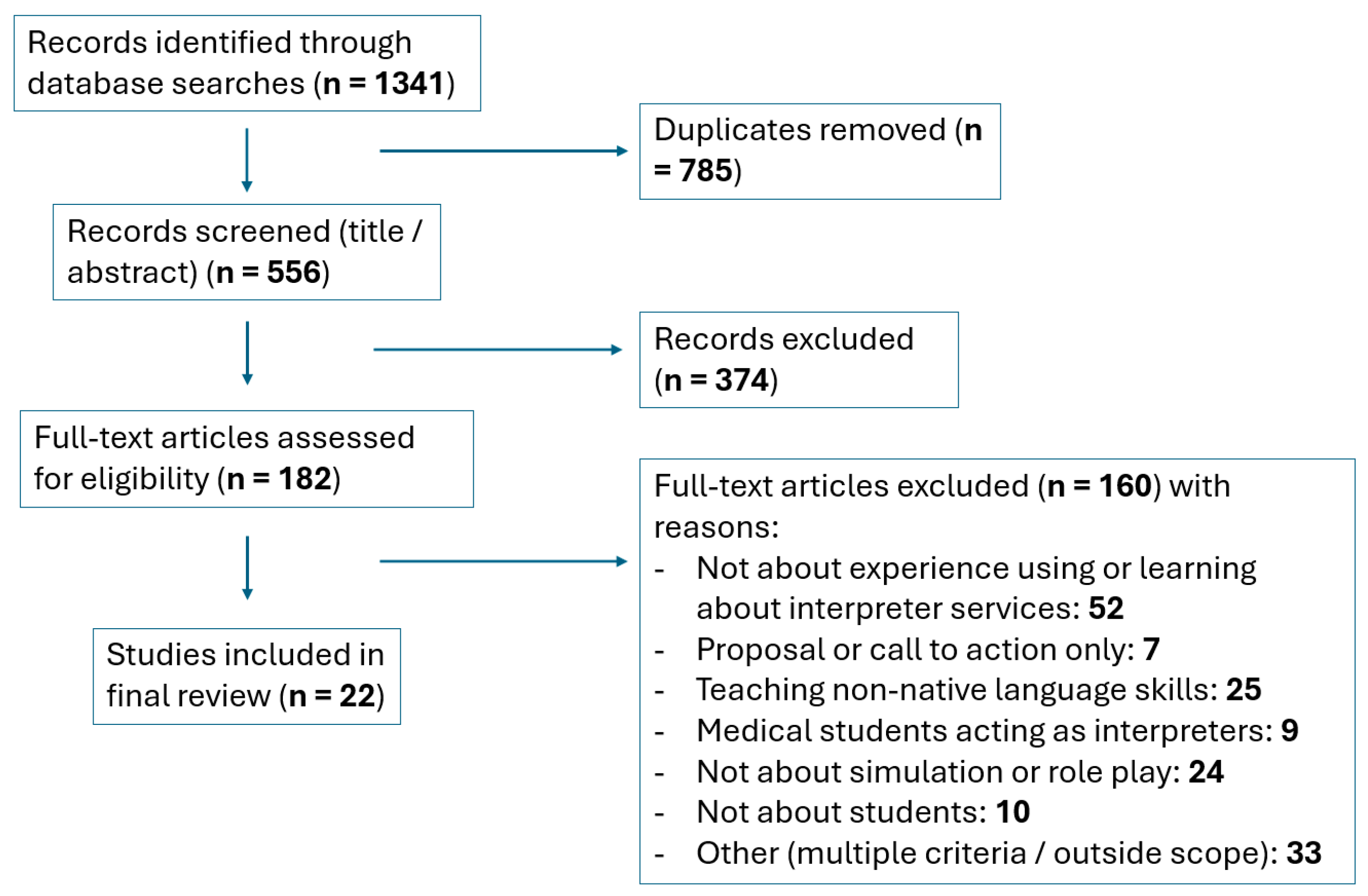
2.4. Study Selection and Screening Process
2.5. Data Extraction and Synthesis
2.6. Methodological Considerations and Reproducibility
3. Results
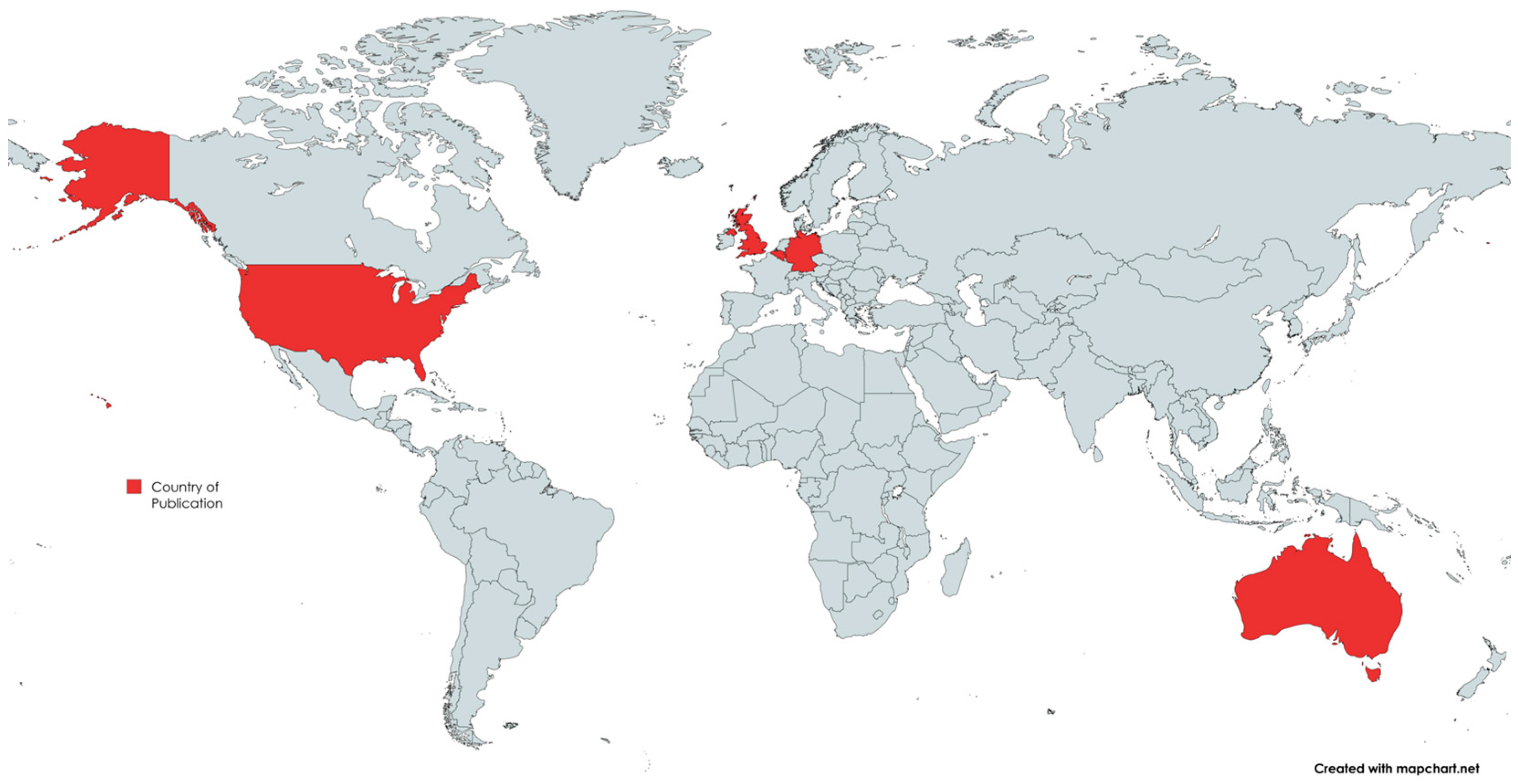
3.1. Geography and Language
3.2. Type of Student
3.3. Type of Experience
3.4. Educational Outcomes
3.5. Innovations and Assessment Instruments
3.6. Published Reviews
4. Discussion
5. Conclusions
Author Contributions
Funding
Institutional Review Board Statement
Informed Consent Statement
Data Availability Statement
Acknowledgments
Conflicts of Interest
Appendix A
References
- Karliner, L.S.; Jacobs, E.A.; Chen, A.H.; Mutha, S. Do professional interpreters improve clinical care for patients with limited English proficiency? A systematic review of the literature. Health Serv. Res. 2007, 42, 727–754. [Google Scholar] [CrossRef]
- Flores, G. The impact of medical interpreter services on the quality of health care: A systematic review. Med. Care Res. Rev. 2005, 62, 255–299. [Google Scholar] [PubMed]
- Chen, A.H.; Youdelman, M.K.; Brooks, J. The legal framework for language access in healthcare settings: Title VI and beyond. J. Gen. Intern. Med. 2007, 22, 362–367. [Google Scholar] [CrossRef]
- Fox, M.T.; Godage, S.K.; Kim, J.M.; Bossano, C.; Muñoz-Blanco, S.; Reinhardt, E.; Wu, L.; Karais, S.; DeCamp, L.R. Moving From Knowledge to Action: Improving Safety and Quality of Care for Patients with Limited English Proficiency. Clin. Pediatr. 2020, 59, 266–277. [Google Scholar] [CrossRef]
- Borowczyk, M.; Stalmach-Przygoda, A.; Doroszewska, A.; Libura, M.; Chojnacka-Kuraś, M.; Małecki, Ł.; Kowalski, Z.; Jankowska, A.K. Developing an effective and comprehensive communication curriculum for undergraduate medical education in Poland—The review and recommendations. BMC Med. Educ. 2023, 23, 645. [Google Scholar] [CrossRef] [PubMed]
- Elendu, C.; Amaechi, D.C.M.; Okatta, A.U.M.; Amaechi, E.C.M.; Elendu, T.C.B.; Ezeh, C.P.M.; Elendu, I.D.B. The impact of simulation-based training in medical education: A review. Medicine 2024, 103, e38813. [Google Scholar] [CrossRef]
- Owolabi, J.O.; Gardner, K.; Agboola, R.; Yesudas, R.R.; Shaw, J.H. Use of simulation for teaching biomedical sciences to undergraduate medical students- a scoping review. BMC Med. Educ. 2025, 25, 1259. [Google Scholar] [CrossRef]
- Thomas, K.; Jacobs, N.; Vera, A.L. A Proposal to Teach Medical Students How to Use Interpreters. Discov. Educ. 2024, 3, 80. [Google Scholar] [CrossRef]
- Friedman-Rhodes, E.; Hale, S. Teaching Medical Students to work with Interpreters. J. Spec. Transl. 2010, 14, 121–144. [Google Scholar]
- Hlavac, J.; Harrison, C. Interpreter-mediated doctor-patient interactions: Interprofessional education in the training of future interpreters and doctors. Perspect. Stud. Transl. Theory Pract. 2021, 29, 572–590. [Google Scholar]
- Griswold, K.S.; Kim, I.; McGuigan, D.; Shogan, M.; Zinnerstrom, K.; Lie, D.; Ohtake, P. Interpreted encounters for interprofessional training in cultural competency. J. Interprofessional Educ. Pract. 2021, 24, 100435. [Google Scholar]
- Fung, C.C.; Lagha, R.R.; Henderson, P.; Gomez, A.G. Working with interpreters: How student behavior affects quality of patient interaction when using interpreters. Med. Educ. Online 2010, 15, 5151. [Google Scholar]
- Krystallidou, D.; Van De Walle, C.; Deveugele, M.; Dougali, E.; Mertens, F.; Truwant, A.; Van Praet, E.; Pype, P. Training “doctor-minded” interpreters and “interpreter-minded” doctors The benefits of collaborative practice in interpreter training. Interpreting 2018, 20, 126–144. [Google Scholar]
- Bereknyei, S.; Nevins, A.; Schillinger, E.; Garcia, R.D.; Stuart, A.E.; Braddock, C.H. Beyond Knowledge, Toward Linguistic Competency: An Experiential Curriculum. J. Gen. Intern. Med. 2010, 25, 155–159. [Google Scholar] [CrossRef]
- Krampe, F.; Fabry, G.; Langer, T. Overcoming language barriers, enhancing collaboration with interpreters—An interprofessional learning intervention (Interpret2Improve). BMC Med. Educ. 2022, 22, 170. [Google Scholar]
- Strelow, K.-U.R.; Bahadir, S.; Stollhof, B.; Heeb, R.M.; Buggenhagen, H. Patient interviews in interprofessional and intercultural contexts (PinKo)—Project report on interdisciplinary competence development in students of medicine, pharmacy, and community interpreting. GMS J. Med. Educ. 2021, 38, Doc67. [Google Scholar]
- Bansal, A.; Swann, J.; Smithson, W.H. Using professional interpreters in undergraduate medical consultation skills teaching. Adv. Med. Educ. Pract. 2014, 5, 439–450. [Google Scholar] [CrossRef]
- Escott, S.; Lucas, B.; Pearson, D. Lost in translation: Using bilingual simulated patients to improve consulting across language barriers. Educ. Prim. Care 2009, 20, 93–98. [Google Scholar] [CrossRef]
- McEvoy, M.; Santos, M.T.; Marzan, M.; Green, E.H.; Milan, F.B. Teaching medical students how to use interpreters: A three year experience. Med. Educ. Online 2009, 14, 12. [Google Scholar]
- Jacobs, E.A.; Diamond, L.C.; Stevak, L. The importance of teaching clinicians when and how to work with interpreters. Patient Educ. Couns. 2010, 78, 149–153. [Google Scholar] [CrossRef]
- Lie, D.; Bereknyei, S.; Vega, C. Longitudinal development of medical students’ communication skills in interpreted encounters. Educ. Health 2010, 23, 466. [Google Scholar] [CrossRef]
- de Nathan, G.G.; Shaw, L.K.; Doolen, J. Social Determinants of Health: A Multilingual Standardized Patient Case to Practice Interpreter Use in a Telehealth Visit. MedEdPORTAL 2023, 19, 11364. [Google Scholar] [CrossRef]
- Jones, J.; Rice, K.; Cueto, V.; Mojica, C.D.V.; Stawitcke, M.; Salem, S.; Talley, E.; Blankenburg, R. Increasing Health Care Workers’ Proficiency With Using Professional Medical Interpretation: A Workshop. MedEdPORTAL 2020, 16, 11017. [Google Scholar] [CrossRef]
- McLaughlin, M.; Nam, Y.; May, W.; Baezconde-Garbanati, L.; Georgiou, P.; Ahn, Z. Technology-based medical interpretation for cross-language communication: In person, telephone, and videoconference interpretation and their comparative impact on Limited English Proficiency (LEP) patient and doctor. In Cross-Cultural Design. Cultural Differences in Everyday Life; Springer: Berlin/Heidelberg, Germany, 2013. [Google Scholar]
- Herrmann-Werner, A.; Loda, T.; Zipfel, S.; Holderried, M.; Holderried, F.; Erschens, R. Evaluation of a Language Translation App in an Undergraduate Medical Communication Course: Proof-of-Concept and Usability Study. JMIR mHealth uHealth 2021, 9, e31559. [Google Scholar] [PubMed]
- Lie, D.; Bereknyei, S.; Braddock, C.H.; Encinas, J.; Ahearn, S.; Boker, J.R. Assessing medical students’ skills in working with interpreters during patient encounters: A validation study of the Interpreter Scale. Acad. Med. 2009, 84, 643–650. [Google Scholar] [PubMed][Green Version]
- Himmelstein, J.; Wright, W.S.; Wiederman, M.W. U.S. medical school curricula on working with medical interpreters and/or patients with limited English proficiency. Adv. Med. Educ. Pract. 2018, 9, 729–733. [Google Scholar]
- Fukui, N.; Partain, D.K.; Yeow, M.-E.; Farfour, H.N.; Prokop, L.; Barwise, A. Learning to collaborate with medical interpreters in health professions education: A systematic review of training programs. Med. Teach. 2024, 46, 258–272. [Google Scholar]
- Constantinou, C.S.; Ng, A.T.; Becker, C.B.; Zadeh, P.E.; Papageorgiou, A. The use of interpreters in medical education: A narrative literature review. Societies 2021, 11, 70. [Google Scholar] [CrossRef]



| Protocol Item and Modifications |
|---|
|
| Inclusion Criteria | Exclusion Criteria |
|---|---|
|
|
| Step | Methodological Element | Description |
|---|---|---|
| 1 | Review Design | Scoping review conducted in accordance with PRISMA-ScR guidelines |
| 2 | Protocol | Protocol published in Deep Blue; modifications made prior to data extraction |
| 3 | Databases Searched | PubMed, ERIC, SCOPUS |
| 4 | Search Timeframe | 2009–2024 |
| 5 | Eligibility Criteria | Medical students, interpreter use, simulation or role play, English-language full text |
| 6 | Screening Process | Dual independent screening using Covidence; disagreements resolved by third reviewer |
| 7 | Full-text review | Independent review with consensus resolution |
| 8 | Data Extraction | Structured extraction by one author with verification by second author |
| 9 | Synthesis Approach | Descriptive and narrative synthesis |
| 10 | Reproducibility Measures | Transparent protocol reporting, explicit eligibility criteria, structured review workflow |
| Author, Year | Country | Learner Type | Simulation/Role Play Type | Interpreter Type | Evaluation Method | Key Findings |
|---|---|---|---|---|---|---|
| Thomas, 2024 [8] | United States | First- and second-year medical students | Workshop with didactic led by second-year medical students followed by practical session with standardized patients | Bilingual students as interpreters, in-person | Pre- and post-survey | Improved knowledge of best practices as well as comfort/confidence; peer-assisted training may be effective tool |
| Friedman-Rhodes, 2010 [9] | Australia | First-year medical students | Didactic followed by role play of different scenarios with students and authors | Authors as interpreters, in-person | Pre- and post-survey | Improved attitude and knowledge about interpreters/interpretation though low participation/response rate |
| Hlavac, 2021 [10] | Australia | Medical and interpreting students | Didactic followed by role play in which interpreter students served as patients | Interpreting students as interpreters, in-person | Post-intervention questionnaire | High perceived usefulness of role play and improved knowledge; interprofessional education may be good tool |
| Griswold, 2021 [11] | United States | Students from medicine, dietetics, health law, pharmacy, physical therapy, public health, and social work | Flipped classroom with students preparing ahead of time followed by discussion session and then small groups with observed interpreted encounters; used patient participants from locally resettled refugee communities | Professional interpreter, in-person | Three rating scales during encounter to assess abilities (Faculty Observer Rating Scale FORS, Interpreter Scale IS, Interpreter Impact Rating Scale IIRS), post-curriculum survey, and post-curriculum debrief | High ratings of trainee effectiveness, high level of agreement with student impression of self-improvement and knowledge. Flipped classroom and interprofessional strategies may be good tools |
| Fung, 2010 [12] | United States | Second-year medical students | Workshop including discussion, demonstration, and practice with students conducting interviews while observed; actors playing SP | Actor playing interpreter, in-person | OSCE after workshop to assess student competency | A total 39.4% failure rate with two problematic skills, may be related to under emphasis of key learning objectives during workshop, curricular changes planned |
| Krystallidou, 2018 [13] | Belgium | Third- and fourth-year medical students and master’s level interpreting students | Plenary lecture followed by small group sessions with practice, role play, and feedback—interpreter students as patients | Interpreting students as interpreters, in-person | Formative assessment during encounters, summative assessment in the form of self-efficacy questionnaires in retrospect before and after the session, and trainer debriefing sessions | Collaborative education and practice may be a good tool particularly to stimulate insight and reflection |
| Bereknyei, 2010 [14] | United States | Medical students | Linguistic competency curriculum—a longitudinal experience including didactics, two role-play interpreter sessions in preclinical years, clerkship SP encounter, and two exams including interpreted SP encounters; used trained SPs | Standardized interpreters acting in different in-person roles: ad hoc untrained, family, and trained | Pre- and post-module knowledge testing in first year that was repeated in fourth year, skills assessed via OSCE exam at end of first year and again in fourth year—used Interpreter Impact Rating Scale (IIRS), faculty observer rating scale (FORS), and Interpreter Scale (IS) | Knowledge improvement after completing module with sustained knowledge in fourth year, skills also good or very good with no decrement with time |
| Krampe, 2022 [15] | Germany | Medical students in final year of training and nursing students | Interpret2Improve—an educational intervention in which medical and nursing students learn together, introduction followed by practice in an interprofessional team with SPs | Professional interpreter, in-person | Post-course evaluation | Increase in perceived knowledge and skills, interprofessional activity may be good tool |
| Strelow, 2021 [16] | Germany | Medical students in 7th to 9th semester, pharmacy, and translation students | PinKo (patient interviews in interprofessional and intercultural contexts) program—didactic followed by practice using scripted roles; interpreting students as patients | Interpreting students as interpreters, in-person | Pre- and post-course surveys | Improved communication and collaboration; overall very satisfied though slightly lower for pharmacy students |
| Bansal, 2014 [17] | UK | Medical students in final primary care attachment | Small groups role-play consultations; actors as patients | Professional interpreters, in-person | Student questionnaire and GP tutor feedback | Students more confident; tutors supportive of the program |
| Escott, 2009 [18] | UK | Medical students on primary care placement | Discussion followed by bilingual SP patient scenarios | Various interpreter types—family member, formal interpreter, telephone interpreting service; not otherwise specified | Post-course evaluation, focus group with SPs, and workshop organizer feedback | Feedback positive including role of bilingual SP practice |
| McEvoy, 2009 [19] | United States | Third-year medical students | “Cross-Cultural Communication—three years of iterative changes to this program—using an Interpreter” a didactic and discussion section with experiential learning added in year 2, moved to the beginning of year 3 | Medical Spanish teachers as untrained interpreters, in-person | Retrospective pre- and post-survey 7 weeks after session to measure perceived efficacy in the final year of the program | Most students with improved sense of preparedness; they appreciated the opportunities to practice |
| Jacobs, 2010 [20] | United States | Second-year medical students | Trigger video of inappropriate use followed by didactic followed by modeling session followed by role-playing session with interpreters playing patients. | Not specified, in-person | Pre- and post-evaluation and questionnaire | Improved knowledge, attitude, and reported likelihood of future behaviors, with role playing highlighted as best component |
| Lie, 2010 [21] | United States | Second- to third-year medical students | Didactic, standardized clinical station as part of clinical practice exam at end of years 2 and 3 | Not specified, in-person | Evaluations during exam, self-assessment of students | Communication skills remained excellent over one year of training though some skills worsened including “managing the encounter”, and students overrated their skills compared with trained observers |
| Guizado de Nathan, 2023 [22] | United States | First-year medical students | Simulation of telehealth encounter with SP patient | Simulated medical interpreter, telehealth | Feedback on course evaluations of the first year of use of curriculum followed by post-curriculum survey the next year | Comments positive, students appreciated opportunity to practice, comments allowed for refinements to curriculum over time |
| Jones, 2020 [23] | United States | Healthcare workers including students | Didactic followed by discussion followed by role play | In-person, video, and phone interpretation | Post-curriculum survey | Most participants agreed workshop is valuable, met objectives, and is helpful |
| Author/Year | Country | Learner Type | Simulation/Role Play Type | Evaluation Method | Key Findings |
|---|---|---|---|---|---|
| McLaughlin, 2013 [24] | United States | Third- and fourth-year medical students | Students as providers during SP encounters; purpose of allowing researchers to evaluate interpreted sessions and satisfaction of patients and students | Post-encounter survey | Technology-based methods of interpretation provided similar levels of satisfaction when compared with human services |
| Hermann-Werner, 2021 [25] | Germany | Second-year preclinical medical students | Students as providers during SP encounters using a language translation app to allow for evaluation of app use | Post-encounter survey | Critical comments about accuracy and technical challenges; may be helpful in emergency situations or brief conversations |
| Lie, 2009 [26] | United States | First- and second-year preclinical medical students | Students as providers during SP encounters | Use of two validated scales: Patient Physician Interaction Scale (PPI) by the SP and Interpreter Impact Rating Scale (IIRS) by the SP as well as the novel Interpreter Scale (IS) by the standardized interpreter | The novel Interpreter Scale (IS) has reasonable internal consistency and validity to warrant use for formatively measuring student communication skills in interpreted SP encounters |
| Author/Year | Country | Learner Type | Simulation/Role Play Type | Evaluation Method | Key Findings |
|---|---|---|---|---|---|
| Himmelstein, 2018 [27] | United States | Medical Schools | A total of 76% of responders offer a curriculum on working with interpreters with 34% providing didactic and SP experiences | Survey sent to medical schools | Low response rate (26%); most responders with curricula have been administering for less than 10 years and format varies; responders without curricula cited various barriers and reasons for this absence |
| Constantinou, 2021 [29] | International | Medical and health professionals’ schools | Narrative review, interpretive approach to article findings and synthesis | Authors propose a framework for integrating working with interpreters into education, existing training has been shown to improve knowledge and skills though research gap persists | |
| Fukui, 2024 [28] | United States and Australia | Medical students, residents, PA students, oral health professions students, other healthcare clinicians | Systematic review | Concluded that the ideal program to train learners on interpreter use involves interpreters in creation/implementation/assessment steps, includes hands-on practice, and blends digital and in-person content |
Disclaimer/Publisher’s Note: The statements, opinions and data contained in all publications are solely those of the individual author(s) and contributor(s) and not of MDPI and/or the editor(s). MDPI and/or the editor(s) disclaim responsibility for any injury to people or property resulting from any ideas, methods, instructions or products referred to in the content. |
© 2026 by the authors. Published by MDPI on behalf of the Academic Society for International Medical Education. Licensee MDPI, Basel, Switzerland. This article is an open access article distributed under the terms and conditions of the Creative Commons Attribution (CC BY) license.
Share and Cite
Wolfe, H.; Schneider, A.; Davis, C. Medical Student Experience with Interpreter Services in a Simulated Environment: A Scoping Review. Int. Med. Educ. 2026, 5, 12. https://doi.org/10.3390/ime5010012
Wolfe H, Schneider A, Davis C. Medical Student Experience with Interpreter Services in a Simulated Environment: A Scoping Review. International Medical Education. 2026; 5(1):12. https://doi.org/10.3390/ime5010012
Chicago/Turabian StyleWolfe, Heather, Allison Schneider, and Carolyn Davis. 2026. "Medical Student Experience with Interpreter Services in a Simulated Environment: A Scoping Review" International Medical Education 5, no. 1: 12. https://doi.org/10.3390/ime5010012
APA StyleWolfe, H., Schneider, A., & Davis, C. (2026). Medical Student Experience with Interpreter Services in a Simulated Environment: A Scoping Review. International Medical Education, 5(1), 12. https://doi.org/10.3390/ime5010012