
Article

Pre- and Post-Evaluation of an Interprofessional Education Program Combining Online and In-Person Instruction on Enhancing Empathy of Medical Students

1
Department of Public Health, Fujita Health University School of Medicine, Toyoake 470-1192, Japan
2
Department of Clinical General Medicine, Fujita Health University School of Medicine, Toyoake 470-1192, Japan
3
Faculty of Nursing, Fujita Health University School of Health Sciences, Toyoake 470-1192, Japan
4
Center for Medical Education and Internationalization, Kyoto University Graduate School of Medicine, Kyoto 606-8501, Japan
*
Author to whom correspondence should be addressed.
Int. Med. Educ. 2026, 5(1), 11; https://doi.org/10.3390/ime5010011
Submission received: 4 December 2025 / Revised: 31 December 2025 / Accepted: 6 January 2026 / Published: 8 January 2026

Abstract

This pre–post study aimed to determine whether interprofessional education (IPE) combining online and in-person instruction enhanced medical students’ empathy. The IPE program was conducted during the academic years 2022 and 2023 for medical (n = 240) and other healthcare students. Subjects discussed a case scenario involving a patient with chronic myeloid leukemia, sharing their ideas within their team and with other teams. The medical students’ empathy was assessed before and after the IPE program using the Japanese version of the Jefferson Scale of Empathy for Health Professions Students (JSE-HPS). Medical students provided written responses to the question, “What do you think is necessary for the care of patients with cancer, besides medical skills and knowledge?” Empathy-related terms were identified using frequency and co-occurrence analyses. The frequencies before and after the IPE were compared. The median JSE-HPS score rose from 98.0 to 114.0 (p < 0.001, Wilcoxon signed-rank test). The frequency of words categorized as demonstrating empathy increased from 37.9% to 52.9% after the IPE (p < 0.01, chi-square test). Our hybrid IPE program enhanced medical students’ empathy, which was supported by both quantitative and qualitative methods.

1. Introduction

Empathy toward patients is a physician’s ability to stand in the patient’s shoes [1]. It plays a crucial role in building trust with patients and is considered one of the most essential skills for physicians. Hojat et al. [2] found that empathy toward patients is associated with physicians’ clinical competence and patient prognosis. Wang et al. [3] demonstrated a correlation between high self-reported empathy scores and patient satisfaction. Several scales have been developed to assess empathy among medical and healthcare professions’ students [4,5,6] as well as among the general population [7]. These measures define empathy as a cognitive trait that involves the following three key components: (a) the ability to understand a patient’s pain, suffering, and perspective; (b) the ability to effectively communicate this understanding; and (c) the intention to support the patient. Empathy is considered a cognitive process rather than an affective one and is distinct from sympathy [1]. In summary, cognitive empathy refers to the rational ability to understand another person’s perspective, emotions, and thoughts, while behavioral empathy is defined as observable actions demonstrated toward others.
Educational efforts have been made to increase medical students’ empathy. Communication workshops for pre-clinical medical students [8] and medical semiotics courses for third-year medical students [9] have been reported to increase empathy among participants. A study involving fourth-year medical students who participated in dialogue-based learning before undertaking an OSCE (Objective Structured Clinical Examination) using case scenarios reported that most participants felt empathy toward patients’ social and emotional aspects [10].
Interprofessional education (IPE) may serve as an effective approach to enhance medical students’ empathy. As healthcare systems evolve in complexity, it is important for physicians to respect other medical co-workers and work collaboratively with them [11]. According to the Center for the Advancement of Interprofessional Education, IPE is defined as an occasion when professionals learn with, from, and about each other to improve collaboration and quality of care [12]. Nevertheless, the impact of IPE involving students from faculty in medicine and other health-related professions on medical students’ empathy remains inconclusive. Some studies reported positive effects of IPE in this regard. A study utilizing the “student hotspotting” model reported greater empathy as interprofessional teams intervened for patients according to goals set jointly by students and patients [13]. Liao and Wang [5,6] provided evidence that interprofessional collaborative learning environments can play a significant role in enhancing empathy among healthcare students. In their study [5], they conducted literature-based group discussions using medical humanities texts and compared two types of learning groups: one composed of students from different professional tracks (a so-called “heterogeneous cluster”) and another consisting of students pursuing the same profession. Their results demonstrated a statistically significant increase in empathy scores in a heterogeneous cluster group. In a subsequent study [6], they applied the three-step narrative medicine approach—attention, representation, and affiliation—to literary reading activities that promoted reflective insights into patients’ suffering and moral dilemmas. Attoe et al. [14] conducted a simulation of aging and reported increased empathic attitude scores. In contrast, some studies yielded negative results concerning the impact of IPE on medical students’ empathy. Kodweis et al. [15] reported that medical and pharmacy students’ empathy did not increase following their participation in collaborative student-run clinics. Ferri et al. [16] found that empathy increased in nursing and occupational therapy students but not in medical students following an IPE program consisting of joint seminar participation, small group discussions, and presentations on support strategies. According to Zelenski et al. [17], applying improvisational acting techniques in conjunction with professional healthcare training programs enhanced behavioral empathy, while leaving cognitive empathy unaltered in healthcare students, including medical students. To our knowledge, few previous studies addressed the long-term effects of IPE on medical students’ empathy.
Recently, online instruction was introduced in IPE [18,19]. It remained unclear whether the level of empathy of the participants increased through IPE delivered online.
Medical schools in Japan have introduced IPE [19,20,21]. Fujita Health University (FHU), which comprises three faculties: medicine, medical sciences, and health sciences, has implemented a unique IPE program called the Assembly Education series for medical and other healthcare students [22,23,24,25,26,27]. It has now expanded to include four universities and seven faculty members (11 professional courses). The present study focused on Assembly III, a component of the Assembly Education series designed for third-year students, and examined its effectiveness in enhancing the empathy of medical students. To continue implementation during the COVID-19 pandemic, Assembly III introduced a hybrid model of online and in-person instruction for medical students during the 2022 and 2023 academic years. This study aimed to investigate whether this hybrid IPE program enhanced medical students’ empathy.

2. Methods

2.1. Study Design

A pre-post study was conducted.

2.2. Subjects

The inclusion criterion was being a third-year medical student from FHU, a private university in Japan, in the 2022 and 2023 academic years. The exclusion criterion was that the students did not participate in Assembly III, a mandatory class, for any reason. A total of 240 subjects were analyzed in this study, with 117 (male: n = 74) in 2022 and 123 (male: n = 69) in 2023.

2.3. Educational Program: The Assembly Education Series and Assembly III

The Assembly Education series is a unique step-by-step IPE program of FHU. First- and second-year students completed Assemblies I and II, respectively, where they learned communication and teamwork skills. Assembly III, a structured IPE program designed for third-year students, aimed to foster patient-, user-, family-, and community-centered perspectives while helping students understand the roles of various health professions. Participants in Assembly III engaged in team-based learning alongside students from other health-related faculties. Assembly III was collaboratively conducted by four universities, as well as students from various healthcare fields. These fields included medicine, biomedical laboratory science, clinical engineering, radiological technology, nursing, rehabilitation sciences, social welfare, pharmacology, dentistry, and nutritional sciences. The students were organized into teams of approximately six members. The total number of participants in the 2022 and 2023 academic years were 953 and 1018, respectively. The details are presented in Supplementary Materials Table S1. Two or more students in the same team were not from the same department.
Assembly III included three half-day courses for participants and other healthcare students, and one additional half-day course exclusively for each faculty. This study was conducted during the first semester of the 2022 and 2023 academic years, specifically during the COVID-19 pandemic. Therefore, Assembly III was held online from Day 1 to 3 using Microsoft Teams, with in-person instruction taking place on Day 4 for medical students. Teachers provided instructions and presented the interview films through a general channel. Each team engaged in discussions within its designated team channel. We prepared another designated channel for the teams to present themselves to each other. Students were instructed to turn on their cameras and microphones, allowing them to see each other’s faces during collaborative tasks. To facilitate discussion within teams, specific roles, such as facilitators, task submitters, and notetakers, were assigned in advance.
Table 1 summarizes the components of Assembly III. The case scenario described a woman diagnosed with chronic myeloid leukemia (CML). The students were directed to discuss the case not only from a medical perspective but also from social, economic, and psychological aspects. As part of the program, students watched a 17 min film featuring a real woman in her twenties who was diagnosed with CML approximately ten years ago. She shared her experiences with the hematologist YI.

2.4. Daily Schedule

Day 1 began with the readiness assurance tests (RATs), which evaluated the participants’ preparatory learning. RATs consisted of quizzes for each participant and team. After the scenario presentation, the students reflected on the experiences of women living with CML. They envisioned what work, home, and family would mean to her. They also considered the perspectives of someone close to her, such as occupational doctors, kindergarten directors, or co-workers.
Day 2 also started with RATs. In the scenario, she was diagnosed with CML and began treatment. Students were tasked with envisioning her thoughts and anxieties before treatment and how those feelings transformed once the treatment began. To encourage students to consider her perspectives, teachers asked them to think about what she would do if the physician approved of her return to work, the emotions and thoughts she might experience at that moment, and what types of support would be beneficial for her. After viewing a film of the real patient’s interview, the students reassessed her quality of life and shared their ideas with other teams. They reflected on the actions they could take to support her, her family, and others around her, considering the unique knowledge and skills relevant to their majors.
On Day 3, students reflected on their majors and other fields of study. The reflections were consolidated into the team’s opinion, which was then shared with the other teams. Peer evaluations were conducted at the end of the day.
On Day 4, each major conducted its class. Medical students reviewed peer evaluations and documented their findings. They rewatched the interview film again. Finally, the students listed the elements they believed were essential for achieving a patient-centered perspective, which was the goal of Assembly III, as they reflected on the insights gained during the previous three days. Participants were encouraged to differentiate their ideas from those of their team members.

2.5. Scenario

The scenario involved a 27-year-old woman working as a nursery school teacher. She was suddenly diagnosed with CML. The scenario was divided into two parts, presenting her conditions before and after the CML diagnosis and treatment on Days 1 and 2, respectively.
On Day 1, the scenario outlined her family structure, financial situation, and life history from childhood to the time she was suspected of having CML. Her life history included the reasons for aspiring to become a nursery school teacher. She returned to her nursery school after taking a year off to take care of her child. One day, she began experiencing physical symptoms, such as fatigue and weight loss. Simultaneously, she noticed changes in her work environment, including increased duties and responsibilities. During her annual health checkup, an alarmingly high white blood cell count was observed. An occupational physician recommended that she consult a hematologist at a nearby general hospital. Confused by a series of technical terms presented by the occupational physician, she and her husband sought more information online, which increased her confusion. This scenario depicted her anxiety about the future, including concerns about her life expectancy and the possibility of having another child.
On Day 2, the scenario began with a description of her visit to a general hospital. She was diagnosed with CML. After two months of treatment, her examinations revealed favorable results. Despite this positive news, she continued to feel anxious about the potential worsening of her condition. Her hematologist indicated that she would be able to return to work. She hoped to achieve financial security, but felt concerned that her illness might be a burden to her colleagues. Additionally, she felt anxious about her health and dependence on her husband for daily support. She felt guilty about the possibility that CML treatment might prevent them from having another child. Three months after starting the treatment, her health improved. She learned how to manage the adverse effects. However, she remained uncertain about returning to work. She consulted a medical social worker, who advised her that cancer survivors could continue working. Although she initially decided not to inform her parents about her CML diagnosis to spare them from worry, she began to think that it might be time to share her condition with them.

2.6. Interview Film

Participants viewed an interview of a woman in her twenties who was undergoing treatment for CML. The interviewer aimed to draw her personal stories. She talked about her daily life before the onset of symptoms, her awareness of the physical changes during the initial stages of the disease, the consultation she had with hematologists at FHU Hospital, and the examinations she underwent. Throughout the interview, she shared her thoughts and emotions, including the discrepancy between her previous understanding of leukemia treatment and the reality she faced, her anxiety about medical examinations, and her concerns about how CML would affect her career. At the end of the interview, she reflected on how her life and perspectives had changed from experiencing CML. Drawing from her personal experience as a patient, she emphasized that health professionals’ words have a profound impact on patients, underscoring their crucial role in providing hope and support during the emotionally challenging period following a diagnosis.

2.7. Measure

The Japanese version of the Jefferson Scale of Empathy of Health Profession Students (JSE-HPS) was utilized to quantitatively assess the empathy of the subjects [28]. The JSE questionnaire consists of 20 items measured on a 7-point Likert scale, with 1 indicating “strongly disagree” and 7 indicating “strongly agree.” Kataoka et al. [29] confirmed the construct validity and reliability of the Japanese version of the JSE. A total JSE-HPS score ranges from 20 to 140, with a higher score indicating greater empathy. Additionally, to qualitatively assess empathy, subjects were asked to write their responses in their own words to the question, “What do you think is necessary for the care of patients with cancer, besides medical skills and knowledge?” Students were asked to complete the JSE-HPS and write the open-ended responses before Day 1 and at the end of Day 4.

2.8. Data Analysis

For the quantitative analysis of empathy, we compared the JSE scores before and after Assembly III using the Wilcoxon signed-rank test because the scores did not follow a normal distribution. We assessed the normality of distribution using the Shapiro–Wilk test. To determine the necessary sample size, we utilized G*Power 3.1.9.7 [30]. We established the effect size, significance level, and power at 0.2 (indicating a small effect), 0.05, and 0.95, respectively. Consequently, the minimum sample size was found to be 208 cases. We excluded the medical students who did not complete the JSE-HPS either before or after Assembly III.
For the qualitative analysis of empathy, we used KH Coder 3.02a (SCREEN Advanced System Solutions Co., Ltd., Kyoto, Japan) [31,32] to conduct text mining. The software performs a morphological analysis to extract words and break the text down into the smallest words and meaningful units. Subsequently, we identified topics from the descriptions by analyzing word frequency and co-occurrence with other words. All analyses were conducted in Japanese and translated into English by the authors. The details of the KH Coder 3.02a analyses are as follows.

2.8.1. Analysis 1: Word Frequency

We counted the word frequency separately for the responses to questions posed before and after Assembly III. Since some compound words, such as “medical worker,” were recognized separately by KH Coder 3.02a, the authors fixed to combine the words for clarity. Several words were used more frequently at the end of the text of the responses, which were influenced by the questions. Those words such as “think,” “feel,” “need,” and “important” were excluded from the analysis after checking the text. The word “patient,” which tended to be the subject of the scenario in free text responses quite frequently, was excluded when creating the co-occurrence network because it was too often associated with other words in the co-occurrence relationships.

2.8.2. Analysis 2: Coding of Empathy and Other Concepts

To identify tendencies in the subjects’ responses, we conducted a co-occurrence analysis for both before and after Assembly III. This analysis showed the frequency of words used, represented in a circular format, with links connecting words that appeared together. We employed the top 60 words with the highest Jaccard indices for the co-occurrence analysis. A high Jaccard index indicates a strong similarity between the linked words. We counted the number and frequency of the specific words, grouped similar words into categories, and tallied their occurrence counts and proportions. This is because the words used to express a particular idea vary depending on the person or situation. Based on the results of co-occurrence analyses and the education goal of the Assembly III, we established the following three categories: “cooperation with healthcare professionals,” “patient-centered perspective,” and “empathy.” The author established coding rules that defined words belonging to specific categories. These rules were based on the word frequency data outlined in Analysis 1 and the co-occurrence analysis. Subsequently, Y.I. and A.O. revised the rules to reach a consensus.

2.8.3. Analysis 3: Change in Empathy and Other Concepts

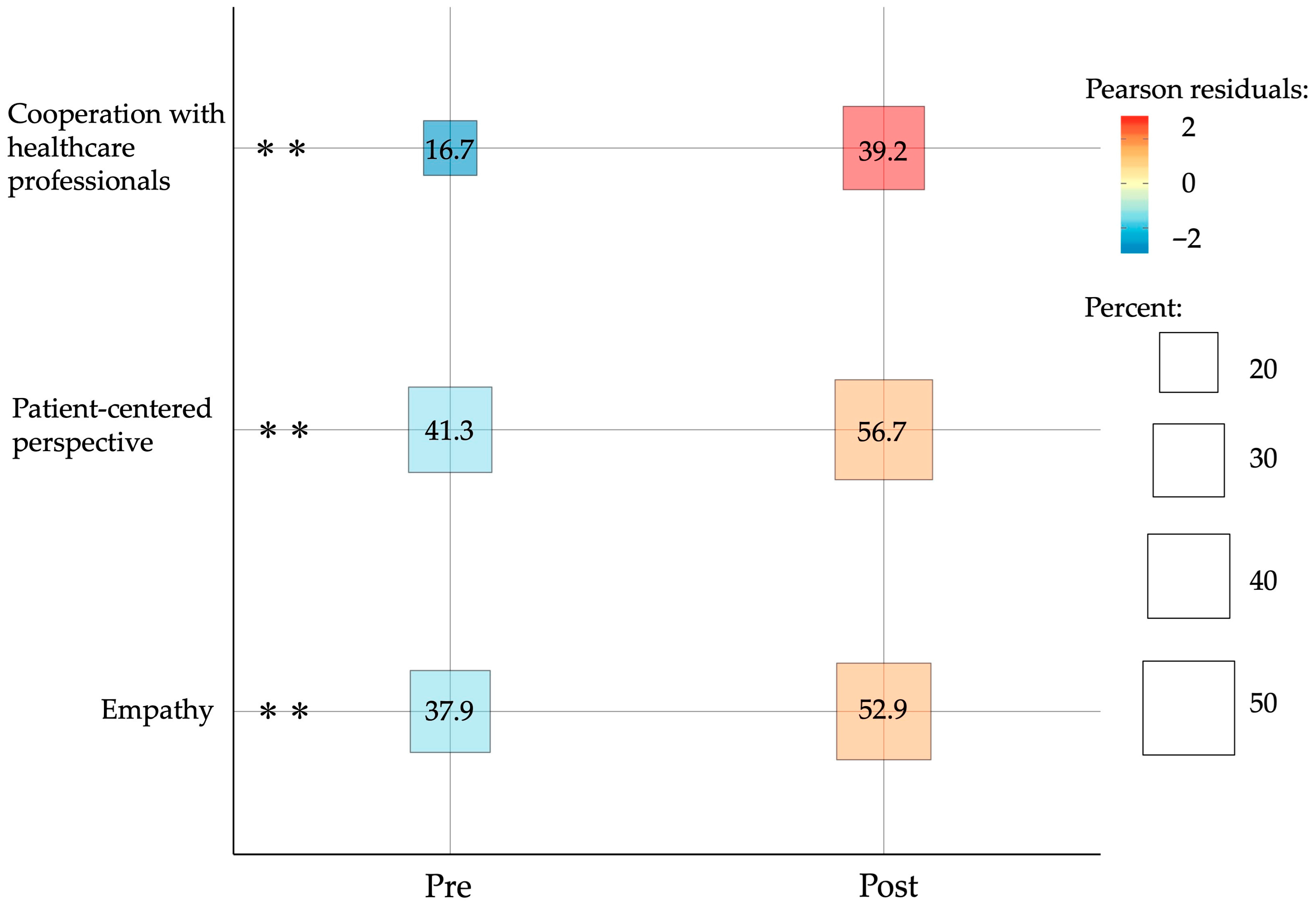
This analysis was designed to examine the changes in the frequency of concepts associated with empathy and interprofessional collaboration after participation in Assembly III. Based on the coding rules regulated in Analysis 2, the frequency of occurrences for the three concepts, “cooperation with healthcare professionals,” “patient-centered perspective,” and “empathy,” was compared before and after Assembly III, employing a cross-tabulation methodology. Each response from the medical student was treated as an independent unit. We used the chi-square test to analyze the differences, setting a p-value of 0.05 as the threshold for statistical significance. We used bubble plotting, a method for cross-tabulation visualization, to display the aggregated results. In this method, the size of the squares increased with the frequency of words belonging to a specific category, while the darkness of the square corresponded to the standardized residual, that is, the Pearson residual.

3. Results

3.1. Quantitative Analysis: Change in JSE-HPS Scores

The Shapiro–Wilk test indicated that JSW-HPS scores were not normally distributed for both pre-test (p < 0.05) and post-test (p < 0.05). The median JSE-HPS scores before and after Assembly III were 98.0 (interquartile range (IQR): 86.0–110.0) and 114.0 (IQR: 105.2–123.0), respectively. The median JSE-HPS score after Assembly III was significantly higher than that before (p < 0.001). The effect size (r) was 0.75, indicating a large effect.

3.2. Qualitative Analysis

3.2.1. Analysis 1: Word Frequency

Subjects’ responses before Assembly III comprised 5097 words, which were classified into 681 types (mean: 4.13 per person, standard deviation (SD): 14.06). From these, KH Coder selected 2203 words that represented 534 types. After Assembly III, the responses included 9359 words, classified into 947 types (mean: 5.09, SD: 19.79). From these, 3810 words covering 749 types were selected. The word frequencies are listed in Table 2. The words “patients,” “care,” “treatment,” and “family” ranked among the top ten both before and after the Assembly III. Several words that were frequently mentioned before the Assembly III, such as “mind,” “spiritual,” and “mental,” disappeared afterward.

3.2.2. Analysis 2: Coding of Empathy and Other Concepts

We conducted co-occurrence analyses of the responses before and after Assembly III and visualized the co-occurrence networks, as illustrated in Supplementary Materials Figures S1 and S2. Before and after Assembly III, the words were grouped into eight and five clusters, respectively. The researchers reviewed the clusters of co-occurring words at each time point, along with the contexts in which these words were used, as well as the word frequencies shown in Table 2. Based on the educational objectives of Assembly III and the purpose of this study, we established coding rules for three concepts: “cooperation with healthcare professionals,” “patient-centered perspective,” and “empathy,” as shown in Table 3. Words that belonged to multiple concepts were categorized to align with relevant concepts by combining them with other words using logical operators. “Cooperation with healthcare professionals” comprised words that expressed interactions and relationships with medical professionals. “Patient-centered perspective” included words used to describe approaches and interactions with patients. For “Empathy,” words that conveyed an attitude of striving to understand the patient’s feelings, rather than focusing solely on their actions and responses, were selected.

3.2.3. Analysis 3: Change in Empathy and Other Concepts

Figure 1 illustrates the frequency with which each concept appeared before and after Assembly III. After Assembly III, the proportions of all concepts were higher compared to before Assembly III. The proportion of responses categorized as “empathy” significantly increased from 37.9% to 52.9% (p < 0.01). Likewise, the proportions for “cooperation with healthcare professionals” and “patient-centered perspective” increased from 16.7% to 39.2% and from 41.3% to 56.7%, respectively (p < 0.01).

4. Discussion

For the quantitative analysis, the JSE-HPS scores of subjects significantly increased after Assembly III. For the qualitative analysis, the words classified into the category “empathy” occurred after Assembly III more frequently than before Assembly III. These findings demonstrate that our hybrid IPE program involving medical and other healthcare students enhanced medical students’ empathy.
Our findings are consistent with those of Collins et al. [13], whose study involved medical students participating in interprofessional teams and used the JSE to assess empathy. Studies by Liao and Wang [5,6] and Zelenski et al. [17] are similar to the present study, as they also included medical students collaborating with other health science students while observing changes in empathy. However, one difference is the type of empathy that IPE enhanced. Our study, which utilized JSE, suggested an increase in cognitive empathy. Liao and Wang [5,6] demonstrated increases in behavioral and emotional empathy. In a study by Zelenski et al. [17], an increase in behavioral empathy was observed; however, there was no significant increase in cognitive empathy. Another difference was the direction of empathy felt by the IPE participants. Collins et al. [13] and Liao and Wang [5,6] specifically focused on empathy toward patients, which we did not specify in the present study.
Some recent IPE programs incorporated online instruction [18,19]. The current findings indicated that there was an increase in medical students’ empathy after Assembly III. Nevertheless, further research is needed to ascertain the effects of online IPE in enhancing medical students’ empathy. Assembly III adopted a hybrid instructional model, integrating online and in-person components. It is plausible that the in-person component contributed to the observed improvement in medical students’ empathy.
The intervention in the present study included the following intertwined and multifactorial components: reading a scenario, viewing a film of a talk given by a real patient with CML, individual work, team learning with students from various majors, and sharing ideas with other teams. Similar methods have been employed in previous studies on IPE. Reportedly, interactions with patients [13], individual work [5,6], team learning [5,6,14,17], and discussions at case conferences [13] increased the empathy of students. A study by Ferri et al. [16] that incorporated interactions with patient educators, individual work, team learning, and exchanging ideas with other teams led to a significant increase in the JSE-HPS scores for nursing and occupational therapy students. However, no such increase was observed among the medical students. Individual work and sharing ideas with other teams may enhance medical students’ empathy. Kodweis et al. [15] and Ferri et al. [16] reported that team learning and meeting patients did not increase medical students’ empathy. Findings regarding the effect of team learning and interaction with actual patients on enhancing medical students’ empathy were inconsistent. Further research is needed to identify the factors that effectively enhance medical students’ empathy in IPE.
In the qualitative analysis, we also examined whether the two educational objectives of collaboration with healthcare professionals and a patient-centered perspective were achieved during Assembly III. Words related to cooperation with healthcare professionals and a patient-centered perspective became more prevalent after Assembly III. The findings indicate that our hybrid IPE program effectively achieved its educational objectives. The increase in both the number and types of words analyzed in the qualitative analysis indicates that the participating students gained a broader perspective through IPE. Nakamura et al. [24] demonstrated that IPE enhanced the understanding of different professions’ roles and collaborative awareness, resulting in better treatment. Our findings exhibit consistent results, suggesting a better understanding of other professions and a patient-centered perspective.
Our Assembly III faces several challenges in enhancing medical students’ empathy. Since the present study is only a pre-post design, the long-term effects of Assembly III remain uncertain. A single three-and-a-half-day educational intervention may be insufficient to produce a lasting impact. Third-year medical students are still in the pre-clinical phase of their education. Therefore, additional measures will be necessary to nurture empathy during their clinical clerkships and after they become physicians.
Finally, we discuss the limitations of this study. First, because Assembly III was implemented as a mandatory lecture, we could not establish a control group without the intervention. Owing to this requirement, subjects could have provided socially desirable responses. Second, the coding rules for qualitative analysis were established after data collection. This was inevitable because these rules must be based on the subjects’ responses. To reduce potential misclassification bias, the coding rules were created through discussions among multiple researchers. Third, it is likely that subjects’ responses after Assembly III were influenced by their responses before Assembly III, as the data were collected by self-reporting.

5. Conclusions

We investigated whether Assembly III, our hybrid IPE program, enhanced medical students’ empathy using both quantitative and qualitative methods. The results indicated significant increases in JSE-HPS scores, as well as a greater occurrence of empathy-related words in the students’ written responses. These findings suggest that our hybrid IPE program has the potential to enhance medical students’ empathy.

Supplementary Materials

The following supporting information can be downloaded at: https://www.mdpi.com/article/10.3390/ime5010011/s1, Figure S1: Co-occurrence networks before Assembly III; Figure S2: Co-occurrence networks after Assembly III; Table S1: Number of participants categorized by major.

Author Contributions

Conceptualization, Y.I. and A.O.; methodology, K.Y., Y.I. and A.O.; software, K.Y.; validation, Y.I. and A.O.; formal analysis, K.Y., Y.I. and A.O.; investigation, S.N. and A.O.; resources, S.N. and A.O.; data curation, K.Y.; writing—original draft preparation, K.Y.; writing—review and editing, Y.I., S.N., M.O. and H.K.; visualization, K.Y.; supervision, H.K. and A.O.; project administration, S.N. and M.O.; funding acquisition, M.O. and A.O. All authors have read and agreed to the published version of the manuscript.

Funding

This research was funded by Fujita Health University School of Medicine, which did not influence the research question, methodology, results, or publication process. We received no external funding.

Institutional Review Board Statement

The study was conducted in accordance with the Declaration of Helsinki and approved by the Institutional Review Board of Fujita Health University (HM25-243; 28 August 2025).

Informed Consent Statement

Informed consent was obtained using an opt-out method: all eligible participants were informed about the study and given the opportunity to decline participation. Those who did not opt out were considered to have consented to the use of their data for the research.

Data Availability Statement

The data are available from the corresponding author upon reasonable request. The data are not publicly available due to privacy concerns.

Acknowledgments

The JSE-HPS was used in this study with permission from Thomas Jefferson University. We would like to thank all the students for participating in the research.

Conflicts of Interest

The authors declare no conflicts of interest.

Abbreviations

The following abbreviations are used in this manuscript:
CMLChronic myeloid leukemia
IQRInterquartile range
IPEInterprofessional education
JSE-HPSJefferson Scale of Empathy for Health Professions Students
OSCEObjective Structured Clinical Examination

References

  1. Hojat, M.; Gonnella, J.S.; Mangione, S.; Nasca, T.J.; Veloski, J.J.; Erdmann, J.B.; Callahan, C.A.; Magee, M. Empathy in medical students as related to academic performance, clinical competence and gender. Med. Educ. 2002, 36, 522–527. [Google Scholar] [CrossRef]
  2. Hojat, M.; Louis, D.Z.; Markham, F.W.; Wender, R.; Rabinowitz, C.; Gonnella, J.S. Physicians’ empathy and clinical outcomes for diabetic patients. Acad. Med. 2011, 86, 359–364. [Google Scholar] [PubMed]
  3. Wang, H.; Kline, J.A.; Jackson, B.E.; Laureano-Phillips, J.; Robinson, R.D.; Cowden, C.D.; d’Etienne, J.P.; Arze, S.E.; Zenarosa, N.R. Association between emergency physician self-reported empathy and patient satisfaction. PLoS ONE 2018, 13, e0204113. [Google Scholar] [CrossRef] [PubMed]
  4. Thomas Jefferson University. Asano-Gonnella Center for Research in Medical Education & Health Care. 2025. Available online: https://www.jefferson.edu/academics/colleges-schools-institutes/skmc/research/research-medical-education/jefferson-scale-of-empathy.html (accessed on 23 November 2025).
  5. Liao, H.C.; Wang, Y.H. The application of heterogeneous cluster grouping to reflective writing for medical humanities literature study to enhance students’ empathy, critical thinking, and reflective writing. BMC Med. Educ. 2016, 16, 234. [Google Scholar] [CrossRef] [PubMed]
  6. Liao, H.C.; Wang, Y.H. Storytelling in medical education: Narrative medicine as a resource for interdisciplinary collaboration. Int. J. Environ. Res. Public Health 2020, 17, 1135. [Google Scholar] [CrossRef]
  7. Davis, M.H. Measuring individual differences in empathy: Evidence for a multidimensional approach. J. Pers. Soc. Psychol. 1983, 44, 113–126. [Google Scholar] [CrossRef]
  8. Dorough, R.J.M.; Adamuti-Trache, M.; Sekar, D.R.; Siropaides, C.H. Medical communication training: The effect of gender and experience and goals of care discussions. South. Med. J. 2024, 117, 725–729. [Google Scholar]
  9. Fernández-Rodríguez, L.J.; Bardales-Zuta, V.H.; San-Martín, M.; Delgado Bolton, R.C.; Vivanco, L. Empathy enhancement based on a semiotics training program: A longitudinal study in Peruvian medical students. Front. Psychol. 2020, 11, 567663. [Google Scholar] [CrossRef]
  10. D’souza, C.; Jain, A.; Mandal, T.; Mohammed, C.A.; Hl, K.P.; Pinto, S. An educational approach using interprofessional (IP) role plays and patient narratives to inculcate empathy and communication among undergraduates in breast cancer management. BMC Med. Educ. 2024, 24, 1320. [Google Scholar] [CrossRef]
  11. Japan Medical Association. Professional Ethics Guideline for Physicians. 2016. Available online: https://www.med.or.jp/dl-med/teireikaiken/20161012_2.pdf (accessed on 23 November 2025). (In Japanese).
  12. Center for the Advancement of Interprofessional Education. About CAIPE. 2025. Available online: https://www.caipe.org/about-caipe/ (accessed on 23 November 2025).
  13. Collins, L.; Sicks, S.; Hass, R.W.; Vause-Earland, T.; Ward, J.; Newsome, C.; Khan, M. Self-efficacy and empathy development through interprofessional student hotspotting. J. Interprof. Care 2021, 35, 320–323. [Google Scholar] [CrossRef]
  14. Attoe, C.; Lavelle, M.; Sherwali, S.; Rimes, K.; Jabur, Z. Student interprofessional mental health simulation (SIMHS): Evaluating the impact on medical and nursing students, and clinical psychology trainees. J. Ment. Health Train. Educ. Pract. 2019, 14, 46–58. [Google Scholar] [CrossRef]
  15. Kodweis, K.R.; Allen, R.B.; Deschamp, E.I.; Bihl, A.T.; LeVine, D.A.M.; Hall, E.A. Impact of student-run clinic participation on empathy and interprofessional skills development in medical and pharmacy students. Explor. Res. Clin. Soc. Pharm. 2023, 11, 100306. [Google Scholar] [CrossRef] [PubMed]
  16. Ferri, P.; Vivarelli, C.; Lui, F.; Alberti, S.; Rovesti, S.; Serafini, A.; Di Lorenzo, R.; Amati, G.; Padula, M.S. Evaluation of an interprofessional education intervention in partnership with patient educators. Acta Biomed. 2023, 94, e2023250. [Google Scholar] [PubMed]
  17. Zelenski, A.B.; Saldivar, N.; Park, L.S.; Schoenleber, V.; Osman, F.; Kraemer, S. Interprofessional improv: Using theater techniques to teach health professions students empathy in Teams. Acad. Med. 2020, 95, 1210–1214. [Google Scholar] [CrossRef]
  18. Garwood, C.L.; Salinitri, F.; Levine, D.L. Delivering interprofessional patient safety education using storytelling, a real-life medication error, and synchronous online platform. Med. Teach. 2022, 44, 643–649. [Google Scholar] [CrossRef]
  19. Nozaki, S.; Makino, T.; Lee, B.; Matsui, H.; Sato, E.; Shinozaki, H.; Watanabe, H. Attitudinal changes of undergraduate students learning online interprofessional education for patient safety: Comparative evaluation of an online program using the DID method. GMS J. Med. Educ. 2024, 41, Doc41. [Google Scholar] [PubMed]
  20. Numasawa, M.; Nawa, N.; Funakoshi, Y.; Noritake, K.; Tsuruta, J.; Kawakami, C.; Nakagawa, M.; Yamaguchi, K.; Akita, K. A mixed methods study on the readiness of dental, medical, and nursing students for interprofessional learning. PLoS ONE 2021, 16, e0255086. [Google Scholar] [CrossRef]
  21. Tomisaki, E.; Haruta, J.; Horiguchi, T.; Arahata, T.; Fukui, R.; Uno, S.; Ando, T.; Yoshino, T.; Ishikawa, S.; Suzuki, S.; et al. A Simulated interprofessional team conference using cross-training for junior healthcare students in interprofessional education: A qualitative content analysis. Adv. Med. Educ. Pract. 2025, 16, 583–594. [Google Scholar] [CrossRef]
  22. Ohtsuki, M.; Matsui, T. Large-scale team-based learning for interprofessional education in medical and health sciences. Med. Teach. 2014, 36, 452–453. [Google Scholar] [CrossRef]
  23. Miyamoto, M.; Ohtsuki, M.; Seko, R.; Nakamura, S.; Yano, H.; Suzuki, S.; Matsui, T. Effects of community-oriented education using team-based learning on students’ motivation to practice community health care. Fujita Med. J. 2017, 3, 28–32. [Google Scholar]
  24. Nakamura, S.; Ohtsuki, M.; Miki, Y.; Noda, T.; Suzuki, S.; Maeno, T.; Matsui, T. Effect of team-based learning in interprofessional education at a health university. Fujita Med. J. 2017, 3, 33–39. [Google Scholar]
  25. Ito, M.; Hida, T.; Goto, K.; Goto, M.; Kanada, Y.; Ohtsuki, M. Moving beyond superficial communication to collaborative communication: Learning processes and outcomes of interprofessional education in actual medical settings. Fujita Med. J. 2020, 6, 93–101. [Google Scholar] [PubMed]
  26. Nakamura, S.; Itoh, M.; Miki, Y.; Kido, T.; Kamei, H.; Suzuki, S.; Ohtsuki, M. Relationship between peer evaluation and interprofessional self-evaluation in a joint healthcare team-based learning class involving three universities. Fujita Med. J. 2020, 6, 102–109. [Google Scholar]
  27. Center for the Assembly Education, Fujita Health University. The Assembly Education Program. 2025. Available online: https://www.fujita-hu.ac.jp/~c-assembly/assembly1002/assembly10011/index.html (accessed on 23 November 2025). (In Japanese).
  28. Fujii, R.; Koyama, T.; Shinomiya, K.; Sendo, T.; Kitamura, Y.; Higuchi, Y.; Inagaki, M.; Kataoka, H.; Hayashibara, C.; Fujimori, M.; et al. Examination of the reliability and validity of the Jefferson Scale of Empathy–Health Professions Student Version (JSE-HPS) among healthcare undergraduate students. In Abstract of the 135th Annual Meeting of the Pharmaceutical Society of Japan; The Pharmaceutical Society of Japan: Tokyo, Japan, 2015; Volume 135, p. 243. (In Japanese) [Google Scholar]
  29. Kataoka, H.U.; Koide, N.; Ochi, K.; Hojat, M.; Gonnella, J.S. Measurement of empathy among Japanese medical students: Psychometrics and score differences by gender and level of medical education. Acad. Med. 2009, 84, 1192–1197. [Google Scholar] [CrossRef]
  30. Faul, F.; Erdfelder, E.; Lang, A.G.; Buchner, A. G*Power 3: A flexible statistical power analysis program for the social, behavioral, and biomedical sciences. Behav. Res. Methods 2007, 39, 175–191. [Google Scholar] [CrossRef]
  31. Higuchi, K. A Two-Step Approach to Quantitative Content Analysis: KH Coder Tutorial using Anne of Green Gables (Part I). Ritsumeikan Soc. Sci. Rev. 2016, 52, 77–91. [Google Scholar]
  32. Koike, D.; Ito, M.; Horiguchi, A.; Yatsuya, H.; Ota, A. Exploring the development of safety culture among physicians with text mining of patient safety reports: A retrospective study. Int. J. Qual. Health Care 2025, 37, mzae108. [Google Scholar] [CrossRef] [PubMed]
Figure 1. Frequency of each concept at pre- and post-Assembly III. The size of the numbers and squares indicates the proportion of categories contained in each period. The color of each square represents the Pearson residual for each period. ** p < 0.01; chi-square test.
Ime 05 00011 g001
Table 1. Components of Assembly III. iRAT: individual readiness assurance test; tRAT: team readiness assurance test.
DayContentsMinutes
1Readiness Assurance Test
iRAT (individual)10
tRAT (team)10
Reading a scenario10
Discussion on scenario, Assignment 1 & 2
individual work20
team learning20
Sharing ideas with other teams30
2Readiness Assurance Test
iRAT (individual)10
tRAT (team)10
Reading a scenario15
Discussion on scenario, Assignment 3
individual work10
team learning15
Sharing ideas15
Viewing an interview film20
Discussion on scenario, Assignment 325
Discussion on scenario, Assignment 4
individual work15
team learning25
3Preparation for sharing ideas
individual work15
team learning30
Sharing ideas with other teams45
4Reflection on peer assessment
individual work15
Viewing an interview film30
Discussion on patient-centered view
individual work10
team learning20
Sharing ideas with other teams30
Table 2. Frequency (proportion) of words in the subjects’ responses to the question “What do you think is necessary for the care of patients with cancer, besides medical skills and knowledge?” in pre- and post-tests (Total word count: pre-test: n = 2203; post-test: n = 3810).
OrderPre-TestPost-Test
WordFrequency (%)WordFrequency (%)
1Patient233 (10.6)Patient402 (10.6)
2Care102 (4.6)Care89 (2.3)
3Family79 (3.6)Treatment71 (1.9)
4Communication49 (2.2)Anxiety60 (1.6)
5Treatment48 (2.2)To empathize51 (1.3)
6Mind47 (2.1)Feeling50 (1.3)
7Spiritual41 (1.9)Medical49 (1.3)
8Feeling40 (1.8)Empathy48 (1.3)
9Mental31 (1.4)Understanding48 (1.3)
10Empathy28 (1.3)Family47 (1.2)
Table 3. Coding rules of each concept.
CategoriesCoding rules
Cooperation with healthcare professionals(“medical workers” and “communication”) or “medical” or “sharing” or “cooperation” or “team” or “partnership” or “trust” or “relationship” or “other professional” or “job”
Patient-centered
perspective
(“the person herself” or “patient”) and (“communication” or “support” or “care” or “spiritual” or “mental” or “treatment”)
Empathy“to empathize” or “be close to” or “feeling” or “empathy”
Disclaimer/Publisher’s Note: The statements, opinions and data contained in all publications are solely those of the individual author(s) and contributor(s) and not of MDPI and/or the editor(s). MDPI and/or the editor(s) disclaim responsibility for any injury to people or property resulting from any ideas, methods, instructions or products referred to in the content.