
Article

Primary Non-Adherence to Electronic Prescriptions in Lithuania, 2018–2024: Nationwide Prevalence, Factors, and Regional Variation
by
Viktorija Butrimaite
1,*,
Marija Blockyte
2,
Jurga Andreja Kazlauskaite
1,2,
Tomas Lasys
3 and
Loreta Kubiliene
1
1
Department of Drug Technology and Social Pharmacy, Lithuanian University of Health Sciences, Sukileliu pr. 13, LT-50161 Kaunas, Lithuania
2
Pharmaceutical Technology Institute, Lithuanian University of Health Sciences, Sukileliu pr. 13, LT-50161 Kaunas, Lithuania
3
Division of Pharmacoepidemiology and Clinical Pharmacology, Utrecht Institute for Pharmaceutical Sciences (UIPS), Utrecht University, 3584 CG Utrecht, The Netherlands
*
Author to whom correspondence should be addressed.
Pharmacoepidemiology 2026, 5(3), 33; https://doi.org/10.3390/pharma5030033
Submission received: 8 July 2026 / Revised: 21 August 2026 / Accepted: 1 September 2026 / Published: 7 September 2026

Abstract

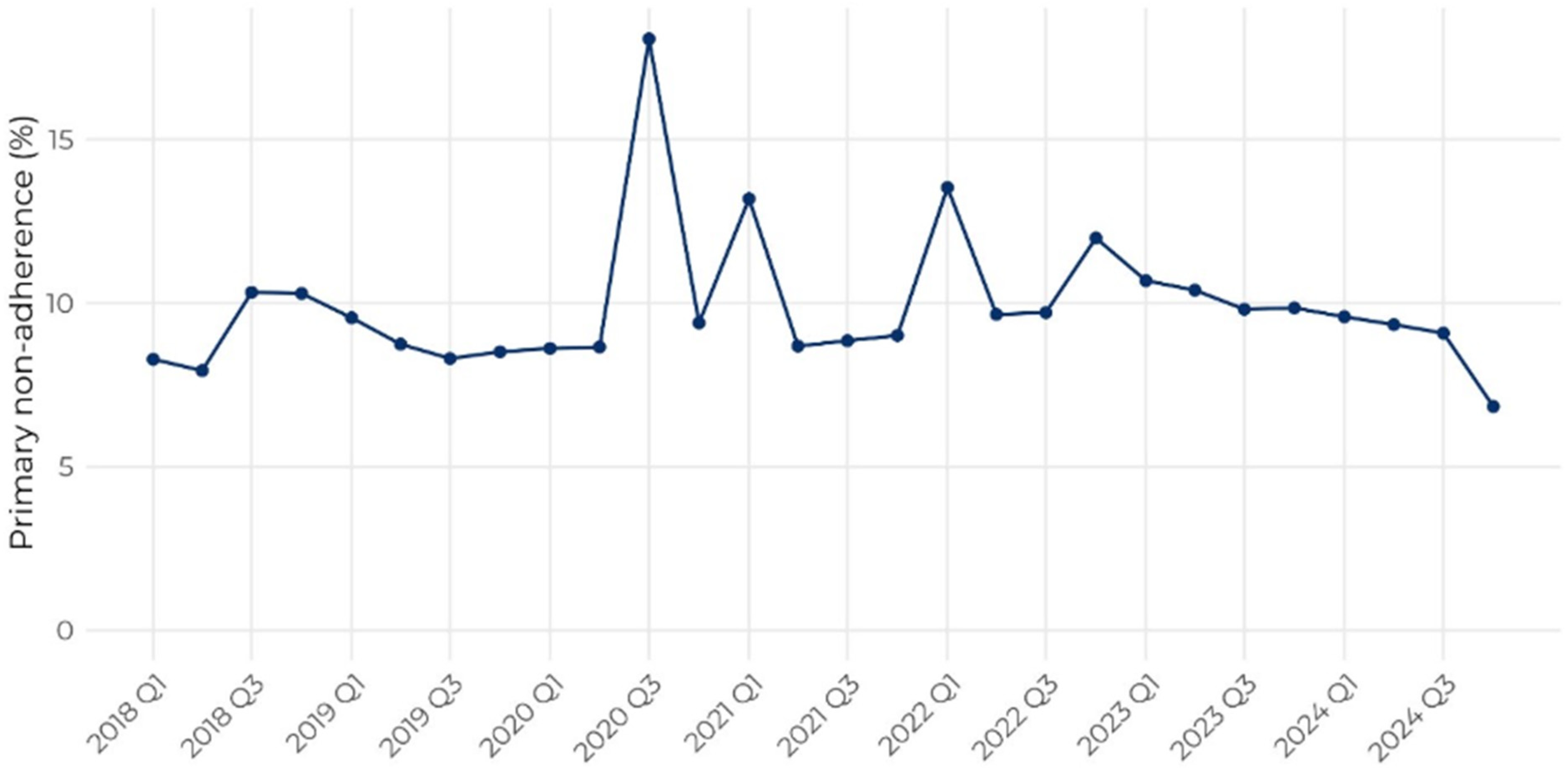
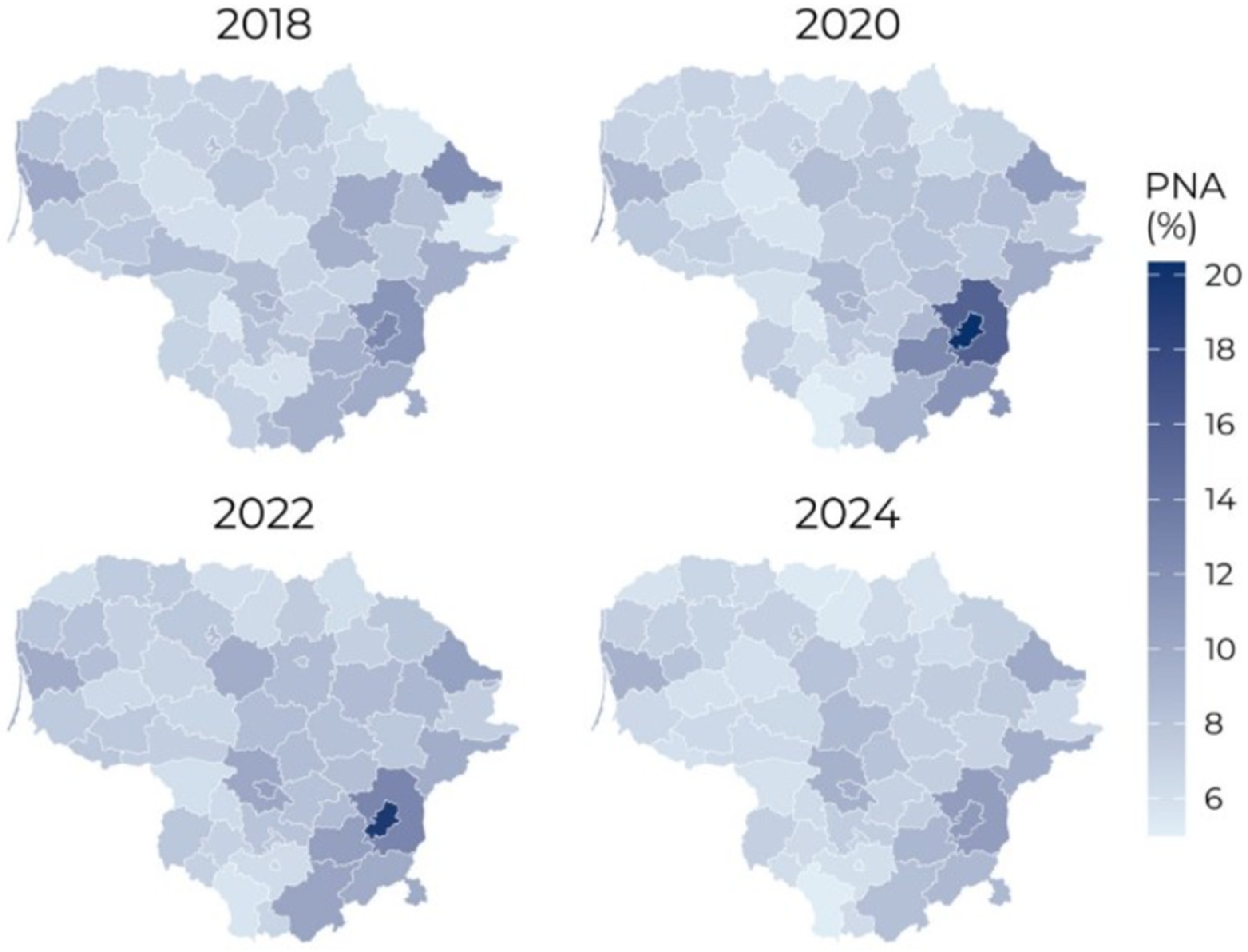
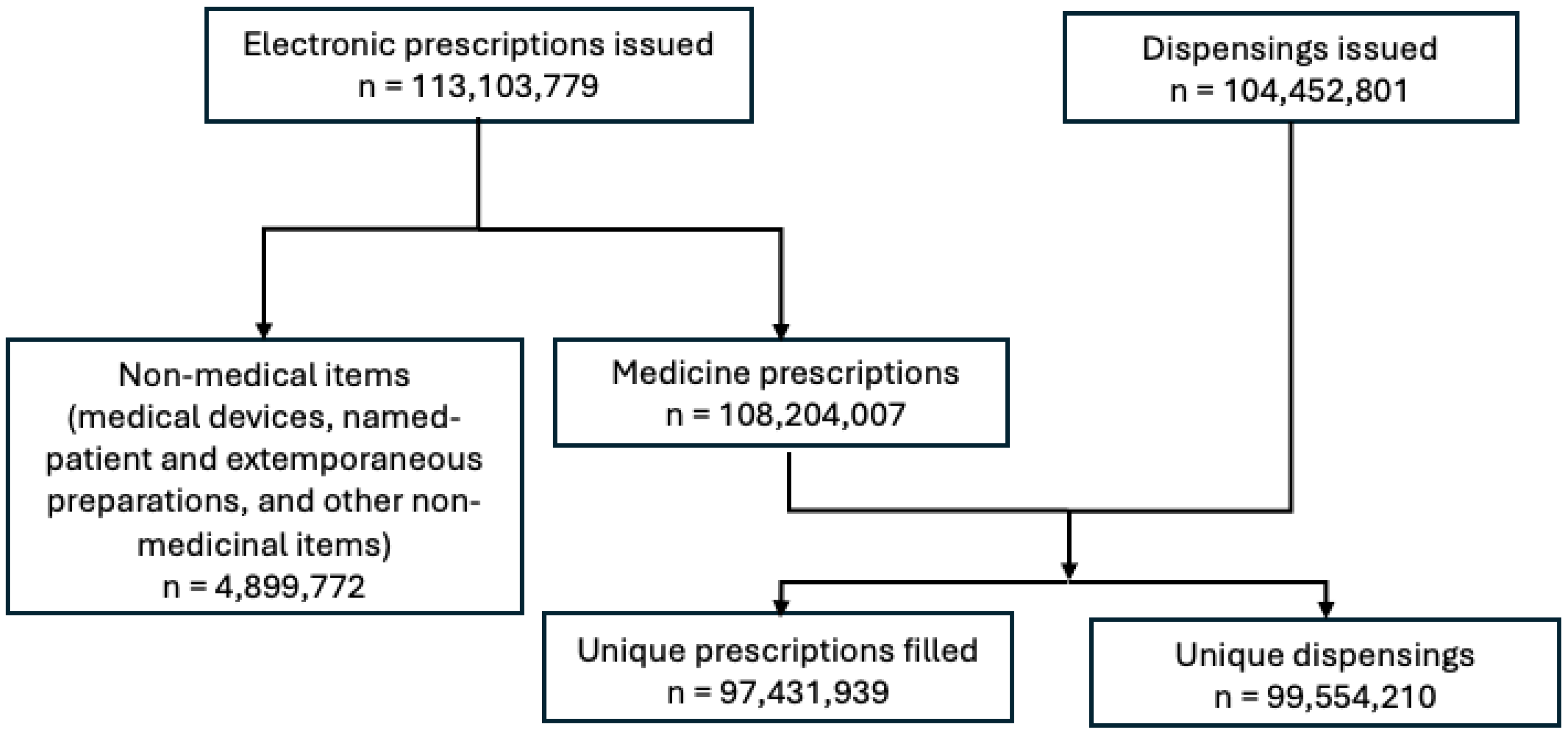
Background/Objectives: Primary non-adherence occurs when a prescribed medicine is never collected, preventing treatment from the beginning. Despite non-adherence being a widespread problem, most evidence comes from Western European and North American systems, and the Baltic region has rarely been assessed. Using Lithuania’s nationwide e-prescription system, we estimated primary non-adherence, identified associated factors, and characterised regional variation. Methods: We conducted a nationwide study of all outpatient electronic prescriptions issued in Lithuania, 2018–2024. We used open, anonymised quarterly prescribing and dispensing records from the national e-prescription subsystem and the national e-Health Services and Cooperation Infrastructure Information System (ESPBI IS). Prescribing and dispensing were deterministically linked. Prescriptions were classified as completed (dispensed quantity ≥ 90% of that prescribed), partially completed (dispensed quantity > 0% but <90%), or not completed (no quantity dispensed, defining primary non-adherence). Logistic regression estimated associations with patient, prescriber, prescription, and geographic characteristics; the results are reported as adjusted odds ratios (aOR) with 99% confidence intervals. Results: Of 108,204,007 prescriptions, 10.0% were never dispensed. Primary non-adherence was strongly associated with non-reimbursed status (aOR 3.47, 99% CI 3.46–3.48), younger age (18–44 years: 19.2% vs. ≥65 years: 7.0%), and short-term treatment (≤30 days: 14.1% vs. >90 days: 5.7%). Primary non-adherence rates were highest in cities (11.8%) and concentrated in the Vilnius metropolitan area (15.3%) and lowest in rural municipalities (5.5–6.0%). Conclusions: One in ten Lithuanian prescriptions is never dispensed. Non-adherence showed a marked, persistent geographic variance, with higher rates centred around Vilnius. Reimbursement status was the dominant correlate, pointing to cost as a key lever at the point of initiation.
Keywords: primary non-adherence; medication non-initiation; electronic prescribing; reimbursement; real-world data; Lithuania; open data; geographic variation primary non-adherence; medication non-initiation; electronic prescribing; reimbursement; real-world data; Lithuania; open data; geographic variation