Article

Impact of Long-Term Statin Therapy on Influenza Incidence and Overall Mortality: A Real-World Data Analysis


by
Diana Toledo
1,2,
Àurea Cartanyà-Hueso
3,4,
Constança Pagès-Fernández
5,
Rosa Morros
3,4,6,
Maria Giner-Soriano
3,4,
Àngela Domínguez
1,2,
Carles Vilaplana-Carnerero
1,7,
Alba Tor-Roca
1,3,4,8 and
María Grau
1,2,9,*
1
Department of Medicine, School of Medicine and Health Sciences, University of Barcelona, 08036 Barcelona, Spain
2
Biomedical Research Consortium in Epidemiology and Public Health (CIBERESP), 28029 Madrid, Spain
3
Fundació Institut Universitari per a la Recerca a l’Atenció Primària de Salut Jordi Gol i Gurina (IDIAPJGol), 08007 Barcelona, Spain
4
School of Medicine, Universitat Autònoma de Barcelona, 08193 Bellaterra (Cerdanyola del Vallès), Spain
5
School of Pharmacy, University of Barcelona, 08028 Barcelona, Spain
6
Biomedical Research Consortium in Infectious Diseases (CIBERINFEC), 28029 Madrid, Spain
7
Service for the Promotion of Quality and Bioethics, General Directorate of Health Planning and Regulation, Department of Health, Government of Catalonia, 08028 Barcelona, Spain
8
Research Institute for Nutrition and Food Safety (INSA-UB), 08921 Santa Coloma de Gramenet, Spain
9
Instituto de Salud Global de Barcelona (ISGlobal), 08003 Barcelona, Spain
*
Author to whom correspondence should be addressed.
Pharmacoepidemiology 2026, 5(2), 10; https://doi.org/10.3390/pharma5020010
Submission received: 9 February 2026 / Revised: 17 March 2026 / Accepted: 21 March 2026 / Published: 26 March 2026

Abstract

Background/Objectives: The study’s goal is to assess the association between long-term statin therapy and influenza incidence, influenza severity, and all-cause mortality. Methods: Two population-based dynamic cohorts (exposed and unexposed to statins) were followed from 2010 to 2019. Participants were 60 years or older; frail patients were excluded. The primary outcomes were influenza incidence, influenza-related intensive care unit (ICU) admission as a proxy for severity, and all-cause mortality. The exposed cohort comprised new statin users with a minimum of two pharmacy invoices within 90 days of enrollment. Adjusted risk ratios (aRRs) for influenza incidence, ICU admission, and mortality rate were calculated using Poisson regression. Results: The initial study population of 639,564 individuals was evenly split into exposed (319,782) and unexposed (319,782) cohorts; mean age was 71 years (standard deviation: 8 years), and 57% were women. Compared to non-users, new statin users showed a higher influenza incidence [9.39 (95% confidence interval: 9.36–9.42) vs. 7.64 (7.61–7.66) per 1000 person-years], ICU admission [1.65 (1.65–1.66) vs. 1.36 (1.35–1.36) per 1000 person-years], and overall mortality rate [97.09 (96.75–97.43) vs. 94.15 (93.82–94.47) per 1000 person-years]. Adjusted analysis revealed no significant association between statin use and influenza incidence [aRR: 1.04 (0.98–1.10)] or influenza-related ICU admission [aRR: 1.03 (0.89–1.19)] and shifted the effect on mortality from harmful to beneficial [aRR: 0.88 (0.87–0.89)]. Conclusions: Despite new users’ greater vulnerability at the start of treatment, our findings indicate that statins do not influence influenza incidence or severity but reduce all-cause mortality, warranting further exploration of their anti-inflammatory properties.

1. Introduction

Influenza remains a major public health challenge in Europe, causing substantial morbidity and mortality each winter season. Globally, seasonal influenza infects up to 1 billion people annually, with 3–5 million cases of severe illness and an estimated 290,000–650,000 respiratory deaths worldwide [1]. In Europe, annual incidence varies by season but typically affects 5–10% of adults and up to 20–30% of children. Older adults (≥65 years), individuals with chronic conditions, and pregnant women are at the highest risk of complications [2]. Hospitalization burden is significant: during recent seasons, peak influenza-associated hospitalization rates in European countries reached up to 18 per 100,000 population in England, with weekly peaks of 0–366 confirmed cases in sentinel hospitals across the European Union (EU) [2]. In Europe, age-standardized influenza mortality rates among older adults can reach 31 deaths per 100,000 annually [3]. Although most infections are mild, influenza can lead to severe complications such as pneumonia, cardiovascular events, and exacerbation of chronic diseases, driving intensive care admissions and excess winter mortality [2]. Vaccination remains the cornerstone of prevention, yet coverage and effectiveness vary by country and season, underscoring the need for robust surveillance and targeted interventions [4].
Statins, as 3-hydroxy-3-methylglutaryl-coenzyme A (HMG-coA) inhibitors, are widely recognized as lipid-lowering agents and are routinely prescribed for cardiovascular disease prevention [5]. Beyond their cholesterol-lowering properties, numerous studies have documented the pleiotropic effects of statins [6,7,8]. These include anti-inflammatory actions observed in healthy individuals, such as reductions in TNF-α, C-reactive protein, and metalloproteinase levels following lipopolysaccharide exposure [9]. Indeed, the potential immunomodulatory effects of statins in respiratory infections have been extensively investigated. Some clinical studies suggest that chronic statin treatment exerts protective effects on infectious respiratory diseases [10,11,12,13,14], while others have found no association between the two [15,16,17].
Analyzing real-world data from electronic health record (EHR) databases provides important insights into the association between chronic statin therapy and both influenza risk and disease severity. These resources capture longitudinal health records across large, diverse populations, permit prolonged follow-up, and document a wide array of outcomes, including influenza diagnoses and intensive care unit admissions [18]. The database used in this study has supported previous research on influenza epidemiology [19] and the anti-inflammatory properties of statins [20]. By leveraging this comprehensive dataset, we aim to produce new evidence on whether long-term statin use influences influenza incidence, thereby addressing a clinically pertinent question.
The goal of this study was to assess whether prior chronic statin therapy influences influenza incidence, intensive care unit (ICU) admission rate, and overall mortality.

2. Results

2.1. Recruitment

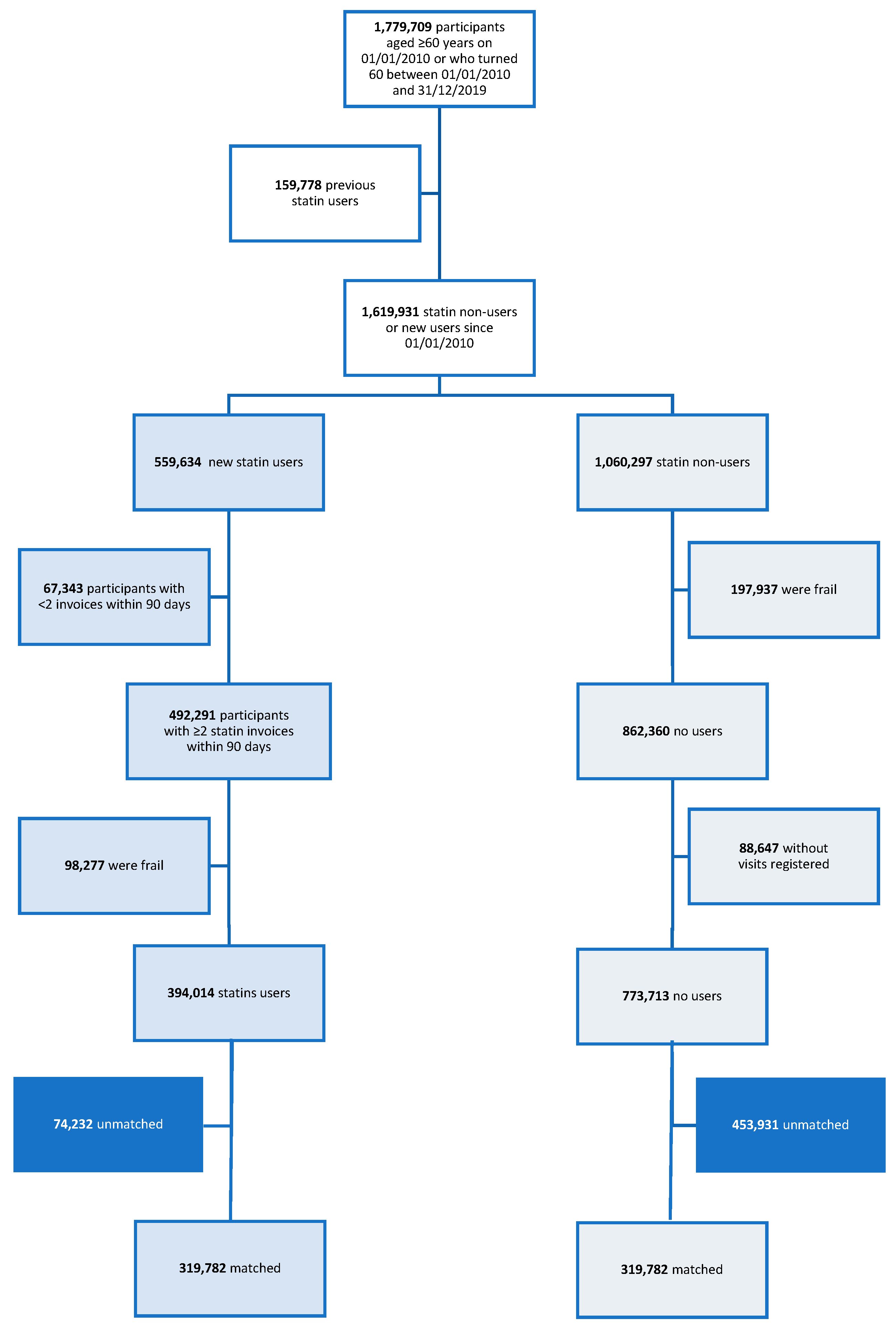
Between 1 January 2010 and 31 December 2019, a total of 1,779,709 individuals were recruited. Following the application of exclusion criteria, 394,014 new statin users formed the exposed group, and 773,713 statin non-users formed the unexposed group. Propensity score matching produced a final sample of 639,564 individuals—319,782 in the exposed cohort and 319,782 in the unexposed cohort (Figure 1).
Median follow-up was 8.9 years (Q1 = 5.2; Q3 = 9.9). The mean age was 71 years (SD = 8 years), and the sample included 56.7% women. Comorbidities and risk factors at baseline included diabetes (prevalence = 10.3%), hypertension (33.5%), current smoking (11.4%), and dyslipidemia (24.9%). Baseline characteristics for new users and non-users can be found in Table 1.

2.2. Outcomes According to Statin Use

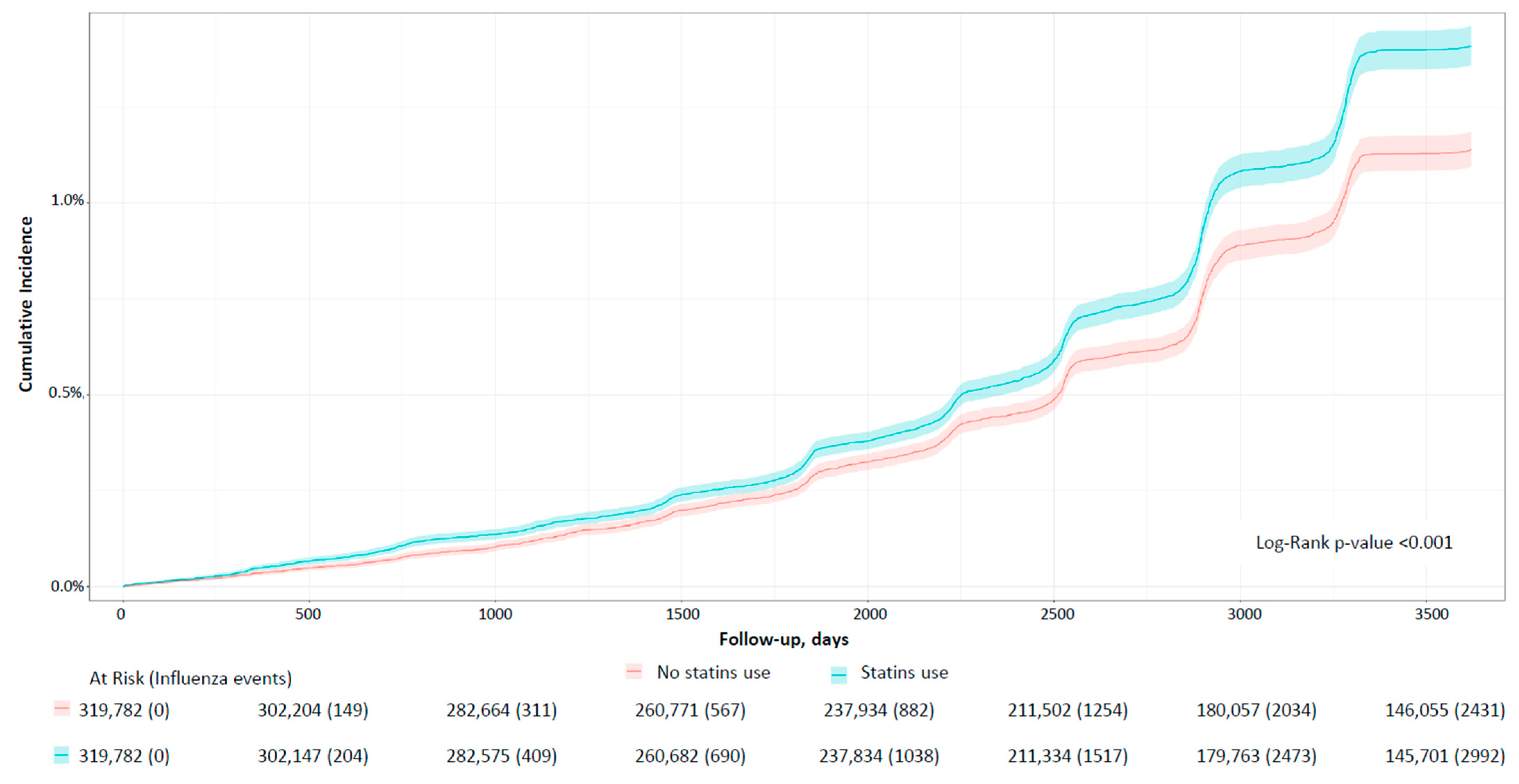
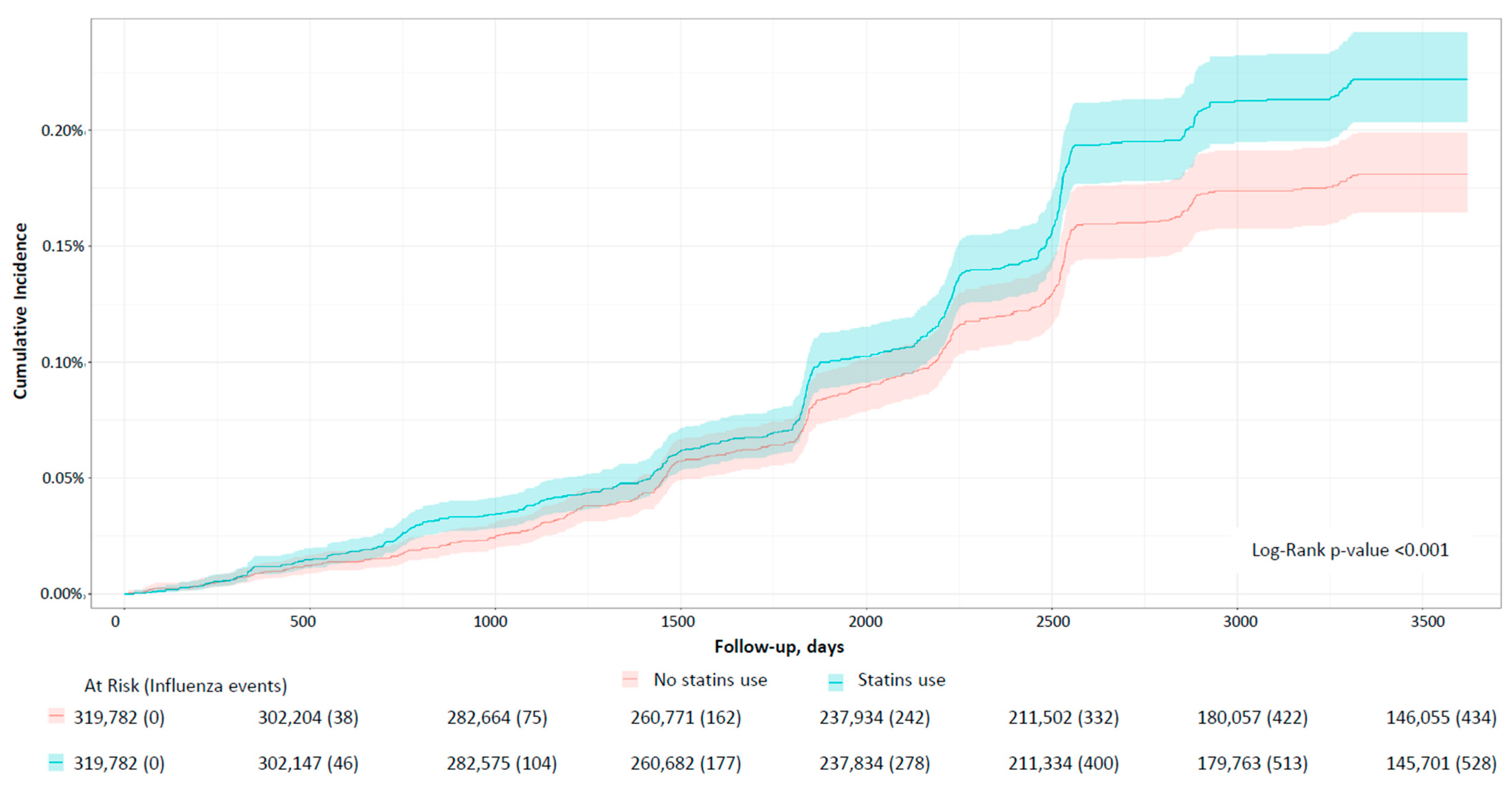
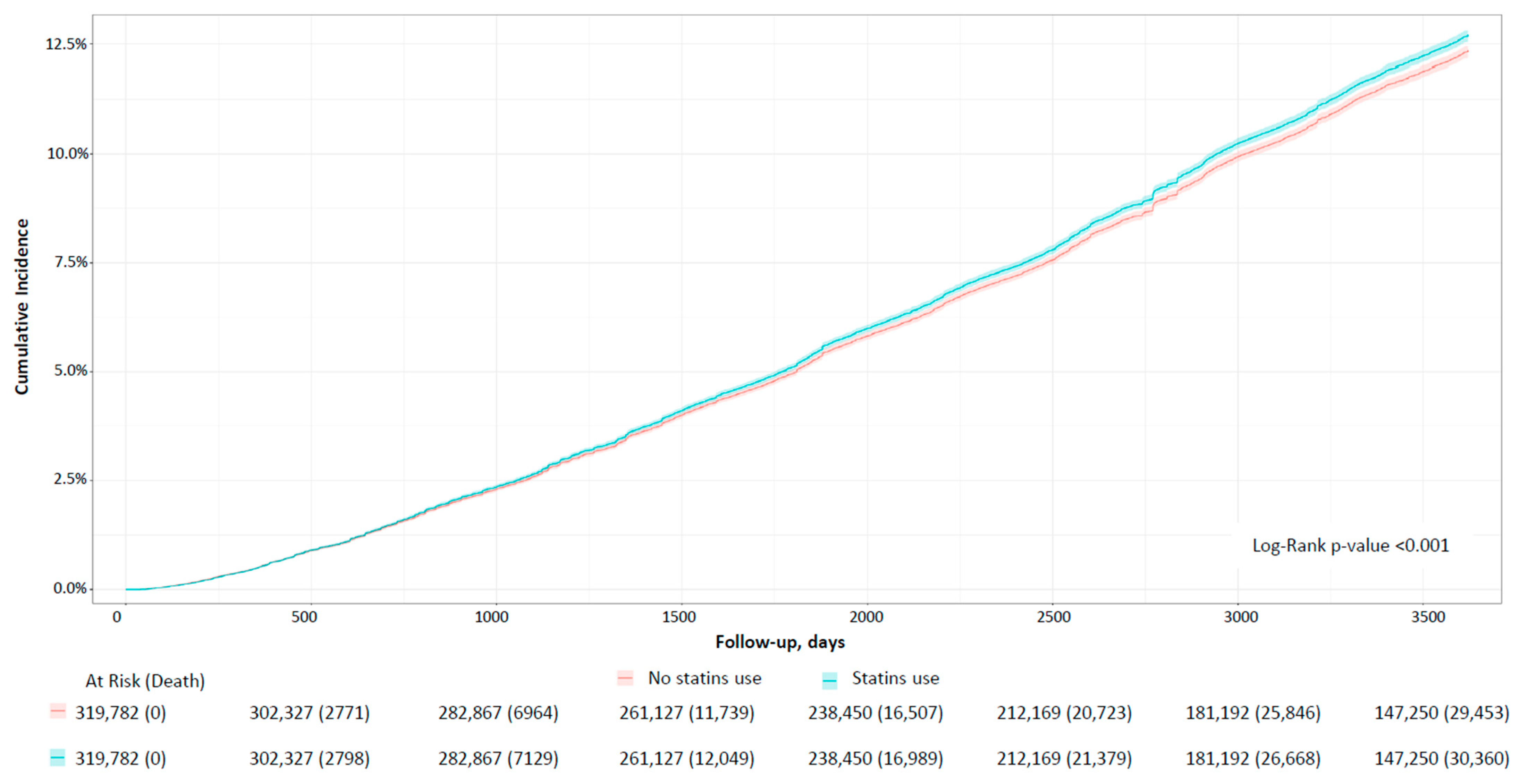
Between 2010 and 2019, new statin users exhibited a higher influenza incidence than non-users, with rates of 9.39 versus 7.64 per 1000 person-years (95% CI: 9.36–9.42 and 7.61–7.66, respectively). ICU admission was more frequently required for statin users (1.65 per 1000 person-years, 95% CI: 1.65–1.66) compared to non-users (1.36 per 1000 person-years, 95% CI: 1.35–1.36), suggesting a higher severity of the disease among exposed individuals. Additionally, overall mortality was slightly higher for statin users, at 97.09 per 1000 person-years (95% CI: 96.75–97.43), compared to 94.15 per 1000 person-years (95% CI: 93.82–94.47) in non-users. Cumulative incidence curves and log-rank tests for influenza incidence, severity, and all-cause mortality are displayed in Figure 2, Figure 3 and Figure 4. It should be noted that adjusted analyses found no significant differences in influenza incidence or severity of the episode in new users vs. non-users. Nevertheless, long-term statin use reduced the overall mortality rate by 12% [adjusted RR: 0.88 (95% CI: 0.87–0.89)] (Table 2).

3. Discussion

This study utilized a comprehensive database from a real-world clinical setting, conducting a retrospective propensity score-matched cohort analysis of 639,564 participants to explore the impacts of statin treatment on three outcomes: influenza incidence, severity, and overall mortality. Statin users exhibited higher rates of influenza incidence, ICU influenza-related admission, and mortality rate for all causes.
After adjusting for patient complexity, no statistical difference was found in influenza incidence or severity between statin users versus non-users. These findings support statin safety for individuals aged 60 or older, who are particularly vulnerable to influenza [21].
For the remaining outcome, patients on statin treatment showed a 12% lower adjusted risk of overall mortality compared to those not receiving statins. Such results might derive from statins’ pleiotropic effects, which extend beyond their primary role as lipid-lowering drugs.

3.1. Chronic Statin Use on Influenza Incidence and Severity

Statins have shown immunomodulatory properties that could affect susceptibility to influenza infection [22,23]. Given the higher risk of severe influenza outcomes among older individuals [21], it is necessary to explore the possible association between statin use and influenza incidence in this population group.
Statins have shown promising antiviral in vitro effects by blocking several steps of the virus life cycle and decreasing the expression of proinflammatory cytokines in influenza-infected cells [24,25]. Numerous preclinical studies have found statins to possess antiviral properties against RSV, HIV-1, and HCV [25]. When it comes to influenza, Liu and colleagues [26] found that a combination of lovastatin and caffeine had therapeutic and preventative effects against H5N1-, H3N2-, and H1N1-infected mice. However, conflicting evidence precludes a consensus. For example, no significant improvements were found in mice treated with either rosuvastatin [27] or simvastatin [28].
Considering the promising but inconclusive preclinical evidence, the use of epidemiological research methodology to analyze EHR databases is particularly suitable for investigating the impacts of chronic statin treatment on influenza incidence and severity. Still, evidence from observational studies utilizing real-world data remains equally contradictory. Several studies indicate a harmful role of statins on influenza morbidity and mortality [29,30,31,32]. For instance, a post hoc analysis using data from a prospective case–control study [30] reported an increased risk of contracting influenza among statin users aged ≥40 years. A recent Canadian study [32] on a population aged ≥66 years similarly found that statin users were 15% more likely to have an influenza infection. Other studies point in the opposite direction [11,14,33]. As an example, Kwong and colleagues [33] found a small yet statistically significant protective role of statins on influenza morbidity and mortality but suggested that the inconsistency of the association could imply it was due to unknown confounders.
Building on these findings, our unadjusted results seem to indicate a harmful effect of statins, but further adjustment reveals it to be null. The absence of association between statin therapy and influenza outcomes is consistent with several population-based studies [17,34,35,36], and suggests that previously observed differences based on statin use [30] may be attributed to hidden confounders. The highly contrasting results in the literature underscore the relevance of rigorous adjustment for baseline differences, as unadjusted analyses may reflect hidden biases (e.g., healthy user bias or indication bias) rather than true treatment effects. By including numerous variables in our propensity score and adjustment, this study provides a more accurate view of the impact of statins on influenza outcomes. Based on our results, statins have no effect on influenza incidence or severity in patients aged 60 years or older, and their discontinuation should not be recommended as a measure to prevent infection among this population group.

3.2. Statin Therapy and Its Protective Role in All-Cause Mortality

Our results, consistent with previous studies [33,37,38,39,40], indicate a protective association between long-term statin therapy and all-cause mortality. Importantly, this beneficial relationship was observed after adjusting for hypercholesterolemia. This aligns with a recent meta-analysis [37], which found the decrease in all-cause mortality risk among statin users to be similar in patients with and without cardiovascular disease, suggesting statins reduce mortality risk through non-cardiovascular mediated mechanisms. As mentioned in Section 4.1, Kwong et al. [33] found a slightly significant protective effect of statins against all-cause mortality after adjusting for relevant covariates. Similarly, Liang et al. [39] described a 20% lower 30-day and 90-day overall mortality among patients receiving long-term statin treatment. Other studies have described a beneficial association between statin treatment after admission and lower overall mortality among ICU patients [40] or patients hospitalized with sepsis [38], which further supports our findings. In contrast, Leung et al. [41] found that the apparent protective effect of statins on 90-day all-cause mortality disappeared after propensity matching, although it should be noted that their sample size was remarkably smaller.
An increasing body of clinical and experimental evidence suggests the existence of certain health benefits of statins unexplained by their primary mechanism as HMG-coA reductase inhibitors [42,43]. These supposed pleiotropic effects include anti-inflammatory, anti-thrombotic, anti-tumoral, and immunomodulatory properties, as well as a reduction in oxidative stress, improved endothelial function, and plaque stabilization [42,44]. In clinical settings, statin therapy has been associated with both a decrease in and therapeutic effects on inflammation-mediated conditions (e.g., cardiovascular events or rheumatoid arthritis) [42,45,46]. With chronic inflammation being at the root of various diseases that collectively represent the leading causes of mortality worldwide [47], our findings, alluding to a positive effect of statins on overall mortality, could be explained by statins’ anti-inflammatory activities. This anti-inflammatory role could improve outcomes for patients on chronic statin therapy, leaving the door open to potential clinical applications of statins beyond their current indication as cholesterol-lowering drugs. However, the mechanisms of statin pleiotropy are yet to be fully elucidated, and further research is needed to understand their real-life implications.

3.3. Strengths and Limitations

A key strength of this study is its large sample obtained from an internally validated, high-quality EHR database. Given the characteristics of Spain’s National Health System, such databases provide highly representative real-world data and enable cross-referencing of individual-level information between primary and hospital care. The possibility of reconstructing individual paths within the healthcare system [18] makes EHR databases a remarkably valuable source for epidemiological research. Additionally, these datasets offer high external validity and capture clinical information from groups often underrepresented in trials, including women, older adults, and people with diabetes. As another strength, propensity score matching accounted for several baseline imbalances between the two cohorts, increasing the robustness of the estimates of statin treatment impact.
Limitations inherent to observational studies that rely on medical records must also be recognized. Such studies are susceptible to residual confounding, notably by indication. Individuals with cancer, dementia, paralysis, or organ transplants; those on dialysis; and those who were institutionalized were excluded to mitigate frailty bias. Selection bias cannot be ruled out, as our study population exclusively comprised users of primary care services. Given that the database is based on EHR, observation bias is also possible. Additional nonclinical factors that may influence prescription patterns and treatment adherence include healthcare providers’ perceptions of patient risk, prescribers’ experiences, unreported side effects, and patients’ risk perceptions and willingness to adhere to their treatment [48]. These were unaccounted for in the EHR, potentially leading to interaction bias and/or confounding.
Another important limitation relates to the definition of statin exposure. Following the standard approach in pharmacoepidemiological research, individuals with at least two statin invoices within a 90-day period were classified as statin users at baseline—an exposure definition consistently applied in previous real-world studies assessing statin effects [5,49]. However, our data do not allow us to verify whether participants maintained long-term statin therapy throughout the nearly nine years of median follow-up. Consequently, changes in statin use over time cannot be fully ascertained, which introduces uncertainty in the interpretation of long-term exposure effects.
It must be acknowledged that the adjusted models did not consider influenza vaccination as a covariate. Although recent studies have found statins’ effects to be independent of vaccination status [30,32], there is no consensus on the existence of an interaction between statin therapy and influenza vaccination [23,50]. As a possible explanation, McLean et al. [51] found that statin treatment only interacted with vaccination for influenza A(H3N2), but not for influenza A(H1N1) or B, suggesting the degree of interference with statins depends on the virulence of the variant [31]. Because of the seasonal nature of influenza vaccination campaigns and the lack of precise temporal data, accurately portraying vaccination status over time proves particularly challenging. This variability complicates cumulative exposure assessment and the alignment of time of vaccination with influenza episodes. With the objective of avoiding misclassification bias and a reduction in the adjusted estimates’ validity, vaccination status was excluded from the current analysis. Further investigation into the interaction between vaccination status and chronic statin treatment could provide valuable insights for future research.
Under-recording or incomplete diagnostic coding in routine clinical practice is another common limitation of real-world datasets. In the present study, approximately 70% of statin patients’ medical history did not contain any formally coded hypercholesterolemia diagnosis, revealing that treatment based on laboratory results or cardiovascular risk assessments is not adequately reflected in diagnostic codes. This underscores the need to ensure cohesion between clinical decision-making and administrative records to facilitate observational research and improve the quality of real-world data. Similarly, the absence of cause-of-death information in the SIDIAP database precludes a more granular assessment of statins’ association with any cause-specific mortality.
In this study, statin potency or type was not considered. Although reaching contradictory conclusions, prior publications have reported differences among individual statins regarding all-cause mortality [31,39,40]. Lastly, possible variations in statin effect depending on influenza type were not accounted for in the current analysis. Future studies could expand upon previously explored differences in pleiotropic effects according to statin molecular structure [31], dosage [32], or influenza variant [32,51].

4. Materials and Methods

4.1. Study Design and Data Source

Two population-based dynamic cohorts—exposed and unexposed to statins—were followed from 2010 to 2019. Participant data were sourced from the Information System for Research in Primary Care (SIDIAP, from the Spanish Sistema de Información para el Desarrollo de la Investigación en Atención Primaria). This study uses the same matched cohort and underlying source population previously described in our published analysis on community-acquired pneumonia [10]. Although the cohort and matching framework are shared, the present manuscript evaluates different outcomes: influenza incidence, influenza-related ICU admission, and all-cause mortality.
The SIDIAP database comprises pseudonymized longitudinal health records routinely collected by over 30,000 healthcare professionals within the Catalan Institute of Health. This data, covering approximately 6 million individuals, encompasses roughly 80% of Catalonia’s population and 10.2% of Spain’s population. Recorded elements include demographic and lifestyle variables, clinical diagnoses, outcomes, events, referrals, and hospital discharges coded using the International Classification of Diseases (ICD-10), together with laboratory results and prescriptions dispensed through community pharmacies [18]. The study protocol received approval from the ethics committees of the two participating institutions (IDIAP Jordi Gol [23/094-EOM] on 10 July 2023, and the University of Barcelona [IRB00003099]) on 2 February 2024.

4.2. Participants and Exposure Assessment

Participants were enrolled in the cohort upon turning 60 years old, or on 1 January 2010 for those who had already reached that age at the start of the recruitment period. Individuals considered frail—defined as those with a diagnosis of cancer, dementia, or paralysis; those who had undergone an organ transplant; those receiving dialysis; or those living in institutional care—were excluded from the study.
Exposure to statins was defined as the use of medications classified under the ATC code C10AA. This category comprises ATC C10 drugs containing, either as monotherapy or in combination, C10AA01–05 (simvastatin, lovastatin, pravastatin, fluvastatin, and atorvastatin) and C10AA07 (rosuvastatin). The exposed cohort comprised new statin users, identified through health records, who had at least two pharmacy invoices within a 90-day window during the recruitment period. The index date corresponded to the first statin pharmacy invoice. Eligible individuals could not have been exposed to statins prior to cohort entry (years 2006–2010). Other exclusion criteria for the exposure cohort were the use of non-statin lipid-lowering agents (ATC codes other than C10AA, including C10AB, C10AC, C10AD, and C10AX) not combined with C10AA, as well as less than two statin invoices or more than 90 days between the first and second invoice. Non-users included in the non-exposure cohort were described as individuals with a minimum of one healthcare visit within the 18 months preceding the index date of their matched counterpart.

4.3. Outcomes

The codes assigned to influenza diagnoses in the SIDIAP database were identified for both primary care and hospital discharge records. The assessed outcomes were: (1) the incidence of influenza, determined by influenza diagnosis; (2) ICU admission linked to influenza, serving as a proxy for complicated cases; and (3) overall mortality, described as death from any cause.

4.4. Baseline Covariates

The baseline period was established as the two years prior to the index date. The covariates considered to influence prescription decisions and study outcomes, and which were therefore accounted for, were sex, age, MEDEA index [52], and Charlson Comorbidity Index, along with dichotomous (yes/no) variables for diabetes or use of antidiabetic medication, hypertension or use of antihypertensive medication, dyslipidemia, obesity (defined as BMI > 30 kg/m2), and influenza vaccination prior to initiation of statin treatment. Lastly, smoking was portrayed in three categories (current, former, and never a smoker).

4.5. Statistical Analysis

To assess the association between statin use and influenza incidence or ICU admission, we used 1:1 nearest neighbor propensity score matching without replacement. The propensity score was estimated using logistic regression of statin use on birth year, sex, MEDEA index [52], smoking status (current, former, or non-smoker), and cohort entry and exit dates. Using the corresponding functions in the MatchIt R package version 4.7.2 [53], the caliper was restricted to 0.1, and individuals were matched by exact year of birth, as well as cohort entry and exit year [54]. The matching process was evaluated through standardized mean differences (SMDs), which measure the discrepancy in covariate means between the two cohorts (exposed and non-exposed), standardized by the pooled standard deviation across both groups. SMDs nearing zero are indicative of good covariate balance between the cohorts [55].
Clinical and sociodemographic characteristics were summarized by statin exposure using absolute frequencies and percentages for categorical variables and means with standard deviations (SDs) or medians with interquartile ranges (IQR; first and third quartiles) for continuous variables. Differences by statin use were assessed using the chi-square test for categorical variables and either Student’s t-test or the Wilcoxon rank-sum test for continuous variables. Incidence rates per 1000 individuals, with 95% confidence intervals (CIs), were calculated for influenza, influenza-related ICU admission, and all-cause mortality among exposed and unexposed participants. Adjusted risk ratios with 95% CIs for each outcome were estimated by applying g-computation on the matched sample via the avg comparison function from the marginaleffects R package, after fitting the outcome models with the generalized linear model (glm) function. Standard errors were derived using cluster-robust variance estimation, with matching stratum membership specified as the clustering variable [56]. Adjustment covariates included the Charlson index as an indicator of patient complexity, cardiovascular risk factors (diabetes, hypercholesterolemia, obesity, hypertension, and smoking), and influenza vaccination. Cumulative incidence curves with 95% CIs for influenza and influenza-associated ICU admission were plotted considering death as a competing risk, using cuminc from the tidycmprsk R package [57] and visualization functions from the ggsurvfit R package [58]. Differences in influenza and influenza severity survival distributions between statin users and non-users were assessed using the log-rank test (significance level 0.05) [58]. The R statistical package (R Core Team; version 4.4.3) [59] was used for all calculations.

5. Conclusions

Prior statin therapy showed no association with the adjusted incidence of influenza and related ICU admissions but was associated with a decreased risk of all-cause mortality. These findings reaffirm the safety of statins in older adults and support existing evidence on their pleiotropic anti-inflammatory effects, suggesting that the clinical implications of these properties extend beyond dyslipidemia management.
This study benefits from a very large sample and a high-quality, population-representative EHR database, enabling robust and consistent estimates. As with all observational designs, however, our results remain subject to residual confounding and other inherent limitations. For this reason, while our findings provide strong and methodologically sound real-world evidence, further research—whether through additional observational studies with refined exposure measurements, quasi-experimental designs, or other appropriate methodological approaches—is warranted to clarify statins’ pleiotropic effects and their potential clinical and public health applications.

Author Contributions

Conceptualization, D.T., À.D. and M.G.; methodology, À.C.-H., M.G.-S., A.T.-R. and R.M.; formal analysis, À.C.-H. and M.G.-S.; data curation, R.M.; writing—original draft preparation, C.P.-F., D.T., M.G. and C.P.-F.; writing—review and editing, À.C.-H., R.M., M.G.-S., C.V.-C., À.D., A.T.-R. and C.P.-F.; funding acquisition, À.D. All authors have read and agreed to the published version of the manuscript.

Funding

This research was funded by the Catalan Agency for the Management of Grants for Universities—AGAUR (grant number [2021/SGR 00702]).

Institutional Review Board Statement

This study was conducted in accordance with the Declaration of Helsinki and approved by the local ethics committees of the two involved institutions: IDIAP Jordi Gol [23/094-EOM] on 10 July 2023, and the University of Barcelona [IRB00003099]) on 2 February 2024.

Informed Consent Statement

Patient consent was waived because this manuscript is based on an electronic medical records review.

Data Availability Statement

The data presented in this study are available on request from the corresponding author due to privacy and ethical restrictions.

Conflicts of Interest

The authors declare no conflicts of interest.

Abbreviations

The following abbreviations are used in this manuscript:
ATCAnatomical Therapeutic Chemical
CIConfidence interval
EHRElectronic health records
HMG-coA3-hydroxy-3-methylglutaryl-coenzyme A
ICUIntensive care unit
SIDIAPInformation System for Research in Primary Care

References

  1. WHO. The Burden of Influenza. Available online: https://www.who.int/news-room/feature-stories/detail/the-burden-of-influenza (accessed on 23 January 2026).
  2. ECDC. Seasonal Influenza—Annual Epidemiological Report for 2023/2024; ECDC: Stockholm, Sweden, 2024.
  3. Paget, J.; Spreeuwenberg, P.; Charu, V.; Taylor, R.J.; Iuliano, A.D.; Bresee, J.; Simonsen, L.; Viboud, C. Global Mortality Associated with Seasonal Influenza Epidemics: New Burden Estimates and Predictors from the GLaMOR Project. J. Glob. Health 2019, 9, 020421. [Google Scholar] [CrossRef]
  4. De Fougerolles, T.R.; Baïssas, T.; Perquier, G.; Vitoux, O.; Crépey, P.; Bartelt-Hofer, J.; Bricout, H.; Petitjean, A. Public Health and Economic Benefits of Seasonal Influenza Vaccination in Risk Groups in France, Italy, Spain and the UK: State of Play and Perspectives. BMC Public Health 2024, 24, 1222. [Google Scholar] [CrossRef]
  5. Garcia-Gil, M.; Comas-Cufí, M.; Blanch, J.; Martí, R.; Ponjoan, A.; Alves-Cabratosa, L.; Petersen, I.; Marrugat, J.; Elosua, R.; Grau, M.; et al. Effectiveness of Statins as Primary Prevention in People with Different Cardiovascular Risk: A Population-based Cohort Study. Clin. Pharmacol. Ther. 2018, 104, 719–732. [Google Scholar] [CrossRef] [PubMed]
  6. Oesterle, A.; Laufs, U.; Liao, J.K. Pleiotropic Effects of Statins on the Cardiovascular System. Circ. Res. 2017, 120, 229–243. [Google Scholar] [CrossRef] [PubMed]
  7. Tleyjeh, I.M.; Kashour, T.; Hakim, F.A.; Zimmerman, V.A.; Erwin, P.J.; Sutton, A.J.; Ibrahim, T. Statins for the Prevention and Treatment of Infections: A Systematic Review and Meta-Analysis. Arch. Intern. Med. 2009, 169, 1658–1667. [Google Scholar] [CrossRef]
  8. Kauerova, S.; Bartuskova, H.; Muffova, B.; Janousek, L.; Fronek, J.; Petras, M.; Poledne, R.; Kralova Lesna, I. Statins Directly Influence the Polarization of Adipose Tissue Macrophages: A Role in Chronic Inflammation. Biomedicines 2021, 9, 211. [Google Scholar] [CrossRef]
  9. Parihar, S.P.; Guler, R.; Brombacher, F. Statins: A Viable Candidate for Host-Directed Therapy against Infectious Diseases. Nat. Rev. Immunol. 2019, 19, 104–117. [Google Scholar] [CrossRef]
  10. Toledo, D.; Cartanyà-Hueso, À.; Morros, R.; Giner-Soriano, M.; Domínguez, À.; Vilaplana-Carnerero, C.; Grau, M. Impact of Long-Term Statin Therapy on Incidence and Severity of Community-Acquired Pneumonia: A Real-World Data Analysis. Biomedicines 2025, 13, 1438. [Google Scholar] [CrossRef]
  11. Masson, W.; Lobo, M.; Lavalle-Cobo, A.; Masson, G.; Molinero, G. Estatinas y mortalidad por influenza: Revisión sistemática y meta-análisis. Rev. Chil. Infectología 2020, 39, 321–329. [Google Scholar] [CrossRef] [PubMed]
  12. Chung, S.-D.; Tsai, M.-C.; Lin, H.-C.; Kang, J.-H. Statin Use and Clinical Outcomes among Pneumonia Patients. Clin. Microbiol. Infect. 2014, 20, 879–885. [Google Scholar] [CrossRef]
  13. Grudzinska, F.S.; Dosanjh, D.P.; Parekh, D.; Dancer, R.C.; Patel, J.; Nightingale, P.; Walton, G.M.; Sapey, E.; Thickett, D.R. Statin Therapy in Patients with Community-Acquired Pneumonia. Clin. Med. 2017, 17, 403–407. [Google Scholar] [CrossRef] [PubMed]
  14. Vahedian-Azimi, A.; Mannarino, M.; Shojaie, S.; Rahimibashar, F.; Esmaeili Gouvarchin Galeh, H.; Banach, M.; Bianconi, V.; Pirro, M.; Sahebkar, A. Effect of Statins on Prevalence and Mortality of Influenza Virus Infection: A Systematic Review and Meta-Analysis. Arch. Med. Sci. 2022, 18, 1513–1524. [Google Scholar] [CrossRef] [PubMed]
  15. Zeenny, R.M.; Mansour, H.; Kabbara, W.K.; Chamoun, N.; Audi, M.; Yared, Y.; Salameh, P. Effects of Statins on Clinical Outcomes in Hospitalized Patients with Community-Acquired Pneumonia. J. Int. Med. Res. 2020, 48, 0300060520938586. [Google Scholar] [CrossRef] [PubMed]
  16. Batais, M.A.; Khan, A.R.; Bin Abdulhak, A.A. The Use of Statins and Risk of Community-Acquired Pneumonia. Curr. Infect. Dis. Rep. 2017, 19, 26. [Google Scholar] [CrossRef]
  17. Cutrell, J.B.; Drechsler, H.; Bedimo, R.; Alvarez, C.A.; Mansi, I.A. Statin Use and Medically Attended Acute Respiratory Illness among Influenza Vaccine Recipients. Vaccine 2019, 37, 6707–6713. [Google Scholar] [CrossRef]
  18. Recalde, M.; Rodríguez, C.; Burn, E.; Far, M.; García, D.; Carrere-Molina, J.; Benítez, M.; Moleras, A.; Pistillo, A.; Bolíbar, B.; et al. Data Resource Profile: The Information System for Research in Primary Care (SIDIAP). Int. J. Epidemiol. 2022, 51, e324–e336. [Google Scholar] [CrossRef]
  19. Coma Redon, E.; Mora, N.; Prats-Uribe, A.; Fina Avilés, F.; Prieto-Alhambra, D.; Medina, M. Excess Cases of Influenza and the Coronavirus Epidemic in Catalonia: A Time-Series Analysis of Primary-Care Electronic Medical Records Covering over 6 Million People. BMJ Open 2020, 10, e039369. [Google Scholar] [CrossRef]
  20. Garcia-Gil, M.; Comas-Cufí, M.; Ramos, R.; Martí, R.; Alves-Cabratosa, L.; Parramon, D.; Prieto-Alhambra, D.; Baena-Díez, J.M.; Salvador-González, B.; Elosua, R.; et al. Effectiveness of Statins as Primary Prevention in People with Gout: A Population-Based Cohort Study. J. Cardiovasc. Pharmacol. Ther. 2019, 24, 542–550. [Google Scholar] [CrossRef]
  21. Thompson, W.W.; Shay, D.K.; Weintraub, E.; Brammer, L.; Cox, N.; Anderson, L.J.; Fukuda, K. Mortality Associated with Influenza and Respiratory Syncytial Virus in the United States. JAMA 2003, 289, 179–186. [Google Scholar] [CrossRef] [PubMed]
  22. Bu, D.; Griffin, G.; Lichtman, A.H. Mechanisms for the Anti-Inflammatory Effects of Statins. Curr. Opin. Lipidol. 2011, 22, 165–170. [Google Scholar] [CrossRef]
  23. Omer, S.B.; Phadke, V.K.; Bednarczyk, R.A.; Chamberlain, A.T.; Brosseau, J.L.; Orenstein, W.A. Impact of Statins on Influenza Vaccine Effectiveness against Medically Attended Acute Respiratory Illness. J. Infect. Dis. 2016, 213, 1216–1223. [Google Scholar] [CrossRef] [PubMed]
  24. Mehrbod, P.; Omar, A.R.; Hair-Bejo, M.; Haghani, A.; Ideris, A. Mechanisms of Action and Efficacy of Statins against Influenza. BioMed Res. Int. 2014, 2014, 872370. [Google Scholar] [CrossRef]
  25. Gorabi, A.M.; Kiaie, N.; Bianconi, V.; Jamialahmadi, T.; Al-Rasadi, K.; Johnston, T.P.; Pirro, M.; Sahebkar, A. Antiviral Effects of Statins. Prog. Lipid Res. 2020, 79, 101054. [Google Scholar] [CrossRef] [PubMed]
  26. Liu, Z.; Guo, Z.; Wang, G.; Zhang, D.; He, H.; Li, G.; Liu, Y.; Higgins, D.; Walsh, A.; Shanahan-Prendergast, L.; et al. Evaluation of the Efficacy and Safety of a Statin/Caffeine Combination against H5N1, H3N2 and H1N1 Virus Infection in BALB/c Mice. Eur. J. Pharm. Sci. 2009, 38, 215–223. [Google Scholar] [CrossRef]
  27. Radigan, K.A.; Urich, D.; Misharin, A.V.; Chiarella, S.E.; Soberanes, S.; Gonzalez, A.; Perlman, H.; Wunderink, R.G.; Budinger, G.R.S.; Mutlu, G.M. The Effect of Rosuvastatin in a Murine Model of Influenza A Infection. PLoS ONE 2012, 7, e35788. [Google Scholar] [CrossRef] [PubMed][Green Version]
  28. Kumaki, Y.; Morrey, J.D.; Barnard, D.L. Effect of Statin Treatments on Highly Pathogenic Avian Influenza H5N1, Seasonal and H1N1pdm09 Virus Infections in BALB/c Mice. Future Virol. 2012, 7, 801–818. [Google Scholar] [CrossRef] [PubMed]
  29. Wu, F.; Wang, C.; Li, S.; Ye, Y.; Cui, M.; Liu, Y.; Jiang, S.; Qian, J.; Yuan, J.; Shu, Y.; et al. Association Between Statins Administration and Influenza Susceptibility: A Systematic Review and Meta-Analysis of Longitudinal Studies. Viruses 2024, 16, 278. [Google Scholar] [CrossRef]
  30. MacIntyre, C.R.; Chughtai, A.A.; Das, A.; Rahman, B.; Moa, A.M.; Gan, C.H.; Tan, T.C. Effect of Statin Use on the Risk of Influenza and Influenza Vaccine Effectiveness. Int. J. Cardiol. 2021, 332, 205–208. [Google Scholar] [CrossRef]
  31. Chiu, H.-T.; Shen, L.-J.; Chen, Y.-C.; Lin, J.-H.; Wang, C.-C. Effect of Statin Use on the Risk of Medically Attended Acute Respiratory Illness among Influenza Vaccinated Elderly. Vaccine 2018, 36, 6133–6137. [Google Scholar] [CrossRef]
  32. Chung, H.; Campitelli, M.A.; Buchan, S.A.; Campigotto, A.; Chen, B.; Crowcroft, N.S.; Dubey, V.; Gubbay, J.B.; Karnauchow, T.; Katz, K.; et al. Evaluating the Impact of Statin Use on Influenza Vaccine Effectiveness and Influenza Infection in Older Adults. Clin. Infect. Dis. 2023, 77, 303–311. [Google Scholar] [CrossRef] [PubMed]
  33. Kwong, J.C.; Li, P.; Redelmeier, D.A. Influenza Morbidity and Mortality in Elderly Patients Receiving Statins: A Cohort Study. PLoS ONE 2009, 4, e8087. [Google Scholar] [CrossRef] [PubMed]
  34. Laidler, M.R.; Thomas, A.; Baumbach, J.; Kirley, P.D.; Meek, J.; Aragon, D.; Morin, C.; Ryan, P.A.; Schaffner, W.; Zansky, S.M.; et al. Statin Treatment and Mortality: Propensity Score-Matched Analyses of 2007–2008 and 2009–2010 Laboratory-Confirmed Influenza Hospitalizations. Open Forum Infect. Dis. 2015, 2, ofv028. [Google Scholar] [CrossRef]
  35. Brett, S.J.; Myles, P.; Lim, W.S.; Enstone, J.E.; Bannister, B.; Semple, M.G.; Read, R.C.; Taylor, B.L.; McMenamin, J.; Nicholson, K.G.; et al. Pre-Admission Statin Use and in-Hospital Severity of 2009 Pandemic Influenza A(H1N1) Disease. PLoS ONE 2011, 6, e18120. [Google Scholar] [CrossRef]
  36. Fleming, D.M.; Verlander, N.Q.; Elliot, A.J.; Zhao, H.; Gelb, D.; Jehring, D.; Nguyen-Van-Tam, J.S. An Assessment of the Effect of Statin Use on the Incidence of Acute Respiratory Infections in England during Winters 1998–1999 to 2005–2006. Epidemiol. Infect. 2010, 138, 1281–1288. [Google Scholar] [CrossRef] [PubMed]
  37. Nowak, M.M.; Niemczyk, M.; Florczyk, M.; Kurzyna, M.; Pączek, L. Effect of Statins on All-Cause Mortality in Adults: A Systematic Review and Meta-Analysis of Propensity Score-Matched Studies. J. Clin. Med. 2022, 11, 5643. [Google Scholar] [CrossRef]
  38. Li, C.; Zhao, K.; Ren, Q.; Chen, L.; Zhang, Y.; Wang, G.; Xie, K. Statin Use during Intensive Care Unit Stay Is Associated with Improved Clinical Outcomes in Critically Ill Patients with Sepsis: A Cohort Study. Front. Immunol. 2025, 16, 1537172. [Google Scholar] [CrossRef]
  39. Liang, B.; Yang, S.T.; Wei, K.K.; Yu, A.S.; Kim, B.J.; Gould, M.K.; Sim, J.J. Statin Use and Mortality among Patients Hospitalized with Sepsis: A Retrospective Cohort Study within Southern California, 2008–2018. Crit. Care Res. Pract. 2022, 2022, 7127531. [Google Scholar] [CrossRef]
  40. Kang, C.; Li, F.; Zhao, H.; Honore, P.M.; Dagli-Hernandez, C.; Hoshi, T.; Jin, Y. Association of Statin Use with 28-Day Mortality in the Medical Information Mart for Intensive Care IV Database: A Retrospective Cohort Study. J. Thorac. Dis. 2025, 17, 429–440. [Google Scholar] [CrossRef] [PubMed]
  41. Leung, S.; Gong, M.N. Statins and Outcomes in Patients with Bloodstream Infection: A Propensity-Matched Analysis. Crit. Care Med. 2012, 185, A1138. [Google Scholar] [CrossRef]
  42. German, C.A.; Liao, J.K. Understanding the Molecular Mechanisms of Statin Pleiotropic Effects. Arch. Toxicol. 2023, 97, 1529–1545. [Google Scholar] [CrossRef]
  43. Satny, M.; Hubacek, J.A.; Vrablik, M. Statins and Inflammation. Curr. Atheroscler. Rep. 2021, 23, 80. [Google Scholar] [CrossRef]
  44. Jiang, W.; Hu, J.-W.; He, X.-R.; Jin, W.-L.; He, X.-Y. Statins: A Repurposed Drug to Fight Cancer. J. Exp. Clin. Cancer Res. 2021, 40, 241. [Google Scholar] [CrossRef]
  45. Aminifar, E.; Tavakkol Afshari, H.S.; Sathyapalan, T.; Abbasifard, M.; Sahebkar, A. The Pleiotropic Effects of Statins in Rheumatoid Arthritis. J. Pharm. Pharmacol. 2023, 75, 910–920. [Google Scholar] [CrossRef] [PubMed]
  46. Ridker, P.M.; Danielson, E.; Fonseca, F.A.H.; Genest, J.; Gotto, A.M.; Kastelein, J.J.P.; Koenig, W.; Libby, P.; Lorenzatti, A.J.; MacFadyen, J.G.; et al. Rosuvastatin to Prevent Vascular Events in Men and Women with Elevated C-Reactive Protein. N. Engl. J. Med. 2008, 359, 2195–2207. [Google Scholar] [CrossRef]
  47. Furman, D.; Campisi, J.; Verdin, E.; Carrera-Bastos, P.; Targ, S.; Franceschi, C.; Ferrucci, L.; Gilroy, D.W.; Fasano, A.; Miller, G.W.; et al. Chronic Inflammation in the Etiology of Disease across the Life Span. Nat. Med. 2019, 25, 1822–1832. [Google Scholar] [CrossRef]
  48. Mann, D.M.; Woodward, M.; Muntner, P.; Falzon, L.; Kronish, I. Predictors of Nonadherence to Statins: A Systematic Review and Meta-Analysis. Ann. Pharmacother. 2010, 44, 1410–1421. [Google Scholar] [CrossRef]
  49. Ramos, R.; Comas-Cufí, M.; Martí-Lluch, R.; Balló, E.; Ponjoan, A.; Alves-Cabratosa, L.; Blanch, J.; Marrugat, J.; Elosua, R.; Grau, M.; et al. Statins for Primary Prevention of Cardiovascular Events and Mortality in Old and Very Old Adults with and without Type 2 Diabetes: Retrospective Cohort Study. BMJ 2018, 362, k3359. [Google Scholar] [CrossRef]
  50. Tsai, L.-W.; Chen, Y.-T.; Shih, C.-J.; Ou, S.-M.; Chao, P.-W.; Lo, S.-H. Statin Use and Influenza Vaccine Effectiveness in Persons > 65 Years of Age, Taiwan. Emerg. Infect. Dis. 2020, 26, 1243–1250. [Google Scholar] [CrossRef]
  51. McLean, H.Q.; Chow, B.D.W.; VanWormer, J.J.; King, J.P.; Belongia, E.A. Effect of Statin Use on Influenza Vaccine Effectiveness. J. Infect. Dis. 2016, 214, 1150–1158. [Google Scholar] [CrossRef] [PubMed]
  52. Domínguez-Berjón, M.F.; Borrell, C.; Cano-Serral, G.; Esnaola, S.; Nolasco, A.; Isabel Pasarín, M.; Ramis, R.; Saurina, C.; Escolar-Pujolar, A. Constructing a Deprivation Index Based on Census Data in Large Spanish Cities (the MEDEA Project). Gac. Sanit. 2008, 22, 179–187. [Google Scholar] [CrossRef] [PubMed]
  53. Ho, D.; Imai, K.; King, G.; Stuart, E.A. MatchIt: Nonparametric Preprocessing for Parametric Causal Inference. J. Stat. Softw. 2011, 42, 1–28. [Google Scholar] [CrossRef]
  54. Iwagami, M.; Shinozaki, T. Introduction to Matching in Case-Control and Cohort Studies. Ann. Clin. Epidemiol. 2022, 4, 33–40. [Google Scholar] [CrossRef] [PubMed]
  55. Ali, M.S.; Groenwold, R.H.H.; Pestman, W.R.; Belitser, S.V.; Roes, K.C.B.; Hoes, A.W.; de Boer, A.; Klungel, O.H. Propensity Score Balance Measures in Pharmacoepidemiology: A Simulation Study. Pharmacoepidemiol. Drug Saf. 2014, 23, 802–811. [Google Scholar] [CrossRef] [PubMed]
  56. Arel-Bundock, V.; Greifer, N.; Heiss, A. How to Interpret Statistical Models Using Marginaleffects for R and Python. J. Stat. Softw. 2024, 111, 1–32. [Google Scholar] [CrossRef]
  57. Sjoberg, D.; Fei, T. Tidycmprsk: Competing Risks Estimation. R Package; CRAN: Vienna, Austria, 2023. [Google Scholar]
  58. Sjoberg, D.; Baillie, M.; Fruechtenicht, C.; Haesendonckx, S.; Treis, T. Ggsurvfit: Flexible Time-to-Event Figures. R Package; Version 1.2.0 2026; CRAN: Vienna, Austria, 2026. [Google Scholar]
  59. R Core Team. R: The R Project for Statistical Computing; R Foundation for Statistical Computing: Vienna, Austria, 2025. [Google Scholar]
Figure 1. Flowchart of participant selection.
Pharmacoepidemiology 05 00010 g001
Figure 2. Unadjusted cumulative incidence curve of influenza over a ten-year period.
Pharmacoepidemiology 05 00010 g002
Figure 3. Unadjusted cumulative incidence curve of ICU admission over ten years among patients diagnosed with influenza.
Pharmacoepidemiology 05 00010 g003
Figure 4. Unadjusted cumulative incidence curve of all-cause mortality over a ten-year period.
Pharmacoepidemiology 05 00010 g004
Table 1. Baseline characteristics of participants according to statin exposure.
New Statin Users
n = 319,782
Statin Non-Users
n = 319,782
p-Value *SMD
Sex, n (%) (women)180,405 (56.4)182,112 (56.9)<0.0010.011
Age, mean (SD)71.09 (7.55)71.09 (7.55)0.963<0.001
Smoking n (%) <0.0010.078
Smoker33,532 (10.5)39,519 (12.4)
Former smoker47,249 (14.8)40,761 (12.7)
Hypertension, n (%)119,638 (37.4)94,498 (29.6)<0.0010.167
Diabetes, n (%)46,093 (14.4)19,932 (6.2)<0.0010.271
Hypercholesterolemia, n (%)98,696 (30.9)60,454 (18.9)<0.0010.279
Obesity, n (%)44,892 (14.0)30,983 (9.7)<0.0010.135
Charlson index, median [IQR]2.00 [1.00, 3.00]2.00 [1.00, 2.00]<0.0010.167
MEDEA deprivation index, n (%) <0.0010.072
Rural21,629 (6.8)23,662 (7.4)
Semi-rural17,726 (5.5)18,944 (5.9)
Urban with low deprivation62,725 (19.6)68,602 (21.5)
Semi-urban39,256 (12.3)38,647 (12.1)
Urban with medium–low deprivation50,357 (15.7)51,499 (16.1)
Urban with medium–high deprivation68,173 (21.3)62,318 (19.5)
Urban with high deprivation59,478 (18.6)55,542 (17.4)
Influenza vaccination, n (%)658 (0.2)448 (0.1)<0.0010.018
IQR: Interquartile range. SD: Standard deviation. SMD: Standard mean difference. * Chi-square test for categorical variables, Student’s t-test for age, and Wilcoxon rank-sum test for the Charlson index. Table 1 presents baseline characteristics of the same matched cohort used in our previously published study on community-acquired pneumonia [10], although the outcomes analyzed in the present study differ (influenza-related endpoints and all-cause mortality).
Table 2. Incidence rate of influenza, ICU admission, and overall mortality rate per 1000 person-years for new statin users and non-users.
New Statin UsersStatin Non-Users
EventsIncidence Rate
(95% CI)
EventsIncidence Rate
(95% CI)
Adjusted Risk Ratio *
(95% CI)
Influenza incidence30039.39
(9.36; 9.42)
24427.64
(7.61; 7.66)
1.04
(0.98; 1.1)
Influenza severity
(ICU admission)
5281.65
(1.65; 1.66)
4341.36
(1.35; 1.36)
1.03
(0.89; 1.19)
Overall mortality31,04897.09
(96.75; 97.43)
30,10794.15
(93.82; 94.47)
0.88
(0.87; 0.89)
CI: confidence interval. ICU: intensive care unit. * Model adjusted for Charlson index, influenza vaccination, diabetes, hypercholesterolemia, obesity, hypertension, and smoking.
Disclaimer/Publisher’s Note: The statements, opinions and data contained in all publications are solely those of the individual author(s) and contributor(s) and not of MDPI and/or the editor(s). MDPI and/or the editor(s) disclaim responsibility for any injury to people or property resulting from any ideas, methods, instructions or products referred to in the content.