Review

CNS-Specific and Coagulation Biomarkers in Traumatic Brain Injury: Beyond the Reach of the Scalpel—A Scoping Review


by
Serban Iancu Papacocea
1,2,*,
Ioana Anca Bădărău
1 and
Toma Marius Papacocea
2
1
Medical Physiology Department, Faculty of Medicine, “Carol Davila” University of Medicine and Pharmacy, 020021 Bucharest, Romania
2
Neurosurgery Department, “Saint Pantelimon” Hospital, Faculty of Medicine, “Carol Davila” University of Medicine and Pharmacy, 020021 Bucharest, Romania
*
Author to whom correspondence should be addressed.
Appl. Biosci. 2026, 5(1), 12; https://doi.org/10.3390/applbiosci5010012

Submission received: 31 October 2025 / Revised: 9 January 2026 / Accepted: 28 January 2026 / Published: 5 February 2026
(This article belongs to the Special Issue Feature Reviews for Applied Biosciences)

Abstract

Despite significant advances in neurosurgical and critical care, traumatic brain injury (TBI) remains a major cause of morbidity and mortality. Surgical treatment of intracranial hemorrhagic lesions can only target the primary mechanical injuries and their immediate consequences but fails to address the biochemical pathological cascade that unfolds during the second injury. This review synthesizes current knowledge regarding the use of several biomarkers in diagnosis and prognosis assessment. A structured literature search was conducted by querying the PubMed database. Articles evaluating diagnostic and prognostic biomarkers in adult TBI were screened according to Prisma guidelines, and data regarding biomarkers type, cut-off values, and correlations with the outcome were extracted and summarized. Among Central Nervous System (CNS)-Specific markers, S100 calcium-binding protein (S100B) emerged as a remarkably strong negative predictor for Computed Tomography (CT)-visible intracranial lesions (NPV = 97.3–100%), whereas glial fibrillary acidic protein (GFAP) yielded both high NPV and brain specificity. Coagulation parameters such as the international normalized ratio (INR) and fibrinogen were independently correlated with mortality and unfavorable outcomes. Fibrinogen displayed a bidirectional relationship with increased mortality risk at both low (<2 g/L) and high (>4.5 g/L) values. In conclusion, biomarkers quantify the otherwise invisible progression of secondary traumatic brain injury that persists even after successful surgery.

1. Introduction

Traumatic brain injury (TBI) represents a major cause of morbidity and mortality, affecting individuals across all age groups and carrying significant socioeconomic burden. It is estimated that about 69 million individuals suffer a TBI each year with the highest burden in low–middle-income countries [1]. In Europe, the mortality rate of TBI is approximately 11 per 100,000 inhabitants [2]. TBI also contributes substantially to the years lived with disability (YLD), reflecting both the frequency of injury and long-term functional consequences [3].
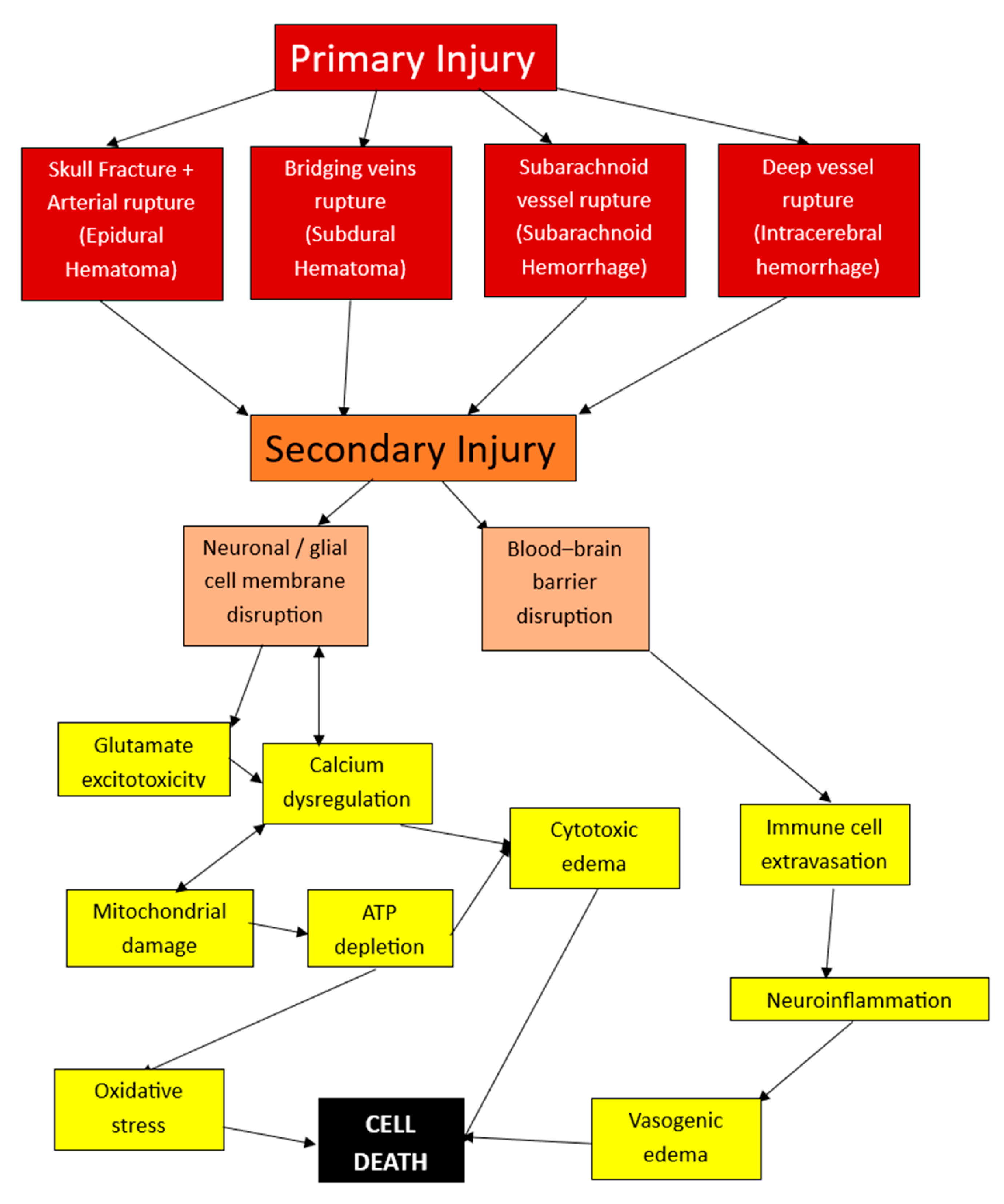
TBIs consist of two major phases: primary injury, in which the damage is caused by the direct transfer of energy resulting from the mechanical impact; and secondary injury, a delayed tissular, cellular, and molecular response initiated by the primary injury.
In recent years, advances in molecular neurosciences, neuroimaging, and biomarker studies have provided new insights into the pathogenesis of TBI-related hemorrhagic lesions.
Unlike the primary injury, which results from the immediate transfer of mechanical energy at the moment of impact and is largely irreversible, secondary brain injury consists of delayed cellular and molecular cascades that evolve over hours to days and represent potential targets for therapeutic intervention. Following the primary injury, the mechanical disruption of neuronal cell membranes and blood vessels causes ionic imbalance and glutamate-mediated excitotoxicity [4,5]. Excessive release of glutamate activates N-methyl-D-aspartate (NMDA) receptors and α-amino-3-hydroxy-5-methyl-4-isoxazolepropionic acid (AMPA) receptors, leading to an increased calcium and sodium influx [6]. Increased intracellular calcium also activates lytic intracellular enzymes, such as proteases, phospholipases, and endonucleases, which contribute to cytoskeletal degradation and membrane damage. This further exacerbates mitochondrial damage, decreasing the amount of available ATP for ion pumps, thus decreasing the cell capability of ejecting calcium. Moreover, mitochondrial damage accelerates ATP depletion and disrupts oxidative phosphorylation [7]. The combined mechanisms of ATP depletion leading to ion pump failure and increased calcium and sodium influx lead to cytotoxic edema and cell death. Apart from decreased ATP and implicit ion pump failure, mitochondrial destruction leads to the accumulation of reactive oxygen and nitrogen species (ROS and RNS). These oxidative mechanisms activate intrinsic apoptotic signaling pathways, such as mitochondrial membrane permeabilization and caspase activation, ultimately contributing to neuronal cell death through both apoptosis and necrosis [8].
Another vital mechanism in secondary injury following TBI is represented by blood–brain barrier (BBB) disruption. The BBB is not a simple physical obstacle but rather a highly specialized cellular interface composed of continuous, non-fenestrated capillaries with a complete basement membrane. The endothelial cells of these capillaries are interconnected by tight junctions [9]. This ultrastructure creates a highly selective membrane that allows the passage of hydrophobic/non-polar molecules (such as CO2, O2, or several fat-soluble hormones), while restricting polar molecules [10] as well as peripheral immune cells [11,12]. When the BBB is damaged, such as in the case of a traumatic brain injury, its permeability increases. This allows for immune cells and otherwise restricted immune mediators to extravasate into the surrounding brain tissue, generating neuroinflammation, which leads to the activation of microglia and astrocytes that release pro-inflammatory chemokines and cytokines such as Interleukin-1 beta (IL-1β), tumor necrosis factor-alpha (TNF-α), and Interleukin-6 (IL-6). All these pro-inflammatory phenomena exacerbate the permeabilization of the BBB, leading to vasogenic edema [13].
Both cytotoxic and vasogenic edema contribute to an increased intracranial pressure (ICP), determining a decrease in cerebral perfusion, ischemia, and hypoxia. The subsequent anaerobic metabolism leads to lactate accumulation and acidosis, which also contribute to the aggravation of cerebral edema [14].
In summary, in TBI, secondary injury is a self-perpetuating cascade that involves glutamate excitotoxicity, calcium accumulation, mitochondrial destruction, energy depletion, and ion pump failure leading to cytotoxic edema on the one hand and BBB disruption with increased permeability, neuroinflammation, and vasogenic edema on the other hand, with both types of edema ultimately leading to increased ICP, ischemia, hypoxia, and cell death.
Clinically, TBI-related damage manifests as a spectrum of focal and diffuse lesions. Focal intracranial hemorrhagic lesions include epidural hematomas, typically associated with arterial bleeding following skull fractures [15], subdural hematomas, most often resulting from the venous rupture of bridging veins [16], traumatic subarachnoid hemorrhage [17,18], and traumatic intracerebral hemorrhage [19]. While the classification of these lesions remains important for surgical decision-making, their biological behavior and clinical evolution are strongly influenced by the secondary injury mechanism described above, regardless of the type of injury.
Importantly, many of the molecular and cellular processes involved in secondary brain injury are not directly accessible with surgical intervention or conventional neuroimaging and are only reflected by circulating biomarkers. Astrocytic injury and BBB disruption determine the release of CNS-specific proteins, such as S100B and GFAP, whereas mitochondrial dysfunction, oxidative stress, neuroinflammation, and microvascular injury contribute to systemic inflammatory responses, captured by coagulation and inflammatory biomarkers. However, these markers represent surrogate signals rather than a direct quantitative measurement of damage caused by the traumatic insult. Furthermore, their interpretation can be influenced by factors such as the timing of sampling, injury pattern, and systemic physiological responses. This highlights both the clinical potential and the inherent limitations of biomarker-based assessment in TBI, underscoring the need for the critical evaluation of their diagnostic and prognostic performance.
The pathophysiology of TBI is represented in Figure 1.
This review aims to synthesize current knowledge regarding molecular mechanisms involved in intracranial post-traumatic hemorrhagic lesions and to critically evaluate the diagnostic and prognostic utility of both CNS-specific and systemic biomarkers in traumatic brain injury and systemic coagulation parameters. By integrating surgical experience with clinical biomarker evidence, we seek to clarify their role in diagnosis and outcome prediction, while acknowledging both their limitations and their clinical applications.

2. Methods

This review was conducted in accordance with the Preferred Reporting Items for Systematic Reviews and Meta-Analyses for Scoping Review (PRISMA-ScR) guidelines [20]. The purpose of this study was to assess the literature regarding CNS-specific and systemic molecular biomarkers involved in the diagnosis and prognosis of focal intracranial hemorrhagic lesions following a traumatic brain injury (TBI).
A systematic literature query was performed across PubMed database for articles published between January 2000 and March 2025. The search syntax used the following terms and operators (“traumatic brain injury” OR “TBI”) AND (“Physiopathology” OR “Biomarker” OR “Molecular marker”) OR (“Glial fibrillary acidic protein” OR “GFAP”) OR (S100B) OR (“INR” OR “Coagulation” OR “pre-injury anticoagulants” OR “warfarin” OR “fibrinogen” OR “coagulopathy”) AND (“diagnosis” OR “outcome” OR “prognosis”).
Searches were limited to English-language publications.
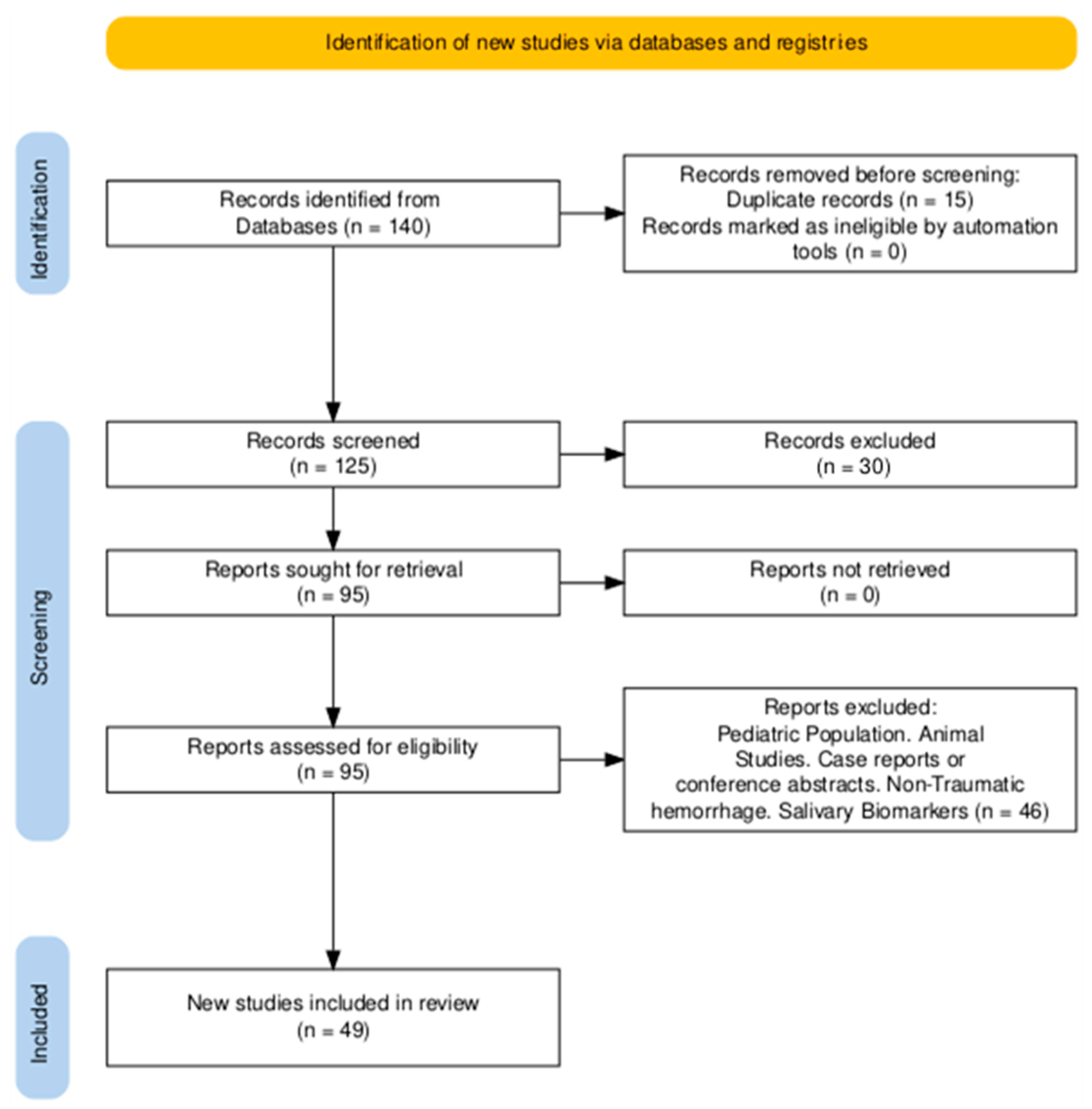
A total of 140 records were initially retrieved. After removing 15 duplicates, 125 unique articles were screened based on title, abstract, and conclusion. Of these, 30 were excluded for irrelevance to a molecular study (focused on imaging studies, clinical medicine, surgical outcomes, etc.). Following the application of inclusion and exclusion criteria, 49 studies were included in the final synthesis. This process is synthesized in the PRISMA diagram represented in Figure 2 [21].
As the PRISMA-ScR flow diagram template does not allow modification of individual boxes, the breakdown of included studies into original research and review articles has been explicitly reported in the figure legend.
Inclusion criteria:
  • Original clinical studies (observational cohort studies, retrospective or prospective), scoping reviews, systematic reviews, or meta-analyses.
  • Adult population with clinical outcomes following TBI (Mortality; GOS/GOSE, CT-visible intracranial hemorrhagic lesions).
  • Studies assessing CNS-specific or hematologic biomarkers relevant to diagnosis and outcome prediction in TBI.
  • Articles published in English, with full-text accessibility.
Exclusion criteria:
  • Pediatric population.
  • Animal studies.
  • Case reports or conference abstracts.
  • Non-traumatic intracranial hemorrhage.
  • Salivary-sourced biomarkers.
The literature search was conducted by S.I.P. Study screening and eligibility assessment were independently performed by I.A.B. and T.M.P., with disagreements resolved by consensus. Data extraction and qualitative synthesis were performed by S.I.P., with critical review and validation by I.A.B. and T.M.P.
Animal studies were excluded, because the objective of this review was to evaluate biomarkers in terms of clinical performance, including diagnostic accuracy, prognostic value, and association with patient-centered outcomes such as mortality, functional scales, and imaging-confirmed intracranial lesions. These endpoints cannot be directly assessed or validated in experimental animal models. However, several animal studies are discussed in the “promising non-surgical therapies” table at the end of the Discussion section.
Pediatric populations were excluded because traumatic brain injury in children differs substantially from adult TBI with respect to injury mechanisms, neurodevelopmental context, biomarker kinetics, reference ranges, and outcome assessment, which would limit the comparability and clinical interpretability of biomarker performance across age groups
Key data was extracted from each eligible study, including the following:
-
Author, year, and country/region;
-
Study design and sample size;
-
Biomarkers assed and their cut-off values/thresholds;
-
Statistical metrics (NPV, sensitivity, specificity, AUC, and p values);
-
Dependent outcome variables (mortality, GOS/GOSE scale, hematoma expansion, and ICP values).
No studies were excluded based on quality rating, but lower-quality findings were interpreted cautiously in the review.
Where available effect sizes (AUC, OR) were used to assess predictive performance of the respective markers. Quantitative data was tabulated where possible in order to facilitate a direct comparison. A qualitative synthesis of the literature was performed; no quantitative meta-analysis or statistical pooling of results was conducted.

3. Results

In this section, we will review several biomarkers whose remarkable sensitivity in detecting intracranial lesions has led to their inclusion in several national trauma guidelines. In well-defined clinical scenarios, particularly in patients with mild TBI, these biomarkers allow for a safe reduction in the use of expensive imaging studies such as CT scans [22]. However, their role in substituting neuroimaging does not apply to moderate or severe TBI, subsequent deterioration, or evolving neurological symptoms. As such, their role outside mild TBI remains under discussion.
Furthermore, surgical intervention in traumatic brain injury usually addresses the primary injury, alleviating the mass effect or increased ICP, yet the molecular cascade that unfolds afterwards remains beyond the reach of the scalpel. As such, the study of molecular biomarkers could be helpful in compensating for these limitations by allowing for the early detection of secondary damage, risk stratification, and the development of targeted therapies that extend beyond the surgical means.

3.1. Biomarkers in TBI

In this subsection, we will categorize several biomarkers according to their primary clinical utility and evaluate their capacity to enable diagnostic pathways that omit more expensive imaging modalities in well-defined patient populations, while also assessing their ability to help exclude structural intracranial abnormalities and to predict or correlate with mortality and poor neurological outcomes.

3.1.1. Diagnostic Biomarkers

We will define diagnostic biomarkers as those molecules that can assist in the early identification of hemorrhagic intracranial lesions. We will particularly focus on those markers that have comparable sensitivity with imaging studies, such as the CT scan.
A. 
S100B
S100B is a calcium-binding protein primarily expressed in astrocytes and other glial cells [23]. In TBI, as a result of astrocytic damage and BBB disruption, this protein can leak into the extracellular space and diffuse into the bloodstream. It is worth noting that its concentration has been proven to correlate with the extent of endothelial damage, as well as with the patient outcome [24]. S100B has several properties that make it an exceptionally useful diagnostic marker. First of all, its plasma levels elevate rapidly even after a minor trauma, making its testing reliable and appropriate for emergency settings [25]. Secondly, and probably the most important characteristic for clinical practice, is its remarkably high negative predictive value for intracranial hemorrhagic lesions, whether they are intracerebral or extra-axial. A study from Halmstad, Sweden, started in 2007, analyzed the correlation between elevated S100B serum levels and visible hemorrhagic intracranial lesions on CT scans in an attempt to reduce imaging study-related costs. Out of 512 included patients, 138 had normal S100B levels (threshold considered = 0.1 µg/L). None of those patients presented intracranial complications of traumatic abnormalities on CT scans, displaying a negative predictive value of 100% in this cohort [26].
These promising findings have led to the implementation of the S100B as a standard test in Scandinavian Neurotrauma Committee (SNC) Guidelines, starting from 2013. According to these guidelines, patients that suffer mild TBIs (Glasgow coma score (GCS) of 14 or 15) can be discharged without a CT scan if the S100B is below the aforementioned threshold within a validated clinical decision algorithm [27]. Since then, several separate high-quality cohort studies from France [28], Spain [29] and Sweden [30] have validated these guidelines, proving that S100B remains a strong negative predictor for focal intracranial post-traumatic lesions. The NPVs found in these cohort studies were 99.6% [28], 98.6% [29], and 93–100% [30]. Another analysis of an American prospective cohort study revealed an NPV of 97.3% [31].
These findings are summarized in Table 1:
One of the main drawbacks when using S100B as a diagnostic biomarker lies in its limited brain specificity. Elevated S100B levels have been reported in a variety of extracranial lesions, such as long bone fractures, soft tissue injuries, and polytrauma, reflecting its expression in adipocytes, chondrocytes, and skeletal muscle [32]. Furthermore, a cohort study comparing patients with isolated head injuries to those with combined head injuries and extracranial trauma demonstrated significantly higher S100B concentrations in the latter group, both at hospital admission and at 6 h post-injury (p = 0.0005 and 0.01, respectively) [33]. Consequently, reliance on S100B levels for the identification of intracranial injury may lead to false-positive interpretations in patients with multiple injuries, thereby reducing diagnostic specificity. This limitation highlights the importance of interpreting S100B values withing the context of the overall injury pattern and supports its preferential role in excluding intracranial injury when levels are below established thresholds rather than confirming or diagnosing intracranial pathology when elevated. Accordingly, its clinical utility appears greatest in patients with isolated or predominantly cranial trauma rather than as a universal diagnostic trauma biomarker. While S100B demonstrates excellent rule-out performance, its limitations highlight the need for biomarkers with greater brain specificity, such as GFAP.
B. 
Glial fibrillary acidic protein (GFAP)
GFAP is a type III intermediate filament protein that represents the main component of the astrocytic cytoskeleton [34], whose main functions are the mechanical support of astrocytes and maintaining the BBB structure [35]. Similarly to S100B, GFAP can be useful in excluding intracranial hemorrhagic lesions within defined clinical contexts, potentially allowing imaging studies to be omitted. A Finnish cohort study that measured GFAP plasma levels in 49 patients found a NPV of 100% for CT intracranial lesions for a threshold of 140 pg/mL [36]. Another cohort study published in the Journal of Neurotrauma compared GFAP to S100B in patients with mild and moderate TBI. Not only did GFAP have a remarkable sensitivity (100%), but it also had a higher brain lesion specificity compared to S100B, whose levels increased in skull fractures without brain involvement. Although S100B had a sensitivity for detecting intracranial lesions of 100% as well, its specificity was only 5% compared to 55% for GFAP [37]. GFAP levels have also been reported to be strongly positively correlated with CT-visible intracranial lesions; in a cohort study of 215 patients, GFAP plasma levels were significantly higher in patients with a detectable injury on a CT scan compared to those without (2.86 ± 3.74 ng/mL vs. 0.26 ± 0.41 ng/mL; p < 0.001); the same study reported a specificity of 89% for a threshold of 0.6 ng/mL, rising up to 99% for a threshold of 1.66 ng/mL [38]. Other studies have come to the same conclusion. Although both S100B and GFAP yield excellent negative predictive capabilities, GFAP is much more brain-specific, proving that this biomarker can sometimes be used even for detecting brain lesions, not solely for excluding them [39]. As a result, extracranial trauma has a more limited influence on GFAP plasma concentrations, which contributes to its improved specificity for intracranial pathology. However, an important limitation in the clinical interpretation of GFAP relates to the timing of blood sampling. GFAP levels rise rapidly following astrocytic injury but may display time-dependent variability, with early measurements reflecting primary injury and later elevations potentially influenced by secondary injury mechanisms, ongoing BBB disruption, or delayed astrocytic degradation [40,41]. Consequently, variability in sampling time across studies can significantly affect the reported sensitivity, specificity, and optimal cut-off thresholds. These considerations underscore the importance of standardized sampling windows and contextual interpretation when using GFAP as a diagnostic biomarker, particularly when applied within biomarker-guided pathways aimed at excluding intracranial injury in selected patient populations.

3.1.2. Outcome Biomarkers

Although both S100B and GFAP yield a remarkably high accuracy in excluding intracranial lesions, thus reducing unnecessary radiation and lowering the economic burden of excessive emergency CT-scans, for many years, their contribution to patient outcome prediction has been considered secondary. In this subsection, we aim to assess the potential performance of the aforementioned diagnostic markers in prognosis, as well as several that may reflect secondary injury dynamics. These include coagulation indices, such as INR and fibrinogen levels, which have been associated with hematoma expansion and other intra- and post-operative complications and systemic inflammatory markers, such as the leucocyte/lymphocyte ratio (LLR) and C-Reactive protein (CRP), which may be relevant in assessing neuroinflammation after a TBI. Furthermore, we will analyze the prognostic utility of oxidative stress markers. Lastly, we will analyze the impact of calcium levels and calcium channel blockers on TBI outcome. For this purpose, we will also describe some of the most used outcome grading systems, notably the Glasgow Outcome Scale (GOS) and its extended version (GOSE). GOS evaluates functional outcomes after TBI. It ranged from 1 (death) to 5 (good recovery), with an intermediate score of 3 being equivalent to severe disability [42]. The extended version of this score (GOSE) ranges from 1 (death) to 8 (upper good recovery), with intermediate scores of 4 and 5 equating upper severe disability and lower moderate disability, respectively [43].
A. 
S100B and GFAP as outcome predictors
Several studies have demonstrated that elevated plasma concentrations of both proteins correlate with injury severity, the extent of structural damage on imaging studies, and clinical outcome. In a cohort study published in the Journal of Neurotrauma, both biomarkers were shown to be higher in non-survivors compared to survivors regardless of the moment of blood sampling, with a high predicting power of early mortality (<12 h, AUC = 0.84 for GFAP and 0.78 for S100B). The same study showed that both S100B and GFAP significantly correlated with established indicators of poor prognosis, such as the GOS (Glasgow Outcome Score) or intracranial pressure. As such, both GFAP and S100B were lower in patients with a GOS of 4 or 5 compared to those with a GOS of 1 (p < 0.005), in patients with intracranial pressure (ICP) < 25 mmHg compared to those with ICP ≥ 25 mmHg (p < 0.0005), and in patients with cerebral perfusion pressure (CPP, a positive prognosis parameter) ≥ 60 mmHg compared to those with a cerebral perfusion pressure (CPP) < 60 mmHg (p < 0.0005) [44]. There are several other research papers that are in line with these results. Vos et al. demonstrated that the increased plasma levels of these parameters correlate with both mortality and poor outcome in two separate cohort studies. The first cohort study also showed that low S100B and GFAP values have remarkably high NPVs for GOS 1 (death) or 100% and 88%, respectively. Deceased patients (GOS 1) had significantly higher plasma concentrations of both S100B and GFAP compared to patients that survived 6 months post-injury (p < 0.001). Similarly, these concentrations were higher in patients with poor outcome, but not necessarily death (GOS 1–3), compared to those with good outcomes (GOS 4–5) at 6 months post-injury (p < 0.01). The AUC for poor outcome, defined as GOS 1–3, was 79.4 for GFAP and 67.7 for S100B [45], but this result was not statistically significant (p = 0.16). The second study, performed 6 years later, validated the results of the first cohort study; it used the extended GOS (GOSE) instead and emphasized the following: GFAP and S100B were both higher in non-survivors (GOSE 1) compared to survivors (p < 0.001) and in patients with an unfavorable outcome (GOSE 1–4) compared to those with a favorable outcome (GOSE 5–8) (p < 0.01). Interestingly, in this study, these two markers had high specificity and positive predictive values for an unfavorable outcome (GOSE 1–4)—95% specificity + 90% PPV for GFAP and 100% specificity + 100% PPV for S100B [46]. Another large multicenter cohort study from 2022 demonstrated a strong prediction capability of GFAP values for 6-month mortality (AUC = 0.87) [47], whereas increased S100B values from both serum and CSF were proven to strongly correlate with both mortality (p < 0.001) and worse GOS (p = 0.002) [48]. Similarly, Thelin et al. confirmed the high prognostic value of S100B, reporting that its ability to predict mortality surpassed even that of conventional clinical predictors, such as age and GCS (Glasgow Coma Scale) (p < 0.0001). Moreover, they observed that this predictive accuracy was greatest when samples were obtained 12–36 h after injury, most likely due to a reduced extracranial influence and a more specific reflection of astrocytic injury [49]. Lastly, in terms of functionality and patient return to work (RTW), Metting et al. demonstrated that higher GFAP values (mean of 0.69 µg/L) were associated with a lower RTW at 6 months compared to those with lower values (mean of 0.27 µg/L) (p < 0.05). This correlation could not be established for S100B [50].
The comparative performance of S100B and GFAP for outcome prediction in TBI is summarized in Table 2.
B. 
INR and other coagulation biomarkers as predictors in TBI
I. The international normalized ratio (INR) is a standardized measure of the extrinsic pathway of coagulation, reflecting the activity of vitamin K-dependent factors (II, VII, IX, and X). Mathematically, it represents the ratio between the prothrombin time in a measured sample and that of a control sample, raised to the power of an International Sensitivity Index, a calibration factor specific to each thromboplastin reagent manufacturer [51]. Its main use is monitoring patients on long-term anticoagulation therapy, particularly Vitamin K antagonists, such as warfarin or acenocoumarol. However, the INR can rise in any situation in which the aforementioned factors are reduced, such as vitamin K deficiency, hepatopathies, or consumptive coagulopathies [52]. In the TBI context, an increased INR, whether from pre-injury anticoagulant use or trauma-induced coagulopathy, has been associated with larger intracranial hematomas, higher rebleeding rates, and increased mortality [53,54,55,56]. A large cohort study, which compared pre-injury anticoagulant and antiplatelet medication, found that warfarin administration significantly increases mortality compared to patients on dual antiplatelet or without antithrombotic medication (28% vs. 13.5%/12.8%) and the need for neurosurgical intervention (23.9% vs. 15.5% and 12.4%), p < 0.001. The adjusted OR was 2.27 (95% CI 0.99–5.21); p = 0.05. A specific INR threshold, however, was not discussed [57]. Another retrospective cohort study showed that, among patients with no physiological derangement, warfarin users had a 25% mortality compared to 2.4% in non-anticoagulated patients, while the adjusted OR was 8.3 (95% CI 2.0–34.8) after controlling for age and injury severity. The same study showed that the mortality in the sub-cohort with INR ≥ 2 was 29% compared to only 2.9% in the group with an INR < 2% [58]. Lastly, a retrospective cohort study that analyzed 1500 patients calculated a mortality of 23.9% in anticoagulated patients compared to 4.9% in non-users (p < 0.001; OR 6.0, 95% CI 3.8 –9.3). This study also stratified risk groups based on INR values. The dependent variables were mortality and INR. Patients that had INR values below 2 had a predicted mortality of approximately 8% and a probability of having a traumatic intracerebral hemorrhage of approximately 25%. By contrast, in the value ranges of 2.0–2.99, 3.0–3.99, and greater than 4, the mortality rates were 22%, 35% and 45%, respectively, whereas the probabilities of developing a post-traumatic intracranial hemorrhage were 50%, 75%, and 70%, respectively [59]. It is worth mentioning that, in all these studies, age was also an important predictor of a poor outcome. Furthermore, elderly patients had a probability of administering antithrombotic therapy, including warfarin. The impact of increased INR/warfarin use on mortality is summarized in Table 3. It should be noted that the prognostic interpretation of INR is strongly influenced by pre-injury anticoagulant use, age, and trauma-induced coagulopathy, which may confound outcome associations if not adequately controlled for.
II. Fibrinogen is a soluble glycoprotein synthesized in the liver that plays a central role in the final stages of the coagulation cascade, where it is converted by thrombin into its active, soluble form, fibrin, in order to form stable blood clots [60]. Apart from its role in hemostasis, fibrinogen is an acute phase protein involved in inflammation and endothelial repair [61]. More recent studies have underlined the role that fibrinogen has in microglial activation due to its ability to activate the JAK2/STAT3 signaling pathway, leading to the increased release of pro-inflammatory cytokines such as IL-6 and IL-1β [62]. Several studies have successfully correlated fibrinogen levels to patient outcomes. A single-center large cohort study that analyzed approximately 2500 patients showed that the fibrinogen–mortality curve is not linear but rather “L-shaped”. In other words, fibrinogen levels correlate inversely with mortality but only up to a certain threshold of 2 g/L (200 mg/dL). As such, when fibrinogen levels were below that threshold, mortality increased as fibrinogen decreased (OR = 0.91; 95% CI, 0.89–0.93; and p < 0.001). When those levels were above 2 g/L, the correlation disappeared. Furthermore, the association between fibrinogen levels and positive outcomes had a negative parabola curve (reverse U-shape); the favorable outcome probability increased with fibrinogen for values below 2.5 g/L (OR, 1.654; 95% CI, 1.186–2.306; and p = 0.003). The correlation was lost between 2.5 g/L and 3 g/L and becomes inversed for values above 3.5 g/L (OR, 0.771; 95% CI, 0.607–0.979; and p = 0.033) [63], most likely due to the involvement of fibrinogen in neuroinflammation. Another prospective study that analyzed patients from Sub-Saharan Africa showed that both values below 2 g/dL and above 4.5 g/dL are associated with injury severity. Additionally, values over 4.5 g/dL are associated with increased mortality (OR 4.5, CI: 1.472–13.607, and p < 0.05) [64]. Additionally, McQuilten et al. demonstrated that, compared to normal plasma values, mortality increases for every decreasing interval: 3.28 [95% CI 1.71–6.28, p < 0.01] for less than 1 g/L, 2.08 [95% CI 1.36–3.16] for 1–1.5 g/L, and 1.39 [95% CI 0.97–2.00, p = 0.08] for 1.6–1.9 g/L [65]. Lastly, Yousefi et al. calculated that plasma values of fibrinogen below 150 mg/dL (1.5 g/L) are a strong predictor of in-hospital mortality (OR:1.75, CI: 1.32–2.34, and p  <  0.001) [66]. It is worth noting that fibrinogen levels reflect both acute-phase inflammatory responses and baseline patient characteristics, which may influence outcome associations independently of traumatic brain injury severity. These results are summarized in Table 4.

4. Discussion

Over recent decades, technological advancements have dramatically improved the quality and safety of neurosurgical procedures. Complex instruments such as neuronavigation devices, ultrasonic aspirators, and the continuous progress of visual enhancement microscopy have enhanced precision, reduced operative morbidity and mortality and improved patient recovery. However, this process has not equally translated for trauma neurosurgery. Paradoxically as it may seem, although trauma-related interventions are widely considered the least difficult or complex in the neurosurgical world, technological advancements have done little to fundamentally improve the surgeon’s contribution to a traumatic head lesion. Indeed, remarkable progress has been made in treating even the most severe forms of traumatic brain injury, but that is rather attributable to the timely pre-hospital emergency intervention systems, the remarkable progress in intensive care units, and the improvement of rehabilitation medicine, rather than refinements in surgical technique. These remarks do not seek to undermine the role of surgery in TBI but to emphasize that its limitations in addressing the complex pathological cascade a TBI patient undergoes. The surgical technique for evacuating a brain hematoma has not changed significantly since the introduction of the CT scan. Although surgical intervention remains the cornerstone of TBI management, particularly for mass lesions, such as epidural or subdural hematomas, even complete hematoma evacuation does not halt the biochemical progression of secondary injury. Cytotoxic and vasogenic edema, mitochondrial dysfunction, excitotoxicity, and microvascular damage leading to BBB disruption continue to evolve in the damaged and pericontusional tissue [67], even in cases of perfectly executed surgery. To address this invisible pathological component, CNS-specific biomarkers such as GFAP and S100B have emerged as adjuncts in diagnosing, assessing, and predicting this invisible process that unfolds beyond surgical control. Beyond these, systemic biomarkers such as coagulation parameters, namely, INR and fibrinogen, play an increasingly important role in establishing TBI outcome. They are easily accessible laboratory markers that can reflect system homeostasis and correlate with both injury progression/severity and mortality.
Beyond coagulation parameters, systemic inflammatory and oxidative parameters can also be useful as predictive tools. For instance, an elevated neutrophil-to-lymphocyte ratio (NLR) has been associated with lower GCS and higher ICU mortality [68,69]. Increased mortality in TBI patients is also correlated with oxidative stress markers, such as malondialdehyde [70] or F2-isoprostane 8-iso-PGF2α [71]. Furthermore, other easily obtainable lab findings have been correlated with outcomes in TBI. As such, an Italian cohort study found that hyperglycemia is a strong predictor of mortality and poor outcome for TBI patients admitted to intensive care units (ICU). In addition, metabolic imbalances such as abnormal base excess have been independently associated with an increased risk of death in neurocritical care settings, reflecting the systemic physiological stress accompanying severe brain injury [72].
Beyond their diagnostic capabilities, the prognostic value of biomarkers such as S100B and GFAP derive from the specific cellular and molecular events that take place during the secondary stage of TBI. Astrocytic injury and BBB disruption represent the main features from which the rest of the pathophysiological cascade unfolds. GFAP, a major structural component of astrocytic intermediate filaments, is released into the extracellular space and subsequently into the bloodstream as a result of cellular swelling, cytoskeletal collapse, and necrosis induced by calcium overload, mitochondrial disfunction, and oxidative stress. As such, its sustained elevation can indirectly assess the extent of glial cell damage and BBB compromise. Therefore, multiple blood samples taken across a defined period of time could potentially enhance this biomarker’s outcome prediction performance. In contrast, S100B, a calcium-binding protein, mainly localized in astrocytes but also expressed in several extracranial tissues, is released rapidly following cranial injury and reflects early astrocytic stress, increased BBB permeability, and calcium dysregulation. Since the brain specificity is reduced in comparison to GFAP, S100B could also be useful as a damage-associated molecular pattern (DAMP). Furthermore, emerging evidence suggests that S100B could be involved directly in neuroinflammation following TBI by activating receptors for advanced glycation end products (RAGE), thus triggering the S100B/RAGE signaling pathway, which further disrupts the BBB [73]. Table 5 summarizes key cellular and molecular mechanisms involved in secondary injury and their corresponding potential therapeutic targets.

Study and Field Limitations

Although these markers demonstrate encouraging diagnosis and prognosis potential, several limitations still persist; the lack of standardized sampling times and cut-off thresholds makes cross-study comparisons much more challenging. This is especially the case for S100B, which can increase in several extracranial lesions [81], thereby drastically reducing its brain specificity. It is still an extremely helpful biomarker for reducing costs and radiation in patients with mild or at least isolated head injuries, but its utility diminishes in polytraumatized patients. Conversely, the clinical interpretation of GFAP is influenced by the timing of blood sampling. This time-dependent variability may affect reported diagnostic and prognostic performance. Additionally, inter-assay variability and differences in analytical platforms further limit comparability across studies, making it difficult to establish universally applicable reference values. As far as systemic biomarkers such as the INR and fibrinogen are concerned, interpreting their values for outcome purposes requires careful contextualization, as these parameters are influenced by pre-injury anticoagulant therapy as well as trauma-induced coagulopathy, which may cofound associations with the outcome. Furthermore, despite the growing body of literature analyzing the use of biomarkers in TBI, the overall quality of evidence remains heterogenous. Most studies evaluating the clinical use of S100B, GFAP, INR, and fibrinogen in head injuries are observational in design, frequently single-center, and characterized by variable inclusion criteria, sampling times, and analytical platforms. Cut-off thresholds differ across cohort studies, limiting direct comparison of the reported diagnostic and outcome prediction performance. Additionally, many studies rely on short-term outcomes or surrogate endpoints. These methodological shortcomings highlight the need for cautious interpretation of reported performance values, particularly when extrapolating findings across different patient populations and trauma settings. As a scoping review, this work aims to map existing evidence rather than provide quantitative pooled estimates or interventional recommendations. We disclose that no risk of bias analysis was conducted.

5. Conclusions

Both of the discussed astrocytic biomarkers (GFAP and S100B) are among the strongest negative predictors for an intracranial focal lesion on a CT scan. Undetectable plasma levels are associated with a very low probability of CT-detectable focal intracranial lesions in patients with mild TBI, with GFAP also having an increased brain specificity. Increased values of these markers have also been associated with poor outcome scores in several studies.
In parallel, elevated admission INR independently predicts mortality after TBI. Several cohort studies place the odds ratio between 2.27 and 8.3. Fibrinogen levels have been shown to correlate with mortality in a non-linear manner outside physiological ranges. Specifically, fibrinogen concentrations below 2 g/L are associated with increased mortality, with the mortality risk rising as fibrinogen decreases further. Conversely, excessively elevated fibrinogen levels do not confer protection and have been associated with higher mortality rates at extreme values (e.g., >4.5 g/L), suggesting that both hypofibrinogenemia and marked hyperfibrinogenemia are linked to adverse outcomes in TBI. The clinical interpretation of these biomarkers requires careful contextualization, as their diagnostic and prognostic performance may be influenced by extracranial injury, sampling time, assay variability, and systemic factors such as pre-injury anticoagulation.
Future research should focus on interventional studies aiming to address secondary injury in TBI by targeting the early biochemical mechanisms that unfold intracellularly, namely, mitochondrial destruction, ATP depletion, calcium cytotoxicity, and oxidative stress. Integrating these biochemical parameters into the multimodal management of TBI may facilitate earlier prevention of secondary injury mechanisms as well as a more biologically driven approach to trauma neurosurgery.

Supplementary Materials

The following supporting information can be downloaded at: https://www.mdpi.com/article/10.3390/applbiosci5010012/s1. Table S1: Distribution of included articles by manuscript section and study type.

Author Contributions

Conceptualization, S.I.P.; methodology, S.I.P., I.A.B., and T.M.P.; software, S.I.P.; validation, I.A.B. and T.M.P.; formal analysis, S.I.P.; investigation, I.A.B. and T.M.P.; resources, S.I.P., I.A.B., and T.M.P.; data curation, S.I.P.; writing—original draft preparation, S.I.P.; writing—review and editing, S.I.P.; visualization, S.I.P. and T.M.P.; supervision, I.A.B. and T.M.P.; project administration, I.A.B. and T.M.P.; funding acquisition, S.I.P. All authors have read and agreed to the published version of the manuscript.

Funding

This research received no external funding.

Institutional Review Board Statement

Not applicable.

Informed Consent Statement

Not applicable.

Data Availability Statement

All data are available upon request from the corresponding author.

Acknowledgments

Publication of this article was supported by the ‘Carol Davila’ University of Medicine and Pharmacy (Bucharest, Romania), through the institutional program ‘Publish not Perish’.

Conflicts of Interest

The authors declare no conflicts of interest.

References

  1. Dewan, M.C.; Rattani, A.; Gupta, S.; Baticulon, R.E.; Hung, Y.C.; Punchak, M.; Agrawal, A.; Adeleye, A.O.; Shrime, M.G.; Rubiano, A.M.; et al. Estimating the Global Incidence of Traumatic Brain Injury. J. Neurosurg. 2019, 130, 1080–1097. [Google Scholar] [CrossRef]
  2. Majdan, M.; Plancikova, D.; Brazinova, A.; Rusnak, M.; Nieboer, D.; Feigin, V.; Maas, A. Epidemiology of Traumatic Brain Injuries in Europe: A Cross-Sectional Analysis. Lancet Public Health 2016, 1, E76–E83. [Google Scholar] [CrossRef] [PubMed]
  3. Liu, J.; Xu, A.; Zhao, Z.; Fang, D.; Lv, W.; Li, Y.; Wang, P.; Wang, Y.; Dai, Y.; Zheng, X.; et al. The Burden of Traumatic Brain Injury, Its Causes, and Future Trend Predictions in 204 Countries and Territories (1990–2021): Results from the Global Burden of Disease Study 2021. Neuroepidemiology 2025, 60, 1–5. [Google Scholar] [CrossRef] [PubMed]
  4. Greve, M.W.; Zink, B.J. Pathophysiology of Traumatic Brain Injury. Mt. Sinai J. Med. J. Transl. Pers. Med. 2009, 76, 97–104. [Google Scholar] [CrossRef] [PubMed]
  5. Thapa, K.; Khan, H.; Singh, T.G.; Kaur, A. Traumatic Brain Injury: Mechanistic Insight on Pathophysiology and Potential Therapeutic Targets. J. Mol. Neurosci. 2021, 71, 1725–1742. [Google Scholar] [CrossRef]
  6. Baracaldo-Santamaría, D.; Ariza-Salamanca, D.F.; Corrales-Hernández, M.G.; Pachón-Londoño, M.J.; Hernandez-Duarte, I.; Calderon-Ospina, C.-A. Revisiting Excitotoxicity in Traumatic Brain Injury: From Bench to Bedside. Pharmaceutics 2022, 14, 152. [Google Scholar] [CrossRef]
  7. Vlodavsky, E.; Palzur, E.; Shehadeh, M.; Soustiel, J.F. Post-Traumatic Cytotoxic Edema Is Directly Related to Mitochondrial Function. J. Cereb. Blood Flow. Metab. 2017, 37, 166–177. [Google Scholar] [CrossRef]
  8. Xiong, Y.; Mahmood, A.; Chopp, M. Animal Models of Traumatic Brain Injury. Nat. Rev. Neurosci. 2013, 14, 128–142. [Google Scholar] [CrossRef]
  9. Daneman, R.; Prat, A. The Blood–Brain Barrier. Cold Spring Harb. Perspect. Biol. 2015, 7, a020412. [Google Scholar] [CrossRef]
  10. Obermeier, B.; Daneman, R.; Ransohoff, R.M. Development, Maintenance and Disruption of the Blood-Brain Barrier. Nat. Med. 2013, 19, 1584–1596. [Google Scholar] [CrossRef]
  11. Muldoon, L.L.; Alvarez, J.I.; Begley, D.J.; Boado, R.J.; del Zoppo, G.J.; Doolittle, N.D.; Engelhardt, B.; Hallenbeck, J.M.; Lonser, R.R.; Ohlfest, J.R.; et al. Immunologic Privilege in the Central Nervous System and the Blood–Brain Barrier. J. Cereb. Blood Flow. Metab. 2013, 33, 13–21. [Google Scholar] [CrossRef]
  12. Engelhardt, B. Regulation of Immune Cell Entry into the Central Nervous System. In Cell Communication in Nervous and Immune System; Springer: Berlin/Heidelberg, Germany, 2006; pp. 259–280. [Google Scholar]
  13. Simon, D.W.; McGeachy, M.J.; Bayır, H.; Clark, R.S.B.; Loane, D.J.; Kochanek, P.M. The Far-Reaching Scope of Neuroinflammation after Traumatic Brain Injury. Nat. Rev. Neurol. 2017, 13, 171–191. [Google Scholar] [CrossRef] [PubMed]
  14. Unterberg, A.W.; Stover, J.; Kress, B.; Kiening, K.L. Edema and Brain Trauma. Neuroscience 2004, 129, 1019–1027. [Google Scholar] [CrossRef] [PubMed]
  15. Khairat, A.; Margetis, K.; Waseem, M. Epidural Hematoma; StatPearls Publishing: Treasure Island, FL, USA, 2025. [Google Scholar]
  16. Miller, J.D.; Nader, R. Acute Subdural Hematoma from Bridging Vein Rupture: A Potential Mechanism for Growth. J. Neurosurg. 2014, 120, 1378–1384. [Google Scholar] [CrossRef] [PubMed]
  17. Abraham, M.K.; Chang, W.-T.W. Subarachnoid Hemorrhage. Emerg. Med. Clin. N. Am. 2016, 34, 901–916. [Google Scholar] [CrossRef]
  18. Griswold, D.P.; Fernandez, L.; Rubiano, A.M. Traumatic Subarachnoid Hemorrhage: A Scoping Review. J. Neurotrauma 2022, 39, 35–48. [Google Scholar] [CrossRef]
  19. Maas, A.I.R.; Menon, D.K.; David Adelson, P.D.; Andelic, N.; Bell, M.J.; Belli, A.; Bragge, P.; Brazinova, A.; Büki, A.; Chesnut, R.M.; et al. Traumatic Brain Injury: Integrated Approaches to Improve Prevention, Clinical Care, and Research. Lancet Neurol. 2017, 16, 987–1048. [Google Scholar] [CrossRef]
  20. Tricco, A.C.; Lillie, E.; Zarin, W.; O’Brien, K.K.; Colquhoun, H.; Levac, D.; Moher, D.; Peters, M.D.J.; Horsley, T.; Weeks, L.; et al. PRISMA Extension for Scoping Reviews (PRISMA-ScR): Checklist and Explanation. Ann. Intern. Med. 2018, 169, 467–473. [Google Scholar] [CrossRef]
  21. Haddaway, N.R.; Page, M.J.; Pritchard, C.C.; McGuinness, L.A. PRISMA2020: An R Package and Shiny App for Producing PRISMA 2020-compliant Flow Diagrams, with Interactivity for Optimised Digital Transparency and Open Synthesis. Campbell Syst. Rev. 2022, 18, e1230. [Google Scholar] [CrossRef]
  22. Calcagnile, O.; Anell, A.; Undén, J. The Addition of S100B to Guidelines for Management of Mild Head Injury Is Potentially Cost Saving. BMC Neurol. 2016, 16, 200. [Google Scholar] [CrossRef]
  23. Michetti, F.; Clementi, M.E.; Di Liddo, R.; Valeriani, F.; Ria, F.; Rende, M.; Di Sante, G.; Romano Spica, V. The S100B Protein: A Multifaceted Pathogenic Factor More Than a Biomarker. Int. J. Mol. Sci. 2023, 24, 9605. [Google Scholar] [CrossRef]
  24. Kleindienst, A.; Meissner, S.; Eyupoglu, I.Y.; Parsch, H.; Schmidt, C.; Buchfelder, M. Dynamics of S100B Release into Serum and Cerebrospinal Fluid Following Acute Brain Injury. Acta Neurochir. Suppl. 2010, 106, 247–250. [Google Scholar] [PubMed]
  25. Thelin, E.P.; Nelson, D.W.; Bellander, B.-M. A Review of the Clinical Utility of Serum S100B Protein Levels in the Assessment of Traumatic Brain Injury. Acta Neurochir. 2017, 159, 209–225. [Google Scholar] [CrossRef] [PubMed]
  26. Calcagnile, O.; Undén, L.; Undén, J. Clinical Validation of S100B Use in Management of Mild Head Injury. BMC Emerg. Med. 2012, 12, 13. [Google Scholar] [CrossRef] [PubMed]
  27. Undén, J.; Ingebrigtsen, T.; Romner, B. Scandinavian Guidelines for Initial Management of Minimal, Mild and Moderate Head Injuries in Adults: An Evidence and Consensus-Based Update. BMC Med. 2013, 11, 50. [Google Scholar] [CrossRef]
  28. Allouchery, G.; Moustafa, F.; Roubin, J.; Pereira, B.; Schmidt, J.; Raconnat, J.; Pic, D.; Sapin, V.; Bouvier, D. Clinical Validation of S100B in the Management of a Mild Traumatic Brain Injury: Issues from an Interventional Cohort of 1449 Adult Patients. Clin. Chem. Lab. Med. 2018, 56, 1897–1904. [Google Scholar] [CrossRef]
  29. Egea-Guerrero, J.J.; Rodríguez-Rodríguez, A.; Quintana-Díaz, M.; Freire-Aragón, M.D.; Raya-Collados, D.; Hernández-García, C.; Ortiz-Manzano, Á.; Vilches-Arenas, Á.; Díez-Naz, A.; Guerrero, J.M.; et al. Validation of S100B Use in a Cohort of Spanish Patients with Mild Traumatic Brain Injury: A Multicentre Study. Brain Inj. 2018, 32, 459–463. [Google Scholar] [CrossRef]
  30. Faisal, M.; Vedin, T.; Edelhamre, M.; Forberg, J.L. Diagnostic Performance of Biomarker S100B and Guideline Adherence in Routine Care of Mild Head Trauma. Scand. J. Trauma Resusc. Emerg. Med. 2023, 31, 3. [Google Scholar] [CrossRef]
  31. Jones, C.M.C.; Harmon, C.; McCann, M.; Gunyan, H.; Bazarian, J.J. S100B Outperforms Clinical Decision Rules for the Identification of Intracranial Injury on Head CT Scan after Mild Traumatic Brain Injury. Brain Inj. 2020, 34, 407–414. [Google Scholar] [CrossRef]
  32. Bloomfield, S.M.; McKinney, J.; Smith, L.; Brisman, J. Reliability of S100B in Predicting Severity of Central Nervous System Injury. Neurocrit. Care 2007, 6, 121–138. [Google Scholar] [CrossRef]
  33. Ohrt-Nissen, S.; Friis-Hansen, L.; Dahl, B.; Stensballe, J.; Romner, B.; Rasmussen, L.S. How Does Extracerebral Trauma Affect the Clinical Value of S100B Measurements? Emerg. Med. J. 2011, 28, 941–944. [Google Scholar] [CrossRef] [PubMed]
  34. Eng, L.F.; Ghirnikar, R.S.; Lee, Y.L. Glial Fibrillary Acidic Protein: GFAP-Thirty-One Years (1969–2000). Neurochem. Res. 2000, 25, 1439–1451. [Google Scholar] [CrossRef] [PubMed]
  35. Jurga, A.M.; Paleczna, M.; Kadluczka, J.; Kuter, K.Z. Beyond the GFAP-Astrocyte Protein Markers in the Brain. Biomolecules 2021, 11, 1361. [Google Scholar] [CrossRef] [PubMed]
  36. Keski-Pukkila, M.; Karr, J.E.; Posti, J.P.; Berghem, K.; Kotilainen, A.-K.; Blennow, K.; Zetterberg, H.; Iverson, G.L.; Luoto, T.M. Preliminary Evaluation of the Scandinavian Guidelines for Initial Management of Minimal, Mild, and Moderate Head Injuries with Glial Fibrillary Acidic Protein. Neurotrauma Rep. 2024, 5, 50–60. [Google Scholar] [CrossRef]
  37. Papa, L.; Silvestri, S.; Brophy, G.M.; Giordano, P.; Falk, J.L.; Braga, C.F.; Tan, C.N.; Ameli, N.J.; Demery, J.A.; Dixit, N.K.; et al. GFAP Out-Performs S100β in Detecting Traumatic Intracranial Lesions on Computed Tomography in Trauma Patients with Mild Traumatic Brain Injury and Those with Extracranial Lesions. J. Neurotrauma 2014, 31, 1815–1822. [Google Scholar] [CrossRef]
  38. McMahon, P.J.; Panczykowski, D.M.; Yue, J.K.; Puccio, A.M.; Inoue, T.; Sorani, M.D.; Lingsma, H.F.; Maas, A.I.R.; Valadka, A.B.; Yuh, E.L.; et al. Measurement of the Glial Fibrillary Acidic Protein and Its Breakdown Products GFAP-BDP Biomarker for the Detection of Traumatic Brain Injury Compared to Computed Tomography and Magnetic Resonance Imaging. J. Neurotrauma 2015, 32, 527–533. [Google Scholar] [CrossRef]
  39. Zetterberg, H.; Blennow, K. Fluid Biomarkers for Mild Traumatic Brain Injury and Related Conditions. Nat. Rev. Neurol. 2016, 12, 563–574. [Google Scholar] [CrossRef]
  40. Papa, L.; Brophy, G.M.; Welch, R.D.; Lewis, L.M.; Braga, C.F.; Tan, C.N.; Ameli, N.J.; Lopez, M.A.; Haeussler, C.A.; Mendez Giordano, D.I.; et al. Time Course and Diagnostic Accuracy of Glial and Neuronal Blood Biomarkers GFAP and UCH-L1 in a Large Cohort of Trauma Patients With and Without Mild Traumatic Brain Injury. JAMA Neurol. 2016, 73, 551. [Google Scholar] [CrossRef]
  41. Shahim, P.; Politis, A.; van der Merwe, A.; Moore, B.; Ekanayake, V.; Lippa, S.M.; Chou, Y.-Y.; Pham, D.L.; Butman, J.A.; Diaz-Arrastia, R.; et al. Time Course and Diagnostic Utility of NfL, Tau, GFAP, and UCH-L1 in Subacute and Chronic TBI. Neurology 2020, 95, e623–e636. [Google Scholar] [CrossRef]
  42. Jennett, B.; Bond, M. Assessment of Outcome After Severe Brain Damage. A Practical Scale. Lancet 1975, 305, 480–484. [Google Scholar] [CrossRef]
  43. Wright, J. Glasgow Outcome Scale—Extended. In Encyclopedia of Clinical Neuropsychology; Springer: New York, NY, USA, 2011; pp. 1152–1153. [Google Scholar]
  44. Pelinka, L.E.; Kroepfl, A.; Leixnering, M.; Buchinger, W.; Raabe, A.; Redl, H. GFAP Versus S100B in Serum after Traumatic Brain Injury: Relationship to Brain Damage and Outcome. J. Neurotrauma 2004, 21, 1553–1561. [Google Scholar] [CrossRef] [PubMed]
  45. Vos, P.E.; Lamers, K.J.B.; Hendriks, J.C.M.; van Haaren, M.; Beems, T.; Zimmerman, C.; van Geel, W.; de Reus, H.; Biert, J.; Verbeek, M.M. Glial and Neuronal Proteins in Serum Predict Outcome after Severe Traumatic Brain Injury. Neurology 2004, 62, 1303–1310. [Google Scholar] [CrossRef] [PubMed]
  46. Vos, P.E.; Jacobs, B.; Andriessen, T.M.J.C.; Lamers, K.J.B.; Borm, G.F.; Beems, T.; Edwards, M.; Rosmalen, C.F.; Vissers, J.L.M. GFAP and S100B Are Biomarkers of Traumatic Brain Injury: An Observational Cohort Study. Neurology 2010, 75, 1786–1793. [Google Scholar] [CrossRef] [PubMed]
  47. Korley, F.K.; Jain, S.; Sun, X.; Puccio, A.M.; Yue, J.K.; Gardner, R.C.; Wang, K.K.W.; Okonkwo, D.O.; Yuh, E.L.; Mukherjee, P.; et al. Prognostic Value of Day-of-Injury Plasma GFAP and UCH-L1 Concentrations for Predicting Functional Recovery after Traumatic Brain Injury in Patients from the US TRACK-TBI Cohort: An Observational Cohort Study. Lancet Neurol. 2022, 21, 803–813. [Google Scholar] [CrossRef]
  48. Goyal, A.; Failla, M.D.; Niyonkuru, C.; Amin, K.; Fabio, A.; Berger, R.P.; Wagner, A.K. S100b as a Prognostic Biomarker in Outcome Prediction for Patients with Severe Traumatic Brain Injury. J. Neurotrauma 2013, 30, 946–957. [Google Scholar] [CrossRef]
  49. Thelin, E.P.; Johannesson, L.; Nelson, D.; Bellander, B.-M. S100B Is an Important Outcome Predictor in Traumatic Brain Injury. J. Neurotrauma 2013, 30, 519–528. [Google Scholar] [CrossRef]
  50. Metting, Z.; Wilczak, N.; Rodiger, L.A.; Schaaf, J.M.; van der Naalt, J. GFAP and S100B in the Acute Phase of Mild Traumatic Brain Injury. Neurology 2012, 78, 1428–1433. [Google Scholar] [CrossRef]
  51. Dorgalaleh, A.; Favaloro, E.J.; Bahraini, M.; Rad, F. Standardization of Prothrombin Time/International Normalized Ratio (PT/INR). Int. J. Lab. Hematol. 2021, 43, 21–28. [Google Scholar] [CrossRef]
  52. Wittkowsky, A.K. Factors Associated With INR Elevation and Bleeding Complications During Warfarin Therapy. Arch. Intern. Med. 2005, 165, 703. [Google Scholar] [CrossRef]
  53. Flaherty, M.L.; Tao, H.; Haverbusch, M.; Sekar, P.; Kleindorfer, D.; Kissela, B.; Khatri, P.; Stettler, B.; Adeoye, O.; Moomaw, C.J.; et al. Warfarin Use Leads to Larger Intracerebral Hematomas. Neurology 2008, 71, 1084–1089. [Google Scholar] [CrossRef]
  54. Dowlatshahi, D.; Butcher, K.S.; Asdaghi, N.; Nahirniak, S.; Bernbaum, M.L.; Giulivi, A.; Wasserman, J.K.; Poon, M.-C.; Coutts, S.B. Poor Prognosis in Warfarin-Associated Intracranial Hemorrhage Despite Anticoagulation Reversal. Stroke 2012, 43, 1812–1817. [Google Scholar] [CrossRef] [PubMed]
  55. Ding, J.; Yuan, F.; Guo, Y.; Chen, S.-W.; Gao, W.-W.; Wang, G.; Cao, H.-L.; Ju, S.-M.; Chen, H.; Zhang, P.-Q.; et al. A Prospective Clinical Study of Routine Repeat Computed Tomography (CT) after Traumatic Brain Injury (TBI). Brain Inj. 2012, 26, 1211–1216. [Google Scholar] [CrossRef] [PubMed]
  56. Mohammadzadeh, I.; Niroomand, B.; Tajerian, A.; Shahnazian, Z.; Nouri, Z.; Mortezaei, A. Coagulopathy at Admission in Traumatic Brain Injury and Its Association with Hematoma Progression: A Systematic Review and Meta-Analysis of 2411 Patients. Clin. Neurol. Neurosurg. 2025, 249, 108699. [Google Scholar] [CrossRef] [PubMed]
  57. Grandhi, R.; Harrison, G.; Voronovich, Z.; Bauer, J.; Chen, S.H.; Nicholas, D.; Alarcon, L.H.; Okonkwo, D.O. Preinjury Warfarin, but Not Antiplatelet Medications, Increases Mortality in Elderly Traumatic Brain Injury Patients. J. Trauma Acute Care Surg. 2015, 78, 614–621. [Google Scholar] [CrossRef]
  58. Narum, S.; Brørs, O.; Stokland, O.; Kringen, M.K. Mortality among Head Trauma Patients Taking Preinjury Antithrombotic Agents: A Retrospective Cohort Analysis from a Level 1 Trauma Centre. BMC Emerg. Med. 2016, 16, 29. [Google Scholar] [CrossRef]
  59. Franko, J.; Kish, K.J.; O’Connell, B.G.; Subramanian, S.; Yuschak, J.V. Advanced Age and Preinjury Warfarin Anticoagulation Increase the Risk of Mortality After Head Trauma. J. Trauma Inj. Infect. Crit. Care 2006, 61, 107–110. [Google Scholar] [CrossRef]
  60. Herrick, S.; Blanc-Brude, O.; Gray, A.; Laurent, G. Fibrinogen. Int. J. Biochem. Cell Biol. 1999, 31, 741–746. [Google Scholar] [CrossRef]
  61. Dejana, E.; Lampugnani, M.; Giorgi, M.; Gaboli, M.; Marchisio, P. Fibrinogen Induces Endothelial Cell Adhesion and Spreading via the Release of Endogenous Matrix Proteins and the Recruitment of More than One Integrin Receptor. Blood 1990, 75, 1509–1517. [Google Scholar] [CrossRef]
  62. Li, X.; Song, X.; Yi, F.; Hou, H. Fibrinogen Regulates Microglial Function through the JAK2/STAT3 Signaling Pathway. Cell Immunol. 2025, 414, 104976. [Google Scholar] [CrossRef]
  63. Lv, K.; Yuan, Q.; Fu, P.; Wu, G.; Wu, X.; Du, Z.; Yu, J.; Li, Z.; Hu, J. Impact of Fibrinogen Level on the Prognosis of Patients with Traumatic Brain Injury: A Single-Center Analysis of 2570 Patients. World J. Emerg. Surg. 2020, 15, 54. [Google Scholar] [CrossRef]
  64. Ssenyondwa, J.B.; Kiryabwire, J.; Kaddumukasa, M.; Michael, D.; Kamabu, L.K.; Galukande, M.; Kaddumukasa, M.; Sajatovic, M.; Makumbi, T.K. Fibrinogen; a Predictor of Injury Severity and Mortality among Patients with Traumatic Brain Injury in Sub-Saharan Africa: A Prospective Study. Medicine 2023, 102, e35685. [Google Scholar]
  65. McQuilten, Z.K.; Wood, E.M.; Bailey, M.; Cameron, P.A.; Cooper, D.J. Fibrinogen Is an Independent Predictor of Mortality in Major Trauma Patients: A Five-Year Statewide Cohort Study. Injury 2017, 48, 1074–1081. [Google Scholar] [CrossRef]
  66. Yousefi, O.; Farrokhi, A.; Taheri, R.; Ghasemi, H.; Zoghi, S.; Eslami, A.; Niakan, A.; Khalili, H. Effect of Low Fibrinogen Level on In-Hospital Mortality and 6-Month Functional Outcome of TBI Patients, a Single Center Experience. Neurosurg. Rev. 2024, 47, 95. [Google Scholar] [CrossRef]
  67. Vespa, P.M.; O’Phelan, K.; McArthur, D.; Miller, C.; Eliseo, M.; Hirt, D.; Glenn, T.; Hovda, D.A. Pericontusional Brain Tissue Exhibits Persistent Elevation of Lactate/Pyruvate Ratio Independent of Cerebral Perfusion Pressure. Crit. Care Med. 2007, 35, 1153–1160. [Google Scholar] [CrossRef] [PubMed]
  68. Xu, J.; Li, S.; Lui, K.Y.; Song, X.; Hu, X.; Cao, L.; Zhu, Y.; Huang, F.; Lin, X.; Cai, C. The Neutrophil-to-Lymphocyte Ratio: A Potential Predictor of Poor Prognosis in Adult Patients with Trauma and Traumatic Brain Injury. Front. Surg. 2022, 9, 917172. [Google Scholar] [CrossRef] [PubMed]
  69. Sabouri, E.; Majdi, A.; Jangjui, P.; Rahigh Aghsan, S.; Naseri Alavi, S.A. Neutrophil-to-Lymphocyte Ratio and Traumatic Brain Injury: A Review Study. World Neurosurg. 2020, 140, 142–147. [Google Scholar] [CrossRef] [PubMed]
  70. Lorente, L.; Martín, M.M.; Abreu-González, P.; Ramos, L.; Argueso, M.; Cáceres, J.J.; Solé-Violán, J.; Lorenzo, J.M.; Molina, I.; Jiménez, A. Association between Serum Malondialdehyde Levels and Mortality in Patients with Severe Brain Trauma Injury. J. Neurotrauma 2015, 32, 1–6. [Google Scholar] [CrossRef]
  71. Yu, G.-F.; Jie, Y.-Q.; Wu, A.; Huang, Q.; Dai, W.-M.; Fan, X.-F. Increased Plasma 8-Iso-Prostaglandin F2α Concentration in Severe Human Traumatic Brain Injury. Clin. Chim. Acta 2013, 421, 7–11. [Google Scholar] [CrossRef]
  72. Prisco, L.; Iscra, F.; Ganau, M.; Berlot, G. Early Predictive Factors on Mortality in Head Injured Patients: A Retrospective Analysis of 112 Traumatic Brain Injured Patients. J. Neurosurg. Sci. 2012, 56, 131–136. [Google Scholar]
  73. Zou, Z.; Li, L.; Li, Q.; Zhao, P.; Zhang, K.; Liu, C.; Cai, D.; Maegele, M.; Gu, Z.; Huang, Q. The Role of S100B/RAGE-Enhanced ADAM17 Activation in Endothelial Glycocalyx Shedding after Traumatic Brain Injury. J. Neuroinflamm. 2022, 19, 46. [Google Scholar] [CrossRef]
  74. Baudry, M.; Luo, Y.L.; Bi, X. Calpain-2 Inhibitors as Therapy for Traumatic Brain Injury. Neurotherapeutics 2023, 20, 1592–1602. [Google Scholar] [CrossRef] [PubMed]
  75. Readnower, R.D.; Pandya, J.D.; McEwen, M.L.; Pauly, J.R.; Springer, J.E.; Sullivan, P.G. Post-Injury Administration of the Mitochondrial Permeability Transition Pore Inhibitor, NIM811, Is Neuroprotective and Improves Cognition after Traumatic Brain Injury in Rats. J. Neurotrauma 2011, 28, 1845–1853. [Google Scholar] [CrossRef] [PubMed]
  76. Dai, X.-Y.; Song, W.-L.; Wu, J.-Y.; Gao, S.-J.; Liu, L.; Wu, H.; Zhang, L.-Q.; Liu, D.-Q.; Zhou, Y.-Q.; Tang, Y.-X.; et al. The Role of PGC-1α in Brain Injury: Mechanisms and Therapeutic Potential. Brain Hemorrhages 2025, in press. [Google Scholar] [CrossRef]
  77. Cheng, H.; Wang, P.; Wang, N.; Dong, W.; Chen, Z.; Wu, M.; Wang, Z.; Yu, Z.; Guan, D.; Wang, L.; et al. Neuroprotection of NRF2 against Ferroptosis after Traumatic Brain Injury in Mice. Antioxidants 2023, 12, 731. [Google Scholar] [CrossRef]
  78. Hadass, O.; Tomlinson, B.N.; Gooyit, M.; Chen, S.; Purdy, J.J.; Walker, J.M.; Zhang, C.; Giritharan, A.B.; Purnell, W.; Robinson, C.R.; et al. Selective Inhibition of Matrix Metalloproteinase-9 Attenuates Secondary Damage Resulting from Severe Traumatic Brain Injury. PLoS ONE 2013, 8, e76904. [Google Scholar] [CrossRef]
  79. Chakraborty, R.; Tabassum, H.; Parvez, S. NLRP3 Inflammasome in Traumatic Brain Injury: Its Implication in the Disease Pathophysiology and Potential as a Therapeutic Target. Life Sci. 2023, 314, 121352. [Google Scholar] [CrossRef]
  80. Sabouri, M.; Vahidian, M.; Sourani, A.; Mahdavi, S.B.; Tehrani, D.S.; Shafiei, E. Efficacy and Safety of Fibrinogen Administration in Acute Post-Traumatic Hypofibrinogenemia in Isolated Severe Traumatic Brain Injury: A Randomized Clinical Trial. J. Clin. Neurosci. 2022, 101, 204–211. [Google Scholar] [CrossRef]
  81. Savola, O.; Pyhtinen, J.; Leino, T.K.; Siitonen, S.; Niemelä, O.; Hillbom, M. Effects of Head and Extracranial Injuries on Serum Protein S100B Levels in Trauma Patients. J. Trauma Inj. Infect. Crit. Care 2004, 56, 1229–1234. [Google Scholar] [CrossRef]
Figure 1. Schematic representation of TBI pathophysiology.
Applbiosci 05 00012 g001
Figure 2. PRISMA flow diagram of study selection adapted for scoping reviews. A total of 49 studies were included in the qualitative synthesis, comprising 37 original clinical studies and 12 review articles. The distribution of included studies across Results subsections is summarized in Supplementary Table S1.
Applbiosci 05 00012 g002
Table 1. Negative predictive value of S100B for post-traumatic intracranial lesions.
NPVStudyPatient Sample
100%Calcagnile et al. 2012 [26]512
99.6%Allouchery et al. 2018 [28]1449
98.6%Egea-Guerrero et al. 2018 [29]260
100%Faisal et al. 2023 [30]131/434
97.3%Jones et al. 2020 [31]279
Table 2. Comparative prognostic performance of S100B and GFAP.
StudyAssessed OutcomeTimingS100BGFAP
Pelinka et al. [44]Early mortality
GOS,
increased ICP,
and decreased CPP
<12 hAUC 0.78 for early mortality
Higher levels in non-survivors
Higher values associated with higher ICP and lower CPP
AUC 0.84 for early mortality
Higher levels in non-survivors
Higher values associated with higher ICP and lower CPP
Vos et al. [45]
(first cohort)
Mortality (GOS 1)
Unfavorable outcome (GOS 1–3)
At 6 months
AdmissionNPV 100% for non-survival (GOS 1)
(Cut-off 1.13 µg/dL)
Higher values in GOS 1–3
NPV 88% for non-survival
(GOS 1)
(Cut-off 1.5 µg/dL)
Higher values in GOS 1–3
Vos et al. [46]
(second cohort)
Mortality (GOSE 1)AdmissionSpecificity 100%
PPV 100%
(Cut-off 1.13 µg/dL)
Specificity 95%
PPV 95%
(Cut-off 1.5 µg/dL)
Korley et al. [47]6 months mortalityAdmissionN/AAUC 0.87 for mortality
Goyal et al. [48]Mortality
Unfavorable GOS (1–3)
AdmissionStrong predictor of mortality
Strong predictor
of unfavorable outcome
(GOS 1–3)
N/A
Thelin et al. [49]Mortality12–36 hStrong predictor of mortality, outperforming age and GCS
(p < 0.0001)
N/A
Metting et al. [50]Return to work at 6 monthsAdmissionNo significant associationHigher levels associated with lover RTW
(p < 0.05)
Abbreviations: AUC = area under the curve; GOS = Glasgow Outcome Score; GOSE = extended GOS; ICP = intracranial pressure; CPP = cerebral perfusion pressure; NPV = negative predictive value; PPV = positive predictive value; N/A = not assessed.
Table 3. Impact of INR values/warfarin administration on mortality.
StudyPatient SampleOR for Mortality (Anticoagulation vs. Non-Anticoagulation)Mortality Rate by INR
Grandhi et al. 2015 [57]15522.27N/A
Narum et al. 2016 [58]4188.32.9% for INR < 2
29% for INR ≥ 2
Franko et al. 2006 [59]14936.08% for INR < 2
22% for INR = 2–2.99
35% for INR = 3–3.99
45% for INR ≥ 4
N/A = not assessed.
Table 4. Impact of fibrinogen values on mortality.
StudyPatient SampleFibrinogen Influence on MortalityOR
Lv K et al. 2020 [63]25702 g/L—fibrinogen values show inverse linear correlation with mortality below this threshold (continuous)0.91
Ssenyondwa J B et al. 2023 [64]211>4.5 g/L 4.5
McQuilten et al. 2017 [65]4773<1 g/L3.28
1–1.59 g/L2.08
1.6–1.99 g/L1.39
Yousefi et al. 2024 [66]3049<1.5 g/L1.75
Table 5. Promising non-surgical therapeutic strategies based on cellular and molecular pathology.
Secondary Injury Cellular/Molecular MechanismPotential Therapeutic Target
Glutamate excitotoxicityAnti-epileptic drugs; sedation
Calcium dysregulationIntracellular calcium buffering
Voltage-gated channel inhibition
Calpain inhibitors [74]
Mitochondrial dysfunctionMitochondrial antioxidants
Enhancement of mitochondrial biogenesis (PGC-1α pathways)
Mitochondrial permeability transition pore (mPTP) inhibition [75,76]
Oxidative and nitrosative stressFree radical scavengers
Lipid peroxidation inhibitors
Nrf2 pathway activation (endogenous antioxidant) [77]
Blood–brain barrier disruptionTight junction stabilization
Aquaporin-4 modulation
MMP inhibition [78]
NeuroinflammationCytokine signaling inhibition
NLRP3 inflammasome modulation [79]
CoagulopathyLethal triad prevention (prevent acidosis and hypothermia)
Early correction of coagulopathy
Fibrinogen administration [80]
Disclaimer/Publisher’s Note: The statements, opinions and data contained in all publications are solely those of the individual author(s) and contributor(s) and not of MDPI and/or the editor(s). MDPI and/or the editor(s) disclaim responsibility for any injury to people or property resulting from any ideas, methods, instructions or products referred to in the content.