Review

Nano Drug Delivery Formulations for Topical Dermal Administration of L-Ascorbic Acid and Derivatives


by
Michael Kenneth Lawson
Department of Galenic Pharmacy, Faculty of Pharmacy, Comenius University in Bratislava, Odbojárov 10, 83232 Bratislava, Slovakia
Appl. Biosci. 2025, 4(4), 47; https://doi.org/10.3390/applbiosci4040047
Submission received: 10 July 2025 / Revised: 25 September 2025 / Accepted: 10 October 2025 / Published: 18 October 2025

Abstract

This review considers L-ascorbic acid as a test substance in designing a dermal drug delivery system for carrying a hydrophilic, low-stability API. Actual studies of nano delivery systems carrying L-ascorbic acid are reviewed. L-ascorbic acid and other antioxidant substances are present in the skin at high levels compared with blood plasma. Augmenting these L-ascorbic acid levels by topical administration may have benefit, but other antioxidants may also need to be augmented. Coadministration of other APIs with L-ascorbic acid may be beneficial, but synergetic interactions are rare and difficult to predict. Some studies reviewed used in vitro methods for quantifying skin retention of API in the living skin layers. These methods may be inadequate. In vivo mouse and rat models suggest therapeutic value of L-ascorbic acid in the skin, but since these animal skins are more permeable than human skin, evidence for good API retention in human skin is weak. Studies using inorganic or polymer nanoparticles for L-ascorbic acid include a lack information concerning skin permeability and retention. Liposome-like systems seem to be the main focus of research now. These studies challenge the understanding of skin penetration mechanisms. Predictions that positively charged deformable liposomes are superior to negatively charged non-deformable liposomes fail.

1. Introduction

Topical dermal delivery is important in directly targeting pharmaceuticals to the skin, where they act locally.
Transdermal delivery has some obvious advantages over oral and other parenteral administrations, including avoidance of first-pass metabolism, gastrointestinal disturbances, reduced frequency of dosage, controlled plasma levels, and good patient compliance [1].
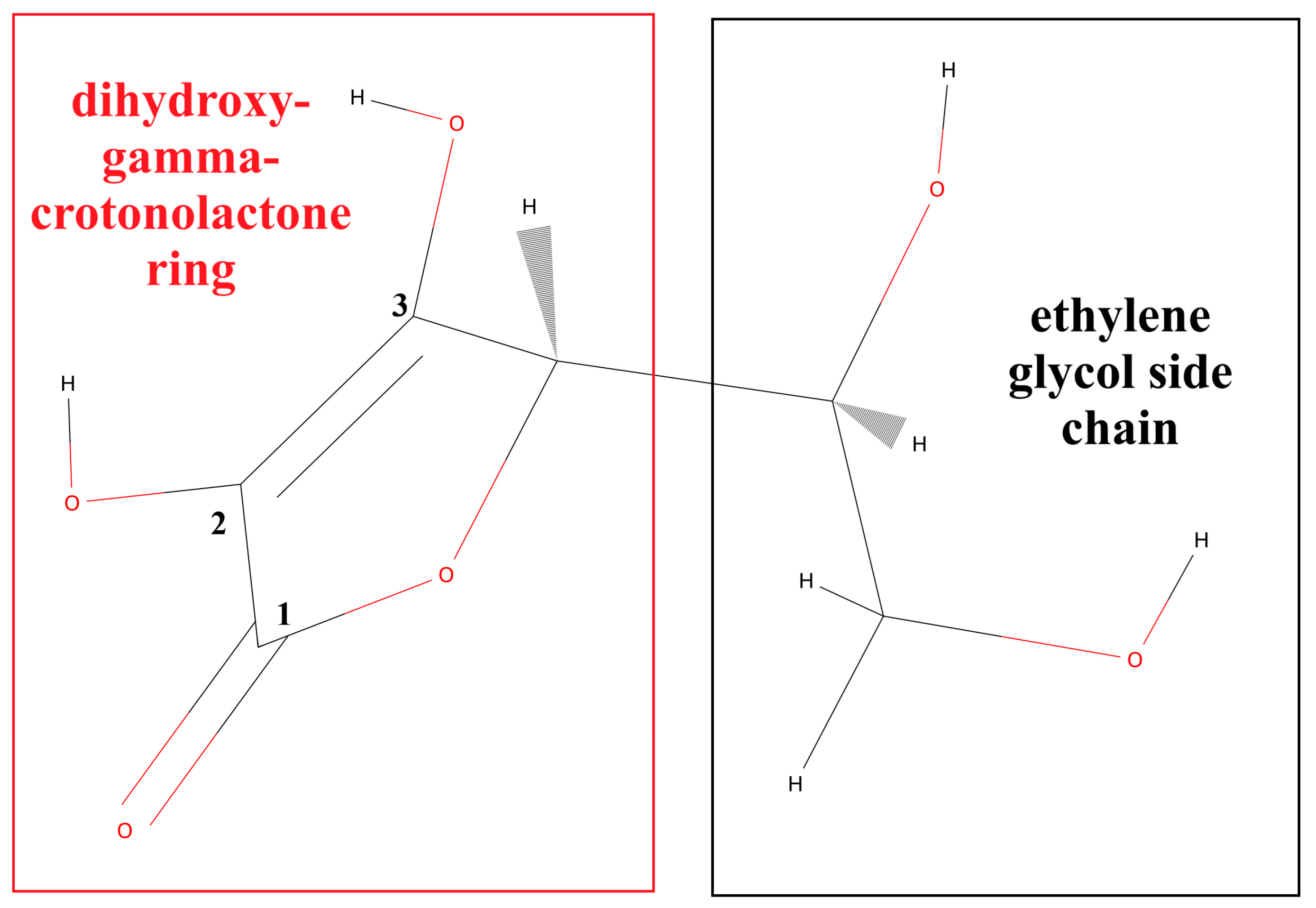
L-ascorbic acid is a very important biomolecule and powerful antioxidant [2]. In particular, it is believed to protect the skin from damage by UV radiation and pre-mature aging. It has been used for a long time in many traditional topical formulations in cosmetics. However, L-ascorbic acid needs to be at a high concentration locally in the skin, which cannot be achieved by traditional formulations nor by oral supplements [3]. Traditional dermal formulations of L-ascorbic acid are inadequate because L-ascorbic acid is not particularly stable, and there is limited penetration through the skin due to its hydrophilic nature. The structural formula of L-ascorbic acid is given in Figure 1.
This paper, therefore, focuses on improved formulations for administering L-ascorbic acid directly to the skin, in particular those using nanoparticle delivery systems. Nanoparticles (a) protect the active pharmaceutical ingredient (API) from external factors leading to instability, (b) can target the API to its place of action, and (c) transfer the API across biological barriers such as the stratum corneum (SC) of the skin. New and innovative formulations, such as nanoparticles, are making it possible to use the dermal and transdermal administration routes for more and more medicines.
The purpose of the review is as follows:
  • To discuss the common in vitro methods for investigating skin permeability and skin retention of a topically or dermally administered API, and how these methods may be replaced by other methods, including in vivo methods.
  • To consider L-ascorbic acid as a test substance in designing a dermal drug delivery system for carrying a hydrophilic API of low stability, discussing possible alternative solutions to these problems.
  • To reconsider L-ascorbic acid as a pharmaceutical for the skin, in light of new formulations developed and tested by several researchers, in particular to describe the latest state-of-the-art design of dermal drug delivery systems based on nanoparticles.
  • To consider other substances that might work synergistically with L-ascorbic acid in topical dermal therapeutic applications.
  • To discuss what was believed to be known concerning topical dermal administration and how new knowledge has challenged this older understanding.
  • To suggest future research, some building on past studies discussed in this review.
In Section 2, we begin by considering the challenges and understanding of both topical dermal delivery and transdermal delivery formulations. Research methods for evaluating such formulations will be described.
In Section 3, the subject of new delivery systems is introduced with special attention to those based on nanotechnology.
In Section 4, the importance of L-ascorbic acid, particularly as an antioxidant, and its role for skin is described. Pertinent facts related to dermal administration of L-ascorbic acid are described. Some common derivatives of L-ascorbic acid that can also be dermally administered are discussed.
In Section 5, new and innovative drug delivery systems, relevant to dermal administration, are described with the greatest emphasis on the method of using nanoparticles.
In Section 6, specific research with nanoparticles carrying L-ascorbic acid (or its derivatives) is reviewed.
The discussion and conclusion are given in Section 7 and Section 8.

2. Topical Dermal and Transdermal Delivery

2.1. Topical and Transdermal Formulations

Traditionally, topical and transdermal delivery systems have formulations based on ointments, gels, creams, and medicinal plasters. The main problem to be overcome in transdermal delivery is the stratum corneum (SC). The following general principles can be used as a guide to selecting a suitable active pharmaceutical ingredient (API) and formulation for transdermal delivery [4]:
  • The API should be moderately lipophilic, with logarithm of the partition coefficient between 1 and 4 (L-ascorbic acid has an octanol/water value of −2.15 [5]).
  • The API should be of relatively low molecular weight of less than 500 Da [6] (L-ascorbic acid has molecular weight of 176.12 g mol−1, ascorbyl palmitate has a molecular weight of 414.53 g mol−1).
  • The API should be effective at low dosages (<10 mg per day) in vivo.
  • The formulation should ensure the appropriate release of the API, depending on whether it is intended for rapid or slow release.
  • The vehicle should allow some solubility of the API but should not retain it so strongly that it does not partition out of the formulation. Many successful formulations involve saturating the API in the vehicle so that the thermodynamic activity is maximised. Upon application, the API may be induced to come out of solution if volatile components in the vehicle evaporate, raising the concentration above the solubility limit.
  • Occlusion, that is, preventing water from escaping from the skin and hydrating the skin, helps most APIs cross the skin barrier.
Furthermore, rheological properties are also important; for example, thixotropic formulations enable the formulation to be easily applied to the skin. Note that these principles are only a guide. According to in vitro studies using pig skin, L-ascorbic acid can pass across the skin barrier even though it is hydrophilic [7]. Additionally, larger molecules may cross the barrier but only in extremely low quantities. Therefore, if the API is very potent, there may be pharmacological activity even for proteins, antigens, and nucleic acids [4].

2.2. Skin Structure

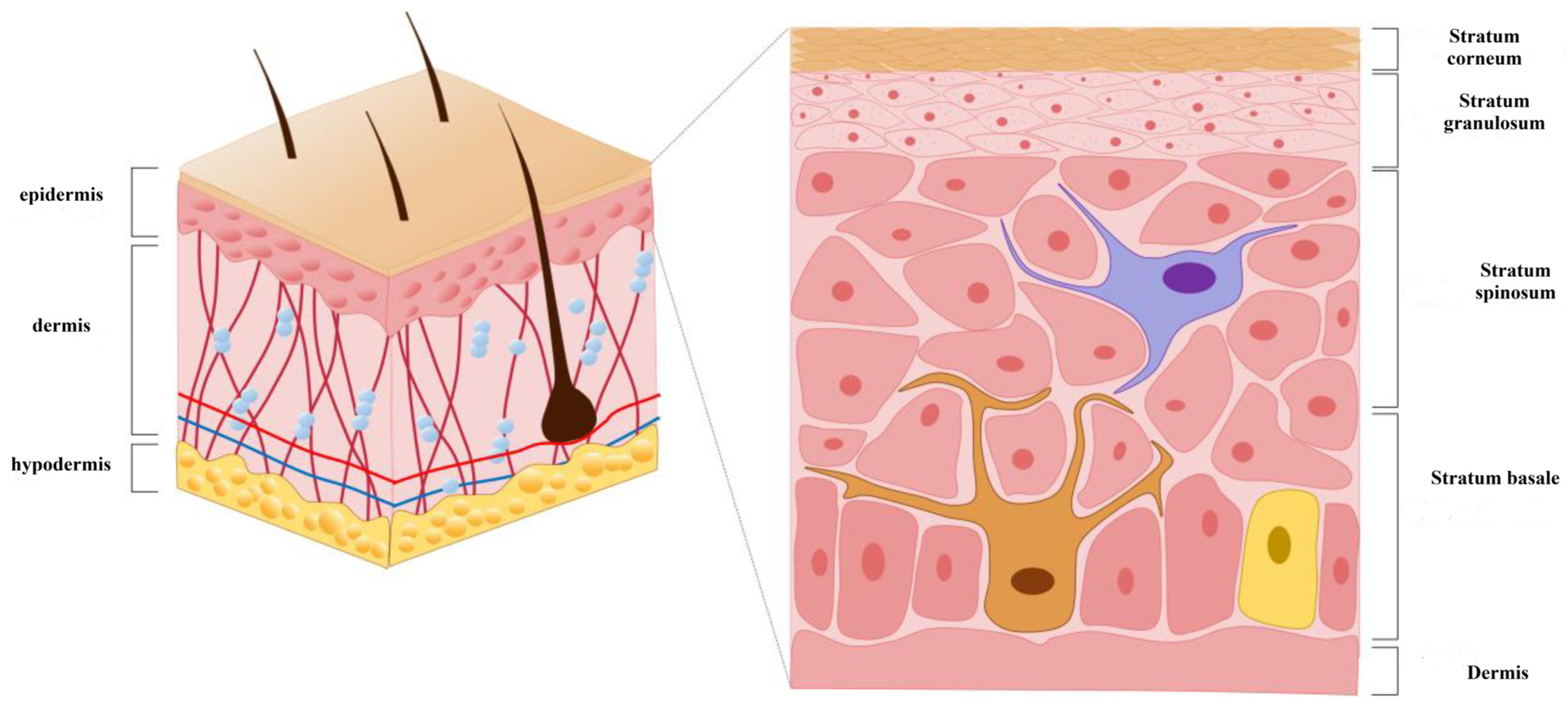
A fuller description of skin can be found in the review by Khater et al. [8]. In brief, the outer layer of skin epidermis is called the stratum corneum (SC), which forms the main barrier to the penetration of the API in a formulation. It can be described as a brick-and-mortar type of structure, with cross-linked corneocyte cells (the bricks) embedded in a lipid bilayer (the mortar) [9]. A diagram of the skin structure is given in Figure 2.
The lipids are somewhat different from those of other lipid bilayers in the body; for example, they consist largely of ceramides, with few phospholipids, fatty acids, and cholesterol [11,12,13].
Corneocytes are dead, flattened, denucleated keratinocyte cells, and there are 10–25 layers of these cells in the stratum corneum [14]. Corneocytes also contain several types of hygroscopic molecules called natural moisturizing factors (NMFs) [15]. Keratinocytes, located below the SC, help produce and maintain the SC. The pH of the skin is about 5.
An API may cross the stratum corneum intracellularly (through the bricks), and intercellularly (through the mortar), or it may also pass through or around the appendages of the skin, such as sweat glands and hair follicles. Regarding the last route, the fractional area of these ‘shunt’ routes is very small. Furthermore, the ducts and sweat glands are often full of fluid passing in an outwards direction, thus inhibiting the passage of the API into the skin [4]. However, the shunt route should not be underestimated in certain cases, including the use of nanoparticles [16,17,18].
Both intracellular and intercellular crossing require the API to travel across lipid-rich regions. Therefore, lipid-soluble APIs will cross the barrier more easily than water-soluble APIs. It appears that most APIs, whether lipophilic or hydrophilic, pass along the tortuous intercellular route [19]. Once the barrier has been passed, however, the API must pass through a more aqueous environment to enter systemic circulation. Even if passage into systemic circulation is not required, as in topical applications, a lipophilic API may build up below the SC, reducing concentration gradient necessary for diffusion and thus preventing further crossing of the skin.
The SC layer can be broken down with the use of special formulations or devices. Device-based approaches mainly involve physical techniques such as mechanical abrasion, ultrasound, electricity, lasers, and localised heating. They will not be further described, as fuller descriptions can be found elsewhere [9]. However, the use of microneedles will be included, as this is related to nanotechnology.
Chemical approaches for enhancing penetration use chemical enhancers. Chemical enhancers are pharmacologically inactive compounds that partition and diffuse into the skin and interact with the SC [19]. Water is a chemical enhancer, as it has already been mentioned that hydrated skin helps many APIs cross the skin barrier. Thus, skin formulations often use substances that prevent water from escaping from the skin (occlusive condition). The protein regions of dead cells in the layer take up water, making the proteins disordered. The excess water competes for hydrogen-binding sites on proteins, reducing the interaction between them. This helps intracellular permeation [20]. Other chemical enhancers act by breaking down the stratum corneum. Isopropyl myristate is a chemical enhancer often used in local and transdermal preparations. Rozman et al. showed that colloidal silica added to microemulsions enhanced the delivery of ascorbic acid and alpha-tocopherol into excised skin samples [21]. This was due to both an increase in the solubility of the two vitamins and a chemical enhancer effect. The colloidal silica penetrated the upper layers of the stratum corneum, increasing the permeability of the two vitamins into the epidermis. The increases in solubility were 1.2-fold for ascorbic acid and 230-fold for alpha-tocopherol.
A review of chemical enhancers can be found in [19,20,22].

2.3. Research Tools

It is essential to determine whether the API in transdermal formulations actually crosses the skin barrier, or, for topical formulations, how much API enters the skin. Ideally, in vivo experiments with live humans would be conducted. Some methods require that skin samples be taken to determine where the API has accumulated in the skin. Since experimentation on humans of this kind is unethical, costly, and somewhat impractical, a number of skin models and in vitro tests have been proposed.
In vitro experiments can be conducted to determine how much API crosses a model membrane representing the skin (or uses excised real animal or human skin as the membrane). The amount crossing the membrane barrier is the permeability, and it corresponds to the amount of API entering systemic circulation. This is important to know for transdermal administration. In contrast, the amount of API that accumulates and remains in the membrane (assuming that it can enter the membrane) represents penetration or retention. This amount is important to know for topical dermal targeting.
These experiments are important not only to determine which APIs can be administered transdermally, but also to assess whether undesirable substances can reach systemic circulation. For example, many sunscreens are applied to the skin with the intention that the ingredients penetrate the skin but do not reach systemic circulation, where they can have toxic effects.
Skin models may involve experiments with live animals, which are then sacrificed, or may involve substitutes for living skin, such as dead skin (human or animal), skin cell cultures, or synthetic materials that mimic skin. A fuller description and comparison of skin models can be found in reviews by Abd et al. and El-Katten et al. [14,23].
Concerning animal skin models, porcine (pig) skin is most widely used due to its histological similarity to human skin, with a comparable SC thickness of 21–26 µm [13]. While there are important differences between porcine and human skin, permeability is similar for a wide range of lipophilic and hydrophilic permeates [14]. Hairless mouse skin is also frequently used, as it is economical and attainable, and mice are easy to house, hairless strains having been bred. However, the permeability of mouse skin is up to 30–40-fold higher than that of human cadaver skin [23].
Reconstructed skin models use layers of cell-cultured human cells laid down over a polymeric matrix. They can be designed in different ways, using different cell types, but are usually designed to simulate the epidermis. RHE is an abbreviation for reconstructed human epidermis, and LHS stands for living human skin equivalent. There are a number of commercially available RHEs [14]. Living skin equivalents simulate the epidermis or full-thickness skin (dermal and epidermal layers) by using cultured human keratinocytes and a collagen matrix in the case of a full-thickness skin model. While these models have advantages, such as reducing animal experimentation, their permeability is variable and often much higher than that of human cadaver skin [23]. Chimeric models include those in which living human skin is grafted onto the skin of severe combined immunodeficient mice. These models are suitable for simulating skin diseases. Polymeric and other artificial membranes can also be used in transdermal experiments. However, they lack the complex histological structures of real skin and exhibit greater permeability than both animal and human skin [23]. PAMPA (parallel artificial membrane permeability assay) is a popular method that uses an artificial membrane as a skin model. This method gives relatively reproducible results due to its simple, standardized construction. It is made from ceramide-analogue compound that mimic the features of ceramides in the lipid matrix, cholesterol, and free fatty acids [24].
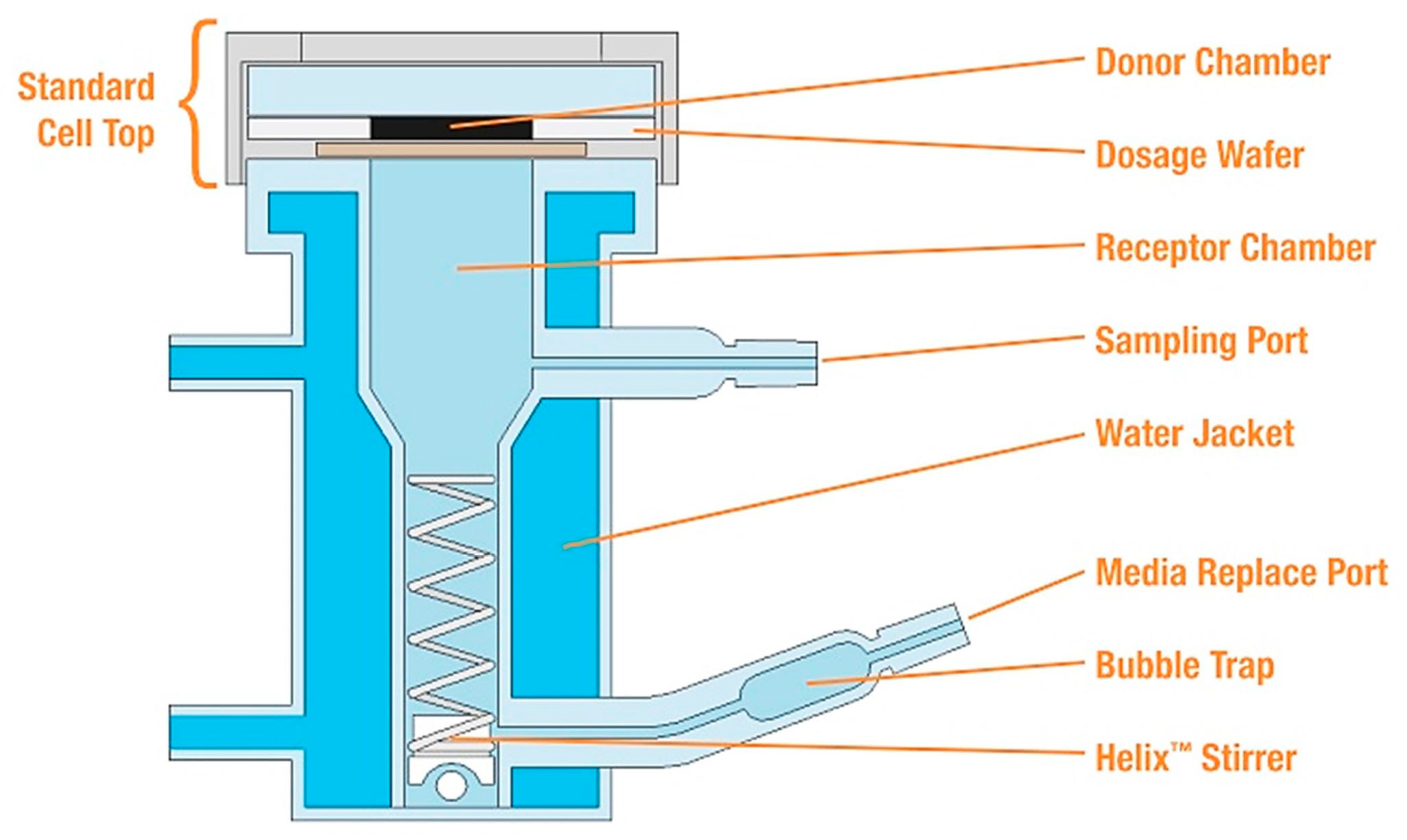
In vitro permeation methods use various types of apparatus to measure permeation across a skin membrane model. Typically, there is a donor compartment where the API is applied uniformly, a permeation barrier (skin model membrane), and a receptor solution. The receptor solution can be varied in parameters such as temperature, buffer composition, etc., and the resulting change in the amount of API reaching the receptor solution can be investigated. Antibiotics and preservatives are often added to the receptor solution to prevent microbial growth and enzymatic degradation [23]. The major types of in vitro permeation methods are the horizontal-type skin permeation system, the Franz diffusion cell, and the flow-through diffusion cell [25]. The particular system used depends on the solubility of the API in the receptor solution. One commonly used type of diffusion cells is shown in Figure 3.
The determination of penetration into the skin (skin retention of API) is less simple, and there are fewer studies on the measurement and modelling of accumulation and loss of APIs in skin models. For models based on real skin, it is possible to strip successive layers of skin using tape. The API in each tape stripping can be determined by suitable analytical techniques. The technique of tape stripping is described in more detail in the following references [27,28,29,30]. However, tape stripping only determines levels of API in the SC and not in the viable epidermis and dermis, where living cells are likely to benefit from the therapeutic effects of the API.
While in vitro skin permeability and retention studies using Franz cells and pig skin are very popular, there are a number of disadvantages:
  • It is difficult to perform, with potential inaccuracies in sampling intervals, mounting of skin neatly, measurement of skin area, etc.
  • The procedure can vary greatly. Some researchers use different buffer solutions in the receptor compartment, while some use stabilizers for the API, etc. Consequently, results may vary for many different reasons.
  • The skin sample is not living, so metabolism, drug clearance, and active transport do not take place.
In vivo studies on animal models can be conducted where the animal is treated with the formulation, sacrificed and then the skin is analysed. The problem is that animals such as rats and mice do not have skin closely resembling that of humans. Experiments using pigs are possible but far more expensive. However, Pinnel et al. used this method for a non-nanoparticle formulation at low pH [31].
Imaging techniques such as autoradiography, mass spectrometry, fluorescence, and vibrational spectroscopic imaging methods are very useful techniques that can identify substances in ex vivo or in vivo skin [32,33]. A brief overview of the many methods will be given, together with an example study where such techniques were used for an L-ascorbic acid topical dermal formulation.
Mass spectrometry and autoradiographic tools are used for the tracking and quantification of drugs and compounds within the skin. They are very sensitive methods but are restricted mostly to ex vivo applications. They are invasive methods. Mass spectrometry methods include Matrix-Assisted Laser Desorption/Ionization (MALDI) and Static and Dynamic Secondary Ion Mass Spectrometry (SIMS). Autoradiography has been developed into microautoradiography (MARG). In autoradiography, a radioactive marker, for example, 3H, is attached to the API. Particles emitted by the radioisotope label, such as beta particles, interact with photographic emulsions to provide an image. A major disadvantage is that the radioactive label can be transferred to other molecules during metabolism, which occurs in the skin. Mass spectrometry has advantages over autoradiography. It requires no radiolabelling and provides structural information, being based on the molecular weight of the API or species to be detected. Thus, metabolites can also be targeted for detection [32].
Optical imaging methods, such as fluorescence, and vibrational spectroscopic imaging methods, can be used in vivo. They are non-invasive and non-destructive, so they can be used to repeatedly image and collect three-dimensional chemical tomograms of the same sample region or individual over time. The limitations are that optical imaging can only penetrate to a certain depth of the skin.
Conventional and confocal fluorescence microscopies are conducted on cell cultures and ex vivo human skin samples. From these techniques, multiphoton technologies, such as ultrashort pulsed near-infrared or infrared lasers, have enabled more powerful techniques to be developed. These are 2PEF (two-photon excited fluorescence), FLIM (fluorescence lifetime imaging), and SHG (second harmonic generation microscopies). They have allowed the study of in vivo human skin in clinical trials. These more powerful techniques can penetrate deeper skin depths.
Vibrational spectroscopy imaging is based on the ability of vibrational spectroscopy to show the unique ‘fingerprint’ of a molecule due to its intrinsic molecular structure. These imaging methods can be classified into those that use light absorption and light scattering. Light scattering methods are based on the Raman effect. These microscopies include those based on confocal Raman spectroscopy, coherent anti-Stokes Raman scattering (CARS), and stimulated Raman scattering (SRS). The limitations of these methods are that water adsorption limits in vivo applications.
Fluorescence and Raman techniques may have limitations. They may not have the sensitivity or specificity to quantify the metabolites of an API. For cases where these limitations prevail, mass spectrometry tools are better and able to follow many simultaneous molecular species.
In short, there are many methods, and the choice of method depends on the API, information required, depth of analysis, etc. Perhaps this makes it difficult for a laboratory to invest in one single method and may explain why these methods are not more common in current studies. Reference [33] has a decision tree to choose the appropriate method, but when more than one substance of interest, or when a metabolized product is of interest, this tree is too simplistic. For multiple APIs, or when there is a need to visualize both a compound and its delivery vehicle or formulation, fluorescent and Raman tools can still be used. However, the potential interference between drug/compound contributions must be taken into consideration [32,33].
While many of the studies using nanoparticle delivery systems, reviewed in Section 6, did not use imaging techniques, a study by Raschke et al. used imaging techniques to demonstrate positive effects of 3% L-ascorbic acid in an optimised w/o emulsion. Using ultraweak photon emission, they demonstrated high in vivo antioxidant capacity in the skin 1 week after application of the formulation. An increased number of dermal papillae after treatment was observed using confocal microscopy [34].
Mathematical/computer (in silico) models can also be developed to simulate both the permeation and penetration/retention of different formulations and APIs [23]. The model is compared or fitted to the experimental results. Key physicochemical parameters, such as diffusion coefficient, permeability coefficient, or transfer coefficient, can be determined. AI is becoming increasingly popular in transdermal delivery modelling. However, it relies heavily on high-quality, diverse, and unbiased training data [35].
Returning the discussion to the in vitro model, currently the most used, a simple model is that of diffusion through the lipid layer. While it is believed that the path is a long, tortuous one, the effective diffusion coefficient can be determined, which uses the simple depth of the membrane rather than the actual path of the molecule through the lipid-filled spaces (the ‘mortar’). It is possible to solve the second-order differential equation describing Fick’s second law of diffusion. The model will often make many further simplifying assumptions, such as sink conditions. For a flow-through Franz diffusion cell, the API is carried away when it reaches the acceptor compartment. This mimics the API being immediately removed by the blood in the physiological model. For the conventional Franz diffusion cell, the acceptor/receptor compartment is closed and has a finite volume. In this case, the sink condition is a valid approximation, provided that the highest concentration of the permeant does not exceed 10% of its saturation solubility in the receptor medium. This condition is usually met for highly water-soluble APIs, such as ascorbic acid, and where the receptor medium is an aqueous solution, such as phosphate buffer solution [25]. The API in the receptor compartment is of lower concentration than the concentration in the donor compartment in order for diffusion to occur across a concentration gradient.
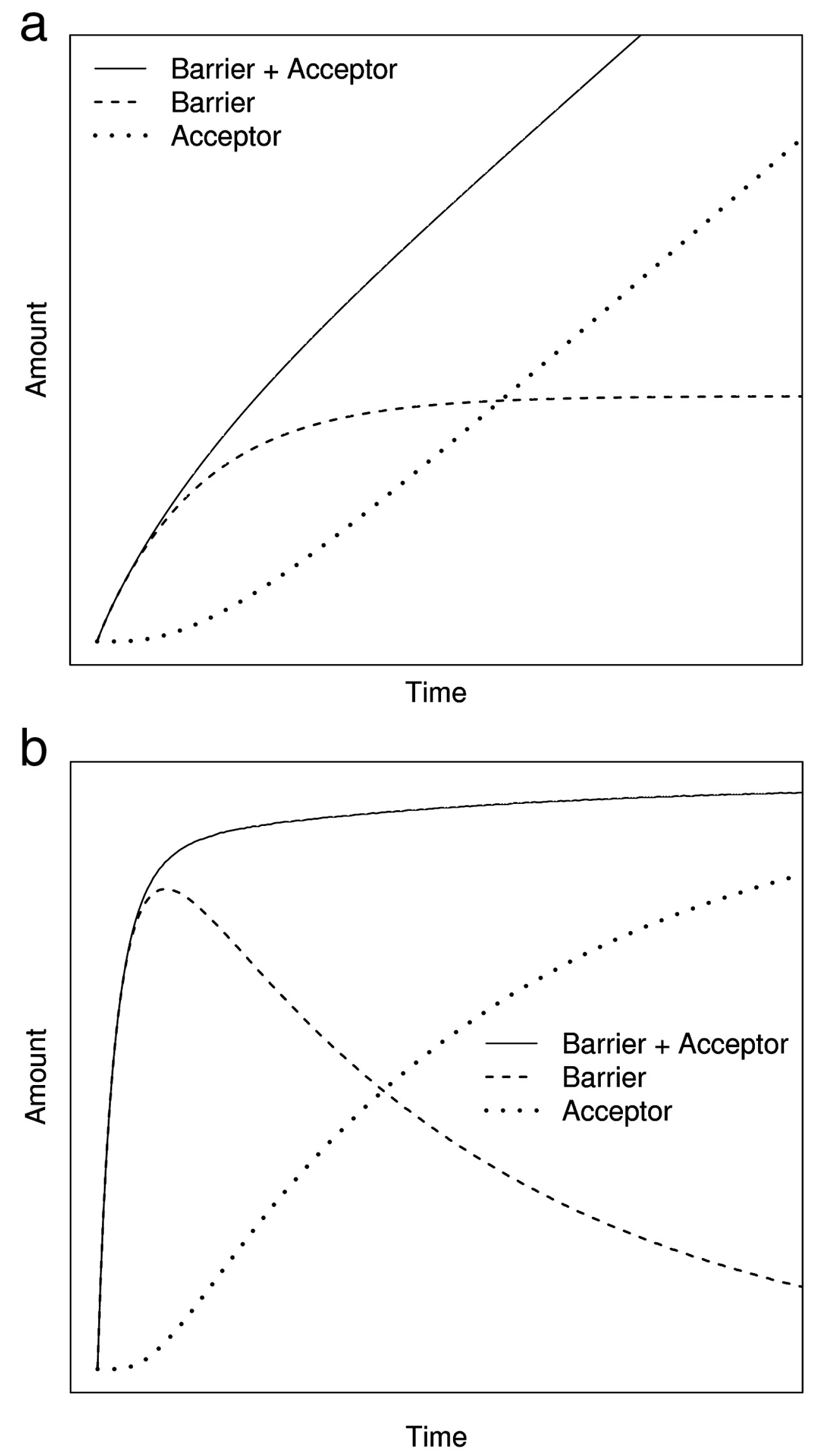
The model for the cumulative increase in API in the donor compartment predicts an initially exponentially increasing curve, which quickly becomes approximately linear with a positive slope in the case of excessive, unlimited (so-called infinite dose) API concentration in the donor compartment. This is shown by the dotted line in Figure 4a. The dashed line in Figure 4a shows the accumulation of API in the skin model (retention), which converges to a constant value for an infinite dose. For a limited dose (so-called finite dose) API concentration, the concentration in the donor compartment rises until it flattens out to a maximum when the whole dose has been absorbed by the membrane plus the receptor solution. This is shown in Figure 4b. The amount absorbed/retained by the membrane rises to a peak value and then decreases asymptotically for the finite dose case, as shown by the dashed line in Figure 4b [25].
For the dotted line in Figure 4a, the following equation applies according to the assumptions of infinite dose and sink conditions.
M t = K   l   c 0   D   t l 2 1 6 2 π 2 1 ( 1 ) n n 2 e x p D n 2 π 2   t l 2
where M(t) is the cumulative permeated mass per time and unit area, K is partition coefficient between the vehicle and the skin model, l is the effective diffusion path length, D is the diffusion coefficient of the permeant in the membrane, and c0 is the constant substance concentration in the donor compartment. The effective diffusion path is a torturous route, but it can be replaced by the skin thickness if D is an effective diffusion rate, a value much smaller than the real diffusion coefficient. We will equate l with skin thickness from now on. Clearly, the equation converges to a straight line as t becomes large and can be written as follows:
M S S t = c 0 K   D l   ( t   t l a g )
where MSS is the steady-state cumulative permeated mass per time unit and unit area after the time lag, tlag.
For the distribution of the API in the membrane as a function of depth and time, the analytical solution shows an exponential decay-like function with the depth of membrane, which converges to a straight-line equation with a negative slope (equal to a uniform concentration gradient) after a sufficiently long time. The complete equation is given below.
c x , t = K   c 0   1 x l 2 π   1 1 n   sin n   π   x l   e x p ( D   n 2   π 2   t l 2 )
where c(x,t) is the concentration at a depth of the skin from the donor compartment, x, after the time from the beginning of experiment, t. The thickness of the skin sample in the Franz cell is l. Other symbols are defined as in Equation (1).
When the SC produces a significant barrier, most of the API is only in the SC and not in the epidermis or dermis. Therefore, to treat the epidermis and dermis, the SC barrier must be made more diffusible, and KSC must be made closer to unity. While API-loaded nanoparticles may cross the SC more easily, the API is useless while locked inside the nanoparticle. Therefore, it is necessary for the nanoparticle to release the API in the SC, epidermis, or dermis, whichever is the most appropriate site for therapeutic action.
Levels of L-ascorbic acid in cosmetics are recommended to be from 5% to 20% [3], with a maximum of 30% [36]. For a simple L-ascorbic acid in water formulation, this corresponds to L-ascorbic acid concentrations of 50 mg/mL to 200 mg/mL. Table 1 shows some values of MSC calculated from lSC and c0. Here, lSC is taken from a pig skin value of about 21–26 μm [14].
The solutions (1) and (3) assume that the concentration of API is excessive, that is, infinite dose absorption [25]. It also assumes no L-ascorbic acid in the skin at the start of the experiment, which, as we will see later, is in disagreement with the fact that the skin already contains L-ascorbic acid and other antioxidants. The situation where the concentration of API is limited (that is, finite dose absorption, as normally occurs in a skin cream) is more problematic but has been tackled by Kasting. Kasting’s studies showed that the absorption by the membrane at low concentrations followed approximately first-order kinetics, which changed to zero-order at higher concentrations [37].

3. New and Innovative Drug Delivery Systems

Some of the challenges for topical and transdermal formulations may be overcome by using improved, new, and innovative drug delivery systems. These formulations seek to widen the range of APIs (for example, a wider range of lipophilicity/hydrophilicity) possible for transdermal administration.

3.1. Microneedles

Microneedle arrays are minimally invasive, painless drug delivery systems, which, when formulated properly, can deliver an API through the skin by puncturing the skin, piercing the SC without reaching the nerve terminals underneath [38]. Microneedles have several advantages, such as controlled-release, reduced side effects, less frequent dosing, and protection of the API from degradation and loss of activity [39].
Microneedles can be categorised into five distinct types:
  • Solid
  • Hollow
  • Coated
  • Hydrogel-forming
  • Dissolving
Solid microneedles can be fabricated from different materials, such as silicon, ceramics, metals, and polymers. Microneedles have attracted great interest for a wide range of transdermal biomedical applications, such as biosensing and drug delivery, due to the advantages of being painless, semi-invasive, and sustainable [40].
Microneedles are loaded with the API, which is released after the microneedle has pierced the SC and transferred the API physically into the skin layers. However, microneedles may be loaded with nanoparticles, which, in turn, carry the API. After penetration of the microneedle, the nanoparticles may penetrate further into the skin and/or release the API at a controlled rate. Thus, a combination of micro- and nano-drug delivery systems is possible.

3.2. Microparticles

Microparticles are particles in the micrometre range (1 to 1000 μm). They may be used as drug delivery systems by carrying an API either embedded in the particles or attached to then. Microspheres are believed to pass through pores in the skin of sizes 0.05 to 0.2 mm2, depending on age and genetics. Microspheres should be less than 120 μm in diameter [41].

3.3. Nanoparticles

Nanoparticles are similar to microparticles but are of the order of nanometres (1 to 1000 nanometres). Design of nanoparticles has been an active research topic for several decades. Consequently, many types of nanoparticles have been developed from materials ranging from inorganic, synthetic, and natural materials using many types of methods. More biocompatible and biodegradable materials are popular now and include lipids, proteins, synthetic and natural polymers, e.g., chitosan, and melanin. Not all methods are easy to scale up to an industrial scale, and some earlier types of nanoparticles, such as liposomes, have been replaced by superior developments. More information about types, materials, and manufacture can be found elsewhere [8,42].
Regarding nanoparticles for dermal and transdermal formulations, nanoparticle delivery systems may offer superior alternatives to traditional dermal formulations in at least four ways [8]:
  • Better penetration
  • Prolonged effect
  • Reduction in toxicity
  • Prevention of degradation
However, there may be disadvantages of nanoparticle formulations. They should be relatively cheap, stable, and easy to produce on a large scale. For example, liposomes (to be described in next subsection) are expensive, unstable, and difficult to produce on a large scale. Newer types of nanoparticles, such as solid lipid nanoparticles (SLNs), have been developed to overcome these limitations [8].
For inorganic nanoparticles, the following principles are a guide for designing nanoparticles that can penetrate the skin [43]:
  • Cationic nanoparticles penetrate best, because skin is acidic and negatively charged. Nanoparticles coated with PEG–amine can give a positive surface charge.
  • Amphiphilic APIs penetrate best, as they can partition in both hydrophilic and hydrophobic layers of the skin. Inorganic nanoparticles can be coated with amphiphilic substances, such as PEG–amine and chitosan.
  • Particle size is the overriding factor when particles are less than 10 nm. Particles greater than 20 nm tend to pass via hair follicles, while those less than 10 nm go through the stratum corneum. (Note that this applies to inorganic nanoparticle-loaded liposome nanoparticles are more likely to be 200 nm but may pass through the skin by deformation).
  • Particle shape is also important: Spheres penetrate better than ellipsoidal nanoparticles, and nanorods penetrate better than spherical nanoparticles.
We will see in Section 6, however, that these guidelines do not apply to all types of nanocarriers.
Nanoparticles are characterised by a number of standard methods. They are sized by a zeta sizer, which uses a technique called dynamic light scattering (DLS). This technique gives a size known as the average hydrodynamic radius as well as a degree of variation of sizes known as the polydispersity index (PDI). PDI can range between 0.0 and 1.0, with lower values indicating good size homogeneity. Size is important in designing nanoparticles to be small enough to penetrate certain tissues. Extrusion methods can be used to select particles of desired size. Transmission electron microscopy (TEM) can give a different measure of size, reflecting the actual boundary of the material making the nanoparticle (grain size). The particle shape can also be seen using electron microscopy.
The electrostatic repulsion between particles is called the zeta potential and is usually determined with the zeta sizer apparatus. The size of the zeta potential can indicate whether the nanoparticles are prone to aggregate or not. Zeta potentials with absolute value greater than 30 mV are considered stable, in the sense that they will not aggregate due to sufficiently large electrostatic repulsion between particles. For nanoparticles with unsuitable zeta potentials, the tendency to aggregate or flocculate over time needs to be tested.
The entrapment efficiency (EE) is a measure of how much API is successfully entrapped in or on the nanoparticle. It can be determined by loading the nanoparticles, removing unentrapped API by washing, and then measuring the quantity of API in the washed nanoparticles using analytical techniques such as high-performance liquid chromatography (HPLC) and UV–vis spectroscopy. Techniques for releasing the entrapped API from the nanoparticles exist, depending on the type of nanoparticle used. Release can be induced by an external stimulus, such as ultrasound or a laser. More often, release occurs under normal physiological conditions after a certain time or upon reaching the target, where conditions such as pH, redox environment, presence of certain enzymes, etc. cause release. The release of API from the nanoparticles can be investigated and the results used to fit a mathematical model of drug release kinetics.
Other tests may include mass spectroscopy to verify composition, differential scanning calorimetry (DSC) to investigate phase changes and crystallinity index, field emission scanning electron microscopy (FESEM) to study the surface of nanoparticles, and X-ray diffraction to study crystallinity and composition. These tests are especially important for lipid nanoparticles, which may undergo a polymorphic transitional variation, which can lead to unwanted API leakage during storage [8]. Fourier transmission infrared spectroscopy (FTIR) is also sometimes used to verify the attachment of the API to nanoparticles.
Finally, it should be mentioned that the possible toxic effects of a new formulation should be investigated. Various cytotoxicity tests can be used. The most common test is the MTT test, which is used on cell cultures [44]. This is, however, considered an in vitro test. In vivo tests can also be conducted on animal models but are more rarely performed in the early research stage [45].
While nanoparticles have been a vigorous and well-established innovative idea for improved drug delivery systems, their use in transdermal and topical dermal delivery is less clear. It was mentioned that, while inorganic nanoparticles can penetrate skin with sizes of the order of 10 to 20 nm, many nanoparticles made from biocompatible materials such as chitosan tend to be of the order of 100 to 200 nm, and larger when loaded with API. This size appears too large. However, the shunt route through the skin may allow nanoparticles of this size to penetrate. Clearly, simple membrane models will not demonstrate this ability, but animal and in vivo studies may.

3.4. Liposomes and Their Progeny

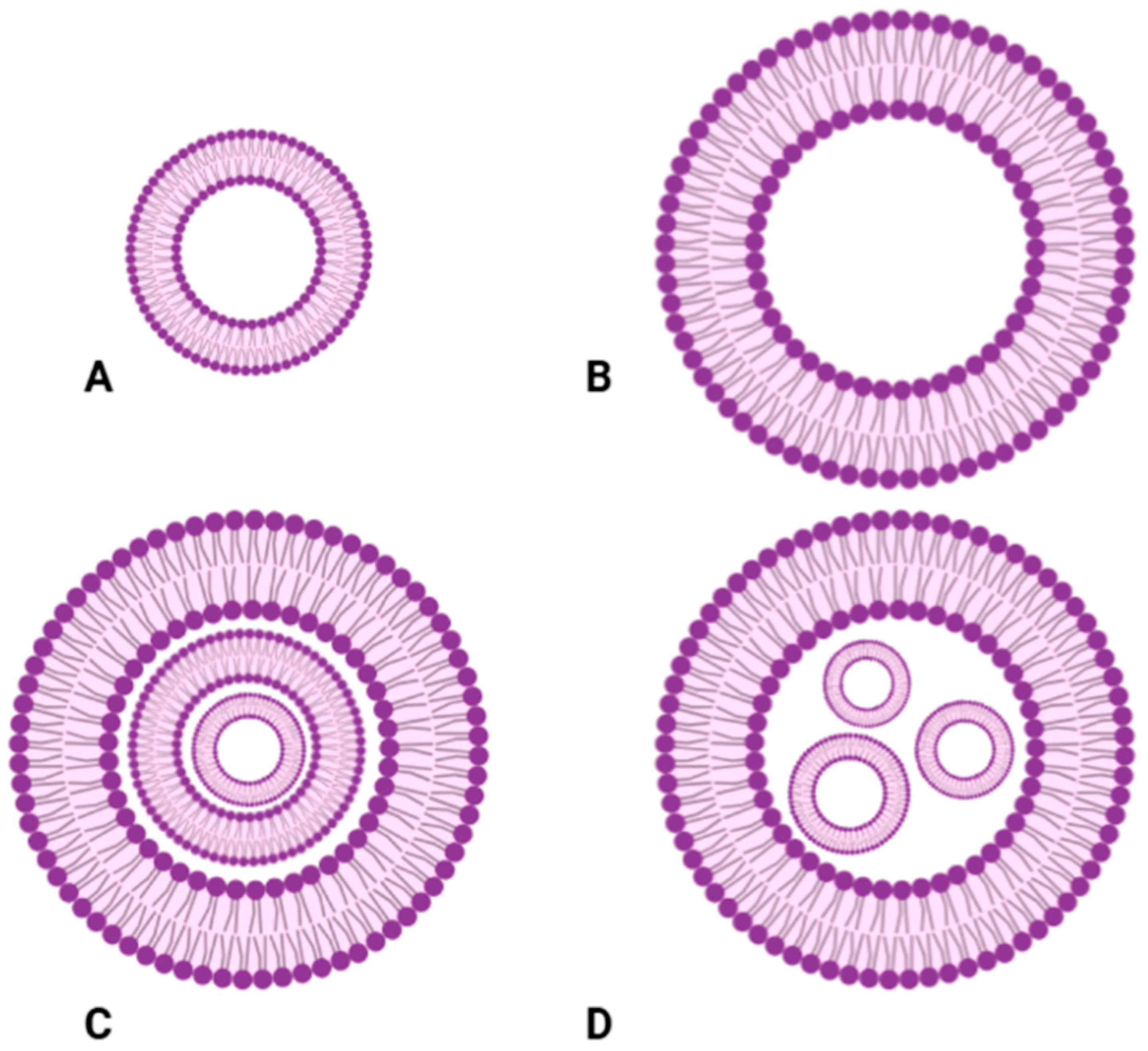
Liposomes are a particular type of nanoparticle, which deserve their own subsection. They are spherical lipid vesicles (usually 50–500 nm in diameter) composed of one or more lipid bilayers as a result of emulsifying natural or synthetic lipids in an aqueous medium [46]. They often contain cholesterol to improve the stability of bilayers and the control release rate of the API. Some liposome structures are illustrated in Figure 5.
They are perhaps the most commonly used nanocarriers and can carry both hydrophilic APIs in the core cavity and hydrophobic APIs in the hydrophobic lipid bilayer. However, the liposome prototype has some disadvantages,. There may be some API leakage, especially for APIs intermediate between hydrophilic and hydrophobic. It will be seen later, in Section 6, that L-ascorbic acid has a rather low EE of only about 30% for liposome carriers compared to about 80–90% of other types of nanoparticles. Liposomes have low aqueous solubility and are prone to oxidation. Production costs can be high. Improvements in drug delivery systems have been made. They can be readily modified by coating with polyethylene glycol (PEG) to prevent attachment of opsonins so that the liposome drug carriers are not degraded by the immune system, thus increasing circulation time. Targeting molecules such as antibodies can be attached to the surface of the liposomes. Liposomes specifically designed for dermal administration have been designed to be deformable. They have been given new names such as transfersomes, ethosomes, transethosomes, and more recently spanlastics and aspasomes. The differences between them are described by Ascenso et al. [48]. Since they are all essentially liposomes, they will be grouped as liposomes. Furthermore, the exact mechanism for improvement in transferring the API through the SC may be more complex than simple deformation [49].
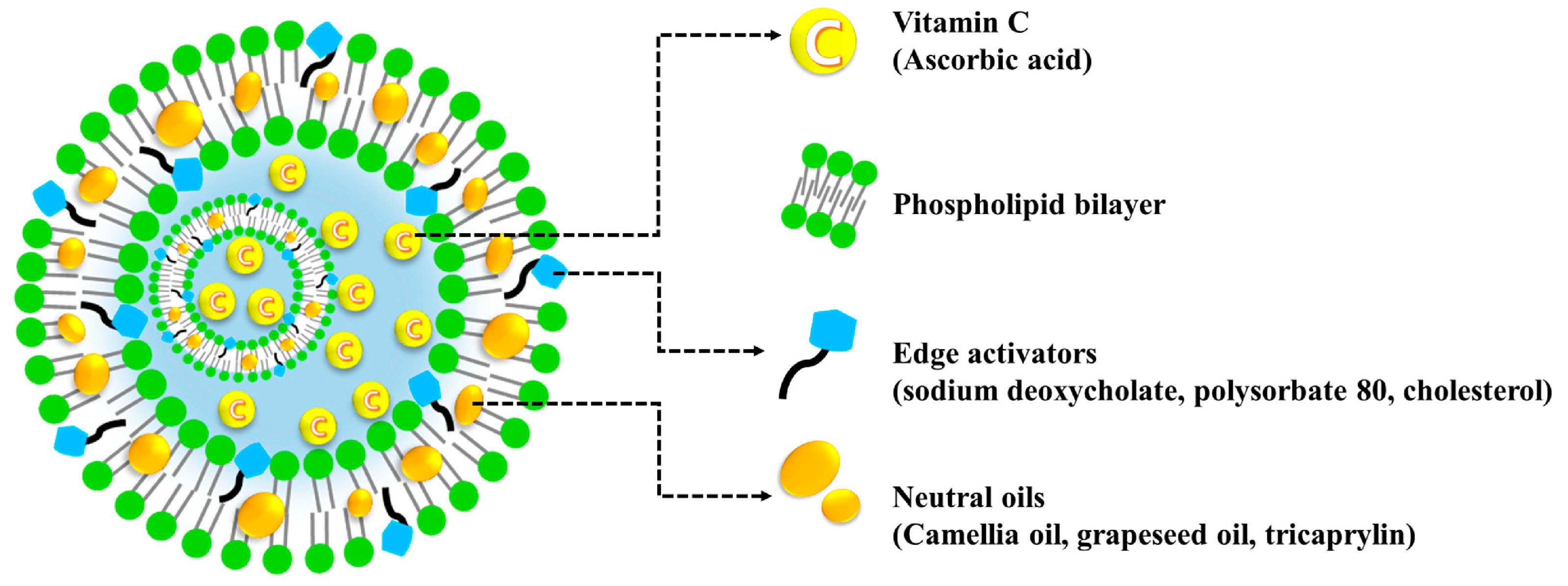
Spanlastics are elastic, deformable surfactant-based nanovesicles [50]. They use so-called edge activators, which are single-chain surfactants that improve the deformability and permeability of vesicular systems, supposedly aiding the passage of spanlastics through biological membranes. Only non-ionic surfactants are used. They are promising nano-drug delivery systems for dermal administration because they can supposably deform and squeeze through the SC. They can be somewhat larger than other nanoparticles and conventional liposomes, which allows more API to be carried per vesicle.
Aspasomes are a recent innovation, discovered in 2004 by Gopinath and others. They are a double-layered vesicular system formed by ascorbyl palmitate. Other negatively charged phospholipids, such as cholesterol and dicethyl phosphate, are often used as well. Aspasomes can be used as a carrier system for L-ascorbic acid, derivatives of L-ascorbic acid, and other APIs. They have been tested as delivery systems for dermal administration to carry various APIs to treat various skin diseases, as well as other diseases such as rheumatoid arthritis. Aspasomes without loaded APIs have high antioxidative activity by themselves. They are generally considered safe but may have prooxidant effects at certain concentrations or instability in the presence of UV light and certain metal ions [51].
Despite their disadvantages, it appears that liposomes and their progeny are good for dermal formulations. Liposomes are able to better interact with keratinocyte and fibroblast membranes [52].

4. Ascorbic Acid

4.1. Introduction

The enantiomer L-ascorbic acid is biologically active, and it is commonly known by the name vitamin C. Most mammals are able to make their own L-ascorbic acid. Humans require this vitamin in the diet, where it is found most abundantly in fruits and vegetables, especially citrus fruits. Study of the human genome has revealed a pseudogene on chromosome 8. This pseudogene is similar to a gene coding for L-gulono-γ-lactone oxidase, which is the enzyme required for the last step of the complex path leading to the biosynthesis of L-ascorbic acid [53]. Halliwell and Gutteridge have suggested an advantage of relying on an exogenous source of vitamin C. They noted that the enzyme gulonolactone oxidase produces hydrogen peroxide, which may cause oxidative stress [54,55].
Deficiency of vitamin C results in the disease called scurvy which was well known to occur in sailors on long sea voyages before the cause of this disease was understood. The first symptoms are fatigue followed by poor healing and bleeding gums. Vitamin C is necessary for the production of carnitine and catecholamines, which are necessary for energy metabolism. It is also necessary as a cofactor for prolylhydroxylase and lysylhydroxylase enzymes. These enzymes hydroxylyse the amino acids proline and lysine, helping to cross-link collagen. This explains the poor healing and bleeding of gum symptoms in scurvy.
Other functions of L-ascorbic acid include UV light protection, synthesis of melanin inhibitor, assisting in the synthesis of immunoglobulins and interferon, suppressing interleukin-18, and assisting the absorption of iron, calcium, and folic acid [56].
L-ascorbic acid has a somewhat controversial history as a possible cure for cancer. While it is true that it is cytotoxic to some cultivated cancer cell lines, such as the malignant leukaemia cell line P388D1, it is difficult to deliver ascorbic acid to sufficiently high levels at the target cells. Taking vitamin C oral supplements can only increase blood plasma levels to an upper limit, after which the kidneys remove it, and it is excreted in the urine. Cameron and Pauling suggested that intravenous administration of ascorbic acid may prolong the life of some cancer patients [57]. Since then, there has been no conclusive evidence. Researchers continue to have hope that new delivery systems may enable L-ascorbic acid to be targeted to cancer cells, helping in their destruction. There may be possibilities of ascorbic acid working synergistically with other anticancer drugs as well.
Roomi et al. were able to determine which parts of the ascorbic acid molecule have the cytotoxic properties by testing derivatives of ascorbic acid on P388D1 cell lines. They concluded that it was the dihydroxy γ-crotonolactone ring—that is, the double bond in the ring and the hydroxyl groups at positions 2 and 3 on the ring—while the side chain ethylene glycol moiety does not seem to be important [58] (see Figure 1).

4.2. Antioxidant Properties

L-ascorbic acid is perhaps best known as an antioxidant. It has been reported that this is only proven in vitro [55]. However, pharmacists continue to hope that it works as an antioxidant in vivo as well, suggesting a mechanism for cancer prevention.
Antioxidants are molecular species that prevent oxidative stress. Oxidative stress is a theory that helps explain ageing and decline associated with long term stress. The theory is that, during metabolic processes such as aerobic respiration, transient free-radical species are produced. These free radicals have an unpaired electron, and examples include hydroxyl radicals OH, nitric oxide NO, and superoxide O2●−. They are extremely reactive but are usually neutralised by antioxidants. If there is an imbalance between free-radicals and antioxidant species, the free-radicals can damage important biomolecules such as lipids in lipid membranes, DNA, and proteins. Over time, this may give rise to age-related diseases, such as cancer and neurodegeneration. Antioxidants react with free-radical species, producing a less damaging species, thereby sparing damage to important biomolecules.
Antioxidants can be either endogenous or exogenous. Endogenous antioxidants are produced by the organism. Examples of endogenous antioxidants are superoxide dismutase (SOD), catalase (CAT), and glutathione peroxidase (GSPHx). Some of them are enzymes, but important endogenous antioxidants such as coenzyme Q10, uric acid, and transferrin are not [31]. In contrast, exogenous antioxidants are obtained from the diet and are non-enzymatic. Examples of exogenous non-enzymatic antioxidants are L-ascorbic acid (vitamin C), alpha-tocopherol (vitamin E), carotenoids, and flavonoids. Sometimes antioxidants can behave as prooxidants under certain conditions. Pro-oxidant behaviour can be affected by at least three factors: presence of metal ions, concentration of the antioxidant in matrix environments, and redox potential of the antioxidant [59].
The antioxidative nature of L-ascorbic acid can be explained with the help of the following equations:
AscH2 → AscH + H+
R-O + AscH → R-O + AscH
R-O + AscH → R-OH + Asc
where AscH2 is L-ascorbic acid, AscH is the ionised form after loss of the proton H+, R-O is a free radical, AscH is the relatively stable radical form of L-ascorbic acid, and Asc is dehydroascorbic acid.
Dehydroascorbate reductase catalyses the regeneration of ascorbic acid from dehydroascorbate. Glutathione (GSH) is also necessary as a source of reducing power. Alternatively, alpha-tocopherol can convert dehydroascorbic acid back to ascorbic acid, as will be shown later.
The prooxidative nature of L-ascorbic acid in the presence of Fe(III) and hydrogen peroxide is described by Equations (7) and (8):
Fe3+ + AscH → Fe2+ + AscH
Fe2+ + H2O2 → Fe3+ + OH + OH
where OH is the hydroxyl radical.
L-ascorbic acid can act synergistically with other substances. The most well-known example is alpha-tocopherol (vitamin E). This substance is complementary to L-ascorbic acid in two important senses. Firstly, it is fat-soluble, so it can scavenge free radicals in the lipid membranes, where water-soluble L-ascorbic acid cannot reach. Secondly, L-ascorbic acid regenerates alpha-tocopherol from its oxidised form, so it can again scavenge free-radicals [60]. Alpha-tocopherol may also have a stabilising effect on the photodegradation of ascorbic acid [61]. The equations showing the interaction between ascorbic acid and tocopherol, demonstrating the regeneration of unoxidized forms, are given below:
TP-O + AscH2 → TP + AscH
2 AscH → Asc + AscH2
TP + AscH → TP-O + AscH2
where TP is tocopherol, TP-O is oxidised tocopheroxyl radical, AscH2 is ascorbic acid, Asc is dehydroascorbate, and AscH is ascorbyl radical.
Another example of synergy is reported by Lin et al. They found that a combination of 15% L-ascorbic acid, 1% alpha-tocopherol, and 0.5% ferulic acid provided a doubling of protection against solar-simulated radiation compared with the combination of L-ascorbic acid and alpha-tocopherol alone [62].
Are there also L-ascorbic acid-incompatible substances? One study showed possible incompatibility of ascorbic acid with riboflavin and nicotinamide, at least in the presence of UV light. Riboflavin and nicotinamide are photosensitizers of ascorbic acid, causing it to break down more rapidly [61].
Many skin creams contain a mixture of antioxidants and excipients. How these components interact with each other is an important question. Interactions may be synergetic, as for ascorbic acid and alpha-tocopherol, or may be antagonistic or incompatible [63]. This important issue needs to be addressed in individual cases.

4.3. Benefit to Skin

L-ascorbic acid is particularly beneficial for the cosmetic appearance of the skin as it favours cell differentiation of keratinocytes, improves dermal-epidermal cohesion, and treats hyperpigmentation while improving collagen structure in the skin [64].
Antioxidants are particularly relevant to the skin, as skin is a target for oxidative stress not only from UV rays but also from toxic substances. In 1994, Shindo et al. determined levels of common and important antioxidants in both the dermis and epidermis of six volunteers undergoing surgery [65]. Their results showed that levels of L-ascorbic acid and dehydroascorbic acid were much higher than those of other antioxidants. The results for L-ascorbic acid and dehydroascorbic acid are presented in Table 2.
These values, while showing high individual variability, clearly suggest an important role of these species in the skin. However, blood plasma concentrations of L-ascorbic acid are of the order of 10−3 mg, as shown in Table 3 [66].
Now, the maximum amount of L-ascorbic acid entering the skin by diffusion alone would occur if the skin tissue were completely permeable and would equal the L-ascorbic acid concentration of the blood. Since the levels in the skin reported by Shindo et al. are much higher than this, it is clear that diffusion does not play a role. The body is able to actively deposit L-ascorbic acid into the skin via sodium-dependent vitamin C transporters [64].
Sun creams and sunscreens containing antioxidants can be important. Sunscreens should be defined as creams containing substances that absorb UV rays. This reduces erythema and thymine dimer formation in DNA. However, there is also the production of free radicals. Antioxidants such as L-ascorbic acid and alpha-tocopherol are not by themselves sunscreens, as they do not absorb UV rays, but they do complement sunscreen substances by scavenging free-radicals caused by sun exposure [63,67,68]. Alpha-tocopherol is more common in creams containing sunscreens than ascorbic acid [69].
Like L-ascorbic acid, alpha-tocopherol is naturally abundant in the stratum corneum, being delivered there by the sebum from the sebaceous glands of hair follicles [70,71]. However, alpha-tocopherol and L-ascorbic acid may be added to topical formulations in case the levels are depleted because of exposure to UV rays. For information about some of the problems and benefits of alpha-tocopherol topical administration, see the review by Burke [63].
L-ascorbic acid can also be used in wound healing [72,73,74,75,76]. Here, its importance is probably due to the production of collagen. Conventional oral administration of L-ascorbic acid may be sufficient to improve wound healing. However, some studies have considered topical dermal administration for healing skin wounds [76,77].

4.4. Combination with Other APIs

L-ascorbic acid is an antioxidant and therefore is assumed to be beneficial in maintaining the general health of the skin. It may be combined with other antioxidants such as the lipid-soluble alpha-tocopherol. However, there are specific skin conditions and diseases that it can treat, sometimes in combination with other APIs such as ferulic acid (protection from UV rays), thymoquinone (skin whitening), glycine (formation of collagen), and caffeic acid (a strong antioxidant).
It is important to thoroughly investigate the combination of L-ascorbic acid with other APIs. Sometimes unexpected results occur. For example, Oliveira et al. found that caffeic acid reduced the stability of L-ascorbic acid formulations when it was expected to improve the stability [78]. Ahmad et al. found that the addition of riboflavin and nicotinamide photosensitised L-ascorbic acid to UV light, increasing its degradation [61]. Conversely, positive effects of combinations have also been found, such as unexpected large positive synergistic effects. Lin et al. found that a combination of 15% L-ascorbic acid, 1% alpha-tocopherol, and 0.5% ferulic acid gave a doubling of protection against solar-simulated radiation compared with the combination of L-ascorbic acid and alpha-tocopherol alone. The combination of 15% L-ascorbic acid, 1% tocopherol, and 0.5% ferulic acid provided approximately eight-fold protection and was statistically different from ferulic acid alone or the combination of vitamins C and E. These observations were confirmed by colorimetric measurements of erythema and sunburn cell counts. Colorimetric measurements of the combination of vitamins C, E, and ferulic acid were statistically different from control and vehicle at all minimal erythema doses (MEDs) tested; different from ferulic acid alone at 2 × MED, 6 × MED, and 8 × MED; and different from the combination of vitamins C and E at 4 × and 6 × MED. Sunburn cell counts of the combination of vitamins C, E, and ferulic acid were statistically different from control and vehicle at all MEDs tested and different from ferulic acid alone, as well as from the combination of vitamins C and E at 2 × MED, 4 × MED, 6 × MED, and 8 × MED (p < 0.05) [61]. Boo found that glycinamide synergistically enhanced collagen production in human dermal fibroblasts when administered with L-ascorbic acid or some derivatives of L-ascorbic acid. While it was expected that glycine would enhance collagen synthesis, it was found that glycinamide was the most effective among the amino acids and amidated amino acids [79]. There are many possible combinations of APIs with L-ascorbic acid and therefore many research gaps to be filled. Neves et al. investigated a serum containing L-ascorbic acid, alpha-tocopherol, neohesperidin, pycnogel, and hyaluronic acid. Their ex vivo studies with human volunteers suggested that the serum is effective in protecting human skin against air pollution-induced skin pigmentation/aging, with a good safety profile after 90 days of daily use [80].

4.5. Topical Dermal Administration

This paper focuses on the assumption that dermal administration of L-ascorbic acid has advantages, such as direct targeting of L-ascorbic acid for skin repair and protection. This raises some challenges because L-ascorbic acid is not particularly stable and there may be limited penetration through the skin due to its hydrophilic nature. Ascorbic acid is a relatively low-weight, water-soluble molecule (Mw = 176.12 g/mol). It is water-soluble, with a solubility 33 g per 100 mL of water. The octanol/water partition coefficient is −2.15 [5], which means it distributes 141 times more in water than in octanol. While the strong hydrophilic nature disfavours permeation through the skin, its low molecular weight favours permeation. It is a weak acid, slightly stronger than acetic acid, with a pH of about 3.5, pKa1 of 4.2, and pKa2 of 11.6. This means that the unionised form is not abundant except at low pH. Since the skin lipids are negatively charged, the ionised form is repelled; therefore, for good permeability, the pH should be lowered. However, lowering pH below skin pH causes the formulation to be irritating to the skin.
Hannesschlaeger and Pohl investigated transmembrane permeability for L-ascorbic acid using a lipid membrane model. However, this models the stomach membrane and not the skin. They obtained a value of 1.1 × 10⁻⁸ cm/s, which is comparable to sorbitol and much lower than acetic acid and salicylic acid. They concluded that passive transcellular diffusion was inadequate for sufficient L-ascorbic acid to be obtained from the gastrointestinal tract [81].
L-ascorbic acid is already used in many traditional topical formulations. New formulations can overcome the challenges and improve targeting. Such new and innovative formulations, for example, the use of nanoparticles, are making it possible to use the dermal and transdermal administration routes for more and more medicines.
To conclude, pharmaceutically administered L-ascorbic acid is likely to have many beneficial effects, particularly in the skin, where there is exposure to damaging UV rays, potential contact with harmful chemicals, and mechanical damage.

5. Important Factors Related to Dermal Formulations of Ascorbic Acid

As mentioned above, despite being highly water-soluble, L-ascorbic acid does in fact pass through the skin barrier. However, in many commercially available skin creams, L-ascorbic acid reaches its target in low, sub-optimal concentrations [62]. The reason for low concentrations at the desired target may be more related to the instability of ascorbic acid. It is unstable in the presence of heat, light, air, moisture, metal ions, and bases, decomposing to biologically inactive compounds such as 2,3-diketo-L-gulonic acid, oxalic acid, L-threonic acid, L-xylonic acid, and L-lyxonic acid [82].
There are several ways of increasing stability. These are pH adjustment, suitable excipients in the formulation, use of derivatives of ascorbic acid, and nanoparticle delivery systems. Some of these methods, such as pH adjustment and the use of derivatives, also simultaneously affect permeability. Each of these methods will be discussed in turn. Nanoparticle delivery, as a solution to the instability and poor penetration of L-ascorbic acid, is the main focus of this paper.

5.1. Importance of pH

For ascorbic acid to be stable, the pH should be lower than the pKa of ascorbic acid—that is, lower than 4.2. The pH of skin is about 5, which is higher than 4.2; thus, ascorbic acid is unstable in the skin. In fact, the pH of an ascorbic acid formulation should be 3.5 [63]. Pinnell et al. found that a formulation for L-ascorbic acid in skin was optimal at pH 2.0 and that tissue levels of ascorbic acid were only enhanced at pH levels less than 3.5 [31]. Oliveira et al. used a formulation where citric acid was added to adjust the formulation to 3.5 [78]. However, formulations with a pH lower than the pH of the skin, about 5, may cause irritation. Thus, it may not be desirable for lower pH formulations to have direct contact with the skin.

5.2. Additives

Excipients such as chelating agents, preservatives, and antioxidants can increase stability. Ferulic acid and sodium metabisulfite have been shown to be useful stabilizers. High-viscosity formulations and multiple-emulsified systems also help stability [83]. Another approach to increase stability is to use non-aqueous mediums with reduced oxygen permeability [56]. Ascorbic acid is soluble in polyol solvents such as propylene glycol, butylene glycol, hexylene glycol, glycerin, polyethylene glycols, glycereth-7, glycereth-26, ethoxydiglycol, and ethanol. Usually, the formulation is an emulsion made with a polyol solvent to dissolve the L-ascorbic acid, an oil phase, such as silicone oil, and a surfactant.
Dermal formulations require many excipients, such as moisturizers, humectants, viscosity adjusters, etc. Oliveira et al. used the following excipients in an emulsion formulation to carry L-ascorbic acid: sodium hyaluronate as a moisturizer, decyl oleate as an emollient/secondary moisturizer, glycerin as a humectant in the oil phase, methyl gluceth-20 as a humectant in the aqueous phase, disodium EDTA as a chelator, sodium metabisulfite as an antioxidant/preservative, phenoxyethanol/2-methyl-2H-isothiazolin-3-one as a preservative, propyleneglycol as a solubilizer, and cyclopentasiloxane as an emollient/humectant/viscosity enhancer [78].
As previously mentioned, alpha-tocopherol stabilizes L-ascorbic acid by regeneration of the antioxidants. The reactions described by Equations (9)–(11) can occur only at the interfaces between lipid and aqueous regions but are very important in combating damage by free radicals. Ideally, skin formulations should provide means for both L-ascorbic acid and alpha-tocopherol to be present and be transferred across the skin barrier.

5.3. Derivatives of L-Ascorbic Acid

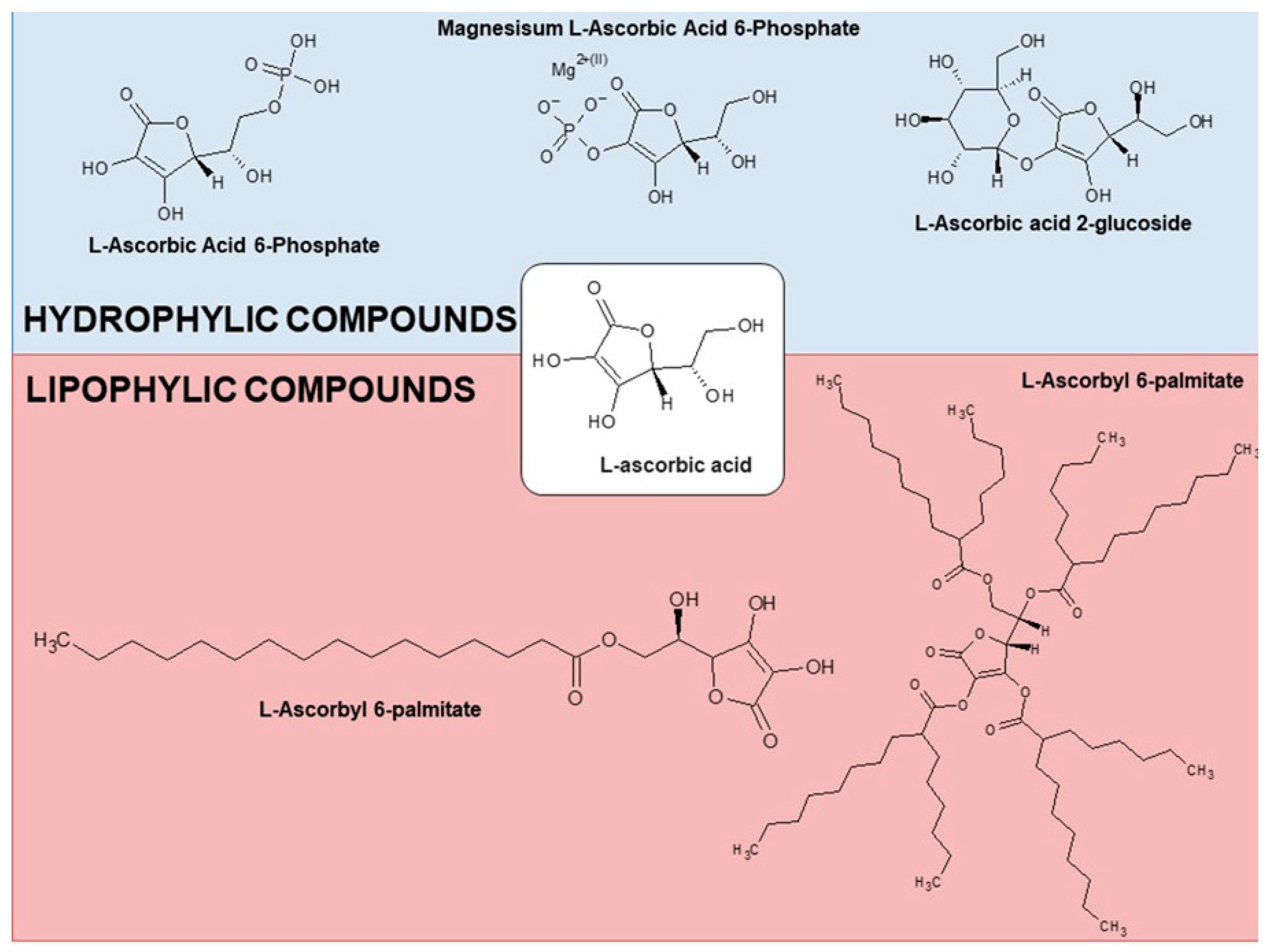
The stability challenge of ascorbic acid can be addressed by using suitable derivatives of ascorbic acid, for example, ascorbyl 2-phosphate 6-palmitate, which protects against decomposition while passing through the skin, aided by the lipophilic part of the molecule. While lipophilicity is good for passage across the SC, the passage of these derivatives through skin often tends to be less than that of ascorbic acid, possibly due to increase in molecular size. Furthermore, not all derivatives are readily converted to ascorbic acid once at their target site [84]. However, such derivatives may be shown to have many beneficial effects, similar or superior to L-ascorbic acid [85]. More information about derivatives of ascorbic acid can be found in a review by Stamford [84]. The molecular structures of some derivatives of L-ascorbic acid are shown in Figure 6.
Many have lipophilic side groups, making them amphiphilic molecules. They have better stability than L-ascorbic acid. To give some idea of stability after 60 days at room temperature, in a standard solution, more than 90% of magnesium ascorbyl phosphate and about 75% of ascorbyl palmate were recovered compared with about 35% of L-ascorbic acid [86].
They also act as antioxidants, and the lipophilic side chain aids penetration through the SC. However, they are not always converted back to L-ascorbic acid after penetrating the skin. Some derivatives, such as the ascorbyl-6-O-alkanoates, have self-assembly properties, so they can be used as drug delivery vehicles. Ascorbyl-6-O-alkanoates also have skin permeation enhancer properties and have been found to offer solutions to destroying antimicrobial-resistant biofilms [87].
Derivatives of ascorbic acid, such as L-ascorbyl-6-stearate and L-ascorbyl-6-palmitate, are fat-soluble and are often used in cosmetics and food industries but are not as principal components in quasi-drugs or as pharmaceutical additives. Trisodium L-ascorbyl 2-phosphate 6-palmitate is water-soluble, amphiphatic, and can form micelles that can be used to carry other lipophilic APIs [88]. It therefore has better skin penetrating ability than ascorbic acid and is converted into ascorbic acid once absorbed by the body. Inoue et al. prepared and evaluated a skin formulation involving distearoylphosphatidylethanolamine-PEG 2000 surfactant with trisodium L-ascorbyl 2-phosphate 6-palmitate micelles loaded with nadifloxacin and the additive isopropyl myristate. The API nadifloxacin can treat acne and is also fluorescent, so it can be used as a marker of skin penetration [88].

5.4. Common Co-Delivered Drugs with L-Ascorbic Acid

In some of the studies described in Section 6, there may be a specific therapeutic goal for a dermal formulation of L-ascorbic acid. This may be skin whitening, collagen synthesis, or wound healing. Sometimes another API is delivered with L-ascorbic acid to better achieve the goal. For example, thymoquinone helps as a skin whitener. Other common co-drugs are alpha-tocopherol and ferulic acid for antioxidant protection of skin; copper or silver for antimicrobial effect in wound-healing formulations; glycine, proline, and hydroxyproline for collagen synthesis; alpha-arbutin for hyperpigmentation treatment; and-adapalene for acne.

5.5. Nanoparticles

Nanoparticles encapsulate ascorbic acid, thus protecting it from attack by the local chemical environment and preventing decomposition.
Nanoparticle delivery can also be used to carry derivatives of ascorbic acid, thus combining the two methods of improving stability. Moribe et al., in an excellent review of nanoparticle delivery systems for derivatives of ascorbic acid, point out that derivatives of ascorbic acid can also form the nanoparticles themselves; for example, ascorbyl octanoate forms micelles above the concentration of 6 mM at pH 2 in aqueous solution [89]. These micelles can be used to carry the ascorbate derivative itself and can also carry hydrophobic APIs [85]. As described above, derivatives of ascorbic acid may solve some of the instability problems, but ascorbic acid needs to be recovered from the derivative once released into the skin by metabolic processes.

6. Research Studies of Improved Dermal Formulations of L-Ascorbic Acid and Derivatives

6.1. Non-Nano Formulations

Here, we consider one study of a formulation without the use of a nano-drug delivery system by Pinnel et al. They determined the levels of L-ascorbic acid in pig skin after applying the formulations to living pigs and then sacrificing the animals for analysis of L-ascorbic acid by HPLC. This paper has become a much-quoted study, as it shows how changing the pH of the formulation can greatly improve the permeability of L-ascorbic acid, as mentioned in Section 4.5 and Section 5.1. This has led some researchers to design formulations at a pH lower than 4.2. However, formulations with a pH below that of the skin pH of about 5 may be irritating, so the study perhaps has had a negative impact. Nevertheless, it is an interesting study with clear results and is considered worthwhile to describe briefly here.
Pinnel et al. developed a topical percutaneous formulation for L-ascorbic acid stabilized by 2% ZnSO4, 0.5% bioflavonoids, 1% hyaluronic acid, and 0.1% citrate. The pH of the formulation was adjusted by triethanolamine. They used a pig skin model for determining the penetration of L-ascorbic acid. The SC was removed by 15 tape strippings. The levels of L-ascorbic acid were determined by high-performance liquid chromatography (HPLC) with coulometric electrochemical detection in the skin under the SC. They found that tissue levels of L-ascorbic acid were only enhanced for pH < 3.5, with an optimal pH of 2.0. This gave a maximum of about 1 nmol/mL. Pinnel et al. found that it was possible to saturate the skin with L-ascorbic acid after 3 days of daily administration. The half-life was determined to be about 4 days. Experiments with the derivatives magnesium ascorbyl phosphate, ascorbyl-6-palmitate, and dehydroascorbatic acid did not give higher levels of L-ascorbic acid in the skin [31]. The optimal results are summarized in Table 4. However, when the results are compared to the values in Table 2, it is seen that natural levels in the dermis are comparable to those measured by Pinnel et al.

6.2. Microneedles

Microneedles require many tests to determine their suitability, such as mechanical properties, toxicity, API content, release of API, dissolution rate if of the dissolving type, and stability on storage [38]. Several researchers have formulated microneedles for dermal administration in the last 5–6 years [38,39]. In this review, we will briefly describe four studies related to L-ascorbic acid. These are summarized in Table 5. While microneedles are a very promising nanotechnology for the dermal administration of L-ascorbic acid, a fuller survey and more details of recent research on L-ascorbic acid-loaded microneedles will not be given here. Microneedles deserve a separate review.

6.3. Nanoparticles and Microparticles

Some studies of potential dermal drug delivery systems for L-ascorbic acid using nanoparticles and microparticles are given in Table 6 and Table 7.
Liposomes and their progeny are also nanoparticles but will be described and discussed in the next subsection. Many of the studies summarized in Table 6 and Table 7 are older than five years. The lack of information for even some of the basic nanoparticle characteristics, as well as permeability and skin retention, is common for these older studies. In contrast, the information most relevant for comparison as a dermal drug delivery system is present for the more recent studies. Older studies have been included to show that non-liposome-like formulations may be feasible but have been neglected recently, perhaps in favour of liposome like systems.
The information summarised in Table 6 shows that the study by Zhang et al. shows better skin retention compared to the study by Lewicka et al. and includes a 6-month storage-stability test, which fared fairly well. The study by Yang et al. lacks the important skin retention information. It also suffers from the fact that they used hairless mouse skin, which is much more permeable than human skin. A further study with pig skin and evaluation of skin retention may, however, demonstrate the value of these types of nanoparticles.
Further descriptions of these studies are as follows. The nanoparticle delivery system developed by Yang et al. consisted of an inorganic nanocapsule composed of a core of SiO2 and hydrated zinc oxide. Despite being inorganic, these nanoparticles have good biocompatibility and high skin affinity. Furthermore, they prevent degradation of ascorbic acid, having been shown to stabilise many other sensitive biomolecules such as nucleic acids, adenosin-5′-triphosphate, and methotrexate [61]. The nanoparticles are described as a ternary encapsulated system with nanoporous shell structure. They were made by initially mixing an aqueous solution of Zn(NO3)2·6H2O with aqueous ascorbic acid, followed by the addition of NaOH to adjust the pH to 6.7. The anionic ascorbic acid is attracted to the positive charge of the hydrated zinc oxide, and a co-precipitation reaction occurs, resulting in ascorbic acid being intercalated in a layer of an inorganic lattice. Further steps are necessary to produce a layered coating over a SiO2 nanoparticle core, involving the controlled hydrolysis of tetraethylorthosilicate. The most important finding in this study was the stability of the encapsulated ascorbic acid, which retained more than 95% of ascorbic acid after 4 weeks in aqueous solution at 42 °C. This can be compared to sodium L-ascorbate in aqueous solution at the same temperature, where only 10% of ascorbic acid remained. Release of ascorbic acid from nanoparticle carriers occurred sustainably via an ion-exchange mechanism, where ascorbic acid is replaced by chloride ions. A Franz diffusion cell method using hairless mouse skin was used to evaluate the potential ability to penetrate the skin. The loaded nanoparticle delivery system had a higher penetration rate than ascorbic acid in the o/w emulsion. This was believed to involve a mechanism where nanoparticles release ascorbic acid into the sweat pores [92].
Stevanović et al. prepared and characterized poly(D,L-lactide-co-glycolide) (DLPLG) nanoparticles containing ascorbic acid. They were able to control nanoparticle size by varying the method (solvent or non-solvent methods) and parameters, such as ageing time after adding non-solvent, as well as the time and velocity of centrifugal processing. The smallest particles with the highest uniformity were produced by a short ageing time and a long centrifuging time (120 min) at a high velocity (4000 rpm). Ascorbic acid was encapsulated into the polymer matrix by means of homogenization of the water and organic phases [93]. The zeta potential of the nanoparticle was rendered negative. As skin is negatively charged, this may suggest that they are unsuitable for skin penetration [43]. However, some studies, to be described later, suggest that this is not always the case, and negatively charged particles can penetrate, perhaps by pushing the negatively charged corneocytes apart. The release of ascorbic acid depended on the degradation of the polymer, which took many days, although it was not clear whether degradation would be faster in vivo.
Othman et al. designed palmitoyl–chitosan nanoparticles from chitosan and palmitic acid N-hydroxysuccinimide ester in a 2:1 volume ratio, with tripolyphosphate serving as a cross-linker. These nanoparticles could be loaded with both the hydrophilic API L-ascorbic acid and the lipophilic API thymoquinone. The basic idea was that chitosan provided the means for holding the hydrophilic API, while the palmitoyl moiety held the lipophilic API. An earlier study using chitosan nanoparticles also enabled both L-ascorbic acid and thymoquinone to be carried, but the palmitoyl–chitosan particles proved to be better. Ammonium cations on the free (those unoccupied by palmitoyl) chitosan side groups electrostatically attract the negatively charged phosphate groups on a tripolyphosphate cross-linker, thus binding the polymers together into a nanoparticle. Thymoquinone attaches to hydrophobic palmitoyl groups on the chitosan backbone, and L-ascorbic acid attaches to the hydrophilic tripolyphosphate cross-linker [93]. Further research may be able to show whether these palmitoyl–chitosan nanoparticles could be used in a transdermal formulation and whether they may be used to carry L-ascorbic acid with alpha-tocopherol.
A solid-in-oil nanodispersion (SOND) is a reverse micellar system, which is an oil-based nanodispersion of the solid powder of a hydrophilic molecule coated with hydrophobic surfactant molecules. SONDs have better dispersibility (particle size 50–300 nm) than conventional water-in-oil micro-emulsions. Their size and the addition of permeation enhancers make them good candidates for dermal administration. The solid state, with low moisture content, of the hydrophilic API ensures excellent stability [7].
They can be produced by first forming a w/o emulsion, then rapidly freezing with liquid nitrogen, and finally lyophilizing. For an L-ascorbic acid formulation, the ingredients include sucrose oleate, sucrose monolaurate, squalene, and cyclohexane. Essentially, the w/o emulsion was formed from an aqueous phase of L-ascorbic acid and sucrose stearate in water, and an oil phase of sucrose erucate in cyclohexane. Squalene is added to the freeze-dried substance and dispersed with stirring to form the nanosuspension [7,95].
Zhang et al. attempted to optimise a SOND formulation for dermal application of L-ascorbic acid. They experimented with three lipophilic sucrose fatty acid esters (sucrose laurate, sucrose oleate, and sucrose erucate) and found that the longer-chain lipophilic sucrose fatty acid esters provided better encapsulation efficiency (EE) and smaller particle size. Different oils (squalane, isopropyl myristate, IOP, MCT, liquid paraffin) were investigated, and it was found that squalene provided the most stable formulation with respect to storage time at room temperature. Squalane was also optimal in terms of viscosity and complete release of L-ascorbic acid. It was found, however, that sucrose erucate combined with squalene provided virtually no release. Therefore, sucrose oleate was chosen as optimal, having a fairly long chain length and providing a good release with squalane.
In vitro skin permeability tests using rat skin showed 30–40 μg cm−2 of L-ascorbic acid after 24 h compared to about 6 μg cm−2 for L-ascorbic acid dissolved in water. Results for permeation and skin retention are reproduced in Figure 7.
Clearly, the SONDs provide much better skin penetration and retention than a simple aqueous solution of L-ascorbic acid. Retention is greater than permeation, which is favourable when using L-ascorbic acid as a skin whitener or for photoprotection.
Other in vitro experiments with porcine skin suggested that the SOND formulation enabled L-ascorbic acid to penetrate the lipophilic SC and then slowly release the L-ascorbic acid into the hydrophilic dermis.
An artificial sebum was also used in this study to determine whether formulations could penetrate the hair follicle route easily. The SONDs could penetrate the sebum more effectively than a simple aqueous formulation or a mixture of ingredients without forming the nanodispersion.
Other experiments were conducted in vivo on mice to evaluate to the photoprotection properties of the formulations. Briefly, thirty-six mice were shaved and divided into six groups of six mice. There were two control groups: one was exposed regularly to UV light, and the other was not. The other four groups were exposed to UV light and regularly treated with L-ascorbic acid formulations, which were (1) a simple aqueous solution, (2) low, (3) medium, and (4) high concentration of the nanodispersion. The control group unexposed to UV light gained the most weight, while the control group exposed to UV light gained the least weight during the 10-week experiment. The L-ascorbic acid-treated groups gained more weight than the UV light-exposed control, but less than the unexposed control group, in the order of increasing concentrations of the nanodispersion.
Histopathologic analysis of the skin showed melanocytes, granules, and inflammatory cells, as well as an irregular arrangement of elastic fibres in the UV light-exposed control group. There was an absence of these pathological features in the unexposed control group. L-ascorbic acid-treated groups again showed a continuum of changes, from pathological to near-normal, corresponding to the concentration of the nanodispersion. Other tests, such as pinch testing to measure the loss of elasticity, also supported the therapeutic action of the nanodispersion treatment.
The optimal formulation chosen by the authors of the study was a 1:1 v/v squalane/isopropyl myristate as the oil phase, as this combined the stability of squalene with the penetration properties of isopropyl myristate. Sucrose oleate was used as the surfactant for reasons described above [7].
According to Lewicka et al., microspheres are believed to pass through pores in the skin of size 0.05 to 0.2 mm2, depending on age and genetics. Microspheres should be less than 120 μm in diameter [41].
Lewicka et al. produced microspheres based on blends of chitosan derivatives with carrageenan (50%:50% w/w) to carry L-ascorbic acid, α-tocopherol, and retinol for dermal administration. These are not nanoparticles but microparticles, with a size on the order of micrometres in diameter. These loaded microspheres were carried in a cosmetic cream vehicle. The manufacturing procedure involved a w/o emulsion method, followed by cross-linking with glutaraldehyde. Span 80 was used as a surfactant.
The size and shape of the particles were determined using TEM. Particles were initially observed to be spherical and smooth, with sizes of 10–20 μm in diameter, whether loaded or unloaded with vitamins. However, they swelled after incubation with pH 5.0 buffer to produce polydispersed particles, with dominant fractions having diameters in the range of 50 to 70 μm.
Loading efficiencies were high: about 95% for vitamins A and E, and 70% for L-ascorbic acid. Release studies were also favourable, showing a continuous release compared with the burst release without microsphere encapsulation.
Permeation studies were conducted using Franz cell systems and a Strat-MTM synthetic membrane impregnated with synthetic lipids to imitate human skin. HPLC was used to analyse samples. For L-ascorbic acid, the total amount released and permeated through the membrane was 60 to 80%. This can be compared to 15 to 20% of L-ascorbic acid in the cream vehicle without encapsulation by microspheres.
Cytotoxicity tests were conducted using WI-38 fibroblasts and human keratinocytes (HaCaTs), using the CCK-8 assay. There were decreases only in cell viability for certain combinations of ingredients and for higher concentrations, probably due to the presence of cytotoxic aldehydes.
The formulation was intended as an anti-aging cosmetic cream. The antibacterial properties of the polymers used in the formulation enabled preservatives, such as parabens, to be excluded from the formulation. They concluded that the controlled release and permeability enhancement of the microspheres reduces the need for repeated administration and makes them a good candidate for use in cosmetology and dermatology [41].

Liposomes and Their Progeny

A number of recent studies of liposomal-like dermal drug delivery systems for carrying L-ascorbic acid are summarised in Table 8 and Table 9.
Carita et al. found that cationic elastic liposomes performed very similarly to the equivalent conventional cationic liposomes, thereby questioning the ability of liposomes to penetrate the SC.
Liposomal dermal drug delivery systems tend to have relatively low EE for hydrophilic drugs like L-ascorbic acid, typically 35% or less, as the first three studies show. Maione-Silva et al. managed to raise the EE to the higher value of about 60% by using the rehydration–dehydration method to make liposomes. However, this method is more demanding and less easy to scale up than the ethanol-injection method used by most of the other studies. The last two studies based on spanlastics apparently give very good EE values of about 90%.
Most of the studies included storage stability tests. All tests showed relatively good stability from 30 days to 6 months, as evidenced by statistically insignificant changes in parameters such as size, PDI, zeta potential, and EE. The LOS (Lipo-oil-some) systems developed by Ho et al. are designed to inhibit degradation by light and free radicals. This was demonstrated by comparable studies with conventional liposomes, as reported in Table 9.
Release studies showed results typical for liposomal systems, that is, an initial rapid release followed by retarded release for about 24 h. This type of release is favourable for topical application of L-ascorbic acid to the skin.
Permeability was measured using a Franz cell and excised pig skin, with the exception of Zaid-Alkilani et al., who used rat skin, and Elhabak et al., who did not conduct permeability studies. Maione-Silva et al. seemed to have obtained much lower permeability values than the other studies. However, for topical application, skin retention values are more important. Maione-Silva showed that anionic liposomes gave much better skin retention in the dermis than cationic liposomes. Table 9 shows results for the optimal formulations for anionic and cationic liposomes after 6 h. Figure 7 shows the results for several formulations after 6 h and 24 h. As can be seen, the optimal anionic liposomes (DRV5) show the best retention for both epidermis and dermis. The cationic liposomes (DRV4) show retention values not much better than the basic L-ascorbic acid in water formulation (AA).
Maione-Silva et al. seem to have used a formulation with a pH of 3.0. According to Pinnel et al., this enables L-ascorbic acid to better penetrate the skin, but it can result in irritation to the skin. In contrast, Zaid-Alkilani et al. used a formulation at a pH of 5.5 which is close to skin pH. They obtained good skin retention values. However, their use of rat skin instead of pig skin makes comparison with the other studies problematic.
Elhabak et al. used human volunteers and a tape stripping method to demonstrate that L-ascorbic acid values in the SC were far superior to those obtained from a simple L-ascorbic acid in water formulation. Values were 29.44 ± 2.67% w/w after 0.25 h and reached a maximum of 92.03 ± 5.32% w/w. In contrast, an L-ascorbic acid in water formulation gave only 7.51 ± 3.16 % w/w after 2 h [98]. However, the SC consists of dead cells, and so the L-ascorbic acid levels in the viable epidermis and dermis are more relevant for topical application. Elhabak et al. demonstrated that their formulation had therapeutic value on UVB skin-damaged rats, and so indirectly suggests good retention in the epidermis and dermis layers, but only for rats, which have skin that is more permeable than pigs and humans.
Further details about these studies are continued in the following section. Carita et al. proposed a rational approach to liposome design: soybean phosphatidylcholine, the cationic 1,2-dioleoyl-3-trimethylammoniopropane chloride (DOTAP), and cholesterol in a ratio of 6:2:2 mol/mol. The cationic lipid helps load the negatively charged L-ascorbic acid as well as attracting the liposomes to the negatively charged skin surface. Cholesterol helps to regulate the fluidity of membrane, increases stability, and reduces the permeability of the membrane. 0.07% alpha-tocopherol was also included to prevent peroxidation of unsaturated chains in lipids. Polysorbate 80 was used as a non-ionic surfactant, which is known to exert a strong skin penetration enhancer effect. Its long carbon chain group appears to give a better encapsulation efficiency despite a high HLB value of 15. This formulation was compared with similar formulations but without the polysorbate 80 surfactant. These were referred to as conventional liposomes (CLs), while the surfactant-containing formulations were referred to as elastic liposomes (ELs). The mean diameter of the CLs, as determined by DLS, were 140 nm, while ELs had a smaller mean diameter of 120 nm. Both CLs and ELs gave a narrow size range with a PDI of 0.1, and the zeta potential was +40 mV due to cationic DOTAP, indicating good stability against aggregation/coalescence. The researchers also used a technique to measure edge tension. It was found that the polysorbate 80 caused a considerable decrease in edge tension. Encapsulation efficiency was measured at pH 3.5. EE was 33% for CLs and 35% for ELs. Although this is quite low, it is expected, as L-ascorbic acid is hydrophilic and limited to the hydrophilic core.
Cryogenic TEM showed the presence of multilamellar liposomes as well as unilamellar ones. Regarding the Els, there were some structures that were not spherical but deformed. More extreme thread-like deformed structures might be micelles, which can form as along with liposomes when the surfactant concentration is somewhat high. Possible cytotoxicity of DOTAP was tested using the Alamar Blue test on human keratinocyte cells. The liposomes were not loaded with L-ascorbic acid for this test. Cell viability, as percentage of the untreated control group, was 132% for liposomes made only from soybean phosphatidylcholine, 151% for CLs, and 88% for ELs. The decreased cell viability of ELs was not considered significant, as it might be due to the lytic effect of surfactant molecules on the lipid bilayer of cell membranes. Permeability studies using a Franz diffusion cell and porcine skin for a 24 h period showed that penetration into the dermis was significantly greater for CL and EL formulations than for a simple aqueous solution of L-ascorbic acid. However, there was little difference in penetration ability between CL and EL formulations. This may suggest that the elasticity of liposomes does not play a major role in aiding liposomes to penetrate the SC, or that the elasticity was not sufficiently high in this formulation to have a marked effect. The authors concluded that the cationic lipids played the major role in the improved liposome formulation for dermal application of L-ascorbic acid [49].
Ho et al. described the design of a novel tricaprylin-incorporated multi-layered liposome system for dermal delivery of L-ascorbic acid. They called this formulation lipo-oil-some (LOS). They used the ethanol injection method with the ingredients phosphatidylcholine, cholesterol, dipalmitoyl-sn-glycerol-3-phosphoglycerol, and tricaprylin in a neutral oil. Part of the study was to optimise the proportions of the ingredients. They hypothesized that the neutral oil accumulates between the liposome bilayers, preventing the penetration of oxygen, light, and free radicals, thereby enhancing the stability of the system. A schematic diagram of an LOS particle is given in Figure 8.
Tricaprylin enables the lipophilic oil to act as a membrane stabilizer. A multi-vesicular liposome is formed, which means that its size is large, reported to be 981 nm by DLS. Cryo-TEM confirmed a multi-vesicular vesicle structure. Despite the large size, the study suggested that the multi-layer liposomes could be used as a dermally administered delivery system for L-ascorbic acid. They suggested the following mechanisms of skin penetration: (i) direct penetration of intact drug-laden vesicles into the skin layer, (ii) acting as permeation promoters through a lipid-softening property, (iii) ‘collision complex transfer’ between the drug in liposomal bilayer and the SC, and (iv) facilitation of skin absorption via appendageal pathways such as hair follicles and sweat glands.
Photostability studies were performed on an aqueous solution of L-ascorbic acid, conventional liposomes (CLs) loaded with L-ascorbic acid, and the multivesicular LOS formulation loaded with ascorbic acid. The L-ascorbic acid exhibited significantly greater stability in the LOS formulation after 8 h and 24 h of light exposure.
In vitro release was studied using a Franz diffusion cell. Release from CLs and LOS after 2 h was about 70% and 64%, respectively. However, there was little difference between the release rates for CLs and LOSs despite the multi-lamellar structure.
Ex vivo skin absorption was evaluated using a Franz diffusion cell with porcine dorsal skin. Results for CLs and LOS were somewhat similar. Considering the large size of the LOS (981 nm) compared to the CL (198 nm), the result is somewhat surprising [96].
In another paper, Ho et al. developed improved LOS delivery systems, experimenting with sodium deoxycholate, polysorbate 80, or cholesterol as edge activators (EAs), and tricaprylin, Camellia oil, or grapeseed oil as the neutral oil. The sizes were smaller than those in the previous study (130–350 nm). L-ascorbic acid loading efficiency was 4–27%. Sodium deoxycholate as the EA and Camellia oil as the neutral oil were considered to give the best results. As shown in Figure 9, cryo-TEM revealed a mixture of SUVs (small unilamellar vesicles), MLVs (multi-lamellar vesicles), and MVVs (multivesicular vesicles), as well as emulsion droplets for the formulation containing sodium deoxycholate.
Zeta potentials were negative, about 63–65 mV in magnitude, for cholesterol and tricaprylin EAs. The most negative value was −75 mV for sodium deoxycholate. They suggested that the negative charge repels the negatively charged corneocytes (dead keratinocytes), causing them to open into a gap in the SC for the vesicle to penetrate. Skin permeation studies were conducted using Franz diffusion cells and porcine skin. Sodium deoxycholate gave the best results, with a flux of 30 to 60 μg/cm2 h, a permeability coefficient of 1.8 to 2.8 × 10⁻⁶ cm/h, and 710 to 1450 μg/cm2 of L-ascorbic acid permeated in 24 h. The amount of L-ascorbic acid retained in the porcine skin was only 3.4 to 4% of these values [97]. Calculating the amount of L-ascorbic acid retained in 1 g of skin with a density of 1.1 g/cm3 and a thickness of 21 μm still retains values larger than those naturally occurring in human skin, as measured by Shindo et al. [65].
Maione-Silva et al. produced charged liposomes using cholesterol, soybean phosphatidylcholine, and either 1,2-dioleoyl-3-trimethylammoniopropane (DOTAP) to make positively charged (cationic) liposomes or 1,2-distearoyl-sn-glycero-3-phospho-(1′-rac-glycerol) (DSPG) to make negatively charged (anionic) liposomes. They used a dehydration–rehydration vesicle method (DRV), a method that can improve EE by enabling hydrophilic drugs to enter the central liposome cavity. It was important to use an optimal cryoprotectant for good results using this method of preparation.
EE was evaluated using HPLC-DAD (high-performance liquid chromatography and diode array detection). EE was about 58% for both the DOTAP and DSPG formulations. Notice that this value is much better than 30%, which is often the EE value for other studies using other methods to prepare liposomes.
DLS and TEM were used for size, morphology, and zeta potential determination. For the DOTAP formulations, the mean diameter was 190 nm, PDI 0.17, and zeta potential +50 mV. The corresponding values for the DSPG formulation were 173 nm, 0.11, and −44 mV. Thus, the sizes are less than 200 nm, have a narrow range of size, and an absolute value of charge greater than 30 mV, meaning they are stable for aggregation/coalescence.
Franz diffusion static flow cells with pig ear skin and HPLC-DAD detection were used to evaluate the skin penetration of L-ascorbic acid using the cationic and anionic liposome formulations. It was found that only the anionic, negatively charged liposomes gave improved skin retention in the epidermis and dermis, with accumulations of 37 ± 12 μg/cm2 and 74 ± 23 μg/cm2 after 6 h for the epidermis and dermis, respectively. This is puzzling because the SC is negatively charged, and so it would be expected that a positively charged formulation would penetrate the SC better. It is in contradiction to a study by Carita et al., who mention that the influence of liposome electrical charge is indeed contradictory in the literature. Mainon-Silva et al. suggested that negatively charged liposomes may promote structural changes in deeper skin layers, favouring the delivery and retention of L-ascorbic acid down to the dermis [49,52].
In vitro efficacy studies showed that the formulation increased the effectiveness of type I collagen synthesis by fibroblasts and the regeneration of UVA-damaged keratinocytes. For the collagen synthesis study, a Balb/c 3T3-A31 cell line was used, employing indirect immunofluorescence to analyse various extracellular proteins, such as collagens. For the regeneration study, a HaCaT (adult human skin immortalized keratinocytes) cell culture was exposed to UVA radiation and treated with the formulation. The MTT test was used to evaluate cell viability [51].
Elhabak et al. used a spanlastic delivery system to carry L-ascorbic acid into the skin to treat UVB-damaged skin. They made the spanlastics using ethanol injection. They experimented with various substances for the surfactant and edge activator, and in various proportions. They selected the most suitable combination that produced high-EE vesicles for further study. They found that Span 60 was effective as a surfactant (but not Span 80 or Span 40). They experimented with Tween 60, Tween 80, and tocopherol polyethylene glycol for edge activators. The selected formulation consisted of 500 mg Span 60 and 100 mg Tween 60. This formulation could carry 2.5 g of L-ascorbic acid. EE was about 90%, and the loading capacity was about 70%. The size was about 650 nm, with a very good PDI of about 0.5. The zeta potential was about −23 mV. The elasticity was quantified by the deformability index (DI) by adopting the extrusion method with a 0.2 μm pore size, using the appropriate formula, and the DI was found to be 11.13 ± 1.145 (mean ± standard deviation). This value indicates good elasticity and high deformability. Furthermore, as well as characterising the vesicles by the usual techniques of TEM, IR spectroscopy, etc., they also investigated the permeation of L-ascorbic acid into human skin using the tape-stripping method and investigated the treatment of UVB-damaged skin using in vivo studies with rats. The analysis of these experiments was performed using Western blot to determine the levels of MMP-2 and MMP-9 proteins, as well as a histological study of rat skin. Finally, stability and storage tests were conducted over a 6-month period, and the formulation was found to be stable during this time. The cumulative percentage of L-ascorbic acid found in the SC over time after the application of the formulation is given in Figure 10.
MMP2 and MMP9 levels were determined by quantitative real-time PCR. The levels were elevated for rats irradiated with UVB compared to the unirradiated control group. It is believed that UV radiation upregulates different MMPs that break dermal matrix proteins, such as collagen and elastin, in the extracellular matrix. Rats treated with the L-ascorbic acid solution and UVB showed a slight reduction in MMP2 and MMP9 levels compared with rats irradiated with UVB without treatment. Rats treated with the spanlastic formulation showed higher levels of MMP2 and MMP9 than the unirradiated control, but these levels were much lower than those in the UVB-irradiated control rats. The quantitative values are given in Table 10.
Western blot analysis also showed reduced MMP9 and MMP2 protein expression for L-ascorbic acid in the spanlastic formulation compared to the UVB-irradiated control, as shown in Figure 11.
Histological examination of rat skin also showed that treatment of UVB-irradiated rat skin with the L-ascorbic acid spanlastic formulation resulted in far fewer abnormalities compared with the irradiated control and irradiated and L-ascorbic acid solution-treated rats. Such abnormalities in the irradiated control group were an atrophied and loosely arranged thin epidermis, with disorganised dermal collagen fibres and atrophy of the associated dermal adnexa [98].
Zaid Alkilani et al. used spanlastic vesicles in a gel to deliver thymoquinone and L-ascorbic acid for the purpose of skin-whitening treatment. The vesicles were made using the ethanol-injection method with Span 60 as the surfactant and Tween 20 or Tween 80 as the edge activator. Various formulations were made with different ratios of surfactant/edge activator, and some with Tween 80 as the edge activator. The researchers selected the best formulations for L-ascorbic acid and thymoquinone vesicle carriers. These had a ratio of surfactant/edge activator of 6:4. Vesicles for L-ascorbic acid were made with 300 mg of Span 60 and 200 mg of Tween 20 and were mixed with 100 mg of L-ascorbic acid. These vesicles were about 120 nm in size when loaded, as measured by TEM, and about 130 nm by DLS (dynamic light scattering). On the other hand, vesicles for thymoquinone had 60 mg of surfactant and 40 mg of edge activator and were mixed with 20 mg of thymoquinone. The size of these loaded vesicles, as measured by TEM, was about 250 nm and about 220 nm by DLS. Thus, some vesicles were loaded with L-ascorbic acid and others with thymoquinone, so the vesicles did not contain both APIs together in the same vesicle. Both types of vesicles had an HLB value of 9.5. The gel was made from the polymer SEPIGEL 305TM, which contains polyacrylamide, C13–14 isoparaffin, and laureth-7. Benzyl alcohol was added to the gel as a preservative. The entrapment efficiency was very high, being about 97% and 93% for thymoquinone and L-ascorbic acid, respectively. The formulation had a pH of 5.53, meaning it was close to skin pH and avoided skin irritation. Drug recovery was very high, being about 95% for thymoquinone and 99% for L-ascorbic acid. These values can be compared to a control formulation involving just a gel, about 55% and 61% for thymoquinone and L-ascorbic acid, respectively. Spreadability was better than a control gel. Rheology studies showed shear-thinning behaviour. However, there was a decreased viscosity, compared to the control gel, possibly due to the interference of polymer gel networks by the vesicles. In vitro release was investigated using a dialysis bag. However, due to the poor aqueous solubility of thymoquinone, in vitro release had to be performed with PBS in 40% ethanol. Ex vivo skin permeation and deposition studies were performed using a Franz diffusion cell with rat skin and showed superior skin deposition of both APIs. Skin-whitening treatment was evaluated by tyrosine-inhibitor assay. It was found that thymoquinone was the primary cause of tyrosinase inhibition, but its combination with L-ascorbic acid increased the lower estimate for inhibition. In addition, cytotoxicity was tested using the MTT assay, and a short-term stability study was performed. The formulation was found to be non-toxic and stable when stored at 4 °C for up to 2 months [3].

6.4. Studies of Dermal Formulations Carrying Derivatives of L-Ascorbic Acid

Studies of some drug delivery systems for derivatives of L-ascorbic acid are summarized in Table 11 and Table 12.
With the exception of the study by Loza-Rodriguez et al., all the studies used liposome-like formulations. Most of the liposomes were produced by film hydration, which may not be easily scalable for industrial production. Lamie et al. produced DSS by ethanol injection, which is more easily scalable. This study was more concerned with the delivery of itraconazole. However, the study used carriers made with ascorbyl-2-glucoside (AA-2G), a pro-drug and derivative of L-ascorbic acid, so they could serve as a DDS for ascorbyl-2-glucoside. It is hydrolysed to L-ascorbic acid by the enzyme alpha-glucoside, is a solubilizing agent for hydrophobic APIs, such as itraconazole, patented as a skin whitener, and is also used in eye treatment [103]. It has been reported that 1.8% AA-2G has the anti-oxidant effect of 15% L-ascorbic acid [103]. In Table 11, the formulations PCG1 and PCG7 were unloaded with itraconazole, the latter having the maximum content of AA-2G. Formulation PCG2 was loaded with itraconazole.
Most of the studies demonstrated stability, but only for a few months, and only for 2 weeks in the study by Fushimi et al. When release behaviour was studied, the release was typically characteristic for liposomes, that is, initially fast release followed by a sustained release, with most of the cargo released in about 24 h. However, Aboul-Einien et al. found that only aspasomes with higher cholesterol content gave a suitable release profile.
Permeability studies using a Franz cell showed that hydrophobic APIs, such as 3-O-cetyl ascorbic acid, did not permeate through pig skin but were trapped in the lipid-rich layers of the skin. However, Loza-Rodrígnez et al. measured permeability for O-ethyl L-ascorbic acid using hydrogel and bigel formulations of the order of 1–10 μg cm−2 h−1. However, the percentages of O-ethyl L-ascorbic acid given in Table 12 for receptor and skin show that much more was present in the skin. Aboul-Einien et al. showed that the skin retention of the hydrophilic magnesium ascorbyl phosphate was about 60% compared to 20% in the receptor fluid for the optimal F7 formulation. The study of Stolić Jovanović et al. demonstrated that over 90% of ascorbyl palmate was deposited in the SC after 2 h. Thus, the lipophilic ascorbyl palmate is mostly trapped in the SC, which might not be very therapeutic, as the SC consists of dead cells.
EEs were all high. For lipophilic APIs, this is not particularly surprising. For the hydrophilic magnesium ascorbyl phosphate, the high EE is due to the use of aspasomes rather than conventional liposomes.
With the exception of the liposomes produced by Fushimi et al. and some of the formulations by Lamie et al., zeta potentials were of magnitudes greater than 30 mV, suggesting good resistance to aggregation.
Particle size diameter was sometimes quite large for some of the studies and formulations, including the formulation PCG7 by Lamie et al., containing the maximum amount of AA-2G. However, in the opinion of the author, the formulations by Lamie et al., as carriers of ascorbyl-2-glucoside, are a promising DDS system, perhaps the most promising.
Further details of these studies are as follows.
Fushimi et al. investigated the use of transferosomes (deformable liposomes), prepared from soya phosphatidylcholine, in carrying hydrophobic derivatives of ascorbic acid and alpha-tocopherol (3-O-cetyl ascorbic acid and tocopherol acetate). The 3-O-cetyl ascorbic acid is actually part of the liposome vesicle component when included. Transferosomes were made using the film dehydration and extrusion method. Full details of the ingredients and construction of the nanoparticles are quite complex and can be found in the original reference [99]. The formulation was shown to be colloidally stable for 14 days [92]. This may be facilitated by the inclusion of ethylenediaminetetraacetic acid (EDTA) in the formulation [104]. Skin penetration was estimated using the Yucatan Micropig skin model [105]. They also used hairless mouse skin to show, using X-ray diffraction, the formation of new lamellar structures on the stratum corneum when glycerol or diglycerol was added to the formulation, showing how glycerol and diglycerol act as chemical enhancers.
Stolić Jovanović et al. compared formulations of liposomal and non-liposomal o/w creams containing the ascorbic acid derivative ascorbyl palmitate. The liposomal formulations proved to be the best. Furthermore, formulations in a hydroxyethylcellulose gel matrix gave an added improvement, helping to stabilise the cream against creaming and giving controlled release. Other excipients, such as propylene glycol as the humectant, phenoxyethanol and ethylhexylglycerin as preservatives, and olive oil, isopropyl myristate, and caprylic/capric triglycerides as emollients, were included in the formulation. Cetearyl alcohol/coco-glucoside and myristyl alcohol/myristyl glucoside were o/w emulsifiers. The pH of the better formulations was about 4.5. This property was found to be stable, as were other physical properties such as electrical conductivity and organoleptic properties. Zeta potentials were favourable for stability, being around −64 mV. The polydispersion index was somewhat large, being 0.67. The entrapment efficiency of the API was good, being 92%. Tape stripping showed ascorbyl palmitate levels to be more than 90% for liposomal formulations as compared to about 70 to 80% for the non-liposomal formulations [100].
Loza-Rodríguez et al. investigated two lipid-based gels for carrying 3-O-ethyl L-ascorbic acid. The first was a hydrogel and the second was a bigel containing olive oil and beeswax. The latter is a two-phase system with solid-like characteristics. The hydrogel was made from hydrogenated soy phosphatidylcholine and 1,2-dioleoyl-3-trimethylammonium-propane using the film hydration method. The bigel included some of the hydrogel just described and alpha-tocopherol, in addition to olive oil, beeswax, and the API. Both gels were found to enhance skin penetration of both hydrophilic and hydrophobic substances. Both were reported to protect L-ascorbic acid against sunlight and temperature compared to other materials. The researchers investigated the formulations with respect to: (a) in vitro antioxidant tests of the API in the formulation in porcine skin, (b) any possible modification of the SC lipids after application of formulations, and (c) release kinetics and permeation using dialysis membrane and porcine skin models. They found that (a) both formulations showed antioxidative activity and suggested that the API is converted to L-ascorbic acid in the porcine skin, (b) the laminar structure of the SC was preserved, and (c) the release of the API after 4 h and 24 h was, respectively, about 40% and 60% for the bigel and 70% and 90% for the hydrogel. For the hydrogel, there was more API accumulated in the SC, and for the bigel, there was more retention in the epidermis and slower release. The study differs from other studies using hydrogels and bigels in that other excipients, in particular polymeric compounds, were not present. This makes direct comparison of the two prototypes easier [101].
Aboul-Einien et al. investigated magnesium ascorbyl phosphate in a modified aspasomes formulation for the treatment of melasma. Aspasomes are multi-layered vesicles formed by amphiphilic molecules in combination with cholesterol and charged lipids for drug encapsulation. In their study, they used ascorbyl palmitate as the amphiphile and lecithin instead of the charged lipid dicetyl phosphate for the aspasomes. They experimented with nine different formulations. The best entrapment efficiency was about 95%. Particle sizes were around 300 to 550 nm. The PDI for each formulation was considered to be acceptably narrow. Zeta potentials were from about −35 mV to −50 mV, indicating good stability against particle aggregation. One formulation was selected to be formulated as an aspasomal topical cream and gel. The cream was found to have enhanced drug permeation and skin retention over the aspasomal gel, as well as the aspasome formulation. The magnesium ascorbyl phosphate aspasomal cream was compared with 15% trichloroacetic acid as an effective treatment for melasma. Their results suggested it to be superior to that of chemical peeling using 15% trichloroacetic acid. The researchers thus concluded that API-carrying aspasomal cream is a novel treatment for melasma, free of side effects [102].
More information about nanoparticle delivery of ascorbic acid derivatives (older studies) can be found in the review by Moribe et al. [89].

7. Discussion

In the introduction, the following goals of the review were stated:
  • To discuss the common in vitro methods for investigating skin permeability and skin retention of a topically and dermally administered API, and how these methods may be replaced by other methods, including in vivo methods.
  • To consider L-ascorbic acid as a test substance in designing a dermal drug delivery system for carrying a hydrophilic API of low stability, discussing possible alternative solutions to these problems.
  • To reconsider L-ascorbic acid as a pharmaceutical for the skin, in the light of new formulations developed and tested by several researchers, in particular to describe the latest state-of-the-art design of dermal drug delivery systems based on nanoparticles.
  • To consider other substances which might work synergistically with L-ascorbic acid in topical dermal therapeutic applications.
  • To discuss what was believed to be known concerning topical dermal administration and how new knowledge has challenged this older understanding.
  • To suggest future research, some building on past studies discussed in this review.
It seems that most of the studies discussed in Section 6 used in vitro methods with Franz cells and some skin models, the best being pig skin. Some studies used tape-stripping on human volunteers, but this method is limited to retention of the API in the SC. Other studies used animal models, such as rats and mice, to demonstrate the therapeutic effects of the treatment, which indirectly suggests good skin retention of L-ascorbic acid for those formulations tested. There is still scope in using other techniques, such as imaging with in vivo studies, to obtain quantitative estimates of skin retention.
General considerations suggest that L-ascorbic acid has a rather hydrophilic partition coefficient for good transdermal permeability. It is also negatively charged, even at skin pH of about 5. This might be unfavourable since skin is also negatively charged. However, negatively charged liposomes have been shown to penetrate well, perhaps by pushing apart the negatively charged dead cells in the SC. The small molecular size of L-ascorbic acid is assumed to favour transdermal permeability. While L-ascorbic acid can be formulated at a lower pH so that the molecule is predominately in its neutral, unionised form, this lower pH may irritate the skin or have other adverse effects. When L-ascorbic acid is enclosed in a nanocarrier, the local pH can be low, with the pH surrounding the nanoparticle at about pH 5, which is that of the skin. This was not made clear in many of the studies reviewed.
Ascorbic acid is somewhat unstable. The problem of the hydrophilicity and instability of ascorbic acid has been addressed by using its derivatives. Derivatives with hydrophobic chains favour transdermal permeability, provided there is a good balance between hydrophilicity and hydrophobicity. This is partly because the SC also repels hydrophobic molecules, and highly hydrophilic molecules may have problems penetrating the more aqueous-rich layers of the skin in the dermis and viable epidermis. The larger molecular size may also disfavour permeability. Furthermore, the research seems to suggest that some derivatives are not effectively converted to L-ascorbic acid, suggesting this approach to be unsatisfactory.
Encapsulating L-ascorbic acid in a nanoparticle is a solution to instability and to delivering ascorbic acid to the skin. While theory suggests that nanoparticles should be of the order of 10 nm, nanoparticles based on natural substances such as chitosan are of the order of 100 nm. It seems that these larger nanoparticles can penetrate the SC, especially if they are liposomal. Nanoparticles may cross or penetrate the skin by a number of different mechanisms and possibly via the shunt routes. To verify crossing via shunt routes, it is required to use real skin and not membranes to model the SC barrier.
In this review, we have described several innovative formulations, but mostly those involving a nanoparticle carrier carrying L-ascorbic acid and perhaps another API as cargo. It appears that the usual characterization of nanoparticles, such as mean hydrodynamic diameter, do not always predict the success or failure of the particle in penetrating the SC. There are many mechanisms of skin penetration. Complex liposomes, and nanocarriers in a liquid vehicle, such as a cream, may contain chemical enhancers.
Clearly, other factors such as cost, scalability, storage stability, and safety also have to be considered. Clinical challenges have to be overcome for an effective formulation to reach the market.
One way to make a valid comparison of several formulations is to determine the therapeutic action of similar doses of L-ascorbic acid. This is problematic for the studies here, as sometimes a second API is involved. Indeed, for a good therapeutic effect, a cocktail of vitamins and nutrients is usually used in topical formulations [64]. Knowledge of synergy between L-ascorbic acid is clearly important. L-ascorbic acid can have synergetic interactions with other substances (for example, alpha-tocopherol). However, this is seldom easy to predict. Conversely, L-ascorbic acid may have some negative interactions with other APIs in a formulation or with substances naturally present in the skin. These substances include riboflavin, nicotinamide, and perhaps pheomelanin [106]. For two APIs, dual-loaded nanoparticles offer the possibility for the two synergistically acting substances to be delivered simultaneously. Otherwise, each API can be encapsulated in its own optimised nanocarrier, and a mixture of the nanocarriers is administrated, provided the APIs come into contact after release so that the synergetic effects can operate.
Direct comparison of two or more different formulations is clearly possible and ripe for future research. In some of the studies, comparison was made with different ingredients or proportions of ingredients, and also with the most basic formulation of an aqueous solution of L-ascorbic acid. One study showed that an aspasome formulation carrying magnesium ascorbyl phosphate had better therapeutic value, with fewer side effects for melasma than a conventional treatment with 15% trichloroacetic acid [102].
Concerning the therapeutic action of L-ascorbic acid, Pullar et al. listed six broad categories where L-ascorbic acid can be therapeutic:
  • Anti-aging
  • UV protection/photoaging
  • Dry skin
  • Wrinkles
  • Wounded skin
  • Inflammation [64]
It also appears that L-ascorbic acid can induce epigenetic changes in genes related to the formation of the SC [64,107]. However, it appears that therapeutic value is mostly evident when a patient is nutritionally deficient in vitamin C. This raises the question as to whether vitamin C oral supplements are adequate for skin health [108]. It also raises the question as to whether increasing the natural levels of L-ascorbic acid in the epidermis and dermis is desirable and safe. Should the proportion of other antioxidants in the skin also be raised for balance? These are questions that can be answered once it is possible to raise skin levels of ascorbic acid using the formulations described in this review.
However, even assuming that boosting skin levels by dermal administration of L-ascorbic acid is unnecessary or unsafe, the knowledge gained in achieving such a goal is invaluable in designing formulations carrying other hydrophilic APIs, either for transdermal administration or topical treatment of the skin.
We therefore make comparisons between some of the formulations described in Section 6 in terms of ability to penetrate skin, and ability to accumulate in the skin, in Table 13.
These results suggest that the spanlastic formulation by Zaid-Alkilani et al. gave the best retention values. However, they used rat skin, which is not as comparable to human skin as pig skin. Considering only the studies that used pig skin, the LOS formulation by Ho et al. gave the best permeability values, suggesting that it is good for transdermal delivery. The positively charged liposome formulation by Carita et al. appears to be best for skin retention, that is, topical delivery, but the results of the negatively charged liposome formulation by Maione-Silva et al. will appear better following further analysis.
It is possible to calculate the amount of L-ascorbic acid per gram of skin using the following formula:
c = m 24 h o u r s ρ s k i n d s k i n
where m24hours is the mass in milligrams passing across 1 cm2 of skin in 24 h, ρskin is the density of skin, usually taken as 1.1 g cm−3, and dskin is an estimate of skin thickness.
Estimates for thicknesses of various types of skin used in permeation experiments are given in Table 14.
The corresponding values calculated using Equation (12) and values of m from a selected number of studies are given in Table 15.
Values should also be compared with the study by Pinnel et al., 2001 [31], in Table 4, and to the upper and lower estimates for L-ascorbic acid in human skin epidermis and dermis according to Shindo et al., 1994 [65], in Table 2, where the lower and upper estimates for the epidermis are 0.88 and 1.8 mg per gram of skin, and for the dermis, 0.12 and 0.32 mg per gram of skin [65]. It is now apparent that the negative liposome formulation by Maione-Silva et al. appears to provide the highest concentration of L-ascorbic acid in the skin model.
While this comparison is interesting, we need to remember that these are dead skin models, apart from the study by Pinnel et al. Tape-stripping studies on human volunteers are limited to the SC. Other factors, such as safety, cost, storage stability, also need to be considered.
Future research can follow several paths. There is probably further potential for the development and optimization of liposome-like carriers. Then, there are the clinical challenges for liposomes. It is important to perform high-throughput screening of liposomes to comprehend biological and cellular interactions [110].
Other nanoparticles, such as inorganic and polymer, such as chitosan, should also be tested for transdermal performance. In vivo studies should also be performed, and imaging techniques described in Section 2 for imaging should be used to quantify in vivo skin retention, as well as to follow the breakdown and metabolism of the API, and the reaction to oxidative stress, etc. Systems where the L-ascorbic acid is released by a stimulus could also be developed. Nanoparticles carrying L-ascorbic acid may accumulate in regions of the skin where they are trapped, perhaps because they reach water-richer regions of the skin. These would form a depot and could be designed to be released by an external stimulus. Such a system would be a good experimental tool for the investigation of the stability of the API in the nanoparticle and the effects of the API when released. Microneedles carrying nanocarriers of L-ascorbic acid would also provide a good research tool or formulation prototype. Additionally, the possibility of targeted release in the dermis or epidermis could be investigated, either in stressed regions or by the presence of substances characteristic of the tissues to be targeted. Systems already exist where the API is released in regions where there is oxidative stress [111,112].
Perhaps, most importantly, the development of nanoparticle delivery systems carrying a cocktail of antioxidants, and the determination of the best cocktail providing the most therapeutic value, will be required. Lastly, research leading to clinical trials and a marketable product easy and inexpensive to produce on a large scale should be conducted. Recently, AI has come to play an important role in the development of medicines [34]. This is especially true for the individual tailoring of medicine, which can be particularly relevant for skin formulations where there are significant variations in skin type, pH, skin thickness, etc.

8. Conclusions

L-ascorbic acid has been administered dermally as cosmetic creams even before nanoparticle formulations, but it has some stability problems. These stability problems can be partly solved by using excipients, such as alpha-tocopherol, or by substituting ascorbic acid with certain derivatives. Nanoparticle delivery systems have been developed for both ascorbic acid and its derivatives, but not all may be suited for dermal administration. There is potential that nanoparticle delivery systems not only solve stability problems but also enhance penetration. It is important that the nanocarrier not only passes through the skin barrier but also releases the L-ascorbic acid cargo at the site where it is needed. Some of the studies reviewed suggest good deposition and retention of L-ascorbic acid in the skin. Some studies also demonstrate a positive therapeutic effect. Therefore, we conclude that certain nanoparticle dermal drug delivery systems are capable of delivering L-ascorbic acid to the skin site where it acts therapeutically.
Nanoparticles are making dermal administration possible for more and more drugs. L-ascorbic acid may not always prove to be particularly therapeutic compared with other drugs, but it is a challenging task to design a nanoparticle dermal drug delivery system for this hydrophilic substance. The process has produced new insights and mechanisms of skin-barrier penetration, which are certain to provide valuable knowledge when attempting to produce topical and transdermal delivery systems for other drugs. L-ascorbic acid may be used with other drugs when synergistic action is discovered, although discovering such useful combinations is not easy.

Funding

This research received no external funding.

Institutional Review Board Statement

Not applicable.

Informed Consent Statement

Not applicable.

Data Availability Statement

Not applicable.

Acknowledgments

I wish to thank my wife, Martina Lawson, and son, Phillip Lawson, for their patience with me while writing this review. During the preparation of this manuscript, the author used ChatGPT (GPT-5) for the purposes of generating the diagram of the ball-and-stick model of the L-ascorbic acid molecule in Figure 1. The author has reviewed and edited the output and takes full responsibility for the content of this publication.

Conflicts of Interest

The author declares no conflicts of interest.

Abbreviations

The following abbreviations are used in this manuscript:
1PEFOne-photon excited fluorescence
2PEFTwo-photon excited fluorescence
AAAscorbic acid
AA-2GAscorbyl-2-glucoside
APIActive pharmaceutical ingredient
CARSCoherent anti-Stokes Raman scattering
CATCatalase
CCK-8Cell Counting Kit-8
CLConventional liposome
Cryo-TEMCryogenic transmission electron microscopy
DADDiode array detection
DLPLGPoly(D,L-lactide-co-glycolide)
DLSDynamic light scattering
DNADeoxyribose nucleic acid
DOTAP1,2-dioleoleoy-3-trimethylammoniopropane chloride
DRVDehydration–rehydration vesicle method
DSCDifferential scanning calorimetry
DSPG1,2-distearoyl-sn-glycero-3-phospho- (1′-rac-glycerol)
EAEdge activator
EDTAEthylenediaminetetraacetic acid
EEEntrapment efficiency
ELElastic liposome
FESEMField emission scanning electron microscopy
FLIMFluorescence lifetime imaging
FTIRFourier transmission infrared spectroscopy
GSHGlutathione
GSPHxGlutathione peroxidase
HaCoTAdult human skin immortalized keratinocyte
HLBHydrophilic–Lipophilic balance
HPLCHigh-performance liquid chromatography
IOPIndustrial oleochemical product
LHSLiving human skin equivalent
LOSLipo-oil-some
LUVLarge unilamellar vesicle
MALDIMatrix-assisted laser desorption mass spectrometry
MAPMagnesium ascorbyl phosphate
MARGMicro-autoradiography
MCTMedium-chain triglyceride
MDAMalondialdehyde
MEDMinimal erythema dose
MLVMulti-lamellar vesicle
MTT3-(4,5-dimethylthiazol-2-yl)-2,5-diphenyltetrazolium bromide
MVVMulti-vesicular vesicle
MMPMatrix metalloproteinase
NMFsNatural moisturizing factors
o/wOil in water
PAMPAParallel artificial membrane-permeability assay
PBSPhosphate buffer solution
PCRPolymerase chain reaction
PDIPolydispersity index
PEGPolyethylene glycol
PEIPolyethyleneimine
PVAPolyvinyl alcohol
PVPPolyvinyl pyrrolidone
RHEReconstructed human epidermis
rpmRotations per minute
SCStratum corneum
SHGSecond harmonic generation microscopy
SIMSStatic secondary ion mass spectrometry
SLNSolid lipid nanoparticle
SONDSolid-in-oil nanodispersion
SRSStimulated Raman scattering
SUVSmall unilamellar vesicle
TACTotal antioxidant content
TEMTransmission electron microscopy
UVUltraviolet
UVAUltraviolet-A rays
UVBUltraviolet-B rays
UV–visUltraviolet–visible
Vit CVitamin C

References

  1. Ren, C.; Fang, L.; Ling, L.; Wang, Q.; Liu, S.; Zhao, L.; He, Z. Design and in vivo evaluation of an indapamide transdermal patch. Int. J. Pharm. 2009, 370, 129–135. [Google Scholar] [CrossRef]
  2. Ravetti, S.; Clemente, C.; Brignone, S.; Hergert, L.; Allemandi, D.; Palma, S. Ascorbic Acid in Skin Health. Cosmetics 2019, 6, 58. [Google Scholar] [CrossRef]
  3. Zaid Alkilani, A.; Alkhaldi, R.; Basheer, H.A.; Amro, B.I.; Alhusban, M.A. Fabrication of Thymoquinone and Ascorbic Acid-Loaded Spanlastics Gel for Hyperpigmentation: In Vitro Release, Cytotoxicity, and Skin Permeation Studies. Pharmaceutics 2025, 17, 48. [Google Scholar] [CrossRef]
  4. Williams, A.C. Topical and transdermal drug delivery. In Aulton’s Pharmaceutics. The Design and Manufacture of Medicines, 5th ed.; Aulton, M.E., Taylor, K.M.G., Eds.; Elsevier: Amsterdam, The Netherlands, 2018; pp. 717–718, 726–727. [Google Scholar]
  5. ICSC 0379—ASCORBIC ACID. Available online: https://www.inchem.org/documents/icsc/icsc/eics0379.htm (accessed on 8 July 2025).
  6. Bos, J.D.; Meinardi, M.M.H.M. The 500 Dalton rule for the skin penetration of chemical compounds and drugs. Exp. Dermatol. 2000, 9, 165–169. [Google Scholar] [CrossRef]
  7. Zhang, Y.; Pan, W.; Wang, D.; Wang, H.; Hou, Y.; Zou, M.; Piao., H. Solid-in-oil nanodispersion as a novel topical transdermal delivery to enhance stability and skin permeation and retention of hydrophilic drugs l-ascorbic acid. Eur. J. Pharm. Biopharm. 2023, 185, 82–93. [Google Scholar] [CrossRef]
  8. Khater, D.; Nsairat, H.; Odeh, F.; Saleh, M.; Jaber, A.; Alshaer, W.; Al Bawab, A.; Mabarak, M.S. Design, Preparation, and Characterization of Effective Dermal and Transdermal Lipid Nanoparticles: A Review. Cosmetics 2021, 8, 39. [Google Scholar] [CrossRef]
  9. Mitragotri, S. Devices for overcoming biological barriers: The use of physical forces to disrupt the barriers. Adv. Drug Deliv. Rev. 2013, 65, 100–103. [Google Scholar] [CrossRef]
  10. Brito, S.; Baek, M.; Bin, B.-H. Skin Structure, Physiology, and Pathology in Topical and Transdermal Drug Delivery. Pharmaceutics 2024, 16, 1403. [Google Scholar] [CrossRef]
  11. Suzuki, M.; Ohno, Y.; Kihara, A. Whole picture of human stratum corneum ceramides, including the chain-length diversity of long-chain bases. J. Lipid Res. 2022, 63, 100235. [Google Scholar] [CrossRef]
  12. Nemes, Z.; Steinert, P.M. Bricks and mortar of the epidermal barrier. Exp. Mol. Med. 1999, 31, 5–19. [Google Scholar] [CrossRef]
  13. Weerheim, A.; Ponec, M. Determination of stratum corneum lipid profile by tape stripping in combination with high-performance thin-layer chromatography. Arch. Dermatol. Res. 2001, 293, 191–199. [Google Scholar] [CrossRef]
  14. Abd, E.; Yousef, S.A.; Pastore, M.N.; Telaprolu, K.; Mohammed, Y.H.; Namjoshi, S.; Grice, J.E.; Roberts, M.S. Skin models for the testing of transdermal drugs. Clin. Pharmacol. Adv. Appl. 2016, 8, 163–176. [Google Scholar] [CrossRef]
  15. Rawlings, A.V. Trends in stratum corneum research and the management of dry skin conditions. Int. J. Cosmet. Sci. 2003, 25, 63–95. [Google Scholar] [CrossRef]
  16. Pereira, M.N.; Nogueira, L.L.; Cunha-Filho, M.; Gratieri, T.; Gelfuso, G.M. Methodologies to Evaluate the Hair Follicle-Targeted Drug Delivery Provided by Nanoparticles. Pharmaceutics 2023, 15, 2002. [Google Scholar] [CrossRef]
  17. Nastiti, C.M.; Ponto, T.; Abd, E.; Grice, J.E.; Benson, H.A.; Roberts, M.S. Topical nano and microemulsions for skin delivery. Pharmaceutics 2017, 9, 37. [Google Scholar] [CrossRef]
  18. Zeb, A.; Arif, S.T.; Malik, M.; Shah, F.A.; ud Din, F.; Qureshi, O.S.; Lee, E.-S.; Lee, G.-Y.; Kim, J.-K. Potential of nanoparticulate carriers for improved drug delivery via skin. J. Pharm. Investig. 2019, 49, 485–517. [Google Scholar] [CrossRef]
  19. Haque, T.; Talukder, M.M.U. Chemical Enhancer: A Simplistic Way to Modulate Barrier Function of the Stratum Corneum. Adv. Pharm. Bull. 2018, 8, 169–179. [Google Scholar] [CrossRef]
  20. Sugumar, V.; Hayyan, M.; Madhavan, P.; Wong, W.F.; Looi, C.Y. Current Development of Chemical Penetration Enhancers for Transdermal Insulin Delivery. Biomedicines 2023, 11, 664. [Google Scholar] [CrossRef]
  21. Rozman, B.; Gosenca, M.; Gasperlin, M.; Padois, K.; Falson, F. Dual in-fluence of colloidal silica on skin deposition of vitamins C and E simultaneously incorporated in topical microemulsions. Drug Dev. Ind. Pharm. 2010, 36, 852–860. [Google Scholar] [CrossRef]
  22. Karande, P.; Mitragotri, S. Enhancement of transdermal drug delivery via synergistic action of chemicals. Biochim. Biophys. Acta 2009, 1788, 2362–2373. [Google Scholar] [CrossRef]
  23. El-Kattan, A.; Asbill, C.S.; Haidar, S. Transdermal testing: Practical aspects and methods. Pharm. Sci. Technol. Today 2000, 3, 426–430. [Google Scholar] [CrossRef]
  24. Vizserálek, G.; Berkó, S.; Tóth, G.; Balogh, R.; Budai-Szűcs, M.; Csányi, E.; Sinkó, B.; Takács-Novák, K. Permeability test for transdermal and local therapeutic patches using Skin PAMPA method. Eur. J. Pharm. Sci. 2015, 76, 165–172. [Google Scholar] [CrossRef] [PubMed]
  25. Selzer, D.; Abdel-Mottaleb, M.M.; Hahn, T.; Schaefer, U.F.; Neumann, D. Finite and infinite dosing: Difficulties in measurements, evaluations and predictions. Adv. Drug Deliv. Rev. 2013, 65, 278–294. [Google Scholar] [CrossRef] [PubMed]
  26. Józsa, L.; Nemes, D.; Pető, Á.; Kósa, D.; Révész, R.; Bácskay, I.; Haimhoffer, Á.; Vasvári, G. Recent Options and Techniques to Assess Improved Bioavailability: In Vitro and Ex Vivo Methods. Pharmaceutics 2023, 15, 1146. [Google Scholar] [CrossRef]
  27. Escobar-Chávez, J.J.; Merino-Sanjuán, V.; López-Cervantes, M.; Urban-Morlan, Z.; Piñón-Segundo, E.; Quintanar-Guerrero, D.; Ganem-Quintanar, A. The tape-stripping technique as a method for drug quantification in skin. J. Pharm. Pharm. Sci. 2008, 11, 104–130. [Google Scholar] [CrossRef] [PubMed]
  28. Lademann, J.; Jacobi, U.; Surber, C.; Weigmann, H.J.; Fluhr, J.W. The tape stripping procedure—Evaluation of some critical parameters. Eur. J. Pharm. Biopharm. 2009, 72, 317–323. [Google Scholar] [CrossRef]
  29. Barber, C.; Boiko, S. Tape stripping: Investigational, diagnostic, and therapeutic uses in dermatology. Clin. Dermatol. 2022, 40, 355–362. [Google Scholar] [CrossRef]
  30. Keurentjes, A.J.; Jakasa, I.; Kezic, S. Research Techniques Made Simple: Stratum Corneum Tape Stripping. J. Investig. Dermatol. 2021, 141, 1129–1133. [Google Scholar] [CrossRef]
  31. Pinnell, S.R.; Yang, H.; Omar, M.; Monteiro-Riviere, N.; DeBuys, H.V.; Walker, L.C.; Wang, Y.; Levine, M. Topical L-ascorbic acid: Percutaneous absorption studies. Dermatol. Surg. 2001, 27, 137–142. [Google Scholar] [CrossRef]
  32. Grégoire, S.; Luengo, G.S.; Hallegot, P.; Pena, A.M.; Chen, X.; Bornschlögl, T.; Chan, K.F.; Pence, I.; Obeidy, P.; Feizpour, A.; et al. Imaging and quantifying drug delivery in skin—Part 1: Autoradiography and mass spectrometry imaging. Adv. Drug Deliv. Rev. 2020, 153, 137–146. [Google Scholar] [CrossRef]
  33. Pena, A.M.; Chen, X.; Pence, I.J.; Bornschlögl, T.; Jeong, S.; Grégoire, S.; Luengo, G.S.; Hallegot, P.; Obeidy, P.; Feizpour, A.; et al. Imaging and quantifying drug delivery in skin—Part 2: Fluorescence and vibrational spectroscopic imaging methods. Adv. Drug Deliv. Rev. 2020, 153, 147–168. [Google Scholar] [CrossRef]
  34. Raschke, T.; Koop, U.; Düsing, H.J.; Filbry, A.; Sauermann, K.; Jaspers, S.; Wenck, H.; Wittern, K.P. Topical activity of ascorbic acid: From in vitro optimization to in vivo efficacy. Ski. Pharmacol. Physiol. 2004, 17, 200–206. [Google Scholar] [CrossRef] [PubMed]
  35. Albayati, N.; Talluri, S.R.; Dholaria, N.; Michniak-Kohn, B. AI-Driven Innovation in Skin Kinetics for Transdermal Drug Delivery: Overcoming Barriers and Enhancing Precision. Pharmaceutics 2025, 17, 188. [Google Scholar] [CrossRef]
  36. Ethylated L-Ascorbic Acid 30% Network (Elan). Available online: https://niod.com/en-fr/ethylated-l-ascorbic-acid-30-network-elan-vitamin-c-100573.html (accessed on 8 July 2025).
  37. Kasting, G.B. Kinetics of finite dose absorption through skin 1. Vanillylnonanamide. J. Pharm. Sci. 2001, 90, 202–212. [Google Scholar] [CrossRef]
  38. Tarawneh, O.; Almasri, S.; Alhusban, A.A.; Hailat, M.; Hamadneh, L.; Ershaid, J.M.A.; Hailat, Z.; Makableh, Y.F. Innovative dissolving microneedles for enhanced delivery of alpha arbutin and ascorbic acid: A novel LC–MS quantification approach. Mater. Adv. 2025, 6, 1006–1019. [Google Scholar] [CrossRef]
  39. Hamed, R.; AbuKwiak, A.D.; Aburayya, R.; Alkilani, A.Z.; Hamadneh., L.; Naser, M.; Al-Adhami, Y.; Alhusban, A.A. Microneedles mediated-dermal delivery of Vitamin C: Formulation, characterization, cytotoxicity, and enhancement of stability. Heliyon 2024, 10, e37381. [Google Scholar] [CrossRef] [PubMed]
  40. Luo, X.; Yang, L.; Cui, Y. Microneedles: Materials, fabrication, and biomedical applications. Biomed. Microdevices 2023, 25, 20. [Google Scholar] [CrossRef] [PubMed]
  41. Lewicka, K.; Smola-Dmochowska, A.; Dobrzyński, P.; Śmigiel-Gac, N.; Jelonek, K.; Musiał-Kulik, M.; Rychter, P. Microspheres Based on Blends of Chitosan Derivatives with Carrageenan as Vitamin Carriers in Cosmeceuticals. Polymers 2024, 16, 1815. [Google Scholar] [CrossRef]
  42. Jijie, R.; Barras, R.; Boukherroub, R.; Szunerits, S. Nanomaterials for transdermal drug delivery: Beyond the state of the art of liposomal structures. J. Mater. Chem. B 2017, 5, 8653–8675. [Google Scholar] [CrossRef]
  43. Wang, M.; Marepally, S.K.; Vemula, P.K.; Xu, C. Chapter 5: Inorganic Nanoparticles for Transdermal Drug Delivery and Topical Application. In Nanoscience in Dermatology, 1st ed.; Hamblin, M.R., Avci, P., Prow, T.W., Eds.; Academic Press: Cambridge, MA, USA, 2016; pp. 57–72. [Google Scholar]
  44. Berridge, M.V.; Herst, P.M.; Tan, A.S. Tetrazolium dyes as tools in cell biology: New insights into their cellular reduction. Biotechnol. Annu. Rev. 2005, 11, 127–152. [Google Scholar] [CrossRef]
  45. Wahab, N.A.C.; Kannan, T.P.; Mahmood, Z.; Rahman, I.A.; Ismail, H. Methods in Cytotoxicity Testing: A Review. Recent Pat. Mater. Sci. 2017, 10, 50–59. [Google Scholar] [CrossRef]
  46. Nsairat, H.; Khater, D.; Sayed, U.; Odeh, F.; Al Bawab, A.; Alshaer, W. Liposomes: Structure, composition, types, and clinical applications. Heliyon 2022, 8, e09394. [Google Scholar] [CrossRef]
  47. Strazzabosco, G.; Liboni, A.; Pezzi, G.; Alogna, A.; Bortolotti, D. Insights into Liposomal and Gel-Based Formulations for Dermatological Treatments. Gels 2025, 11, 245. [Google Scholar] [CrossRef]
  48. Ascenso, A.; Raposo, S.; Batista, C.; Cardoso, P.; Mendes, T.; Praça, F.G.; Bentley, M.V.; Simões, S. Development, characterization, and skin delivery studies of related ultradeformable vesicles: Transfersomes, ethosomes, and transethosomes. Int. J. Nanomed. 2015, 10, 5837–5851. [Google Scholar] [CrossRef]
  49. Caritá, A.C.; de Azevedo, J.R.; Chevalier, Y.; Arquier, D.; Buri, M.V.; Riske, K.A.; Leonardi, G.R.; Bolzinger, M.-A. Elastic cationic liposomes for vitamin C delivery: Development, characterization and skin absorption study. Int. J. Pharm. 2023, 638, 122897. [Google Scholar] [CrossRef] [PubMed]
  50. Saini, H.; Rapolu, Y.; Razdan, K.; Nirmala; Sinha, V.R. Spanlastics: A novel elastic drug delivery system with potential applications via multifarious routes of administration. J. Drug Target. 2023, 31, 999–1012. [Google Scholar] [CrossRef]
  51. Uslu, E.N.; Yücel, Ç. Innovative Drug Delivery System: Aspasomes and Their Effectiveness in Treatment. Fabad Eczacılık Bilim. Derg. 2025, 50, 157–168. [Google Scholar] [CrossRef]
  52. Maione-Silva, L.; de Castro, E.G.; Nascimento, T.L.; Cintra, E.R.; Moreira, L.C.; Cintra, B.A.S.; Valadares, M.C.; Lima, E.M. Ascorbic acid encapsulated into negatively charged liposomes exhibits increased skin permeation, retention and enhances collagen synthesis by fibroblasts. Sci. Rep. 2019, 9, 522. [Google Scholar] [CrossRef]
  53. Drouin, G.; Godin, J.R.; Pagé, B. The genetics of vitamin C loss in vertebrates. Curr. Genom. 2011, 12, 371–378. [Google Scholar] [CrossRef]
  54. Braun, L.; Mile, V.; Schaff, Z.; Csala, M.; Kardon, T.; Mandl, J.; Bánhegyi, G. Induction and peroxisomal appearance of gulonolactone oxidase upon clofibrate treatment in mouse liver. FEBS Lett. 1999, 458, 359–362. [Google Scholar] [CrossRef] [PubMed]
  55. Halliwell, B.; Gutteridge, J.M.C. Free Radicals in Biology and Medicine, 4th ed.; Oxford University Press: Oxford, UK, 2010; p. 160. [Google Scholar]
  56. Caritá, A.C.; Fonseca-Santos, B.; Shultz, J.S.; Michniak-Kohn, B.; Chorilli, M.; Leonardi, G.R. Vitamin C: One compound, several uses. Advances for delivery, efficiency and stability. Nanomed. Nanotechnol. Biol. Med. 2020, 24, 102117. [Google Scholar] [CrossRef]
  57. Cameron, E.; Pauling, L. Supplemental ascorbate in the supportive treatment of cancer: Prolongation of survival times in terminal human cancer. Proc. Natl. Acad. Sci. USA 1976, 73, 3685–3689. [Google Scholar]
  58. Roomi, M.W.; House, D.; Eckert-Maksić, M.; Maksić, Z.B.; Tsao, C.S. Growth suppression of malignant leukemia cell line in vitro by ascorbic acid (vitamin C) and its derivatives. Cancer Lett. 1998, 122, 93–99. [Google Scholar] [CrossRef]
  59. Sotler, R.; Poljšak, B.; Dahmane, R.; Jukić, T.; Jukić, P.D.; Rotim, C.; Trebše, P.; Starc, A. Prooxidant Activities of Antioxidants and their Impact on Health. Acta Clin. Croat. 2019, 58, 726–736. [Google Scholar] [CrossRef]
  60. Chan, A.C. Partners in defence, vitamin E and vitamin C. Can. J. Physiol. Pharmacol. 1993, 71, 725–731. [Google Scholar] [CrossRef]
  61. Ahmad, I.; Sheraz, M.A.; Ahmed, S.; Bano, R.; Vaid, F.H.M. Photochemical interaction of ascorbic acid with riboflavin, nicotinamide and alpha-tocopherol in cream formulations. Int. J. Cosmet. Sci. 2012, 34, 123–131. [Google Scholar] [CrossRef]
  62. Lin, F.H.; Lin, J.Y.; Gupta, R.D.; Tournas, J.A.; Burch, J.A.; Selim, M.A.; Monteiro-Riviere, N.A.; Grichnik, J.M.; Zielinski, J.; Pinnell, S.R. Ferulic acid stabilizes a solution of vitamins C and E and doubles its photoprotection of skin. J. Investig. Dermatol. 2005, 125, 826–832. [Google Scholar] [CrossRef]
  63. Burke, K.E. Interaction of vitamins C and E as better cosmeceuticals. Dermatol. Ther. 2007, 20, 314–321. [Google Scholar] [CrossRef]
  64. Pullar, J.M.; Carr, A.C.; Vissers, M.C.M. The Roles of Vitamin C in Skin Health. Nutrients 2017, 9, 866. [Google Scholar] [CrossRef]
  65. Shindo, Y.; Witt, E.; Han, D.; Epstein, W.; Packer, L. Enzymic and non-enzymic antioxidants in epidermis and dermis of human skin. J. Investig. Dermatol. 1994, 102, 122–124. [Google Scholar] [CrossRef]
  66. Hagel, A.F.; Albrecht, H.; Dauth, W.; Hagel, W.; Vitali, F.; Ganzleben, I.; Schultis, H.W.; Konturek, P.C.; Stein, J.; Neurath, M.F.; et al. Plasma concentrations of ascorbic acid in a cross section of the German population. J. Int. Med. Res. 2018, 46, 168–174. [Google Scholar] [CrossRef] [PubMed]
  67. Haywood, R.; Wardman, P.; Sanders, R.; Linge, C. Sunscreens inadequately protect against ultraviolet A-induced free radicals in skin: Implications for skin aging and melanoma? J. Investig. Dermatol. 2003, 121, 862–868. [Google Scholar] [CrossRef]
  68. Wulf, H.C.; Stender, I.M.; Lock-Andersen, J. Sunscreens used at the beach do not protect against erythema: A new definition of SPF is proposed. Photodermatol. Photoimmunol. Photomed. 1997, 13, 129–132. [Google Scholar] [CrossRef]
  69. Jesus, A.; Mota, S.; Torres, A.; Cruz, M.T.; Sousa, E.; Almeida, I.F.; Cidade, H. Antioxidants in Sunscreens: Which and What For? Antioxidants 2023, 12, 138. [Google Scholar] [CrossRef]
  70. Podda, M.; Weber, C.; Traber, M.G.; Packer, L. Simultaneous determination of tissue tocopherols, tocotrienols, ubiquinols, and ubiquinones. J. Lipid Res. 1996, 37, 893–901. [Google Scholar] [CrossRef]
  71. Thiele, J.J. Oxidative targets in the stratum corneum: A new basis for antioxidative strategies. Ski. Pharmacol. Appl. Ski. Physiol. 2001, 14, 87–91. [Google Scholar] [CrossRef]
  72. Bechara, N.; Flood, V.M.; Gunton, J.E. A Systematic Review on the Role of Vitamin C in Tissue Healing. Antioxidants 2022, 11, 1605. [Google Scholar] [CrossRef]
  73. Ghahremani-Nasab, M.; Del Bakhshayesh, A.R.; Akbari-Gharalari, N.; Mehdipour, A. Biomolecular and cellular effects in skin wound healing: The association between ascorbic acid and hypoxia-induced factor. J. Biol. Eng. 2023, 17, 62–75. [Google Scholar] [CrossRef]
  74. Mohammed, B.M.; Fisher, B.J.; Kraskauskas, D.; Ward, S.; Wayne, J.S.; Brophy, D.F.; Fowler, A.A., III; Yager, D.R.; Natarajan, R. Vitamin C promotes wound healing through novel pleiotropic mechanisms. Int. Wound J. 2016, 13, 572–584. [Google Scholar] [CrossRef]
  75. Moores, J. Vitamin C: A wound healing perspective. Br. J. Community Nurs. 2013, 18 (Suppl. S12), S6–S11. [Google Scholar] [CrossRef] [PubMed]
  76. Alster, T.S.; West, T.B. Effect of topical vitamin C on postoperative carbon dioxide laser resurfacing erythema. Dermatol. Surg. 1998, 24, 331–334. [Google Scholar] [CrossRef]
  77. Pinheiro, L.D.; Sangoi, G.G.; Vizzotto, B.S.; Ruiz, Y.P.; Galembeck, A.; Pavoski, G.; Espinosa, D.C.; Machado, A.K.; da Silva, W.L. Silver nanoparticles from ascorbic acid: Biosynthesis, characterization, in vitro safety profile, antimicrobial activity and phytotoxicity. Mater. Chem. Phys. 2024, 325, 129715. [Google Scholar] [CrossRef]
  78. Oliveira, A.C.; Morocho-Jacome, A.L.; Martins, E.A.; de Oliveira Pinto, C.A.S.; Baby, A.R.; Velasco, M.V.R. New discoveries of the action of L-ascorbic acid (vitamin C)—Enhanced effiency in formulations. Braz. J. Pharm. Sci. 2025, 61, e24274. [Google Scholar] [CrossRef]
  79. Boo, Y.C. Ascorbic Acid (Vitamin C) as a Cosmeceutical to Increase Dermal Collagen for Skin Antiaging Purposes: Emerging Combination Therapies. Antioxidants 2022, 11, 1663. [Google Scholar] [CrossRef]
  80. Neves, J.R.; Grether-Beck, S.; Krutmann, J.; Correia, P.; Gonçalves, J.E., Jr.; Sant’Anna, B.; Kerob, D. Efficacy of a topical serum containing L-ascorbic acid, neohesperidin, pycnogenol, tocopherol, and hyaluronic acid in relation to skin aging signs. J. Cosmet. Dermatol. 2022, 21, 4462–4469. [Google Scholar] [CrossRef] [PubMed]
  81. Hannesschlaeger, C.; Pohl, P. Membrane Permeabilities of Ascorbic Acid and Ascorbate. Biomolecules 2018, 8, 73. [Google Scholar] [CrossRef]
  82. Deutsch, J.C. Ascorbic acid oxidation by hydrogen peroxide. Anal. Biochem. 1998, 255, 1–7. [Google Scholar] [CrossRef] [PubMed]
  83. Sheraz, M.A.; Ahmed, S.; Ahmad, I.; Shaikh, R.H.; Vaid, F.H.M.; Iqbal, K. Formulation and stability of ascorbic acid in topical preparations. Syst. Rev. Pharm. 2011, 2, 86–90. [Google Scholar] [CrossRef]
  84. Stamford, N.P.J. Stability, transdermal penetration, and cutaneous effects of ascorbic acid and its derivatives. J. Cosmet. Dermatol. 2012, 11, 310–317. [Google Scholar] [CrossRef]
  85. Lo Nostro, P.; Capuzzi, G.; Pinelli, P.; Mulinacci, N.; Romani, A.; Vincieri, F.F. Self-assembling and antioxidant activity of some vitamin C derivatives. Colloids Surf. A Physicochem. Eng. Asp. 2000, 167, 83–93. [Google Scholar] [CrossRef]
  86. Austria, R.; Semenzato, A.; Bettero, A. Stability of vitamin C derivatives in solution and topical formulations. J. Pharm. Biomed. Anal. 1997, 15, 795–801. [Google Scholar] [CrossRef] [PubMed]
  87. Mottola, M.; Valdivia Pérez, J.A.; Fanani, M.L. The role of biophysical properties in defining the functional applications of alkyl esters of L-ascorbic acid. Biochem. Biophys. Res. Commun. 2025, 748, 151311. [Google Scholar] [CrossRef]
  88. Inoue, Y.; Hibino, M.; Murata, I.; Kanamoto, I. A Nanocarrier Skin-Targeted Drug Delivery System using an Ascorbic Acid Derivative. Pharm. Res. 2018, 35, 38–45. [Google Scholar] [CrossRef] [PubMed]
  89. Moribe, K.; Limwikrant, W.; Higashi, K.; Yamamoto, K. Drug Nanoparticle Formulation Using Ascorbic Acid Derivatives. J. Drug Deliv. 2011, 2011, 138929. [Google Scholar] [CrossRef] [PubMed]
  90. Lee, C.; Yang, H.; Kim, S.; Kim, M.; Kang, H.; Kim, N.; An, S.; Koh, J.; Jung, H. Evaluation of the anti-wrinkle effect of an ascorbic acid-loaded dissolving microneedle patch via a double-blind, placebo-controlled clinical study. Int. J. Cosmet. Sci. 2016, 38, 375–381. [Google Scholar] [CrossRef]
  91. Leelawattanachai, J.; Panyasu, K.; Prasertsom, K.; Manakasettharn, S.; Duangdaw, H.; Budthong, P.; Thepphornbanchakit, N.; Chetprayoon, P.; Muangnapoh, K.; Srinives, S.; et al. Highly stable and fast-dissolving ascorbic acid-loaded microneedles. Int. J. Cosmet. Sci. 2023, 45, 612–626. [Google Scholar] [CrossRef]
  92. Yang, J.H.; Lee, S.Y.; Han, Y.S.; Park, K.C.; Choy, J.H. Efficient Transdermal Penetration and Improved Stability of L-Ascorbic Acid Encapsulated in an Inorganic Nanocapsule. Bull. Korean Chem. Soc. 2003, 24, 499–503. [Google Scholar] [CrossRef]
  93. Stevanovic, M.M.; Jordovic, B.; Uskokovic, D.P. Preparation and Characterization of Poly(D,L-Lactide-co-Glycolide) Nanoparticles Containing Ascorbic Acid. J. Biomed. Biotechnol. 2007, 2007, 84965. [Google Scholar] [CrossRef]
  94. Othman, N.; Jamil, S.N.A.M.; Masarudin, M.J.; Abdullah, L.C.; Daik, R.; Sarman, N.S. L-Ascorbic Acid and Thymoquinone Dual-Loaded Palmitoyl-Chitosan Nanoparticles: Improved Preparation Method, Encapsulation and Release Efficiency. Processes 2020, 8, 1040. [Google Scholar] [CrossRef]
  95. Piao, H.; Kamiya, N.; Cui, F.; Goto, M. Preparation of a solid-in-oil nanosuspension containing L-ascorbic acid as a novel long-term stable topical formulation. Int. J. Pharm. 2011, 420, 156–160. [Google Scholar] [CrossRef]
  96. Ho, M.J.; Park, D.W.; Kang, M.J. Design of Novel Tricaprylin-Incorporated Multi-Layered Liposomal System for Skin Delivery of Ascorbic Acid with Improved Chemical Stability. Pharmaceuticals 2023, 16, 121. [Google Scholar] [CrossRef]
  97. Ho, M.J.; Park, H.J.; Kang, M.J. Neutral Oil-Incorporated Liposomal Nanocarrier for Increased Skin Delivery of Ascorbic Acid. Materials 2023, 16, 2294. [Google Scholar] [CrossRef]
  98. Elhabak, M.; Ibrahim, S.; Abouelatta, S.M. Topical delivery of l-ascorbic acid spanlastics for stability enhancement and treatment of UVB induced damaged skin. Drug Deliv. 2021, 28, 445–453. [Google Scholar]
  99. Fushimi, T.; Uchino, T.; Miyazaki, Y.; Hatta, I.; Asano, M.; Fujino, H.; Suzuki, R.; Fujimori, S.; Kamiya, D.; Kagawa, Y. Development of phospholipid nanoparticles encapsulating 3-O-cetyl ascorbic acid and tocopherol acetate (TA-Cassome) for improving their skin accumulation. Int. J. Pharm. 2018, 548, 192–205. [Google Scholar] [CrossRef] [PubMed]
  100. Stolić Jovanović, A.; Tadić, V.M.; Martinović, M.; Žugić, A.; Nešić, I.; Blagojević, S.; Jasnić, N.; Tosti, T. Liposomal Encapsulation of Ascorbyl Palmitate: Influence on Skin Performance. Pharmaceutics 2024, 16, 962. [Google Scholar] [CrossRef]
  101. Loza-Rodríguez, N.; Millán-Sánchez, A.; Mallandrich, M.; Calpena, A.C.; López, O. Lipid-Based Gels for Delivery of 3-O-Ethyl L-Ascorbic acid in Topical Applications. Pharmaceutics 2024, 16, 1187. [Google Scholar] [CrossRef]
  102. Aboul-Einien, M.H.; Kandil, S.M.; Abdou, E.M.; Diab, H.M.; Zaki, M.S.E. Ascorbic acid derivative-loaded modified aspasomes: Formulation, in vitro, ex vivo and clinical evaluation for melasma treatment. J. Liposome Res. 2020, 30, 54–67. [Google Scholar] [CrossRef] [PubMed]
  103. Lamie, C.; Elmowafy, E.; Attia, D.; Mortada, N.D. Glucospanlastics: Innovative antioxidant and anticancer ascorbyl-2-glucoside vesicles for striking topical performance of repurposed itraconazole. RSC Adv. 2024, 14, 26524. [Google Scholar] [CrossRef]
  104. Huang, S.W.; Satue-Gracia, M.T.; Frankel, E.N.; German, J.B. Effect of lactoferrin on oxidative stability of corn oil emulsions and liposomes. J. Agric. Food Chem. 1999, 47, 1356–1361. [Google Scholar] [CrossRef]
  105. Fujii, M.; Yamanouchi, S.; Hori, N.; Iwanaga, N.; Kawaguchi, N.; Matsumoto, M. Evaluation of Yucatan Micropig Skin for Use as an in vitro Model for Skin Permeation Study. Biol. Pharm. Bull. 1997, 20, 249–254. [Google Scholar] [CrossRef]
  106. Lawson, M.K.; Valko, M.; Jomova, K. EPR study of effect of ascorbic acid on hair and feather samples in relation to eumelanin and pheomelanin. Eur. Pharm. J. 2021, 63, 89–91. [Google Scholar] [CrossRef]
  107. Sato, Y.; Sato, A.; Florence; Kuwano, A.; Sato, Y.; Tanaka, H.; Kimura, T.; Ishii, T.; Ishigami, A. Vitamin C Promotes Epidermal Proliferation by Promoting DNA Demethylation of Proliferation-Related Genes in Human Epidermal Equivalents. J. Investig. Dermatol. 2025, 20, S0022-202X(25)00416-6. [Google Scholar] [CrossRef]
  108. Marini, A. Schönheit von innen. Funktioniert das wirklich? [Beauty from the inside. Does it really work?]. Hautarzt 2011, 62, 614–617. [Google Scholar] [CrossRef] [PubMed]
  109. Jung, E.C.; Maibach, H.I. Animal models for percutaneous absorption. J. Appl. Toxicol. 2014, 35, 1–10. [Google Scholar] [CrossRef] [PubMed]
  110. Gyanani, V.; Haley, J.C.; Goswami, R. Challenges of Current Anticancer Treatment Approaches with Focus on Liposomal Drug Delivery Systems. Pharmaceuticals 2021, 14, 835. [Google Scholar] [CrossRef]
  111. Liu, H.T.; Li, W.M.; Xu, G.; Li, X.Y.; Bai, X.F.; Wei, P.; Yu, C.; Du, Y.G. Chitosan oligosaccharides attenuate hydrogen peroxide-induced stress injury in human umbilical vein endothelial cells. Pharmacol. Res. 2009, 59, 167–175. [Google Scholar] [CrossRef]
  112. Tao, W.; He, Z. ROS-responsive drug delivery systems for biomedical applications. Asian J. Pharm. Sci. 2018, 13, 101–112. [Google Scholar] [CrossRef]
Figure 1. Chemical structure of ascorbic acid. Generated by ChatGPT and labelled with Paint.
Applbiosci 04 00047 g001
Figure 2. Structure of the skin. Reproduced and adapted from Ref. [10].
Applbiosci 04 00047 g002
Figure 3. Franz diffusion cell. Reproduced from Ref. [26].
Applbiosci 04 00047 g003
Figure 4. Comparison of the total amount absorbed (“Barrier + Acceptor”), cumulative amount in the acceptor compartment (“Acceptor”), and amount in the barrier (“Barrier”) for (a) infinite and (b) finite dose experiments. Adapted with permission from Ref. [25]. Copyright 2013 Elsevier.
Applbiosci 04 00047 g004
Figure 5. (A) SUVs (small unilamellar vesicles), (B) LUVs (large unilamellar vesicles), (C) MLVs (multilamellar vesicles), and (D) MVVs (multivesicular vesicles). Figure generated with BioRender. Reproduced from Ref. [47].
Applbiosci 04 00047 g005
Figure 6. Chemical structures of some derivatives of L-ascorbic acid. Adapted from Ref. [56].
Applbiosci 04 00047 g006
Figure 7. AA permeation and retention results in pig ear skin. AA (A) 6 and (B) 24 h retention in the epidermis and dermis after application of AA-liposome formulations (DRV) and AA solution (AA). (C) Cumulative amount of AA permeated through the skin per cm2 over 24 h. (D) AA calculated permeation flux. * p  <  0.05 free AA vs. DRV1, DRV2, DRV3, and DRV4 in the epidermis at 24 h. # p  <  0.001 AA vs. DRV5 in the epidermis at 24 h. ** p  <  0.001 DRV5 vs. AA, DRV1, DRV2, DRV3, and DRV4 in the dermis at 6 and 24 h. p  >  0.05 DRV5 vs. DRV1, DRV2, DRV3, DRV4, and AA. *** p  >  0.05 DRV4 vs. DRV2 and AA. ### p  >  0.05 DRV3 vs. DRV2 and AA. ## p  >  0.05 flux DRV 1 vs. DRV2 and DRV3 vs. DRV4. Intrinsic AA present in pig skin is not represented in the graph as it was below the method’s LOQ. Values are represented as mean  ±  SD. Reproduced from Ref. [52].
Applbiosci 04 00047 g007
Figure 8. Schematic illustration of the configuration of a vitamin C-loaded lipo-oil-somal nanocarrier. Reproduced from Ref. [97].
Applbiosci 04 00047 g008
Figure 9. Representative cryo-TEM images of lipo-oil-somes (LOSs) prepared with different edge activators: (A) cholesterol (L1), (B) sodium deoxycholate (L2), and (C) polysorbate 80 (L3). White arrows in (C) indicate oil-in-water emulsion droplets. Reproduced from Ref. [97].
Applbiosci 04 00047 g009
Figure 10. Cumulative percentage of LAA absorbed through human SC. Reproduced from Ref. [98].
Applbiosci 04 00047 g010
Figure 11. Western blot analysis: (A) protein expression in untreated control group; (B) protein expression in UVB-treated group; (C) protein expression in UVB and LAA solution-treated group; and (D) protein expression in UVB and LAA-loaded spanlastic-treated group in skin biopsies. Reproduced from Ref. [98].
Applbiosci 04 00047 g011
Table 1. Calculated mass of L-ascorbic acid per cm2 of skin in the stratum corneum, MSC, when different concentrations c0 are applied to the skin surface. This assumes a pig skin model [14], KSC = 0.01, and assumes steady-state conditions to give a uniform concentration gradient across the stratum corneum, with a negligible amount of L-ascorbic acid at the bottom of the stratum corneum layer.
c050 mg/mL100 mg/mL300 mg/mL
MSC0.0005–0.0007 mg per cm2 of skin0.0011–0.0013 mg per cm2 of skin0.0032–0.0039 mg per cm2 of skin
MSC
(assuming a density of skin of 1.1 g cm−3)
0.19–0.27 mg per g skin0.43–0.50 mg per g skin1.2–1.5 mg per g skin
Table 2. Amounts of L-ascorbic acid and dehydroascorbic acid found in human epidermis and dermis according to Shindo et al. [65].
EPIDERMIS
Mean − 1 Standard DeviationMeanMean + 1 Standard Deviation
L-ascorbic acid/nmol per gram of skin278237984814
Dehydroascorbic acid/nmol per gram of skin225038025354
L-ascorbic acid + dehydroascorbic acid/nmol per gram of skin5102760010,100
L-ascorbic acid + dehydroascorbic acid/mg per gram of skin0.90001.3391.778
L-ascorbic acid + dehydroascorbic acid/mg per cm3 of skin (assuming an epidermis density of 1.1 mg/cm3)0.991.52.0
DERMIS
Mean − 1 Standard DeviationMeanMean + 1 Standard Deviation
L-ascorbic acid/nmol per gram of skin4037231043
Dehydroascorbic acid/nmol per gram of skin348588828
L-ascorbic acid + dehydroascorbic acid/nmol per gram of skin75113111871
L-ascorbic acid + dehydroascorbic acid/mg per gram of skin0.1320.2310.329
L-ascorbic acid + dehydroascorbic acid/mg per cm3 of skin (assuming a dermis density of 1.1 mg/cm3)0.150.250.36
Table 3. Blood plasma concentrations of L-ascorbic acid according to Hagel et al. 2018 [66].
L-Ascorbic Acid Concentrations in Blood Plasma/mg cm−3
Severe Deficient (Scurvy)DeficientHealthy
1.5 × 10−35 × 10−37.98 × 10⁻³
Table 4. Percutaneous absorption of L-ascorbic acid determined by Pinnel et al. 2001 [31] using live pigs and analysing L-ascorbic acid content after treatment with formulation.
Formulation DescriptionOptimal pH and L-Ascorbic Acid ConcentrationSkin Retention/nmol per g of SkinSkin Retention/mg per g of Skin
2% ZnSO4
0.5% bioflavonoids
1% hyaluronic acid
0.1% citrate
pH adjustment with triethanolamine
pH 3.2

Concentration 20%
1100 ± 1000.19 ± 0.02
Control formulationNot specified400 ± 3000.07 ± 0.03
Table 5. A comparison of some microneedle formulations for dermal administration of L-ascorbic acid (AA).
Study ReferenceMaterial of CompositionAPIProposed ApplicationStrengths of Study
Lee et al., 2016 [90]16.76% w/w 28.5 kDa and 1.04% w/w 490 kDa hyaluronic acidAAWrinkle treatmentDouble-blind, placebo-controlled study on 23 volunteers confirmed therapeutic action. No skin irritation or skin sensitization problems
Leelawattanachai et al., 2023 [91]Dextran and polyethyleneimine (PEI)AAWound healingGood stability after 8 weeks of storage. Fast dissolving rate of less than 2 min. Satisfactory penetration. Good biocompatibility. Broad range of antimicrobial properties. Non irritating.
Tarawneh et al., 2025 [38]Hydroxypropylmethylcellulose and polyvinylpyrrolidoneAA
and alpha-arbutin
Hyperpigmentation treatmentRapid dissolution of 5 min. Fast and effective transport of APIs within 24 h. pH similar to skin pH.
Hamed et al., 2024 [39]Six formulations from a range of biodegradable polymers, that is, polyvinyl alcohol (PVA) and polyvinyl pyrrolidone (PVP)
(EDTA and sodium metabisulphite were used as stabilizing agents)
AA 12 tests conducted, and the best formulations showed the following:
No toxicity detected. Dissolution in at most 30 min. Ex vivo permeation: good. Needle shape and mechanical strength: good. Stability optimised with 0.3% EDTA and 0.1% sodium metabisulpite.
Table 6. Basic characteristics of some nanoparticle (NP), and one microparticle drug delivery systems for L-ascorbic acid. Abbreviations: AA = L-ascorbic acid, TQ = thymoquinone, TC = alpha-tocopherol, ada = adapalene, ret = retinol, DLPLG = poly(D,L-lactide-co-glycolide), PVA = polyvinyl alcohol, SEM = scanning electron microscope.
Description of Formulation and ReferenceAPIsSize/nm
Diameter (Dynamic Light Scattering or SEM)
Polydispersity Index, PDIZeta Potential/mvEncapsulation Efficacy, EETested for Dermal Admin.
Yang et al., 2003 [92] hydrated ZnO/SiO2 NPs AA500, aggregates of smaller nano-sized particles yes
Stevanović et al., 2007 [93] DLPLG NPsAA130 to 200, determined by SEM Not stated but negative due to the use of PVA as a stabilizing agent no
Othman et al., 2020 [94] palmitoyl chitosan NPsAA
TQ
247.7 ± 24.00.348 ± 0.04319.60 ± 1.2790.0 ± 0 (AA)
64.9 ± 5.3 (TQ)
no
Zhang et al., 2023 [7]
Solid-in-oil nanodispersion
AA187.7 ± 230.141–0.248 98.45 ± 0.03yes
Lewicka et al., 2024 [41] microspheres
made of blends of chitosan derivatives with carrageenan in cream vehicle
AA
TC
ret
10,000 to 20,000, swelling to 50,000 to 70,000 after incubation with pH 5 buffer 70% (AA)
95% (TC)
95% (ret)
yes
Table 7. Stability, release, permeability, and skin retention for some nanoparticle (NP), and one microparticle drug delivery systems for L-ascorbic acid. Abbreviations: AA = L-ascorbic acid, TQ = thymoquinone, TC = alpha-tocopherol, ada = adapalene, ret = retinol, DLPLG = poly(D,L-lactide-co-glycolide).
Description of Formulation and ReferenceStabilityReleasePermeabilitySkin RetentionComments
Yang et al., 2003 [92]; hydrated ZnO/SiO2 NPs95% AA after 4 weeks in aqueous solution at 42 °CSustained release by ion exchange mechanism12 μg cm−2 permeated after 24 h but hairless mouse model usedNot reportedEarly study, so lacking in some information.
Stevanović et al., 2007 [93]; DLPLG NPs In 0.9% sodium chloride in water, there was very slow initial release of AA (less than 20% after 30 days), with faster release after further time (100% after 55 days) Early study, so lacking in some information. DLPLG/AA 85/15% gave spherical particles. Solvent/non-solvent method used to make particles.
Othman et al., 2020 [94]; palmitoyl chitosan NPs 36.1% AA released in about 34 h
97.5% TQ released in about 44 h. Approx. zeroth-order kinetics.
Zhang et al., 2023 [7];
Solid-in-oil nanodispersion
6 months at room temperature. Minor increase in size. Minor decrease in EE.
Content
decreased from 98.23 ± 2.77
to 92.85 ± 1.03
Initial burst release followed by slow and continuous release within 24 h.
Makoid–Banaker model.
32 μg cm−2
Other formulations had higher values.
Aqueous control formulation was 6.09 ± 1.18 μg cm−2
50 μg cm−2
after 24 h
Squalene and isopropyl myristate as oil phase, sucrose oleate as surfactant. Formulation gave photoprotection in mouse study—skin sagging reduced. Artificial sebum study also performed.
Lewicka et al., 2024 [41]; microspheres made of blends of chitosan derivatives with carrageenan carrying vitamins A, C and E in cream vehicle. AA fast release in the first hour, followed by steady release over the following 5 h.
After 6 h, about 60% AA released; 40% TC for best formulation, 40% ret. for better formulations.
AA 60–85%
TC 55–85%
ret 40–55%
after 6 h
AA 10–15%
TC 10–15%
ret 10–20%
after 6 h
Strat-MTM membrane used in in vitro permeability tests.
Table 8. Basic properties of liposomal drug delivery systems for L-ascorbic acid and co-APIs.
Description of Formulation and ReferenceSize/nmPDIZeta Potential/mVEncapsulation Efficacy, EE/%
Carita et al., 2023 [49]

Cationic elastic liposomes


Equivalent cationic conventional liposomes


120 (unloaded)

140 (unloaded)


0.1


0.1


+40


+40


35


35
Ho et al., 2023a [96]
Tricaprylin-incorporated multi-layer system
(Lipo-oil-somes)

981

−58

35
Ho et al., 2023 [97]
LOS system containing sodium deoxycholate (20 mg/mL) as the edge activator and Camillia oil as neutral oil (20 mg/mL), and neutral oil
incorporated into liposomal nanocarriers
(Lipo-oil-somes)


196


−75


18.5
Maione-Silva et al., 2019 [52]

Anionic liposomes
(DSPG)

Cationic liposomes
(DOTAP)


173 ± 2


190 ± 3


0.11 ± 0.04


0.17 ± 0.02


−44.0 ± 5.0


+50.1 ± 0.8


57.8 ± 2.9


58.1 ± 4.0
Elhabak et al., 2021 [98]
Spanlastics

642.6 ± 16.54

0.533 ± 0.12

−23.5 ± 1.34

89.77 ± 3.61
Zaid-Alkilani et al., 2025 [3]
Spanlastics
(a) Thymoquinone carriers
(b) L-ascorbic acid carriers


223.40 ± 3.50
133.00 ± 2.80


0.25 ± 0.00
0.28 ± 0.00


−21.50 ± 1.72
−19.50 ± 1.27


97.18 ± 2.02
93.08 ± 1.95
Table 9. Stability, release, permeability, and skin retention of liposomal dermal drug delivery systems for L-ascorbic acid and co-APIs.
Description of Formulation and ReferenceStabilityReleasePermeability/μg cm−2Skin Retention/μg cm−2Comments
Carita et al., 2023 [49]

Cationic elastic liposomes

Equivalent cationic conventional liposomes
Colloidal stability for 6 months at 25 °C in the dark.

80


90


40


40
Porcine skin model.
Polysorbate 80 used as edge activator.
Ho et al., 2023a [96]

Tricaprylin-incorporated multi-layer system (Lipo-oil-somes)
12% decrease in L-ascorbic acid content after 24 h exposure to light (compared to > 20% decrease for conventional liposomes).Initial rapid release followed by
retarded release for 24 h.
Ho et al., 2023b [97]
Neutral oil (Camellia oil)-incorporated liposomal nanocarriers (Lipo-oil-somes)
45.4 (per hour) Porcine skin model.
Maione-Silva et al., 2019 [52]

Anionic liposomes
(DSPG)

Cationic liposomes
(DOTAP)


Stability tested for 30 days at 25 °C with 1/3 air in an amber flask.


2.19 ± 0.07 (per hour)

1.65 ± 0.25 (per hour)
Anionic
37 ± 12 (epidermis after 6 h
74 ± 23 (dermis after 6 h)
Cationic
18 (epidermis after 6 h)
20
(dermis after 6 h)
Dehydration–rehydration method of manufacture.
Pig ear skin.
In succinate buffer at pH 3.0.
Anionic liposomes were far superior to cationic liposomes regarding retention of the API in the dermis (even after 24 h).
Elhabak et al., 2021 [98]

Spanlastics
Stable for 6 months at room temperature in a coloured vial.Not determinedNot determinedOnly API in stratum corneum determined by tape stripping
29.44 ± 2.67% w/w after 0.25 h; maximum of
92.03 ± 5.32% w/w after 0.5 h
Ethanol injection method of manufacture.
Western blot analysis and histological skin biopsies on the UVB-damaged rat skin model supported the claim that the formulation was therapeutic.
Zaid-Alkilani et al., 2025 [3]
Spanlastics in gel
(a)
Thymoquinone (TQ) carriers
(b)
L-ascorbic acid (AA) carriers
High drug recovery of two APIs after 1 month of storage at 4 °C:
(a) TQ
97.45 ± 1.70%
(b) AA
99.87 ± 1.24%
Stability after 2 months; statistically insignificant changes in size, PDI, and EE (p < 0.005).
Rapid release after 30 min
followed by slower release.


(a) TQ
65.49 ± 2.01 (after 5 h)
(b) AA
128.75 ± 0.92
(after 5 h)


(a) TQ
438.05 ± 3.53
(after 5 h)
(b) AA
259.56 ± 5.33
(after 5 h)
Ethanol-injection method of manufacture.
Rat skin.

Experiments using the rat model suggested that treatment of hyperpigmentation was primarily due to the thymoquinone API.
pH of formulation 5.5.
Table 10. The expression of MMP2 and MMP9 genes in rat skin according to the study by Elhabak et al., 2021. Reproduced from Ref. [98].
Group I
Control Group a
Group II
UVB Control a
Group III
LAA Solution-Treated Group a
Group IV
LAA Spanlastics (F 10)-Treated Group a
MMP20.333 ± 0.012.738 ± 0.042.595 ± 0.1570.834 ± 0.04 *
MMP 92.223 ± 0.034.029 ± 0.043.857 ± 0.062.633 ± 0.04 *
a Data are presented as mean ± SD (n = 3).* Statistically significant difference compared to group II (p ≤ 0.05).
Table 11. Basic properties of dermal drug delivery systems for derivatives of L-ascorbic acid.
Description of Formulation and ReferenceAPI(s)Size (Hydrodynamic Diameter)/nmPoly Dispersity Index, PDIZeta Potential/mVEncapsulation Efficacy/%
Fushimi et al., 2018 [99];
glycerosomes
(a) 3-O-cetyl ascorbic acid
(b) Tocopherol acetate
105.1 ± 0.70.096 ± 0.0170.14 ± 0.1394.0 ± 9.5
Stolić Jovanović et al., 2024 [100]; liposomes in emulsion and cream formulationsAscorbyl palmitate7830.67 ± 0.01−63.67 ± 0.8192.02
Loza-Rodríguez et al., 2024 [101];
hydrogel and
bigel formulations
3-O-ethyl L-ascorbic acidNot nanoparticleNot nanoparticleNot nanoparticleNot nanoparticle
Aboul-Einien et al., 2019 [102];
aspasomes

Results for the three best formulations, F7, F8, and F9, are shown
Magnesium ascorbyl phosphate

Ascorbyl palmitate (as part of the carrier)
464.37
±93.46
(F7)
463.56
±72.34
(F8)
395.67
±50.64
(F9)
0.212
±0.068
(F7)
0.337
±0.056
(F8)
0.242
±0.073
(F9)
−48.63
±2.34
(F7)
−42.73
±3.42
(F8)
−44.37
±1.86
(F9)
95.18
±1.06
(F7)
88.77
±2.07
(F8)
71.69
±2.51
(F9)
Lamie et al., 2024 [103];
spanlastics with ascorbyl-2-glucoside (AA-2G) in cream at pH 7
Dermal delivery system carrying itraconazole,
but carrier has AA-2G
137.7 ± 5.42 (PCG1)
286.0 ± 4.25 (PCG2)
314.7 ± 3.42 (PCG7)
0.29 ± 0.01
0.41 ± 0.06
0.32 ± 0.05
−27.1 ± 0.43
−35.6 ± 0.62
−23.5 ± 0.72
-
99.4 ± 1.02 itraconazole
-
Table 12. Stability, release, permeability, skin retention, and method of manufacture of dermal drug delivery systems for derivatives of L-ascorbic acid.
Description of API(s), Formulation; ReferenceStabilityReleasePermeabilitySkin RetentionMethod of Manufacture/Other Comments
Fushimi et al., 2018 [99];
(a) 3-O-cetyl ascorbic acid; (b) tocopherol acetate in glycerosomes
2 weeksNot
described
No permeation due to hydrophobic nature of APIs(a) Epidermis
0.005–0.060 mg/g skin
Dermis
0.014–0.028 mg/g skin
(b) see reference if interested
Film rehydration and extrusion.

Yucatan micropig skin model.
Stolić Jovanović et al., 2024 [100]; ascorbyl palmate liposomes in emulsion and cream formulations1 month at room
temperature
Accelerated stability tests performed for 24 h at 5 °C and 45 °C
Stratum corneum after 2 h retained 93.31% of API in the emulsion formulation and 96.4% in cream formulationHomogenisation and extrusion.

pH 4.5–4.9
Loza-Rodríguez et al., 2024 [101]; 3-O-ethyl L-ascorbic acid in a lipid-based gel compared with bigel Initial fast release, then steady release. 80% hydrogel cumulative release
(<60% for bigel)
Hydrogel
1.46–7.77 μg cm−2 h−1
11.24%3.57
Bigel
3.97–10.43 μg cm−2 h−1
22.22% ± 11.42
Control
56.12% ± 14.80
Hydrogel
80.99% ± 19.30

Bigel
77.78% ± 11.42

Control
43.88% ± 14.80
Film hydration method.

Pig skin model.
Aboul-Einien et al., 2019 [102];
Magnesium ascorbyl phosphate (MAP) carried in aspasomes, with ascorbyl palmitate as an ingredient
F7 aspasomes, as well as cream and gel formulations of F7 in sealed vials at 25 °C, were stable for 3 months of storage with respect to MAP contentIn vitro release studies using the dialysis method. Only the highest cholesterol-containing aspasomes (F7) gave a good, sustained release profile over a 24 h period. Lower cholesterol formulations (F8, F9) released all in about 12 h or less18.22 ± 1.2%
(F7)

23.6 ± 0.9%
(F8)

26.9 ± 0.5%
(F9)
(percentage of total MAP in formulation after 24 h). These values can be compared with 12.8 ± 0.5 for control formulation of MAP in solution
58.5 ± 1.9
(F7)

39.1 ± 2.9
(F8)

25.4 ± 1.1
(F9)
(% of total MAP in formulation after 24 h). These values can be compared with 5.6 ± 1.4 for the control formulation of MAP in solution
Film hydration method. Nine formulations with different ascorbyl palmitate/cholesterol ratios and API carried. Best three (F7, F8, F9) were selected for rat abdominal skin model retention tests. Best formulation (F7) also tested as cream and gel formulation. Cream was better, giving higher skin retention values as shown in the previous column for F7, whereas gel gave lower retention.
Lamie et al., 2024 [103];
spanlastics made with ascorbyl-2-glucoside (AA-2G) in cream with a pH of about 7
1- and 3-month stability
studies at 4 °C, monitoring size change and drug leakage
Confocal scanning laser microscopy and fluorescent labelling showed penetration of itraconazole. AA-2G showed deep penetration in mouse skinEthanol-injection method. Optimal formulation capable of accommodating 20 mg of itraconazole. Unloaded formulation with maximum AA-2G showed therapeutic value evidenced by necrosis of induced tumour cells, lower MDA levels, higher GSH, and TAC levels in mouse model.
Table 13. Comparison between selected studies of (a) the ability of loaded nanocarriers to pass through skin models and (b) the accumulation of L-ascorbic acid in the skin model.
Model for SkinAmount of L-Ascorbic Acid Accumulated in Receptor After 24 h/mg cm−2Amount of Ascorbic Acid Accumulated in Skin After 24 h/mg cm−2Reference
Rat0.129 (after 5 h)0.260 (after 5 h)Zaid-Alkilani et al., 2025 [3]
Rat0.0150.035Zhang et al., 2023 [7]
Pig0.060–0.1200.110–0.200Carita et al., 2023 [49]
Pig0.2000.100Ho et al., 2023a [96]
Pig ear0.0420.050–0.100Maione-Silva et al., 2019 [52]
Table 14. Thicknesses of skin of various animal models. Taken from Jung and Maibach, 2014 [109].
Skin TypeThickness/cm
Mouse0.070
Rat0.209
Pig0.343
Pig ear0.013
Human0.297
Table 15. Estimated concentrations in skin models according to Equation (12) for selected studies. Here, we used the lower estimates for skin retention to provide conservative estimates of L-ascorbic acid concentrations in the skin models.
StudyType of Skin Used in ModelMass of L-Ascorbic Acid Accumulated in the Skin in 24 h (Lower Estimate)/mgEstimated Concentration According to Equation (12)/mg per g of Skin
Yang et al., 2003 [92]Hairless mouse0.0100.13
Zaid-Alkilani et al., 2025 [3]Rat0.2601.1
Zhang et al., 2023 [7]Rat0.0350.15
Carita et al., 2023 [49]Pig0.1102.9
Ho et al., 2023a [96]Pig0.1002.7
Maione-Silva et al., 2019 [52]Pig ear0.0503.5
Disclaimer/Publisher’s Note: The statements, opinions and data contained in all publications are solely those of the individual author(s) and contributor(s) and not of MDPI and/or the editor(s). MDPI and/or the editor(s) disclaim responsibility for any injury to people or property resulting from any ideas, methods, instructions or products referred to in the content.