
Big Tech and the Sustainable Consumer Practices: A Critical Analysis Using a Mixed Methodology †

Abstract
1. Introduction
2. Literature Review
2.1. Big Data and Sustainable Consumerism
2.2. AI-Driven Engagement and Environmental Action
2.3. Digital Technologies and Sustainable Decision Making
2.4. Visual Marketing and Consumer Psychology
2.5. Corporate Influence and Strategic Integration
2.6. Generational Trends and Digital Impact
2.7. Technology, Urban Systems, and Sustainability
3. Method
3.1. Research Objective
- Examine how sustainability is embedded into the operational logic, technological systems, and consumer interfaces of leading Indian IT firms.
- Analyze the strategic use of digital technologies, specifically artificial intelligence (AI), big data analytics, and digital marketing, in shaping environmentally responsible consumer behavior.
- Evaluate the implications of these strategies for broader sustainability transitions, including the risks of digital overconsumption and ethical contradictions.
- Identify sustainability factors through expert consensus.
3.2. Research Questions
- How is sustainability conceptualized and implemented within the digital infrastructure and consumer-facing platforms of leading Indian IT firms?
- What role do technologies such as AI, big data, and digital marketing play in shaping sustainable consumption practices within the firms’ ecosystems?
- To what extent do the firms’ public sustainability commitments align with their technological practices and market strategies?
- What expert consensus emerges regarding the critical factors of digital sustainability integration?
3.3. Critical Case Analysis: Sustainable Consumer Practices in Indian Big Tech
3.3.1. Tata Consultancy Services (TCS)
3.3.2. Infosys
3.3.3. HCLTech
3.3.4. Wipro
3.3.5. Cognizant
3.3.6. Tech Mahindra
3.4. Cross-Case Synthesis: Insights and Implications
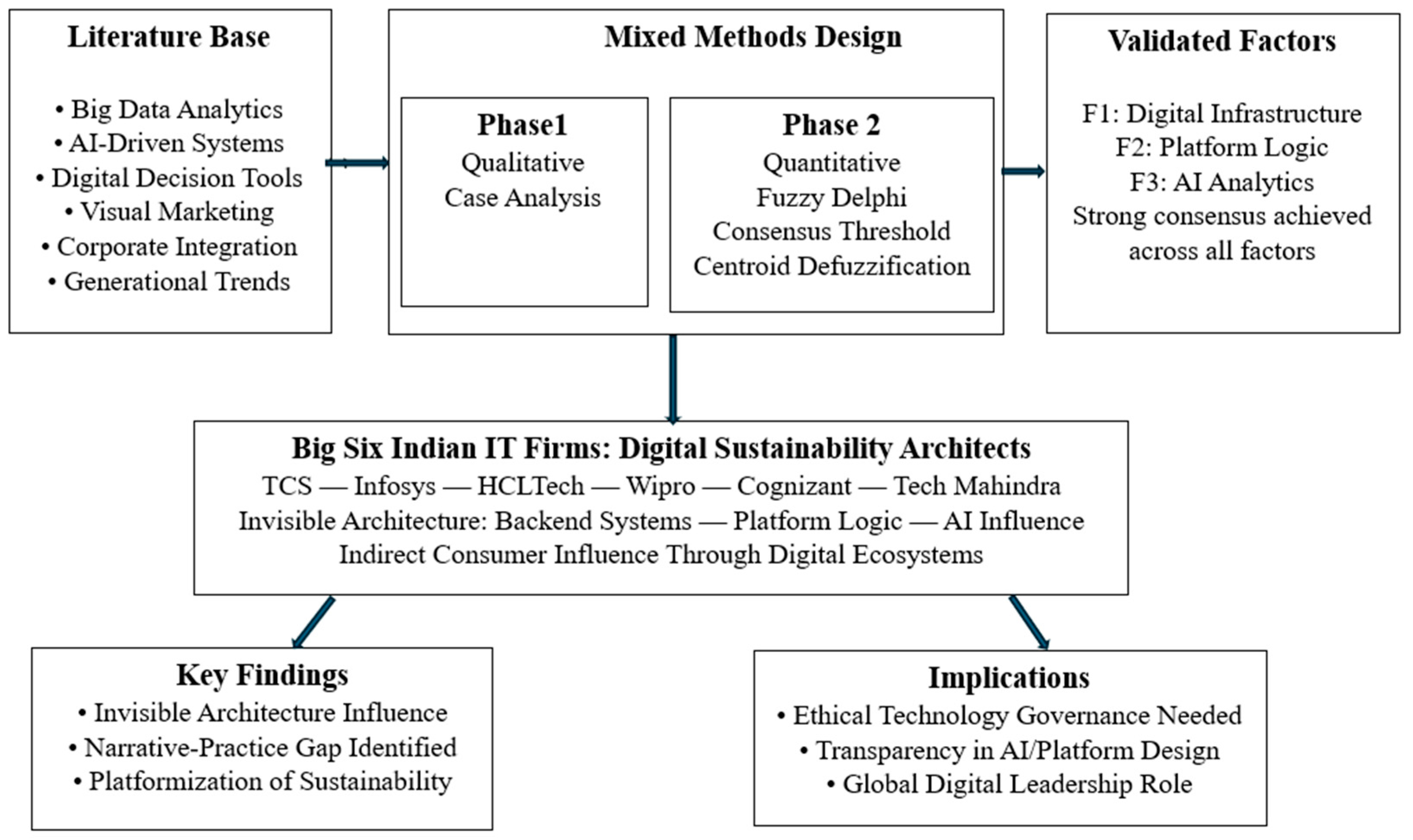
- Digital Enablers, Not Direct Influencers: These organizations do not have direct connection with customers, but rather an indirect effect on consumption through platforms, algorithms, and enterprise systems. As stated in the concept of “invisible architecture”, sustainability technology underscores a structural approach to shaping customer behavior; hence, they align (RQ1, RQ2).
- Technology Systems as Ethical Intermediaries: This positioning is evident from usage of tools like ESG dashboards, AI-driven suggestions, and gamified sustainability apps that help people make ethical choices. They highlight the role of technology in helping people make ethical choices based on digital behavioral nudges (RQ2).
- Sustainability Discourse vs. Practice: There is a major difference between the ground reality of ESG, real platform-level features, and discussion about it backed by sustainability reports. This raises lots of questions and makes people wonder about authenticity, greenwashing, and strategic branding (RQ3).
- Internal Culture as a Strategic Lever: Business culture improves external sustainability outcomes via means like intranet CSR initiatives, staff engagement, and intergenerational educational programs. These impact society along with its stakeholders.
- Phantomization of Sustainability: To promote sustainability, digital technologies like artificial intelligence, the Internet of Things, and cloud infrastructure are being used. This shows the positioning of sustainability projects at the supply chain and ecosystem levels.
3.5. Fuzzy Delphi Analysis
Factor Validation and Consensus Development
4. Discussion
5. Conclusions
Author Contributions
Funding
Institutional Review Board Statement
Informed Consent Statement
Data Availability Statement
Acknowledgments
Conflicts of Interest
References
- Singh, N. Information Technology and Its Role in India’s Economic Development: A Review; Working Paperm, No. 718; University of California, Economics Department: Santa Cruz, CA, USA, 2015. [Google Scholar]
- Bansal, P. India’s Digital Transformation: Opportunities and Challenges in the Digital Economy. Int. J. Econ. Policy 2024, 4, 53–57. [Google Scholar] [CrossRef] [Scilit]
- Swargiary, K. Digital Transformation on Economic Growth in India: A Study of the Post-Pandemic India: A Comprehensive Study. Available online: https://www.researchsquare.com/article/rs-3464759/v2 (accessed on 1 September 2025).
- Gupta, K.; Pandey, R. Emerging Design Trends in Social Media and Its Impact on Business Efficiency and Growth in India. Shodhkosh J. Vis. Perform. Arts 2023, 4, 1–7. [Google Scholar] [CrossRef] [Scilit]
- Kumar, K.; Prakash, A. Examination of Sustainability Reporting Practices in Indian Banking Sector. Asian J. Sustain. Soc. Responsib. 2019, 4, 2. [Google Scholar] [CrossRef] [Scilit]
- Guo, L.; Zhang, B.; Zhao, X. A Consumer Behavior Prediction Model Based on Multivariate Real-Time Sequence Analysis. Math. Probl. Eng. 2021, 2021, 6688750. [Google Scholar] [CrossRef] [Scilit]
- Fozooni, A.; Nazari, S.; Jamalpur, A. Prioritizing Big Data Applications in E-Commerce Considering Sustainable Development Indicators. J. Future Sustain. 2024, 4, 169–178. [Google Scholar] [CrossRef] [Scilit]
- Liao, F.; Han, T.; Yang, Y.; Jia, L.; Li, T. Design of a User Electricity Consumption Reminder System and Sensitivity Analysis of Credit Ratings Based on Big Data Analytics of Paper. In Proceedings of the Second International Conference on Big Data, Computational Intelligence, and Applications (BDCIA 2024), Huanggang, China, 15–17 November 2024; pp. 227–235. [Google Scholar]
- Yi, S.; Liu, X. Machine Learning Based Customer Sentiment Analysis for Recommending Shoppers, Shops Based on Customers’ Review. Complex Intell. Syst. 2020, 6, 621–634. [Google Scholar] [CrossRef] [Scilit]
- Khrais, L.T. Role of Artificial Intelligence in Shaping Consumer Demand in E-Commerce. Future Internet 2020, 12, 226. [Google Scholar] [CrossRef] [Scilit]
- Ismatullaev, U.V.U.; Kim, S.-H. Review of the Factors Affecting Acceptance of Ai-Infused Systems. Hum. Factors 2024, 66, 126–144. [Google Scholar] [CrossRef] [Scilit] [PubMed]
- Geddam, S.M.; Nethravathi, N.; Hussian, A.A. Understanding AI Adoption: The Mediating Role of Attitude in User Acceptance. J. Inform. Educ. Res. 2024, 4, 1664–1672. [Google Scholar]
- Lutfi, H.; Glasauer, S.; Spittler, T. The Healthcare Benefits and Impact of Artificial Intelligence Applications on Behaviour of Healthcare Users: A Structured Review of Primary Literature. J. Int. Soc. Telemed. Ehealth 2020, 8, e10. [Google Scholar] [CrossRef] [Scilit]
- Paracolli, A.; Arquilla, V. Ux Sustainability: An Overview on the Sustainability Dimension of Ai-Infused Objects Forming Product-Service Ecosystems. In Proceedings of the ServDes 2023 Entanglements and Flows Service Encounters and Meanings, Rio de Janeiro, Brazil, 11–14 July 2023; pp. 1319–1336. [Google Scholar]
- Kronemann, B.; Kizgin, H.; Rana, N.K.; Dwivedi, Y. How Ai Encourages Consumers to Share Their Secrets? The Role of Anthropomorphism, Personalisation, and Privacy Concerns and Avenues for Future Research. Span. J. Mark.-ESIC 2023, 27, 3–19. [Google Scholar] [CrossRef] [Scilit]
- Zannat, N.; Mahmud, M. Mindful Ux Design in Industry 4.0: Mitigating Addiction and Enhancing User Well-Being Insocial Media and Ai Environments. J. Inf. Syst. Digit. Technol. 2023, 5, 321–344. [Google Scholar] [CrossRef] [Scilit]
- Menard, P.; Bott, G.J. Artificial Intelligence Misuse and Concern for Information Privacy: New Construct Validation and Future Directions. Inf. Syst. J. 2025, 35, 322–367. [Google Scholar] [CrossRef] [Scilit]
- Rahwan, I.; Cebrian, M.; Obradovich, N.; Bongard, J.; Bonnefon, J.-F.; Breazeal, C.; Crandall, J.W.; Christakis, N.A.; Couzin, I.D.; Jackson, M.O. Machine Behaviour. Nature 2019, 568, 477–486. [Google Scholar] [CrossRef] [Scilit]
- Chauhan, K.D.S.; Anupriya. Darker Patterns? Ai-Generated Persuasion and the Regulatory Void in Indian Law. J. Dev. Policy Pract. 2025, 10, 80–95. [Google Scholar] [CrossRef] [Scilit]
- Harland, H.; Dazeley, R.; Nakisa, B.; Cruz, F.; Vamplew, P. Ai Apology: Interactive Multi-Objective Reinforcement Learning for Human-Aligned Ai. Neural Comput. Appl. 2023, 35, 16917–16930. [Google Scholar] [CrossRef] [Scilit]
- Liu, Q.; Trevisan, A.H.; Yang, M.; Mascarenhas, J. A Framework of Digital Technologies for the Circular Economy: Digital Functions and Mechanisms. Bus. Strategy Environ. 2022, 31, 2171–2192. [Google Scholar] [CrossRef] [Scilit]
- Muhammad, A.; Naidu, B.M.; Sundram, V.P.K.; Hussain, M.; Chew, L.L.; Amirrudin, F.A. Sustainable Waste Management in Malaysia: Leveraging Supply Chain Solutions for a Greener Future. Inf. Manag. Bus. Rev. 2023, 15, 147–154. [Google Scholar] [CrossRef] [Scilit] [PubMed]
- Bressanelli, G.; Perona, M.; Saccani, N. Challenges in Supply Chain Redesign for the Circular Economy: A Literature Review and a Multiple Case Study. Int. J. Prod. Res. 2019, 57, 7395–7422. [Google Scholar] [CrossRef] [Scilit]
- Amaleshwari, U.; Jeevitha, R. Adopting Digital Technology to Overcome Challenges of Circular Economy: A Case Study of Platform-Based Start-up in India. J. Manag. Public Policy 2023, 15, 30–43. [Google Scholar] [CrossRef] [Scilit]
- Martínez-Peláez, R.; Ochoa-Brust, A.; Rivera, S.; Félix, V.G.; Ostos, R.; Brito, H.; Félix, R.A.; Mena, L.J. Role of Digital Transformation for Achieving Sustainability: Mediated Role of Stakeholders, Key Capabilities, and Technology. Sustainability 2023, 15, 11221. [Google Scholar] [CrossRef] [Scilit]
- Cioffi, R.; Travaglioni, M.; Piscitelli, G.; Petrillo, A.; De Felice, F. Artificial Intelligence and Machine Learning Applications in Smart Production: Progress, Trends, and Directions. Sustainability 2020, 12, 492. [Google Scholar] [CrossRef] [Scilit]
- Huang, C.; Zhuang, S.; Li, Z.; Gao, J. Creating a Sincere Sustainable Brand: The Application of Aristotle’s Rhetorical Theory to Green Brand Storytelling. Front. Psychol. 2022, 13, 897281. [Google Scholar] [CrossRef] [Scilit]
- Pai, C.Y.; Young, K.Y.; Liska, L.I.; Laverie, D. I Know I Am Ugly, but Please Listen to My Story First: An Examination of How Storytelling Can Impact Consumers’ Valuation of Unattractive Produce. J. Consum. Behav. 2025, 24, 247–266. [Google Scholar] [CrossRef] [Scilit]
- Wei, C.F.; Chiang, C.T.; Kou, T.C.; Lee, B.C. Toward Sustainable Livelihoods: Investigating the Drivers of Purchase Behavior for Green Products. Bus. Strategy Environ. 2017, 26, 626–639. [Google Scholar] [CrossRef] [Scilit]
- Vilkaite-Vaitone, N. From Likes to Sustainability: How Social Media Influencers Are Changing the Way We Consume. Sustainability 2024, 16, 1393. [Google Scholar] [CrossRef] [Scilit]
- Ha, S.; Kwon, S. Spillover from Past Recycling to Green Apparel Shopping Behavior: The Role of Environmental Concern and Anticipated Guilt. Fash. Text. 2016, 3, 16. [Google Scholar] [CrossRef] [Scilit]
- Castro Santa, J.; Drews, S.; van den Bergh, J. Behavioral Spillovers from Green Purchases: Comparing Impacts on Consumption and Policy Support. Front. Behav. Econ. 2024, 2, 1283311. [Google Scholar] [CrossRef] [Scilit]
- Rachmawati, D.; Wijaya, H.; Pambreni, Y. Analysis of Digital Marketing and Green Marketing Strategies to Maintain Business Sustainability on Msmes Bandung Regency in Digital Era. J. Appl. Bus. Adm. 2023, 7, 237–244. [Google Scholar] [CrossRef] [Scilit]
- Arantes, L. Communicating sustainability: How brands can influence consumers’ purchasing decision. In Proceedings of the International Scientific Conference on Economics, Management and Information Technologies, Blace, Serbia, 21–23 September 2023; pp. 7–15. [Google Scholar] [CrossRef] [Scilit]
- Beulah, P.; Chitrakala, I. Consumer Perceptions and Attitudes Towards Sustainability: The Role of Influencers in Shaping Eco-Conscious Behavior. Int. J. Multidiscip. Res. 2024, 5, 1–9. [Google Scholar]
- Taoketao, E.; Feng, T.; Song, Y.; Nie, Y. Does Sustainability Marketing Strategy Achieve Payback Profits? A Signaling Theory Perspective. Corp. Soc. Responsib. Environ. Manag. 2018, 25, 1039–1049. [Google Scholar] [CrossRef] [Scilit]
- Hayuningardi, B.M.D.A.P.; Najib, M.F.; Purnamasari, Y. Assessing the Millennials’ Intention Toward Green Fast Food Retail: The Use of the Theory of Planned Behavior. J. Mark. Innov. (JMI) 2024, 4, 107. [Google Scholar] [CrossRef] [Scilit]
- Zarei, G.; Mirzaei, K. Impact of Perceived Social Responsibility on Consumers’ Green Perception and Green Behavior: The Moderating Role of Personality Traits. J. Consum. Sci. 2022, 7, 169–189. [Google Scholar] [CrossRef] [Scilit]
- Nikolić, J.L.; Mirković, V.; Brkljač, M. Circular Economy and Banking Industry in the Digital Age: Case Study of Erste Bank Ad Novi Sad Cirkularna Ekonomija I Bankarska Industrija U Digitalnom Dobu: Studija Slučaja Erste Banke Ad Novi Sad. Ecologica 2023, 30, 157–164. [Google Scholar] [CrossRef] [Scilit]
- Jakonen, O.I. Smart Cities, Virtual Futures?–Interests of Urban Actors in Mediating Digital Technology and Urban Space in Tallinn, Estonia. Urban Stud. 2025, 62, 52–68. [Google Scholar] [CrossRef] [Scilit]
- Fernandez Lopez, T.; Schroeder, S. Gis for Sustainable Urban Transformation in Countries with Emerging Economies. Int. J. E-Plan. Res. IJEPR 2023, 12, 1–20. [Google Scholar] [CrossRef] [Scilit]
- Böttcher, T.P.; Empelmann, S.; Weking, J.; Hein, A.; Krcmar, H. Digital Sustainable Business Models: Using Digital Technology to Integrate Ecological Sustainability into the Core of Business Models. Inf. Syst. J. 2024, 34, 736–761. [Google Scholar] [CrossRef] [Scilit]


| Factor | Round 1 Fuzzy Mean | Round 1 SD | Round 2 Fuzzy Mean | Round 2 SD | Round 3 Fuzzy Mean | Round 3 SD | Final Consensus |
|---|---|---|---|---|---|---|---|
| F1: Digital Infrastructure | (0.65, 0.73, 0.81) | 0.18 | (0.73, 0.81, 0.89) | 0.12 | (0.78, 0.85, 0.91) | 0.09 | Strong |
| F2: AI-Enabled Analytics | (0.63, 0.71, 0.79) | 0.19 | (0.70, 0.78, 0.86) | 0.14 | (0.75, 0.83, 0.88) | 0.10 | Strong |
| F3: Platform Logic | (0.61, 0.69, 0.77) | 0.21 | (0.68, 0.76, 0.84) | 0.15 | (0.76, 0.84, 0.89) | 0.08 | Strong |
| F4: Internal Culture | (0.60, 0.68, 0.76) | 0.22 | (0.66, 0.74, 0.82) | 0.16 | (0.69, 0.78, 0.84) | 0.11 | Moderate |
| F5: Ethical Intermediaries | (0.64, 0.72, 0.80) | 0.20 | (0.71, 0.79, 0.87) | 0.13 | (0.74, 0.82, 0.87) | 0.09 | Strong |
| F6: Discourse Integration | (0.59, 0.67, 0.75) | 0.24 | (0.65, 0.73, 0.81) | 0.17 | (0.68, 0.77, 0.83) | 0.12 | Moderate |
| Rank | Factor | Triangular Fuzzy Weight | Defuzzified Score (Centroid) | Importance Level |
|---|---|---|---|---|
| 1 | F1: Digital Infrastructure for Sustainability | (0.78, 0.85, 0.91) | 0.847 | Very High |
| 2 | F3: Platform Logic for Behavioral Change | (0.76, 0.84, 0.89) | 0.831 | Very High |
| 3 | F2: AI-Enabled Analytics and Recommendations | (0.75, 0.83, 0.88) | 0.820 | High |
| 4 | F5: Technology Systems as Ethical Intermediaries | (0.74, 0.82, 0.87) | 0.810 | High |
| 5 | F4: Internal Culture as a Strategic Lever | (0.69, 0.78, 0.84) | 0.770 | High |
| 6 | F6: Sustainability Discourse Integration | (0.68, 0.77, 0.83) | 0.760 | Moderate |
Disclaimer/Publisher’s Note: The statements, opinions and data contained in all publications are solely those of the individual author(s) and contributor(s) and not of MDPI and/or the editor(s). MDPI and/or the editor(s) disclaim responsibility for any injury to people or property resulting from any ideas, methods, instructions or products referred to in the content. |
© 2025 by the authors. Licensee MDPI, Basel, Switzerland. This article is an open access article distributed under the terms and conditions of the Creative Commons Attribution (CC BY) license (https://creativecommons.org/licenses/by/4.0/).
Share and Cite
Singh, B.; Pandey, A.; Kakkar, T. Big Tech and the Sustainable Consumer Practices: A Critical Analysis Using a Mixed Methodology. Comput. Sci. Math. Forum 2025, 12, 2. https://doi.org/10.3390/cmsf2025012002
Singh B, Pandey A, Kakkar T. Big Tech and the Sustainable Consumer Practices: A Critical Analysis Using a Mixed Methodology. Computer Sciences & Mathematics Forum. 2025; 12(1):2. https://doi.org/10.3390/cmsf2025012002
Chicago/Turabian StyleSingh, Bharti, Anand Pandey, and Timsy Kakkar. 2025. "Big Tech and the Sustainable Consumer Practices: A Critical Analysis Using a Mixed Methodology" Computer Sciences & Mathematics Forum 12, no. 1: 2. https://doi.org/10.3390/cmsf2025012002
APA StyleSingh, B., Pandey, A., & Kakkar, T. (2025). Big Tech and the Sustainable Consumer Practices: A Critical Analysis Using a Mixed Methodology. Computer Sciences & Mathematics Forum, 12(1), 2. https://doi.org/10.3390/cmsf2025012002