1. Introduction
1.1. Overview of the Cybersecurity Landscape
Considering the continual growth in technology and the rise in new cyber threats, the field of cybersecurity has gone through major shifts in the past decade. Businesses in every field face a growing number of risks, including threats from insiders, nation-state-sponsored online spying, computer virus attacks, and data leaks. Businesses rely on technology and connected systems for processes, which has boosted the possibility of cyberattacks to their tasks and financial results. Effective security measures are currently needed in these circumstances, which is why businesses are taking proactive actions to safeguard their sensitive data and digital property [
1].
1.2. Definition and Importance of SIEM Tools
Given the power to manage and assess security event data in real-time, Security Information and Event Management (SIEM) methods are today critical components of a cybersecurity strategy. A single tool for collecting, integrating, contrasting, and analyzing log data generated from various sources, such as networks, servers, programs, and endpoints within a company’s IT infrastructure, is provided by SIEM solutions. SIEM solutions limit the duration of the period when risks remain operational and reduce the probable impact of attacks by using advanced data analysis and correlation methods to assist businesses in swiftly recognizing and solving security issues. SIEM systems also greatly help with risk intelligence improvement, legal compliance aid, and total safety position optimization [
2].
1.3. Purpose and Structure of the Study
This study aims to give an in-depth exploration of SIEM systems, containing an analysis of their key characteristics, advantages, implementation best practices, and difficulties. The present research seeks to explain the importance of SIEM solutions in helping businesses decrease dangers related to cyberattacks by examining how they work within the overall cybersecurity framework. It also explains all of the aspects of the SIEM systems, what they offer, and the ways they help with identifying threats, responses to incidents, and legal actions. This will further address difficulties related to setting up and maintaining SIEM solutions and offer relevant guidance and advice to businesses aiming to make the greatest value out of these systems.
2. Understanding SIEM Solutions
2.1. Definition and Core Functionalities
Under the cybersecurity design used by modern businesses, Security Information and Event Management (SIEM) services serve as vital pillars. Security event data surveillance, evaluation, and control are all centralized functions given by SIEM products. In simple terms, security incident tracking, examination, and handling involve centralized features offered by SIEM solutions. Logs from a wide range of resources in the IT environment of an organization, like networks, servers, apps, and devices, are gathered and collected for that reason. Expanded analytical methods used by SIEM solutions allow the detection of movements, problems, and potential incidents in security, helping businesses to easily identify and fix threats. Furthermore, SIEM solutions feature important benefits such as regulation tracking, incident handling planning, and warning, which make them essential tools in fighting against cyberattacks [
3].
2.2. Components of SIEM Solutions
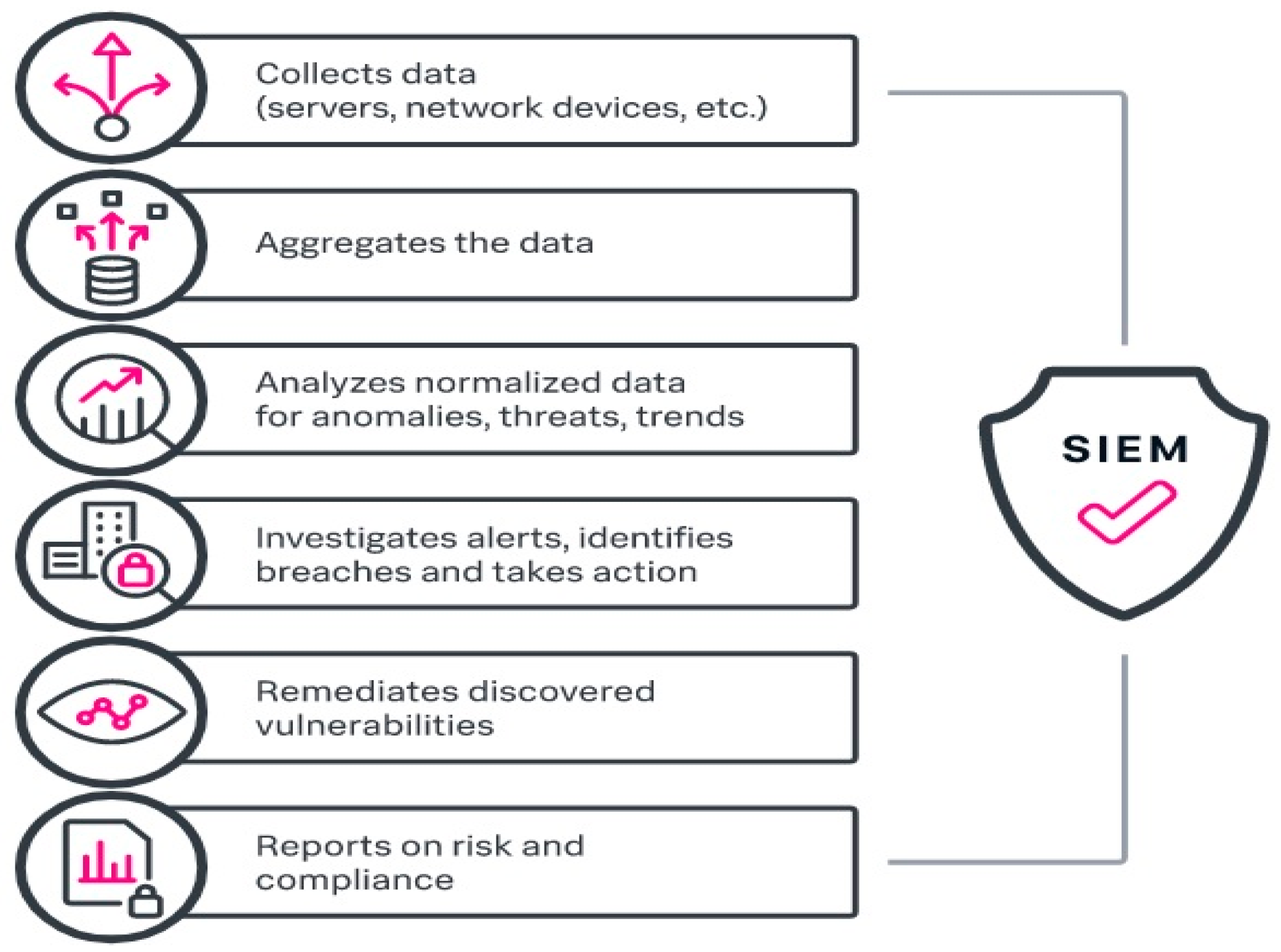
All of the parts of SIEM systems offer comprehensive security features. Security event logs from different places are collected by data-gathering agents and then aggregated in the SIEM’s log system for management. This system’s link generator aggregates the whole data for connections among possibly related events, facilitating early identification of advanced risks. A brief description of those components is provided in
Figure 1. Security analysts can later quickly track breaches, examine data, and plan responses to incidents with the support of simple dashboards and visualization skills provided by SIEM systems. Tracking and regulatory aspects are also included with SIEM solutions to aid in generating audit records, reviews, and legal reports [
4].
2.3. Types of Data if Collected and Analyzed
As a way to provide businesses with an extensive knowledge of their privacy posture, SIEM systems collect and analyze a broad range of data streams. Other than data from network traffic for detecting unusual action, it additionally includes log files from the system, uses, networks, and user activity logs. Similarly collected for enhanced warning abilities is gateway data, which includes data on user behavior, file integrity, and system activity. Utilizing user and object behavior analyses (UEBA) data and threat information feeds, SIEM systems additionally enhance threat identification abilities by augmenting security events. Businesses can use the entire potential of SIEM solutions to reinforce their cybersecurity defenses while lowering the dangers associated with cyberattacks by understanding the parts and data types concerned [
6].
3. Understanding SIEM Solutions
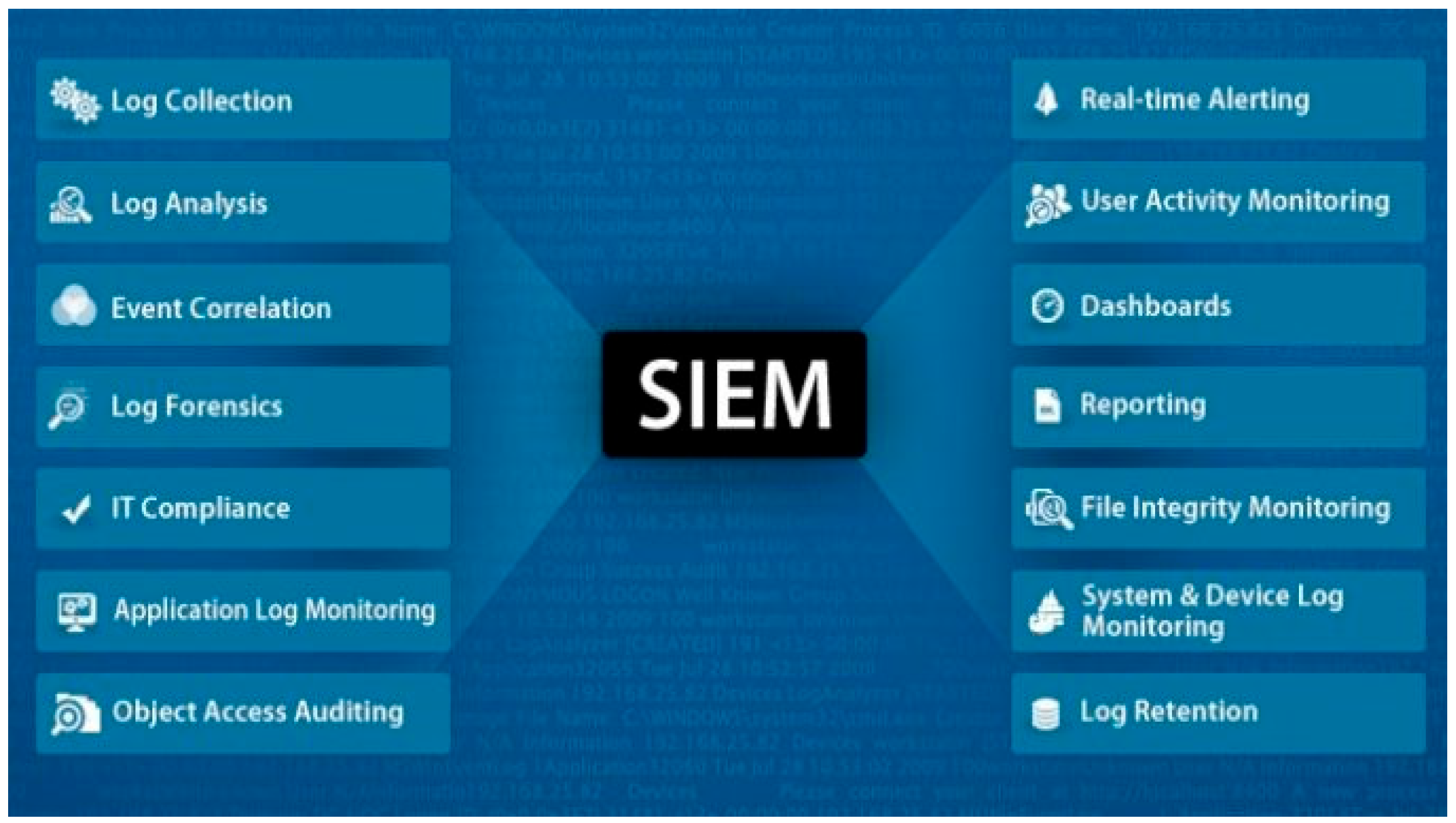
SIEM solutions capture logs from servers, networks, apps, and terminals via specific agents or interfaces and combine them into a single source. SIEM (Security Information and Event Management) solutions play a major part in establishing cybersecurity defenses in businesses by providing several features that are needed for the fast detection, examination, and handling of security risks. The easy collection and integration of logs from different locations in the IT systems of an organization is vital for SIEM activity. By providing an overview of their security incidents, businesses may better assess and respond to any potential risks owing to this single strategy. A brief description of those components is presented in
Figure 2.
The majority of SIEM solutions’ main advantages are real-time monitoring and notification, which allow businesses to dynamically recognize and deal with security incidents as they arise. With ongoing log data analysis, SIEM technologies might be utilized to identify abnormalities and unusual activity emerging within a network. Specific warning systems promise that security personnel get alerted faster as an alarm occurs, permitting immediate action and response. Businesses can mitigate the effects of security incidents and avoid any kind of data leakage or hacking due to these real-time monitoring skills. Combined with real-time monitoring and full accordance and analysis abilities, SIEM solutions share an environment for risks and permit systems to identify patterns, deviations, and potential risks throughout any number of data points through complex correlation methods. Furthermore, SIEM systems use complex analytics, like machine behavior and learning analytics, to find deviations from typical activity and detect new risks faster. Businesses can rapidly identify vulnerabilities and take proactive actions to prevent risks earlier than they develop by using SIEM systems, which relate events and examine data in real time. SIEM solutions additionally aid with handling incidents and management, regulation, and reporting, all of which are needed for effective cybersecurity management. After detecting security issues, these systems enable businesses to collaborate and manage incident-handling activities. The systems simplify emergency response processes and ensure fast risk mitigation through established reaction steps and processes. Also, SIEM systems give robust analytics and regulatory abilities. They generate visualizations, records of audits, and compliance records demonstrating that security standards and regulations have been fulfilled. With the guidance of this broad functionality collection, businesses may mitigate the risks linked to new cyber threats while preserving a strong cybersecurity attitude [
8,
9].
4. Benefits of Implementing SIEM Solutions
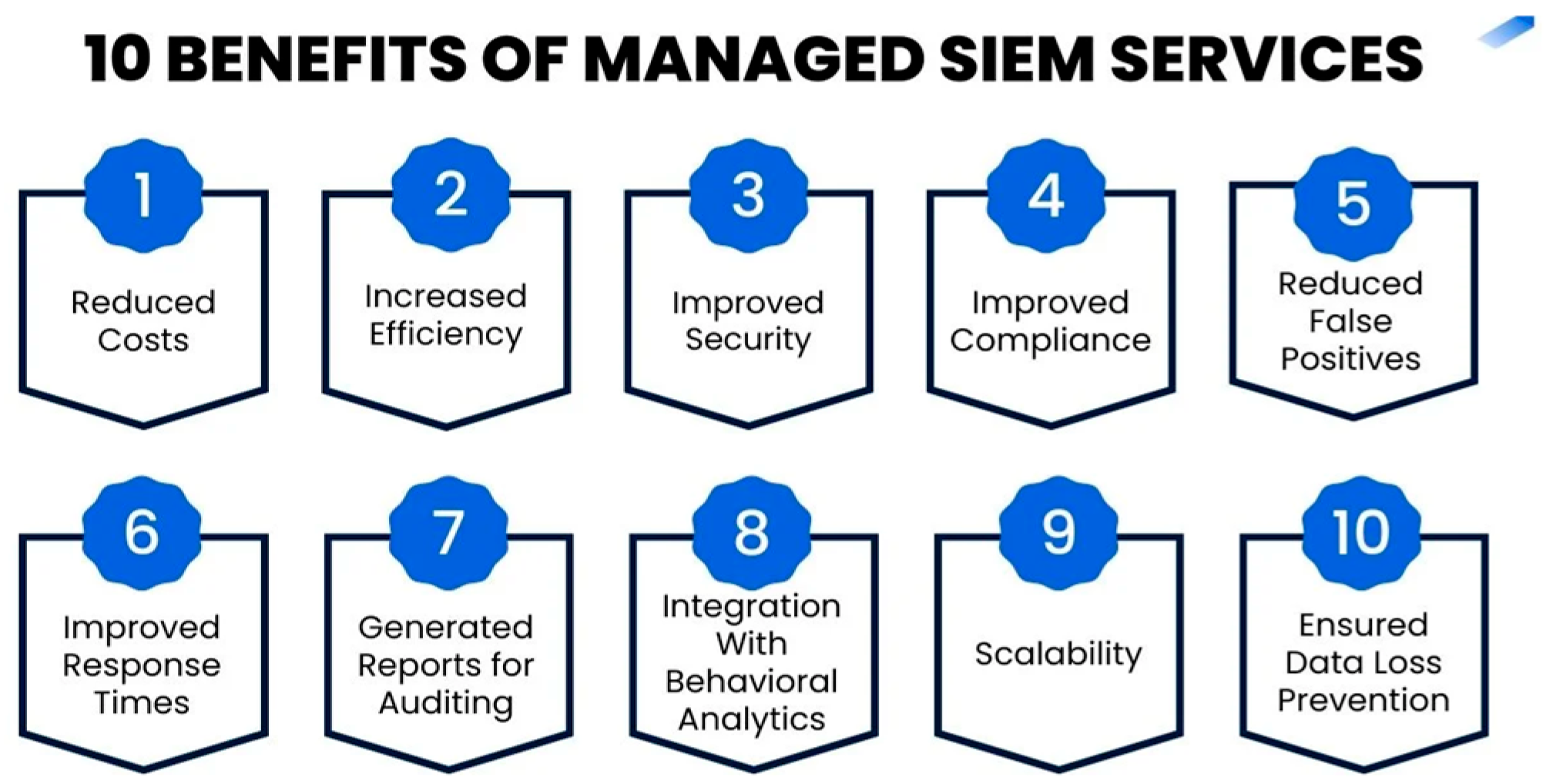
Adopting Security Information and Event Management (SIEM) systems gives businesses that are interested in strengthening their cybersecurity systems several benefits. A brief description of the top 10 benefits is provided in
Figure 3. Initially, by providing real-time monitoring and analysis of security incidents, SIEM systems enhance the abilities of risk identification and mitigation.
By performing the integration and analysis of data across multiple locations within the information technology (IT) system of the business, SIEM solutions provide rapid detection of suspicious activity and potential security risks. The speed of identifying threats is further enhanced by complex correlation methods and behavioral analysis computations, which allow businesses to proactively minimize threats and prevent any data breaches or system intrusions. Maintaining the security of business processes and preserving sensitive data is rendered feasible by this active method of identifying threats. Also, by assisting businesses to swiftly and effectively recognize and handle threats, SIEM systems enhance response to incident durations. When security incidents occur, authorities are immediately notified via real-time monitoring and alerting methods, which accelerates the analysis and review. Solutions provide predetermined response options and automatic coordination characteristics that simplify incident handling activities. The solutions help businesses reduce the consequences of hacking attempts and minimize time by using automated reactive methods while giving relevant data. In case of an attack, our preventive incident management approach ensures business continuity while improving defenses against cyber assaults. Additionally, by giving robust compliance monitoring and reporting characteristics, SIEM systems guide businesses to follow rules. Businesses must show that they follow business standards and guidelines, as regulations become harder to follow. Moreover, by providing excellent compliance tracking and reporting attributes, SIEM systems assist businesses in complying with regulatory standards. Businesses must demonstrate that they meet business standards and regulations, as they become increasingly strict when systems generate visualizations, monitoring logs, and reports of compliance demonstrating adherence to security policies and regulations. Finally, these guarantee that businesses maintain the trust of customers, coworkers, and other involved parties while securing personal data and minimizing legal costs [
11].
5. Challenges in Implementing SIEM Solutions
Interested businesses that want to improve their cybersecurity barriers are experiencing several challenges when utilizing Security Information and Event Management (SIEM) solutions. Initially, this presents an enormous barrier caused by the installation and operational difficulty. A lot of thought and technical expertise are required for SIEM solutions to be installed properly within a business’s IT architecture. Network architecture, guidelines for security, and data sources demand to be fully understood to configure the SIEM system for gathering and analyzing data from different sources. Public datasets from trustworthy sources, such as worldwide medical databases, medical agencies, and academic organizations, provide significant information for research and replication. Such databases could include information regarding demographics, health diagnoses, outcomes from therapy, and anonymized medical records. The findings of the research are open and reliable, as datasets that are publicly accessible were utilized. These independent sources present helpful perspectives on practical uses of privacy-preserving technologies [
12,
13] and a better understanding of the challenges that are faced in health data management. With the combination of qualitative and quantitative data from multiple sources, the study intends to offer an in-depth and insightful examination of the enhanced Shiny Anonymizer’s effectiveness in fixing concerns about privacy in the management of health data [
14,
15].
In addition, challenges with integrating data offer major obstacles to the implementation of SIEM. Integrating data from numerous places in the company’s IT infrastructure, like networks, computers, programs, and devices, is important for SIEM systems. However, it may be challenging to connect data from numerous places, particularly in complex and varied IT environments. Difficulties with data organization, connectivity, and accuracy may arise and delay the integration procedure. To get past these challenges, thorough preparation, input from stakeholders, and the utilization of adapters and other tools for speeding up the process of normalization and data input operations are all required. By overcoming these challenges, businesses might fully employ SIEM solutions to strengthen their cybersecurity boundaries and mitigate risks linked to cyberattacks [
16,
17]. Major challenges to SIEM popularity are also caused by the integration of data issues. Network equipment, computers, mobile apps, and terminals include only some of the technical elements that help SIEM systems obtain data from several sources. However, it can be challenging to integrate data from lots of places, particularly in difficult and heterogeneous IT environments. Concerns with standardized data, consistency, and overall quality may arise and delay the installation procedure. To conquer these challenges, careful preparation, input from stakeholders, and the utilization of adapters and tools for speeding up standardization of data intake procedures are all required. By conquering these challenges, businesses may fully utilize SIEM solutions to reinforce their cybersecurity barriers and reduce the dangers linked to cyberattacks [
18].
6. Best Practices for SIEM Implementation
After integrating SIEM, businesses ought to define particular objectives and goals associated with their business objectives and cybersecurity policy. This means finding exactly the specific security issues or laws that the SIEM solution aims to deal with. Understanding certain security issues or laws that the SIEM solution aims to resolve constitutes an element of this process. Businesses must choose use cases and regulations that are important for completing their goals through a full risk analysis. Businesses can be confident that SIEM use is in compliance with their business goals and produces measurements by establishing precise goals and making suitable plans. By giving security teams the right skills, businesses could benefit from the use of the SIEM platform and enhance their ability to recognize and manage security risks effectively.
The selection of staff and team training is important for an effective SIEM deployment. Businesses have to allocate expenses, employees, and assets properly to be able to promote the implementation and utilization of the SIEM system. It is essential to keep the right people and skills to efficiently guide and sustain the SIEM platform. To be able to ensure the usefulness of the SIEM system, security officers have to participate in full education programs. Education requires to involve an extensive array of SIEM setup, architecture, execution, and handling of incident subjects. Businesses can use the SIEM platform to their benefit to strengthen their ability to identify and tackle security risks by educating security professionals with the necessary skills.
For SIEM usage to be beneficial over a long time, continuous monitoring and adjustment are required. To constantly assess the success of the SIEM system, businesses need to set up robust reporting methods and metrics. Regular analyses and inspections help with identifying points requiring expansion and swiftly fixing all issues. Additionally, businesses must stay aware of new risks, weaknesses, and revisions in rules, and change their SIEM installations and programs properly. Businesses can continue complying with security demands and hold benefits in cybersecurity risk management by taking a proactive strategy to address and update their SIEM system.
7. Explain How Businesses Should Access SIEM Solutions Based on Their Unique Needs
A detailed review of many different types of factors is required when choosing a Security Information and Event Management (SIEM) solution fitted to a business’s specific needs. Firstly, businesses will evaluate the state of their infrastructure, considering the number and types of data generated, the broad range of devices, and the complex nature of their computer network design. This evaluation helps in determining the suitability and flexibility demands for the chosen SIEM system. It is extremely important to take specific businesses’ standards seriously since businesses, including finance and healthcare, possess strict privacy regulations that need particular SIEM abilities [
19].
After the establishment of the basic factors, businesses should order the characteristics according to their ability to meet their privacy and business objectives. As an example, businesses with a distributed staff can give priority to cloud-based SIEM solutions that offer remote monitoring. Similarly, businesses that manage sensitive data may give attention to functionality such as real-time warning and enhanced threat detection. Additionally, analyzing the business’s reputation for immediate assistance, ongoing maintenance, and changes is important to ensuring SIEM solutions for long-term functionality [
20].
Businesses use their scoring system to determine significant factors when considering SIEM systems such as Splunk Technology, LogRhythm, and SolarWinds. Scalability is an important factor, and Splunk Technology dominates this category, having a score of five owing to its solid ability to handle several data volumes. LogRhythm follows close by with a score of four, while SolarWinds finishes last at three. One important factor is compliance with the present system. LogRhythm scores a perfect five, showing perfect integration abilities. Splunk Technology and SolarWinds score four and three, respectively, showing excellent but slightly poor compliance [
21].
Guidance for legal compliance is necessary for businesses in regulated sectors [
22]. In this group, LogRhythm receives a perfect score of five, showing its significant compliance abilities. Splunk Technology and SolarWinds, on the other hand, earn scores of four and three, respectively, showing their crucial but less emphasis on compliance features. Having an ideal rating of five, LogRhythm guides this group with its great compliance abilities. But Splunk Technology and SolarWinds have scores of four and three, each, demonstrating that they concentrate a major but smaller attention on compliance requirements. LogRhythm gained a perfect score of five for specific industry attributes, closely matched by Splunk Technology at four and SolarWinds at three. It shows that these businesses are different in the way they focus on reaching specific industry demands. Focusing on industry characteristics is important for meeting the needs of a variety of businesses.
Also, providing an extended scoring table to ensure a greater number of criteria can be utilized to evaluate the SIEM vendors previously mentioned. Businesses assessing these choices for their security and log management needs may find this table helpful in making decisions because it displays a clear comparison of the criteria, ratings, and total scores for every option. Splunk Enterprise, IBM QRadar, LogRhythm, McAfee ESM, and SolarWinds SEM are evaluated, and the findings demonstrate clear benefits and drawbacks in a variety of areas. When Splunk Enterprise, IBM QRadar, LogRhythm, McAfee ESM, and SolarWinds SEM are evaluated, numerous advantages and disadvantages are displayed for each of them along a range of factors [
23]. Because of its outstanding ratings across all of the evaluated criteria, especially in Vendor Reputation, Deployment Options, Scalability, Threat Detection, and Integration with Other Security Tools, Splunk Business appears as the best performer, achieving an overall average of 51. Just a few places behind, LogRhythm shows solid results, ranking well in Threat Detection, Customization, and Flexibility, earning a final score of 48. With an overall lower rating of 42, IBM QRadar remains an excellent rival, with specific advantages in Scalability and Configuration Options. Meanwhile, SolarWinds SEM and McAfee ESM score 45 and 38, respectively, below all of them. McAfee ESM issues in Scalability and Ease of Use, while SolarWinds SEM struggles in Threat Detection.
In summary, Splunk Enterprise [
24] is perhaps the top choice for businesses that require complete privacy and management of log solutions, closely surpassed by LogRhythm [
25] and IBM QRadar [
26]. Even though McAfee ESM [
11] and SolarWinds SEM [
27] have lower ratings in a variety of variables, likely, they likely do not meet the requirements of businesses with higher security and management of log rules. The choice among these options ought to be determined by the desired balance between features and accessibility, financial limitations, and particular business goals.
Comparable scores for every criterion for all SIEM systems show evaluation consistency, as presented in both
Table 1 and
Table 2. With the addition of the calculation of the Total Score, the second table provides a more comprehensive evaluation overall.
8. Case Studies and Examples
We examine real-world examples in this part to emphasize the challenges and advantageous purposes of Security Information and Event Management (SIEM) systems. Also, we show how businesses use SIEM solutions to effectively enhance their cybersecurity defenses by presenting case studies involving effective installations. On the other hand, we discuss the lessons that can be gained from failed SIEM executions, showing typical errors and challenges that businesses face. Moreover, real-world scenarios provide specific examples of the benefits and drawbacks linked with SIEM systems, providing useful data for businesses handling the complexities of cybersecurity methods [
29,
30].
8.1. Successful SIEM Implementation
Businesses can nicely enhance their cybersecurity strategy by using SIEM solutions, as shown by effective deployments. To gather and analyze security event data from its global network design, for instance, an international retail business created an SIEM solution. The business has managed to enhance its risk detection abilities and minimize responses to incidents by using advanced analytics and real-time monitoring. In the end, the business was able to protect client data and uphold operational resilience [
31,
32].
8.2. Real-World Scenarios Showing Benefits and Challenges
Businesses can gain much from the typical issues and challenges faced by not implementing SIEM. Because of poor preparation and allocation of resources, for example, a local healthcare provider’s SIEM implementation crashed. The business needed the knowledge and experience to effectively set up and manage the SIEM system, as it underestimated how challenging the deployment process would be. The importance of careful planning, proper allocation of resources, and expertise in ensuring the success of SIEM installations is demonstrated by this collection. Businesses may enhance the probability of utilizing SIEM properly by preventing similar errors by taking lessons from experience. Implementation challenges and alerting fatigue were some of the issues noticed all over the installation procedure, regardless of whether the SIEM system provided enhanced visibility and alerting abilities. The business handled the complexities of SIEM execution and enjoyed all of the benefits of the system by solving such problems via planned strategy and ongoing enhancement efforts. To overcome barriers and enhance the success of SIEM installations, such situations show the importance of early leadership and flexibility [
33].
9. Future Trends and Developments
Considering the development of cybersecurity strategies being affected by new technologies and increasing Cybersecurity Landscapes, Security Information and Event Management (SIEM) Solutions will probably see important changes in the future. Businesses deal with greater complexity of security challenges in this rapidly evolving digital era, requiring continual creativity and flexibility in security policies. In this section, we delve into the emerging technologies that affect the development of SIEM solutions, new functions of SIEM platforms, and estimations regarding their position in cybersecurity strategies. Businesses deal with greater complex security challenges in this rapidly evolving digital era, requiring continual creativity and flexibility in security policies. This section explores the impact of emerging technologies on the advancement of SIEM solutions, the novel functionalities introduced by SIEM platforms, and assessments of their significance in cybersecurity strategies.
9.1. Emerging Technologies Influencing SIEM Solutions
The fast growth of Security Information and Event Management (SIEM) systems may be attributed to the emergence of technologies that improve monitoring, response capabilities, and adaptability. To enhance the detection of anomalies and data analytics, Artificial Intelligence (AI) and Machine Learning (ML) algorithms will be included in SIEM platforms on a growing basis. Despite the use of these technologies, SIEM systems may handle huge quantities of data, find small changes that might reveal risks to security, and adapt to new attacks. Moreover, impacting SIEM systems’ abilities to collect, study, and analyze data from multiple sources in distributed environments is going to be the growing popularity of cloud computing, Internet of Things (IoT) devices, and edge computing designs [
34,
35].
9.2. Evolution of SIEM Functionalities
Having an aim of simplifying security processes and accelerating emergency response periods, SIEM capacity is growing with a focus on enhancing technology, automation, and integrating skills. A huge number of automated procedures will soon be included in SIEM platforms, helping businesses respond quickly and effectively to security issues. In addition, end-to-end incident handling procedures, from monitoring to restoration, will be simplified by interaction with automation systems and security orchestration, automation, and response (SOAR) solutions. Further, by linking with threat intelligence feeds, risk management systems, and behavior analytics platforms, SIEM solutions are going to offer enhanced insight and perspective into security incidents [
36].
9.3. Predictions for the Future of SIEM in Cybersecurity
Greater utilization of AI and ML for detection and reaction to threats, more emphasis on user and object behavioral analytics (UEBA), and greater adoption of cloud-native SIEM systems are among the key characteristics of SIEM in cybersecurity moving ahead. Businesses are going to be able to flexibly develop their defenses and meet new business requirements with the support of cloud-native SIEM solutions. SIEM systems will soon be able to recognize and respond to complicated risks immediately, since they recognize the significant role that AI and ML will have in enhancing the skills of data analysts. Also, unauthorized access, anomalous user conduct, and account violations will all need UEBA abilities, which are going to increase in popularity. As security concerns change, SIEM solutions will also, in entirety, need to develop to help businesses successfully defend against advanced cyberattacks [
37].
10. Conclusions
Current cybersecurity strategies have to involve Security Information and Event Management (SIEM) systems, which offer businesses the ability to successfully detect, assess, and manage security incidents. This comprehensive analysis elucidates the significant role that Security Information and Event Management (SIEM) systems play in bolstering cybersecurity defenses. The primary findings indicate that Security Information and Event Management (SIEM) systems provide centralized services that enable the continuous monitoring and intelligent identification of potential threats. This is achieved by gathering, evaluating, and adjusting to security events originating from diverse sources. The ability of an accurate SIEM installation to enhance incident handling, risk recognition, and regulations compliance, finally securing confidential data and maintaining business resilience, underlines the importance of this deployment. To fully enjoy the advantages of SIEM systems, firms must address obstacles such as the intricacy of implementation and the continuous need for training. However, organizations have the potential to improve the effectiveness of their Security Information and Event Management (SIEM) implementations and fortify their cybersecurity measures by implementing optimal strategies, including the establishment of precise goals, efficient resource management, and comprehensive staff training. In summary, firms aiming to improve their cybersecurity stance and mitigate the risks associated with emerging cyber threats must allocate resources towards a robust SIEM installation.
Author Contributions
Conceptualization, M.V. (Marios Vardalachakis), M.V. (Manos Vasilakis), and M.T.; methodology, M.V. (Marios Vardalachakis), M.V. (Manos Vasilakis), and M.T.; writing—original draft preparation, M.V. (Marios Vardalachakis), M.V. (Manos Vasilakis); writing—review and editing, M.V. (Marios Vardalachakis), M.V. (Manos Vasilakis), and M.T. All authors have read and agreed to the published version of the manuscript.
Funding
This research received no external funding.
Institutional Review Board Statement
Not applicable.
Informed Consent Statement
Not applicable.
Data Availability Statement
Data sharing is not applicable to this article.
Conflicts of Interest
The authors declare no conflict of interest.
References
- González-Granadillo, G.; González-Zarzosa, S.; Diaz, R. Security Information and Event Management (SIEM): Analysis, Trends, and Usage in Critical Infrastructures. Sensors 2021, 21, 4759. [Google Scholar] [CrossRef] [Scilit] [PubMed]
- Ünal, U.; Kahya, C.N.; Kurtlutepe, Y.; Dağ, H. Investigation of Cyber Situation Awareness via SIEM Tools: A Constructive Review. In Proceedings of the IEEE International Conference on Computer Science and Engineering (UBMK 2021), Ankara, Turkey, 15–18 September 2021; IEEE: Piscataway, NJ, USA, 2021; pp. 676–681. [Google Scholar]
- Mokalled, H.; Catelli, R.; Casola, V.; Debertol, D.; Meda, E.; Zunino, R. The Guidelines to Adopt an Applicable SIEM Solution. In Proceedings of the AEIT International Annual Conference (AEIT 2020), Catania, Italy, 23–25 September 2020; IEEE: Piscataway, NJ, USA, 2020; pp. 1–6. [Google Scholar]
- Sheeraz, M.; Paracha, M.A.; Haque, M.U.; Durad, M.H.; Mohsin, S.M.; Band, S.S.; Mosavi, A. Effective security monitoring using efficient SIEM architecture. Hum.-Centric Comput. Inf. Sci. 2023, 13, 1–18. [Google Scholar]
- Benefits of SIEM Tools. Available online: https://2wtech.com/benefits-of-siem-tools/ (accessed on 5 March 2025).
- Khaliq, S.; Tariq, Z.U.A.; Masood, A. Role of user and entity behaviour analytics in detecting insider attacks. In Proceedings of the IEEE International Conference on Cyber Warfare and Security (ICCWS 2020), Islamabad, Pakistan, 20–21 October 2020; pp. 1–6. [Google Scholar]
- SIEM Solutions. Available online: https://alconcysec.com/alconcysec_services/siem-solutions (accessed on 5 March 2025).
- Miloslavskaya, N. Analysis of SIEM Systems and their Usage in Security Operations and Security Intelligence Centers. In Biologically Inspired Cognitive Architectures (BICA) for Young Scientists; Springer: Cham, Switzerland, 2018; pp. 282–288. [Google Scholar]
- Karampidis, K.; Panagiotakis, S.; Vasilakis, M.; Markakis, E.; Papadourakis, G. Industrial CyberSecurity 4.0: Preparing the Operational Technicians for Industry 4.0. In Proceedings of the 2019 IEEE 24th International Workshop on Computer Aided Modeling and Design of Communication Links and Networks (CAMAD), Limassol, Cyprus, 11–13 September 2019; pp. 1–6. [Google Scholar]
- Top 10 Benefits of Managed SIEM Services. Available online: https://www.bitlyft.com/resources/top-10-benefits-of-managed-siem-services (accessed on 5 March 2025).
- Vielberth, M.; Pernul, G. A Security Information and Event Management Pattern. In Proceedings of the 12th Latin American Conference on Pattern Languages of Programs (SugarLoafPLoP 2018), Valparaíso, Chile, 20–23 November 2018; 12p. [Google Scholar]
- Vardalachakis, M.; Tampouratzis, M. Privacy Preservation in IoT: Anonymization Methods and Best Practices. In Proceedings of the 2024 5th International Conference on Communications, Information, Electronic and Energy Systems (CIEES), Veliko Tarnovo, Bulgaria, 20–22 November 2024; pp. 1–6. [Google Scholar]
- Vardalachakis, M.; Tampouratzis, M.; Papadakis, N.; Vasilakis, M. The Future of Privacy: A Review on AI’s Role in Shaping Data Security. In Proceedings of the 2024 5th International Conference in Electronic Engineering, Information Technology & Education (EEITE), Chania, Greece, 29–31 May 2024; pp. 1–8. [Google Scholar]
- Vardalachakis, M.; Tampouratzis, M.; Papadakis, N. ShinyAnonymizer Enhanced Version and Beyond: A Further Exploration of Privacy-Preserving Solutions in Health Data Management. Appl. Sci. 2024, 14, 6921. [Google Scholar] [CrossRef] [Scilit]
- Vardalachakis, M.; Kondylakis, H.; Tampouratzis, M.; Papadakis, N.; Mastorakis, N. Anonymization, Hashing and Data Encryption Techniques: A Comparative Case Study. In Proceedings of the 2023 International Conference on Applied Mathematics & Computer Science (ICAMCS), Lefkada Island, Greece, 8–10 August 2023; pp. 129–135. [Google Scholar]
- Karampidis, K.; Panagiotakis, S.; Vasilakis, M.; Tsironi Lamari, A.; Markakis, E.; Papadourakis, G. Digital Training for Cybersecurity in Industrial Fields via virtual labs and Capture-The-Flag challenges. In Proceedings of the 2023 32nd Annual Conference of the European Association for Education in Electrical and Information Engineering (EAEEIE), Eindhoven, The Netherlands, 14–16 June 2023; pp. 1–6. [Google Scholar]
- Karampidis, K.; Panagiotakis, S.; Vasilakis, M.; Markakis, E.; Papadourakis, G.; Escudeiro, N.; Santos, F.; Menica, A.; Goioaga, J. EP8-INCYS 4.0-training industrial operations technicians in cyber security. In Proceedings of the 2022 18th ERACON Congress & CAREER-EU Conference, Hybrid Event, Nicosia, Cyprus, 27 June–1 July 2022; p. 25. [Google Scholar]
- Cinque, M.; Cotroneo, D.; Pecchia, A. Challenges and directions in security information and event management (SIEM). In Proceedings of the ΙΕΕΕ International Symposium on Software Reliability Engineering Workshops (ISSREW 2018), Memphis, TN, USA, 15–18 October 2018; pp. 95–99. [Google Scholar]
- Mokalled, H.; Catelli, R.; Casola, V.; Debertol, D.; Meda, E.; Zunino, R. The Applicability of a SIEM Solution: Requirements and Evaluation. In Proceedings of the 2019 IEEE 28th International Conference on Enabling Technologies: Infrastructure for Collaborative Enterprises (WETICE), Naples, Italy, 12–14 June 2019; pp. 132–137. [Google Scholar]
- Tuyishime, E.; Balan, T.C.; Cotfas, P.A.; Cotfas, D.T.; Rekeraho, A. Enhancing Cloud Security-Proactive Threat Monitoring and Detection Using a SIEM-Based Approach. Appl. Sci. 2023, 13, 12359. [Google Scholar] [CrossRef] [Scilit]
- Bezas, K.; Filippidou, F. Comparative Analysis of Open-Source Security Information & Event Management Systems (SIEMs). Indones. J. Comput. Sci. 2023, 12, 443–468. [Google Scholar]
- Jangampeta, S.; Khambam, S.K.R. Impact of SIEM on Compliance: Achieving Security and Adherence Simultaneously. Turk. J. Comput. Math. Educ. 2020, 11, 1123–1126. [Google Scholar] [CrossRef] [Scilit]
- Nabil, M.; Soukainat, S.; Lakbabi, A.; Ghizlane, O. SIEM Selection Criteria for Efficient Contextual Security. In Proceedings of the IEEE International Symposium on Networks, Computers and Communications (ISNCC 2017), Marrakech, Morocco, 16–18 May 2017; pp. 1–6. [Google Scholar]
- Hristov, M.; Nenova, M.; Iliev, G.; Avresky, D. Integration of Splunk Enterprise SIEM for DDoS Attack Detection in IoT. In Proceedings of the IEEE 20th International Symposium on Network Computing and Applications (NCA), Cambridge, MA, USA, 13–15 September 2021; pp. 1–5. [Google Scholar]
- LogRhythm—The Security Intelligence Company. Available online: https://www.exabeam.com/platform/logrhythm-siem/ (accessed on 31 December 2025).
- Suskalo, D.; Moric, Z.; Redzepagic, J.; Regvart, D. Comparative Analysis of IBM Qradar and Wazuh for Security Information and Event Management. In Proceedings of the 34th DAAAM International Symposium, Vienna, Austria, 26–27 October 2023; Katalinic, B., Ed.; DAAAM International: Vienna, Austria, 2023; pp. 96–102. [Google Scholar]
- Martínez, J.; Durán, J.M. Software Supply Chain Attacks, a Threat to Global Cybersecurity: SolarWinds’ Case Study. Int. J. Saf. Secur. Eng. 2021, 11, 537–545. [Google Scholar] [CrossRef] [Scilit]
- A, A.; Achuthan, K. Threat Modeling and Threat Intelligence System for Cloud Using Splunk. In Proceedings of the 2022 10th International Symposium on Digital Forensics and Security (ISDFS), Istanbul, Turkey, 6–7 June 2022; pp. 1–6. [Google Scholar]
- Ahmad, A.; Maynard, S.B.; Desouza, K.C.; Kotsias, J.; Whitty, M.T.; Baskerville, R.L. How Can Organizations Develop Situation Awareness for Incident Response: A Case Study of Management Practice. Comput. Secur. 2021, 101, 102122. [Google Scholar] [CrossRef] [Scilit]
- Vasilakis, M.; Karampidis, K.; Tampouratzis, M.; Malamos, A.; Panagiotakis, S.; Papadourakis, G. Enhancing Industry 4.0 Cybersecurity Training through Cyber Range Platform. In Proceedings of the 2024 5th International Conference in Electronic Engineering, Information Technology & Education (EEITE), Chania, Greece, 29–31 May 2024; pp. 1–6. [Google Scholar]
- Neumann, P. Successful Implementation of the Security Information and Event Management (SIEM). Bachelor’s Thesis, University of Management and Technology (UMT), Arlington, VA, USA, 2016. Available online: https://www.academia.edu/46721036/Successful_implementation_of_the_Security_Information_and_Event_Management_SIEM (accessed on 31 December 2025).
- Vasilakis, M.; Karampidis, K.; Tampouratzis, M.; Malamos, A.; Panagiotakis, S.; Mastorakis, N. Copyright Protection on Electronic Books: Study and Design of a New Approach. In Proceedings of the 2023 International Conference on Applied Mathematics & Computer Science (ICAMCS), Lefkada Island, Greece, 8–10 August 2023; pp. 144–149. [Google Scholar]
- Gonçalves, E.D.A. Analysis of Implementation of a Security Information and Events Management (SIEM) System in Public Business Entities (PBE) Hospitals. Master’s Thesis, Centro Universitário de Brasília (UniCEUB), Brasília, Brazil, 2023. [Google Scholar]
- Pulyala, S.R.; Jangampet, V.D.; Desetty, A.G. Revolutionizing SIEM with ML-Driven Risk Assessment and Priorization. Int. J. Inf. Technol. 2023, 4, 55–62. [Google Scholar]
- Lauwers, B.; Karampidis, K.; Tampouratzis, M.; Vasilakis, M.; Papadourakis, G.; Mastorakis, N. A Comparative Study of Copy-Move Forgery Detection Techniques. In Proceedings of the 2023 International Conference on Applied Mathematics & Computer Science (ICAMCS), Lefkada Island, Greece, 8–10 August 2023; pp. 122–128. [Google Scholar]
- Frigård, J. Security Information and Event Management Systems Monitoring Automation Systems. Master’s Thesis, 2019. Available online: https://trepo.tuni.fi/handle/10024/117593 (accessed on 31 December 2025).
- Pulyala, S.R. The Future of SIEM in a Machine Learning-Driven Cybersecurity Landscape. Turk. J. Comput. Math. Educ. 2023, 14, 1309–1314. [Google Scholar] [CrossRef] [Scilit]
| Disclaimer/Publisher’s Note: The statements, opinions and data contained in all publications are solely those of the individual author(s) and contributor(s) and not of MDPI and/or the editor(s). MDPI and/or the editor(s) disclaim responsibility for any injury to people or property resulting from any ideas, methods, instructions or products referred to in the content. |
© 2026 by the authors. Licensee MDPI, Basel, Switzerland. This article is an open access article distributed under the terms and conditions of the Creative Commons Attribution (CC BY) license (https://creativecommons.org/licenses/by/4.0/).