1. Introduction
Urban flooding areas have emerged as a critical challenge for rapidly growing cities across the world, particularly in countries like India where urban expansion often outpaces the development of essential infrastructure. Bengaluru, the capital city of Karnataka, is one of the major IT hubs and has experienced a significant rise in flood incidents over the past decade. The Kodigehalli, Hebbal, and Nagavara regions are one of the most affected localities. These areas are classified by high population density, inadequate drainage infrastructure, encroachments on natural water bodies, and poor urban planning. Consequently, even a small rainfall leads to severe waterlogging, traffic jams, property damage, and an increase in the risk of waterborne diseases. Traditional flood management systems have proven insufficient in solving these issues due to their reactive nature and the lack of real-time data in response to these challenges; there is an urgent need for a proactive and technology-driven solution that can anticipate flooding events and enable swift response mechanisms. A smart flood alert and communication system that leverages the power of Internet of things, artificial intelligence, and cloud computing to provide real-time monitoring and predictive flood alerts [
1]. Unlike conventional flood control methods, the proposed system is designed to be preventive, community-oriented, and data-driven. By installing IOT sensors in flood areas such as storm water drains, lake perimeters, and roadways, the system continuously measures parameters like rainfall intensity, water levels, and flow rates. These data are transmitted to a central cloud platform for processing and analysis purposes. The AI models are deployed in the backend, using historical weather data, current meteorological inputs, and environmental patterns to assess flood risks [
2]. Advanced algorithms such as long short-term memory (LSTM) networks and random forest classifiers enable the system to predict flood-prone zones with high accuracy [
3]. Based on these predictions, automatic alerts are sent to related officials, including city authorities like BBMP (Bruhat Bengaluru Mahanagara Palike), BWSSB (Bangalore Water Supply and Sewerage Board), and local traffic control departments. This system also includes a mobile application that provides two-way communication between citizens and related disaster response teams. Residents can report incidents like waterlogging, view flood forecasts, and receive location-based emergency alerts directly on their smartphones via SMS, WhatsApp, or app notifications. In addition to technological features, this system promotes community engagement and prediction, though the public absence of citizen engagement in flood preparedness and reporting also hampers effective disaster teams. These challenges necessitate an intelligent, integrated, and technology-driven solution that can detect potential flood risks in real time, alert authorities and citizens proactively, and streamline emergency response operations. Such a robust system can also involve the local community to improve public awareness and create long-term infrastructure solutions that can enhance the city’s resilience to flooding. This paper addresses these challenges through the design and proposal of a smart flood alert and communication system tailored to the needs of Kodigehalli–Hebbal–Nagavara and potentially scalable to other flood-prone urban areas through workshops, mock drills, and digital awareness campaigns.
2. Related Work
Infrastructure elements such as intelligent streetlights with flood indicators, automated pumps, and AI-controlled drainage gates further enhance the effectiveness of this approach. The overarching goal is to transform the flood management paradigm from reactive relief to proactive resilience [
4]. This paper outlines the architecture, implementation strategy, and expected outcomes of the proposed system. A six-month pilot phase is planned to assess its real-world viability, with scalability options for broader deployment across Bengaluru and other flood-prone cities in India [
5]. By bridging the gap between smart technologies and urban planning, this initiative aims to create safe urban communities [
6]. Over the past few years, these areas have witnessed repeated instances of waterlogging and flash floods during the monsoon season, causing disruption to daily life [
7,
8]. The city’s study highlights further problems, and the situation shows that low-lying neighborhoods become natural basins for flood accumulation [
9]. The lack of real-time monitoring, predictive capabilities, and coordinated emergency response systems adds to the difficulty. LoRa is a wireless platform designed for greenhouse monitoring, providing reliable data on temperature, humidity, and soil moisture [
10]. LoRa is based on chirp spread spectrum modulation, which has low-power characteristics like FSK modulation and may be utilized for long-distance communications. The Internet of things (IoT) [
11,
12] is a system that connects various objects and technologies, reducing the need for human interaction. This facilitates the development of smart (or smarter) cities across the globe. The Internet of things has driven the creation of smart city systems for sustainable living, enhanced comfort, and productivity for inhabitants by hosting various technologies and enabling them to communicate with one another. The Internet of things for smart cities operates across a wide range of disciplines and depends on a variety of underlying technologies. The smartphone application not only functions as an alarm system, but also allows individuals to report local flooding or waterlogging problems using geo-tagged photographs and texts, as discussed in [
13,
14].
Table 1 below lists the rainfall in Bangalore City over the last three years along with the problems faced.
3. Proposed System
The Kodigehalli–Hebbal–Nagavara regions in Bengaluru have become increasingly vulnerable to urban flooding due to a confluence of infrastructural, environmental, and governance-related challenges. The root cause of this recurring problem lies in the cities’ insufficient and outdated drainage systems, which are unable to co-operate with the growing volume of storm water runoff produce by rapid urbanization and unregulated construction. One of the primary issues is the blocking of storm water drains due to poor maintenance and garbage dumping. Additionally, several lakes in the area, which have historically acted as a natural buffer against the flooding, have either been reduced in capacity or completely depleted, eliminating vital flood-absorbing zones. Currently, most flood alerts and responses are reactive, delayed, and inefficient, leading to traffic jams, property damage, displacement, power outages, and significant economic losses. The absence of citizen engagement in flood preparedness and reporting also hampers effective disaster teams. These challenges necessitate an intelligent, integrated, and technology-driven solution that can detect potential flood risks in real time, alert authorities and citizens proactively, and streamline emergency response operations. Such a robust system must also involve the local community, improve public awareness, and create long-term infrastructure solutions that enhance the city’s resilience to flooding. This paper addresses these challenges through the design and proposal of a smart flood alert and communication system tailored to the needs of Kodigehalli–Hebbal–Nagavara and potentially scalable to other flood-prone urban areas.
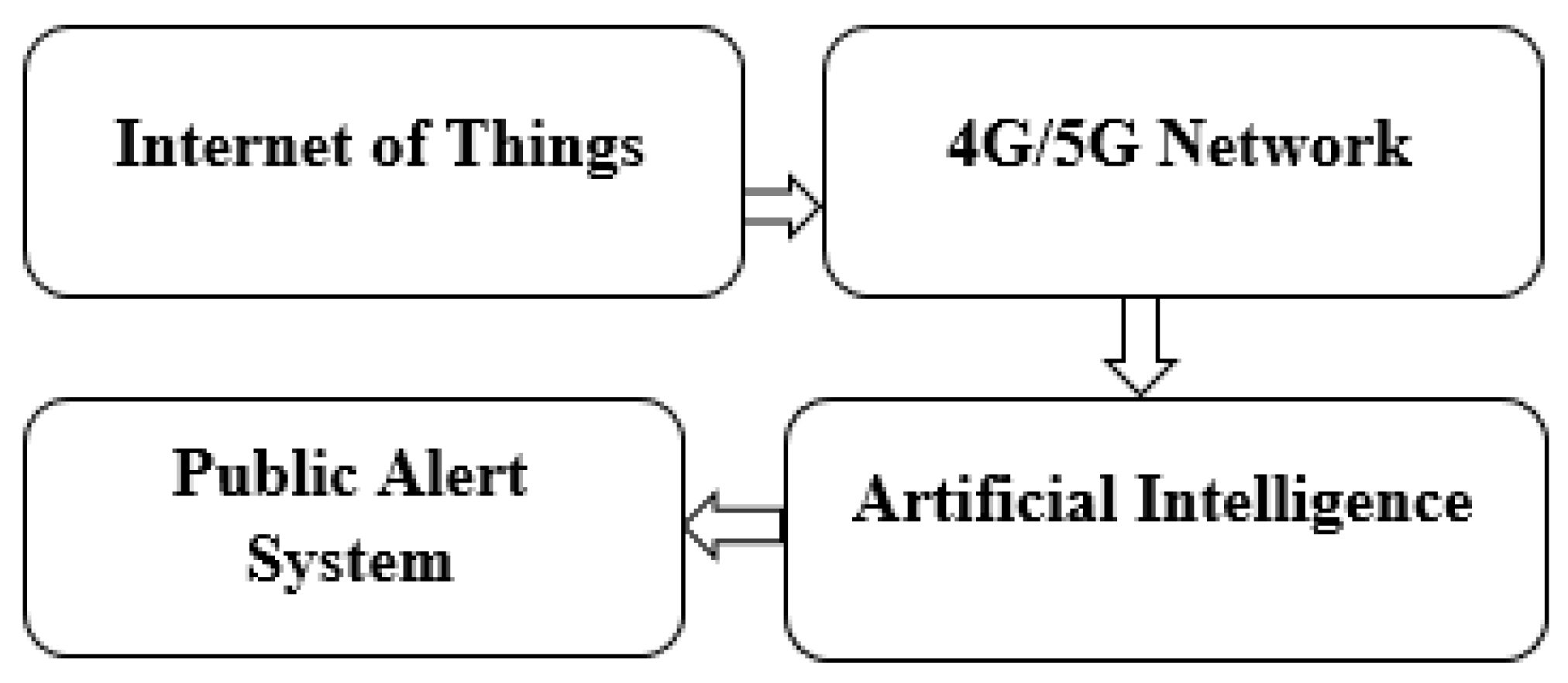
The technologies used to implement the proposed system are shown in
Figure 1, and they consist of the Internet of things, 4G/5G networks, and artificial intelligence.
4. Processing of Data
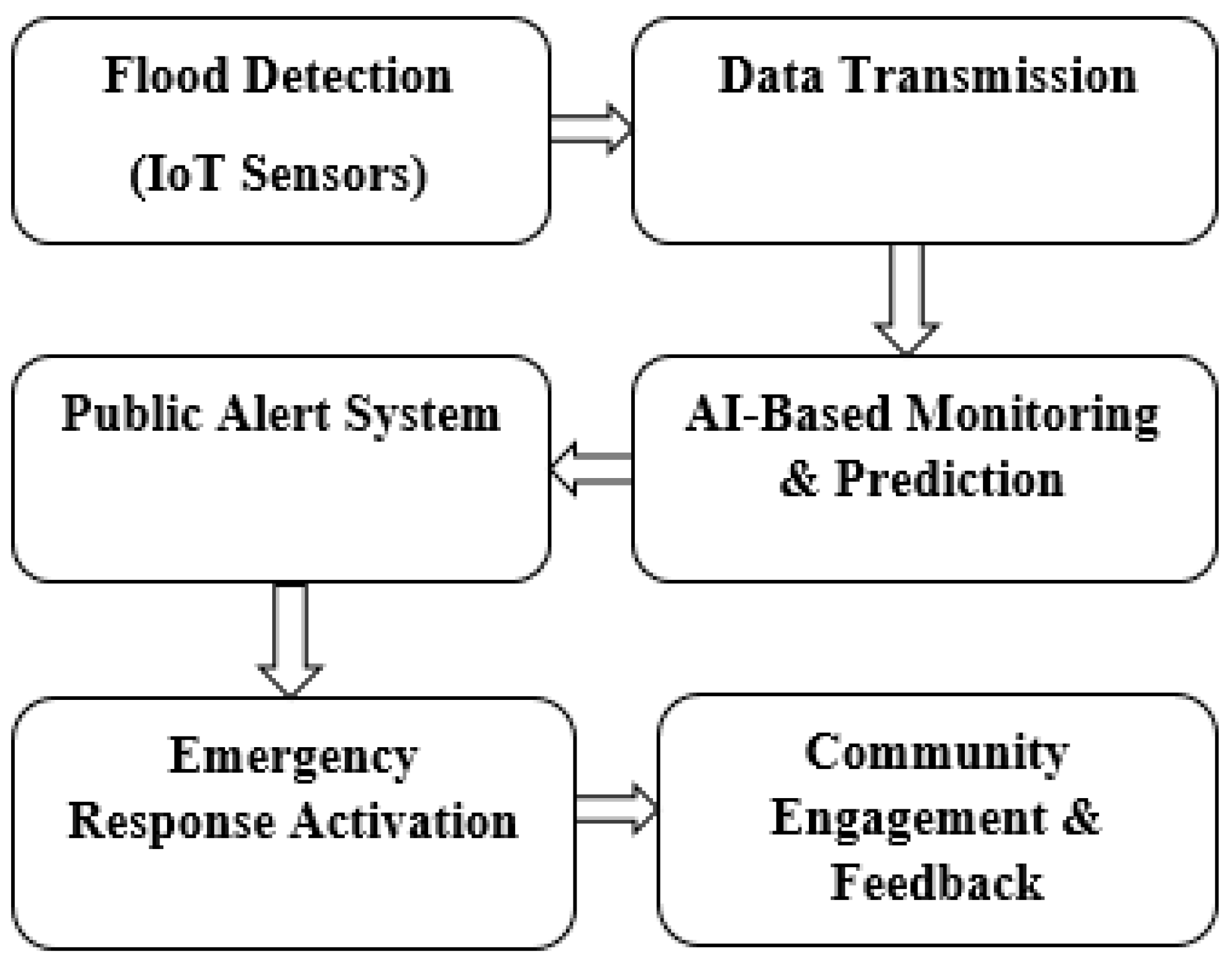
The processing of data of the proposed system is shown below in
Figure 2. The process comprises the following: Flood detection, in which sensors monitor rainfall, water levels, and floods and AI-powered CCTV cameras detect flooding. Data transmission, in which sensor data is sent via LoRA WAN, NB-IoT, or 4G/5G networks to a central system. A public alert system, in which authorities receive alerts for rapid action and AI suggests evacuation routes and adjusts traffic signals. AI-based monitoring and prediction, which analyzes data and predicts flood-prone areas, and alerts are generated based on severity levels. Emergency response activation, which receives alerts and deploys pumps and rescue teams.
Community engagement and feedback sends the citizens flooding reports via a mobile application.
5. Working of the System
The proposed solution is a smart flood alert and communication system designed to mitigate urban flooding in Kodigehalli, Hebbal, and Nagavara by utilizing a multi-layered technology framework. This system contains different types of IOT-based sensors and AI-based drive analytics, cloud computing infrastructures made to transform the flood response approach easily by using these tools. Hence, the flood detections take place by using different types of IOT-based detection units, like a Rain Guage, a Water Level Sensor, and Smart CCTV cameras, which are installed in flood zone areas. Mainly these sensors monitor parameters like rainfall intensity, drainage blockage, and water, and collected data is transmitted in real time via different types of communication networks, like local or wide-area networks, narrow-band networks in IOT, or 4G\5G networks, to a centralized cloud platform. Here AI includes long-term memory networks and analysis of real-time data and data that is generated by prediction. This system identifies the patterns of flooding and automatically alerts through different types of networks. The alerts take place via different types of networking channels, such as SMS, WhatsApp, automatic incoming calls, and through detection on Google Maps.
The mobile application not only serves as an alert system but also empowers citizens to report local flooding or waterlogging incidents with geo-tagged photos and messages. On the response front, the system connects with municipal bodies like BBMP, BWSSB, and the traffic police, enabling automated dispatch of field personnel, water pumps, and traffic rerouting plans. The system also integrates with smart infrastructure, such as adaptive drainage controls and streetlights that indicate flood warnings visually [
13,
14]. This end-to-end architecture enables real-time situational awareness, faster decision-making, and community participation, laying the foundation for a resilient, flood-prepared urban ecosystem.
6. System Architecture
The architecture of the smart flood alert and communication system is designed to deliver real-time flood monitoring, predictive analysis, and automated emergency communication. It integrates multiple technologies across sensing, networking, data processing, and public interfaces to form an intelligent and responsive flood mitigation network.
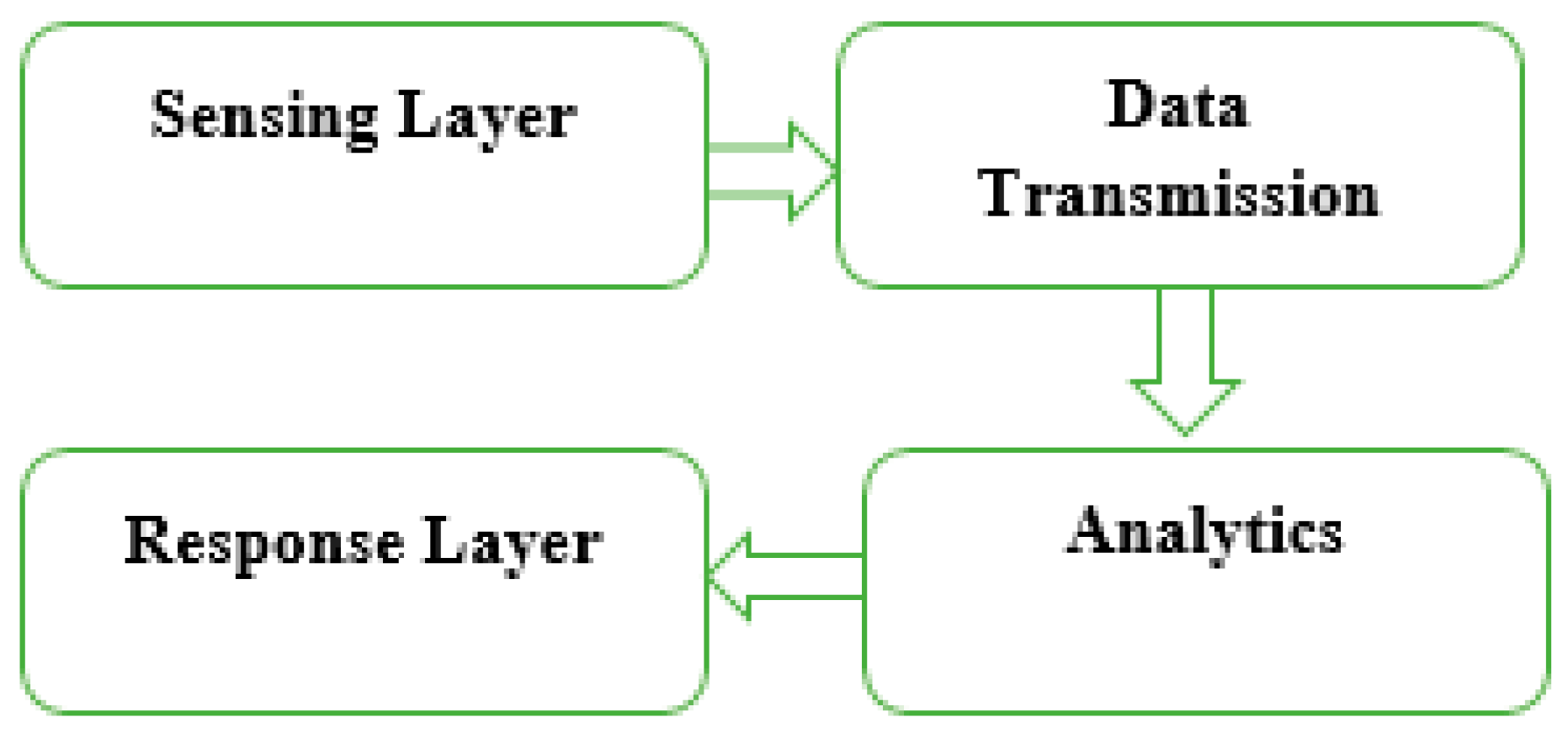
The architecture is composed of four key layers, Sensing, Data transmission, Analytics, and Response, as shown in
Figure 3.
Sensing Layer: At the ground level, a network of IoT sensors is deployed in flood-prone areas. These include rainfall sensors, ultrasonic or pressure-based water level sensors, and AI-enabled CCTV cameras. Mainly these devices help in continuously capturing the data of the environmental parameters, like the intensity of precipitation, drainage water level, and surface floating.
Data Transmission: In the data transmitting layer, the data is collected from different sensors and is transmitted to the centralized cloud platform using robust communication protocols, such as local area and wide-area networks, or by 4G/5G networks. This ensures latency and wide-area coverage in densely populated zones.
Analytics: In the Analytics layer the data reaches the cloud, and AI models perform analysis using real-time and historical inputs; the LSTM network gives the flood events by evaluating trends in rainfall and drainage flow. This system provides alerts based on severity and affected population density.
Response Layer: When a flood risk is detected, the system automatically provides alerts. The alerts are sent through SMS, WhatsApp, IVR, and mobile apps to the people. At the same time the municipal bodies such as BBMP and BWSSB are notified by the action plan. The system automatically implements the automated action plan, like activating water pumps or changing the traffic signals. This layered workflow ensures fast, predictive, and scalable flood management, turning raw environmental data into life-saving decisions in real time.
7. Technology Stack
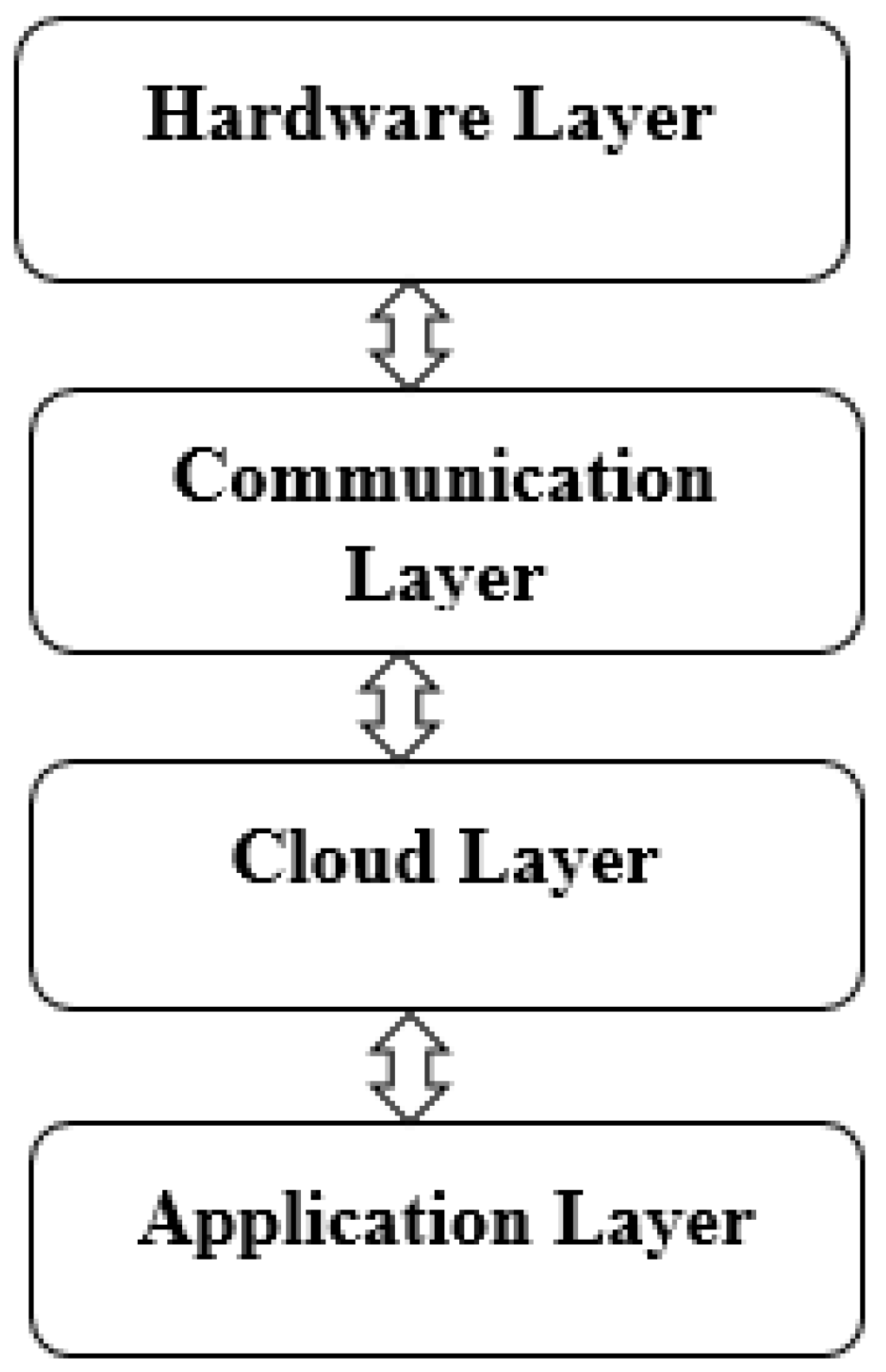
The smart flood alert and communication system leverages a comprehensive and scalable technology stack combining hardware and software components to ensure real-time monitoring, intelligent decision-making, and efficient communication. The stack of layers used in the prosed system is shown in
Figure 4.
Hardware Layer: The system uses IoT sensors such as ultrasonic water level detectors, rainfall gauges, and soil moisture sensors to collect real-time environmental data. Additionally, AI-enabled CCTV cameras assist in detecting water accumulation and movement in urban areas. These devices are mainly designed for low-power consumption and are highly durable in extreme water conditions.
Communication Layer: Sensor data is transmitted using local and wide-area networks, NB-IOT, or 4G/5G networks depending upon the availability of infrastructure. This protocol ensures fast communication between the sensor network and the cloud.
Cloud and AI Layer: In this the backend runs on a cloud-based platform such as Amazon Web series, which handles the data storage, processing, and analytics. The AI models are built with Python, TensorFlow, and different types of platforms for prediction of floods by using historical and live data.
Application Layer: A mobile app (Android/iOS) and a web dashboard built using React, Flutter, and Node.js enable real-time alerts and user interaction. The communication to the citizens and authorities are performed through SMS, WhatsApp, and IVR platforms and helps to reach out to the people.
8. Implementation Flow
The implementation of the smart flood alert and communication system is structured in phased stages to ensure efficiency, scalability, and real-world adaptability.
Phase 1: Site Survey and Sensor Deployment
Initial deployment begins with identifying flood-prone zones in Bengaluru, such as Kodigehalli, Hebbal, and Nagavara. A site survey will be conducted to determine optimal locations for installing IoT sensors and AI-powered CCTV cameras. Following this, hardware components will be installed and calibrated for environmental conditions.
Phase 2: Network and Cloud Integration
IoT sensors will be connected via LoRaWAN or NB-IoT to ensure seamless data transmission. The system backend will be hosted on a cloud platform (e.g., AWS), where real-time data aggregation, storage, and AI processing will take place.
Phase 3: AI Model Deployment and Testing
AI models will be trained using historical flood data to predict future occurrences. These models will be integrated into the cloud system, and rigorous testing will be conducted to validate accuracy and reliability.
Phase 4: Application and Alert System Launch
The mobile application and web dashboard will be launched for public and authority use. Alert systems, including SMS, WhatsApp, and IVR integration, will be tested with stakeholders.
9. Expected Outcome
The smart flood alert and communication system is designed to deliver multiple impactful outcomes, both immediate and long-term, to improve urban resilience against floods in Bengaluru and other vulnerable cities.
Enhanced Early Warning System: The real-time data collected from IoT sensors and AI-powered surveillance will enable early detection of flood risks. This mainly leads to alerting the citizens and the authorities, potentially protecting the infrastructure from damage. The authorities will have access to a centralized dashboard for prediction using AI tools. This enables them to make informed decisions about evaluating road closure and resource allocation. It reduces emergency response time. The automated alert system, integrating SMS, WhatsApp, and IVR technologies, will ensure that the warning reaches both authorities and the public, minimizing delays in the period of emergency response and allowing quick mobilization of rescue operations. Community participation through the mobile app allows citizens to report localized flooding, enables real-time feedback, and also improves the accuracy of flood mapping. This model builds community awareness and engagement in disaster management. Once it is a successfully implemented in Bengaluru, this system can be shared with other Indian cities and flood-prone areas globally, offering a model for smart urban disaster preparedness. Strategic collaborations will be established with BBMP, BWSSB, and Karnataka SDRF for infrastructure and emergency coordination. Technology partnerships with leading IoT and AI firms will drive innovation, while academic institutions can aid in data analysis and model validation.
10. Conclusions
The smart flood alert and communication system represents one of the forward-thinking approaches to addressing the flooding issues in the Kodigehalli–Hebbal–Nagavara regions of Bengaluru. By using IoT-based flood detection, AI-powered predictive analytics, and real-time emergency communication, the system offers a proactive solution to minimize flood-related problems in these areas. This not only empowers authorities with timely alerts for swift action but also engages the community through a dedicated mobile app, fostering collective responsibility in flood preparedness. This inclusion of smart infrastructure and green urban planning further strengthens long-term resilience. It will undergo a six-month pilot plan, which will demonstrate the system’s operational effectiveness, technological robustness, and social impact. Based on the success of the project, it can be expanded across other regions where flooding happens frequently in the zones of Bengaluru. With strategic partnerships, sustainable funding, and citizen participation, this initiative sets a benchmark for smart urban flood management and builds a safer, more resilient future for the city.
Author Contributions
Conceptualization, V.K.H.K., S.B.D., B.P., J.S.M., M.Z.P., and N.R.P.R.; methodology, V.K.H.K. and S.B.D.; writing—original draft preparation, V.K.H.K. and S.B.D.; writing—review and editing, V.K.H.K., S.B.D., B.P., J.S.M., M.Z.P., and N.R.P.R. All authors have read and agreed to the published version of the manuscript.
Funding
This research received no external funding.
Institutional Review Board Statement
Not applicable.
Informed Consent Statement
Not applicable.
Data Availability Statement
Data sharing is not applicable to this article.
Conflicts of Interest
The authors declare no conflicts of interest.
Abbreviations
The following abbreviations are used in this manuscript:
| AI | Artificial Intelligence |
| IoT | Internet of Things |
| BBMP | Bruhat Bengaluru Mahanagara Palike |
| LSTM | Long Short-Term Memory |
References
- Zhang, Y.; Li, X.; Wei, H.; Liu, Q. A Framework on Fast Mapping of Urban Flood Based on a Multi-Objective Random Forest Model. Int. J. Disaster Risk Sci. 2023, 14, 253–268. [Google Scholar] [CrossRef]
- Peixoto, J.P.J.; Costa, D.G.; Portugal, P.; Vasques, F. Flood-Resilient Smart Cities: A Data-Driven Risk Assessment Approach Based on Geographical Risks and Emergency Response Infrastructure. Smart Cities 2024, 7, 662–679. [Google Scholar] [CrossRef]
- Kim, J.; Hoekstra, A.Y.; Lees, M.J. Predicting Urban Flooding Due to Extreme Precipitation Using a Long Short-Term Memory Neural Network. Hydrology 2022, 9, 105. [Google Scholar] [CrossRef]
- Jang, S.-D.; Yoo, J.-H.; Lee, Y.-S.; Kim, B. Flood Prediction in Urban Areas Based on Machine Learning Considering the Statistical Characteristics of Rainfall. Prog. Disaster Sci. 2025, 26, 100415. [Google Scholar] [CrossRef]
- Jeffery, D.N.S.B.P.M.; Newaz, S.H.S.; Shams, S.; Guillou, N.; Nafi, N.S. LoRaWAN-Based Smart Sewerage Monitoring System. In Proceedings of the 2021 International Conference on Electronics, Communications and Information Technology (ICECIT), Khulna, Bangladesh, 14–16 September 2021; pp. 1–6. [Google Scholar] [CrossRef]
- Kim, H.I.; Lee, Y.-S.; Kim, B. Real-Time Flood Prediction Applying Random Forest Regression Model in Urban Areas. J. Korea Water Resour. Assoc. 2021, 54, 1119–1130. [Google Scholar] [CrossRef]
- Kim, C.; Kim, C.-S. Analysis of AI-Based Techniques for Forecasting Water Level According to Rainfall. Transp. Res. Rec. 2021, 10, 223–228. [Google Scholar] [CrossRef]
- Morsy, M.M.; Goodall, J.L.; O’Neil, G.L.; Sadler, J.M.; Voce, D.; Hassan, G.; Huxley, C. A Cloud-Based Flood Warning System for Forecasting Impacts to Transportation Infrastructure Systems. Environ. Model. Softw. 2018, 107, 231–244. [Google Scholar] [CrossRef]
- Mosavi, A.; Ozturk, P.; Chau, K.-w. Flood Prediction Using Machine Learning Models: Literature Review. Water 2018, 10, 1536. [Google Scholar] [CrossRef]
- Shreya, B.B.; Yamini Niharika, P.; Thota, V.; Yashaswini, U.S.; Roopa, G.M.; Vaishnavi Ajay, I. LoRa Based Framework for Smart Greenhouse Monitoring Systems. Int. J. Res. Appl. Sci. Eng. Technol. 2022, 10, 4593–4598. [Google Scholar] [CrossRef]
- Syed, A.S.; Sierra-Sosa, D.; Kumar, A.; Elmaghraby, A. IoT in Smart Cities: A Survey of Technologies, Practices and Challenges. Smart Cities 2021, 4, 429–475. [Google Scholar] [CrossRef]
- Sharma, V.K.; Abhilash, K.S. Hierarchical Cloud–IoT Architecture for AI-Powered Intelligent Disaster Response. In Proceedings of the 7th International Conference on Innovative Data Communication Technologies and Application (ICIDCA 2025), Coimbatore, India, 6–8 October 2025; pp. 603–610. [Google Scholar]
- Yan, Y.; Zhang, N.; Zhang, H. Applications of Advanced Technologies in the Development of Urban Flood Models. Water 2023, 15, 622. [Google Scholar] [CrossRef]
- Babu, C.V.; Monika, R.; Dhanusha, T.; Vishnuvaradhanan, K.; Harish, A. Smart Street Lighting System for Smart Cities Using IoT (LoRa). In Effective AI, Blockchain, and E-Governance Applications for Knowledge Discovery and Management; Kumar, R., Abdul Hamid, A., Binti Ya’akub, D., Eds.; IGI Global Scientific Publishing: Hershey, PA, USA, 2023; pp. 78–96. [Google Scholar] [CrossRef]
| Disclaimer/Publisher’s Note: The statements, opinions and data contained in all publications are solely those of the individual author(s) and contributor(s) and not of MDPI and/or the editor(s). MDPI and/or the editor(s) disclaim responsibility for any injury to people or property resulting from any ideas, methods, instructions or products referred to in the content. |
© 2025 by the authors. Licensee MDPI, Basel, Switzerland. This article is an open access article distributed under the terms and conditions of the Creative Commons Attribution (CC BY) license (https://creativecommons.org/licenses/by/4.0/).