
Visualizing Trends and Correlation Between Fashion Features for Product Design Prediction Using Classification and Sentiment Analysis †
Abstract
1. Introduction
- Forecast trends: The system uses runway images, influencer content, and retail sales data to generate future market predictions.
- Understand consumer preferences: The system uses review data, purchase records, and user browsing patterns to determine what customers want
- Personalize recommendations: The system generates individualized product suggestions through user segmentation based on their fashion choices, measurement details, and shopping patterns
- Optimize inventory and pricing: The system uses predictive models to determine optimal inventory levels and prices through analysis of market demand and seasonal patterns.
2. Literature Review
- DeepFashion2: A large-scale dataset with diverse fashion images and detailed annotations.
- Kaggle Fashion Datasets: Various datasets available for fashion-related machine learning tasks.
Sentiment Analysis Using NLP Algorithms in Fashion Data Mining

| S. No | Paper Title | Authors | Data Mining Technique Used | Dataset | Limitations |
|---|---|---|---|---|---|
| 1 | Sentiment Analysis Using NLP and ML in Fashion E-commerce | J. I. Nandalwar et al. [4] | NLTK-Models | Fashion Reviews | Generalized ML pipeline; limited explainability and interpretability |
| 2 | Sentiment Analysis of Fashion Product Reviews Using Deep Learning | S. K. Singh Verma [9] | Naïve Bayes | Fashion Reviews | Requires computational; less effective datasets |
| 3 | Emotional Analysis of Fashion Trends Using Social media and AI | Aayam Bansal, Agneya Tharun [7] | NLP, Time-Series (ARIMA, Granger Causality) | Twitter, T4SA | Limited to short-form text; lacks product-specific granularity |
| 4 | Sentiment Analysis of Women’s Clothing Reviews | Kunal Choudhary, Dr. Sapna Sinha [8] | Naïve Bayes | Reviews | Focuses only on polarity/subjectivity; lacks aspect-level sentiment |
3. Visualizing Trends Using Classification and Sentiment Analysis
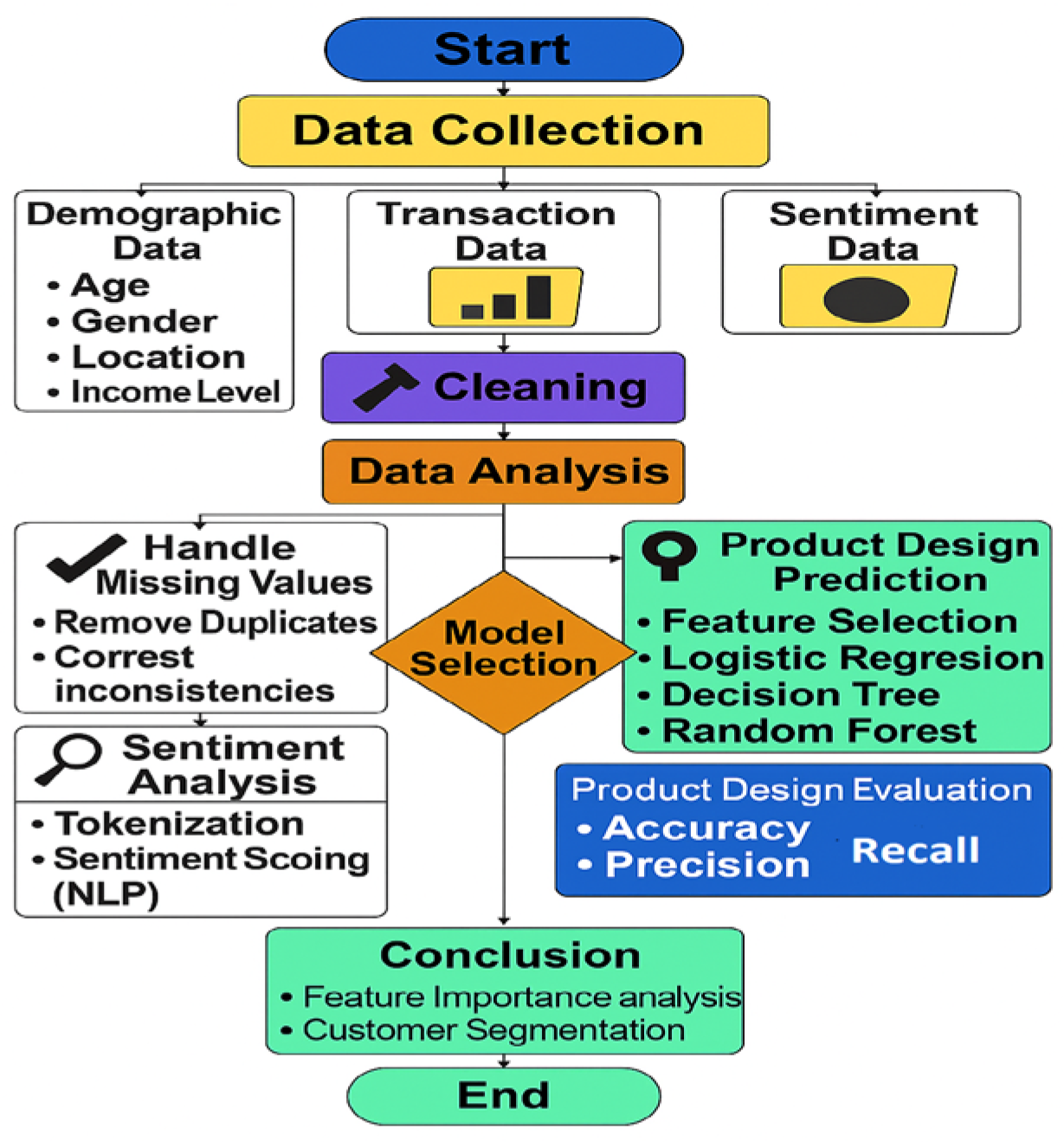
- A.
- Demographic Data
- Age: To examine preferences across age groups, it is necessary to group them (e.g., 18–25, 26–35, 36–50).
- Gender: This factor aids in determining the appeal of a product; for example, men may favor darker hues, while women may favor pastel tones.
- Location: Regional seasonal trends differ, as do urban versus rural preferences
- Income Level: This shows purchasing power; consumers with higher incomes might favor luxury brands.
- B.
- Transaction Data
- Quantity Sold: This indicates how popular a product is.
- Sales Amount: This helps to find products with worth and money.
- Time of Purchase: Seasonal trends affect when people buy things (for example, sweater sales peak in November).
- C.
- Sentiment Data
- Product Reviews and Ratings: Written comments like “Too tight” or “Loved the fit”.
- Answers to surveys may include simple thoughts on comfort, style, cost, etc.
- To obtain user thoughts, preferences, and feelings about particular goods, fashions, or experiences, a structured questionnaire is created.
- To gather qualitative information, the survey has both open-ended and closed-ended questions (like multiple-choice and Likert scale ratings).
- Sentiment analysis techniques are used to preprocess and analyze responses in order to classify user intent and extract emotional tone.
- This helps the target audience directly identify subjective trends and user expectations.
- Openly accessible datasets are gathered from sites like social media, fashion blogs, review portals, and e-commerce websites.
- User-generated content such as product reviews, ratings, comments, and behavioral logs (such as clicks, purchases, and browsing history) are included in these datasets.
- Black Friday sales, Brazilian e-commerce, Big Mart sales, and sales datasets are among the ones we use.
- Mendeley Raw Clothing Data: This dataset includes Amazon reviews of clothing products. These data can be utilized for data analytics and academic purposes.
- Hugging Face Datasets/Amazon Reviews/2023/McAuley Lab: This large collection of Amazon reviews was collected by McAuley Lab in 2023 and includes rich data such as user reviews, item metadata, and links.
- Cleaning
- Sentiment Analysis
- Tokenization: Dividing text into individual words.
- Sentiment scoring: Using programs like VADER or BERT, assign scores (for example, +0.8 for “excellent quality,” −0.6 for “poor stitching”).
- Trend Visualization—Line graphs illustrating festival-related sales spikes.
- Correlation Analysis—For instance, repeat business is frequently associated with high ratings.
- Summary Metrics: Average sales by age group and sentiment scores by product type.
- To forecast future sales, select models:
- Linear Regression—This approach forecasts sales by utilizing sentiment and price.
- Random Forest—These models manage numerous variables and intricate relationships.
- Feature Selection
- Classification Models
- ○
- Logistic Regression—This method generates binary results, such as will buy vs. will not buy.
- ○
- Decision Trees—These offer a visual representation of the decision-making process.
- ○
- Random Forest Classifier—For increased accuracy, the RFC combines several trees.
- ○
- Model training and evaluation.
- ○
- Accuracy—This reflects total correctness.
- ○
- Precision—This reflects the number of accurate positive forecasts.
- ○
- Recall—This is the model’s capacity to locate all pertinent cases.
- ○
- Feature Importance: For example, sentiment score may be more significant than price.
- ○
- Customer segmentation: Assign users to groups according to their inclinations (e.g., budget-conscious vs. trend-focused)
- ○
- Marketing and Design Strategy: Use research to create eye-catching collections and campaigns.
4. Conclusions
Author Contributions
Funding
Institutional Review Board Statement
Informed Consent Statement
Data Availability Statement
Conflicts of Interest
References
- Shen, X.; Agrawal, P.; Cheng, Z. Data efficient training with imbalanced label sample distribution for fashion detection. arXiv 2023. [Google Scholar] [CrossRef]
- Sagar, D.; Garg, J.; Kansal, P.; Bhalla, S.; Shah, R.; Yu, Y. PAI-BPR: Personalized outfit recommendation scheme with attribute-wise interpretability. arXiv 2020. [Google Scholar] [CrossRef]
- Candeias, A.; Silva, I.; Sousa, V.; Marcelino, J. Tailor: Size recommendations for high-end fashion marketplaces. arXiv 2024. [Google Scholar] [CrossRef]
- Nandalwar, J.I.; Parase, D.B.; Pandhare, P.S.; Ishwargond, S.M. Sentiment analysis using NLP and ML in fashion e-commerce. Int. J. Nov. Res. Dev. 2023, 8, 238–243. [Google Scholar]
- Ding, Y.; Lai, Z.; Mok, P.Y.; Chua, T.-S. Computational technologies for fashion recommendation: A survey. arXiv 2023, arXiv:2306.03395. [Google Scholar] [CrossRef]
- Ma, Y.; Ding, Y.; Yang, X.; Liao, L.; Wong, W.K.; Chua, T.-S. Knowledge enhanced neural fashion trend forecasting. In Proceedings of the 2020 International Conference on Multimedia Retrieval (ICMR ‘20), Dublin, Ireland, 8–11 June 2020; ACM: New York, NY, USA, 2020; pp. 82–90. [Google Scholar]
- Bansal, A.; Tharun, A. Emotional analysis of fashion trends using social media and AI: Sentiment analysis on Twitter for fashion trend forecasting. arXiv 2025. [Google Scholar] [CrossRef]
- Choudhary, K.; Sinha, S. Sentiment analysis of women’s clothing reviews. Int. J. Res. Publ. Rev. 2025, 6, 1641–1654. [Google Scholar]
- Singh, S.K.; Verma, R. Sentiment analysis of fashion product reviews using deep learning. Int. J. Comput. Appl. 2024, 182, 25–30. [Google Scholar]
- Panchal, B.V. Exploring the effectiveness of influencer marketing in the digital age. Int. J. Creat. Res. Thoughts (IJCRT) 2024, 12, 149–154. [Google Scholar]
- Hu, W.; Chen, Y. Application of artificial intelligence in financial risk management in a company. In Artificial Intelligence and Security; Sun, X., Zhang, X., Xia, Z., Bertino, E., Eds.; Lecture Notes in Computer Science; Springer: Cham, Switzerland, 2022; Volume 13338, pp. 180–188. [Google Scholar]
- Sulianta, F.; Ulfah, K.; Amalia, E. Revealing consumer preferences in the fashion industry using K-means clustering. Int. J. Eng. Contin. 2024, 3, 34–53. [Google Scholar] [CrossRef]
- Girawan, N. Raw Clothing Data [Data Set]. Mendeley Data. 2023. Available online: https://data.mendeley.com/datasets/pv678kzv35/1 (accessed on 1 December 2025).
- Xia, Y.; Shen, J.; Wu, J.; Yu, T.; Kim, S.; Rossi, R.; Yao, L.; McAuley, J. SAND: Boosting LLM agents with self-taught action deliberation. In Proceedings of the 2023 Conference on Empirical Methods in Natural Language Processing (EMNLP), Singapore, 6–10 December 2023. [Google Scholar]
- Rahman, O.; Kharb, D.; Chen, Z. A study of emerging consumer markets through fashion selection and consumption. In Proceedings of the NIFT International Conference, New Delhi, India, 31 January–2 February 2018. [Google Scholar]
- Raorane, A.; Kulkarni, R.V. Data mining techniques: A source for consumer behavior analysis. arXiv 2011, arXiv:1109.1202. [Google Scholar] [CrossRef]
- Srinivasan, B.; Pavya, K. Feature selection techniques in data mining: A study. Int. J. Sci. Dev. Res. (IJSDR) 2017, 2, 594–598. [Google Scholar]
- Tope-Oke, A.; Afolalu, C.A.; Omofade, O. A data mining based approach to customer behaviour in an electronic settings. J. Comput. Commun. 2019, 7, 42–53. [Google Scholar] [CrossRef]
- Adilah, D.; Alamsyah, A. An augmented method of selecting fashion talent by adding social media characteristic. In Proceedings of the 2019 International Conference on ICT for Smart Society (ICISS), Bandung, Indonesia, 19–20 November 2019; IEEE: New York, NY, USA, 2019; Volume 7, pp. 1–5. [Google Scholar]
- Trnka, A. Statistical analysis of online shopping behavior of students. Mark. Identity 2015, 3, 283–292. [Google Scholar]
- Wang, Z.; Chi, C.; Zhang, M.; Zeng, X.; Bruniaux, P.; Wang, J.; Xing, Y. Data mining-based optimal assignment of apparel size for mass customization. Commun. Dev. Assem. Text. Prod. 2020, 1, 20–29. [Google Scholar] [CrossRef]
- Girneata, A.D. The importance of clusters in the development of the textile and clothing industry. Netw. Intell. Stud. 2013, 1, 83–89. [Google Scholar]
- Guden, S.; Gursoy, U.T. Online shopping customer data analysis by using association rules and cluster analysis. In Industrial Conference on Data Mining; Springer: Berlin/Heidelberg, Germany, 2013; pp. 127–136. [Google Scholar]
- Gull, M.; Pervaiz, A. Customer behavior analysis towards online shopping using data mining. In Proceedings of the 2018 5th International Multi-Topic ICT Conference (IMTIC), Jamshoro, Pakistan, 25–27 April 2018; IEEE: New York, NY, USA, 2018; pp. 1–5. [Google Scholar]
- Hsu, C.H.; Wang, M.J.J. Using decision tree-based data mining to establish a sizing system for the manufacture of garments. Int. J. Adv. Manuf. Technol. 2005, 26, 669–674. [Google Scholar] [CrossRef]
- Hu, G.; Liu, H. Application of data mining technology in portfolio optimization. J. Phys. Conf. Ser. 2020, 1648, 042064. [Google Scholar] [CrossRef]
- Istrat, V.; Lalić, N. Association rules as a decision making model in the textile industry. Fibres Text. East. Europe 2017, 25, 8–14. [Google Scholar] [CrossRef]
- Jain, S.; Kumar, V. Garment categorization using data mining techniques. Symmetry 2020, 12, 984. [Google Scholar] [CrossRef]

| S. No | Paper Title | Authors | Data Mining Technique Used | Dataset | Limitations |
|---|---|---|---|---|---|
| 1 | Data Efficient Training with Imbalanced Label Sample Distribution for Fashion Detection | Xin Shen, Praful Agrawal, Zhongwei Cheng [1] | Deep neural network (DNN)-weighted objective function for multi-label classification with long-tailed data distribution | Fashion attribute classification dataset (specific dataset details not explicitly mentioned) | Identified substantial errors in experimental results and a potentially misleading explanation of the algorithm |
| 2 | PAI-BPR: Personalized Outfit Recommendation Scheme with Attribute-wise Interpretability | Dikshant Sagar, Jatin Garg, Prarthana Kansal, Sejal Bhalla, Rajiv Ratn Shah, Yi Yu [2] | Attribute-wise interpretable compatibility scheme with personal preference modeling | IQON3000 publicly available real-world dataset | Subjectivity in fashion compatibility modeling; need for personalization in recommendations |
| 3 | Tailor: Size Recommendations for High-End Fashion Marketplaces | Alexandre Candeias, Ivo Silva, Vitor Sousa, José Marcelino [3] | Combines explicit (ReturnReason) and implicit (Add2Bag) user signals in sequence classification method | Historical transactional data from high-end fashion marketplaces | Evaluated usability in real-time recommendation scenarios, measuring latency performance |
| 4 | Computational Technologies for Fashion Recommendation: A Survey | Yujuan Ding, Zhihui Lai, P. Y. Mok, Tat-Seng Chua [5] | Various computational techniques for fashion recommendation, including personalized product recommendation, complementary (mix-and-match) recommendation, and outfit recommendation | Multiple datasets used in fashion recommendation studies (specific datasets not explicitly listed) | Identifies gaps between academic research and real-world fashion industry needs |
| 5 | Knowledge Enhanced Neural Fashion Trend Forecasting | Yunshan Ma, Yujuan Ding, Xun Yang, Lizi Liao, Wai Keung Wong, Tat-Seng Chua [6] | Knowledge-Enhanced Recurrent Network (KERN) leveraging internal and external domain knowledge | FIT dataset collected from Instagram | Challenges in capturing complex patterns of fashion elements; need for further refinement in trend prediction |
Disclaimer/Publisher’s Note: The statements, opinions and data contained in all publications are solely those of the individual author(s) and contributor(s) and not of MDPI and/or the editor(s). MDPI and/or the editor(s) disclaim responsibility for any injury to people or property resulting from any ideas, methods, instructions or products referred to in the content. |
© 2026 by the authors. Licensee MDPI, Basel, Switzerland. This article is an open access article distributed under the terms and conditions of the Creative Commons Attribution (CC BY) license (https://creativecommons.org/licenses/by/4.0/).
Share and Cite
Sharma, M.; Sharma, N.; Verma, P. Visualizing Trends and Correlation Between Fashion Features for Product Design Prediction Using Classification and Sentiment Analysis. Comput. Sci. Math. Forum 2025, 12, 16. https://doi.org/10.3390/cmsf2025012016
Sharma M, Sharma N, Verma P. Visualizing Trends and Correlation Between Fashion Features for Product Design Prediction Using Classification and Sentiment Analysis. Computer Sciences & Mathematics Forum. 2025; 12(1):16. https://doi.org/10.3390/cmsf2025012016
Chicago/Turabian StyleSharma, Monika, Navneet Sharma, and Priyanka Verma. 2025. "Visualizing Trends and Correlation Between Fashion Features for Product Design Prediction Using Classification and Sentiment Analysis" Computer Sciences & Mathematics Forum 12, no. 1: 16. https://doi.org/10.3390/cmsf2025012016
APA StyleSharma, M., Sharma, N., & Verma, P. (2025). Visualizing Trends and Correlation Between Fashion Features for Product Design Prediction Using Classification and Sentiment Analysis. Computer Sciences & Mathematics Forum, 12(1), 16. https://doi.org/10.3390/cmsf2025012016